



PHYS 231 - UNIVERSITY PHYSICS I
- Equilibrium and Elasticity
Question Bank - Set 4
Liberty University
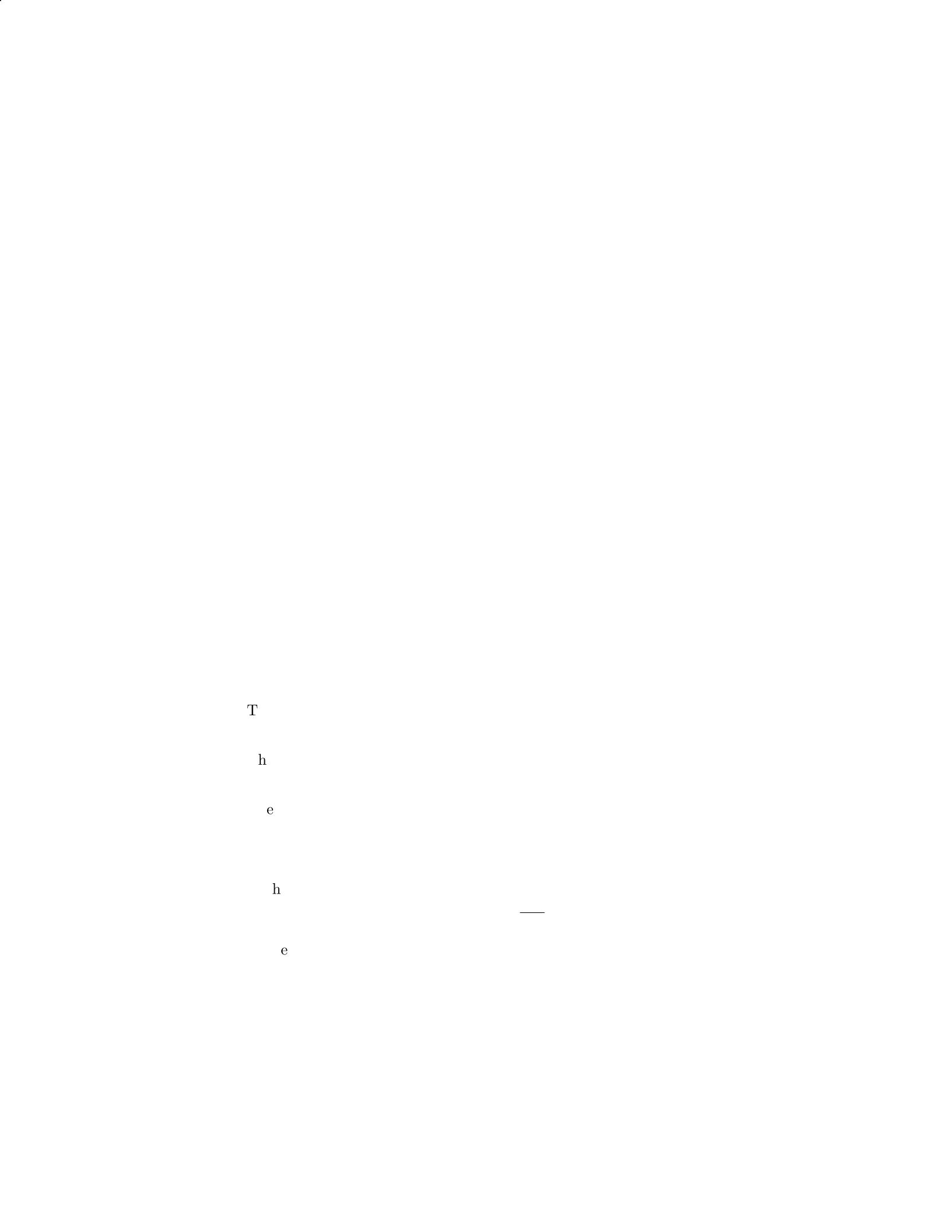
Question 1
Question
A uniform rod of length Land mass Mis suspended horizontally at two points,
one-quarter of the distance from one end and the other three-quarters of the
distance from the same end. What is the tension in the upper supporting string?
Solution
To find the tension in the upper supporting string, we need to analyze the forces
acting on the rod. Let T1be the tension in the upper string, T2be the tension
in the lower string, and Wbe the weight of the rod.
Step 1: Set up the forces acting on the rod. The forces acting on the rod
are the tensions T1and T2from the strings and the weight Wof the rod acting
downward.
Step 2: Write the equations for equilibrium. In the vertical direction, the
forces must balance out:
T1+T2=W
In the horizontal direction, there is no net force, as the rod is not moving:
T1L
4=T23L
4
Step 3: Express the weight in terms of the mass and acceleration due to
gravity. The weight of the rod is given by W=Mg, where gis the acceleration
due to gravity.
Step 4: Solve the equations. Substitute W=Mg into the first equilibrium
equation to get:
T1+T2=Mg

Use the second equilibrium equation to express T2in terms of T1:
T1L
4=T23L
4
T2=L
3T1
Substitute T2=L
3T1into T1+T2=Mg:
T1+L
3T1=Mg
4
3T1=Mg
T1=3Mg
4
Step 5: Calculate the tension in the upper supporting string. Finally,
substitute the given values Mand ginto the expression for T1:
T1=3Mg
4
T1=3
4Mg
Therefore, the tension in the upper supporting string is 3
4Mg.
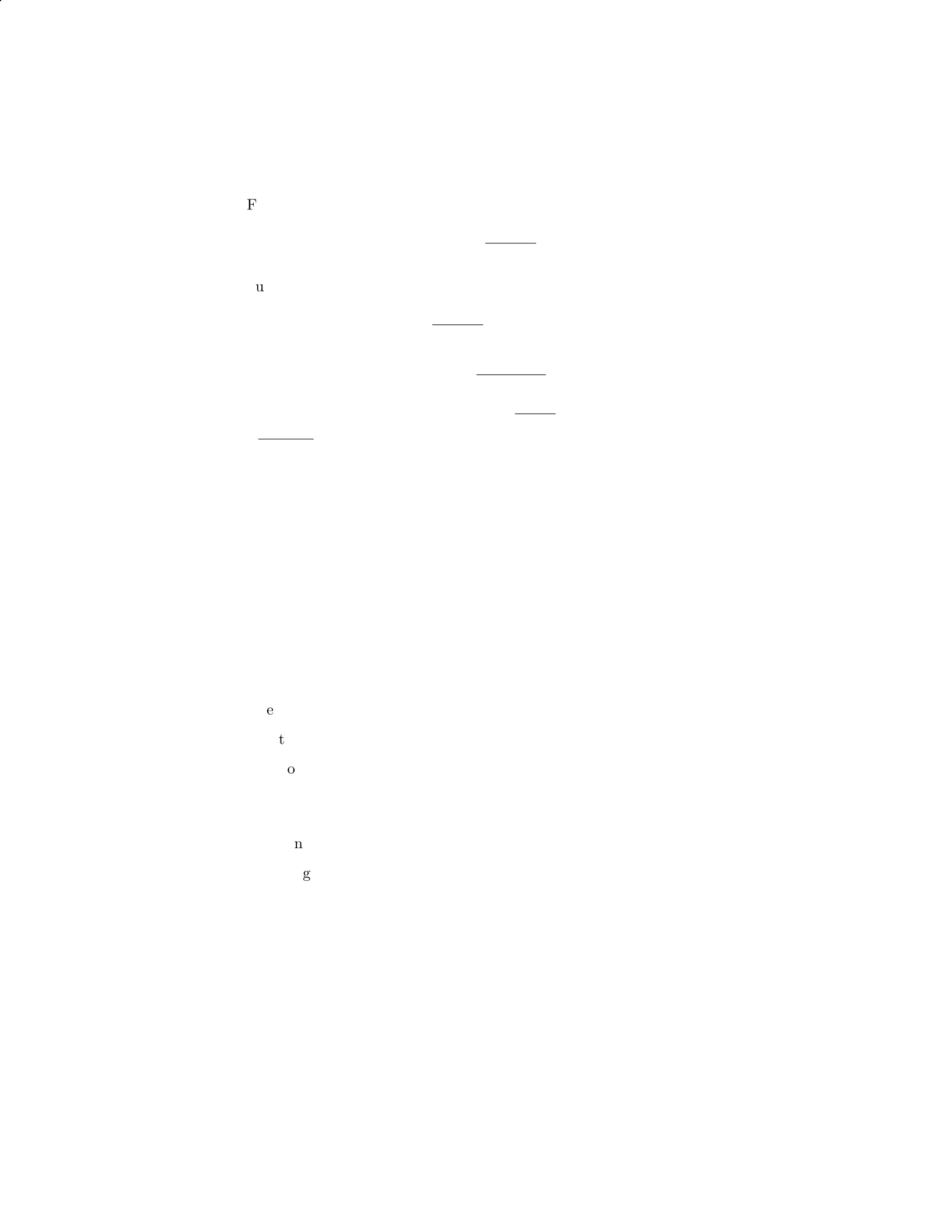
Question 2
Question
A uniform rod of length Land mass Mis pivoted at one end. A force F
is applied horizontally at a distance xfrom the pivot point. Determine the
minimum value of xsuch that the rod will remain in equilibrium.
Solution
To find the minimum value of xsuch that the rod remains in equilibrium, we
need to consider the torques acting on the rod.
1. Let’s begin by drawing a free-body diagram of the rod. The forces acting
on the rod are the force of gravity (Mg) acting at the center of mass of the
rod and the applied force Facting at a distance xfrom the pivot point.
2. The torque τproduced by the gravitational force M g at the center of
mass is zero since it acts along the line connecting the pivot point and
the center of mass. The torque produced by the applied force Fis F·L
(since the lever arm is the full length of the rod). For the rod to remain
in equilibrium, the total torque acting on the rod must be zero.
2

3. The condition for equilibrium is:
Xτ= 0
F·L= 0
4. However, since Fcannot be equal to zero, the only way for the rod to be
in equilibrium is if the total torque applied by the force Fis balanced by
the torque due to the force of gravity. This gives us:
F·L=Mg ·L
2
5. Solving for xgives:
x=Mg
F·L
2=MgL
2F
Thus, the minimum value of xsuch that the rod will remain in equilibrium
is x=MgL
2F.
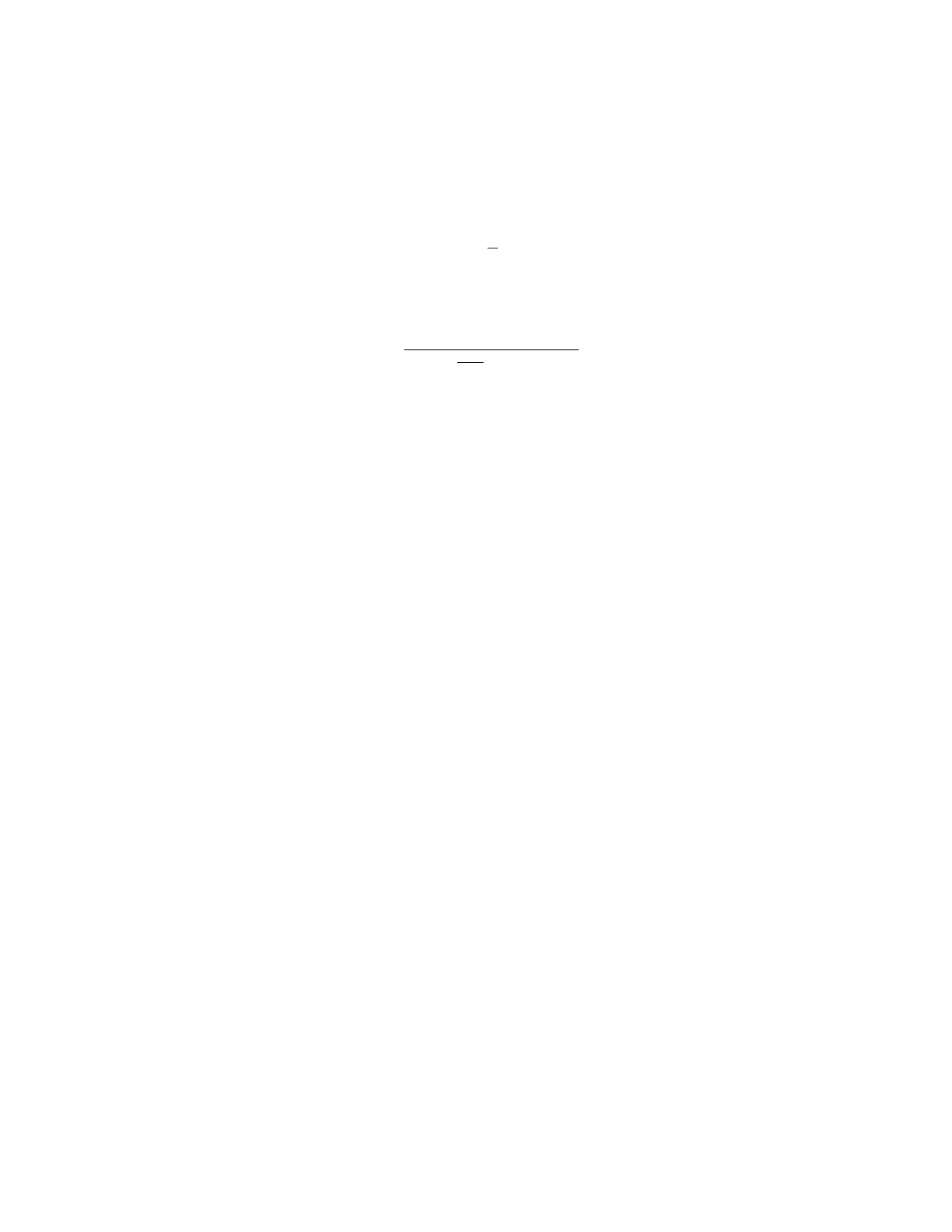
Question 3
Question
A uniform ladder of length Land weight Wrests against a frictionless wall and
on a rough horizontal floor. The coefficient of static friction between the ladder
and the floor is µs. Find the minimum angle at which the ladder can rest in
equilibrium.
Solution
Let’s denote the angle the ladder makes with the floor as θ. We will first draw
a free body diagram of the ladder to help us analyze the forces acting on it.
Step 1: Consider the forces acting on the ladder. The forces acting on the
ladder are the weight W, the normal force Nexerted by the floor, the frictional
force fsexerted by the floor, and the force exerted by the wall.
Step 2: Break down the forces into components. The weight Wcan be
broken down into two components: one perpendicular to the ladder (W⊥=
Wcos θ) and one parallel to the ladder (W∥=Wsin θ).
Step 3: Write down the equilibrium equations. In the vertical direction:
N=W⊥=Wcos θ
In the horizontal direction:
fs=W∥=Wsin θ
Step 4: Apply the maximum frictional force condition. The maximum
frictional force is given by fmax =µsN. In this case, the maximum frictional
3

force will act in the opposite direction to the ladder’s motion, which is to the
left in our diagram. Therefore:
fs=µsN=µsWcos θ
Step 5: Find the minimum angle for equilibrium. For the ladder to be in
equilibrium, the ladder must not slip. This means that the ladder is at the
point of tipping over. At this point, the frictional force reaches its maximum
value. So, the ladder will be at equilibrium when the frictional force is at its
maximum:
Wsin θ=µsWcos θ
tan θ=µs
θ= tan−1(µs)
Therefore, the minimum angle at which the ladder can rest in equilibrium is
θ= tan−1(µs).
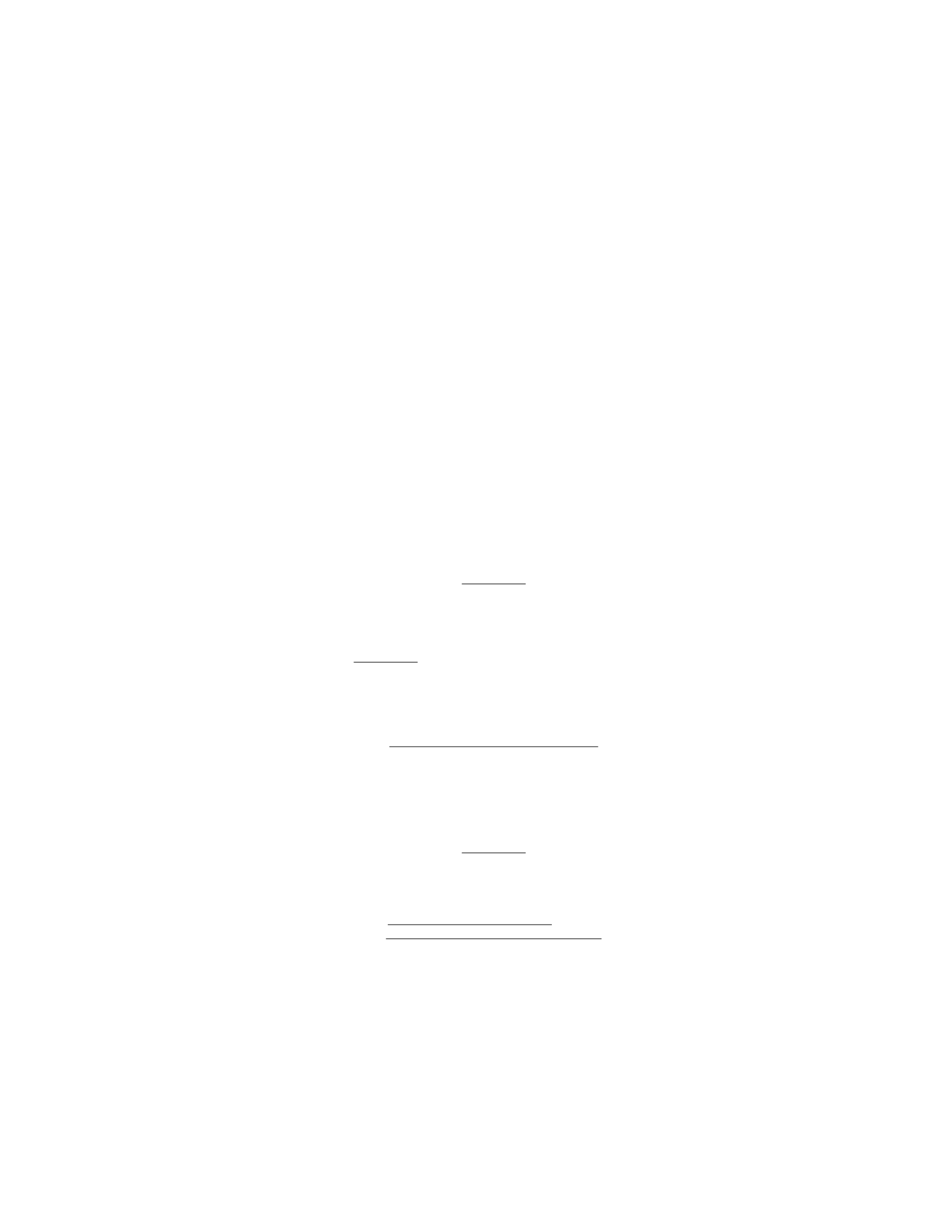
Question 4
Question
A steel rod of length 2.0 m and cross-sectional area 0.0010 m2is supported
horizontally at its ends. A 2000 N weight is suspended from the rod. If Young’s
modulus for steel is 2.0×10¹¹ N/m2, determine the amount by which the rod
sags.
Solution
Step 1: First, calculate the force due to the weight of the 2000 N weight. Given:
F= 2000 N
Step 2: Next, calculate the stress on the rod. The stress on the rod is given
by:
Stress = F
A
where Fis the force acting on the rod and Ais the cross-sectional area of the
rod. Substitute the given values:
Stress = 2000
0.0010 = 2.0×10⁶N/m2
Step 3: Calculate the strain on the rod. The strain is given by Hooke’s law:
Strain = Stress
Y
where Yis Young’s modulus for steel. Substitute the given values:
Strain = 2.0×10⁶
2.0×1011 = 1.0×10⁻⁵
4

Step 4: Determine the amount by which the rod sags. The sag is given by
the equation:
Sag = Strain ×Length
Substitute the calculated values:
Sag = 1.0×10−5×2.0=2.0×10⁻⁵m=2.0×10⁻²mm
Therefore, the amount by which the rod sags is 2.0 ×10⁻²mm.
Question 5
Question
A uniform beam of length Land mass Mis supported by two ropes attached
to its ends. If each rope makes an angle θwith the horizontal, find the tension
in each rope when the beam is in equilibrium.
Solution
Step 1: We begin by drawing a free body diagram of the beam. The forces
acting on the beam are the weight Mg acting downwards at the center of mass
of the beam, the tension T1in the left rope, and the tension T2in the right
rope. The angles that the ropes make with the horizontal are both θ.
Step 2: The vertical components of the tensions T1and T2cancel out the
weight Mg, so we have:
T1sin θ+T2sin θ=Mg
Step 3: The horizontal components of the tensions T1and T2balance each
other out. Since the beam is in equilibrium, the net horizontal force must be
zero. Therefore:
T1cos θ=T2cos θ
Step 4: From Step 3, we can see that T1=T2. Substituting this into the
equation from Step 2, we get:
2Tsin θ=Mg
Step 5: Solving for the tension T, we find:
T=Mg
2 sin θ
5

Question 6
Question
A cylindrical steel rod of length Land diameter dis hanging vertically from the
ceiling. A weight Wis attached to the bottom end of the rod. The Young’s
modulus of steel is Y. If the rod has a deformation ∆Ldue to the weight,
determine the stress and strain in the rod.
Solution
Step 1: Calculate the cross-sectional area of the rod. The cross-sectional area
Aof a cylinder is given by A=πd2
4.
Step 2: Calculate the force experienced by the rod. The force Fexperienced
by the rod is equal to the weight W.
Step 3: Determine the stress in the rod. The stress σin the rod is given by
σ=F
A.
Step 4: Calculate the strain in the rod. The strain εin the rod is given by
ε=∆L
L.
Step 5: Determine the Young’s modulus of steel. The Young’s modulus Y
is given in the problem.
Step 6: Relate stress, strain, and Young’s modulus. Hooke’s Law states that
stress is directly proportional to strain, with the constant of proportionality
being the Young’s modulus: σ=Y ε.
Step 7: Substitute the known values into the equations. Substitute the
values of F,A, ∆L, and Linto the equations for stress and strain, and then
into Hooke’s Law to find the stress and strain in the rod.
Question 7
Question
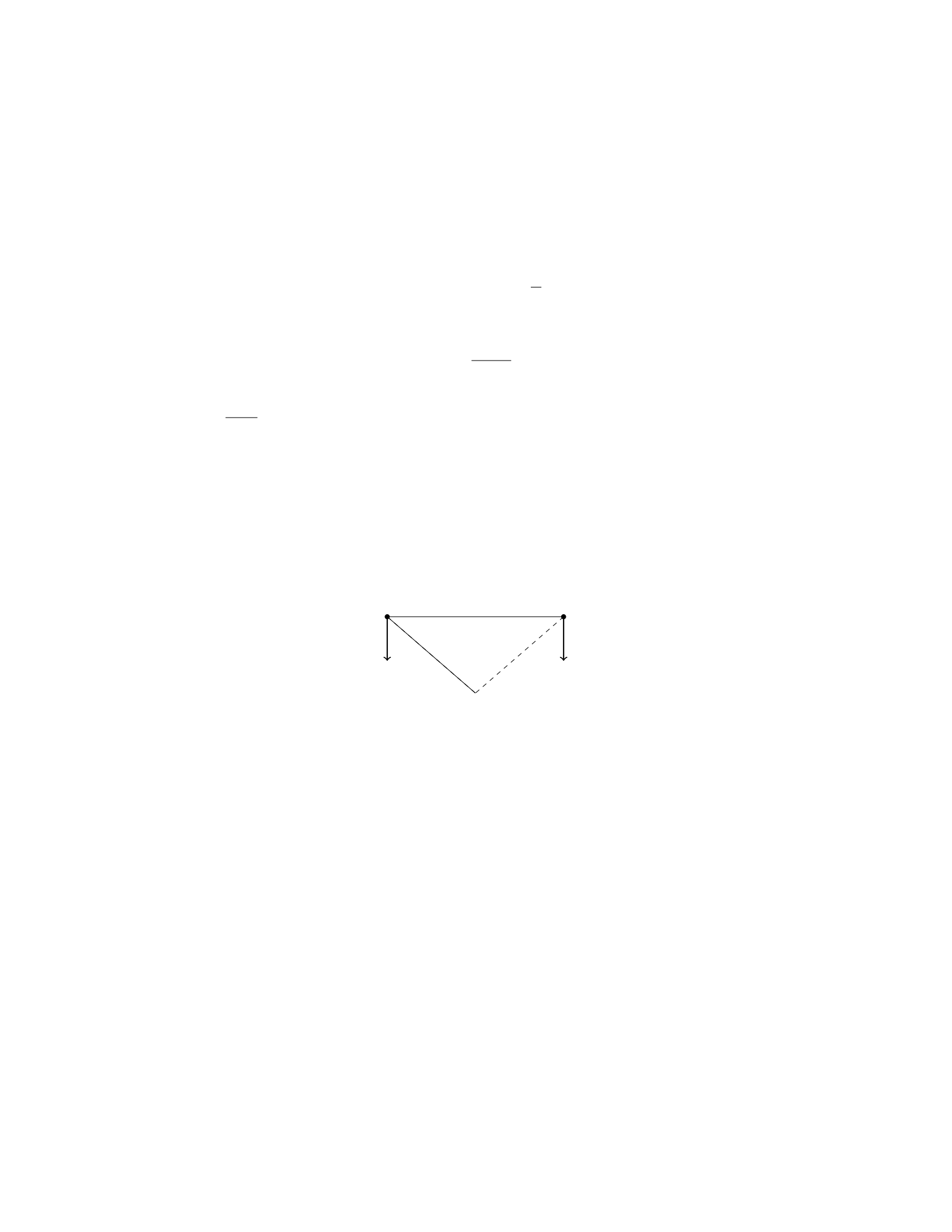
A uniform beam of length Land mass Mis supported on a wall by a hinge
at one end and by a cable at an angle θfrom the horizontal at the other end.
The cable is attached to the beam a distance xfrom the hinge. Determine the
tension in the cable required to keep the beam in equilibrium.
Solution
1. Draw a free body diagram of the beam. The forces acting on the beam are
the tension in the cable (T) and the gravitational force acting at the center of
mass of the beam (mg) directed vertically downward.
2. Resolve the tension force into its vertical and horizontal components.
The vertical component Tcos θbalances the gravitational force mg vertically,
while the horizontal component Tsin θprovides the torque necessary to keep
the beam in equilibrium.
6
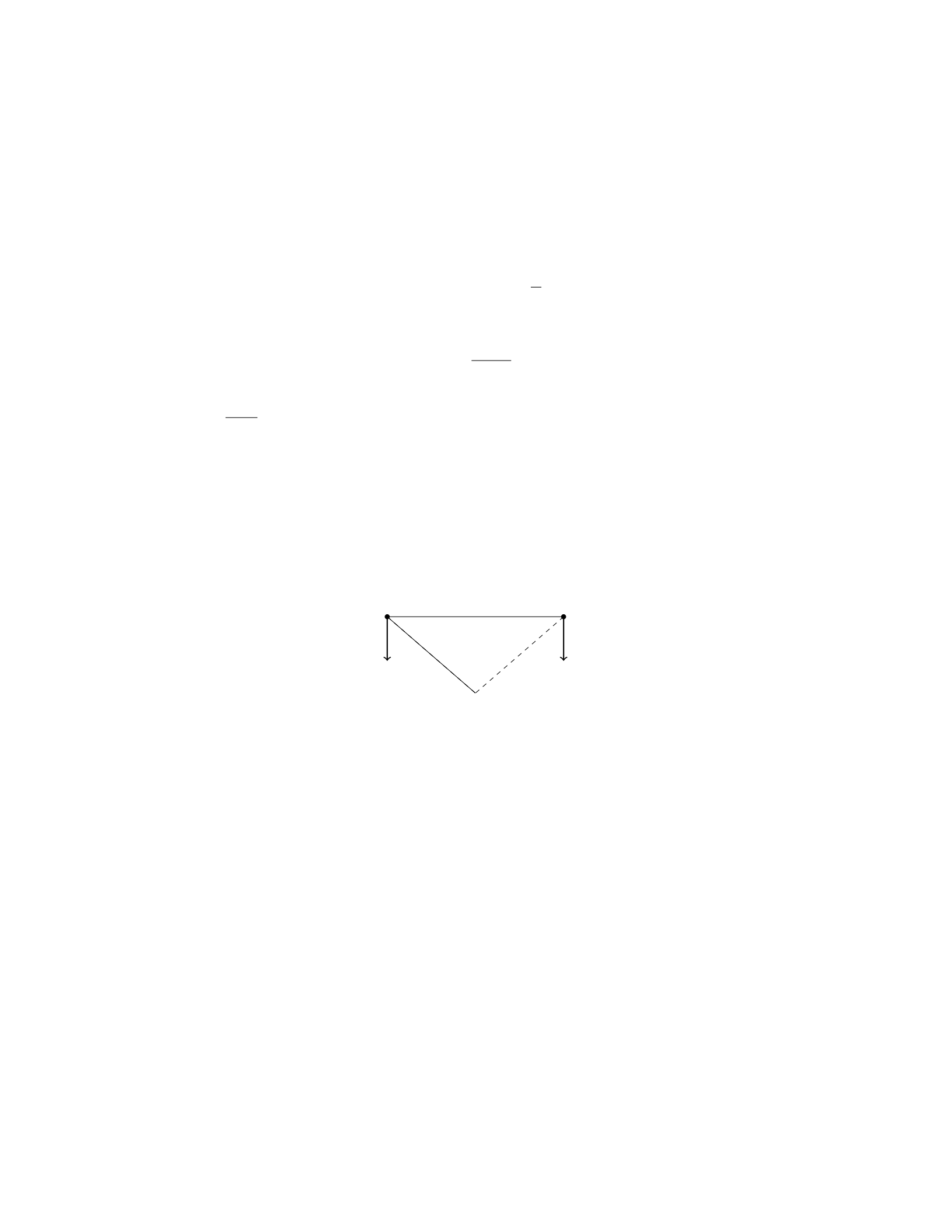
3. Write the torque equilibrium equation about the hinge at the wall: Pτ=
0. The torque due to the tension about the hinge is Tsin θ·L, while the clockwise
torque due to the gravitational force about the hinge is Mg ·L/2. Setting these
torques equal, we have:
Tsin θ·L=Mg ·L
2
4. Solve the equation obtained in step 3 for the tension T:
T=Mg
2 sin θ
Therefore, the tension in the cable required to keep the beam in equilibrium
is Mg
2 sin θ.
Question 8
Question
A uniform rod of length Land mass Mis supported horizontally by two vertical
strings attached to its ends, as shown in the figure below. The left string makes
an angle θwith the horizontal, while the right string is horizontal. What is the
tension in the left string?
L
L/2L/2
θ
T1T2
Solution
Step 1: Set up the equilibrium conditions in both vertical and horizontal direc-
tions to find expressions for the tensions T1and T2.
In the horizontal direction: The horizontal components of the tensions T1
and T2must balance the horizontal component of the weight of the rod.
T1cos θ=T2
In the vertical direction: The vertical components of the tensions T1and T2
and the weight of the rod must balance each other.
T1sin θ+T2=Mg
Step 2: Find T2in terms of θand M.
From the equilibrium condition in the horizontal direction:
T1=T2sec θ
7

Step 3: Substitute the expression for T1into the equation from the vertical
direction.
T2sec θsin θ+T2=Mg
Simplifying this equation gives:
T2(tan θ+ 1) = Mg
T2=Mg
tan θ+ 1
Step 4: Find the tension T1in terms of θand M.
Substitute T2into the expression for T1:
T1=Mg
tan θ+ 1 cos θ
Therefore, the tension in the left string is Mg cos θ
tan θ+1 .
Question 9
Question
A cylindrical steel rod with length Land radius ris hanging vertically and is
supporting a weight Wat its lower end. Given that the Young’s modulus for
steel is Y, determine the elongation of the rod due to the weight.
Solution
Step 1: The weight Wacting on the rod creates a tension force equal to W
throughout the rod.
Step 2: The elongation of the steel rod can be determined using Hooke’s
law, which states that the stress (σ) in a material is proportional to the strain
(ϵ) it undergoes: σ=Y ϵ.
Step 3: The stress can be calculated using the formula σ=F
A, where Fis
the force being applied (in this case W) and Ais the cross-sectional area of the
rod.
Step 4: The cross-sectional area of the rod can be calculated using the
formula A=πr2.
Step 5: Knowing the stress and Young’s modulus, we can now determine the
strain ϵ.
Step 6: The strain represents the ratio of the elongation of the rod (∆L) to
its original length L, so we have ϵ=∆L
L.
Step 7: Combining the equations σ=Y ϵ and ϵ=∆L
L, we can solve for ∆L.
Step 8: Therefore, the elongation of the rod due to the weight Wis ∆L=
W
A·Y.
8
Question 10
Question
A steel cable with a cross-sectional area of 2.5 cm2and a length of 3.5 m is
suspended vertically. When a 250 kg mass is attached to the bottom of the
cable, the cable stretches by 3 mm. Calculate the Young’s modulus of the steel.
Solution
Step 1: First, we need to calculate the force applied to the cable. The mass
mattached to the cable can be converted to force using F=mg, where g=
9.81 m/s2:
F= (250 kg)(9.81 m/s2) = 2452.5 N
Step 2: Next, we can calculate the original length of the cable. Since the
cable stretches by 3 mm (or 0.003 m) when the mass is attached, the original
length L0can be found using the equation for strain, ∆L
L0=F
A·Y, where Ais the
cross-sectional area and Yis Young’s modulus:
L0=F·L
A·Y
L0=(2452.5 N)(3.5 m)
2.5×10⁻⁴m2·Y
L0=8578.75
2.5×10⁻⁴Y= 34315 Ym
Step 3: Using the given information that the cable stretches by 3 mm when
the mass is attached, we get:
∆L= 0.003 m
∆L=L−L0
0.003 = L−34315 Y
L= 34315 Y+ 0.003
Step 4: Using Hooke’s Law (σ=Y·ϵ) and the definition ϵ=∆L
L0, we find:
σ=Y·∆L
L0
=Y·0.003
34315 Y=0.003
34315
Step 5: We know that stress σ=F
A, thus:
F
A=0.003
34315
Y=2452.5
2.5×10−4= 9.81 ×10⁶N/m2
Therefore, the Young’s modulus of the steel cable is 9.81 ×10⁶N/m2.
9
Question 11
Question
A uniform horizontal beam of mass Mand length Lis supported by two vertical
ropes attached at its ends. A weight of mass mis suspended from a point one-
third of the length of the beam measured from one end. If the tension in one of
the ropes is twice that in the other, find the mass mof the weight.
Solution
Step 1: Draw a free-body diagram of the beam and the weight. Step 2: Write
out the equations of equilibrium in the vertical direction for the weight and the
beam. Step 3: Solve the equations to find the mass mof the weight.
Question 12
Question
A uniform beam of length Land mass Mis supported by a vertical cable
attached at the midpoint of the beam. The other end of the beam is supported
by a horizontal cord. If the cable makes an angle θwith the vertical, find the
tension in both the cable and the cord.
Solution
Step 1: Draw a free-body diagram of the beam.
The weight of the beam acts downward through the center of gravity, G,
and has a magnitude of Mg.
The tension in the cable acts upward and makes an angle θwith the
vertical.
The tension in the cord acts upward and is horizontal.
Step 2: Write the equilibrium equations for the beam in the vertical and
horizontal directions.
In the vertical direction:
Tcos(θ) = Mg
2
In the horizontal direction:
Tsin(θ) = F
Here, Tis the tension in the cable and Fis the tension in the cord.
Step 3: Solve the equations simultaneously.
10
From the vertical equilibrium equation:
T=Mg
2 cos(θ)
Substituting this expression for Tinto the horizontal equilibrium equation:
Mg
2 cos(θ)sin(θ) = F
F=Mg tan(θ)
2
Therefore, the tension in the cable is T=M g
2 cos(θ)and the tension in the cord
is F=Mg tan(θ)
2.
Question 13
Question
A uniform beam of length Land mass Mis supported by a pivot at one end and
a cable attached a distance xfrom the pivot. If the beam makes an angle of θ
with the horizontal and the cable makes an angle of ϕwith the beam, determine
the tension in the cable.
Solution
Step 1: Draw a free-body diagram of the beam.
The weight Wof the beam acts at its center of mass.
The tension Tin the cable acts at an angle ϕwith the beam.
The normal force Nat the pivot acts perpendicular to the beam.
Step 2: Write the equilibrium equations in the horizontal and vertical direc-
tions.
Summing forces in the horizontal direction: Tsin ϕ= 0
Summing forces in the vertical direction: Tcos ϕ+N−W= 0
Step 3: Express the weight Win terms of the beam’s mass Mand the
acceleration due to gravity g.
W=Mg
Step 4: Solve for the normal force Nin terms of the beam’s mass M, the
acceleration due to gravity g, and the tension T.
Tcos ϕ+N−Mg = 0
N=Mg −Tcos ϕ
11
Step 5: Write the torque equilibrium equation about the pivot.
Tsin ϕ(L−x)−ML
2−xgsin θ= 0
Step 6: Solve for the tension Tin terms of the beam’s mass M, the acceler-
ation due to gravity g, and the angles ϕand θ.
T=Mg
cos ϕ+sin ϕ
cos ϕ(L−2x) tan θ
Question 14
Question
A uniform ladder of length Land mass Mrests against a smooth wall, making
an angle θwith the horizontal floor. If the coefficient of static friction between
the ladder and the floor is µs, determine the minimum angle θfor which the
ladder does not slip.
Solution
Step 1: Draw a free-body diagram of the ladder. Let N1and N2represent the
normal forces exerted by the wall and the floor on the ladder, respectively. Let
fsrepresent the static frictional force between the ladder and the floor. The
weight of the ladder acts at the center of mass, C, and is denoted by W=Mg.
We choose our coordinate system such that the y-axis is perpendicular to the
wall and floor, and the x-axis is parallel to the wall and floor.
Step 2: Write out the equations of equilibrium. In the y-direction, the
equation of equilibrium is:
N1+N2=Wcos θ
In the x-direction, the equation of equilibrium is:
fs=N1−Wsin θ
Step 3: Determine the conditions for equilibrium. For the ladder not to slip,
the static friction force must be able to prevent sliding. The maximum static
friction force is:
fs,max =µsN2
where N2is the normal force exerted by the floor on the ladder. The ladder will
slip when fsreaches its maximum value.
Step 4: Find the minimum angle θfor which the ladder does not slip. Sub-
stitute the expressions for N1and N2into the equation for fs:
fs=Wsin θ−Mg =µs(Wcos θ)
12

Mg sin θ=µsMg cos θ+M g
tan θ=µs+ 1
θ= tan−1(µs+ 1)
Therefore, the minimum angle θfor which the ladder does not slip is θ=
tan−1(µs+ 1).
Question 15
Question
A uniform steel beam of length 10 m and mass 500 kg is supported by a hinge
at one end and a cable attached 6 m from the hinge at the other end. A load
of 5000 N is hung from a point 2 m from the hinge. Determine the tension in
the cable and the reaction force at the hinge.
Solution
Step 1: Calculate the weight of the beam. The weight of the beam can be
calculated as Wbeam =mbeam ·g, where mbeam is the mass of the beam and gis
the acceleration due to gravity (9.81 m/s2). Given: mbeam = 500 kg Therefore,
Wbeam = 500 kg ×9.81 m/s2= 4905 N
Step 2: Calculate the clockwise and counterclockwise moments. Let’s take
the hinge as the pivot point. Clockwise moments are positive, and counterclock-
wise moments are negative. The clockwise moment from the weight of the load
can be calculated as Mload = 5000 N ×2 m = 10000 N ·m. The clockwise mo-
ment from the weight of the beam can be calculated as Mbeam = 4905 N ×5 m =
24525 N ·m.
Step 3: Write the equation for the sum of moments about the hinge. The
sum of moments about the hinge must be zero for the beam to be in equilibrium.
XM=Mload −Mbeam = 0
10000 N ·m−24525 N ·m=0
10000 N ·m = 24525 N ·m
14525 N ·m=0
Since the equation doesn’t make sense, there might be computational or
conceptual mistake. Let’s reassess the setup and calculations.
13

Question 16
Question
A uniform rod of length Land mass Mis hanging vertically from a pivot point
at the top. A horizontal force Fis applied at a distance dbelow the pivot point.
If the rod is in static equilibrium, find the magnitude and direction of the force
Fneeded to keep the system in equilibrium.
Solution
Step 1: To begin, let’s draw a free-body diagram of the rod. We have the weight
acting downwards at the center of mass, the tension force acting upwards at the
pivot point, and the applied force Facting horizontally at a distance dbelow
the pivot point.
Step 2: The torque equation for this system is Pτ= 0. We will choose
the pivot point as the origin of our coordinate system. The torque due to the
weight and tension is zero as their lines of action pass through the pivot point.
The torque due to the force Fis F d in the counterclockwise direction.
Step 3: The torque equation becomes F d = 0. Since the system is in static
equilibrium, the net torque applied to the rod must be zero.
Step 4: Setting the torque equal to zero, we find that F d = 0. Therefore,
the magnitude of the force Fneeded to keep the system in equilibrium is F= 0.
Step 5: Since F= 0, we see that no force is needed to keep the system in
equilibrium. This makes sense since the rod is hanging vertically from the pivot
point and the weight and tension forces balance each other out.
Therefore, the force Fneeded to keep the system in equilibrium is 0 and it
acts in the counterclockwise direction.
Question 17
Question
A 2-meter long uniform beam with a mass of 10 kg is supported by a pivot at
one end and a rope attached to the other end, making an angle of 30 degrees
with the beam. A 5 kg mass is hanging vertically from the beam at a point that
is 1.5 meters from the pivot. Determine the tension in the rope and the force
exerted by the pivot on the beam.
Solution
Step 1: Calculate the torque due to the 5 kg mass hanging from the beam. The
torque due to the 5 kg mass is given by: τ=mgh sin(θ), where: - mis the mass
of the object (5 kg), - gis the acceleration due to gravity (9.8 m/s2), - his the
perpendicular distance from the pivot to the line of action of the force (1.5 m),
14

-θis the angle between the force and the lever arm (90 degrees in this case for
a hanging mass).
Substitute the values into the formula:
τ= (5 kg)(9.8 m/s2)(1.5 m) sin(90◦)
τ= 73.5 N
Step 2: Calculate the torque due to the beam. The torque due to the beam
can be calculated using the weight of the beam acting at its center of mass. The
force is acting perpendicular to the beam, so τ=F d sin(θ), where: - Fis the
weight of the beam (mass * gravity = 10 kg * 9.8 m/s2), - dis the distance from
the pivot to the center of mass (1 meter), - θis the angle between the force and
the lever arm.
Substitute the values into the formula:
τ= (10 kg)(9.8 m/s2)(1 m) sin(90◦)
τ= 98 N
Step 3: Set up the equilibrium condition for rotational equilibrium about
the pivot point. The sum of the torques acting on the beam must be zero for
rotational equilibrium.
Clockwise Torques = Counterclockwise Torques
98 N −73.5 N cos(30◦) = Tsin(30◦)(2 m)
Step 4: Solve for the tension in the rope.
98 N −63.6 N = T(1)
T= 34.4 N
Step 5: Calculate the force exerted by the pivot on the beam. The vertical
force exerted by the pivot can be found using the vertical equilibrium condition.
XFy= 0
N−(10 kg ×9.8 m/s2)−(5 kg ×9.8 m/s2)=0
N= 147 N
Therefore, the tension in the rope is 34.4 N and the force exerted by the
pivot on the beam is 147 N.
Question 18
Question
A uniform rod of length Land mass Mis supported horizontally by two vertical
strings attached to its ends. The strings make angles θ1and θ2with the rod.
Find an expression for the tension in each string in terms of M,L,θ1, and θ2.
15
Solution
Step 1: Draw a Free Body Diagram (FBD) of the rod. - There are three forces
acting on the rod: the weight of the rod (
W) acting at the center of mass, and
the tensions (
T1and
T2) acting at the ends. - We will consider the forces along
the horizontal and vertical directions. - Let Tbe the tension in each string. -
The angles between the strings and the horizontal direction are θ1and θ2.
Step 2: Equilibrium along the vertical direction. - The vertical forces must
cancel each other out for equilibrium. - We have
T1cos(θ1) + T2cos(θ2) = Mg
where gis the acceleration due to gravity.
Step 3: Equilibrium along the horizontal direction. - The horizontal forces
must also cancel each other out for equilibrium. - Since the rod is supported
horizontally, the horizontal components of the tensions must also cancel each
other. - We have
T1sin(θ1) = T2sin(θ2)
Step 4: Solving the equations from Steps 2 and 3. - From Step 3, we can
express T1in terms of T2:
T1=T2sin(θ2)
sin(θ1)
- Substitute T1in the vertical force equation from Step 2:
T2sin(θ2)
sin(θ1)cos(θ1) + T2cos(θ2) = Mg
- Simplify the equation to solve for T2:
T2=Mg sin(θ1)
sin(θ1) cos(θ2) + cos(θ1) sin(θ2)
- We have found the expression for tension T2.
Step 5: Finding the tension in the other string. - Substitute T2back into
the equation for T1:
T1=T2sin(θ2)
sin(θ1)
- Substitute the expression we found for T2:
T1=
Mg sin(θ1)
sin(θ1) cos(θ2)+cos(θ1) sin(θ2)sin(θ2)
sin(θ1)
- Simplify to find the tension in the other string, T1.
16

Question 19
Question
A uniform beam of length Land mass Mis supported by a hinge at one end
and a cable at a distance dfrom the hinge. The beam makes an angle θwith
the horizontal. The cable makes an angle αwith the beam. Find the tension in
the cable.
Solution
Step 1: Sum of forces in the vertical direction must be zero for equilibrium.
Let’s consider the forces acting on the beam. The tension in the cable can be
broken down into horizontal and vertical components. The vertical component
provides the upward force to balance the weight of the beam.
Tsin α=Mg
Step 2: Sum of torques about the hinge must be zero for equilibrium. Taking
torques about the hinge, we have the torque due to the weight of the beam and
the torque due to the tension in the cable.
Mg L
2sin θ−Tsin α·dcos θ= 0
Step 3: Solve for the tension in the cable. Substitute the expression for
tension from Step 1 into the torque equation from Step 2.
Mg L
2sin θ−(Mg cot α)·dcos θ= 0
L
2sin θ=dcos θcot α
tan θ= 2 cot α
Step 4: Find the tension in the cable. Substitute the expression for tension
from Step 1 into the vertical force equilibrium equation.
T=Mg csc α
Therefore, the tension in the cable is T=Mg csc α.
Question 20
Question
A uniform rod of length Land mass mis suspended horizontally by two vertical
cables attached at points Aand B, which are 3L
8and 5L
8from one end of the rod,
respectively. If a small object of mass Mis attached to the rod at a distance
7L
8from that same end, determine the tension in each cable.
17

Solution
Step 1: Draw a free-body diagram of the system. Label all forces and distances
involved.
Step 2: Write down the equations for the forces in the xand ydirections. In
the xdirection, the sum of the horizontal forces should be zero since the system
is in equilibrium. In the ydirection, the sum of vertical forces should also be
zero.
Step 3: Write down the equations for the torques about a pivot point. Choose
a point where one of the forces passes through to simplify the calculations.
Step 4: Solve the equations simultaneously to find the tensions in the cables.
Step 5: Substitute the values of mass m,M, length L, and distances to get
the final numerical values of the tensions in the cables.
Question 21
Question
A uniform beam of length Land mass Mis supported by a hinge at one end
and by a cable attached a distance dfrom the other end. The beam makes an
angle θwith the horizontal. Find the tension in the cable.
Solution
Step 1: Begin by drawing a free body diagram of the beam. Label all the forces
acting on it - the force of gravity acting at the center of mass, the normal force
at the hinge, and the tension in the cable.
Step 2: Apply Newton’s second law in both the horizontal and vertical
directions. In the horizontal direction, the sum of the torques must be zero as
there is no angular acceleration.
Xτ= 0
T d sin θ= 0
Step 3: In the vertical direction, the sum of the forces must be zero as the
beam is in equilibrium.
XFy= 0
N−Mg = 0
N=Mg
Step 4: Now, consider the torque about the hinge.
Xτ= 0
T d sin θ−Mg(L/2) cos θ= 0
18

Step 5: Finally, solve for the tension in the cable.
T d sin θ=Mg(L/2) cos θ
T=MgL cos θ
2dsin θ
Question 22
Question
A uniform solid disk of radius Rand mass Mis placed on a rough horizontal
surface. A horizontal external force
Fis applied to the disk at a distance rfrom
the center of the disk. The coefficient of kinetic friction between the disk and
the surface is µk. Determine the minimum value of
Frequired to cause the disk
to start moving.
Solution
Step 1: Draw a free-body diagram for the disk. The forces acting on the disk are
the normal force
Npointing upward, the force of gravity mg pointing downward,
the applied force
Fto the right, and the frictional force
fkopposing the motion
to the left.
Step 2: Write the equation for the sum of forces in the x-direction:
XFx=F−fk= 0
Step 3: Write the equation for the frictional force
fk:
fk=µkN
Step 4: Write the equation for the normal force
N:
N=mg
Step 5: Substitute the expressions for fkand Ninto the sum of forces
equation:
F−µkmg = 0
Step 6: Rearrange the equation to solve for the minimum value of the applied
force
F:
F=µkmg
Therefore, the minimum value of the applied force
Frequired to cause the
disk to start moving is µkmg.
19

Question 23
Question
A uniform beam of length Land mass Mis supported by a pivot at one end and
by a cable attached to the other end, making an angle θwith the horizontal.
The tension in the cable is T. If the beam is in equilibrium, determine the
tension in the cable and the reaction force at the pivot point.
Solution
To solve this problem, we’ll first draw a free body diagram of the beam and
analyze the forces acting on it.
Step 1: Identify the forces Let’s consider the following forces acting on
the beam: - The force of gravity acting at the center of mass, mg, pointing
downwards. - The tension force in the cable, T, making an angle θwith the
horizontal. - The reaction force at the pivot point, R, pointing upwards.
Step 2: Break down the forces Since the beam is in equilibrium, the
sum of the forces in the vertical direction and the sum of the moments about
any point must be zero.
Step 3: Sum of forces in the vertical direction Summing the forces in
the vertical direction:
Tsin θ−mg +R= 0
Step 4: Sum of moments about the pivot point Taking moments
about the pivot point (which eliminates the need to consider the weight of the
beam):
T L cos θ=R·0
Since the beam is in equilibrium, the sum of the moments about the pivot
point is zero.
Step 5: Solve for Tension, T, and Reaction Force, R Solving the two
equations from Step 3 and Step 4 simultaneously, we can find the tension in the
cable, T, and the reaction force at the pivot point, R.
From Step 3:
Tsin θ−mg +R= 0
Tsin θ=mg −R
T=mg −R
sin θ
Substitute Tinto the moment equation from Step 4:
(mg −R) cos θ
sin θ= 0
mg cos θ−Rcos θ= 0
R=mg
Therefore, the tension in the cable is T=mg
sin θand the reaction force at the
pivot point is R=mg.
20

Question 24
Question
A steel cable is used to support a 2000 kg elevator. The cable has a maximum
tension of 15,000 N. Determine the maximum acceleration the elevator can have
before the cable snaps, assuming it starts and stops smoothly.
Solution
Step 1: Let’s first determine the weight of the elevator. The weight of an
object can be calculated using the formula W=mg, where mis the mass of
the object and gis the acceleration due to gravity (approximately 9.81 m/s2).
Given: m= 2000 kg g= 9.81 m/s2We can plug in the values to find the weight
of the elevator:
W= (2000 kg)(9.81 m/s2) = 19620 N
Step 2: Now, let’s determine the net force acting on the elevator when it
accelerates. When the elevator accelerates upwards, the net force acting on it
is the difference between the tension in the cable (T) and the weight of the
elevator acting downwards. Therefore, the net force (Fnet) is given by:
Fnet =T−W
Step 3: Next, we’ll determine the maximum acceleration the elevator can
have before the cable snaps. From Newton’s second law, we know that the net
force acting on an object is equal to the mass of the object multiplied by its
acceleration:
Fnet =ma
Substitute the expressions for net force and weight into the equation:
T−W=ma
T=W+ma
T=mg +ma
Now we have an expression for the tension in the cable. To find the maxi-
mum acceleration (amax) before the cable snaps, we set the tension equal to its
maximum value:
amax =T−W
m
amax =15000 N −19620 N
2000 kg
amax =−4620 N
2000 kg
amax =−2.31 m/s2
So, the maximum acceleration the elevator can have before the cable snaps
is −2.31 m/s2.
21

Question 25
Question
A uniform cylindrical beam of length Land radius Ris attached to a wall by
a horizontal hinge. A weight Wis hung at a distance xfrom the hinge. The
beam makes an angle θwith the horizontal. Find the tension Tin the wire and
the force Fthe hinge exerts on the beam.
Solution
To solve this problem, we will first analyze the forces acting on the beam in
equilibrium.
Step 1: Define the forces Let Tbe the tension in the wire, Fbe the force
the hinge exerts on the beam, and Wbe the weight hanging from the beam.
Step 2: Draw a free-body diagram Draw a free-body diagram of the
beam, showing all the forces acting on it. The forces included are the tension T
in the wire, the force Fthe hinge exerts on the beam, and the weight Wacting
downwards at the center of mass of the beam.
Step 3: Break down forces into components Resolve the weight W
into two components: one perpendicular to the beam W⊥and one parallel to
the beam W∥. The component W⊥acts downwards and the component W∥acts
to the right.
Step 4: Write out the force balance equations In the vertical direction:
T+W⊥= 0
In the horizontal direction:
F+W∥= 0
Step 5: Use trigonometry to solve for components of weight From
the geometry of the problem, we can find W⊥and W∥.W⊥=Wcos θand
W∥=Wsin θ.
Step 6: Solve for tension Tand force FSubstitute the expressions for
W⊥and W∥into our force balance equations: In the vertical direction:
T+Wcos θ= 0
In the horizontal direction:
F+Wsin θ= 0
Solving these equations, we find T=−Wcos θand F=−Wsin θ.
Thus, the tension in the wire is T=−Wcos θand the force the hinge exerts
on the beam is F=−Wsin θ. Note that negative signs indicate the direction
of the force.
22

Question 26
Question
A uniform concrete block of mass mand volume Vis submerged in water such
that it is floating with its surface just at the water level. Calculate the density
of the concrete.
Solution
Step 1: The buoyant force is equal to the weight of the water displaced by the
concrete block. The buoyant force Fbcan be calculated by Fb=ρwater ·V·g,
where ρwater is the density of water, Vis the volume of the concrete block
submerged, and gis the acceleration due to gravity.
Step 2: The weight of the concrete block is given by W=m·g.
Step 3: At equilibrium, the buoyant force equals the weight of the concrete
block. Thus, Fb=W.
Step 4: Equating the two forces and using the definitions from Step 1 and
Step 2, we have ρwater ·V·g=m·g.
Step 5: Canceling gfrom both sides and solving for the density of the con-
crete, we find ρconcrete =m
V.
Step 6: Therefore, the density of the concrete block is m
V.
Question 27
Question
A uniform wooden beam, of length Land mass M, is supported horizontally
by a cable attached to the beam at a distance dfrom one end, as shown in the
figure below. The cable makes an angle θwith the horizontal. Find the tension
in the cable and the force provided by the pivot.
Pivot
W
Ld
θ
m
T
23

Solution
Step 1: The forces acting on the beam are the tension Tin the cable, the weight
W=Mg acting downward, and the force mprovided by the pivot.
Step 2: The sum of the forces in the vertical direction must be equal to zero
since the beam is in equilibrium. Therefore, we have
Tcos θ−W−m= 0
Tcos θ−Mg −m= 0
Step 3: The sum of the forces in the horizontal direction must also be equal
to zero. There is only one force in the horizontal direction: Tsin θ. Therefore,
Tsin θ= 0
Step 4: From the horizontal equilibrium condition, we have
sin θ= 0
Step 5: This implies that θ= 0, which means the cable is horizontal. In this
case, there is no torque about the pivot, so the beam does not rotate. Therefore,
the tension in the cable is zero and the entire weight of the beam is supported
by the pivot.
Question 28
Question
A 2.0 m long horizontal steel beam with a cross-sectional area of 7.0×10⁻⁴m2
is used as a support for an engine with weight 15 kN at the end of the beam.
If the Young’s modulus of steel is 2.10 ×10¹¹ N/m2, what is the amount of
elongation of the beam? Assume that the beam is fixed at one end and the
engine is hung from the other end.
(Hint: Use Hooke’s Law, F=kx, where Fis the force, kis the spring
constant, and xis the displacement.)
Solution
Step 1: Calculate the force acting on the beam due to the weight of the engine.
The weight of the engine is 15 kN, which is equivalent to 15,000 N. This force
acts downwards.
Step 2: Calculate the stress on the beam. The stress (σ) on the beam is
given by:
σ=F
A
where Fis the force acting on the beam and Ais the cross-sectional area of the
beam.
24

Step 3: Calculate the strain on the beam. The strain (ε) on the beam is
given by:
ε=σ
Y
where Yis the Young’s modulus of steel.
Step 4: Calculate the elongation of the beam. The elongation of the beam
is given by:
∆L=ε·L
where Lis the original length of the beam.
Putting it all together:
∆L=F
A·Y·L
Now let’s calculate the elongation of the beam step by step.
Question 29
Question
A 3.0 m long uniform beam weighing 400 N is supported on a wall by a cable
attached 1.0 m from the end of the beam and by a hinge at the other end. A
500 N object hangs from the beam 0.50 m from the hinge. Calculate the tension
in the cable and the horizontal and vertical forces on the hinge.
Solution
Step 1: Calculate the torque about the hinge due to the weight of the beam.
Let xbe the distance from the end of the beam to the point where the beam is
supported by the cable. The torque about the hinge due to the weight of the
beam is given by:
τbeam =−(400 N) ·(3.0 m −x)
Step 2: Calculate the torque about the hinge due to the hanging object. For
the object, the torque about the hinge is given by:
τobject = (500 N) ·(1.0 m + 0.50 m)
Step 3: Set up the equilibrium equation for torque about the hinge. For the
beam to be in equilibrium, the net torque about the hinge should be zero:
τbeam +τobject = 0
−(400 N) ·(3.0 m −x) + (500 N) ·(1.0 m + 0.50 m) = 0
Step 4: Solve for x.
−1200 + 900 = 0.5·500
−300 = 250
25
x= 2.50 m
Step 5: Calculate the tension in the cable. The tension in the cable is equal
to the weight of the object plus the weight of the beam:
T= 500 N + 400 N = 900 N
Step 6: Calculate the horizontal and vertical forces on the hinge. The hor-
izontal force at the hinge is zero since the horizontal forces are balanced. The
vertical force on the hinge is the vertical component of the tension in the cable:
Fvertical =T·1.0 m
2.50 m = 900 N ·1.0 m
2.50 m = 360 N
Therefore, the tension in the cable is 900 N and the vertical force on the
hinge is 360 N.
Question 30
Question
A uniform beam of length Land mass Mis supported by a horizontal wire that
is attached to the end of the beam (see figure below). The wire makes an angle
θwith the horizontal. Determine the tension in the wire.
Solution
Step 1: First, we draw a free-body diagram of the beam. We label the forces
acting on the beam: the weight W=M g acting at the center of mass, the
tension force Tat an angle θ, and the force Fat the center of mass acting
vertically.
Step 2: Since the beam is in equilibrium, the sum of the forces in the x-
direction and the sum of the forces in the y-direction must be zero.
In the x-direction: Tsin θ= 0
In the y-direction: Tcos θ−Mg −F= 0
Step 3: Considering the torque about the pivot point at the end of the beam,
we have: τ= 0
The torque due to the weight Wabout the pivot point is zero because it
acts at the pivot point.
The torque due to the force Fcan be calculated as FL
2sin θ
The torque due to the tension force Tis TL
2cos θ
Step 4: Setting up the torque equation, we have: FL
2sin θ−TL
2cos θ= 0
Step 5: Simplifying the torque equation, we get: F=Ttan θ
Step 6: Substituting the expression for Finto the y-direction equilibrium
equation: Tcos θ−Mg −Ttan θ= 0
Step 7: Rearranging the above equation to solve for T, we get: T=Mg
cos θ−tan θ
Therefore, the tension in the wire is Mg
cos θ−tan θ.
26

Question 31
Question
A steel cable of length 10 m and diameter 2 mm hangs vertically. If the Young’s
modulus of steel is 2 ×10¹¹ N/m2, determine the elongation of the cable due to
its own weight. (Assume the acceleration due to gravity is 9.81 m/s2and the
density of steel is 7.8×10³kg/m3.)
Solution
Step 1: Calculate the cross-sectional area of the cable. The cross-sectional area
of a cylindrical cable is given by the formula: A=π
4d2, where dis the diameter
of the cable. Substituting d= 2 mm = 0.002 m, we have:
A=π
4(0.002)2= 3.14 ×10⁻⁶m2
Step 2: Determine the weight of the cable. The weight of the cable can be
calculated using the formula: W=ρV g, where ρis the density of the steel, V
is the volume of the cable, and gis the acceleration due to gravity. The volume
of the cable is V=Al, where lis the length of the cable. Substituting l= 10
m, ρ= 7.8×10³kg/m3, and g= 9.81 m/s2, we have:
V= (3.14 ×10⁻⁶m2)(10 m) = 3.14 ×10⁻⁵m3
W= (7.8×10³kg/m3)(3.14 ×10−5m3)(9.81 m/s2)=2.25 N
Step 3: Calculate the stress in the cable. The stress in the cable can be
determined using the formula: σ=F
A, where Fis the force applied to the cable.
Since the force applied is the weight of the cable, we have:
σ=W
A=2.25
3.14 ×10−6= 7.17 ×10⁵N/m2
Step 4: Determine the strain in the cable. Using Hooke’s Law, the strain in
the cable can be calculated as: ϵ=σ
Y, where Yis the Young’s modulus of steel.
Substituting Y= 2 ×10¹¹ N/m2, we get:
ϵ=7.17 ×10⁵
2×1011 = 3.585 ×10⁻⁶
Step 5: Find the elongation of the cable. The elongation of the cable can be
determined using the formula: ∆L=ϵL, where Lis the original length of the
cable. Substituting L= 10 m, we have:
∆L= (3.585 ×10⁻⁶)(10) = 3.585 ×10⁻⁵m
27

Question 32
Question
A block of mass mis attached to the lower end of a vertical spring and is in
equilibrium. The block is then pulled down and released from rest, oscillating
up and down. Determine the period of the oscillation in terms of the mass m,
the spring constant k, and the acceleration due to gravity g.
Solution
1. When the block is in equilibrium, the weight of the block is balanced by the
spring force:
mg =kx0(where x0is the equilibrium position)
2. At the block’s lowest point during the oscillation, the net force acting on
the block is the sum of the spring force and the gravitational force:
mg +ks =mg +k(x0+A)
where sis the distance the spring is stretched from equilibrium at the lowest
point and Ais the amplitude of oscillation.
3. At the block’s highest point, the net force acting on the block is the sum
of the spring force and the gravitational force again:
mg −ks =mg −k(x0+A)
4. We can simplify the two equations above to get:
s=A(since s=A, the distance the spring is stretched is equal to the amplitude)
5. We know that T= 2πpm
k, where Tis the period of the oscillation. We
just need to express kin terms of m,g, and x0:
k=mg
x0
6. Substituting kback into the expression for the period T, we get:
T= 2πsm
mg
x0
= 2πrx0
g
Therefore, the period of the oscillation in terms of the mass m, the spring
constant k, and the acceleration due to gravity gis T= 2πqx0
g.
28

Question 33
Question
A uniform horizontal beam of length Land mass Mis supported by two vertical
cables attached at the ends of the beam. If the tension in the left cable is twice
the tension in the right cable, what is the tension in the right cable in terms of
Mand L?
Solution
Step 1: Draw a free body diagram of the beam. Let Tlbe the tension in the
left cable and Trbe the tension in the right cable. The weight of the beam acts
downward from the center of the beam. The reaction forces at the supports
cancel out.
Step 2: Write the equations of equilibrium. In the vertical direction, the
sum of the forces must equal zero. We have:
Tl+Tr=Mg
Step 3: Use the given information to write another equation. Given that the
tension in the left cable is twice the tension in the right cable, we have:
Tl= 2Tr
Step 4: Substitute Tl= 2Trinto Tl+Tr=Mg. Substitute Tl= 2Trinto
the equation Tl+Tr=Mg:
2Tr+Tr=Mg
3Tr=Mg
Step 5: Solve for the tension in the right cable.
Tr=Mg
3
Therefore, the tension in the right cable is Mg
3in terms of Mand L.
Question 34
Question
A uniform beam of length Land mass Mis supported by a pivot at one end
and a force Fapplied at the other end. If the beam makes an angle θwith the
horizontal and the pivot exerts a normal force Non the beam, determine an
expression for the magnitude of the force Fin terms of θ,L,M, and acceleration
due to gravity g.
29

Solution
Step 1: Draw free-body diagrams for the beam and consider the forces acting
on it.
Step 2: The forces acting on the beam are the normal force Nat the pivot
point, the force Fat the other end, the weight of the beam acting at its center
of mass (located at L/2), and the normal force N′acting upwards at the center
of mass to balance the weight.
Step 3: Using the torque equation Pτ=Iα, where τis the torque, Iis the
moment of inertia of the beam, and αis the angular acceleration of the beam,
we can find an expression for Fin terms of θ,L,M, and g.
Step 4: Applying the condition for rotational equilibrium, Pτ= 0, we have:
N·0 + F·Lsin θ−Mg ·L
2cos θ−N′·L
2= 0
Step 5: Simplifying and solving the equation for F, we get:
F=Mg tan θ+MgL
2cot θ
Therefore, the magnitude of the force Fin terms of θ,L,M, and gis
Mg tan θ+MgL
2cot θ.
Question 35
Question
A uniform beam of length Land mass Mis supported at its midpoint by a cable
that makes an angle θwith the vertical. Find an expression for the tension in
the cable and the forces exerted by the beam on the supports at each end.
Solution
Step 1: We begin by drawing a free body diagram of the beam. The forces
acting on the beam are the tension Tin the cable, the gravitational force Mg
acting at the center of the beam, and the forces exerted by the supports at each
end.
Step 2: We can resolve the gravitational force into horizontal and vertical
components. The vertical component is Mg cos(θ) and the horizontal compo-
nent is Mg sin(θ).
Step 3: In the vertical direction, we have the equation of equilibrium:
2T=Mg cos(θ)
Step 4: In the horizontal direction, the beam remains in equilibrium so the
horizontal forces must also balance:
Fsupport1 =Fsupport2 =Mg sin(θ)
2
30

Use the second equilibrium equation to express T2in terms of T1:
T1L
4=T23L
4
T2=L
3T1
Substitute T2=L
3T1into T1+T2=Mg:
T1+L
3T1=Mg
4
3T1=Mg
T1=3Mg
4
Step 5: Calculate the tension in the upper supporting string. Finally,
substitute the given values Mand ginto the expression for T1:
T1=3Mg
4
T1=3
4Mg
Therefore, the tension in the upper supporting string is 3
4Mg.
Question 2
Question
A uniform rod of length Land mass Mis pivoted at one end. A force F
is applied horizontally at a distance xfrom the pivot point. Determine the
minimum value of xsuch that the rod will remain in equilibrium.
Solution
To find the minimum value of xsuch that the rod remains in equilibrium, we
need to consider the torques acting on the rod.
1. Let’s begin by drawing a free-body diagram of the rod. The forces acting
on the rod are the force of gravity (Mg) acting at the center of mass of the
rod and the applied force Facting at a distance xfrom the pivot point.
2. The torque τproduced by the gravitational force M g at the center of
mass is zero since it acts along the line connecting the pivot point and
the center of mass. The torque produced by the applied force Fis F·L
(since the lever arm is the full length of the rod). For the rod to remain
in equilibrium, the total torque acting on the rod must be zero.
2

3. The condition for equilibrium is:
Xτ= 0
F·L= 0
4. However, since Fcannot be equal to zero, the only way for the rod to be
in equilibrium is if the total torque applied by the force Fis balanced by
the torque due to the force of gravity. This gives us:
F·L=Mg ·L
2
5. Solving for xgives:
x=Mg
F·L
2=MgL
2F
Thus, the minimum value of xsuch that the rod will remain in equilibrium
is x=MgL
2F.
Question 3
Question
A uniform ladder of length Land weight Wrests against a frictionless wall and
on a rough horizontal floor. The coefficient of static friction between the ladder
and the floor is µs. Find the minimum angle at which the ladder can rest in
equilibrium.
Solution
Let’s denote the angle the ladder makes with the floor as θ. We will first draw
a free body diagram of the ladder to help us analyze the forces acting on it.
Step 1: Consider the forces acting on the ladder. The forces acting on the
ladder are the weight W, the normal force Nexerted by the floor, the frictional
force fsexerted by the floor, and the force exerted by the wall.
Step 2: Break down the forces into components. The weight Wcan be
broken down into two components: one perpendicular to the ladder (W⊥=
Wcos θ) and one parallel to the ladder (W∥=Wsin θ).
Step 3: Write down the equilibrium equations. In the vertical direction:
N=W⊥=Wcos θ
In the horizontal direction:
fs=W∥=Wsin θ
Step 4: Apply the maximum frictional force condition. The maximum
frictional force is given by fmax =µsN. In this case, the maximum frictional
3

force will act in the opposite direction to the ladder’s motion, which is to the
left in our diagram. Therefore:
fs=µsN=µsWcos θ
Step 5: Find the minimum angle for equilibrium. For the ladder to be in
equilibrium, the ladder must not slip. This means that the ladder is at the
point of tipping over. At this point, the frictional force reaches its maximum
value. So, the ladder will be at equilibrium when the frictional force is at its
maximum:
Wsin θ=µsWcos θ
tan θ=µs
θ= tan−1(µs)
Therefore, the minimum angle at which the ladder can rest in equilibrium is
θ= tan−1(µs).
Question 4
Question
A steel rod of length 2.0 m and cross-sectional area 0.0010 m2is supported
horizontally at its ends. A 2000 N weight is suspended from the rod. If Young’s
modulus for steel is 2.0×10¹¹ N/m2, determine the amount by which the rod
sags.
Solution
Step 1: First, calculate the force due to the weight of the 2000 N weight. Given:
F= 2000 N
Step 2: Next, calculate the stress on the rod. The stress on the rod is given
by:
Stress = F
A
where Fis the force acting on the rod and Ais the cross-sectional area of the
rod. Substitute the given values:
Stress = 2000
0.0010 = 2.0×10⁶N/m2
Step 3: Calculate the strain on the rod. The strain is given by Hooke’s law:
Strain = Stress
Y
where Yis Young’s modulus for steel. Substitute the given values:
Strain = 2.0×10⁶
2.0×1011 = 1.0×10⁻⁵
4

Step 4: Determine the amount by which the rod sags. The sag is given by
the equation:
Sag = Strain ×Length
Substitute the calculated values:
Sag = 1.0×10−5×2.0=2.0×10⁻⁵m=2.0×10⁻²mm
Therefore, the amount by which the rod sags is 2.0 ×10⁻²mm.
Question 5
Question
A uniform beam of length Land mass Mis supported by two ropes attached
to its ends. If each rope makes an angle θwith the horizontal, find the tension
in each rope when the beam is in equilibrium.
Solution
Step 1: We begin by drawing a free body diagram of the beam. The forces
acting on the beam are the weight Mg acting downwards at the center of mass
of the beam, the tension T1in the left rope, and the tension T2in the right
rope. The angles that the ropes make with the horizontal are both θ.
Step 2: The vertical components of the tensions T1and T2cancel out the
weight Mg, so we have:
T1sin θ+T2sin θ=Mg
Step 3: The horizontal components of the tensions T1and T2balance each
other out. Since the beam is in equilibrium, the net horizontal force must be
zero. Therefore:
T1cos θ=T2cos θ
Step 4: From Step 3, we can see that T1=T2. Substituting this into the
equation from Step 2, we get:
2Tsin θ=Mg
Step 5: Solving for the tension T, we find:
T=Mg
2 sin θ
5

Question 6
Question
A cylindrical steel rod of length Land diameter dis hanging vertically from the
ceiling. A weight Wis attached to the bottom end of the rod. The Young’s
modulus of steel is Y. If the rod has a deformation ∆Ldue to the weight,
determine the stress and strain in the rod.
Solution
Step 1: Calculate the cross-sectional area of the rod. The cross-sectional area
Aof a cylinder is given by A=πd2
4.
Step 2: Calculate the force experienced by the rod. The force Fexperienced
by the rod is equal to the weight W.
Step 3: Determine the stress in the rod. The stress σin the rod is given by
σ=F
A.
Step 4: Calculate the strain in the rod. The strain εin the rod is given by
ε=∆L
L.
Step 5: Determine the Young’s modulus of steel. The Young’s modulus Y
is given in the problem.
Step 6: Relate stress, strain, and Young’s modulus. Hooke’s Law states that
stress is directly proportional to strain, with the constant of proportionality
being the Young’s modulus: σ=Y ε.
Step 7: Substitute the known values into the equations. Substitute the
values of F,A, ∆L, and Linto the equations for stress and strain, and then
into Hooke’s Law to find the stress and strain in the rod.
Question 7
Question
A uniform beam of length Land mass Mis supported on a wall by a hinge
at one end and by a cable at an angle θfrom the horizontal at the other end.
The cable is attached to the beam a distance xfrom the hinge. Determine the
tension in the cable required to keep the beam in equilibrium.
Solution
1. Draw a free body diagram of the beam. The forces acting on the beam are
the tension in the cable (T) and the gravitational force acting at the center of
mass of the beam (mg) directed vertically downward.
2. Resolve the tension force into its vertical and horizontal components.
The vertical component Tcos θbalances the gravitational force mg vertically,
while the horizontal component Tsin θprovides the torque necessary to keep
the beam in equilibrium.
6
3. Write the torque equilibrium equation about the hinge at the wall: Pτ=
0. The torque due to the tension about the hinge is Tsin θ·L, while the clockwise
torque due to the gravitational force about the hinge is Mg ·L/2. Setting these
torques equal, we have:
Tsin θ·L=Mg ·L
2
4. Solve the equation obtained in step 3 for the tension T:
T=Mg
2 sin θ
Therefore, the tension in the cable required to keep the beam in equilibrium
is Mg
2 sin θ.
Question 8
Question
A uniform rod of length Land mass Mis supported horizontally by two vertical
strings attached to its ends, as shown in the figure below. The left string makes
an angle θwith the horizontal, while the right string is horizontal. What is the
tension in the left string?
L
L/2L/2
θ
T1T2
Solution
Step 1: Set up the equilibrium conditions in both vertical and horizontal direc-
tions to find expressions for the tensions T1and T2.
In the horizontal direction: The horizontal components of the tensions T1
and T2must balance the horizontal component of the weight of the rod.
T1cos θ=T2
In the vertical direction: The vertical components of the tensions T1and T2
and the weight of the rod must balance each other.
T1sin θ+T2=Mg
Step 2: Find T2in terms of θand M.
From the equilibrium condition in the horizontal direction:
T1=T2sec θ
7

Step 3: Substitute the expression for T1into the equation from the vertical
direction.
T2sec θsin θ+T2=Mg
Simplifying this equation gives:
T2(tan θ+ 1) = Mg
T2=Mg
tan θ+ 1
Step 4: Find the tension T1in terms of θand M.
Substitute T2into the expression for T1:
T1=Mg
tan θ+ 1 cos θ
Therefore, the tension in the left string is Mg cos θ
tan θ+1 .
Question 9
Question
A cylindrical steel rod with length Land radius ris hanging vertically and is
supporting a weight Wat its lower end. Given that the Young’s modulus for
steel is Y, determine the elongation of the rod due to the weight.
Solution
Step 1: The weight Wacting on the rod creates a tension force equal to W
throughout the rod.
Step 2: The elongation of the steel rod can be determined using Hooke’s
law, which states that the stress (σ) in a material is proportional to the strain
(ϵ) it undergoes: σ=Y ϵ.
Step 3: The stress can be calculated using the formula σ=F
A, where Fis
the force being applied (in this case W) and Ais the cross-sectional area of the
rod.
Step 4: The cross-sectional area of the rod can be calculated using the
formula A=πr2.
Step 5: Knowing the stress and Young’s modulus, we can now determine the
strain ϵ.
Step 6: The strain represents the ratio of the elongation of the rod (∆L) to
its original length L, so we have ϵ=∆L
L.
Step 7: Combining the equations σ=Y ϵ and ϵ=∆L
L, we can solve for ∆L.
Step 8: Therefore, the elongation of the rod due to the weight Wis ∆L=
W
A·Y.
8

Question 10
Question
A steel cable with a cross-sectional area of 2.5 cm2and a length of 3.5 m is
suspended vertically. When a 250 kg mass is attached to the bottom of the
cable, the cable stretches by 3 mm. Calculate the Young’s modulus of the steel.
Solution
Step 1: First, we need to calculate the force applied to the cable. The mass
mattached to the cable can be converted to force using F=mg, where g=
9.81 m/s2:
F= (250 kg)(9.81 m/s2) = 2452.5 N
Step 2: Next, we can calculate the original length of the cable. Since the
cable stretches by 3 mm (or 0.003 m) when the mass is attached, the original
length L0can be found using the equation for strain, ∆L
L0=F
A·Y, where Ais the
cross-sectional area and Yis Young’s modulus:
L0=F·L
A·Y
L0=(2452.5 N)(3.5 m)
2.5×10⁻⁴m2·Y
L0=8578.75
2.5×10⁻⁴Y= 34315 Ym
Step 3: Using the given information that the cable stretches by 3 mm when
the mass is attached, we get:
∆L= 0.003 m
∆L=L−L0
0.003 = L−34315 Y
L= 34315 Y+ 0.003
Step 4: Using Hooke’s Law (σ=Y·ϵ) and the definition ϵ=∆L
L0, we find:
σ=Y·∆L
L0
=Y·0.003
34315 Y=0.003
34315
Step 5: We know that stress σ=F
A, thus:
F
A=0.003
34315
Y=2452.5
2.5×10−4= 9.81 ×10⁶N/m2
Therefore, the Young’s modulus of the steel cable is 9.81 ×10⁶N/m2.
9
Question 11
Question
A uniform horizontal beam of mass Mand length Lis supported by two vertical
ropes attached at its ends. A weight of mass mis suspended from a point one-
third of the length of the beam measured from one end. If the tension in one of
the ropes is twice that in the other, find the mass mof the weight.
Solution
Step 1: Draw a free-body diagram of the beam and the weight. Step 2: Write
out the equations of equilibrium in the vertical direction for the weight and the
beam. Step 3: Solve the equations to find the mass mof the weight.
Question 12
Question
A uniform beam of length Land mass Mis supported by a vertical cable
attached at the midpoint of the beam. The other end of the beam is supported
by a horizontal cord. If the cable makes an angle θwith the vertical, find the
tension in both the cable and the cord.
Solution
Step 1: Draw a free-body diagram of the beam.
The weight of the beam acts downward through the center of gravity, G,
and has a magnitude of Mg.
The tension in the cable acts upward and makes an angle θwith the
vertical.
The tension in the cord acts upward and is horizontal.
Step 2: Write the equilibrium equations for the beam in the vertical and
horizontal directions.
In the vertical direction:
Tcos(θ) = Mg
2
In the horizontal direction:
Tsin(θ) = F
Here, Tis the tension in the cable and Fis the tension in the cord.
Step 3: Solve the equations simultaneously.
10
From the vertical equilibrium equation:
T=Mg
2 cos(θ)
Substituting this expression for Tinto the horizontal equilibrium equation:
Mg
2 cos(θ)sin(θ) = F
F=Mg tan(θ)
2
Therefore, the tension in the cable is T=M g
2 cos(θ)and the tension in the cord
is F=Mg tan(θ)
2.
Question 13
Question
A uniform beam of length Land mass Mis supported by a pivot at one end and
a cable attached a distance xfrom the pivot. If the beam makes an angle of θ
with the horizontal and the cable makes an angle of ϕwith the beam, determine
the tension in the cable.
Solution
Step 1: Draw a free-body diagram of the beam.
The weight Wof the beam acts at its center of mass.
The tension Tin the cable acts at an angle ϕwith the beam.
The normal force Nat the pivot acts perpendicular to the beam.
Step 2: Write the equilibrium equations in the horizontal and vertical direc-
tions.
Summing forces in the horizontal direction: Tsin ϕ= 0
Summing forces in the vertical direction: Tcos ϕ+N−W= 0
Step 3: Express the weight Win terms of the beam’s mass Mand the
acceleration due to gravity g.
W=Mg
Step 4: Solve for the normal force Nin terms of the beam’s mass M, the
acceleration due to gravity g, and the tension T.
Tcos ϕ+N−Mg = 0
N=Mg −Tcos ϕ
11
Step 5: Write the torque equilibrium equation about the pivot.
Tsin ϕ(L−x)−ML
2−xgsin θ= 0
Step 6: Solve for the tension Tin terms of the beam’s mass M, the acceler-
ation due to gravity g, and the angles ϕand θ.
T=Mg
cos ϕ+sin ϕ
cos ϕ(L−2x) tan θ
Question 14
Question
A uniform ladder of length Land mass Mrests against a smooth wall, making
an angle θwith the horizontal floor. If the coefficient of static friction between
the ladder and the floor is µs, determine the minimum angle θfor which the
ladder does not slip.
Solution
Step 1: Draw a free-body diagram of the ladder. Let N1and N2represent the
normal forces exerted by the wall and the floor on the ladder, respectively. Let
fsrepresent the static frictional force between the ladder and the floor. The
weight of the ladder acts at the center of mass, C, and is denoted by W=Mg.
We choose our coordinate system such that the y-axis is perpendicular to the
wall and floor, and the x-axis is parallel to the wall and floor.
Step 2: Write out the equations of equilibrium. In the y-direction, the
equation of equilibrium is:
N1+N2=Wcos θ
In the x-direction, the equation of equilibrium is:
fs=N1−Wsin θ
Step 3: Determine the conditions for equilibrium. For the ladder not to slip,
the static friction force must be able to prevent sliding. The maximum static
friction force is:
fs,max =µsN2
where N2is the normal force exerted by the floor on the ladder. The ladder will
slip when fsreaches its maximum value.
Step 4: Find the minimum angle θfor which the ladder does not slip. Sub-
stitute the expressions for N1and N2into the equation for fs:
fs=Wsin θ−Mg =µs(Wcos θ)
12

Mg sin θ=µsMg cos θ+M g
tan θ=µs+ 1
θ= tan−1(µs+ 1)
Therefore, the minimum angle θfor which the ladder does not slip is θ=
tan−1(µs+ 1).
Question 15
Question
A uniform steel beam of length 10 m and mass 500 kg is supported by a hinge
at one end and a cable attached 6 m from the hinge at the other end. A load
of 5000 N is hung from a point 2 m from the hinge. Determine the tension in
the cable and the reaction force at the hinge.
Solution
Step 1: Calculate the weight of the beam. The weight of the beam can be
calculated as Wbeam =mbeam ·g, where mbeam is the mass of the beam and gis
the acceleration due to gravity (9.81 m/s2). Given: mbeam = 500 kg Therefore,
Wbeam = 500 kg ×9.81 m/s2= 4905 N
Step 2: Calculate the clockwise and counterclockwise moments. Let’s take
the hinge as the pivot point. Clockwise moments are positive, and counterclock-
wise moments are negative. The clockwise moment from the weight of the load
can be calculated as Mload = 5000 N ×2 m = 10000 N ·m. The clockwise mo-
ment from the weight of the beam can be calculated as Mbeam = 4905 N ×5 m =
24525 N ·m.
Step 3: Write the equation for the sum of moments about the hinge. The
sum of moments about the hinge must be zero for the beam to be in equilibrium.
XM=Mload −Mbeam = 0
10000 N ·m−24525 N ·m=0
10000 N ·m = 24525 N ·m
14525 N ·m=0
Since the equation doesn’t make sense, there might be computational or
conceptual mistake. Let’s reassess the setup and calculations.
13

Question 16
Question
A uniform rod of length Land mass Mis hanging vertically from a pivot point
at the top. A horizontal force Fis applied at a distance dbelow the pivot point.
If the rod is in static equilibrium, find the magnitude and direction of the force
Fneeded to keep the system in equilibrium.
Solution
Step 1: To begin, let’s draw a free-body diagram of the rod. We have the weight
acting downwards at the center of mass, the tension force acting upwards at the
pivot point, and the applied force Facting horizontally at a distance dbelow
the pivot point.
Step 2: The torque equation for this system is Pτ= 0. We will choose
the pivot point as the origin of our coordinate system. The torque due to the
weight and tension is zero as their lines of action pass through the pivot point.
The torque due to the force Fis F d in the counterclockwise direction.
Step 3: The torque equation becomes F d = 0. Since the system is in static
equilibrium, the net torque applied to the rod must be zero.
Step 4: Setting the torque equal to zero, we find that F d = 0. Therefore,
the magnitude of the force Fneeded to keep the system in equilibrium is F= 0.
Step 5: Since F= 0, we see that no force is needed to keep the system in
equilibrium. This makes sense since the rod is hanging vertically from the pivot
point and the weight and tension forces balance each other out.
Therefore, the force Fneeded to keep the system in equilibrium is 0 and it
acts in the counterclockwise direction.
Question 17
Question
A 2-meter long uniform beam with a mass of 10 kg is supported by a pivot at
one end and a rope attached to the other end, making an angle of 30 degrees
with the beam. A 5 kg mass is hanging vertically from the beam at a point that
is 1.5 meters from the pivot. Determine the tension in the rope and the force
exerted by the pivot on the beam.
Solution
Step 1: Calculate the torque due to the 5 kg mass hanging from the beam. The
torque due to the 5 kg mass is given by: τ=mgh sin(θ), where: - mis the mass
of the object (5 kg), - gis the acceleration due to gravity (9.8 m/s2), - his the
perpendicular distance from the pivot to the line of action of the force (1.5 m),
14

-θis the angle between the force and the lever arm (90 degrees in this case for
a hanging mass).
Substitute the values into the formula:
τ= (5 kg)(9.8 m/s2)(1.5 m) sin(90◦)
τ= 73.5 N
Step 2: Calculate the torque due to the beam. The torque due to the beam
can be calculated using the weight of the beam acting at its center of mass. The
force is acting perpendicular to the beam, so τ=F d sin(θ), where: - Fis the
weight of the beam (mass * gravity = 10 kg * 9.8 m/s2), - dis the distance from
the pivot to the center of mass (1 meter), - θis the angle between the force and
the lever arm.
Substitute the values into the formula:
τ= (10 kg)(9.8 m/s2)(1 m) sin(90◦)
τ= 98 N
Step 3: Set up the equilibrium condition for rotational equilibrium about
the pivot point. The sum of the torques acting on the beam must be zero for
rotational equilibrium.
Clockwise Torques = Counterclockwise Torques
98 N −73.5 N cos(30◦) = Tsin(30◦)(2 m)
Step 4: Solve for the tension in the rope.
98 N −63.6 N = T(1)
T= 34.4 N
Step 5: Calculate the force exerted by the pivot on the beam. The vertical
force exerted by the pivot can be found using the vertical equilibrium condition.
XFy= 0
N−(10 kg ×9.8 m/s2)−(5 kg ×9.8 m/s2)=0
N= 147 N
Therefore, the tension in the rope is 34.4 N and the force exerted by the
pivot on the beam is 147 N.
Question 18
Question
A uniform rod of length Land mass Mis supported horizontally by two vertical
strings attached to its ends. The strings make angles θ1and θ2with the rod.
Find an expression for the tension in each string in terms of M,L,θ1, and θ2.
15
Solution
Step 1: Draw a Free Body Diagram (FBD) of the rod. - There are three forces
acting on the rod: the weight of the rod (
W) acting at the center of mass, and
the tensions (
T1and
T2) acting at the ends. - We will consider the forces along
the horizontal and vertical directions. - Let Tbe the tension in each string. -
The angles between the strings and the horizontal direction are θ1and θ2.
Step 2: Equilibrium along the vertical direction. - The vertical forces must
cancel each other out for equilibrium. - We have
T1cos(θ1) + T2cos(θ2) = Mg
where gis the acceleration due to gravity.
Step 3: Equilibrium along the horizontal direction. - The horizontal forces
must also cancel each other out for equilibrium. - Since the rod is supported
horizontally, the horizontal components of the tensions must also cancel each
other. - We have
T1sin(θ1) = T2sin(θ2)
Step 4: Solving the equations from Steps 2 and 3. - From Step 3, we can
express T1in terms of T2:
T1=T2sin(θ2)
sin(θ1)
- Substitute T1in the vertical force equation from Step 2:
T2sin(θ2)
sin(θ1)cos(θ1) + T2cos(θ2) = Mg
- Simplify the equation to solve for T2:
T2=Mg sin(θ1)
sin(θ1) cos(θ2) + cos(θ1) sin(θ2)
- We have found the expression for tension T2.
Step 5: Finding the tension in the other string. - Substitute T2back into
the equation for T1:
T1=T2sin(θ2)
sin(θ1)
- Substitute the expression we found for T2:
T1=
Mg sin(θ1)
sin(θ1) cos(θ2)+cos(θ1) sin(θ2)sin(θ2)
sin(θ1)
- Simplify to find the tension in the other string, T1.
16

Question 19
Question
A uniform beam of length Land mass Mis supported by a hinge at one end
and a cable at a distance dfrom the hinge. The beam makes an angle θwith
the horizontal. The cable makes an angle αwith the beam. Find the tension in
the cable.
Solution
Step 1: Sum of forces in the vertical direction must be zero for equilibrium.
Let’s consider the forces acting on the beam. The tension in the cable can be
broken down into horizontal and vertical components. The vertical component
provides the upward force to balance the weight of the beam.
Tsin α=Mg
Step 2: Sum of torques about the hinge must be zero for equilibrium. Taking
torques about the hinge, we have the torque due to the weight of the beam and
the torque due to the tension in the cable.
Mg L
2sin θ−Tsin α·dcos θ= 0
Step 3: Solve for the tension in the cable. Substitute the expression for
tension from Step 1 into the torque equation from Step 2.
Mg L
2sin θ−(Mg cot α)·dcos θ= 0
L
2sin θ=dcos θcot α
tan θ= 2 cot α
Step 4: Find the tension in the cable. Substitute the expression for tension
from Step 1 into the vertical force equilibrium equation.
T=Mg csc α
Therefore, the tension in the cable is T=Mg csc α.
Question 20
Question
A uniform rod of length Land mass mis suspended horizontally by two vertical
cables attached at points Aand B, which are 3L
8and 5L
8from one end of the rod,
respectively. If a small object of mass Mis attached to the rod at a distance
7L
8from that same end, determine the tension in each cable.
17

Solution
Step 1: Draw a free-body diagram of the system. Label all forces and distances
involved.
Step 2: Write down the equations for the forces in the xand ydirections. In
the xdirection, the sum of the horizontal forces should be zero since the system
is in equilibrium. In the ydirection, the sum of vertical forces should also be
zero.
Step 3: Write down the equations for the torques about a pivot point. Choose
a point where one of the forces passes through to simplify the calculations.
Step 4: Solve the equations simultaneously to find the tensions in the cables.
Step 5: Substitute the values of mass m,M, length L, and distances to get
the final numerical values of the tensions in the cables.
Question 21
Question
A uniform beam of length Land mass Mis supported by a hinge at one end
and by a cable attached a distance dfrom the other end. The beam makes an
angle θwith the horizontal. Find the tension in the cable.
Solution
Step 1: Begin by drawing a free body diagram of the beam. Label all the forces
acting on it - the force of gravity acting at the center of mass, the normal force
at the hinge, and the tension in the cable.
Step 2: Apply Newton’s second law in both the horizontal and vertical
directions. In the horizontal direction, the sum of the torques must be zero as
there is no angular acceleration.
Xτ= 0
T d sin θ= 0
Step 3: In the vertical direction, the sum of the forces must be zero as the
beam is in equilibrium.
XFy= 0
N−Mg = 0
N=Mg
Step 4: Now, consider the torque about the hinge.
Xτ= 0
T d sin θ−Mg(L/2) cos θ= 0
18

Step 5: Finally, solve for the tension in the cable.
T d sin θ=Mg(L/2) cos θ
T=MgL cos θ
2dsin θ
Question 22
Question
A uniform solid disk of radius Rand mass Mis placed on a rough horizontal
surface. A horizontal external force
Fis applied to the disk at a distance rfrom
the center of the disk. The coefficient of kinetic friction between the disk and
the surface is µk. Determine the minimum value of
Frequired to cause the disk
to start moving.
Solution
Step 1: Draw a free-body diagram for the disk. The forces acting on the disk are
the normal force
Npointing upward, the force of gravity mg pointing downward,
the applied force
Fto the right, and the frictional force
fkopposing the motion
to the left.
Step 2: Write the equation for the sum of forces in the x-direction:
XFx=F−fk= 0
Step 3: Write the equation for the frictional force
fk:
fk=µkN
Step 4: Write the equation for the normal force
N:
N=mg
Step 5: Substitute the expressions for fkand Ninto the sum of forces
equation:
F−µkmg = 0
Step 6: Rearrange the equation to solve for the minimum value of the applied
force
F:
F=µkmg
Therefore, the minimum value of the applied force
Frequired to cause the
disk to start moving is µkmg.
19

Question 23
Question
A uniform beam of length Land mass Mis supported by a pivot at one end and
by a cable attached to the other end, making an angle θwith the horizontal.
The tension in the cable is T. If the beam is in equilibrium, determine the
tension in the cable and the reaction force at the pivot point.
Solution
To solve this problem, we’ll first draw a free body diagram of the beam and
analyze the forces acting on it.
Step 1: Identify the forces Let’s consider the following forces acting on
the beam: - The force of gravity acting at the center of mass, mg, pointing
downwards. - The tension force in the cable, T, making an angle θwith the
horizontal. - The reaction force at the pivot point, R, pointing upwards.
Step 2: Break down the forces Since the beam is in equilibrium, the
sum of the forces in the vertical direction and the sum of the moments about
any point must be zero.
Step 3: Sum of forces in the vertical direction Summing the forces in
the vertical direction:
Tsin θ−mg +R= 0
Step 4: Sum of moments about the pivot point Taking moments
about the pivot point (which eliminates the need to consider the weight of the
beam):
T L cos θ=R·0
Since the beam is in equilibrium, the sum of the moments about the pivot
point is zero.
Step 5: Solve for Tension, T, and Reaction Force, R Solving the two
equations from Step 3 and Step 4 simultaneously, we can find the tension in the
cable, T, and the reaction force at the pivot point, R.
From Step 3:
Tsin θ−mg +R= 0
Tsin θ=mg −R
T=mg −R
sin θ
Substitute Tinto the moment equation from Step 4:
(mg −R) cos θ
sin θ= 0
mg cos θ−Rcos θ= 0
R=mg
Therefore, the tension in the cable is T=mg
sin θand the reaction force at the
pivot point is R=mg.
20

Question 24
Question
A steel cable is used to support a 2000 kg elevator. The cable has a maximum
tension of 15,000 N. Determine the maximum acceleration the elevator can have
before the cable snaps, assuming it starts and stops smoothly.
Solution
Step 1: Let’s first determine the weight of the elevator. The weight of an
object can be calculated using the formula W=mg, where mis the mass of
the object and gis the acceleration due to gravity (approximately 9.81 m/s2).
Given: m= 2000 kg g= 9.81 m/s2We can plug in the values to find the weight
of the elevator:
W= (2000 kg)(9.81 m/s2) = 19620 N
Step 2: Now, let’s determine the net force acting on the elevator when it
accelerates. When the elevator accelerates upwards, the net force acting on it
is the difference between the tension in the cable (T) and the weight of the
elevator acting downwards. Therefore, the net force (Fnet) is given by:
Fnet =T−W
Step 3: Next, we’ll determine the maximum acceleration the elevator can
have before the cable snaps. From Newton’s second law, we know that the net
force acting on an object is equal to the mass of the object multiplied by its
acceleration:
Fnet =ma
Substitute the expressions for net force and weight into the equation:
T−W=ma
T=W+ma
T=mg +ma
Now we have an expression for the tension in the cable. To find the maxi-
mum acceleration (amax) before the cable snaps, we set the tension equal to its
maximum value:
amax =T−W
m
amax =15000 N −19620 N
2000 kg
amax =−4620 N
2000 kg
amax =−2.31 m/s2
So, the maximum acceleration the elevator can have before the cable snaps
is −2.31 m/s2.
21

Question 25
Question
A uniform cylindrical beam of length Land radius Ris attached to a wall by
a horizontal hinge. A weight Wis hung at a distance xfrom the hinge. The
beam makes an angle θwith the horizontal. Find the tension Tin the wire and
the force Fthe hinge exerts on the beam.
Solution
To solve this problem, we will first analyze the forces acting on the beam in
equilibrium.
Step 1: Define the forces Let Tbe the tension in the wire, Fbe the force
the hinge exerts on the beam, and Wbe the weight hanging from the beam.
Step 2: Draw a free-body diagram Draw a free-body diagram of the
beam, showing all the forces acting on it. The forces included are the tension T
in the wire, the force Fthe hinge exerts on the beam, and the weight Wacting
downwards at the center of mass of the beam.
Step 3: Break down forces into components Resolve the weight W
into two components: one perpendicular to the beam W⊥and one parallel to
the beam W∥. The component W⊥acts downwards and the component W∥acts
to the right.
Step 4: Write out the force balance equations In the vertical direction:
T+W⊥= 0
In the horizontal direction:
F+W∥= 0
Step 5: Use trigonometry to solve for components of weight From
the geometry of the problem, we can find W⊥and W∥.W⊥=Wcos θand
W∥=Wsin θ.
Step 6: Solve for tension Tand force FSubstitute the expressions for
W⊥and W∥into our force balance equations: In the vertical direction:
T+Wcos θ= 0
In the horizontal direction:
F+Wsin θ= 0
Solving these equations, we find T=−Wcos θand F=−Wsin θ.
Thus, the tension in the wire is T=−Wcos θand the force the hinge exerts
on the beam is F=−Wsin θ. Note that negative signs indicate the direction
of the force.
22
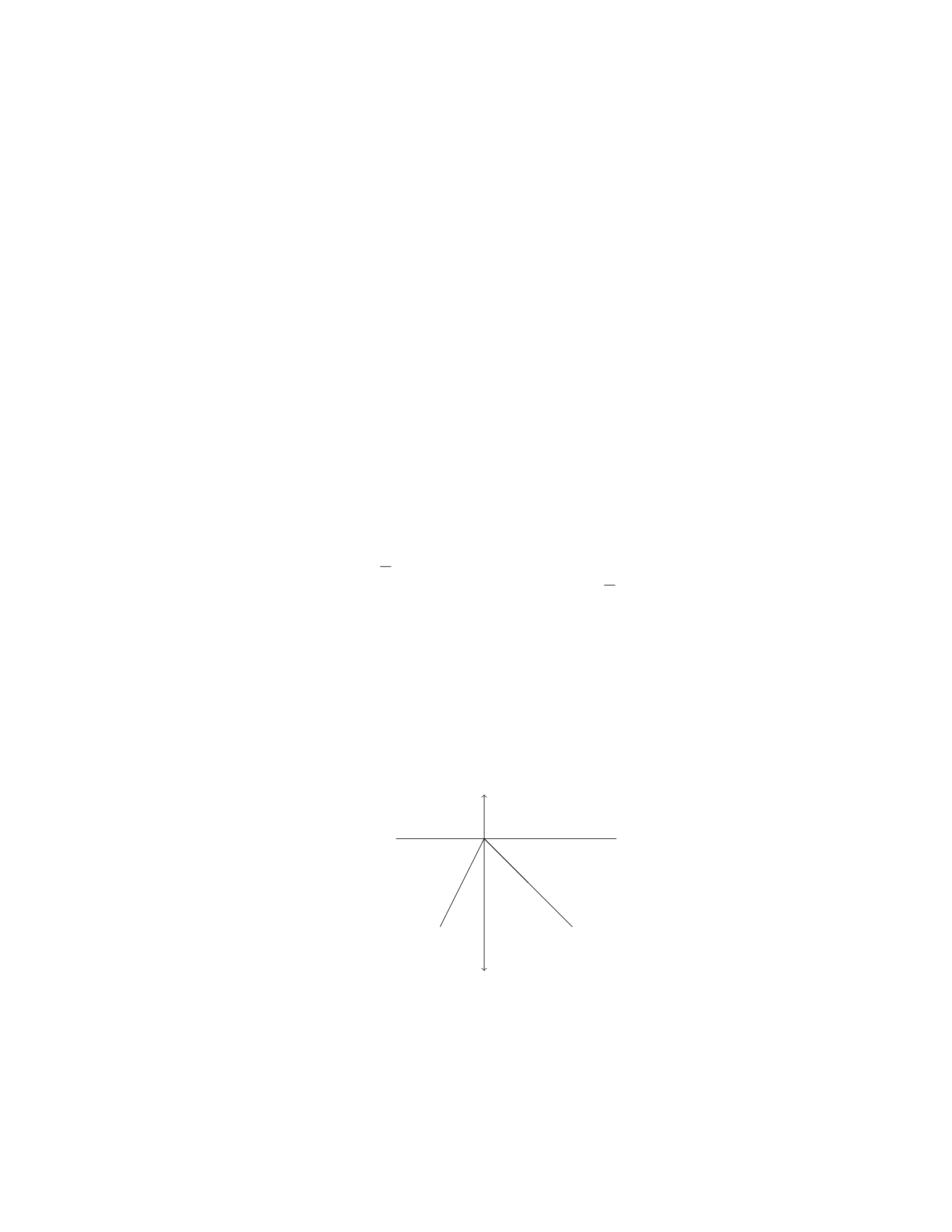
Question 26
Question
A uniform concrete block of mass mand volume Vis submerged in water such
that it is floating with its surface just at the water level. Calculate the density
of the concrete.
Solution
Step 1: The buoyant force is equal to the weight of the water displaced by the
concrete block. The buoyant force Fbcan be calculated by Fb=ρwater ·V·g,
where ρwater is the density of water, Vis the volume of the concrete block
submerged, and gis the acceleration due to gravity.
Step 2: The weight of the concrete block is given by W=m·g.
Step 3: At equilibrium, the buoyant force equals the weight of the concrete
block. Thus, Fb=W.
Step 4: Equating the two forces and using the definitions from Step 1 and
Step 2, we have ρwater ·V·g=m·g.
Step 5: Canceling gfrom both sides and solving for the density of the con-
crete, we find ρconcrete =m
V.
Step 6: Therefore, the density of the concrete block is m
V.
Question 27
Question
A uniform wooden beam, of length Land mass M, is supported horizontally
by a cable attached to the beam at a distance dfrom one end, as shown in the
figure below. The cable makes an angle θwith the horizontal. Find the tension
in the cable and the force provided by the pivot.
Pivot
W
Ld
θ
m
T
23

Solution
Step 1: The forces acting on the beam are the tension Tin the cable, the weight
W=Mg acting downward, and the force mprovided by the pivot.
Step 2: The sum of the forces in the vertical direction must be equal to zero
since the beam is in equilibrium. Therefore, we have
Tcos θ−W−m= 0
Tcos θ−Mg −m= 0
Step 3: The sum of the forces in the horizontal direction must also be equal
to zero. There is only one force in the horizontal direction: Tsin θ. Therefore,
Tsin θ= 0
Step 4: From the horizontal equilibrium condition, we have
sin θ= 0
Step 5: This implies that θ= 0, which means the cable is horizontal. In this
case, there is no torque about the pivot, so the beam does not rotate. Therefore,
the tension in the cable is zero and the entire weight of the beam is supported
by the pivot.
Question 28
Question
A 2.0 m long horizontal steel beam with a cross-sectional area of 7.0×10⁻⁴m2
is used as a support for an engine with weight 15 kN at the end of the beam.
If the Young’s modulus of steel is 2.10 ×10¹¹ N/m2, what is the amount of
elongation of the beam? Assume that the beam is fixed at one end and the
engine is hung from the other end.
(Hint: Use Hooke’s Law, F=kx, where Fis the force, kis the spring
constant, and xis the displacement.)
Solution
Step 1: Calculate the force acting on the beam due to the weight of the engine.
The weight of the engine is 15 kN, which is equivalent to 15,000 N. This force
acts downwards.
Step 2: Calculate the stress on the beam. The stress (σ) on the beam is
given by:
σ=F
A
where Fis the force acting on the beam and Ais the cross-sectional area of the
beam.
24

Step 3: Calculate the strain on the beam. The strain (ε) on the beam is
given by:
ε=σ
Y
where Yis the Young’s modulus of steel.
Step 4: Calculate the elongation of the beam. The elongation of the beam
is given by:
∆L=ε·L
where Lis the original length of the beam.
Putting it all together:
∆L=F
A·Y·L
Now let’s calculate the elongation of the beam step by step.
Question 29
Question
A 3.0 m long uniform beam weighing 400 N is supported on a wall by a cable
attached 1.0 m from the end of the beam and by a hinge at the other end. A
500 N object hangs from the beam 0.50 m from the hinge. Calculate the tension
in the cable and the horizontal and vertical forces on the hinge.
Solution
Step 1: Calculate the torque about the hinge due to the weight of the beam.
Let xbe the distance from the end of the beam to the point where the beam is
supported by the cable. The torque about the hinge due to the weight of the
beam is given by:
τbeam =−(400 N) ·(3.0 m −x)
Step 2: Calculate the torque about the hinge due to the hanging object. For
the object, the torque about the hinge is given by:
τobject = (500 N) ·(1.0 m + 0.50 m)
Step 3: Set up the equilibrium equation for torque about the hinge. For the
beam to be in equilibrium, the net torque about the hinge should be zero:
τbeam +τobject = 0
−(400 N) ·(3.0 m −x) + (500 N) ·(1.0 m + 0.50 m) = 0
Step 4: Solve for x.
−1200 + 900 = 0.5·500
−300 = 250
25
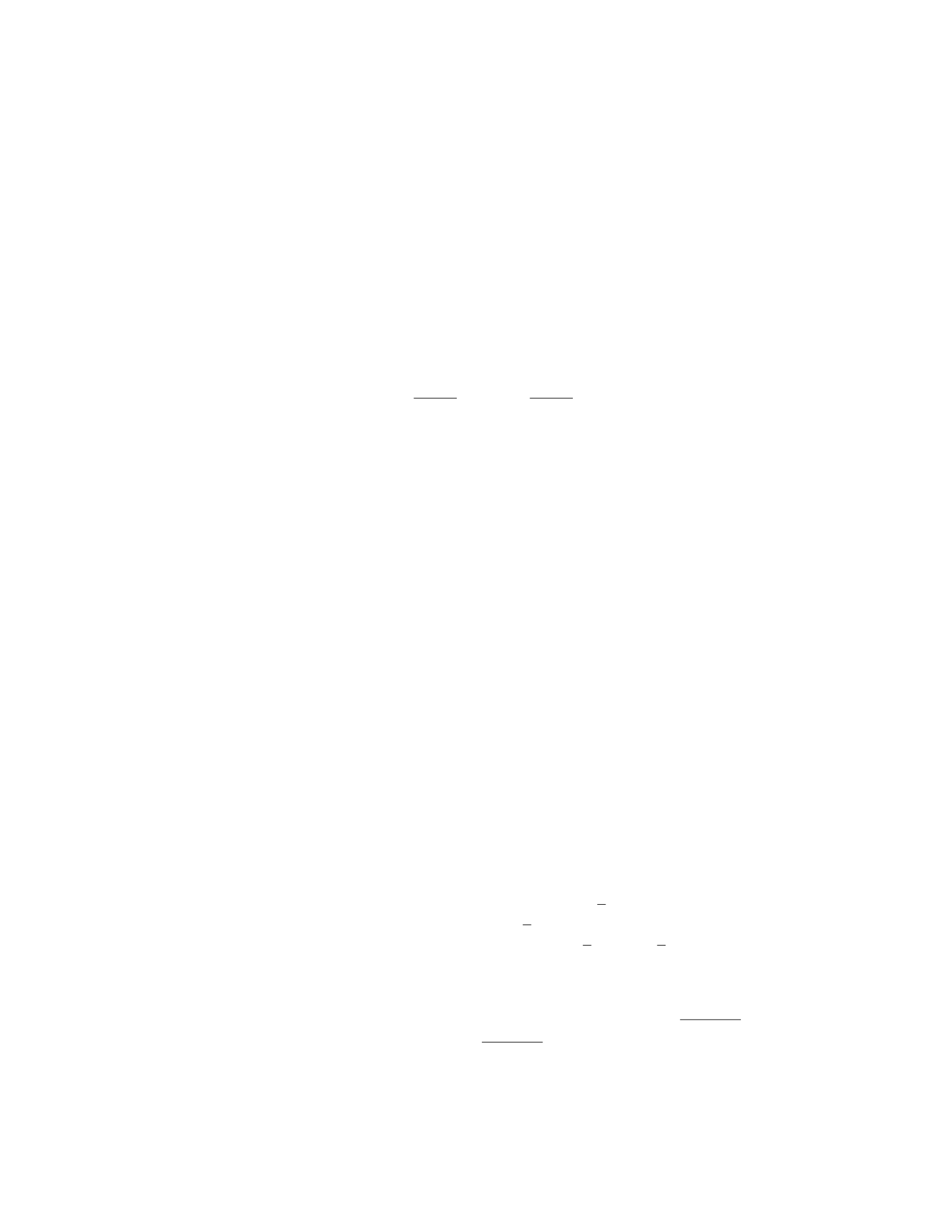
x= 2.50 m
Step 5: Calculate the tension in the cable. The tension in the cable is equal
to the weight of the object plus the weight of the beam:
T= 500 N + 400 N = 900 N
Step 6: Calculate the horizontal and vertical forces on the hinge. The hor-
izontal force at the hinge is zero since the horizontal forces are balanced. The
vertical force on the hinge is the vertical component of the tension in the cable:
Fvertical =T·1.0 m
2.50 m = 900 N ·1.0 m
2.50 m = 360 N
Therefore, the tension in the cable is 900 N and the vertical force on the
hinge is 360 N.
Question 30
Question
A uniform beam of length Land mass Mis supported by a horizontal wire that
is attached to the end of the beam (see figure below). The wire makes an angle
θwith the horizontal. Determine the tension in the wire.
Solution
Step 1: First, we draw a free-body diagram of the beam. We label the forces
acting on the beam: the weight W=M g acting at the center of mass, the
tension force Tat an angle θ, and the force Fat the center of mass acting
vertically.
Step 2: Since the beam is in equilibrium, the sum of the forces in the x-
direction and the sum of the forces in the y-direction must be zero.
In the x-direction: Tsin θ= 0
In the y-direction: Tcos θ−Mg −F= 0
Step 3: Considering the torque about the pivot point at the end of the beam,
we have: τ= 0
The torque due to the weight Wabout the pivot point is zero because it
acts at the pivot point.
The torque due to the force Fcan be calculated as FL
2sin θ
The torque due to the tension force Tis TL
2cos θ
Step 4: Setting up the torque equation, we have: FL
2sin θ−TL
2cos θ= 0
Step 5: Simplifying the torque equation, we get: F=Ttan θ
Step 6: Substituting the expression for Finto the y-direction equilibrium
equation: Tcos θ−Mg −Ttan θ= 0
Step 7: Rearranging the above equation to solve for T, we get: T=Mg
cos θ−tan θ
Therefore, the tension in the wire is Mg
cos θ−tan θ.
26

Question 31
Question
A steel cable of length 10 m and diameter 2 mm hangs vertically. If the Young’s
modulus of steel is 2 ×10¹¹ N/m2, determine the elongation of the cable due to
its own weight. (Assume the acceleration due to gravity is 9.81 m/s2and the
density of steel is 7.8×10³kg/m3.)
Solution
Step 1: Calculate the cross-sectional area of the cable. The cross-sectional area
of a cylindrical cable is given by the formula: A=π
4d2, where dis the diameter
of the cable. Substituting d= 2 mm = 0.002 m, we have:
A=π
4(0.002)2= 3.14 ×10⁻⁶m2
Step 2: Determine the weight of the cable. The weight of the cable can be
calculated using the formula: W=ρV g, where ρis the density of the steel, V
is the volume of the cable, and gis the acceleration due to gravity. The volume
of the cable is V=Al, where lis the length of the cable. Substituting l= 10
m, ρ= 7.8×10³kg/m3, and g= 9.81 m/s2, we have:
V= (3.14 ×10⁻⁶m2)(10 m) = 3.14 ×10⁻⁵m3
W= (7.8×10³kg/m3)(3.14 ×10−5m3)(9.81 m/s2)=2.25 N
Step 3: Calculate the stress in the cable. The stress in the cable can be
determined using the formula: σ=F
A, where Fis the force applied to the cable.
Since the force applied is the weight of the cable, we have:
σ=W
A=2.25
3.14 ×10−6= 7.17 ×10⁵N/m2
Step 4: Determine the strain in the cable. Using Hooke’s Law, the strain in
the cable can be calculated as: ϵ=σ
Y, where Yis the Young’s modulus of steel.
Substituting Y= 2 ×10¹¹ N/m2, we get:
ϵ=7.17 ×10⁵
2×1011 = 3.585 ×10⁻⁶
Step 5: Find the elongation of the cable. The elongation of the cable can be
determined using the formula: ∆L=ϵL, where Lis the original length of the
cable. Substituting L= 10 m, we have:
∆L= (3.585 ×10⁻⁶)(10) = 3.585 ×10⁻⁵m
27

Question 32
Question
A block of mass mis attached to the lower end of a vertical spring and is in
equilibrium. The block is then pulled down and released from rest, oscillating
up and down. Determine the period of the oscillation in terms of the mass m,
the spring constant k, and the acceleration due to gravity g.
Solution
1. When the block is in equilibrium, the weight of the block is balanced by the
spring force:
mg =kx0(where x0is the equilibrium position)
2. At the block’s lowest point during the oscillation, the net force acting on
the block is the sum of the spring force and the gravitational force:
mg +ks =mg +k(x0+A)
where sis the distance the spring is stretched from equilibrium at the lowest
point and Ais the amplitude of oscillation.
3. At the block’s highest point, the net force acting on the block is the sum
of the spring force and the gravitational force again:
mg −ks =mg −k(x0+A)
4. We can simplify the two equations above to get:
s=A(since s=A, the distance the spring is stretched is equal to the amplitude)
5. We know that T= 2πpm
k, where Tis the period of the oscillation. We
just need to express kin terms of m,g, and x0:
k=mg
x0
6. Substituting kback into the expression for the period T, we get:
T= 2πsm
mg
x0
= 2πrx0
g
Therefore, the period of the oscillation in terms of the mass m, the spring
constant k, and the acceleration due to gravity gis T= 2πqx0
g.
28

Question 33
Question
A uniform horizontal beam of length Land mass Mis supported by two vertical
cables attached at the ends of the beam. If the tension in the left cable is twice
the tension in the right cable, what is the tension in the right cable in terms of
Mand L?
Solution
Step 1: Draw a free body diagram of the beam. Let Tlbe the tension in the
left cable and Trbe the tension in the right cable. The weight of the beam acts
downward from the center of the beam. The reaction forces at the supports
cancel out.
Step 2: Write the equations of equilibrium. In the vertical direction, the
sum of the forces must equal zero. We have:
Tl+Tr=Mg
Step 3: Use the given information to write another equation. Given that the
tension in the left cable is twice the tension in the right cable, we have:
Tl= 2Tr
Step 4: Substitute Tl= 2Trinto Tl+Tr=Mg. Substitute Tl= 2Trinto
the equation Tl+Tr=Mg:
2Tr+Tr=Mg
3Tr=Mg
Step 5: Solve for the tension in the right cable.
Tr=Mg
3
Therefore, the tension in the right cable is Mg
3in terms of Mand L.
Question 34
Question
A uniform beam of length Land mass Mis supported by a pivot at one end
and a force Fapplied at the other end. If the beam makes an angle θwith the
horizontal and the pivot exerts a normal force Non the beam, determine an
expression for the magnitude of the force Fin terms of θ,L,M, and acceleration
due to gravity g.
29

Solution
Step 1: Draw free-body diagrams for the beam and consider the forces acting
on it.
Step 2: The forces acting on the beam are the normal force Nat the pivot
point, the force Fat the other end, the weight of the beam acting at its center
of mass (located at L/2), and the normal force N′acting upwards at the center
of mass to balance the weight.
Step 3: Using the torque equation Pτ=Iα, where τis the torque, Iis the
moment of inertia of the beam, and αis the angular acceleration of the beam,
we can find an expression for Fin terms of θ,L,M, and g.
Step 4: Applying the condition for rotational equilibrium, Pτ= 0, we have:
N·0 + F·Lsin θ−Mg ·L
2cos θ−N′·L
2= 0
Step 5: Simplifying and solving the equation for F, we get:
F=Mg tan θ+MgL
2cot θ
Therefore, the magnitude of the force Fin terms of θ,L,M, and gis
Mg tan θ+MgL
2cot θ.
Question 35
Question
A uniform beam of length Land mass Mis supported at its midpoint by a cable
that makes an angle θwith the vertical. Find an expression for the tension in
the cable and the forces exerted by the beam on the supports at each end.
Solution
Step 1: We begin by drawing a free body diagram of the beam. The forces
acting on the beam are the tension Tin the cable, the gravitational force Mg
acting at the center of the beam, and the forces exerted by the supports at each
end.
Step 2: We can resolve the gravitational force into horizontal and vertical
components. The vertical component is Mg cos(θ) and the horizontal compo-
nent is Mg sin(θ).
Step 3: In the vertical direction, we have the equation of equilibrium:
2T=Mg cos(θ)
Step 4: In the horizontal direction, the beam remains in equilibrium so the
horizontal forces must also balance:
Fsupport1 =Fsupport2 =Mg sin(θ)
2
30

Step 5: Solving for the tension in the cable T:
2T=Mg cos(θ)⇒T=Mg cos(θ)
2
Step 6: Simplifying the expressions for the forces exerted by the supports:
Fsupport1 =Fsupport2 =Mg sin(θ)
2
31

