



PHYS 101 - ELEMENTS OF PHYSICS
- Moment of Inertia
Question Bank - Set 5
Liberty University
Question 1
Question
A uniform rod of length Land mass Mis rotating about an axis passing through
its midpoint perpendicular to the rod. Find the moment of inertia of the rod
about this axis.
Solution
Let’s consider the rod to be oriented along the x-axis with the origin at the
center of the rod.
Step 1: Determine the mass per unit length λof the rod. The mass per
unit length λis given by λ=M
L.
Step 2: Calculate the moment of inertia of an infinitesimally small mass
element dm. Consider a small element of length dx at a distance xfrom the
origin. The mass of this element is dm =λ·dx.
The moment of inertia of this element about the axis passing through the
center is dI =dm ·x2.
Substitute dm =λ·dx:
dI =λ·dx ·x2
Step 3: Integrate to find the total moment of inertia. Integrate dI from
−L/2 to L/2 to get the total moment of inertia I:
I=ZL/2
−L/2
λ·x2dx
Step 4: Plug in the values and solve. Substitute λ=M
Land integrate:
I=ZL/2
−L/2
M
L·x2dx
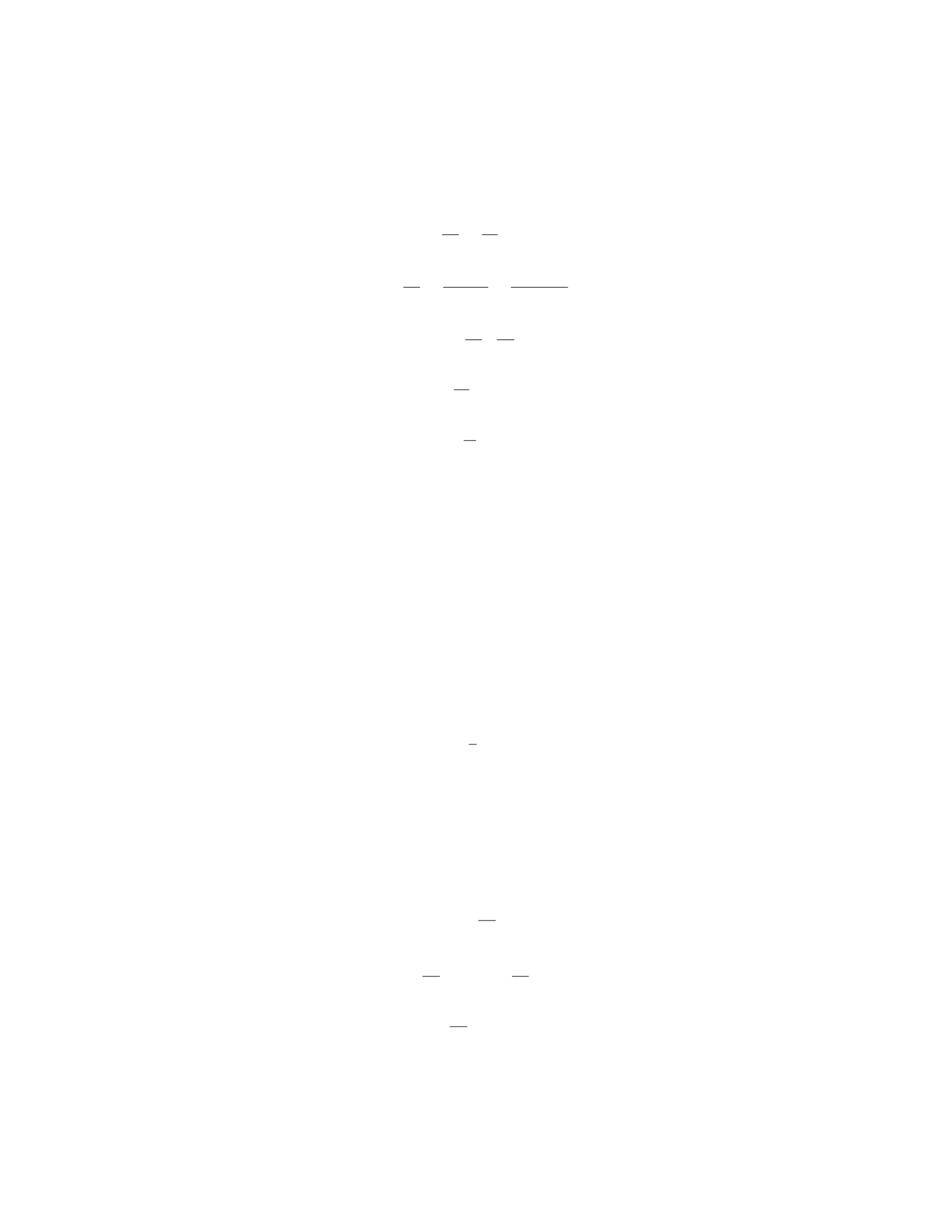
I=M
L·x3
3L/2
−L/2
I=M
L·(L/2)3
3−(−L/2)3
3
I=M
L·L3
24
I=1
12 ·M·L2
Thus, the moment of inertia of the rod about the axis passing through its
midpoint perpendicular to the rod is 1
12 ·M·L2.
Question 2
Question
A thin rod of length Land mass Mis rotated about an axis perpendicular to
the rod and passing through one end. Calculate the moment of inertia of the
rod with respect to this axis.
Solution
To find the moment of inertia of the rod about an axis perpendicular to the rod
and passing through one end, we can use the formula for the moment of inertia
of a slender rod rotating about one end:
I=1
3ML2
Step 1: Determine the moment of inertia formula for a slender rod rotating
about one end. The moment of inertia formula for a slender rod rotating about
one end can be derived using the integral definition of moment of inertia. For a
point mass mat a distance rfrom the axis of rotation, the moment of inertia
is I=mr2. Integrating this formula along the length of the rod from 0 to L,
where Lis the length of the rod, we get:
I=ZL
0
x2
L2·dm
I=1
L2ZL
0
x2·M
Ldx
I=M
L2ZL
0
x2dx
2

I=M
L2x3
3L
0
I=M
3L2(L3)
I=1
3ML2
Therefore, the moment of inertia of a slender rod about an axis perpendicular
to the rod and passing through one end is 1
3ML2.
Question 3
Question
Find the moment of inertia of a thin rod of length Land mass Mabout an axis
passing through one end and perpendicular to the rod.
Solution
We can find the moment of inertia of the rod by treating it as a continuous mass
distribution and integrating the contribution of each small mass element along
the length of the rod.
Step 1: Consider an element of length dx at a distance xfrom the end
where the axis passes through.
Step 2: The mass dm of this element can be expressed in terms of Mand
dx as follows:
dm =M
Ldx
Step 3: The moment of inertia of this element about the axis of rotation is
given by:
dI =dm ·x2
Substitute the expression for dm:
dI =M
Lx2dx
Step 4: The total moment of inertia Iof the rod is obtained by integrating
dI from 0 to L:
I=ZL
0
M
Lx2dx
Step 5: Perform the integration:
I=M
LZL
0
x2dx
3

I=M
L1
3x3L
0
I=M
L1
3L3
I=1
3ML2
Therefore, the moment of inertia of a thin rod of length Land mass Mabout
an axis passing through one end and perpendicular to the rod is 1
3ML2.
Question 4
Question
Find the moment of inertia of a thin uniform rod of length Land mass Mabout
an axis perpendicular to the rod and passing through one end of the rod.
Solution
Let’s consider the rod to be along the x-axis with one end at the origin and
the other end at the point L. The moment of inertia of a continuous mass
distribution is given by the formula:
I=Zr2dm
where ris the distance from the axis of rotation to the point mass dm.
Step 1: Since the rod is thin and uniform, the linear mass density λis given
by λ=M
L.
Step 2: Next, express dm in terms of dx where dx is an elemental length
of the rod. We have dm =λdx =M
Ldx.
Step 3: Now, express rin terms of x, the distance along the rod from the
axis of rotation. We have r=x.
Step 4: Substitute dm =M
Ldx and r=xinto I=Rr2dm:
I=ZL
0
x2M
Ldx
Step 5: Solve the integral:
I=M
LZL
0
x2dx =M
L1
3x3L
0
=M
L1
3L3−1
3·03
Step 6: Simplify the expression:
I=M
L·1
3L3=1
3ML2
4

Therefore, the moment of inertia of the thin uniform rod about an axis
perpendicular to the rod and passing through one end is 1
3ML2.
Question 5
Question
Find the moment of inertia of a thin rod of length Land mass Mwith respect
to an axis perpendicular to the rod and passing through one end of the rod.
Solution
Step 1: Determine the mass per unit length of the rod. Let λbe the mass per
unit length of the rod. Then, λ=M
L.
Step 2: Calculate the moment of inertia. The moment of inertia of a con-
tinuous mass distribution is given by the integral:
I=Zr2dm
Step 3: Express the mass element dm of the rod in terms of ds. Since the
rod is thin and uniform, the mass element dm can be expressed as dm =λds,
where ds is an infinitesimally small length along the rod.
Step 4: Express rin terms of s. Let sbe the distance of an infinitesimal
mass element dm from the axis of rotation. Then, r=s.
Step 5: Substitute dm and rinto the moment of inertia formula.
I=Zr2dm =ZL
0
s2λds
Step 6: Integrate to find the moment of inertia.
I=λZL
0
s2ds =λs3
3L
0
=λL3
3−0=M
L·L3
3=1
3ML2
Therefore, the moment of inertia of the thin rod with respect to an axis
perpendicular to the rod and passing through one end of the rod is 1
3ML2.
Question 6
Question
Find the moment of inertia of the region bounded by the curve y=x2and the
x-axis, rotated about the line y=−2.
5

Solution
To find the moment of inertia of the region about the line y=−2, we need to
use the formula:
I=Zb
a
(x2+ 2)2dx
Step 1: Determine the limits of integration
The limits of integration aand bcan be found by setting x2= 0:
x2= 0
x= 0
So the limits of integration are from 0 to the x-coordinate where y=x2
intersects y=−2:
x2=−2
x=√2i, −√2i
Since we are dealing with real values, a= 0 and b=√2.
Step 2: Set up the integral for the moment of inertia
Substitute a= 0 and b=√2 into the formula for I:
I=Z√2
0
(x2+ 2)2dx
Now, expand (x2+ 2)2:
I=Z√2
0
(x4+ 4x2+ 4) dx
Step 3: Integrate to find the moment of inertia
Integrate term by term:
I=Z√2
0
x4+ 4x2+ 4 dx
I=1
5x5+4
3x3+ 4x√2
0
Evaluate the integral at the upper and lower limits:
I=1
5(√2)5+4
3(√2)3+ 4(√2)−1
5(0)5+4
3(0)3+ 4(0)
I=32√2
15 +32√2
3+ 4√2
I=32√2
15 +160√2
15 +60√2
15
6

I=252√2
15
I=84√2
5
Therefore, the moment of inertia of the region about the line y=−2 is 84√2
5.
Question 7
Question
A thin rod of length Lis rotating about an axis perpendicular to the rod and
passing through one end of the rod. Determine the moment of inertia of the rod
about this axis.
Solution
To find the moment of inertia of the rod about the given axis, we can use the
formula for the moment of inertia of a continuous rod rotating about an axis
perpendicular to the rod and passing through one end:
I=Zr2dm
Step 1: Express dm in terms of the linear density λand dx, where dx is a
small element of length along the rod.
dm =λ·dx
Step 2: Express rin terms of x, the distance from the axis to a small
element dx.
r=x
Step 3: Substitute dm and rinto the formula for moment of inertia.
I=Zr2dm =Zx2λ dx
Step 4: Integrate over the length of the rod from 0 to L.
I=ZL
0
x2λ dx
Step 5: Evaluate the integral.
I=λZL
0
x2dx =λ1
3x3L
0
7

I=λ1
3L3
I=1
3λL3
Therefore, the moment of inertia of the rod about the given axis is 1
3λL3.
Question 8
Question
Find the moment of inertia of a uniform rod of length Land mass Mabout an
axis perpendicular to the rod and passing through one end.
Solution
Let’s consider the rod as a collection of small elements of mass dm and length
dx at distance xfrom the end through which the axis passes. We will then
integrate over all these elements to find the moment of inertia.
Step 1: Determine the mass element dm in terms of xand dx. Since the rod
is uniform, the linear mass density λ=M
L. The mass of a small element dm of
length dx located at a distance xfrom the end is given by dm =λ·dx =M
L·dx.
Step 2: Express the moment of inertia dI of the mass element dm about
the axis perpendicular to the rod and passing through one end. The moment
of inertia of an element dm of the rod about an axis passing through its end
perpendicular to the rod is dI =dm ·x2=M
L·dx·x2.
Step 3: Integrate to find the total moment of inertia I. The total moment
of inertia Iis given by
I=ZdI =ZL
0M
L·dx·x2=M
LZL
0
x2dx
Step 4: Evaluate the integral to find the moment of inertia I.
I=M
Lx3
3L
0
=M
LL3
3−0=M
L·L3
3=1
3ML2
Final Answer: The moment of inertia of the uniform rod about the axis
perpendicular to the rod and passing through one end is 1
3ML2.
Question 9
Question
Find the moment of inertia for a solid cone of mass M, base radius R, and
height Hrotating about its central axis.
8

Solution
Step 1: The moment of inertia for a solid cone rotating about its central axis
can be calculated using the formula:
I=3
10MR2
Step 2: First, we need to express the mass Mof the cone in terms of the
base radius Rand height H. The volume of a cone is given by:
V=1
3πR2H
Step 3: The density ρof the cone is given by:
ρ=M
V=M
1
3πR2H
Step 4: Now, express the mass Min terms of density ρ, base radius R, and
height H:
M=ρ×1
3πR2H
Step 5: Substitute the expression for mass Minto the formula for moment
of inertia:
I=3
10 ρ×1
3πR2HR2
Step 6: Simplify the equation:
I=1
10ρπR4H
Step 7: Therefore, the moment of inertia for a solid cone of mass M, base
radius R, and height Hrotating about its central axis is 1
10 ρπR4H.
Question 10
Question
Find the moment of inertia of a thin circular disc of radius Rand mass Mabout
an axis passing through its center and perpendicular to its plane.
Solution
Let’s consider the circular disc is divided into infinitesimally small concentric
rings of radius rand thickness dr. The mass of the ring is dm and is given by
dm =M
πR2πr2dr =M
R2r2dr
9

To find the moment of inertia Iof the entire disc, we sum up all the moments
of inertia of all the infinitesimally small rings and integrate over the entire disc:
I=ZdI =Zr2dm
Step 1: Write the expression for dI in terms of rand dr:
dI =r2·M
R2r2dr =M
R2r4dr
Step 2: Integrate dI from 0 to Rto find the moment of inertia I:
I=ZR
0
M
R2r4dr =M
R2r5
5R
0
=M
R2·R5
5=M
5R3
Therefore, the moment of inertia of the thin circular disc about an axis
passing through its center and perpendicular to its plane is M
5R3.
Question 11
Question
A thin uniform rod of length Land mass Mis rotating about an axis perpen-
dicular to the rod and passing through one end. Find the moment of inertia of
the rod about this axis.
Solution
Step 1: Consider dividing the rod into small mass elements δm =M
Lδx.
Step 2: The moment of inertia for each mass element δI = (δm)(x2), where
xis the distance of the mass element from the axis of rotation.
Step 3: Integrate δI over the length of the rod from 0 to L:
I=ZL
0
M
Lx2dx
Step 4: Solve the integral:
I=M
Lx3
3L
0
=M
LL3
3−03
3=M
LL3
3=1
3ML2
Step 5: Therefore, the moment of inertia of the thin uniform rod about the
given axis is 1
3ML2.
10

Question 12
Question
A uniform rod of length Land mass Mis rotating about an axis passing through
one end and perpendicular to the rod. Determine the moment of inertia of the
rod about this axis.
Solution
Given: Length of rod, L; Mass of rod, M.
Step 1: Divide the rod into small elements of length dx at a distance xfrom
the rotating axis.
Step 2: The mass of each small element is dm =M
Ldx. The moment of
inertia of each small element about the axis is dI =x2·dm.
Step 3: Using the expression for dm, we can rewrite dI as dI =x2·M
Ldx.
Step 4: Now, integrate dI from 0 to Lto find the moment of inertia of the
entire rod.
I=ZL
0
x2·M
Ldx
Step 5: Solving the integral:
I=M
LZL
0
x2dx
Step 6:
I=M
Lx3
3L
0
Step 7:
I=M
LL3
3−0
Step 8:
I=M
3LL3
Step 9:
I=1
3ML2
Therefore, the moment of inertia of the rod about the given axis is 1
3ML2.
Question 13
Question
A thin uniform rod of mass mand length Lis rotating about an axis through
its center of mass perpendicular to the rod. Find the moment of inertia of the
rod about this axis.
11
Solution
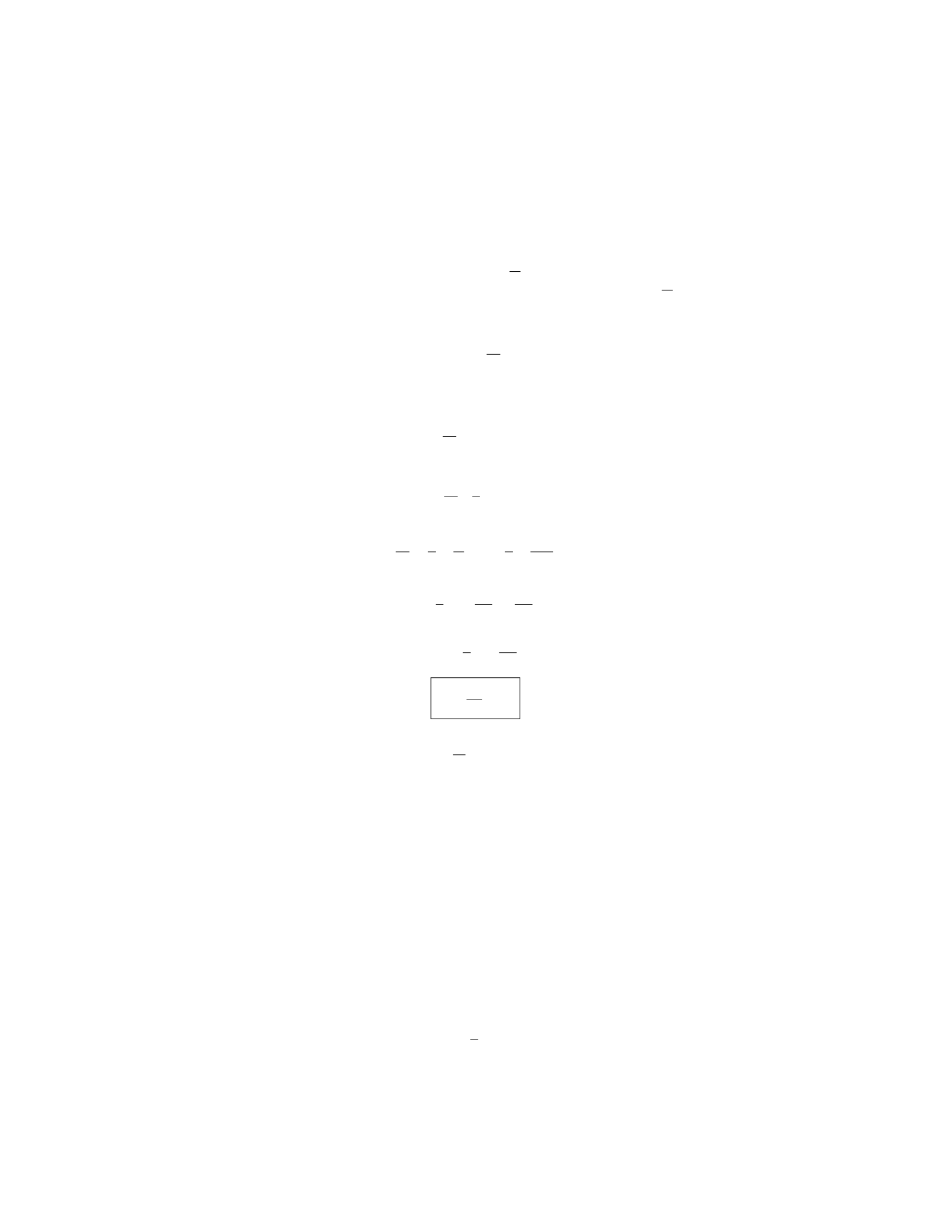
Step 1: Divide the rod into small elements of length dx such that the distance
of each element from the axis is x.
Step 2: The mass of each element dm is m
Ldx.
Step 3: The moment of inertia of each element dI is dm ·x2=m
Ldx ·x2.
Step 4: Integrate dI from −L/2 to L/2 to find the total moment of inertia
I.
I=ZL/2
−L/2
m
Lx2dx
Step 5: Simplify the integral:
I=m
LZL/2
−L/2
x2dx
I=m
L1
3x3L/2
−L/2
I=m
L 1
3L
23
−1
3−L
23!
I=1
3mL3
8+L3
8
I=1
3m·L3
4
I=1
12mL2
Therefore, the moment of inertia of the rod about the axis through its center
of mass perpendicular to the rod is 1
12 mL2.
Question 14
Question
A uniform rod of mass mand length Lis rotating about an axis perpendicular
to the rod and passing through one end with an angular velocity ω. Find the
moment of inertia of the rod about the axis of rotation.
Solution
Step 1: The moment of inertia of a uniform rod rotating about an axis perpen-
dicular to the rod and passing through one end is given by the formula:
I=1
3mL2
12

Step 2: We first need to find the moment of inertia of a small element of the
rod at a distance xfrom the axis of rotation. This small element of mass dm
can be represented as dm =m
Ldx.
Step 3: The moment of inertia of this small element about the axis of rotation
is dI =x2dm =x2m
Ldx.
Step 4: To find the total moment of inertia I, we integrate dI from 0 to L
(length of the rod):
I=ZL
0
x2m
Ldx
Step 5: Solving the integral, we get:
I=1
3mL2
Step 6: Therefore, the moment of inertia of the rod about the axis of rotation
is 1
3mL2.
Question 15
Question
Find the moment of inertia of a thin uniform rod of length Land mass Mabout
an axis perpendicular to the rod and passing through its midpoint.
Solution
Let’s consider the rod aligned along the x-axis, with the origin at the midpoint
of the rod.
Step 1: Determine the mass per unit length of the rod.
The linear mass density λof the rod is given by:
λ=M
L
Step 2: Express the element of mass dm in terms of dx.
The mass dm of an element of length dx located at a distance xfrom the origin
is given by:
dm =λ·dx
Step 3: Express the moment of inertia dI of the element of mass dm about
the axis x0at the origin.
The moment of inertia dI of the element of mass dm about the axis x0is given
by:
dI =dm ·x2
Step 4: Expressing dI in terms of xand dx.
Substitute dm =λ·dx into the equation for dI to get:
dI =λ·x2·dx
13

Step 5: Integrate to find the total moment of inertia I.
The total moment of inertia Iis obtained by integrating dI over the entire
length of the rod:
I=ZL/2
−L/2
dI =ZL/2
−L/2
λ·x2dx
Step 6: Evaluate the integral.
I=ZL/2
−L/2M
L·x2dx =M
L·x3
3L/2
−L/2
I=M
L·L3
24 −−L3
24 =1
12 ·M·L2
Thus, the moment of inertia of the thin uniform rod about an axis perpen-
dicular to the rod and passing through its midpoint is 1
12 ·M·L2.
Question 16
Question
A thin rod of length Land mass Mis rotating about one end with an an-
gular velocity ω. Determine the moment of inertia of the rod about an axis
perpendicular to the rod and passing through the center of the rod.
Solution
Step 1: The moment of inertia of a rigid body rotating about an axis is given
by the formula I=Rr2dm, where ris the perpendicular distance from the axis
of rotation to the mass element dm.
Step 2: To calculate the moment of inertia of the rod, we need to consider an
elemental mass dm of the rod at a distance xfrom the rotating end. The mass
dm can be expressed in terms of the linear mass density λ=M
Las dm =λdx.
Step 3: The distance rcan be expressed in terms of xand the total length
of the rod Las r=L
2−x.
Step 4: Substituting dm =λdx and r=L
2−xinto the formula for the
moment of inertia, we have:
I=ZL
0
(L
2−x)2λdx
Step 5: Simplifying the integrand, we get:
I=λZL
0
(L2
4−Lx +x2)dx
Step 6: Integrating term by term, we have:
14

I=λ[L2
4x−Lx2
2+x3
3]
L
0
Step 7: Evaluating the integral and simplifying, we find:
I=1
12ML2
Step 8: Therefore, the moment of inertia of the rod about an axis perpen-
dicular to the rod and passing through the center of the rod is 1
12 ML2.
Question 17
Question
A solid cylinder of radius Rand mass Mis placed on a rough horizontal surface.
The cylinder starts from rest and rolls without slipping down an incline plane
which makes an angle θwith the horizontal. Find the moment of inertia of the
cylinder about an axis passing through its center and perpendicular to the plane
of the base when its kinetic energy is maximum.
Solution
Step 1: Let Ibe the moment of inertia of the cylinder about the given axis.
Step 2: The total kinetic energy of the rolling cylinder can be expressed as
the sum of its translational and rotational kinetic energy.
Step 3: At the instant when the kinetic energy is maximum, the translational
and rotational kinetic energies are related by the condition of no slipping.
Step 4: The translational kinetic energy of the cylinder is given by 1
2Mv2,
where vis the velocity of the center of mass.
Step 5: The rotational kinetic energy of the cylinder is given by 1
2Iω2, where
ωis the angular velocity of the cylinder.
Step 6: The velocity vand angular velocity ωare related by the condition
of no slipping: v=Rω.
Step 7: Substitute the expression for vin terms of ωinto the expression for
the translational kinetic energy.
Step 8: Express the total kinetic energy Kin terms of Iand ω.
Step 9: To find the moment of inertia Ifor maximum kinetic energy, differ-
entiate Kwith respect to Iand set the derivative to zero.
Step 10: Solve for Ito find the moment of inertia about the given axis when
the kinetic energy is maximum.
15

Question 18
Question
A thin uniform bar of length Land mass Mis rotating about an axis perpendic-
ular to the bar and passing through one end. Calculate the moment of inertia
of the bar about this axis.
Solution
Step 1: Consider a small element dmof the bar at a distance xfrom the axis
of rotation. The moment of inertia of this element about the rotation axis is
dI=x2dm.
Step 2: Since the bar is uniform, the mass per unit length is λ=M
L. The
mass of the element dmcan be written as dm=λdx.
Step 3: Substitute dmin terms of xand λin the expression for dI. Thus,
dI=x2λdx.
Step 4: Integrate dIfrom 0 to Lto find the total moment of inertia I.
I=ZL
0
x2λdx
Step 5: Substitute the expression for λand solve the integral.
I=ZL
0
x2M
Ldx=M
LZL
0
x2dx
Step 6: Solve the integral to find the moment of inertia I.
I=M
L1
3x3L
0
=M
L1
3L3−1
3·03=1
3ML2
Therefore, the moment of inertia of the uniform bar rotating about an axis
passing through one end is 1
3ML2.
Question 19
Question
A thin uniform rod of length Land mass Mis bent into the shape of a semicircle.
Calculate the moment of inertia of the rod about an axis passing through one
end of the rod and perpendicular to the plane of the semicircle.
Solution
Step 1: Divide the semicircle into small elements δm and express the mass of
each element in terms of the total mass Mand the length L. Step 2: Write
16

an expression for the distance rof each element from the axis of rotation in
terms of the total length L. Step 3: Write the expression for the moment of
inertia Iof the entire semicircle by summing the contributions from all the small
elements δI. Step 4: Integrate the expression for δI over the entire length of
the semicircle to find the moment of inertia Iabout the given axis.
Question 20
Question
A thin uniform rod of length Land mass Mis rotating about an axis passing
through one of its ends and perpendicular to it. Find the moment of inertia of
the rod about this axis.
Solution
Step 1: Consider a small element of length dx at a distance xfrom the axis of
rotation.
Step 2: The mass of this element is dm =M
Ldx.
Step 3: The moment of inertia of this element about the axis is dI =dm·x2.
Step 4: Substituting for dm and integrating from 0 to Lgives the total
moment of inertia.
Step 5: The moment of inertia Iof the rod is given by
I=ZL
0
M
Lx2dx
Step 6: Solving the integral, we get
I=M
Lx3
3L
0
Step 7: Simplifying further,
I=M
LL3
3−0=M
3L2
Therefore, the moment of inertia of the rod about the given axis is M
3L2.
Question 21
Question
A metal rod of length Lis bent into a semi-circle of radius R. Find the moment
of inertia of the rod about an axis passing through its diameter and perpendic-
ular to the plane of the semi-circle. Assume the density of the rod is uniform.
17

Solution
Step 1: Let’s split the semi-circle into small segments of length dx and mass dm.
The mass dm of each segment is proportional to the length dx, so dm =M
πR dx,
where Mis the total mass of the rod.
Step 2: The moment of inertia dI of this small segment about the axis
passing through its diameter is given by dI =dm
2·(R−x)2. Substituting the
expression for dm into this equation gives dI =M
2πR ·(R−x)2dx.
Step 3: To find the total moment of inertia I, we integrate dI from x= 0 to
x=R. This gives us:
I=ZR
0
M
2πR ·(R−x)2dx
Step 4: Simplifying the integral:
I=M
2πR ZR
0
(R2−2Rx +x2)dx
I=M
2πR R3
3−R2·R+R3
3
I=M
2πR 2R3
3
I=MR2
3
Therefore, the moment of inertia of the rod about an axis passing through
its diameter and perpendicular to the plane of the semi-circle is MR2
3.
Question 22
Question
A thin rod of length Land mass Mis rotated about an axis that passes through
one end of the rod and is perpendicular to the length of the rod. Find the
moment of inertia of the rod about this axis.
Solution
We can calculate the moment of inertia of the rod by integrating small mass
elements along the length of the rod.
Step 1: Consider a small mass element dm of length dx at a distance x
from the pivot point. The mass of the small element dm can be written as:
dm =M
Ldx
18

Step 2: The moment of inertia dI of this small mass element about the
pivot point is:
dI = (dm)·(x)2=M
Ldx·x2
Step 3: To find the total moment of inertia I, we sum up all the small
contributions by integrating over the length of the rod:
I=ZdI =ZM
Ldx·x2
Step 4: Solving the integral gives:
I=M
LZL
0
x2dx =M
Lx3
3L
0
=M
LL3
3−0=M
3L2
Step 5: Therefore, the moment of inertia of the rod rotating about an axis
passing through one end and perpendicular to the length of the rod is M
3L2.
Question 23
Question
A thin uniform rod of length Land mass Mis rotating about an axis perpendic-
ular to the rod and passing through one end of the rod. Calculate the moment
of inertia of the rod about this axis.
Solution
To find the moment of inertia of the rod, we need to integrate the contribution
from each small mass element along the length of the rod.
Step 1: Consider a small mass element dm of the rod at a distance xfrom
the axis of rotation. The length of the rod is L, and its mass is M, so the linear
mass density λ=M
L.
Step 2: The moment of inertia dI of this small mass element about the axis
of rotation is given by dI =x2dm. We need to express dm in terms of x.
The mass dm can be expressed in terms of linear mass density and length
element dx:dm =λdx.
Step 3: Substituting dm =λdx into the expression for dI, we get:
dI =x2λdx =x2M
Ldx
Step 4: To find the total moment of inertia Iof the rod, we need to integrate
dI from x= 0 to x=L:
I=ZL
0
x2M
Ldx
19

Step 5: Solving the integral, we get:
I=M
L·x3
3L
0
=1
3ML2
Step 6: Therefore, the moment of inertia of the rod about the given axis is
1
3ML2.
Question 24
Question
A thin rod of length Land mass Mis rotating about an axis passing through
one end perpendicular to the rod. Find the moment of inertia of the rod about
this axis.
Solution
Step 1: Consider an elemental mass dm at a distance xfrom the axis of rotation.
The moment of inertia dI of this elemental mass is dm ·x2.
Step 2: The linear mass density λof the rod is given by λ=M
L. Therefore,
dm =λ·dx =M
Ldx.
Step 3: Now, the total moment of inertia Iof the rod can be found by
integrating the elemental moments of inertia from 0 to L:
I=ZL
0
dm ·x2
Step 4: Substituting for dm from Step 2 and integrating, we get:
I=ZL
0
M
L·x2dx
I=M
LZL
0
x2dx
Step 5: Evaluate the integral:
I=M
Lx3
3L
0
I=M
L·L3
3−0
I=M
L·L3
3
I=1
3·M·L2
Therefore, the moment of inertia of the thin rod about the axis passing
through one end perpendicular to the rod is 1
3ML2.
20

Question 25
Question
A thin uniform rod of length Land mass Mis bent at its midpoint at a right
angle so that it forms an ”L” shape. The moment of inertia of the bent rod
about an axis passing through the corner where the two arms of the ”L” meet
and perpendicular to the plane of the rod is given by 3
2ML2. Determine the
moment of inertia of the rod about an axis passing through one end of the rod
and perpendicular to the plane of the rod.
Solution
Step 1: Let’s denote the moment of inertia of the rod about the axis passing
through one end and perpendicular to the plane of the rod as I. We will split the
”L” shaped rod into two parts: a horizontal rod (of length L/2) and a vertical
rod (of length L/2).
Step 2: We know that the total moment of inertia of the rod is the sum of
the moment of inertia of the two parts. Therefore,
I=Ihorizontal +Ivertical
Step 3: The moment of inertia for a rod with respect to an axis perpendicular
to one end and passing through the other end is given by 1
3ML2. So, the moment
of inertia of the horizontal part is:
Ihorizontal =1
3ML
22
=1
12ML2
Step 4: Similarly, the moment of inertia of the vertical part is also 1
12 ML2.
Thus,
Ivertical =1
12ML2
Step 5: Substituting the expressions for Ihorizontal and Ivertical back into the
equation from Step 2, we find:
I=1
12ML2+1
12ML2=1
6ML2
Therefore, the moment of inertia of the rod about an axis passing through
one end of the rod and perpendicular to the plane of the rod is 1
6ML2.
Question 26
Question
A thin rod of mass mand length Lrotates around an axis perpendicular to the
rod and passing through one end. What is the moment of inertia of the rod
about this axis?
21

Solution
Let’s consider the rod to be composed of infinitesimally small mass elements
dm at distance rfrom the axis of rotation. The moment of inertia Ican be
obtained by summing the contributions of all these mass elements.
Step 1: Express the mass element dm in terms of linear mass density λ. The
linear mass density λis defined as mass per unit length. Therefore, dm =λ·dr,
where dr is the length of the infinitesimal mass element.
Step 2: Express dr in terms of dθ. Since the rod is thin and rotating about
an axis through one end, dr =rdθ, where ris the distance of the mass element
from the axis of rotation.
Step 3: Express rin terms of θ. For a rod of length Lrotating around an
axis through one end, r=Lsin(θ).
Step 4: Determine the moment of inertia dI of the mass element dm. The
moment of inertia of a point mass dm at distance rfrom the axis of rotation
is dI =dm ·r2. Substituting dm =λ·dr and r=Lsin(θ), we have dI =
λ·(Lsin(θ))2·(Lsin(θ)dθ).
Step 5: Integrate dI to find the total moment of inertia I. Integrating dI
over the entire length of the rod, we get:
I=ZdI =Zπ
2
0
λ(Lsin(θ))2(Lsin(θ)dθ)
Step 6: Solve the integral to find the moment of inertia I.
I=Zπ
2
0
λL3sin3(θ)dθ =λL3Zπ
2
0
sin3(θ)dθ
Using the trigonometric identity sin3(θ) = 3
4sin(θ)−1
4sin(3θ), we have:
I=λL3"3
4Zπ
2
0
sin(θ)dθ −1
4Zπ
2
0
sin(3θ)dθ#
Solving the integrals,
I=λL33
4·2−1
4·2
3=5
4λL3
Therefore, the moment of inertia of the rod about the given axis is 5
4λL3.
Question 27
Question
A thin uniform rod of length Land mass Mis rotated about an axis at one end
with an angular speed ω. Determine the moment of inertia of the rod about
this axis.
22

Solution
Step 1: Divide the rod into small elements ∆mof mass ∆mand length ∆x.
Step 2: Express the mass of each element in terms of its position along the
rod, x.
∆m=M
L∆x
Step 3: Express the moment of inertia of each element about the axis of
rotation.
dI = (∆m)x2
Step 4: Integrate the expression for dI from x= 0 to x=Lto find the total
moment of inertia I.
ZL
0
dI =ZL
0M
L∆xx2
Step 5: Simplify the integral by substituting ∆x=dx
L.
I=ZL
0M
Ldxx2
Step 6: Integrate and evaluate the integral.
I=M
LZL
0
x2dx
Step 7:
I=M
L1
3x3L
0
I=M
L1
3L3−0
I=M
3L2
Therefore, the moment of inertia of the rod about the given axis is M
3L2.
Question 28
Question
Find the moment of inertia of the region bounded by the curves y=x2and
y=x3about the y-axis.
23

Solution
Step 1: First, we need to find the points of intersection of the curves y=x2and
y=x3. Setting x2=x3, we have x= 0 and x= 1. So the points of intersection
are (0,0) and (1,1).
Step 2: To find the moment of inertia about the y-axis, we use the formula
I=Zb
a
y2dx
where aand bare the x-values of the intersection points.
Step 3: Our integral becomes
I=Z1
0
x6−x4dx.
Step 4: Integrating term by term, we have
I=1
7x7−1
5x51
0
.
Step 5: Evaluating at the limits of integration gives us
I=1
7−1
5=5−7
35 =−2
35.
Therefore, the moment of inertia of the region about the y-axis is −2
35 .
Question 29
Question
A thin rod of length Land mass Mis rotating about an axis passing through
one of its ends perpendicular to its length. Find the moment of inertia of the
rod about this axis.
Solution
To find the moment of inertia of the rod about an axis passing through one
of its ends, we can treat the rod as a collection of infinitesimally small point
masses along its length and sum up their individual moments of inertia.
Step 1: Choose an infinitesimal element of length dx at a distance xfrom
the end of the rod. The mass of this element dm can be expressed in terms of
the mass Mand length Lof the rod.
dm =M
Ldx
24

Step 2: The moment of inertia dI of this element about the given axis can
be calculated as:
dI =dm x2
Substitute dm into the equation:
dI =M
Ldxx2
Step 3: Integrate dI over the entire length of the rod from x= 0 to x=L
to find the total moment of inertia I.
I=ZL
0
dI =ZL
0M
Ldxx2
Step 4: Simplify and solve the integral:
I=M
LZL
0
x2dx
I=M
L1
3x3L
0
I=M
L1
3L3−0
I=1
3ML2
Therefore, the moment of inertia of the rod about an axis passing through
one of its ends perpendicular to its length is 1
3ML2.
Question 30
Question
Find the moment of inertia of a thin rod of mass mand length Labout an axis
perpendicular to the rod and passing through the center of the rod.
Solution
Step 1: Start by considering an elemental mass dm of the rod at a distance x
from the center. The length of this elemental mass is dx. Step 2: The moment
of inertia dI of this elemental mass about the given axis is dI =dm ·x2. Step
3: We need to express dm in terms of dx since the mass is distributed along
the length of the rod. Step 4: The linear mass density λof the rod is λ=m
L.
Therefore, dm =λ·dx. Step 5: Substitute dm =λ·dx into the expression
for dI to get dI =λ·x2·dx. Step 6: To find the total moment of inertia
25

Iof the rod, integrate dI from −L/2 to L/2, since the elemental masses are
symmetrically positioned around the center. Step 7: Hence, I=RL/2
−L/2λ·x2dx.
Step 8: Substituting λ=m
Linto the integral gives I=RL/2
−L/2
m
L·x2dx. Step 9:
Solve the integral to find the moment of inertia I. Step 10: After integrating,
we get I=mL2
12 . Thus, the moment of inertia of the thin rod about the given
axis is mL2
12 .
Question 31
Question
Find the moment of inertia of a thin plate of mass m, having the shape of a
quarter circle of radius R, about an axis passing through the center of the circle
and perpendicular to the plane of the plate.
Solution
To find the moment of inertia of the quarter circle plate, we need to consider
small mass elements on the plate and sum up their contribution to the moment
of inertia.
Step 1: Divide the quarter circle plate into small mass elements. Consider
a small mass element dmof the plate at a distance rfrom the axis of rotation.
The mass dmcan be expressed in terms of the linear mass density λas follows:
dm=λ·ds
where dsis a small arc length at a distance rfrom the axis of rotation.
Step 2: Express λin terms of mand R. Since the plate is of mass mand
radius R, the total area of the quarter circle is πR2
4. Thus, the linear mass
density λcan be expressed as:
λ=m
πR2
4
Step 3: Find the moment of inertia for the small mass element dm. The
moment of inertia of the small mass element dmwith respect to the axis of
rotation is given by:
dI=r2dm
Substitute dm=λ·dsand r=Rsin(θ), where θis the angle formed by the
radius rand the horizontal axis.
Step 4: Calculate the total moment of inertia. Integrate dIover the quarter
circle plate to find the total moment of inertia I.
I=ZdI=Zπ
2
0
R2sin2(θ)λds
Substitute λand dsin terms of Rand m, and perform the integration.
26

Step 5: Solve for the expression for the moment of inertia. Calculate the
integral to find the moment of inertia Iof the quarter circle plate about the
given axis. When the integration is complete, simplify the expression to obtain
the final answer.
Question 32
Question
A thin uniform rod of mass Mand length Lis pivoted at one end. Find the
moment of inertia of the rod about an axis perpendicular to the rod and passing
through its other end.
Solution
Step 1: Determine the moment of inertia of a differential element of mass dm
at a distance xfrom the pivot.
Let the mass dm be a small element of length dx at a distance xfrom the pivot.
The mass dm is given by dm =M
Ldx. The moment of inertia of this element
about the pivot is dI =dm ·x2. Substituting dm and x2gives dI =M
Lx2dx.
Step 2: Integrate to find the total moment of inertia.
To find the total moment of inertia I, we integrate dI from 0 to L(the length
of the rod).
I=ZL
0
M
Lx2dx
Step 3: Solve the integral.
Integrating, we have:
I=M
LZL
0
x2dx =M
Lx3
3L
0
=M
LL3
3−0=M
3L2
Therefore, the moment of inertia of the rod about an axis perpendicular to
the rod and passing through its other end is M
3L2.
Question 33
Question
Find the moment of inertia of a thin rod of length Land mass Mabout an axis
perpendicular to the rod and passing through one end.
Solution
To find the moment of inertia of the rod, we need to integrate the contribution
of each infinitesimal mass element along the length of the rod.
27

Step 1: Consider an infinitesimal mass element dm of the rod a distance
xfrom the end through which the axis passes. Since the rod is thin, we can
consider dm as a point mass.
Step 2: The moment of inertia of this infinitesimal mass element dm with
respect to the axis is given by dI =x2dm.
Step 3: Next, express dm in terms of dx to derive the relationship between
dm and dx. The linear mass density λof the rod is given by λ=M
L, where
λ=dm
dx .
Step 4: Substitute dm in terms of dx into the expression for dI to get
dI =x2λ dx.
Step 5: Integrate dI from x= 0 to x=Lto get the total moment of inertia
Iof the rod.
I=ZL
0
x2λ dx
Step 6: Substitute the expression for λand solve the integral to find the
moment of inertia I.
I=ZL
0
x2M
Ldx
I=M
LZL
0
x2dx
I=M
Lx3
3L
0
I=M
LL3
3−0
I=1
3ML2
Therefore, the moment of inertia of the thin rod of length Land mass M
about an axis perpendicular to the rod and passing through one end is 1
3ML2.
Question 34
Question
A thin uniform rod of length Land mass Mis rotating about an axis passing
through one end and perpendicular to the rod. Determine the moment of inertia
of the rod about this axis.
28

Solution
Step 1: Divide the rod into small mass elements δm of length δx. Step 2: The
mass of each element will be δm =M
Lδx. Step 3: The distance of each element
from the axis of rotation will be x, where xranges from 0 to L. Step 4: The
moment of inertia of a small element δI about the axis of rotation is δI =δm·x2.
Step 5: Plugging in the expression for δm:δI =M
Lδx·x2=M
Lx2δx. Step
6: Integrate the expression for δI over the length of the rod to find the total
moment of inertia I. Step 7: I=RL
0
M
Lx2dx. Step 8: Solving the integral gives
I=M
Lhx3
3iL
0. Step 9: Simplifying further: I=M
L·L3
3. Step 10: Finally, we get
I=1
3ML2. Therefore, the moment of inertia of the rod about the given axis is
1
3ML2.
Question 35
Question
A thin uniform rod of length Land mass Mis rotating about an axis passing
through one end and perpendicular to the rod. Calculate the moment of inertia
of the rod about this axis.
Solution
Let’s denote the moment of inertia of the rod about the axis passing through
one end and perpendicular to the rod as I.
Step 1: Divide the rod into infinitesimally small mass elements δm.
Let’s consider an element of length δx at a distance xfrom the end of the
rod. The mass of this element δm can be expressed as:
δm =M
Lδx
The moment of inertia of this small mass element with respect to the axis is
δI = (δm)x2.
Step 2: Integrate the moment of inertia of all the mass elements over the
length of the rod.
The total moment of inertia Iis obtained by integrating the moment of
inertia of each small mass element from 0 to L:
I=ZL
0
δI =ZL
0M
Lδx·x2
Step 3: Simplify the integral.
I=ZL
0M
Lδx·x2=M
LZL
0
x2δx
29
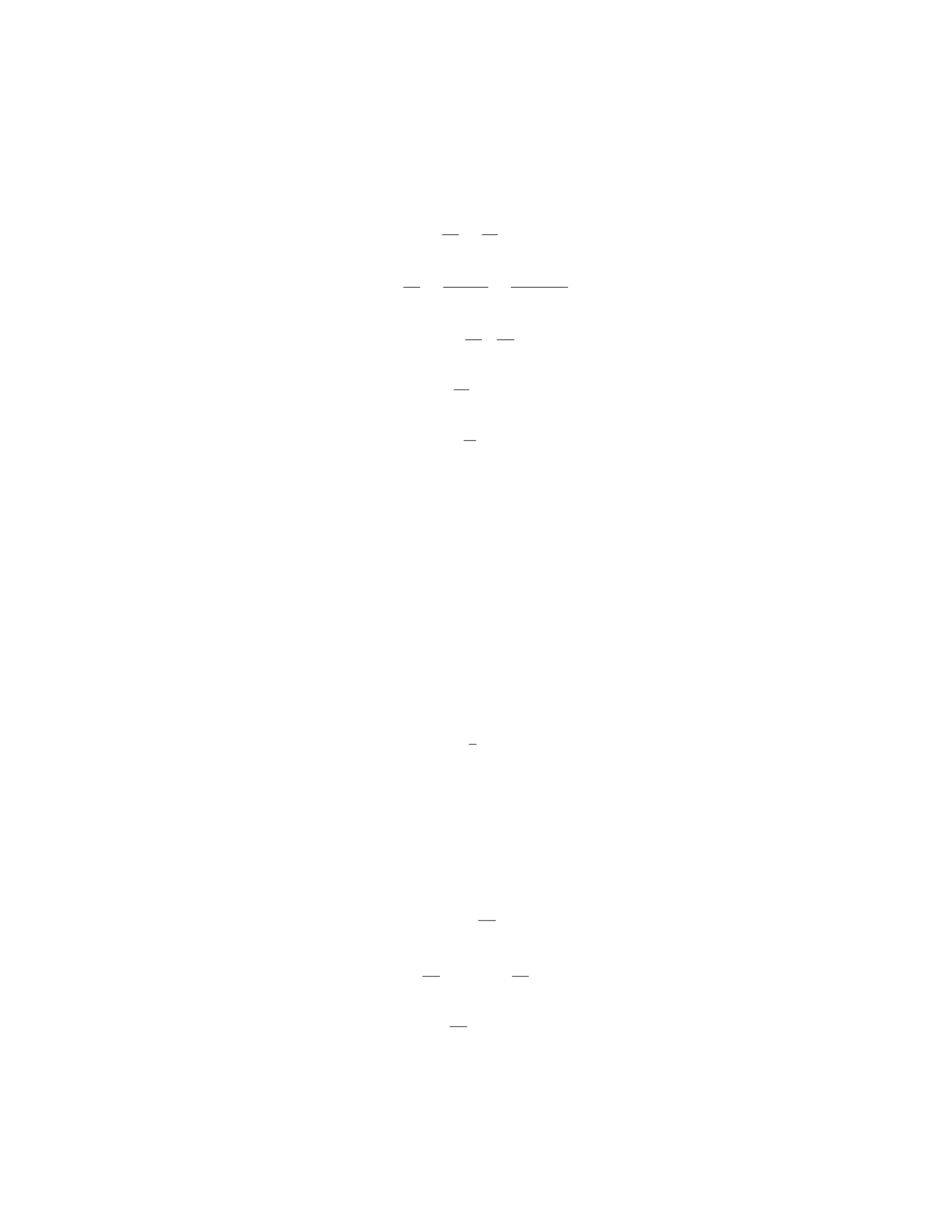
I=M
L·x3
3L/2
−L/2
I=M
L·(L/2)3
3−(−L/2)3
3
I=M
L·L3
24
I=1
12 ·M·L2
Thus, the moment of inertia of the rod about the axis passing through its
midpoint perpendicular to the rod is 1
12 ·M·L2.
Question 2
Question
A thin rod of length Land mass Mis rotated about an axis perpendicular to
the rod and passing through one end. Calculate the moment of inertia of the
rod with respect to this axis.
Solution
To find the moment of inertia of the rod about an axis perpendicular to the rod
and passing through one end, we can use the formula for the moment of inertia
of a slender rod rotating about one end:
I=1
3ML2
Step 1: Determine the moment of inertia formula for a slender rod rotating
about one end. The moment of inertia formula for a slender rod rotating about
one end can be derived using the integral definition of moment of inertia. For a
point mass mat a distance rfrom the axis of rotation, the moment of inertia
is I=mr2. Integrating this formula along the length of the rod from 0 to L,
where Lis the length of the rod, we get:
I=ZL
0
x2
L2·dm
I=1
L2ZL
0
x2·M
Ldx
I=M
L2ZL
0
x2dx
2

I=M
L2x3
3L
0
I=M
3L2(L3)
I=1
3ML2
Therefore, the moment of inertia of a slender rod about an axis perpendicular
to the rod and passing through one end is 1
3ML2.
Question 3
Question
Find the moment of inertia of a thin rod of length Land mass Mabout an axis
passing through one end and perpendicular to the rod.
Solution
We can find the moment of inertia of the rod by treating it as a continuous mass
distribution and integrating the contribution of each small mass element along
the length of the rod.
Step 1: Consider an element of length dx at a distance xfrom the end
where the axis passes through.
Step 2: The mass dm of this element can be expressed in terms of Mand
dx as follows:
dm =M
Ldx
Step 3: The moment of inertia of this element about the axis of rotation is
given by:
dI =dm ·x2
Substitute the expression for dm:
dI =M
Lx2dx
Step 4: The total moment of inertia Iof the rod is obtained by integrating
dI from 0 to L:
I=ZL
0
M
Lx2dx
Step 5: Perform the integration:
I=M
LZL
0
x2dx
3

I=M
L1
3x3L
0
I=M
L1
3L3
I=1
3ML2
Therefore, the moment of inertia of a thin rod of length Land mass Mabout
an axis passing through one end and perpendicular to the rod is 1
3ML2.
Question 4
Question
Find the moment of inertia of a thin uniform rod of length Land mass Mabout
an axis perpendicular to the rod and passing through one end of the rod.
Solution
Let’s consider the rod to be along the x-axis with one end at the origin and
the other end at the point L. The moment of inertia of a continuous mass
distribution is given by the formula:
I=Zr2dm
where ris the distance from the axis of rotation to the point mass dm.
Step 1: Since the rod is thin and uniform, the linear mass density λis given
by λ=M
L.
Step 2: Next, express dm in terms of dx where dx is an elemental length
of the rod. We have dm =λdx =M
Ldx.
Step 3: Now, express rin terms of x, the distance along the rod from the
axis of rotation. We have r=x.
Step 4: Substitute dm =M
Ldx and r=xinto I=Rr2dm:
I=ZL
0
x2M
Ldx
Step 5: Solve the integral:
I=M
LZL
0
x2dx =M
L1
3x3L
0
=M
L1
3L3−1
3·03
Step 6: Simplify the expression:
I=M
L·1
3L3=1
3ML2
4

Therefore, the moment of inertia of the thin uniform rod about an axis
perpendicular to the rod and passing through one end is 1
3ML2.
Question 5
Question
Find the moment of inertia of a thin rod of length Land mass Mwith respect
to an axis perpendicular to the rod and passing through one end of the rod.
Solution
Step 1: Determine the mass per unit length of the rod. Let λbe the mass per
unit length of the rod. Then, λ=M
L.
Step 2: Calculate the moment of inertia. The moment of inertia of a con-
tinuous mass distribution is given by the integral:
I=Zr2dm
Step 3: Express the mass element dm of the rod in terms of ds. Since the
rod is thin and uniform, the mass element dm can be expressed as dm =λds,
where ds is an infinitesimally small length along the rod.
Step 4: Express rin terms of s. Let sbe the distance of an infinitesimal
mass element dm from the axis of rotation. Then, r=s.
Step 5: Substitute dm and rinto the moment of inertia formula.
I=Zr2dm =ZL
0
s2λds
Step 6: Integrate to find the moment of inertia.
I=λZL
0
s2ds =λs3
3L
0
=λL3
3−0=M
L·L3
3=1
3ML2
Therefore, the moment of inertia of the thin rod with respect to an axis
perpendicular to the rod and passing through one end of the rod is 1
3ML2.
Question 6
Question
Find the moment of inertia of the region bounded by the curve y=x2and the
x-axis, rotated about the line y=−2.
5

Solution
To find the moment of inertia of the region about the line y=−2, we need to
use the formula:
I=Zb
a
(x2+ 2)2dx
Step 1: Determine the limits of integration
The limits of integration aand bcan be found by setting x2= 0:
x2= 0
x= 0
So the limits of integration are from 0 to the x-coordinate where y=x2
intersects y=−2:
x2=−2
x=√2i, −√2i
Since we are dealing with real values, a= 0 and b=√2.
Step 2: Set up the integral for the moment of inertia
Substitute a= 0 and b=√2 into the formula for I:
I=Z√2
0
(x2+ 2)2dx
Now, expand (x2+ 2)2:
I=Z√2
0
(x4+ 4x2+ 4) dx
Step 3: Integrate to find the moment of inertia
Integrate term by term:
I=Z√2
0
x4+ 4x2+ 4 dx
I=1
5x5+4
3x3+ 4x√2
0
Evaluate the integral at the upper and lower limits:
I=1
5(√2)5+4
3(√2)3+ 4(√2)−1
5(0)5+4
3(0)3+ 4(0)
I=32√2
15 +32√2
3+ 4√2
I=32√2
15 +160√2
15 +60√2
15
6

I=252√2
15
I=84√2
5
Therefore, the moment of inertia of the region about the line y=−2 is 84√2
5.
Question 7
Question
A thin rod of length Lis rotating about an axis perpendicular to the rod and
passing through one end of the rod. Determine the moment of inertia of the rod
about this axis.
Solution
To find the moment of inertia of the rod about the given axis, we can use the
formula for the moment of inertia of a continuous rod rotating about an axis
perpendicular to the rod and passing through one end:
I=Zr2dm
Step 1: Express dm in terms of the linear density λand dx, where dx is a
small element of length along the rod.
dm =λ·dx
Step 2: Express rin terms of x, the distance from the axis to a small
element dx.
r=x
Step 3: Substitute dm and rinto the formula for moment of inertia.
I=Zr2dm =Zx2λ dx
Step 4: Integrate over the length of the rod from 0 to L.
I=ZL
0
x2λ dx
Step 5: Evaluate the integral.
I=λZL
0
x2dx =λ1
3x3L
0
7

I=λ1
3L3
I=1
3λL3
Therefore, the moment of inertia of the rod about the given axis is 1
3λL3.
Question 8
Question
Find the moment of inertia of a uniform rod of length Land mass Mabout an
axis perpendicular to the rod and passing through one end.
Solution
Let’s consider the rod as a collection of small elements of mass dm and length
dx at distance xfrom the end through which the axis passes. We will then
integrate over all these elements to find the moment of inertia.
Step 1: Determine the mass element dm in terms of xand dx. Since the rod
is uniform, the linear mass density λ=M
L. The mass of a small element dm of
length dx located at a distance xfrom the end is given by dm =λ·dx =M
L·dx.
Step 2: Express the moment of inertia dI of the mass element dm about
the axis perpendicular to the rod and passing through one end. The moment
of inertia of an element dm of the rod about an axis passing through its end
perpendicular to the rod is dI =dm ·x2=M
L·dx·x2.
Step 3: Integrate to find the total moment of inertia I. The total moment
of inertia Iis given by
I=ZdI =ZL
0M
L·dx·x2=M
LZL
0
x2dx
Step 4: Evaluate the integral to find the moment of inertia I.
I=M
Lx3
3L
0
=M
LL3
3−0=M
L·L3
3=1
3ML2
Final Answer: The moment of inertia of the uniform rod about the axis
perpendicular to the rod and passing through one end is 1
3ML2.
Question 9
Question
Find the moment of inertia for a solid cone of mass M, base radius R, and
height Hrotating about its central axis.
8

Solution
Step 1: The moment of inertia for a solid cone rotating about its central axis
can be calculated using the formula:
I=3
10MR2
Step 2: First, we need to express the mass Mof the cone in terms of the
base radius Rand height H. The volume of a cone is given by:
V=1
3πR2H
Step 3: The density ρof the cone is given by:
ρ=M
V=M
1
3πR2H
Step 4: Now, express the mass Min terms of density ρ, base radius R, and
height H:
M=ρ×1
3πR2H
Step 5: Substitute the expression for mass Minto the formula for moment
of inertia:
I=3
10 ρ×1
3πR2HR2
Step 6: Simplify the equation:
I=1
10ρπR4H
Step 7: Therefore, the moment of inertia for a solid cone of mass M, base
radius R, and height Hrotating about its central axis is 1
10 ρπR4H.
Question 10
Question
Find the moment of inertia of a thin circular disc of radius Rand mass Mabout
an axis passing through its center and perpendicular to its plane.
Solution
Let’s consider the circular disc is divided into infinitesimally small concentric
rings of radius rand thickness dr. The mass of the ring is dm and is given by
dm =M
πR2πr2dr =M
R2r2dr
9

To find the moment of inertia Iof the entire disc, we sum up all the moments
of inertia of all the infinitesimally small rings and integrate over the entire disc:
I=ZdI =Zr2dm
Step 1: Write the expression for dI in terms of rand dr:
dI =r2·M
R2r2dr =M
R2r4dr
Step 2: Integrate dI from 0 to Rto find the moment of inertia I:
I=ZR
0
M
R2r4dr =M
R2r5
5R
0
=M
R2·R5
5=M
5R3
Therefore, the moment of inertia of the thin circular disc about an axis
passing through its center and perpendicular to its plane is M
5R3.
Question 11
Question
A thin uniform rod of length Land mass Mis rotating about an axis perpen-
dicular to the rod and passing through one end. Find the moment of inertia of
the rod about this axis.
Solution
Step 1: Consider dividing the rod into small mass elements δm =M
Lδx.
Step 2: The moment of inertia for each mass element δI = (δm)(x2), where
xis the distance of the mass element from the axis of rotation.
Step 3: Integrate δI over the length of the rod from 0 to L:
I=ZL
0
M
Lx2dx
Step 4: Solve the integral:
I=M
Lx3
3L
0
=M
LL3
3−03
3=M
LL3
3=1
3ML2
Step 5: Therefore, the moment of inertia of the thin uniform rod about the
given axis is 1
3ML2.
10

Question 12
Question
A uniform rod of length Land mass Mis rotating about an axis passing through
one end and perpendicular to the rod. Determine the moment of inertia of the
rod about this axis.
Solution
Given: Length of rod, L; Mass of rod, M.
Step 1: Divide the rod into small elements of length dx at a distance xfrom
the rotating axis.
Step 2: The mass of each small element is dm =M
Ldx. The moment of
inertia of each small element about the axis is dI =x2·dm.
Step 3: Using the expression for dm, we can rewrite dI as dI =x2·M
Ldx.
Step 4: Now, integrate dI from 0 to Lto find the moment of inertia of the
entire rod.
I=ZL
0
x2·M
Ldx
Step 5: Solving the integral:
I=M
LZL
0
x2dx
Step 6:
I=M
Lx3
3L
0
Step 7:
I=M
LL3
3−0
Step 8:
I=M
3LL3
Step 9:
I=1
3ML2
Therefore, the moment of inertia of the rod about the given axis is 1
3ML2.
Question 13
Question
A thin uniform rod of mass mand length Lis rotating about an axis through
its center of mass perpendicular to the rod. Find the moment of inertia of the
rod about this axis.
11
Solution
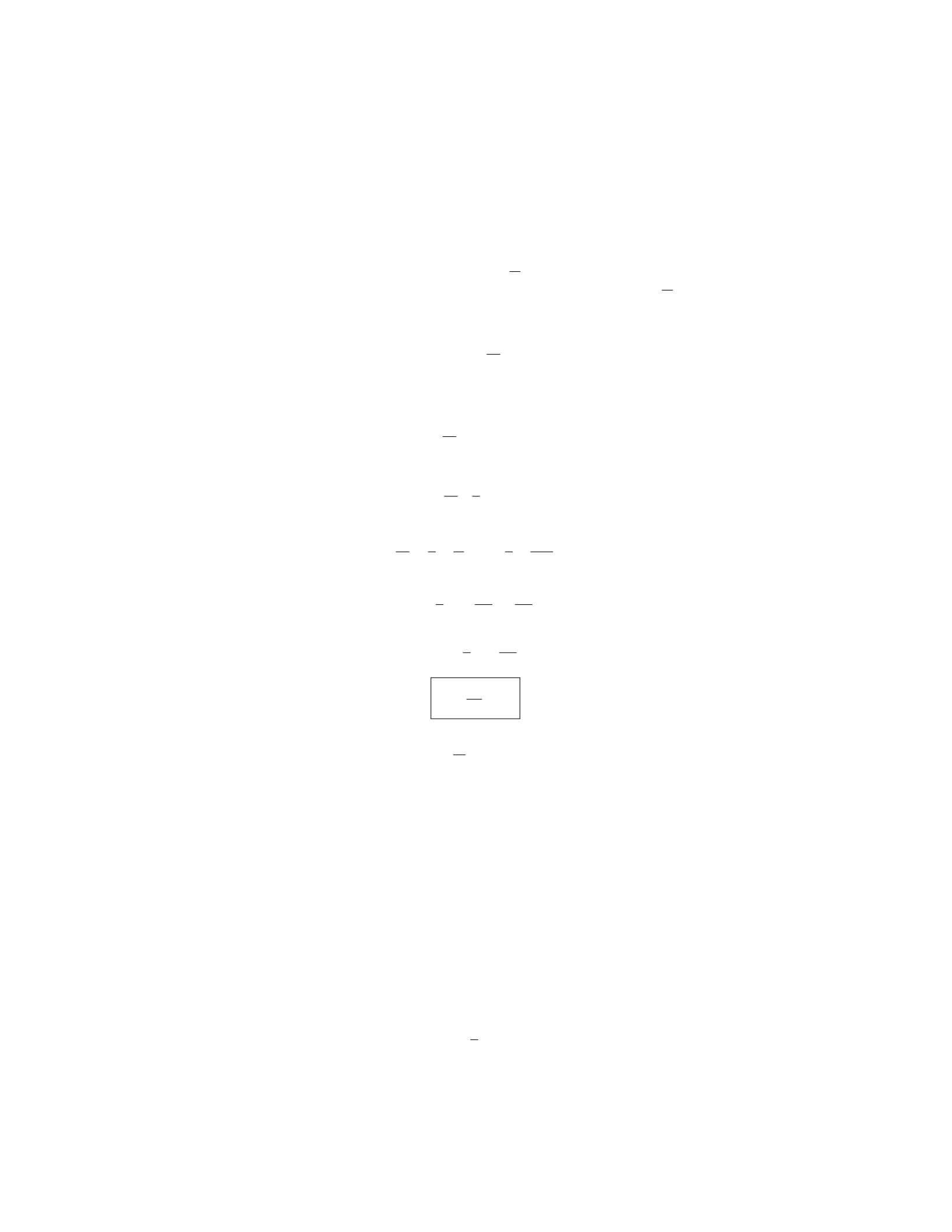
Step 1: Divide the rod into small elements of length dx such that the distance
of each element from the axis is x.
Step 2: The mass of each element dm is m
Ldx.
Step 3: The moment of inertia of each element dI is dm ·x2=m
Ldx ·x2.
Step 4: Integrate dI from −L/2 to L/2 to find the total moment of inertia
I.
I=ZL/2
−L/2
m
Lx2dx
Step 5: Simplify the integral:
I=m
LZL/2
−L/2
x2dx
I=m
L1
3x3L/2
−L/2
I=m
L 1
3L
23
−1
3−L
23!
I=1
3mL3
8+L3
8
I=1
3m·L3
4
I=1
12mL2
Therefore, the moment of inertia of the rod about the axis through its center
of mass perpendicular to the rod is 1
12 mL2.
Question 14
Question
A uniform rod of mass mand length Lis rotating about an axis perpendicular
to the rod and passing through one end with an angular velocity ω. Find the
moment of inertia of the rod about the axis of rotation.
Solution
Step 1: The moment of inertia of a uniform rod rotating about an axis perpen-
dicular to the rod and passing through one end is given by the formula:
I=1
3mL2
12

Step 2: We first need to find the moment of inertia of a small element of the
rod at a distance xfrom the axis of rotation. This small element of mass dm
can be represented as dm =m
Ldx.
Step 3: The moment of inertia of this small element about the axis of rotation
is dI =x2dm =x2m
Ldx.
Step 4: To find the total moment of inertia I, we integrate dI from 0 to L
(length of the rod):
I=ZL
0
x2m
Ldx
Step 5: Solving the integral, we get:
I=1
3mL2
Step 6: Therefore, the moment of inertia of the rod about the axis of rotation
is 1
3mL2.
Question 15
Question
Find the moment of inertia of a thin uniform rod of length Land mass Mabout
an axis perpendicular to the rod and passing through its midpoint.
Solution
Let’s consider the rod aligned along the x-axis, with the origin at the midpoint
of the rod.
Step 1: Determine the mass per unit length of the rod.
The linear mass density λof the rod is given by:
λ=M
L
Step 2: Express the element of mass dm in terms of dx.
The mass dm of an element of length dx located at a distance xfrom the origin
is given by:
dm =λ·dx
Step 3: Express the moment of inertia dI of the element of mass dm about
the axis x0at the origin.
The moment of inertia dI of the element of mass dm about the axis x0is given
by:
dI =dm ·x2
Step 4: Expressing dI in terms of xand dx.
Substitute dm =λ·dx into the equation for dI to get:
dI =λ·x2·dx
13

Step 5: Integrate to find the total moment of inertia I.
The total moment of inertia Iis obtained by integrating dI over the entire
length of the rod:
I=ZL/2
−L/2
dI =ZL/2
−L/2
λ·x2dx
Step 6: Evaluate the integral.
I=ZL/2
−L/2M
L·x2dx =M
L·x3
3L/2
−L/2
I=M
L·L3
24 −−L3
24 =1
12 ·M·L2
Thus, the moment of inertia of the thin uniform rod about an axis perpen-
dicular to the rod and passing through its midpoint is 1
12 ·M·L2.
Question 16
Question
A thin rod of length Land mass Mis rotating about one end with an an-
gular velocity ω. Determine the moment of inertia of the rod about an axis
perpendicular to the rod and passing through the center of the rod.
Solution
Step 1: The moment of inertia of a rigid body rotating about an axis is given
by the formula I=Rr2dm, where ris the perpendicular distance from the axis
of rotation to the mass element dm.
Step 2: To calculate the moment of inertia of the rod, we need to consider an
elemental mass dm of the rod at a distance xfrom the rotating end. The mass
dm can be expressed in terms of the linear mass density λ=M
Las dm =λdx.
Step 3: The distance rcan be expressed in terms of xand the total length
of the rod Las r=L
2−x.
Step 4: Substituting dm =λdx and r=L
2−xinto the formula for the
moment of inertia, we have:
I=ZL
0
(L
2−x)2λdx
Step 5: Simplifying the integrand, we get:
I=λZL
0
(L2
4−Lx +x2)dx
Step 6: Integrating term by term, we have:
14

I=λ[L2
4x−Lx2
2+x3
3]
L
0
Step 7: Evaluating the integral and simplifying, we find:
I=1
12ML2
Step 8: Therefore, the moment of inertia of the rod about an axis perpen-
dicular to the rod and passing through the center of the rod is 1
12 ML2.
Question 17
Question
A solid cylinder of radius Rand mass Mis placed on a rough horizontal surface.
The cylinder starts from rest and rolls without slipping down an incline plane
which makes an angle θwith the horizontal. Find the moment of inertia of the
cylinder about an axis passing through its center and perpendicular to the plane
of the base when its kinetic energy is maximum.
Solution
Step 1: Let Ibe the moment of inertia of the cylinder about the given axis.
Step 2: The total kinetic energy of the rolling cylinder can be expressed as
the sum of its translational and rotational kinetic energy.
Step 3: At the instant when the kinetic energy is maximum, the translational
and rotational kinetic energies are related by the condition of no slipping.
Step 4: The translational kinetic energy of the cylinder is given by 1
2Mv2,
where vis the velocity of the center of mass.
Step 5: The rotational kinetic energy of the cylinder is given by 1
2Iω2, where
ωis the angular velocity of the cylinder.
Step 6: The velocity vand angular velocity ωare related by the condition
of no slipping: v=Rω.
Step 7: Substitute the expression for vin terms of ωinto the expression for
the translational kinetic energy.
Step 8: Express the total kinetic energy Kin terms of Iand ω.
Step 9: To find the moment of inertia Ifor maximum kinetic energy, differ-
entiate Kwith respect to Iand set the derivative to zero.
Step 10: Solve for Ito find the moment of inertia about the given axis when
the kinetic energy is maximum.
15

Question 18
Question
A thin uniform bar of length Land mass Mis rotating about an axis perpendic-
ular to the bar and passing through one end. Calculate the moment of inertia
of the bar about this axis.
Solution
Step 1: Consider a small element dmof the bar at a distance xfrom the axis
of rotation. The moment of inertia of this element about the rotation axis is
dI=x2dm.
Step 2: Since the bar is uniform, the mass per unit length is λ=M
L. The
mass of the element dmcan be written as dm=λdx.
Step 3: Substitute dmin terms of xand λin the expression for dI. Thus,
dI=x2λdx.
Step 4: Integrate dIfrom 0 to Lto find the total moment of inertia I.
I=ZL
0
x2λdx
Step 5: Substitute the expression for λand solve the integral.
I=ZL
0
x2M
Ldx=M
LZL
0
x2dx
Step 6: Solve the integral to find the moment of inertia I.
I=M
L1
3x3L
0
=M
L1
3L3−1
3·03=1
3ML2
Therefore, the moment of inertia of the uniform bar rotating about an axis
passing through one end is 1
3ML2.
Question 19
Question
A thin uniform rod of length Land mass Mis bent into the shape of a semicircle.
Calculate the moment of inertia of the rod about an axis passing through one
end of the rod and perpendicular to the plane of the semicircle.
Solution
Step 1: Divide the semicircle into small elements δm and express the mass of
each element in terms of the total mass Mand the length L. Step 2: Write
16

an expression for the distance rof each element from the axis of rotation in
terms of the total length L. Step 3: Write the expression for the moment of
inertia Iof the entire semicircle by summing the contributions from all the small
elements δI. Step 4: Integrate the expression for δI over the entire length of
the semicircle to find the moment of inertia Iabout the given axis.
Question 20
Question
A thin uniform rod of length Land mass Mis rotating about an axis passing
through one of its ends and perpendicular to it. Find the moment of inertia of
the rod about this axis.
Solution
Step 1: Consider a small element of length dx at a distance xfrom the axis of
rotation.
Step 2: The mass of this element is dm =M
Ldx.
Step 3: The moment of inertia of this element about the axis is dI =dm·x2.
Step 4: Substituting for dm and integrating from 0 to Lgives the total
moment of inertia.
Step 5: The moment of inertia Iof the rod is given by
I=ZL
0
M
Lx2dx
Step 6: Solving the integral, we get
I=M
Lx3
3L
0
Step 7: Simplifying further,
I=M
LL3
3−0=M
3L2
Therefore, the moment of inertia of the rod about the given axis is M
3L2.
Question 21
Question
A metal rod of length Lis bent into a semi-circle of radius R. Find the moment
of inertia of the rod about an axis passing through its diameter and perpendic-
ular to the plane of the semi-circle. Assume the density of the rod is uniform.
17

Solution
Step 1: Let’s split the semi-circle into small segments of length dx and mass dm.
The mass dm of each segment is proportional to the length dx, so dm =M
πR dx,
where Mis the total mass of the rod.
Step 2: The moment of inertia dI of this small segment about the axis
passing through its diameter is given by dI =dm
2·(R−x)2. Substituting the
expression for dm into this equation gives dI =M
2πR ·(R−x)2dx.
Step 3: To find the total moment of inertia I, we integrate dI from x= 0 to
x=R. This gives us:
I=ZR
0
M
2πR ·(R−x)2dx
Step 4: Simplifying the integral:
I=M
2πR ZR
0
(R2−2Rx +x2)dx
I=M
2πR R3
3−R2·R+R3
3
I=M
2πR 2R3
3
I=MR2
3
Therefore, the moment of inertia of the rod about an axis passing through
its diameter and perpendicular to the plane of the semi-circle is MR2
3.
Question 22
Question
A thin rod of length Land mass Mis rotated about an axis that passes through
one end of the rod and is perpendicular to the length of the rod. Find the
moment of inertia of the rod about this axis.
Solution
We can calculate the moment of inertia of the rod by integrating small mass
elements along the length of the rod.
Step 1: Consider a small mass element dm of length dx at a distance x
from the pivot point. The mass of the small element dm can be written as:
dm =M
Ldx
18

Step 2: The moment of inertia dI of this small mass element about the
pivot point is:
dI = (dm)·(x)2=M
Ldx·x2
Step 3: To find the total moment of inertia I, we sum up all the small
contributions by integrating over the length of the rod:
I=ZdI =ZM
Ldx·x2
Step 4: Solving the integral gives:
I=M
LZL
0
x2dx =M
Lx3
3L
0
=M
LL3
3−0=M
3L2
Step 5: Therefore, the moment of inertia of the rod rotating about an axis
passing through one end and perpendicular to the length of the rod is M
3L2.
Question 23
Question
A thin uniform rod of length Land mass Mis rotating about an axis perpendic-
ular to the rod and passing through one end of the rod. Calculate the moment
of inertia of the rod about this axis.
Solution
To find the moment of inertia of the rod, we need to integrate the contribution
from each small mass element along the length of the rod.
Step 1: Consider a small mass element dm of the rod at a distance xfrom
the axis of rotation. The length of the rod is L, and its mass is M, so the linear
mass density λ=M
L.
Step 2: The moment of inertia dI of this small mass element about the axis
of rotation is given by dI =x2dm. We need to express dm in terms of x.
The mass dm can be expressed in terms of linear mass density and length
element dx:dm =λdx.
Step 3: Substituting dm =λdx into the expression for dI, we get:
dI =x2λdx =x2M
Ldx
Step 4: To find the total moment of inertia Iof the rod, we need to integrate
dI from x= 0 to x=L:
I=ZL
0
x2M
Ldx
19

Step 5: Solving the integral, we get:
I=M
L·x3
3L
0
=1
3ML2
Step 6: Therefore, the moment of inertia of the rod about the given axis is
1
3ML2.
Question 24
Question
A thin rod of length Land mass Mis rotating about an axis passing through
one end perpendicular to the rod. Find the moment of inertia of the rod about
this axis.
Solution
Step 1: Consider an elemental mass dm at a distance xfrom the axis of rotation.
The moment of inertia dI of this elemental mass is dm ·x2.
Step 2: The linear mass density λof the rod is given by λ=M
L. Therefore,
dm =λ·dx =M
Ldx.
Step 3: Now, the total moment of inertia Iof the rod can be found by
integrating the elemental moments of inertia from 0 to L:
I=ZL
0
dm ·x2
Step 4: Substituting for dm from Step 2 and integrating, we get:
I=ZL
0
M
L·x2dx
I=M
LZL
0
x2dx
Step 5: Evaluate the integral:
I=M
Lx3
3L
0
I=M
L·L3
3−0
I=M
L·L3
3
I=1
3·M·L2
Therefore, the moment of inertia of the thin rod about the axis passing
through one end perpendicular to the rod is 1
3ML2.
20

Question 25
Question
A thin uniform rod of length Land mass Mis bent at its midpoint at a right
angle so that it forms an ”L” shape. The moment of inertia of the bent rod
about an axis passing through the corner where the two arms of the ”L” meet
and perpendicular to the plane of the rod is given by 3
2ML2. Determine the
moment of inertia of the rod about an axis passing through one end of the rod
and perpendicular to the plane of the rod.
Solution
Step 1: Let’s denote the moment of inertia of the rod about the axis passing
through one end and perpendicular to the plane of the rod as I. We will split the
”L” shaped rod into two parts: a horizontal rod (of length L/2) and a vertical
rod (of length L/2).
Step 2: We know that the total moment of inertia of the rod is the sum of
the moment of inertia of the two parts. Therefore,
I=Ihorizontal +Ivertical
Step 3: The moment of inertia for a rod with respect to an axis perpendicular
to one end and passing through the other end is given by 1
3ML2. So, the moment
of inertia of the horizontal part is:
Ihorizontal =1
3ML
22
=1
12ML2
Step 4: Similarly, the moment of inertia of the vertical part is also 1
12 ML2.
Thus,
Ivertical =1
12ML2
Step 5: Substituting the expressions for Ihorizontal and Ivertical back into the
equation from Step 2, we find:
I=1
12ML2+1
12ML2=1
6ML2
Therefore, the moment of inertia of the rod about an axis passing through
one end of the rod and perpendicular to the plane of the rod is 1
6ML2.
Question 26
Question
A thin rod of mass mand length Lrotates around an axis perpendicular to the
rod and passing through one end. What is the moment of inertia of the rod
about this axis?
21

Solution
Let’s consider the rod to be composed of infinitesimally small mass elements
dm at distance rfrom the axis of rotation. The moment of inertia Ican be
obtained by summing the contributions of all these mass elements.
Step 1: Express the mass element dm in terms of linear mass density λ. The
linear mass density λis defined as mass per unit length. Therefore, dm =λ·dr,
where dr is the length of the infinitesimal mass element.
Step 2: Express dr in terms of dθ. Since the rod is thin and rotating about
an axis through one end, dr =rdθ, where ris the distance of the mass element
from the axis of rotation.
Step 3: Express rin terms of θ. For a rod of length Lrotating around an
axis through one end, r=Lsin(θ).
Step 4: Determine the moment of inertia dI of the mass element dm. The
moment of inertia of a point mass dm at distance rfrom the axis of rotation
is dI =dm ·r2. Substituting dm =λ·dr and r=Lsin(θ), we have dI =
λ·(Lsin(θ))2·(Lsin(θ)dθ).
Step 5: Integrate dI to find the total moment of inertia I. Integrating dI
over the entire length of the rod, we get:
I=ZdI =Zπ
2
0
λ(Lsin(θ))2(Lsin(θ)dθ)
Step 6: Solve the integral to find the moment of inertia I.
I=Zπ
2
0
λL3sin3(θ)dθ =λL3Zπ
2
0
sin3(θ)dθ
Using the trigonometric identity sin3(θ) = 3
4sin(θ)−1
4sin(3θ), we have:
I=λL3"3
4Zπ
2
0
sin(θ)dθ −1
4Zπ
2
0
sin(3θ)dθ#
Solving the integrals,
I=λL33
4·2−1
4·2
3=5
4λL3
Therefore, the moment of inertia of the rod about the given axis is 5
4λL3.
Question 27
Question
A thin uniform rod of length Land mass Mis rotated about an axis at one end
with an angular speed ω. Determine the moment of inertia of the rod about
this axis.
22

Solution
Step 1: Divide the rod into small elements ∆mof mass ∆mand length ∆x.
Step 2: Express the mass of each element in terms of its position along the
rod, x.
∆m=M
L∆x
Step 3: Express the moment of inertia of each element about the axis of
rotation.
dI = (∆m)x2
Step 4: Integrate the expression for dI from x= 0 to x=Lto find the total
moment of inertia I.
ZL
0
dI =ZL
0M
L∆xx2
Step 5: Simplify the integral by substituting ∆x=dx
L.
I=ZL
0M
Ldxx2
Step 6: Integrate and evaluate the integral.
I=M
LZL
0
x2dx
Step 7:
I=M
L1
3x3L
0
I=M
L1
3L3−0
I=M
3L2
Therefore, the moment of inertia of the rod about the given axis is M
3L2.
Question 28
Question
Find the moment of inertia of the region bounded by the curves y=x2and
y=x3about the y-axis.
23

Solution
Step 1: First, we need to find the points of intersection of the curves y=x2and
y=x3. Setting x2=x3, we have x= 0 and x= 1. So the points of intersection
are (0,0) and (1,1).
Step 2: To find the moment of inertia about the y-axis, we use the formula
I=Zb
a
y2dx
where aand bare the x-values of the intersection points.
Step 3: Our integral becomes
I=Z1
0
x6−x4dx.
Step 4: Integrating term by term, we have
I=1
7x7−1
5x51
0
.
Step 5: Evaluating at the limits of integration gives us
I=1
7−1
5=5−7
35 =−2
35.
Therefore, the moment of inertia of the region about the y-axis is −2
35 .
Question 29
Question
A thin rod of length Land mass Mis rotating about an axis passing through
one of its ends perpendicular to its length. Find the moment of inertia of the
rod about this axis.
Solution
To find the moment of inertia of the rod about an axis passing through one
of its ends, we can treat the rod as a collection of infinitesimally small point
masses along its length and sum up their individual moments of inertia.
Step 1: Choose an infinitesimal element of length dx at a distance xfrom
the end of the rod. The mass of this element dm can be expressed in terms of
the mass Mand length Lof the rod.
dm =M
Ldx
24

Step 2: The moment of inertia dI of this element about the given axis can
be calculated as:
dI =dm x2
Substitute dm into the equation:
dI =M
Ldxx2
Step 3: Integrate dI over the entire length of the rod from x= 0 to x=L
to find the total moment of inertia I.
I=ZL
0
dI =ZL
0M
Ldxx2
Step 4: Simplify and solve the integral:
I=M
LZL
0
x2dx
I=M
L1
3x3L
0
I=M
L1
3L3−0
I=1
3ML2
Therefore, the moment of inertia of the rod about an axis passing through
one of its ends perpendicular to its length is 1
3ML2.
Question 30
Question
Find the moment of inertia of a thin rod of mass mand length Labout an axis
perpendicular to the rod and passing through the center of the rod.
Solution
Step 1: Start by considering an elemental mass dm of the rod at a distance x
from the center. The length of this elemental mass is dx. Step 2: The moment
of inertia dI of this elemental mass about the given axis is dI =dm ·x2. Step
3: We need to express dm in terms of dx since the mass is distributed along
the length of the rod. Step 4: The linear mass density λof the rod is λ=m
L.
Therefore, dm =λ·dx. Step 5: Substitute dm =λ·dx into the expression
for dI to get dI =λ·x2·dx. Step 6: To find the total moment of inertia
25

Iof the rod, integrate dI from −L/2 to L/2, since the elemental masses are
symmetrically positioned around the center. Step 7: Hence, I=RL/2
−L/2λ·x2dx.
Step 8: Substituting λ=m
Linto the integral gives I=RL/2
−L/2
m
L·x2dx. Step 9:
Solve the integral to find the moment of inertia I. Step 10: After integrating,
we get I=mL2
12 . Thus, the moment of inertia of the thin rod about the given
axis is mL2
12 .
Question 31
Question
Find the moment of inertia of a thin plate of mass m, having the shape of a
quarter circle of radius R, about an axis passing through the center of the circle
and perpendicular to the plane of the plate.
Solution
To find the moment of inertia of the quarter circle plate, we need to consider
small mass elements on the plate and sum up their contribution to the moment
of inertia.
Step 1: Divide the quarter circle plate into small mass elements. Consider
a small mass element dmof the plate at a distance rfrom the axis of rotation.
The mass dmcan be expressed in terms of the linear mass density λas follows:
dm=λ·ds
where dsis a small arc length at a distance rfrom the axis of rotation.
Step 2: Express λin terms of mand R. Since the plate is of mass mand
radius R, the total area of the quarter circle is πR2
4. Thus, the linear mass
density λcan be expressed as:
λ=m
πR2
4
Step 3: Find the moment of inertia for the small mass element dm. The
moment of inertia of the small mass element dmwith respect to the axis of
rotation is given by:
dI=r2dm
Substitute dm=λ·dsand r=Rsin(θ), where θis the angle formed by the
radius rand the horizontal axis.
Step 4: Calculate the total moment of inertia. Integrate dIover the quarter
circle plate to find the total moment of inertia I.
I=ZdI=Zπ
2
0
R2sin2(θ)λds
Substitute λand dsin terms of Rand m, and perform the integration.
26

Step 5: Solve for the expression for the moment of inertia. Calculate the
integral to find the moment of inertia Iof the quarter circle plate about the
given axis. When the integration is complete, simplify the expression to obtain
the final answer.
Question 32
Question
A thin uniform rod of mass Mand length Lis pivoted at one end. Find the
moment of inertia of the rod about an axis perpendicular to the rod and passing
through its other end.
Solution
Step 1: Determine the moment of inertia of a differential element of mass dm
at a distance xfrom the pivot.
Let the mass dm be a small element of length dx at a distance xfrom the pivot.
The mass dm is given by dm =M
Ldx. The moment of inertia of this element
about the pivot is dI =dm ·x2. Substituting dm and x2gives dI =M
Lx2dx.
Step 2: Integrate to find the total moment of inertia.
To find the total moment of inertia I, we integrate dI from 0 to L(the length
of the rod).
I=ZL
0
M
Lx2dx
Step 3: Solve the integral.
Integrating, we have:
I=M
LZL
0
x2dx =M
Lx3
3L
0
=M
LL3
3−0=M
3L2
Therefore, the moment of inertia of the rod about an axis perpendicular to
the rod and passing through its other end is M
3L2.
Question 33
Question
Find the moment of inertia of a thin rod of length Land mass Mabout an axis
perpendicular to the rod and passing through one end.
Solution
To find the moment of inertia of the rod, we need to integrate the contribution
of each infinitesimal mass element along the length of the rod.
27

Step 1: Consider an infinitesimal mass element dm of the rod a distance
xfrom the end through which the axis passes. Since the rod is thin, we can
consider dm as a point mass.
Step 2: The moment of inertia of this infinitesimal mass element dm with
respect to the axis is given by dI =x2dm.
Step 3: Next, express dm in terms of dx to derive the relationship between
dm and dx. The linear mass density λof the rod is given by λ=M
L, where
λ=dm
dx .
Step 4: Substitute dm in terms of dx into the expression for dI to get
dI =x2λ dx.
Step 5: Integrate dI from x= 0 to x=Lto get the total moment of inertia
Iof the rod.
I=ZL
0
x2λ dx
Step 6: Substitute the expression for λand solve the integral to find the
moment of inertia I.
I=ZL
0
x2M
Ldx
I=M
LZL
0
x2dx
I=M
Lx3
3L
0
I=M
LL3
3−0
I=1
3ML2
Therefore, the moment of inertia of the thin rod of length Land mass M
about an axis perpendicular to the rod and passing through one end is 1
3ML2.
Question 34
Question
A thin uniform rod of length Land mass Mis rotating about an axis passing
through one end and perpendicular to the rod. Determine the moment of inertia
of the rod about this axis.
28

Solution
Step 1: Divide the rod into small mass elements δm of length δx. Step 2: The
mass of each element will be δm =M
Lδx. Step 3: The distance of each element
from the axis of rotation will be x, where xranges from 0 to L. Step 4: The
moment of inertia of a small element δI about the axis of rotation is δI =δm·x2.
Step 5: Plugging in the expression for δm:δI =M
Lδx·x2=M
Lx2δx. Step
6: Integrate the expression for δI over the length of the rod to find the total
moment of inertia I. Step 7: I=RL
0
M
Lx2dx. Step 8: Solving the integral gives
I=M
Lhx3
3iL
0. Step 9: Simplifying further: I=M
L·L3
3. Step 10: Finally, we get
I=1
3ML2. Therefore, the moment of inertia of the rod about the given axis is
1
3ML2.
Question 35
Question
A thin uniform rod of length Land mass Mis rotating about an axis passing
through one end and perpendicular to the rod. Calculate the moment of inertia
of the rod about this axis.
Solution
Let’s denote the moment of inertia of the rod about the axis passing through
one end and perpendicular to the rod as I.
Step 1: Divide the rod into infinitesimally small mass elements δm.
Let’s consider an element of length δx at a distance xfrom the end of the
rod. The mass of this element δm can be expressed as:
δm =M
Lδx
The moment of inertia of this small mass element with respect to the axis is
δI = (δm)x2.
Step 2: Integrate the moment of inertia of all the mass elements over the
length of the rod.
The total moment of inertia Iis obtained by integrating the moment of
inertia of each small mass element from 0 to L:
I=ZL
0
δI =ZL
0M
Lδx·x2
Step 3: Simplify the integral.
I=ZL
0M
Lδx·x2=M
LZL
0
x2δx
29

I=M
L1
3x3L
0
=M
L·1
3L3=1
3ML2
Therefore, the moment of inertia of the rod about the given axis is 1
3ML2.
30

