



PHYS 101 - ELEMENTS OF PHYSICS
- Moment of Inertia
Question Bank - Set 2
Liberty University
Question 1
Question
A thin uniform rod of length Land mass Mis rotated about an axis perpen-
dicular to the rod that passes through one end of the rod. Find the moment of
inertia of the rod about this axis.
Solution
To find the moment of inertia of the rod, we need to consider the rotational
inertia contributed by each infinitesimally small mass element dm of the rod
and then integrate over the length of the rod.
Let m=M
Lbe the mass per unit length of the rod.
Step 1: Consider an infinitesimal mass element dm at a distance xfrom
the end of the rod.
The moment of inertia of this element about the axis of rotation is given by
dI =x2dm.
The mass element dm can be expressed in terms of dx as dm =m dx.
Substitute dm =m dx and x=xinto dI =x2dm to get dI =x2m dx.
Step 2: To find the total moment of inertia Iof the entire rod, integrate
dI from x= 0 to x=L.
I=ZL
0
x2m dx
Step 3:
I=mZL
0
x2dx =m1
3x3L
0
=mL3
3=ML2
3
Step 4: Therefore, the moment of inertia of the thin uniform rod about the
axis perpendicular to the rod that passes through one end is ML2
3.

Question 2
Question
Find the moment of inertia of a thin rod of length Land mass Mabout an axis
perpendicular to the rod and passing through one of its ends.
Solution
To find the moment of inertia of the thin rod about an axis passing through
one of its ends and perpendicular to the rod, we can use the formula for the
moment of inertia of a continuous distribution of mass:
I=Zr2dm
To express dm in terms of dx (an element of length along the rod), we note
that dm
dx represents the mass per unit length of the rod. Since the mass of the
rod is Mand its length is L, we have dm
dx =M
L. Thus, dm =M
Ldx.
Now, consider a small element of the rod of length dx at a distance xfrom
the end of the rod. The distance of this element from the axis of rotation passing
through the end of the rod is r=x. Therefore, the moment of inertia of this
element is dI =r2×dm =x2×M
Ldx.
Since the rod extends from x= 0 to x=L, we integrate these contributions
over the length of the rod to find the total moment of inertia:
I=ZL
0
x2×M
Ldx
Step 1: Simplify the expression inside the integral.
The integral becomes:
I=M
LZL
0
x2dx
Step 2: Perform the integration.
I=M
Lx3
3L
0
I=M
LL3
3−03
3
I=M
L×L3
3
I=ML2
3
Therefore, the moment of inertia of the thin rod about an axis passing
through one of its ends and perpendicular to the rod is ML2
3.
2

Question 3
Question
Find the moment of inertia about the x-axis of the region bounded by the curves
y=x2and y=x3.
Solution
Step 1: First, we need to find the points of intersection of the two curves. Setting
x2=x3, we find the points where the curves intersect:
x3−x2= 0
x2(x−1) = 0
This gives x= 0 and x= 1.
Step 2: To find the moment of inertia about the x-axis, we will use the
formula:
Ix=Zb
a
y2dx
Where aand bare the x-values of the points of intersection.
Step 3: We need to express yin terms of xfor the given curves. Since the
region is bounded by y=x2and y=x3,y=x2is the upper curve and y=x3
is the lower curve. Thus, y=x2and y=x3are the respective yexpressions.
Step 4: The moment of inertia about the x-axis is given by:
Ix=Z1
0
(x2−x3)2dx
Step 5: Simplify the integrand and then integrate:
Ix=Z1
0
(x4−2x5+x6)dx
Ix=1
5x5−1
3x6+1
7x71
0
Ix=1
5−1
3+1
7−(0)
Ix=24
105 =8
35
Therefore, the moment of inertia about the x-axis of the region bounded by
the curves y=x2and y=x3is 8
35 .
3

Question 4
Question
Calculate the moment of inertia of a uniform rod of mass Mand length Labout
an axis perpendicular to the rod and passing through one end of the rod.
Solution
Let’s consider a rod of mass Mand length L. The moment of inertia of the rod
about an axis perpendicular to the rod and passing through one end of the rod
can be calculated using the formula:
I=Zr2dm
where ris the distance of an element of mass dm from the axis of rotation.
Step 1: We can express dm in terms of Mand dx (the length element along
the rod). Since the rod is of uniform mass distribution, the mass per unit length
is M/L, so dm =M
Ldx.
Step 2: Next, we need to express rin terms of x(position along the rod).
The distance rof an element dx from the end of the rod is given by r=L−x.
Step 3: Substitute r=L−xand dm =M
Ldx into the formula for moment
of inertia:
I=Z(L−x)2M
Ldx
Step 4: Simplify the integrand:
I=ZM
L(L2−2Lx +x2)dx
I=Z(M−2mx +nx2)dx
where m=M
Land n=M
L2.
Step 5: Integrate the expression to find the moment of inertia:
I=Mx −mx2+n
3x3+C
Step 6: Evaluate the integral from 0 to L:
I=M(L)−m(L2) + n
3L3−(0 −m·02+n
3·03)
I=ML −ML +M
3L3
I=1
3ML2
4

Hence, the moment of inertia of the uniform rod about an axis perpendicular
to the rod and passing through one end of the rod is 1
3ML2.
Question 5
Question
Calculate the moment of inertia of a thin rod of length Land mass M, rotating
about an axis perpendicular to the rod and passing through one end.
Solution
Step 1: Consider an element of the rod of length dx at a distance xfrom the
end. The mass of this element is M
Ldx.
Step 2: The moment of inertia dI of this element about the end of the rod
is given by dI =M
Ldxx2.
Step 3: Integrating over the length of the rod, we get the total moment of
inertia I:
I=ZL
0M
Lx2dx
Step 4: Solving the integral, we have:
I=M
LZL
0
x2dx
=M
L1
3x3L
0
=M
L1
3L3−1
3×03
=M
L1
3L3
=1
3ML2
Step 5: Therefore, the moment of inertia of the rod rotating about an axis
perpendicular to the rod and passing through one end is 1
3ML2.
Question 6
Question
A thin uniform rod of length Land mass Mis rotated about an axis perpen-
dicular to the rod and passing through one end of the rod. Find the moment of
inertia of the rod about this axis.
5

Solution
Let’s denote the moment of inertia of the rod about the given axis as I.
Step 1: Divide the rod into infinitesimally small elements of length dx and
mass dm.
Mass of the element, dm =M
Ldx
Step 2: The moment of inertia of the element about the given axis is given
by dI =r2dm, where ris the perpendicular distance of the element from the
axis.
Step 3: For the element at a distance xfrom the end of the rod, r=L−x.
Step 4: Substitute dm =M
Ldx and r=L−xinto the equation for dI to
get dI = (L−x)2M
Ldx.
Step 5: Integrate dI from 0 to Lto find the total moment of inertia Iof
the rod about the given axis.
I=ZL
0
(L−x)2M
Ldx
Step 6: Simplify the integral and solve for I.
I=1
3ML2
Therefore, the moment of inertia of the rod about the given axis is 1
3ML2.
Question 7
Question
Calculate the moment of inertia of a thin uniform rod of mass mand length L
about an axis perpendicular to the rod passing through one end.
Solution
Let’s divide the rod into small elements ∆mof length ∆xat a distance xfrom
the end where the axis passes through. The mass of each element is given by
∆m=m
L∆x. The distance of this element from the axis passing through one
end is x.
The moment of inertia of each element is given by dI = ∆m·x2=m
L∆x·x2.
The total moment of inertia of the rod can be found by integrating this
expression from 0 to L:
I=ZL
0
m
Lx2dx
6
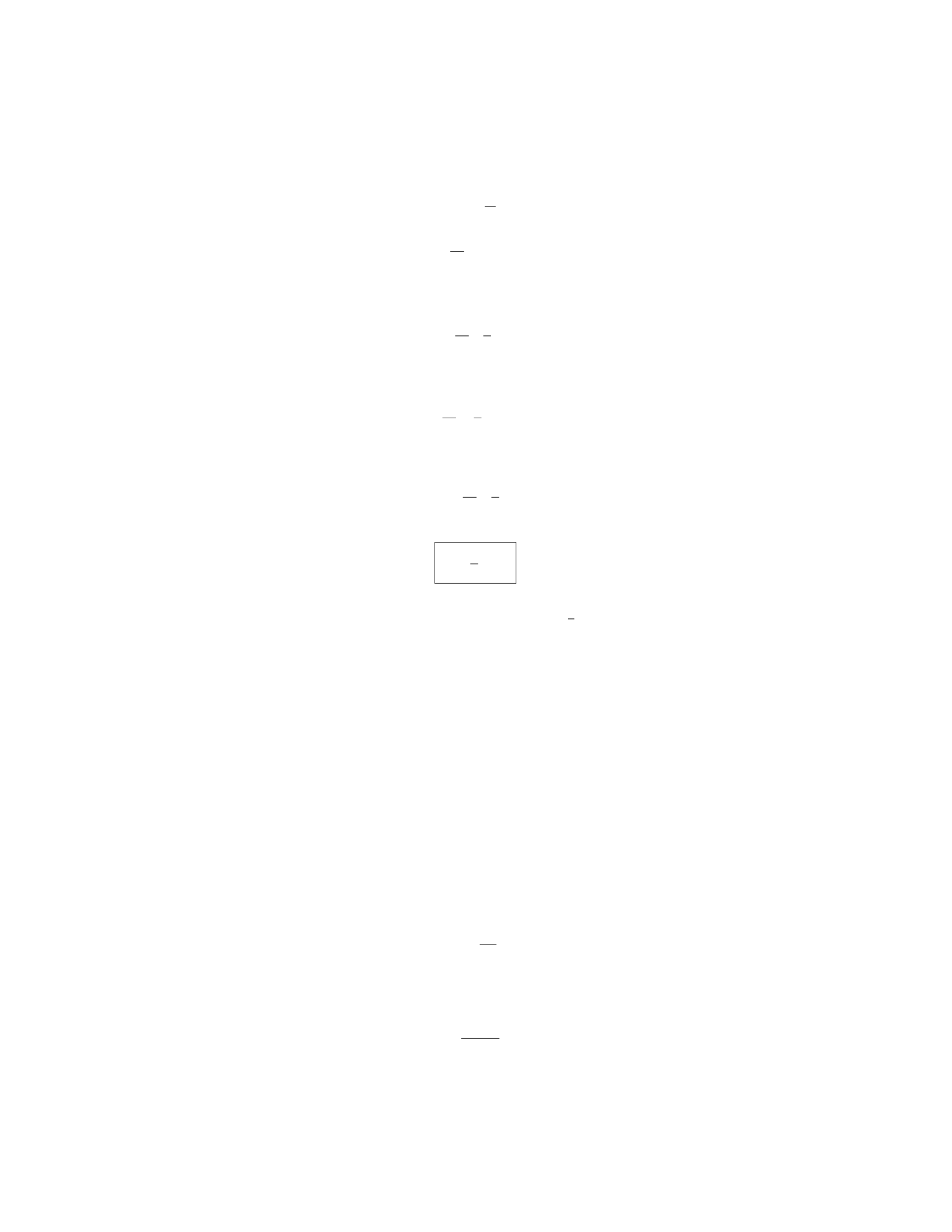
Step 1: Integrate the expression RL
0
m
Lx2dx.
I=m
LZL
0
x2dx
Step 2: Evaluate the integral:
I=m
L1
3x3L
0
Step 3: Substitute the limits of integration:
I=m
L1
3L3−0
Step 4: Simplify the expression:
I=m
L·1
3L3
Step 5:
I=1
3mL2
Therefore, the moment of inertia of the thin uniform rod about an axis
perpendicular to the rod passing through one end is 1
3mL2.
Question 8
Question
Find the moment of inertia of a thin rod of length Land mass Mabout an
axis passing through one end and perpendicular to the rod. Assume the rod has
constant density.
Solution
Given: Length of the rod, LMass of the rod, M
Let’s consider an elemental strip of width dx at a distance xfrom the end
of the rod.
Step 1: Determine the mass of the elemental strip. The mass of an elemental
strip dm is given by:
dm =M
Ldx
Step 2: Find the moment of inertia of the elemental strip. The moment
of inertia of an elemental strip about an axis perpendicular to the rod passing
through one end is:
dI =dm
L−x·x2
7

Substitute dm into the equation:
dI =M
L·dx
L·x2
L−x
Step 3: Integrate to find the total moment of inertia. Integrate dI from 0
to Lto find the total moment of inertia I:
I=ZL
0
M
L·x2
L−xdx
I=M
LZL
0
x2
L−xdx
Integration becomes easier by using partial fractions.
Step 4: Perform partial fraction decomposition. Write x2
L−xas A
L−x+B
(L−x)2.
Solving for Aand B, we get A=−L2
Land B=L2
L.
Step 5: Integrate the partial fractions. Now, integrate the partial fractions:
I=M
LZL
0−L2
L(L−x)+L2
L(L−x)2dx
I=−MZL
0
1
L−xdx +MZL
0
1
(L−x)2dx
I=−M[ln |L−x|]L
0+M−1
L−xL
0
I=−M[ln |0| − ln |L|] + M−1
0−L−−1
L
I=−Mln |L|+M1
L
I=ML
2
Question 9
Question
Find the moment of inertia of a thin rectangular plate of mass M, width a, and
length babout an axis passing through one of its corners and perpendicular to
the plate.
8

Solution
Step 1: Calculate the distance from the corner to the axis of rotation.
Let dbe the distance from the corner to the axis of rotation. This distance
can be calculated using the Pythagorean theorem:
d=pa2+b2
Step 2: Set up the integral for the moment of inertia.
The moment of inertia Ican be calculated by integrating over the mass
distribution of the rectangular plate. We can divide the plate into small rect-
angular strips parallel to the sides of length dx and thickness dy. The mass of
each strip dm is dm =M
ab dx ·dy. The moment of inertia of each strip about the
axis passing through the corner and perpendicular to the plate is dm ·d2.
Step 3: Set up the double integral for the moment of inertia.
The double integral for the moment of inertia can be set up as follows:
I=ZZ d2·dm
Step 4: Express dm in terms of dx and dy.
Since dx and dy are independent variables, dm can be expressed as follows:
dm =M
ab dx ·dy
Step 5: Substitute in the expression for dand integrate.
The moment of inertia can now be expressed as:
I=ZZ (pa2+b2)2·M
ab dx ·dy
I=ZZ M(a2+b2)
ab dx ·dy
Step 6: Evaluate the double integral to find the moment of inertia.
Integrating over the rectangle with sides of length aand b, we get:
I=M(a2+b2)
Therefore, the moment of inertia of the thin rectangular plate about the axis
passing through one of its corners and perpendicular to the plate is M(a2+b2).
Question 10
Question
Find the moment of inertia of a thin-walled hollow cylinder with mass M, inner
radius r1, and outer radius r2about its central axis.
9

Solution
Step 1: The moment of inertia of a thin-walled hollow cylinder about its central
axis can be calculated using the formula:
I=1
2Mr2
1+r2
2
Step 2: Since the mass Mof the hollow cylinder is distributed uniformly, we
can express Min terms of its volume and density. The volume of the cylinder
is given by the difference in the volumes of the outer and inner cylinders:
V=πr2
2−r2
1h
where his the height of the cylinder.
Step 3: If the density of the cylinder is ρ, then the mass Mis:
M=ρV =ρπ r2
2−r2
1h
Step 4: Substitute the expression for Minto the formula for the moment of
inertia I:
I=1
2ρπ r2
2−r2
1hr2
1+r2
2
Step 5: Simplify the expression to get the final moment of inertia of the
thin-walled hollow cylinder:
I=1
2πρh r4
1+r4
2
Question 11
Question
Find the moment of inertia of a thin rod of length Land mass Mabout an axis
perpendicular to the rod and passing through one end of the rod.
Solution
Step 1: Determine the mass per unit length of the rod.
The mass per unit length of the rod is given by M
L.
Step 2: Consider a small element of length dx and mass dm at a distance x
from the end where the axis passes through.
The mass of the element dm is given by dm =M
Ldx.
Step 3: Determine the moment of inertia of the element about the axis of
rotation.
The moment of inertia dI of the element about the axis of rotation is given by
dI =dm ·x2.
10

Step 4: Express the moment of inertia of the entire rod.
Integrating dI =M
Lx2dx over the length of the rod from 0 to L, we get
I=ZL
0
M
Lx2dx
Step 5: Evaluate the integral.
I=M
LZL
0
x2dx
=M
L1
3x3L
0
=M
L1
3L3−0
=1
3ML2
Therefore, the moment of inertia of the thin rod about an axis perpendicular
to the rod and passing through one end of the rod is 1
3ML2.
Question 12
Question
Calculate the moment of inertia of a thin rod of length Land mass Mabout
an axis perpendicular to the rod and passing through one of its ends.
Solution
Step 1: Begin by defining the moment of inertia for a particle of mass dm at a
distance rfrom the axis of rotation. This can be expressed as dI =r2dm.
Step 2: Express the mass dm in terms of the linear mass density λand a
small length element dx. We have dm =λdx.
Step 3: Determine the distance rof the small mass element dx from the axis
of rotation in terms of xand L. Since we are measuring from one end, r=L−x.
Step 4: Substitute dm and rinto the expression for dI to get dI = (L−
x)2λdx.
Step 5: Integrate dI over the length of the rod from x= 0 to x=Lto find
the total moment of inertia I:
I=ZL
0
dI =ZL
0
(L−x)2λdx
Step 6: Simplify the integral:
I=λZL
0
(L2−2Lx +x2)dx
11
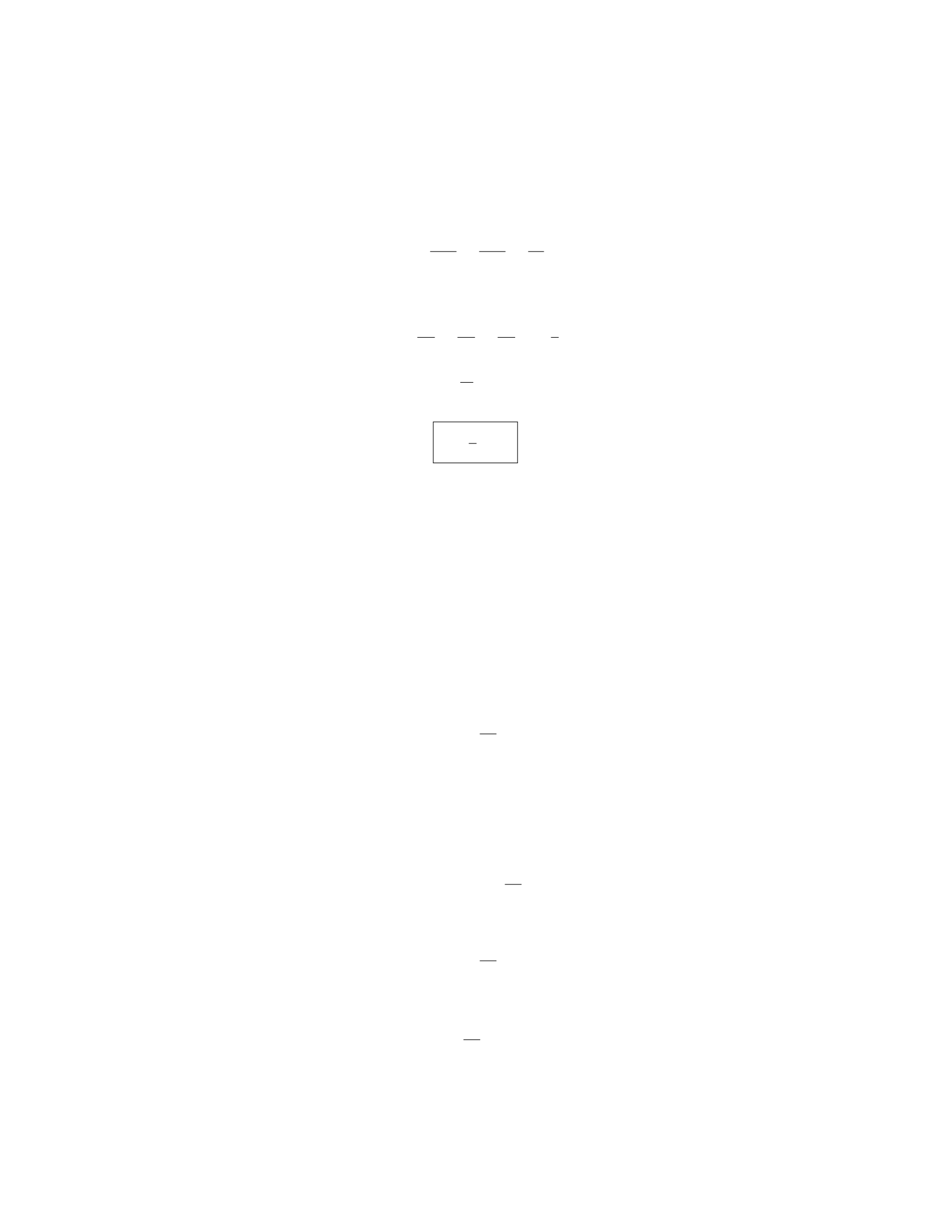
Step 7: Integrate term by term:
I=λL2x
3−Lx2
2+x3
3
L
0
Step 8: Evaluate the integral at the limits of integration:
I=λL3
3−L3
2+L3
3=1
3λL3
Step 9: Finally, recall that λ=M
L, so substitute this back in to find the
moment of inertia Iin terms of Mand L:
I=1
3ML2
Question 13
Question
A thin uniform rod of mass Mand length Lis rotating about an axis passing
through one of its ends and perpendicular to its length. Find the moment of
inertia of the rod about this axis.
Solution
Let’s consider an elemental mass dm at a distance xfrom the end through which
the axis passes. The mass dm of the element is given by:
dm =M
Ldx
The moment of inertia of this elemental mass about the axis is given by:
dI =dm ·x2
To find the total moment of inertia, we integrate dI over the length of the
rod:
I=ZdI =ZL
0
M
Lx2dx
Step 1: Calculate dm in terms of dx.
dm =M
Ldx
Step 2: Find dI in terms of dx.
dI =M
Ldx ·x2
12

Step 3: Integrate dI to find the total moment of inertia.
I=ZL
0
M
Lx2dx =M
LZL
0
x2dx
Step 4: Evaluate the integral.
I=M
L1
3x3L
0
=M
L1
3L3−0=1
3ML2
Therefore, the moment of inertia of the rod about the given axis is 1
3ML2.
Question 14
Question
Find the moment of inertia of a solid cone with height hand base radius R
about its central axis.
Solution
Step 1: Consider an elemental disk of radius xand thickness dx at a height x
from the vertex of the cone. The mass of this elemental disk can be expressed
in terms of its volume. Step 2: The volume of the elemental disk can be given
by dV =πx2dx. Step 3: The density of the cone is assumed to be constant,
so the mass of the elemental disk dm can be expressed as dm =ρdV , where
ρis the density of the cone. Step 4: Substituting dV into the expression for
dm, we get dm =ρπx2dx. Step 5: The moment of inertia dI of this elemental
disk about the central axis is given by dI =r2dm, where ris the distance of
the elemental disk from the axis. Step 6: Substituting r=xand dm =ρπx2dx
into the expression for dI, we get dI =ρπx4dx. Step 7: To find the total
moment of inertia Iof the cone, integrate dI from 0 to h. Step 8: Therefore,
I=Rh
0ρπx4dx. Step 9: Solving the integral, we get I=1
5ρπh5. Therefore,
the moment of inertia of a solid cone with height hand base radius Rabout its
central axis is 1
5ρπh5.
Question 15
Question
Find the moment of inertia of a solid cylinder of mass Mand radius Rabout
an axis passing through its center and perpendicular to its length.
13

Solution
Step 1: The moment of inertia for a solid cylinder of radius Rand mass M
about an axis passing through its center and perpendicular to its length can be
calculated using the formula I=1
2MR2.
Step 2: Given that the mass of the cylinder is Mand the radius is R, we
can substitute these values into the formula to find the moment of inertia:
I=1
2MR2
Therefore, the moment of inertia of a solid cylinder of mass Mand radius
Rabout an axis passing through its center and perpendicular to its length is
1
2MR2.
Question 16
Question
A thin rod of length Land mass Mis rotated around an axis perpendicular to
the rod and passing through one of its ends. Find the moment of inertia of the
rod about this axis.
Solution
To find the moment of inertia of the rod about the given axis, we will consider
each infinitesimal element of the rod and sum up their individual moments of
inertia.
Step 1: Consider an infinitesimal element of length dx at a distance xfrom
the end of the rod. The mass of this element can be expressed as dm =M
Ldx.
Step 2: The moment of inertia of this element about the given axis is given
by dI =r2dm, where ris the distance of the element from the axis of rotation.
In this case, r=x.
Step 3: Substituting dm and rinto the expression for dI, we get:
dI =x2M
Ldx
Step 4: To find the total moment of inertia of the rod, we integrate dI from
x= 0 to x=L:
I=ZL
0
x2M
Ldx
Step 5: Solving the integral, we get:
I=M
LZL
0
x2dx
14

I=M
Lx3
3L
0
I=M
LL3
3−0
I=M
3L2
Therefore, the moment of inertia of the rod about the given axis is M
3L2.
Question 17
Question
Find the moment of inertia of a solid cylinder of radius Rand mass Mabout
an axis perpendicular to the cylinder passing through its center.
Solution
Step 1: The moment of inertia of a solid cylinder about its central axis can be
calculated using the formula I=1
2MR2.
Step 2: The moment of inertia for a solid cylinder through its central axis is calculated by integrating the infinitesimal masses.
Step 3: Let’s consider an infinitesimally thin disc of radius rand thickness dr within the cylinder.
Step 4: The mass dm of this disc is dm =M
πR2·πr2·dr =M
R2·r2·dr.
Step 5: To find the moment of inertia about the central axis, we need to express the mass element dm in terms of the distance rfrom the central axis.
Step 6: The moment of inertia of this elemental disc about the central axis is dI =dm·r2=M
R2·r2·dr·r2=M
R2·r4·dr.
Step 7: Now, we integrate this over the entire cylinder:
I=ZR
0
M
R2·r4·dr =M
R2r5
5R
0
=M
R2·R5
5=1
5MR2.
Therefore, the moment of inertia of a solid cylinder of radius Rand mass Mabout an axis perpendicular to the cylinder passing through its center is 1
5MR2.
Question 18
Question
A thin uniform square plate of side length aand mass Mis rotated about an
axis through its center perpendicular to its plane. Calculate the moment of
inertia of the square plate with respect to this axis.
15
Solution
Let’s denote the moment of inertia of the square plate with respect to the axis
passing through its center and perpendicular to its plane as I. We can find I
by integrating the moment of inertia of each small element of the plate.
Step 1: Consider an infinitesimally small square element with side length dx
at a distance xfrom the center. The mass dm of this element can be expressed
as dm =ρ·dx ·dx, where ρ=M
a2is the mass per unit area of the plate.
Step 2: The moment of inertia dI of this small element about the axis is
given by dI =dm ·x2. Substituting the expression for dm into this equation,
we get dI =ρ·dx ·dx ·x2.
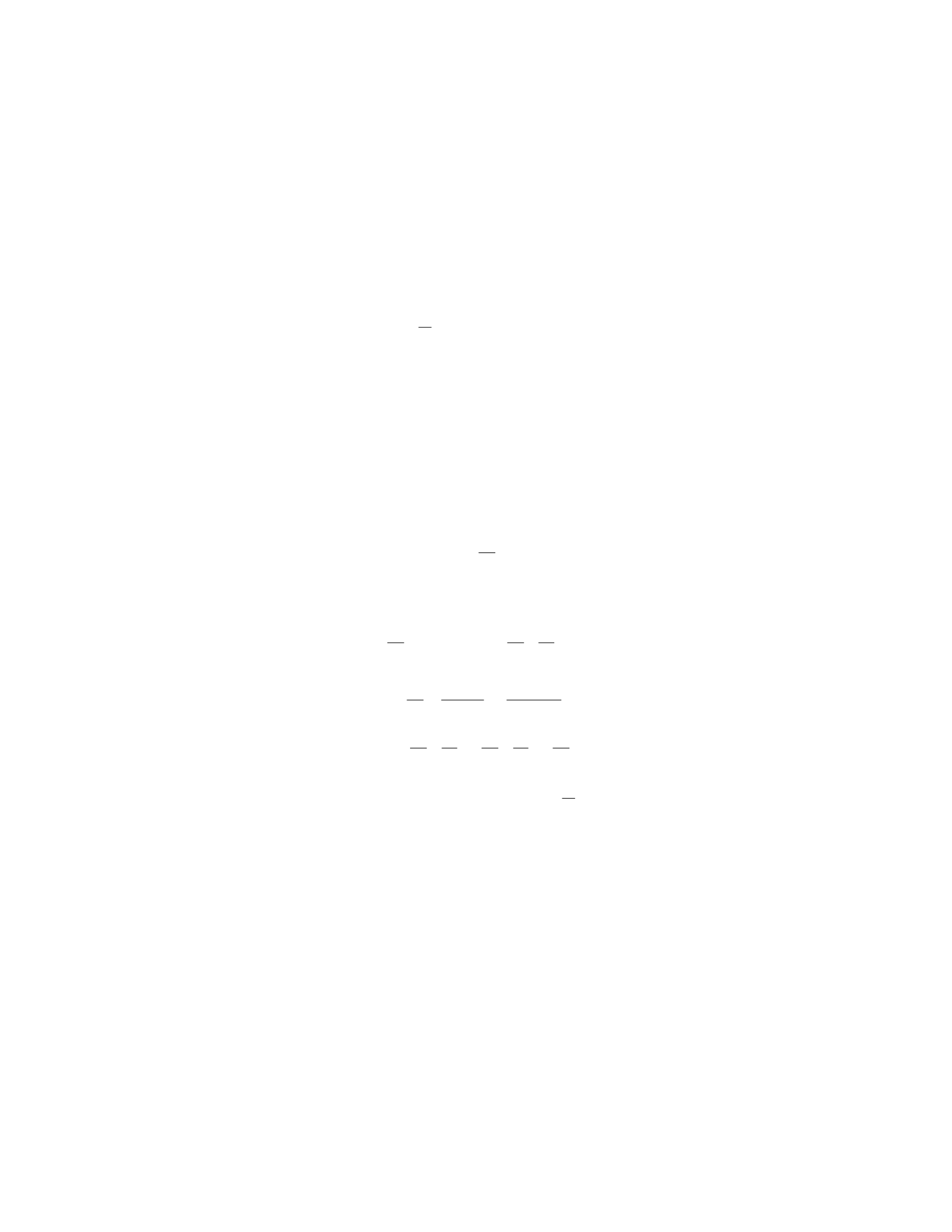
Step 3: To find the total moment of inertia I, we need to integrate dI over
the whole area of the plate.
I=Za/2
−a/2
dI =Za/2
−a/2
ρ·x2dx
Step 4: Substituting the expression for ρinto the integral, we have:
I=Za/2
−a/2
M
a2·x2dx
Step 5: Solving the integral, we get:
I=M
a2Za/2
−a/2
x2dx =M
a2x3
3a/2
−a/2
I=M
a2(a/2)3
3−(−a/2)3
3
I=M
a2·a3
24 =M
24 ·a2
a2=M
24
So, the moment of inertia of the square plate with respect to the axis passing
through its center and perpendicular to its plane is M
24 .
Question 19
Question
Find the moment of inertia of a thin uniform rod of length Land mass Mabout
an axis perpendicular to the rod passing through one of its ends.
Solution
Let’s consider the rod to be along the x-axis with one end at the origin (0,0)
and the other end at (L,0). To find the moment of inertia, we need to integrate
over the length of the rod.
16

Step 1: Identify the mass element. Let’s consider a small mass element δm
at a distance xfrom the origin. The mass of this element is proportional to its
length, so δm =M
Ldx.
Step 2: Find the moment of inertia of the mass element. The moment of
inertia of a mass element is given by dI = (δm)x2. Substituting δm into the
equation gives dI =M
Lx2dx.
Step 3: Integrate to find the total moment of inertia. Integrating over the
length of the rod gives the total moment of inertia:
I=ZL
0
M
Lx2dx
Step 4: Evaluate the integral.
I=M
LZL
0
x2dx =M
Lx3
3L
0
=M
LL3
3−0=M
3L2
Therefore, the moment of inertia of the thin uniform rod about an axis
perpendicular to the rod passing through one of its ends is M
3L2.
Question 20
Question
A thin rod of length Land mass Mis rotating about an axis passing through
one end of the rod perpendicular to the rod. Find the moment of inertia of the
rod about this axis.
Solution
Let’s consider a thin rod of length Land mass Mrotating about an axis passing
through one end of the rod perpendicular to the rod. We will determine the
moment of inertia of the rod about this axis.
Step 1: Identify the formula for moment of inertia of a rod rotating about
an axis passing through one end perpendicular to the rod. The formula for
the moment of inertia of a rod rotating about an axis passing through one end
perpendicular to the rod is given by:
I=1
3ML2
Step 2: Substitute the values into the formula. Given: Length of the rod,
L=LMass of the rod, M=M
Substitute these values into the formula:
I=1
3ML2
17

Step 3: Calculate the moment of inertia.
I=1
3ML2
Therefore, the moment of inertia of the rod about the axis passing through
one end perpendicular to the rod is 1
3ML2.
Question 21
Question
A thin rod of length Land mass Mis bent at its midpoint to form an L-shape.
The moment of inertia of the bent rod about an axis perpendicular to the plane
of the rod and passing through one end is given by:
I=1
6ML2
Determine the moment of inertia of the bent rod about an axis perpendicular
to the plane of the rod and passing through the corner where the rod is bent.
Solution
Step 1: The moment of inertia of the bent rod can be split into two parts: one
about the axis passing through the corner where the rod is bent (denoted as
Ibent) and the other about the axis passing through one end of the rod (denoted
as Iend). We are given the moment of inertia about the end axis to be 1
6ML2.
Step 2: According to the parallel axis theorem, the moment of inertia about
an axis parallel to and at a distance dfrom an axis passing through the center
of mass is given by:
Ibent =Icm +Md2
Step 3: The center of mass of the bent rod lies at the midpoint of the rod
where the rod is bent. The distance from this center of mass to the corner where
the rod is bent is half the length of the rod, L
2.
Step 4: Substitute the values into the parallel axis theorem equation:
Ibent =1
6ML2+ML
22
Step 5: Simplify the expression:
Ibent =1
6ML2+1
4ML2
Step 6: Combine the terms:
Ibent =5
12ML2
18

Step 7: Therefore, the moment of inertia of the bent rod about an axis
perpendicular to the plane of the rod and passing through the corner where the
rod is bent is 5
12 ML2.
Question 22
Question
A thin rod of length Land mass Mis rotating about an axis perpendicular to
the rod and passing through one end with angular velocity ω. Calculate the
moment of inertia of the rod about this axis.
Solution
Step 1: Consider a small element of length dx at a distance xfrom the axis of
rotation. The mass of this element dm is given by:
dm =M
Ldx
Step 2: The moment of inertia dI of this element about the axis of rotation
is given by:
dI =dm ·x2
Step 3: Substituting the expression for dm into the moment of inertia equa-
tion gives:
dI =M
Ldx ·x2
Step 4: To find the total moment of inertia I, we integrate dI from 0 to L:
I=ZL
0
dI =ZL
0
M
Lx2dx
Step 5: Solving the integral gives:
I=M
LZL
0
x2dx
Step 6: Integrating x2with respect to x:
I=M
Lx3
3L
0
Step 7: Evaluating the integral at the limits:
I=M
LL3
3−03
3=M
LL3
3
Step 8: Simplifying the expression gives the moment of inertia of the rod
about the given axis as:
I=ML2
3
19

Question 23
Question
A uniform rod of length Land mass Mis rotated about an axis perpendicular
to the rod and passing through one end of the rod. Calculate the moment of
inertia of the rod about this axis.
Solution
Step 1: Consider a small element of length dx at a distance xfrom the axis of
rotation. The mass of this element dm can be expressed as:
dm =M
Ldx
Step 2: The moment of inertia of this element about the axis of rotation is
given by:
dI =dm ·x2=M
Lx2dx
Step 3: To find the total moment of inertia of the rod, we integrate dI from
x= 0 to x=L:
I=ZL
0
M
Lx2dx
Step 4: Solving the integral:
I=M
LZL
0
x2dx
I=M
Lx3
3L
0
I=M
LL3
3
I=ML2
3
Step 5: Therefore, the moment of inertia of the rod about the given axis is
ML2
3.
Question 24
Question
A thin rectangular plate of dimensions 2 m by 3 m is rotated about an axis
passing through one of its corners and perpendicular to the plane of the plate.
Find the moment of inertia of the plate about this axis.
20

Solution
Step 1: Let’s label the axes as follows: the x-axis goes along the 3m side of
the plate, the y-axis goes along the 2m side of the plate, and the z-axis is
perpendicular to the plate and passes through the corner of the plate. The
plate will rotate about the z-axis, which passes through the corner where the
x-axis and y-axis intersect.
Step 2: The moment of inertia of a thin rectangular plate about an axis
passing through one of its corners and perpendicular to the plane of the plate
is given by the formula:
I=1
3m(a2+b2)
where: - mis the mass of the plate, - ais the length of the side of the plate
perpendicular to the axis of rotation (in this case, 3 m), and - bis the length of
the side of the plate parallel to the axis of rotation (in this case, 2 m).
Step 3: To find the mass mof the plate, we need to know the area density
σ(mass per unit area) of the plate.
Step 4: The total area of the plate is given by:
A= 2 ×3 = 6 m2
Step 5: Assuming the plate has uniform density, the mass mof the plate is
given by:
m=σ×A
Step 6: Let’s substitute the values of A,a, and binto the formula for the
moment of inertia:
I=1
3(σ×A)(a2+b2) = 1
3(σ×6)(32+ 22)
Step 7: Simplifying further, we get:
I=1
3(σ×6)(9 + 4) = 1
3(σ×6)(13) = 26σ
Therefore, the moment of inertia of the plate about the given axis is 26σ.
Question 25
Question
Find the moment of inertia of a solid cylinder with radius Rand height habout
an axis passing through its center and perpendicular to its circular base.
21

Solution
Let’s consider the solid cylinder with radius Rand height h. We can find the
moment of inertia about the central axis by integrating over the volume of the
cylinder.
Step 1: Divide the cylinder into thin disk-shaped slices along its height.
Let’s consider a thin disk-shaped slice with radius r, thickness dr, and dis-
tance yfrom the central axis. The mass of this slice can be represented as
dm =ρdV =ρA dr, where ρis the density of the cylinder and Ais the area of
the disk slice.
Step 2: Find the moment of inertia dI of this disk slice about the central
axis.
The moment of inertia of a thin disk-shaped slice about an axis passing
through its center and perpendicular to its circular base is dI =1
2r2dm.
Substitute dm into the equation and simplify:
dI =1
2r2ρA dr =1
2r2ρπr2dr
Step 3: Integrate dI to find the total moment of inertia Iof the cylinder.
Integrate dI over the entire volume of the cylinder:
I=ZdI =ZR
0
1
2r2ρπr2dr
I=1
2ρπ ZR
0
r4dr
I=1
10ρπR5
Hence, the moment of inertia of the solid cylinder about the central axis is
1
10 ρπR5.
Question 26
Question
A thin rod of length Land mass Mis rotating about an axis passing through
one of its ends perpendicular to its length, with an angular velocity ω. Find
the moment of inertia of the rod about an axis passing through its center and
perpendicular to its length.
Solution
Step 1: Let’s denote the moment of inertia of the rod about an axis passing
through its center and perpendicular to its length as I.
22

Step 2: We know that the moment of inertia of a point mass mat a distance
rfrom an axis of rotation is given by Ipoint =mr2.
Step 3: To find the moment of inertia of the rod, we need to consider each
infinitesimally small mass element dm of the rod and sum up its contributions
to the total moment of inertia.
Step 4: Let’s consider a small mass element dm of the rod at a distance x
from the center of the rod. The mass of this element dm can be expressed as
dm =M
Ldx.
Step 5: The moment of inertia dI of this mass element about the center of
the rod is dI =dm ·x2=M
Ldx·x2.
Step 6: Now, we can integrate dI from −L/2 to L/2 to find the total moment
of inertia I:
I=ZL/2
−L/2
dI =ZL/2
−L/2M
Ldx·x2.
Step 7: Evaluating the integral, we get:
I=M
LZL/2
−L/2
x2dx.
Step 8: Solving the integral, we find:
I=M
Lx3
3L/2
−L/2
=M
3LL3
8−(−L)3
8.
Step 9: Simplifying further, we get:
I=M
3LL3
8+L3
8
= M L2
12.
Step 10: Therefore, the moment of inertia of the rod about an axis passing
through its center and perpendicular to its length is 1
12 ML2.
Question 27
Question
A thin uniform rod of length Land mass Mis bent into a quarter circle, with
the radius of the quarter circle being R. Find the moment of inertia of this bent
rod about an axis passing through one end of the rod and perpendicular to the
plane of the quarter circle.
Solution
Step 1: The bent rod can be thought of as a combination of two shapes: a
line segment and a quarter circle. The moment of inertia of the line segment
23

is 1
3ML2, and the moment of inertia of the quarter circle about its diameter is
1
2MR2. We will now find the distance between the axis passing through one
end of the rod and each shape’s center of mass.
Step 2: The center of mass of the line segment is located at L
2from the end
of the rod. The center of mass of the quarter circle lies at a distance of 2R
πalong
the diameter from the point where the axis passes through.
Step 3: To find the effective moment of inertia about the given axis, we
need to use the parallel axis theorem. The moment of inertia of the two shapes
summed together is I=1
3ML2+1
2MR2.
Step 4: The distance between the axis and the center of mass of the line
segment is L
2, so the contribution of the line segment to the total moment of
inertia is 1
3ML2×L
22.
Step 5: The distance between the axis and the center of mass of the quarter
circle is 2R
π, so the contribution of the quarter circle to the total moment of
inertia is 1
2MR2×2R
π2.
Step 6: Adding the contributions of the line segment and quarter circle, we
have: I=1
3ML2×L
22+1
2MR2×2R
π2.
Step 7: Simplifying the expression, we get: I=1
3ML2×L2
4+1
2MR2×4R2
π2.
Step 8: Further simplifying gives us the final result:
I=1
12ML2+2
π2MR2
Question 28
Question
Find the moment of inertia of a thin rod of mass mand length Labout an axis
passing through one end of the rod and perpendicular to the rod.
Solution
Step 1: The moment of inertia of a continuous system can be calculated by
integrating the product of the square of the distance from the axis of rotation
to the mass element and the mass element. Let’s consider a small mass element
of length dx at a distance xfrom the axis passing through one end of the rod.
Step 2: The mass dm of the element is given by dm =m
Ldx, where m
Lis the
linear mass density of the rod.
Step 3: The moment of inertia element dI for this mass element is dI =
x2dm.
Step 4: Substituting dm =m
Ldx into the expression for dI, we get:
dI =x2m
Ldx
24

Step 5: Integrate the expression for dI from x= 0 to x=Lto find the total
moment of inertia I:
I=ZL
0
dI
=ZL
0
x2m
Ldx
=m
L
x3
3L
0
=m
3L(L3−0)
=mL2
3
Step 6: Therefore, the moment of inertia of the thin rod about an axis
passing through one end of the rod and perpendicular to the rod is mL2
3.
Question 29
Question
A thin uniform rod of length Land mass Mis rotating about an axis passing
through one end perpendicular to the rod. Find the moment of inertia of the
rod about this axis.
Solution
Let’s consider an elemental mass dm at a distance xfrom the axis of rotation.
The mass of this element can be expressed as dm =M
Ldx.
Step 1: Write the expression for the moment of inertia of the elemental
mass. The moment of inertia dI of the elemental mass about the given axis is
dI =dm ·x2=M
Lx2dx.
Step 2: Integrate to find the total moment of inertia. To find the total
moment of inertia I, we integrate the expression for dI over the length of the
rod:
I=ZL
0
M
Lx2dx
Step 3: Simplify the integral.
I=M
LZL
0
x2dx =M
Lx3
3L
0
=M
3LL3−03=M
3L2
Step 4: Evaluate the final expression. Therefore, the moment of inertia of
the rod about the given axis is M
3L2.
25

Question 30
Question
A thin rod of length Lis bent at its midpoint to form a right angle. Find the
moment of inertia of this bent rod about an axis passing through one end of the
rod and perpendicular to the plane of the bent rod.
Solution
Step 1: Consider the two parts of the bent rod separately. We will calculate the
moment of inertia for each part of the rod and then sum the results to find the
total moment of inertia.
Step 2: Moment of inertia for the straight part of the rod. Let’s denote the
mass per unit length of the rod as λ.
The moment of inertia for a uniform rod of length L/2 and mass per unit
length λabout an axis passing through one end and perpendicular to the rod
is given by:
I1=1
3ml2=1
3(λL
2)(L
2)2=1
24λL3
Step 3: Moment of inertia for the bent part of the rod. Since the bent part
is a right triangle with dimensions L
2and L
2, we can consider it as two rectangles
with dimensions L
2and L
4.
The moment of inertia for each rectangle about an axis through its center
and perpendicular to its plane is given by:
I2=1
12ml2=1
12(λL
2)(L
4)2=1
96λL3
Step 4: Total moment of inertia. The total moment of inertia is the sum of
the moment of inertia for each part:
Itotal =I1+ 2I2=1
24λL3+ 2( 1
96λL3) = 1
12λL3
Therefore, the moment of inertia of the bent rod about the specified axis is
1
12 λL3.
Question 31
Question
Find the moment of inertia of a thin rod of length Land mass M, rotating
about an axis perpendicular to the rod and passing through one end of the rod.
26

Solution
Step 1: Divide the rod into small elements ∆miof length ∆xi.
Step 2: The moment of inertia of each element ∆Iiis given by dIi=
∆mi(∆xi)2.
Step 3: To find ∆mi, express it in terms of the linear mass density λ=M
L
and ∆xi:
∆mi=λ∆xi.
Step 4: Substitute ∆mi=λ∆xiinto the expression for ∆Iito get:
∆Ii=λ(∆xi)3.
Step 5: The total moment of inertia Iis the sum of the moments of inertia
of all small elements:
I=X∆Ii=λX(∆xi)3.
Step 6: Replace the sum with an integral to find the total moment of inertia:
I=ZL
0
λx2dx.
Step 7: Evaluate the integral:
I=λx3
3L
0
.
Step 8: Simplify the expression:
I=1
3λL3.
Step 9: Substitute λ=M
Lto find the moment of inertia I:
I=1
3M
LL3=1
3ML2.
Therefore, the moment of inertia of the thin rod rotating about an axis
perpendicular to the rod and passing through one end of the rod is 1
3ML2.
Question 32
Question
Determine the moment of inertia of a solid cylinder of radius Rand mass M
about an axis passing through its center perpendicular to its length.
27

Solution
Let’s consider a solid cylinder of radius Rand mass M. The moment of iner-
tia Iabout an axis passing through its center perpendicular to its length can
be calculated by integrating the area density function over the volume of the
cylinder.
Step 1: First, we need to determine the area density function of the cylinder.
The volume density function ρcan be defined as M
V, where V=πR2his the
volume of the cylinder and his the height of the cylinder.
Step 2: The elemental mass dm for an elemental volume dV =πR2dy is
given by dm =ρdV . Substituting the values, we get dm =M
πR2hπR2dy =M
hdy.
Step 3: The elemental moment of inertia dI for this elemental mass dm
about an axis passing through its center and perpendicular to its length is given
by dI =r2dm, where ris the perpendicular distance between the elemental
mass dm and the axis of rotation.
Step 4: Since the elemental mass dm is located at a distance yfrom the
axis of rotation, the perpendicular distance is r=pR2+y2. Substituting
r=pR2+y2and dm =M
hdy into the formula for dI, we get
dI = (pR2+y2)2M
hdy.
Step 5: Integrating dI from −h/2 to h/2 to consider the whole volume of
the cylinder, we have
I=Zh/2
−h/2
(pR2+y2)2M
hdy.
Step 6: Solving the integral, we get
I=M
hZh/2
−h/2
(R2+y2)dy.
I=M
h R2Zh/2
−h/2
dy +Zh/2
−h/2
y2dy!.
I=M
h R2(h) + 1
3y3
h/2
−h/2!.
I=M
h R2(h) + 1
3h
23
−1
3−h
23!.
I=M
hR2h+h3
24 +h3
24 .
I=M
hR2h+h3
12 .
28

I=MR2
h+h
12.
Therefore, the moment of inertia of the solid cylinder about the given axis
is MR2
h+h
12 .
Question 33
Question
A thin, uniform rod of length Land mass Mis rotating about an axis per-
pendicular to the rod and passing through one end. Determine the moment of
inertia of the rod about this axis.
Solution
Let’s consider the rod as a collection of small mass elements dm. The moment
of inertia of the entire rod can then be found by summing up the moments of
inertia of all these small mass elements.
Step 1: Express the differential mass element dm in terms of dx. The mass
of the rod is uniformly distributed, so the linear mass density λis given by
λ=M
L.
The differential mass element dm is given by
dm =λ dx =M
Ldx.
Step 2: Express the moment of inertia of the differential mass element dI.
The moment of inertia of a differential mass element dI about the axis passing
through one end is given by
dI =r2dm,
where ris the distance of dm from the axis of rotation. For this rod, r=x(the
distance from the end of the rod), so
dI =x2M
Ldx.
Step 3: Integrate the expression for dI to find the total moment of inertia
Iof the rod. Integrating both sides, we get
ZdI =Zx2·M
Ldx.
I=M
LZL
0
x2dx.
29

I=M
Lx3
3L
0
.
I=M
LL3
3−0.
I=M
L·L3
3.
I=1
3ML2.
Therefore, the moment of inertia of the rod about the axis passing through
one end is 1
3ML2.
Question 34
Question
A thin rod of mass Mand length Lis rotating about an axis passing through
one end perpendicular to the rod. Find the moment of inertia of the rod about
this axis.
Solution
Let’s consider an elemental mass dm of the rod located at a distance xfrom the
end of the rod where the axis of rotation passes. The length of this elemental
mass is dx. The moment of inertia dI of this elemental mass about the axis can
be calculated as dm ·x2.
Step 1: Setting up the integral
I=ZdI
=Zx2dm
Step 2: Expressing dm in terms of dx We know that mass per unit
length λ=M
L. So, dm =λ·dx.
30

Step 3: Substituting into the integral
I=Zx2(λ dx)
=λZx2dx
=λ1
3x3L
0
=λ1
3L3
=1
3λL3
=1
3M
LL3
=1
3ML2
Therefore, the moment of inertia of the thin rod about the given axis is
1
3ML2.
Question 35
Question
A thin rod of length Land mass Mis rotated about one end with an angular
speed ω. Find the moment of inertia of the rod about an axis perpendicular to
the rod passing through its center of mass.
Solution
Step 1: The moment of inertia of a straight rod rotating about an axis perpen-
dicular to the rod through one end is given by the formula I=1
3ML2.
Step 2: To find the moment of inertia about an axis perpendicular to the rod
passing through its center of mass, we will use the parallel axis theorem which
states Inew =Icm +MD2, where Inew is the moment of inertia about a new
axis, Icm is the moment of inertia about the center of mass, Dis the distance
between the two axes, and Mis the mass of the object.
Step 3: Since the axis passing through the center of mass is located at the
midpoint of the rod, the distance Dbetween the two axes is L/2.
Step 4: The moment of inertia about the center of mass is Icm =1
12 ML2for
a rod rotating about its center.
Step 5: Substituting Icm =1
12 ML2,M, and D=L/2 into the parallel axis
theorem equation, we get
Inew =1
12ML2+ML2/4 = 1
3ML2.
31

Question 2
Question
Find the moment of inertia of a thin rod of length Land mass Mabout an axis
perpendicular to the rod and passing through one of its ends.
Solution
To find the moment of inertia of the thin rod about an axis passing through
one of its ends and perpendicular to the rod, we can use the formula for the
moment of inertia of a continuous distribution of mass:
I=Zr2dm
To express dm in terms of dx (an element of length along the rod), we note
that dm
dx represents the mass per unit length of the rod. Since the mass of the
rod is Mand its length is L, we have dm
dx =M
L. Thus, dm =M
Ldx.
Now, consider a small element of the rod of length dx at a distance xfrom
the end of the rod. The distance of this element from the axis of rotation passing
through the end of the rod is r=x. Therefore, the moment of inertia of this
element is dI =r2×dm =x2×M
Ldx.
Since the rod extends from x= 0 to x=L, we integrate these contributions
over the length of the rod to find the total moment of inertia:
I=ZL
0
x2×M
Ldx
Step 1: Simplify the expression inside the integral.
The integral becomes:
I=M
LZL
0
x2dx
Step 2: Perform the integration.
I=M
Lx3
3L
0
I=M
LL3
3−03
3
I=M
L×L3
3
I=ML2
3
Therefore, the moment of inertia of the thin rod about an axis passing
through one of its ends and perpendicular to the rod is ML2
3.
2

Question 3
Question
Find the moment of inertia about the x-axis of the region bounded by the curves
y=x2and y=x3.
Solution
Step 1: First, we need to find the points of intersection of the two curves. Setting
x2=x3, we find the points where the curves intersect:
x3−x2= 0
x2(x−1) = 0
This gives x= 0 and x= 1.
Step 2: To find the moment of inertia about the x-axis, we will use the
formula:
Ix=Zb
a
y2dx
Where aand bare the x-values of the points of intersection.
Step 3: We need to express yin terms of xfor the given curves. Since the
region is bounded by y=x2and y=x3,y=x2is the upper curve and y=x3
is the lower curve. Thus, y=x2and y=x3are the respective yexpressions.
Step 4: The moment of inertia about the x-axis is given by:
Ix=Z1
0
(x2−x3)2dx
Step 5: Simplify the integrand and then integrate:
Ix=Z1
0
(x4−2x5+x6)dx
Ix=1
5x5−1
3x6+1
7x71
0
Ix=1
5−1
3+1
7−(0)
Ix=24
105 =8
35
Therefore, the moment of inertia about the x-axis of the region bounded by
the curves y=x2and y=x3is 8
35 .
3

Question 4
Question
Calculate the moment of inertia of a uniform rod of mass Mand length Labout
an axis perpendicular to the rod and passing through one end of the rod.
Solution
Let’s consider a rod of mass Mand length L. The moment of inertia of the rod
about an axis perpendicular to the rod and passing through one end of the rod
can be calculated using the formula:
I=Zr2dm
where ris the distance of an element of mass dm from the axis of rotation.
Step 1: We can express dm in terms of Mand dx (the length element along
the rod). Since the rod is of uniform mass distribution, the mass per unit length
is M/L, so dm =M
Ldx.
Step 2: Next, we need to express rin terms of x(position along the rod).
The distance rof an element dx from the end of the rod is given by r=L−x.
Step 3: Substitute r=L−xand dm =M
Ldx into the formula for moment
of inertia:
I=Z(L−x)2M
Ldx
Step 4: Simplify the integrand:
I=ZM
L(L2−2Lx +x2)dx
I=Z(M−2mx +nx2)dx
where m=M
Land n=M
L2.
Step 5: Integrate the expression to find the moment of inertia:
I=Mx −mx2+n
3x3+C
Step 6: Evaluate the integral from 0 to L:
I=M(L)−m(L2) + n
3L3−(0 −m·02+n
3·03)
I=ML −ML +M
3L3
I=1
3ML2
4

Hence, the moment of inertia of the uniform rod about an axis perpendicular
to the rod and passing through one end of the rod is 1
3ML2.
Question 5
Question
Calculate the moment of inertia of a thin rod of length Land mass M, rotating
about an axis perpendicular to the rod and passing through one end.
Solution
Step 1: Consider an element of the rod of length dx at a distance xfrom the
end. The mass of this element is M
Ldx.
Step 2: The moment of inertia dI of this element about the end of the rod
is given by dI =M
Ldxx2.
Step 3: Integrating over the length of the rod, we get the total moment of
inertia I:
I=ZL
0M
Lx2dx
Step 4: Solving the integral, we have:
I=M
LZL
0
x2dx
=M
L1
3x3L
0
=M
L1
3L3−1
3×03
=M
L1
3L3
=1
3ML2
Step 5: Therefore, the moment of inertia of the rod rotating about an axis
perpendicular to the rod and passing through one end is 1
3ML2.
Question 6
Question
A thin uniform rod of length Land mass Mis rotated about an axis perpen-
dicular to the rod and passing through one end of the rod. Find the moment of
inertia of the rod about this axis.
5

Solution
Let’s denote the moment of inertia of the rod about the given axis as I.
Step 1: Divide the rod into infinitesimally small elements of length dx and
mass dm.
Mass of the element, dm =M
Ldx
Step 2: The moment of inertia of the element about the given axis is given
by dI =r2dm, where ris the perpendicular distance of the element from the
axis.
Step 3: For the element at a distance xfrom the end of the rod, r=L−x.
Step 4: Substitute dm =M
Ldx and r=L−xinto the equation for dI to
get dI = (L−x)2M
Ldx.
Step 5: Integrate dI from 0 to Lto find the total moment of inertia Iof
the rod about the given axis.
I=ZL
0
(L−x)2M
Ldx
Step 6: Simplify the integral and solve for I.
I=1
3ML2
Therefore, the moment of inertia of the rod about the given axis is 1
3ML2.
Question 7
Question
Calculate the moment of inertia of a thin uniform rod of mass mand length L
about an axis perpendicular to the rod passing through one end.
Solution
Let’s divide the rod into small elements ∆mof length ∆xat a distance xfrom
the end where the axis passes through. The mass of each element is given by
∆m=m
L∆x. The distance of this element from the axis passing through one
end is x.
The moment of inertia of each element is given by dI = ∆m·x2=m
L∆x·x2.
The total moment of inertia of the rod can be found by integrating this
expression from 0 to L:
I=ZL
0
m
Lx2dx
6
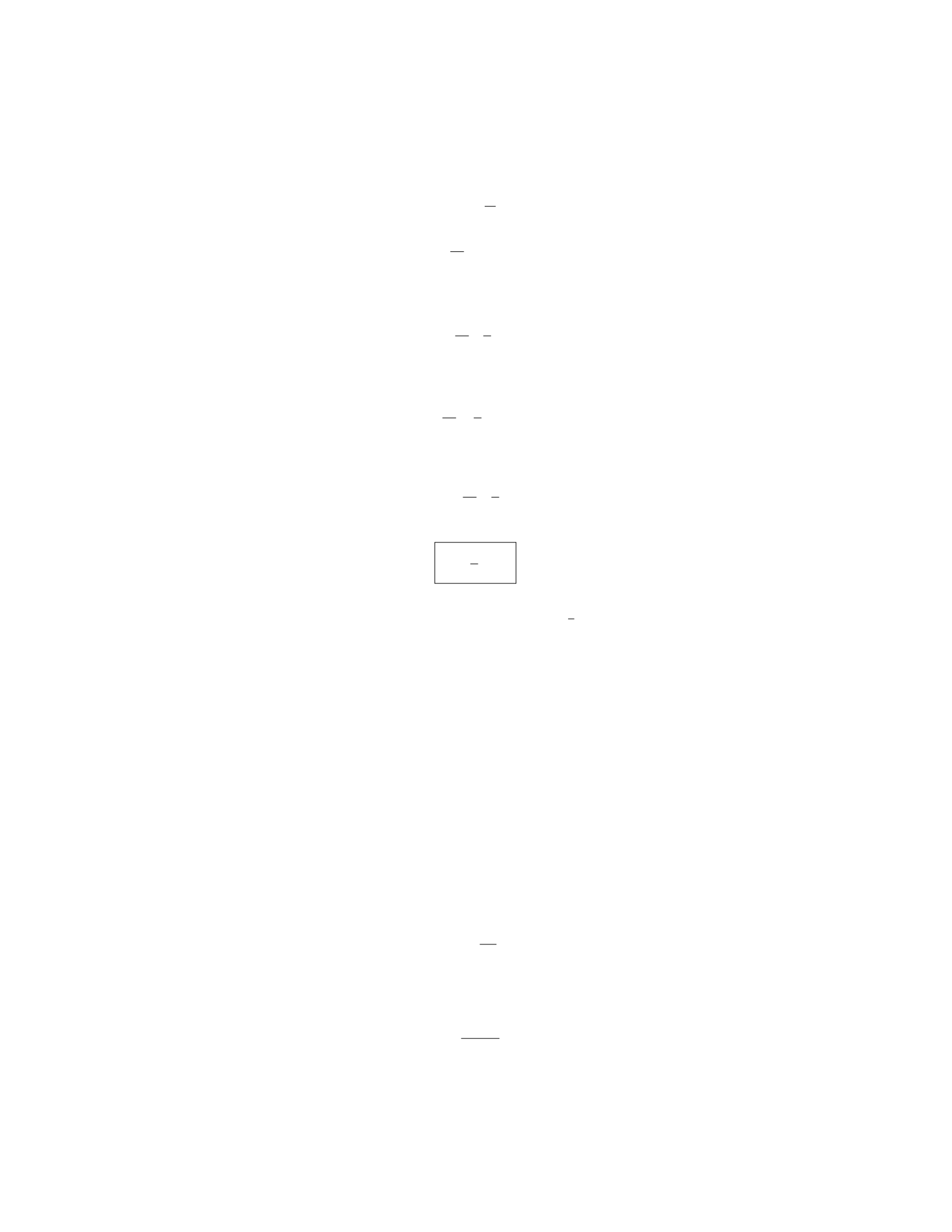
Step 1: Integrate the expression RL
0
m
Lx2dx.
I=m
LZL
0
x2dx
Step 2: Evaluate the integral:
I=m
L1
3x3L
0
Step 3: Substitute the limits of integration:
I=m
L1
3L3−0
Step 4: Simplify the expression:
I=m
L·1
3L3
Step 5:
I=1
3mL2
Therefore, the moment of inertia of the thin uniform rod about an axis
perpendicular to the rod passing through one end is 1
3mL2.
Question 8
Question
Find the moment of inertia of a thin rod of length Land mass Mabout an
axis passing through one end and perpendicular to the rod. Assume the rod has
constant density.
Solution
Given: Length of the rod, LMass of the rod, M
Let’s consider an elemental strip of width dx at a distance xfrom the end
of the rod.
Step 1: Determine the mass of the elemental strip. The mass of an elemental
strip dm is given by:
dm =M
Ldx
Step 2: Find the moment of inertia of the elemental strip. The moment
of inertia of an elemental strip about an axis perpendicular to the rod passing
through one end is:
dI =dm
L−x·x2
7

Substitute dm into the equation:
dI =M
L·dx
L·x2
L−x
Step 3: Integrate to find the total moment of inertia. Integrate dI from 0
to Lto find the total moment of inertia I:
I=ZL
0
M
L·x2
L−xdx
I=M
LZL
0
x2
L−xdx
Integration becomes easier by using partial fractions.
Step 4: Perform partial fraction decomposition. Write x2
L−xas A
L−x+B
(L−x)2.
Solving for Aand B, we get A=−L2
Land B=L2
L.
Step 5: Integrate the partial fractions. Now, integrate the partial fractions:
I=M
LZL
0−L2
L(L−x)+L2
L(L−x)2dx
I=−MZL
0
1
L−xdx +MZL
0
1
(L−x)2dx
I=−M[ln |L−x|]L
0+M−1
L−xL
0
I=−M[ln |0| − ln |L|] + M−1
0−L−−1
L
I=−Mln |L|+M1
L
I=ML
2
Question 9
Question
Find the moment of inertia of a thin rectangular plate of mass M, width a, and
length babout an axis passing through one of its corners and perpendicular to
the plate.
8

Solution
Step 1: Calculate the distance from the corner to the axis of rotation.
Let dbe the distance from the corner to the axis of rotation. This distance
can be calculated using the Pythagorean theorem:
d=pa2+b2
Step 2: Set up the integral for the moment of inertia.
The moment of inertia Ican be calculated by integrating over the mass
distribution of the rectangular plate. We can divide the plate into small rect-
angular strips parallel to the sides of length dx and thickness dy. The mass of
each strip dm is dm =M
ab dx ·dy. The moment of inertia of each strip about the
axis passing through the corner and perpendicular to the plate is dm ·d2.
Step 3: Set up the double integral for the moment of inertia.
The double integral for the moment of inertia can be set up as follows:
I=ZZ d2·dm
Step 4: Express dm in terms of dx and dy.
Since dx and dy are independent variables, dm can be expressed as follows:
dm =M
ab dx ·dy
Step 5: Substitute in the expression for dand integrate.
The moment of inertia can now be expressed as:
I=ZZ (pa2+b2)2·M
ab dx ·dy
I=ZZ M(a2+b2)
ab dx ·dy
Step 6: Evaluate the double integral to find the moment of inertia.
Integrating over the rectangle with sides of length aand b, we get:
I=M(a2+b2)
Therefore, the moment of inertia of the thin rectangular plate about the axis
passing through one of its corners and perpendicular to the plate is M(a2+b2).
Question 10
Question
Find the moment of inertia of a thin-walled hollow cylinder with mass M, inner
radius r1, and outer radius r2about its central axis.
9

Solution
Step 1: The moment of inertia of a thin-walled hollow cylinder about its central
axis can be calculated using the formula:
I=1
2Mr2
1+r2
2
Step 2: Since the mass Mof the hollow cylinder is distributed uniformly, we
can express Min terms of its volume and density. The volume of the cylinder
is given by the difference in the volumes of the outer and inner cylinders:
V=πr2
2−r2
1h
where his the height of the cylinder.
Step 3: If the density of the cylinder is ρ, then the mass Mis:
M=ρV =ρπ r2
2−r2
1h
Step 4: Substitute the expression for Minto the formula for the moment of
inertia I:
I=1
2ρπ r2
2−r2
1hr2
1+r2
2
Step 5: Simplify the expression to get the final moment of inertia of the
thin-walled hollow cylinder:
I=1
2πρh r4
1+r4
2
Question 11
Question
Find the moment of inertia of a thin rod of length Land mass Mabout an axis
perpendicular to the rod and passing through one end of the rod.
Solution
Step 1: Determine the mass per unit length of the rod.
The mass per unit length of the rod is given by M
L.
Step 2: Consider a small element of length dx and mass dm at a distance x
from the end where the axis passes through.
The mass of the element dm is given by dm =M
Ldx.
Step 3: Determine the moment of inertia of the element about the axis of
rotation.
The moment of inertia dI of the element about the axis of rotation is given by
dI =dm ·x2.
10

Step 4: Express the moment of inertia of the entire rod.
Integrating dI =M
Lx2dx over the length of the rod from 0 to L, we get
I=ZL
0
M
Lx2dx
Step 5: Evaluate the integral.
I=M
LZL
0
x2dx
=M
L1
3x3L
0
=M
L1
3L3−0
=1
3ML2
Therefore, the moment of inertia of the thin rod about an axis perpendicular
to the rod and passing through one end of the rod is 1
3ML2.
Question 12
Question
Calculate the moment of inertia of a thin rod of length Land mass Mabout
an axis perpendicular to the rod and passing through one of its ends.
Solution
Step 1: Begin by defining the moment of inertia for a particle of mass dm at a
distance rfrom the axis of rotation. This can be expressed as dI =r2dm.
Step 2: Express the mass dm in terms of the linear mass density λand a
small length element dx. We have dm =λdx.
Step 3: Determine the distance rof the small mass element dx from the axis
of rotation in terms of xand L. Since we are measuring from one end, r=L−x.
Step 4: Substitute dm and rinto the expression for dI to get dI = (L−
x)2λdx.
Step 5: Integrate dI over the length of the rod from x= 0 to x=Lto find
the total moment of inertia I:
I=ZL
0
dI =ZL
0
(L−x)2λdx
Step 6: Simplify the integral:
I=λZL
0
(L2−2Lx +x2)dx
11
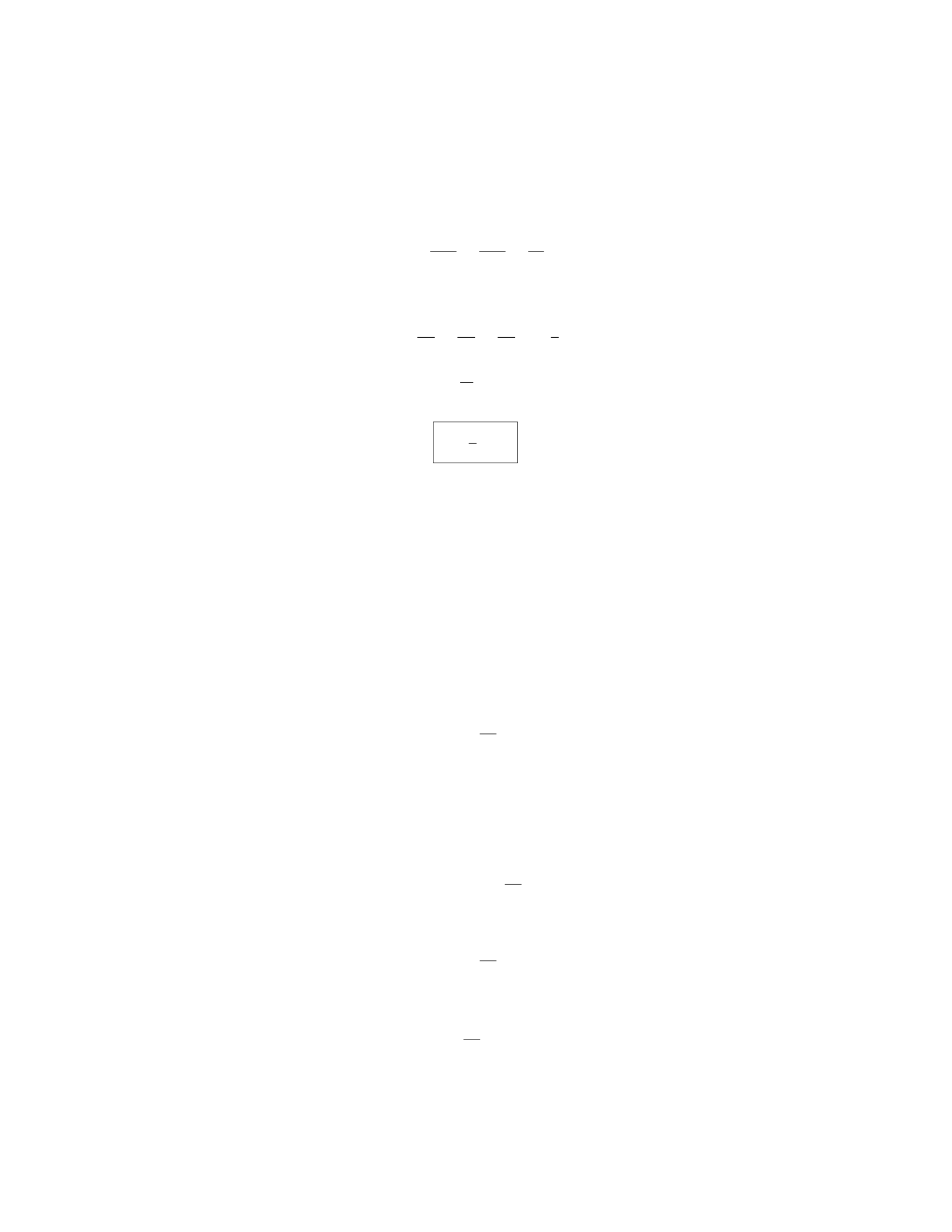
Step 7: Integrate term by term:
I=λL2x
3−Lx2
2+x3
3
L
0
Step 8: Evaluate the integral at the limits of integration:
I=λL3
3−L3
2+L3
3=1
3λL3
Step 9: Finally, recall that λ=M
L, so substitute this back in to find the
moment of inertia Iin terms of Mand L:
I=1
3ML2
Question 13
Question
A thin uniform rod of mass Mand length Lis rotating about an axis passing
through one of its ends and perpendicular to its length. Find the moment of
inertia of the rod about this axis.
Solution
Let’s consider an elemental mass dm at a distance xfrom the end through which
the axis passes. The mass dm of the element is given by:
dm =M
Ldx
The moment of inertia of this elemental mass about the axis is given by:
dI =dm ·x2
To find the total moment of inertia, we integrate dI over the length of the
rod:
I=ZdI =ZL
0
M
Lx2dx
Step 1: Calculate dm in terms of dx.
dm =M
Ldx
Step 2: Find dI in terms of dx.
dI =M
Ldx ·x2
12

Step 3: Integrate dI to find the total moment of inertia.
I=ZL
0
M
Lx2dx =M
LZL
0
x2dx
Step 4: Evaluate the integral.
I=M
L1
3x3L
0
=M
L1
3L3−0=1
3ML2
Therefore, the moment of inertia of the rod about the given axis is 1
3ML2.
Question 14
Question
Find the moment of inertia of a solid cone with height hand base radius R
about its central axis.
Solution
Step 1: Consider an elemental disk of radius xand thickness dx at a height x
from the vertex of the cone. The mass of this elemental disk can be expressed
in terms of its volume. Step 2: The volume of the elemental disk can be given
by dV =πx2dx. Step 3: The density of the cone is assumed to be constant,
so the mass of the elemental disk dm can be expressed as dm =ρdV , where
ρis the density of the cone. Step 4: Substituting dV into the expression for
dm, we get dm =ρπx2dx. Step 5: The moment of inertia dI of this elemental
disk about the central axis is given by dI =r2dm, where ris the distance of
the elemental disk from the axis. Step 6: Substituting r=xand dm =ρπx2dx
into the expression for dI, we get dI =ρπx4dx. Step 7: To find the total
moment of inertia Iof the cone, integrate dI from 0 to h. Step 8: Therefore,
I=Rh
0ρπx4dx. Step 9: Solving the integral, we get I=1
5ρπh5. Therefore,
the moment of inertia of a solid cone with height hand base radius Rabout its
central axis is 1
5ρπh5.
Question 15
Question
Find the moment of inertia of a solid cylinder of mass Mand radius Rabout
an axis passing through its center and perpendicular to its length.
13

Solution
Step 1: The moment of inertia for a solid cylinder of radius Rand mass M
about an axis passing through its center and perpendicular to its length can be
calculated using the formula I=1
2MR2.
Step 2: Given that the mass of the cylinder is Mand the radius is R, we
can substitute these values into the formula to find the moment of inertia:
I=1
2MR2
Therefore, the moment of inertia of a solid cylinder of mass Mand radius
Rabout an axis passing through its center and perpendicular to its length is
1
2MR2.
Question 16
Question
A thin rod of length Land mass Mis rotated around an axis perpendicular to
the rod and passing through one of its ends. Find the moment of inertia of the
rod about this axis.
Solution
To find the moment of inertia of the rod about the given axis, we will consider
each infinitesimal element of the rod and sum up their individual moments of
inertia.
Step 1: Consider an infinitesimal element of length dx at a distance xfrom
the end of the rod. The mass of this element can be expressed as dm =M
Ldx.
Step 2: The moment of inertia of this element about the given axis is given
by dI =r2dm, where ris the distance of the element from the axis of rotation.
In this case, r=x.
Step 3: Substituting dm and rinto the expression for dI, we get:
dI =x2M
Ldx
Step 4: To find the total moment of inertia of the rod, we integrate dI from
x= 0 to x=L:
I=ZL
0
x2M
Ldx
Step 5: Solving the integral, we get:
I=M
LZL
0
x2dx
14

I=M
Lx3
3L
0
I=M
LL3
3−0
I=M
3L2
Therefore, the moment of inertia of the rod about the given axis is M
3L2.
Question 17
Question
Find the moment of inertia of a solid cylinder of radius Rand mass Mabout
an axis perpendicular to the cylinder passing through its center.
Solution
Step 1: The moment of inertia of a solid cylinder about its central axis can be
calculated using the formula I=1
2MR2.
Step 2: The moment of inertia for a solid cylinder through its central axis is calculated by integrating the infinitesimal masses.
Step 3: Let’s consider an infinitesimally thin disc of radius rand thickness dr within the cylinder.
Step 4: The mass dm of this disc is dm =M
πR2·πr2·dr =M
R2·r2·dr.
Step 5: To find the moment of inertia about the central axis, we need to express the mass element dm in terms of the distance rfrom the central axis.
Step 6: The moment of inertia of this elemental disc about the central axis is dI =dm·r2=M
R2·r2·dr·r2=M
R2·r4·dr.
Step 7: Now, we integrate this over the entire cylinder:
I=ZR
0
M
R2·r4·dr =M
R2r5
5R
0
=M
R2·R5
5=1
5MR2.
Therefore, the moment of inertia of a solid cylinder of radius Rand mass Mabout an axis perpendicular to the cylinder passing through its center is 1
5MR2.
Question 18
Question
A thin uniform square plate of side length aand mass Mis rotated about an
axis through its center perpendicular to its plane. Calculate the moment of
inertia of the square plate with respect to this axis.
15
Solution
Let’s denote the moment of inertia of the square plate with respect to the axis
passing through its center and perpendicular to its plane as I. We can find I
by integrating the moment of inertia of each small element of the plate.
Step 1: Consider an infinitesimally small square element with side length dx
at a distance xfrom the center. The mass dm of this element can be expressed
as dm =ρ·dx ·dx, where ρ=M
a2is the mass per unit area of the plate.
Step 2: The moment of inertia dI of this small element about the axis is
given by dI =dm ·x2. Substituting the expression for dm into this equation,
we get dI =ρ·dx ·dx ·x2.
Step 3: To find the total moment of inertia I, we need to integrate dI over
the whole area of the plate.
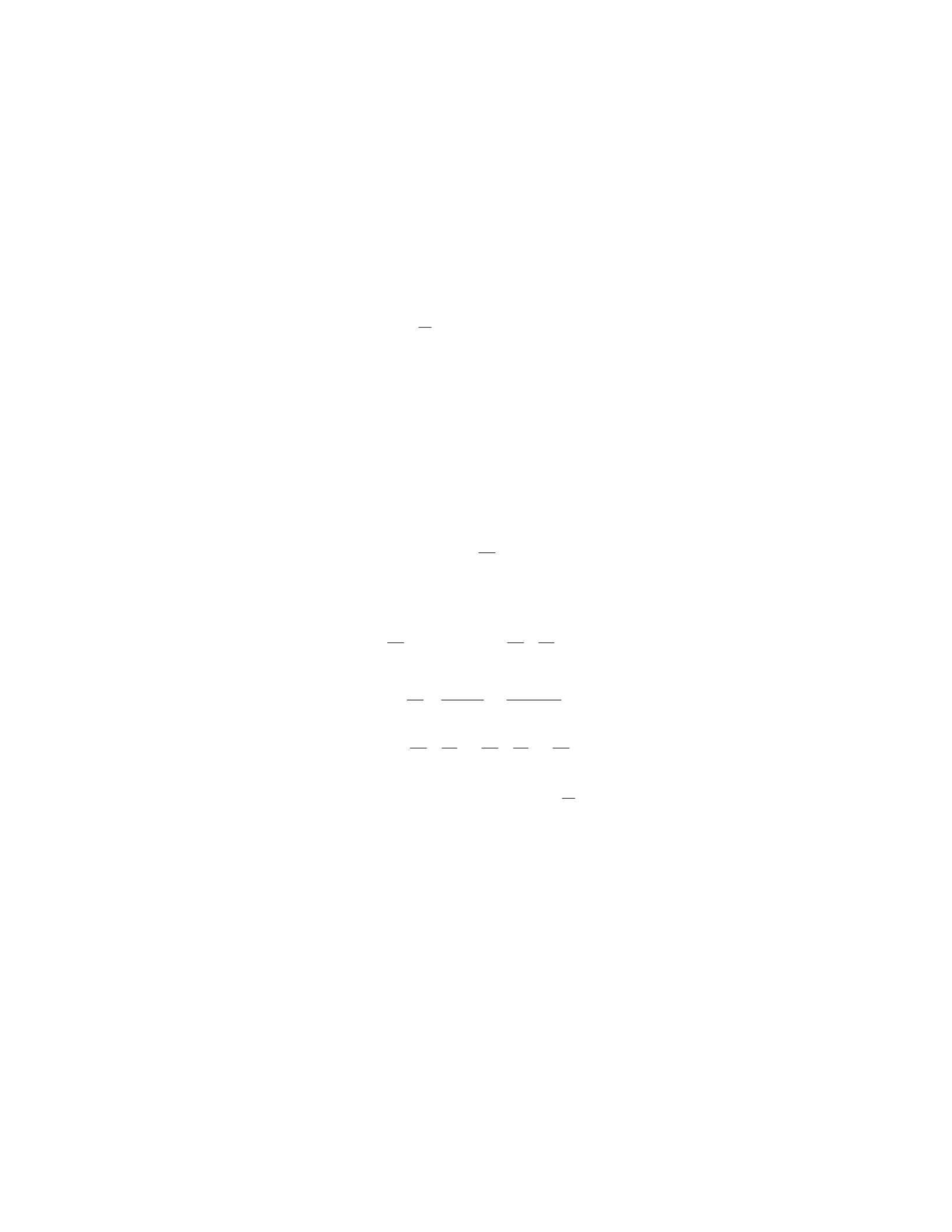
I=Za/2
−a/2
dI =Za/2
−a/2
ρ·x2dx
Step 4: Substituting the expression for ρinto the integral, we have:
I=Za/2
−a/2
M
a2·x2dx
Step 5: Solving the integral, we get:
I=M
a2Za/2
−a/2
x2dx =M
a2x3
3a/2
−a/2
I=M
a2(a/2)3
3−(−a/2)3
3
I=M
a2·a3
24 =M
24 ·a2
a2=M
24
So, the moment of inertia of the square plate with respect to the axis passing
through its center and perpendicular to its plane is M
24 .
Question 19
Question
Find the moment of inertia of a thin uniform rod of length Land mass Mabout
an axis perpendicular to the rod passing through one of its ends.
Solution
Let’s consider the rod to be along the x-axis with one end at the origin (0,0)
and the other end at (L,0). To find the moment of inertia, we need to integrate
over the length of the rod.
16

Step 1: Identify the mass element. Let’s consider a small mass element δm
at a distance xfrom the origin. The mass of this element is proportional to its
length, so δm =M
Ldx.
Step 2: Find the moment of inertia of the mass element. The moment of
inertia of a mass element is given by dI = (δm)x2. Substituting δm into the
equation gives dI =M
Lx2dx.
Step 3: Integrate to find the total moment of inertia. Integrating over the
length of the rod gives the total moment of inertia:
I=ZL
0
M
Lx2dx
Step 4: Evaluate the integral.
I=M
LZL
0
x2dx =M
Lx3
3L
0
=M
LL3
3−0=M
3L2
Therefore, the moment of inertia of the thin uniform rod about an axis
perpendicular to the rod passing through one of its ends is M
3L2.
Question 20
Question
A thin rod of length Land mass Mis rotating about an axis passing through
one end of the rod perpendicular to the rod. Find the moment of inertia of the
rod about this axis.
Solution
Let’s consider a thin rod of length Land mass Mrotating about an axis passing
through one end of the rod perpendicular to the rod. We will determine the
moment of inertia of the rod about this axis.
Step 1: Identify the formula for moment of inertia of a rod rotating about
an axis passing through one end perpendicular to the rod. The formula for
the moment of inertia of a rod rotating about an axis passing through one end
perpendicular to the rod is given by:
I=1
3ML2
Step 2: Substitute the values into the formula. Given: Length of the rod,
L=LMass of the rod, M=M
Substitute these values into the formula:
I=1
3ML2
17

Step 3: Calculate the moment of inertia.
I=1
3ML2
Therefore, the moment of inertia of the rod about the axis passing through
one end perpendicular to the rod is 1
3ML2.
Question 21
Question
A thin rod of length Land mass Mis bent at its midpoint to form an L-shape.
The moment of inertia of the bent rod about an axis perpendicular to the plane
of the rod and passing through one end is given by:
I=1
6ML2
Determine the moment of inertia of the bent rod about an axis perpendicular
to the plane of the rod and passing through the corner where the rod is bent.
Solution
Step 1: The moment of inertia of the bent rod can be split into two parts: one
about the axis passing through the corner where the rod is bent (denoted as
Ibent) and the other about the axis passing through one end of the rod (denoted
as Iend). We are given the moment of inertia about the end axis to be 1
6ML2.
Step 2: According to the parallel axis theorem, the moment of inertia about
an axis parallel to and at a distance dfrom an axis passing through the center
of mass is given by:
Ibent =Icm +Md2
Step 3: The center of mass of the bent rod lies at the midpoint of the rod
where the rod is bent. The distance from this center of mass to the corner where
the rod is bent is half the length of the rod, L
2.
Step 4: Substitute the values into the parallel axis theorem equation:
Ibent =1
6ML2+ML
22
Step 5: Simplify the expression:
Ibent =1
6ML2+1
4ML2
Step 6: Combine the terms:
Ibent =5
12ML2
18

Step 7: Therefore, the moment of inertia of the bent rod about an axis
perpendicular to the plane of the rod and passing through the corner where the
rod is bent is 5
12 ML2.
Question 22
Question
A thin rod of length Land mass Mis rotating about an axis perpendicular to
the rod and passing through one end with angular velocity ω. Calculate the
moment of inertia of the rod about this axis.
Solution
Step 1: Consider a small element of length dx at a distance xfrom the axis of
rotation. The mass of this element dm is given by:
dm =M
Ldx
Step 2: The moment of inertia dI of this element about the axis of rotation
is given by:
dI =dm ·x2
Step 3: Substituting the expression for dm into the moment of inertia equa-
tion gives:
dI =M
Ldx ·x2
Step 4: To find the total moment of inertia I, we integrate dI from 0 to L:
I=ZL
0
dI =ZL
0
M
Lx2dx
Step 5: Solving the integral gives:
I=M
LZL
0
x2dx
Step 6: Integrating x2with respect to x:
I=M
Lx3
3L
0
Step 7: Evaluating the integral at the limits:
I=M
LL3
3−03
3=M
LL3
3
Step 8: Simplifying the expression gives the moment of inertia of the rod
about the given axis as:
I=ML2
3
19

Question 23
Question
A uniform rod of length Land mass Mis rotated about an axis perpendicular
to the rod and passing through one end of the rod. Calculate the moment of
inertia of the rod about this axis.
Solution
Step 1: Consider a small element of length dx at a distance xfrom the axis of
rotation. The mass of this element dm can be expressed as:
dm =M
Ldx
Step 2: The moment of inertia of this element about the axis of rotation is
given by:
dI =dm ·x2=M
Lx2dx
Step 3: To find the total moment of inertia of the rod, we integrate dI from
x= 0 to x=L:
I=ZL
0
M
Lx2dx
Step 4: Solving the integral:
I=M
LZL
0
x2dx
I=M
Lx3
3L
0
I=M
LL3
3
I=ML2
3
Step 5: Therefore, the moment of inertia of the rod about the given axis is
ML2
3.
Question 24
Question
A thin rectangular plate of dimensions 2 m by 3 m is rotated about an axis
passing through one of its corners and perpendicular to the plane of the plate.
Find the moment of inertia of the plate about this axis.
20

Solution
Step 1: Let’s label the axes as follows: the x-axis goes along the 3m side of
the plate, the y-axis goes along the 2m side of the plate, and the z-axis is
perpendicular to the plate and passes through the corner of the plate. The
plate will rotate about the z-axis, which passes through the corner where the
x-axis and y-axis intersect.
Step 2: The moment of inertia of a thin rectangular plate about an axis
passing through one of its corners and perpendicular to the plane of the plate
is given by the formula:
I=1
3m(a2+b2)
where: - mis the mass of the plate, - ais the length of the side of the plate
perpendicular to the axis of rotation (in this case, 3 m), and - bis the length of
the side of the plate parallel to the axis of rotation (in this case, 2 m).
Step 3: To find the mass mof the plate, we need to know the area density
σ(mass per unit area) of the plate.
Step 4: The total area of the plate is given by:
A= 2 ×3 = 6 m2
Step 5: Assuming the plate has uniform density, the mass mof the plate is
given by:
m=σ×A
Step 6: Let’s substitute the values of A,a, and binto the formula for the
moment of inertia:
I=1
3(σ×A)(a2+b2) = 1
3(σ×6)(32+ 22)
Step 7: Simplifying further, we get:
I=1
3(σ×6)(9 + 4) = 1
3(σ×6)(13) = 26σ
Therefore, the moment of inertia of the plate about the given axis is 26σ.
Question 25
Question
Find the moment of inertia of a solid cylinder with radius Rand height habout
an axis passing through its center and perpendicular to its circular base.
21

Solution
Let’s consider the solid cylinder with radius Rand height h. We can find the
moment of inertia about the central axis by integrating over the volume of the
cylinder.
Step 1: Divide the cylinder into thin disk-shaped slices along its height.
Let’s consider a thin disk-shaped slice with radius r, thickness dr, and dis-
tance yfrom the central axis. The mass of this slice can be represented as
dm =ρdV =ρA dr, where ρis the density of the cylinder and Ais the area of
the disk slice.
Step 2: Find the moment of inertia dI of this disk slice about the central
axis.
The moment of inertia of a thin disk-shaped slice about an axis passing
through its center and perpendicular to its circular base is dI =1
2r2dm.
Substitute dm into the equation and simplify:
dI =1
2r2ρA dr =1
2r2ρπr2dr
Step 3: Integrate dI to find the total moment of inertia Iof the cylinder.
Integrate dI over the entire volume of the cylinder:
I=ZdI =ZR
0
1
2r2ρπr2dr
I=1
2ρπ ZR
0
r4dr
I=1
10ρπR5
Hence, the moment of inertia of the solid cylinder about the central axis is
1
10 ρπR5.
Question 26
Question
A thin rod of length Land mass Mis rotating about an axis passing through
one of its ends perpendicular to its length, with an angular velocity ω. Find
the moment of inertia of the rod about an axis passing through its center and
perpendicular to its length.
Solution
Step 1: Let’s denote the moment of inertia of the rod about an axis passing
through its center and perpendicular to its length as I.
22

Step 2: We know that the moment of inertia of a point mass mat a distance
rfrom an axis of rotation is given by Ipoint =mr2.
Step 3: To find the moment of inertia of the rod, we need to consider each
infinitesimally small mass element dm of the rod and sum up its contributions
to the total moment of inertia.
Step 4: Let’s consider a small mass element dm of the rod at a distance x
from the center of the rod. The mass of this element dm can be expressed as
dm =M
Ldx.
Step 5: The moment of inertia dI of this mass element about the center of
the rod is dI =dm ·x2=M
Ldx·x2.
Step 6: Now, we can integrate dI from −L/2 to L/2 to find the total moment
of inertia I:
I=ZL/2
−L/2
dI =ZL/2
−L/2M
Ldx·x2.
Step 7: Evaluating the integral, we get:
I=M
LZL/2
−L/2
x2dx.
Step 8: Solving the integral, we find:
I=M
Lx3
3L/2
−L/2
=M
3LL3
8−(−L)3
8.
Step 9: Simplifying further, we get:
I=M
3LL3
8+L3
8
= M L2
12.
Step 10: Therefore, the moment of inertia of the rod about an axis passing
through its center and perpendicular to its length is 1
12 ML2.
Question 27
Question
A thin uniform rod of length Land mass Mis bent into a quarter circle, with
the radius of the quarter circle being R. Find the moment of inertia of this bent
rod about an axis passing through one end of the rod and perpendicular to the
plane of the quarter circle.
Solution
Step 1: The bent rod can be thought of as a combination of two shapes: a
line segment and a quarter circle. The moment of inertia of the line segment
23

is 1
3ML2, and the moment of inertia of the quarter circle about its diameter is
1
2MR2. We will now find the distance between the axis passing through one
end of the rod and each shape’s center of mass.
Step 2: The center of mass of the line segment is located at L
2from the end
of the rod. The center of mass of the quarter circle lies at a distance of 2R
πalong
the diameter from the point where the axis passes through.
Step 3: To find the effective moment of inertia about the given axis, we
need to use the parallel axis theorem. The moment of inertia of the two shapes
summed together is I=1
3ML2+1
2MR2.
Step 4: The distance between the axis and the center of mass of the line
segment is L
2, so the contribution of the line segment to the total moment of
inertia is 1
3ML2×L
22.
Step 5: The distance between the axis and the center of mass of the quarter
circle is 2R
π, so the contribution of the quarter circle to the total moment of
inertia is 1
2MR2×2R
π2.
Step 6: Adding the contributions of the line segment and quarter circle, we
have: I=1
3ML2×L
22+1
2MR2×2R
π2.
Step 7: Simplifying the expression, we get: I=1
3ML2×L2
4+1
2MR2×4R2
π2.
Step 8: Further simplifying gives us the final result:
I=1
12ML2+2
π2MR2
Question 28
Question
Find the moment of inertia of a thin rod of mass mand length Labout an axis
passing through one end of the rod and perpendicular to the rod.
Solution
Step 1: The moment of inertia of a continuous system can be calculated by
integrating the product of the square of the distance from the axis of rotation
to the mass element and the mass element. Let’s consider a small mass element
of length dx at a distance xfrom the axis passing through one end of the rod.
Step 2: The mass dm of the element is given by dm =m
Ldx, where m
Lis the
linear mass density of the rod.
Step 3: The moment of inertia element dI for this mass element is dI =
x2dm.
Step 4: Substituting dm =m
Ldx into the expression for dI, we get:
dI =x2m
Ldx
24

Step 5: Integrate the expression for dI from x= 0 to x=Lto find the total
moment of inertia I:
I=ZL
0
dI
=ZL
0
x2m
Ldx
=m
L
x3
3L
0
=m
3L(L3−0)
=mL2
3
Step 6: Therefore, the moment of inertia of the thin rod about an axis
passing through one end of the rod and perpendicular to the rod is mL2
3.
Question 29
Question
A thin uniform rod of length Land mass Mis rotating about an axis passing
through one end perpendicular to the rod. Find the moment of inertia of the
rod about this axis.
Solution
Let’s consider an elemental mass dm at a distance xfrom the axis of rotation.
The mass of this element can be expressed as dm =M
Ldx.
Step 1: Write the expression for the moment of inertia of the elemental
mass. The moment of inertia dI of the elemental mass about the given axis is
dI =dm ·x2=M
Lx2dx.
Step 2: Integrate to find the total moment of inertia. To find the total
moment of inertia I, we integrate the expression for dI over the length of the
rod:
I=ZL
0
M
Lx2dx
Step 3: Simplify the integral.
I=M
LZL
0
x2dx =M
Lx3
3L
0
=M
3LL3−03=M
3L2
Step 4: Evaluate the final expression. Therefore, the moment of inertia of
the rod about the given axis is M
3L2.
25

Question 30
Question
A thin rod of length Lis bent at its midpoint to form a right angle. Find the
moment of inertia of this bent rod about an axis passing through one end of the
rod and perpendicular to the plane of the bent rod.
Solution
Step 1: Consider the two parts of the bent rod separately. We will calculate the
moment of inertia for each part of the rod and then sum the results to find the
total moment of inertia.
Step 2: Moment of inertia for the straight part of the rod. Let’s denote the
mass per unit length of the rod as λ.
The moment of inertia for a uniform rod of length L/2 and mass per unit
length λabout an axis passing through one end and perpendicular to the rod
is given by:
I1=1
3ml2=1
3(λL
2)(L
2)2=1
24λL3
Step 3: Moment of inertia for the bent part of the rod. Since the bent part
is a right triangle with dimensions L
2and L
2, we can consider it as two rectangles
with dimensions L
2and L
4.
The moment of inertia for each rectangle about an axis through its center
and perpendicular to its plane is given by:
I2=1
12ml2=1
12(λL
2)(L
4)2=1
96λL3
Step 4: Total moment of inertia. The total moment of inertia is the sum of
the moment of inertia for each part:
Itotal =I1+ 2I2=1
24λL3+ 2( 1
96λL3) = 1
12λL3
Therefore, the moment of inertia of the bent rod about the specified axis is
1
12 λL3.
Question 31
Question
Find the moment of inertia of a thin rod of length Land mass M, rotating
about an axis perpendicular to the rod and passing through one end of the rod.
26

Solution
Step 1: Divide the rod into small elements ∆miof length ∆xi.
Step 2: The moment of inertia of each element ∆Iiis given by dIi=
∆mi(∆xi)2.
Step 3: To find ∆mi, express it in terms of the linear mass density λ=M
L
and ∆xi:
∆mi=λ∆xi.
Step 4: Substitute ∆mi=λ∆xiinto the expression for ∆Iito get:
∆Ii=λ(∆xi)3.
Step 5: The total moment of inertia Iis the sum of the moments of inertia
of all small elements:
I=X∆Ii=λX(∆xi)3.
Step 6: Replace the sum with an integral to find the total moment of inertia:
I=ZL
0
λx2dx.
Step 7: Evaluate the integral:
I=λx3
3L
0
.
Step 8: Simplify the expression:
I=1
3λL3.
Step 9: Substitute λ=M
Lto find the moment of inertia I:
I=1
3M
LL3=1
3ML2.
Therefore, the moment of inertia of the thin rod rotating about an axis
perpendicular to the rod and passing through one end of the rod is 1
3ML2.
Question 32
Question
Determine the moment of inertia of a solid cylinder of radius Rand mass M
about an axis passing through its center perpendicular to its length.
27

Solution
Let’s consider a solid cylinder of radius Rand mass M. The moment of iner-
tia Iabout an axis passing through its center perpendicular to its length can
be calculated by integrating the area density function over the volume of the
cylinder.
Step 1: First, we need to determine the area density function of the cylinder.
The volume density function ρcan be defined as M
V, where V=πR2his the
volume of the cylinder and his the height of the cylinder.
Step 2: The elemental mass dm for an elemental volume dV =πR2dy is
given by dm =ρdV . Substituting the values, we get dm =M
πR2hπR2dy =M
hdy.
Step 3: The elemental moment of inertia dI for this elemental mass dm
about an axis passing through its center and perpendicular to its length is given
by dI =r2dm, where ris the perpendicular distance between the elemental
mass dm and the axis of rotation.
Step 4: Since the elemental mass dm is located at a distance yfrom the
axis of rotation, the perpendicular distance is r=pR2+y2. Substituting
r=pR2+y2and dm =M
hdy into the formula for dI, we get
dI = (pR2+y2)2M
hdy.
Step 5: Integrating dI from −h/2 to h/2 to consider the whole volume of
the cylinder, we have
I=Zh/2
−h/2
(pR2+y2)2M
hdy.
Step 6: Solving the integral, we get
I=M
hZh/2
−h/2
(R2+y2)dy.
I=M
h R2Zh/2
−h/2
dy +Zh/2
−h/2
y2dy!.
I=M
h R2(h) + 1
3y3
h/2
−h/2!.
I=M
h R2(h) + 1
3h
23
−1
3−h
23!.
I=M
hR2h+h3
24 +h3
24 .
I=M
hR2h+h3
12 .
28

I=MR2
h+h
12.
Therefore, the moment of inertia of the solid cylinder about the given axis
is MR2
h+h
12 .
Question 33
Question
A thin, uniform rod of length Land mass Mis rotating about an axis per-
pendicular to the rod and passing through one end. Determine the moment of
inertia of the rod about this axis.
Solution
Let’s consider the rod as a collection of small mass elements dm. The moment
of inertia of the entire rod can then be found by summing up the moments of
inertia of all these small mass elements.
Step 1: Express the differential mass element dm in terms of dx. The mass
of the rod is uniformly distributed, so the linear mass density λis given by
λ=M
L.
The differential mass element dm is given by
dm =λ dx =M
Ldx.
Step 2: Express the moment of inertia of the differential mass element dI.
The moment of inertia of a differential mass element dI about the axis passing
through one end is given by
dI =r2dm,
where ris the distance of dm from the axis of rotation. For this rod, r=x(the
distance from the end of the rod), so
dI =x2M
Ldx.
Step 3: Integrate the expression for dI to find the total moment of inertia
Iof the rod. Integrating both sides, we get
ZdI =Zx2·M
Ldx.
I=M
LZL
0
x2dx.
29

I=M
Lx3
3L
0
.
I=M
LL3
3−0.
I=M
L·L3
3.
I=1
3ML2.
Therefore, the moment of inertia of the rod about the axis passing through
one end is 1
3ML2.
Question 34
Question
A thin rod of mass Mand length Lis rotating about an axis passing through
one end perpendicular to the rod. Find the moment of inertia of the rod about
this axis.
Solution
Let’s consider an elemental mass dm of the rod located at a distance xfrom the
end of the rod where the axis of rotation passes. The length of this elemental
mass is dx. The moment of inertia dI of this elemental mass about the axis can
be calculated as dm ·x2.
Step 1: Setting up the integral
I=ZdI
=Zx2dm
Step 2: Expressing dm in terms of dx We know that mass per unit
length λ=M
L. So, dm =λ·dx.
30

Step 3: Substituting into the integral
I=Zx2(λ dx)
=λZx2dx
=λ1
3x3L
0
=λ1
3L3
=1
3λL3
=1
3M
LL3
=1
3ML2
Therefore, the moment of inertia of the thin rod about the given axis is
1
3ML2.
Question 35
Question
A thin rod of length Land mass Mis rotated about one end with an angular
speed ω. Find the moment of inertia of the rod about an axis perpendicular to
the rod passing through its center of mass.
Solution
Step 1: The moment of inertia of a straight rod rotating about an axis perpen-
dicular to the rod through one end is given by the formula I=1
3ML2.
Step 2: To find the moment of inertia about an axis perpendicular to the rod
passing through its center of mass, we will use the parallel axis theorem which
states Inew =Icm +MD2, where Inew is the moment of inertia about a new
axis, Icm is the moment of inertia about the center of mass, Dis the distance
between the two axes, and Mis the mass of the object.
Step 3: Since the axis passing through the center of mass is located at the
midpoint of the rod, the distance Dbetween the two axes is L/2.
Step 4: The moment of inertia about the center of mass is Icm =1
12 ML2for
a rod rotating about its center.
Step 5: Substituting Icm =1
12 ML2,M, and D=L/2 into the parallel axis
theorem equation, we get
Inew =1
12ML2+ML2/4 = 1
3ML2.
31

Step 6: Therefore, the moment of inertia of the rod about an axis perpen-
dicular to the rod passing through its center of mass is 1
3ML2.
32

