


PHYS 101 - ELEMENTS OF PHYSICS
- Buoyant forces and Archimedes’
principle
Question Bank - Set 8
Liberty University
Question 1
Question
A cube of wood with a volume of 0.1 m3and a density of 800 kg/m3is floating
in a container of water. Determine the depth to which the cube is submerged in
the water. Given: density of water = 1000 kg/m3, acceleration due to gravity
= 9.81 m/s2.
Solution
Step 1: Calculate the weight of the wooden cube. The weight of the cube is
equal to the gravitational force acting on it, which is given by:
Wcube =mcube ·g
where mcube is the mass of the cube and gis the acceleration due to gravity.
Since density = mass / volume, we can rearrange this equation to find the mass:
mcube = density ×volume
Substitute the given values:
mcube = 800 kg/m3×0.1 m3= 80 kg
Now, calculate the weight of the cube:
Wcube = 80 kg ×9.81 m/s2= 784.8 N

Step 2: Calculate the buoyant force acting on the cube. According to
Archimedes’ principle, the buoyant force is equal to the weight of the water
displaced by the cube:
Fbuoyant = density of water ×volume submerged ×g
Let hbe the depth to which the cube is submerged. The volume submerged is
0.1 m3−0.1hm3= 0.1(1 −h) m3. Substitute the given values:
Fbuoyant = 1000 kg/m3×0.1(1 −h) m3×9.81 m/s2
Step 3: Determine the equilibrium condition. For the cube to float, the
weight of the cube must be balanced by the buoyant force:
Wcube =Fbuoyant
784.8 = 1000 ×0.1(1 −h)×9.81
Solve the equation for hto find the depth to which the cube is submerged.
Question 2
Question
A solid sphere of radius Rand density ρsolid is completely submerged in a liquid
of density ρliquid. The sphere has a volume fraction of 60% that is submerged
in the liquid. Calculate the buoyant force experienced by the sphere in terms of
R,ρsolid,ρliquid, and g.
Solution
Step 1: First, let’s express the volume of the sphere that is submerged in terms
of the total volume of the sphere. We know that the volume of a sphere is
Vsphere =4
3πR3, and the submerged volume is Vsubmerged = 0.6×Vsphere. Thus,
Vsubmerged = 0.6×4
3πR3.
Step 2: The weight of the fluid displaced is equal to the weight of the buoy-
ant force acting on the sphere. The weight of the fluid displaced is given by
mg =ρliquid ·Vsubmerged ·g. So, the buoyant force experienced by the sphere is
Fbuoyant =ρliquid ·Vsubmerged ·g.
Step 3: Substituting Vsubmerged = 0.6×4
3πR3into the equation for the
buoyant force, we get:
Fbuoyant =ρliquid ·0.6×4
3πR3·g
.
Step 4: Simplifying the expression yields the final answer for the buoyant
force:
Fbuoyant = 0.8×ρliquid ·πR3·g
.
2

Question 3
Question
A sphere made of a certain material has a density of 4000 kg/m3and a radius
of 0.1 m. The sphere is submerged in a liquid with a density of 800 kg/m3.
Calculate the buoyant force acting on the sphere.
Solution
Step 1: First, we need to calculate the volume of the sphere. The volume of a
sphere is given by the formula:
V=4
3πr3
where ris the radius of the sphere. Substituting r= 0.1 m into the formula:
V=4
3×π×(0.1)3=4
3×π×0.001 = 0.004188 m3
Step 2: The mass of the sphere can be calculated using the formula:
mass = density ×volume
Substitute the density of the sphere (4000 kg/m3) and the calculated volume
into the formula:
mass = 4000 ×0.004188 = 16.752 kg
Step 3: The weight of the sphere is given by:
weight = mass ×g
where gis the acceleration due to gravity (9.81 m/s2). Substituting the mass
calculated in Step 2:
weight = 16.752 ×9.81 = 164.667 N
Step 4: According to Archimedes’ principle, the buoyant force acting on a
submerged object is equal to the weight of the fluid displaced by the object.
The volume of liquid displaced by the sphere is the same as the volume of the
sphere.
Step 5: The buoyant force Fbuoyant can be calculated using the formula:
Fbuoyant = density of liquid ×volume ×g
Substitute the density of the liquid and the volume of the sphere:
Fbuoyant = 800 ×0.004188 ×9.81 = 32.913 N
Therefore, the buoyant force acting on the sphere is 32.913 N.
3

Question 4
Question
A cube of iron with sides of length 10 cm is submerged in a container of water.
If the cube floats with 20
Given: Density of water = 1000 kg/m3
Solution
Step 1: First, let’s determine the volume of the cube submerged in water. The
volume of the cube is given by Vcube = (side length)3= (0.1 m)3= 0.001 m3.
Since 20
Step 2: Next, calculate the buoyant force acting on the iron cube. The
buoyant force is given by Fbuoyant =ρwater ×Vsubmerged ×g, where ρwater is the
density of water and gis the acceleration due to gravity.
Substitute ρwater = 1000 kg/m3,Vsubmerged = 0.0008 m3, and g= 9.8 m/s2:
Fbuoyant = 1000 ×0.0008 ×9.8=7.84 N.
Step 3: Calculate the weight of the iron cube. The weight of the iron cube is
equal to the force acting downwards on it due to gravity. This weight is given by
Fweight =m×g, where mis the mass of the iron cube and gis the acceleration
due to gravity.
Since Fbuoyant is equal to Fweight (the cube is floating), we have m×g= 7.84
N.
Step 4: Finally, calculate the density of the iron cube. The density of the iron
cube is given by ρiron =m
Vcube . But since m=Fweight/g, we get ρiron =Fweight
g×Vcube .
Substitute Fweight = 7.84 N, g= 9.8 m/s2, and Vcube = 0.001 m3:ρiron =
7.84
9.8×0.001 = 8000 kg/m3.
Therefore, the density of the iron cube is 8000 kg/m3.
Question 5
Question
A cylindrical object made of aluminum with a radius of 5 cm and a height of
10 cm is submerged in water. The density of aluminum is 2.7 g/cm3and the
density of water is 1 g/cm3. Determine the buoyant force acting on the object
and also the depth to which the object is submerged in water.
Solution
Step 1: Calculate the volume of the cylinder. The volume of a cylinder is given
by the formula:
V=πr2h
where ris the radius and his the height.
4

Substitute r= 5 cm and h= 10 cm into the formula:
V=π×(5 cm)2×10 cm
V=π×25 cm2×10 cm
V= 250πcm3
Step 2: Calculate the mass of the aluminum object. The mass of the object
can be found using the formula:
Mass = Density ×Volume
Mass = 2.7 g/cm3×250πcm3
Mass = 675πg
Step 3: Calculate the weight of the object. The weight of the object can be
found using the formula:
Weight = Mass ×Gravity
Weight = 675πg×9.8 m/s2
Weight = 6615πN
Step 4: Calculate the buoyant force. The buoyant force acting on the object
is equal in magnitude to the weight of the fluid displaced. The volume of water
displaced is equal to the volume of the object. Using the density of water:
Buoyant force = Density of water ×Volume of object ×Gravity
Buoyant force = 1 g/cm3×250πcm3×9.8 m/s2
Buoyant force = 2450πN
Step 5: Calculate the depth to which the object is submerged. The depth
to which the object is submerged is given by the formula:
Buoyant force = Weight of water displaced
ρwater ×g×Vsubmerged = 675πN
1 g/cm3×9.8 m/s2×Abase ×d= 675πN
Abase ×d=675π
9.8
25πcm2×d= 68.8π
d=68.8π
25π
d= 2.75 cm
The object is submerged to a depth of 2.75 cm in water.
5

Question 6
Question
A steel cube with a side length of 20 cm and a mass of 30 kg is submerged in
water. Calculate the buoyant force acting on the cube and determine if it will
float or sink.
Solution
Step 1: Calculate the volume of the cube. The volume of a cube is given by the
formula V= (side length)3. Substituting the side length of 20 cm:
V= (0.20 m)3= 0.008 m3
Step 2: Calculate the density of steel. The density of steel is approximately
7,800 kg/m3.
Step 3: Calculate the weight of the cube. The weight of the cube is given
by the formula W=mg, where mis the mass and gis the acceleration due to
gravity (9.81 m/s2):
W= 30 kg ×9.81 m/s2= 294.3N
Step 4: Calculate the buoyant force. According to Archimedes’ principle,
the buoyant force is equal to the weight of the fluid displaced by the object. The
buoyant force is given by the formula Fb=ρwater V g, where ρwater is the density
of water (1,000 kg/m3), Vis the volume of the cube, and gis the acceleration
due to gravity:
Fb= 1000 kg/m3×0.008 m3×9.81 m/s2= 78.48 N
Step 5: Determine if the cube will float or sink. Since the buoyant force
(78.48 N) is greater than the weight of the cube (294.3 N), the cube will float
in water.
Question 7
Question
A cardboard box with dimensions 2 m ×1 m ×1 m is completely submerged
in water. The box is initially floating with 0.2 m of its height above the water
level. Calculate the buoyant force acting on the box. The density of water is
1000 kg/m3and the acceleration due to gravity is 9.81 m/s2.
6

Solution
Step 1: Calculate the volume of the submerged part of the box. Step 2: Calcu-
late the weight of the water displaced by the box. Step 3: Apply Archimedes’
principle to find the buoyant force.
Step 1: The volume of the box that is submerged in water is equal to the
volume of water it displaces. Let hbe the height of the submerged part of the
box. The volume is given by V= 2 m ×1 m ×h, which simplifies to V= 2hm3.
Step 2: The weight of the water displaced by the box is equal to the weight
of the box when it is floating in water. The weight of the box is given by the
density of water times the volume of the submerged part of the box times the
acceleration due to gravity. The weight is W= 1000 kg/m3×2hm3×9.81 m/s2.
Step 3: According to Archimedes’ principle, the buoyant force is equal to
the weight of the water displaced by the object. Therefore, the buoyant force
Fbis equal to the weight calculated in step 2. This gives
Fb= 1000 kg/m3×2hm3×9.81 m/s2.
Question 8
Question
A cube of wood with a density of 800 kg/m3and a volume of 0.02 m3is floating
in water. Calculate the minimum mass that needs to be placed on top of the
cube to make it sink. The density of water is 1000 kg/m3and the acceleration
due to gravity is 9.81 m/s2.
Solution
Step 1: Find the weight of the cube in air using the formula Wcube =mcube ·g
where gis the acceleration due to gravity, mcube is the mass of the cube, and
Vcube is the volume of the cube:
mcube =ρcube ·Vcube
mcube = 800 kg/m3·0.02 m3
mcube = 16 kg
Wcube = 16 kg ·9.81 m/s2
Wcube = 157.44 N
Step 2: Find the buoyant force acting on the cube when it is floating in
water using the formula Fbuoy =ρwater ·Vcube ·g:
Fbuoy = 1000 kg/m3·0.02 m3·9.81 m/s2
Fbuoy = 196.2 N
7

Step 3: To make the cube sink, the added mass needs to increase the net
downward force. This means the added mass needs to counteract the buoyant
force and the weight of the cube. Therefore, the minimum mass needed to make
the cube sink is m=Fbuoy +Wcube
g:
m=196.2 N + 157.44 N
9.81 m/s2
m=353.64 N
9.81 m/s2
m≈36 kg
Therefore, the minimum mass that needs to be placed on top of the cube to
make it sink is approximately 36 kg.
Question 9
Question
A cube of side length Land density ρis placed in a fluid of density ρfluid. The
cube is submerged in the fluid such that a fraction fof its height is below the
surface of the fluid. Determine the value of fat which the cube will be in
equilibrium.
Solution
Step 1: We first find an expression for the buoyant force on the cube. The
buoyant force FBon an object submerged in a fluid is equal to the weight of the
fluid displaced by the object. The weight of the fluid displaced is equal to the
volume of fluid displaced times the density of the fluid times the acceleration
due to gravity. The volume of fluid displaced by the cube will be L2f, where
Lis the side length of the cube and fis the fraction of the height submerged.
Therefore, the buoyant force is given by:
FB=ρfluid ·g·L2·f
Step 2: Next, we calculate the weight of the cube. The weight of the cube
is equal to the volume of the cube times the density of the cube times the
acceleration due to gravity. The volume of the cube is L3and therefore, the
weight of the cube is:
W=ρ·g·L3
Step 3: For the cube to be in equilibrium, the buoyant force must equal the
weight of the cube. Therefore, we set FB=W:
ρfluid ·g·L2·f=ρ·g·L3
8

Step 4: Solving for fgives us the fraction of the height submerged at which
the cube will be in equilibrium:
f=ρ·L
ρfluid ·L
f=ρ
ρfluid
Therefore, the cube will be in equilibrium when a fraction ρ
ρfluid of its height
is submerged in the fluid.
Question 10
Question
A ship with a mass of 2000 tons and a volume of 8000 m3floats in seawater.
Determine the buoyant force acting on the ship and the weight of seawater
displaced by the ship.
Given: Density of seawater = 1025 kg/m3Acceleration due to gravity =
9.81 m/s2
Solution
Step 1: Calculate the weight of the ship Given: Mass of the ship (m) = 2000
tons = 2,000,000 kg The weight of the ship can be calculated using the formula:
Wship =m×g, where gis the acceleration due to gravity. Wship = 2,000,000 ×
9.81 Wship = 19,620,000 N
Step 2: Calculate the buoyant force acting on the ship Since the ship is
floating, the buoyant force Fbuoyant acting on it is equal in magnitude to its
weight. Therefore, Fbuoyant =Wship Fbuoyant = 19,620,000 N
Step 3: Calculate the weight of seawater displaced by the ship The weight of
the seawater displaced by the ship is also equal to the buoyant force. Wdisplaced =
Fbuoyant Wdisplaced = 19,620,000 N
Therefore, the buoyant force acting on the ship is 19,620,000 N and the
weight of seawater displaced by the ship is also 19,620,000 N.
Question 11
Question
A cube of wood with a density of 600 kg/m3and side length 0.15 m is floating
in water. What is the volume of the cube that is submerged in the water?
9

Solution
Step 1: Let’s begin by determining the density of water, ρwater, which is ρwater =
1000 kg/m3. This will be necessary for calculating the buoyant force. Step 2:
Calculate the weight of the cube using the formula Wcube =mg, where mis the
mass of the cube and gis the acceleration due to gravity (9.81 m/s2). Step 3:
Since the cube is floating, the weight of the cube is equal to the buoyant force
acting on it. The buoyant force is given by Fbuoyant =ρwaterVsubmergedg, where
Vsubmerged is the volume submerged. Step 4: Set the weight of the cube equal to
the buoyant force to find the volume submerged: Fbuoyant =Wcube. This gives
us ρwaterVsubmergedg=mg. Step 5: Solve for Vsubmerged to find the volume of
the cube that is submerged in the water.
Question 12
Question
A cube of side length 10 cm and density 800 kg/m3is submerged in a liquid of
density 1200 kg/m3. What is the buoyant force acting on the cube?
Solution
Step 1: Calculate the volume of the cube. Given that the side length of the
cube is 10 cm, we can calculate the volume using the formula:
Volume = side length3
Volume = (0.10 m)3
Volume = 0.001 m3
Step 2: Calculate the weight of the cube. The weight of the cube is given
by:
Weight = Density ×Volume ×Acceleration due to gravity
Weight = 800 kg/m3×0.001 m3×9.81 m/s2
Weight = 7.848 N
Step 3: Calculate the buoyant force acting on the cube. The buoyant force
on an object is equal to the weight of the fluid displaced by the object. Since the
cube is fully submerged, it displaces a volume of fluid equal to its own volume.
The buoyant force is given by:
Buoyant force = Density of fluid ×Volume ×Acceleration due to gravity
Buoyant force = 1200 kg/m3×0.001 m3×9.81 m/s2
Buoyant force = 11.772 N
Therefore, the buoyant force acting on the cube is 11.772 N.
10

Question 13
Question
A cylindrical submarine has a diameter of 8 meters and a length of 40 meters.
If the submarine is floating in seawater with a density of 1.03 g/cm3, find the
force required to hold it in place.
Solution
Step 1: Calculate the volume of the submarine. The volume of a cylinder is
given by the formula V=πr2h, where ris the radius and his the height. Given
that the diameter is 8 meters, the radius is r=8
2= 4 meters. The height of the
cylinder is 40 meters. Therefore, the volume of the submarine is:
V=π×42×40 m3
Step 2: Calculate the weight of the displaced water. According to Archimedes’
principle, the buoyant force is equal to the weight of the water displaced by the
submarine. The weight of the displaced water can be calculated using the for-
mula W=ρ×g×V, where ρis the density of the fluid, gis the acceleration
due to gravity, and Vis the volume of the water displaced. Given that the
density of seawater is 1.03 g/cm3and 1 m3= 106cm3, we convert the density to
ρ= 1.03 ×10³kg/m3. The weight of the displaced water is:
W= 1.03 ×103×9.81 ×VN
Step 3: Calculate the force required to hold the submarine in place. Since
the submarine is in equilibrium, the force holding it in place must be equal in
magnitude and opposite in direction to the buoyant force. Therefore, the force
required to hold the submarine in place is:
Frequired =−W
Step 4: Substitute the values and calculate. Substitute the values of V
and Winto the equations above and calculate the force required to hold the
submarine in place.
Question 14
Question
A spherical balloon has a radius of 3 meters and is filled with helium gas. The
density of helium is 0.1785 kg/m3, while the density of air is 1.225 kg/m3.
Calculate the maximum mass that the balloon can carry without sinking in air.
11

Solution
Step 1: Calculate the volume of the balloon using the formula for the volume
of a sphere. Step 2: Calculate the buoyant force acting on the balloon. Step
3: Set the buoyant force equal to the weight of the maximum mass the balloon
can carry and solve for the mass.
Step 1: Calculate the volume of the balloon. The volume of a sphere is
given by the formula:
V=4
3πr3
Substitute the radius r= 3 meters into the formula:
V=4
3π(3)3= 36πm3
Step 2: Calculate the buoyant force acting on the balloon. The buoyant
force on an object immersed in a fluid is given by:
Fbuoyant =ρfluidVdisplacedg
where ρfluid is the density of the fluid, Vdisplaced is the volume of fluid displaced
by the object, and gis the acceleration due to gravity.
The volume of air displaced by the balloon is equal to the volume of the
balloon itself:
Vdisplaced = 36πm3
The buoyant force is then:
Fbuoyant = 1.225 ×36π×9.81 N = 4253.98πN
Step 3: Calculate the maximum mass that the balloon can carry without
sinking in air. The buoyant force must be equal to the weight of the maximum
mass the balloon can carry without sinking. Let’s denote this maximum mass
as m. The weight of the maximum mass is:
Weight = m·g
Setting the buoyant force equal to the weight of the maximum mass:
4253.98π=m×9.81
Solving for m:
m=4253.98π
9.81 ≈1365.34 kg
Therefore, the maximum mass that the balloon can carry without sinking in
air is approximately 1365.34 kg.
12

Question 15
Question
A solid cube of wood with a density of 0.7 g/cm3and a side length of 10 cm
floats in a tank of water. What is the volume of the cube that is submerged?
Solution
Step 1: Calculate the density of water. Given that the density of water is
approximately 1 g/cm3, the density of water (ρwater) is 1 g/cm3.
Step 2: Determine the volume of the cube that is submerged. Let the volume
of the suberged part of the cube be V. The weight of the water displaced should
be equal to the weight of the cube. The weight of the water displaced is given by
the volume of water displaced multiplied by the density of water and acceleration
due to gravity (g), i.e., V·ρwater ·g. The weight of the cube is given by the
volume of the cube submerged multiplied by the density of the cube material
(0.7 g/cm3) and acceleration due to gravity (g), i.e., V·0.7·g.
Step 3: Equate the weight of the water displaced to the weight of the cube.
V·ρwater ·g=V·0.7·g
Step 4: Solve for the volume of the cube submerged. V·1·9.8 = V·0.7·9.8
V=V·0.7·9.8
9.8
V= 0.7V
Therefore, 70
Question 16
Question
A cube of density ρ1and side length ais placed in a liquid of density ρ2. The
cube floats with a fraction hof its volume submerged in the liquid. Calculate
the value of hin terms of ρ1,ρ2, and a.
Solution
Step 1: Find the weight of the cube: The weight of the cube is equal to the
weight of the liquid displaced by the cube. This can be calculated using the
formula Fbuoyant =ρliquid ·g·Vsubmerged. Here, ρliquid is the density of the liquid
and Vsubmerged is the volume of the cube submerged in the liquid.
Step 2: Find the volume of the cube submerged: Given a cube of side
length awith a fraction hof its volume submerged, the volume submerged is
Vsubmerged =h·a3.
Step 3: Set up the equilibrium condition: The weight of the cube, ρ1·g·a3,
is equal to the buoyant force, ρ2·g·h·a3. So, we have ρ1·g·a3=ρ2·g·h·a3.
Step 4: Solve for h: Solving the above equation, we find: h=ρ1
ρ2.
Therefore, the fraction of the cube’s volume submerged in the liquid is ρ1
ρ2.
13

Question 17
Question
A cube of wood with sides of length 10 cm and a density of 0.8 g/cm3is floating
in water. Calculate the depth to which the cube is submerged in the water.
Solution
Step 1: We first need to determine the density of water. The density of water
is 1 g/cm3.
Step 2: Next, we calculate the mass of the cube. Since the density of the
cube is 0.8 g/cm3and its volume is (10 cm)3= 1000 cm3, the mass of the cube
is given by:
mass = density ×volume = 0.8 g/cm3×1000 cm3= 800 g
Step 3: Now, we calculate the volume of the cube submerged in the water.
Let the depth to which the cube is submerged be hcm. The submerged volume
is 100 cm ×100 cm ×hcm3.
Step 4: According to Archimedes’ principle, the buoyant force acting on the
cube is equal to the weight of the water displaced by the cube. The weight of
the water displaced is given by the density of water times the volume of water
displaced, which is 1 g/cm3×100 cm ×100 cm ×hcm = 10000hg.
Step 5: The weight of the cube is equal to its mass times the acceleration
due to gravity, which is 800 g ×9.8 m/s2= 7840 N.
Step 6: Since the cube is floating, the buoyant force is equal to the weight
of the cube:
10000hg = 7840 N
100h= 78.4
h= 0.784 cm
Therefore, the depth to which the cube is submerged in the water is 0.784
cm.
Question 18
Question
A cube of wood with a density of 700 kg/m3and a side length of 0.1 m is floating
in water. Determine the depth to which the cube is submerged in the water.
(Density of water = 1000 kg/m3)
14

Solution
Step 1: Calculate the weight of the cube. The weight of the cube is given by:
Wcube =ρwood ·g·Vcube
where: ρwood = 700 kg/m3(density of the wood)
g= 9.81 m/s2(acceleration due to gravity)
Vcube = 0.13m3(volume of the cube)
Substitute the values into the equation to find Wcube.
Step 2: Calculate the buoyant force acting on the cube. The buoyant force
is given by:
Fbuoyant =ρwater ·g·Vdisplaced
where: ρwater = 1000 kg/m3(density of water)
Vdisplaced is the volume of water displaced by the cube.
Step 3: Use Archimedes’ principle to find the depth of submersion. Accord-
ing to Archimedes’ principle, the buoyant force acting on an object submerged
in fluid is equal to the weight of the fluid displaced. Here, the weight of the
fluid displaced is equal to the weight of the cube.
Fbuoyant =Wcube
ρwater ·g·Vdisplaced =ρwood ·g·Vcube
Step 4: Solve for Vdisplaced to find the depth of submersion. Finally, use the
value of Vdisplaced to calculate the depth to which the cube is submerged in the
water.
Question 19
Question
A cube of side length aand density ρ1is floating in a liquid of density ρ2. If
one-third of the cube’s volume is submerged in the liquid, determine the density
ρ2in terms of ρ1and a.
Solution
Step 1: The buoyant force Fbacting on the cube is equal to the weight of the
liquid displaced by the cube. Since one-third of the cube’s volume is submerged,
the volume of liquid displaced is 1
3a2·a=a3
3. The weight of this displaced liquid
is mg, where mis the mass of the displaced liquid and gis the acceleration due
to gravity. mcan be expressed in terms of the density of the liquid ρ2and the
volume as m=ρ2·a3
3. Therefore, Fb=ρ2·a3
3·g.
Step 2: The weight of the cube Fcis equal to the volume of the cube multi-
plied by the density of the cube times gravity. Fc=ρ1·a3·g.
15

Step 3: According to Archimedes’ principle, the buoyant force Fbis equal to
the weight of the cube Fcfor the cube to float. Therefore, ρ2·a3
3·g=ρ1·a3·g.
Step 4: Simplifying the equation, we get ρ2·1
3=ρ1. Thus, the density ρ2
of the liquid in terms of ρ1is ρ2= 3ρ1.
Question 20
Question
A cube of wood with a density of 700 kg/m3and a side length of 0.1 m is floating
in water. What is the fraction of the cube that is submerged in the water?
Solution
Step 1: First, we need to determine the density of water, which is ρwater = 1000
kg/m3.
Step 2: Since the cube is floating, the buoyant force FBacting on the cube is
equal to the weight of the water displaced by the cube. This can be calculated
using Archimedes’ principle:
FB=ρwater ·g·Vsubmerged
Where Vsubmerged is the volume of the cube that is submerged and gis the
acceleration due to gravity (g= 9.81 m/s2).
Step 3: The weight of the cube Wcube can be calculated using its density
and volume:
Wcube =ρcube ·g·Vtotal
Where Vtotal is the total volume of the cube.
Step 4: Since the cube is floating, the buoyant force FBis equal to the weight
of the cube:
FB=Wcube
Step 5: From Steps 2, 3, and 4, we can set up the following equation:
ρwater ·g·Vsubmerged =ρcube ·g·Vtotal
Step 6: The fraction of the cube that is submerged can be found using the
following equation:
Fraction submerged = Vsubmerged
Vtotal
Step 7: By rearranging the equation from Step 5, we can solve for the fraction
submerged:
16
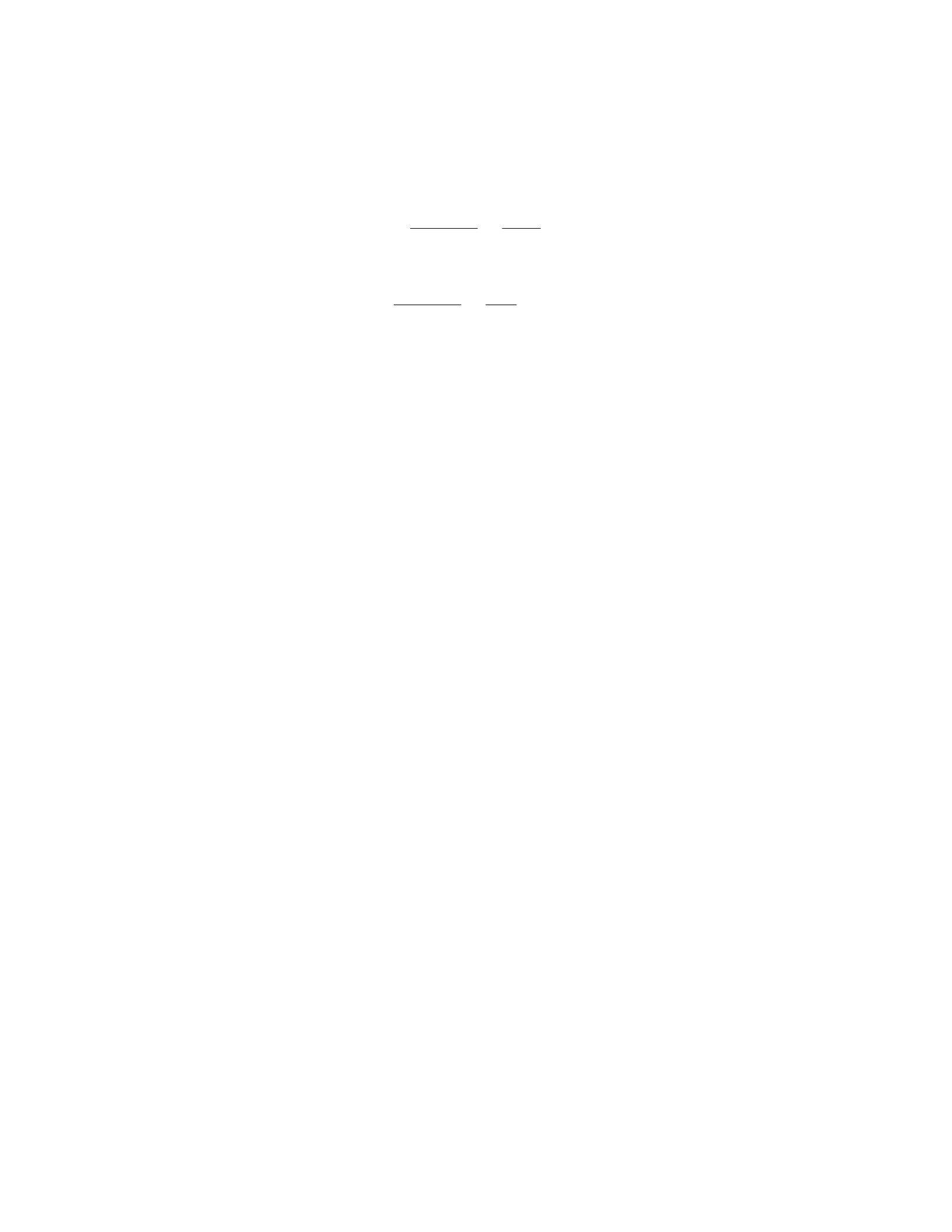
Vsubmerged
Vtotal
=ρcube
ρwater
Step 8: Substitute the given values into the equation:
Vsubmerged
Vtotal
=700
1000 = 0.7
Therefore, 70
Question 21
Question
A piece of aluminum with a volume of 0.1 m3and a density of 2700 kg/m3is
submerged in a container of water. If the aluminum piece experiences an upward
buoyant force of 2000 N, what is the depth of its immersion in the water?
Solution
Step 1: Firstly, we need to determine the weight of the aluminum piece. The
weight of an object can be calculated using the formula: W=mg, where mis
the mass of the object and gis the acceleration due to gravity (approx. 9.81
m/s2). The density of aluminum is 2700 kg/m3and the volume is 0.1 m3, so the
mass mcan be calculated using the formula: m= density ×volume. Therefore,
m= 2700 kg/m3×0.1 m3= 270 kg. Thus, the weight of the aluminum piece is:
W= 270 kg ×9.81 m/s2= 2650.7 N.
Step 2: Next, we need to understand that the buoyant force is equal to the
weight of the water displaced by the submerged object. Therefore, the buoyant
force is equal to the weight of water with the same volume as the submerged part
of the aluminum piece. Let dbe the depth of immersion of the aluminum piece in
the water. The volume of water displaced will be 0.1 m3×d. The weight of this
displaced water is given by: Wdisplaced = density of water ×volume of water.
The density of water is 1000 kg/m3, so Wdisplaced = 1000 kg/m3×0.1 m3×d=
100dN.
Step 3: Since the buoyant force is equal to 2000 N, we can set up the equation:
2000 N = 100dN. Solving for d, we get d= 2000 N/100 N = 20 m. Therefore,
the depth of immersion of the aluminum piece in the water is 20 meters.
Question 22
Question
A cube of wood with sides of length 10 cm and a density of 0.8 g/cm3is floating
in a container of water. Determine the fraction of the cube’s volume that is
submerged in the water.
17

Solution
Step 1: Calculate the weight of the cube The weight of the cube can be calculated
using the formula:
Weight = Density ×Volume ×Acceleration due to gravity
Weight = 0.8 g/cm3×(10 cm)3×9.81 m/s2
Step 2: Calculate the buoyant force acting on the cube The buoyant force
on the cube equals the weight of the water displaced by the cube, which is equal
to the weight of the cube when it is floating. Therefore, the buoyant force is the
same as the weight of the cube.
Step 3: Determine the fraction of the cube’s volume submerged The fraction
of the cube’s volume submerged is equal to the ratio of the buoyant force acting
on the cube to the weight of the cube when fully submerged. This can be
calculated using the formula:
Fraction submerged = Buoyant force
Weight of cube when fully submerged
Fraction submerged = Weight of cube
Weight of cube
Fraction submerged = 1
Therefore, the entire volume of the cube is submerged in the water.
Question 23
Question
A large wooden cube with a side length of 2 meters and a density of 600 kg/m3
is floating in a pool of water. What is the depth of the cube below the surface
of the water?
Solution
Step 1: First, we can calculate the mass of the wooden cube using its density
and volume. Given that the side length of the cube is 2 meters, the volume of
the cube is given by:
V= (side length)3= (2 m)3= 8 m3
The mass of the wooden cube is then:
mass = density ×volume = 600 kg/m3×8 m3= 4800 kg
Step 2: Next, we need to consider the forces acting on the wooden cube
when it is floating in water. The buoyant force acting on the cube is equal
18

to the weight of the water displaced by the cube. According to Archimedes’
principle, the buoyant force is also equal to the weight of the cube. So, the
buoyant force is:
buoyant force = mass ×g= 4800 kg ×9.81 m/s2= 47088 N
Step 3: Now, let’s consider the forces acting on the cube in equilibrium. The
buoyant force acts upward, while the weight of the cube acts downward. Since
the cube is floating, these two forces must be equal in magnitude. Using this,
we can find the volume of water displaced by the cube. The weight of the cube
is:
weight of cube = mass ×g= 4800 kg ×9.81 m/s2= 47088 N
Step 4: The weight of the cube is also equal to the weight of the water
displaced:
weight of water displaced = density of water ×volume of water displaced ×g
Since the cube is fully submerged, the volume of water displaced is equal to the
volume of the cube. Rearranging the equation gives:
depth of cube submerged = weight of cube
density of water ×g=47088 N
1000 kg/m3×9.81 m/s2
Solving this will give us the depth of the cube below the surface of the water.
Question 24
Question
A cube of wood with sides measuring 5 cm is floating in water. If the cube is
pushed down until it is completely submerged, what is the change in the buoyant
force acting on the cube? The density of water is 1000 kg/m3.
Solution
Step 1: First, we need to find the weight of the cube when it is floating. When
the cube is floating, the weight of the cube is balanced by the buoyant force.
The weight of the cube is given by the formula:
Weight of cube = Volume ×Density ×Acceleration due to gravity
The volume of the cube is calculated as follows:
Volume = (side length)3= (0.05 m)3
Step 2: Calculate the volume of the cube.
Volume = 0.053m3
19

Step 3: Now, let’s calculate the weight of the cube.
Weight of cube = 0.053m3×Density of wood ×9.81 m/s2
Step 4: Next, we need to find the buoyant force acting on the cube when it
is floating. The buoyant force is equal to the weight of the water displaced by
the cube, which is equal to the weight of the cube when it is floating.
Step 5: Find the change in the buoyant force when the cube is fully sub-
merged. When the cube is fully submerged, the buoyant force acting on it will
be equal to the weight of the water displaced by the cube, which will be equal
to the weight of the cube when fully submerged.
Step 6: Finally, we need to find the change in the buoyant force. The
change in the buoyant force is equal to the buoyant force when the cube is fully
submerged minus the buoyant force when the cube is floating.
Change in buoyant force = Weight of cube fully submerged−Weight of cube floating
Question 25
Question
A solid object of mass mand volume Vis submerged in a fluid of density ρ. If
the object is floating at equilibrium in the fluid, determine the expression for
the buoyant force acting on the object.
Solution
Step 1: First, let’s determine the volume of fluid displaced by the object. Ac-
cording to Archimedes’ principle, the buoyant force acting on an object is equal
to the weight of the fluid displaced by the object. Since the object is floating at
equilibrium, the buoyant force is equal in magnitude and opposite in direction
to the gravitational force acting on the object. Therefore, the buoyant force
can be expressed as Fb=mg, where mis the mass of the object and gis the
acceleration due to gravity.
Step 2: The weight of the fluid displaced by the object is equal to the
weight of the fluid with volume V. The weight of the fluid can be expressed as
Wf=ρV g, where ρis the density of the fluid.
Step 3: Since the buoyant force is equal to the weight of the fluid displaced,
we have Fb=ρV g. Setting this equal to mg, we can solve for the expression of
the buoyant force: ρV g =mg.
Step 4: Canceling out the mass mfrom both sides of the equation, we are
left with the expression for the buoyant force: Fb=ρV g .
20

Question 26
Question
A cube with sides of length 10 cm and a density of 800 kg/m3is floating in
water. Determine the depth to which the cube is submerged.
Solution
Let’s denote the density of water as ρw= 1000 kg/m3and the depth to which
the cube is submerged as h. We can begin by setting up an equation based on
the forces acting on the cube.
Step 1: The buoyant force exerted on the cube is equal to the weight of the
water displaced by the cube.
Weight of cube = Buoyant force
Step 2: The weight of the cube is given by mcube ×g, where mcube is the
mass of the cube and gis the acceleration due to gravity.
mcube ×g=ρcube ×Vcube ×g
Step 3: The buoyant force is given by the weight of the water displaced.
Buoyant force = ρw×Vsubmerged ×g
Step 4: Since the cube is floating, the weight of the cube is balanced by the
buoyant force.
ρcube ×Vcube ×g=ρw×Vsubmerged ×g
Step 5: Calculate the volumes involved using the geometry of the cube and
the submerged part of the cube.
Vcube = (0.1 m)3= 0.001 m3
Vsubmerged =Abase ×h= (0.1 m)2×h= 0.01hm3
Step 6: Substitute the volumes back into the equation.
ρcube ×0.001 m3×g=ρw×0.01hm3×g
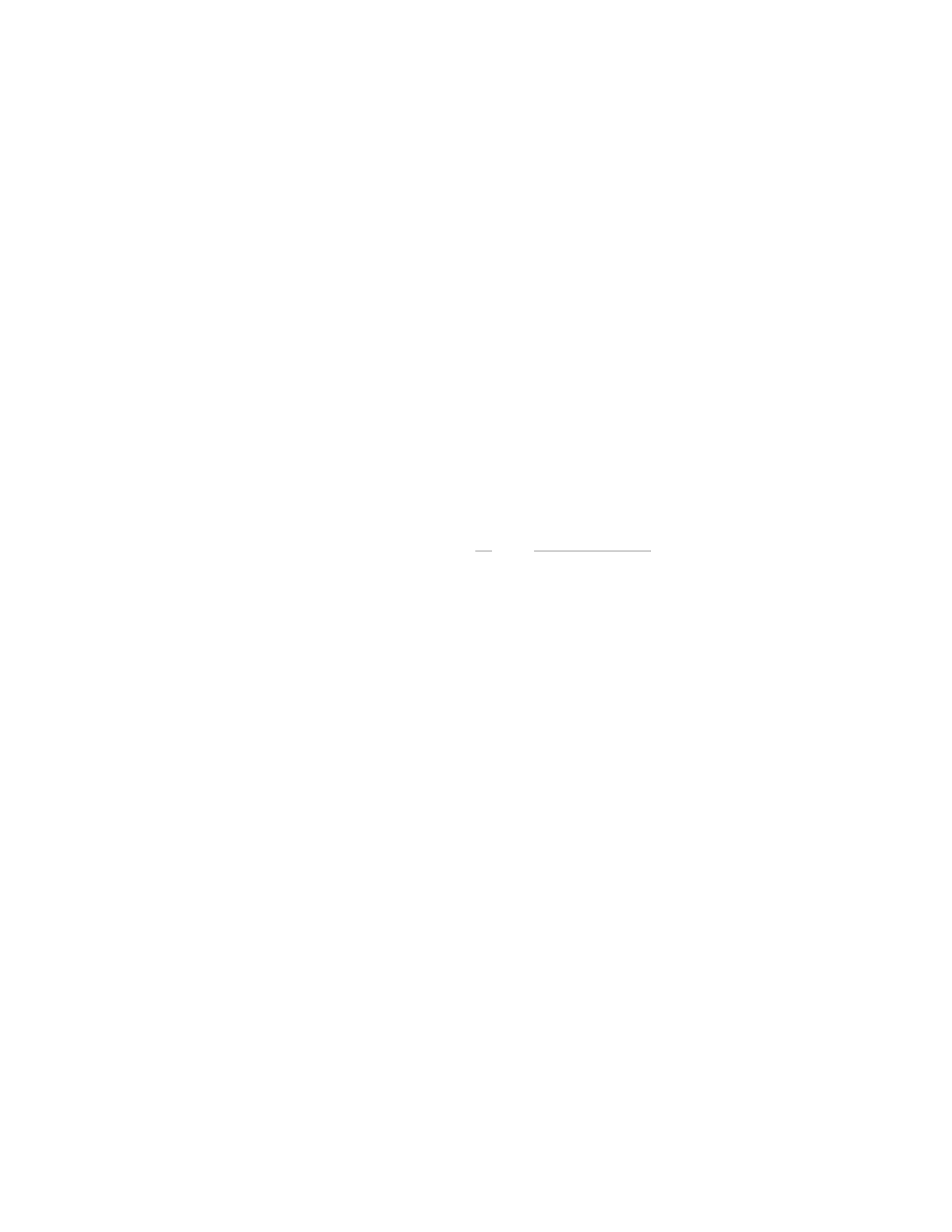
Step 7: Solve for h.
h=ρcube
ρw×0.01 m
Step 8: Plug in the values to find the depth to which the cube is submerged.
h=800
1000 ×0.01 = 0.008 m = 8 cm
Therefore, the cube is submerged to a depth of 8 cm.
21
Question 27
Question
A ship has a mass of 120,000 kg and displaces water with a density of 1000
kg/m3. If the ship is floating at the surface of the water, what is the total
volume of water displaced by the ship?
Solution
Step 1: We will first calculate the weight of the ship. Given: Mass of the ship,
m= 120,000 kg Acceleration due to gravity, g= 9.8 m/s2Weight, W=m·g
W= 120,000 kg ×9.8 m/s2= 1,176,000 N.
Step 2: Next, we will calculate the buoyant force acting on the ship. Buoyant
force, Fb=ρ·V·g(where ρis the density of the fluid, Vis the volume
of fluid displaced, and gis the acceleration due to gravity) Since the ship is
floating, the buoyant force is equal to the weight of the ship: Fb=W. Thus,
ρ·V·g= 1,176,000 N.
Step 3: Now, we can solve for the volume of water displaced (V). Given:
Density of water, ρ= 1000 kg/m3V=W
ρ·gV=1,176,000 N
1000 kg/m3×9.8 m/s2V≈120 m3.
Therefore, the total volume of water displaced by the ship is approximately
120 cubic meters.
Question 28
Question
A cube of side length aand density ρ1is floating in a liquid of density ρ2with
a fraction xof its volume submerged. Determine the expression for xin terms
of a,ρ1, and ρ2.
Given: - Mass of the cube: M- Acceleration due to gravity: g- Volume
submerged: V
Solution
Step 1: Calculate the buoyant force acting on the cube. The buoyant force Fb
exerted on the cube is equal to the weight of the liquid displaced by the cube.
Fb=ρ2V g
Step 2: Calculate the weight of the cube. The weight of the cube Wis equal
to the mass of the cube times the acceleration due to gravity.
W=Mg
Step 3: Analyze the forces acting on the cube in equilibrium. In equilibrium,
the buoyant force Fbmust balance the weight Wof the cube. Thus, Fb=W.
22

Substitute the expressions for Fband Winto the equilibrium condition:
ρ2V g =Mg
Step 4: Express the volume submerged in terms of given variables. The mass
Mcan be expressed in terms of the density ρ1and the volume submerged Vas
M=ρ1V. Substitute M=ρ1Vinto the equilibrium condition:
ρ2V g =ρ1V g
Step 5: Solve for the fraction xof the volume submerged. The fraction xof
the volume submerged can be expressed as x=V
a3. Substitute V=xa3into
the equilibrium condition:
ρ2xa3g=ρ1xa3g
ρ2=ρ1
Therefore, the expression for xin terms of a,ρ1, and ρ2is:
x=ρ1
ρ2
Question 29
Question
A cube of wood with sides of length 10 cm is floating in a container of water.
The density of the wood is 600 kg/m3and the density of water is 1000 kg/m3.
What fraction of the cube’s volume is submerged in the water?
Solution
Step 1: Let’s first determine the buoyant force acting on the cube. The buoyant
force is equal to the weight of the water displaced by the cube. The volume of
water displaced is equal to the volume of the submerged part of the cube.
Step 2: The weight of the water displaced is equal to the weight of the cube
itself. We can calculate the weight of the cube using the formula:
Weight = Mass ×Gravity
Step 3: The mass of the cube can be calculated using the formula:
Mass = Density ×Volume
Step 4: Let’s calculate the mass of the cube. Given: Density of the wood,
ρwood = 600 kg/m3Volume of the cube, V= (0.1 m)3= 0.001 m3
Step 5:
Mass of the wood cube = ρwood ×V
23

Step 6:
Mass of the wood cube = 600 kg/m3×0.001 m3= 0.6 kg
Step 7: Calculate the weight of the wood cube using the formula:
Weight = Mass ×Gravity
Step 8:
Weight = 0.6 kg ×9.8 m/s2= 5.88 N
Step 9: Since the weight of the water displaced is equal to the weight of the
cube, the buoyant force acting on the cube is 5.88 N.
Step 10: The volume of the cube submerged in water is equal to the volume
of water displaced, which is also equal to the volume of the submerged part of
the cube.
Step 11: Let Vsubmerged be the volume submerged in water. We know that
the buoyant force is equal to the weight of the water displaced, which is the
weight of the submerged part of the cube. The weight of the submerged part of
the cube can be calculated using:
Weight = Densitywater ×Vsubmerged ×g
Step 12:
5.88 N = 1000 kg/m3×Vsubmerged ×9.8 m/s2
Step 13: Solve for Vsubmerged to find the volume of the cube submerged in
water.
Step 14:
Vsubmerged =5.88
1000 ×9.8= 0.0006 m3
Step 15: The fraction of the cube’s volume submerged in water is given by:
Vsubmerged
Vtotal
=0.0006 m3
0.001 m3= 0.6
Step 16: Therefore, 0.6 or 60
Question 30
Question
A cylindrical object with height hand radius ris floating in a liquid with density
ρliquid. If the height of the object submerged in the liquid is h′, express h′in
terms of hand r.
24

Solution
Step 1: Firstly, let’s denote the density of the cylindrical object as ρobject.
Step 2: Since the object is floating, the buoyant force acting on the object
is equal to the weight of the object. The volume of the object submerged in the
liquid is V′=πr2h′.
Step 3: The buoyant force acting on the object is given by Fbuoyant =
ρliquidgV ′, where gis the acceleration due to gravity.
Step 4: The weight of the object is given by Fweight =ρobjectgV , where
V=πr2his the total volume of the object.
Step 5: Since the object is floating, the buoyant force equals the weight of
the object: ρliquidgπr2h′=ρobjectgπr2h.
Step 6: Simplifying, we find ρliquidh′=ρobjecth.
Step 7: Finally, we express h′in terms of hand r:h′=ρobject
ρliquid h.
Therefore, the height of the object submerged in the liquid, h′, can be ex-
pressed as h′=ρobject
ρliquid
h.
Question 31
Question
A metal object has a mass of 1.5 kg in air and is completely submerged in a
container of water. When submerged, the object has an apparent mass of 1.2
kg. Calculate the buoyant force acting on the object and the density of the
metal.
Solution
Step 1: First, let’s determine the weight of the object in air. The weight of the
object in air is given by:
Wair =m·g
where: m= 1.5 kg (mass of the object) and g= 9.81 m/s2(acceleration due to
gravity).
Calculating Wair:
Wair = 1.5 kg ×9.81 m/s2= 14.715 N
Step 2: Next, let’s determine the weight of the object when submerged in
water. The apparent weight of the object in water is given by:
Wwater =Wair −buoyant force
Given that the apparent mass of the object in water is 1.2 kg, we have:
Wwater = 1.2 kg ×9.81 m/s2= 11.772 N
25

Step 3: Calculate the buoyant force. Using the equation:
buoyant force = Wair −Wwater
we find:
buoyant force = 14.715 N −11.772 N = 2.943 N
Step 4: Calculate the volume of the object. The volume of the object can
be calculated using the buoyant force and the density of water:
buoyant force = ρwater ·V·g
where: ρwater = 1000 kg/m3(density of water), Vis the volume of the object to
be determined, and g= 9.81 m/s2as before.
Calculating the volume:
V=buoyant force
ρwater ·g=2.943
1000 ·9.81 = 0.0003 m3
Step 5: Calculate the density of the metal. The density of the metal can be
calculated using the volume and the mass of the object:
density of metal = m
V=1.5
0.0003 = 5000 kg/m3
Therefore, the buoyant force acting on the object is 2.943 N and the density
of the metal is 5000 kg/m3.
Question 32
Question
A solid cube of density ρ1is floating in a liquid of density ρ2. The cube has a
side length L. What is the minimum density of the cube that will allow it to
float in the liquid such that exactly half of its volume is submerged?
Solution
Step 1: Let’s first determine the conditions for the cube to float. The buoyant
force acting on the cube is equal to the weight of the liquid displaced by the
cube. This can be expressed as:
ρ2gVsub =ρ1gVcube
where ρ2is the density of the liquid, gis the acceleration due to gravity, Vsub is
the volume submerged in the liquid, and Vcube is the volume of the cube.
Step 2: Since the cube is floating, the buoyant force equals the weight of the
cube, so:
ρ2g1
2L2=ρ1g(L3)
26

Step 3: Rearranging the equation, we get:
ρ1=ρ2
2
Step 4: Therefore, the minimum density of the cube that will allow it to
float in the liquid such that exactly half of its volume is submerged is ρ2
2.
Question 33
Question
A cylindrical object with a height of 20 cm and a radius of 5 cm is partially
submerged in water. The density of the object is 700 kg/m3and the density of
water is 1000 kg/m3. Calculate the buoyant force acting on the object.
Solution
Let’s start by calculating the volume of the object submerged in water. The
volume of a cylinder is given by the formula:
V=πr2h
where ris the radius of the cylinder and his the height of the cylinder.
Step 1: Calculate the volume of the object. Given that the radius r= 5
cm and the height h= 20 cm, we have:
V=π(0.05 m)2×0.20 m
V=π×0.0025 m2×0.20 m
V= 0.0025π m3
Step 2: Calculate the volume of water displaced/suspended. The volume of
water displaced by the submerged portion of the object is equal to the volume
of the submerged portion of the object.
Vwater = 0.0025π m3
Step 3: Calculate the weight of the water displaced/suspended. The weight
of the water displaced is equal to the weight of the water that would occupy
that volume.
Weightwater =ρwater ×g×Vwater
where ρwater = 1000 kg/m3is the density of water and g= 9.81 m/s2is the
acceleration due to gravity.
Weightwater = 1000 ×9.81 ×0.0025π
Weightwater ≈77.3903 N
27

Step 4: Calculate the weight of the object. The weight of the object is
given by:
Weightobject =ρobject ×g×Vobject
where ρobject = 700 kg/m3is the density of the object and Vobject =πr2his the
total volume of the cylinder.
Weightobject = 700 ×9.81 ×π×(0.05)2×0.2
Weightobject ≈133.114 N
Step 5: Calculate the buoyant force. The buoyant force is equal to the
weight of the water displaced/suspended.
Buoyant Force = Weightwater ≈77.3903 N
Therefore, the buoyant force acting on the object is approximately 77.39 N.
Question 34
Question
A cube of wood with sides of length 10 cm and density 800 kg/m3is floating in
water. Determine the depth to which the cube is submerged in water.
Solution
To solve this problem, we will use Archimedes’ principle, which states that the
buoyant force acting on an object in a fluid is equal to the weight of the fluid
displaced by the object.
Step 1: First, we calculate the weight of the cube. The volume of the cube
is given by:
V= (10 cm)3= (0.1 m)3= 0.001 m3
The weight of the cube can be found using the formula:
Weight = density ×volume ×g
where g= 9.81 m/s2is the acceleration due to gravity.
Weight = 800 kg/m3×0.001 m3×9.81 m/s2= 7.848 N
Step 2: Next, we calculate the buoyant force acting on the cube. The
buoyant force is given by:
Buoyant force = Weight of displaced water
Since the cube is floating in water, the weight of the displaced water is equal
to the weight of the cube. Therefore, the buoyant force is also 7.848 N.
28

Step 3: Finally, we determine the depth to which the cube is submerged.
The buoyant force is given by:
Buoyant force = Density of water ×g×Volume submerged
Solving for the volume submerged:
Volume submerged = Buoyant force
Density of water ×g=7.848
1000 kg/m3×9.81 m/s2= 0.0008 m3
Since the cube is a cube, the side length submerged is the cube root of the
volume submerged:
Depth = 3
√0.0008 m3= 0.1 m = 10 cm
Therefore, the depth to which the cube is submerged in water is 10 cm.
Question 35
Question
A solid cube of aluminum with a density of 2700 kg/m3and side length 0.1 m is
floating in water. What fraction of the cube’s volume is submerged below the
water surface?
Solution
Step 1: We first need to find the density of water, as it will help us determine
the fraction of the cube’s volume that is submerged. The density of water is
typically 1000 kg/m3.
Step 2: Next, we can use Archimedes’ principle, which states that the buoy-
ant force on an object is equal to the weight of the fluid displaced by the object.
We can calculate the buoyant force on the cube using the formula:
Fb=ρwater ·Vsubmerged ·g
where Fbis the buoyant force, ρwater is the density of water, Vsubmerged is
the volume submerged, and gis the acceleration due to gravity.
Step 3: The weight of the cube is equal to its density times the volume times
g:
W=ρaluminum ·Vcube ·g
Step 4: Since the cube is floating, the weight of the cube must be balanced
by the buoyant force:
ρaluminum ·Vcube ·g=ρwater ·Vsubmerged ·g
Step 5: We can rearrange this equation to solve for Vsubmerged:
29

Question 3
Question
A sphere made of a certain material has a density of 4000 kg/m3and a radius
of 0.1 m. The sphere is submerged in a liquid with a density of 800 kg/m3.
Calculate the buoyant force acting on the sphere.
Solution
Step 1: First, we need to calculate the volume of the sphere. The volume of a
sphere is given by the formula:
V=4
3πr3
where ris the radius of the sphere. Substituting r= 0.1 m into the formula:
V=4
3×π×(0.1)3=4
3×π×0.001 = 0.004188 m3
Step 2: The mass of the sphere can be calculated using the formula:
mass = density ×volume
Substitute the density of the sphere (4000 kg/m3) and the calculated volume
into the formula:
mass = 4000 ×0.004188 = 16.752 kg
Step 3: The weight of the sphere is given by:
weight = mass ×g
where gis the acceleration due to gravity (9.81 m/s2). Substituting the mass
calculated in Step 2:
weight = 16.752 ×9.81 = 164.667 N
Step 4: According to Archimedes’ principle, the buoyant force acting on a
submerged object is equal to the weight of the fluid displaced by the object.
The volume of liquid displaced by the sphere is the same as the volume of the
sphere.
Step 5: The buoyant force Fbuoyant can be calculated using the formula:
Fbuoyant = density of liquid ×volume ×g
Substitute the density of the liquid and the volume of the sphere:
Fbuoyant = 800 ×0.004188 ×9.81 = 32.913 N
Therefore, the buoyant force acting on the sphere is 32.913 N.
3

Question 4
Question
A cube of iron with sides of length 10 cm is submerged in a container of water.
If the cube floats with 20
Given: Density of water = 1000 kg/m3
Solution
Step 1: First, let’s determine the volume of the cube submerged in water. The
volume of the cube is given by Vcube = (side length)3= (0.1 m)3= 0.001 m3.
Since 20
Step 2: Next, calculate the buoyant force acting on the iron cube. The
buoyant force is given by Fbuoyant =ρwater ×Vsubmerged ×g, where ρwater is the
density of water and gis the acceleration due to gravity.
Substitute ρwater = 1000 kg/m3,Vsubmerged = 0.0008 m3, and g= 9.8 m/s2:
Fbuoyant = 1000 ×0.0008 ×9.8=7.84 N.
Step 3: Calculate the weight of the iron cube. The weight of the iron cube is
equal to the force acting downwards on it due to gravity. This weight is given by
Fweight =m×g, where mis the mass of the iron cube and gis the acceleration
due to gravity.
Since Fbuoyant is equal to Fweight (the cube is floating), we have m×g= 7.84
N.
Step 4: Finally, calculate the density of the iron cube. The density of the iron
cube is given by ρiron =m
Vcube . But since m=Fweight/g, we get ρiron =Fweight
g×Vcube .
Substitute Fweight = 7.84 N, g= 9.8 m/s2, and Vcube = 0.001 m3:ρiron =
7.84
9.8×0.001 = 8000 kg/m3.
Therefore, the density of the iron cube is 8000 kg/m3.
Question 5
Question
A cylindrical object made of aluminum with a radius of 5 cm and a height of
10 cm is submerged in water. The density of aluminum is 2.7 g/cm3and the
density of water is 1 g/cm3. Determine the buoyant force acting on the object
and also the depth to which the object is submerged in water.
Solution
Step 1: Calculate the volume of the cylinder. The volume of a cylinder is given
by the formula:
V=πr2h
where ris the radius and his the height.
4

Substitute r= 5 cm and h= 10 cm into the formula:
V=π×(5 cm)2×10 cm
V=π×25 cm2×10 cm
V= 250πcm3
Step 2: Calculate the mass of the aluminum object. The mass of the object
can be found using the formula:
Mass = Density ×Volume
Mass = 2.7 g/cm3×250πcm3
Mass = 675πg
Step 3: Calculate the weight of the object. The weight of the object can be
found using the formula:
Weight = Mass ×Gravity
Weight = 675πg×9.8 m/s2
Weight = 6615πN
Step 4: Calculate the buoyant force. The buoyant force acting on the object
is equal in magnitude to the weight of the fluid displaced. The volume of water
displaced is equal to the volume of the object. Using the density of water:
Buoyant force = Density of water ×Volume of object ×Gravity
Buoyant force = 1 g/cm3×250πcm3×9.8 m/s2
Buoyant force = 2450πN
Step 5: Calculate the depth to which the object is submerged. The depth
to which the object is submerged is given by the formula:
Buoyant force = Weight of water displaced
ρwater ×g×Vsubmerged = 675πN
1 g/cm3×9.8 m/s2×Abase ×d= 675πN
Abase ×d=675π
9.8
25πcm2×d= 68.8π
d=68.8π
25π
d= 2.75 cm
The object is submerged to a depth of 2.75 cm in water.
5

Question 6
Question
A steel cube with a side length of 20 cm and a mass of 30 kg is submerged in
water. Calculate the buoyant force acting on the cube and determine if it will
float or sink.
Solution
Step 1: Calculate the volume of the cube. The volume of a cube is given by the
formula V= (side length)3. Substituting the side length of 20 cm:
V= (0.20 m)3= 0.008 m3
Step 2: Calculate the density of steel. The density of steel is approximately
7,800 kg/m3.
Step 3: Calculate the weight of the cube. The weight of the cube is given
by the formula W=mg, where mis the mass and gis the acceleration due to
gravity (9.81 m/s2):
W= 30 kg ×9.81 m/s2= 294.3N
Step 4: Calculate the buoyant force. According to Archimedes’ principle,
the buoyant force is equal to the weight of the fluid displaced by the object. The
buoyant force is given by the formula Fb=ρwater V g, where ρwater is the density
of water (1,000 kg/m3), Vis the volume of the cube, and gis the acceleration
due to gravity:
Fb= 1000 kg/m3×0.008 m3×9.81 m/s2= 78.48 N
Step 5: Determine if the cube will float or sink. Since the buoyant force
(78.48 N) is greater than the weight of the cube (294.3 N), the cube will float
in water.
Question 7
Question
A cardboard box with dimensions 2 m ×1 m ×1 m is completely submerged
in water. The box is initially floating with 0.2 m of its height above the water
level. Calculate the buoyant force acting on the box. The density of water is
1000 kg/m3and the acceleration due to gravity is 9.81 m/s2.
6

Solution
Step 1: Calculate the volume of the submerged part of the box. Step 2: Calcu-
late the weight of the water displaced by the box. Step 3: Apply Archimedes’
principle to find the buoyant force.
Step 1: The volume of the box that is submerged in water is equal to the
volume of water it displaces. Let hbe the height of the submerged part of the
box. The volume is given by V= 2 m ×1 m ×h, which simplifies to V= 2hm3.
Step 2: The weight of the water displaced by the box is equal to the weight
of the box when it is floating in water. The weight of the box is given by the
density of water times the volume of the submerged part of the box times the
acceleration due to gravity. The weight is W= 1000 kg/m3×2hm3×9.81 m/s2.
Step 3: According to Archimedes’ principle, the buoyant force is equal to
the weight of the water displaced by the object. Therefore, the buoyant force
Fbis equal to the weight calculated in step 2. This gives
Fb= 1000 kg/m3×2hm3×9.81 m/s2.
Question 8
Question
A cube of wood with a density of 800 kg/m3and a volume of 0.02 m3is floating
in water. Calculate the minimum mass that needs to be placed on top of the
cube to make it sink. The density of water is 1000 kg/m3and the acceleration
due to gravity is 9.81 m/s2.
Solution
Step 1: Find the weight of the cube in air using the formula Wcube =mcube ·g
where gis the acceleration due to gravity, mcube is the mass of the cube, and
Vcube is the volume of the cube:
mcube =ρcube ·Vcube
mcube = 800 kg/m3·0.02 m3
mcube = 16 kg
Wcube = 16 kg ·9.81 m/s2
Wcube = 157.44 N
Step 2: Find the buoyant force acting on the cube when it is floating in
water using the formula Fbuoy =ρwater ·Vcube ·g:
Fbuoy = 1000 kg/m3·0.02 m3·9.81 m/s2
Fbuoy = 196.2 N
7

Step 3: To make the cube sink, the added mass needs to increase the net
downward force. This means the added mass needs to counteract the buoyant
force and the weight of the cube. Therefore, the minimum mass needed to make
the cube sink is m=Fbuoy +Wcube
g:
m=196.2 N + 157.44 N
9.81 m/s2
m=353.64 N
9.81 m/s2
m≈36 kg
Therefore, the minimum mass that needs to be placed on top of the cube to
make it sink is approximately 36 kg.
Question 9
Question
A cube of side length Land density ρis placed in a fluid of density ρfluid. The
cube is submerged in the fluid such that a fraction fof its height is below the
surface of the fluid. Determine the value of fat which the cube will be in
equilibrium.
Solution
Step 1: We first find an expression for the buoyant force on the cube. The
buoyant force FBon an object submerged in a fluid is equal to the weight of the
fluid displaced by the object. The weight of the fluid displaced is equal to the
volume of fluid displaced times the density of the fluid times the acceleration
due to gravity. The volume of fluid displaced by the cube will be L2f, where
Lis the side length of the cube and fis the fraction of the height submerged.
Therefore, the buoyant force is given by:
FB=ρfluid ·g·L2·f
Step 2: Next, we calculate the weight of the cube. The weight of the cube
is equal to the volume of the cube times the density of the cube times the
acceleration due to gravity. The volume of the cube is L3and therefore, the
weight of the cube is:
W=ρ·g·L3
Step 3: For the cube to be in equilibrium, the buoyant force must equal the
weight of the cube. Therefore, we set FB=W:
ρfluid ·g·L2·f=ρ·g·L3
8

Step 4: Solving for fgives us the fraction of the height submerged at which
the cube will be in equilibrium:
f=ρ·L
ρfluid ·L
f=ρ
ρfluid
Therefore, the cube will be in equilibrium when a fraction ρ
ρfluid of its height
is submerged in the fluid.
Question 10
Question
A ship with a mass of 2000 tons and a volume of 8000 m3floats in seawater.
Determine the buoyant force acting on the ship and the weight of seawater
displaced by the ship.
Given: Density of seawater = 1025 kg/m3Acceleration due to gravity =
9.81 m/s2
Solution
Step 1: Calculate the weight of the ship Given: Mass of the ship (m) = 2000
tons = 2,000,000 kg The weight of the ship can be calculated using the formula:
Wship =m×g, where gis the acceleration due to gravity. Wship = 2,000,000 ×
9.81 Wship = 19,620,000 N
Step 2: Calculate the buoyant force acting on the ship Since the ship is
floating, the buoyant force Fbuoyant acting on it is equal in magnitude to its
weight. Therefore, Fbuoyant =Wship Fbuoyant = 19,620,000 N
Step 3: Calculate the weight of seawater displaced by the ship The weight of
the seawater displaced by the ship is also equal to the buoyant force. Wdisplaced =
Fbuoyant Wdisplaced = 19,620,000 N
Therefore, the buoyant force acting on the ship is 19,620,000 N and the
weight of seawater displaced by the ship is also 19,620,000 N.
Question 11
Question
A cube of wood with a density of 600 kg/m3and side length 0.15 m is floating
in water. What is the volume of the cube that is submerged in the water?
9

Solution
Step 1: Let’s begin by determining the density of water, ρwater, which is ρwater =
1000 kg/m3. This will be necessary for calculating the buoyant force. Step 2:
Calculate the weight of the cube using the formula Wcube =mg, where mis the
mass of the cube and gis the acceleration due to gravity (9.81 m/s2). Step 3:
Since the cube is floating, the weight of the cube is equal to the buoyant force
acting on it. The buoyant force is given by Fbuoyant =ρwaterVsubmergedg, where
Vsubmerged is the volume submerged. Step 4: Set the weight of the cube equal to
the buoyant force to find the volume submerged: Fbuoyant =Wcube. This gives
us ρwaterVsubmergedg=mg. Step 5: Solve for Vsubmerged to find the volume of
the cube that is submerged in the water.
Question 12
Question
A cube of side length 10 cm and density 800 kg/m3is submerged in a liquid of
density 1200 kg/m3. What is the buoyant force acting on the cube?
Solution
Step 1: Calculate the volume of the cube. Given that the side length of the
cube is 10 cm, we can calculate the volume using the formula:
Volume = side length3
Volume = (0.10 m)3
Volume = 0.001 m3
Step 2: Calculate the weight of the cube. The weight of the cube is given
by:
Weight = Density ×Volume ×Acceleration due to gravity
Weight = 800 kg/m3×0.001 m3×9.81 m/s2
Weight = 7.848 N
Step 3: Calculate the buoyant force acting on the cube. The buoyant force
on an object is equal to the weight of the fluid displaced by the object. Since the
cube is fully submerged, it displaces a volume of fluid equal to its own volume.
The buoyant force is given by:
Buoyant force = Density of fluid ×Volume ×Acceleration due to gravity
Buoyant force = 1200 kg/m3×0.001 m3×9.81 m/s2
Buoyant force = 11.772 N
Therefore, the buoyant force acting on the cube is 11.772 N.
10

Question 13
Question
A cylindrical submarine has a diameter of 8 meters and a length of 40 meters.
If the submarine is floating in seawater with a density of 1.03 g/cm3, find the
force required to hold it in place.
Solution
Step 1: Calculate the volume of the submarine. The volume of a cylinder is
given by the formula V=πr2h, where ris the radius and his the height. Given
that the diameter is 8 meters, the radius is r=8
2= 4 meters. The height of the
cylinder is 40 meters. Therefore, the volume of the submarine is:
V=π×42×40 m3
Step 2: Calculate the weight of the displaced water. According to Archimedes’
principle, the buoyant force is equal to the weight of the water displaced by the
submarine. The weight of the displaced water can be calculated using the for-
mula W=ρ×g×V, where ρis the density of the fluid, gis the acceleration
due to gravity, and Vis the volume of the water displaced. Given that the
density of seawater is 1.03 g/cm3and 1 m3= 106cm3, we convert the density to
ρ= 1.03 ×10³kg/m3. The weight of the displaced water is:
W= 1.03 ×103×9.81 ×VN
Step 3: Calculate the force required to hold the submarine in place. Since
the submarine is in equilibrium, the force holding it in place must be equal in
magnitude and opposite in direction to the buoyant force. Therefore, the force
required to hold the submarine in place is:
Frequired =−W
Step 4: Substitute the values and calculate. Substitute the values of V
and Winto the equations above and calculate the force required to hold the
submarine in place.
Question 14
Question
A spherical balloon has a radius of 3 meters and is filled with helium gas. The
density of helium is 0.1785 kg/m3, while the density of air is 1.225 kg/m3.
Calculate the maximum mass that the balloon can carry without sinking in air.
11

Solution
Step 1: Calculate the volume of the balloon using the formula for the volume
of a sphere. Step 2: Calculate the buoyant force acting on the balloon. Step
3: Set the buoyant force equal to the weight of the maximum mass the balloon
can carry and solve for the mass.
Step 1: Calculate the volume of the balloon. The volume of a sphere is
given by the formula:
V=4
3πr3
Substitute the radius r= 3 meters into the formula:
V=4
3π(3)3= 36πm3
Step 2: Calculate the buoyant force acting on the balloon. The buoyant
force on an object immersed in a fluid is given by:
Fbuoyant =ρfluidVdisplacedg
where ρfluid is the density of the fluid, Vdisplaced is the volume of fluid displaced
by the object, and gis the acceleration due to gravity.
The volume of air displaced by the balloon is equal to the volume of the
balloon itself:
Vdisplaced = 36πm3
The buoyant force is then:
Fbuoyant = 1.225 ×36π×9.81 N = 4253.98πN
Step 3: Calculate the maximum mass that the balloon can carry without
sinking in air. The buoyant force must be equal to the weight of the maximum
mass the balloon can carry without sinking. Let’s denote this maximum mass
as m. The weight of the maximum mass is:
Weight = m·g
Setting the buoyant force equal to the weight of the maximum mass:
4253.98π=m×9.81
Solving for m:
m=4253.98π
9.81 ≈1365.34 kg
Therefore, the maximum mass that the balloon can carry without sinking in
air is approximately 1365.34 kg.
12

Question 15
Question
A solid cube of wood with a density of 0.7 g/cm3and a side length of 10 cm
floats in a tank of water. What is the volume of the cube that is submerged?
Solution
Step 1: Calculate the density of water. Given that the density of water is
approximately 1 g/cm3, the density of water (ρwater) is 1 g/cm3.
Step 2: Determine the volume of the cube that is submerged. Let the volume
of the suberged part of the cube be V. The weight of the water displaced should
be equal to the weight of the cube. The weight of the water displaced is given by
the volume of water displaced multiplied by the density of water and acceleration
due to gravity (g), i.e., V·ρwater ·g. The weight of the cube is given by the
volume of the cube submerged multiplied by the density of the cube material
(0.7 g/cm3) and acceleration due to gravity (g), i.e., V·0.7·g.
Step 3: Equate the weight of the water displaced to the weight of the cube.
V·ρwater ·g=V·0.7·g
Step 4: Solve for the volume of the cube submerged. V·1·9.8 = V·0.7·9.8
V=V·0.7·9.8
9.8
V= 0.7V
Therefore, 70
Question 16
Question
A cube of density ρ1and side length ais placed in a liquid of density ρ2. The
cube floats with a fraction hof its volume submerged in the liquid. Calculate
the value of hin terms of ρ1,ρ2, and a.
Solution
Step 1: Find the weight of the cube: The weight of the cube is equal to the
weight of the liquid displaced by the cube. This can be calculated using the
formula Fbuoyant =ρliquid ·g·Vsubmerged. Here, ρliquid is the density of the liquid
and Vsubmerged is the volume of the cube submerged in the liquid.
Step 2: Find the volume of the cube submerged: Given a cube of side
length awith a fraction hof its volume submerged, the volume submerged is
Vsubmerged =h·a3.
Step 3: Set up the equilibrium condition: The weight of the cube, ρ1·g·a3,
is equal to the buoyant force, ρ2·g·h·a3. So, we have ρ1·g·a3=ρ2·g·h·a3.
Step 4: Solve for h: Solving the above equation, we find: h=ρ1
ρ2.
Therefore, the fraction of the cube’s volume submerged in the liquid is ρ1
ρ2.
13

Question 17
Question
A cube of wood with sides of length 10 cm and a density of 0.8 g/cm3is floating
in water. Calculate the depth to which the cube is submerged in the water.
Solution
Step 1: We first need to determine the density of water. The density of water
is 1 g/cm3.
Step 2: Next, we calculate the mass of the cube. Since the density of the
cube is 0.8 g/cm3and its volume is (10 cm)3= 1000 cm3, the mass of the cube
is given by:
mass = density ×volume = 0.8 g/cm3×1000 cm3= 800 g
Step 3: Now, we calculate the volume of the cube submerged in the water.
Let the depth to which the cube is submerged be hcm. The submerged volume
is 100 cm ×100 cm ×hcm3.
Step 4: According to Archimedes’ principle, the buoyant force acting on the
cube is equal to the weight of the water displaced by the cube. The weight of
the water displaced is given by the density of water times the volume of water
displaced, which is 1 g/cm3×100 cm ×100 cm ×hcm = 10000hg.
Step 5: The weight of the cube is equal to its mass times the acceleration
due to gravity, which is 800 g ×9.8 m/s2= 7840 N.
Step 6: Since the cube is floating, the buoyant force is equal to the weight
of the cube:
10000hg = 7840 N
100h= 78.4
h= 0.784 cm
Therefore, the depth to which the cube is submerged in the water is 0.784
cm.
Question 18
Question
A cube of wood with a density of 700 kg/m3and a side length of 0.1 m is floating
in water. Determine the depth to which the cube is submerged in the water.
(Density of water = 1000 kg/m3)
14

Solution
Step 1: Calculate the weight of the cube. The weight of the cube is given by:
Wcube =ρwood ·g·Vcube
where: ρwood = 700 kg/m3(density of the wood)
g= 9.81 m/s2(acceleration due to gravity)
Vcube = 0.13m3(volume of the cube)
Substitute the values into the equation to find Wcube.
Step 2: Calculate the buoyant force acting on the cube. The buoyant force
is given by:
Fbuoyant =ρwater ·g·Vdisplaced
where: ρwater = 1000 kg/m3(density of water)
Vdisplaced is the volume of water displaced by the cube.
Step 3: Use Archimedes’ principle to find the depth of submersion. Accord-
ing to Archimedes’ principle, the buoyant force acting on an object submerged
in fluid is equal to the weight of the fluid displaced. Here, the weight of the
fluid displaced is equal to the weight of the cube.
Fbuoyant =Wcube
ρwater ·g·Vdisplaced =ρwood ·g·Vcube
Step 4: Solve for Vdisplaced to find the depth of submersion. Finally, use the
value of Vdisplaced to calculate the depth to which the cube is submerged in the
water.
Question 19
Question
A cube of side length aand density ρ1is floating in a liquid of density ρ2. If
one-third of the cube’s volume is submerged in the liquid, determine the density
ρ2in terms of ρ1and a.
Solution
Step 1: The buoyant force Fbacting on the cube is equal to the weight of the
liquid displaced by the cube. Since one-third of the cube’s volume is submerged,
the volume of liquid displaced is 1
3a2·a=a3
3. The weight of this displaced liquid
is mg, where mis the mass of the displaced liquid and gis the acceleration due
to gravity. mcan be expressed in terms of the density of the liquid ρ2and the
volume as m=ρ2·a3
3. Therefore, Fb=ρ2·a3
3·g.
Step 2: The weight of the cube Fcis equal to the volume of the cube multi-
plied by the density of the cube times gravity. Fc=ρ1·a3·g.
15

Step 3: According to Archimedes’ principle, the buoyant force Fbis equal to
the weight of the cube Fcfor the cube to float. Therefore, ρ2·a3
3·g=ρ1·a3·g.
Step 4: Simplifying the equation, we get ρ2·1
3=ρ1. Thus, the density ρ2
of the liquid in terms of ρ1is ρ2= 3ρ1.
Question 20
Question
A cube of wood with a density of 700 kg/m3and a side length of 0.1 m is floating
in water. What is the fraction of the cube that is submerged in the water?
Solution
Step 1: First, we need to determine the density of water, which is ρwater = 1000
kg/m3.
Step 2: Since the cube is floating, the buoyant force FBacting on the cube is
equal to the weight of the water displaced by the cube. This can be calculated
using Archimedes’ principle:
FB=ρwater ·g·Vsubmerged
Where Vsubmerged is the volume of the cube that is submerged and gis the
acceleration due to gravity (g= 9.81 m/s2).
Step 3: The weight of the cube Wcube can be calculated using its density
and volume:
Wcube =ρcube ·g·Vtotal
Where Vtotal is the total volume of the cube.
Step 4: Since the cube is floating, the buoyant force FBis equal to the weight
of the cube:
FB=Wcube
Step 5: From Steps 2, 3, and 4, we can set up the following equation:
ρwater ·g·Vsubmerged =ρcube ·g·Vtotal
Step 6: The fraction of the cube that is submerged can be found using the
following equation:
Fraction submerged = Vsubmerged
Vtotal
Step 7: By rearranging the equation from Step 5, we can solve for the fraction
submerged:
16
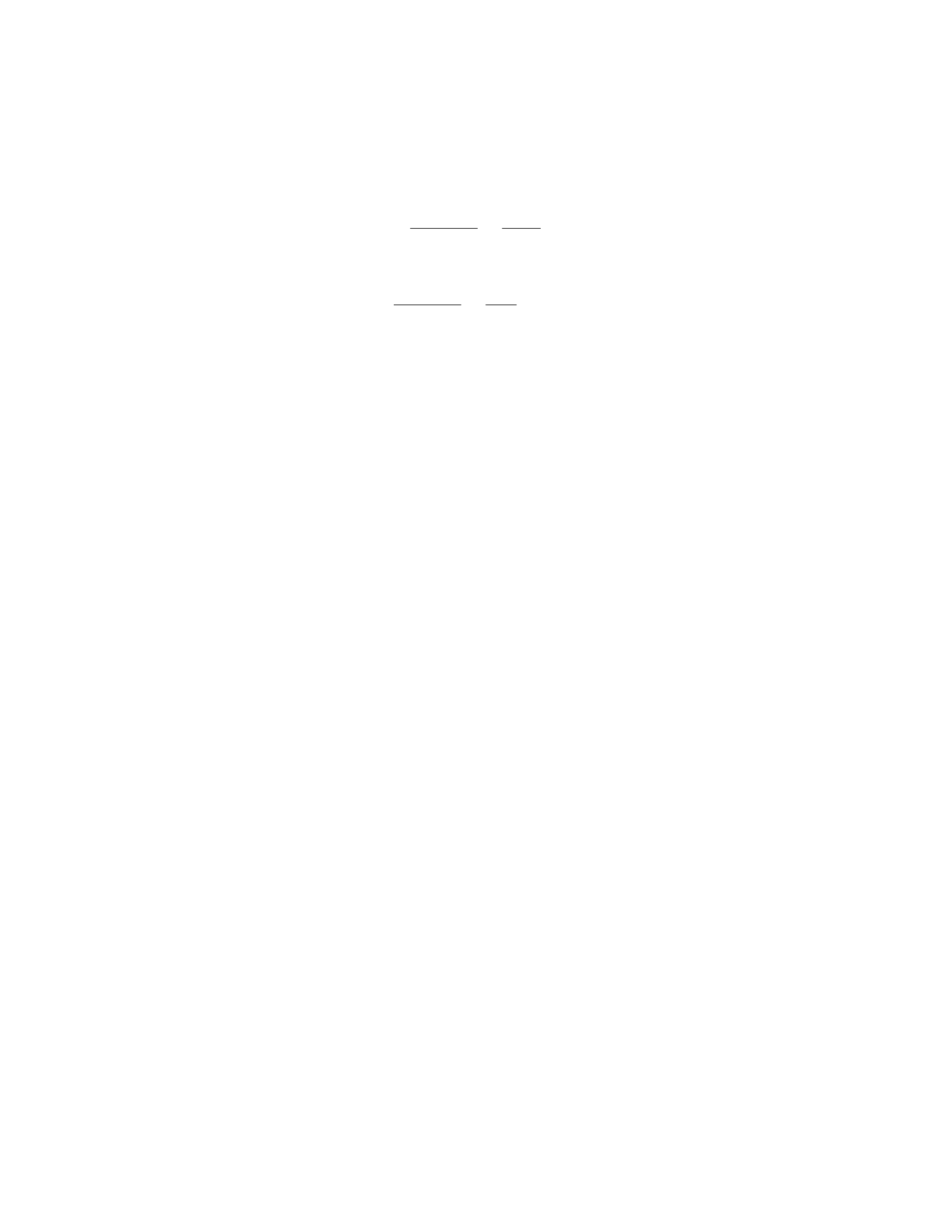
Vsubmerged
Vtotal
=ρcube
ρwater
Step 8: Substitute the given values into the equation:
Vsubmerged
Vtotal
=700
1000 = 0.7
Therefore, 70
Question 21
Question
A piece of aluminum with a volume of 0.1 m3and a density of 2700 kg/m3is
submerged in a container of water. If the aluminum piece experiences an upward
buoyant force of 2000 N, what is the depth of its immersion in the water?
Solution
Step 1: Firstly, we need to determine the weight of the aluminum piece. The
weight of an object can be calculated using the formula: W=mg, where mis
the mass of the object and gis the acceleration due to gravity (approx. 9.81
m/s2). The density of aluminum is 2700 kg/m3and the volume is 0.1 m3, so the
mass mcan be calculated using the formula: m= density ×volume. Therefore,
m= 2700 kg/m3×0.1 m3= 270 kg. Thus, the weight of the aluminum piece is:
W= 270 kg ×9.81 m/s2= 2650.7 N.
Step 2: Next, we need to understand that the buoyant force is equal to the
weight of the water displaced by the submerged object. Therefore, the buoyant
force is equal to the weight of water with the same volume as the submerged part
of the aluminum piece. Let dbe the depth of immersion of the aluminum piece in
the water. The volume of water displaced will be 0.1 m3×d. The weight of this
displaced water is given by: Wdisplaced = density of water ×volume of water.
The density of water is 1000 kg/m3, so Wdisplaced = 1000 kg/m3×0.1 m3×d=
100dN.
Step 3: Since the buoyant force is equal to 2000 N, we can set up the equation:
2000 N = 100dN. Solving for d, we get d= 2000 N/100 N = 20 m. Therefore,
the depth of immersion of the aluminum piece in the water is 20 meters.
Question 22
Question
A cube of wood with sides of length 10 cm and a density of 0.8 g/cm3is floating
in a container of water. Determine the fraction of the cube’s volume that is
submerged in the water.
17

Solution
Step 1: Calculate the weight of the cube The weight of the cube can be calculated
using the formula:
Weight = Density ×Volume ×Acceleration due to gravity
Weight = 0.8 g/cm3×(10 cm)3×9.81 m/s2
Step 2: Calculate the buoyant force acting on the cube The buoyant force
on the cube equals the weight of the water displaced by the cube, which is equal
to the weight of the cube when it is floating. Therefore, the buoyant force is the
same as the weight of the cube.
Step 3: Determine the fraction of the cube’s volume submerged The fraction
of the cube’s volume submerged is equal to the ratio of the buoyant force acting
on the cube to the weight of the cube when fully submerged. This can be
calculated using the formula:
Fraction submerged = Buoyant force
Weight of cube when fully submerged
Fraction submerged = Weight of cube
Weight of cube
Fraction submerged = 1
Therefore, the entire volume of the cube is submerged in the water.
Question 23
Question
A large wooden cube with a side length of 2 meters and a density of 600 kg/m3
is floating in a pool of water. What is the depth of the cube below the surface
of the water?
Solution
Step 1: First, we can calculate the mass of the wooden cube using its density
and volume. Given that the side length of the cube is 2 meters, the volume of
the cube is given by:
V= (side length)3= (2 m)3= 8 m3
The mass of the wooden cube is then:
mass = density ×volume = 600 kg/m3×8 m3= 4800 kg
Step 2: Next, we need to consider the forces acting on the wooden cube
when it is floating in water. The buoyant force acting on the cube is equal
18

to the weight of the water displaced by the cube. According to Archimedes’
principle, the buoyant force is also equal to the weight of the cube. So, the
buoyant force is:
buoyant force = mass ×g= 4800 kg ×9.81 m/s2= 47088 N
Step 3: Now, let’s consider the forces acting on the cube in equilibrium. The
buoyant force acts upward, while the weight of the cube acts downward. Since
the cube is floating, these two forces must be equal in magnitude. Using this,
we can find the volume of water displaced by the cube. The weight of the cube
is:
weight of cube = mass ×g= 4800 kg ×9.81 m/s2= 47088 N
Step 4: The weight of the cube is also equal to the weight of the water
displaced:
weight of water displaced = density of water ×volume of water displaced ×g
Since the cube is fully submerged, the volume of water displaced is equal to the
volume of the cube. Rearranging the equation gives:
depth of cube submerged = weight of cube
density of water ×g=47088 N
1000 kg/m3×9.81 m/s2
Solving this will give us the depth of the cube below the surface of the water.
Question 24
Question
A cube of wood with sides measuring 5 cm is floating in water. If the cube is
pushed down until it is completely submerged, what is the change in the buoyant
force acting on the cube? The density of water is 1000 kg/m3.
Solution
Step 1: First, we need to find the weight of the cube when it is floating. When
the cube is floating, the weight of the cube is balanced by the buoyant force.
The weight of the cube is given by the formula:
Weight of cube = Volume ×Density ×Acceleration due to gravity
The volume of the cube is calculated as follows:
Volume = (side length)3= (0.05 m)3
Step 2: Calculate the volume of the cube.
Volume = 0.053m3
19

Step 3: Now, let’s calculate the weight of the cube.
Weight of cube = 0.053m3×Density of wood ×9.81 m/s2
Step 4: Next, we need to find the buoyant force acting on the cube when it
is floating. The buoyant force is equal to the weight of the water displaced by
the cube, which is equal to the weight of the cube when it is floating.
Step 5: Find the change in the buoyant force when the cube is fully sub-
merged. When the cube is fully submerged, the buoyant force acting on it will
be equal to the weight of the water displaced by the cube, which will be equal
to the weight of the cube when fully submerged.
Step 6: Finally, we need to find the change in the buoyant force. The
change in the buoyant force is equal to the buoyant force when the cube is fully
submerged minus the buoyant force when the cube is floating.
Change in buoyant force = Weight of cube fully submerged−Weight of cube floating
Question 25
Question
A solid object of mass mand volume Vis submerged in a fluid of density ρ. If
the object is floating at equilibrium in the fluid, determine the expression for
the buoyant force acting on the object.
Solution
Step 1: First, let’s determine the volume of fluid displaced by the object. Ac-
cording to Archimedes’ principle, the buoyant force acting on an object is equal
to the weight of the fluid displaced by the object. Since the object is floating at
equilibrium, the buoyant force is equal in magnitude and opposite in direction
to the gravitational force acting on the object. Therefore, the buoyant force
can be expressed as Fb=mg, where mis the mass of the object and gis the
acceleration due to gravity.
Step 2: The weight of the fluid displaced by the object is equal to the
weight of the fluid with volume V. The weight of the fluid can be expressed as
Wf=ρV g, where ρis the density of the fluid.
Step 3: Since the buoyant force is equal to the weight of the fluid displaced,
we have Fb=ρV g. Setting this equal to mg, we can solve for the expression of
the buoyant force: ρV g =mg.
Step 4: Canceling out the mass mfrom both sides of the equation, we are
left with the expression for the buoyant force: Fb=ρV g .
20

Question 26
Question
A cube with sides of length 10 cm and a density of 800 kg/m3is floating in
water. Determine the depth to which the cube is submerged.
Solution
Let’s denote the density of water as ρw= 1000 kg/m3and the depth to which
the cube is submerged as h. We can begin by setting up an equation based on
the forces acting on the cube.
Step 1: The buoyant force exerted on the cube is equal to the weight of the
water displaced by the cube.
Weight of cube = Buoyant force
Step 2: The weight of the cube is given by mcube ×g, where mcube is the
mass of the cube and gis the acceleration due to gravity.
mcube ×g=ρcube ×Vcube ×g
Step 3: The buoyant force is given by the weight of the water displaced.
Buoyant force = ρw×Vsubmerged ×g
Step 4: Since the cube is floating, the weight of the cube is balanced by the
buoyant force.
ρcube ×Vcube ×g=ρw×Vsubmerged ×g
Step 5: Calculate the volumes involved using the geometry of the cube and
the submerged part of the cube.
Vcube = (0.1 m)3= 0.001 m3
Vsubmerged =Abase ×h= (0.1 m)2×h= 0.01hm3
Step 6: Substitute the volumes back into the equation.
ρcube ×0.001 m3×g=ρw×0.01hm3×g
Step 7: Solve for h.
h=ρcube
ρw×0.01 m
Step 8: Plug in the values to find the depth to which the cube is submerged.
h=800
1000 ×0.01 = 0.008 m = 8 cm
Therefore, the cube is submerged to a depth of 8 cm.
21
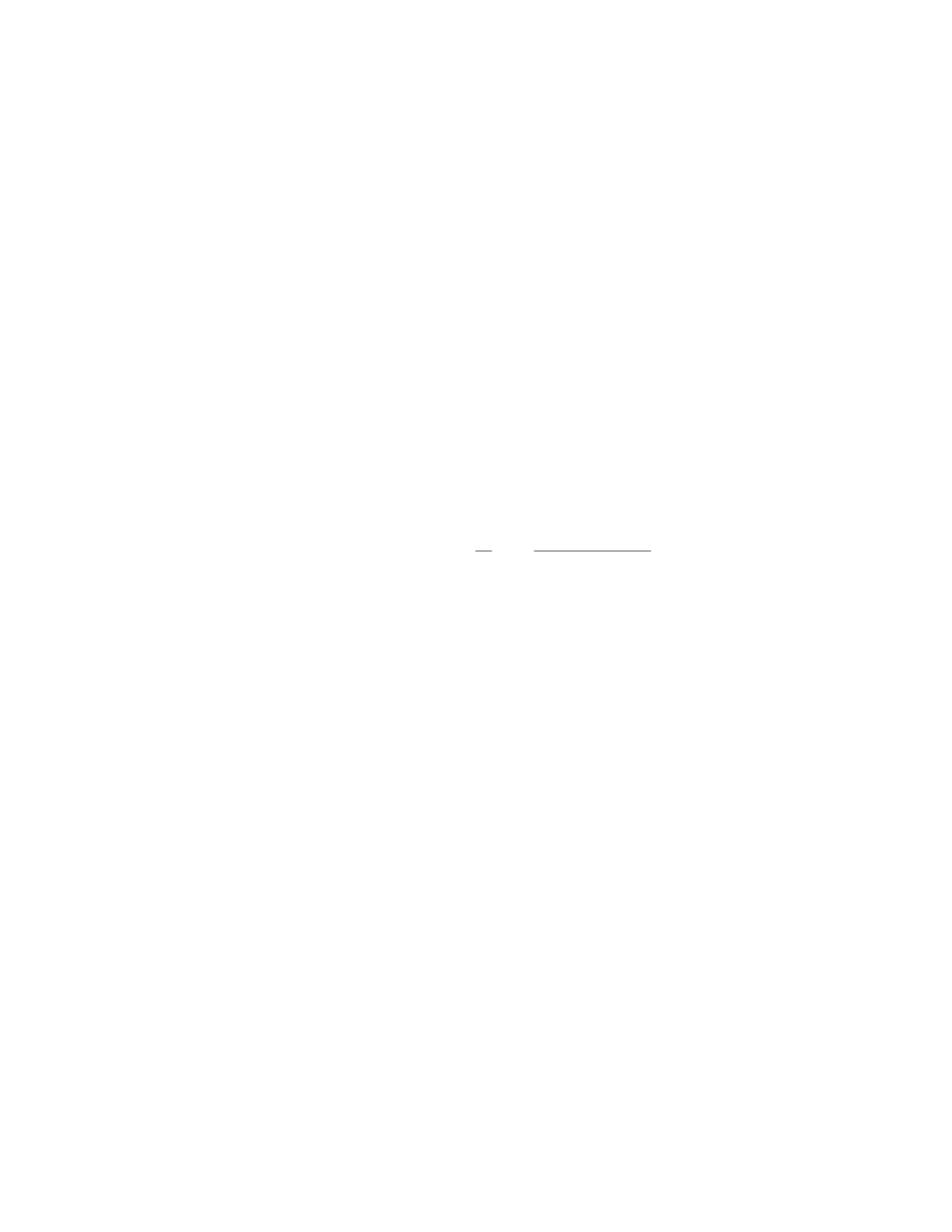
Question 27
Question
A ship has a mass of 120,000 kg and displaces water with a density of 1000
kg/m3. If the ship is floating at the surface of the water, what is the total
volume of water displaced by the ship?
Solution
Step 1: We will first calculate the weight of the ship. Given: Mass of the ship,
m= 120,000 kg Acceleration due to gravity, g= 9.8 m/s2Weight, W=m·g
W= 120,000 kg ×9.8 m/s2= 1,176,000 N.
Step 2: Next, we will calculate the buoyant force acting on the ship. Buoyant
force, Fb=ρ·V·g(where ρis the density of the fluid, Vis the volume
of fluid displaced, and gis the acceleration due to gravity) Since the ship is
floating, the buoyant force is equal to the weight of the ship: Fb=W. Thus,
ρ·V·g= 1,176,000 N.
Step 3: Now, we can solve for the volume of water displaced (V). Given:
Density of water, ρ= 1000 kg/m3V=W
ρ·gV=1,176,000 N
1000 kg/m3×9.8 m/s2V≈120 m3.
Therefore, the total volume of water displaced by the ship is approximately
120 cubic meters.
Question 28
Question
A cube of side length aand density ρ1is floating in a liquid of density ρ2with
a fraction xof its volume submerged. Determine the expression for xin terms
of a,ρ1, and ρ2.
Given: - Mass of the cube: M- Acceleration due to gravity: g- Volume
submerged: V
Solution
Step 1: Calculate the buoyant force acting on the cube. The buoyant force Fb
exerted on the cube is equal to the weight of the liquid displaced by the cube.
Fb=ρ2V g
Step 2: Calculate the weight of the cube. The weight of the cube Wis equal
to the mass of the cube times the acceleration due to gravity.
W=Mg
Step 3: Analyze the forces acting on the cube in equilibrium. In equilibrium,
the buoyant force Fbmust balance the weight Wof the cube. Thus, Fb=W.
22

Substitute the expressions for Fband Winto the equilibrium condition:
ρ2V g =Mg
Step 4: Express the volume submerged in terms of given variables. The mass
Mcan be expressed in terms of the density ρ1and the volume submerged Vas
M=ρ1V. Substitute M=ρ1Vinto the equilibrium condition:
ρ2V g =ρ1V g
Step 5: Solve for the fraction xof the volume submerged. The fraction xof
the volume submerged can be expressed as x=V
a3. Substitute V=xa3into
the equilibrium condition:
ρ2xa3g=ρ1xa3g
ρ2=ρ1
Therefore, the expression for xin terms of a,ρ1, and ρ2is:
x=ρ1
ρ2
Question 29
Question
A cube of wood with sides of length 10 cm is floating in a container of water.
The density of the wood is 600 kg/m3and the density of water is 1000 kg/m3.
What fraction of the cube’s volume is submerged in the water?
Solution
Step 1: Let’s first determine the buoyant force acting on the cube. The buoyant
force is equal to the weight of the water displaced by the cube. The volume of
water displaced is equal to the volume of the submerged part of the cube.
Step 2: The weight of the water displaced is equal to the weight of the cube
itself. We can calculate the weight of the cube using the formula:
Weight = Mass ×Gravity
Step 3: The mass of the cube can be calculated using the formula:
Mass = Density ×Volume
Step 4: Let’s calculate the mass of the cube. Given: Density of the wood,
ρwood = 600 kg/m3Volume of the cube, V= (0.1 m)3= 0.001 m3
Step 5:
Mass of the wood cube = ρwood ×V
23

Step 6:
Mass of the wood cube = 600 kg/m3×0.001 m3= 0.6 kg
Step 7: Calculate the weight of the wood cube using the formula:
Weight = Mass ×Gravity
Step 8:
Weight = 0.6 kg ×9.8 m/s2= 5.88 N
Step 9: Since the weight of the water displaced is equal to the weight of the
cube, the buoyant force acting on the cube is 5.88 N.
Step 10: The volume of the cube submerged in water is equal to the volume
of water displaced, which is also equal to the volume of the submerged part of
the cube.
Step 11: Let Vsubmerged be the volume submerged in water. We know that
the buoyant force is equal to the weight of the water displaced, which is the
weight of the submerged part of the cube. The weight of the submerged part of
the cube can be calculated using:
Weight = Densitywater ×Vsubmerged ×g
Step 12:
5.88 N = 1000 kg/m3×Vsubmerged ×9.8 m/s2
Step 13: Solve for Vsubmerged to find the volume of the cube submerged in
water.
Step 14:
Vsubmerged =5.88
1000 ×9.8= 0.0006 m3
Step 15: The fraction of the cube’s volume submerged in water is given by:
Vsubmerged
Vtotal
=0.0006 m3
0.001 m3= 0.6
Step 16: Therefore, 0.6 or 60
Question 30
Question
A cylindrical object with height hand radius ris floating in a liquid with density
ρliquid. If the height of the object submerged in the liquid is h′, express h′in
terms of hand r.
24

Solution
Step 1: Firstly, let’s denote the density of the cylindrical object as ρobject.
Step 2: Since the object is floating, the buoyant force acting on the object
is equal to the weight of the object. The volume of the object submerged in the
liquid is V′=πr2h′.
Step 3: The buoyant force acting on the object is given by Fbuoyant =
ρliquidgV ′, where gis the acceleration due to gravity.
Step 4: The weight of the object is given by Fweight =ρobjectgV , where
V=πr2his the total volume of the object.
Step 5: Since the object is floating, the buoyant force equals the weight of
the object: ρliquidgπr2h′=ρobjectgπr2h.
Step 6: Simplifying, we find ρliquidh′=ρobjecth.
Step 7: Finally, we express h′in terms of hand r:h′=ρobject
ρliquid h.
Therefore, the height of the object submerged in the liquid, h′, can be ex-
pressed as h′=ρobject
ρliquid
h.
Question 31
Question
A metal object has a mass of 1.5 kg in air and is completely submerged in a
container of water. When submerged, the object has an apparent mass of 1.2
kg. Calculate the buoyant force acting on the object and the density of the
metal.
Solution
Step 1: First, let’s determine the weight of the object in air. The weight of the
object in air is given by:
Wair =m·g
where: m= 1.5 kg (mass of the object) and g= 9.81 m/s2(acceleration due to
gravity).
Calculating Wair:
Wair = 1.5 kg ×9.81 m/s2= 14.715 N
Step 2: Next, let’s determine the weight of the object when submerged in
water. The apparent weight of the object in water is given by:
Wwater =Wair −buoyant force
Given that the apparent mass of the object in water is 1.2 kg, we have:
Wwater = 1.2 kg ×9.81 m/s2= 11.772 N
25

Step 3: Calculate the buoyant force. Using the equation:
buoyant force = Wair −Wwater
we find:
buoyant force = 14.715 N −11.772 N = 2.943 N
Step 4: Calculate the volume of the object. The volume of the object can
be calculated using the buoyant force and the density of water:
buoyant force = ρwater ·V·g
where: ρwater = 1000 kg/m3(density of water), Vis the volume of the object to
be determined, and g= 9.81 m/s2as before.
Calculating the volume:
V=buoyant force
ρwater ·g=2.943
1000 ·9.81 = 0.0003 m3
Step 5: Calculate the density of the metal. The density of the metal can be
calculated using the volume and the mass of the object:
density of metal = m
V=1.5
0.0003 = 5000 kg/m3
Therefore, the buoyant force acting on the object is 2.943 N and the density
of the metal is 5000 kg/m3.
Question 32
Question
A solid cube of density ρ1is floating in a liquid of density ρ2. The cube has a
side length L. What is the minimum density of the cube that will allow it to
float in the liquid such that exactly half of its volume is submerged?
Solution
Step 1: Let’s first determine the conditions for the cube to float. The buoyant
force acting on the cube is equal to the weight of the liquid displaced by the
cube. This can be expressed as:
ρ2gVsub =ρ1gVcube
where ρ2is the density of the liquid, gis the acceleration due to gravity, Vsub is
the volume submerged in the liquid, and Vcube is the volume of the cube.
Step 2: Since the cube is floating, the buoyant force equals the weight of the
cube, so:
ρ2g1
2L2=ρ1g(L3)
26

Step 3: Rearranging the equation, we get:
ρ1=ρ2
2
Step 4: Therefore, the minimum density of the cube that will allow it to
float in the liquid such that exactly half of its volume is submerged is ρ2
2.
Question 33
Question
A cylindrical object with a height of 20 cm and a radius of 5 cm is partially
submerged in water. The density of the object is 700 kg/m3and the density of
water is 1000 kg/m3. Calculate the buoyant force acting on the object.
Solution
Let’s start by calculating the volume of the object submerged in water. The
volume of a cylinder is given by the formula:
V=πr2h
where ris the radius of the cylinder and his the height of the cylinder.
Step 1: Calculate the volume of the object. Given that the radius r= 5
cm and the height h= 20 cm, we have:
V=π(0.05 m)2×0.20 m
V=π×0.0025 m2×0.20 m
V= 0.0025π m3
Step 2: Calculate the volume of water displaced/suspended. The volume of
water displaced by the submerged portion of the object is equal to the volume
of the submerged portion of the object.
Vwater = 0.0025π m3
Step 3: Calculate the weight of the water displaced/suspended. The weight
of the water displaced is equal to the weight of the water that would occupy
that volume.
Weightwater =ρwater ×g×Vwater
where ρwater = 1000 kg/m3is the density of water and g= 9.81 m/s2is the
acceleration due to gravity.
Weightwater = 1000 ×9.81 ×0.0025π
Weightwater ≈77.3903 N
27

Step 4: Calculate the weight of the object. The weight of the object is
given by:
Weightobject =ρobject ×g×Vobject
where ρobject = 700 kg/m3is the density of the object and Vobject =πr2his the
total volume of the cylinder.
Weightobject = 700 ×9.81 ×π×(0.05)2×0.2
Weightobject ≈133.114 N
Step 5: Calculate the buoyant force. The buoyant force is equal to the
weight of the water displaced/suspended.
Buoyant Force = Weightwater ≈77.3903 N
Therefore, the buoyant force acting on the object is approximately 77.39 N.
Question 34
Question
A cube of wood with sides of length 10 cm and density 800 kg/m3is floating in
water. Determine the depth to which the cube is submerged in water.
Solution
To solve this problem, we will use Archimedes’ principle, which states that the
buoyant force acting on an object in a fluid is equal to the weight of the fluid
displaced by the object.
Step 1: First, we calculate the weight of the cube. The volume of the cube
is given by:
V= (10 cm)3= (0.1 m)3= 0.001 m3
The weight of the cube can be found using the formula:
Weight = density ×volume ×g
where g= 9.81 m/s2is the acceleration due to gravity.
Weight = 800 kg/m3×0.001 m3×9.81 m/s2= 7.848 N
Step 2: Next, we calculate the buoyant force acting on the cube. The
buoyant force is given by:
Buoyant force = Weight of displaced water
Since the cube is floating in water, the weight of the displaced water is equal
to the weight of the cube. Therefore, the buoyant force is also 7.848 N.
28

Step 3: Finally, we determine the depth to which the cube is submerged.
The buoyant force is given by:
Buoyant force = Density of water ×g×Volume submerged
Solving for the volume submerged:
Volume submerged = Buoyant force
Density of water ×g=7.848
1000 kg/m3×9.81 m/s2= 0.0008 m3
Since the cube is a cube, the side length submerged is the cube root of the
volume submerged:
Depth = 3
√0.0008 m3= 0.1 m = 10 cm
Therefore, the depth to which the cube is submerged in water is 10 cm.
Question 35
Question
A solid cube of aluminum with a density of 2700 kg/m3and side length 0.1 m is
floating in water. What fraction of the cube’s volume is submerged below the
water surface?
Solution
Step 1: We first need to find the density of water, as it will help us determine
the fraction of the cube’s volume that is submerged. The density of water is
typically 1000 kg/m3.
Step 2: Next, we can use Archimedes’ principle, which states that the buoy-
ant force on an object is equal to the weight of the fluid displaced by the object.
We can calculate the buoyant force on the cube using the formula:
Fb=ρwater ·Vsubmerged ·g
where Fbis the buoyant force, ρwater is the density of water, Vsubmerged is
the volume submerged, and gis the acceleration due to gravity.
Step 3: The weight of the cube is equal to its density times the volume times
g:
W=ρaluminum ·Vcube ·g
Step 4: Since the cube is floating, the weight of the cube must be balanced
by the buoyant force:
ρaluminum ·Vcube ·g=ρwater ·Vsubmerged ·g
Step 5: We can rearrange this equation to solve for Vsubmerged:
29

Vsubmerged =ρaluminum
ρwater Vcube
Step 6: Finally, we can find the fraction of the cube’s volume submerged
below the water surface by dividing Vsubmerged by Vcube:
Fraction submerged = Vsubmerged
Vcube
Now, we can substitute the given values and solve for the fraction submerged.
30

