


PHYS 101 - ELEMENTS OF PHYSICS
- Buoyant forces and Archimedes’
principle
Question Bank - Set 4
Liberty University
Question 1
Question
A solid metal cube of side length 10 cm and mass 2 kg is fully submerged in a
liquid with a density of 800 kg/m3. Calculate the buoyant force acting on the
cube and determine if the cube will float or sink in the liquid.
Solution
Step 1: Calculate the volume of the cube. The volume of a cube is given by
V= side length3. Substituting the given side length of 10 cm into the formula,
we have:
V= (0.1 m)3= 0.001 m3
Step 2: Calculate the mass of the cube. Given the mass of the cube is 2 kg,
where m= density ×volume, we can rewrite the formula to solve for density:
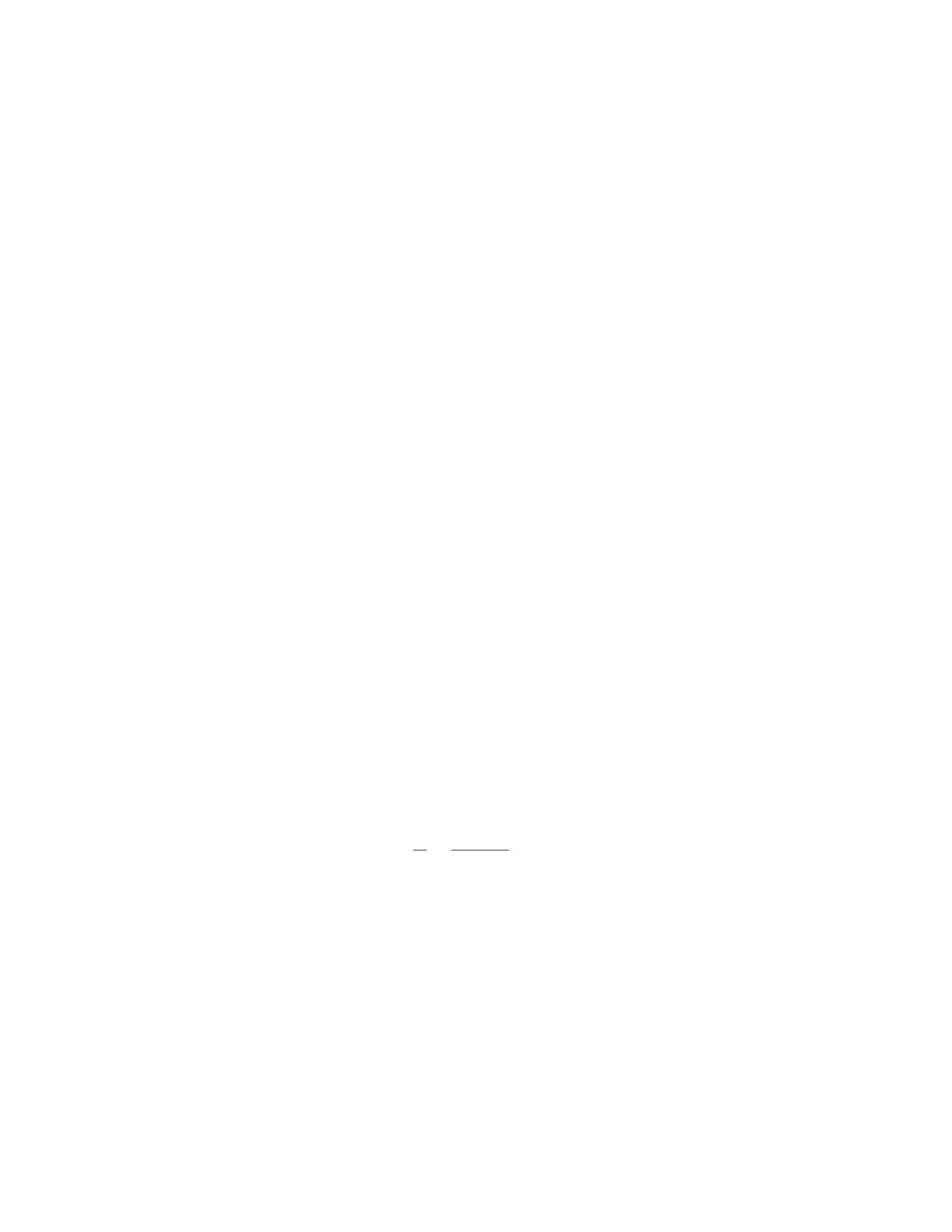
density = m
V=2 kg
0.001 m3= 2000 kg/m3
Step 3: Calculate the weight of the cube. The weight of the cube is equal to
its mass times the acceleration due to gravity (g= 9.81 m/s2):
W=m×g= 2 kg ×9.81 m/s2= 19.62 N
Step 4: Calculate the buoyant force. The buoyant force is given by Fb=
density of liquid ×g×Vsubmerged, where Vsubmerged is the volume of the cube
submerged in the liquid. Since the entire cube is submerged, Vsubmerged =V:
Fb= 800 kg/m3×9.81 m/s2×0.001 m3= 7.848 N

Step 5: Determine if the cube will float or sink. Since the buoyant force
(7.848 N) is greater than the weight of the cube (19.62 N), the cube will float
in the liquid.
Question 2
Question
A rectangular block of wood has dimensions 10 cm ×5 cm ×3 cm and a density
of 0.8 g/cm3. The block is placed in a container of water. Find the buoyant
force acting on the block and determine if the block will sink or float in the
water.
Solution
Step 1: Calculate the volume of the block. The volume of the block can be
calculated using the formula: volume = length ×width ×height. Given the
dimensions are 10 cm ×5 cm ×3 cm, the volume of the block is:
10 cm ×5 cm ×3 cm = 150 cm3
Step 2: Calculate the mass of the block. The mass of the block can be
calculated using the formula: mass = density ×volume. Given the density of
the wood is 0.8 g/cm3, the mass of the block is:
0.8 g/cm3×150 cm3= 120 g
Step 3: Calculate the weight of the block. The weight of the block can
be calculated using the formula: weight = mass ×acceleration due to gravity.
Given the acceleration due to gravity is 9.8 m/s2, the weight of the block is:
120 g ×1 kg
1000 g ×9.8 m/s2= 1.176 N
Step 4: Calculate the buoyant force acting on the block. The buoyant force
acting on the block is equal to the weight of the water displaced by the block.
Since the block is fully submerged, the volume of water displaced is equal to the
volume of the block, which is 150 cm3. The density of water is 1 g/cm3, so the
mass of the water displaced is 150 g. Therefore, the buoyant force acting on the
block is:
150 g ×1 kg
1000 g ×9.8 m/s2= 1.47 N
Step 5: Conclusion Since the buoyant force (1.47 N) is greater than the
weight of the block (1.176 N), the block will float in the water.
2
Question 3
Question
A cube of side length Land density ρcube is floating on the surface of a liquid
of density ρliquid. The cube is pushed down so that a fraction xof its volume
is submerged in the liquid. Determine the value of xin terms of L,ρcube, and
ρliquid.
Solution
Step 1: Determine the buoyant force acting on the cube. The buoyant force
Fbuoyant is equal to the weight of the liquid displaced by the cube. The volume
of the cube submerged in the liquid is xL3, so the weight of the liquid displaced
is ρliquid ·xL3·g, where gis the acceleration due to gravity.
Step 2: Determine the weight of the cube. The weight of the cube is equal to
its mass times the acceleration due to gravity. The mass of the cube is ρcube ·L3
and the weight is ρcube ·L3·g.
Step 3: Apply the condition for equilibrium. For the cube to float at a
constant height, the buoyant force must equal the weight of the cube. Therefore,
we have:
ρliquid ·xL3·g=ρcube ·L3·g
Step 4: Solve for x. Canceling the gand L3terms on both sides gives us:
ρliquid ·x=ρcube
Therefore, the fraction xof the cube’s volume submerged in the liquid is:
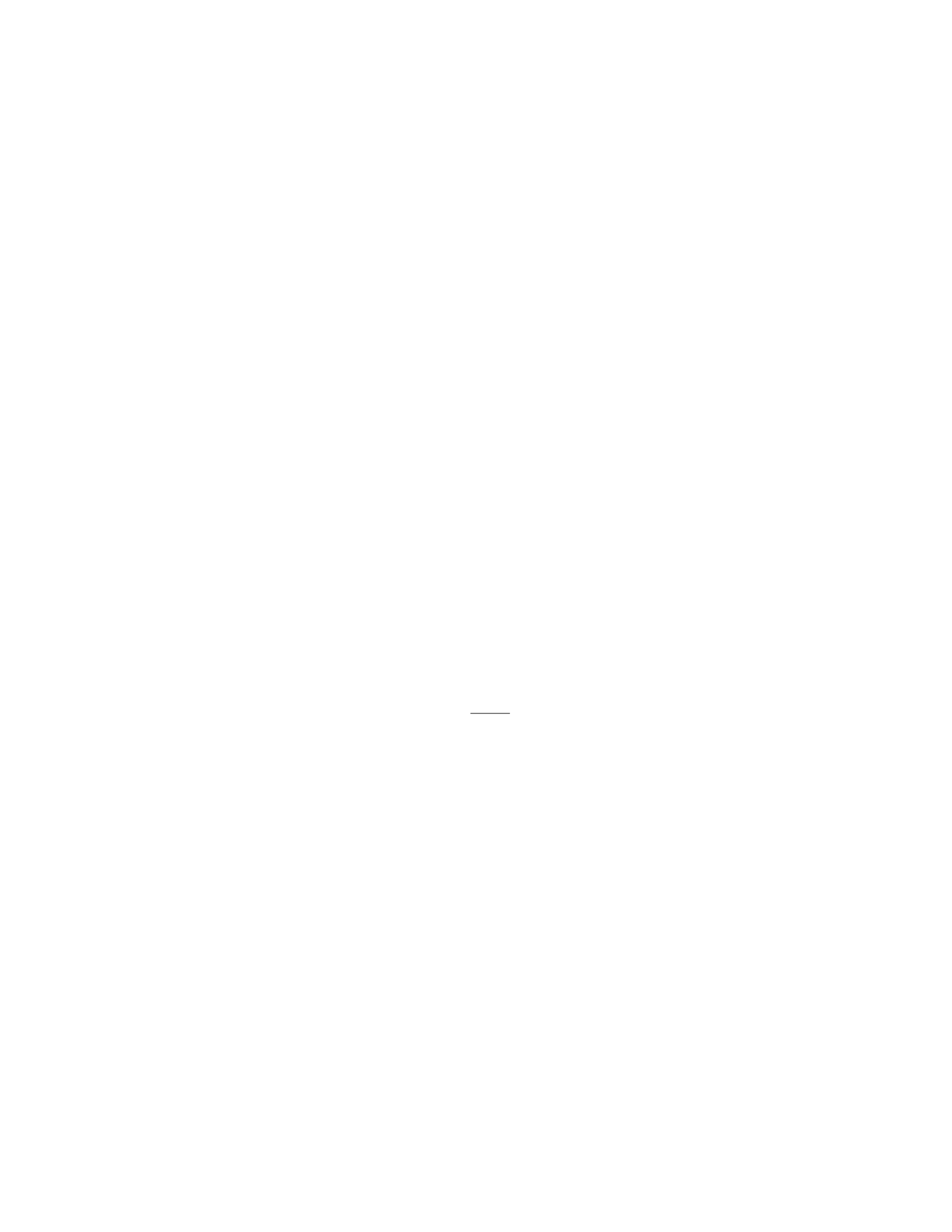
x=ρcube
ρliquid
Question 4
Question
A solid cube of side length 10 cm and density 1500 kg/m3is placed in a container
of water. If the cube floats with 3 cm of its height above the water surface,
calculate the buoyant force acting on the cube.
Solution
Step 1: Calculate the volume of the cube submerged in water. Let Vsub be the
volume submerged.
Volume of cube = Side length3
= (0.1 m)3
= 0.001 m3
3

Since the cube floats with 3 cm of its height above water, the volume sub-
merged is:
Vsub = Volume of cube −Volume above water
= 0.001 m3−0.001 m ×0.1 m ×0.1 m
= 0.0007 m3
Step 2: Calculate the mass of the cube.
Mass = Density ×Volume
= 1500 kg/m3×0.001 m3
= 1.5 kg
Step 3: Calculate the weight of the cube.
Weight = Mass ×Acceleration due to gravity
= 1.5 kg ×9.8 m/s2
= 14.7 N
Step 4: Calculate the buoyant force acting on the cube.
Buoyant force = Weight of water displaced
= Density of water ×Volume submerged ×Acceleration due to gravity
= 1000 kg/m3×0.0007 m3×9.8 m/s2
= 6.86 N
Therefore, the buoyant force acting on the cube is 6.86 N.
Question 5
Question
A cube of side length 20 cm and mass 1 kg is completely submerged in water.
Calculate the buoyant force acting on the cube and determine whether the cube
will sink or float in water.
Solution
Let’s first calculate the buoyant force acting on the cube. Step 1: Determine
the volume of the cube. The volume of a cube is given by V=s3, where sis
the side length. Given that the side length is 20 cm, the volume is:
V= (0.20m)3= 0.008m3
Step 2: Determine the density of water. The density of water is typically
ρ= 1000 kg/m3.
4

Step 3: Calculate the buoyant force acting on the cube. The buoyant force
Fbis given by Archimedes’ principle as the weight of the water displaced by the
cube:
Fb=ρ·V·g
Fb= 1000 kg/m3×0.008m3×9.8m/s2
Fb= 78.4 N
Step 4: Determine the weight of the cube. The weight Wof the cube is given
by W=m·g, where mis the mass of the cube (1 kg) and gis the acceleration
due to gravity (9.8 m/s2).
W= 1 kg ×9.8 m/s2= 9.8 N
Step 5: Compare the weight of the cube and the buoyant force. Since the
buoyant force (78.4 N) is greater than the weight of the cube (9.8 N), the cube
will float in water.
Question 6
Question
A rectangular block of wood with a density of 700 kg/m3and dimensions 0.4
m×0.3 m ×0.2 m floats on water. Calculate the minimum mass of lead that
must be added to the top of the block so that it now sinks completely in water.
(Density of lead = 11 400 kg/m3)
Solution
Step 1: Calculate the volume of the wooden block. The volume of the wooden
block can be calculated as:
Vwood = length ×width ×height
Vwood = 0.4 m ×0.3 m ×0.2 m = 0.024 m3
Step 2: Calculate the mass of the wooden block. The mass of the wooden
block can be found using the formula:
mass = density ×volume
masswood = 700 kg/m3×0.024 m3= 16.8 kg
Step 3: Calculate the volume of the lead required. Since the entire system
(wooden block + lead) will now sink, the total volume of the system must be
equal to the volume of water displaced when submerged. The volume of the
system can be expressed as:
Vtotal =Vwood +Vlead
5

Step 4: Calculate the mass of lead required. The mass of lead required to
sink the entire system can be calculated using:
masslead = densitylead ×Vlead
masslead = 11400 kg/m3×Vlead
Step 5: Set up the equation for volume to solve for the mass of lead. Using
the relationship between the volume of the system and the volumes of wood and
lead:
Vtotal =Vwood +Vlead
Vtotal = 0.024 m3+Vlead
Step 6: Substitute the values into the equation from step 5.
Vtotal = 0.024 m3+Vlead
Vlead =Vtotal −0.024 m3
Step 7: Substitute the expression for lead volume into the answer obtained
in step 4 and solve for the mass.
masslead = 11400 kg/m3×(Vtotal −0.024 m3)
Step 8: Substitute the known values into the equation from step 7 and
calculate the mass of lead required to sink the wooden block.
masslead = 11400 kg/m3×Vtotal −11400 kg/m3×0.024 m3
Step 9: Calculate the numerical value of the mass of lead required to sink
the wooden block completely.
Question 7
Question
A cube of side length aand density ρ1is floating in a liquid of density ρ2. The
cube is immersed to a depth dand the part of the cube that is above the liquid
surface has a volume V0. Determine the density of the cube material in terms
of ρ2,a,d, and V0.
Solution
Step 1: Let’s consider the forces acting on the cube. The forces acting on the
cube when it’s floating are the buoyant force FB, the weight of the cube mg,
and the normal force from the liquid FN. Since the cube is floating, these forces
must be balanced.
6

Step 2: The weight of the cube is given by mg =ρ1V0g, where V0is the vol-
ume of the cube above the liquid surface, ρ1is the density of the cube material,
and gis the acceleration due to gravity.
Step 3: The buoyant force is FB= (ρ2V0)g, where ρ2is the density of the
liquid and V0is the volume of the cube above the liquid surface.
Step 4: The normal force FNis equal in magnitude to the weight of the
liquid displaced by the cube. The volume of the cube below the liquid surface
is V1=a2(d−a
2). The weight of this displaced liquid is ρ2V1g=ρ2a2(d−a
2)g.
Step 5: Since the cube is floating, the sum of the forces in the vertical
direction is zero. Therefore, the net force is FN−ρ2a2(d−a
2)g−ρ1V0g= 0.
Step 6: Solving for ρ1gives ρ1=ρ2a2(d−a
2)
V0as the density of the cube
material in terms of ρ2,a,d, and V0.
Question 8
Question
A cylindrical object with a diameter of 20 cm and a height of 30 cm is floating in
water. If the density of water is 1000 kg/m3, what is the mass of the cylindrical
object? (Assume the entire object is submerged in water)
Solution
Step 1: Find the volume of the cylindrical object. The volume of a cylinder is
given by the formula V=πr2h, where ris the radius and his the height. Given
that the diameter is 20 cm, the radius (r) is 10 cm or 0.1 m.
V=π×(0.1)2×0.3=0.00943 m3
Step 2: Find the buoyant force acting on the cylindrical object. According
to Archimedes’ principle, the buoyant force (Fb) acting on an object immersed
in a fluid is equal to the weight of the fluid displaced by the object. The weight
of the fluid displaced is given by the formula W=ρV g, where ρis the density
of the fluid, Vis the volume of the object submerged, and gis the acceleration
due to gravity (9.81 m/s2).
W= 1000 ×0.00943 ×9.81 = 92.43 N
Step 3: Calculate the mass of the cylindrical object. Since the object is float-
ing, the buoyant force (Fb) must be equal to the weight of the object (Wobject).
The weight of the object can be calculated using the formula Wobject =m×g,
where mis the mass of the object.
92.43 = m×9.81 =⇒m=92.43
9.81 = 9.42 kg
Therefore, the mass of the cylindrical object is 9.42 kg.
7

Question 9
Question
A cube of side length aand density ρis placed in a container filled with water.
The cube floats with 1
3of its volume submerged. Determine the density of the
water in terms of ρ.
Solution
Step 1: We first determine the volume of the cube submerged in water. Let V
be the volume of the cube. Since 1
3of the volume is submerged, we have:
Vsubmerged =1
3V
Step 2: The weight of the cube is equal to the buoyant force acting on it.
The weight of the cube can be expressed as mg, where mis the mass of the
cube and gis the acceleration due to gravity.
Step 3: The mass of the cube mcan be expressed in terms of its volume V
and density ρ:
m=ρV
Step 4: The buoyant force can be calculated using the volume of the cube
submerged Vsubmerged and the density of water ρwater:
Buoyant force = ρwaterVsubmergedg
Step 5: Equating the weight of the cube to the buoyant force:
ρV g =ρwaterVsubmergedg
Step 6: Substituting the expressions for m,Vsubmerged, and rearranging the
equation:
ρ(4a3
27 )g=ρwater(a3
3)g
Step 7: Solving for ρwater in terms of ρ:
ρwater =4
27ρ
Step 8: Therefore, the density of the water in terms of the density of the
cube is 4
27 ρ.
Question 10
Question
A cubical block of wood with sides of length 0.20 m and a density of 600 kg/m3
is floating in water with 20
8

Solution
Step 1: The buoyant force (FB) acting on the block is equal to the weight of
the water displaced by the block.
FB=ρw·Vdisplaced ·g
where: - ρwis the density of water (1000 kg/m3), - Vdisplaced is the volume of
water displaced by the block, - gis the acceleration due to gravity (9.81 m/s2).
Step 2: Since 20
Vdisplaced = 0.20 ×Vblock
Vdisplaced = 0.20 ×(0.20)3
Vdisplaced = 0.008 m3
Step 3: Now, we can calculate the buoyant force.
FB= 1000 ×0.008 ×9.81
FB= 78.48 N
Step 4: The apparent weight of the block is given by the difference between
the weight of the block in air and the buoyant force.
Apparent weight = Weight in air −FB
Step 5: The weight of the block in air can be calculated as:
Weight in air = ρwood ·Vblock ·g
Weight in air = 600 ×(0.20)3×9.81
Weight in air = 23.53 N
Step 6: Finally, we can find the apparent weight of the block.
Apparent weight = 23.53 −78.48
Apparent weight = −54.95 N
Therefore, the apparent weight of the block when floating in water is 54.95
N, directed upwards.
Question 11
Question
A cube of side length 10 cm and density 800 kg/m3is placed in a liquid of
density 1000 kg/m3. Find the depth to which the cube sinks in the liquid.
Assume that the gravitational acceleration is 9.81 m/s2.
9

Solution
Step 1: The buoyant force on the cube is equal to the weight of the liquid
displaced by the cube. Let Vbe the volume of the cube submerged in the
liquid, and hbe the depth to which the cube sinks. The submerged volume can
be expressed as V=h×A, where Ais the area of one face of the cube. The
weight of the cube can be calculated as Wcube = density ×volume ×gravity =
800 kg/m3×V×9.81 m/s2. The weight of the liquid displaced by the cube can
be calculated as Wliquid = density ×V×gravity = 1000 kg/m3×V×9.81 m/s2.
Step 2: Equate the weight of the cube to the weight of the displaced liquid
to find the depth. Setting Wcube =Wliquid, we have: 800 ×V×9.81 = 1000 ×
V×9.81. Solving for V: 800 ×V= 1000 ×V, 200V= 0, V= 0.
Step 3: Analyzing the result. The negative volume indicates that the cube
does not sink in the liquid. This is because the density of the cube is greater
than the density of the liquid, so it will float on the surface.
Therefore, the cube does not sink in the liquid, and the depth to which it
sinks is 0.
Question 12
Question
A cube of wood with a density of 700 kg/m3and side length 0.2 m is floating
in water. What is the depth of the cube below the water surface? Recalling
that the density of water is 1000 kg/m3and the acceleration due to gravity is
9.81 m/s2.
Solution
Step 1: Let’s first determine the volume of the cube. The volume of the cube
can be calculated using the formula V=l3, where lis the side length of the
cube. Substituting l= 0.2 m:
V= (0.2 m)3= 0.008 m3
Step 2: Next, let’s determine the weight of the cube. The weight Wof an
object can be calculated using the formula W=m·g, where mis the mass of
the cube and gis the acceleration due to gravity. The mass mcan be calculated
using the formula m=ρ·V, where ρis the density of the cube. Substituting
the given values:
m= 700 kg/m3×0.008 m3= 5.6 kg
W= 5.6 kg ×9.81 m/s2= 54.936 N
Step 3: Now, let’s determine the buoyant force acting on the cube. The
buoyant force Fbacting on an object immersed in a fluid can be calculated
using the formula Fb=ρfluid ·V·g, where ρfluid is the density of the fluid and
10

Vis the volume of the object submerged in the fluid. Substituting the given
values with Vbeing the volume of the cube:
Fb= 1000 kg/m3×0.008 m3×9.81 m/s2= 78.48 N
Step 4: Now, we can determine the depth of the cube below the water
surface. The depth dof the cube below the water surface can be calculated
using Archimedes’ principle: the buoyant force acting on the cube is equal to
the weight of the water displaced.
Fb=Wdisplaced
ρfluid ·g·Vsubmerged =ρfluid ·g·d·A
d=Vsubmerged
A
d=V
A
where Ais the surface area of the cube. Substituting the values:
d=0.008 m3
0.04 m2= 0.2 m
Therefore, the depth of the cube below the water surface is 0.2 m.
Question 13
Question
A cube of side length aand density ρis partially submerged in a fluid of density
σsuch that a fraction fof the cube’s volume is submerged. The cube is in
stable equilibrium when released. Determine the value of fin terms of ρ,σ,
and a.
Solution
Step 1: We first consider the forces acting on the cube. The weight of the cube
acts downward through its center of mass while the buoyant force acts upward
through the center of buoyancy.
Step 2: The weight of the cube is given by W=ρa3g, where ρis the density
of the cube and gis the acceleration due to gravity.
Step 3: The buoyant force is given by B=σa3fg, where σis the density of
the fluid and fis the fraction of the cube’s volume submerged.
Step 4: Since the cube is in stable equilibrium, the net force acting on it
must be zero. This gives us the equation:
B−W= 0
11

σa3fg −ρa3g= 0
Step 5: Solving for f, we get:
f=ρ
σ
Step 6: Therefore, the value of fin terms of ρ,σ, and ais f=ρ
σ.
Question 14
Question
A cube of side length ais made up of two materials: the top half (z > a/2)
is made of material with density ρ1, while the bottom half (z < a/2) is made
of material with density ρ2, where ρ1> ρ2. The cube is floating in a liquid of
density ρlsuch that the top surface of the cube is at the liquid-air interface.
Calculate the fraction of the total volume of the cube that is submerged in the
liquid.
Solution
Let’s denote the fraction of the cube submerged in the liquid as f. We will find
this fraction step by step.
Step 1: Determine the depth dat which the cube floats Since the
cube is in equilibrium, the buoyant force must balance the weight of the sub-
merged part of the cube. The weight of the submerged part is given by:
Wsub =ρ2gfa2
where fis the fraction of the cube submerged, a2is the base area of the cube,
and gis the acceleration due to gravity. The buoyant force is given by:
Fbuoyant =ρlgf a2
Setting these two equal and solving for fgives:
ρ2gfa2=ρlgfa2
f=ρl
ρ2
Step 2: Calculate the fraction f′of the top half of the cube that
is submerged The depth at which the top half of the cube floats is a/2. The
depth at which the cube floats is d=f′a/2. We can find f′by:
f′a/2 = ρl
ρ1
a/2
f′=ρl
ρ1
12

Step 3: Calculate the total fraction submerged ftotal The total frac-
tion submerged is the sum of fand f′:
ftotal =f+f′=ρl
ρ2
+ρl
ρ1
=ρl1
ρ2
+1
ρ1
Question 15
Question
A cube of edge length 1.5 m and density 800 kg/m3is floating in water. De-
termine the depth to which the cube is submerged in the water. The density of
water is 1000 kg/m3and the acceleration due to gravity is 9.8 m/s2.
Solution
Step 1: We can start by calculating the buoyant force acting on the cube.
The buoyant force is given by the formula Fb=ρfluidVdispg, where ρfluid is the
density of the fluid, Vdisp is the volume of fluid displaced by the cube, and gis the
acceleration due to gravity. Given that the cube is floating, the buoyant force
will be equal to the weight of the cube. Step 2: The weight of the cube is given
by W=mcubeg, where mcube is the mass of the cube. The mass of the cube
can be calculated as mcube =ρcubeVcube, where ρcube is the density of the cube
and Vcube = (1.5 m)3is the volume of the cube. Step 3: Setting the buoyant
force equal to the weight of the cube, we have: ρfluidVdispg=ρcubeVcubegStep
4: Solving for Vdisp, we get: Vdisp =ρcubeVcube
ρfluid
Step 5: The depth to which the
cube is submerged will be equal to Vdisp divided by the surface area of the cube
in contact with water. Since the cube is floating, this submerged depth is the
depth we need to find.
Question 16
Question
A cube with sides of length 10 cm and a density of 800 kg/m3is completely
submerged in water.
If the cube is in equilibrium, what is the tension in the string attached to
the bottom of the cube?
Solution
Step 1: First, we need to determine the volume of the cube and the weight of
the cube.
13

The volume Vof the cube can be calculated using the formula V=s3, where
sis the side length of the cube:
V= (0.10 m)3= 0.001 m3
Step 2: The weight Wof the cube is given by the formula W=mg, where
mis the mass of the cube and gis the acceleration due to gravity (9.8 m/s2).
The mass mof the cube can be calculated using the formula m=ρV , where ρ
is the density of the cube:
m= 800 kg/m3×0.001 m3= 0.8 kg
Therefore, the weight Wof the cube is:
W= 0.8 kg ×9.8 m/s2= 7.84 N
Step 3: According to Archimedes’ principle, the buoyant force acting on the
cube is equal to the weight of the water displaced by the cube. The buoyant
force can be calculated using the formula Fb=ρwaterVdisplacedg, where ρwater is
the density of water and Vdisplaced is the volume of water displaced by the cube.
Since the cube is fully submerged, Vdisplaced =V= 0.001 m3. The density
of water is 1000 kg/m3, so the buoyant force Fbis:
Fb= 1000 kg/m3×0.001 m3×9.8 m/s2= 9.8 N
Step 4: In equilibrium, the tension Tin the string attached to the bottom
of the cube is equal to the difference between the weight of the cube and the
buoyant force:
T=W−Fb= 7.84 N −9.8 N = −1.96 N
Therefore, the tension in the string attached to the bottom of the cube is
1.96 N and it acts upward.
Question 17
Question
A spherical ball of radius rand density ρball is floating in a liquid of density
ρliquid. The ball has a small hole of radius aon its surface through which air is
escaping at a rate of ˙
V. Determine the speed of the ball as a function of time.
Solution
Step 1: The buoyant force acting on the ball is given by the weight of the liquid
displaced by the ball. The weight of the liquid displaced is equal to the weight
of the ball, which can be expressed as the sum of the weight of the ball and
the force due to the escaping air. The weight of the ball is Wball =4
3πr3ρballg,
where gis the acceleration due to gravity. The force due to the escaping air is
14
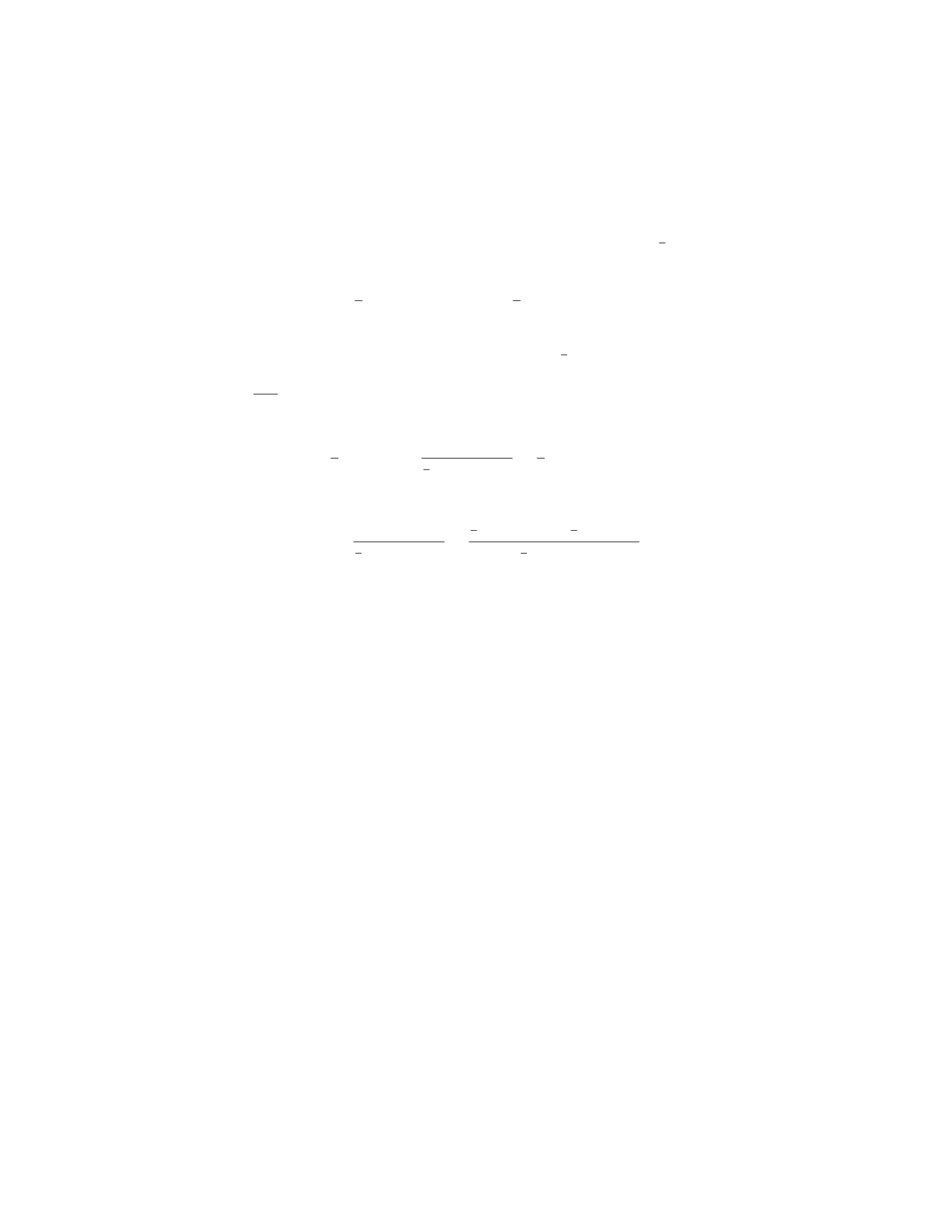
Fair =˙
V·vair, where vair is the velocity of the escaping air, which can be related
to the speed of the ball. Therefore, the buoyant force Fbuoyant =Wball +Fair.
Step 2: The buoyant force can also be expressed as Fbuoyant =4
3πr3ρliquidg.
Equating the two expressions for Fbuoyant, we have
4
3πr3ρballg+˙
V·vair =4
3πr3ρliquidg.
Step 3: The volume of air in the ball decreases with time as air escapes.
The volume of air in the ball at time tis V(t) = 4
3πa2(r−t)2t, where r−t
is the effective radius of the ball at time t. The escaping velocity of the air is
vair =˙
V
V(t).
Step 4: Substituting V(t) and vair into the buoyant force equation, we get
4
3πr3ρballg+˙
V2
4
3πa2(r−t)2t=4
3πr3ρliquidg.
Step 5: Rearranging the terms in the equation, we get
v(t) = ˙
V
4
3πa2(r−t)2t=
4
3πr3ρliquidg−4
3πr3ρballg
4
3πr3ρballg.
Therefore, the speed of the ball as a function of time tis v(t).
Question 18
Question
A cube of side length 3.0 m and density 1000 kg/m3is completely submerged in
water. Determine the buoyant force acting on the cube and its weight. (Density
of water is 1000 kg/m3, acceleration due to gravity is 9.81 m/s2)
Solution
Step 1: Let’s start by finding the volume of the cube. The volume of a cube is
given by the formula V=s3, where sis the side length of the cube. Substituting
s= 3.0 m, we get:
V= (3.0 m)3= 27 m3
Step 2: Next, let’s find the weight of the cube. The weight of an object is
given by the formula W=mg, where mis the mass of the object and gis the
acceleration due to gravity. Since the density of the cube is 1000 kg/m3, the
mass of the cube is:
m= Density ×Volume = 1000 kg/m3×27 m3= 27000 kg
Substituting m= 27000 kg and g= 9.81 m/s2, we get:
W= 27000 kg ×9.81 m/s2= 264870 N
15

Step 3: Now, let’s calculate the buoyant force acting on the cube. According
to Archimedes’ principle, the buoyant force is equal to the weight of the water
displaced by the object. Since the cube is completely submerged in water, the
volume of water displaced is equal to the volume of the cube. The weight of the
displaced water is:
Weight of displaced water = Density of water×Volume×g= 1000 kg/m3×27 m3×9.81 m/s2= 264870 N
Therefore, the buoyant force acting on the cube is also 264870 N.
Question 19
Question
A cylindrical object of height hand radius ris completely submerged in water.
The object has a density of ρoand the density of water is ρw. If the object
floats with its axis vertical, what is the condition that must satisfy the ratio h
r
in terms of ρoand ρw?
Solution
To determine the condition that the ratio h
rmust satisfy, we need to consider
the forces acting on the object.
Step 1: The buoyant force exerted on the object is equal to the weight
of the water displaced by the object. This buoyant force can be calculated
as Fbuoyant =ρwVsubmergedg, where Vsubmerged is the volume of the object
submerged in water.
Step 2: The weight of the object can be calculated as Fweight =ρoVcylinder g,
where Vcylinder is the volume of the entire cylindrical object.
Step 3: The condition for the object to float with its axis vertical is that
the buoyant force is equal to the weight of the object. Therefore, we have:
ρwVsubmergedg=ρoVcylinder g
Step 4: The volume of the submerged portion of the cylinder Vsubmerged
can be written as Vsubmerged =πr2h, and the volume of the entire cylindrical
object Vcylinder is Vcylinder =πr2(2h).
Substitute these expressions into the condition from Step 3:
ρwπr2hg =ρoπr2(2h)g
Step 5: Simplifying the equation above, we find:
ρwh= 2ρoh=⇒ρw= 2ρo
Step 6: Therefore, the condition that must be satisfied for the cylindrical
object to float with its axis vertical is that the density of water ρwmust be
double the density of the object ρo.
Thus, the ratio h
rmust satisfy the condition ρw= 2ρo.
16

Question 20
Question
A cube of aluminum with sides of length 0.1 m is submerged in water. Given
that the density of aluminum is 2700 kg/m3and the density of water is 1000
kg/m3, calculate the buoyant force acting on the cube.
Solution
Step 1: Calculate the volume of the aluminum cube. The volume of a cube is
given by V=s3, where sis the length of a side. In this case, s= 0.1 m, so
V= (0.1 m)3= 0.001 m3.
Step 2: Calculate the weight of the aluminum cube. The weight of an object
is given by W=mg, where mis the mass of the object and gis the acceleration
due to gravity (9.81 m/s2). The mass of the cube can be calculated using its
density and volume:
m=ρV = 2700 kg/m3×0.001 m3= 2.7 kg.
Therefore, the weight of the cube is
W= 2.7 kg ×9.81 m/s2= 26.487 N.
Step 3: Calculate the buoyant force acting on the cube. According to
Archimedes’ principle, the buoyant force acting on an object fully or partially
submerged in a fluid is equal to the weight of the fluid displaced by the object.
The volume of water displaced by the cube is equal to its volume, which is
0.001 m3. The weight of this water is given by = ρwaterV g:
ρwaterV g = 1000 kg/m3×0.001 m3×9.81 m/s2= 9.81 N.
Therefore, the buoyant force acting on the cube is 9.81 N, directed upward.
Question 21
Question
A sphere of radius Rand density ρis submerged in a liquid of density ρl. The
top of the sphere is located at a depth dbelow the surface of the liquid. Find
an expression for the buoyant force acting on the sphere.
17
Solution
Step 1: The force due to gravity on the sphere is given by:
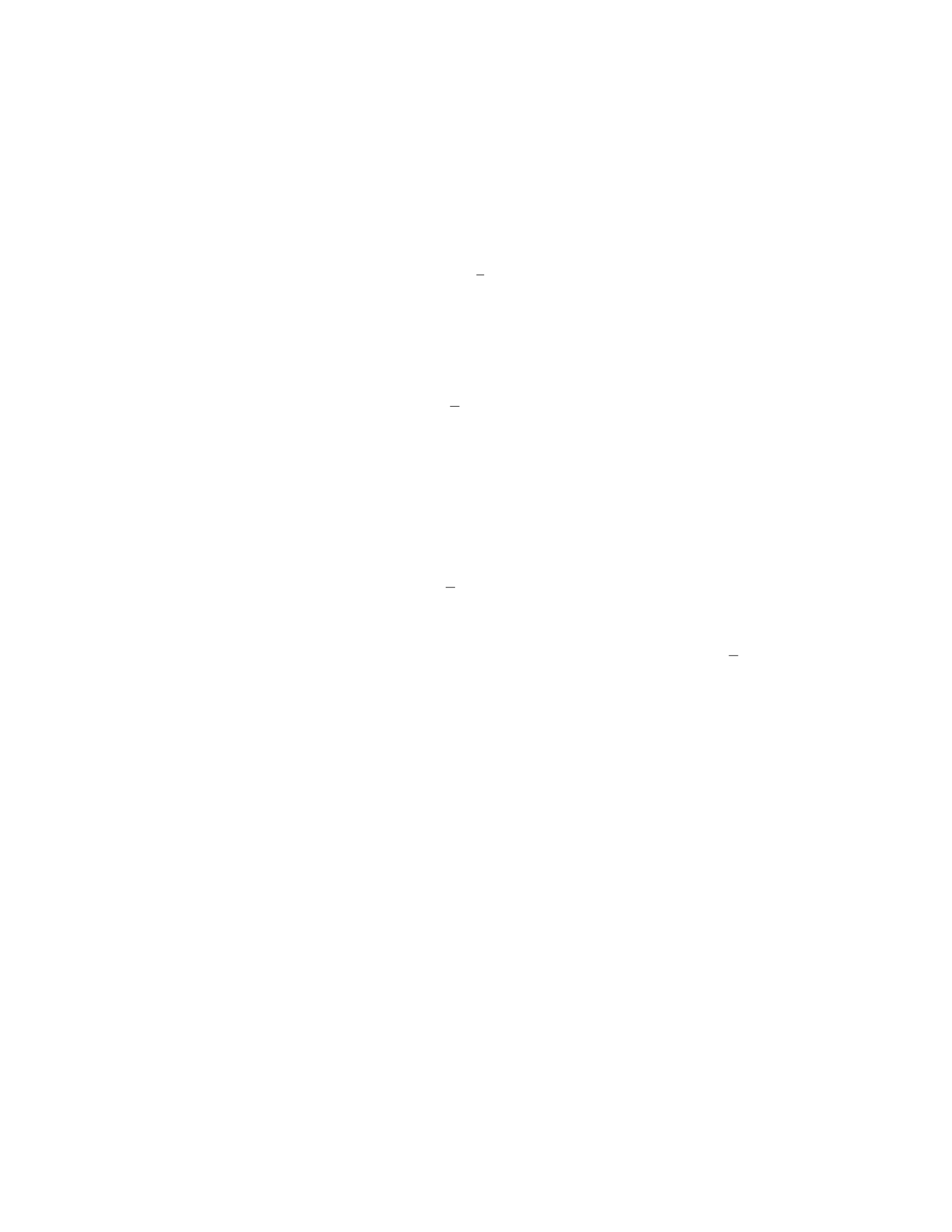
Fg=ρ·4
3πR3·g
Step 2: The buoyant force acting on the sphere is equal to the weight of the
liquid displaced by the sphere. The volume of the liquid displaced is equal to
the volume of the sphere submerged in the liquid. The volume of the sphere
submerged is given by:
Vsubmerged =π
3(2R−d)2(3R−d)
Step 3: The weight of the liquid displaced is:
Fbuoyant =ρl·Vsubmerged ·g
Step 4: Substitute the expression for Vsubmerged into the equation for Fbuoyant
to find the buoyant force acting on the sphere. Remembering that Fbuoyant =
Weight of the liquid displaced, and multiplying gout:
Fbuoyant =ρl·π
3(2R−d)2(3R−d)·g
∴The expression for the buoyant force acting on the sphere is Fbuoyant =ρl·π
3(2R−d)2(3R−d)·g
Question 22
Question
A cube with sides of length 0.1 m and density 800 kg/m3is submerged in water.
Calculate the buoyant force acting on the cube and determine if the cube will
float or sink. Assume the density of water is 1000 kg/m3.
Solution
Step 1: Determine the weight of the cube in water. The weight of the cube is
given by the formula:
Weight = mass ×gravitational acceleration
The mass of the cube can be calculated using the formula:
mass = density ×volume
mass = 800 kg/m3×(0.1 m)3= 8 kg
18

Therefore, the weight of the cube in water is:
Weight = 8 kg ×9.81 m/s2= 78.48 N
Step 2: Determine the buoyant force acting on the cube. The buoyant force
can be calculated using Archimedes’ principle:
Buoyant force = density of fluid×volume submerged×gravitational acceleration
The volume of the cube submerged in water is equal to its volume, since it
is completely submerged. Therefore, the buoyant force is:
Buoyant force = 1000 kg/m3×(0.1 m)3×9.81 m/s2= 9.81 N
Step 3: Determine if the cube will float or sink. For an object to float, the
buoyant force must be greater than or equal to the weight of the object. In this
case, the buoyant force is 9.81 N and the weight of the cube is 78.48 N. Since
the weight is greater than the buoyant force, the cube will sink in water.
Question 23
Question
A rectangular block of wood with dimensions 10 cm x 10 cm x 20 cm floats in
a container of water. If the density of water is 1000 kg/m
³
, calculate the mass
of the block of wood.
Solution
Step 1: Find the volume of the block of wood. The volume of the block of wood
can be calculated using the formula:
Volume = Length ×Width ×Height
Given that the dimensions of the block of wood are 10 cm x 10 cm x 20 cm,
we convert them to meters:
10 cm = 0.1 m
20 cm = 0.2 m
Therefore, the volume of the block of wood is:
Volume = 0.1 m ×0.1 m ×0.2 m = 0.002 m3
Step 2: Calculate the weight of the water displaced by the block of wood.
According to Archimedes’ principle, the weight of the water displaced by the
block of wood is equal to the weight of the block of wood. The weight of the
water displaced can be calculated using the formula:
Weight = Volume ×Density ×Acceleration due to gravity
19

Given that the density of water is 1000 kg/m
³
and the acceleration due to
gravity is 9.81 m/s2, we have:
Weight = 0.002 m3×1000 kg/m3×9.81 m/s2= 19.62 N
Step 3: Calculate the mass of the block of wood. The weight of the block of
wood is equal to the weight of the water displaced, so the mass of the block of
wood can be calculated using the formula:
Weight = Mass ×Acceleration due to gravity
Therefore, the mass of the block of wood is:
Mass = Weight
Acceleration due to gravity =19.62 N
9.81 m/s2= 2 kg
Thus, the mass of the block of wood is 2 kg.
Question 24
Question
A cube of side length 10 cm and density 800 kg/m3is submerged in a liquid
with a density of 1000 kg/m3. Calculate the buoyant force acting on the cube.
Solution
Step 1: First, calculate the volume of the cube. Given that the side length of
the cube is 10 cm, the volume Vof the cube is given by
V= (10 cm)3= (0.1 m)3= 0.001 m3
Step 2: Next, calculate the weight of the cube. The weight Wof the cube
is given by the formula
W=mg
where mis the mass of the cube and gis the acceleration due to gravity,
9.81 m/s2. First, calculate the mass mof the cube using its density ρ:
ρ=m
V
m=ρV = 800 kg/m3×0.001 m3= 0.8 kg
Therefore, the weight of the cube is
W= 0.8 kg ×9.81 m/s2= 7.848 N
20

Step 3: Calculate the buoyant force acting on the cube. The buoyant force
Fbacting on the cube is equal in magnitude to the weight of the liquid displaced
by the cube. This can be calculated using Archimedes’ principle:
Fb=ρliquidVdisplacedg
where ρliquid is the density of the liquid, Vdisplaced is the volume of the liquid
displaced by the cube, and gis the acceleration due to gravity. Given that the
density of the liquid is 1000 kg/m3, the volume of the liquid displaced by the
cube is equal to the volume of the cube.
Fb= 1000 kg/m3×0.001 m3×9.81 m/s2
Fb= 9.81 N
Therefore, the buoyant force acting on the cube is 9.81 N.
Question 25
Question
A cube of wood with dimensions 4 m ×4 m ×4 m floats in water with exactly 1
3
of its height above the waterline. Calculate the density of the wood.
Solution
Step 1: First, calculate the volume of the cube of wood. The volume of the
cube is given by the formula V=l×w×h, where l,w, and hare the length,
width, and height of the cube, respectively. Given l=w=h= 4 m, we have:
V= 4 ×4×4 = 64 m3
Step 2: Next, calculate the volume of the cube submerged in water. Given
that 1
3of the height of the cube is submerged, the submerged volume is:
Vsubmerged =2
3×4×4×4 = 128
3m3
Step 3: The buoyant force acting on the cube is equal to the weight of the
water displaced by the cube. The density of water, ρwater, is 1000 kg/m3. The
weight of the water displaced is given by the formula Fbuoyant =ρwater ×g×
Vsubmerged, where gis the acceleration due to gravity. Substituting the values,
we have:
Fbuoyant = 1000 ×9.8×128
3= 419840 N
Step 4: Since the cube is floating, the weight of the cube is equal to the
buoyant force acting on it. The weight of the cube is given by the formula
Wcube =ρcube ×g×V. We can rearrange this formula to solve for ρcube:
ρcube =Wcube
g×V
21

Given that the cube is floating, Wcube =Fbuoyant. Substituting the values, we
get:
ρcube =419840
9.8×64 = 662.5 kg/m3
Therefore, the density of the wood is 662.5 kg/m3.
Question 26
Question
A hollow cube with sides of length aand mass mfloats in a liquid of density
ρ. The cube is submerged to a depth hand its bottom is at a distance dfrom
the bottom of the container. Find the expressions for the buoyant force and the
normal force acting on the cube.
Solution
Step 1: Calculate the volume of the cube submerged in the liquid. The volume
of the cube submerged in the liquid is given by the area of the face of the cube
submerged multiplied by the depth it is submerged to:
Vsubmerged =a2×h
Step 2: Calculate the mass of the liquid displaced by the cube. The mass of
the liquid displaced by the cube is given by the volume of the liquid displaced
multiplied by the density of the liquid:
mdisplaced =ρ×Vsubmerged
Step 3: Calculate the weight of the displaced liquid, which is equal to the
buoyant force acting on the cube. The weight of the displaced liquid is given by
the mass of the displaced liquid multiplied by the acceleration due to gravity, g:
Fbuoyant =mdisplaced ×g
Step 4: Calculate the weight of the cube acting downwards. The weight of
the cube acting downwards is given by the mass of the cube multiplied by the
acceleration due to gravity:
Fdownward =m×g
Step 5: Calculate the normal force acting upwards on the cube. Since the
cube is in equilibrium, the normal force exerted by the liquid on the cube is
equal in magnitude and opposite in direction to the weight of the cube and the
buoyant force:
Fnormal =Fbuoyant +Fdownward
22

Therefore, the expressions for the buoyant force and the normal force acting
on the cube are:
Fbuoyant =ρga2h
Fnormal =mg −ρga2h
Question 27
Question
A spherical metal ball with a radius of 10 cm and a mass of 5 kg is submerged
in water. Calculate the buoyant force acting on the ball and determine whether
it will sink or float. The density of water is 1000 kg/m3.
Solution
Step 1: Calculate the volume of the spherical metal ball using the formula for
the volume of a sphere:
Volume = 4
3πr3
Volume = 4
3π(0.1 m)3
Volume = 4
3π(0.001 m3) = 0.00419 m3
Step 2: Calculate the weight of the metal ball using its mass and the accel-
eration due to gravity:
Weight = mass ×g
Weight = 5 kg ×9.81 m/s2= 49.05 N
Step 3: Calculate the buoyant force acting on the metal ball using Archimedes’
principle, which states that the buoyant force is equal to the weight of the fluid
displaced by the object:
Buoyant force = Densitywater ×Volume ×g
Buoyant force = 1000 kg/m3×0.00419 m3×9.81 m/s2= 41.21 N
Step 4: Determine whether the metal ball will sink or float by comparing
the buoyant force and the weight of the ball. Since the weight of the ball (49.05
N) is greater than the buoyant force (41.21 N), the ball will sink in water.
23

Question 28
Question
A cube of wood with a side length of 15 cm and a density of 0.8 g/cm3is floating
in water. What is the depth of water displaced that can support this cube?
Solution
Step 1: First, we need to determine the weight of the cube to calculate the
buoyant force acting on it. The weight of the cube can be calculated using the
formula:
Weight = Density ×Volume ×g
Step 2: The volume of the cube can be found using the formula:
Volume = (Side length)3
Step 3: Substituting the given values: Side length = 15 cm = 0.15 m Density
= 0.8 g/cm3
Volume = (0.15)3m3
Step 4: Calculate the volume and then the weight of the cube.
Step 5: The buoyant force acting on the cube is equal to the weight of the
water displaced. This buoyant force can be calculated using the formula:
Buoyant force = Density of water ×g×Volume of water displaced
Step 6: Since the cube is floating, the buoyant force acting on it is equal to
its weight. Equating these two forces, we can find the volume of water displaced.
Step 7: The depth of the water displaced can be calculated using the formula:
Depth = Volume of water displaced
Area of the base
Step 8: Calculate the depth of the water displaced by plugging in the values
obtained from the previous steps.
Question 29
Question
A cube of ice with a side length of 5 cm floats in a glass of water. What is the
depth of the ice cube’s bottom surface below the water surface? The density of
ice is 917 kg/m3and the density of water is 1000 kg/m3.
24
Solution
Step 1: Determine the volume of the ice cube. The volume of a cube is given
by V=a3, where ais the length of one side. Substituting a= 0.05 m, we get
V= (0.05)3= 0.000125 m3.
Step 2: Calculate the mass of the ice cube. The mass of the ice cube can be
found using the formula m= density ×volume. Substituting the density of ice
(917 kg/m3) and the volume of the cube, we have
m= 917 ×0.000125 = 0.114625 kg.
Step 3: Calculate the buoyant force acting on the ice cube. The buoyant force
acting on an object in a fluid is equal to the weight of the fluid that the object
displaces. The volume of fluid displaced by the ice cube is equal to its volume,
so the buoyant force Fbis given by Fb= density of water ×volume of ice ×g,
where gis the acceleration due to gravity. Substitute the values to get
Fb= 1000 ×0.000125 ×9.8=1.225 N.
Step 4: Find the total weight of the ice cube. The weight of an object is
given by W=mg, where mis the mass of the object and gis the acceleration
due to gravity. Therefore, the weight Wof the ice cube in water is
W= 0.114625 ×9.8=1.12385 N.
Step 5: Determine the depth of the ice cube’s bottom surface. Since the ice
cube is in equilibrium, the net force acting on it is zero. This means the buoyant
force is equal in magnitude to the weight of the ice cube. Using Archimedes’
principle, the buoyant force is also equal to the weight of water displaced. Let
hbe the depth of the ice cube’s bottom surface below the water surface. The
volume of water displaced by the cube is equal to the volume of the cube that
is submerged, which is (0.05)2h. Equating the weight of water displaced to the
weight of the ice cube, we have
1000 ×0.000125 ×h×9.8=0.114625 ×9.8.
Solving for h, we get
h=0.114625
0.052= 0.459 m.
Therefore, the depth of the ice cube’s bottom surface below the water surface
is 0.459 m.
Question 30
Question
A spherical balloon with radius Ris filled with helium gas. The density of helium
gas is ρhelium, the density of air is ρair, and the acceleration due to gravity is g.
The buoyant force on the balloon can be calculated using Archimedes’ principle.
25

Given that the mass of the empty balloon is mempty and the total mass of
the balloon when filled with helium gas is mfilled, derive an expression for the
buoyant force acting on the balloon in terms of the parameters mentioned.
Solution
Step 1: Calculate the volume of helium in the balloon when it is filled.
The volume of the spherical balloon when it is filled with helium gas is the
difference between the volume of the sphere with radius Rand the volume of
the empty balloon.
The volume of a sphere with radius Ris given by:
Vsphere =4
3πR3
The volume of the helium in the balloon can be calculated as:
Vhelium =Vsphere −Vballoon
=4
3πR3−mempty/ρhelium
Step 2: Calculate the weight of the helium in the balloon.
The weight of the helium in the balloon is equal to the mass of the helium
times the acceleration due to gravity:
Whelium =mfilled ·g
Step 3: Calculate the buoyant force acting on the balloon.
According to Archimedes’ principle, the buoyant force is equal to the weight
of the fluid displaced by the object. In this case, the buoyant force can be
calculated as the weight of the helium displaced by the balloon:
Fbuoyant =ρair ·Vhelium ·g
Therefore, the expression for the buoyant force acting on the balloon in terms
of the given parameters is:
Fbuoyant =ρair 4
3πR3−mempty
ρhelium ·g
Question 31
Question
A cube of wood with a density of 0.6 g/cm3and side length of 10 cm is floating
in water. What is the height of the cube that is immersed in the water? (Density
of water = 1 g/cm3)
26
Solution
Step 1: Calculate the volume of the cube. Given the side length of the cube is
10 cm, the volume can be calculated as:
Volume = (side length)3= 10 cm ×10 cm ×10 cm = 1000 cm3
Step 2: Calculate the mass of the cube. Using the density formula Density =
Mass
Volume , we can rearrange it to find the mass:
Mass = Density ×Volume = 0.6 g/cm3×1000 cm3= 600 g
Step 3: Calculate the weight of the cube. The weight of the cube is given
by:
Weight = Mass ×Acceleration due to gravity = 600 g ×9.8 m/s2= 5880 N
Step 4: Calculate the buoyant force acting on the cube. Using the formula for
buoyant force Fb= Density of fluid×Volume displaced×Acceleration due to gravity,
we can find the buoyant force:
Fb= 1 g/cm3×Volume immersed ×9.8 m/s2
Step 5: Apply Archimedes’ principle. The buoyant force acting on the cube
is equal to the weight of the water displaced, so we have:
Fb= Weight of water displaced = Density of water×Volume immersed×9.8 m/s2
Step 6: Solve for the height of the cube immersed in water. Since the volume
of the immersed part of the cube is equal to the base area times the height, we
have:
1 g/cm3×Base area ×Height immersed ×9.8 m/s2= 600 g ×9.8 m/s2
Solving for the height immersed:
Height immersed = 600
1×Base area =600
1×(10 ×10) = 6 cm
Therefore, the height of the cube that is immersed in water is 6 cm.
Question 32
Question
A cube of wood with sides of length 10 cm and a density of 0.8 g/cm3is floating
in a container of water. The water has a density of 1 g/cm3. Calculate the
depth to which the cube floats in the water.
27

Solution
Step 1: The buoyant force acting on the cube is equal to the weight of the water
displaced by the cube. Let’s denote: - Vcube as the volume of the cube - dwater
as the density of water - dcube as the density of the cube - has the depth to
which the cube floats
Therefore, the buoyant force (Fbuoyant) can be calculated as:
Fbuoyant =dwater ·Vdisplaced ·g
Step 2: The volume of water displaced by the cube is equal to the volume
of the cube that is submerged in the water. The volume of the cube that is
submerged is given by:
Vdisplaced =A·h
where Ais the area of one face of the cube.
Step 3: The weight of the cube acts downwards and the buoyant force acts
upwards. At equilibrium, these forces are equal. Therefore, we can set up the
following equation:
Fbuoyant =Fweight
Step 4: Calculate the weight of the cube. The weight of the cube (Fweight)
is given by:
Fweight =dcube ·Vcube ·g
Step 5: Equate the weight of the cube to the buoyant force and solve for the
depth (h).
dwater ·A·h·g=dcube ·Vcube ·g
Step 6: Plug in the values and solve for h.
1 g/cm3·(10 cm)2·h= 0.8 g/cm3·(10 cm)3
h=0.8·(10)3
(10)2= 80 cm
Therefore, the cube floats to a depth of 80 cm in the water.
Question 33
Question
A cube of side length 2 m and density 1000 kg/m3is submerged in a liquid of
density 800 kg/m3with one face of the cube parallel to the surface of the liquid.
Determine the buoyant force acting on the cube.
28
Solution
Step 1: First, we need to determine the volume and weight of the cube. The
volume of the cube is given by V= side length3= (2 m)3= 8 m3.
Step 2: The weight of the cube can be calculated using the formula W=mg,
where mis the mass of the cube and gis the acceleration due to gravity. The
mass of the cube can be found using the formula m= density ×volume =
1000 kg/m3×8 m3= 8000 kg. Then, the weight of the cube is W= 8000 kg ×
9.81 m/s2= 78480 N.
Step 3: Next, we need to determine the buoyant force acting on the cube.
The buoyant force is equal to the weight of the liquid displaced by the cube,
and is given by Fb= density of liquid ×g×Vdisplaced.
Step 4: The volume of liquid displaced by the cube is equal to the volume
submerged. Since one face of the cube is parallel to the surface of the liquid,
the volume submerged is given by Vsubmerged =1
2×side length ×side length ×
side length = 1
2×2 m ×2 m ×2 m = 4 m3.
Step 5: Substituting the values into the formula for buoyant force, we get
Fb= 800 kg/m3×9.81 m/s2×4 m3= 31392 N.
Therefore, the buoyant force acting on the cube is 31392 N.
Question 34
Question
A cube of side length 10 cm is submerged in water. If the cube is completely
submerged and the buoyant force acting on it is 4 N, determine the density of
the cube.
(Note: The density of water is 1000 kg/m3and the acceleration due to gravity
is 9.81 m/s2.)
Solution
Step 1: Determine the volume of the cube. Given that the side length of the
cube is 10 cm, the volume of the cube can be calculated as:
Volume of the cube = (side length)3= (0.1 m)3= 0.001 m3
Step 2: Calculate the weight of the cube in water. The weight of the cube
in water is equal to the weight of the cube in air minus the buoyant force acting
on it. Using the equation Fbuoyant =ρwater ·Vsubmerged ·g, where Vsubmerged is
the volume of the cube submerged in water, we can rearrange to find:
Weight of the cube in water = Weight of the cube in air −Buoyant force
ρcube ·Vtotal ·g=ρwater ·Vsubmerged ·g+ Buoyant force
29

Plugging in the known values:
ρcube ·0.001 m3·9.81 m/s2= 1000 kg/m3·Vsubmerged ·9.81 m/s2+ 4 N
Step 3: Solve for the density of the cube. Solving the equation from step 2
gives us:
ρcube =1000 ·Vsubmerged + 0.004
0.001
ρcube = 1000 ·Vsubmerged + 4
Step 4: Calculate the volume of the cube submerged in water. Since the
cube is completely submerged, the volume of the cube submerged in water is
equal to the total volume of the cube. Thus, Vsubmerged = 0.001 m3
Step 5: Substitute the volume of the cube submerged in water back into the
equation from step 3 to find the density of the cube.
ρcube = 1000 ·0.001 + 4
ρcube = 1 + 4 = 5 kg/m3
Therefore, the density of the cube is 5 kg/m3.
Question 35
Question
A cube of wood with a density of 600 kg/m3and side length 0.2 m is floating in
a liquid of density 800 kg/m3. What is the fraction of the volume of the cube
that is submerged in the liquid?
Solution
Step 1: First, we need to determine the volume of the cube submerged in the
liquid. Let Vcube be the total volume of the cube and Vsubmerged be the volume
submerged. The buoyant force acting on the cube is equal to the weight of the
liquid displaced by the submerged volume. According to Archimedes’ Principle,
the buoyant force Fbis given by:
Fb=Vsubmerged ·ρliquid ·g,
where ρliquid is the density of the liquid and gis the acceleration due to gravity.
Step 2: The weight of the cube itself is equal to the weight of the liquid
displaced by the entire volume of the cube. This weight is given by:
W=Vcube ·ρcube ·g,
where ρcube is the density of the cube.
30

Step 5: Determine if the cube will float or sink. Since the buoyant force
(7.848 N) is greater than the weight of the cube (19.62 N), the cube will float
in the liquid.
Question 2
Question
A rectangular block of wood has dimensions 10 cm ×5 cm ×3 cm and a density
of 0.8 g/cm3. The block is placed in a container of water. Find the buoyant
force acting on the block and determine if the block will sink or float in the
water.
Solution
Step 1: Calculate the volume of the block. The volume of the block can be
calculated using the formula: volume = length ×width ×height. Given the
dimensions are 10 cm ×5 cm ×3 cm, the volume of the block is:
10 cm ×5 cm ×3 cm = 150 cm3
Step 2: Calculate the mass of the block. The mass of the block can be
calculated using the formula: mass = density ×volume. Given the density of
the wood is 0.8 g/cm3, the mass of the block is:
0.8 g/cm3×150 cm3= 120 g
Step 3: Calculate the weight of the block. The weight of the block can
be calculated using the formula: weight = mass ×acceleration due to gravity.
Given the acceleration due to gravity is 9.8 m/s2, the weight of the block is:
120 g ×1 kg
1000 g ×9.8 m/s2= 1.176 N
Step 4: Calculate the buoyant force acting on the block. The buoyant force
acting on the block is equal to the weight of the water displaced by the block.
Since the block is fully submerged, the volume of water displaced is equal to the
volume of the block, which is 150 cm3. The density of water is 1 g/cm3, so the
mass of the water displaced is 150 g. Therefore, the buoyant force acting on the
block is:
150 g ×1 kg
1000 g ×9.8 m/s2= 1.47 N
Step 5: Conclusion Since the buoyant force (1.47 N) is greater than the
weight of the block (1.176 N), the block will float in the water.
2
Question 3
Question
A cube of side length Land density ρcube is floating on the surface of a liquid
of density ρliquid. The cube is pushed down so that a fraction xof its volume
is submerged in the liquid. Determine the value of xin terms of L,ρcube, and
ρliquid.
Solution
Step 1: Determine the buoyant force acting on the cube. The buoyant force
Fbuoyant is equal to the weight of the liquid displaced by the cube. The volume
of the cube submerged in the liquid is xL3, so the weight of the liquid displaced
is ρliquid ·xL3·g, where gis the acceleration due to gravity.
Step 2: Determine the weight of the cube. The weight of the cube is equal to
its mass times the acceleration due to gravity. The mass of the cube is ρcube ·L3
and the weight is ρcube ·L3·g.
Step 3: Apply the condition for equilibrium. For the cube to float at a
constant height, the buoyant force must equal the weight of the cube. Therefore,
we have:
ρliquid ·xL3·g=ρcube ·L3·g
Step 4: Solve for x. Canceling the gand L3terms on both sides gives us:
ρliquid ·x=ρcube
Therefore, the fraction xof the cube’s volume submerged in the liquid is:
x=ρcube
ρliquid
Question 4
Question
A solid cube of side length 10 cm and density 1500 kg/m3is placed in a container
of water. If the cube floats with 3 cm of its height above the water surface,
calculate the buoyant force acting on the cube.
Solution
Step 1: Calculate the volume of the cube submerged in water. Let Vsub be the
volume submerged.
Volume of cube = Side length3
= (0.1 m)3
= 0.001 m3
3

Since the cube floats with 3 cm of its height above water, the volume sub-
merged is:
Vsub = Volume of cube −Volume above water
= 0.001 m3−0.001 m ×0.1 m ×0.1 m
= 0.0007 m3
Step 2: Calculate the mass of the cube.
Mass = Density ×Volume
= 1500 kg/m3×0.001 m3
= 1.5 kg
Step 3: Calculate the weight of the cube.
Weight = Mass ×Acceleration due to gravity
= 1.5 kg ×9.8 m/s2
= 14.7 N
Step 4: Calculate the buoyant force acting on the cube.
Buoyant force = Weight of water displaced
= Density of water ×Volume submerged ×Acceleration due to gravity
= 1000 kg/m3×0.0007 m3×9.8 m/s2
= 6.86 N
Therefore, the buoyant force acting on the cube is 6.86 N.
Question 5
Question
A cube of side length 20 cm and mass 1 kg is completely submerged in water.
Calculate the buoyant force acting on the cube and determine whether the cube
will sink or float in water.
Solution
Let’s first calculate the buoyant force acting on the cube. Step 1: Determine
the volume of the cube. The volume of a cube is given by V=s3, where sis
the side length. Given that the side length is 20 cm, the volume is:
V= (0.20m)3= 0.008m3
Step 2: Determine the density of water. The density of water is typically
ρ= 1000 kg/m3.
4

Step 3: Calculate the buoyant force acting on the cube. The buoyant force
Fbis given by Archimedes’ principle as the weight of the water displaced by the
cube:
Fb=ρ·V·g
Fb= 1000 kg/m3×0.008m3×9.8m/s2
Fb= 78.4 N
Step 4: Determine the weight of the cube. The weight Wof the cube is given
by W=m·g, where mis the mass of the cube (1 kg) and gis the acceleration
due to gravity (9.8 m/s2).
W= 1 kg ×9.8 m/s2= 9.8 N
Step 5: Compare the weight of the cube and the buoyant force. Since the
buoyant force (78.4 N) is greater than the weight of the cube (9.8 N), the cube
will float in water.
Question 6
Question
A rectangular block of wood with a density of 700 kg/m3and dimensions 0.4
m×0.3 m ×0.2 m floats on water. Calculate the minimum mass of lead that
must be added to the top of the block so that it now sinks completely in water.
(Density of lead = 11 400 kg/m3)
Solution
Step 1: Calculate the volume of the wooden block. The volume of the wooden
block can be calculated as:
Vwood = length ×width ×height
Vwood = 0.4 m ×0.3 m ×0.2 m = 0.024 m3
Step 2: Calculate the mass of the wooden block. The mass of the wooden
block can be found using the formula:
mass = density ×volume
masswood = 700 kg/m3×0.024 m3= 16.8 kg
Step 3: Calculate the volume of the lead required. Since the entire system
(wooden block + lead) will now sink, the total volume of the system must be
equal to the volume of water displaced when submerged. The volume of the
system can be expressed as:
Vtotal =Vwood +Vlead
5

Step 4: Calculate the mass of lead required. The mass of lead required to
sink the entire system can be calculated using:
masslead = densitylead ×Vlead
masslead = 11400 kg/m3×Vlead
Step 5: Set up the equation for volume to solve for the mass of lead. Using
the relationship between the volume of the system and the volumes of wood and
lead:
Vtotal =Vwood +Vlead
Vtotal = 0.024 m3+Vlead
Step 6: Substitute the values into the equation from step 5.
Vtotal = 0.024 m3+Vlead
Vlead =Vtotal −0.024 m3
Step 7: Substitute the expression for lead volume into the answer obtained
in step 4 and solve for the mass.
masslead = 11400 kg/m3×(Vtotal −0.024 m3)
Step 8: Substitute the known values into the equation from step 7 and
calculate the mass of lead required to sink the wooden block.
masslead = 11400 kg/m3×Vtotal −11400 kg/m3×0.024 m3
Step 9: Calculate the numerical value of the mass of lead required to sink
the wooden block completely.
Question 7
Question
A cube of side length aand density ρ1is floating in a liquid of density ρ2. The
cube is immersed to a depth dand the part of the cube that is above the liquid
surface has a volume V0. Determine the density of the cube material in terms
of ρ2,a,d, and V0.
Solution
Step 1: Let’s consider the forces acting on the cube. The forces acting on the
cube when it’s floating are the buoyant force FB, the weight of the cube mg,
and the normal force from the liquid FN. Since the cube is floating, these forces
must be balanced.
6
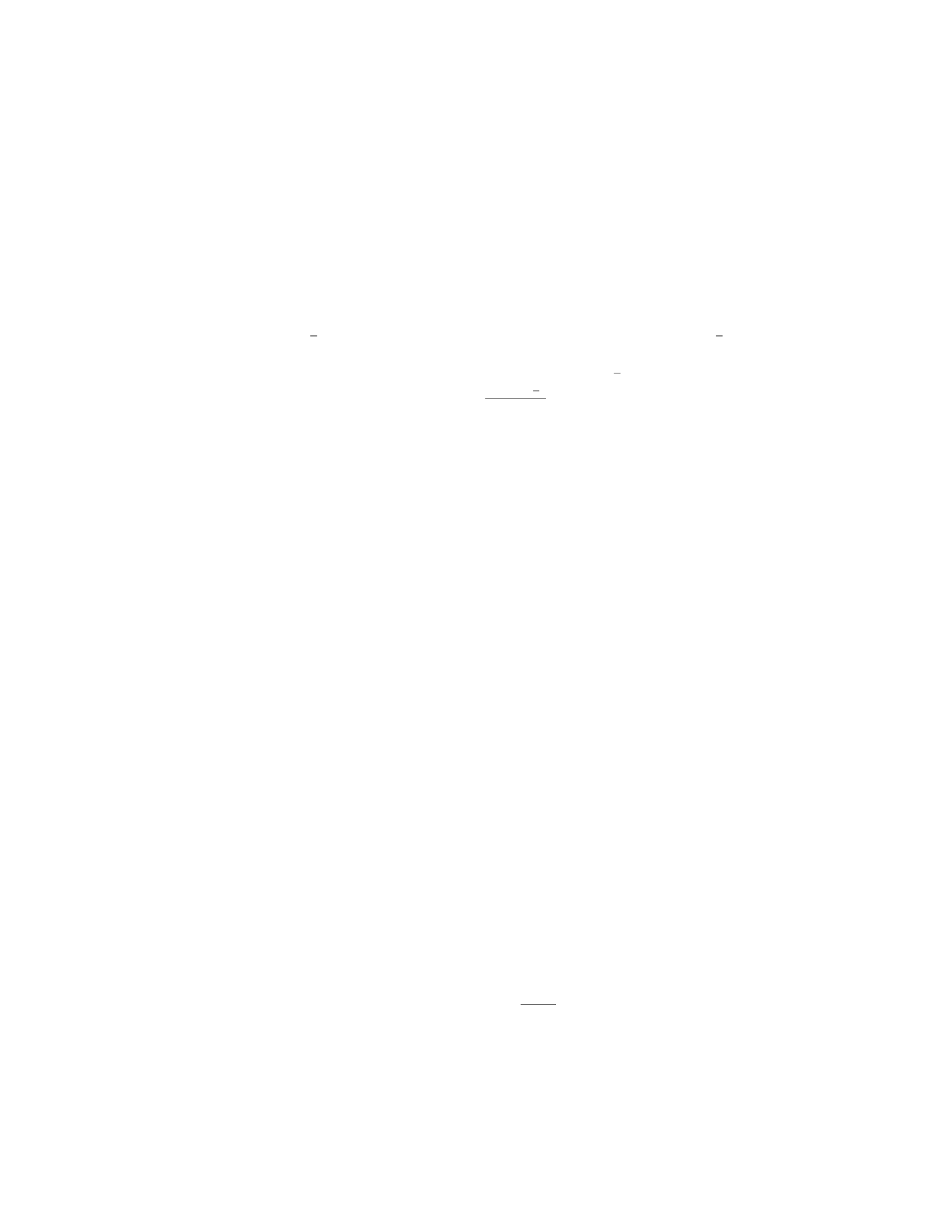
Step 2: The weight of the cube is given by mg =ρ1V0g, where V0is the vol-
ume of the cube above the liquid surface, ρ1is the density of the cube material,
and gis the acceleration due to gravity.
Step 3: The buoyant force is FB= (ρ2V0)g, where ρ2is the density of the
liquid and V0is the volume of the cube above the liquid surface.
Step 4: The normal force FNis equal in magnitude to the weight of the
liquid displaced by the cube. The volume of the cube below the liquid surface
is V1=a2(d−a
2). The weight of this displaced liquid is ρ2V1g=ρ2a2(d−a
2)g.
Step 5: Since the cube is floating, the sum of the forces in the vertical
direction is zero. Therefore, the net force is FN−ρ2a2(d−a
2)g−ρ1V0g= 0.
Step 6: Solving for ρ1gives ρ1=ρ2a2(d−a
2)
V0as the density of the cube
material in terms of ρ2,a,d, and V0.
Question 8
Question
A cylindrical object with a diameter of 20 cm and a height of 30 cm is floating in
water. If the density of water is 1000 kg/m3, what is the mass of the cylindrical
object? (Assume the entire object is submerged in water)
Solution
Step 1: Find the volume of the cylindrical object. The volume of a cylinder is
given by the formula V=πr2h, where ris the radius and his the height. Given
that the diameter is 20 cm, the radius (r) is 10 cm or 0.1 m.
V=π×(0.1)2×0.3=0.00943 m3
Step 2: Find the buoyant force acting on the cylindrical object. According
to Archimedes’ principle, the buoyant force (Fb) acting on an object immersed
in a fluid is equal to the weight of the fluid displaced by the object. The weight
of the fluid displaced is given by the formula W=ρV g, where ρis the density
of the fluid, Vis the volume of the object submerged, and gis the acceleration
due to gravity (9.81 m/s2).
W= 1000 ×0.00943 ×9.81 = 92.43 N
Step 3: Calculate the mass of the cylindrical object. Since the object is float-
ing, the buoyant force (Fb) must be equal to the weight of the object (Wobject).
The weight of the object can be calculated using the formula Wobject =m×g,
where mis the mass of the object.
92.43 = m×9.81 =⇒m=92.43
9.81 = 9.42 kg
Therefore, the mass of the cylindrical object is 9.42 kg.
7

Question 9
Question
A cube of side length aand density ρis placed in a container filled with water.
The cube floats with 1
3of its volume submerged. Determine the density of the
water in terms of ρ.
Solution
Step 1: We first determine the volume of the cube submerged in water. Let V
be the volume of the cube. Since 1
3of the volume is submerged, we have:
Vsubmerged =1
3V
Step 2: The weight of the cube is equal to the buoyant force acting on it.
The weight of the cube can be expressed as mg, where mis the mass of the
cube and gis the acceleration due to gravity.
Step 3: The mass of the cube mcan be expressed in terms of its volume V
and density ρ:
m=ρV
Step 4: The buoyant force can be calculated using the volume of the cube
submerged Vsubmerged and the density of water ρwater:
Buoyant force = ρwaterVsubmergedg
Step 5: Equating the weight of the cube to the buoyant force:
ρV g =ρwaterVsubmergedg
Step 6: Substituting the expressions for m,Vsubmerged, and rearranging the
equation:
ρ(4a3
27 )g=ρwater(a3
3)g
Step 7: Solving for ρwater in terms of ρ:
ρwater =4
27ρ
Step 8: Therefore, the density of the water in terms of the density of the
cube is 4
27 ρ.
Question 10
Question
A cubical block of wood with sides of length 0.20 m and a density of 600 kg/m3
is floating in water with 20
8

Solution
Step 1: The buoyant force (FB) acting on the block is equal to the weight of
the water displaced by the block.
FB=ρw·Vdisplaced ·g
where: - ρwis the density of water (1000 kg/m3), - Vdisplaced is the volume of
water displaced by the block, - gis the acceleration due to gravity (9.81 m/s2).
Step 2: Since 20
Vdisplaced = 0.20 ×Vblock
Vdisplaced = 0.20 ×(0.20)3
Vdisplaced = 0.008 m3
Step 3: Now, we can calculate the buoyant force.
FB= 1000 ×0.008 ×9.81
FB= 78.48 N
Step 4: The apparent weight of the block is given by the difference between
the weight of the block in air and the buoyant force.
Apparent weight = Weight in air −FB
Step 5: The weight of the block in air can be calculated as:
Weight in air = ρwood ·Vblock ·g
Weight in air = 600 ×(0.20)3×9.81
Weight in air = 23.53 N
Step 6: Finally, we can find the apparent weight of the block.
Apparent weight = 23.53 −78.48
Apparent weight = −54.95 N
Therefore, the apparent weight of the block when floating in water is 54.95
N, directed upwards.
Question 11
Question
A cube of side length 10 cm and density 800 kg/m3is placed in a liquid of
density 1000 kg/m3. Find the depth to which the cube sinks in the liquid.
Assume that the gravitational acceleration is 9.81 m/s2.
9

Solution
Step 1: The buoyant force on the cube is equal to the weight of the liquid
displaced by the cube. Let Vbe the volume of the cube submerged in the
liquid, and hbe the depth to which the cube sinks. The submerged volume can
be expressed as V=h×A, where Ais the area of one face of the cube. The
weight of the cube can be calculated as Wcube = density ×volume ×gravity =
800 kg/m3×V×9.81 m/s2. The weight of the liquid displaced by the cube can
be calculated as Wliquid = density ×V×gravity = 1000 kg/m3×V×9.81 m/s2.
Step 2: Equate the weight of the cube to the weight of the displaced liquid
to find the depth. Setting Wcube =Wliquid, we have: 800 ×V×9.81 = 1000 ×
V×9.81. Solving for V: 800 ×V= 1000 ×V, 200V= 0, V= 0.
Step 3: Analyzing the result. The negative volume indicates that the cube
does not sink in the liquid. This is because the density of the cube is greater
than the density of the liquid, so it will float on the surface.
Therefore, the cube does not sink in the liquid, and the depth to which it
sinks is 0.
Question 12
Question
A cube of wood with a density of 700 kg/m3and side length 0.2 m is floating
in water. What is the depth of the cube below the water surface? Recalling
that the density of water is 1000 kg/m3and the acceleration due to gravity is
9.81 m/s2.
Solution
Step 1: Let’s first determine the volume of the cube. The volume of the cube
can be calculated using the formula V=l3, where lis the side length of the
cube. Substituting l= 0.2 m:
V= (0.2 m)3= 0.008 m3
Step 2: Next, let’s determine the weight of the cube. The weight Wof an
object can be calculated using the formula W=m·g, where mis the mass of
the cube and gis the acceleration due to gravity. The mass mcan be calculated
using the formula m=ρ·V, where ρis the density of the cube. Substituting
the given values:
m= 700 kg/m3×0.008 m3= 5.6 kg
W= 5.6 kg ×9.81 m/s2= 54.936 N
Step 3: Now, let’s determine the buoyant force acting on the cube. The
buoyant force Fbacting on an object immersed in a fluid can be calculated
using the formula Fb=ρfluid ·V·g, where ρfluid is the density of the fluid and
10

Vis the volume of the object submerged in the fluid. Substituting the given
values with Vbeing the volume of the cube:
Fb= 1000 kg/m3×0.008 m3×9.81 m/s2= 78.48 N
Step 4: Now, we can determine the depth of the cube below the water
surface. The depth dof the cube below the water surface can be calculated
using Archimedes’ principle: the buoyant force acting on the cube is equal to
the weight of the water displaced.
Fb=Wdisplaced
ρfluid ·g·Vsubmerged =ρfluid ·g·d·A
d=Vsubmerged
A
d=V
A
where Ais the surface area of the cube. Substituting the values:
d=0.008 m3
0.04 m2= 0.2 m
Therefore, the depth of the cube below the water surface is 0.2 m.
Question 13
Question
A cube of side length aand density ρis partially submerged in a fluid of density
σsuch that a fraction fof the cube’s volume is submerged. The cube is in
stable equilibrium when released. Determine the value of fin terms of ρ,σ,
and a.
Solution
Step 1: We first consider the forces acting on the cube. The weight of the cube
acts downward through its center of mass while the buoyant force acts upward
through the center of buoyancy.
Step 2: The weight of the cube is given by W=ρa3g, where ρis the density
of the cube and gis the acceleration due to gravity.
Step 3: The buoyant force is given by B=σa3fg, where σis the density of
the fluid and fis the fraction of the cube’s volume submerged.
Step 4: Since the cube is in stable equilibrium, the net force acting on it
must be zero. This gives us the equation:
B−W= 0
11
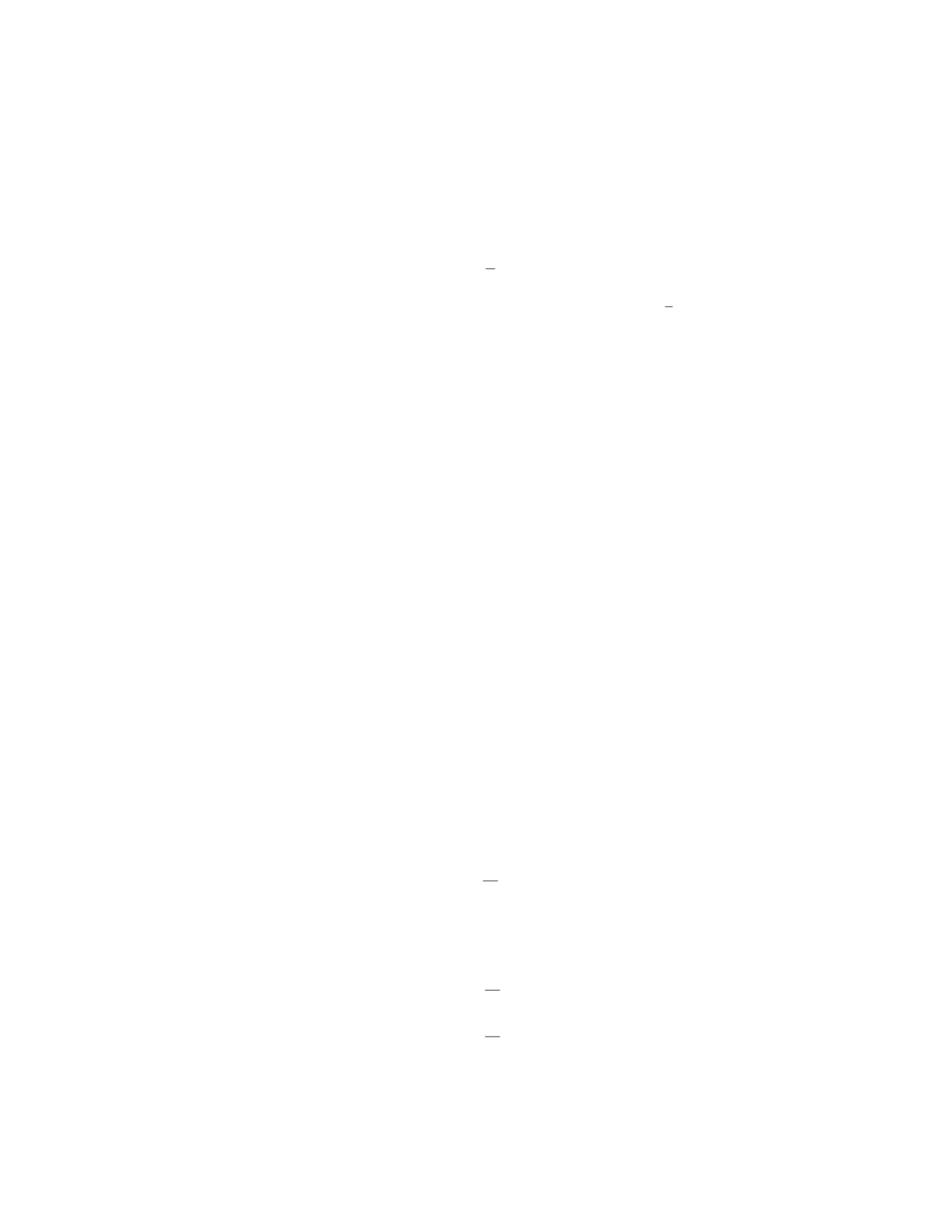
σa3fg −ρa3g= 0
Step 5: Solving for f, we get:
f=ρ
σ
Step 6: Therefore, the value of fin terms of ρ,σ, and ais f=ρ
σ.
Question 14
Question
A cube of side length ais made up of two materials: the top half (z > a/2)
is made of material with density ρ1, while the bottom half (z < a/2) is made
of material with density ρ2, where ρ1> ρ2. The cube is floating in a liquid of
density ρlsuch that the top surface of the cube is at the liquid-air interface.
Calculate the fraction of the total volume of the cube that is submerged in the
liquid.
Solution
Let’s denote the fraction of the cube submerged in the liquid as f. We will find
this fraction step by step.
Step 1: Determine the depth dat which the cube floats Since the
cube is in equilibrium, the buoyant force must balance the weight of the sub-
merged part of the cube. The weight of the submerged part is given by:
Wsub =ρ2gfa2
where fis the fraction of the cube submerged, a2is the base area of the cube,
and gis the acceleration due to gravity. The buoyant force is given by:
Fbuoyant =ρlgf a2
Setting these two equal and solving for fgives:
ρ2gfa2=ρlgfa2
f=ρl
ρ2
Step 2: Calculate the fraction f′of the top half of the cube that
is submerged The depth at which the top half of the cube floats is a/2. The
depth at which the cube floats is d=f′a/2. We can find f′by:
f′a/2 = ρl
ρ1
a/2
f′=ρl
ρ1
12

Step 3: Calculate the total fraction submerged ftotal The total frac-
tion submerged is the sum of fand f′:
ftotal =f+f′=ρl
ρ2
+ρl
ρ1
=ρl1
ρ2
+1
ρ1
Question 15
Question
A cube of edge length 1.5 m and density 800 kg/m3is floating in water. De-
termine the depth to which the cube is submerged in the water. The density of
water is 1000 kg/m3and the acceleration due to gravity is 9.8 m/s2.
Solution
Step 1: We can start by calculating the buoyant force acting on the cube.
The buoyant force is given by the formula Fb=ρfluidVdispg, where ρfluid is the
density of the fluid, Vdisp is the volume of fluid displaced by the cube, and gis the
acceleration due to gravity. Given that the cube is floating, the buoyant force
will be equal to the weight of the cube. Step 2: The weight of the cube is given
by W=mcubeg, where mcube is the mass of the cube. The mass of the cube
can be calculated as mcube =ρcubeVcube, where ρcube is the density of the cube
and Vcube = (1.5 m)3is the volume of the cube. Step 3: Setting the buoyant
force equal to the weight of the cube, we have: ρfluidVdispg=ρcubeVcubegStep
4: Solving for Vdisp, we get: Vdisp =ρcubeVcube
ρfluid
Step 5: The depth to which the
cube is submerged will be equal to Vdisp divided by the surface area of the cube
in contact with water. Since the cube is floating, this submerged depth is the
depth we need to find.
Question 16
Question
A cube with sides of length 10 cm and a density of 800 kg/m3is completely
submerged in water.
If the cube is in equilibrium, what is the tension in the string attached to
the bottom of the cube?
Solution
Step 1: First, we need to determine the volume of the cube and the weight of
the cube.
13

The volume Vof the cube can be calculated using the formula V=s3, where
sis the side length of the cube:
V= (0.10 m)3= 0.001 m3
Step 2: The weight Wof the cube is given by the formula W=mg, where
mis the mass of the cube and gis the acceleration due to gravity (9.8 m/s2).
The mass mof the cube can be calculated using the formula m=ρV , where ρ
is the density of the cube:
m= 800 kg/m3×0.001 m3= 0.8 kg
Therefore, the weight Wof the cube is:
W= 0.8 kg ×9.8 m/s2= 7.84 N
Step 3: According to Archimedes’ principle, the buoyant force acting on the
cube is equal to the weight of the water displaced by the cube. The buoyant
force can be calculated using the formula Fb=ρwaterVdisplacedg, where ρwater is
the density of water and Vdisplaced is the volume of water displaced by the cube.
Since the cube is fully submerged, Vdisplaced =V= 0.001 m3. The density
of water is 1000 kg/m3, so the buoyant force Fbis:
Fb= 1000 kg/m3×0.001 m3×9.8 m/s2= 9.8 N
Step 4: In equilibrium, the tension Tin the string attached to the bottom
of the cube is equal to the difference between the weight of the cube and the
buoyant force:
T=W−Fb= 7.84 N −9.8 N = −1.96 N
Therefore, the tension in the string attached to the bottom of the cube is
1.96 N and it acts upward.
Question 17
Question
A spherical ball of radius rand density ρball is floating in a liquid of density
ρliquid. The ball has a small hole of radius aon its surface through which air is
escaping at a rate of ˙
V. Determine the speed of the ball as a function of time.
Solution
Step 1: The buoyant force acting on the ball is given by the weight of the liquid
displaced by the ball. The weight of the liquid displaced is equal to the weight
of the ball, which can be expressed as the sum of the weight of the ball and
the force due to the escaping air. The weight of the ball is Wball =4
3πr3ρballg,
where gis the acceleration due to gravity. The force due to the escaping air is
14
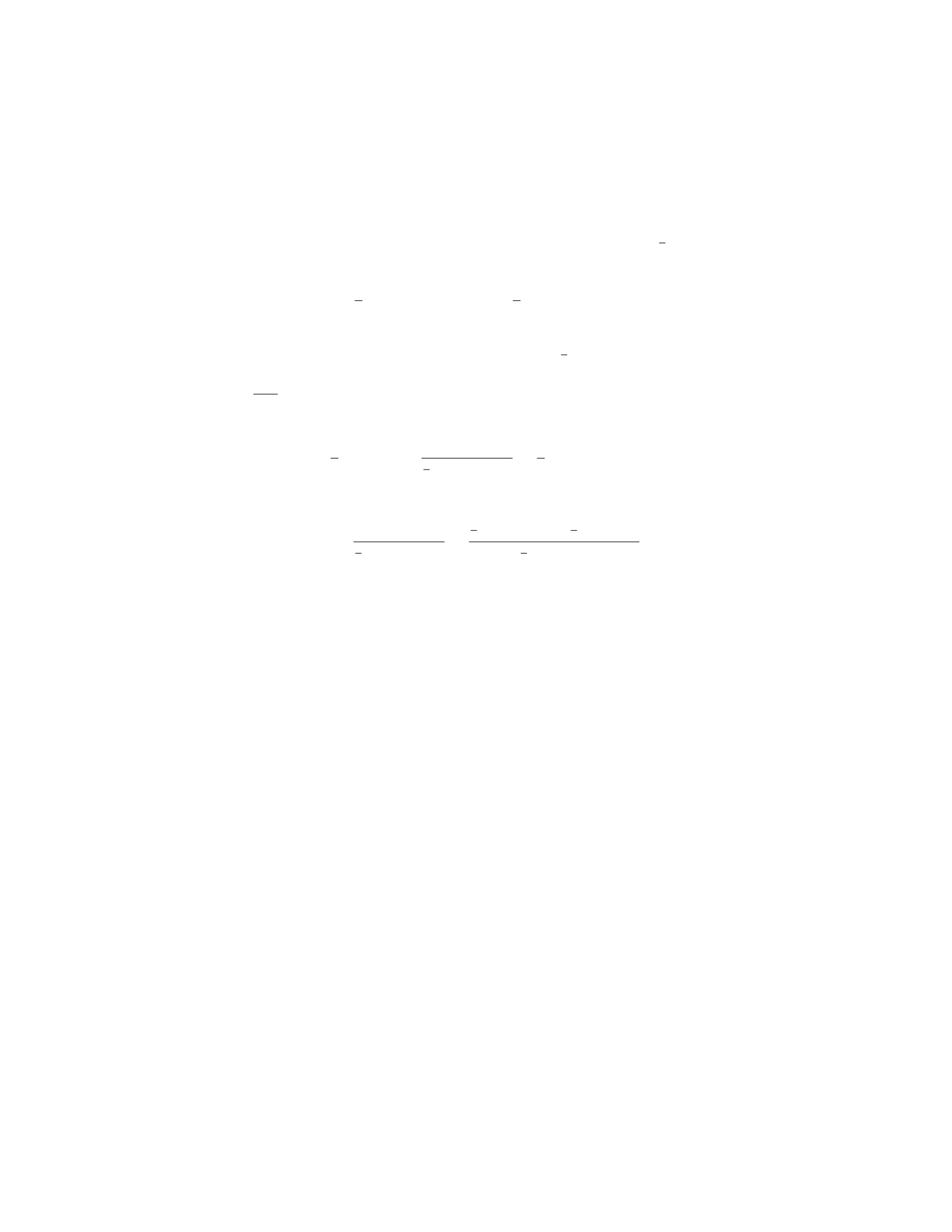
Fair =˙
V·vair, where vair is the velocity of the escaping air, which can be related
to the speed of the ball. Therefore, the buoyant force Fbuoyant =Wball +Fair.
Step 2: The buoyant force can also be expressed as Fbuoyant =4
3πr3ρliquidg.
Equating the two expressions for Fbuoyant, we have
4
3πr3ρballg+˙
V·vair =4
3πr3ρliquidg.
Step 3: The volume of air in the ball decreases with time as air escapes.
The volume of air in the ball at time tis V(t) = 4
3πa2(r−t)2t, where r−t
is the effective radius of the ball at time t. The escaping velocity of the air is
vair =˙
V
V(t).
Step 4: Substituting V(t) and vair into the buoyant force equation, we get
4
3πr3ρballg+˙
V2
4
3πa2(r−t)2t=4
3πr3ρliquidg.
Step 5: Rearranging the terms in the equation, we get
v(t) = ˙
V
4
3πa2(r−t)2t=
4
3πr3ρliquidg−4
3πr3ρballg
4
3πr3ρballg.
Therefore, the speed of the ball as a function of time tis v(t).
Question 18
Question
A cube of side length 3.0 m and density 1000 kg/m3is completely submerged in
water. Determine the buoyant force acting on the cube and its weight. (Density
of water is 1000 kg/m3, acceleration due to gravity is 9.81 m/s2)
Solution
Step 1: Let’s start by finding the volume of the cube. The volume of a cube is
given by the formula V=s3, where sis the side length of the cube. Substituting
s= 3.0 m, we get:
V= (3.0 m)3= 27 m3
Step 2: Next, let’s find the weight of the cube. The weight of an object is
given by the formula W=mg, where mis the mass of the object and gis the
acceleration due to gravity. Since the density of the cube is 1000 kg/m3, the
mass of the cube is:
m= Density ×Volume = 1000 kg/m3×27 m3= 27000 kg
Substituting m= 27000 kg and g= 9.81 m/s2, we get:
W= 27000 kg ×9.81 m/s2= 264870 N
15

Step 3: Now, let’s calculate the buoyant force acting on the cube. According
to Archimedes’ principle, the buoyant force is equal to the weight of the water
displaced by the object. Since the cube is completely submerged in water, the
volume of water displaced is equal to the volume of the cube. The weight of the
displaced water is:
Weight of displaced water = Density of water×Volume×g= 1000 kg/m3×27 m3×9.81 m/s2= 264870 N
Therefore, the buoyant force acting on the cube is also 264870 N.
Question 19
Question
A cylindrical object of height hand radius ris completely submerged in water.
The object has a density of ρoand the density of water is ρw. If the object
floats with its axis vertical, what is the condition that must satisfy the ratio h
r
in terms of ρoand ρw?
Solution
To determine the condition that the ratio h
rmust satisfy, we need to consider
the forces acting on the object.
Step 1: The buoyant force exerted on the object is equal to the weight
of the water displaced by the object. This buoyant force can be calculated
as Fbuoyant =ρwVsubmergedg, where Vsubmerged is the volume of the object
submerged in water.
Step 2: The weight of the object can be calculated as Fweight =ρoVcylinder g,
where Vcylinder is the volume of the entire cylindrical object.
Step 3: The condition for the object to float with its axis vertical is that
the buoyant force is equal to the weight of the object. Therefore, we have:
ρwVsubmergedg=ρoVcylinder g
Step 4: The volume of the submerged portion of the cylinder Vsubmerged
can be written as Vsubmerged =πr2h, and the volume of the entire cylindrical
object Vcylinder is Vcylinder =πr2(2h).
Substitute these expressions into the condition from Step 3:
ρwπr2hg =ρoπr2(2h)g
Step 5: Simplifying the equation above, we find:
ρwh= 2ρoh=⇒ρw= 2ρo
Step 6: Therefore, the condition that must be satisfied for the cylindrical
object to float with its axis vertical is that the density of water ρwmust be
double the density of the object ρo.
Thus, the ratio h
rmust satisfy the condition ρw= 2ρo.
16

Question 20
Question
A cube of aluminum with sides of length 0.1 m is submerged in water. Given
that the density of aluminum is 2700 kg/m3and the density of water is 1000
kg/m3, calculate the buoyant force acting on the cube.
Solution
Step 1: Calculate the volume of the aluminum cube. The volume of a cube is
given by V=s3, where sis the length of a side. In this case, s= 0.1 m, so
V= (0.1 m)3= 0.001 m3.
Step 2: Calculate the weight of the aluminum cube. The weight of an object
is given by W=mg, where mis the mass of the object and gis the acceleration
due to gravity (9.81 m/s2). The mass of the cube can be calculated using its
density and volume:
m=ρV = 2700 kg/m3×0.001 m3= 2.7 kg.
Therefore, the weight of the cube is
W= 2.7 kg ×9.81 m/s2= 26.487 N.
Step 3: Calculate the buoyant force acting on the cube. According to
Archimedes’ principle, the buoyant force acting on an object fully or partially
submerged in a fluid is equal to the weight of the fluid displaced by the object.
The volume of water displaced by the cube is equal to its volume, which is
0.001 m3. The weight of this water is given by = ρwaterV g:
ρwaterV g = 1000 kg/m3×0.001 m3×9.81 m/s2= 9.81 N.
Therefore, the buoyant force acting on the cube is 9.81 N, directed upward.
Question 21
Question
A sphere of radius Rand density ρis submerged in a liquid of density ρl. The
top of the sphere is located at a depth dbelow the surface of the liquid. Find
an expression for the buoyant force acting on the sphere.
17
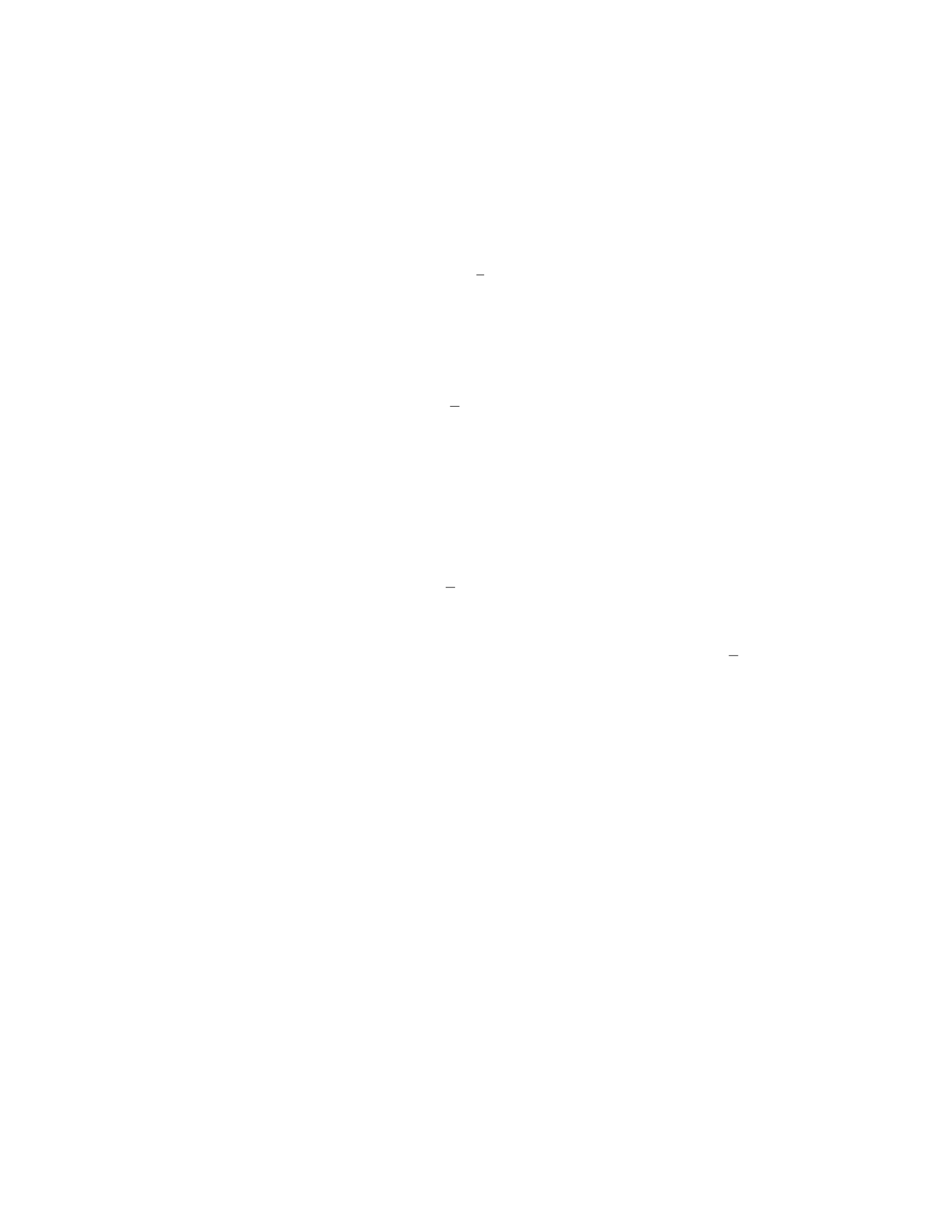
Solution
Step 1: The force due to gravity on the sphere is given by:
Fg=ρ·4
3πR3·g
Step 2: The buoyant force acting on the sphere is equal to the weight of the
liquid displaced by the sphere. The volume of the liquid displaced is equal to
the volume of the sphere submerged in the liquid. The volume of the sphere
submerged is given by:
Vsubmerged =π
3(2R−d)2(3R−d)
Step 3: The weight of the liquid displaced is:
Fbuoyant =ρl·Vsubmerged ·g
Step 4: Substitute the expression for Vsubmerged into the equation for Fbuoyant
to find the buoyant force acting on the sphere. Remembering that Fbuoyant =
Weight of the liquid displaced, and multiplying gout:
Fbuoyant =ρl·π
3(2R−d)2(3R−d)·g
∴The expression for the buoyant force acting on the sphere is Fbuoyant =ρl·π
3(2R−d)2(3R−d)·g
Question 22
Question
A cube with sides of length 0.1 m and density 800 kg/m3is submerged in water.
Calculate the buoyant force acting on the cube and determine if the cube will
float or sink. Assume the density of water is 1000 kg/m3.
Solution
Step 1: Determine the weight of the cube in water. The weight of the cube is
given by the formula:
Weight = mass ×gravitational acceleration
The mass of the cube can be calculated using the formula:
mass = density ×volume
mass = 800 kg/m3×(0.1 m)3= 8 kg
18

Therefore, the weight of the cube in water is:
Weight = 8 kg ×9.81 m/s2= 78.48 N
Step 2: Determine the buoyant force acting on the cube. The buoyant force
can be calculated using Archimedes’ principle:
Buoyant force = density of fluid×volume submerged×gravitational acceleration
The volume of the cube submerged in water is equal to its volume, since it
is completely submerged. Therefore, the buoyant force is:
Buoyant force = 1000 kg/m3×(0.1 m)3×9.81 m/s2= 9.81 N
Step 3: Determine if the cube will float or sink. For an object to float, the
buoyant force must be greater than or equal to the weight of the object. In this
case, the buoyant force is 9.81 N and the weight of the cube is 78.48 N. Since
the weight is greater than the buoyant force, the cube will sink in water.
Question 23
Question
A rectangular block of wood with dimensions 10 cm x 10 cm x 20 cm floats in
a container of water. If the density of water is 1000 kg/m
³
, calculate the mass
of the block of wood.
Solution
Step 1: Find the volume of the block of wood. The volume of the block of wood
can be calculated using the formula:
Volume = Length ×Width ×Height
Given that the dimensions of the block of wood are 10 cm x 10 cm x 20 cm,
we convert them to meters:
10 cm = 0.1 m
20 cm = 0.2 m
Therefore, the volume of the block of wood is:
Volume = 0.1 m ×0.1 m ×0.2 m = 0.002 m3
Step 2: Calculate the weight of the water displaced by the block of wood.
According to Archimedes’ principle, the weight of the water displaced by the
block of wood is equal to the weight of the block of wood. The weight of the
water displaced can be calculated using the formula:
Weight = Volume ×Density ×Acceleration due to gravity
19

Given that the density of water is 1000 kg/m
³
and the acceleration due to
gravity is 9.81 m/s2, we have:
Weight = 0.002 m3×1000 kg/m3×9.81 m/s2= 19.62 N
Step 3: Calculate the mass of the block of wood. The weight of the block of
wood is equal to the weight of the water displaced, so the mass of the block of
wood can be calculated using the formula:
Weight = Mass ×Acceleration due to gravity
Therefore, the mass of the block of wood is:
Mass = Weight
Acceleration due to gravity =19.62 N
9.81 m/s2= 2 kg
Thus, the mass of the block of wood is 2 kg.
Question 24
Question
A cube of side length 10 cm and density 800 kg/m3is submerged in a liquid
with a density of 1000 kg/m3. Calculate the buoyant force acting on the cube.
Solution
Step 1: First, calculate the volume of the cube. Given that the side length of
the cube is 10 cm, the volume Vof the cube is given by
V= (10 cm)3= (0.1 m)3= 0.001 m3
Step 2: Next, calculate the weight of the cube. The weight Wof the cube
is given by the formula
W=mg
where mis the mass of the cube and gis the acceleration due to gravity,
9.81 m/s2. First, calculate the mass mof the cube using its density ρ:
ρ=m
V
m=ρV = 800 kg/m3×0.001 m3= 0.8 kg
Therefore, the weight of the cube is
W= 0.8 kg ×9.81 m/s2= 7.848 N
20

Step 3: Calculate the buoyant force acting on the cube. The buoyant force
Fbacting on the cube is equal in magnitude to the weight of the liquid displaced
by the cube. This can be calculated using Archimedes’ principle:
Fb=ρliquidVdisplacedg
where ρliquid is the density of the liquid, Vdisplaced is the volume of the liquid
displaced by the cube, and gis the acceleration due to gravity. Given that the
density of the liquid is 1000 kg/m3, the volume of the liquid displaced by the
cube is equal to the volume of the cube.
Fb= 1000 kg/m3×0.001 m3×9.81 m/s2
Fb= 9.81 N
Therefore, the buoyant force acting on the cube is 9.81 N.
Question 25
Question
A cube of wood with dimensions 4 m ×4 m ×4 m floats in water with exactly 1
3
of its height above the waterline. Calculate the density of the wood.
Solution
Step 1: First, calculate the volume of the cube of wood. The volume of the
cube is given by the formula V=l×w×h, where l,w, and hare the length,
width, and height of the cube, respectively. Given l=w=h= 4 m, we have:
V= 4 ×4×4 = 64 m3
Step 2: Next, calculate the volume of the cube submerged in water. Given
that 1
3of the height of the cube is submerged, the submerged volume is:
Vsubmerged =2
3×4×4×4 = 128
3m3
Step 3: The buoyant force acting on the cube is equal to the weight of the
water displaced by the cube. The density of water, ρwater, is 1000 kg/m3. The
weight of the water displaced is given by the formula Fbuoyant =ρwater ×g×
Vsubmerged, where gis the acceleration due to gravity. Substituting the values,
we have:
Fbuoyant = 1000 ×9.8×128
3= 419840 N
Step 4: Since the cube is floating, the weight of the cube is equal to the
buoyant force acting on it. The weight of the cube is given by the formula
Wcube =ρcube ×g×V. We can rearrange this formula to solve for ρcube:
ρcube =Wcube
g×V
21

Given that the cube is floating, Wcube =Fbuoyant. Substituting the values, we
get:
ρcube =419840
9.8×64 = 662.5 kg/m3
Therefore, the density of the wood is 662.5 kg/m3.
Question 26
Question
A hollow cube with sides of length aand mass mfloats in a liquid of density
ρ. The cube is submerged to a depth hand its bottom is at a distance dfrom
the bottom of the container. Find the expressions for the buoyant force and the
normal force acting on the cube.
Solution
Step 1: Calculate the volume of the cube submerged in the liquid. The volume
of the cube submerged in the liquid is given by the area of the face of the cube
submerged multiplied by the depth it is submerged to:
Vsubmerged =a2×h
Step 2: Calculate the mass of the liquid displaced by the cube. The mass of
the liquid displaced by the cube is given by the volume of the liquid displaced
multiplied by the density of the liquid:
mdisplaced =ρ×Vsubmerged
Step 3: Calculate the weight of the displaced liquid, which is equal to the
buoyant force acting on the cube. The weight of the displaced liquid is given by
the mass of the displaced liquid multiplied by the acceleration due to gravity, g:
Fbuoyant =mdisplaced ×g
Step 4: Calculate the weight of the cube acting downwards. The weight of
the cube acting downwards is given by the mass of the cube multiplied by the
acceleration due to gravity:
Fdownward =m×g
Step 5: Calculate the normal force acting upwards on the cube. Since the
cube is in equilibrium, the normal force exerted by the liquid on the cube is
equal in magnitude and opposite in direction to the weight of the cube and the
buoyant force:
Fnormal =Fbuoyant +Fdownward
22

Therefore, the expressions for the buoyant force and the normal force acting
on the cube are:
Fbuoyant =ρga2h
Fnormal =mg −ρga2h
Question 27
Question
A spherical metal ball with a radius of 10 cm and a mass of 5 kg is submerged
in water. Calculate the buoyant force acting on the ball and determine whether
it will sink or float. The density of water is 1000 kg/m3.
Solution
Step 1: Calculate the volume of the spherical metal ball using the formula for
the volume of a sphere:
Volume = 4
3πr3
Volume = 4
3π(0.1 m)3
Volume = 4
3π(0.001 m3) = 0.00419 m3
Step 2: Calculate the weight of the metal ball using its mass and the accel-
eration due to gravity:
Weight = mass ×g
Weight = 5 kg ×9.81 m/s2= 49.05 N
Step 3: Calculate the buoyant force acting on the metal ball using Archimedes’
principle, which states that the buoyant force is equal to the weight of the fluid
displaced by the object:
Buoyant force = Densitywater ×Volume ×g
Buoyant force = 1000 kg/m3×0.00419 m3×9.81 m/s2= 41.21 N
Step 4: Determine whether the metal ball will sink or float by comparing
the buoyant force and the weight of the ball. Since the weight of the ball (49.05
N) is greater than the buoyant force (41.21 N), the ball will sink in water.
23

Question 28
Question
A cube of wood with a side length of 15 cm and a density of 0.8 g/cm3is floating
in water. What is the depth of water displaced that can support this cube?
Solution
Step 1: First, we need to determine the weight of the cube to calculate the
buoyant force acting on it. The weight of the cube can be calculated using the
formula:
Weight = Density ×Volume ×g
Step 2: The volume of the cube can be found using the formula:
Volume = (Side length)3
Step 3: Substituting the given values: Side length = 15 cm = 0.15 m Density
= 0.8 g/cm3
Volume = (0.15)3m3
Step 4: Calculate the volume and then the weight of the cube.
Step 5: The buoyant force acting on the cube is equal to the weight of the
water displaced. This buoyant force can be calculated using the formula:
Buoyant force = Density of water ×g×Volume of water displaced
Step 6: Since the cube is floating, the buoyant force acting on it is equal to
its weight. Equating these two forces, we can find the volume of water displaced.
Step 7: The depth of the water displaced can be calculated using the formula:
Depth = Volume of water displaced
Area of the base
Step 8: Calculate the depth of the water displaced by plugging in the values
obtained from the previous steps.
Question 29
Question
A cube of ice with a side length of 5 cm floats in a glass of water. What is the
depth of the ice cube’s bottom surface below the water surface? The density of
ice is 917 kg/m3and the density of water is 1000 kg/m3.
24
Solution
Step 1: Determine the volume of the ice cube. The volume of a cube is given
by V=a3, where ais the length of one side. Substituting a= 0.05 m, we get
V= (0.05)3= 0.000125 m3.
Step 2: Calculate the mass of the ice cube. The mass of the ice cube can be
found using the formula m= density ×volume. Substituting the density of ice
(917 kg/m3) and the volume of the cube, we have
m= 917 ×0.000125 = 0.114625 kg.
Step 3: Calculate the buoyant force acting on the ice cube. The buoyant force
acting on an object in a fluid is equal to the weight of the fluid that the object
displaces. The volume of fluid displaced by the ice cube is equal to its volume,
so the buoyant force Fbis given by Fb= density of water ×volume of ice ×g,
where gis the acceleration due to gravity. Substitute the values to get
Fb= 1000 ×0.000125 ×9.8=1.225 N.
Step 4: Find the total weight of the ice cube. The weight of an object is
given by W=mg, where mis the mass of the object and gis the acceleration
due to gravity. Therefore, the weight Wof the ice cube in water is
W= 0.114625 ×9.8=1.12385 N.
Step 5: Determine the depth of the ice cube’s bottom surface. Since the ice
cube is in equilibrium, the net force acting on it is zero. This means the buoyant
force is equal in magnitude to the weight of the ice cube. Using Archimedes’
principle, the buoyant force is also equal to the weight of water displaced. Let
hbe the depth of the ice cube’s bottom surface below the water surface. The
volume of water displaced by the cube is equal to the volume of the cube that
is submerged, which is (0.05)2h. Equating the weight of water displaced to the
weight of the ice cube, we have
1000 ×0.000125 ×h×9.8=0.114625 ×9.8.
Solving for h, we get
h=0.114625
0.052= 0.459 m.
Therefore, the depth of the ice cube’s bottom surface below the water surface
is 0.459 m.
Question 30
Question
A spherical balloon with radius Ris filled with helium gas. The density of helium
gas is ρhelium, the density of air is ρair, and the acceleration due to gravity is g.
The buoyant force on the balloon can be calculated using Archimedes’ principle.
25

Given that the mass of the empty balloon is mempty and the total mass of
the balloon when filled with helium gas is mfilled, derive an expression for the
buoyant force acting on the balloon in terms of the parameters mentioned.
Solution
Step 1: Calculate the volume of helium in the balloon when it is filled.
The volume of the spherical balloon when it is filled with helium gas is the
difference between the volume of the sphere with radius Rand the volume of
the empty balloon.
The volume of a sphere with radius Ris given by:
Vsphere =4
3πR3
The volume of the helium in the balloon can be calculated as:
Vhelium =Vsphere −Vballoon
=4
3πR3−mempty/ρhelium
Step 2: Calculate the weight of the helium in the balloon.
The weight of the helium in the balloon is equal to the mass of the helium
times the acceleration due to gravity:
Whelium =mfilled ·g
Step 3: Calculate the buoyant force acting on the balloon.
According to Archimedes’ principle, the buoyant force is equal to the weight
of the fluid displaced by the object. In this case, the buoyant force can be
calculated as the weight of the helium displaced by the balloon:
Fbuoyant =ρair ·Vhelium ·g
Therefore, the expression for the buoyant force acting on the balloon in terms
of the given parameters is:
Fbuoyant =ρair 4
3πR3−mempty
ρhelium ·g
Question 31
Question
A cube of wood with a density of 0.6 g/cm3and side length of 10 cm is floating
in water. What is the height of the cube that is immersed in the water? (Density
of water = 1 g/cm3)
26

Solution
Step 1: Calculate the volume of the cube. Given the side length of the cube is
10 cm, the volume can be calculated as:
Volume = (side length)3= 10 cm ×10 cm ×10 cm = 1000 cm3
Step 2: Calculate the mass of the cube. Using the density formula Density =
Mass
Volume , we can rearrange it to find the mass:
Mass = Density ×Volume = 0.6 g/cm3×1000 cm3= 600 g
Step 3: Calculate the weight of the cube. The weight of the cube is given
by:
Weight = Mass ×Acceleration due to gravity = 600 g ×9.8 m/s2= 5880 N
Step 4: Calculate the buoyant force acting on the cube. Using the formula for
buoyant force Fb= Density of fluid×Volume displaced×Acceleration due to gravity,
we can find the buoyant force:
Fb= 1 g/cm3×Volume immersed ×9.8 m/s2
Step 5: Apply Archimedes’ principle. The buoyant force acting on the cube
is equal to the weight of the water displaced, so we have:
Fb= Weight of water displaced = Density of water×Volume immersed×9.8 m/s2
Step 6: Solve for the height of the cube immersed in water. Since the volume
of the immersed part of the cube is equal to the base area times the height, we
have:
1 g/cm3×Base area ×Height immersed ×9.8 m/s2= 600 g ×9.8 m/s2
Solving for the height immersed:
Height immersed = 600
1×Base area =600
1×(10 ×10) = 6 cm
Therefore, the height of the cube that is immersed in water is 6 cm.
Question 32
Question
A cube of wood with sides of length 10 cm and a density of 0.8 g/cm3is floating
in a container of water. The water has a density of 1 g/cm3. Calculate the
depth to which the cube floats in the water.
27

Solution
Step 1: The buoyant force acting on the cube is equal to the weight of the water
displaced by the cube. Let’s denote: - Vcube as the volume of the cube - dwater
as the density of water - dcube as the density of the cube - has the depth to
which the cube floats
Therefore, the buoyant force (Fbuoyant) can be calculated as:
Fbuoyant =dwater ·Vdisplaced ·g
Step 2: The volume of water displaced by the cube is equal to the volume
of the cube that is submerged in the water. The volume of the cube that is
submerged is given by:
Vdisplaced =A·h
where Ais the area of one face of the cube.
Step 3: The weight of the cube acts downwards and the buoyant force acts
upwards. At equilibrium, these forces are equal. Therefore, we can set up the
following equation:
Fbuoyant =Fweight
Step 4: Calculate the weight of the cube. The weight of the cube (Fweight)
is given by:
Fweight =dcube ·Vcube ·g
Step 5: Equate the weight of the cube to the buoyant force and solve for the
depth (h).
dwater ·A·h·g=dcube ·Vcube ·g
Step 6: Plug in the values and solve for h.
1 g/cm3·(10 cm)2·h= 0.8 g/cm3·(10 cm)3
h=0.8·(10)3
(10)2= 80 cm
Therefore, the cube floats to a depth of 80 cm in the water.
Question 33
Question
A cube of side length 2 m and density 1000 kg/m3is submerged in a liquid of
density 800 kg/m3with one face of the cube parallel to the surface of the liquid.
Determine the buoyant force acting on the cube.
28
Solution
Step 1: First, we need to determine the volume and weight of the cube. The
volume of the cube is given by V= side length3= (2 m)3= 8 m3.
Step 2: The weight of the cube can be calculated using the formula W=mg,
where mis the mass of the cube and gis the acceleration due to gravity. The
mass of the cube can be found using the formula m= density ×volume =
1000 kg/m3×8 m3= 8000 kg. Then, the weight of the cube is W= 8000 kg ×
9.81 m/s2= 78480 N.
Step 3: Next, we need to determine the buoyant force acting on the cube.
The buoyant force is equal to the weight of the liquid displaced by the cube,
and is given by Fb= density of liquid ×g×Vdisplaced.
Step 4: The volume of liquid displaced by the cube is equal to the volume
submerged. Since one face of the cube is parallel to the surface of the liquid,
the volume submerged is given by Vsubmerged =1
2×side length ×side length ×
side length = 1
2×2 m ×2 m ×2 m = 4 m3.
Step 5: Substituting the values into the formula for buoyant force, we get
Fb= 800 kg/m3×9.81 m/s2×4 m3= 31392 N.
Therefore, the buoyant force acting on the cube is 31392 N.
Question 34
Question
A cube of side length 10 cm is submerged in water. If the cube is completely
submerged and the buoyant force acting on it is 4 N, determine the density of
the cube.
(Note: The density of water is 1000 kg/m3and the acceleration due to gravity
is 9.81 m/s2.)
Solution
Step 1: Determine the volume of the cube. Given that the side length of the
cube is 10 cm, the volume of the cube can be calculated as:
Volume of the cube = (side length)3= (0.1 m)3= 0.001 m3
Step 2: Calculate the weight of the cube in water. The weight of the cube
in water is equal to the weight of the cube in air minus the buoyant force acting
on it. Using the equation Fbuoyant =ρwater ·Vsubmerged ·g, where Vsubmerged is
the volume of the cube submerged in water, we can rearrange to find:
Weight of the cube in water = Weight of the cube in air −Buoyant force
ρcube ·Vtotal ·g=ρwater ·Vsubmerged ·g+ Buoyant force
29

Plugging in the known values:
ρcube ·0.001 m3·9.81 m/s2= 1000 kg/m3·Vsubmerged ·9.81 m/s2+ 4 N
Step 3: Solve for the density of the cube. Solving the equation from step 2
gives us:
ρcube =1000 ·Vsubmerged + 0.004
0.001
ρcube = 1000 ·Vsubmerged + 4
Step 4: Calculate the volume of the cube submerged in water. Since the
cube is completely submerged, the volume of the cube submerged in water is
equal to the total volume of the cube. Thus, Vsubmerged = 0.001 m3
Step 5: Substitute the volume of the cube submerged in water back into the
equation from step 3 to find the density of the cube.
ρcube = 1000 ·0.001 + 4
ρcube = 1 + 4 = 5 kg/m3
Therefore, the density of the cube is 5 kg/m3.
Question 35
Question
A cube of wood with a density of 600 kg/m3and side length 0.2 m is floating in
a liquid of density 800 kg/m3. What is the fraction of the volume of the cube
that is submerged in the liquid?
Solution
Step 1: First, we need to determine the volume of the cube submerged in the
liquid. Let Vcube be the total volume of the cube and Vsubmerged be the volume
submerged. The buoyant force acting on the cube is equal to the weight of the
liquid displaced by the submerged volume. According to Archimedes’ Principle,
the buoyant force Fbis given by:
Fb=Vsubmerged ·ρliquid ·g,
where ρliquid is the density of the liquid and gis the acceleration due to gravity.
Step 2: The weight of the cube itself is equal to the weight of the liquid
displaced by the entire volume of the cube. This weight is given by:
W=Vcube ·ρcube ·g,
where ρcube is the density of the cube.
30

Step 3: Since the cube is floating, the buoyant force must equal the weight
of the cube. Therefore, we have:
Vsubmerged ·ρliquid ·g=Vcube ·ρcube ·g.
Step 4: Solving for Vsubmerged, we find:
Vsubmerged =Vcube ·ρcube
ρliquid
.
Step 5: Substituting the given values into the equation gives:
Vsubmerged =(0.23)·600
800 = 0.03 m3.
Step 6: The fraction of the volume submerged is then given by:
Vsubmerged
Vcube
=0.03
0.23= 0.375.
Therefore, approximately 37.5% of the volume of the cube is submerged in
the liquid.
31

