


1 Jane Clendinning and Elizabeth Marvin, The Musician’s Guide to Theory and Analysis, 2nd
Norton & Company, Inc., 2011, 468.
MUSC 103
ed., W. W.
Page 1 of 8
UNDERSTANDING FORM
Notes before you begin:
You are encouraged to open the Watch: Basic Guide to the Elements of Music page in Canvas
while reading this document. On this page, you will find all the direct links to the songs that are
referenced on this document with bold text to help you associate the topics being discussed into
practical music application.
**All text is necessary to successfully complete assignments in this course; any text under a
GREEN header is of heightened importance.
FORM: “the overall harmonic and thematic organization of a composition.”1 Songs/pieces of
music are a balance of repetition and contrast: Too much repetition is boring; too much contrast
may be considered chaotic. Musical compositions are structures built on smaller units (sections),
which we label as A, B, C, etc.; within each section, lower case letters are used to label units
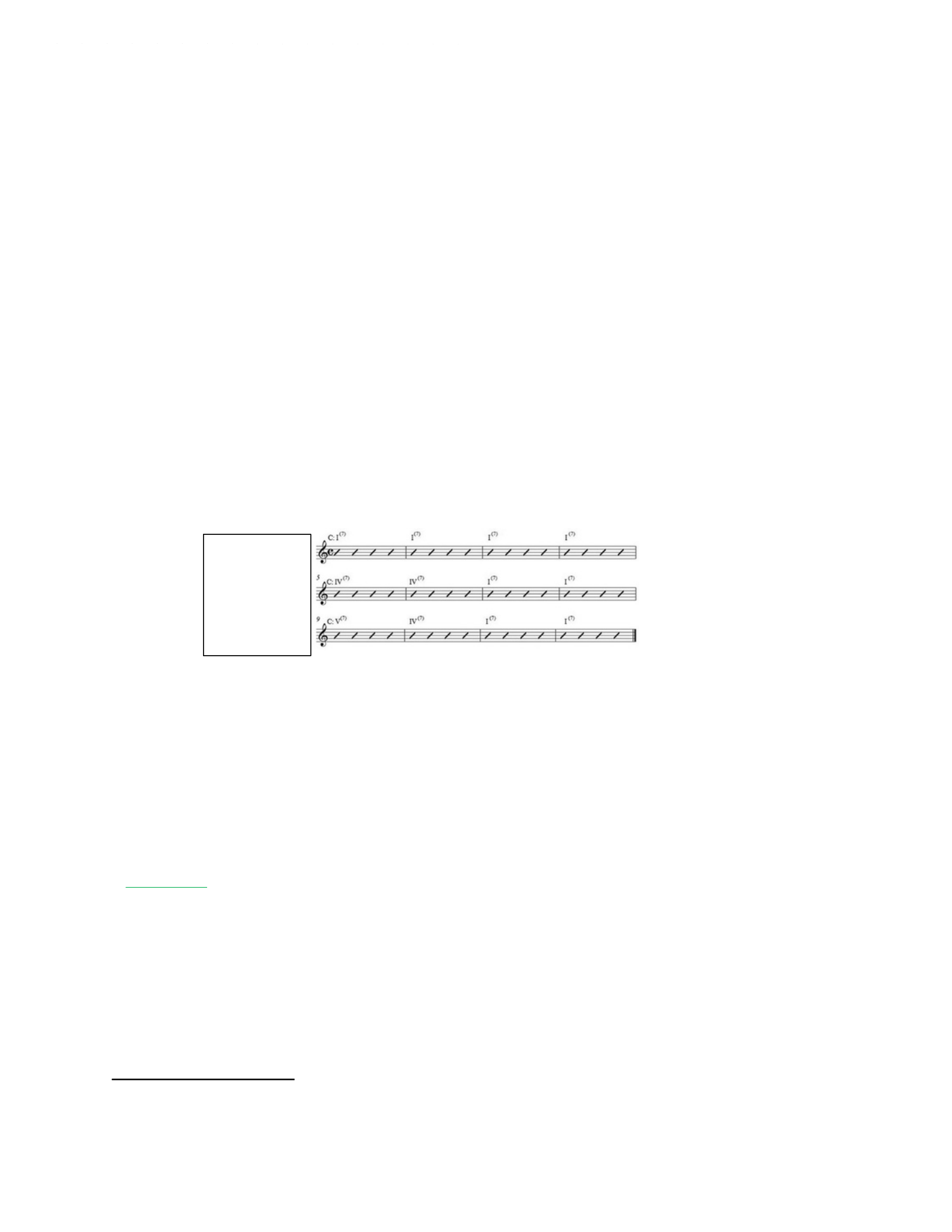
within units. For example, the 12-bar blues example shown below is one section (A) comprising
three smaller sections (a a b) of four measures each.
A a
a
b
The entire “A” section repeats multiple times with the same music, but different lyrics, thereby
revealing the importance of listening to a piece in its entirety before determining the song’s form.
If you only listened to one stanza (verse) of the 12-bar blues, you might consider the form AAB,
but listening to the entire song reveals an AAAA (and so on) structure, which you will soon read
is strophic form.
Forms with which you need to be familiar: Strophic, Binary, Ternary, Standard Song, Theme and
variations, Through-composed, and Rondo.
Strophic Form: AAAA etc.: Same music repeated for each successive stanza (verse) of a poem.
Most traditional 12-bar blues songs, most hymns (e.g., “Amazing Grace”), and traditional ballads
(not the slow, pop love songs) are strophic.
“Barbara Allen” a traditional Scottish ballad – Barbara Allen
AAll in the merry month of May
When the green buds they were swellin'
Young William Green on his death bed lay
For the love of Barbry Allen

MUSC 103
Page 2 of 8
A
A
A
A
A
A
B
B
B
If you wake up and don’t want to smile
If it takes just a little while
Open your eyes and look at the day
You’ll see things in a different way
Don’t stop thinking about tomorrow
Don’t stop, it’ll soon be here
It’ll be better than before
Yesterday’s gone, yesterday’s gone
Why not think about times to come
And not about the things you’ve done?
If your life was bad to you
Just think what tomorrow will do
Don’t stop thinking about tomorrow
Don’t stop, it’ll soon be here
It’ll be better than before
Yesterday’s gone, yesterday’s gone
All I want is to see you smile
If it takes just a little while
I know you don’t believe that it’s true
I never meant any harm to you
Don’t stop thinking about tomorrow
Don’t stop, it’ll soon be here
He sent his servant to the town
To the place where she was dwellin'
Saying "Master's sick and he send for you,
If your name be Barbry Allen
So slowly, slowly she got up
And slowly she came a' nigh him
And all she said when she got there
Young man I believe you're dyin'
a “I went to the crossroad, fell down on my knees”
a “I went to the crossroad, fell down on my knees”
b “Asked the Lord above, ‘Have mercy, now, save poor Bob if you please’” a
“Yeah, standin' at the crossroad, tried to flag a ride”
a “Ooh-ee, I tried to flag a ride”
b “Didn't nobody seem to know me, babe, everybody pass me by”
Other strophic examples are:
oSimon & Garfunkel’s “The Sound of Silence”
Simon & Garfunkel – The Sounds of Silence
oBob Dylan’s “The Times They Are a Changin’”
Bob Dylan - The Times They Are-A-Changin (Official Audio)
NOT Strophic: Chuck Berry’s “Johnny B. Goode”
Johnny B. Goode (see Standard Song Form below)
Binary Form: AB, two sections with contrasting material; verses and choruses, no bridge
Fleetwood Mac: “Don’t Stop” - Fleetwood Mac - Don't Stop (Official Music Video)
A
In Robert Johnson’s “Cross Road Blues” you would label each stanza as “A,” with the
first a second lines being “a,” and the third line labelled “b.”
Robert Johnson CrossRoads – Cross Road Blues Song and Lyrics

MUSC 103
Page 3 of 8
It’ll be better than before
Yesterday’s gone, yesterday’s gone
Ternary Form: ABA, three sections, with the final section a repeat of the first
Pyotr Ilyich Tchaikovsky: The Nutcracker – “Dance of the Reed Pipes”
Tchiakovsky - The Nutcracker - Dance of The Reed Pipes
AFlutes play melody above low string pizzicato
English horn and then clarinet add counterpoint
Melody repeats with violins now adding counterpoint
BChange to minor mode
Trumpets play melody above two-note bass ostinato
Violins join melody
AReturn to flute melody (with violin counterpoint) in major mode
Standard Song Form: AABA, also called ‘32-bar form,’ is the most common form in popular
music styles. Two important notes:
Songs do not have to be in AABA or be 32 bars long to be in standard song form.
Numerous musicians and academics debate whether AABA form and 32-bar form are the
same, but for the purposes of this guide and your analyses in this course, do not get
bogged down with the discussion; learn how to perceive and diagram different song
structures before you join in the debate.
Two people could analyze the same song and come to different conclusions on the formal
organization. You should make an argument for the formal diagram that makes the most
sense.
Since the 1950s, terminology in popular music discussions has changed or evolved perhaps more
than any other style of music, which often presents challenges to understanding analyses;
nevertheless, for this course, if you encounter a song in so-called ‘standard song form,’ you will
use the terms below.
Introduction (or “Intro”): Opens the piece to establish or foreshadow the song’s general
musical direction.
oSome intros present harmonic and/or melodic features without vocals.
Grandmaster Flash & The Furious Five - “The Message”
Grandmaster Flash & The Furious Five – The Message (Official Video)
The Eagles - “Hotel California”
Eagles Perform “Hotel California” at the 1998 Rock & Roll Hall of Fame
Induction Ceremony
oOthers establish a mood and foreshadow musical ideas
Dire Straits - “Money for Nothing” presents a mood for the first half of the
intro, then the band plays the verse music before Verse 1 begins at ~1:03.
Dire Straits - Money For Nothing
oWhile other songs are establishing a mood by presenting music heard only in the
intro
Red Hot Chili Peppers - “Under the Bridge”
Red Hot Chili Peppers – Under The Bridge (Official Music Video
You will label the Introduction as “I” when diagramming a song.

MUSC 103
Page 4 of 8
Verse: section of a song in which the tune remains consistent in each repetition, but the
text changes. You will label the verse with a capital “V” when diagramming a song that’s
in song form.
PreChorus: Standalone material that leads a verse into a chorus. You will label the
prechorus with a capital “PC” when diagramming a song.
oExample: The section of Nirvana’s “Smells Like Teen Spirit” (0:43s-0:58s) in
which Kurt Cobain sings “hello, hello, hello, how low.”
Nirvana - Smells Like Teen Spirit (Official Music Video)
Chorus: In modern popular music, although ‘chorus’ and ‘refrain’ are often used
synonymously by musicians of certain eras and genres, the terms have different
meanings. A chorus is longer than a refrain and is often considered the most prominent
section of a song, as it can stand alone as a separate part of the music.
oExample of a chorus begins at ~0:33 of Sia’s “Chandelier”
Chandelier
You will label the chorus with a capital “C” when diagramming a song.
Refrain: shorter than a chorus, and acts to close out a verse, does not act as a standalone
section, and is followed by another A section/stanza after a short interlude or turnaround.
You will not normally label a refrain, but if you decide to diagram a song at a deeper
level, label the refrain with a lower case “b” along with other lower-case letters (i.e., “a”).
Bridge (often called “the middle eight” in AABA form): Connecting material that is
unlike the verse and chorus music, and is rarely heard more than once or twice
oExample: ~3:21-4:19 in “Kashmir”
Kashmir (Remaster)
You will label the bridge with a capital “B” when diagramming a song.
Interlude: An instrumental section between main sections. In popular music, an interlude
usually occurs in the song’s second half, landing between two choruses or a chorus and a
bridge, and often directly quotes the vocal melody. You will label the interlude as
“Interlude” when diagramming a song.
Solo: You will label the solo “Solo (____)” when diagramming a song. In parentheses
(the blank), label the dominant instrument(s); for example: “Solo (guitar, harmonica).”
Coda: Italian for “tail,” is “the last part of a piece or melody, the implication being of
some addition being made to a standard form or design.” Often called an “outro” in
modern popular music, you will label the Coda as “Coda” when diagramming a song.
*Use an apostrophe at the end of a section letter to display those two sections are related, but not
identical. See the “Bohemian Rhapsody” diagram in ‘through-composed form’ for an example.

MUSC 103
Page 5 of 8
The Beatles: “I Saw Her Standing There”
I Saw Her Standing There (Remastered 2009)
A
Standard Song Examples:
Some analysts mislabel the chorus in “Stand By Me” as a refrain, but the chorus lasts more than
an entire chord progression (picks up on the eighth measure of the verse’s progression), and the
melody is substantially different from the verse, so it is clearly its own section. Therefore, you
would diagram it as: I, V, C, V, C, Interlude, C, C, (fade out).
Ben E. King: “Stand By Me” Ben E. King - Stand By ME
A
Verse 2
Intro
Verse 1
Chorus 1
Chorus 1
Chorus 2
Interlude
Chorus 1
a Well, she was just seventeen
You know what I mean
And the way she looked
Was way beyond compare
b So how could I dance with another
Ooh, when I saw her standing there? a
Well, she looked at me
And I, I could see
That before too long
I'd fall in love with her
She wouldn't dance with another
Ooh, when I saw her standing there
When the night has come
And the land is dark
And the moon is the only light we'll see
No, I won't be afraid
Oh, I won't be afraid
Just as long as you stand, stand by me
So darlin', darlin', stand by me
Oh, stand by me
Oh, stand
Stand by me, stand by me
If the sky that we look upon
Should tumble and fall
Or the mountains should crumble to the sea
I won't cry, I won't cry
No, I won't shed a tear
Just as long as you stand, stand by me
And darlin', darlin', stand by me
Oh, stand by me
Woah, stand now
Stand by me, stand by me
And darlin', darlin', stand by me
Oh, stand by me
Woah, stand now
Stand by me, stand by me
Whenever you're in trouble won't you stand by me
Oh, stand by me
Woah, just stand now
Oh, stand, stand by me

MUSC 103
Page 6 of 8
A
B
A
C
A
B
lively main theme in minor key
lyrical melody in major key
lively main theme in minor key
upward rushes in each instrument,
major lively main theme in minor key
lyrical melody in major key
B Well, my heart went "boom"
When I crossed that room
And I held her hand in mine
A a Oh we danced through the night
And we held each other tight
And before too long
I fell in love with her
b Now I'll never dance with another
Ooh, since I saw her standing there
Guitar Solo
BWell, my heart went, "Boom"
When I crossed that room
And I held her hand in mine
A a Oh, we danced through the night
And we held each other tight
And before too long
I fell in love with her
Now I'll never dance with another
Oh, since I saw her standing there
Coda Oh, since I saw her standing there
Yeah, well since I saw her standing there
A: Themeclarinet
A1: Variation 1oboe and bassoon
A2: Variation 2violas (notes are ½ as fast) violins, cellos & basses imitate
A3: Variation 3trumpets and trombones
A4: Variation 4woodwinds (2nd half of tune)
A5: Variation 5full orchestra
Rondo: A B A C A B A, repeated section alternates with at least two different episodes
Ludwig van Beethoven: String Quartet in C Minor, Op. 18, no. 4, Allegro
The Fry Street Quartet - Beethoven: String Quartet in C Minor, Op. 18, no. 4,
Allegro
Other examples:
Chuck Berry’s “Johnny B. Goode.” Despite the structure being 12-bar blues, which is
often in strophic form, there is a clear chorus that stands alone (it’s probably the part you
hear in your head as you read this).
The diagram of Toto’s “Rosanna” (Rosanna) would be I, V, PC, C, V, PC, C, Solo
(keyboard/synth), Guitar Solo (guitar), PC, C, C, Solo/Vamp (keyboard and guitar).
The PC is “Not quite a year . . . ;” C is “Meet you all the way . . .”
Theme and Variations: A A1 A2 etc., theme is repeated and changed in some way.
Aaron Copland: Appalachian Spring, VII. Doppio movimento
Appalachian Spring: Vii. Doppio movimento

MUSC 103
Page 7 of 8
A
Introduction
lively main them in minor key
Is this the real life?
Is this just fantasy?
Caught in a landside,
No escape from reality
Open your eyes,
Look up to the skies and see,
I'm just a poor boy, I need no sympathy,
Because I'm easy come, easy go,
Little high, little low,
Any way the wind blows doesn't really matter to
Me, to me
A a Mamaaa, just killed a man,
Put a gun against his head, pulled my trigger,
Now he's dead
Mamaaa, life had just begun,
But now I've gone and thrown it all away
b Mama, oooh, didn't mean to make you cry,
If I'm not back again this time tomorrow,
Carry on, carry on as if nothing really matters
A a Too late, my time has come,
Sends shivers down my spine, body's aching all the time
Goodbye, everybody, I've got to go,
Gotta leave you all behind and face the truth
b’Mama, oooh
I don't want to die,
I sometimes wish I'd never been born at all
b’’/c (guitar solo)
B I see a little silhouetto of a man
Scaramouch, Scaramouch, will you do the Fandango!
Thunderbolts and lightning, very, very frightening me
Galileo, Galileo
Galileo, Galileo
Galileo, Figaro - magnificoo
I'm just a poor boy nobody loves me
He's just a poor boy from a poor family,
Spare him his life from this monstrosity
Easy come, easy go, will you let me go
Bismillah! No, we will not let you go
(Let him go!) Bismillah! We will not let you go
(Let him go!) Bismillah! We will not let you go
(Let me go) Will not let you go
(Let me go)(Never) Never let you go
(Let me go) (Never) let you go (Let me go) Ah
No, no, no, no, no, no, no
Oh mama mia, mama mia, mama mia, let me go
Through-composed: A B C D etc., substantially different musical ideas for each stanza or section.
Queen: “Bohemian Rhapsody”
Queen – Bohemian Rhapsody (Official Video Remastered)

MUSC 103
Page 8 of 8
C
Coda
Beelzebub has a devil put aside for me, for me,
For meee
So you think you can stop me and spit in my eye
So you think you can love me and leave me to die
Oh, baby, can't do this to me, baby,
Just gotta get out, just gotta get right outta here
Nothing really matters, anyone can see,
Nothing really matters,
Nothing really matters to me
Any way the wind blows...
Other through-composed examples:
Franz Schubert’s Die Schöne Müllerin, Op. 25, D. 795, “Halt!” (4:45-6:08)
Schubert Die Schone Mullerin (Full) Op. 25, D. 795
The Beatles’ “Happiness is a Warm Gun”
Happiness Is A Warm Gun (Remastered 2009)

