



MATH 334 - DIFFERENTIAL
EQUATIONS - Initial value problems
Question Bank - Set 5
Liberty University
Question 1
Question
Solve the initial value problem:
dy
dx = 3y−2x, y(0) = 1
Solution
Step 1: First, we find the general solution to the differential equation by solving
the homogeneous part.
dy
dx −3y= 0
The characteristic equation is r−3 = 0, so r= 3. Therefore, the homogeneous
solution is yh=Ce3x, where Cis an arbitrary constant.
Step 2: Next, we find a particular solution using the method of undetermined
coefficients. Assume the particular solution has the form yp=Ax +B. Then,
differentiate ypto find dyp
dx and substitute into the differential equation to solve
for Aand B.
dyp
dx =A
dyp
dx = 3yp−2x
A= 3(Ax +B)−2x
A= 3Ax + 3B−2x

Equating coefficients of xon both sides gives A=−2 and equating constants
gives B= 3.
Therefore, the particular solution is yp=−2x+ 3.
Step 3: Adding the homogeneous and particular solutions gives the general
solution y=yh+yp=Ce3x−2x+ 3.
Step 4: Finally, find the value of Cusing the initial condition y(0) = 1.
1 = Ce3·0−2·0 + 3 = C+ 3 ⇒C=−2
Therefore, the solution to the initial value problem is y=−2e3x−2x+ 3.
Question 2
Question
Solve the initial value problem: dy
dx = 3x2−2xwith y(0) = 4.
Solution
Step 1: Find the general solution to the differential equation dy
dx = 3x2−2x.
dy
dx = 3x2−2x
Integrate both sides with respect to x:
Zdy =Z(3x2−2x)dx
y=x3−x2+C
where Cis the constant of integration.
Step 2: Use the initial condition y(0) = 4 to solve for C.
4=03−02+C
C= 4
Step 3: Substitute C= 4 back into the general solution to find the particular
solution.
y=x3−x2+ 4
Therefore, the solution to the initial value problem dy
dx = 3x2−2xwith
y(0) = 4 is y=x3−x2+ 4.
Question 3
Question
Solve the initial value problem:
y′=y2+y, y(0) = 1.
2

Solution
Step 1: We first write the given initial value problem in the form dy
dx =y2+y.
Step 2: We can rewrite the equation as dy
y2+y=dx. Step 3: We then integrate
both sides to solve for x:
Z1
y2+ydy =Zdx.
Step 4: We can rewrite the left integral as:
Z1
y(y+ 1) dy.
Step 4: We use partial fraction decomposition to split the integrand:
1
y(y+ 1) =A
y+B
y+ 1.
Step 5: Solving for Aand B, we get A=−1 and B= 1. Step 6: Substituting
back into the integral, we have:
Z−1
y+1
y+ 1dy.
Step 7: This simplifies to −ln |y|+ ln |y+ 1|=x+C, where Cis an arbitrary
constant. Step 8: Applying the initial condition y(0) = 1, we have:
−ln |1|+ ln |1+1|= 0 + C.
Step 9: This simplifies to ln 2 = C. Step 10: Therefore, our solution is −ln |y|+
ln |y+ 1|=x+ ln 2. Step 11: Finally, we can rearrange the equation to get the
solution for y:
ln y+ 1
y=x+ ln 2.
Step 12: Exponentiating both sides gives:
y+ 1
y=ex+ln 2.
Step 13: Simplifying further gives:
y+ 1
y=ex·eln 2.
Step 14: Therefore, the solution to the initial value problem is:
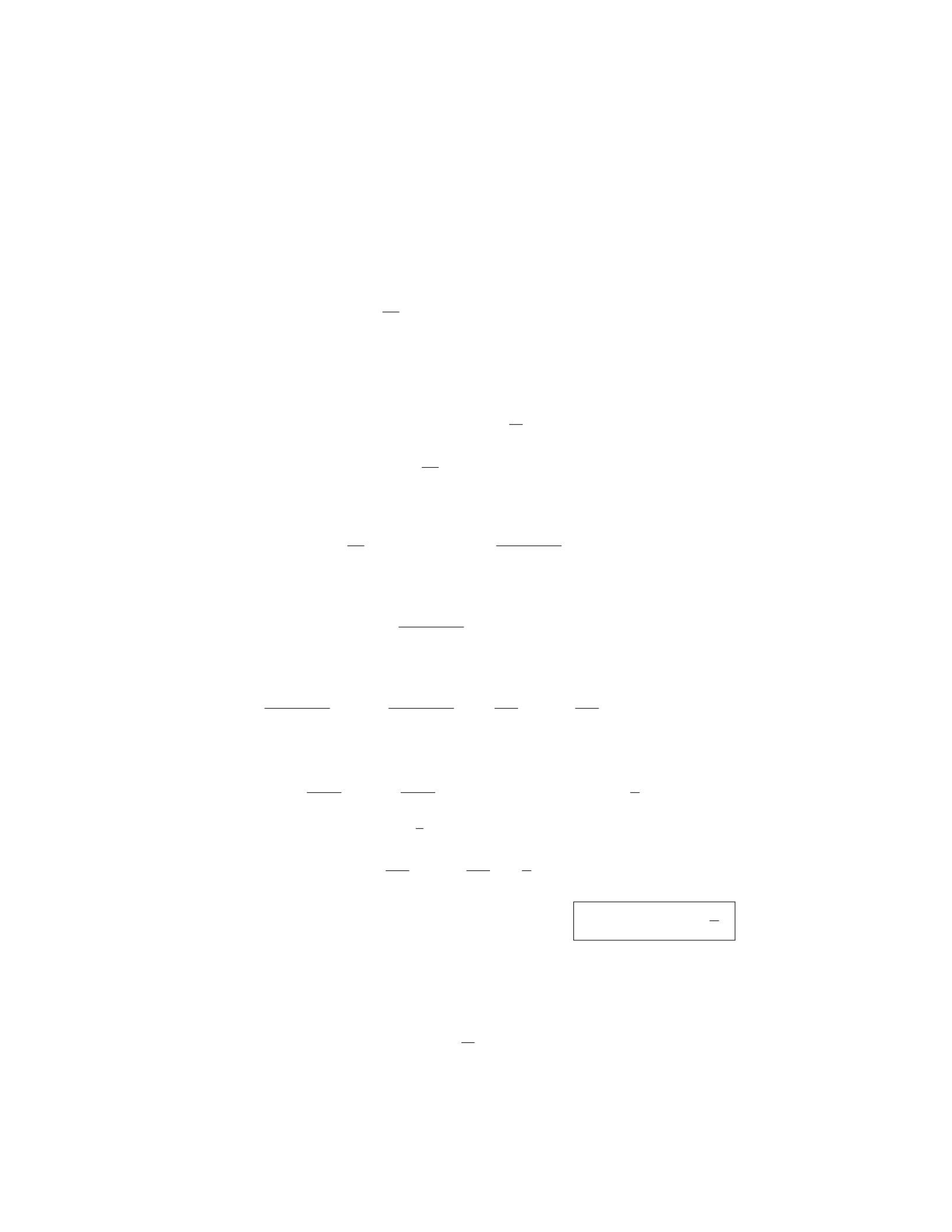
y(x) = 1
1−ex.
3
Question 4
Question
Solve the initial value problem:
dy
dx = 2x3+ 3y2, y(0) = 1.
Solution
We can solve this first-order ordinary differential equation by separation of vari-
ables.
Step 1: Write the equation in the form dy
dx =f(x)g(y).
dy
dx = 2x3+ 3y2.
Step 2: Rearrange the equation to separate variables.
dy
dx = 2x3+ 3y2=⇒dy
2x3+ 3y2=dx.
Step 3: Integrate both sides with respect to xand a constant C.
Z1
2x3+ 3y2dy =Zdx +C.
Step 4: Perform the integrations.
Z1
2x3+ 3y2dy =Z1
2x3+ 3y2dy =1
4x2tan−1y
2x2+D=x+C.
Step 5: Apply the initial condition y(0) = 1 to find the value of the constant
C.1
4(0)2tan−11
2(0)2+D= 0 + C=⇒D=−π
4.
Step 6: Substitute D=−π
4back into the equation.
1
4x2tan−1y
2x2−π
4=x.
Hence, the solution to the initial value problem is y= 2x2tan2x3+π
2.
Question 5
Question
Solve the initial value problem: y′=2x
y,y(0) = 1.
4

Solution
Given the initial value problem: y′=2x
y,y(0) = 1, we will solve it using
separation of variables.
Step 1: Separate the variables.
y dy = 2x dx
Step 2: Integrate both sides.
Zy dy =Z2x dx
y2
2=x2+C
Step 3: Solve for yin terms of x.
y2= 2x2+ 2C
Since y(0) = 1, we can find the value of C:
1 = 2(0)2+ 2C
C= 1
Thus, the solution is:
y2= 2x2+ 2
Step 4: Find the explicit solution for y.
y=±p2x2+ 2
Since y(0) = 1, we choose the positive square root:
y=p2x2+ 2
Question 6
Question
Solve the initial value problem:
dy
dx =1
2√y, y(0) = 1
5

Solution
Step 1: Separate variables by writing dy
√y=1
2dx.
Step 2: Integrate both sides:
Z1
√ydy =Z1
2dx
Step 3: Simplify the integrals to get:
2√y=x
2+C
where Cis the constant of integration.
Step 4: Apply the initial condition y(0) = 1 to find the value of C:
2√1 = 0
2+C=⇒C= 2
Step 5: Substitute C= 2 back into the equation to obtain the particular
solution:
2√y=x
2+ 2
Step 6: Solve for yby isolating it on one side:
√y=x
4+ 1 =⇒y=x
4+ 12
Hence, the solution to the initial value problem is y=x
4+ 12.
Question 7
Question
Solve the initial value problem: dy
dx = 2y−1, with initial condition y(0) = 3.
Solution
Step 1: First, we rewrite the differential equation dy
dx = 2y−1 in the standard
form for solving linear first-order differential equations: dy
dx −2y=−1.
Step 2: Next, we find the integrating factor by multiplying the integrating
factor I(x) on both sides of the equation where I(x) = eR−2dx.
I(x) = e−2x
Step 3: Multiply the integrating factor with the differential equation to get:
e−2xdy
dx −2e−2xy=−e−2x
6

Step 4: Rewrite the left side as the derivative of the product of the integrating
factor and y using the product rule:
d
dx (e−2xy) = −e−2x
Step 5: Integrate both sides with respect to x:
Zd
dx (e−2xy)dx =Z−e−2xdx
Step 6: Solve the integrals on both sides:
e−2xy=1
2e−2x+C
Step 7: Apply the initial condition y(0) = 3 to find the value of the constant
C:
e0·3 = 1
2e0+C
3 = 1
2+C
C=5
2
Step 8: Substitute the value of Cback into the equation:
e−2xy=1
2e−2x+5
2
Step 9: Solve for y:
y=1
2+ 5e2x
Question 8
Question
Solve the initial value problem:
y′= 2y−3e2xwith y(0) = 4
Solution
Step 1: First, we find the general solution to the homogeneous differential equa-
tion y′= 2y.
y′= 2y
dy
dx = 2y
7

dy
y= 2dx
Z1
ydy =Z2dx
ln|y|= 2x+c1
y=e2x+c1
y=Ce2xwhere C=ec1
Step 2: Next, we find a particular solution to the non-homogeneous equation
y′= 2y−3e2xusing the method of undetermined coefficients. Let yp=Ae2x
y′
p= 2Ae2x
Plugging this into the differential equation:
2Ae2x= 2(Ae2x)−3e2x
2A= 2, A = 1
So, yp=e2x
Step 3: The general solution is the sum of the homogeneous and particular
solutions.
y=Ce2x+e2x
Step 4: Applying the initial condition y(0) = 4 to find the value of C.
4 = C·e0+e0
4 = C+ 1
C= 3
Step 5: The solution to the initial value problem is:
y= 3e2x+e2x
Question 9
Question
Solve the initial value problem:
y′=y(1 −y), y(0) = 2
8

Solution
Step 1: First, let’s separate variables by writing the given differential equation
as: dy
dt =y(1 −y)
Step 2: Next, we rewrite the equation as:
dy
y(1 −y)=dt
Step 3: We perform partial fraction decomposition on the left side:
1
y(1 −y)=A
y+B
1−y
Multiplying by y(1 −y) on both sides, we get:
1 = A(1 −y) + By
Step 4: Setting y= 0, we have 1 = A, and setting y= 1, we have 1 = −B+A.
Solving these equations gives A= 1 and B=−1.
Step 5: The equation can be now rewritten as:
Z1
ydy −Z1
1−ydy =Zdt
Step 6: Integrating both sides gives:
ln |y| − ln |1−y|=t+C
Step 7: Combine the logarithms and use the initial condition y(0) = 2 to
solve for C:
ln
y
1−y
=t+C=⇒ln
2
1−2
= 0 + C=⇒C= ln(2)
Step 8: Substituting back C= ln(2), we get:
ln
y
1−y
=t+ ln(2)
Step 9: Solving for y, we have:
y
1−y=et+ln(2) = 2et
Step 10: Rearranging to solve for y, we obtain:
y=2et
1+2et
Therefore, the solution to the initial value problem is y=2et
1+2etwith the
initial condition y(0) = 2.
9

Question 10
Question
Solve the initial value problem:
y′=1
2y+1
x, y(1) = 0.
Solution
Step 1: First, rewrite the differential equation in standard form:
y′−1
2y=1
x.
Step 2: Next, find the integrating factor, which is given by eR−1
2dx =e−1
2x.
Step 3: Multiply both sides of the differential equation by the integrating
factor:
e−1
2xy′−1
2e−1
2xy=e−1
2x1
x.
Step 4: Recognize the left side as the result of the product rule for derivatives:
(e−1
2xy)′=e−1
2x1
x.
Step 5: Integrate both sides of the equation to solve for y:
Z(e−1
2xy)′dx =Ze−1
2x1
xdx.
Step 6: Integrate the right side to get:
e−1
2xy= 2√x+C.
Step 7: Multiply through by e1
2xto solve for y:
y= 2e1
2x√x+Ce 1
2x.
Step 8: Apply the initial condition y(1) = 0 to find C:
0=2e1
2√1 + Ce 1
2⇒0=2√e+Ce 1
2⇒C=−2√e.
Step 9: Substitute Cback into the solution to get the final answer:
y= 2e1
2x√x−2√ee 1
2x.
Question 11
Question
Given the initial value problem:
dy
dx = 4x−3, y(0) = 2
Find the particular solution to the initial value problem.
10

Solution
Step 1: First, we solve the differential equation by separating variables:
dy
dx = 4x−3
dy = (4x−3)dx
Step 2: Integrate both sides:
Zdy =Z(4x−3)dx
y= 2x2−3x+C
Step 3: To find the particular solution, we use the initial condition y(0) = 2:
2 = 2(0)2−3(0) + C
2 = C
Step 4: Therefore, the particular solution to the initial value problem is:
y= 2x2−3x+ 2
Question 12
Question
Solve the initial value problem:
dy
dx = 3x2−6x, y(0) = 4
Solution
Step 1: First, solve the differential equation
dy
dx = 3x2−6x
Step 2: Integrate both sides with respect to xto find y:
y=Z(3x2−6x)dx
Step 3: Solve the integral:
y=x3−3x2+C
11

Step 4: Use the initial condition y(0) = 4 to find the value of C:
4=03−3(0)2+C
C= 4
Step 5: Substitute back Cinto the general solution to obtain the particular
solution:
y=x3−3x2+ 4
Thus, the solution to the initial value problem is y=x3−3x2+ 4.
Question 13
Question
Solve the initial value problem:
dy
dx + 2y= 4x, y(0) = 3
Solution
Step 1: First, we find the integrating factor by solving the auxiliary equation
m+ 2 = 0:
m=−2
The integrating factor is then given by:
µ(x) = eR2dx =e2x
Step 2: Multiply the given differential equation by the integrating factor
µ(x) = e2x:
e2xdy
dx + 2e2xy= 4xe2x
Step 3: Rewrite the left side as a derivative of the product of yand µ(x):
d
dx (e2xy) = 4xe2x
Step 4: Integrate both sides with respect to x:
Zd
dx (e2xy)dx =Z4xe2xdx
Step 5: Solve the integrals on both sides:
e2xy= 2xe2x−Z2e2xdx
e2xy= 2xe2x−e2x+C
12

for some constant C.
Step 6: To find the constant C, apply the initial condition y(0) = 3:
e0·3 = 0 ·e0−e0+C
3 = −1 + C
C= 4
Step 7: Substitute C= 4 back into the equation from Step 5:
e2xy= 2xe2x−e2x+ 4
Step 8: Solve for y:
y= 2x−1+4e−2x
Therefore, the solution to the initial value problem is y= 2x−1+4e−2x.
Question 14
Question
Consider the initial value problem:
dy
dx =y2−x2, y(0) = 1.
Find the solution to the initial value problem.
Solution
Step 1: First, we rewrite the initial value problem as:
dy
dx =y2−x2, y(0) = 1.
Step 2: This is a separable first-order ordinary differential equation. We can
rewrite the equation as:
dy
y2−x2=dx.
Step 3: Next, we integrate both sides of the equation with respect to x:
Z1
y2−x2dy =Zdx.
Step 4: To integrate the left side, we write the denominator as a difference
of squares:
Z1
(y+x)(y−x)dy =Zdx.
13

Step 5: We can now use partial fraction decomposition to simplify the inte-
gral on the left side:
1
(y+x)(y−x)=A
y+x+B
y−x.
Step 6: Solving for Aand Bgives A=1
2xand B=−1
2x.
Step 7: Substituting back into the integral, we have:
Z1
2x(y+x)−1
2x(y−x)dy =Zdx.
Step 8: Integrating both sides gives:
1
2xln |y+x| − 1
2xln |y−x|=x+C.
Step 9: Combining the logarithms on the left side gives:
ln
y+x
y−x
= 2x+C.
Step 10: Exponentiating both sides yields:
y+x
y−x=e2x+C.
Step 11: We can rewrite eCas a constant K, so that:
y+x
y−x=Ke2x.
Step 12: Now, we apply the initial condition y(0) = 1:
1+0
1−0=K·e0=⇒K= 1.
Step 13: Therefore, the solution to the initial value problem is:
y=x+ 1
x−1.
Question 15
Question
Consider the initial value problem:
dy
dx = 2x+e−y, y(0) = 1.
Use Euler’s method with step size h= 0.1 to approximate the value of y(0.2).
Perform three iterations of the method.
14

Solution
We will use Euler’s method to approximate the solution of the initial value
problem. Let h= 0.1 be the step size.
Step 1: Calculate the approximations using Euler’s method.
x1=x0+h= 0 + 0.1=0.1,
y1=y0+hf(x0, y0) = 1 + 0.1(2(0) + e−1) = 1 + 0.1e−1,
x2=x1+h= 0.1+0.1=0.2,
y2=y1+hf(x1, y1) = (1 + 0.1e−1)+0.1(2(0.1) + e−(1+0.1e−1)).
Step 2: Calculate y2.
y2≈1.005
Therefore, the approximate value of y(0.2) using Euler’s method after three
iterations with step size h= 0.1 is 1.005.
Question 16
Question
Consider the initial value problem:
y′=e3x+y2, y(0) = 1.
Find the particular solution to the initial value problem on the interval [0,1].
Solution
Step 1: First, let’s write the given initial value problem as a separable first-order
differential equation. We have:
dy
dx =e3x+y2.
Step 2: Rearrange the terms to separate the variables yand x:
dy
dx =e3x+y2=⇒dy
dx =e3x+y2=⇒dy
e3x+y2=dx.
Step 3: Integrate both sides with respect to x:
Zdy
e3x+y2=Zdx.
Step 4: The left-hand side integral involves partial fractions. We rewrite it
as: Zdy
e3x+y2=ZA
e3x+By +C
y2+ 1 dy.
15

Step 5: Solve for A,B, and Cby multiplying both sides by e3x+y2and
equating like terms. The resulting system of equations can be solved to find
A=1
14 ,B=−3
14 , and C=3
14 .
Step 6: Now, integrating the partial fractions gives us:
1
14 Z1
e3xdy −3
14 Zy
y2+ 1dy +3
14 Z1
y2+ 1dy =Zdx.
Step 7: Simplifying and integrating the above gives:
1
14e−3x−3
28 ln |y2+ 1|+3
14 arctan(y) = x+c,
where cis the constant of integration.
Step 8: Use the initial condition y(0) = 1 to find the value of the constant
c. Substituting x= 0 and y= 1 into the general solution, we have:
1
14 −3
28 ln 2 + 3
14
π
4= 0 + c.
Step 9: Solving for cgives:
c=−1
14 −3
28 ln 2 + 3
14
π
4.
Step 10: The particular solution to the initial value problem on the interval
[0,1] is:
1
14e−3x−3
28 ln |y2+ 1|+3
14 arctan(y) = x−1
14 −3
28 ln 2 + 3
14
π
4.
Question 17
Question
Find the particular solution to the initial value problem: dy
dx =3x2
y2,y(1) = 2.
Solution
Step 1: Rewrite the differential equation as a separable equation:
dy
dx =3x2
y2=⇒y2dy = 3x2dx.
Step 2: Integrate both sides:
Zy2dy =Z3x2dx.
Step 3: Solve the integrals:
1
3y3=x3+C,
16

where Cis the constant of integration.
Step 4: Find the particular solution using the initial condition y(1) = 2:
1
3(2)3= 13+C=⇒8
3= 1 + C=⇒C=5
3.
Step 5: Substitute Cback into the equation to find the particular solution:
1
3y3=x3+5
3.
Step 6: Find the particular solution by solving for y:
y3= 3(x3+ 5) =⇒y= (3(x3+ 5)) 1
3.
Therefore, the particular solution to the initial value problem is y= (3(x3+
5))1
3.
Question 18
Question
Solve the initial value problem
y′=3y2
x, y(1) = 1.
Solution
Step 1: Rewrite the differential equation in separable form.
dy
dx =3y2
x=⇒dy
y2=3
xdx.
Step 2: Integrate both sides.
Z1
y2dy =Z3
xdx =⇒ −1
y= 3 ln |x|+C.
Step 3: Solve for y.
y=−1
3 ln |x|+C.
Step 4: Apply the initial condition y(1) = 1 to solve for the constant C.
1 = −1
3 ln |1|+C=⇒1 = −1
C=⇒C=−1.
Step 5: Substitute C=−1 back into the expression for y.
y=−1
3 ln |x| − 1.
Therefore, the solution to the initial value problem is y=−1
3 ln |x|−1with
the initial condition y(1) = 1.
17

Question 19
Question
Solve the initial value problem:
dy
dx = 2x+y, y(0) = 1
Solution
Step 1: First, we rewrite the differential equation as a separable equation by
moving all terms involving yto one side and all terms involving xto the other
side. dy
dx −y= 2x
Step 2: Next, we multiply both sides of the equation by the integrating
factor e−xto solve the differential equation.
e−xdy
dx −e−xy= 2xe−x
Step 3: Recognize that the left side of the above equation is the derivative
of ye−xwith respect to x. Thus, we rewrite the equation as:
d
dx (ye−x) = 2xe−x
Step 4: Integrate both sides of the equation with respect to x:
Zd
dx (ye−x)dx =Z2xe−xdx
Step 5: Integrate the right side to get:
ye−x=−2(x+ 1)e−x+C
Step 6: Simplify the equation by solving for y:
y=−2(x+ 1) + Cex
Step 7: Use the initial condition y(0) = 1 to find the value of the constant
C.
1 = −2(0 + 1) + C·e0
1 = −2 + C
C= 3
Step 8: Finally, substitute C= 3 back into the equation to get the particular
solution:
y=−2(x+ 1) + 3ex
18

Question 20
Question
Consider the initial value problem:
dy
dx =2x+y
x−y, y(0) = 1.
(a) Find the particular solution to the initial value problem.
(b) Determine the interval where the solution is valid.
Solution
(a) To solve the initial value problem, we can rewrite the given differential
equation as:
(x−y)dy
dx = 2x+y.
Step 1: Let’s rearrange the equation and separate variables:
(x−y)dy = (2x+y)dx.
Step 2: Integrate both sides:
Z(x−y)dy =Z(2x+y)dx.
Step 3: Simplify the integrals:
Zxdy −Zydy =Z2xdx +Zydx.
Step 4: Integrate the expressions:
xy −y2
2=x2+xy +C.
Step 5: Substitute the initial condition y(0) = 1 into the equation:
0·1−12
2=0+0+C.
−1
2=C.
Step 6: Now we can find the particular solution by substituting the constant
back into the equation:
xy −y2
2=x2+xy −1
2.
Therefore, the particular solution to the initial value problem is 2xy −y2=
2x2−1.
(b) The solution is valid as long as x=yto avoid division by zero. So, the
interval where the solution is valid is (−∞,∞)\ {x=y}.
19

Question 21
Question
Solve the initial value problem:
dy
dx = 2y2+ 3y, y(0) = 1.
Solution
Step 1: First, we rewrite the given first-order differential equation as a separable
differential equation by dividing both sides by (2y2+ 3y):
dy
2y2+ 3y=dx.
Step 2: We can simplify the left side by factoring out a yfrom the denomi-
nator: dy
y(2y+ 3) =dx.
Step 3: Now, we can use partial fraction decomposition to separate the
fraction: A
y+B
2y+ 3 =dy
y(2y+ 3).
Step 4: Find Aand Bby clearing the denominators and comparing coeffi-
cients:
1 = A(2y+ 3) + By.
1 = (2A+B)y+ 3A.
Step 5: Equating coefficients, we have the system of equations:
2A+B= 0,
3A= 1.
Step 6: Solving the system, we find A=1
3and B=−2
3. Therefore, we can
rewrite the differential equation as:
1
31
y−2
31
2y+ 3=dx.
Step 7: Integrating both sides, we get:
1
3ln |y| − 2
3ln |2y+ 3|=x+C,
where Cis the constant of integration.
20

Step 8: Simplifying further, we have:
ln
y
(2y+ 3)2
= 3x+ 3C.
Step 9: Exponentiating both sides, we get:
y
(2y+ 3)2=e3x+3C.
Step 10: Applying the initial condition y(0) = 1, we can find the value of
the constant C:
1 = 1
(2 ·1 + 3)2=e0+3C.
Step 11: Solving for C, we find C=−1
3. Therefore, the particular solution
to the initial value problem is:
y=1
(2y+ 3)2=e3x−1.
Question 22
Question
Consider the initial value problem:
y′+ 2y= 4x, y(0) = 3.
Solve the initial value problem using an integrating factor.
Solution
Step 1: Write the initial value problem in the standard form y′+p(x)y=q(x)
where p(x) and q(x) are functions of x.
y′+ 2y= 4x=⇒y′+ 2y−4x= 0
Step 2: Identify p(x) and q(x). Here, p(x) = 2 and q(x)=4x.
Step 3: Find the integrating factor I(x), given by I(x) = eRp(x)dx.
I(x) = eR2dx =e2x
Step 4: Multiply both sides of the standard form by the integrating factor
I(x).
e2xy′+ 2e2xy−4xe2x= 0
Step 5: Rewrite the left side as the derivative of a product [e2xy].
(e2xy)′= 4xe2x
21

Step 6: Integrate both sides with respect to x.
Z(e2xy)′dx =Z4xe2xdx
e2xy= 2xe2x−1
2e2x+C
Step 7: Solve for yby dividing by e2x.
y= 2x−1
2+Ce−2x
Step 8: Use the initial condition y(0) = 3 to find C.
3=0−1
2+C
C=7
2
Step 9: Substitute the value of Cback into the general solution.
y= 2x−1
2+7
2e−2x
Therefore, the solution to the initial value problem is y= 2x−1
2+7
2e−2x.
Question 23
Question
Consider the initial value problem:
dy
dx =x2−2xe−y, y(0) = 1
Determine the solution to the differential equation.
Solution
Step 1: First, separate variables by moving all terms involving yto one side and
all terms involving xto the other side:
eydy = (x2−2x)dx
Step 2: Integrate both sides with respect to yand x:
Zeydy =Z(x2−2x)dx
22

Step 3: Integrating, we have:
ey=1
3x3−x2+C
where Cis the constant of integration.
Step 4: Now, we can use the initial condition y(0) = 1 to solve for C:
e1=1
303−02+C=⇒e=C
Step 5: Substituting C=eback into the solution, we get:
ey=1
3x3−x2+e
Step 6: To find y, we take the natural logarithm of both sides:
y= ln 1
3x3−x2+e
Therefore, the solution to the initial value problem is y= ln 1
3x3−x2+e.
Question 24
Question
Solve the initial value problem:
(y′= 2x(y−1)2
y(0) = 2
Solution
We are given the initial value problem:
(y′= 2x(y−1)2
y(0) = 2
Step 1: Separate variables by writing the differential equation in the form
dy
dx =f(x)g(y).
dy
(y−1)2= 2xdx
Step 2: Integrate both sides with respect to x.
Z1
(y−1)2dy =Z2xdx
23

Z1
v2dv =Z2xdx
Step 3: Solve the integrals.
−1
y−1=x2+C
Step 4: Apply the initial condition y(0) = 2 to find the value of the constant
C.
−1
2−1= 0 + C
C=−1
Step 5: Substitute Cback into the general solution to get the particular
solution.
−1
y−1=x2−1
1
y−1= 1 −x2
y−1 = 1
1−x2
y= 1 + 1
1−x2
Therefore, the solution to the initial value problem is y= 1 + 1
1−x2with the
initial condition y(0) = 2.
Question 25
Question
Consider the initial value problem
dy
dx = 2x−4y, y(0) = 3.
Find the particular solution to the initial value problem.
Solution
To solve this initial value problem, we will use the method of integrating factors.
Step 1: Find the integrating factor. The integrating factor µ(x) is given
by
µ(x) = eR−4dx =e−4x.
24

Step 2: Multiply the differential equation by the integrating factor.
Multiplying both sides of the differential equation by µ(x) gives
e−4xdy
dx =e−4x(2x−4y).
Step 3: Recognize the left side as the derivative of a product. The
left side can be rewritten as d
dx (ye−4x).
Step 4: Integrate both sides. Integrating gives
ye−4x=Z2xe−4xdx −4Zye−4xdx.
Step 5: Solve for y. Solving for y, we get
y=e4xZ2xe−4xdx −4Zye−4xdx.
Step 6: Evaluate the integrals. Evaluating the integrals, we obtain
y=e4x−1
2xe−4x−1
8e−4x+C,
where Cis the constant of integration.
Step 7: Apply the initial condition. Applying the initial condition
y(0) = 3, we have
3 = −1
8+C,
which implies C=25
8.
Step 8: Final solution. Therefore, the particular solution to the initial
value problem is
y=e4x−1
2xe−4x−1
8e−4x+25
8.
Question 26
Question
Consider the initial value problem:
dy
dx = 2x−y, y(0) = 1
25

Solution
To solve the given initial value problem, we will use the method of integrating
factors.
Step 1: Find the integrating factor µ(x).
dy
dx +y= 2x
µ(x) = eR1dx
µ(x) = ex
Step 2: Multiply both sides by the integrating factor µ(x) = ex.
exdy
dx +exy= 2xex
Step 3: Rewrite the left side as the derivative of a product.
d
dx (exy) = 2xex
Step 4: Integrate both sides with respect to x.
Zd
dx (exy)dx =Z2xexdx
exy=Z2xexdx
Step 5: Solve the integral on the right side.
exy= 2 Zxd(ex)
exy= 2xex−2Zexdx
exy= 2xex−2ex+C
Step 6: Use the initial condition y(0) = 1 to find the constant C.
e0·1 = 2(0)e0−2e0+C
1 = −2 + C
C= 3
Step 7: Substitute the constant back into the equation to get the particular
solution.
exy= 2xex−2ex+ 3
y= 2x−2+3e−x
Therefore, the solution to the initial value problem is y= 2x−2+3e−x.
26

Question 27
Question
Solve the initial value problem
dy
dx =1
2e2x−y2, y(0) = 1.
Solution
Step 1: Let’s rewrite the differential equation in a more standard form.
dy
dx +y2=1
2e2x
This is a first-order linear differential equation. To solve it, we will use an
integrating factor µ(x) = eR1dx =ex.
Step 2: Multiply both sides of the differential equation by the integrating
factor µ(x).
exdy
dx +exy2=1
2e3x
Step 3: Recognize the left side of the equation as the derivative of the product
exywith respect to x.
d
dx (exy) = 1
2e3x
Step 4: Integrate both sides with respect to x.
Zd
dx (exy)dx =Z1
2e3xdx
exy=1
6e3x+C
Step 5: Solve for yby dividing by ex.
y=1
6e2x+Ce−x
Step 6: Apply the initial condition y(0) = 1 to find the value of C.
1 = 1
6e0+C
1 = 1
6+C
C=5
6
Step 7: Substitute the value of Cback into the solution.
y=1
6e2x+5
6e−x
Therefore, the solution to the initial value problem is y=1
6e2x+5
6e−x.
27

Question 28
Question
Consider the initial value problem: dy
dx +y=x2,y(0) = 2. Find the particular
solution to the differential equation.
Solution
Step 1: First, let’s rearrange the equation into standard form:
dy
dx =x2−y
Step 2: This is a first-order linear ordinary differential equation. To solve
it, we start by finding the integrating factor, which is eR−1dx =e−x.
Step 3: Now, we multiply both sides of the equation by the integrating
factor:
e−xdy
dx +e−xy=e−xx2
Step 4: Recognizing that the left side is now the derivative of the product
e−xy, we can simplify the equation:
d
dx (e−xy) = e−xx2
Step 5: Integrating both sides with respect to x, we get:
Zd
dx (e−xy)dx =Ze−xx2dx
Step 6: This simplifies to:
e−xy=−e−xx2−2e−x+C
where Cis the constant of integration.
Step 7: Applying the initial condition y(0) = 2, we can find the constant C:
2 = −1 + C⇒C= 3
Step 8: Substituting Cback into our equation, we obtain the particular
solution to the initial value problem:
y=−x2−2+3ex
Question 29
Question
Consider the initial value problem:
y′+y=e−x, y(0) = 2
Solve the initial value problem using an integrating factor.
28

Solution
Step 1: Rewrite the initial value problem in the form y′+P(x)y=Q(x).
y′+y=e−x
Step 2: Identify P(x) and Q(x).
P(x) = 1 and Q(x) = e−x
Step 3: Find the integrating factor µ(x) = eRP(x)dx.
µ(x) = eR1dx =ex
Step 4: Multiply the initial value problem by the integrating factor.
exy′+exy=exe−x
Step 5: Simplify the left side of the equation.
(exy)′= 1
Step 6: Integrate both sides with respect to x.
Z(exy)′dx =Z1dx
Step 7: Solve the equation.
exy=x+C
Step 8: Apply the initial condition y(0) = 2.
e0·2 = 0 + C
C= 2
Step 9: Find the particular solution.
exy=x+ 2
Step 10: Solve for y.
y=e−x(x+ 2)
Therefore, the solution to the initial value problem is y=e−x(x+ 2).
Question 30
Question
Solve the initial value problem:
y′= 2xy, y(0) = 1
29

Solution
Step 1: Write the general solution to the differential equation.
dy
dx = 2xy
dy
y= 2xdx
Integrating both sides:
Z1
ydy =Z2x dx
ln|y|=x2+C
y=Cex2
Step 2: Apply the initial condition y(0) = 1 to find the value of the constant
C.
1 = Ce0
C= 1
Step 3: Write the particular solution to the initial value problem.
y=ex2
Question 31
Question
Consider the initial value problem:
dy
dx = 2x−1, y(0) = 3.
Solve the initial value problem to find the function y(x).
Solution
Step 1: First, we solve the differential equation dy
dx = 2x−1.
Integrating both sides with respect to x, we get:
Zdy
dx dx =Z(2x−1) dx
y=x2−x+C
where Cis the constant of integration.
30

Step 2: Next, we use the initial condition y(0) = 3 to find the value of C.
Substitute x= 0 and y= 3 into the equation we found in Step 1:
3=02−0 + C
C= 3
So, the particular solution to the differential equation is y=x2−x+ 3.
Question 32
Question
Solve the initial value problem:
dy
dx =2x+y−3
x, y(1) = 4
Solution
Step 1: First, let’s rewrite the given initial value problem in the standard form
of a first-order linear differential equation: dy
dx −y
x= 2 + 3
x.
Step 2: Next, we need to find the integrating factor. The integrating factor,
denoted by I(x), is given by I(x) = eR−1
xdx =e−ln x=1
x.
Step 3: Multiply both sides of the equation from Step 1 by the integrating
factor found in Step 2 to get: 1
x
dy
dx −1
x2y= 2 1
x+ 3 1
x2.
Step 4: The left side of the equation from Step 3 can be rewritten as d
dx y
x,
so we have: d
dx y
x= 2 1
x+ 3 1
x2.
Step 5: Integrate both sides of the equation from Step 4 with respect to x
to solve for y
x:y
x= 2 ln |x|− 3
x+C, where C∈Ris the constant of integration.
Step 6: Multiplying both sides of the equation from Step 5 by xgives the
general solution to the differential equation: y= 2xln |x| − 3 + Cx.
Step 7: To find the value of the constant C, substitute the initial condition
y(1) = 4 into the general solution obtained in Step 6. We have 4 = 2(1) ln |1|−
3 + C(1), which simplifies to C= 7.
Step 8: Thus, the solution to the initial value problem is y= 2xln |x|−3+7x.
Question 33
Question
Solve the initial value problem:
dy
dx =2x+y
2y−x, y(0) = 1
31

Solution
Step 1: Rewrite the given differential equation in a more standard form by
separating variables.
(2y−x)dy = (2x+y)dx
Step 2: Integrate both sides of the equation.
Z(2y−x)dy =Z(2x+y)dx
y2−xy =x2+y2
2+C
Step 3: Rewrite the equation in a form where all terms are on one side.
3y2
2−xy −x2=C
Step 4: Use the initial condition y(0) = 1 to solve for the constant C.
3(1)2
2−0·1−(0)2=C
3
2=C
Step 5: Substitute C=3
2back into the equation to get the final solution.
3y2
2−xy −x2=3
2
Question 34
Question
Solve the initial value problem:
y′=√y, y(0) = 0.
Solution
Step 1: Rewrite the differential equation in a separable form.
dy
dx =√y.
Step 2: Separate the variables by bringing all terms involving yto one side
and all terms involving xto the other side.
dy
√y=dx.
32

Step 3: Integrate both sides with respect to their respective variables.
Z1
√ydy =Zdx.
Step 4: Integrate R1
√ydy by letting u=√y, which implies du =1
2√ydy.
Z1
√ydy =Z2du = 2u+C= 2√y+C.
Step 5: Integrate both sides with respect to x.
2√y=x+C.
Step 6: Apply the initial condition y(0) = 0 to solve for the constant C.
2√0 = 0 + C,
0 = C.
Step 7: Substitute C= 0 back into the expression 2√y=x+C.
2√y=x.
Step 8: Solve for yin terms of x.
√y=x
2,
y=x
22
,
y=x2
4.
Therefore, the solution to the initial value problem y′=√y,y(0) = 0 is
y=x2
4.
Question 35
Question
Solve the initial value problem:
dy
dx = 2x(3y−x), y(0) = 1
33
Question 4
Question
Solve the initial value problem:
dy
dx = 2x3+ 3y2, y(0) = 1.
Solution
We can solve this first-order ordinary differential equation by separation of vari-
ables.
Step 1: Write the equation in the form dy
dx =f(x)g(y).
dy
dx = 2x3+ 3y2.
Step 2: Rearrange the equation to separate variables.
dy
dx = 2x3+ 3y2=⇒dy
2x3+ 3y2=dx.
Step 3: Integrate both sides with respect to xand a constant C.
Z1
2x3+ 3y2dy =Zdx +C.
Step 4: Perform the integrations.
Z1
2x3+ 3y2dy =Z1
2x3+ 3y2dy =1
4x2tan−1y
2x2+D=x+C.
Step 5: Apply the initial condition y(0) = 1 to find the value of the constant
C.1
4(0)2tan−11
2(0)2+D= 0 + C=⇒D=−π
4.
Step 6: Substitute D=−π
4back into the equation.
1
4x2tan−1y
2x2−π
4=x.
Hence, the solution to the initial value problem is y= 2x2tan2x3+π
2.
Question 5
Question
Solve the initial value problem: y′=2x
y,y(0) = 1.
4

Solution
Given the initial value problem: y′=2x
y,y(0) = 1, we will solve it using
separation of variables.
Step 1: Separate the variables.
y dy = 2x dx
Step 2: Integrate both sides.
Zy dy =Z2x dx
y2
2=x2+C
Step 3: Solve for yin terms of x.
y2= 2x2+ 2C
Since y(0) = 1, we can find the value of C:
1 = 2(0)2+ 2C
C= 1
Thus, the solution is:
y2= 2x2+ 2
Step 4: Find the explicit solution for y.
y=±p2x2+ 2
Since y(0) = 1, we choose the positive square root:
y=p2x2+ 2
Question 6
Question
Solve the initial value problem:
dy
dx =1
2√y, y(0) = 1
5

Solution
Step 1: Separate variables by writing dy
√y=1
2dx.
Step 2: Integrate both sides:
Z1
√ydy =Z1
2dx
Step 3: Simplify the integrals to get:
2√y=x
2+C
where Cis the constant of integration.
Step 4: Apply the initial condition y(0) = 1 to find the value of C:
2√1 = 0
2+C=⇒C= 2
Step 5: Substitute C= 2 back into the equation to obtain the particular
solution:
2√y=x
2+ 2
Step 6: Solve for yby isolating it on one side:
√y=x
4+ 1 =⇒y=x
4+ 12
Hence, the solution to the initial value problem is y=x
4+ 12.
Question 7
Question
Solve the initial value problem: dy
dx = 2y−1, with initial condition y(0) = 3.
Solution
Step 1: First, we rewrite the differential equation dy
dx = 2y−1 in the standard
form for solving linear first-order differential equations: dy
dx −2y=−1.
Step 2: Next, we find the integrating factor by multiplying the integrating
factor I(x) on both sides of the equation where I(x) = eR−2dx.
I(x) = e−2x
Step 3: Multiply the integrating factor with the differential equation to get:
e−2xdy
dx −2e−2xy=−e−2x
6

Step 4: Rewrite the left side as the derivative of the product of the integrating
factor and y using the product rule:
d
dx (e−2xy) = −e−2x
Step 5: Integrate both sides with respect to x:
Zd
dx (e−2xy)dx =Z−e−2xdx
Step 6: Solve the integrals on both sides:
e−2xy=1
2e−2x+C
Step 7: Apply the initial condition y(0) = 3 to find the value of the constant
C:
e0·3 = 1
2e0+C
3 = 1
2+C
C=5
2
Step 8: Substitute the value of Cback into the equation:
e−2xy=1
2e−2x+5
2
Step 9: Solve for y:
y=1
2+ 5e2x
Question 8
Question
Solve the initial value problem:
y′= 2y−3e2xwith y(0) = 4
Solution
Step 1: First, we find the general solution to the homogeneous differential equa-
tion y′= 2y.
y′= 2y
dy
dx = 2y
7

dy
y= 2dx
Z1
ydy =Z2dx
ln|y|= 2x+c1
y=e2x+c1
y=Ce2xwhere C=ec1
Step 2: Next, we find a particular solution to the non-homogeneous equation
y′= 2y−3e2xusing the method of undetermined coefficients. Let yp=Ae2x
y′
p= 2Ae2x
Plugging this into the differential equation:
2Ae2x= 2(Ae2x)−3e2x
2A= 2, A = 1
So, yp=e2x
Step 3: The general solution is the sum of the homogeneous and particular
solutions.
y=Ce2x+e2x
Step 4: Applying the initial condition y(0) = 4 to find the value of C.
4 = C·e0+e0
4 = C+ 1
C= 3
Step 5: The solution to the initial value problem is:
y= 3e2x+e2x
Question 9
Question
Solve the initial value problem:
y′=y(1 −y), y(0) = 2
8

Solution
Step 1: First, let’s separate variables by writing the given differential equation
as: dy
dt =y(1 −y)
Step 2: Next, we rewrite the equation as:
dy
y(1 −y)=dt
Step 3: We perform partial fraction decomposition on the left side:
1
y(1 −y)=A
y+B
1−y
Multiplying by y(1 −y) on both sides, we get:
1 = A(1 −y) + By
Step 4: Setting y= 0, we have 1 = A, and setting y= 1, we have 1 = −B+A.
Solving these equations gives A= 1 and B=−1.
Step 5: The equation can be now rewritten as:
Z1
ydy −Z1
1−ydy =Zdt
Step 6: Integrating both sides gives:
ln |y| − ln |1−y|=t+C
Step 7: Combine the logarithms and use the initial condition y(0) = 2 to
solve for C:
ln
y
1−y
=t+C=⇒ln
2
1−2
= 0 + C=⇒C= ln(2)
Step 8: Substituting back C= ln(2), we get:
ln
y
1−y
=t+ ln(2)
Step 9: Solving for y, we have:
y
1−y=et+ln(2) = 2et
Step 10: Rearranging to solve for y, we obtain:
y=2et
1+2et
Therefore, the solution to the initial value problem is y=2et
1+2etwith the
initial condition y(0) = 2.
9

Question 10
Question
Solve the initial value problem:
y′=1
2y+1
x, y(1) = 0.
Solution
Step 1: First, rewrite the differential equation in standard form:
y′−1
2y=1
x.
Step 2: Next, find the integrating factor, which is given by eR−1
2dx =e−1
2x.
Step 3: Multiply both sides of the differential equation by the integrating
factor:
e−1
2xy′−1
2e−1
2xy=e−1
2x1
x.
Step 4: Recognize the left side as the result of the product rule for derivatives:
(e−1
2xy)′=e−1
2x1
x.
Step 5: Integrate both sides of the equation to solve for y:
Z(e−1
2xy)′dx =Ze−1
2x1
xdx.
Step 6: Integrate the right side to get:
e−1
2xy= 2√x+C.
Step 7: Multiply through by e1
2xto solve for y:
y= 2e1
2x√x+Ce 1
2x.
Step 8: Apply the initial condition y(1) = 0 to find C:
0=2e1
2√1 + Ce 1
2⇒0=2√e+Ce 1
2⇒C=−2√e.
Step 9: Substitute Cback into the solution to get the final answer:
y= 2e1
2x√x−2√ee 1
2x.
Question 11
Question
Given the initial value problem:
dy
dx = 4x−3, y(0) = 2
Find the particular solution to the initial value problem.
10

Solution
Step 1: First, we solve the differential equation by separating variables:
dy
dx = 4x−3
dy = (4x−3)dx
Step 2: Integrate both sides:
Zdy =Z(4x−3)dx
y= 2x2−3x+C
Step 3: To find the particular solution, we use the initial condition y(0) = 2:
2 = 2(0)2−3(0) + C
2 = C
Step 4: Therefore, the particular solution to the initial value problem is:
y= 2x2−3x+ 2
Question 12
Question
Solve the initial value problem:
dy
dx = 3x2−6x, y(0) = 4
Solution
Step 1: First, solve the differential equation
dy
dx = 3x2−6x
Step 2: Integrate both sides with respect to xto find y:
y=Z(3x2−6x)dx
Step 3: Solve the integral:
y=x3−3x2+C
11

Step 4: Use the initial condition y(0) = 4 to find the value of C:
4=03−3(0)2+C
C= 4
Step 5: Substitute back Cinto the general solution to obtain the particular
solution:
y=x3−3x2+ 4
Thus, the solution to the initial value problem is y=x3−3x2+ 4.
Question 13
Question
Solve the initial value problem:
dy
dx + 2y= 4x, y(0) = 3
Solution
Step 1: First, we find the integrating factor by solving the auxiliary equation
m+ 2 = 0:
m=−2
The integrating factor is then given by:
µ(x) = eR2dx =e2x
Step 2: Multiply the given differential equation by the integrating factor
µ(x) = e2x:
e2xdy
dx + 2e2xy= 4xe2x
Step 3: Rewrite the left side as a derivative of the product of yand µ(x):
d
dx (e2xy) = 4xe2x
Step 4: Integrate both sides with respect to x:
Zd
dx (e2xy)dx =Z4xe2xdx
Step 5: Solve the integrals on both sides:
e2xy= 2xe2x−Z2e2xdx
e2xy= 2xe2x−e2x+C
12

for some constant C.
Step 6: To find the constant C, apply the initial condition y(0) = 3:
e0·3 = 0 ·e0−e0+C
3 = −1 + C
C= 4
Step 7: Substitute C= 4 back into the equation from Step 5:
e2xy= 2xe2x−e2x+ 4
Step 8: Solve for y:
y= 2x−1+4e−2x
Therefore, the solution to the initial value problem is y= 2x−1+4e−2x.
Question 14
Question
Consider the initial value problem:
dy
dx =y2−x2, y(0) = 1.
Find the solution to the initial value problem.
Solution
Step 1: First, we rewrite the initial value problem as:
dy
dx =y2−x2, y(0) = 1.
Step 2: This is a separable first-order ordinary differential equation. We can
rewrite the equation as:
dy
y2−x2=dx.
Step 3: Next, we integrate both sides of the equation with respect to x:
Z1
y2−x2dy =Zdx.
Step 4: To integrate the left side, we write the denominator as a difference
of squares:
Z1
(y+x)(y−x)dy =Zdx.
13

Step 5: We can now use partial fraction decomposition to simplify the inte-
gral on the left side:
1
(y+x)(y−x)=A
y+x+B
y−x.
Step 6: Solving for Aand Bgives A=1
2xand B=−1
2x.
Step 7: Substituting back into the integral, we have:
Z1
2x(y+x)−1
2x(y−x)dy =Zdx.
Step 8: Integrating both sides gives:
1
2xln |y+x| − 1
2xln |y−x|=x+C.
Step 9: Combining the logarithms on the left side gives:
ln
y+x
y−x
= 2x+C.
Step 10: Exponentiating both sides yields:
y+x
y−x=e2x+C.
Step 11: We can rewrite eCas a constant K, so that:
y+x
y−x=Ke2x.
Step 12: Now, we apply the initial condition y(0) = 1:
1+0
1−0=K·e0=⇒K= 1.
Step 13: Therefore, the solution to the initial value problem is:
y=x+ 1
x−1.
Question 15
Question
Consider the initial value problem:
dy
dx = 2x+e−y, y(0) = 1.
Use Euler’s method with step size h= 0.1 to approximate the value of y(0.2).
Perform three iterations of the method.
14

Solution
We will use Euler’s method to approximate the solution of the initial value
problem. Let h= 0.1 be the step size.
Step 1: Calculate the approximations using Euler’s method.
x1=x0+h= 0 + 0.1=0.1,
y1=y0+hf(x0, y0) = 1 + 0.1(2(0) + e−1) = 1 + 0.1e−1,
x2=x1+h= 0.1+0.1=0.2,
y2=y1+hf(x1, y1) = (1 + 0.1e−1)+0.1(2(0.1) + e−(1+0.1e−1)).
Step 2: Calculate y2.
y2≈1.005
Therefore, the approximate value of y(0.2) using Euler’s method after three
iterations with step size h= 0.1 is 1.005.
Question 16
Question
Consider the initial value problem:
y′=e3x+y2, y(0) = 1.
Find the particular solution to the initial value problem on the interval [0,1].
Solution
Step 1: First, let’s write the given initial value problem as a separable first-order
differential equation. We have:
dy
dx =e3x+y2.
Step 2: Rearrange the terms to separate the variables yand x:
dy
dx =e3x+y2=⇒dy
dx =e3x+y2=⇒dy
e3x+y2=dx.
Step 3: Integrate both sides with respect to x:
Zdy
e3x+y2=Zdx.
Step 4: The left-hand side integral involves partial fractions. We rewrite it
as: Zdy
e3x+y2=ZA
e3x+By +C
y2+ 1 dy.
15

Step 5: Solve for A,B, and Cby multiplying both sides by e3x+y2and
equating like terms. The resulting system of equations can be solved to find
A=1
14 ,B=−3
14 , and C=3
14 .
Step 6: Now, integrating the partial fractions gives us:
1
14 Z1
e3xdy −3
14 Zy
y2+ 1dy +3
14 Z1
y2+ 1dy =Zdx.
Step 7: Simplifying and integrating the above gives:
1
14e−3x−3
28 ln |y2+ 1|+3
14 arctan(y) = x+c,
where cis the constant of integration.
Step 8: Use the initial condition y(0) = 1 to find the value of the constant
c. Substituting x= 0 and y= 1 into the general solution, we have:
1
14 −3
28 ln 2 + 3
14
π
4= 0 + c.
Step 9: Solving for cgives:
c=−1
14 −3
28 ln 2 + 3
14
π
4.
Step 10: The particular solution to the initial value problem on the interval
[0,1] is:
1
14e−3x−3
28 ln |y2+ 1|+3
14 arctan(y) = x−1
14 −3
28 ln 2 + 3
14
π
4.
Question 17
Question
Find the particular solution to the initial value problem: dy
dx =3x2
y2,y(1) = 2.
Solution
Step 1: Rewrite the differential equation as a separable equation:
dy
dx =3x2
y2=⇒y2dy = 3x2dx.
Step 2: Integrate both sides:
Zy2dy =Z3x2dx.
Step 3: Solve the integrals:
1
3y3=x3+C,
16

where Cis the constant of integration.
Step 4: Find the particular solution using the initial condition y(1) = 2:
1
3(2)3= 13+C=⇒8
3= 1 + C=⇒C=5
3.
Step 5: Substitute Cback into the equation to find the particular solution:
1
3y3=x3+5
3.
Step 6: Find the particular solution by solving for y:
y3= 3(x3+ 5) =⇒y= (3(x3+ 5)) 1
3.
Therefore, the particular solution to the initial value problem is y= (3(x3+
5))1
3.
Question 18
Question
Solve the initial value problem
y′=3y2
x, y(1) = 1.
Solution
Step 1: Rewrite the differential equation in separable form.
dy
dx =3y2
x=⇒dy
y2=3
xdx.
Step 2: Integrate both sides.
Z1
y2dy =Z3
xdx =⇒ −1
y= 3 ln |x|+C.
Step 3: Solve for y.
y=−1
3 ln |x|+C.
Step 4: Apply the initial condition y(1) = 1 to solve for the constant C.
1 = −1
3 ln |1|+C=⇒1 = −1
C=⇒C=−1.
Step 5: Substitute C=−1 back into the expression for y.
y=−1
3 ln |x| − 1.
Therefore, the solution to the initial value problem is y=−1
3 ln |x|−1with
the initial condition y(1) = 1.
17

Question 19
Question
Solve the initial value problem:
dy
dx = 2x+y, y(0) = 1
Solution
Step 1: First, we rewrite the differential equation as a separable equation by
moving all terms involving yto one side and all terms involving xto the other
side. dy
dx −y= 2x
Step 2: Next, we multiply both sides of the equation by the integrating
factor e−xto solve the differential equation.
e−xdy
dx −e−xy= 2xe−x
Step 3: Recognize that the left side of the above equation is the derivative
of ye−xwith respect to x. Thus, we rewrite the equation as:
d
dx (ye−x) = 2xe−x
Step 4: Integrate both sides of the equation with respect to x:
Zd
dx (ye−x)dx =Z2xe−xdx
Step 5: Integrate the right side to get:
ye−x=−2(x+ 1)e−x+C
Step 6: Simplify the equation by solving for y:
y=−2(x+ 1) + Cex
Step 7: Use the initial condition y(0) = 1 to find the value of the constant
C.
1 = −2(0 + 1) + C·e0
1 = −2 + C
C= 3
Step 8: Finally, substitute C= 3 back into the equation to get the particular
solution:
y=−2(x+ 1) + 3ex
18

Question 20
Question
Consider the initial value problem:
dy
dx =2x+y
x−y, y(0) = 1.
(a) Find the particular solution to the initial value problem.
(b) Determine the interval where the solution is valid.
Solution
(a) To solve the initial value problem, we can rewrite the given differential
equation as:
(x−y)dy
dx = 2x+y.
Step 1: Let’s rearrange the equation and separate variables:
(x−y)dy = (2x+y)dx.
Step 2: Integrate both sides:
Z(x−y)dy =Z(2x+y)dx.
Step 3: Simplify the integrals:
Zxdy −Zydy =Z2xdx +Zydx.
Step 4: Integrate the expressions:
xy −y2
2=x2+xy +C.
Step 5: Substitute the initial condition y(0) = 1 into the equation:
0·1−12
2=0+0+C.
−1
2=C.
Step 6: Now we can find the particular solution by substituting the constant
back into the equation:
xy −y2
2=x2+xy −1
2.
Therefore, the particular solution to the initial value problem is 2xy −y2=
2x2−1.
(b) The solution is valid as long as x=yto avoid division by zero. So, the
interval where the solution is valid is (−∞,∞)\ {x=y}.
19

Question 21
Question
Solve the initial value problem:
dy
dx = 2y2+ 3y, y(0) = 1.
Solution
Step 1: First, we rewrite the given first-order differential equation as a separable
differential equation by dividing both sides by (2y2+ 3y):
dy
2y2+ 3y=dx.
Step 2: We can simplify the left side by factoring out a yfrom the denomi-
nator: dy
y(2y+ 3) =dx.
Step 3: Now, we can use partial fraction decomposition to separate the
fraction: A
y+B
2y+ 3 =dy
y(2y+ 3).
Step 4: Find Aand Bby clearing the denominators and comparing coeffi-
cients:
1 = A(2y+ 3) + By.
1 = (2A+B)y+ 3A.
Step 5: Equating coefficients, we have the system of equations:
2A+B= 0,
3A= 1.
Step 6: Solving the system, we find A=1
3and B=−2
3. Therefore, we can
rewrite the differential equation as:
1
31
y−2
31
2y+ 3=dx.
Step 7: Integrating both sides, we get:
1
3ln |y| − 2
3ln |2y+ 3|=x+C,
where Cis the constant of integration.
20

Step 8: Simplifying further, we have:
ln
y
(2y+ 3)2
= 3x+ 3C.
Step 9: Exponentiating both sides, we get:
y
(2y+ 3)2=e3x+3C.
Step 10: Applying the initial condition y(0) = 1, we can find the value of
the constant C:
1 = 1
(2 ·1 + 3)2=e0+3C.
Step 11: Solving for C, we find C=−1
3. Therefore, the particular solution
to the initial value problem is:
y=1
(2y+ 3)2=e3x−1.
Question 22
Question
Consider the initial value problem:
y′+ 2y= 4x, y(0) = 3.
Solve the initial value problem using an integrating factor.
Solution
Step 1: Write the initial value problem in the standard form y′+p(x)y=q(x)
where p(x) and q(x) are functions of x.
y′+ 2y= 4x=⇒y′+ 2y−4x= 0
Step 2: Identify p(x) and q(x). Here, p(x) = 2 and q(x)=4x.
Step 3: Find the integrating factor I(x), given by I(x) = eRp(x)dx.
I(x) = eR2dx =e2x
Step 4: Multiply both sides of the standard form by the integrating factor
I(x).
e2xy′+ 2e2xy−4xe2x= 0
Step 5: Rewrite the left side as the derivative of a product [e2xy].
(e2xy)′= 4xe2x
21

Step 6: Integrate both sides with respect to x.
Z(e2xy)′dx =Z4xe2xdx
e2xy= 2xe2x−1
2e2x+C
Step 7: Solve for yby dividing by e2x.
y= 2x−1
2+Ce−2x
Step 8: Use the initial condition y(0) = 3 to find C.
3=0−1
2+C
C=7
2
Step 9: Substitute the value of Cback into the general solution.
y= 2x−1
2+7
2e−2x
Therefore, the solution to the initial value problem is y= 2x−1
2+7
2e−2x.
Question 23
Question
Consider the initial value problem:
dy
dx =x2−2xe−y, y(0) = 1
Determine the solution to the differential equation.
Solution
Step 1: First, separate variables by moving all terms involving yto one side and
all terms involving xto the other side:
eydy = (x2−2x)dx
Step 2: Integrate both sides with respect to yand x:
Zeydy =Z(x2−2x)dx
22

Step 3: Integrating, we have:
ey=1
3x3−x2+C
where Cis the constant of integration.
Step 4: Now, we can use the initial condition y(0) = 1 to solve for C:
e1=1
303−02+C=⇒e=C
Step 5: Substituting C=eback into the solution, we get:
ey=1
3x3−x2+e
Step 6: To find y, we take the natural logarithm of both sides:
y= ln 1
3x3−x2+e
Therefore, the solution to the initial value problem is y= ln 1
3x3−x2+e.
Question 24
Question
Solve the initial value problem:
(y′= 2x(y−1)2
y(0) = 2
Solution
We are given the initial value problem:
(y′= 2x(y−1)2
y(0) = 2
Step 1: Separate variables by writing the differential equation in the form
dy
dx =f(x)g(y).
dy
(y−1)2= 2xdx
Step 2: Integrate both sides with respect to x.
Z1
(y−1)2dy =Z2xdx
23

Z1
v2dv =Z2xdx
Step 3: Solve the integrals.
−1
y−1=x2+C
Step 4: Apply the initial condition y(0) = 2 to find the value of the constant
C.
−1
2−1= 0 + C
C=−1
Step 5: Substitute Cback into the general solution to get the particular
solution.
−1
y−1=x2−1
1
y−1= 1 −x2
y−1 = 1
1−x2
y= 1 + 1
1−x2
Therefore, the solution to the initial value problem is y= 1 + 1
1−x2with the
initial condition y(0) = 2.
Question 25
Question
Consider the initial value problem
dy
dx = 2x−4y, y(0) = 3.
Find the particular solution to the initial value problem.
Solution
To solve this initial value problem, we will use the method of integrating factors.
Step 1: Find the integrating factor. The integrating factor µ(x) is given
by
µ(x) = eR−4dx =e−4x.
24

Step 2: Multiply the differential equation by the integrating factor.
Multiplying both sides of the differential equation by µ(x) gives
e−4xdy
dx =e−4x(2x−4y).
Step 3: Recognize the left side as the derivative of a product. The
left side can be rewritten as d
dx (ye−4x).
Step 4: Integrate both sides. Integrating gives
ye−4x=Z2xe−4xdx −4Zye−4xdx.
Step 5: Solve for y. Solving for y, we get
y=e4xZ2xe−4xdx −4Zye−4xdx.
Step 6: Evaluate the integrals. Evaluating the integrals, we obtain
y=e4x−1
2xe−4x−1
8e−4x+C,
where Cis the constant of integration.
Step 7: Apply the initial condition. Applying the initial condition
y(0) = 3, we have
3 = −1
8+C,
which implies C=25
8.
Step 8: Final solution. Therefore, the particular solution to the initial
value problem is
y=e4x−1
2xe−4x−1
8e−4x+25
8.
Question 26
Question
Consider the initial value problem:
dy
dx = 2x−y, y(0) = 1
25

Solution
To solve the given initial value problem, we will use the method of integrating
factors.
Step 1: Find the integrating factor µ(x).
dy
dx +y= 2x
µ(x) = eR1dx
µ(x) = ex
Step 2: Multiply both sides by the integrating factor µ(x) = ex.
exdy
dx +exy= 2xex
Step 3: Rewrite the left side as the derivative of a product.
d
dx (exy) = 2xex
Step 4: Integrate both sides with respect to x.
Zd
dx (exy)dx =Z2xexdx
exy=Z2xexdx
Step 5: Solve the integral on the right side.
exy= 2 Zxd(ex)
exy= 2xex−2Zexdx
exy= 2xex−2ex+C
Step 6: Use the initial condition y(0) = 1 to find the constant C.
e0·1 = 2(0)e0−2e0+C
1 = −2 + C
C= 3
Step 7: Substitute the constant back into the equation to get the particular
solution.
exy= 2xex−2ex+ 3
y= 2x−2+3e−x
Therefore, the solution to the initial value problem is y= 2x−2+3e−x.
26

Question 27
Question
Solve the initial value problem
dy
dx =1
2e2x−y2, y(0) = 1.
Solution
Step 1: Let’s rewrite the differential equation in a more standard form.
dy
dx +y2=1
2e2x
This is a first-order linear differential equation. To solve it, we will use an
integrating factor µ(x) = eR1dx =ex.
Step 2: Multiply both sides of the differential equation by the integrating
factor µ(x).
exdy
dx +exy2=1
2e3x
Step 3: Recognize the left side of the equation as the derivative of the product
exywith respect to x.
d
dx (exy) = 1
2e3x
Step 4: Integrate both sides with respect to x.
Zd
dx (exy)dx =Z1
2e3xdx
exy=1
6e3x+C
Step 5: Solve for yby dividing by ex.
y=1
6e2x+Ce−x
Step 6: Apply the initial condition y(0) = 1 to find the value of C.
1 = 1
6e0+C
1 = 1
6+C
C=5
6
Step 7: Substitute the value of Cback into the solution.
y=1
6e2x+5
6e−x
Therefore, the solution to the initial value problem is y=1
6e2x+5
6e−x.
27

Question 28
Question
Consider the initial value problem: dy
dx +y=x2,y(0) = 2. Find the particular
solution to the differential equation.
Solution
Step 1: First, let’s rearrange the equation into standard form:
dy
dx =x2−y
Step 2: This is a first-order linear ordinary differential equation. To solve
it, we start by finding the integrating factor, which is eR−1dx =e−x.
Step 3: Now, we multiply both sides of the equation by the integrating
factor:
e−xdy
dx +e−xy=e−xx2
Step 4: Recognizing that the left side is now the derivative of the product
e−xy, we can simplify the equation:
d
dx (e−xy) = e−xx2
Step 5: Integrating both sides with respect to x, we get:
Zd
dx (e−xy)dx =Ze−xx2dx
Step 6: This simplifies to:
e−xy=−e−xx2−2e−x+C
where Cis the constant of integration.
Step 7: Applying the initial condition y(0) = 2, we can find the constant C:
2 = −1 + C⇒C= 3
Step 8: Substituting Cback into our equation, we obtain the particular
solution to the initial value problem:
y=−x2−2+3ex
Question 29
Question
Consider the initial value problem:
y′+y=e−x, y(0) = 2
Solve the initial value problem using an integrating factor.
28

Solution
Step 1: Rewrite the initial value problem in the form y′+P(x)y=Q(x).
y′+y=e−x
Step 2: Identify P(x) and Q(x).
P(x) = 1 and Q(x) = e−x
Step 3: Find the integrating factor µ(x) = eRP(x)dx.
µ(x) = eR1dx =ex
Step 4: Multiply the initial value problem by the integrating factor.
exy′+exy=exe−x
Step 5: Simplify the left side of the equation.
(exy)′= 1
Step 6: Integrate both sides with respect to x.
Z(exy)′dx =Z1dx
Step 7: Solve the equation.
exy=x+C
Step 8: Apply the initial condition y(0) = 2.
e0·2 = 0 + C
C= 2
Step 9: Find the particular solution.
exy=x+ 2
Step 10: Solve for y.
y=e−x(x+ 2)
Therefore, the solution to the initial value problem is y=e−x(x+ 2).
Question 30
Question
Solve the initial value problem:
y′= 2xy, y(0) = 1
29

Solution
Step 1: Write the general solution to the differential equation.
dy
dx = 2xy
dy
y= 2xdx
Integrating both sides:
Z1
ydy =Z2x dx
ln|y|=x2+C
y=Cex2
Step 2: Apply the initial condition y(0) = 1 to find the value of the constant
C.
1 = Ce0
C= 1
Step 3: Write the particular solution to the initial value problem.
y=ex2
Question 31
Question
Consider the initial value problem:
dy
dx = 2x−1, y(0) = 3.
Solve the initial value problem to find the function y(x).
Solution
Step 1: First, we solve the differential equation dy
dx = 2x−1.
Integrating both sides with respect to x, we get:
Zdy
dx dx =Z(2x−1) dx
y=x2−x+C
where Cis the constant of integration.
30

Step 2: Next, we use the initial condition y(0) = 3 to find the value of C.
Substitute x= 0 and y= 3 into the equation we found in Step 1:
3=02−0 + C
C= 3
So, the particular solution to the differential equation is y=x2−x+ 3.
Question 32
Question
Solve the initial value problem:
dy
dx =2x+y−3
x, y(1) = 4
Solution
Step 1: First, let’s rewrite the given initial value problem in the standard form
of a first-order linear differential equation: dy
dx −y
x= 2 + 3
x.
Step 2: Next, we need to find the integrating factor. The integrating factor,
denoted by I(x), is given by I(x) = eR−1
xdx =e−ln x=1
x.
Step 3: Multiply both sides of the equation from Step 1 by the integrating
factor found in Step 2 to get: 1
x
dy
dx −1
x2y= 2 1
x+ 3 1
x2.
Step 4: The left side of the equation from Step 3 can be rewritten as d
dx y
x,
so we have: d
dx y
x= 2 1
x+ 3 1
x2.
Step 5: Integrate both sides of the equation from Step 4 with respect to x
to solve for y
x:y
x= 2 ln |x|− 3
x+C, where C∈Ris the constant of integration.
Step 6: Multiplying both sides of the equation from Step 5 by xgives the
general solution to the differential equation: y= 2xln |x| − 3 + Cx.
Step 7: To find the value of the constant C, substitute the initial condition
y(1) = 4 into the general solution obtained in Step 6. We have 4 = 2(1) ln |1|−
3 + C(1), which simplifies to C= 7.
Step 8: Thus, the solution to the initial value problem is y= 2xln |x|−3+7x.
Question 33
Question
Solve the initial value problem:
dy
dx =2x+y
2y−x, y(0) = 1
31

Solution
Step 1: Rewrite the given differential equation in a more standard form by
separating variables.
(2y−x)dy = (2x+y)dx
Step 2: Integrate both sides of the equation.
Z(2y−x)dy =Z(2x+y)dx
y2−xy =x2+y2
2+C
Step 3: Rewrite the equation in a form where all terms are on one side.
3y2
2−xy −x2=C
Step 4: Use the initial condition y(0) = 1 to solve for the constant C.
3(1)2
2−0·1−(0)2=C
3
2=C
Step 5: Substitute C=3
2back into the equation to get the final solution.
3y2
2−xy −x2=3
2
Question 34
Question
Solve the initial value problem:
y′=√y, y(0) = 0.
Solution
Step 1: Rewrite the differential equation in a separable form.
dy
dx =√y.
Step 2: Separate the variables by bringing all terms involving yto one side
and all terms involving xto the other side.
dy
√y=dx.
32

Step 3: Integrate both sides with respect to their respective variables.
Z1
√ydy =Zdx.
Step 4: Integrate R1
√ydy by letting u=√y, which implies du =1
2√ydy.
Z1
√ydy =Z2du = 2u+C= 2√y+C.
Step 5: Integrate both sides with respect to x.
2√y=x+C.
Step 6: Apply the initial condition y(0) = 0 to solve for the constant C.
2√0 = 0 + C,
0 = C.
Step 7: Substitute C= 0 back into the expression 2√y=x+C.
2√y=x.
Step 8: Solve for yin terms of x.
√y=x
2,
y=x
22
,
y=x2
4.
Therefore, the solution to the initial value problem y′=√y,y(0) = 0 is
y=x2
4.
Question 35
Question
Solve the initial value problem:
dy
dx = 2x(3y−x), y(0) = 1
33

Solution
Step 1: Rewrite the differential equation in the form dy
dx +P(x)y=Q(x). Step
2: Identify P(x) and Q(x). Step 3: Find the integrating factor eRP(x)dx. Step
4: Multiply the integrating factor by the differential equation. Step 5: Integrate
both sides to solve for y. Step 6: Apply the initial condition to find the constant
of integration.
Step 1: Rewrite the differential equation in the form dy
dx +P(x)y=Q(x).
dy
dx −6xy = 2x2
Step 2: Identify P(x) and Q(x). Here, P(x) = −6xand Q(x)=2x2.
Step 3: Find the integrating factor eRP(x)dx. The integrating factor is
eR−6xdx =e−3x2.
Step 4: Multiply the integrating factor by the differential equation.
e−3x2dy
dx −6xy=e−3x2·2x2
Step 5: Integrate both sides to solve for y.
e−3x2y=Ze−3x2·2x2dx
y=e3x2Z2x2e−3x2dx
Step 6: Apply the initial condition to find the constant of integration. Given
y(0) = 1:
1 = e3(0)2Z2(0)2e3(0)2dx
1=0
This initial condition does not yield a well-defined value for the constant of
integration, so the solution cannot be determined uniquely.
34

