



MATH 334 - DIFFERENTIAL
EQUATIONS - Initial value problems
Question Bank - Set 4
Liberty University
Question 1
Question
Consider the initial value problem:
dx
dt =x(4 −x2), x(0) = 3.
Determine the solution to the initial value problem.
Solution
Step 1: Find the critical points by setting dx
dt = 0:
x(4 −x2)=0
This gives us x= 0 and x=±2.
Step 2: Check the signs of dx
dt in the intervals (−∞,−2), (−2,0), (0,2), and
(2,∞).
For x < −2, we have x(4−x2)>0 (since xis negative but 4−x2is positive),
so dx
dt >0. Thus, x(t) is increasing on (−∞,−2).
For −2< x < 0, we have x(4 −x2)<0 (since xis negative and 4 −x2is
positive), so dx
dt <0. Thus, x(t) is decreasing on (−2,0).
For 0 < x < 2, we have x(4 −x2)>0 (since xis positive and 4 −x2is
positive), so dx
dt >0. Thus, x(t) is increasing on (0,2).
For x > 2, we have x(4 −x2)<0 (since xis positive but 4 −x2is negative),
so dx
dt <0. Thus, x(t) is decreasing on (2,∞).
Step 3: Since x(0) = 3 is between 2 and 4, x(t) increases until it reaches 4
where it will stay steady. Therefore, the solution to the initial value problem is:
x(t) = (3 if t∈(−∞,0),
4 if t∈[0,∞).

Question 2
Question
Solve the initial value problem:
dy
dx =−2y, y(0) = 3
Solution
Step 1: We begin by separating the variables in the differential equation:
dy
dx =−2y
dy
y=−2dx
Step 2: Next, we integrate both sides with respect to their respective vari-
ables: Z1
ydy =Z−2dx
ln |y|=−2x+C
where Cis the constant of integration.
Step 3: Exponentiate both sides to solve for y:
y=e−2x+C=e−2xeC
y=Ke−2x
where K=eCis a new constant of integration.
Step 4: Apply the initial condition y(0) = 3 to solve for K:
3 = Ke−2(0) =K
K= 3
Step 5: Finally, substitute K= 3 back into the general solution to get the
particular solution:
y= 3e−2x
Therefore, the solution to the initial value problem is y= 3e−2x.
Question 3
Question
Solve the initial value problem:
dy
dx =2x+y
x, y(1) = 3
2

Solution
Step 1: Rewrite the differential equation in a more manageable form.
dy
dx =2x+y
x
xdy
dx = 2x+y
xdy
dx −y= 2x
Step 2: This is a linear differential equation and can be solved using an
integrating factor. The integrating factor is given by:
µ(x) = eR−1
xdx =e−ln |x|=1
|x|
Step 3: Multiply the integrating factor by the differential equation.
1
|x|xdy
dx −1
|x|y= 2
Step 4: Recognize that the left-hand side can be written as the derivative of
y|x|with respect to x.
d
dx(y|x|)=2
Step 5: Integrate both sides with respect to x.
Zd
dx(y|x|)dx =Z2dx
Step 6: Solve the integrals.
y|x|= 2x+C
Step 7: Apply the initial condition y(1) = 3.
3· |1|= 2 ·1 + C=⇒3 = 2 + C=⇒C= 1
Step 8: Substitute C= 1 back into the equation.
y|x|= 2x+ 1
Step 9: Divide both sides by |x|.
y=2x
|x|+1
|x|
Step 10: Simplify the solution based on the sign of x.
y=(2x+ 1 if x > 0
−2x+ 1 if x < 0
Thus, the solution to the initial value problem is y=(2x+ 1 if x > 0
−2x+ 1 if x < 0.
3

Question 4
Question
Solve the initial value problem:
dy
dx =1
xy+x, y(1) = 2.
Solution
Step 1: First, rewrite the differential equation in standard form by noticing that
it is a linear first-order ODE:
dy
dx −1
xy=x.
Step 2: To solve the above ODE, we use an integrating factor given by
µ(x) = eR−1
xdx =e−ln(x)=1
x.
Step 3: Multiply both sides of the ODE by the integrating factor 1
x:
1
x
dy
dx −1
x2y= 1.
Step 4: Rewrite the left side as the derivative of the product y·1
x:
d
dx y
x= 1.
Step 5: Integrate both sides with respect to x:
Zd
dx y
xdx =Z1dx.
Step 6: Simplify the integrals on both sides:
y
x=x+C,
where Cis the constant of integration.
Step 7: Solve for y:
y=x2+Cx.
Step 8: Use the initial condition y(1) = 2 to find the value of C:
2=12+C·1 =⇒C= 1.
Step 9: Substitute C= 1 back into the general solution to obtain the par-
ticular solution:
y=x2+x.
Hence, the solution to the initial value problem is y=x2+x.
4

Question 5
Question
Solve the initial value problem:
dy
dx =2x+ 3y
x+y, y(0) = 1
Solution
Step 1: Notice the given differential equation is separable. We can rewrite it as:
(x+y)dy = (2x+ 3y)dx
Step 2: Integrate both sides of the equation:
Z(x+y)dy =Z(2x+ 3y)dx
Step 3: Integrating the left side gives:
Z(x+y)dy =Zxdy +Zydy =1
2x2+1
2y2+C1
Step 4: Integrating the right side gives:
Z(2x+ 3y)dx =Z2xdx +Z3ydx =x2+3
2y2+C2
Step 5: Setting C1and C2equal to C, we have:
1
2y2−3
2y2=x2−2x+C
Step 6: Rearranging the equation gives the implicit solution:
−y2−2x=C+ 1
Step 7: We use the initial condition y(0) = 1 to find the constant C:
−(1)2−2(0) = C+ 1 =⇒C=−2
Step 8: Substituting C=−2 back into our implicit solution, we have:
−y2−2x=−2+1
−y2−2x=−1
So, the solution to the initial value problem is y=√2x+ 1.
5

Question 6
Question
Consider the initial value problem:
y′=1
2y+ 3e2x, y(0) = 1.
Find the particular solution to the initial value problem.
Solution
Step 1: First, we find the general solution to the differential equation by solving
the homogeneous equation.
y′−1
2y= 0.
The characteristic equation is r−1
2= 0, which gives us r=1
2. Hence, the
solution to the homogeneous equation is yh=ce1
2x, where cis a constant.
Step 2: Next, we find a particular solution to the non-homogeneous equation.
Since the non-homogeneous term is of the form aebx, we can guess a particular
solution in the form yp=Ae2x. Plugging this into the differential equation
gives:
2Ae2x−1
2Ae2x= 3e2x.
Solving this equation gives A= 6.
Therefore, a particular solution to the non-homogeneous equation is yp=
6e2x.
Step 3: To find the general solution, we combine the homogeneous and
particular solutions: y=yh+yp. So, the general solution to the differential
equation is y=ce1
2x+ 6e2x.
Step 4: Finally, we find the value of the constant cby applying the initial
condition y(0) = 1.
1 = ce0+ 6e0
1 = c+ 6
c=−5
Therefore, the particular solution to the initial value problem is y=−5e1
2x+
6e2x.
Question 7
Question
Solve the initial value problem
dy
dx = 2x(1 −y), y(0) = −1.
6

Solution
Step 1: First, we need to separate variables to solve the differential equation.
This involves moving all terms involving yto one side and all terms involving x
to the other side. We start by dividing both sides by (1 −y):
dy
1−y= 2x dx.
Step 2: Next, we integrate both sides with respect to their respective vari-
ables. Integrating the left side involves a substitution u= 1 −y,du =−dy:
Z1
u·(−du) = −Z1
udu =−ln |u|+C1,
where C1is the constant of integration.
Step 3: After making the substitution back in terms of y, the left side
simplifies to −ln |1−y|+C1. On the right side, we integrate 2x dx to get
x2+C2, where C2is another constant of integration.
Step 4: Therefore, our equation now looks like −ln |1−y|=x2+Cwhere
C=C2−C1is a constant of integration.
Step 5: To find the value of C, we use the initial condition y(0) = −1. Plug
in x= 0 and y=−1 into the equation to get
−ln |1+1|= 02+C⇒ −ln(2) = C.
Step 6: Now we can rewrite our equation to solve for y:
−ln |1−y|=x2−ln(2).
Step 7: Finally, we solve for yby exponentiating both sides and then taking
−expx2−ln(2)to the other side. Thus, the solution to the initial value
problem is
y(x)=1−ex2−ln(2).
Question 8
Question
Solve the initial value problem:
dy
dx = 2x−y, y(0) = 3
Solution
Step 1: First, rewrite the initial value problem as:
dy
dx +y= 2x, y(0) = 3
7

Step 2: This is a first-order linear differential equation. To solve it, we’ll use
an integrating factor. The integrating factor is given by eR1dx =ex.
Step 3: Multiply both sides of the equation by the integrating factor:
exdy
dx +exy= 2xex
Step 4: Recognize the left-hand side as the derivative of the product exy.
Rewrite the equation as: d
dx(exy) = 2xex
Step 5: Integrate both sides with respect to x:
Zd
dx(exy)dx =Z2xexdx
Step 6: Solving the integrals gives:
exy= 2xex−2ex+C
where Cis the constant of integration.
Step 7: Now, apply the initial condition y(0) = 3 to find the value of C:
e0·3=2·0·e0−2e0+C
3 = −2 + C
C= 5
Step 8: Substitute C= 5 back into the equation to find the particular
solution:
exy= 2xex−2ex+ 5
y= 2x−2+5e−x
Therefore, the solution to the initial value problem is y= 2x−2 + 5e−x,
where y(0) = 3.
Question 9
Question
Solve the initial value problem:
dy
dx + 2y=e−x, y(0) = 2
8

Solution
Step 1: First, we solve the homogeneous equation dy
dx + 2y= 0. This is a first-
order linear ordinary differential equation (ODE). The solution to the homoge-
neous equation is given by yh=Ce−2x, where Cis the constant of integration.
Step 2: Next, we find a particular solution to the non-homogeneous equation.
Let’s assume the particular solution has the form yp=Ae−x, where Ais a
constant to be determined.
Step 3: Substitute ypback into the original differential equation:
d(Ae−x)
dx + 2(Ae−x) = e−x
Step 4: Simplify the equation:
−Ae−x+ 2Ae−x=e−x
Step 5: Solving the above equation gives A=1
3.
Step 6: Therefore, the general solution to the original differential equation
is:
y=yh+yp=Ce−2x+1
3e−x
Step 7: Next, apply the initial condition y(0) = 2 to find the value of C:
2 = C+1
3
Step 8: Solving the above equation gives C=5
3.
Step 9: Thus, the solution to the initial value problem is:
y=5
3e−2x+1
3e−x
Question 10
Question
Solve the initial value problem:
y′= 2y−3, y(0) = 4.
Solution
Step 1: First, we solve the differential equation y′= 2y−3. This is a first-order
linear homogeneous differential equation.
Step 2: To solve this, we first find the integrating factor:
µ(t) = eR2dt =e2t.
9

Step 3: Multiply both sides of the equation by the integrating factor:
e2ty′= 2e2ty−3e2t.
Step 4: Rewrite the left side using the product rule:
d
dt(e2ty)=2e2ty−3e2t.
Step 5: Integrate both sides with respect to t:
Zd
dt(e2ty)dt =Z2e2ty−3e2tdt.
Step 6: Simplify and solve the integrals:
e2ty=Z2e2tydt −Z3e2tdt.
Step 7: Integrating, we get:
e2ty=2
2e2ty−3
2e2t+C.
Step 8: Simplify and solve for y:
y=y−3
2+Ce−2t.
Step 9: Next, we use the initial condition y(0) = 4 to find the value of C:
4 = 4 −3
2+C.
Step 10: Solve for C:
C=3
2.
Step 11: Finally, substitute C=3
2back into the solution:
y= 4 −3
2+3
2e−2t.
Therefore, the solution to the initial value problem is y=5
2+3
2e−2t.
Question 11
Question
Solve the initial value problem:
dy
dx = 3x2+ 4, y(0) = 2
10
Solution
Step 1: First, we integrate both sides of the given differential equation:
Zdy
dx dx =Z(3x2+ 4) dx
Step 2: Integrating, we get:
y=x3+ 4x+C
Step 3: Next, we substitute the initial condition y(0) = 2 into the equation
above:
2=03+ 4(0) + C
Step 4: Solving for C, we find:
C= 2
Step 5: Therefore, the particular solution to the initial value problem is:
y=x3+ 4x+ 2
Question 12
Question
Consider the initial value problem:
dy
dt =et−y, y(0) = 2.
Determine the solution to the initial value problem.
Solution
Step 1: To solve the differential equation, we first write it in the form of separable
variables: dy
dt +y=et.
Step 2: Next, we multiply both sides by the integrating factor, which is
eR1dt =et:
etdy
dt +ety=e2t.
Step 3: Notice that the left-hand side is now the derivative of the product
of yand et. So, we can rewrite the equation as:
d
dt(y·et) = e2t.
11

Step 4: Now, we integrate both sides with respect to t:
Zd
dt(y·et)dt =Ze2tdt.
Step 5: Integrating both sides gives:
y·et=1
2e2t+C.
Step 6: Applying the initial condition y(0) = 2, we get:
2·e0=1
2e0+C.
Step 7: Solving for Cgives C=3
2.
Step 8: Substituting Cback into our equation, we have:
y·et=1
2e2t+3
2.
Step 9: Finally, isolating ygives the solution to the initial value problem:
y(t) = 1
2et+3
2e−t.
Question 13
Question
Consider the initial value problem:
dy
dx = 3x2y, y(0) = 1
Solve the initial value problem explicitly.
Solution
Step 1: Rewrite the initial value problem as a separable differential equation by
moving all terms involving yto one side and all terms involving xto the other
side: dy
y= 3x2dx
Step 2: Integrate both sides of the equation:
Z1
ydy =Z3x2dx
Step 3: Solve the integrals to obtain:
ln |y|=x3+C
12

Step 4: Apply the initial condition y(0) = 1 to find the value of the constant
C:
ln |1|= 03+C
0 = C
Step 5: Rewrite the solution without the absolute value:
y=ex3
Question 14
Question
Solve the initial value problem:
dy
dx =y2−y−6, y(0) = 3
Solution
Step 1: First, let’s rewrite the given differential equation as:
dy
dx =y2−y−6=(y−3)(y+ 2)
Step 2: Next, we separate variables and integrate both sides. This gives:
Z1
(y−3)(y+ 2) dy =Zdx
Step 3: We now need to perform partial fraction decomposition to simplify
the integral on the left side. Let’s express 1
(y−3)(y+2) as follows:
1
(y−3)(y+ 2) =A
y−3+B
y+ 2
Step 4: By finding a common denominator on the right side, we can rewrite
the integral as:
ZA
y−3+B
y+ 2dy =Zdx
Step 5: Solving for Aand Bby multiplying both sides by the denominators
y−3 and y+ 2 respectively, we get A(y+ 2) + B(y−3) = 1.
Step 6: By substituting y= 3, which is given in the initial condition, we can
solve for Band then solve for Aby substituting y=−2.
Step 7: The simplified integral becomes:
Z1
5·1
y−3−1
5·1
y+ 2dy =Zdx
13

Step 8: Integrating both sides, we have:
1
5ln |y−3| − 1
5ln |y+ 2|=x+C
Step 9: By combining the logarithms and rearranging, we get:
ln
y−3
y+ 2
= 5x+C
Step 10: Exponentiating both sides gives:
y−3
y+ 2
=e5x+C
Step 11: From the initial condition y(0) = 3, we find that C= 0. Substitut-
ing this back into the equation, we have:
y−3
y+ 2 =e5x
Step 12: To find y, cross multiply and solve for y, which yields:
y=3e5x+ 2
1−e5x
Therefore, the solution to the initial value problem dy
dx =y2−y−6, y(0) = 3
is y=3e5x+2
1−e5x.
Question 15
Question
Solve the initial value problem:
dy
dx = 2x(y−1), y(0) = 2
Solution
Step 1: Rewrite the initial value problem as:
dy
dx = 2xy −2xand y(0) = 2
Step 2: This is a first-order linear differential equation. To solve it, we need
to separate variables.
Step 3: Separate variables by moving all terms involving yto one side and
terms involving xto the other side:
dy
y−1= 2xdx
14

Step 4: Integrate both sides of the equation:
Z1
y−1dy =Z2x dx
Step 5: Solve the integrals to find:
ln |y−1|=x2+C
where Cis the constant of integration.
Step 6: Exponentiate both sides to solve for y:
|y−1|=ex2+C
Step 7: Since eCis just a constant (D), we can rewrite the equation as:
y−1 = Dex2
Step 8: Apply the initial condition y(0) = 2 to find the value of D:
2−1 = D·e0
Step 9: Solve for Dto get D= 1.
Step 10: Substitute D= 1 back into the equation:
y−1 = ex2
Step 11: Add 1 to both sides to find the solution to the initial value problem:
y= 1 + ex2
Therefore, the solution to the initial value problem is y= 1 + ex2.
Question 16
Question
Solve the initial value problem y′=2x
3y2+2 ,y(0) = 1.
Solution
Step 1: Rewrite the differential equation in a separable form:
3y2dy =2x
2dx.
Step 2: Integrate both sides:
Z3y2dy =Zxdx.
15

Step 3: Simplify the integrals:
y3=1
2x2+C1,
where C1is the constant of integration.
Step 4: Use the initial condition y(0) = 1 to find the value of C1:
13=1
2·02+C1.
1 = C1.
Step 5: Substitute C1= 1 back into the equation:
y3=1
2x2+ 1.
Step 6: Solve for y:
y=1
2x2+ 11/3
.
Therefore, the solution to the initial value problem is y=1
2x2+ 11/3with
the initial condition y(0) = 1.
Question 17
Question
Find the particular solution to the initial value problem:
y′= 2x(1 −y), y(0) = 3
Solution
Step 1: Rewrite the differential equation in a suitable form.
The given differential equation is:
y′= 2x(1 −y)
Step 2: Separate variables and integrate.
Separating variables, we get:
dy
dx = 2x(1 −y)
dy
1−y= 2xdx
Integrating both sides:
Z1
1−ydy =Z2xdx
16

−ln |1−y|=x2+C1
Step 3: Solve for yand find the particular solution using the initial condition.
Exponentiating both sides gives:
1−y=e−x2−C1
y= 1 −e−x2−C1
y= 1 −Ce−x2
To find the particular solution, use the initial condition y(0) = 3:
3=1−Ce0
C=−2
Therefore, the particular solution to the initial value problem is:
y= 1 + 2e−x2
Question 18
Question
Solve the initial value problem:
dy
dx = 2y−x, y(0) = 3
Solution
Step 1: First, let’s find the general solution to the differential equation dy
dx =
2y−xusing the method of integrating factors.
Given differential equation: dy
dx = 2y−x
Rewrite the equation in the form dy
dx +P(x)y=Q(x): P(x) = 2, Q(x) = −x
The integrating factor is given by:
Integrating Factor = eRP(x)dx =eR2dx =e2x
Multiplying both sides of the differential equation by the integrating factor:
e2xdy
dx + 2e2xy=−xe2x
Rewrite the left side as the derivative of the product y(x)e2x:
d
dx(y(x)e2x) = −xe2x
17

Integrating both sides with respect to x:
Zd(y(x)e2x) = Z−xe2xdx
y(x)e2x=−1
4xe2x−1
8e2x+C
y(x) = −1
4x−1
8+Ce−2x
Step 2: Next, we use the initial condition y(0) = 3 to find the value of the
constant C.
3 = −1
8+C
C=25
8
Therefore, the solution to the initial value problem is:
y(x) = −1
4x−1
8+25
8e−2x
Question 19
Question
Consider the initial value problem
dy
dx =2x−y
x+ 2y, y(0) = 1.
Solution
Step 1: Rewrite the initial value problem as a separable differential equation by
rearranging terms:
(x+ 2y)dy = (2x−y)dx.
Step 2: Integrate both sides:
Z(x+ 2y)dy =Z(2x−y)dx.
Step 3: Solve the integrals separately:
Z(x+ 2y)dy =Z(2x−y)dx
⇒xy +y2=x2−1
2y2+C,
where Cis the constant of integration.
18

Step 4: Use the initial condition y(0) = 1 to find the value of C:
0 + 1 = 0 −1
2+C
⇒C=3
2.
Step 5: Substitute Cback into the equation:
xy +y2=x2−1
2y2+3
2.
Step 6: Using the initial condition y(0) = 1, plug in x= 0 and y= 1 to
solve for the constant C:
0(1) + 12= 02−1
2(1)2+3
2
⇒1 = −1
2+3
2
⇒1=1.
Therefore, the initial value problem is satisfied by the solution y(x) = x2.
Question 20
Question
Solve the initial value problem:
dy
dx =y2−4x, y(0) = 1
Solution
Step 1: Rewrite the initial value problem in the form dy
dx =f(x, y).
dy
dx =y2−4x
Step 2: We can rewrite the equation as dy
dx =y2−4xby separating variables.
dy
y2=dx −4
y2dx
Step 3: Integrate both sides with respect to x.
Z1
y2dy =Zdx −4Z1
y2dx
19

Step 4: Solve the integrals.
−1
y=x−4
3y3+C
Step 5: Solve for yin terms of xby multiplying through by −yand rear-
ranging.
y=1
x+4
3y3−C
Step 6: Use the initial condition y(0) = 1 to find the value of the constant
C.
1 = 1
0 + 4
3·13−C⇒C=−3
4
Step 7: Substitute C=−3
4back into the equation to find the solution.
y=1
x+4
3y3+3
4
Question 21
Question
Solve the initial value problem:
dy
dx =1
x+y, y(1) = 2
Solution
Step 1: We rewrite the given differential equation in standard form:
dy
dx −y=1
x
Step 2: This is a first-order linear differential equation. We identify the
integrating factor µ(x) = eR−1dx =e−x.
Step 3: We multiply both sides of the differential equation by the integrating
factor:
e−x·dy
dx −e−xy=e−x·1
x
Step 4: The left side can now be written as the derivative of the product
y·e−x:d
dx(y·e−x) = e−x·1
x
Step 5: We integrate both sides:
Zd
dx(y·e−x)dx =Ze−x·1
xdx
20

Step 6: Integrating, we get:
y·e−x=−Ei(−x) + C
Step 7: Applying the initial condition y(1) = 2, we find the value of the
constant C:
2·e−1=−Ei(−1) + C
C= 2e−Ei(−1)
Step 8: Therefore, the solution to the initial value problem is:
y=ex(2 −Ei(1) + Ei(x))
Question 22
Question
Solve the initial value problem:
dy
dx =y2cos(x), y(0) = 1
Solution
Step 1: Separate variables by writing the differential equation in the form dy
y2=
cos(x)dx.
Step 2: Integrate both sides:
Z1
y2dy =Zcos(x)dx
Step 3: Simplify and integrate:
−1
y= sin(x) + C
where Cis the constant of integration.
Step 4: Solve for y:
y=−1
sin(x) + C
Step 5: Use the initial condition y(0) = 1 to find the constant C:
1 = −1
sin(0) + C=⇒C=−1
Step 6: Substitute C=−1 back into the solution:
y=−1
sin(x)−1
Therefore, the solution to the initial value problem is y=−1
sin(x)−1.
21

Question 23
Question
Solve the initial value problem:
dy
dx =−2y, y(0) = 4
Solution
Step 1: Rewrite the differential equation in standard form:
dy
dx + 2y= 0
Step 2: This is a first-order linear differential equation. We can solve it by
finding an integrating factor µ(x) = eR2dx =e2x.
Step 3: Multiply both sides of the equation by the integrating factor:
e2xdy
dx + 2e2xy= 0
Step 4: Recognize that the left side is the derivative of the product e2xy, so
we have: d
dx(e2xy) = 0
Step 5: Integrate both sides with respect to x:
Zd
dx(e2xy)dx =Z0dx
Step 6: Simplify and solve the integral:
e2xy=C
where Cis the constant of integration.
Step 7: Apply the initial condition y(0) = 4:
e2(0) ·4 = C⇒C= 4
Step 8: Substitute C= 4 back into the equation:
e2xy= 4
Step 9: Solve for y:
y=4
e2x= 4e−2x
Therefore, the solution to the initial value problem is y= 4e−2x.
22

Question 24
Question
Solve the initial value problem dy
dx =−2y, where y(0) = 3.
Solution
Step 1: We can rewrite the given first-order differential equation as dy
dx +2y= 0.
Step 2: This is a linear first-order differential equation, so we can solve it
using an integrating factor. The integrating factor is given by eR2dx =e2x.
Step 3: Multiply the integrating factor by the original equation to get:
e2xdy
dx + 2e2xy= 0
Step 4: Rewrite this as the derivative of a product:
d
dx(e2xy) = 0
Step 5: Integrate both sides with respect to x:
Zd
dx(e2xy)dx =Z0dx
e2xy=C
Step 6: Solve for y:
y=Ce−2x
Step 7: Apply the initial condition y(0) = 3 to find the value of C:
3 = Ce0⇒C= 3
Step 8: The solution to the initial value problem is:
y= 3e−2x
Question 25
Question
Solve the initial value problem:
y′=2x+y
x, y(1) = 1
23
Solution
Step 1: First, rewrite the given differential equation in standard form by multi-
plying through by x:
xdy
dx = 2 + y
x
xdy
dx −y
x= 2
Step 2: This is now a first-order linear differential equation. To solve, we
will use the integrating factor method. Let µ(x) = eR−1
xdx =e−ln |x|=1
|x|.
Multiply both sides of the equation by µ(x):
1
|x|xdy
dx −y
x=2
|x|
Step 3: Simplify the left side of the equation:
1
|x|xdy
dx −y
x=1
|x|·xdy
dx −1
|x|·y
x
=dy
dx −y
|x|
Step 4: Integrate both sides of the equation with respect to x:
Zdy
dx −y
|x|dx =Z2dx
y−Zy
|x|dx = 2x+C
Step 5: Solve the integral on the left side:
y− |x|Zy
|x|dx = 2x+C
y− |x| · y= 2x+C
Step 6: Substitute the initial condition y(1) = 1:
1− |1| · 1=2·1 + C
1−1 = 2 + C
C=−1
Step 7: Therefore, the particular solution to the initial value problem is:
y− |x| · y= 2x−1
24

Question 26
Question
Solve the initial value problem:
dy
dx = 2x(y−1), y(0) = 3
Solution
Step 1: Rewrite the initial value problem as:
dy
dx = 2xy −2x, y(0) = 3
Step 2: This is a first-order linear differential equation of the form dy
dx +
P(x)y=Q(x). Here P(x)=2xand Q(x) = −2x.
Step 3: To solve the differential equation, we can use an integrating factor
µ(x) = eRP(x)dx.
µ(x) = eR2x dx
Step 4: Calculate the integrating factor:
Z2x dx =x2+C(where C is the constant of integration)
µ(x) = ex2+C=ex2eC
Step 5: We can choose eC= 1 for simplicity, so µ(x) = ex2.
Step 6: Multiply the integrating factor by both sides of the differential equa-
tion:
ex2dy
dx + 2xex2y=−2xex2
Step 7: Rewrite the left-hand side as the derivative of the product ex2y:
d
dx(ex2y) = −2xex2
Step 8: Integrate both sides with respect to x:
Zd
dx(ex2y)dx =Z−2xex2dx
Step 9: Solve the integrals to get:
ex2y=−ex2+C
where Cis the constant of integration.
Step 10: Solve for y:
y=−1 + Ce−x2
25

Step 11: Substitute the initial condition y(0) = 3 into the equation:
3 = −1 + Ce0=⇒C= 4
Step 12: The solution to the initial value problem is:
y=−1+4e−x2
Question 27
Question
Solve the initial value problem:
y′=1
x+y, y(1) = 1.
Solution
Step 1: Rewrite the initial value problem as a separable differential equation by
grouping terms containing yon one side and terms containing xon the other
side:
y′=1
x+y.
Step 2: Multiply both sides by (x+y) to separate the variables:
(x+y)dy =dx.
Step 3: Integrate both sides with respect to their respective variable:
Z(x+y)dy =Z1dx.
Step 4: Integrate the left side with respect to yfirst:
Z(x+y)dy =Zx dy +Zy dy =xy +y2
2+C1,
where C1is the constant of integration.
Step 5: Integrate the right side with respect to x:
Z1dx =x+C2,
where C2is the constant of integration.
Step 6: Equate the two results from Step 4 and Step 5 to eliminate the
constants of integration:
xy +y2
2+C1=x+C2.
26

Step 7: Apply the initial condition y(1) = 1 to find the values of C1and C2:
1(1) + (1)2
2+C1= 1 + C2.
Step 8: Simplify the equation from Step 7 to solve for C1and C2:
1 + 1
2+C1= 1 + C2=⇒3
2+C1=C2.
Step 9: Substitute C1=3
2+C2back into the equation from Step 6 to get
the particular solution:
xy +y2
2+3
2+C2=x+C2.
Step 10: This equation represents the solution to the initial value problem.
Question 28
Question
Solve the initial value problem:
dy
dx =2x
y, y(0) = 1.
Solution
Step 1: Write the differential equation in separated variables form.
dy
dx =2x
y.
Step 2: Separate variables by multiplying both sides by yand dividing by
dx.
y dy = 2x dx.
Step 3: Integrate both sides.
Zy dy =Z2x dx.
Step 4: Integrate to get expressions in terms of yand x.
1
2y2=x2+C,
where Cis the constant of integration.
Step 5: Use the initial condition y(0) = 1 to find the value of C.
1
2(1)2= 02+C.
27
C=1
2.
Step 6: Substitute the value of Cback into the equation from Step 4.
1
2y2=x2+1
2.
Step 7: Solve for y.
y2= 2x2+ 1.
y=±p2x2+ 1.
Therefore, the solution to the initial value problem is y=±√2x2+ 1 with
the initial condition y(0) = 1.
Question 29
Question
Consider the initial value problem:
y′=2x+y
2y−x, y(0) = 1.
Solution
To solve this initial value problem, we will first rewrite the differential equation
in standard form by dividing both sides by 2y−x:
y′=2x+y
2y−x=⇒dy
dx =2x+y
2y−x.
Step 1: Let u=y/x. Then, y=xu and y′=u+xu′.
Step 2: Substitute y=xu and y′=u+xu′into the differential equation
to get:
u+xu′=2x+xu
2xu −x=2 + u
2u−1.
Step 3: Simplify the equation to get:
xu′=2 + u
2u−1−u=4−2u−u2
2u−1.
Step 4: Separate variables by multiplying both sides by dx and dividing by
the expression on the right:
2u−1
4−2u−u2du =1
xdx.
Step 5: Integrate both sides:
Z2u−1
4−2u−u2du =Z1
xdx.
28

Step 6: The integral of the left side can be calculated using partial fraction
decomposition or by recognizing that the denominator factors as (2 + u)(2 −u):
ZA
2 + u+B
2−udu = ln |x|+C.
Step 7: Solve the system of equations obtained from the partial fraction
decomposition to find Aand B.
Step 8: Once you find Aand B, integrate both sides to find the solution
u(x).
Step 9: Finally, use the fact that u=y/x to find the solution y(x). Don’t
forget to apply the initial condition y(0) = 1.
Question 30
Question
Solve the initial value problem:
y′=2x+y
x, y(1) = 3.
Solution
Step 1: Rewrite the given differential equation in a standard form y′+P(x)y=
Q(x).
y′=2x+y
x
y′= 2 + y
x
y′−y
x= 2
Step 2: Find the integrating factor I(x) = eR−1
xdx.
Z−1
xdx =−ln |x|
eR−1
xdx =e−ln |x
I(x) = 1
|x|
Step 3: Multiply the integrating factor by the differential equation.
1
|x|y′−y
x=1
|x|·2
y′
|x|−y
x|x|=2
|x|
1
x
dy
dx −y
x2=2
x
29

Step 4: Integrate both sides of the equation.
Z1
x
dy
dx −y
x2dx =Z2
xdx
y
x+C= 2 ln |x|+D(where C and D are constants)
Step 5: Apply the initial condition y(1) = 3 to find the values of the constants
C and D.
3
1+C= 2 ln |1|+D
3 + C=D
C=D−3
Step 6: Substitute the values of C and D back into the equation to get the
final solution. y
x= 2 ln |x|+D−3
y= 2xln |x|+Dx −3x
Question 31
Question
Solve the initial value problem: dy
dx =1
x2+y2,y(1) = 0.
Solution
Step 1: First, rewrite the differential equation as separable by moving terms
involving yto the left side and terms involving xto the right side:
dy
dx =1
x2+y2
x2+y2dy =dx
Step 2: Integrate both sides with respect to x:
Zx2+y2dy =Zdx
Zy2dy =x+C1
Step 3: Solve the integral:
y3
3=x+C1
30

Step 4: Apply the initial condition y(1) = 0 to find the value of the constant
C1:
03
3= 1 + C1
C1=−1
Step 5: Substitute the value of C1back into the solution:
y3
3=x−1
y3= 3x−3
Step 6: Solve for y:
y=3
√3x−3
Therefore, the solution to the initial value problem dy
dx =1
x2+y2,y(1) = 0 is
y=3
√3x−3.
Question 32
Question
Solve the initial value problem:
y′= 2x√y, y(0) = 1.
Solution
Step 1: Write the given initial value problem in the standard form of a first-
order ordinary differential equation. Step 2: Separate the variables by writing
the equation in the form of dy
dx =f(x)g(y). Step 3: Integrate both sides with
respect to xand simplify the resulting equation. Step 4: Solve for yby explicit
integration. Step 5: Determine the constant of integration using the initial
condition y(0) = 1. Step 6: Write out the final solution to the initial value
problem.
Question 33
Question
Solve the initial value problem:
y′= 2y−1, y(0) = 3.
31

Solution
Step 1: First, we find the general solution to the differential equation y′= 2y−1
by separating variables. dy
dx = 2y−1
dy
2y−1=dx
Step 2: Now, we integrate both sides:
Z1
2y−1dy =Zdx
1
2ln |2y−1|=x+C1
ln |2y−1|= 2x+C2
2y−1 = e2x+C2
2y−1 = Ce2x(where C=eC2is a constant)
Step 3: To find the particular solution, we use the initial condition y(0) = 3.
2(3) −1 = C·e2·0
C= 5
Step 4: Substituting C= 5 back into the general solution, we get the par-
ticular solution.
2y−1=5e2x
2y= 5e2x+ 1
y=5
2e2x+1
2
Therefore, the solution to the initial value problem is y=5
2e2x+1
2with the
initial condition y(0) = 3.
Question 34
Question
Solve the initial value problem:
dy
dx = 2x+ 3y, y(0) = 1
32

Solution
Step 1: First, we notice that the given initial value problem is a first-order linear
differential equation. To solve it, we will use the method of integrating factor.
Step 2: The standard form of a first-order linear differential equation is:
dy
dx +P(x)y=Q(x)
In this case, P(x) = 3 and Q(x)=2x.
Step 3: To find the integrating factor, µ(x), we use the formula:
µ(x) = eRP(x)dx
So, µ(x) = eR3dx =e3x.
Step 4: Multiply both sides of the differential equation by the integrating
factor, µ(x):
e3xdy
dx + 3e3xy= 2xe3x
Step 5: Notice that the left side is now the derivative of the product e3xy
with respect to x. So, we can rewrite the equation as:
d
dx(e3xy) = 2xe3x
Step 6: Integrate both sides with respect to x:
Zd(e3xy) = Z2xe3xdx
Step 7: This yields:
e3xy=Z2xe3xdx
Step 8: Solve the integral on the right side using integration by parts:
u= 2x dv =e3xdx
Step 9: Calculating the integral gives:
e3xy= 2xe3x
3−Z2
3e3xdx
Step 10: Simplifying further, we get:
e3xy=2xe3x
3−2e3x
9+C
Step 11: Solve for yby dividing through by e3x:
y=2x
3−2
9+Ce−3x
33
Step 12: Use the initial condition y(0) = 1 to find the value of the constant
C:
1 = 0
3−2
9+C
C= 1 + 2
9=11
9
Step 13: Therefore, the solution to the initial value problem is:
y=2x
3−2
9+11
9e−3x
Question 35
Question
Consider the initial value problem:
dy
dx =2x
1 + y, y(0) = 1.
Use the method of separation of variables to find the solution to this initial
value problem.
Solution
Step 1: Rewrite the differential equation in separated form by multiplying both
sides by (1 + y)dx:
dy
1 + y= 2x dx.
Step 2: Integrate both sides with respect to x:
Zdy
1 + y=Z2x dx.
Step 3: Solve the integrals separately:
ln |1 + y|=x2+C,
where Cis the constant of integration.
Step 4: Solve for yby taking the exponential of both sides:
1 + y=ex2+C.
Step 5: Use the initial condition y(0) = 1 to solve for the constant C:
1 + 1 = e0+C⇒2 = eC⇒C= ln 2.
Step 6: Substitute C= ln 2 back into the equation to find the final solution:
1 + y=ex2+ln 2 = 2ex2.
Therefore, the solution to the initial value problem is y= 2ex2−1.
34

Question 2
Question
Solve the initial value problem:
dy
dx =−2y, y(0) = 3
Solution
Step 1: We begin by separating the variables in the differential equation:
dy
dx =−2y
dy
y=−2dx
Step 2: Next, we integrate both sides with respect to their respective vari-
ables: Z1
ydy =Z−2dx
ln |y|=−2x+C
where Cis the constant of integration.
Step 3: Exponentiate both sides to solve for y:
y=e−2x+C=e−2xeC
y=Ke−2x
where K=eCis a new constant of integration.
Step 4: Apply the initial condition y(0) = 3 to solve for K:
3 = Ke−2(0) =K
K= 3
Step 5: Finally, substitute K= 3 back into the general solution to get the
particular solution:
y= 3e−2x
Therefore, the solution to the initial value problem is y= 3e−2x.
Question 3
Question
Solve the initial value problem:
dy
dx =2x+y
x, y(1) = 3
2

Solution
Step 1: Rewrite the differential equation in a more manageable form.
dy
dx =2x+y
x
xdy
dx = 2x+y
xdy
dx −y= 2x
Step 2: This is a linear differential equation and can be solved using an
integrating factor. The integrating factor is given by:
µ(x) = eR−1
xdx =e−ln |x|=1
|x|
Step 3: Multiply the integrating factor by the differential equation.
1
|x|xdy
dx −1
|x|y= 2
Step 4: Recognize that the left-hand side can be written as the derivative of
y|x|with respect to x.
d
dx(y|x|)=2
Step 5: Integrate both sides with respect to x.
Zd
dx(y|x|)dx =Z2dx
Step 6: Solve the integrals.
y|x|= 2x+C
Step 7: Apply the initial condition y(1) = 3.
3· |1|= 2 ·1 + C=⇒3 = 2 + C=⇒C= 1
Step 8: Substitute C= 1 back into the equation.
y|x|= 2x+ 1
Step 9: Divide both sides by |x|.
y=2x
|x|+1
|x|
Step 10: Simplify the solution based on the sign of x.
y=(2x+ 1 if x > 0
−2x+ 1 if x < 0
Thus, the solution to the initial value problem is y=(2x+ 1 if x > 0
−2x+ 1 if x < 0.
3

Question 4
Question
Solve the initial value problem:
dy
dx =1
xy+x, y(1) = 2.
Solution
Step 1: First, rewrite the differential equation in standard form by noticing that
it is a linear first-order ODE:
dy
dx −1
xy=x.
Step 2: To solve the above ODE, we use an integrating factor given by
µ(x) = eR−1
xdx =e−ln(x)=1
x.
Step 3: Multiply both sides of the ODE by the integrating factor 1
x:
1
x
dy
dx −1
x2y= 1.
Step 4: Rewrite the left side as the derivative of the product y·1
x:
d
dx y
x= 1.
Step 5: Integrate both sides with respect to x:
Zd
dx y
xdx =Z1dx.
Step 6: Simplify the integrals on both sides:
y
x=x+C,
where Cis the constant of integration.
Step 7: Solve for y:
y=x2+Cx.
Step 8: Use the initial condition y(1) = 2 to find the value of C:
2=12+C·1 =⇒C= 1.
Step 9: Substitute C= 1 back into the general solution to obtain the par-
ticular solution:
y=x2+x.
Hence, the solution to the initial value problem is y=x2+x.
4

Question 5
Question
Solve the initial value problem:
dy
dx =2x+ 3y
x+y, y(0) = 1
Solution
Step 1: Notice the given differential equation is separable. We can rewrite it as:
(x+y)dy = (2x+ 3y)dx
Step 2: Integrate both sides of the equation:
Z(x+y)dy =Z(2x+ 3y)dx
Step 3: Integrating the left side gives:
Z(x+y)dy =Zxdy +Zydy =1
2x2+1
2y2+C1
Step 4: Integrating the right side gives:
Z(2x+ 3y)dx =Z2xdx +Z3ydx =x2+3
2y2+C2
Step 5: Setting C1and C2equal to C, we have:
1
2y2−3
2y2=x2−2x+C
Step 6: Rearranging the equation gives the implicit solution:
−y2−2x=C+ 1
Step 7: We use the initial condition y(0) = 1 to find the constant C:
−(1)2−2(0) = C+ 1 =⇒C=−2
Step 8: Substituting C=−2 back into our implicit solution, we have:
−y2−2x=−2+1
−y2−2x=−1
So, the solution to the initial value problem is y=√2x+ 1.
5

Question 6
Question
Consider the initial value problem:
y′=1
2y+ 3e2x, y(0) = 1.
Find the particular solution to the initial value problem.
Solution
Step 1: First, we find the general solution to the differential equation by solving
the homogeneous equation.
y′−1
2y= 0.
The characteristic equation is r−1
2= 0, which gives us r=1
2. Hence, the
solution to the homogeneous equation is yh=ce1
2x, where cis a constant.
Step 2: Next, we find a particular solution to the non-homogeneous equation.
Since the non-homogeneous term is of the form aebx, we can guess a particular
solution in the form yp=Ae2x. Plugging this into the differential equation
gives:
2Ae2x−1
2Ae2x= 3e2x.
Solving this equation gives A= 6.
Therefore, a particular solution to the non-homogeneous equation is yp=
6e2x.
Step 3: To find the general solution, we combine the homogeneous and
particular solutions: y=yh+yp. So, the general solution to the differential
equation is y=ce1
2x+ 6e2x.
Step 4: Finally, we find the value of the constant cby applying the initial
condition y(0) = 1.
1 = ce0+ 6e0
1 = c+ 6
c=−5
Therefore, the particular solution to the initial value problem is y=−5e1
2x+
6e2x.
Question 7
Question
Solve the initial value problem
dy
dx = 2x(1 −y), y(0) = −1.
6

Solution
Step 1: First, we need to separate variables to solve the differential equation.
This involves moving all terms involving yto one side and all terms involving x
to the other side. We start by dividing both sides by (1 −y):
dy
1−y= 2x dx.
Step 2: Next, we integrate both sides with respect to their respective vari-
ables. Integrating the left side involves a substitution u= 1 −y,du =−dy:
Z1
u·(−du) = −Z1
udu =−ln |u|+C1,
where C1is the constant of integration.
Step 3: After making the substitution back in terms of y, the left side
simplifies to −ln |1−y|+C1. On the right side, we integrate 2x dx to get
x2+C2, where C2is another constant of integration.
Step 4: Therefore, our equation now looks like −ln |1−y|=x2+Cwhere
C=C2−C1is a constant of integration.
Step 5: To find the value of C, we use the initial condition y(0) = −1. Plug
in x= 0 and y=−1 into the equation to get
−ln |1+1|= 02+C⇒ −ln(2) = C.
Step 6: Now we can rewrite our equation to solve for y:
−ln |1−y|=x2−ln(2).
Step 7: Finally, we solve for yby exponentiating both sides and then taking
−expx2−ln(2)to the other side. Thus, the solution to the initial value
problem is
y(x)=1−ex2−ln(2).
Question 8
Question
Solve the initial value problem:
dy
dx = 2x−y, y(0) = 3
Solution
Step 1: First, rewrite the initial value problem as:
dy
dx +y= 2x, y(0) = 3
7

Step 2: This is a first-order linear differential equation. To solve it, we’ll use
an integrating factor. The integrating factor is given by eR1dx =ex.
Step 3: Multiply both sides of the equation by the integrating factor:
exdy
dx +exy= 2xex
Step 4: Recognize the left-hand side as the derivative of the product exy.
Rewrite the equation as: d
dx(exy) = 2xex
Step 5: Integrate both sides with respect to x:
Zd
dx(exy)dx =Z2xexdx
Step 6: Solving the integrals gives:
exy= 2xex−2ex+C
where Cis the constant of integration.
Step 7: Now, apply the initial condition y(0) = 3 to find the value of C:
e0·3=2·0·e0−2e0+C
3 = −2 + C
C= 5
Step 8: Substitute C= 5 back into the equation to find the particular
solution:
exy= 2xex−2ex+ 5
y= 2x−2+5e−x
Therefore, the solution to the initial value problem is y= 2x−2 + 5e−x,
where y(0) = 3.
Question 9
Question
Solve the initial value problem:
dy
dx + 2y=e−x, y(0) = 2
8

Solution
Step 1: First, we solve the homogeneous equation dy
dx + 2y= 0. This is a first-
order linear ordinary differential equation (ODE). The solution to the homoge-
neous equation is given by yh=Ce−2x, where Cis the constant of integration.
Step 2: Next, we find a particular solution to the non-homogeneous equation.
Let’s assume the particular solution has the form yp=Ae−x, where Ais a
constant to be determined.
Step 3: Substitute ypback into the original differential equation:
d(Ae−x)
dx + 2(Ae−x) = e−x
Step 4: Simplify the equation:
−Ae−x+ 2Ae−x=e−x
Step 5: Solving the above equation gives A=1
3.
Step 6: Therefore, the general solution to the original differential equation
is:
y=yh+yp=Ce−2x+1
3e−x
Step 7: Next, apply the initial condition y(0) = 2 to find the value of C:
2 = C+1
3
Step 8: Solving the above equation gives C=5
3.
Step 9: Thus, the solution to the initial value problem is:
y=5
3e−2x+1
3e−x
Question 10
Question
Solve the initial value problem:
y′= 2y−3, y(0) = 4.
Solution
Step 1: First, we solve the differential equation y′= 2y−3. This is a first-order
linear homogeneous differential equation.
Step 2: To solve this, we first find the integrating factor:
µ(t) = eR2dt =e2t.
9

Step 3: Multiply both sides of the equation by the integrating factor:
e2ty′= 2e2ty−3e2t.
Step 4: Rewrite the left side using the product rule:
d
dt(e2ty)=2e2ty−3e2t.
Step 5: Integrate both sides with respect to t:
Zd
dt(e2ty)dt =Z2e2ty−3e2tdt.
Step 6: Simplify and solve the integrals:
e2ty=Z2e2tydt −Z3e2tdt.
Step 7: Integrating, we get:
e2ty=2
2e2ty−3
2e2t+C.
Step 8: Simplify and solve for y:
y=y−3
2+Ce−2t.
Step 9: Next, we use the initial condition y(0) = 4 to find the value of C:
4 = 4 −3
2+C.
Step 10: Solve for C:
C=3
2.
Step 11: Finally, substitute C=3
2back into the solution:
y= 4 −3
2+3
2e−2t.
Therefore, the solution to the initial value problem is y=5
2+3
2e−2t.
Question 11
Question
Solve the initial value problem:
dy
dx = 3x2+ 4, y(0) = 2
10
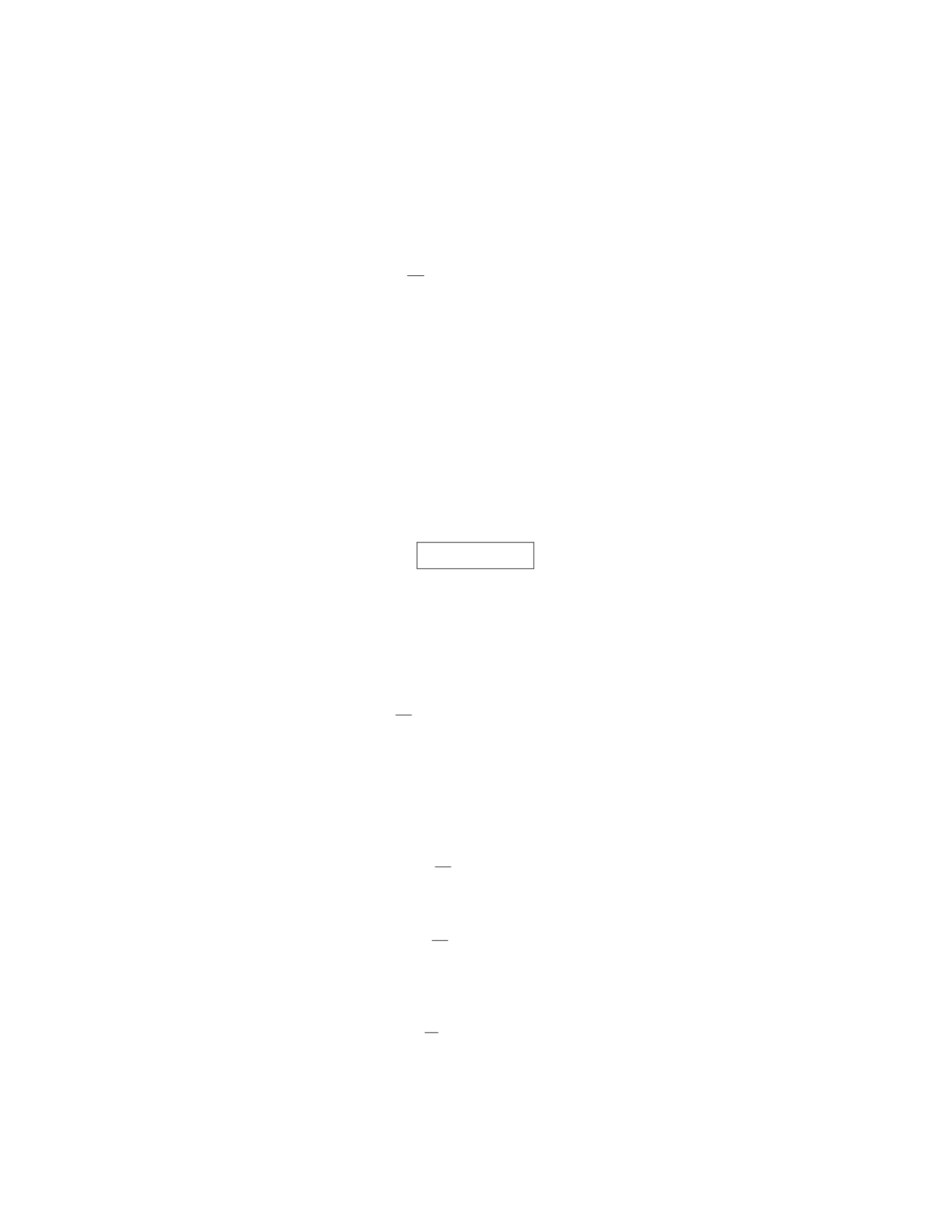
Solution
Step 1: First, we integrate both sides of the given differential equation:
Zdy
dx dx =Z(3x2+ 4) dx
Step 2: Integrating, we get:
y=x3+ 4x+C
Step 3: Next, we substitute the initial condition y(0) = 2 into the equation
above:
2=03+ 4(0) + C
Step 4: Solving for C, we find:
C= 2
Step 5: Therefore, the particular solution to the initial value problem is:
y=x3+ 4x+ 2
Question 12
Question
Consider the initial value problem:
dy
dt =et−y, y(0) = 2.
Determine the solution to the initial value problem.
Solution
Step 1: To solve the differential equation, we first write it in the form of separable
variables: dy
dt +y=et.
Step 2: Next, we multiply both sides by the integrating factor, which is
eR1dt =et:
etdy
dt +ety=e2t.
Step 3: Notice that the left-hand side is now the derivative of the product
of yand et. So, we can rewrite the equation as:
d
dt(y·et) = e2t.
11

Step 4: Now, we integrate both sides with respect to t:
Zd
dt(y·et)dt =Ze2tdt.
Step 5: Integrating both sides gives:
y·et=1
2e2t+C.
Step 6: Applying the initial condition y(0) = 2, we get:
2·e0=1
2e0+C.
Step 7: Solving for Cgives C=3
2.
Step 8: Substituting Cback into our equation, we have:
y·et=1
2e2t+3
2.
Step 9: Finally, isolating ygives the solution to the initial value problem:
y(t) = 1
2et+3
2e−t.
Question 13
Question
Consider the initial value problem:
dy
dx = 3x2y, y(0) = 1
Solve the initial value problem explicitly.
Solution
Step 1: Rewrite the initial value problem as a separable differential equation by
moving all terms involving yto one side and all terms involving xto the other
side: dy
y= 3x2dx
Step 2: Integrate both sides of the equation:
Z1
ydy =Z3x2dx
Step 3: Solve the integrals to obtain:
ln |y|=x3+C
12

Step 4: Apply the initial condition y(0) = 1 to find the value of the constant
C:
ln |1|= 03+C
0 = C
Step 5: Rewrite the solution without the absolute value:
y=ex3
Question 14
Question
Solve the initial value problem:
dy
dx =y2−y−6, y(0) = 3
Solution
Step 1: First, let’s rewrite the given differential equation as:
dy
dx =y2−y−6=(y−3)(y+ 2)
Step 2: Next, we separate variables and integrate both sides. This gives:
Z1
(y−3)(y+ 2) dy =Zdx
Step 3: We now need to perform partial fraction decomposition to simplify
the integral on the left side. Let’s express 1
(y−3)(y+2) as follows:
1
(y−3)(y+ 2) =A
y−3+B
y+ 2
Step 4: By finding a common denominator on the right side, we can rewrite
the integral as:
ZA
y−3+B
y+ 2dy =Zdx
Step 5: Solving for Aand Bby multiplying both sides by the denominators
y−3 and y+ 2 respectively, we get A(y+ 2) + B(y−3) = 1.
Step 6: By substituting y= 3, which is given in the initial condition, we can
solve for Band then solve for Aby substituting y=−2.
Step 7: The simplified integral becomes:
Z1
5·1
y−3−1
5·1
y+ 2dy =Zdx
13

Step 8: Integrating both sides, we have:
1
5ln |y−3| − 1
5ln |y+ 2|=x+C
Step 9: By combining the logarithms and rearranging, we get:
ln
y−3
y+ 2
= 5x+C
Step 10: Exponentiating both sides gives:
y−3
y+ 2
=e5x+C
Step 11: From the initial condition y(0) = 3, we find that C= 0. Substitut-
ing this back into the equation, we have:
y−3
y+ 2 =e5x
Step 12: To find y, cross multiply and solve for y, which yields:
y=3e5x+ 2
1−e5x
Therefore, the solution to the initial value problem dy
dx =y2−y−6, y(0) = 3
is y=3e5x+2
1−e5x.
Question 15
Question
Solve the initial value problem:
dy
dx = 2x(y−1), y(0) = 2
Solution
Step 1: Rewrite the initial value problem as:
dy
dx = 2xy −2xand y(0) = 2
Step 2: This is a first-order linear differential equation. To solve it, we need
to separate variables.
Step 3: Separate variables by moving all terms involving yto one side and
terms involving xto the other side:
dy
y−1= 2xdx
14

Step 4: Integrate both sides of the equation:
Z1
y−1dy =Z2x dx
Step 5: Solve the integrals to find:
ln |y−1|=x2+C
where Cis the constant of integration.
Step 6: Exponentiate both sides to solve for y:
|y−1|=ex2+C
Step 7: Since eCis just a constant (D), we can rewrite the equation as:
y−1 = Dex2
Step 8: Apply the initial condition y(0) = 2 to find the value of D:
2−1 = D·e0
Step 9: Solve for Dto get D= 1.
Step 10: Substitute D= 1 back into the equation:
y−1 = ex2
Step 11: Add 1 to both sides to find the solution to the initial value problem:
y= 1 + ex2
Therefore, the solution to the initial value problem is y= 1 + ex2.
Question 16
Question
Solve the initial value problem y′=2x
3y2+2 ,y(0) = 1.
Solution
Step 1: Rewrite the differential equation in a separable form:
3y2dy =2x
2dx.
Step 2: Integrate both sides:
Z3y2dy =Zxdx.
15

Step 3: Simplify the integrals:
y3=1
2x2+C1,
where C1is the constant of integration.
Step 4: Use the initial condition y(0) = 1 to find the value of C1:
13=1
2·02+C1.
1 = C1.
Step 5: Substitute C1= 1 back into the equation:
y3=1
2x2+ 1.
Step 6: Solve for y:
y=1
2x2+ 11/3
.
Therefore, the solution to the initial value problem is y=1
2x2+ 11/3with
the initial condition y(0) = 1.
Question 17
Question
Find the particular solution to the initial value problem:
y′= 2x(1 −y), y(0) = 3
Solution
Step 1: Rewrite the differential equation in a suitable form.
The given differential equation is:
y′= 2x(1 −y)
Step 2: Separate variables and integrate.
Separating variables, we get:
dy
dx = 2x(1 −y)
dy
1−y= 2xdx
Integrating both sides:
Z1
1−ydy =Z2xdx
16

−ln |1−y|=x2+C1
Step 3: Solve for yand find the particular solution using the initial condition.
Exponentiating both sides gives:
1−y=e−x2−C1
y= 1 −e−x2−C1
y= 1 −Ce−x2
To find the particular solution, use the initial condition y(0) = 3:
3=1−Ce0
C=−2
Therefore, the particular solution to the initial value problem is:
y= 1 + 2e−x2
Question 18
Question
Solve the initial value problem:
dy
dx = 2y−x, y(0) = 3
Solution
Step 1: First, let’s find the general solution to the differential equation dy
dx =
2y−xusing the method of integrating factors.
Given differential equation: dy
dx = 2y−x
Rewrite the equation in the form dy
dx +P(x)y=Q(x): P(x) = 2, Q(x) = −x
The integrating factor is given by:
Integrating Factor = eRP(x)dx =eR2dx =e2x
Multiplying both sides of the differential equation by the integrating factor:
e2xdy
dx + 2e2xy=−xe2x
Rewrite the left side as the derivative of the product y(x)e2x:
d
dx(y(x)e2x) = −xe2x
17

Integrating both sides with respect to x:
Zd(y(x)e2x) = Z−xe2xdx
y(x)e2x=−1
4xe2x−1
8e2x+C
y(x) = −1
4x−1
8+Ce−2x
Step 2: Next, we use the initial condition y(0) = 3 to find the value of the
constant C.
3 = −1
8+C
C=25
8
Therefore, the solution to the initial value problem is:
y(x) = −1
4x−1
8+25
8e−2x
Question 19
Question
Consider the initial value problem
dy
dx =2x−y
x+ 2y, y(0) = 1.
Solution
Step 1: Rewrite the initial value problem as a separable differential equation by
rearranging terms:
(x+ 2y)dy = (2x−y)dx.
Step 2: Integrate both sides:
Z(x+ 2y)dy =Z(2x−y)dx.
Step 3: Solve the integrals separately:
Z(x+ 2y)dy =Z(2x−y)dx
⇒xy +y2=x2−1
2y2+C,
where Cis the constant of integration.
18

Step 4: Use the initial condition y(0) = 1 to find the value of C:
0 + 1 = 0 −1
2+C
⇒C=3
2.
Step 5: Substitute Cback into the equation:
xy +y2=x2−1
2y2+3
2.
Step 6: Using the initial condition y(0) = 1, plug in x= 0 and y= 1 to
solve for the constant C:
0(1) + 12= 02−1
2(1)2+3
2
⇒1 = −1
2+3
2
⇒1=1.
Therefore, the initial value problem is satisfied by the solution y(x) = x2.
Question 20
Question
Solve the initial value problem:
dy
dx =y2−4x, y(0) = 1
Solution
Step 1: Rewrite the initial value problem in the form dy
dx =f(x, y).
dy
dx =y2−4x
Step 2: We can rewrite the equation as dy
dx =y2−4xby separating variables.
dy
y2=dx −4
y2dx
Step 3: Integrate both sides with respect to x.
Z1
y2dy =Zdx −4Z1
y2dx
19

Step 4: Solve the integrals.
−1
y=x−4
3y3+C
Step 5: Solve for yin terms of xby multiplying through by −yand rear-
ranging.
y=1
x+4
3y3−C
Step 6: Use the initial condition y(0) = 1 to find the value of the constant
C.
1 = 1
0 + 4
3·13−C⇒C=−3
4
Step 7: Substitute C=−3
4back into the equation to find the solution.
y=1
x+4
3y3+3
4
Question 21
Question
Solve the initial value problem:
dy
dx =1
x+y, y(1) = 2
Solution
Step 1: We rewrite the given differential equation in standard form:
dy
dx −y=1
x
Step 2: This is a first-order linear differential equation. We identify the
integrating factor µ(x) = eR−1dx =e−x.
Step 3: We multiply both sides of the differential equation by the integrating
factor:
e−x·dy
dx −e−xy=e−x·1
x
Step 4: The left side can now be written as the derivative of the product
y·e−x:d
dx(y·e−x) = e−x·1
x
Step 5: We integrate both sides:
Zd
dx(y·e−x)dx =Ze−x·1
xdx
20

Step 6: Integrating, we get:
y·e−x=−Ei(−x) + C
Step 7: Applying the initial condition y(1) = 2, we find the value of the
constant C:
2·e−1=−Ei(−1) + C
C= 2e−Ei(−1)
Step 8: Therefore, the solution to the initial value problem is:
y=ex(2 −Ei(1) + Ei(x))
Question 22
Question
Solve the initial value problem:
dy
dx =y2cos(x), y(0) = 1
Solution
Step 1: Separate variables by writing the differential equation in the form dy
y2=
cos(x)dx.
Step 2: Integrate both sides:
Z1
y2dy =Zcos(x)dx
Step 3: Simplify and integrate:
−1
y= sin(x) + C
where Cis the constant of integration.
Step 4: Solve for y:
y=−1
sin(x) + C
Step 5: Use the initial condition y(0) = 1 to find the constant C:
1 = −1
sin(0) + C=⇒C=−1
Step 6: Substitute C=−1 back into the solution:
y=−1
sin(x)−1
Therefore, the solution to the initial value problem is y=−1
sin(x)−1.
21

Question 23
Question
Solve the initial value problem:
dy
dx =−2y, y(0) = 4
Solution
Step 1: Rewrite the differential equation in standard form:
dy
dx + 2y= 0
Step 2: This is a first-order linear differential equation. We can solve it by
finding an integrating factor µ(x) = eR2dx =e2x.
Step 3: Multiply both sides of the equation by the integrating factor:
e2xdy
dx + 2e2xy= 0
Step 4: Recognize that the left side is the derivative of the product e2xy, so
we have: d
dx(e2xy) = 0
Step 5: Integrate both sides with respect to x:
Zd
dx(e2xy)dx =Z0dx
Step 6: Simplify and solve the integral:
e2xy=C
where Cis the constant of integration.
Step 7: Apply the initial condition y(0) = 4:
e2(0) ·4 = C⇒C= 4
Step 8: Substitute C= 4 back into the equation:
e2xy= 4
Step 9: Solve for y:
y=4
e2x= 4e−2x
Therefore, the solution to the initial value problem is y= 4e−2x.
22

Question 24
Question
Solve the initial value problem dy
dx =−2y, where y(0) = 3.
Solution
Step 1: We can rewrite the given first-order differential equation as dy
dx +2y= 0.
Step 2: This is a linear first-order differential equation, so we can solve it
using an integrating factor. The integrating factor is given by eR2dx =e2x.
Step 3: Multiply the integrating factor by the original equation to get:
e2xdy
dx + 2e2xy= 0
Step 4: Rewrite this as the derivative of a product:
d
dx(e2xy) = 0
Step 5: Integrate both sides with respect to x:
Zd
dx(e2xy)dx =Z0dx
e2xy=C
Step 6: Solve for y:
y=Ce−2x
Step 7: Apply the initial condition y(0) = 3 to find the value of C:
3 = Ce0⇒C= 3
Step 8: The solution to the initial value problem is:
y= 3e−2x
Question 25
Question
Solve the initial value problem:
y′=2x+y
x, y(1) = 1
23
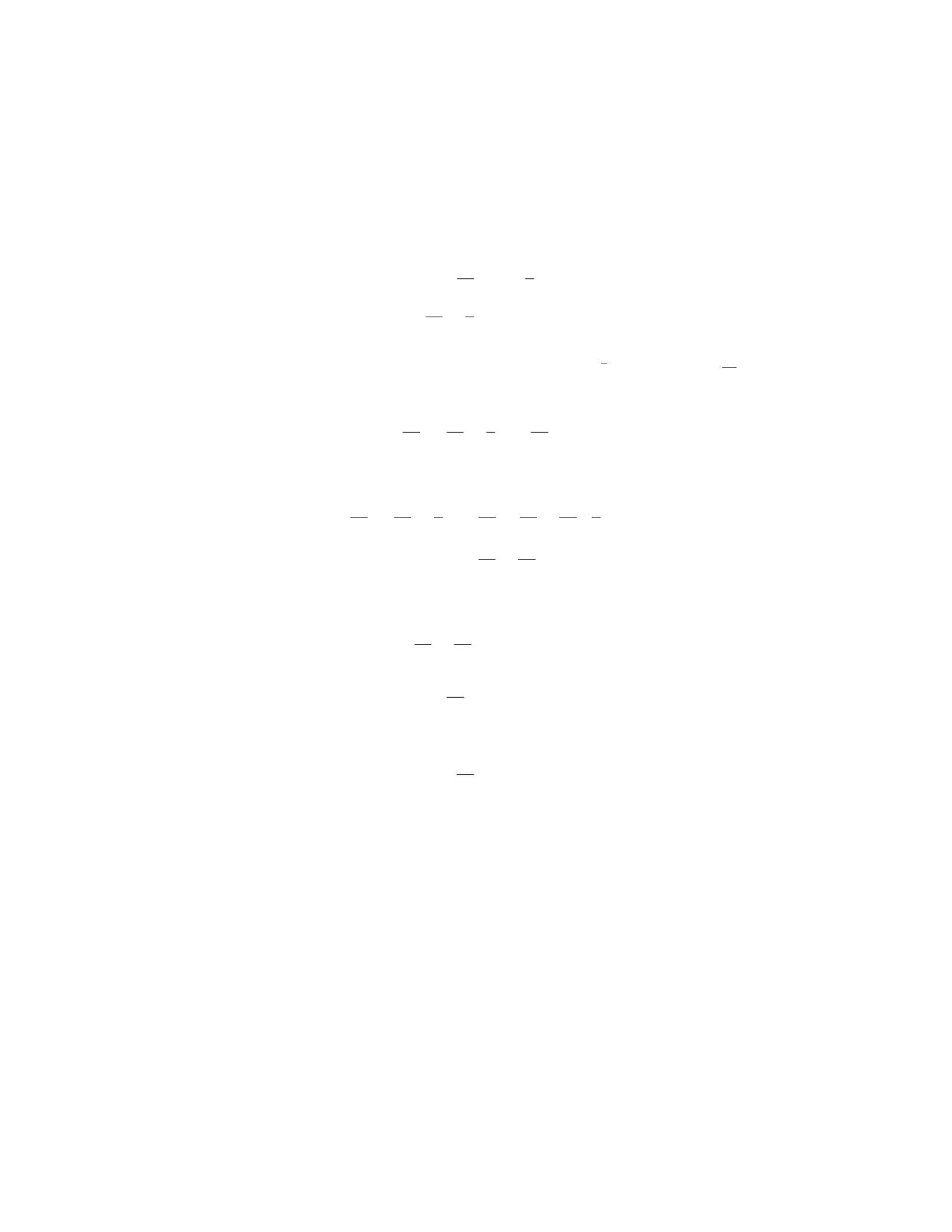
Solution
Step 1: First, rewrite the given differential equation in standard form by multi-
plying through by x:
xdy
dx = 2 + y
x
xdy
dx −y
x= 2
Step 2: This is now a first-order linear differential equation. To solve, we
will use the integrating factor method. Let µ(x) = eR−1
xdx =e−ln |x|=1
|x|.
Multiply both sides of the equation by µ(x):
1
|x|xdy
dx −y
x=2
|x|
Step 3: Simplify the left side of the equation:
1
|x|xdy
dx −y
x=1
|x|·xdy
dx −1
|x|·y
x
=dy
dx −y
|x|
Step 4: Integrate both sides of the equation with respect to x:
Zdy
dx −y
|x|dx =Z2dx
y−Zy
|x|dx = 2x+C
Step 5: Solve the integral on the left side:
y− |x|Zy
|x|dx = 2x+C
y− |x| · y= 2x+C
Step 6: Substitute the initial condition y(1) = 1:
1− |1| · 1=2·1 + C
1−1 = 2 + C
C=−1
Step 7: Therefore, the particular solution to the initial value problem is:
y− |x| · y= 2x−1
24

Question 26
Question
Solve the initial value problem:
dy
dx = 2x(y−1), y(0) = 3
Solution
Step 1: Rewrite the initial value problem as:
dy
dx = 2xy −2x, y(0) = 3
Step 2: This is a first-order linear differential equation of the form dy
dx +
P(x)y=Q(x). Here P(x)=2xand Q(x) = −2x.
Step 3: To solve the differential equation, we can use an integrating factor
µ(x) = eRP(x)dx.
µ(x) = eR2x dx
Step 4: Calculate the integrating factor:
Z2x dx =x2+C(where C is the constant of integration)
µ(x) = ex2+C=ex2eC
Step 5: We can choose eC= 1 for simplicity, so µ(x) = ex2.
Step 6: Multiply the integrating factor by both sides of the differential equa-
tion:
ex2dy
dx + 2xex2y=−2xex2
Step 7: Rewrite the left-hand side as the derivative of the product ex2y:
d
dx(ex2y) = −2xex2
Step 8: Integrate both sides with respect to x:
Zd
dx(ex2y)dx =Z−2xex2dx
Step 9: Solve the integrals to get:
ex2y=−ex2+C
where Cis the constant of integration.
Step 10: Solve for y:
y=−1 + Ce−x2
25

Step 11: Substitute the initial condition y(0) = 3 into the equation:
3 = −1 + Ce0=⇒C= 4
Step 12: The solution to the initial value problem is:
y=−1+4e−x2
Question 27
Question
Solve the initial value problem:
y′=1
x+y, y(1) = 1.
Solution
Step 1: Rewrite the initial value problem as a separable differential equation by
grouping terms containing yon one side and terms containing xon the other
side:
y′=1
x+y.
Step 2: Multiply both sides by (x+y) to separate the variables:
(x+y)dy =dx.
Step 3: Integrate both sides with respect to their respective variable:
Z(x+y)dy =Z1dx.
Step 4: Integrate the left side with respect to yfirst:
Z(x+y)dy =Zx dy +Zy dy =xy +y2
2+C1,
where C1is the constant of integration.
Step 5: Integrate the right side with respect to x:
Z1dx =x+C2,
where C2is the constant of integration.
Step 6: Equate the two results from Step 4 and Step 5 to eliminate the
constants of integration:
xy +y2
2+C1=x+C2.
26

Step 7: Apply the initial condition y(1) = 1 to find the values of C1and C2:
1(1) + (1)2
2+C1= 1 + C2.
Step 8: Simplify the equation from Step 7 to solve for C1and C2:
1 + 1
2+C1= 1 + C2=⇒3
2+C1=C2.
Step 9: Substitute C1=3
2+C2back into the equation from Step 6 to get
the particular solution:
xy +y2
2+3
2+C2=x+C2.
Step 10: This equation represents the solution to the initial value problem.
Question 28
Question
Solve the initial value problem:
dy
dx =2x
y, y(0) = 1.
Solution
Step 1: Write the differential equation in separated variables form.
dy
dx =2x
y.
Step 2: Separate variables by multiplying both sides by yand dividing by
dx.
y dy = 2x dx.
Step 3: Integrate both sides.
Zy dy =Z2x dx.
Step 4: Integrate to get expressions in terms of yand x.
1
2y2=x2+C,
where Cis the constant of integration.
Step 5: Use the initial condition y(0) = 1 to find the value of C.
1
2(1)2= 02+C.
27
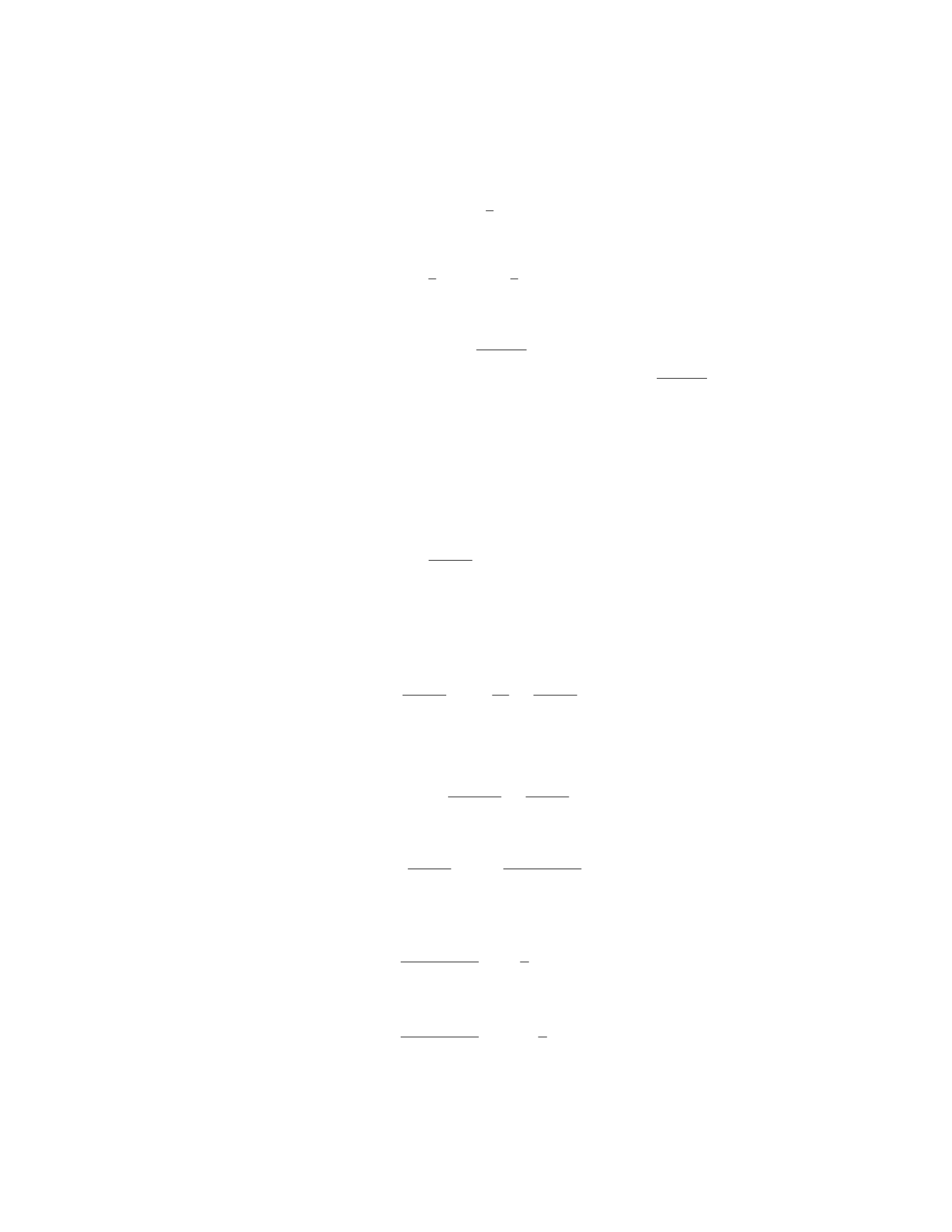
C=1
2.
Step 6: Substitute the value of Cback into the equation from Step 4.
1
2y2=x2+1
2.
Step 7: Solve for y.
y2= 2x2+ 1.
y=±p2x2+ 1.
Therefore, the solution to the initial value problem is y=±√2x2+ 1 with
the initial condition y(0) = 1.
Question 29
Question
Consider the initial value problem:
y′=2x+y
2y−x, y(0) = 1.
Solution
To solve this initial value problem, we will first rewrite the differential equation
in standard form by dividing both sides by 2y−x:
y′=2x+y
2y−x=⇒dy
dx =2x+y
2y−x.
Step 1: Let u=y/x. Then, y=xu and y′=u+xu′.
Step 2: Substitute y=xu and y′=u+xu′into the differential equation
to get:
u+xu′=2x+xu
2xu −x=2 + u
2u−1.
Step 3: Simplify the equation to get:
xu′=2 + u
2u−1−u=4−2u−u2
2u−1.
Step 4: Separate variables by multiplying both sides by dx and dividing by
the expression on the right:
2u−1
4−2u−u2du =1
xdx.
Step 5: Integrate both sides:
Z2u−1
4−2u−u2du =Z1
xdx.
28

Step 6: The integral of the left side can be calculated using partial fraction
decomposition or by recognizing that the denominator factors as (2 + u)(2 −u):
ZA
2 + u+B
2−udu = ln |x|+C.
Step 7: Solve the system of equations obtained from the partial fraction
decomposition to find Aand B.
Step 8: Once you find Aand B, integrate both sides to find the solution
u(x).
Step 9: Finally, use the fact that u=y/x to find the solution y(x). Don’t
forget to apply the initial condition y(0) = 1.
Question 30
Question
Solve the initial value problem:
y′=2x+y
x, y(1) = 3.
Solution
Step 1: Rewrite the given differential equation in a standard form y′+P(x)y=
Q(x).
y′=2x+y
x
y′= 2 + y
x
y′−y
x= 2
Step 2: Find the integrating factor I(x) = eR−1
xdx.
Z−1
xdx =−ln |x|
eR−1
xdx =e−ln |x
I(x) = 1
|x|
Step 3: Multiply the integrating factor by the differential equation.
1
|x|y′−y
x=1
|x|·2
y′
|x|−y
x|x|=2
|x|
1
x
dy
dx −y
x2=2
x
29

Step 4: Integrate both sides of the equation.
Z1
x
dy
dx −y
x2dx =Z2
xdx
y
x+C= 2 ln |x|+D(where C and D are constants)
Step 5: Apply the initial condition y(1) = 3 to find the values of the constants
C and D.
3
1+C= 2 ln |1|+D
3 + C=D
C=D−3
Step 6: Substitute the values of C and D back into the equation to get the
final solution. y
x= 2 ln |x|+D−3
y= 2xln |x|+Dx −3x
Question 31
Question
Solve the initial value problem: dy
dx =1
x2+y2,y(1) = 0.
Solution
Step 1: First, rewrite the differential equation as separable by moving terms
involving yto the left side and terms involving xto the right side:
dy
dx =1
x2+y2
x2+y2dy =dx
Step 2: Integrate both sides with respect to x:
Zx2+y2dy =Zdx
Zy2dy =x+C1
Step 3: Solve the integral:
y3
3=x+C1
30

Step 4: Apply the initial condition y(1) = 0 to find the value of the constant
C1:
03
3= 1 + C1
C1=−1
Step 5: Substitute the value of C1back into the solution:
y3
3=x−1
y3= 3x−3
Step 6: Solve for y:
y=3
√3x−3
Therefore, the solution to the initial value problem dy
dx =1
x2+y2,y(1) = 0 is
y=3
√3x−3.
Question 32
Question
Solve the initial value problem:
y′= 2x√y, y(0) = 1.
Solution
Step 1: Write the given initial value problem in the standard form of a first-
order ordinary differential equation. Step 2: Separate the variables by writing
the equation in the form of dy
dx =f(x)g(y). Step 3: Integrate both sides with
respect to xand simplify the resulting equation. Step 4: Solve for yby explicit
integration. Step 5: Determine the constant of integration using the initial
condition y(0) = 1. Step 6: Write out the final solution to the initial value
problem.
Question 33
Question
Solve the initial value problem:
y′= 2y−1, y(0) = 3.
31

Solution
Step 1: First, we find the general solution to the differential equation y′= 2y−1
by separating variables. dy
dx = 2y−1
dy
2y−1=dx
Step 2: Now, we integrate both sides:
Z1
2y−1dy =Zdx
1
2ln |2y−1|=x+C1
ln |2y−1|= 2x+C2
2y−1 = e2x+C2
2y−1 = Ce2x(where C=eC2is a constant)
Step 3: To find the particular solution, we use the initial condition y(0) = 3.
2(3) −1 = C·e2·0
C= 5
Step 4: Substituting C= 5 back into the general solution, we get the par-
ticular solution.
2y−1=5e2x
2y= 5e2x+ 1
y=5
2e2x+1
2
Therefore, the solution to the initial value problem is y=5
2e2x+1
2with the
initial condition y(0) = 3.
Question 34
Question
Solve the initial value problem:
dy
dx = 2x+ 3y, y(0) = 1
32

Solution
Step 1: First, we notice that the given initial value problem is a first-order linear
differential equation. To solve it, we will use the method of integrating factor.
Step 2: The standard form of a first-order linear differential equation is:
dy
dx +P(x)y=Q(x)
In this case, P(x) = 3 and Q(x)=2x.
Step 3: To find the integrating factor, µ(x), we use the formula:
µ(x) = eRP(x)dx
So, µ(x) = eR3dx =e3x.
Step 4: Multiply both sides of the differential equation by the integrating
factor, µ(x):
e3xdy
dx + 3e3xy= 2xe3x
Step 5: Notice that the left side is now the derivative of the product e3xy
with respect to x. So, we can rewrite the equation as:
d
dx(e3xy) = 2xe3x
Step 6: Integrate both sides with respect to x:
Zd(e3xy) = Z2xe3xdx
Step 7: This yields:
e3xy=Z2xe3xdx
Step 8: Solve the integral on the right side using integration by parts:
u= 2x dv =e3xdx
Step 9: Calculating the integral gives:
e3xy= 2xe3x
3−Z2
3e3xdx
Step 10: Simplifying further, we get:
e3xy=2xe3x
3−2e3x
9+C
Step 11: Solve for yby dividing through by e3x:
y=2x
3−2
9+Ce−3x
33
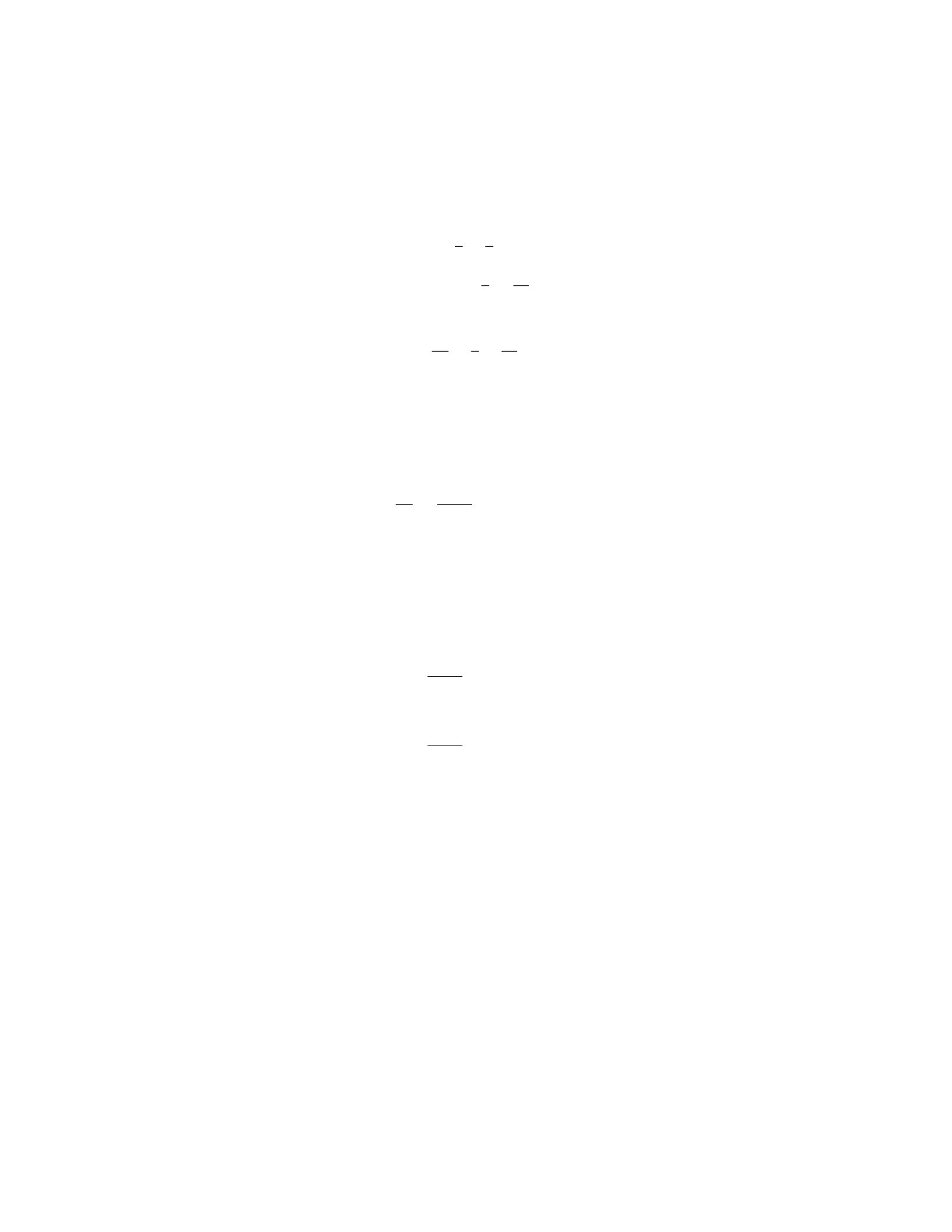
Step 12: Use the initial condition y(0) = 1 to find the value of the constant
C:
1 = 0
3−2
9+C
C= 1 + 2
9=11
9
Step 13: Therefore, the solution to the initial value problem is:
y=2x
3−2
9+11
9e−3x
Question 35
Question
Consider the initial value problem:
dy
dx =2x
1 + y, y(0) = 1.
Use the method of separation of variables to find the solution to this initial
value problem.
Solution
Step 1: Rewrite the differential equation in separated form by multiplying both
sides by (1 + y)dx:
dy
1 + y= 2x dx.
Step 2: Integrate both sides with respect to x:
Zdy
1 + y=Z2x dx.
Step 3: Solve the integrals separately:
ln |1 + y|=x2+C,
where Cis the constant of integration.
Step 4: Solve for yby taking the exponential of both sides:
1 + y=ex2+C.
Step 5: Use the initial condition y(0) = 1 to solve for the constant C:
1 + 1 = e0+C⇒2 = eC⇒C= ln 2.
Step 6: Substitute C= ln 2 back into the equation to find the final solution:
1 + y=ex2+ln 2 = 2ex2.
Therefore, the solution to the initial value problem is y= 2ex2−1.
34

