



MATH 332 - ADVANCED CALCULUS
- Stokes’ Theorem
Question Bank - Set 1
Liberty University
Question 2
Question
Let Cbe the curve of intersection of the sphere x2+y2+z2= 1 and the plane z=
0oriented counterclockwise when viewed from the positive z-axis. Use Stokes’
Theorem to evaluate the line integral HC(x2+y2)dx+(y2+z2)dy +(z2+x2)dz.
Solution
Step 1: We first compute the curl of the vector field F= (x2+y2, y2+z2, z2+x2):
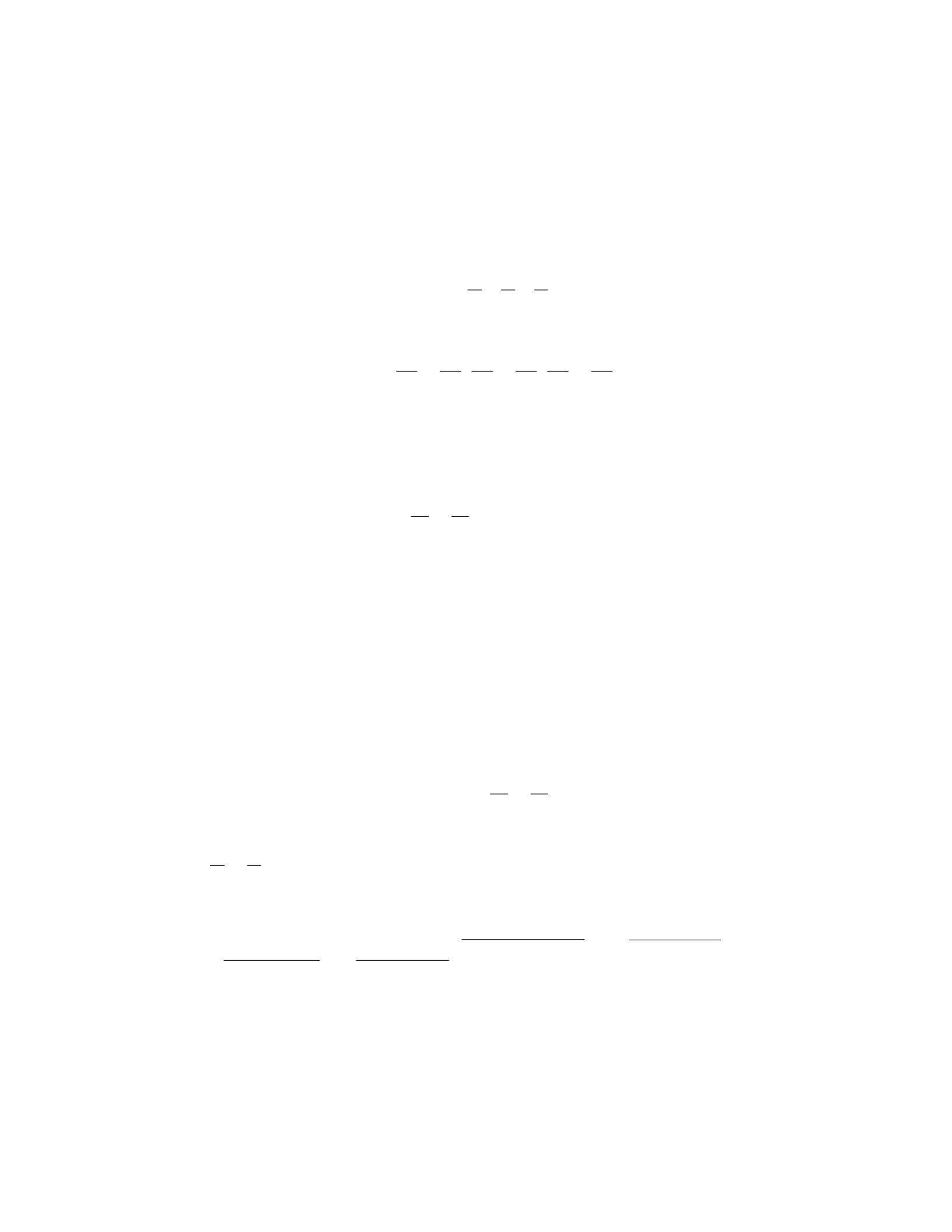
∇ × F=
i j k
∂
∂x
∂
∂y
∂
∂z
x2+y2y2+z2z2+x2
=∂(z2+x2)
∂y −∂(y2+z2)
∂z i−∂(z2+x2)
∂x −∂(x2+y2)
∂z j+∂(y2+z2)
∂x −∂(x2+y2)
∂y k
= (0 −2z)i−(2x−0)j+ (2y−2x)k
=−2zi−2xj+ 2(y−x)k=G
Step 2: By Stokes’ Theorem, we have
IC
F·dr=ZZS∇ × F·ndS
where nis the outward normal vector of the surface Sand dS represents the
area element.
Step 3: The curve Cis simply the circle in the xy-plane centered at the
origin with radius 1. This is the boundary of the disk Din the xy-plane where
z= 0, so the orientation of Ccorresponds to the counterclockwise orientation.

Step 4: The unit normal vector nto the xy-plane is k.
Step 5: Since the surface Sis the disk Din the xy-plane, its outward normal
vector nis also k.
Step 6: Therefore, the line integral becomes
IC
F·dr=ZZS
G·kdS
ZZS
2(y−x)dS
Step 7: We can set up the double integral in polar coordinates as follows:
ZZS
2(y−x)dS =Z2π
0Z1
0
2(rsin θ−rcos θ)r drdθ
Step 8: Solving the double integral, we get
Z2π
0−1
3dθ =−2π
3
Step 9: Therefore, the value of the line integral is −2π
3.
Question 3
Question
Let Fbe a vector field defined by F(x, y, z) = (x2+yz)i+ (y2+zx)j, and
let Sbe the surface of the region bounded by the plane z= 0 and the cone
z=px2+y2. Calculate the surface integral R RSF·dSusing Stoke’s Theorem.
Solution
Step 1: We first find the curl of the vector field F.
curl(F) = ∇ × F=
i j k
∂
∂x
∂
∂y
∂
∂z
x2+yz y2+zx 0
Step 2: Computing the determinant, we have:
curl(F) = 0−∂
∂y (0)i−∂
∂x(0) −∂
∂z (x2+yz)j+∂
∂y (y2+zx)−∂
∂x(0)k
Step 3: Simplifying, we get:
curl(F) = −zj+zk
2

Step 4: Then, the surface integral becomes:
Z ZS
F·dS=Z Z curl(F)·dS=ZZZdiv(curl(F)) dV
Step 5: Since div(curl(F)) = 0 for all vector fields, we have:
Z ZS
F·dS= 0
Question 4
Question
Let Sbe the surface of the part of the plane x+y+z= 1 that lies in the
first octant. Let Fbe the vector field defined by F(x, y, z)=(x2, y2, z2). Use
Stokes’ Theorem to evaluate the surface integral RRScurl(F)·ndS, where nis
the outward-pointing unit normal to S.
Solution
Step 1: Parameterize the surface Susing two variables xand y.
Since x+y+z= 1 and the surface Slies in the first octant, we can param-
eterize Sas:
r(x, y) = (x, y, 1−x−y),for 0≤x≤1,0≤y≤1−x
Step 2: Calculate the curl of the vector field F.
The curl of F(x, y, z) = (x2, y2, z2)is given by:
curl(F) = ∂F3
∂y −∂F2
∂z ,∂F1
∂z −∂F3
∂x ,∂F2
∂x −∂F1
∂y
= (0 −2y, 0−2z, 0−2x) = (−2y, −2z, −2x)
Step 3: Calculate the outward-pointing unit normal n.
The unit normal vector nis given by:
n=r
x×ry|rx×ry|
where, rx= (1,0,−1),ry= (0,1,−1).
n=(1,0,−1) ×(0,1,−1)
|(1,0,−1) ×(0,1,−1)|=(−1,1,1)
√3
Step 4: Calculate the surface integral using Stokes’ Theorem.
We have:
ZZS
curl(F)·ndS =ZZD
(curl(F)·(rx×ry)) dA
where Dis the projection of surface Sonto the xy-plane.
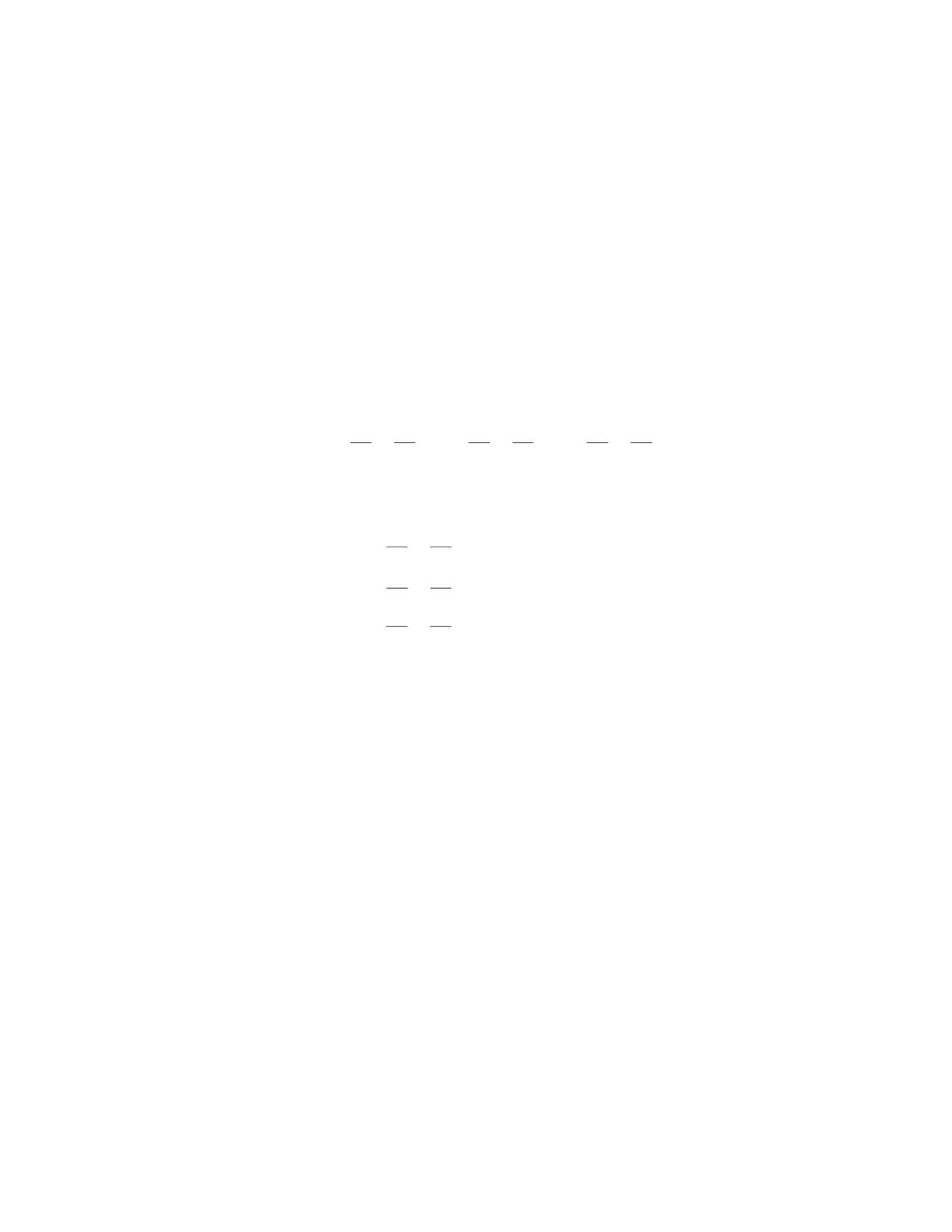
Now, Dis a triangle in the xy-plane with vertices at (0,0),(1,0), and (0,1).
Evaluating the surface integral on Dwill give the final answer.
3
Question 5
Question
Let F=⟨x2, y2, z2⟩be a vector field, and let Sbe the surface of the solid region
enclosed by the paraboloid z= 4 −x2−y2and the plane z= 0. Calculate the
flux of Facross Susing Stokes’ Theorem.
Solution
Step 1: To use Stokes’ Theorem, we need to find the curl of F. The curl of a
vector field F=⟨P, Q, R⟩is given by
∇ × F=∂R
∂y −∂Q
∂z i+∂P
∂z −∂R
∂x j+∂Q
∂x −∂P
∂y k
In this case, F=⟨x2, y2, z2⟩, so P=x2,Q=y2, and R=z2. Calculating
the partial derivatives:
∂R
∂y −∂Q
∂z = 2z−0 = 2z
∂P
∂z −∂R
∂x = 0 −2x=−2x
∂Q
∂x −∂P
∂y = 0 −2y=−2y
So, the curl of Fis ∇ × F= (2z)i+ (−2x)j+ (−2y)k.
Step 2: Next, we need to find the surface normal vector nto S. Since S
is the closed surface enclosing the solid region, the outward unit normal vector
is given by −∇h, where h(x, y, z) = z−(4 −x2−y2). Thus, n=−∇h=
⟨−(−2x),−(2y),1⟩=⟨2x, 2y, 1⟩.
Step 3: Now, we can apply Stokes’ Theorem, which states:
ZZS
(∇ × F)·dS=IC
F·dr
where Cis the boundary curve of S. Since Sis the solid region enclosed by the
paraboloid and the plane z= 0, the boundary curve Cconsists of the paraboloid
and the circle in the xy plane corresponding to z= 0.
Step 4: Calculate the surface integral:
ZZS
(∇ × F)·dS=ZZS
(2z)i+ (−2x)j+ (−2y)k·(2x, 2y, 1) dA
=ZZS
2z(2x)+(−2x)(2y)−2y dA
=ZZS
4xz −4xy −2y dA
4

Step 5: Since the equation of the paraboloid is z= 4 −x2−y2, we can
rewrite the integral in terms of xand y:
ZZS
(4x(4 −x2−y2)−4xy −2y)dA
Step 6: Integration can be challenging in this case due to the complexity
of the integrand. The solution will require careful algebraic manipulation to
simplify the expression before performing the integration.
Question 6
Question
Let Sbe the part of the plane z= 4−x−ythat lies inside the cylinder x2+y2= 4.
Use Stokes’ Theorem to evaluate RRS(∇×F)·ds, where F(x, y, z) = yi+zj+xk.
Solution
Step 1: Find the normal vector to S.
The surface Sis described by the function z= 4 −x−y. To find the normal
vector to S, we compute ∇f=D−∂f
∂x ,−∂f
∂y ,1E.
So, ∇f=⟨−1,−1,1⟩.
Step 2: Compute ∇ × F.
Given F(x, y, z) = yi+zj+xk,∇ × F=
i j k
∂
∂x
∂
∂y
∂
∂z
y z x
.
Solving this expression, we get ∇ × F=i−j−k.
Step 3: Find the parametric representation of S.
Let x=rcos θ,y=rsin θ,z= 4 −rcos θ−rsin θ. We have rranging from
0 to 2 and θranging from 0 to 2π.
Then, rcos θ,rsin θ, and 4−rcos θ−rsin θare the parametric equations
for S.
Step 4: Compute the surface integral.
RRS(∇ × F)·ds =R2π
0R2
0⟨1,−1,−1⟩ · ⟨−rsin θ, r cos θ, −rsin θ−rcos θ⟩ ·
r dr dθ.
After carrying out the dot product and integrating, the solution is obtained.
Question 7
Question
Let Sbe the part of the cone z=px2+y2that lies above the plane z= 1.
Use Stokes’ Theorem to evaluate the surface integral RRS(∇ × F)·dS, where
F= (y2−z2, xz, yz)and Sis oriented outward.
5

Solution
To apply Stokes’ Theorem, we need to find the curl of F, the area of S, and a
normal vector nto S.
Step 1: Calculate ∇ × F. The curl of Fis given by:
∇×F=
i j k
∂
∂x
∂
∂y
∂
∂z
y2−z2xz yz
= (∂(yz)
∂y −∂(xz)
∂z )i−(∂(y2−z2)
∂z −∂(yz)
∂x )j+(∂(y2−z2)
∂x −∂(y2)
∂y )k
Compute each partial derivative:
∂(yz)
∂y −∂(xz)
∂z =z−x,
∂(y2−z2)
∂z −∂(yz)
∂x =−2z−y,
∂(y2−z2)
∂x −∂(y2)
∂y = 0 −2y.
Thus, the curl of Fis:
∇ × F= (z−x)i−(2z+y)j−2yk.
Step 2: Find the area of S.The surface Sis the cone z=px2+y2
above the plane z= 1.
The area of Scan be found by calculating the surface area of the cone within
the range 1≤z≤px2+y2:
ZZS
dS =ZZD||n||dA,
where Dis the projection of Sonto the xy-plane and nis the unit normal vector
to Spointing outward.
Step 3: Apply Stokes’ Theorem. By Stokes’ Theorem, the surface
integral becomes the line integral over the boundary of S:
ZZS
(∇ × F)·dS=IC
F·dr,
where Cis the boundary curve of S.
Unfortunately, Slies outside the scope of Stokes’ Theorem, as it is not a
single surface but rather a part of a surface. Thus, Stokes’ Theorem cannot be
applied directly in this case.
Question 8
Question
Let Sbe the part of the plane z= 16 −x−2ythat lies inside the cylinder
x2+y2= 1. Calculate the flux of the vector field F=⟨y, x, z⟩across the
surface S(oriented outward).
6
Solution
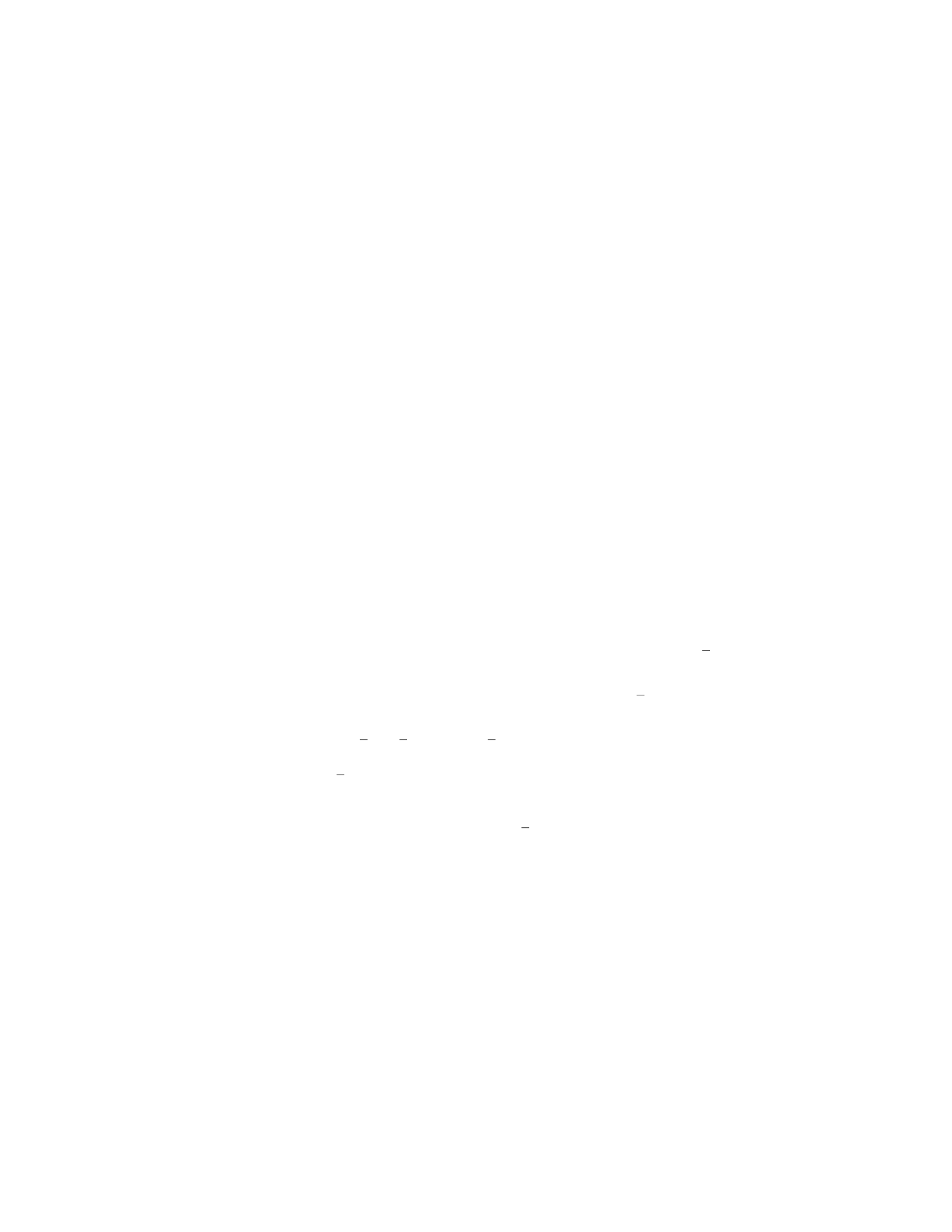
To compute the flux of Facross S, we will use Stokes’ Theorem, which relates
surface integrals to line integrals. Stokes’ Theorem states that the flux of a
vector field Facross a surface Sis equal to the line integral of the vector field
around the boundary curve of S, oriented in the positive direction.
Step 1: Find the normal vector to the surface S.
The surface Sis defined by z= 16 −x−2y. The normal vector to Sis given
by n=∇z=⟨−1,−2,1⟩.
Step 2: Determine the orientation of the boundary curve of S.
The boundary curve of Sis the circle defined by x2+y2= 1. Since the
normal vector npoints outward and the cylinder is oriented counterclockwise
when viewed from above, the boundary curve of Sis oriented counterclockwise
as well.
Step 3: Calculate the line integral of Faround the boundary curve of S.
The line integral is given by
IC
F·dr=ZC
F·Tds
where Tis the unit tangent vector to the curve and ds is the arc length differ-
ential.
Since F=⟨y, x, z⟩and the curve is the unit circle, C:x= cos(t), y =
sin(t), z = 16 −cos(t)−2 sin(t)with 0≤t≤2π, we have
IC
F·dr=Z2π
0⟨sin(t),cos(t),16 −cos(t)−2 sin(t)⟩ · ⟨−sin(t),cos(t),√5⟩dt
=Z2π
0−sin2(t) + cos2(t) + (16 −cos(t)−2 sin(t))√5dt
=Z2π
0
16√5−√5 cos(t)−2√5 sin(t)dt
= 32π√5.
Step 4: State the final result.
The flux of Facross the surface Sis 32π√5.
Question 9
Question
Let Sbe the part of the surface z=x2−y2that lies above the square 0≤
x≤1,0≤y≤1. Calculate the flux of the curl of the vector field F=
(x2yz, −xz2, xy2z)through Sin the positive z-direction.
7
Solution
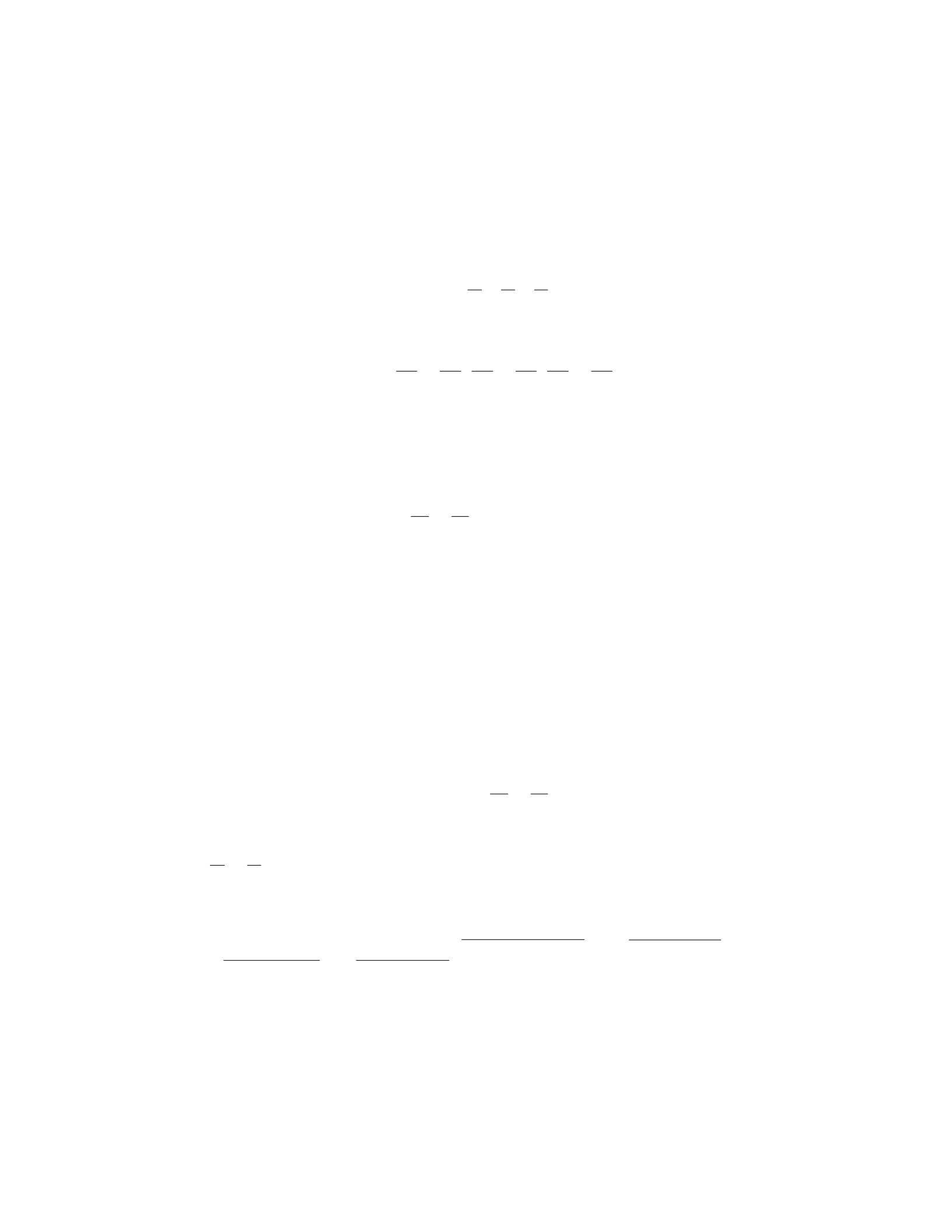
Step 1: Calculate the curl of the vector field F. The curl of F= (P, Q, R)is
given by
∇ × F=
i j k
∂
∂x
∂
∂y
∂
∂z
P Q R
where P=x2yz,Q=−xz2, and R=xy2z. Therefore,
∇ × F=∂R
∂y −∂Q
∂z ,∂P
∂z −∂R
∂x ,∂Q
∂x −∂P
∂y .
Calculating the partial derivatives, we get
∇ × F= (z−y2,2xy, x −z).
Step 2: Calculate the outward unit normal vector to the surface S. Since
the surface is given by z=x2−y2, the normal vector is given by
N=−∂z
∂x,−∂z
∂y ,1= (−2x, 2y, 1).
Step 3: Calculate the flux of the curl of Fthrough Sin the positive z-
direction. The flux is given by the surface integral
ZZS∇ × F·NdS.
Note that dS points in the direction of N, so we consider only the z-component
of the curl of Fi.e., x−z. Thus, the flux integral reduces to
ZZS
(x−z)dS.
Step 4: Parametrize the surface S. Parametrizing the surface with x=u,
y=v, and z=u2−v2, where 0≤u≤1and 0≤v≤1, we have the surface
integral
ZZS
(u−(u2−v2))
∂r
∂u ×∂r
∂v
du dv,
where r(u, v) = (u, v, u2−v2)is the position vector of the surface.
Step 5: Compute the cross product and its magnitude. The cross product
∂r
∂u ×∂r
∂v is
i j k
1 0 2u
0 1 −2v
= (2v, 2u, 1).
The magnitude of this vector is p12+ (2u)2+ (2v)2=√1+4u2+ 4v2=
p1 + 4(u2+v2) = p1+4|r(u, v)|2.
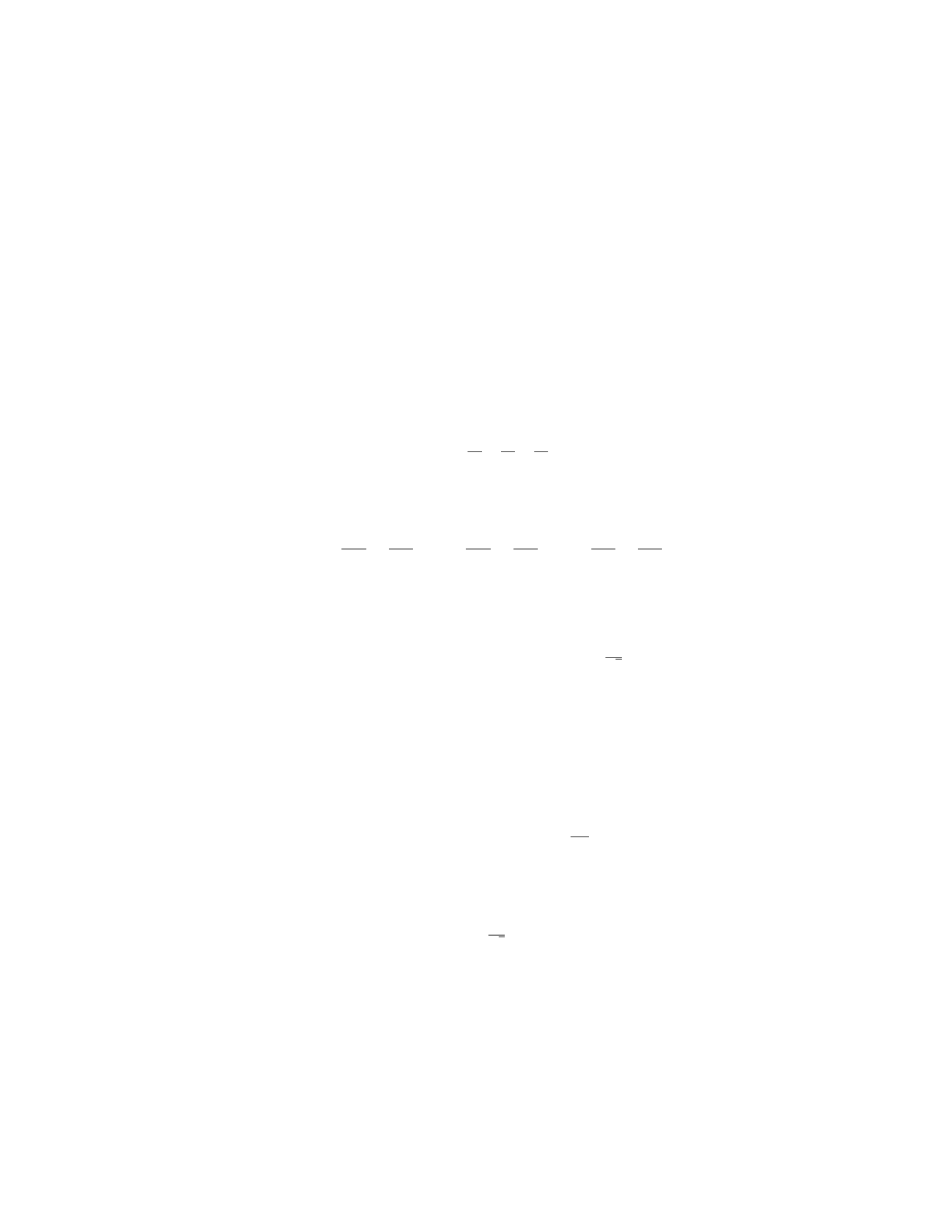
Step 6: Evaluate the surface integral. Substituting all relevant values and
simplifying, we have
Z1
0Z0
8
Question 10
Question
Let Sbe the portion of the plane z= 2 −x−ythat lies above the square
0≤x≤1,0≤y≤1. Use Stokes’ Theorem to evaluate HCF·dr, where
F(x, y, z) = ⟨y2, z2, x2⟩,Cis the boundary curve of Soriented counterclockwise
when viewed from above, and Sis oriented with upward-pointing normal vector.
Solution
Step 1: Calculate ∇ × F. The curl of Fis given by:
∇ × F=
i j k
∂
∂x
∂
∂y
∂
∂z
y2z2x2
Expanding the determinant, we have:
∇ × F=∂x2
∂y −∂z2
∂z i−∂x2
∂x −∂y2
∂z j+∂y2
∂x −∂z2
∂y k
= (−2)i−(−2)j+ 0k=−2i+ 2j
Step 2: Determine the unit normal vector to S. The normal vector to the
plane z= 2 −x−yis n=⟨−1,−1,1⟩. Since Sis oriented with an upward-
pointing normal vector, the unit normal vector is n/|n|=1
√3⟨−1,−1,1⟩.
Step 3: Calculate the line integral over the boundary curve C. By Stokes’
Theorem, we have: IC
F·dr =ZZS
(∇ × F)·dS
where dS=ndS.
Step 4: Find the surface integral of ∇ × Fover S. Since Sis a portion of a
plane, the surface integral over Scan be calculated as:
ZZS
(∇ × F)·dS=ZZD
(∇ × F)·n
|n|dA
where Dis the projection of Sonto the xy-plane. In this case, Dis the square
0≤x≤1,0≤y≤1.
Step 5: Calculate the surface integral by substituting the values of ∇×Fand
n. We have RRS(∇×F)·dS=RRD⟨−2,2⟩· 1
√3⟨−1,−1⟩dA =RRD(−2+2) dA = 0.
Therefore, HCF·dr = 0.
9

Question 11
Question
Let Sbe the part of the cone z=px2+y2that lies inside the cylinder x2+
y2= 1, oriented outward. Use Stokes’ Theorem to evaluate the surface integral
RRS(∇ × F)·dS, where F(x, y, z) = (xy2, xz, yz).
Solution
Step 1: Calculate the curl of the vector field F:
∇ × F=
i j k
∂
∂x
∂
∂y
∂
∂z
xy2xz yz
=∂(yz)
∂y −∂(xz)
∂z i−∂(xy2)
∂x −∂(yz)
∂z j+∂(xy2)
∂x −∂(xz)
∂y k
= (z−0)i−(y2−0)j+ (2xy −0)k= (z, −y2,2xy)
Step 2: Determine the unit normal vector to the surface S: The unit normal
vector to the surface Sis given by N=∂z
∂x ,∂z
∂y ,−1.
Since z=px2+y2, we have ∂z
∂x =x
√x2+y2and ∂z
∂y =y
√x2+y2.
Therefore, the unit normal vector Nis x
√x2+y2,y
√x2+y2,−1.
Step 3: Compute the surface integral using Stokes’ Theorem: By Stokes’
Theorem, the surface integral can be written as:
ZZS
(∇ × F)·dS=IC
F·dr
where Cis the boundary curve of surface S.
We can parameterize the boundary curve Cas r(t) = (cos(t),sin(t),qcos2(t) + sin2(t)) =
(cos(t),sin(t),1), where 0≤t≤2π.
Then, dr= (−sin(t)dt, cos(t)dt, 0).
Substitute these into the line integral formula:
IC
F·dr=Z2π
0
F(r(t)) ·r′(t)dt
=Z2π
0
(y2cos(t) sin(t),cos(t)qcos2(t) + sin2(t),sin(t)qcos2(t) + sin2(t))·(−sin(t),cos(t),0)dt
10

=Z2π
0
(−sin(t) cos(t) sin(t)+cos(t)√1,−cos(t) sin(t)+sin(t)√1,0)·(−sin(t),cos(t),0)dt
=Z2π
0
(0 + cos(t),
Question 12
Question
Let Sbe the surface bounded by the cylinder x2+y2= 4 and the planes z= 0
and z= 3. Calculate the flux of the vector field F(x, y, z) = (y2,−xz, yz)across
the surface Soriented outwards using Stokes’ Theorem.
Solution
Step 1: First, we need to parameterize the surface S. Let’s choose cylindrical
coordinates, where x= 2 cos(θ)and y= 2 sin(θ).
Step 2: The unit normal vector to the surface Sis given by n=∂x
∂θ ×∂y
∂θ ·k.
Computing the cross product and simplifying, we get n= (−2 sin(θ),2 cos(θ),0).
Step 3: The flux of Facross Scan be computed as the surface integral
RRS(∇ × F)·ndS. Let’s first find ∇ × F.
Step 4: We have F(x, y, z) = (y2,−xz, yz). Calculating the curl of F, we get
∇ × F= (0, z + 2,−y).
Step 5: Now, we can compute the surface integral. We have RRS(∇ × F)·
ndS =RRD(∇ × F)·ndA, where Dis the projection of Son the xy-plane.
Step 6: The projection of Son the xy-plane is the circle with radius 2.
Hence, the bounds of integration are 0≤θ≤2π.
Step 7: Substituting the values of ∇ × Fand n, we get the integral to be
R2π
0R2
0(−2 sin(θ) + 4 cos(θ)) rdrdθ.
Step 8: Evaluating the double integral, we find the flux of Facross Sto be
8π.
Question 13
Question
Let Sbe the portion of the plane z=x+ 2ythat lies inside the cylinder
x2+y2= 4 and z≤3. Let F(x, y, z) = (x+y+z, x −y2, xy)and let ndenote
the unit normal vector to Sthat points upward. Calculate the flux of Facross
Susing Stokes’ Theorem.
11

Solution
Step 1: First, we need to parameterize the boundary curve of Swhich is the
circle Cdefined by x2+y2= 4. Let Cbe given by the parameterization
r(t) = (2 cos t, 2 sin t, 2 cos t+ 4 sin t)where 0≤t≤2π.
Step 2: Next, we find the curl of F. The curl of Fis given by ∇ × F=
∂Q
∂y −∂P
∂z ,∂R
∂z −∂P
∂x ,∂P
∂y −∂Q
∂x , where F(x, y, z) = (P, Q, R).
Step 3: Calculating the curl, we have
∇ × F= (1 −1,0−1,1−1) = (0,−1,0).
Step 4: Now we can apply Stokes’ Theorem, which states
ZZS
(∇ × F)·ndS =IC
F·dr.
Step 5: We compute the line integral over Cusing the parameterization r(t),
IC
F·dr=Z2π
0
F(r(t)) ·r′(t)dt.
Step 6: Substituting in the values we get
IC
F·dr=Z2π
0
(6 cos t−2 sin2t)(−2 sin t, 2 cos t, 2 cos t+ 4 sin t)dt.
Step 7: Evaluating this line integral would give us the flux of Facross S.
Question 14
Question
Let Sbe the part of the surface z=x2+y2in the first octant enclosed by the
planes z= 0,z= 4,x= 0, and y= 0. Use Stokes’ Theorem to evaluate the
surface integral RRS(zcos(x) + ysin(z)) ·dS counter-clockwise.
Solution
Step 1: We first parameterize the surface Susing the parameterization r(u, v) =
⟨u, v, u2+v2⟩for 0≤u≤2and 0≤v≤2. Then we compute the cross product
ru×rvto find the normal vector to the surface.
ru=⟨1,0,2u⟩and rv=⟨0,1,2v⟩
ru×rv=
i j k
102u
0 1 2v
=−2ui−2vj+k
So the unit normal vector is N=ru×rv
∥ru×rv∥=−2ui−2vj+k
√4u2+4v2+1 .
12
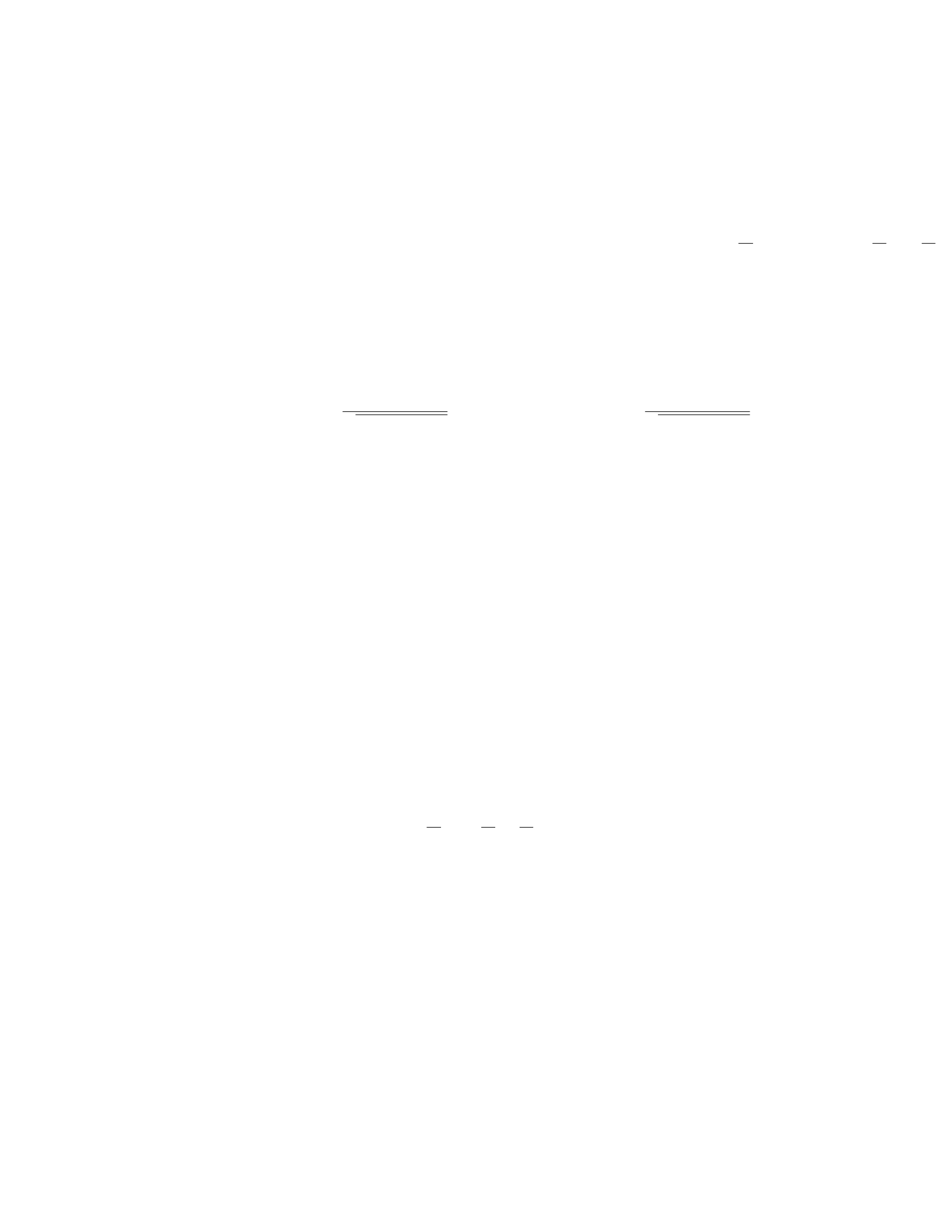
Step 2: Next, we compute the curl of the vector field F= (zcos(x) + ysin(z)) =
(u2+v2) cos(u)+vsinu2+v2i+0j+k. Since ∇×F=curl F=
i j k
∂
∂u
∂
∂v
∂
∂z
(u2+v2) cos(u) + vsinu2+v20u2+v2
,
we have ∇ × F=−2vcos(u)i−(2ucos(u) + sinu2+v2)j−k.
Step 3: Now, we integrate the dot product of Fand the unit normal vector
Nover the surface S.
ZZS
F·dS=ZZD
F·(ru×rv)dudv =ZZD
(∇ × F)·NdA
=ZZD−2vcos(u)−2u
√4u2+ 4v2+ 1 −(2ucos(u) + sinu2+v2)−2v
√4u2+ 4v2+ 1 + 0dA
Step 4: At this point, we evaluate the double integral over the region D=
{(u, v)|0≤u≤2,0≤v≤2}to find the final numerical result.
Question 15
Question
Let Sbe the surface given by z=x2+y2for 0≤z≤4. Use Stokes’ Theorem
to evaluate the line integral
ZC
F·dr
where F(x, y, z) = (x2+y2,−2y, z)and Cis the curve formed by the intersection
of the plane x+y+z= 2 with the plane y= 0 oriented counterclockwise when
viewed from above (i.e. when z > 2).
Solution
Step 1: Compute the curl of F:
curl F=
i j k
∂
∂x
∂
∂y
∂
∂z
x2+y2−2y z
= (0,2,2)
Step 2: Find the outward unit normal vector to the surface S={(x, y, z) :
z=x2+y2,0≤z≤4}.
The parametric equations for the surface Sare:
r(u, v) = (u, v, u2+v2)for (u, v)∈D={(u, v) : 0 ≤u≤2,0≤v≤2}
Therefore, ru= (1,0,2u)and rv= (0,1,2v). The normal vector to the surface
is given by
N=ru×rv= (−2u, −2v, 1)
13

Normalizing N, we get
N=1
√1+4u2+ 4v2(−2u, −2v, 1)
Step 3: Compute the line integral over the curve C. We need to parametrize
the curve Cbased on the given information. The intersection of the plane
x+y+z= 2 with the plane y= 0 is the line z= 2 −x. Parametrizing this line,
we get r(t) = (t, 0,2−t)for 0≤t≤2. The tangent vector is r′(t) = (1,0,−1).
Step 4: Evaluate the line integral using Stokes’ Theorem. By Stokes’ Theo-
rem, we have ZC
F·dr=ZZS
curl F·NdS
where Nis the unit outward normal to the surface S. Substitute the given
values into the formula above:
=ZZD
0
2
2
·1
√1+4u2+ 4v2(−2u, −2v, 1)dA
Step 5: Simplify the integral and compute. The dot product simplifies to
4(2v+u)
√1+4u2+4v2. Therefore, the integral becomes
Z2
0Z2
0
4(2v+u)
√1+4u2+ 4v2dv du
Calculating this double integral will yield the value of the line integral.
Question 16
Question
Let Sbe the part of the plane z= 1−x−ythat lies above the square 0≤x≤1,
0≤y≤1. Use Stokes’ Theorem to evaluate the surface integral
ZZS
(∇ × F)·dS,
where F(x, y, z) = ⟨y2,−x2, z2⟩.
Solution
Step 1: Find the normal vector to the surface S. The normal vector to the
surface Sis given by N=⟨∂z
∂x ,∂z
∂y ,−1⟩=⟨−1,−1,−1⟩.
Step 2: Compute the curl of F. The curl of Fis given by ∇ × F=
i j k
∂
∂x
∂
∂y
∂
∂z
y2−x2z2
=⟨2z, 2z, 2y+ 2x⟩.
14

Step 3: Calculate RRS(∇ × F)·dS. We can express the surface integral as
ZZS
(∇ × F)·dS=ZZS⟨2z, 2z, 2y+ 2x⟩ · ⟨−1,−1,−1⟩dS.
Step 4: Determine the bounds for the surface integral. Since Slies above the
square 0≤x≤1,0≤y≤1, the bounds for the surface integral are 0≤x≤1
and 0≤y≤1.
Step 5: Evaluate the surface integral. Substitute the given values into the
integral to get
ZZS
(∇ × F)·dS=ZZ 1
0ZZ 1
0⟨2z, 2z, 2y+ 2x⟩ · ⟨−1,−1,−1⟩dydx.
This simplifies to
ZZS
(∇ × F)·dS=ZZ 1
0ZZ 1
0
(−4z−2y−2x)dydx.
Integrating with respect to yand then x, we find
ZZS
(∇ × F)·dS=Z1
0
[−2z−y−2x]1
0dx =Z1
0
(−2z−1−2x)dx.
Finally, integrating with respect to xgives
ZZS
(∇ × F)·dS=−2zx −x−x21
0=−3z−1.
Question 17
Question
Let Sbe the cone in R3bounded by the surface z=px2+y2over the region
x2+y2≤1. Use Stokes’ Theorem to evaluate the surface integral RRS∇×F·dS,
where F(x, y, z) = (y2, z2, x2).
Solution
Step 1: Calculate the curl of F. The curl of Fis given by
∇ × F=
i j k
∂
∂x
∂
∂y
∂
∂z
y2z2x2
= (2z−0,0−2x, 2y−2z) = (2z, −2x, 2(y−z))
Step 2: Parameterize the surface Sand find the normal vector. Let Sbe
parameterized by r(r, θ) = (rcos θ, r sin θ, r)for (r, θ)∈[0,1] ×[0,2π]. The
normal vector to Sis given by N=rr×rθ
∥rr×rθ∥.
15

Calculate rr= (cos θ, sin θ, 1) and rθ= (−rsin θ, r cos θ, 0). Then, N=
(cos θ, sin θ, −r).
Step 3: Calculate the dot product of ∇ × Fwith N. We have ∇ × F·N=
(2z, −2x, 2(y−z)) ·(cos θ, sin θ, −r) = 2zcos θ−2xsin θ+ 2(y−z)(−r).
Step 4: Set up and evaluate the surface integral. The surface integral RRS∇×
F·dScan be evaluated as
ZZS∇ × F·dS=Z2π
0Z1
0
(2zcos θ−2xsin θ+ 2(y−z)(−r)) r drdθ
Simplify the integrand and evaluate the integral to find the final answer.
Question 18
Question
Let Sbe the part of the plane z= 3 + x+ythat lies above the region in the xy-
plane bounded by the curves y=x2and y= 3−x2. Let F(x, y, z) = ⟨2z, 2x, −y⟩.
Use Stokes’ Theorem to compute the flux of Facross the boundary of S.
Solution
Step 1: Determine the normal vector to the surface S.
The normal vector to the surface Sis given by n=∇g
∥∇g∥, where g(x, y, z) = z−
3−x−y. Therefore, ∇g=⟨−1,−1,1⟩and ∥∇g∥=p(−1)2+ (−1)2+ 12=√3.
Thus, the unit normal vector is n=1
√3⟨−1,−1,1⟩.
Step 2: Calculate ∇ × F.
We have ∇ × F=
i j k
∂
∂x
∂
∂y
∂
∂z
2z2x−y
=⟨2,2,2⟩.
Step 3: Find the boundary curve Cin the xy-plane.
The boundary curve Cis the intersection of the surfaces z= 3 + x+yand
z= 0. Substituting z= 0 into z= 3 + x+y, we get 0 = 3 + x+y. Rearranging,
we have y=−x+ 3. The bounds of xover which Clies are −1≤x≤1.
Step 4: Evaluate the line integral HCF·dr.
Using Stokes’ Theorem, the flux of Facross the boundary of Sis given by the
line integral HCF·dr, where dr=⟨dx, dy⟩. We have:
HCF·dr=RRS(∇ × F)·ndS =RRS⟨2,2,2⟩ · 1
√3⟨−1,−1,1⟩dS
Step 5: Compute the flux.
This simplifies to 2
√3RRS(2 −2 + 2) dS =2
√3RRS2dS =4
√3Area(S).
To find the area of S, we need to integrate dA over the region bounded by
y=x2and y= 3 −x2. This becomes:
Area(S) = R1
−1R3−x2
x2dy dx
Now, we compute the integral to find the final answer.
16

Question 19
Question
Let Sbe the part of the paraboloid z= 4 −x2−y2that lies above the plane
z= 2, oriented upward. Use Stokes’ Theorem to evaluate the surface integral
RRS(∇ × F)·dS, where F(x, y, z) = (x2+y2)i+ (y2−z)j+ (z2+y)k.
Solution
Step 1: Compute ∇ × F. The curl is given by:
∇ × F=
i j k
∂
∂x
∂
∂y
∂
∂z
x2+y2y2−z z2+y
∇×F=∂(z2+y)
∂y −∂(y2−z)
∂z i−∂(z2+y)
∂x −∂(x2+y2)
∂z j+∂(y2−z)
∂x −∂(x2+y2)
∂y k
∇ × F= (−1−1)i−(−2x)j−(−2y)k=−2i+ 2xj+ 2yk
Step 2: Use Stokes’ Theorem to evaluate the surface integral. Stokes’
Theorem states: ZZS
(∇ × F)·dS=IC
F·dr
where HCF·drrepresents the line integral of Faround the boundary curve C
of the surface S.
The boundary curve C corresponds to the intersection of the paraboloid and
the plane, which is a circle centered at the origin with radius √2.
Therefore, the line integral becomes:
IC
F·dr=IC
((x2+y2)i+ (y2−z)j+ (z2+y)k)·(dxi+dyj)
=IC
(x2+y2)dx + (y2−z)dy =IC
r2dθ
Since the curve is a circle with radius √2, the line integral simplifies to:
=Z2π
0
(√2)2dθ
= 4π
Therefore, the surface integral RRS(∇×F)·dSusing Stokes’ Theorem is 4π.
17

Question 20
Question
Let Sbe the part of the paraboloid z=x2+y2that lies below the plane z= 1
oriented upward. Use Stokes’ Theorem to evaluate the circulation of the vector
field F(x, y, z) = (y+z, x +z, x +y)around the boundary curve of S.
Solution
Step 1: First, we need to find the boundary curve of the surface S, denoted by
C, which is the intersection of the paraboloid z=x2+y2and the plane z= 1.
Setting z= 1 in the equation of the paraboloid, we have 1 = x2+y2.
This represents a circle in the xy-plane with radius 1 centered at the origin.
Therefore, the boundary curve Cis the circle x2+y2= 1.
Step 2: The normal vector of the surface Sis given by n=−∂f
∂x ,−∂f
∂y ,1,
where f(x, y, z) = x2+y2−z. Calculating the partial derivatives, we have
∂f
∂x = 2x,∂f
∂y = 2y. Therefore, n= (−2x, −2y, 1).
Step 3: We can now compute the curl of the vector field F(x, y, z) = (y+
z, x +z, x +y):
∇×F=
i j k
∂
∂x
∂
∂y
∂
∂z
y+z x +z x +y
=∂
∂y (x+y)−∂
∂z (x+z),∂
∂z (y+z)−∂
∂x(x+y),∂
∂x(x+z)−∂
∂y (y+z)
= (1 −1,1−1,1−1) = (0,0,0)
Step 4: Finally, we can use Stokes’ Theorem which states that the circulation
of a vector field around a closed curve is equal to the surface integral of the curl
of the vector field over the surface. Since the curl of Fis zero, the circulation
of Faround Cis 0.
Question 21
Question
Let F= (x2+y2+z2)i+yzj+xzkbe a vector field in R3.
Consider the surface Sgiven by the part of the paraboloid z=x2+y2that
lies between the planes z= 0 and z= 1.
Use Stokes’ Theorem to evaluate RRScurl(F)·dS.
Solution
• The curl of the vector field Fis given by:
curl(F) = ∇ × F=
i j k
∂
∂x
∂
∂y
∂
∂z
x2+y2+z2yz xz
= (2z−x)i+zj+ (2x−y)k
18

• The orientation of the surface Sis given by the outward-pointing normal
vector n=−∇z=−i−j−2zk.
• The boundary curve Cof the surface Sis the circle in the xy-plane given by
x2+y2= 1. Parametrize this curve as r(t) = cos ti+ sin tjfor 0≤t≤2π.
• Using Stokes’ Theorem, we have:
ZZS
curl(F)·dS=IC
F·dr=Z2π
0
F(r(t)) ·r′(t)dt
• Now, we evaluate this line integral:
(r(t)) ·r′(t)dt
=R2π
0(cos2t+ sin2t)·i+ sin t·cos t·j+ cos t·sin t·k·(−sin ti+ cos tj)dt
=R2π
0(−cos tsin t+ sin tcos t+ 0) dt
=R2π
00dt
= 0
Question 22
Question
Let Sbe the part of the cone z=px2+y2that lies below the plane z= 1
oriented upward. Using Stokes’ Theorem, calculate the flux of the vector field
F=x2i+y2j+z2kacross the boundary curve of S.
Solution
Step 1: Calculate the curl of the vector field F.
∇ × F=
i j k
∂
∂x
∂
∂y
∂
∂z
x2y2z2
=∂z2
∂y −∂y2
∂z i−∂z2
∂x −∂x2
∂z j+∂y2
∂x −∂x2
∂y k
= (0 −0)i−(0 −0)j+ (0 −0)k=0
19
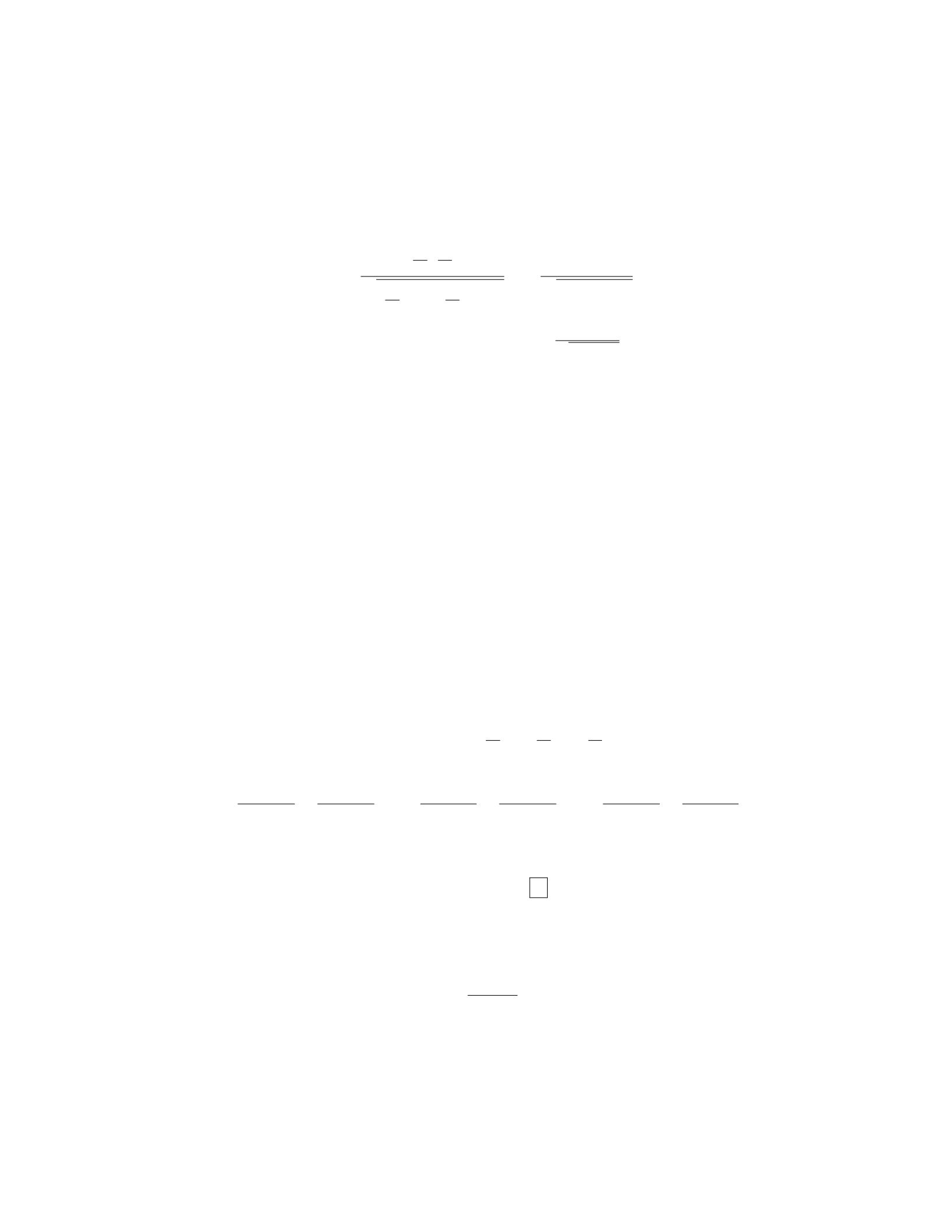
Step 2: Calculate the surface integral by finding the unit normal vector to
S. The unit normal vector to the surface Sis given by
n=±−∂z
∂x ,∂z
∂y ,1
r∂z
∂x 2+∂z
∂y 2+ 1
=±(−x, −y, 1)
px2+y2+ 1
We choose the positive unit normal vector, so n=1
√x2+y2+1 (−x, −y, 1).
Step 3: Calculate the flux of Facross the boundary curve of Susing Stokes’
Theorem. The flux is given by
ZZS
(∇ × F)·dS=ZZS
0·ndS = 0
Question 23
Question
Let Sbe the part of the plane z= 2x+3ythat lies inside the cylinder x2+y2= 1
and above the xy-plane. Use Stokes’ Theorem to evaluate RRScurl(F)·dS, where
F= (y+z, x +z, x +y).
Solution
Step 1: Find the normal vector nThe normal vector for the plane z= 2x+ 3y
is n=grad(z) = (2,3,−1).
Step 2: Compute the curl of FThe curl of Fis given by:
curl(F) = ∇ × F=
i j k
∂
∂x
∂
∂y
∂
∂z
y+z x +z x +y
=∂(x+y)
∂y −∂(x+z)
∂z i−∂(y+z)
∂x −∂(x+y)
∂z j+∂(x+z)
∂x −∂(y+z)
∂y k
= (1 −1)i−(1 −1)j+ (1 −1)k=0
Since the curl of Fis 0, the integral RRScurl(F)·dSis also 0.
Therefore, the value of the given integral is 0.
Question 24
Question
Let Sbe the surface of the cone z=px2+y2bounded by the plane z= 3. Use
Stokes’ Theorem to evaluate the flux of the curl of the vector field F= (y2, x, z)
across S.
20

Solution
Step 1: We first compute the curl of the vector field F:
∇ × F=
i j k
∂
∂x
∂
∂y
∂
∂z
y2x z
= (1,−1,2y−x)
Step 2: Next, we parameterize the cone Susing the surface parameterization:
r(u, v) = (ucos v, u sin v, u)
where 0≤u≤3and 0≤v≤2π.
Step 3: Compute the cross product ru×rv:
ru= (cos v, sin v, 1),rv= (−usin v, u cos v, 0)
ru×rv=
i j k
cos vsin v1
−usin v u cos v0
= (−ucos v, −usin v, u)
Step 4: Calculate the unit normal vector to the surface S:
n=ru×rv
∥ru×rv∥=(−ucos v, −usin v, u)
√u2+u2=−cos v
√2,−sin v
√2,1
√2
Step 5: Finally, we apply Stokes’ Theorem:
ZZS
(∇ × F)·ndS =ZZD
(∇ × F)·(ru×rv)du dv
=ZZD
(1,−1,2y−x)·(−ucos v, −usin v, u)du dv
Step 6: After simplifying, we integrate over the region D:
=ZZD
(−ucos v+usin v+ 2usin v−ucos v)du dv =ZZD
usin v du dv
=Z2π
0Z3
0
usin v du dv =Z2π
03
2sin v2π
0
dv =Z2π
0
0dv = 0
Therefore, the flux of the curl of Facross the surface Sis 0.
Question 25
Question
Let Sbe the surface of the portion of the paraboloid z=x2+y2that lies above
the disk x2+y2≤4, oriented upwards, and let F(x, y, z)=(x2, y2, z2). Use
Stokes’ Theorem to evaluate the surface integral RRScurl(F)·dS.
21
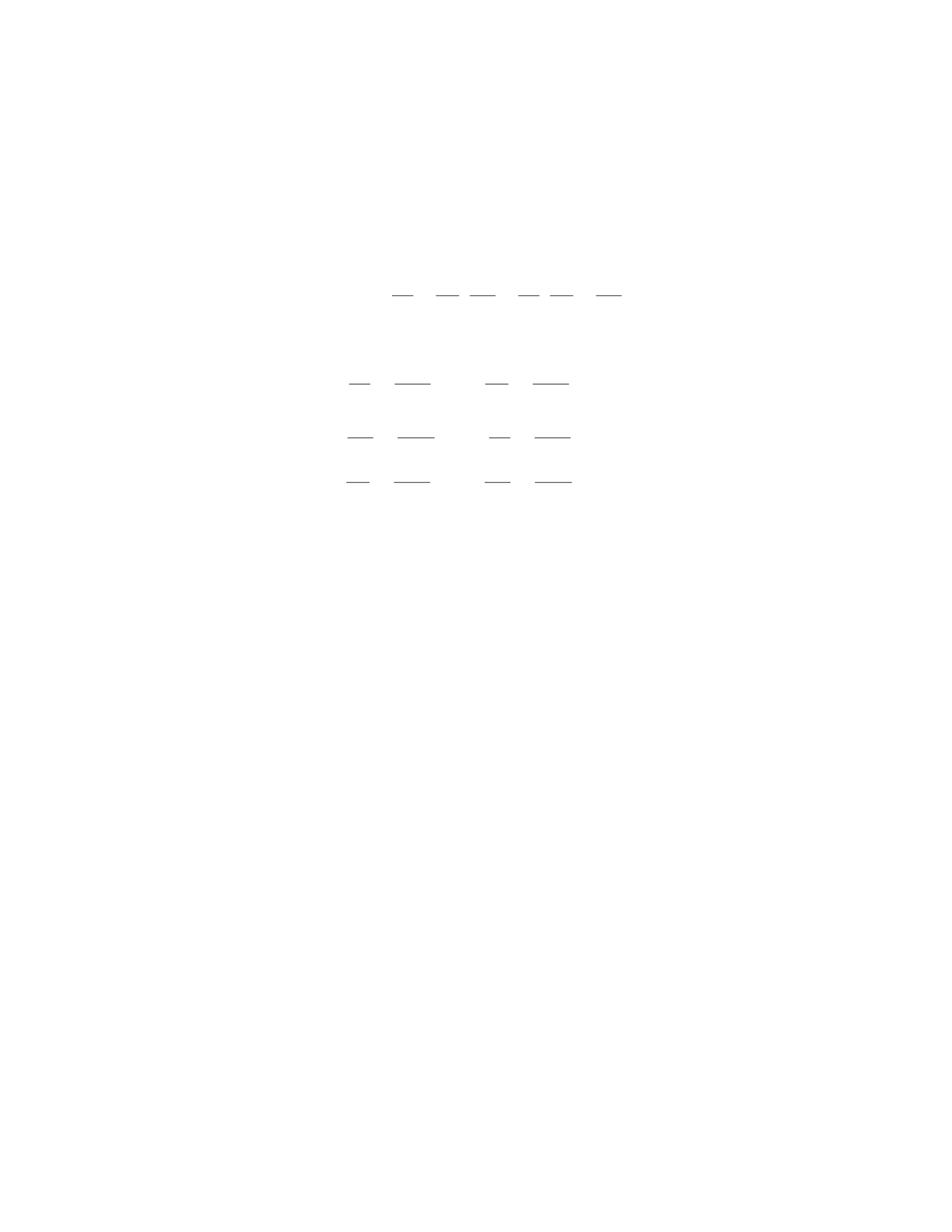
Solution
Step 1: Compute the curl of F: The curl of a vector field F(x, y, z) = (M, N, P )
is given by
curl(F) = ∂P
∂y −∂N
∂z ,∂M
∂z −∂P
∂x ,∂N
∂x −∂M
∂y .
In this case, F(x, y, z) = (x2, y2, z2), so M=x2,N=y2, and P=z2. We have:
∂P
∂y =∂(z2)
∂y = 0,∂N
∂z =∂(y2)
∂z = 0,
∂M
∂z =∂(x2)
∂z = 0,∂P
∂x =∂(z2)
∂x = 0,
∂N
∂x =∂(y2)
∂x = 0,∂M
∂y =∂(x2)
∂y = 0.
Thus, the curl of Fis curl(F) = (0,0,0).
Step 2: Using Stokes’ Theorem, we have
ZZS
curl(F)·dS=IC
F·dr,
where Cis the boundary curve of the surface Swith the positive orientation. In
this case, the boundary of the surface Sis the circle x2+y2= 4 in the xy-plane.
Step 3: Parameterize the boundary curve C: Let Cbe parameterized by
r(t) = (2 cos t, 2 sin t, 2 cos2t+ 2 sin2t) = (2 cos t, 2 sin t, 4),
where 0≤t≤2π.
Step 4: Calculate F(r(t)) and r′(t):
F(r(t)) = F(2 cos t, 2 sin t, 4) = (4 cos2t, 4 sin2t, 16),
r′(t) = (−2 sin t, 2 cos t, 0).
Step 5: Compute the line integral:
IC
F·dr=Z2π
0
F(r(t)) ·r′(t)dt.
Substitute F(r(t)) and r′(t)into the integral, simplify, and compute the integral
to find the final answer.
22

Step 4: The unit normal vector nto the xy-plane is k.
Step 5: Since the surface Sis the disk Din the xy-plane, its outward normal
vector nis also k.
Step 6: Therefore, the line integral becomes
IC
F·dr=ZZS
G·kdS
ZZS
2(y−x)dS
Step 7: We can set up the double integral in polar coordinates as follows:
ZZS
2(y−x)dS =Z2π
0Z1
0
2(rsin θ−rcos θ)r drdθ
Step 8: Solving the double integral, we get
Z2π
0−1
3dθ =−2π
3
Step 9: Therefore, the value of the line integral is −2π
3.
Question 3
Question
Let Fbe a vector field defined by F(x, y, z) = (x2+yz)i+ (y2+zx)j, and
let Sbe the surface of the region bounded by the plane z= 0 and the cone
z=px2+y2. Calculate the surface integral R RSF·dSusing Stoke’s Theorem.
Solution
Step 1: We first find the curl of the vector field F.
curl(F) = ∇ × F=
i j k
∂
∂x
∂
∂y
∂
∂z
x2+yz y2+zx 0
Step 2: Computing the determinant, we have:
curl(F) = 0−∂
∂y (0)i−∂
∂x(0) −∂
∂z (x2+yz)j+∂
∂y (y2+zx)−∂
∂x(0)k
Step 3: Simplifying, we get:
curl(F) = −zj+zk
2

Step 4: Then, the surface integral becomes:
Z ZS
F·dS=Z Z curl(F)·dS=ZZZdiv(curl(F)) dV
Step 5: Since div(curl(F)) = 0 for all vector fields, we have:
Z ZS
F·dS= 0
Question 4
Question
Let Sbe the surface of the part of the plane x+y+z= 1 that lies in the
first octant. Let Fbe the vector field defined by F(x, y, z)=(x2, y2, z2). Use
Stokes’ Theorem to evaluate the surface integral RRScurl(F)·ndS, where nis
the outward-pointing unit normal to S.
Solution
Step 1: Parameterize the surface Susing two variables xand y.
Since x+y+z= 1 and the surface Slies in the first octant, we can param-
eterize Sas:
r(x, y) = (x, y, 1−x−y),for 0≤x≤1,0≤y≤1−x
Step 2: Calculate the curl of the vector field F.
The curl of F(x, y, z) = (x2, y2, z2)is given by:
curl(F) = ∂F3
∂y −∂F2
∂z ,∂F1
∂z −∂F3
∂x ,∂F2
∂x −∂F1
∂y
= (0 −2y, 0−2z, 0−2x) = (−2y, −2z, −2x)
Step 3: Calculate the outward-pointing unit normal n.
The unit normal vector nis given by:
n=r
x×ry|rx×ry|
where, rx= (1,0,−1),ry= (0,1,−1).
n=(1,0,−1) ×(0,1,−1)
|(1,0,−1) ×(0,1,−1)|=(−1,1,1)
√3
Step 4: Calculate the surface integral using Stokes’ Theorem.
We have:
ZZS
curl(F)·ndS =ZZD
(curl(F)·(rx×ry)) dA
where Dis the projection of surface Sonto the xy-plane.
Now, Dis a triangle in the xy-plane with vertices at (0,0),(1,0), and (0,1).
Evaluating the surface integral on Dwill give the final answer.
3
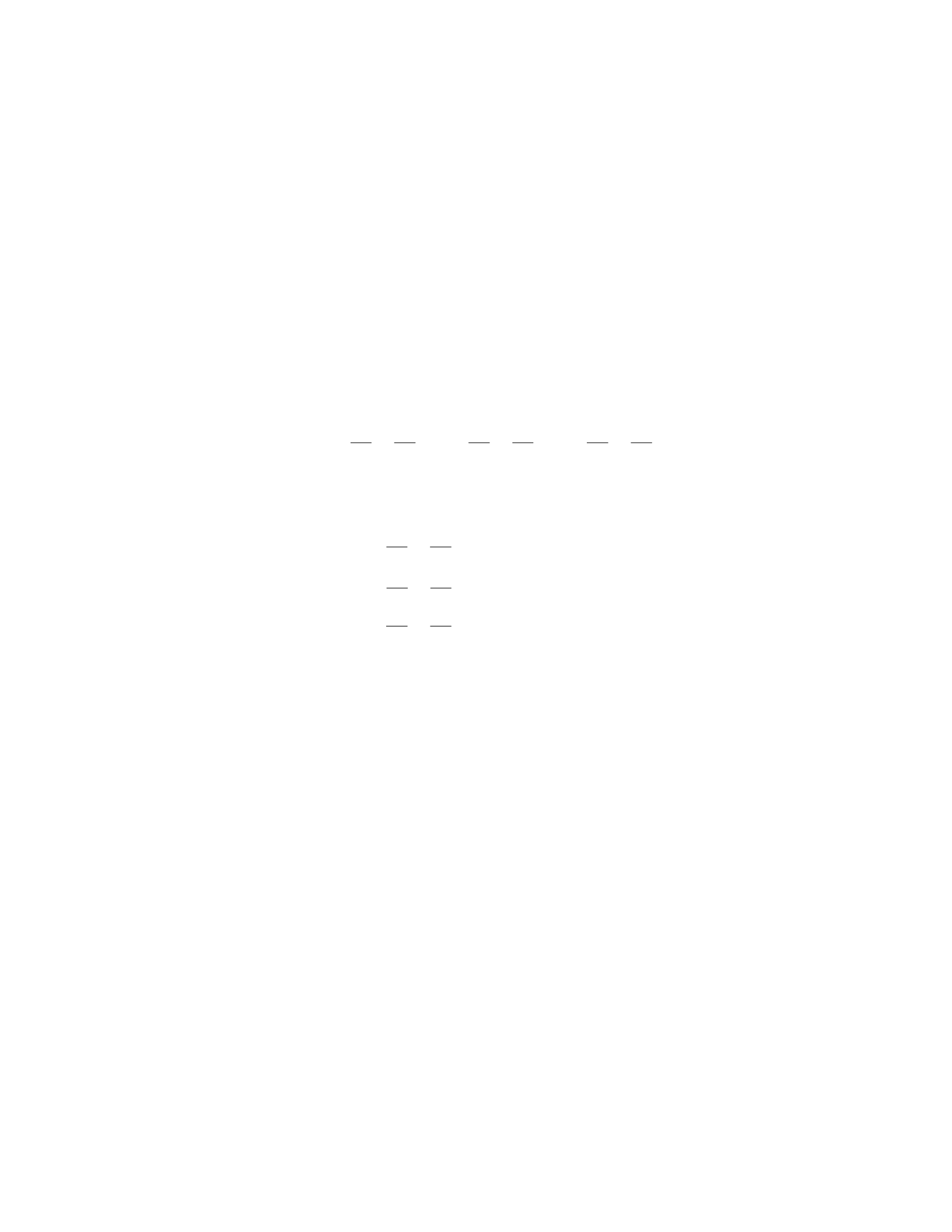
Question 5
Question
Let F=⟨x2, y2, z2⟩be a vector field, and let Sbe the surface of the solid region
enclosed by the paraboloid z= 4 −x2−y2and the plane z= 0. Calculate the
flux of Facross Susing Stokes’ Theorem.
Solution
Step 1: To use Stokes’ Theorem, we need to find the curl of F. The curl of a
vector field F=⟨P, Q, R⟩is given by
∇ × F=∂R
∂y −∂Q
∂z i+∂P
∂z −∂R
∂x j+∂Q
∂x −∂P
∂y k
In this case, F=⟨x2, y2, z2⟩, so P=x2,Q=y2, and R=z2. Calculating
the partial derivatives:
∂R
∂y −∂Q
∂z = 2z−0 = 2z
∂P
∂z −∂R
∂x = 0 −2x=−2x
∂Q
∂x −∂P
∂y = 0 −2y=−2y
So, the curl of Fis ∇ × F= (2z)i+ (−2x)j+ (−2y)k.
Step 2: Next, we need to find the surface normal vector nto S. Since S
is the closed surface enclosing the solid region, the outward unit normal vector
is given by −∇h, where h(x, y, z) = z−(4 −x2−y2). Thus, n=−∇h=
⟨−(−2x),−(2y),1⟩=⟨2x, 2y, 1⟩.
Step 3: Now, we can apply Stokes’ Theorem, which states:
ZZS
(∇ × F)·dS=IC
F·dr
where Cis the boundary curve of S. Since Sis the solid region enclosed by the
paraboloid and the plane z= 0, the boundary curve Cconsists of the paraboloid
and the circle in the xy plane corresponding to z= 0.
Step 4: Calculate the surface integral:
ZZS
(∇ × F)·dS=ZZS
(2z)i+ (−2x)j+ (−2y)k·(2x, 2y, 1) dA
=ZZS
2z(2x)+(−2x)(2y)−2y dA
=ZZS
4xz −4xy −2y dA
4

Step 5: Since the equation of the paraboloid is z= 4 −x2−y2, we can
rewrite the integral in terms of xand y:
ZZS
(4x(4 −x2−y2)−4xy −2y)dA
Step 6: Integration can be challenging in this case due to the complexity
of the integrand. The solution will require careful algebraic manipulation to
simplify the expression before performing the integration.
Question 6
Question
Let Sbe the part of the plane z= 4−x−ythat lies inside the cylinder x2+y2= 4.
Use Stokes’ Theorem to evaluate RRS(∇×F)·ds, where F(x, y, z) = yi+zj+xk.
Solution
Step 1: Find the normal vector to S.
The surface Sis described by the function z= 4 −x−y. To find the normal
vector to S, we compute ∇f=D−∂f
∂x ,−∂f
∂y ,1E.
So, ∇f=⟨−1,−1,1⟩.
Step 2: Compute ∇ × F.
Given F(x, y, z) = yi+zj+xk,∇ × F=
i j k
∂
∂x
∂
∂y
∂
∂z
y z x
.
Solving this expression, we get ∇ × F=i−j−k.
Step 3: Find the parametric representation of S.
Let x=rcos θ,y=rsin θ,z= 4 −rcos θ−rsin θ. We have rranging from
0 to 2 and θranging from 0 to 2π.
Then, rcos θ,rsin θ, and 4−rcos θ−rsin θare the parametric equations
for S.
Step 4: Compute the surface integral.
RRS(∇ × F)·ds =R2π
0R2
0⟨1,−1,−1⟩ · ⟨−rsin θ, r cos θ, −rsin θ−rcos θ⟩ ·
r dr dθ.
After carrying out the dot product and integrating, the solution is obtained.
Question 7
Question
Let Sbe the part of the cone z=px2+y2that lies above the plane z= 1.
Use Stokes’ Theorem to evaluate the surface integral RRS(∇ × F)·dS, where
F= (y2−z2, xz, yz)and Sis oriented outward.
5

Solution
To apply Stokes’ Theorem, we need to find the curl of F, the area of S, and a
normal vector nto S.
Step 1: Calculate ∇ × F. The curl of Fis given by:
∇×F=
i j k
∂
∂x
∂
∂y
∂
∂z
y2−z2xz yz
= (∂(yz)
∂y −∂(xz)
∂z )i−(∂(y2−z2)
∂z −∂(yz)
∂x )j+(∂(y2−z2)
∂x −∂(y2)
∂y )k
Compute each partial derivative:
∂(yz)
∂y −∂(xz)
∂z =z−x,
∂(y2−z2)
∂z −∂(yz)
∂x =−2z−y,
∂(y2−z2)
∂x −∂(y2)
∂y = 0 −2y.
Thus, the curl of Fis:
∇ × F= (z−x)i−(2z+y)j−2yk.
Step 2: Find the area of S.The surface Sis the cone z=px2+y2
above the plane z= 1.
The area of Scan be found by calculating the surface area of the cone within
the range 1≤z≤px2+y2:
ZZS
dS =ZZD||n||dA,
where Dis the projection of Sonto the xy-plane and nis the unit normal vector
to Spointing outward.
Step 3: Apply Stokes’ Theorem. By Stokes’ Theorem, the surface
integral becomes the line integral over the boundary of S:
ZZS
(∇ × F)·dS=IC
F·dr,
where Cis the boundary curve of S.
Unfortunately, Slies outside the scope of Stokes’ Theorem, as it is not a
single surface but rather a part of a surface. Thus, Stokes’ Theorem cannot be
applied directly in this case.
Question 8
Question
Let Sbe the part of the plane z= 16 −x−2ythat lies inside the cylinder
x2+y2= 1. Calculate the flux of the vector field F=⟨y, x, z⟩across the
surface S(oriented outward).
6
Solution
To compute the flux of Facross S, we will use Stokes’ Theorem, which relates
surface integrals to line integrals. Stokes’ Theorem states that the flux of a
vector field Facross a surface Sis equal to the line integral of the vector field
around the boundary curve of S, oriented in the positive direction.
Step 1: Find the normal vector to the surface S.
The surface Sis defined by z= 16 −x−2y. The normal vector to Sis given
by n=∇z=⟨−1,−2,1⟩.
Step 2: Determine the orientation of the boundary curve of S.
The boundary curve of Sis the circle defined by x2+y2= 1. Since the
normal vector npoints outward and the cylinder is oriented counterclockwise
when viewed from above, the boundary curve of Sis oriented counterclockwise
as well.
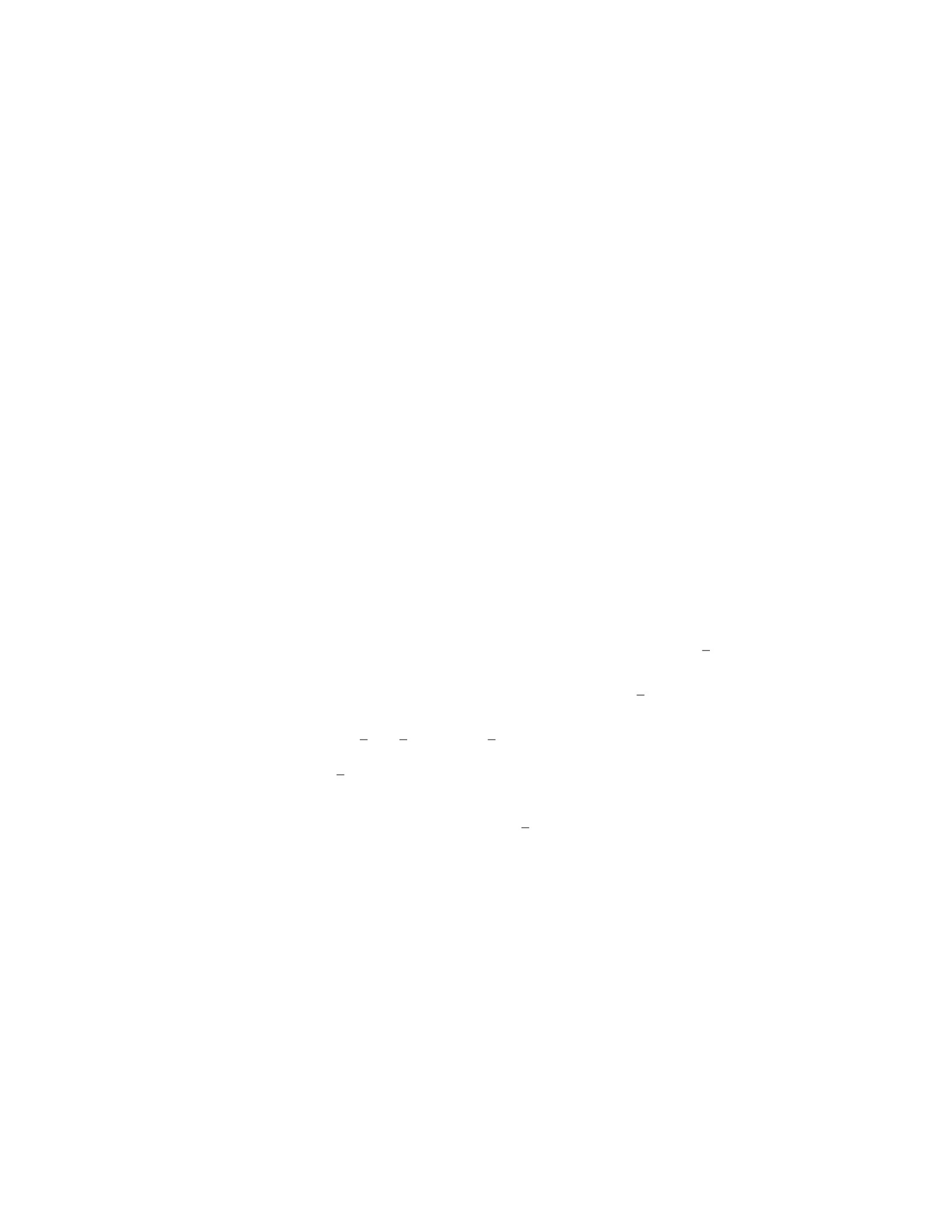
Step 3: Calculate the line integral of Faround the boundary curve of S.
The line integral is given by
IC
F·dr=ZC
F·Tds
where Tis the unit tangent vector to the curve and ds is the arc length differ-
ential.
Since F=⟨y, x, z⟩and the curve is the unit circle, C:x= cos(t), y =
sin(t), z = 16 −cos(t)−2 sin(t)with 0≤t≤2π, we have
IC
F·dr=Z2π
0⟨sin(t),cos(t),16 −cos(t)−2 sin(t)⟩ · ⟨−sin(t),cos(t),√5⟩dt
=Z2π
0−sin2(t) + cos2(t) + (16 −cos(t)−2 sin(t))√5dt
=Z2π
0
16√5−√5 cos(t)−2√5 sin(t)dt
= 32π√5.
Step 4: State the final result.
The flux of Facross the surface Sis 32π√5.
Question 9
Question
Let Sbe the part of the surface z=x2−y2that lies above the square 0≤
x≤1,0≤y≤1. Calculate the flux of the curl of the vector field F=
(x2yz, −xz2, xy2z)through Sin the positive z-direction.
7
Solution
Step 1: Calculate the curl of the vector field F. The curl of F= (P, Q, R)is
given by
∇ × F=
i j k
∂
∂x
∂
∂y
∂
∂z
P Q R
where P=x2yz,Q=−xz2, and R=xy2z. Therefore,
∇ × F=∂R
∂y −∂Q
∂z ,∂P
∂z −∂R
∂x ,∂Q
∂x −∂P
∂y .
Calculating the partial derivatives, we get
∇ × F= (z−y2,2xy, x −z).
Step 2: Calculate the outward unit normal vector to the surface S. Since
the surface is given by z=x2−y2, the normal vector is given by
N=−∂z
∂x,−∂z
∂y ,1= (−2x, 2y, 1).
Step 3: Calculate the flux of the curl of Fthrough Sin the positive z-
direction. The flux is given by the surface integral
ZZS∇ × F·NdS.
Note that dS points in the direction of N, so we consider only the z-component
of the curl of Fi.e., x−z. Thus, the flux integral reduces to
ZZS
(x−z)dS.
Step 4: Parametrize the surface S. Parametrizing the surface with x=u,
y=v, and z=u2−v2, where 0≤u≤1and 0≤v≤1, we have the surface
integral
ZZS
(u−(u2−v2))
∂r
∂u ×∂r
∂v
du dv,
where r(u, v) = (u, v, u2−v2)is the position vector of the surface.
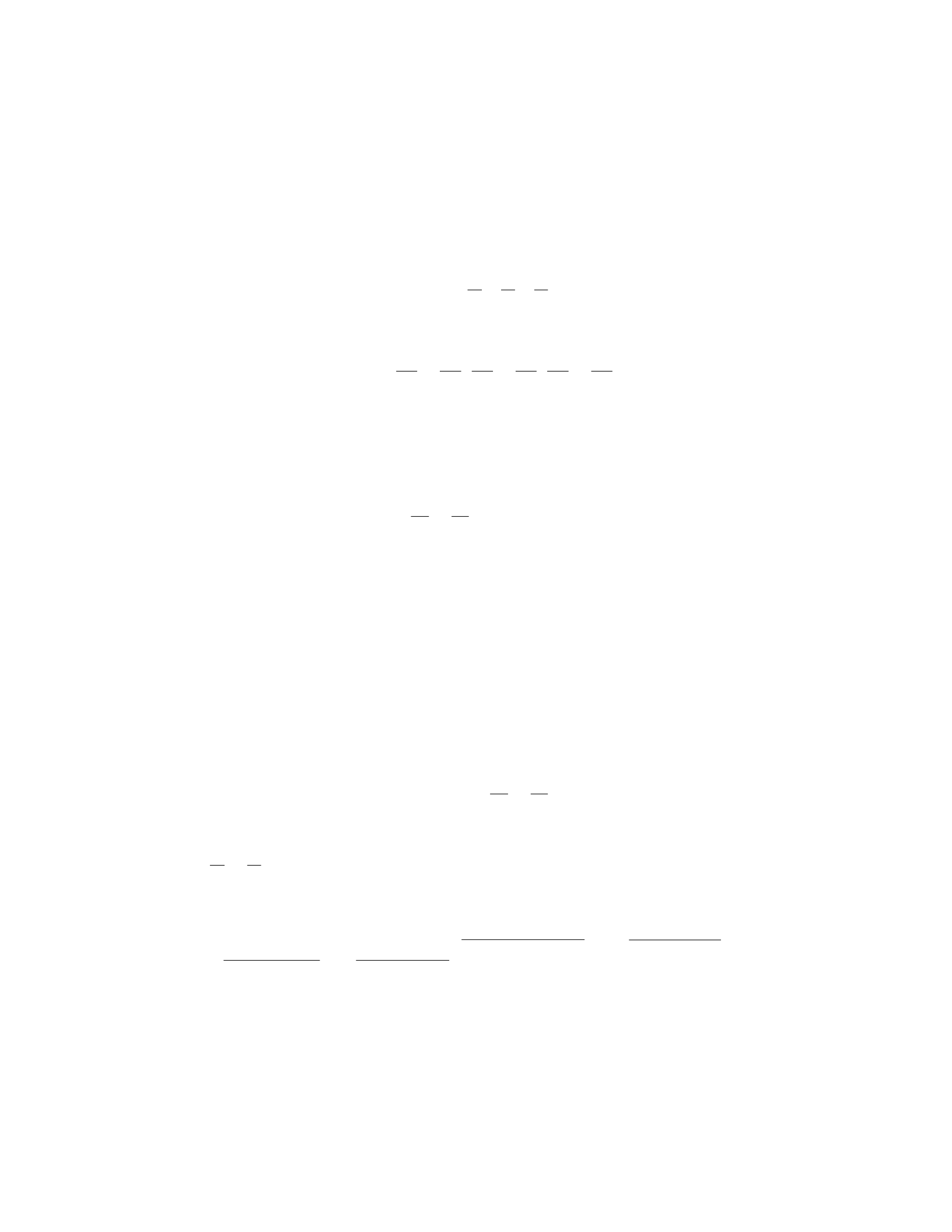
Step 5: Compute the cross product and its magnitude. The cross product
∂r
∂u ×∂r
∂v is
i j k
1 0 2u
0 1 −2v
= (2v, 2u, 1).
The magnitude of this vector is p12+ (2u)2+ (2v)2=√1+4u2+ 4v2=
p1 + 4(u2+v2) = p1+4|r(u, v)|2.
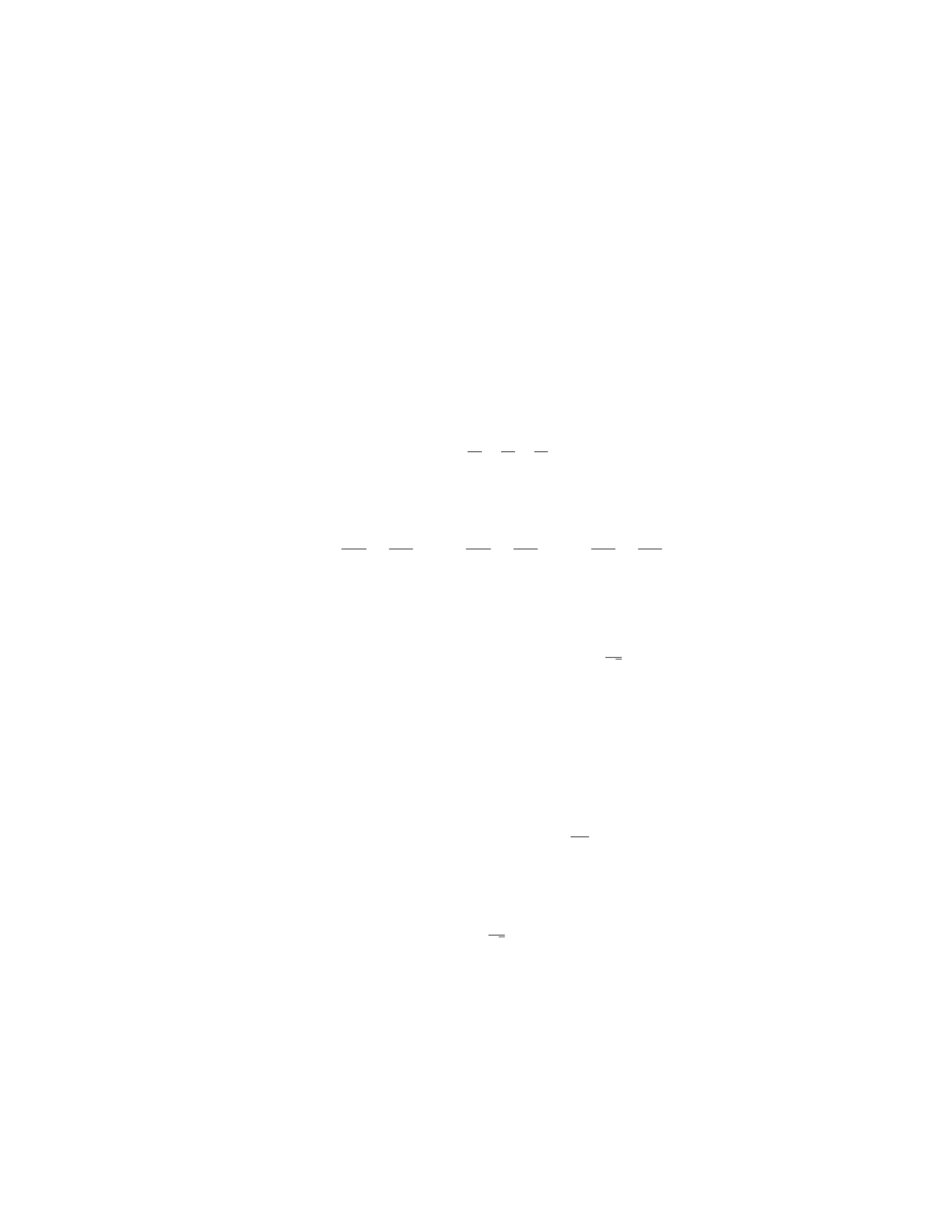
Step 6: Evaluate the surface integral. Substituting all relevant values and
simplifying, we have
Z1
0Z0
8
Question 10
Question
Let Sbe the portion of the plane z= 2 −x−ythat lies above the square
0≤x≤1,0≤y≤1. Use Stokes’ Theorem to evaluate HCF·dr, where
F(x, y, z) = ⟨y2, z2, x2⟩,Cis the boundary curve of Soriented counterclockwise
when viewed from above, and Sis oriented with upward-pointing normal vector.
Solution
Step 1: Calculate ∇ × F. The curl of Fis given by:
∇ × F=
i j k
∂
∂x
∂
∂y
∂
∂z
y2z2x2
Expanding the determinant, we have:
∇ × F=∂x2
∂y −∂z2
∂z i−∂x2
∂x −∂y2
∂z j+∂y2
∂x −∂z2
∂y k
= (−2)i−(−2)j+ 0k=−2i+ 2j
Step 2: Determine the unit normal vector to S. The normal vector to the
plane z= 2 −x−yis n=⟨−1,−1,1⟩. Since Sis oriented with an upward-
pointing normal vector, the unit normal vector is n/|n|=1
√3⟨−1,−1,1⟩.
Step 3: Calculate the line integral over the boundary curve C. By Stokes’
Theorem, we have: IC
F·dr =ZZS
(∇ × F)·dS
where dS=ndS.
Step 4: Find the surface integral of ∇ × Fover S. Since Sis a portion of a
plane, the surface integral over Scan be calculated as:
ZZS
(∇ × F)·dS=ZZD
(∇ × F)·n
|n|dA
where Dis the projection of Sonto the xy-plane. In this case, Dis the square
0≤x≤1,0≤y≤1.
Step 5: Calculate the surface integral by substituting the values of ∇×Fand
n. We have RRS(∇×F)·dS=RRD⟨−2,2⟩· 1
√3⟨−1,−1⟩dA =RRD(−2+2) dA = 0.
Therefore, HCF·dr = 0.
9

Question 11
Question
Let Sbe the part of the cone z=px2+y2that lies inside the cylinder x2+
y2= 1, oriented outward. Use Stokes’ Theorem to evaluate the surface integral
RRS(∇ × F)·dS, where F(x, y, z) = (xy2, xz, yz).
Solution
Step 1: Calculate the curl of the vector field F:
∇ × F=
i j k
∂
∂x
∂
∂y
∂
∂z
xy2xz yz
=∂(yz)
∂y −∂(xz)
∂z i−∂(xy2)
∂x −∂(yz)
∂z j+∂(xy2)
∂x −∂(xz)
∂y k
= (z−0)i−(y2−0)j+ (2xy −0)k= (z, −y2,2xy)
Step 2: Determine the unit normal vector to the surface S: The unit normal
vector to the surface Sis given by N=∂z
∂x ,∂z
∂y ,−1.
Since z=px2+y2, we have ∂z
∂x =x
√x2+y2and ∂z
∂y =y
√x2+y2.
Therefore, the unit normal vector Nis x
√x2+y2,y
√x2+y2,−1.
Step 3: Compute the surface integral using Stokes’ Theorem: By Stokes’
Theorem, the surface integral can be written as:
ZZS
(∇ × F)·dS=IC
F·dr
where Cis the boundary curve of surface S.
We can parameterize the boundary curve Cas r(t) = (cos(t),sin(t),qcos2(t) + sin2(t)) =
(cos(t),sin(t),1), where 0≤t≤2π.
Then, dr= (−sin(t)dt, cos(t)dt, 0).
Substitute these into the line integral formula:
IC
F·dr=Z2π
0
F(r(t)) ·r′(t)dt
=Z2π
0
(y2cos(t) sin(t),cos(t)qcos2(t) + sin2(t),sin(t)qcos2(t) + sin2(t))·(−sin(t),cos(t),0)dt
10

=Z2π
0
(−sin(t) cos(t) sin(t)+cos(t)√1,−cos(t) sin(t)+sin(t)√1,0)·(−sin(t),cos(t),0)dt
=Z2π
0
(0 + cos(t),
Question 12
Question
Let Sbe the surface bounded by the cylinder x2+y2= 4 and the planes z= 0
and z= 3. Calculate the flux of the vector field F(x, y, z) = (y2,−xz, yz)across
the surface Soriented outwards using Stokes’ Theorem.
Solution
Step 1: First, we need to parameterize the surface S. Let’s choose cylindrical
coordinates, where x= 2 cos(θ)and y= 2 sin(θ).
Step 2: The unit normal vector to the surface Sis given by n=∂x
∂θ ×∂y
∂θ ·k.
Computing the cross product and simplifying, we get n= (−2 sin(θ),2 cos(θ),0).
Step 3: The flux of Facross Scan be computed as the surface integral
RRS(∇ × F)·ndS. Let’s first find ∇ × F.
Step 4: We have F(x, y, z) = (y2,−xz, yz). Calculating the curl of F, we get
∇ × F= (0, z + 2,−y).
Step 5: Now, we can compute the surface integral. We have RRS(∇ × F)·
ndS =RRD(∇ × F)·ndA, where Dis the projection of Son the xy-plane.
Step 6: The projection of Son the xy-plane is the circle with radius 2.
Hence, the bounds of integration are 0≤θ≤2π.
Step 7: Substituting the values of ∇ × Fand n, we get the integral to be
R2π
0R2
0(−2 sin(θ) + 4 cos(θ)) rdrdθ.
Step 8: Evaluating the double integral, we find the flux of Facross Sto be
8π.
Question 13
Question
Let Sbe the portion of the plane z=x+ 2ythat lies inside the cylinder
x2+y2= 4 and z≤3. Let F(x, y, z) = (x+y+z, x −y2, xy)and let ndenote
the unit normal vector to Sthat points upward. Calculate the flux of Facross
Susing Stokes’ Theorem.
11

Solution
Step 1: First, we need to parameterize the boundary curve of Swhich is the
circle Cdefined by x2+y2= 4. Let Cbe given by the parameterization
r(t) = (2 cos t, 2 sin t, 2 cos t+ 4 sin t)where 0≤t≤2π.
Step 2: Next, we find the curl of F. The curl of Fis given by ∇ × F=
∂Q
∂y −∂P
∂z ,∂R
∂z −∂P
∂x ,∂P
∂y −∂Q
∂x , where F(x, y, z) = (P, Q, R).
Step 3: Calculating the curl, we have
∇ × F= (1 −1,0−1,1−1) = (0,−1,0).
Step 4: Now we can apply Stokes’ Theorem, which states
ZZS
(∇ × F)·ndS =IC
F·dr.
Step 5: We compute the line integral over Cusing the parameterization r(t),
IC
F·dr=Z2π
0
F(r(t)) ·r′(t)dt.
Step 6: Substituting in the values we get
IC
F·dr=Z2π
0
(6 cos t−2 sin2t)(−2 sin t, 2 cos t, 2 cos t+ 4 sin t)dt.
Step 7: Evaluating this line integral would give us the flux of Facross S.
Question 14
Question
Let Sbe the part of the surface z=x2+y2in the first octant enclosed by the
planes z= 0,z= 4,x= 0, and y= 0. Use Stokes’ Theorem to evaluate the
surface integral RRS(zcos(x) + ysin(z)) ·dS counter-clockwise.
Solution
Step 1: We first parameterize the surface Susing the parameterization r(u, v) =
⟨u, v, u2+v2⟩for 0≤u≤2and 0≤v≤2. Then we compute the cross product
ru×rvto find the normal vector to the surface.
ru=⟨1,0,2u⟩and rv=⟨0,1,2v⟩
ru×rv=
i j k
102u
0 1 2v
=−2ui−2vj+k
So the unit normal vector is N=ru×rv
∥ru×rv∥=−2ui−2vj+k
√4u2+4v2+1 .
12
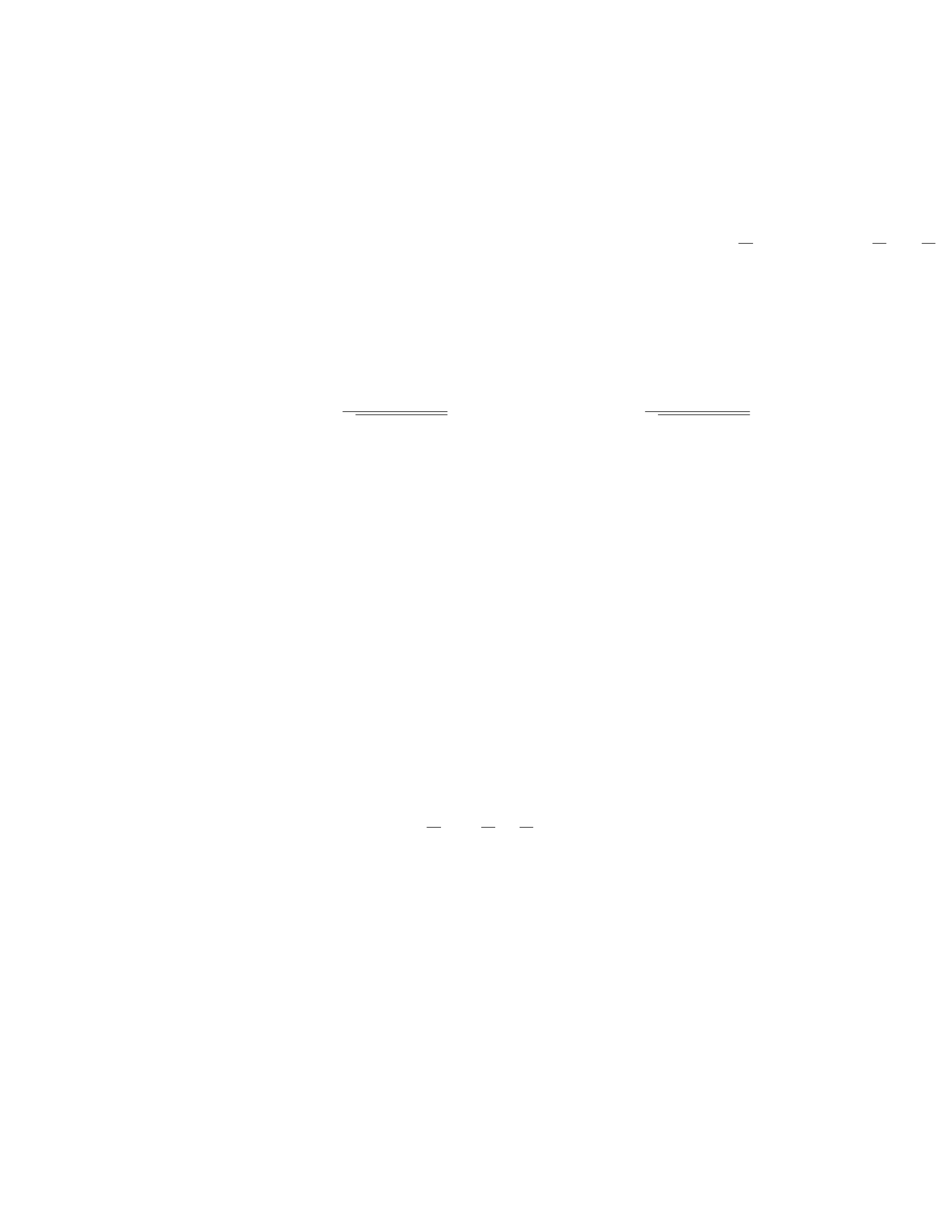
Step 2: Next, we compute the curl of the vector field F= (zcos(x) + ysin(z)) =
(u2+v2) cos(u)+vsinu2+v2i+0j+k. Since ∇×F=curl F=
i j k
∂
∂u
∂
∂v
∂
∂z
(u2+v2) cos(u) + vsinu2+v20u2+v2
,
we have ∇ × F=−2vcos(u)i−(2ucos(u) + sinu2+v2)j−k.
Step 3: Now, we integrate the dot product of Fand the unit normal vector
Nover the surface S.
ZZS
F·dS=ZZD
F·(ru×rv)dudv =ZZD
(∇ × F)·NdA
=ZZD−2vcos(u)−2u
√4u2+ 4v2+ 1 −(2ucos(u) + sinu2+v2)−2v
√4u2+ 4v2+ 1 + 0dA
Step 4: At this point, we evaluate the double integral over the region D=
{(u, v)|0≤u≤2,0≤v≤2}to find the final numerical result.
Question 15
Question
Let Sbe the surface given by z=x2+y2for 0≤z≤4. Use Stokes’ Theorem
to evaluate the line integral
ZC
F·dr
where F(x, y, z) = (x2+y2,−2y, z)and Cis the curve formed by the intersection
of the plane x+y+z= 2 with the plane y= 0 oriented counterclockwise when
viewed from above (i.e. when z > 2).
Solution
Step 1: Compute the curl of F:
curl F=
i j k
∂
∂x
∂
∂y
∂
∂z
x2+y2−2y z
= (0,2,2)
Step 2: Find the outward unit normal vector to the surface S={(x, y, z) :
z=x2+y2,0≤z≤4}.
The parametric equations for the surface Sare:
r(u, v) = (u, v, u2+v2)for (u, v)∈D={(u, v) : 0 ≤u≤2,0≤v≤2}
Therefore, ru= (1,0,2u)and rv= (0,1,2v). The normal vector to the surface
is given by
N=ru×rv= (−2u, −2v, 1)
13

Normalizing N, we get
N=1
√1+4u2+ 4v2(−2u, −2v, 1)
Step 3: Compute the line integral over the curve C. We need to parametrize
the curve Cbased on the given information. The intersection of the plane
x+y+z= 2 with the plane y= 0 is the line z= 2 −x. Parametrizing this line,
we get r(t) = (t, 0,2−t)for 0≤t≤2. The tangent vector is r′(t) = (1,0,−1).
Step 4: Evaluate the line integral using Stokes’ Theorem. By Stokes’ Theo-
rem, we have ZC
F·dr=ZZS
curl F·NdS
where Nis the unit outward normal to the surface S. Substitute the given
values into the formula above:
=ZZD
0
2
2
·1
√1+4u2+ 4v2(−2u, −2v, 1)dA
Step 5: Simplify the integral and compute. The dot product simplifies to
4(2v+u)
√1+4u2+4v2. Therefore, the integral becomes
Z2
0Z2
0
4(2v+u)
√1+4u2+ 4v2dv du
Calculating this double integral will yield the value of the line integral.
Question 16
Question
Let Sbe the part of the plane z= 1−x−ythat lies above the square 0≤x≤1,
0≤y≤1. Use Stokes’ Theorem to evaluate the surface integral
ZZS
(∇ × F)·dS,
where F(x, y, z) = ⟨y2,−x2, z2⟩.
Solution
Step 1: Find the normal vector to the surface S. The normal vector to the
surface Sis given by N=⟨∂z
∂x ,∂z
∂y ,−1⟩=⟨−1,−1,−1⟩.
Step 2: Compute the curl of F. The curl of Fis given by ∇ × F=
i j k
∂
∂x
∂
∂y
∂
∂z
y2−x2z2
=⟨2z, 2z, 2y+ 2x⟩.
14

Step 3: Calculate RRS(∇ × F)·dS. We can express the surface integral as
ZZS
(∇ × F)·dS=ZZS⟨2z, 2z, 2y+ 2x⟩ · ⟨−1,−1,−1⟩dS.
Step 4: Determine the bounds for the surface integral. Since Slies above the
square 0≤x≤1,0≤y≤1, the bounds for the surface integral are 0≤x≤1
and 0≤y≤1.
Step 5: Evaluate the surface integral. Substitute the given values into the
integral to get
ZZS
(∇ × F)·dS=ZZ 1
0ZZ 1
0⟨2z, 2z, 2y+ 2x⟩ · ⟨−1,−1,−1⟩dydx.
This simplifies to
ZZS
(∇ × F)·dS=ZZ 1
0ZZ 1
0
(−4z−2y−2x)dydx.
Integrating with respect to yand then x, we find
ZZS
(∇ × F)·dS=Z1
0
[−2z−y−2x]1
0dx =Z1
0
(−2z−1−2x)dx.
Finally, integrating with respect to xgives
ZZS
(∇ × F)·dS=−2zx −x−x21
0=−3z−1.
Question 17
Question
Let Sbe the cone in R3bounded by the surface z=px2+y2over the region
x2+y2≤1. Use Stokes’ Theorem to evaluate the surface integral RRS∇×F·dS,
where F(x, y, z) = (y2, z2, x2).
Solution
Step 1: Calculate the curl of F. The curl of Fis given by
∇ × F=
i j k
∂
∂x
∂
∂y
∂
∂z
y2z2x2
= (2z−0,0−2x, 2y−2z) = (2z, −2x, 2(y−z))
Step 2: Parameterize the surface Sand find the normal vector. Let Sbe
parameterized by r(r, θ) = (rcos θ, r sin θ, r)for (r, θ)∈[0,1] ×[0,2π]. The
normal vector to Sis given by N=rr×rθ
∥rr×rθ∥.
15

Calculate rr= (cos θ, sin θ, 1) and rθ= (−rsin θ, r cos θ, 0). Then, N=
(cos θ, sin θ, −r).
Step 3: Calculate the dot product of ∇ × Fwith N. We have ∇ × F·N=
(2z, −2x, 2(y−z)) ·(cos θ, sin θ, −r) = 2zcos θ−2xsin θ+ 2(y−z)(−r).
Step 4: Set up and evaluate the surface integral. The surface integral RRS∇×
F·dScan be evaluated as
ZZS∇ × F·dS=Z2π
0Z1
0
(2zcos θ−2xsin θ+ 2(y−z)(−r)) r drdθ
Simplify the integrand and evaluate the integral to find the final answer.
Question 18
Question
Let Sbe the part of the plane z= 3 + x+ythat lies above the region in the xy-
plane bounded by the curves y=x2and y= 3−x2. Let F(x, y, z) = ⟨2z, 2x, −y⟩.
Use Stokes’ Theorem to compute the flux of Facross the boundary of S.
Solution
Step 1: Determine the normal vector to the surface S.
The normal vector to the surface Sis given by n=∇g
∥∇g∥, where g(x, y, z) = z−
3−x−y. Therefore, ∇g=⟨−1,−1,1⟩and ∥∇g∥=p(−1)2+ (−1)2+ 12=√3.
Thus, the unit normal vector is n=1
√3⟨−1,−1,1⟩.
Step 2: Calculate ∇ × F.
We have ∇ × F=
i j k
∂
∂x
∂
∂y
∂
∂z
2z2x−y
=⟨2,2,2⟩.
Step 3: Find the boundary curve Cin the xy-plane.
The boundary curve Cis the intersection of the surfaces z= 3 + x+yand
z= 0. Substituting z= 0 into z= 3 + x+y, we get 0 = 3 + x+y. Rearranging,
we have y=−x+ 3. The bounds of xover which Clies are −1≤x≤1.
Step 4: Evaluate the line integral HCF·dr.
Using Stokes’ Theorem, the flux of Facross the boundary of Sis given by the
line integral HCF·dr, where dr=⟨dx, dy⟩. We have:
HCF·dr=RRS(∇ × F)·ndS =RRS⟨2,2,2⟩ · 1
√3⟨−1,−1,1⟩dS
Step 5: Compute the flux.
This simplifies to 2
√3RRS(2 −2 + 2) dS =2
√3RRS2dS =4
√3Area(S).
To find the area of S, we need to integrate dA over the region bounded by
y=x2and y= 3 −x2. This becomes:
Area(S) = R1
−1R3−x2
x2dy dx
Now, we compute the integral to find the final answer.
16

Question 19
Question
Let Sbe the part of the paraboloid z= 4 −x2−y2that lies above the plane
z= 2, oriented upward. Use Stokes’ Theorem to evaluate the surface integral
RRS(∇ × F)·dS, where F(x, y, z) = (x2+y2)i+ (y2−z)j+ (z2+y)k.
Solution
Step 1: Compute ∇ × F. The curl is given by:
∇ × F=
i j k
∂
∂x
∂
∂y
∂
∂z
x2+y2y2−z z2+y
∇×F=∂(z2+y)
∂y −∂(y2−z)
∂z i−∂(z2+y)
∂x −∂(x2+y2)
∂z j+∂(y2−z)
∂x −∂(x2+y2)
∂y k
∇ × F= (−1−1)i−(−2x)j−(−2y)k=−2i+ 2xj+ 2yk
Step 2: Use Stokes’ Theorem to evaluate the surface integral. Stokes’
Theorem states: ZZS
(∇ × F)·dS=IC
F·dr
where HCF·drrepresents the line integral of Faround the boundary curve C
of the surface S.
The boundary curve C corresponds to the intersection of the paraboloid and
the plane, which is a circle centered at the origin with radius √2.
Therefore, the line integral becomes:
IC
F·dr=IC
((x2+y2)i+ (y2−z)j+ (z2+y)k)·(dxi+dyj)
=IC
(x2+y2)dx + (y2−z)dy =IC
r2dθ
Since the curve is a circle with radius √2, the line integral simplifies to:
=Z2π
0
(√2)2dθ
= 4π
Therefore, the surface integral RRS(∇×F)·dSusing Stokes’ Theorem is 4π.
17

Question 20
Question
Let Sbe the part of the paraboloid z=x2+y2that lies below the plane z= 1
oriented upward. Use Stokes’ Theorem to evaluate the circulation of the vector
field F(x, y, z) = (y+z, x +z, x +y)around the boundary curve of S.
Solution
Step 1: First, we need to find the boundary curve of the surface S, denoted by
C, which is the intersection of the paraboloid z=x2+y2and the plane z= 1.
Setting z= 1 in the equation of the paraboloid, we have 1 = x2+y2.
This represents a circle in the xy-plane with radius 1 centered at the origin.
Therefore, the boundary curve Cis the circle x2+y2= 1.
Step 2: The normal vector of the surface Sis given by n=−∂f
∂x ,−∂f
∂y ,1,
where f(x, y, z) = x2+y2−z. Calculating the partial derivatives, we have
∂f
∂x = 2x,∂f
∂y = 2y. Therefore, n= (−2x, −2y, 1).
Step 3: We can now compute the curl of the vector field F(x, y, z) = (y+
z, x +z, x +y):
∇×F=
i j k
∂
∂x
∂
∂y
∂
∂z
y+z x +z x +y
=∂
∂y (x+y)−∂
∂z (x+z),∂
∂z (y+z)−∂
∂x(x+y),∂
∂x(x+z)−∂
∂y (y+z)
= (1 −1,1−1,1−1) = (0,0,0)
Step 4: Finally, we can use Stokes’ Theorem which states that the circulation
of a vector field around a closed curve is equal to the surface integral of the curl
of the vector field over the surface. Since the curl of Fis zero, the circulation
of Faround Cis 0.
Question 21
Question
Let F= (x2+y2+z2)i+yzj+xzkbe a vector field in R3.
Consider the surface Sgiven by the part of the paraboloid z=x2+y2that
lies between the planes z= 0 and z= 1.
Use Stokes’ Theorem to evaluate RRScurl(F)·dS.
Solution
• The curl of the vector field Fis given by:
curl(F) = ∇ × F=
i j k
∂
∂x
∂
∂y
∂
∂z
x2+y2+z2yz xz
= (2z−x)i+zj+ (2x−y)k
18

• The orientation of the surface Sis given by the outward-pointing normal
vector n=−∇z=−i−j−2zk.
• The boundary curve Cof the surface Sis the circle in the xy-plane given by
x2+y2= 1. Parametrize this curve as r(t) = cos ti+ sin tjfor 0≤t≤2π.
• Using Stokes’ Theorem, we have:
ZZS
curl(F)·dS=IC
F·dr=Z2π
0
F(r(t)) ·r′(t)dt
• Now, we evaluate this line integral:
(r(t)) ·r′(t)dt
=R2π
0(cos2t+ sin2t)·i+ sin t·cos t·j+ cos t·sin t·k·(−sin ti+ cos tj)dt
=R2π
0(−cos tsin t+ sin tcos t+ 0) dt
=R2π
00dt
= 0
Question 22
Question
Let Sbe the part of the cone z=px2+y2that lies below the plane z= 1
oriented upward. Using Stokes’ Theorem, calculate the flux of the vector field
F=x2i+y2j+z2kacross the boundary curve of S.
Solution
Step 1: Calculate the curl of the vector field F.
∇ × F=
i j k
∂
∂x
∂
∂y
∂
∂z
x2y2z2
=∂z2
∂y −∂y2
∂z i−∂z2
∂x −∂x2
∂z j+∂y2
∂x −∂x2
∂y k
= (0 −0)i−(0 −0)j+ (0 −0)k=0
19
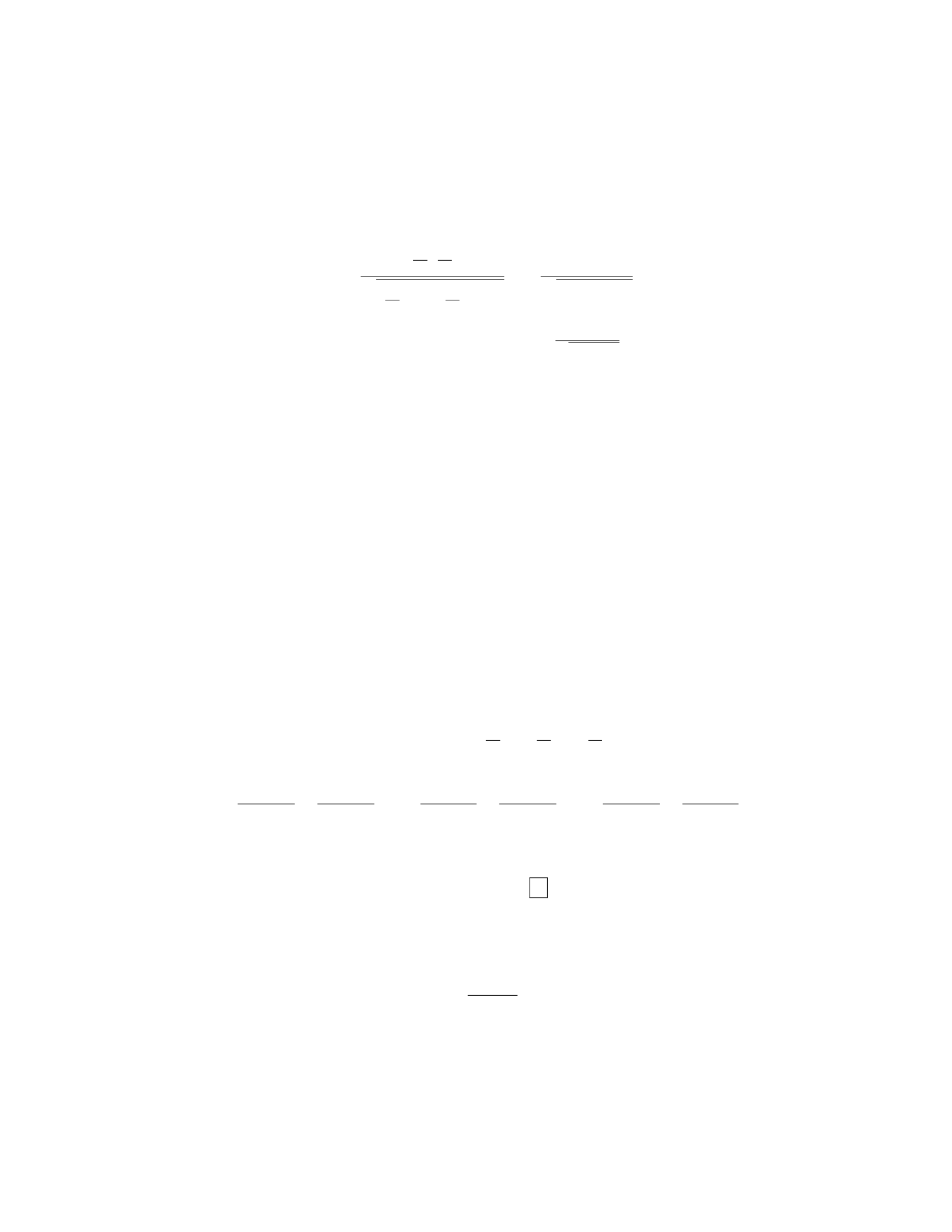
Step 2: Calculate the surface integral by finding the unit normal vector to
S. The unit normal vector to the surface Sis given by
n=±−∂z
∂x ,∂z
∂y ,1
r∂z
∂x 2+∂z
∂y 2+ 1
=±(−x, −y, 1)
px2+y2+ 1
We choose the positive unit normal vector, so n=1
√x2+y2+1 (−x, −y, 1).
Step 3: Calculate the flux of Facross the boundary curve of Susing Stokes’
Theorem. The flux is given by
ZZS
(∇ × F)·dS=ZZS
0·ndS = 0
Question 23
Question
Let Sbe the part of the plane z= 2x+3ythat lies inside the cylinder x2+y2= 1
and above the xy-plane. Use Stokes’ Theorem to evaluate RRScurl(F)·dS, where
F= (y+z, x +z, x +y).
Solution
Step 1: Find the normal vector nThe normal vector for the plane z= 2x+ 3y
is n=grad(z) = (2,3,−1).
Step 2: Compute the curl of FThe curl of Fis given by:
curl(F) = ∇ × F=
i j k
∂
∂x
∂
∂y
∂
∂z
y+z x +z x +y
=∂(x+y)
∂y −∂(x+z)
∂z i−∂(y+z)
∂x −∂(x+y)
∂z j+∂(x+z)
∂x −∂(y+z)
∂y k
= (1 −1)i−(1 −1)j+ (1 −1)k=0
Since the curl of Fis 0, the integral RRScurl(F)·dSis also 0.
Therefore, the value of the given integral is 0.
Question 24
Question
Let Sbe the surface of the cone z=px2+y2bounded by the plane z= 3. Use
Stokes’ Theorem to evaluate the flux of the curl of the vector field F= (y2, x, z)
across S.
20

Solution
Step 1: We first compute the curl of the vector field F:
∇ × F=
i j k
∂
∂x
∂
∂y
∂
∂z
y2x z
= (1,−1,2y−x)
Step 2: Next, we parameterize the cone Susing the surface parameterization:
r(u, v) = (ucos v, u sin v, u)
where 0≤u≤3and 0≤v≤2π.
Step 3: Compute the cross product ru×rv:
ru= (cos v, sin v, 1),rv= (−usin v, u cos v, 0)
ru×rv=
i j k
cos vsin v1
−usin v u cos v0
= (−ucos v, −usin v, u)
Step 4: Calculate the unit normal vector to the surface S:
n=ru×rv
∥ru×rv∥=(−ucos v, −usin v, u)
√u2+u2=−cos v
√2,−sin v
√2,1
√2
Step 5: Finally, we apply Stokes’ Theorem:
ZZS
(∇ × F)·ndS =ZZD
(∇ × F)·(ru×rv)du dv
=ZZD
(1,−1,2y−x)·(−ucos v, −usin v, u)du dv
Step 6: After simplifying, we integrate over the region D:
=ZZD
(−ucos v+usin v+ 2usin v−ucos v)du dv =ZZD
usin v du dv
=Z2π
0Z3
0
usin v du dv =Z2π
03
2sin v2π
0
dv =Z2π
0
0dv = 0
Therefore, the flux of the curl of Facross the surface Sis 0.
Question 25
Question
Let Sbe the surface of the portion of the paraboloid z=x2+y2that lies above
the disk x2+y2≤4, oriented upwards, and let F(x, y, z)=(x2, y2, z2). Use
Stokes’ Theorem to evaluate the surface integral RRScurl(F)·dS.
21
Solution
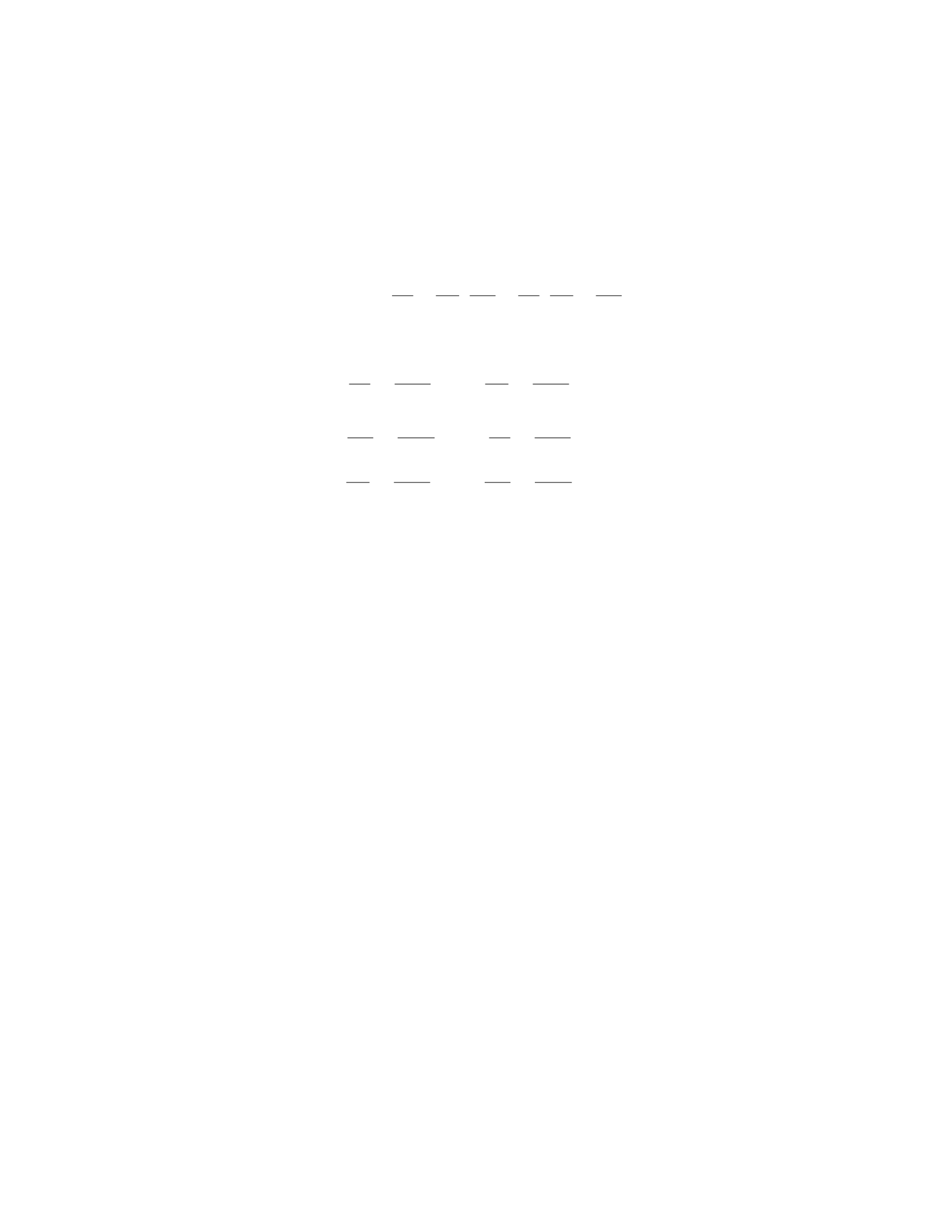
Step 1: Compute the curl of F: The curl of a vector field F(x, y, z) = (M, N, P )
is given by
curl(F) = ∂P
∂y −∂N
∂z ,∂M
∂z −∂P
∂x ,∂N
∂x −∂M
∂y .
In this case, F(x, y, z) = (x2, y2, z2), so M=x2,N=y2, and P=z2. We have:
∂P
∂y =∂(z2)
∂y = 0,∂N
∂z =∂(y2)
∂z = 0,
∂M
∂z =∂(x2)
∂z = 0,∂P
∂x =∂(z2)
∂x = 0,
∂N
∂x =∂(y2)
∂x = 0,∂M
∂y =∂(x2)
∂y = 0.
Thus, the curl of Fis curl(F) = (0,0,0).
Step 2: Using Stokes’ Theorem, we have
ZZS
curl(F)·dS=IC
F·dr,
where Cis the boundary curve of the surface Swith the positive orientation. In
this case, the boundary of the surface Sis the circle x2+y2= 4 in the xy-plane.
Step 3: Parameterize the boundary curve C: Let Cbe parameterized by
r(t) = (2 cos t, 2 sin t, 2 cos2t+ 2 sin2t) = (2 cos t, 2 sin t, 4),
where 0≤t≤2π.
Step 4: Calculate F(r(t)) and r′(t):
F(r(t)) = F(2 cos t, 2 sin t, 4) = (4 cos2t, 4 sin2t, 16),
r′(t) = (−2 sin t, 2 cos t, 0).
Step 5: Compute the line integral:
IC
F·dr=Z2π
0
F(r(t)) ·r′(t)dt.
Substitute F(r(t)) and r′(t)into the integral, simplify, and compute the integral
to find the final answer.
22

Step 4: The unit normal vector nto the xy-plane is k.
Step 5: Since the surface Sis the disk Din the xy-plane, its outward normal
vector nis also k.
Step 6: Therefore, the line integral becomes
IC
F·dr=ZZS
G·kdS
ZZS
2(y−x)dS
Step 7: We can set up the double integral in polar coordinates as follows:
ZZS
2(y−x)dS =Z2π
0Z1
0
2(rsin θ−rcos θ)r drdθ
Step 8: Solving the double integral, we get
Z2π
0−1
3dθ =−2π
3
Step 9: Therefore, the value of the line integral is −2π
3.
Question 3
Question
Let Fbe a vector field defined by F(x, y, z) = (x2+yz)i+ (y2+zx)j, and
let Sbe the surface of the region bounded by the plane z= 0 and the cone
z=px2+y2. Calculate the surface integral R RSF·dSusing Stoke’s Theorem.
Solution
Step 1: We first find the curl of the vector field F.
curl(F) = ∇ × F=
i j k
∂
∂x
∂
∂y
∂
∂z
x2+yz y2+zx 0
Step 2: Computing the determinant, we have:
curl(F) = 0−∂
∂y (0)i−∂
∂x(0) −∂
∂z (x2+yz)j+∂
∂y (y2+zx)−∂
∂x(0)k
Step 3: Simplifying, we get:
curl(F) = −zj+zk
2

Step 4: Then, the surface integral becomes:
Z ZS
F·dS=Z Z curl(F)·dS=ZZZdiv(curl(F)) dV
Step 5: Since div(curl(F)) = 0 for all vector fields, we have:
Z ZS
F·dS= 0
Question 4
Question
Let Sbe the surface of the part of the plane x+y+z= 1 that lies in the
first octant. Let Fbe the vector field defined by F(x, y, z)=(x2, y2, z2). Use
Stokes’ Theorem to evaluate the surface integral RRScurl(F)·ndS, where nis
the outward-pointing unit normal to S.
Solution
Step 1: Parameterize the surface Susing two variables xand y.
Since x+y+z= 1 and the surface Slies in the first octant, we can param-
eterize Sas:
r(x, y) = (x, y, 1−x−y),for 0≤x≤1,0≤y≤1−x
Step 2: Calculate the curl of the vector field F.
The curl of F(x, y, z) = (x2, y2, z2)is given by:
curl(F) = ∂F3
∂y −∂F2
∂z ,∂F1
∂z −∂F3
∂x ,∂F2
∂x −∂F1
∂y
= (0 −2y, 0−2z, 0−2x) = (−2y, −2z, −2x)
Step 3: Calculate the outward-pointing unit normal n.
The unit normal vector nis given by:
n=r
x×ry|rx×ry|
where, rx= (1,0,−1),ry= (0,1,−1).
n=(1,0,−1) ×(0,1,−1)
|(1,0,−1) ×(0,1,−1)|=(−1,1,1)
√3
Step 4: Calculate the surface integral using Stokes’ Theorem.
We have:
ZZS
curl(F)·ndS =ZZD
(curl(F)·(rx×ry)) dA
where Dis the projection of surface Sonto the xy-plane.
Now, Dis a triangle in the xy-plane with vertices at (0,0),(1,0), and (0,1).
Evaluating the surface integral on Dwill give the final answer.
3
Question 5
Question
Let F=⟨x2, y2, z2⟩be a vector field, and let Sbe the surface of the solid region
enclosed by the paraboloid z= 4 −x2−y2and the plane z= 0. Calculate the
flux of Facross Susing Stokes’ Theorem.
Solution
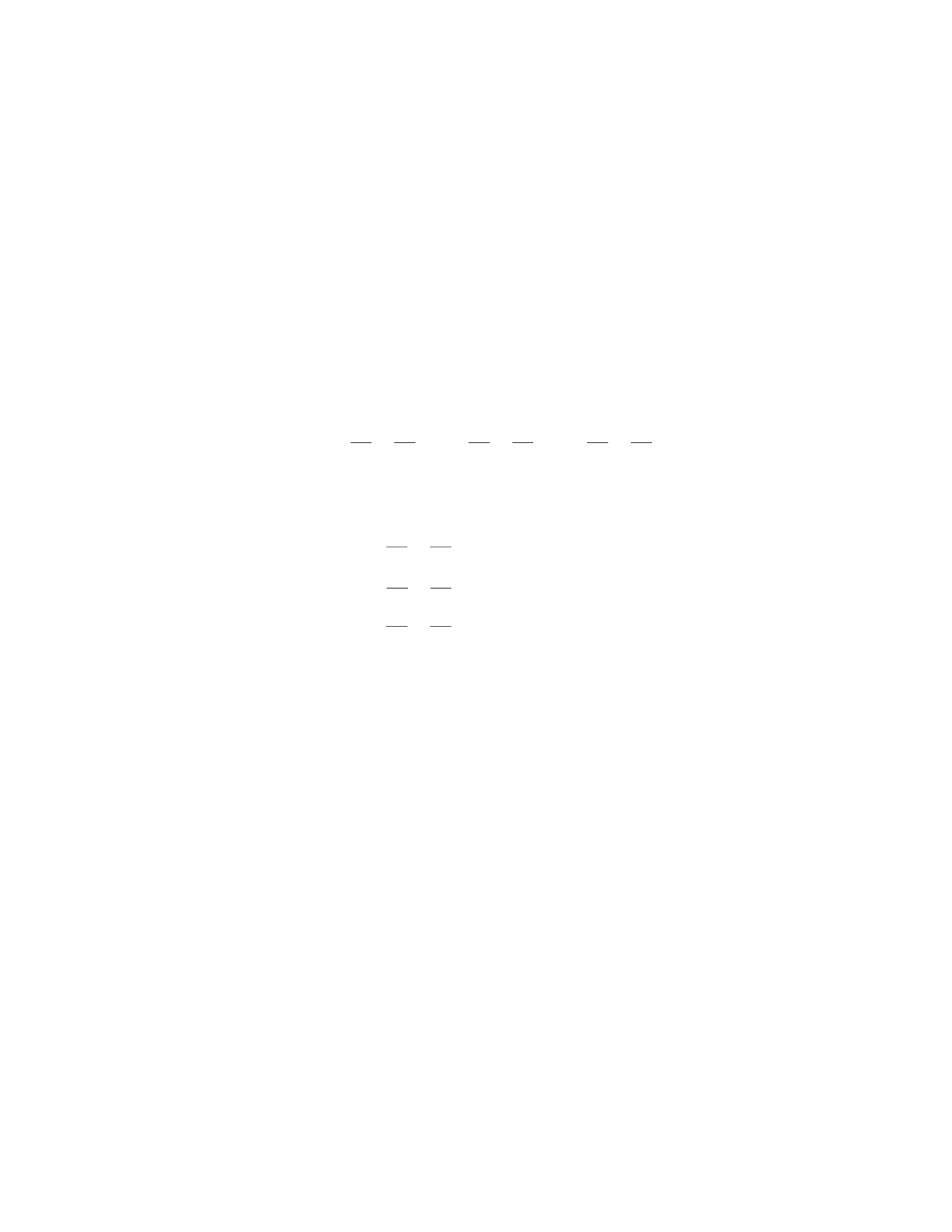
Step 1: To use Stokes’ Theorem, we need to find the curl of F. The curl of a
vector field F=⟨P, Q, R⟩is given by
∇ × F=∂R
∂y −∂Q
∂z i+∂P
∂z −∂R
∂x j+∂Q
∂x −∂P
∂y k
In this case, F=⟨x2, y2, z2⟩, so P=x2,Q=y2, and R=z2. Calculating
the partial derivatives:
∂R
∂y −∂Q
∂z = 2z−0 = 2z
∂P
∂z −∂R
∂x = 0 −2x=−2x
∂Q
∂x −∂P
∂y = 0 −2y=−2y
So, the curl of Fis ∇ × F= (2z)i+ (−2x)j+ (−2y)k.
Step 2: Next, we need to find the surface normal vector nto S. Since S
is the closed surface enclosing the solid region, the outward unit normal vector
is given by −∇h, where h(x, y, z) = z−(4 −x2−y2). Thus, n=−∇h=
⟨−(−2x),−(2y),1⟩=⟨2x, 2y, 1⟩.
Step 3: Now, we can apply Stokes’ Theorem, which states:
ZZS
(∇ × F)·dS=IC
F·dr
where Cis the boundary curve of S. Since Sis the solid region enclosed by the
paraboloid and the plane z= 0, the boundary curve Cconsists of the paraboloid
and the circle in the xy plane corresponding to z= 0.
Step 4: Calculate the surface integral:
ZZS
(∇ × F)·dS=ZZS
(2z)i+ (−2x)j+ (−2y)k·(2x, 2y, 1) dA
=ZZS
2z(2x)+(−2x)(2y)−2y dA
=ZZS
4xz −4xy −2y dA
4

Step 5: Since the equation of the paraboloid is z= 4 −x2−y2, we can
rewrite the integral in terms of xand y:
ZZS
(4x(4 −x2−y2)−4xy −2y)dA
Step 6: Integration can be challenging in this case due to the complexity
of the integrand. The solution will require careful algebraic manipulation to
simplify the expression before performing the integration.
Question 6
Question
Let Sbe the part of the plane z= 4−x−ythat lies inside the cylinder x2+y2= 4.
Use Stokes’ Theorem to evaluate RRS(∇×F)·ds, where F(x, y, z) = yi+zj+xk.
Solution
Step 1: Find the normal vector to S.
The surface Sis described by the function z= 4 −x−y. To find the normal
vector to S, we compute ∇f=D−∂f
∂x ,−∂f
∂y ,1E.
So, ∇f=⟨−1,−1,1⟩.
Step 2: Compute ∇ × F.
Given F(x, y, z) = yi+zj+xk,∇ × F=
i j k
∂
∂x
∂
∂y
∂
∂z
y z x
.
Solving this expression, we get ∇ × F=i−j−k.
Step 3: Find the parametric representation of S.
Let x=rcos θ,y=rsin θ,z= 4 −rcos θ−rsin θ. We have rranging from
0 to 2 and θranging from 0 to 2π.
Then, rcos θ,rsin θ, and 4−rcos θ−rsin θare the parametric equations
for S.
Step 4: Compute the surface integral.
RRS(∇ × F)·ds =R2π
0R2
0⟨1,−1,−1⟩ · ⟨−rsin θ, r cos θ, −rsin θ−rcos θ⟩ ·
r dr dθ.
After carrying out the dot product and integrating, the solution is obtained.
Question 7
Question
Let Sbe the part of the cone z=px2+y2that lies above the plane z= 1.
Use Stokes’ Theorem to evaluate the surface integral RRS(∇ × F)·dS, where
F= (y2−z2, xz, yz)and Sis oriented outward.
5

Solution
To apply Stokes’ Theorem, we need to find the curl of F, the area of S, and a
normal vector nto S.
Step 1: Calculate ∇ × F. The curl of Fis given by:
∇×F=
i j k
∂
∂x
∂
∂y
∂
∂z
y2−z2xz yz
= (∂(yz)
∂y −∂(xz)
∂z )i−(∂(y2−z2)
∂z −∂(yz)
∂x )j+(∂(y2−z2)
∂x −∂(y2)
∂y )k
Compute each partial derivative:
∂(yz)
∂y −∂(xz)
∂z =z−x,
∂(y2−z2)
∂z −∂(yz)
∂x =−2z−y,
∂(y2−z2)
∂x −∂(y2)
∂y = 0 −2y.
Thus, the curl of Fis:
∇ × F= (z−x)i−(2z+y)j−2yk.
Step 2: Find the area of S.The surface Sis the cone z=px2+y2
above the plane z= 1.
The area of Scan be found by calculating the surface area of the cone within
the range 1≤z≤px2+y2:
ZZS
dS =ZZD||n||dA,
where Dis the projection of Sonto the xy-plane and nis the unit normal vector
to Spointing outward.
Step 3: Apply Stokes’ Theorem. By Stokes’ Theorem, the surface
integral becomes the line integral over the boundary of S:
ZZS
(∇ × F)·dS=IC
F·dr,
where Cis the boundary curve of S.
Unfortunately, Slies outside the scope of Stokes’ Theorem, as it is not a
single surface but rather a part of a surface. Thus, Stokes’ Theorem cannot be
applied directly in this case.
Question 8
Question
Let Sbe the part of the plane z= 16 −x−2ythat lies inside the cylinder
x2+y2= 1. Calculate the flux of the vector field F=⟨y, x, z⟩across the
surface S(oriented outward).
6
Solution
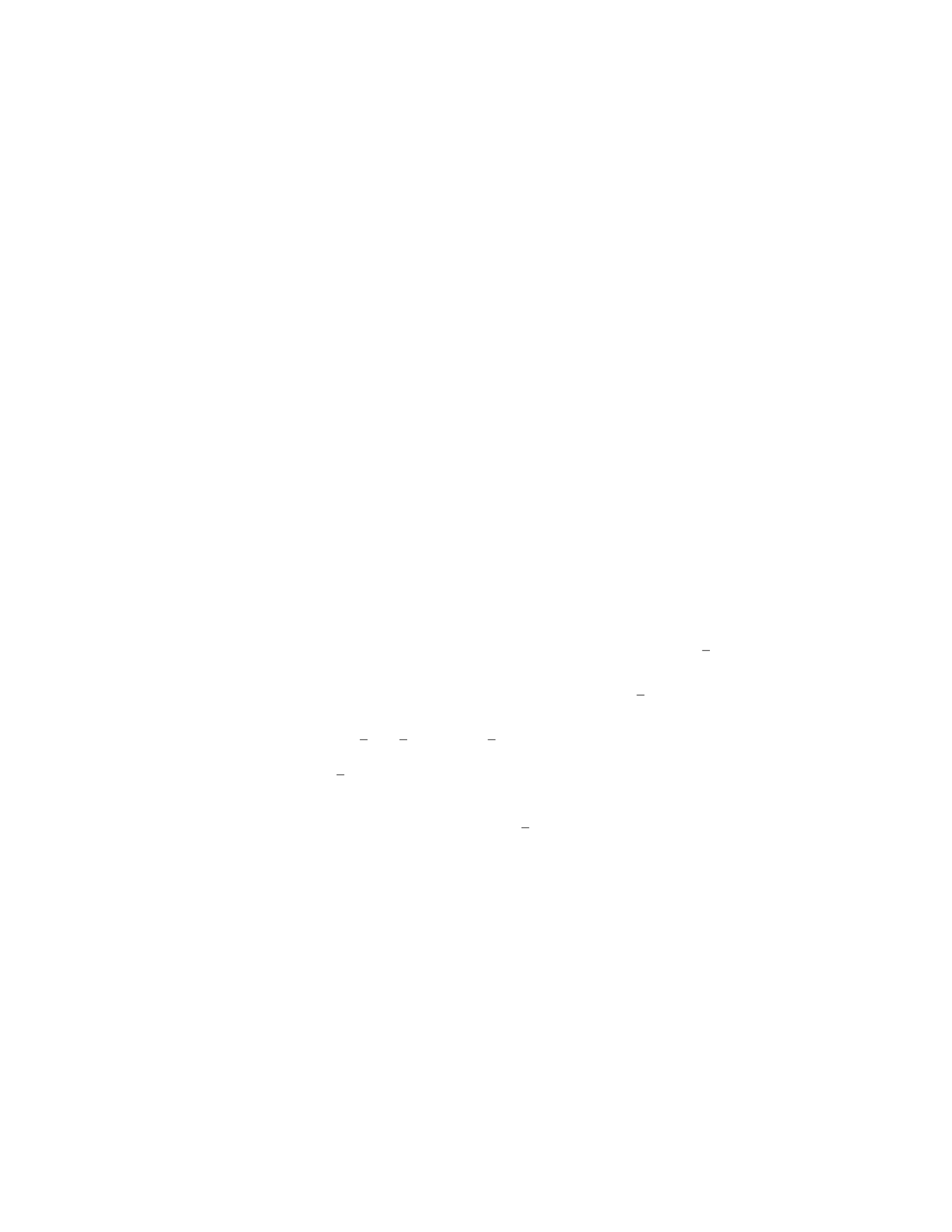
To compute the flux of Facross S, we will use Stokes’ Theorem, which relates
surface integrals to line integrals. Stokes’ Theorem states that the flux of a
vector field Facross a surface Sis equal to the line integral of the vector field
around the boundary curve of S, oriented in the positive direction.
Step 1: Find the normal vector to the surface S.
The surface Sis defined by z= 16 −x−2y. The normal vector to Sis given
by n=∇z=⟨−1,−2,1⟩.
Step 2: Determine the orientation of the boundary curve of S.
The boundary curve of Sis the circle defined by x2+y2= 1. Since the
normal vector npoints outward and the cylinder is oriented counterclockwise
when viewed from above, the boundary curve of Sis oriented counterclockwise
as well.
Step 3: Calculate the line integral of Faround the boundary curve of S.
The line integral is given by
IC
F·dr=ZC
F·Tds
where Tis the unit tangent vector to the curve and ds is the arc length differ-
ential.
Since F=⟨y, x, z⟩and the curve is the unit circle, C:x= cos(t), y =
sin(t), z = 16 −cos(t)−2 sin(t)with 0≤t≤2π, we have
IC
F·dr=Z2π
0⟨sin(t),cos(t),16 −cos(t)−2 sin(t)⟩ · ⟨−sin(t),cos(t),√5⟩dt
=Z2π
0−sin2(t) + cos2(t) + (16 −cos(t)−2 sin(t))√5dt
=Z2π
0
16√5−√5 cos(t)−2√5 sin(t)dt
= 32π√5.
Step 4: State the final result.
The flux of Facross the surface Sis 32π√5.
Question 9
Question
Let Sbe the part of the surface z=x2−y2that lies above the square 0≤
x≤1,0≤y≤1. Calculate the flux of the curl of the vector field F=
(x2yz, −xz2, xy2z)through Sin the positive z-direction.
7
Solution
Step 1: Calculate the curl of the vector field F. The curl of F= (P, Q, R)is
given by
∇ × F=
i j k
∂
∂x
∂
∂y
∂
∂z
P Q R
where P=x2yz,Q=−xz2, and R=xy2z. Therefore,
∇ × F=∂R
∂y −∂Q
∂z ,∂P
∂z −∂R
∂x ,∂Q
∂x −∂P
∂y .
Calculating the partial derivatives, we get
∇ × F= (z−y2,2xy, x −z).
Step 2: Calculate the outward unit normal vector to the surface S. Since
the surface is given by z=x2−y2, the normal vector is given by
N=−∂z
∂x,−∂z
∂y ,1= (−2x, 2y, 1).
Step 3: Calculate the flux of the curl of Fthrough Sin the positive z-
direction. The flux is given by the surface integral
ZZS∇ × F·NdS.
Note that dS points in the direction of N, so we consider only the z-component
of the curl of Fi.e., x−z. Thus, the flux integral reduces to
ZZS
(x−z)dS.
Step 4: Parametrize the surface S. Parametrizing the surface with x=u,
y=v, and z=u2−v2, where 0≤u≤1and 0≤v≤1, we have the surface
integral
ZZS
(u−(u2−v2))
∂r
∂u ×∂r
∂v
du dv,
where r(u, v) = (u, v, u2−v2)is the position vector of the surface.
Step 5: Compute the cross product and its magnitude. The cross product
∂r
∂u ×∂r
∂v is
i j k
1 0 2u
0 1 −2v
= (2v, 2u, 1).
The magnitude of this vector is p12+ (2u)2+ (2v)2=√1+4u2+ 4v2=
p1 + 4(u2+v2) = p1+4|r(u, v)|2.
Step 6: Evaluate the surface integral. Substituting all relevant values and
simplifying, we have
Z1
0Z0
8
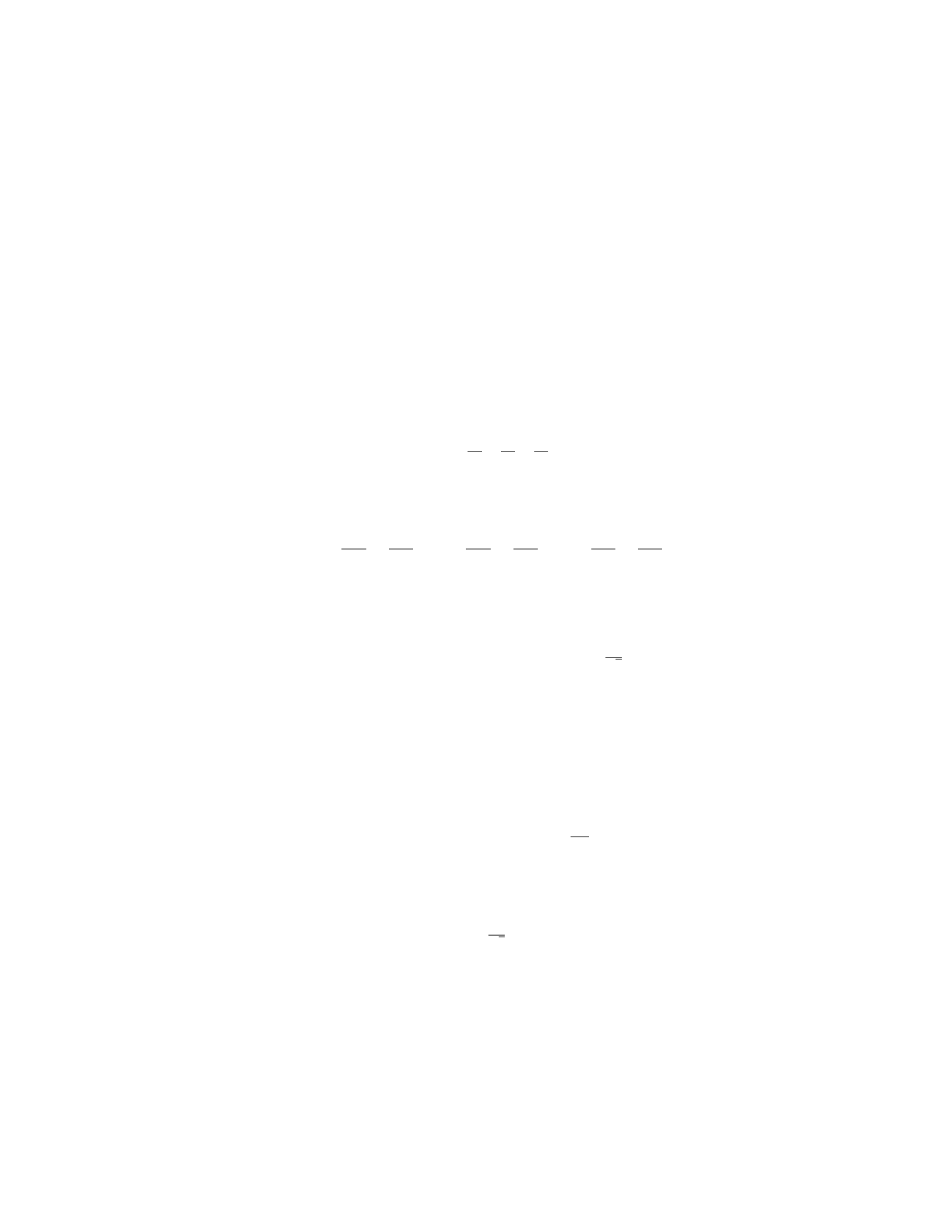
Question 10
Question
Let Sbe the portion of the plane z= 2 −x−ythat lies above the square
0≤x≤1,0≤y≤1. Use Stokes’ Theorem to evaluate HCF·dr, where
F(x, y, z) = ⟨y2, z2, x2⟩,Cis the boundary curve of Soriented counterclockwise
when viewed from above, and Sis oriented with upward-pointing normal vector.
Solution
Step 1: Calculate ∇ × F. The curl of Fis given by:
∇ × F=
i j k
∂
∂x
∂
∂y
∂
∂z
y2z2x2
Expanding the determinant, we have:
∇ × F=∂x2
∂y −∂z2
∂z i−∂x2
∂x −∂y2
∂z j+∂y2
∂x −∂z2
∂y k
= (−2)i−(−2)j+ 0k=−2i+ 2j
Step 2: Determine the unit normal vector to S. The normal vector to the
plane z= 2 −x−yis n=⟨−1,−1,1⟩. Since Sis oriented with an upward-
pointing normal vector, the unit normal vector is n/|n|=1
√3⟨−1,−1,1⟩.
Step 3: Calculate the line integral over the boundary curve C. By Stokes’
Theorem, we have: IC
F·dr =ZZS
(∇ × F)·dS
where dS=ndS.
Step 4: Find the surface integral of ∇ × Fover S. Since Sis a portion of a
plane, the surface integral over Scan be calculated as:
ZZS
(∇ × F)·dS=ZZD
(∇ × F)·n
|n|dA
where Dis the projection of Sonto the xy-plane. In this case, Dis the square
0≤x≤1,0≤y≤1.
Step 5: Calculate the surface integral by substituting the values of ∇×Fand
n. We have RRS(∇×F)·dS=RRD⟨−2,2⟩· 1
√3⟨−1,−1⟩dA =RRD(−2+2) dA = 0.
Therefore, HCF·dr = 0.
9

Question 11
Question
Let Sbe the part of the cone z=px2+y2that lies inside the cylinder x2+
y2= 1, oriented outward. Use Stokes’ Theorem to evaluate the surface integral
RRS(∇ × F)·dS, where F(x, y, z) = (xy2, xz, yz).
Solution
Step 1: Calculate the curl of the vector field F:
∇ × F=
i j k
∂
∂x
∂
∂y
∂
∂z
xy2xz yz
=∂(yz)
∂y −∂(xz)
∂z i−∂(xy2)
∂x −∂(yz)
∂z j+∂(xy2)
∂x −∂(xz)
∂y k
= (z−0)i−(y2−0)j+ (2xy −0)k= (z, −y2,2xy)
Step 2: Determine the unit normal vector to the surface S: The unit normal
vector to the surface Sis given by N=∂z
∂x ,∂z
∂y ,−1.
Since z=px2+y2, we have ∂z
∂x =x
√x2+y2and ∂z
∂y =y
√x2+y2.
Therefore, the unit normal vector Nis x
√x2+y2,y
√x2+y2,−1.
Step 3: Compute the surface integral using Stokes’ Theorem: By Stokes’
Theorem, the surface integral can be written as:
ZZS
(∇ × F)·dS=IC
F·dr
where Cis the boundary curve of surface S.
We can parameterize the boundary curve Cas r(t) = (cos(t),sin(t),qcos2(t) + sin2(t)) =
(cos(t),sin(t),1), where 0≤t≤2π.
Then, dr= (−sin(t)dt, cos(t)dt, 0).
Substitute these into the line integral formula:
IC
F·dr=Z2π
0
F(r(t)) ·r′(t)dt
=Z2π
0
(y2cos(t) sin(t),cos(t)qcos2(t) + sin2(t),sin(t)qcos2(t) + sin2(t))·(−sin(t),cos(t),0)dt
10

=Z2π
0
(−sin(t) cos(t) sin(t)+cos(t)√1,−cos(t) sin(t)+sin(t)√1,0)·(−sin(t),cos(t),0)dt
=Z2π
0
(0 + cos(t),
Question 12
Question
Let Sbe the surface bounded by the cylinder x2+y2= 4 and the planes z= 0
and z= 3. Calculate the flux of the vector field F(x, y, z) = (y2,−xz, yz)across
the surface Soriented outwards using Stokes’ Theorem.
Solution
Step 1: First, we need to parameterize the surface S. Let’s choose cylindrical
coordinates, where x= 2 cos(θ)and y= 2 sin(θ).
Step 2: The unit normal vector to the surface Sis given by n=∂x
∂θ ×∂y
∂θ ·k.
Computing the cross product and simplifying, we get n= (−2 sin(θ),2 cos(θ),0).
Step 3: The flux of Facross Scan be computed as the surface integral
RRS(∇ × F)·ndS. Let’s first find ∇ × F.
Step 4: We have F(x, y, z) = (y2,−xz, yz). Calculating the curl of F, we get
∇ × F= (0, z + 2,−y).
Step 5: Now, we can compute the surface integral. We have RRS(∇ × F)·
ndS =RRD(∇ × F)·ndA, where Dis the projection of Son the xy-plane.
Step 6: The projection of Son the xy-plane is the circle with radius 2.
Hence, the bounds of integration are 0≤θ≤2π.
Step 7: Substituting the values of ∇ × Fand n, we get the integral to be
R2π
0R2
0(−2 sin(θ) + 4 cos(θ)) rdrdθ.
Step 8: Evaluating the double integral, we find the flux of Facross Sto be
8π.
Question 13
Question
Let Sbe the portion of the plane z=x+ 2ythat lies inside the cylinder
x2+y2= 4 and z≤3. Let F(x, y, z) = (x+y+z, x −y2, xy)and let ndenote
the unit normal vector to Sthat points upward. Calculate the flux of Facross
Susing Stokes’ Theorem.
11

Solution
Step 1: First, we need to parameterize the boundary curve of Swhich is the
circle Cdefined by x2+y2= 4. Let Cbe given by the parameterization
r(t) = (2 cos t, 2 sin t, 2 cos t+ 4 sin t)where 0≤t≤2π.
Step 2: Next, we find the curl of F. The curl of Fis given by ∇ × F=
∂Q
∂y −∂P
∂z ,∂R
∂z −∂P
∂x ,∂P
∂y −∂Q
∂x , where F(x, y, z) = (P, Q, R).
Step 3: Calculating the curl, we have
∇ × F= (1 −1,0−1,1−1) = (0,−1,0).
Step 4: Now we can apply Stokes’ Theorem, which states
ZZS
(∇ × F)·ndS =IC
F·dr.
Step 5: We compute the line integral over Cusing the parameterization r(t),
IC
F·dr=Z2π
0
F(r(t)) ·r′(t)dt.
Step 6: Substituting in the values we get
IC
F·dr=Z2π
0
(6 cos t−2 sin2t)(−2 sin t, 2 cos t, 2 cos t+ 4 sin t)dt.
Step 7: Evaluating this line integral would give us the flux of Facross S.
Question 14
Question
Let Sbe the part of the surface z=x2+y2in the first octant enclosed by the
planes z= 0,z= 4,x= 0, and y= 0. Use Stokes’ Theorem to evaluate the
surface integral RRS(zcos(x) + ysin(z)) ·dS counter-clockwise.
Solution
Step 1: We first parameterize the surface Susing the parameterization r(u, v) =
⟨u, v, u2+v2⟩for 0≤u≤2and 0≤v≤2. Then we compute the cross product
ru×rvto find the normal vector to the surface.
ru=⟨1,0,2u⟩and rv=⟨0,1,2v⟩
ru×rv=
i j k
102u
0 1 2v
=−2ui−2vj+k
So the unit normal vector is N=ru×rv
∥ru×rv∥=−2ui−2vj+k
√4u2+4v2+1 .
12
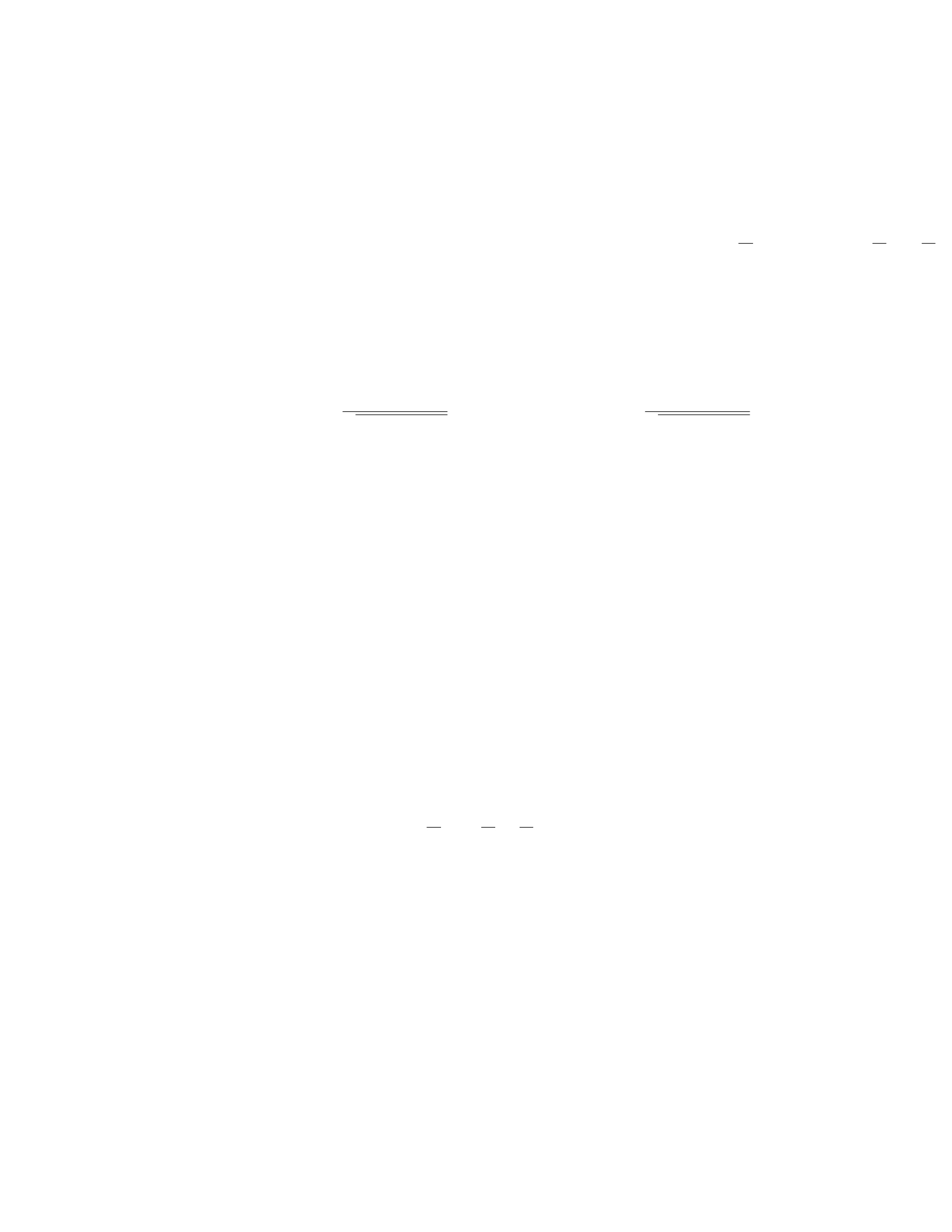
Step 2: Next, we compute the curl of the vector field F= (zcos(x) + ysin(z)) =
(u2+v2) cos(u)+vsinu2+v2i+0j+k. Since ∇×F=curl F=
i j k
∂
∂u
∂
∂v
∂
∂z
(u2+v2) cos(u) + vsinu2+v20u2+v2
,
we have ∇ × F=−2vcos(u)i−(2ucos(u) + sinu2+v2)j−k.
Step 3: Now, we integrate the dot product of Fand the unit normal vector
Nover the surface S.
ZZS
F·dS=ZZD
F·(ru×rv)dudv =ZZD
(∇ × F)·NdA
=ZZD−2vcos(u)−2u
√4u2+ 4v2+ 1 −(2ucos(u) + sinu2+v2)−2v
√4u2+ 4v2+ 1 + 0dA
Step 4: At this point, we evaluate the double integral over the region D=
{(u, v)|0≤u≤2,0≤v≤2}to find the final numerical result.
Question 15
Question
Let Sbe the surface given by z=x2+y2for 0≤z≤4. Use Stokes’ Theorem
to evaluate the line integral
ZC
F·dr
where F(x, y, z) = (x2+y2,−2y, z)and Cis the curve formed by the intersection
of the plane x+y+z= 2 with the plane y= 0 oriented counterclockwise when
viewed from above (i.e. when z > 2).
Solution
Step 1: Compute the curl of F:
curl F=
i j k
∂
∂x
∂
∂y
∂
∂z
x2+y2−2y z
= (0,2,2)
Step 2: Find the outward unit normal vector to the surface S={(x, y, z) :
z=x2+y2,0≤z≤4}.
The parametric equations for the surface Sare:
r(u, v) = (u, v, u2+v2)for (u, v)∈D={(u, v) : 0 ≤u≤2,0≤v≤2}
Therefore, ru= (1,0,2u)and rv= (0,1,2v). The normal vector to the surface
is given by
N=ru×rv= (−2u, −2v, 1)
13

Normalizing N, we get
N=1
√1+4u2+ 4v2(−2u, −2v, 1)
Step 3: Compute the line integral over the curve C. We need to parametrize
the curve Cbased on the given information. The intersection of the plane
x+y+z= 2 with the plane y= 0 is the line z= 2 −x. Parametrizing this line,
we get r(t) = (t, 0,2−t)for 0≤t≤2. The tangent vector is r′(t) = (1,0,−1).
Step 4: Evaluate the line integral using Stokes’ Theorem. By Stokes’ Theo-
rem, we have ZC
F·dr=ZZS
curl F·NdS
where Nis the unit outward normal to the surface S. Substitute the given
values into the formula above:
=ZZD
0
2
2
·1
√1+4u2+ 4v2(−2u, −2v, 1)dA
Step 5: Simplify the integral and compute. The dot product simplifies to
4(2v+u)
√1+4u2+4v2. Therefore, the integral becomes
Z2
0Z2
0
4(2v+u)
√1+4u2+ 4v2dv du
Calculating this double integral will yield the value of the line integral.
Question 16
Question
Let Sbe the part of the plane z= 1−x−ythat lies above the square 0≤x≤1,
0≤y≤1. Use Stokes’ Theorem to evaluate the surface integral
ZZS
(∇ × F)·dS,
where F(x, y, z) = ⟨y2,−x2, z2⟩.
Solution
Step 1: Find the normal vector to the surface S. The normal vector to the
surface Sis given by N=⟨∂z
∂x ,∂z
∂y ,−1⟩=⟨−1,−1,−1⟩.
Step 2: Compute the curl of F. The curl of Fis given by ∇ × F=
i j k
∂
∂x
∂
∂y
∂
∂z
y2−x2z2
=⟨2z, 2z, 2y+ 2x⟩.
14

Step 3: Calculate RRS(∇ × F)·dS. We can express the surface integral as
ZZS
(∇ × F)·dS=ZZS⟨2z, 2z, 2y+ 2x⟩ · ⟨−1,−1,−1⟩dS.
Step 4: Determine the bounds for the surface integral. Since Slies above the
square 0≤x≤1,0≤y≤1, the bounds for the surface integral are 0≤x≤1
and 0≤y≤1.
Step 5: Evaluate the surface integral. Substitute the given values into the
integral to get
ZZS
(∇ × F)·dS=ZZ 1
0ZZ 1
0⟨2z, 2z, 2y+ 2x⟩ · ⟨−1,−1,−1⟩dydx.
This simplifies to
ZZS
(∇ × F)·dS=ZZ 1
0ZZ 1
0
(−4z−2y−2x)dydx.
Integrating with respect to yand then x, we find
ZZS
(∇ × F)·dS=Z1
0
[−2z−y−2x]1
0dx =Z1
0
(−2z−1−2x)dx.
Finally, integrating with respect to xgives
ZZS
(∇ × F)·dS=−2zx −x−x21
0=−3z−1.
Question 17
Question
Let Sbe the cone in R3bounded by the surface z=px2+y2over the region
x2+y2≤1. Use Stokes’ Theorem to evaluate the surface integral RRS∇×F·dS,
where F(x, y, z) = (y2, z2, x2).
Solution
Step 1: Calculate the curl of F. The curl of Fis given by
∇ × F=
i j k
∂
∂x
∂
∂y
∂
∂z
y2z2x2
= (2z−0,0−2x, 2y−2z) = (2z, −2x, 2(y−z))
Step 2: Parameterize the surface Sand find the normal vector. Let Sbe
parameterized by r(r, θ) = (rcos θ, r sin θ, r)for (r, θ)∈[0,1] ×[0,2π]. The
normal vector to Sis given by N=rr×rθ
∥rr×rθ∥.
15

Calculate rr= (cos θ, sin θ, 1) and rθ= (−rsin θ, r cos θ, 0). Then, N=
(cos θ, sin θ, −r).
Step 3: Calculate the dot product of ∇ × Fwith N. We have ∇ × F·N=
(2z, −2x, 2(y−z)) ·(cos θ, sin θ, −r) = 2zcos θ−2xsin θ+ 2(y−z)(−r).
Step 4: Set up and evaluate the surface integral. The surface integral RRS∇×
F·dScan be evaluated as
ZZS∇ × F·dS=Z2π
0Z1
0
(2zcos θ−2xsin θ+ 2(y−z)(−r)) r drdθ
Simplify the integrand and evaluate the integral to find the final answer.
Question 18
Question
Let Sbe the part of the plane z= 3 + x+ythat lies above the region in the xy-
plane bounded by the curves y=x2and y= 3−x2. Let F(x, y, z) = ⟨2z, 2x, −y⟩.
Use Stokes’ Theorem to compute the flux of Facross the boundary of S.
Solution
Step 1: Determine the normal vector to the surface S.
The normal vector to the surface Sis given by n=∇g
∥∇g∥, where g(x, y, z) = z−
3−x−y. Therefore, ∇g=⟨−1,−1,1⟩and ∥∇g∥=p(−1)2+ (−1)2+ 12=√3.
Thus, the unit normal vector is n=1
√3⟨−1,−1,1⟩.
Step 2: Calculate ∇ × F.
We have ∇ × F=
i j k
∂
∂x
∂
∂y
∂
∂z
2z2x−y
=⟨2,2,2⟩.
Step 3: Find the boundary curve Cin the xy-plane.
The boundary curve Cis the intersection of the surfaces z= 3 + x+yand
z= 0. Substituting z= 0 into z= 3 + x+y, we get 0 = 3 + x+y. Rearranging,
we have y=−x+ 3. The bounds of xover which Clies are −1≤x≤1.
Step 4: Evaluate the line integral HCF·dr.
Using Stokes’ Theorem, the flux of Facross the boundary of Sis given by the
line integral HCF·dr, where dr=⟨dx, dy⟩. We have:
HCF·dr=RRS(∇ × F)·ndS =RRS⟨2,2,2⟩ · 1
√3⟨−1,−1,1⟩dS
Step 5: Compute the flux.
This simplifies to 2
√3RRS(2 −2 + 2) dS =2
√3RRS2dS =4
√3Area(S).
To find the area of S, we need to integrate dA over the region bounded by
y=x2and y= 3 −x2. This becomes:
Area(S) = R1
−1R3−x2
x2dy dx
Now, we compute the integral to find the final answer.
16

Question 19
Question
Let Sbe the part of the paraboloid z= 4 −x2−y2that lies above the plane
z= 2, oriented upward. Use Stokes’ Theorem to evaluate the surface integral
RRS(∇ × F)·dS, where F(x, y, z) = (x2+y2)i+ (y2−z)j+ (z2+y)k.
Solution
Step 1: Compute ∇ × F. The curl is given by:
∇ × F=
i j k
∂
∂x
∂
∂y
∂
∂z
x2+y2y2−z z2+y
∇×F=∂(z2+y)
∂y −∂(y2−z)
∂z i−∂(z2+y)
∂x −∂(x2+y2)
∂z j+∂(y2−z)
∂x −∂(x2+y2)
∂y k
∇ × F= (−1−1)i−(−2x)j−(−2y)k=−2i+ 2xj+ 2yk
Step 2: Use Stokes’ Theorem to evaluate the surface integral. Stokes’
Theorem states: ZZS
(∇ × F)·dS=IC
F·dr
where HCF·drrepresents the line integral of Faround the boundary curve C
of the surface S.
The boundary curve C corresponds to the intersection of the paraboloid and
the plane, which is a circle centered at the origin with radius √2.
Therefore, the line integral becomes:
IC
F·dr=IC
((x2+y2)i+ (y2−z)j+ (z2+y)k)·(dxi+dyj)
=IC
(x2+y2)dx + (y2−z)dy =IC
r2dθ
Since the curve is a circle with radius √2, the line integral simplifies to:
=Z2π
0
(√2)2dθ
= 4π
Therefore, the surface integral RRS(∇×F)·dSusing Stokes’ Theorem is 4π.
17

Question 20
Question
Let Sbe the part of the paraboloid z=x2+y2that lies below the plane z= 1
oriented upward. Use Stokes’ Theorem to evaluate the circulation of the vector
field F(x, y, z) = (y+z, x +z, x +y)around the boundary curve of S.
Solution
Step 1: First, we need to find the boundary curve of the surface S, denoted by
C, which is the intersection of the paraboloid z=x2+y2and the plane z= 1.
Setting z= 1 in the equation of the paraboloid, we have 1 = x2+y2.
This represents a circle in the xy-plane with radius 1 centered at the origin.
Therefore, the boundary curve Cis the circle x2+y2= 1.
Step 2: The normal vector of the surface Sis given by n=−∂f
∂x ,−∂f
∂y ,1,
where f(x, y, z) = x2+y2−z. Calculating the partial derivatives, we have
∂f
∂x = 2x,∂f
∂y = 2y. Therefore, n= (−2x, −2y, 1).
Step 3: We can now compute the curl of the vector field F(x, y, z) = (y+
z, x +z, x +y):
∇×F=
i j k
∂
∂x
∂
∂y
∂
∂z
y+z x +z x +y
=∂
∂y (x+y)−∂
∂z (x+z),∂
∂z (y+z)−∂
∂x(x+y),∂
∂x(x+z)−∂
∂y (y+z)
= (1 −1,1−1,1−1) = (0,0,0)
Step 4: Finally, we can use Stokes’ Theorem which states that the circulation
of a vector field around a closed curve is equal to the surface integral of the curl
of the vector field over the surface. Since the curl of Fis zero, the circulation
of Faround Cis 0.
Question 21
Question
Let F= (x2+y2+z2)i+yzj+xzkbe a vector field in R3.
Consider the surface Sgiven by the part of the paraboloid z=x2+y2that
lies between the planes z= 0 and z= 1.
Use Stokes’ Theorem to evaluate RRScurl(F)·dS.
Solution
• The curl of the vector field Fis given by:
curl(F) = ∇ × F=
i j k
∂
∂x
∂
∂y
∂
∂z
x2+y2+z2yz xz
= (2z−x)i+zj+ (2x−y)k
18

• The orientation of the surface Sis given by the outward-pointing normal
vector n=−∇z=−i−j−2zk.
• The boundary curve Cof the surface Sis the circle in the xy-plane given by
x2+y2= 1. Parametrize this curve as r(t) = cos ti+ sin tjfor 0≤t≤2π.
• Using Stokes’ Theorem, we have:
ZZS
curl(F)·dS=IC
F·dr=Z2π
0
F(r(t)) ·r′(t)dt
• Now, we evaluate this line integral:
(r(t)) ·r′(t)dt
=R2π
0(cos2t+ sin2t)·i+ sin t·cos t·j+ cos t·sin t·k·(−sin ti+ cos tj)dt
=R2π
0(−cos tsin t+ sin tcos t+ 0) dt
=R2π
00dt
= 0
Question 22
Question
Let Sbe the part of the cone z=px2+y2that lies below the plane z= 1
oriented upward. Using Stokes’ Theorem, calculate the flux of the vector field
F=x2i+y2j+z2kacross the boundary curve of S.
Solution
Step 1: Calculate the curl of the vector field F.
∇ × F=
i j k
∂
∂x
∂
∂y
∂
∂z
x2y2z2
=∂z2
∂y −∂y2
∂z i−∂z2
∂x −∂x2
∂z j+∂y2
∂x −∂x2
∂y k
= (0 −0)i−(0 −0)j+ (0 −0)k=0
19
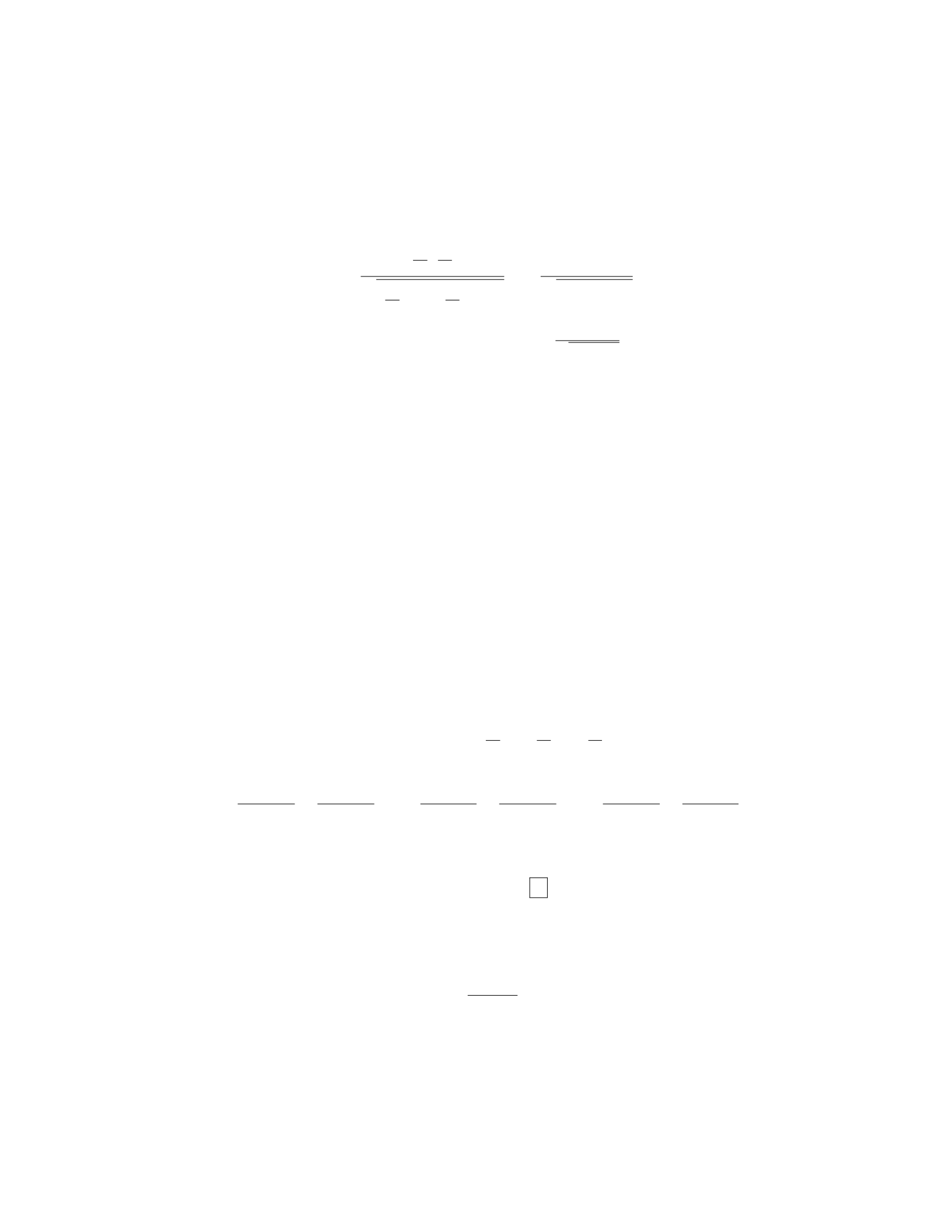
Step 2: Calculate the surface integral by finding the unit normal vector to
S. The unit normal vector to the surface Sis given by
n=±−∂z
∂x ,∂z
∂y ,1
r∂z
∂x 2+∂z
∂y 2+ 1
=±(−x, −y, 1)
px2+y2+ 1
We choose the positive unit normal vector, so n=1
√x2+y2+1 (−x, −y, 1).
Step 3: Calculate the flux of Facross the boundary curve of Susing Stokes’
Theorem. The flux is given by
ZZS
(∇ × F)·dS=ZZS
0·ndS = 0
Question 23
Question
Let Sbe the part of the plane z= 2x+3ythat lies inside the cylinder x2+y2= 1
and above the xy-plane. Use Stokes’ Theorem to evaluate RRScurl(F)·dS, where
F= (y+z, x +z, x +y).
Solution
Step 1: Find the normal vector nThe normal vector for the plane z= 2x+ 3y
is n=grad(z) = (2,3,−1).
Step 2: Compute the curl of FThe curl of Fis given by:
curl(F) = ∇ × F=
i j k
∂
∂x
∂
∂y
∂
∂z
y+z x +z x +y
=∂(x+y)
∂y −∂(x+z)
∂z i−∂(y+z)
∂x −∂(x+y)
∂z j+∂(x+z)
∂x −∂(y+z)
∂y k
= (1 −1)i−(1 −1)j+ (1 −1)k=0
Since the curl of Fis 0, the integral RRScurl(F)·dSis also 0.
Therefore, the value of the given integral is 0.
Question 24
Question
Let Sbe the surface of the cone z=px2+y2bounded by the plane z= 3. Use
Stokes’ Theorem to evaluate the flux of the curl of the vector field F= (y2, x, z)
across S.
20

Solution
Step 1: We first compute the curl of the vector field F:
∇ × F=
i j k
∂
∂x
∂
∂y
∂
∂z
y2x z
= (1,−1,2y−x)
Step 2: Next, we parameterize the cone Susing the surface parameterization:
r(u, v) = (ucos v, u sin v, u)
where 0≤u≤3and 0≤v≤2π.
Step 3: Compute the cross product ru×rv:
ru= (cos v, sin v, 1),rv= (−usin v, u cos v, 0)
ru×rv=
i j k
cos vsin v1
−usin v u cos v0
= (−ucos v, −usin v, u)
Step 4: Calculate the unit normal vector to the surface S:
n=ru×rv
∥ru×rv∥=(−ucos v, −usin v, u)
√u2+u2=−cos v
√2,−sin v
√2,1
√2
Step 5: Finally, we apply Stokes’ Theorem:
ZZS
(∇ × F)·ndS =ZZD
(∇ × F)·(ru×rv)du dv
=ZZD
(1,−1,2y−x)·(−ucos v, −usin v, u)du dv
Step 6: After simplifying, we integrate over the region D:
=ZZD
(−ucos v+usin v+ 2usin v−ucos v)du dv =ZZD
usin v du dv
=Z2π
0Z3
0
usin v du dv =Z2π
03
2sin v2π
0
dv =Z2π
0
0dv = 0
Therefore, the flux of the curl of Facross the surface Sis 0.
Question 25
Question
Let Sbe the surface of the portion of the paraboloid z=x2+y2that lies above
the disk x2+y2≤4, oriented upwards, and let F(x, y, z)=(x2, y2, z2). Use
Stokes’ Theorem to evaluate the surface integral RRScurl(F)·dS.
21
Solution
Step 1: Compute the curl of F: The curl of a vector field F(x, y, z) = (M, N, P )
is given by
curl(F) = ∂P
∂y −∂N
∂z ,∂M
∂z −∂P
∂x ,∂N
∂x −∂M
∂y .
In this case, F(x, y, z) = (x2, y2, z2), so M=x2,N=y2, and P=z2. We have:
∂P
∂y =∂(z2)
∂y = 0,∂N
∂z =∂(y2)
∂z = 0,
∂M
∂z =∂(x2)
∂z = 0,∂P
∂x =∂(z2)
∂x = 0,
∂N
∂x =∂(y2)
∂x = 0,∂M
∂y =∂(x2)
∂y = 0.
Thus, the curl of Fis curl(F) = (0,0,0).
Step 2: Using Stokes’ Theorem, we have
ZZS
curl(F)·dS=IC
F·dr,
where Cis the boundary curve of the surface Swith the positive orientation. In
this case, the boundary of the surface Sis the circle x2+y2= 4 in the xy-plane.
Step 3: Parameterize the boundary curve C: Let Cbe parameterized by
r(t) = (2 cos t, 2 sin t, 2 cos2t+ 2 sin2t) = (2 cos t, 2 sin t, 4),
where 0≤t≤2π.
Step 4: Calculate F(r(t)) and r′(t):
F(r(t)) = F(2 cos t, 2 sin t, 4) = (4 cos2t, 4 sin2t, 16),
r′(t) = (−2 sin t, 2 cos t, 0).
Step 5: Compute the line integral:
IC
F·dr=Z2π
0
F(r(t)) ·r′(t)dt.
Substitute F(r(t)) and r′(t)into the integral, simplify, and compute the integral
to find the final answer.
22

