



MATH 332 - ADVANCED CALCULUS
- Green’s Theorem
Question Bank - Set 5
Liberty University
Question 1
Question
Let Cbe the boundary of the region in the first quadrant enclosed by the curves
y=x3and y=x. Evaluate the line integral HCx3y dx +x2y dy using Green’s
Theorem.
Solution
To evaluate the line integral using Green’s Theorem, we need to find the double
integral of the curl of the vector field over the region enclosed by C, which in
this case is the region in the first quadrant between the curves y=x3and y=x.
Step 1: Find the curl of the vector field. The vector field in this case is
F(x, y) = (x3y, x2y). The curl of Fis given by
∇ × F=∂(x2y)
∂x −∂(x3y)
∂y k= (2xy −x3)k.
Step 2: Find the double integral of the curl over the region enclosed by C.
The region enclosed by Cis the area between the two curves y=x3and y=x.
We can express this region as
D={(x, y)|0≤x≤1, x3≤y≤x}.
Therefore, the double integral of the curl over this region can be computed as
ZZD
(2xy −x3)dA =Z1
0Zx
x3
(2xy −x3)dy dx.
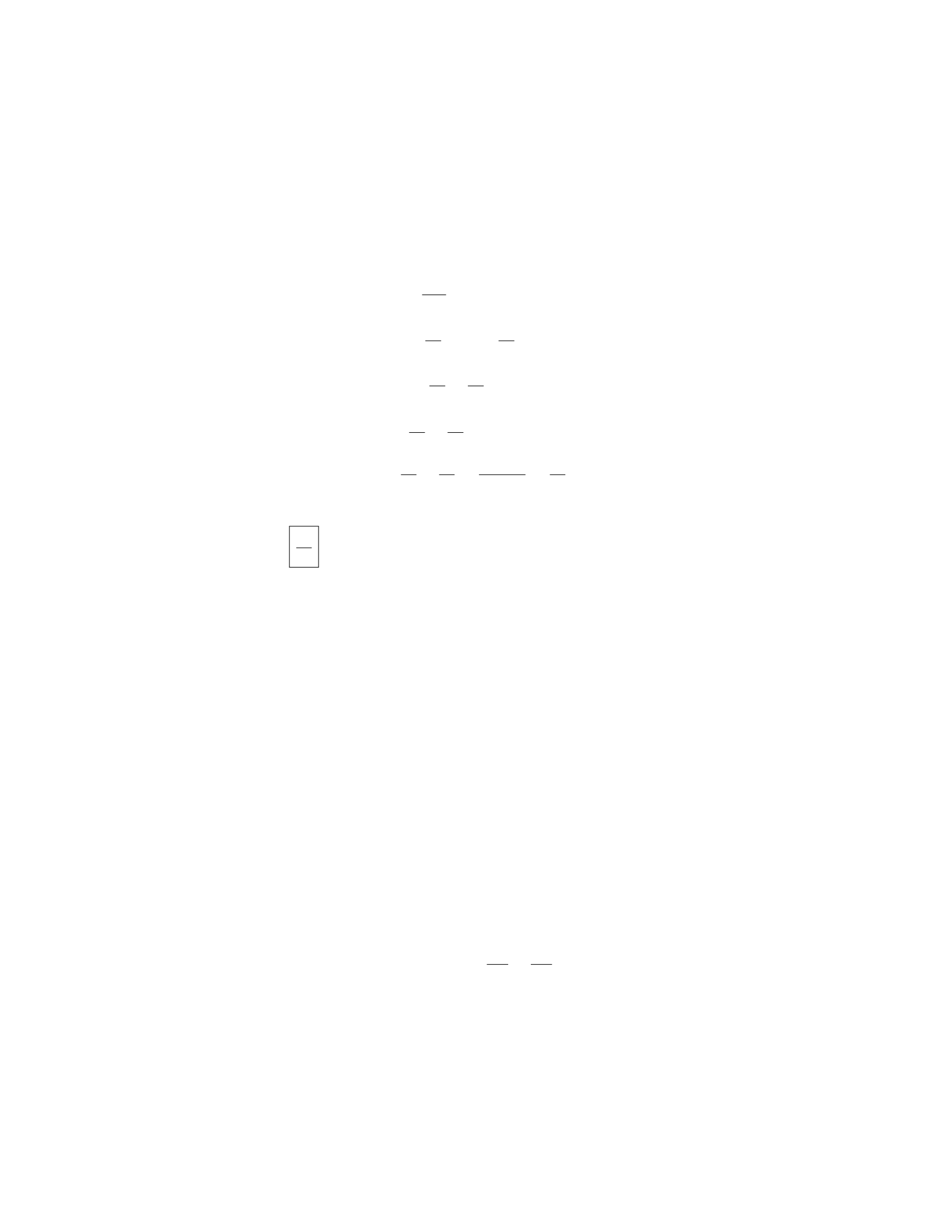
Step 3: Evaluate the double integral.
Z1
0Zx
x3
(2xy −x3)dy dx
=Z1
0xy2
2−x3yx
x3
dx
=Z1
0x4
2−x4−x7
2+x4dx
=Z1
0
(−x7
2+x4
2)dx
=−x8
16 +x5
10 1
0
=−1
16 +1
10 =−5+8
80 =3
80.
Therefore, the value of the line integral HCx3y dx +x2y dy using Green’s
Theorem is 3
80 .
Question 2
Question
Let Cbe the boundary of the region enclosed by the curve x2+y2= 2xoriented
counterclockwise. Evaluate the line integral HC(x3y2+y)dx + (2xy2−x2)dy
using Green’s Theorem.
Solution
Step 1: Determine the region enclosed by the curve C. To find the region
enclosed by C, we first rewrite the equation of the curve in polar coordinates:
x= 1 + cos θ, y = sin θ
The curve Crepresents a circle centered at (1,0) with radius 1.
Step 2: Apply Green’s Theorem. Green’s Theorem states that for a posi-
tively oriented simple closed curve Cenclosing a region D, and a vector field F
with continuous partial derivatives defined on an open region containing D, we
have: IC
F·dr=ZZD∂Q
∂x −∂P
∂y dA
where F(x, y) = (P(x, y), Q(x, y)).
Step 3: Find Pand Q. Given F(x, y) = (x3y2+y, 2xy2−x2), we have
P(x, y) = x3y2+yand Q(x, y) = 2xy2−x2.
2

Step 4: Calculate the partial derivatives of Pand Q.
∂Q
∂x = 2y2−2x, ∂P
∂y = 3x2y+ 1
Step 5: Evaluate the line integral using Green’s Theorem. By Green’s The-
orem, the line integral over the curve Cis equal to the double integral over the
region Denclosed by C:
IC
(x3y2+y)dx + (2xy2−x2)dy =ZZD2y2−2x−(3x2y+ 1)dA
Step 6: Compute the double integral. Since the region Dis a circle of radius
1 centered at (1,0), we can rewrite the integral in polar coordinates:
Z2π
0Z1
02 sin2θ−2−(3(1 + cos θ)2sin θ+ 1)r dr dθ
Step 7: Simplify and solve the double integral. After simplifying the inte-
grand and performing the calculations, the final result will provide the value of
the line integral.
Step 8: Conclude the solution. With the calculated value of the line integral,
we have successfully evaluated the given line integral using Green’s Theorem.
Question 3
Question
Let Cbe the curve given by the intersection of the plane x+y+z= 1 and the
cylinder x2+y2= 1. Calculate the circulation of the vector field F(x, y, z) =
(y2, xz, 2y)around Cin the counterclockwise direction.
Solution
Step 1: Parameterize the curve C.
The curve Cis the intersection of a plane and a cylinder, which is a circle.
We can parameterize the circle by using polar coordinates, with x= cos(t)and
y= sin(t), where t∈[0,2π).
Thus, the parameterization of Cis given by r(t) = (cos(t),sin(t),1−cos(t)−
sin(t)).
Step 2: Calculate the circulation of Faround Cusing Green’s Theorem.
The circulation of Faround Cis given by the line integral:
IC
F·dr=ZZD
(∇ × F)·ndA,
where Dis the region enclosed by C,∇×Fis the curl of F,nis the unit normal
vector to C, and dA is the area element.
3

Step 3: Calculate the curl of Fand the unit normal vector n.
The curl of Fis given by:
∇ × F=∂(2y)
∂y −∂(xz)
∂z i+∂(y2)
∂z −∂(2y)
∂x j+∂(xz)
∂x −∂(y2)
∂y k.
Plugging in the components of Fand simplifying, we get ∇ × F= (0,0,1).
The unit normal vector to Ccan be calculated as n=r
x×ry|rx×ry|, where
rx= (−sin(t),cos(t),sin(t)) and ry= (−cos(t),−sin(t),−cos(t)).
Step 4: Calculate the line integral.
Substitute ∇ × Fand ninto the line integral formula:
The circulation of Faround Cis:
IC
F·dr=ZZD
(0,0,1) ·r
x×ry|rx×ry|dA =ZZD
1
|rx×ry|dA.
Step 5: Calculate the area integral.
The area element dA =|rx×ry|dt = 2 dt.
Therefore, the circulation of Faround Cis:
IC
F·dr=ZZD
2dt = 2 ·Area(D).
Step 6: Calculate the area enclosed by the circle D.
The area enclosed by the circle Dis π(using the formula for the area of a
circle).
Thus, the circulation of Faround Cin the counterclock
Question 4
Question
Let Cbe the curve represented by the intersection of the plane x+y+z= 3
and the surface z=x2+y2. Calculate the circulation around Cof the vector
field F(x, y, z) = (−y, x, z)using Green’s Theorem.
Solution
Step 1: Find the parametric representation of the curve Cby solving the system
of equations given by the intersection of the plane and the surface:
x+y+x2+y2= 3
x2+y2−z= 0
x+y+z= 3
Step 2: Simplify the first equation to obtain:
x2+x+y2+y−3 = 0
4

x2+x+1
4+y2+y+1
4−3 = 0
(x+1
2)2+ (y+1
2)2=11
4
Step 3: Rewrite the equation in standard form:
x=−1
2+√11
2cos(t)
y=−1
2+√11
2sin(t)
z= 3 −x−y
Step 4: Determine the partial derivatives of M=−y,N=x, and P=z
with respect to xand y:∂P
∂x =−1
∂N
∂y = 1
Step 5: Apply Green’s Theorem, which relates the line integral around a
closed curve Cto the double integral over the region Denclosed by C:
IC
F·dr=ZZD∂N
∂x −∂M
∂y dA
Step 6: Substituting the partial derivatives into Green’s Theorem, we have:
IC
F·dr=ZZD
(1 −(−1)) dA
IC
F·dr=ZZD
2dA
Step 7: Evaluate the double integral over the region Denclosed by the curve
C:ZZD
2dA = 2 ZZD
dA
Since the line integral around a closed curve of a conservative vector field is
always zero, the circulation around Cof the vector field Fis 0.
Question 5
Question
Let Cbe the curve given by x(t) = cos(t),y(t) = sin(t)for 0≤t≤2π. Calculate
the line integral HC(x2+y2)dx +xydy using Green’s Theorem.
5

Solution
Step 1: First, we need to compute the partial derivatives of x2+y2and xy with
respect to xand y:
∂
∂x(x2+y2) = 2x, ∂
∂y (x2+y2) = 2y,
∂
∂x(xy) = y, ∂
∂y (xy) = x.
Step 2: Green’s Theorem states that for a region Denclosed by a simple,
positively oriented, piecewise-smooth curve C, if P(x, y)and Q(x, y)have con-
tinuous partial derivatives on an open region containing D, then
IC
(P dx +Qdy) = ZZD∂Q
∂x −∂P
∂y dA.
Step 3: Applying Green’s Theorem to our line integral, we have
IC
(x2+y2)dx +xydy =ZZD∂(xy)
∂x −∂(x2+y2)
∂y dA
=ZZD
(y−x)dA.
Step 4: The region Denclosed by the curve Cis the unit circle centered at
the origin.
Step 5: Changing to polar coordinates, x=rcos(θ)and y=rsin(θ), with
0≤r≤1and 0≤θ≤2π. Also, dA =rdrdθ.
Step 6: Substitute xand yin the integrand:
y−x=rsin(θ)−rcos(θ) = r(sin(θ)−cos(θ)).
Step 7: Now, we can evaluate the double integral:
ZZD
(y−x)dA =Z2π
0Z1
0
r(sin(θ)−cos(θ))rdrdθ
=Z2π
0−1
2cos(θ)−1
2sin(θ)dθ
=−π.
Therefore, the line integral HC(x2+y2)dx +xydy is equal to −π.
Question 6
Question
Let Cbe the curve defined by x= 2 cos(t)and y= 3 sin(t)for 0≤t≤2π.
Calculate the line integral HC(x2+y2)dx+(xy)dy by applying Green’s Theorem.
6

Solution
Step 1: Find the parametric equations for the curve C. Since x= 2 cos(t)and
y= 3 sin(t), we can write Cas a parametric curve:
r(t) = ⟨2 cos(t),3 sin(t)⟩
Step 2: Calculate the derivatives of xand ywith respect to t. The derivatives
of xand ywith respect to tare:
dx
dt =−2 sin(t)
dy
dt = 3 cos(t)
Step 3: Apply Green’s Theorem. Green’s Theorem states:
IC
(M dx +N dy) = ZZD∂N
∂x −∂M
∂y dA
where M=x2+y2and N=xy.
Step 4: Compute the partial derivatives. Compute ∂N
∂x and ∂M
∂y :
∂N
∂x =y= 3 sin(t)
∂M
∂y = 2y= 6 sin(t)
Step 5: Compute the double integral. Since the region Denclosed by Cis a
bounded region in the xy-plane, we can integrate over D:
ZZD
(3 sin(t)−6 sin(t)) dA
ZZD
(−3 sin(t)) dA
Step 6: Calculate the area enclosed by C. The area enclosed by the curve
Cis given by:
A=Z2π
0Z3
0
r dr dt
A=Z2π
0
9
2dt
A=9
2·2π= 9π
Step 7: Evaluate the line integral using Green’s Theorem. Using Green’s
Theorem, the line integral becomes:
IC
(x2+y2)dx + (xy)dy =−3 sin(t)
Finally, the value of the line integral HC(x2+y2)dx + (xy)dy is −3 sin(2π) = 0
since sin(2π) = 0.
7

Question 7
Question
Let Cbe the curve defined by r(t) = ⟨t3, t2−1⟩for 0≤t≤2π. Use Green’s
Theorem to evaluate the line integral HC(x2+y2)dx + 2xy dy.
Solution
Step 1: Calculate the curl of the vector field F(x, y) = ⟨x2+y2,2xy⟩. Since
F(x, y) = ∇f(x, y), where f(x, y) = 1
3x3+xy2+g(y),fx=x2+y2and fy= 2xy.
Hence, curl F(x, y) = fyx −fxy = 2x−2x= 0.
Step 2: Apply Green’s Theorem to evaluate the line integral. By Green’s
Theorem, HCF·dr=RRD(curl F)dA where Dis the region enclosed by the
curve C. Since the curl of Fis zero, the line integral is zero.
Therefore, HC(x2+y2)dx + 2xy dy = 0 .
Question 8
Question
Let Cbe the curve given by x2+y2= 4 oriented counterclockwise. Compute
the line integral HC(x+y)dx + (x−y)dy using Green’s Theorem.
Solution
To apply Green’s Theorem, we need to find a region Denclosed by the curve
C. In this case, Dis the disk of radius 2 centered at the origin, x2+y2≤4.
Step 1: Parameterize the curve CThe curve Cis the boundary of D,
which is the circle of radius 2. We can parameterize this circle using polar
coordinates as (x= 2 cos θ
y= 2 sin θwhere θvaries from 0 to 2π.
Step 2: Calculate the partial derivatives Compute the partial deriva-
tives of the functions P(x, y) = x+yand Q(x, y) = x−y:
∂Q
∂x = 1 and ∂P
∂y = 1
Step 3: Apply Green’s Theorem Green’s Theorem states:
IC
(P dx +Q dy) = ZZD∂Q
∂x −∂P
∂y dA
Substitute the values and set up the double integral:
ZZD
(1 −1) dA =ZZD
0dA = 0
Therefore, the line integral HC(x+y)dx + (x−y)dy is equal to 0.
8

Question 9
Question
Let Cbe the circle centered at the origin with radius 2oriented counterclockwise.
Calculate the line integral HC(x3y2+ex)dx + (xy3−sin y)dy using Green’s
Theorem.
Solution
To apply Green’s Theorem, we need to find a vector field F= (P, Q)such that
∂Q
∂x −∂P
∂y =x3y2+ex−(xy3−sin y).
Let’s set P=x3y2+exand Q=xy3−sin y. Then,
∂Q
∂x =y3
∂P
∂y =x3·2y
Now, let’s compute the line integral using Green’s Theorem:
IC
F·dr=ZZD∂Q
∂x −∂P
∂y dA
Since Cis a circle of radius 2centered at the origin, Dis the disk enclosed
by C, so D:{(x, y)|x2+y2≤4}.
We can rewrite the line integral as a double integral:
ZZD
(y3−2x3y)dA
Switching to polar coordinates, x=rcos θand y=rsin θ, and dA =rdrdθ:
ZZD
(r4sin3θ−2r5cos3θsin θ)drdθ
Integrating with respect to rfirst:
Z2π
0Z2
0
(r4sin3θ−2r5cos3θsin θ)drdθ
Step 1: Integrate r5sin3θwith respect to r:
1
5r5sin3θ−2
6r6cos3θsin θ
2
0
Step 2: Evaluate the integral at the limits:
1
5(2)5sin3θ−2
6(2)6cos3θsin θ−0
9

Step 3: Simplify the expression:
32
5sin3θ−64
3cos3θsin θ
Step 4: Integrate the result with respect to θ:
Z2π
032
5sin3θ−64
3cos3θsin θdθ
Step 5: The integral of sin3θover [0,2π]is zero:
Z2π
0−64
3cos3θsin θdθ
Step 6: Since cos3θsin θis an odd function, the integral over [0,2π]is zero.
Therefore, the line integral is 0.
Question 10
Question
Let Cbe the circle given by x2+y2= 4 oriented counterclockwise. Use Green’s
Theorem to evaluate the line integral HCF·dr, where F(x, y) = (y2+ex, x−y3).
Solution
Step 1: Calculate the curl of F. The curl of a vector field F(x, y) = (P(x, y), Q(x, y))
is given by curl F=∂Q
∂x −∂P
∂y .
In this case, we have P(x, y) = y2+exand Q(x, y) = x−y3. Therefore,
curl F=∂
∂x(x−y3)−∂
∂y (y2+ex)= (1 −0) −(0 −2ex) = 1 −2ex.
Step 2: Apply Green’s Theorem. Green’s Theorem states that for a vector
field F= (P, Q)and a simply connected region Dwhose boundary ∂D consists
of a simple, piecewise smooth, oriented curve C, we have
IC
F·dr =ZZD
curl F dA.
Since Cis the circle given by x2+y2= 4 oriented counterclockwise, C
bounds the region Dinside the circle. Then, the line integral becomes
IC
F·dr =ZZD
(1 −2ex)dA.
Step 3: Convert the integral to polar coordinates. In polar coordinates, the
region inside the circle x2+y2= 4 is described by 0≤r≤2and 0≤θ≤2π.
10

The differential area element in polar coordinates is dA =r dr dθ. Substituting
this into the integral, we have
ZZD
(1 −2ex)dA =Z2π
0Z2
0
(1 −2ercos θ)r dr dθ.
Step 4: Evaluate the double integral. First, integrate with respect to r:
Z2
0
(r−2rercos θ)dr =r2
2−2ercos θ·r2
2
2
0
= (2 −2e2 cos θ)−0 = 2 −2e2 cos θ.
Then integrate with respect to θ:
Z2π
0
(2 −2e2 cos θ)dθ =2θ−2e2 cos θ·θ
2π
0
= 4π−2π= 2π.
Therefore, the line integral HCF·dr around the circle x2+y2= 4 oriented
counterclockwise is 2π.
Question 11
Question
Let Cbe the curve defined by x2+y2= 4 oriented clockwise. Calculate the
line integral HC(x2−y2)dx + (2xy)dy using Green’s Theorem.
Solution
Step 1: Determine the region enclosed by Cand verify that it is simply con-
nected.
The curve Cis a circle centered at the origin with radius 2. The region
enclosed by Cis the interior of this circle, which is simply connected as it has
no ”holes.”
Step 2: Parameterize the curve C.
Let x= 2 cos(t)and y= 2 sin(t)for 0≤t≤2πparametrize the curve C.
Step 3: Find ∂Q
∂x −∂P
∂y where P=x2−y2and Q= 2xy.
∂P
∂y =−2y, ∂Q
∂x = 2y
∂Q
∂x −∂P
∂y = 2y+ 2y= 4y
Step 4: Apply Green’s Theorem to evaluate the line integral.
By Green’s Theorem, the line integral along Ccan be computed as a double
integral over the region enclosed by C:
IC
(x2−y2)dx + (2xy)dy =ZZR
(4y)dA
11

Step 5: Evaluate the double integral.
Changing to polar coordinates (x= 2 cos(θ),y= 2 sin(θ)), dA = 2r dr dθ.
ZZR
(4y)dA =Z2π
0Z2
0
(4(2 sin(θ))) ·2dr dθ
Solving the double integral yields:
Z2π
0Z2
0
16 sin(θ)dr dθ = 64π
Therefore, the line integral is 64π.
Question 12
Question
Let Cbe the curve defined by x2+y2= 4 oriented in the counterclockwise
direction. Calculate the line integral HC(x2+y2)dx +xydy using Green’s The-
orem.
Solution
Green’s Theorem relates a line integral around a closed curve to a double integral
over the region enclosed by the curve. The theorem states:
IC
P dx +Qdy =ZZD∂Q
∂x −∂P
∂y dA
Let P=x2+y2and Q=xy. Then,
∂Q
∂x =yand ∂P
∂y = 2y
The given curve can be parametrized as x= 2 cos(t),y= 2 sin(t)for 0≤t≤2π.
Thus, Drepresents the region enclosed by Cwhich is the disk centered at the
origin with radius 2.
Now, we can apply Green’s Theorem:
IC
(x2+y2)dx +xydy =ZZD
(y−2y)dA =ZZD
(−y)dA
The region Dcan be expressed in polar coordinates as 0≤r≤2,0≤θ≤2π.
Therefore, the double integral becomes:
=Z2π
0Z2
0
(−rsin(θ))rdrdθ
=Z2π
0Z2
0−r2sin(θ)drdθ
12

=Z2π
0−23
3sin(θ)dθ
=−8
3Z2π
0
sin(θ)dθ
=−8
3[−cos(θ)]
2π
0
=−8
3[−(−1) −(−1)]
=−8
3(2) = −16
3
Therefore, the line integral HC(x2+y2)dx+xydy around the curve Cis −16
3.
Question 13
Question
Let Cbe the curve given by the intersection of the plane x+y+z= 2 and the
cylinder x2+y2= 1 oriented counterclockwise when viewed from the positive
z-axis. Calculate the circulation of the vector field F(x, y, z)=(x2+y2, z, x)
along the curve C.
Solution
Step 1: Let’s start by parameterizing the curve C. Since Clies on both the plane
x+y+z= 2 and the cylinder x2+y2= 1, we can choose the parameterization:
r(t) = (cos t, sin t, 2−cos t−sin t),0≤t≤2π
Step 2: Next, we calculate the derivative of r(t)with respect to t:
r′(t) = (−sin t, cos t, sin t−cos t)
Step 3: We can now calculate the circulation of Falong Cusing the line
integral formula:
Circulation =ZC
F·dr=Z2π
0
F(r(t)) ·r′(t)dt
Step 4: Substituting in the values of Fand r′(t), we get:
Z2π
0
((cos2t+ sin2t)(−sin t) + (2 −cos t−sin t)(cos t) + cos t(sin t−cos t)) dt
=Z2π
0
(−sin t+ 2 cos t−cos t−sin t+ sin tcos t−cos2t)dt
13

Step 5: Simplifying the integrand, we have:
Z2π
0
(2 cos t−3 sin t−cos2t)dt = 0
Therefore, the circulation of the vector field Falong the curve Cis 0.
Question 14
Question
Let Cbe the curve formed by the intersection of the plane x+y+z= 1 and
the cylinder x2+y2= 1. Use Green’s Theorem to compute the circulation of
the vector field F(x, y, z) = (3y2z, xz, yz)counterclockwise around the curve C.
Solution
Step 1: Determine the region enclosed by the curve C.
The curve Cis the intersection of the plane x+y+z= 1 and the cylinder
x2+y2= 1. We can rewrite the plane equation as z= 1 −x−y. Substituting
this into the cylinder equation gives us x2+y2= 1. This corresponds to the
circle of radius 1 in the xy-plane centered at the origin.
Step 2: Find a parameterization for the boundary curve C.
Since Cis the intersection of the plane and the cylinder, we can parameterize
Cusing polar coordinates. Let x= cos(t)and y= sin(t)for 0≤t≤2π. Then,
z= 1 −cos(t)−sin(t).
Step 3: Apply Green’s Theorem.
Green’s Theorem states that for a region Denclosed by a simple, positively
oriented curve C, and a vector field F= (P, Q)whose partial derivatives are
continuous on an open region containing D:
IC
F·dr=ZZD∂Q
∂x −∂P
∂y dA
In this case, F(x, y, z) = (3y2z, xz, yz), which can be written as F(x, y, z) =
(0, xz, yz)+(3y2z, 0,0). Let’s consider the first term P(x, y, z) = 0 and Q(x, y, z) =
xz.
Step 4: Compute the circulation.
By Green’s Theorem,
IC
F·dr=ZZD∂Q
∂x −∂P
∂y dA
=ZZD
z−0dA
=ZZD
z dA
14

Converting to polar coordinates, dA =r dr dθ. The integral becomes:
Z2π
0Z1
0
(1 −rcos(θ)−rsin(θ)) ·r dr dθ
This can now be computed to find the circulation.
Question 15
Question
Let Cbe the curve given by x2+y2= 4 oriented counterclockwise. Use Green’s
Theorem to evaluate the line integral HC(x2+y2)dx +xydy.
Solution
Step 1: Determine the region enclosed by the curve C. The curve Cgiven by
x2+y2= 4 represents a circle of radius 2 centered at the origin. Let’s denote
this region as D.
Step 2: Parameterize the curve C. We can parameterize the circle Cas
x= 2 cos(t)and y= 2 sin(t)where 0≤t≤2π.
Step 3: Calculate the partial derivatives. Compute ∂Q
∂x and ∂P
∂y where
P=x2+y2and Q=xy.
∂Q
∂x =yand ∂P
∂y = 2y.
Step 4: Apply Green’s Theorem. Using Green’s Theorem, we have
IC
P dx +Qdy =ZZD∂Q
∂x −∂P
∂y dA.
Step 5: Evaluate the line integral. Substitute the values calculated in Step
3 into the line integral formula to get
IC
(x2+y2)dx +xydy =ZZD
(y−2y)dA =ZZD
(−y)dA.
Step 6: Evaluate the double integral over region D. Since −yis a constant
with respect to xand y, we have
ZZD
(−y)dA =−Z2π
0Z2
0
(2 sin(t))rdrdt.
Step 7: Solve the double integral. The inner integral gives us
−Z2π
0Z2
0
(2 sin(t))rdrdt =−Z2π
0
[−cos(t)]2
0dt =−Z2π
0
(1−(−1))dt =−Z2π
0
2dt =−4π.
Step 8: Conclusion. Therefore, HC(x2+y2)dx +xydy =−4π.
15

Question 16
Question
Let Cbe the curve defined by x2+y2= 4 oriented counterclockwise. Calculate
the line integral HCx2y2
x2+y2dx +x3y2
x2+y2dyusing Green’s Theorem.
Solution
Step 1: Verify that the curve Cencloses a region Dby checking if Dis simply
connected and its boundary is C. Since Cis a simple, closed curve, Dis simply
connected.
Step 2: Apply Green’s Theorem, which states that for a simply connected
region Denclosed by a simple, closed curve Cdescribed by the parameterization
r(t) = (x(t), y(t)) for a≤t≤b, the line integral HCF·drcan be calculated as
a double integral over D:
IC
F·dr=ZZD∂Q
∂x −∂P
∂y dA
where F(x, y) = (P(x, y), Q(x, y)).
Step 3: Identify P(x, y)and Q(x, y)in the given line integral:
P(x, y) = x2y2
x2+y2and Q(x, y) = x3y2
x2+y2
Step 4: Calculate the partial derivatives:
∂Q
∂x = 3yx2−2xy2and ∂P
∂y = 2xy −2xy2
Step 5: Compute the double integral over D:
ZZD∂Q
∂x −∂P
∂y dA =ZZD3yx2−2xy2−2xy + 2xy2dA
Step 6: Simplify the integrand:
ZZD3yx2−2xydA
Step 7: Change to polar coordinates for easier integration:
ZZD3r3sin2θcos2θ−2r2sin θcos θdrdθ
Step 8: Integrate with respect to rand θover the region Denclosed by C.
Finally, compute the double integral to find the value of the line integral.
16

Question 17
Question
Let Cbe the positively oriented boundary of the region bounded by the ellipse
x2
a2+y2
b2= 1, where a, b > 0, and let F(x, y) = (P(x, y), Q(x, y)). If P(x, y) = xy2
and Q(x, y) = x+y, use Green’s Theorem to evaluate HCF·dr.
Solution
Step 1: Verify that the assumptions of Green’s Theorem are satisfied.
Since Pand Qhave continuous first-order partial derivatives on a region
that contains C, we can apply Green’s Theorem.
Step 2: Calculate the partial derivatives of Pand Q.
The partial derivatives are: ∂Q
∂x = 1 and ∂P
∂y = 2xy
Step 3: Apply Green’s Theorem.
By Green’s Theorem,
IC
F·dr =ZZD∂Q
∂x −∂P
∂y dA
where Dis the region enclosed by C.
Step 4: Calculate the double integral.
The given ellipse can be parametrized as r(t) = (acos t, b sin t), where 0≤
t≤2π. Then the double integral becomes:
ZZD
(1 −2xy)dA =Z2π
0Z1
0
(1 −2acos t·bsin t)·ab dt
Step 5: Simplify and evaluate the integral.
After simplifying and integrating over t, we get:
Z2π
0
(ab −ab sin(2t)) dt = 2πab
So, HCF·dr = 2πab .
Question 18
Question
Let Cbe the curve given by the intersection of the plane z= 3 and the cylinder
x2+y2= 4, oriented counterclockwise when viewed from above. Use Green’s
theorem to evaluate the line integral HC(2y−x)dx + (x+y)dy.
17

Solution
Step 1: First, we need to parametrize the curve C. Since Clies at z= 3 and
on the cylinder x2+y2= 4, we can let x= 2 cos(t)and y= 2 sin(t), where
0≤t≤2πparametrizes the circle x2+y2= 4 counterclockwise.
Step 2: Next, we calculate the derivatives of xand ywith respect to t:
dx
dt =−2 sin(t)and dy
dt = 2 cos(t)
Step 3: Now we substitute x= 2 cos(t)and y= 2 sin(t)into the line integral,
and express dx and dy in terms of dt:
IC
(2y−x)dx + (x+y)dy
=Z2π
0
(2(2 sin(t)) −2 cos(t))(−2 sin(t)dt) + (2 cos(t) + 2 sin(t))(2 cos(t)dt)
Step 4: Simplify the integrand:
=Z2π
0
(−4 sin2(t) + 4 cos(t) sin(t)−4 cos2(t) + 4 cos(t) sin(t))dt
=Z2π
0
(−4 + 4 cos(t) sin(t))dt
=Z2π
0−4dt +Z2π
0
2 sin(2t)dt
=−8π
Therefore, the value of the line integral HC(2y−x)dx + (x+y)dy around
curve Cis −8π.
Question 19
Question
Let Cbe the positively oriented circle x2+y2= 4 and let Dbe the region inside
C. Use Green’s Theorem to evaluate the line integral HC(x2+y2)dx + 2xy dy.
Solution
Step 1: Find the partial derivatives Qxand Py: Since P(x, y) = x2+y2and
Q(x, y) = 2xy, we have Py= 2yand Qx= 2y.
Step 2: Compute the double integral over the region D: Let R={(x, y)|x2+
y2≤4}. Then by Green’s Theorem, we have
IC
(x2+y2)dx + 2xy dy =ZZR
(Qx−Py)dA.
18

Since Qx−Py= 0, the line integral becomes
IC
(x2+y2)dx + 2xy dy =ZZR
0dA = 0.
Therefore, the line integral over the circle Cis equal to 0.
Question 20
Question
Let Cbe the curve defined by x=t2,y=t3, and 0≤t≤1. Compute the line
integral
IC2y2dx −3x2dy.
Solution
Step 1: First, parameterize the curve C. Since x=t2and y=t3, we have
dx = 2tdt and dy = 3t2dt. Thus, the parameterization of Cis r(t) = t2i+t3j,
where 0≤t≤1.
Step 2: Compute the line integral using the parameterization of C:
IC2y2dx −3x2dy=Z1
02(t3)2(2t)−3(t2)2(3t2)dt.
Step 3: Simplify the integral:
=Z1
04t7−27t6dt
=4
8t8−27
7t71
0
=1
2−27
7
=7−54
14
=−47
14 .
Therefore, the line integral HC2y2dx −3x2dyalong the curve Cis −47
14 .
19

Question 21
Question
Let Cbe the curve given by the intersection of the surfaces z=x2+y2and
z= 4 −x2−y2. Use Green’s Theorem to calculate the circulation of the vector
field F= (2y, −2x, z)around the curve C.
Solution
Step 1: First, we need to find the region Denclosed by the curve C. This region
Dis the region enclosed by the two surfaces z=x2+y2and z= 4 −x2−y2.
Step 2: To find the bounds of integration, we need to determine the inter-
section of the two surfaces. Setting x2+y2= 4 −x2−y2, we have 2x2+2y2= 4,
which simplifies to x2+y2= 2. Thus, the region Dis the disk with radius √2
centered at the origin.
Step 3: Green’s Theorem states that for a vector field F= (P, Q), the
circulation around a simple closed curve Cin the plane is given by the double
integral over the region Dof (∂Q
∂x −∂P
∂y )dA.
Step 4: In this case, we have F= (2y, −2x, z), so P= 2yand Q=−2x. We
need to calculate the partial derivatives ∂Q
∂x and ∂P
∂y .
Step 5: ∂Q
∂x =−2and ∂P
∂y = 2. Therefore, the circulation of Faround Cis
given by:
IC
F·dr=ZZD
(∂Q
∂x −∂P
∂y )dA =ZZD
(−2−2)dA
Step 6: Simplifying the integral gives:
IC
F·dr=ZZD
(−4)dA =−4ZZD
dA
Step 7: The double integral of 1over the region D, which is a disk with
radius √2and area π·2 = 2π, is simply 2π. Therefore, the circulation of the
vector field Faround the curve Cis −4×2π=−8π.
Question 22
Question
Let Cbe the curve defined by x2+y2= 1, oriented counter-clockwise. Use
Green’s Theorem to evaluate the line integral HC(x3−y3)dx + (x2+y2)dy.
Solution
Step 1: First, we need to parameterize the curve C. Since Cis the unit circle
x2+y2= 1, we can parameterize it as x= cos(t)and y= sin(t), where
0≤t≤2π.
20

Step 2: Next, we compute the line integral using the parameterization of C:
IC
(x3−y3)dx+(x2+y2)dy =Z2π
0
((cos3(t)−sin3(t))(−sin(t))+(cos2(t)+sin2(t)) cos(t)) dt.
Step 3: Simplify the integrand:
=Z2π
0
(−cos3(t) sin(t) + sin4(t) + cos3(t) sin(t) + cos3(t)) dt
=Z2π
0
(sin4(t) + cos3(t)) dt.
Step 4: Since the curve Cis the unit circle, it is a closed curve and the line
integral of a function over a closed curve in the plane is equal to the double
integral of the curl of the function over the region it encloses. Apply Green’s
Theorem:
=ZZD∂
∂x(x2+y2)−∂
∂y (x3−y3)dA
=ZZD
(2x−(−3y2)) dA
=ZZD
(2x+ 3y2)dA,
where Dis the region enclosed by C, which is the unit circle.
Step 5: Since x= cos(t)and y= sin(t), we can rewrite the double integral
in polar coordinates:
=Z2π
0Z1
0
(2 cos(t) + 3 sin2(t))r dr dt
=Z2π
0Z1
0
(2rcos(t)+3rsin2(t)) dr dt.
Step 6: Computing the double integral, we obtain:
=Z2π
02
2cos(t)+3·1
3sin3(t)
1
0dt
=Z2π
0
(cos(t) + sin3(t)) dt
=sin(t)−1
3cos3(t)2π
0
= sin(2π)−1
3cos3(2π)−(sin(0) −1
3cos3(0))
= 0 −1
3−(0 −1
3)
=−2
3.
Therefore, the value of the line integral HC(x3−y3)dx + (x2+y2)dy is −2
3.
21

Question 23
Question
Let Cbe the curve given by x=t3,y=t2, where 0≤t≤2π. Calculate the
flux of the vector field F= (y, x)across C.
Solution
Step 1: Parameterize the curve Cusing t. The curve Cis given by x=t3,
y=t2, where 0≤t≤2π. Let’s parameterize Cby defining r(t) = (t3, t2).
Step 2: Find the derivative of r(t). The derivative of r(t)is r′(t) = (3t2,2t).
Step 3: Calculate the line integral of Fover C. The line integral of Fover
Ccan be calculated as:
ZC
F·dr=Z2π
0
F(r(t)) ·r′(t)dt
Step 4: Substitute the parameterization and its derivative into the integral.
We have:
Z2π
0
F(r(t)) ·r′(t)dt =Z2π
0t2
t3·3t2
2tdt
=Z2π
0
(3t4+ 2t4)dt
=Z2π
0
5t4dt
=5t5
52π
0
= 32π5
Therefore, the flux of the vector field F= (y, x)across the curve Cis 32π5.
Question 24
Question
Let Cbe the curve given by x2+y2= 4, oriented counterclockwise, and let D
be the region enclosed by C. Use Green’s Theorem to evaluate the line integral
HC(x2−y2)dx +xydy.
Solution
Step 1: Determine the region Denclosed by C. Since Cis the circle with radius
2centered at the origin, we have Das the region inside the circle x2+y2= 4.
22

Step 2: Parameterize the curve C. We can parameterize the circle Cas
x(t) = 2 cos(t)and y(t) = 2 sin(t)for 0≤t≤2π.
Step 3: Compute the partial derivatives. Calculate the partial derivatives
∂Q
∂x and ∂P
∂y :∂Q
∂x = 2x,∂P
∂y =x.
Step 4: Evaluate the line integral using Green’s Theorem. By Green’s The-
orem, HC(P dx +Qdy) = RRD∂Q
∂x −∂P
∂y dA. Thus, HC(x2−y2)dx +xydy =
RRD(2x−x)dA =RRDx dA.
Step 5: Evaluate the double integral over the region D. We will integrate x
over region D, which is the circle of radius 2centered at the origin. Using polar
coordinates, we have: RRDx dA =R2π
0R2
0(rcos(θ))r dr dθ.
Step 6: Integrate over the region D.R2π
0R2
0(r2cos(θ)) dr dθ =R2π
0[1
3r3cos(θ)]
2
0dθ
R2π
0
8
3cos(θ)dθ =8
3R2π
0cos(θ)dθ 8
3[sin(θ)]
2π
0=8
3[0 −0] = 0.
Therefore, the line integral HC(x2−y2)dx +xydy evaluates to 0.
Question 25
Question
Let Cbe the curve defined by x2+y2= 4 oriented counterclockwise. Calculate
the line integral HC3x2−2y2dx + (2xy +ex)dy using Green’s Theorem.
Solution
Step 1: Verify that the curve Cis simple, closed, and piecewise smooth.
Since x2+y2= 4 represents a circle centered at the origin with radius 2, we
can see that Cis indeed a simple closed curve.
Step 2: Represent the given line integral as a double integral using Green’s
Theorem.
Green’s Theorem states that for a positively oriented, piecewise smooth,
simple closed curve Cand a vector field F=Pi+Qjdefined on an open region
containing C, the line integral of Faround Cis equal to the double integral of
(∂Q/∂x −∂P/∂y)over the region enclosed by C. In other words,
IC
F·dr=ZZD∂Q
∂x −∂P
∂y dA,
where Fand drare given by F= (3x2−2y2)i+ (2xy +ex)jand dr=dxi+dyj,
respectively.
Step 3: Calculate the partial derivatives of Pand Q.
For F= (3x2−2y2)i+(2xy +ex)j, we have P= 3x2−2y2and Q= 2xy +ex.
Calculating the partial derivatives, we find:
∂Q
∂x = 2y+exand ∂P
∂y =−4y,
23

Step 4: Formulate the double integral over the region enclosed by C.
Substitute the calculated partial derivatives into the double integral formula:
ZZD∂Q
∂x −∂P
∂y dA =ZZD
(2y+ex+ 4y)dA.
Step 5: Evaluate the double integral over the region enclosed by C.
Now, we need to find the region Denclosed by the circle x2+y2= 4,
which represents the interior of the circle. By polar coordinates, Dis defined
by 0≤r≤2and 0≤θ≤2π.
Thus, the double integral becomes:
Z2π
0Z2
0
(2rsin θ+ercos θ)r dr dθ.
Solving this double integral will give us the value of the line integral over C
using Green’s Theorem.
24
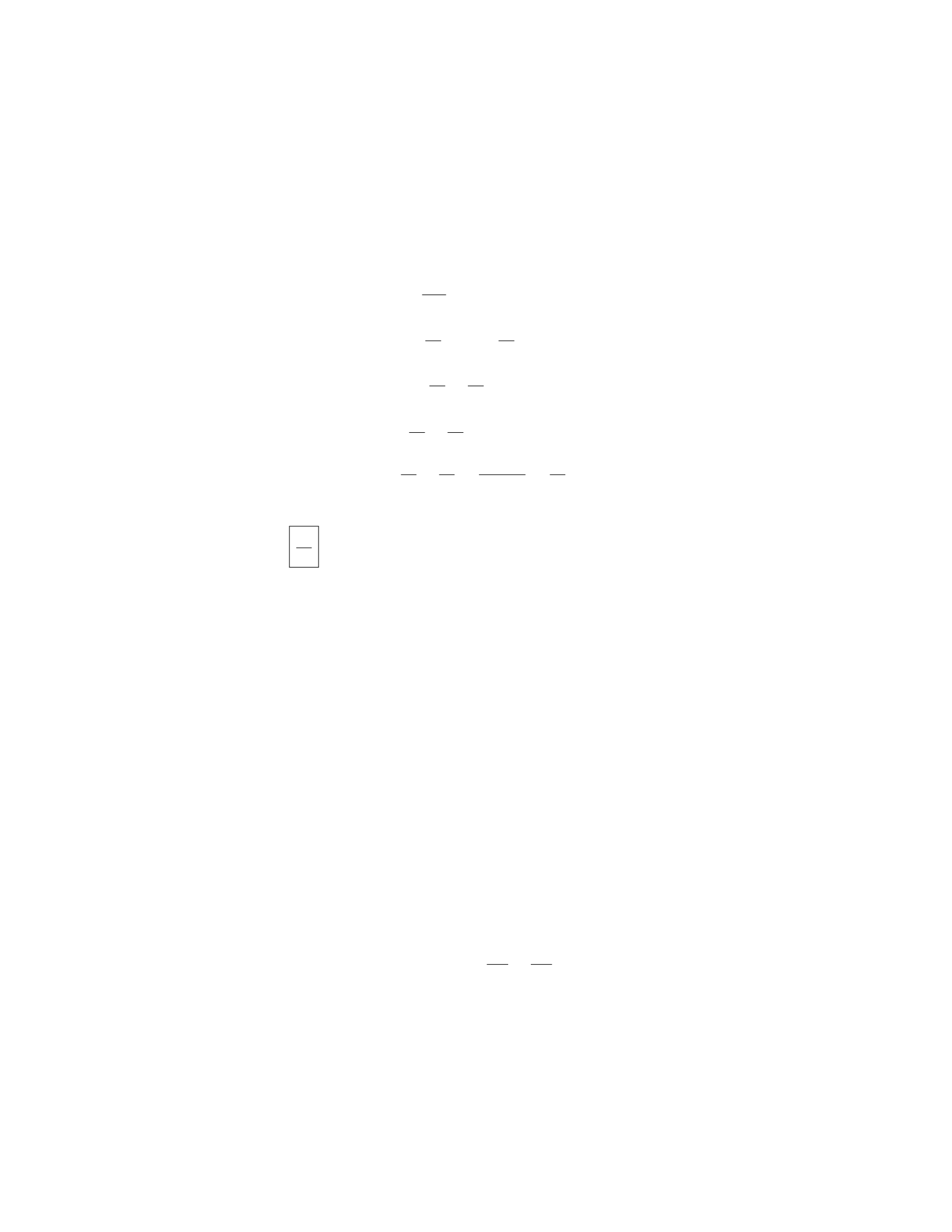
Step 3: Evaluate the double integral.
Z1
0Zx
x3
(2xy −x3)dy dx
=Z1
0xy2
2−x3yx
x3
dx
=Z1
0x4
2−x4−x7
2+x4dx
=Z1
0
(−x7
2+x4
2)dx
=−x8
16 +x5
10 1
0
=−1
16 +1
10 =−5+8
80 =3
80.
Therefore, the value of the line integral HCx3y dx +x2y dy using Green’s
Theorem is 3
80 .
Question 2
Question
Let Cbe the boundary of the region enclosed by the curve x2+y2= 2xoriented
counterclockwise. Evaluate the line integral HC(x3y2+y)dx + (2xy2−x2)dy
using Green’s Theorem.
Solution
Step 1: Determine the region enclosed by the curve C. To find the region
enclosed by C, we first rewrite the equation of the curve in polar coordinates:
x= 1 + cos θ, y = sin θ
The curve Crepresents a circle centered at (1,0) with radius 1.
Step 2: Apply Green’s Theorem. Green’s Theorem states that for a posi-
tively oriented simple closed curve Cenclosing a region D, and a vector field F
with continuous partial derivatives defined on an open region containing D, we
have: IC
F·dr=ZZD∂Q
∂x −∂P
∂y dA
where F(x, y) = (P(x, y), Q(x, y)).
Step 3: Find Pand Q. Given F(x, y) = (x3y2+y, 2xy2−x2), we have
P(x, y) = x3y2+yand Q(x, y) = 2xy2−x2.
2

Step 4: Calculate the partial derivatives of Pand Q.
∂Q
∂x = 2y2−2x, ∂P
∂y = 3x2y+ 1
Step 5: Evaluate the line integral using Green’s Theorem. By Green’s The-
orem, the line integral over the curve Cis equal to the double integral over the
region Denclosed by C:
IC
(x3y2+y)dx + (2xy2−x2)dy =ZZD2y2−2x−(3x2y+ 1)dA
Step 6: Compute the double integral. Since the region Dis a circle of radius
1 centered at (1,0), we can rewrite the integral in polar coordinates:
Z2π
0Z1
02 sin2θ−2−(3(1 + cos θ)2sin θ+ 1)r dr dθ
Step 7: Simplify and solve the double integral. After simplifying the inte-
grand and performing the calculations, the final result will provide the value of
the line integral.
Step 8: Conclude the solution. With the calculated value of the line integral,
we have successfully evaluated the given line integral using Green’s Theorem.
Question 3
Question
Let Cbe the curve given by the intersection of the plane x+y+z= 1 and the
cylinder x2+y2= 1. Calculate the circulation of the vector field F(x, y, z) =
(y2, xz, 2y)around Cin the counterclockwise direction.
Solution
Step 1: Parameterize the curve C.
The curve Cis the intersection of a plane and a cylinder, which is a circle.
We can parameterize the circle by using polar coordinates, with x= cos(t)and
y= sin(t), where t∈[0,2π).
Thus, the parameterization of Cis given by r(t) = (cos(t),sin(t),1−cos(t)−
sin(t)).
Step 2: Calculate the circulation of Faround Cusing Green’s Theorem.
The circulation of Faround Cis given by the line integral:
IC
F·dr=ZZD
(∇ × F)·ndA,
where Dis the region enclosed by C,∇×Fis the curl of F,nis the unit normal
vector to C, and dA is the area element.
3

Step 3: Calculate the curl of Fand the unit normal vector n.
The curl of Fis given by:
∇ × F=∂(2y)
∂y −∂(xz)
∂z i+∂(y2)
∂z −∂(2y)
∂x j+∂(xz)
∂x −∂(y2)
∂y k.
Plugging in the components of Fand simplifying, we get ∇ × F= (0,0,1).
The unit normal vector to Ccan be calculated as n=r
x×ry|rx×ry|, where
rx= (−sin(t),cos(t),sin(t)) and ry= (−cos(t),−sin(t),−cos(t)).
Step 4: Calculate the line integral.
Substitute ∇ × Fand ninto the line integral formula:
The circulation of Faround Cis:
IC
F·dr=ZZD
(0,0,1) ·r
x×ry|rx×ry|dA =ZZD
1
|rx×ry|dA.
Step 5: Calculate the area integral.
The area element dA =|rx×ry|dt = 2 dt.
Therefore, the circulation of Faround Cis:
IC
F·dr=ZZD
2dt = 2 ·Area(D).
Step 6: Calculate the area enclosed by the circle D.
The area enclosed by the circle Dis π(using the formula for the area of a
circle).
Thus, the circulation of Faround Cin the counterclock
Question 4
Question
Let Cbe the curve represented by the intersection of the plane x+y+z= 3
and the surface z=x2+y2. Calculate the circulation around Cof the vector
field F(x, y, z) = (−y, x, z)using Green’s Theorem.
Solution
Step 1: Find the parametric representation of the curve Cby solving the system
of equations given by the intersection of the plane and the surface:
x+y+x2+y2= 3
x2+y2−z= 0
x+y+z= 3
Step 2: Simplify the first equation to obtain:
x2+x+y2+y−3 = 0
4

x2+x+1
4+y2+y+1
4−3 = 0
(x+1
2)2+ (y+1
2)2=11
4
Step 3: Rewrite the equation in standard form:
x=−1
2+√11
2cos(t)
y=−1
2+√11
2sin(t)
z= 3 −x−y
Step 4: Determine the partial derivatives of M=−y,N=x, and P=z
with respect to xand y:∂P
∂x =−1
∂N
∂y = 1
Step 5: Apply Green’s Theorem, which relates the line integral around a
closed curve Cto the double integral over the region Denclosed by C:
IC
F·dr=ZZD∂N
∂x −∂M
∂y dA
Step 6: Substituting the partial derivatives into Green’s Theorem, we have:
IC
F·dr=ZZD
(1 −(−1)) dA
IC
F·dr=ZZD
2dA
Step 7: Evaluate the double integral over the region Denclosed by the curve
C:ZZD
2dA = 2 ZZD
dA
Since the line integral around a closed curve of a conservative vector field is
always zero, the circulation around Cof the vector field Fis 0.
Question 5
Question
Let Cbe the curve given by x(t) = cos(t),y(t) = sin(t)for 0≤t≤2π. Calculate
the line integral HC(x2+y2)dx +xydy using Green’s Theorem.
5

Solution
Step 1: First, we need to compute the partial derivatives of x2+y2and xy with
respect to xand y:
∂
∂x(x2+y2) = 2x, ∂
∂y (x2+y2) = 2y,
∂
∂x(xy) = y, ∂
∂y (xy) = x.
Step 2: Green’s Theorem states that for a region Denclosed by a simple,
positively oriented, piecewise-smooth curve C, if P(x, y)and Q(x, y)have con-
tinuous partial derivatives on an open region containing D, then
IC
(P dx +Qdy) = ZZD∂Q
∂x −∂P
∂y dA.
Step 3: Applying Green’s Theorem to our line integral, we have
IC
(x2+y2)dx +xydy =ZZD∂(xy)
∂x −∂(x2+y2)
∂y dA
=ZZD
(y−x)dA.
Step 4: The region Denclosed by the curve Cis the unit circle centered at
the origin.
Step 5: Changing to polar coordinates, x=rcos(θ)and y=rsin(θ), with
0≤r≤1and 0≤θ≤2π. Also, dA =rdrdθ.
Step 6: Substitute xand yin the integrand:
y−x=rsin(θ)−rcos(θ) = r(sin(θ)−cos(θ)).
Step 7: Now, we can evaluate the double integral:
ZZD
(y−x)dA =Z2π
0Z1
0
r(sin(θ)−cos(θ))rdrdθ
=Z2π
0−1
2cos(θ)−1
2sin(θ)dθ
=−π.
Therefore, the line integral HC(x2+y2)dx +xydy is equal to −π.
Question 6
Question
Let Cbe the curve defined by x= 2 cos(t)and y= 3 sin(t)for 0≤t≤2π.
Calculate the line integral HC(x2+y2)dx+(xy)dy by applying Green’s Theorem.
6

Solution
Step 1: Find the parametric equations for the curve C. Since x= 2 cos(t)and
y= 3 sin(t), we can write Cas a parametric curve:
r(t) = ⟨2 cos(t),3 sin(t)⟩
Step 2: Calculate the derivatives of xand ywith respect to t. The derivatives
of xand ywith respect to tare:
dx
dt =−2 sin(t)
dy
dt = 3 cos(t)
Step 3: Apply Green’s Theorem. Green’s Theorem states:
IC
(M dx +N dy) = ZZD∂N
∂x −∂M
∂y dA
where M=x2+y2and N=xy.
Step 4: Compute the partial derivatives. Compute ∂N
∂x and ∂M
∂y :
∂N
∂x =y= 3 sin(t)
∂M
∂y = 2y= 6 sin(t)
Step 5: Compute the double integral. Since the region Denclosed by Cis a
bounded region in the xy-plane, we can integrate over D:
ZZD
(3 sin(t)−6 sin(t)) dA
ZZD
(−3 sin(t)) dA
Step 6: Calculate the area enclosed by C. The area enclosed by the curve
Cis given by:
A=Z2π
0Z3
0
r dr dt
A=Z2π
0
9
2dt
A=9
2·2π= 9π
Step 7: Evaluate the line integral using Green’s Theorem. Using Green’s
Theorem, the line integral becomes:
IC
(x2+y2)dx + (xy)dy =−3 sin(t)
Finally, the value of the line integral HC(x2+y2)dx + (xy)dy is −3 sin(2π) = 0
since sin(2π) = 0.
7

Question 7
Question
Let Cbe the curve defined by r(t) = ⟨t3, t2−1⟩for 0≤t≤2π. Use Green’s
Theorem to evaluate the line integral HC(x2+y2)dx + 2xy dy.
Solution
Step 1: Calculate the curl of the vector field F(x, y) = ⟨x2+y2,2xy⟩. Since
F(x, y) = ∇f(x, y), where f(x, y) = 1
3x3+xy2+g(y),fx=x2+y2and fy= 2xy.
Hence, curl F(x, y) = fyx −fxy = 2x−2x= 0.
Step 2: Apply Green’s Theorem to evaluate the line integral. By Green’s
Theorem, HCF·dr=RRD(curl F)dA where Dis the region enclosed by the
curve C. Since the curl of Fis zero, the line integral is zero.
Therefore, HC(x2+y2)dx + 2xy dy = 0 .
Question 8
Question
Let Cbe the curve given by x2+y2= 4 oriented counterclockwise. Compute
the line integral HC(x+y)dx + (x−y)dy using Green’s Theorem.
Solution
To apply Green’s Theorem, we need to find a region Denclosed by the curve
C. In this case, Dis the disk of radius 2 centered at the origin, x2+y2≤4.
Step 1: Parameterize the curve CThe curve Cis the boundary of D,
which is the circle of radius 2. We can parameterize this circle using polar
coordinates as (x= 2 cos θ
y= 2 sin θwhere θvaries from 0 to 2π.
Step 2: Calculate the partial derivatives Compute the partial deriva-
tives of the functions P(x, y) = x+yand Q(x, y) = x−y:
∂Q
∂x = 1 and ∂P
∂y = 1
Step 3: Apply Green’s Theorem Green’s Theorem states:
IC
(P dx +Q dy) = ZZD∂Q
∂x −∂P
∂y dA
Substitute the values and set up the double integral:
ZZD
(1 −1) dA =ZZD
0dA = 0
Therefore, the line integral HC(x+y)dx + (x−y)dy is equal to 0.
8

Question 9
Question
Let Cbe the circle centered at the origin with radius 2oriented counterclockwise.
Calculate the line integral HC(x3y2+ex)dx + (xy3−sin y)dy using Green’s
Theorem.
Solution
To apply Green’s Theorem, we need to find a vector field F= (P, Q)such that
∂Q
∂x −∂P
∂y =x3y2+ex−(xy3−sin y).
Let’s set P=x3y2+exand Q=xy3−sin y. Then,
∂Q
∂x =y3
∂P
∂y =x3·2y
Now, let’s compute the line integral using Green’s Theorem:
IC
F·dr=ZZD∂Q
∂x −∂P
∂y dA
Since Cis a circle of radius 2centered at the origin, Dis the disk enclosed
by C, so D:{(x, y)|x2+y2≤4}.
We can rewrite the line integral as a double integral:
ZZD
(y3−2x3y)dA
Switching to polar coordinates, x=rcos θand y=rsin θ, and dA =rdrdθ:
ZZD
(r4sin3θ−2r5cos3θsin θ)drdθ
Integrating with respect to rfirst:
Z2π
0Z2
0
(r4sin3θ−2r5cos3θsin θ)drdθ
Step 1: Integrate r5sin3θwith respect to r:
1
5r5sin3θ−2
6r6cos3θsin θ
2
0
Step 2: Evaluate the integral at the limits:
1
5(2)5sin3θ−2
6(2)6cos3θsin θ−0
9

Step 3: Simplify the expression:
32
5sin3θ−64
3cos3θsin θ
Step 4: Integrate the result with respect to θ:
Z2π
032
5sin3θ−64
3cos3θsin θdθ
Step 5: The integral of sin3θover [0,2π]is zero:
Z2π
0−64
3cos3θsin θdθ
Step 6: Since cos3θsin θis an odd function, the integral over [0,2π]is zero.
Therefore, the line integral is 0.
Question 10
Question
Let Cbe the circle given by x2+y2= 4 oriented counterclockwise. Use Green’s
Theorem to evaluate the line integral HCF·dr, where F(x, y) = (y2+ex, x−y3).
Solution
Step 1: Calculate the curl of F. The curl of a vector field F(x, y) = (P(x, y), Q(x, y))
is given by curl F=∂Q
∂x −∂P
∂y .
In this case, we have P(x, y) = y2+exand Q(x, y) = x−y3. Therefore,
curl F=∂
∂x(x−y3)−∂
∂y (y2+ex)= (1 −0) −(0 −2ex) = 1 −2ex.
Step 2: Apply Green’s Theorem. Green’s Theorem states that for a vector
field F= (P, Q)and a simply connected region Dwhose boundary ∂D consists
of a simple, piecewise smooth, oriented curve C, we have
IC
F·dr =ZZD
curl F dA.
Since Cis the circle given by x2+y2= 4 oriented counterclockwise, C
bounds the region Dinside the circle. Then, the line integral becomes
IC
F·dr =ZZD
(1 −2ex)dA.
Step 3: Convert the integral to polar coordinates. In polar coordinates, the
region inside the circle x2+y2= 4 is described by 0≤r≤2and 0≤θ≤2π.
10

The differential area element in polar coordinates is dA =r dr dθ. Substituting
this into the integral, we have
ZZD
(1 −2ex)dA =Z2π
0Z2
0
(1 −2ercos θ)r dr dθ.
Step 4: Evaluate the double integral. First, integrate with respect to r:
Z2
0
(r−2rercos θ)dr =r2
2−2ercos θ·r2
2
2
0
= (2 −2e2 cos θ)−0 = 2 −2e2 cos θ.
Then integrate with respect to θ:
Z2π
0
(2 −2e2 cos θ)dθ =2θ−2e2 cos θ·θ
2π
0
= 4π−2π= 2π.
Therefore, the line integral HCF·dr around the circle x2+y2= 4 oriented
counterclockwise is 2π.
Question 11
Question
Let Cbe the curve defined by x2+y2= 4 oriented clockwise. Calculate the
line integral HC(x2−y2)dx + (2xy)dy using Green’s Theorem.
Solution
Step 1: Determine the region enclosed by Cand verify that it is simply con-
nected.
The curve Cis a circle centered at the origin with radius 2. The region
enclosed by Cis the interior of this circle, which is simply connected as it has
no ”holes.”
Step 2: Parameterize the curve C.
Let x= 2 cos(t)and y= 2 sin(t)for 0≤t≤2πparametrize the curve C.
Step 3: Find ∂Q
∂x −∂P
∂y where P=x2−y2and Q= 2xy.
∂P
∂y =−2y, ∂Q
∂x = 2y
∂Q
∂x −∂P
∂y = 2y+ 2y= 4y
Step 4: Apply Green’s Theorem to evaluate the line integral.
By Green’s Theorem, the line integral along Ccan be computed as a double
integral over the region enclosed by C:
IC
(x2−y2)dx + (2xy)dy =ZZR
(4y)dA
11

Step 5: Evaluate the double integral.
Changing to polar coordinates (x= 2 cos(θ),y= 2 sin(θ)), dA = 2r dr dθ.
ZZR
(4y)dA =Z2π
0Z2
0
(4(2 sin(θ))) ·2dr dθ
Solving the double integral yields:
Z2π
0Z2
0
16 sin(θ)dr dθ = 64π
Therefore, the line integral is 64π.
Question 12
Question
Let Cbe the curve defined by x2+y2= 4 oriented in the counterclockwise
direction. Calculate the line integral HC(x2+y2)dx +xydy using Green’s The-
orem.
Solution
Green’s Theorem relates a line integral around a closed curve to a double integral
over the region enclosed by the curve. The theorem states:
IC
P dx +Qdy =ZZD∂Q
∂x −∂P
∂y dA
Let P=x2+y2and Q=xy. Then,
∂Q
∂x =yand ∂P
∂y = 2y
The given curve can be parametrized as x= 2 cos(t),y= 2 sin(t)for 0≤t≤2π.
Thus, Drepresents the region enclosed by Cwhich is the disk centered at the
origin with radius 2.
Now, we can apply Green’s Theorem:
IC
(x2+y2)dx +xydy =ZZD
(y−2y)dA =ZZD
(−y)dA
The region Dcan be expressed in polar coordinates as 0≤r≤2,0≤θ≤2π.
Therefore, the double integral becomes:
=Z2π
0Z2
0
(−rsin(θ))rdrdθ
=Z2π
0Z2
0−r2sin(θ)drdθ
12

=Z2π
0−23
3sin(θ)dθ
=−8
3Z2π
0
sin(θ)dθ
=−8
3[−cos(θ)]
2π
0
=−8
3[−(−1) −(−1)]
=−8
3(2) = −16
3
Therefore, the line integral HC(x2+y2)dx+xydy around the curve Cis −16
3.
Question 13
Question
Let Cbe the curve given by the intersection of the plane x+y+z= 2 and the
cylinder x2+y2= 1 oriented counterclockwise when viewed from the positive
z-axis. Calculate the circulation of the vector field F(x, y, z)=(x2+y2, z, x)
along the curve C.
Solution
Step 1: Let’s start by parameterizing the curve C. Since Clies on both the plane
x+y+z= 2 and the cylinder x2+y2= 1, we can choose the parameterization:
r(t) = (cos t, sin t, 2−cos t−sin t),0≤t≤2π
Step 2: Next, we calculate the derivative of r(t)with respect to t:
r′(t) = (−sin t, cos t, sin t−cos t)
Step 3: We can now calculate the circulation of Falong Cusing the line
integral formula:
Circulation =ZC
F·dr=Z2π
0
F(r(t)) ·r′(t)dt
Step 4: Substituting in the values of Fand r′(t), we get:
Z2π
0
((cos2t+ sin2t)(−sin t) + (2 −cos t−sin t)(cos t) + cos t(sin t−cos t)) dt
=Z2π
0
(−sin t+ 2 cos t−cos t−sin t+ sin tcos t−cos2t)dt
13

Step 5: Simplifying the integrand, we have:
Z2π
0
(2 cos t−3 sin t−cos2t)dt = 0
Therefore, the circulation of the vector field Falong the curve Cis 0.
Question 14
Question
Let Cbe the curve formed by the intersection of the plane x+y+z= 1 and
the cylinder x2+y2= 1. Use Green’s Theorem to compute the circulation of
the vector field F(x, y, z) = (3y2z, xz, yz)counterclockwise around the curve C.
Solution
Step 1: Determine the region enclosed by the curve C.
The curve Cis the intersection of the plane x+y+z= 1 and the cylinder
x2+y2= 1. We can rewrite the plane equation as z= 1 −x−y. Substituting
this into the cylinder equation gives us x2+y2= 1. This corresponds to the
circle of radius 1 in the xy-plane centered at the origin.
Step 2: Find a parameterization for the boundary curve C.
Since Cis the intersection of the plane and the cylinder, we can parameterize
Cusing polar coordinates. Let x= cos(t)and y= sin(t)for 0≤t≤2π. Then,
z= 1 −cos(t)−sin(t).
Step 3: Apply Green’s Theorem.
Green’s Theorem states that for a region Denclosed by a simple, positively
oriented curve C, and a vector field F= (P, Q)whose partial derivatives are
continuous on an open region containing D:
IC
F·dr=ZZD∂Q
∂x −∂P
∂y dA
In this case, F(x, y, z) = (3y2z, xz, yz), which can be written as F(x, y, z) =
(0, xz, yz)+(3y2z, 0,0). Let’s consider the first term P(x, y, z) = 0 and Q(x, y, z) =
xz.
Step 4: Compute the circulation.
By Green’s Theorem,
IC
F·dr=ZZD∂Q
∂x −∂P
∂y dA
=ZZD
z−0dA
=ZZD
z dA
14

Converting to polar coordinates, dA =r dr dθ. The integral becomes:
Z2π
0Z1
0
(1 −rcos(θ)−rsin(θ)) ·r dr dθ
This can now be computed to find the circulation.
Question 15
Question
Let Cbe the curve given by x2+y2= 4 oriented counterclockwise. Use Green’s
Theorem to evaluate the line integral HC(x2+y2)dx +xydy.
Solution
Step 1: Determine the region enclosed by the curve C. The curve Cgiven by
x2+y2= 4 represents a circle of radius 2 centered at the origin. Let’s denote
this region as D.
Step 2: Parameterize the curve C. We can parameterize the circle Cas
x= 2 cos(t)and y= 2 sin(t)where 0≤t≤2π.
Step 3: Calculate the partial derivatives. Compute ∂Q
∂x and ∂P
∂y where
P=x2+y2and Q=xy.
∂Q
∂x =yand ∂P
∂y = 2y.
Step 4: Apply Green’s Theorem. Using Green’s Theorem, we have
IC
P dx +Qdy =ZZD∂Q
∂x −∂P
∂y dA.
Step 5: Evaluate the line integral. Substitute the values calculated in Step
3 into the line integral formula to get
IC
(x2+y2)dx +xydy =ZZD
(y−2y)dA =ZZD
(−y)dA.
Step 6: Evaluate the double integral over region D. Since −yis a constant
with respect to xand y, we have
ZZD
(−y)dA =−Z2π
0Z2
0
(2 sin(t))rdrdt.
Step 7: Solve the double integral. The inner integral gives us
−Z2π
0Z2
0
(2 sin(t))rdrdt =−Z2π
0
[−cos(t)]2
0dt =−Z2π
0
(1−(−1))dt =−Z2π
0
2dt =−4π.
Step 8: Conclusion. Therefore, HC(x2+y2)dx +xydy =−4π.
15

Question 16
Question
Let Cbe the curve defined by x2+y2= 4 oriented counterclockwise. Calculate
the line integral HCx2y2
x2+y2dx +x3y2
x2+y2dyusing Green’s Theorem.
Solution
Step 1: Verify that the curve Cencloses a region Dby checking if Dis simply
connected and its boundary is C. Since Cis a simple, closed curve, Dis simply
connected.
Step 2: Apply Green’s Theorem, which states that for a simply connected
region Denclosed by a simple, closed curve Cdescribed by the parameterization
r(t) = (x(t), y(t)) for a≤t≤b, the line integral HCF·drcan be calculated as
a double integral over D:
IC
F·dr=ZZD∂Q
∂x −∂P
∂y dA
where F(x, y) = (P(x, y), Q(x, y)).
Step 3: Identify P(x, y)and Q(x, y)in the given line integral:
P(x, y) = x2y2
x2+y2and Q(x, y) = x3y2
x2+y2
Step 4: Calculate the partial derivatives:
∂Q
∂x = 3yx2−2xy2and ∂P
∂y = 2xy −2xy2
Step 5: Compute the double integral over D:
ZZD∂Q
∂x −∂P
∂y dA =ZZD3yx2−2xy2−2xy + 2xy2dA
Step 6: Simplify the integrand:
ZZD3yx2−2xydA
Step 7: Change to polar coordinates for easier integration:
ZZD3r3sin2θcos2θ−2r2sin θcos θdrdθ
Step 8: Integrate with respect to rand θover the region Denclosed by C.
Finally, compute the double integral to find the value of the line integral.
16

Question 17
Question
Let Cbe the positively oriented boundary of the region bounded by the ellipse
x2
a2+y2
b2= 1, where a, b > 0, and let F(x, y) = (P(x, y), Q(x, y)). If P(x, y) = xy2
and Q(x, y) = x+y, use Green’s Theorem to evaluate HCF·dr.
Solution
Step 1: Verify that the assumptions of Green’s Theorem are satisfied.
Since Pand Qhave continuous first-order partial derivatives on a region
that contains C, we can apply Green’s Theorem.
Step 2: Calculate the partial derivatives of Pand Q.
The partial derivatives are: ∂Q
∂x = 1 and ∂P
∂y = 2xy
Step 3: Apply Green’s Theorem.
By Green’s Theorem,
IC
F·dr =ZZD∂Q
∂x −∂P
∂y dA
where Dis the region enclosed by C.
Step 4: Calculate the double integral.
The given ellipse can be parametrized as r(t) = (acos t, b sin t), where 0≤
t≤2π. Then the double integral becomes:
ZZD
(1 −2xy)dA =Z2π
0Z1
0
(1 −2acos t·bsin t)·ab dt
Step 5: Simplify and evaluate the integral.
After simplifying and integrating over t, we get:
Z2π
0
(ab −ab sin(2t)) dt = 2πab
So, HCF·dr = 2πab .
Question 18
Question
Let Cbe the curve given by the intersection of the plane z= 3 and the cylinder
x2+y2= 4, oriented counterclockwise when viewed from above. Use Green’s
theorem to evaluate the line integral HC(2y−x)dx + (x+y)dy.
17

Solution
Step 1: First, we need to parametrize the curve C. Since Clies at z= 3 and
on the cylinder x2+y2= 4, we can let x= 2 cos(t)and y= 2 sin(t), where
0≤t≤2πparametrizes the circle x2+y2= 4 counterclockwise.
Step 2: Next, we calculate the derivatives of xand ywith respect to t:
dx
dt =−2 sin(t)and dy
dt = 2 cos(t)
Step 3: Now we substitute x= 2 cos(t)and y= 2 sin(t)into the line integral,
and express dx and dy in terms of dt:
IC
(2y−x)dx + (x+y)dy
=Z2π
0
(2(2 sin(t)) −2 cos(t))(−2 sin(t)dt) + (2 cos(t) + 2 sin(t))(2 cos(t)dt)
Step 4: Simplify the integrand:
=Z2π
0
(−4 sin2(t) + 4 cos(t) sin(t)−4 cos2(t) + 4 cos(t) sin(t))dt
=Z2π
0
(−4 + 4 cos(t) sin(t))dt
=Z2π
0−4dt +Z2π
0
2 sin(2t)dt
=−8π
Therefore, the value of the line integral HC(2y−x)dx + (x+y)dy around
curve Cis −8π.
Question 19
Question
Let Cbe the positively oriented circle x2+y2= 4 and let Dbe the region inside
C. Use Green’s Theorem to evaluate the line integral HC(x2+y2)dx + 2xy dy.
Solution
Step 1: Find the partial derivatives Qxand Py: Since P(x, y) = x2+y2and
Q(x, y) = 2xy, we have Py= 2yand Qx= 2y.
Step 2: Compute the double integral over the region D: Let R={(x, y)|x2+
y2≤4}. Then by Green’s Theorem, we have
IC
(x2+y2)dx + 2xy dy =ZZR
(Qx−Py)dA.
18

Since Qx−Py= 0, the line integral becomes
IC
(x2+y2)dx + 2xy dy =ZZR
0dA = 0.
Therefore, the line integral over the circle Cis equal to 0.
Question 20
Question
Let Cbe the curve defined by x=t2,y=t3, and 0≤t≤1. Compute the line
integral
IC2y2dx −3x2dy.
Solution
Step 1: First, parameterize the curve C. Since x=t2and y=t3, we have
dx = 2tdt and dy = 3t2dt. Thus, the parameterization of Cis r(t) = t2i+t3j,
where 0≤t≤1.
Step 2: Compute the line integral using the parameterization of C:
IC2y2dx −3x2dy=Z1
02(t3)2(2t)−3(t2)2(3t2)dt.
Step 3: Simplify the integral:
=Z1
04t7−27t6dt
=4
8t8−27
7t71
0
=1
2−27
7
=7−54
14
=−47
14 .
Therefore, the line integral HC2y2dx −3x2dyalong the curve Cis −47
14 .
19

Question 21
Question
Let Cbe the curve given by the intersection of the surfaces z=x2+y2and
z= 4 −x2−y2. Use Green’s Theorem to calculate the circulation of the vector
field F= (2y, −2x, z)around the curve C.
Solution
Step 1: First, we need to find the region Denclosed by the curve C. This region
Dis the region enclosed by the two surfaces z=x2+y2and z= 4 −x2−y2.
Step 2: To find the bounds of integration, we need to determine the inter-
section of the two surfaces. Setting x2+y2= 4 −x2−y2, we have 2x2+2y2= 4,
which simplifies to x2+y2= 2. Thus, the region Dis the disk with radius √2
centered at the origin.
Step 3: Green’s Theorem states that for a vector field F= (P, Q), the
circulation around a simple closed curve Cin the plane is given by the double
integral over the region Dof (∂Q
∂x −∂P
∂y )dA.
Step 4: In this case, we have F= (2y, −2x, z), so P= 2yand Q=−2x. We
need to calculate the partial derivatives ∂Q
∂x and ∂P
∂y .
Step 5: ∂Q
∂x =−2and ∂P
∂y = 2. Therefore, the circulation of Faround Cis
given by:
IC
F·dr=ZZD
(∂Q
∂x −∂P
∂y )dA =ZZD
(−2−2)dA
Step 6: Simplifying the integral gives:
IC
F·dr=ZZD
(−4)dA =−4ZZD
dA
Step 7: The double integral of 1over the region D, which is a disk with
radius √2and area π·2 = 2π, is simply 2π. Therefore, the circulation of the
vector field Faround the curve Cis −4×2π=−8π.
Question 22
Question
Let Cbe the curve defined by x2+y2= 1, oriented counter-clockwise. Use
Green’s Theorem to evaluate the line integral HC(x3−y3)dx + (x2+y2)dy.
Solution
Step 1: First, we need to parameterize the curve C. Since Cis the unit circle
x2+y2= 1, we can parameterize it as x= cos(t)and y= sin(t), where
0≤t≤2π.
20

Step 2: Next, we compute the line integral using the parameterization of C:
IC
(x3−y3)dx+(x2+y2)dy =Z2π
0
((cos3(t)−sin3(t))(−sin(t))+(cos2(t)+sin2(t)) cos(t)) dt.
Step 3: Simplify the integrand:
=Z2π
0
(−cos3(t) sin(t) + sin4(t) + cos3(t) sin(t) + cos3(t)) dt
=Z2π
0
(sin4(t) + cos3(t)) dt.
Step 4: Since the curve Cis the unit circle, it is a closed curve and the line
integral of a function over a closed curve in the plane is equal to the double
integral of the curl of the function over the region it encloses. Apply Green’s
Theorem:
=ZZD∂
∂x(x2+y2)−∂
∂y (x3−y3)dA
=ZZD
(2x−(−3y2)) dA
=ZZD
(2x+ 3y2)dA,
where Dis the region enclosed by C, which is the unit circle.
Step 5: Since x= cos(t)and y= sin(t), we can rewrite the double integral
in polar coordinates:
=Z2π
0Z1
0
(2 cos(t) + 3 sin2(t))r dr dt
=Z2π
0Z1
0
(2rcos(t)+3rsin2(t)) dr dt.
Step 6: Computing the double integral, we obtain:
=Z2π
02
2cos(t)+3·1
3sin3(t)
1
0dt
=Z2π
0
(cos(t) + sin3(t)) dt
=sin(t)−1
3cos3(t)2π
0
= sin(2π)−1
3cos3(2π)−(sin(0) −1
3cos3(0))
= 0 −1
3−(0 −1
3)
=−2
3.
Therefore, the value of the line integral HC(x3−y3)dx + (x2+y2)dy is −2
3.
21

Question 23
Question
Let Cbe the curve given by x=t3,y=t2, where 0≤t≤2π. Calculate the
flux of the vector field F= (y, x)across C.
Solution
Step 1: Parameterize the curve Cusing t. The curve Cis given by x=t3,
y=t2, where 0≤t≤2π. Let’s parameterize Cby defining r(t) = (t3, t2).
Step 2: Find the derivative of r(t). The derivative of r(t)is r′(t) = (3t2,2t).
Step 3: Calculate the line integral of Fover C. The line integral of Fover
Ccan be calculated as:
ZC
F·dr=Z2π
0
F(r(t)) ·r′(t)dt
Step 4: Substitute the parameterization and its derivative into the integral.
We have:
Z2π
0
F(r(t)) ·r′(t)dt =Z2π
0t2
t3·3t2
2tdt
=Z2π
0
(3t4+ 2t4)dt
=Z2π
0
5t4dt
=5t5
52π
0
= 32π5
Therefore, the flux of the vector field F= (y, x)across the curve Cis 32π5.
Question 24
Question
Let Cbe the curve given by x2+y2= 4, oriented counterclockwise, and let D
be the region enclosed by C. Use Green’s Theorem to evaluate the line integral
HC(x2−y2)dx +xydy.
Solution
Step 1: Determine the region Denclosed by C. Since Cis the circle with radius
2centered at the origin, we have Das the region inside the circle x2+y2= 4.
22

Step 2: Parameterize the curve C. We can parameterize the circle Cas
x(t) = 2 cos(t)and y(t) = 2 sin(t)for 0≤t≤2π.
Step 3: Compute the partial derivatives. Calculate the partial derivatives
∂Q
∂x and ∂P
∂y :∂Q
∂x = 2x,∂P
∂y =x.
Step 4: Evaluate the line integral using Green’s Theorem. By Green’s The-
orem, HC(P dx +Qdy) = RRD∂Q
∂x −∂P
∂y dA. Thus, HC(x2−y2)dx +xydy =
RRD(2x−x)dA =RRDx dA.
Step 5: Evaluate the double integral over the region D. We will integrate x
over region D, which is the circle of radius 2centered at the origin. Using polar
coordinates, we have: RRDx dA =R2π
0R2
0(rcos(θ))r dr dθ.
Step 6: Integrate over the region D.R2π
0R2
0(r2cos(θ)) dr dθ =R2π
0[1
3r3cos(θ)]
2
0dθ
R2π
0
8
3cos(θ)dθ =8
3R2π
0cos(θ)dθ 8
3[sin(θ)]
2π
0=8
3[0 −0] = 0.
Therefore, the line integral HC(x2−y2)dx +xydy evaluates to 0.
Question 25
Question
Let Cbe the curve defined by x2+y2= 4 oriented counterclockwise. Calculate
the line integral HC3x2−2y2dx + (2xy +ex)dy using Green’s Theorem.
Solution
Step 1: Verify that the curve Cis simple, closed, and piecewise smooth.
Since x2+y2= 4 represents a circle centered at the origin with radius 2, we
can see that Cis indeed a simple closed curve.
Step 2: Represent the given line integral as a double integral using Green’s
Theorem.
Green’s Theorem states that for a positively oriented, piecewise smooth,
simple closed curve Cand a vector field F=Pi+Qjdefined on an open region
containing C, the line integral of Faround Cis equal to the double integral of
(∂Q/∂x −∂P/∂y)over the region enclosed by C. In other words,
IC
F·dr=ZZD∂Q
∂x −∂P
∂y dA,
where Fand drare given by F= (3x2−2y2)i+ (2xy +ex)jand dr=dxi+dyj,
respectively.
Step 3: Calculate the partial derivatives of Pand Q.
For F= (3x2−2y2)i+(2xy +ex)j, we have P= 3x2−2y2and Q= 2xy +ex.
Calculating the partial derivatives, we find:
∂Q
∂x = 2y+exand ∂P
∂y =−4y,
23

Step 4: Formulate the double integral over the region enclosed by C.
Substitute the calculated partial derivatives into the double integral formula:
ZZD∂Q
∂x −∂P
∂y dA =ZZD
(2y+ex+ 4y)dA.
Step 5: Evaluate the double integral over the region enclosed by C.
Now, we need to find the region Denclosed by the circle x2+y2= 4,
which represents the interior of the circle. By polar coordinates, Dis defined
by 0≤r≤2and 0≤θ≤2π.
Thus, the double integral becomes:
Z2π
0Z2
0
(2rsin θ+ercos θ)r dr dθ.
Solving this double integral will give us the value of the line integral over C
using Green’s Theorem.
24
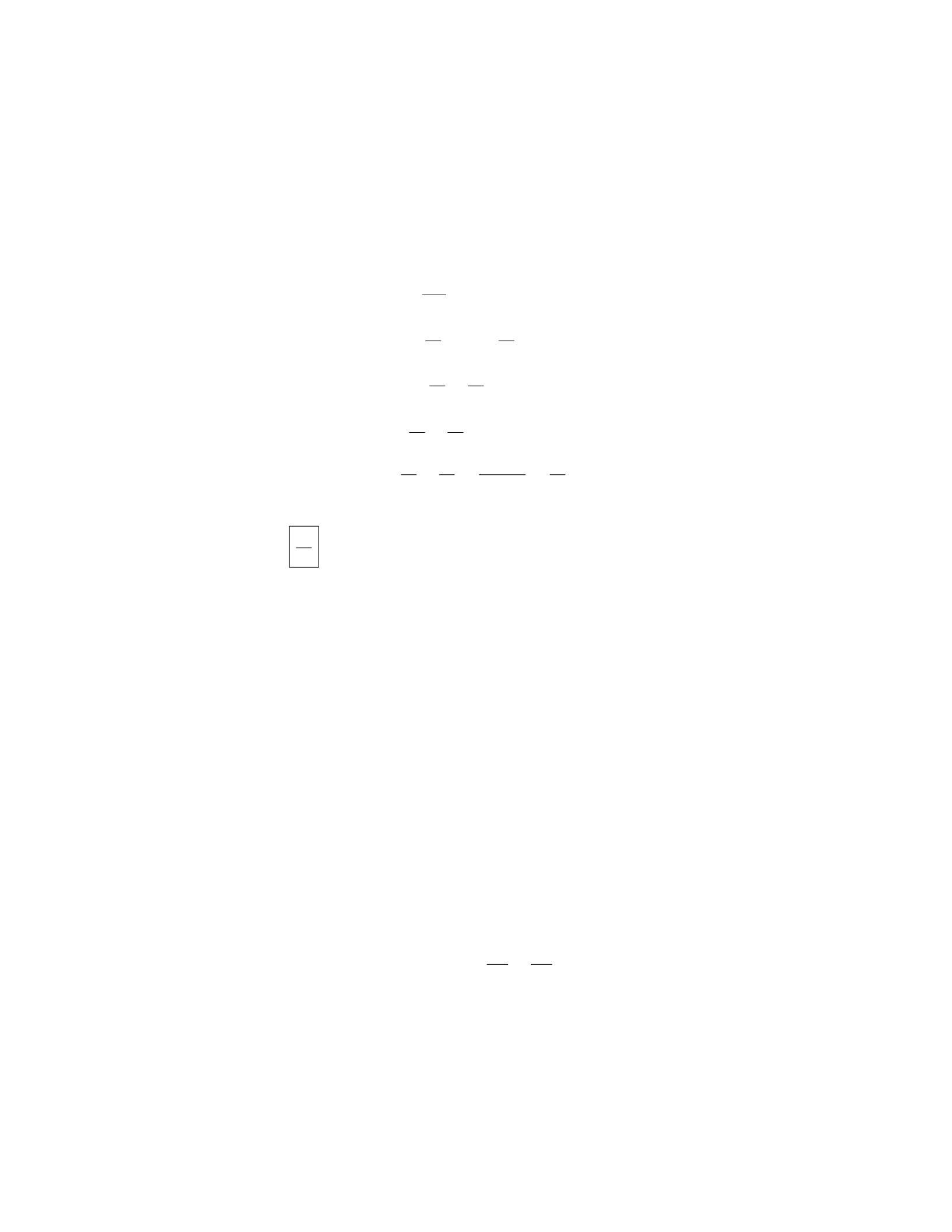
Step 3: Evaluate the double integral.
Z1
0Zx
x3
(2xy −x3)dy dx
=Z1
0xy2
2−x3yx
x3
dx
=Z1
0x4
2−x4−x7
2+x4dx
=Z1
0
(−x7
2+x4
2)dx
=−x8
16 +x5
10 1
0
=−1
16 +1
10 =−5+8
80 =3
80.
Therefore, the value of the line integral HCx3y dx +x2y dy using Green’s
Theorem is 3
80 .
Question 2
Question
Let Cbe the boundary of the region enclosed by the curve x2+y2= 2xoriented
counterclockwise. Evaluate the line integral HC(x3y2+y)dx + (2xy2−x2)dy
using Green’s Theorem.
Solution
Step 1: Determine the region enclosed by the curve C. To find the region
enclosed by C, we first rewrite the equation of the curve in polar coordinates:
x= 1 + cos θ, y = sin θ
The curve Crepresents a circle centered at (1,0) with radius 1.
Step 2: Apply Green’s Theorem. Green’s Theorem states that for a posi-
tively oriented simple closed curve Cenclosing a region D, and a vector field F
with continuous partial derivatives defined on an open region containing D, we
have: IC
F·dr=ZZD∂Q
∂x −∂P
∂y dA
where F(x, y) = (P(x, y), Q(x, y)).
Step 3: Find Pand Q. Given F(x, y) = (x3y2+y, 2xy2−x2), we have
P(x, y) = x3y2+yand Q(x, y) = 2xy2−x2.
2

Step 4: Calculate the partial derivatives of Pand Q.
∂Q
∂x = 2y2−2x, ∂P
∂y = 3x2y+ 1
Step 5: Evaluate the line integral using Green’s Theorem. By Green’s The-
orem, the line integral over the curve Cis equal to the double integral over the
region Denclosed by C:
IC
(x3y2+y)dx + (2xy2−x2)dy =ZZD2y2−2x−(3x2y+ 1)dA
Step 6: Compute the double integral. Since the region Dis a circle of radius
1 centered at (1,0), we can rewrite the integral in polar coordinates:
Z2π
0Z1
02 sin2θ−2−(3(1 + cos θ)2sin θ+ 1)r dr dθ
Step 7: Simplify and solve the double integral. After simplifying the inte-
grand and performing the calculations, the final result will provide the value of
the line integral.
Step 8: Conclude the solution. With the calculated value of the line integral,
we have successfully evaluated the given line integral using Green’s Theorem.
Question 3
Question
Let Cbe the curve given by the intersection of the plane x+y+z= 1 and the
cylinder x2+y2= 1. Calculate the circulation of the vector field F(x, y, z) =
(y2, xz, 2y)around Cin the counterclockwise direction.
Solution
Step 1: Parameterize the curve C.
The curve Cis the intersection of a plane and a cylinder, which is a circle.
We can parameterize the circle by using polar coordinates, with x= cos(t)and
y= sin(t), where t∈[0,2π).
Thus, the parameterization of Cis given by r(t) = (cos(t),sin(t),1−cos(t)−
sin(t)).
Step 2: Calculate the circulation of Faround Cusing Green’s Theorem.
The circulation of Faround Cis given by the line integral:
IC
F·dr=ZZD
(∇ × F)·ndA,
where Dis the region enclosed by C,∇×Fis the curl of F,nis the unit normal
vector to C, and dA is the area element.
3

Step 3: Calculate the curl of Fand the unit normal vector n.
The curl of Fis given by:
∇ × F=∂(2y)
∂y −∂(xz)
∂z i+∂(y2)
∂z −∂(2y)
∂x j+∂(xz)
∂x −∂(y2)
∂y k.
Plugging in the components of Fand simplifying, we get ∇ × F= (0,0,1).
The unit normal vector to Ccan be calculated as n=r
x×ry|rx×ry|, where
rx= (−sin(t),cos(t),sin(t)) and ry= (−cos(t),−sin(t),−cos(t)).
Step 4: Calculate the line integral.
Substitute ∇ × Fand ninto the line integral formula:
The circulation of Faround Cis:
IC
F·dr=ZZD
(0,0,1) ·r
x×ry|rx×ry|dA =ZZD
1
|rx×ry|dA.
Step 5: Calculate the area integral.
The area element dA =|rx×ry|dt = 2 dt.
Therefore, the circulation of Faround Cis:
IC
F·dr=ZZD
2dt = 2 ·Area(D).
Step 6: Calculate the area enclosed by the circle D.
The area enclosed by the circle Dis π(using the formula for the area of a
circle).
Thus, the circulation of Faround Cin the counterclock
Question 4
Question
Let Cbe the curve represented by the intersection of the plane x+y+z= 3
and the surface z=x2+y2. Calculate the circulation around Cof the vector
field F(x, y, z) = (−y, x, z)using Green’s Theorem.
Solution
Step 1: Find the parametric representation of the curve Cby solving the system
of equations given by the intersection of the plane and the surface:
x+y+x2+y2= 3
x2+y2−z= 0
x+y+z= 3
Step 2: Simplify the first equation to obtain:
x2+x+y2+y−3 = 0
4

x2+x+1
4+y2+y+1
4−3 = 0
(x+1
2)2+ (y+1
2)2=11
4
Step 3: Rewrite the equation in standard form:
x=−1
2+√11
2cos(t)
y=−1
2+√11
2sin(t)
z= 3 −x−y
Step 4: Determine the partial derivatives of M=−y,N=x, and P=z
with respect to xand y:∂P
∂x =−1
∂N
∂y = 1
Step 5: Apply Green’s Theorem, which relates the line integral around a
closed curve Cto the double integral over the region Denclosed by C:
IC
F·dr=ZZD∂N
∂x −∂M
∂y dA
Step 6: Substituting the partial derivatives into Green’s Theorem, we have:
IC
F·dr=ZZD
(1 −(−1)) dA
IC
F·dr=ZZD
2dA
Step 7: Evaluate the double integral over the region Denclosed by the curve
C:ZZD
2dA = 2 ZZD
dA
Since the line integral around a closed curve of a conservative vector field is
always zero, the circulation around Cof the vector field Fis 0.
Question 5
Question
Let Cbe the curve given by x(t) = cos(t),y(t) = sin(t)for 0≤t≤2π. Calculate
the line integral HC(x2+y2)dx +xydy using Green’s Theorem.
5

Solution
Step 1: First, we need to compute the partial derivatives of x2+y2and xy with
respect to xand y:
∂
∂x(x2+y2) = 2x, ∂
∂y (x2+y2) = 2y,
∂
∂x(xy) = y, ∂
∂y (xy) = x.
Step 2: Green’s Theorem states that for a region Denclosed by a simple,
positively oriented, piecewise-smooth curve C, if P(x, y)and Q(x, y)have con-
tinuous partial derivatives on an open region containing D, then
IC
(P dx +Qdy) = ZZD∂Q
∂x −∂P
∂y dA.
Step 3: Applying Green’s Theorem to our line integral, we have
IC
(x2+y2)dx +xydy =ZZD∂(xy)
∂x −∂(x2+y2)
∂y dA
=ZZD
(y−x)dA.
Step 4: The region Denclosed by the curve Cis the unit circle centered at
the origin.
Step 5: Changing to polar coordinates, x=rcos(θ)and y=rsin(θ), with
0≤r≤1and 0≤θ≤2π. Also, dA =rdrdθ.
Step 6: Substitute xand yin the integrand:
y−x=rsin(θ)−rcos(θ) = r(sin(θ)−cos(θ)).
Step 7: Now, we can evaluate the double integral:
ZZD
(y−x)dA =Z2π
0Z1
0
r(sin(θ)−cos(θ))rdrdθ
=Z2π
0−1
2cos(θ)−1
2sin(θ)dθ
=−π.
Therefore, the line integral HC(x2+y2)dx +xydy is equal to −π.
Question 6
Question
Let Cbe the curve defined by x= 2 cos(t)and y= 3 sin(t)for 0≤t≤2π.
Calculate the line integral HC(x2+y2)dx+(xy)dy by applying Green’s Theorem.
6

Solution
Step 1: Find the parametric equations for the curve C. Since x= 2 cos(t)and
y= 3 sin(t), we can write Cas a parametric curve:
r(t) = ⟨2 cos(t),3 sin(t)⟩
Step 2: Calculate the derivatives of xand ywith respect to t. The derivatives
of xand ywith respect to tare:
dx
dt =−2 sin(t)
dy
dt = 3 cos(t)
Step 3: Apply Green’s Theorem. Green’s Theorem states:
IC
(M dx +N dy) = ZZD∂N
∂x −∂M
∂y dA
where M=x2+y2and N=xy.
Step 4: Compute the partial derivatives. Compute ∂N
∂x and ∂M
∂y :
∂N
∂x =y= 3 sin(t)
∂M
∂y = 2y= 6 sin(t)
Step 5: Compute the double integral. Since the region Denclosed by Cis a
bounded region in the xy-plane, we can integrate over D:
ZZD
(3 sin(t)−6 sin(t)) dA
ZZD
(−3 sin(t)) dA
Step 6: Calculate the area enclosed by C. The area enclosed by the curve
Cis given by:
A=Z2π
0Z3
0
r dr dt
A=Z2π
0
9
2dt
A=9
2·2π= 9π
Step 7: Evaluate the line integral using Green’s Theorem. Using Green’s
Theorem, the line integral becomes:
IC
(x2+y2)dx + (xy)dy =−3 sin(t)
Finally, the value of the line integral HC(x2+y2)dx + (xy)dy is −3 sin(2π) = 0
since sin(2π) = 0.
7

Question 7
Question
Let Cbe the curve defined by r(t) = ⟨t3, t2−1⟩for 0≤t≤2π. Use Green’s
Theorem to evaluate the line integral HC(x2+y2)dx + 2xy dy.
Solution
Step 1: Calculate the curl of the vector field F(x, y) = ⟨x2+y2,2xy⟩. Since
F(x, y) = ∇f(x, y), where f(x, y) = 1
3x3+xy2+g(y),fx=x2+y2and fy= 2xy.
Hence, curl F(x, y) = fyx −fxy = 2x−2x= 0.
Step 2: Apply Green’s Theorem to evaluate the line integral. By Green’s
Theorem, HCF·dr=RRD(curl F)dA where Dis the region enclosed by the
curve C. Since the curl of Fis zero, the line integral is zero.
Therefore, HC(x2+y2)dx + 2xy dy = 0 .
Question 8
Question
Let Cbe the curve given by x2+y2= 4 oriented counterclockwise. Compute
the line integral HC(x+y)dx + (x−y)dy using Green’s Theorem.
Solution
To apply Green’s Theorem, we need to find a region Denclosed by the curve
C. In this case, Dis the disk of radius 2 centered at the origin, x2+y2≤4.
Step 1: Parameterize the curve CThe curve Cis the boundary of D,
which is the circle of radius 2. We can parameterize this circle using polar
coordinates as (x= 2 cos θ
y= 2 sin θwhere θvaries from 0 to 2π.
Step 2: Calculate the partial derivatives Compute the partial deriva-
tives of the functions P(x, y) = x+yand Q(x, y) = x−y:
∂Q
∂x = 1 and ∂P
∂y = 1
Step 3: Apply Green’s Theorem Green’s Theorem states:
IC
(P dx +Q dy) = ZZD∂Q
∂x −∂P
∂y dA
Substitute the values and set up the double integral:
ZZD
(1 −1) dA =ZZD
0dA = 0
Therefore, the line integral HC(x+y)dx + (x−y)dy is equal to 0.
8

Question 9
Question
Let Cbe the circle centered at the origin with radius 2oriented counterclockwise.
Calculate the line integral HC(x3y2+ex)dx + (xy3−sin y)dy using Green’s
Theorem.
Solution
To apply Green’s Theorem, we need to find a vector field F= (P, Q)such that
∂Q
∂x −∂P
∂y =x3y2+ex−(xy3−sin y).
Let’s set P=x3y2+exand Q=xy3−sin y. Then,
∂Q
∂x =y3
∂P
∂y =x3·2y
Now, let’s compute the line integral using Green’s Theorem:
IC
F·dr=ZZD∂Q
∂x −∂P
∂y dA
Since Cis a circle of radius 2centered at the origin, Dis the disk enclosed
by C, so D:{(x, y)|x2+y2≤4}.
We can rewrite the line integral as a double integral:
ZZD
(y3−2x3y)dA
Switching to polar coordinates, x=rcos θand y=rsin θ, and dA =rdrdθ:
ZZD
(r4sin3θ−2r5cos3θsin θ)drdθ
Integrating with respect to rfirst:
Z2π
0Z2
0
(r4sin3θ−2r5cos3θsin θ)drdθ
Step 1: Integrate r5sin3θwith respect to r:
1
5r5sin3θ−2
6r6cos3θsin θ
2
0
Step 2: Evaluate the integral at the limits:
1
5(2)5sin3θ−2
6(2)6cos3θsin θ−0
9

Step 3: Simplify the expression:
32
5sin3θ−64
3cos3θsin θ
Step 4: Integrate the result with respect to θ:
Z2π
032
5sin3θ−64
3cos3θsin θdθ
Step 5: The integral of sin3θover [0,2π]is zero:
Z2π
0−64
3cos3θsin θdθ
Step 6: Since cos3θsin θis an odd function, the integral over [0,2π]is zero.
Therefore, the line integral is 0.
Question 10
Question
Let Cbe the circle given by x2+y2= 4 oriented counterclockwise. Use Green’s
Theorem to evaluate the line integral HCF·dr, where F(x, y) = (y2+ex, x−y3).
Solution
Step 1: Calculate the curl of F. The curl of a vector field F(x, y) = (P(x, y), Q(x, y))
is given by curl F=∂Q
∂x −∂P
∂y .
In this case, we have P(x, y) = y2+exand Q(x, y) = x−y3. Therefore,
curl F=∂
∂x(x−y3)−∂
∂y (y2+ex)= (1 −0) −(0 −2ex) = 1 −2ex.
Step 2: Apply Green’s Theorem. Green’s Theorem states that for a vector
field F= (P, Q)and a simply connected region Dwhose boundary ∂D consists
of a simple, piecewise smooth, oriented curve C, we have
IC
F·dr =ZZD
curl F dA.
Since Cis the circle given by x2+y2= 4 oriented counterclockwise, C
bounds the region Dinside the circle. Then, the line integral becomes
IC
F·dr =ZZD
(1 −2ex)dA.
Step 3: Convert the integral to polar coordinates. In polar coordinates, the
region inside the circle x2+y2= 4 is described by 0≤r≤2and 0≤θ≤2π.
10

The differential area element in polar coordinates is dA =r dr dθ. Substituting
this into the integral, we have
ZZD
(1 −2ex)dA =Z2π
0Z2
0
(1 −2ercos θ)r dr dθ.
Step 4: Evaluate the double integral. First, integrate with respect to r:
Z2
0
(r−2rercos θ)dr =r2
2−2ercos θ·r2
2
2
0
= (2 −2e2 cos θ)−0 = 2 −2e2 cos θ.
Then integrate with respect to θ:
Z2π
0
(2 −2e2 cos θ)dθ =2θ−2e2 cos θ·θ
2π
0
= 4π−2π= 2π.
Therefore, the line integral HCF·dr around the circle x2+y2= 4 oriented
counterclockwise is 2π.
Question 11
Question
Let Cbe the curve defined by x2+y2= 4 oriented clockwise. Calculate the
line integral HC(x2−y2)dx + (2xy)dy using Green’s Theorem.
Solution
Step 1: Determine the region enclosed by Cand verify that it is simply con-
nected.
The curve Cis a circle centered at the origin with radius 2. The region
enclosed by Cis the interior of this circle, which is simply connected as it has
no ”holes.”
Step 2: Parameterize the curve C.
Let x= 2 cos(t)and y= 2 sin(t)for 0≤t≤2πparametrize the curve C.
Step 3: Find ∂Q
∂x −∂P
∂y where P=x2−y2and Q= 2xy.
∂P
∂y =−2y, ∂Q
∂x = 2y
∂Q
∂x −∂P
∂y = 2y+ 2y= 4y
Step 4: Apply Green’s Theorem to evaluate the line integral.
By Green’s Theorem, the line integral along Ccan be computed as a double
integral over the region enclosed by C:
IC
(x2−y2)dx + (2xy)dy =ZZR
(4y)dA
11

Step 5: Evaluate the double integral.
Changing to polar coordinates (x= 2 cos(θ),y= 2 sin(θ)), dA = 2r dr dθ.
ZZR
(4y)dA =Z2π
0Z2
0
(4(2 sin(θ))) ·2dr dθ
Solving the double integral yields:
Z2π
0Z2
0
16 sin(θ)dr dθ = 64π
Therefore, the line integral is 64π.
Question 12
Question
Let Cbe the curve defined by x2+y2= 4 oriented in the counterclockwise
direction. Calculate the line integral HC(x2+y2)dx +xydy using Green’s The-
orem.
Solution
Green’s Theorem relates a line integral around a closed curve to a double integral
over the region enclosed by the curve. The theorem states:
IC
P dx +Qdy =ZZD∂Q
∂x −∂P
∂y dA
Let P=x2+y2and Q=xy. Then,
∂Q
∂x =yand ∂P
∂y = 2y
The given curve can be parametrized as x= 2 cos(t),y= 2 sin(t)for 0≤t≤2π.
Thus, Drepresents the region enclosed by Cwhich is the disk centered at the
origin with radius 2.
Now, we can apply Green’s Theorem:
IC
(x2+y2)dx +xydy =ZZD
(y−2y)dA =ZZD
(−y)dA
The region Dcan be expressed in polar coordinates as 0≤r≤2,0≤θ≤2π.
Therefore, the double integral becomes:
=Z2π
0Z2
0
(−rsin(θ))rdrdθ
=Z2π
0Z2
0−r2sin(θ)drdθ
12

=Z2π
0−23
3sin(θ)dθ
=−8
3Z2π
0
sin(θ)dθ
=−8
3[−cos(θ)]
2π
0
=−8
3[−(−1) −(−1)]
=−8
3(2) = −16
3
Therefore, the line integral HC(x2+y2)dx+xydy around the curve Cis −16
3.
Question 13
Question
Let Cbe the curve given by the intersection of the plane x+y+z= 2 and the
cylinder x2+y2= 1 oriented counterclockwise when viewed from the positive
z-axis. Calculate the circulation of the vector field F(x, y, z)=(x2+y2, z, x)
along the curve C.
Solution
Step 1: Let’s start by parameterizing the curve C. Since Clies on both the plane
x+y+z= 2 and the cylinder x2+y2= 1, we can choose the parameterization:
r(t) = (cos t, sin t, 2−cos t−sin t),0≤t≤2π
Step 2: Next, we calculate the derivative of r(t)with respect to t:
r′(t) = (−sin t, cos t, sin t−cos t)
Step 3: We can now calculate the circulation of Falong Cusing the line
integral formula:
Circulation =ZC
F·dr=Z2π
0
F(r(t)) ·r′(t)dt
Step 4: Substituting in the values of Fand r′(t), we get:
Z2π
0
((cos2t+ sin2t)(−sin t) + (2 −cos t−sin t)(cos t) + cos t(sin t−cos t)) dt
=Z2π
0
(−sin t+ 2 cos t−cos t−sin t+ sin tcos t−cos2t)dt
13

Step 5: Simplifying the integrand, we have:
Z2π
0
(2 cos t−3 sin t−cos2t)dt = 0
Therefore, the circulation of the vector field Falong the curve Cis 0.
Question 14
Question
Let Cbe the curve formed by the intersection of the plane x+y+z= 1 and
the cylinder x2+y2= 1. Use Green’s Theorem to compute the circulation of
the vector field F(x, y, z) = (3y2z, xz, yz)counterclockwise around the curve C.
Solution
Step 1: Determine the region enclosed by the curve C.
The curve Cis the intersection of the plane x+y+z= 1 and the cylinder
x2+y2= 1. We can rewrite the plane equation as z= 1 −x−y. Substituting
this into the cylinder equation gives us x2+y2= 1. This corresponds to the
circle of radius 1 in the xy-plane centered at the origin.
Step 2: Find a parameterization for the boundary curve C.
Since Cis the intersection of the plane and the cylinder, we can parameterize
Cusing polar coordinates. Let x= cos(t)and y= sin(t)for 0≤t≤2π. Then,
z= 1 −cos(t)−sin(t).
Step 3: Apply Green’s Theorem.
Green’s Theorem states that for a region Denclosed by a simple, positively
oriented curve C, and a vector field F= (P, Q)whose partial derivatives are
continuous on an open region containing D:
IC
F·dr=ZZD∂Q
∂x −∂P
∂y dA
In this case, F(x, y, z) = (3y2z, xz, yz), which can be written as F(x, y, z) =
(0, xz, yz)+(3y2z, 0,0). Let’s consider the first term P(x, y, z) = 0 and Q(x, y, z) =
xz.
Step 4: Compute the circulation.
By Green’s Theorem,
IC
F·dr=ZZD∂Q
∂x −∂P
∂y dA
=ZZD
z−0dA
=ZZD
z dA
14

Converting to polar coordinates, dA =r dr dθ. The integral becomes:
Z2π
0Z1
0
(1 −rcos(θ)−rsin(θ)) ·r dr dθ
This can now be computed to find the circulation.
Question 15
Question
Let Cbe the curve given by x2+y2= 4 oriented counterclockwise. Use Green’s
Theorem to evaluate the line integral HC(x2+y2)dx +xydy.
Solution
Step 1: Determine the region enclosed by the curve C. The curve Cgiven by
x2+y2= 4 represents a circle of radius 2 centered at the origin. Let’s denote
this region as D.
Step 2: Parameterize the curve C. We can parameterize the circle Cas
x= 2 cos(t)and y= 2 sin(t)where 0≤t≤2π.
Step 3: Calculate the partial derivatives. Compute ∂Q
∂x and ∂P
∂y where
P=x2+y2and Q=xy.
∂Q
∂x =yand ∂P
∂y = 2y.
Step 4: Apply Green’s Theorem. Using Green’s Theorem, we have
IC
P dx +Qdy =ZZD∂Q
∂x −∂P
∂y dA.
Step 5: Evaluate the line integral. Substitute the values calculated in Step
3 into the line integral formula to get
IC
(x2+y2)dx +xydy =ZZD
(y−2y)dA =ZZD
(−y)dA.
Step 6: Evaluate the double integral over region D. Since −yis a constant
with respect to xand y, we have
ZZD
(−y)dA =−Z2π
0Z2
0
(2 sin(t))rdrdt.
Step 7: Solve the double integral. The inner integral gives us
−Z2π
0Z2
0
(2 sin(t))rdrdt =−Z2π
0
[−cos(t)]2
0dt =−Z2π
0
(1−(−1))dt =−Z2π
0
2dt =−4π.
Step 8: Conclusion. Therefore, HC(x2+y2)dx +xydy =−4π.
15

Question 16
Question
Let Cbe the curve defined by x2+y2= 4 oriented counterclockwise. Calculate
the line integral HCx2y2
x2+y2dx +x3y2
x2+y2dyusing Green’s Theorem.
Solution
Step 1: Verify that the curve Cencloses a region Dby checking if Dis simply
connected and its boundary is C. Since Cis a simple, closed curve, Dis simply
connected.
Step 2: Apply Green’s Theorem, which states that for a simply connected
region Denclosed by a simple, closed curve Cdescribed by the parameterization
r(t) = (x(t), y(t)) for a≤t≤b, the line integral HCF·drcan be calculated as
a double integral over D:
IC
F·dr=ZZD∂Q
∂x −∂P
∂y dA
where F(x, y) = (P(x, y), Q(x, y)).
Step 3: Identify P(x, y)and Q(x, y)in the given line integral:
P(x, y) = x2y2
x2+y2and Q(x, y) = x3y2
x2+y2
Step 4: Calculate the partial derivatives:
∂Q
∂x = 3yx2−2xy2and ∂P
∂y = 2xy −2xy2
Step 5: Compute the double integral over D:
ZZD∂Q
∂x −∂P
∂y dA =ZZD3yx2−2xy2−2xy + 2xy2dA
Step 6: Simplify the integrand:
ZZD3yx2−2xydA
Step 7: Change to polar coordinates for easier integration:
ZZD3r3sin2θcos2θ−2r2sin θcos θdrdθ
Step 8: Integrate with respect to rand θover the region Denclosed by C.
Finally, compute the double integral to find the value of the line integral.
16

Question 17
Question
Let Cbe the positively oriented boundary of the region bounded by the ellipse
x2
a2+y2
b2= 1, where a, b > 0, and let F(x, y) = (P(x, y), Q(x, y)). If P(x, y) = xy2
and Q(x, y) = x+y, use Green’s Theorem to evaluate HCF·dr.
Solution
Step 1: Verify that the assumptions of Green’s Theorem are satisfied.
Since Pand Qhave continuous first-order partial derivatives on a region
that contains C, we can apply Green’s Theorem.
Step 2: Calculate the partial derivatives of Pand Q.
The partial derivatives are: ∂Q
∂x = 1 and ∂P
∂y = 2xy
Step 3: Apply Green’s Theorem.
By Green’s Theorem,
IC
F·dr =ZZD∂Q
∂x −∂P
∂y dA
where Dis the region enclosed by C.
Step 4: Calculate the double integral.
The given ellipse can be parametrized as r(t) = (acos t, b sin t), where 0≤
t≤2π. Then the double integral becomes:
ZZD
(1 −2xy)dA =Z2π
0Z1
0
(1 −2acos t·bsin t)·ab dt
Step 5: Simplify and evaluate the integral.
After simplifying and integrating over t, we get:
Z2π
0
(ab −ab sin(2t)) dt = 2πab
So, HCF·dr = 2πab .
Question 18
Question
Let Cbe the curve given by the intersection of the plane z= 3 and the cylinder
x2+y2= 4, oriented counterclockwise when viewed from above. Use Green’s
theorem to evaluate the line integral HC(2y−x)dx + (x+y)dy.
17

Solution
Step 1: First, we need to parametrize the curve C. Since Clies at z= 3 and
on the cylinder x2+y2= 4, we can let x= 2 cos(t)and y= 2 sin(t), where
0≤t≤2πparametrizes the circle x2+y2= 4 counterclockwise.
Step 2: Next, we calculate the derivatives of xand ywith respect to t:
dx
dt =−2 sin(t)and dy
dt = 2 cos(t)
Step 3: Now we substitute x= 2 cos(t)and y= 2 sin(t)into the line integral,
and express dx and dy in terms of dt:
IC
(2y−x)dx + (x+y)dy
=Z2π
0
(2(2 sin(t)) −2 cos(t))(−2 sin(t)dt) + (2 cos(t) + 2 sin(t))(2 cos(t)dt)
Step 4: Simplify the integrand:
=Z2π
0
(−4 sin2(t) + 4 cos(t) sin(t)−4 cos2(t) + 4 cos(t) sin(t))dt
=Z2π
0
(−4 + 4 cos(t) sin(t))dt
=Z2π
0−4dt +Z2π
0
2 sin(2t)dt
=−8π
Therefore, the value of the line integral HC(2y−x)dx + (x+y)dy around
curve Cis −8π.
Question 19
Question
Let Cbe the positively oriented circle x2+y2= 4 and let Dbe the region inside
C. Use Green’s Theorem to evaluate the line integral HC(x2+y2)dx + 2xy dy.
Solution
Step 1: Find the partial derivatives Qxand Py: Since P(x, y) = x2+y2and
Q(x, y) = 2xy, we have Py= 2yand Qx= 2y.
Step 2: Compute the double integral over the region D: Let R={(x, y)|x2+
y2≤4}. Then by Green’s Theorem, we have
IC
(x2+y2)dx + 2xy dy =ZZR
(Qx−Py)dA.
18

Since Qx−Py= 0, the line integral becomes
IC
(x2+y2)dx + 2xy dy =ZZR
0dA = 0.
Therefore, the line integral over the circle Cis equal to 0.
Question 20
Question
Let Cbe the curve defined by x=t2,y=t3, and 0≤t≤1. Compute the line
integral
IC2y2dx −3x2dy.
Solution
Step 1: First, parameterize the curve C. Since x=t2and y=t3, we have
dx = 2tdt and dy = 3t2dt. Thus, the parameterization of Cis r(t) = t2i+t3j,
where 0≤t≤1.
Step 2: Compute the line integral using the parameterization of C:
IC2y2dx −3x2dy=Z1
02(t3)2(2t)−3(t2)2(3t2)dt.
Step 3: Simplify the integral:
=Z1
04t7−27t6dt
=4
8t8−27
7t71
0
=1
2−27
7
=7−54
14
=−47
14 .
Therefore, the line integral HC2y2dx −3x2dyalong the curve Cis −47
14 .
19

Question 21
Question
Let Cbe the curve given by the intersection of the surfaces z=x2+y2and
z= 4 −x2−y2. Use Green’s Theorem to calculate the circulation of the vector
field F= (2y, −2x, z)around the curve C.
Solution
Step 1: First, we need to find the region Denclosed by the curve C. This region
Dis the region enclosed by the two surfaces z=x2+y2and z= 4 −x2−y2.
Step 2: To find the bounds of integration, we need to determine the inter-
section of the two surfaces. Setting x2+y2= 4 −x2−y2, we have 2x2+2y2= 4,
which simplifies to x2+y2= 2. Thus, the region Dis the disk with radius √2
centered at the origin.
Step 3: Green’s Theorem states that for a vector field F= (P, Q), the
circulation around a simple closed curve Cin the plane is given by the double
integral over the region Dof (∂Q
∂x −∂P
∂y )dA.
Step 4: In this case, we have F= (2y, −2x, z), so P= 2yand Q=−2x. We
need to calculate the partial derivatives ∂Q
∂x and ∂P
∂y .
Step 5: ∂Q
∂x =−2and ∂P
∂y = 2. Therefore, the circulation of Faround Cis
given by:
IC
F·dr=ZZD
(∂Q
∂x −∂P
∂y )dA =ZZD
(−2−2)dA
Step 6: Simplifying the integral gives:
IC
F·dr=ZZD
(−4)dA =−4ZZD
dA
Step 7: The double integral of 1over the region D, which is a disk with
radius √2and area π·2 = 2π, is simply 2π. Therefore, the circulation of the
vector field Faround the curve Cis −4×2π=−8π.
Question 22
Question
Let Cbe the curve defined by x2+y2= 1, oriented counter-clockwise. Use
Green’s Theorem to evaluate the line integral HC(x3−y3)dx + (x2+y2)dy.
Solution
Step 1: First, we need to parameterize the curve C. Since Cis the unit circle
x2+y2= 1, we can parameterize it as x= cos(t)and y= sin(t), where
0≤t≤2π.
20

Step 2: Next, we compute the line integral using the parameterization of C:
IC
(x3−y3)dx+(x2+y2)dy =Z2π
0
((cos3(t)−sin3(t))(−sin(t))+(cos2(t)+sin2(t)) cos(t)) dt.
Step 3: Simplify the integrand:
=Z2π
0
(−cos3(t) sin(t) + sin4(t) + cos3(t) sin(t) + cos3(t)) dt
=Z2π
0
(sin4(t) + cos3(t)) dt.
Step 4: Since the curve Cis the unit circle, it is a closed curve and the line
integral of a function over a closed curve in the plane is equal to the double
integral of the curl of the function over the region it encloses. Apply Green’s
Theorem:
=ZZD∂
∂x(x2+y2)−∂
∂y (x3−y3)dA
=ZZD
(2x−(−3y2)) dA
=ZZD
(2x+ 3y2)dA,
where Dis the region enclosed by C, which is the unit circle.
Step 5: Since x= cos(t)and y= sin(t), we can rewrite the double integral
in polar coordinates:
=Z2π
0Z1
0
(2 cos(t) + 3 sin2(t))r dr dt
=Z2π
0Z1
0
(2rcos(t)+3rsin2(t)) dr dt.
Step 6: Computing the double integral, we obtain:
=Z2π
02
2cos(t)+3·1
3sin3(t)
1
0dt
=Z2π
0
(cos(t) + sin3(t)) dt
=sin(t)−1
3cos3(t)2π
0
= sin(2π)−1
3cos3(2π)−(sin(0) −1
3cos3(0))
= 0 −1
3−(0 −1
3)
=−2
3.
Therefore, the value of the line integral HC(x3−y3)dx + (x2+y2)dy is −2
3.
21

Question 23
Question
Let Cbe the curve given by x=t3,y=t2, where 0≤t≤2π. Calculate the
flux of the vector field F= (y, x)across C.
Solution
Step 1: Parameterize the curve Cusing t. The curve Cis given by x=t3,
y=t2, where 0≤t≤2π. Let’s parameterize Cby defining r(t) = (t3, t2).
Step 2: Find the derivative of r(t). The derivative of r(t)is r′(t) = (3t2,2t).
Step 3: Calculate the line integral of Fover C. The line integral of Fover
Ccan be calculated as:
ZC
F·dr=Z2π
0
F(r(t)) ·r′(t)dt
Step 4: Substitute the parameterization and its derivative into the integral.
We have:
Z2π
0
F(r(t)) ·r′(t)dt =Z2π
0t2
t3·3t2
2tdt
=Z2π
0
(3t4+ 2t4)dt
=Z2π
0
5t4dt
=5t5
52π
0
= 32π5
Therefore, the flux of the vector field F= (y, x)across the curve Cis 32π5.
Question 24
Question
Let Cbe the curve given by x2+y2= 4, oriented counterclockwise, and let D
be the region enclosed by C. Use Green’s Theorem to evaluate the line integral
HC(x2−y2)dx +xydy.
Solution
Step 1: Determine the region Denclosed by C. Since Cis the circle with radius
2centered at the origin, we have Das the region inside the circle x2+y2= 4.
22

Step 2: Parameterize the curve C. We can parameterize the circle Cas
x(t) = 2 cos(t)and y(t) = 2 sin(t)for 0≤t≤2π.
Step 3: Compute the partial derivatives. Calculate the partial derivatives
∂Q
∂x and ∂P
∂y :∂Q
∂x = 2x,∂P
∂y =x.
Step 4: Evaluate the line integral using Green’s Theorem. By Green’s The-
orem, HC(P dx +Qdy) = RRD∂Q
∂x −∂P
∂y dA. Thus, HC(x2−y2)dx +xydy =
RRD(2x−x)dA =RRDx dA.
Step 5: Evaluate the double integral over the region D. We will integrate x
over region D, which is the circle of radius 2centered at the origin. Using polar
coordinates, we have: RRDx dA =R2π
0R2
0(rcos(θ))r dr dθ.
Step 6: Integrate over the region D.R2π
0R2
0(r2cos(θ)) dr dθ =R2π
0[1
3r3cos(θ)]
2
0dθ
R2π
0
8
3cos(θ)dθ =8
3R2π
0cos(θ)dθ 8
3[sin(θ)]
2π
0=8
3[0 −0] = 0.
Therefore, the line integral HC(x2−y2)dx +xydy evaluates to 0.
Question 25
Question
Let Cbe the curve defined by x2+y2= 4 oriented counterclockwise. Calculate
the line integral HC3x2−2y2dx + (2xy +ex)dy using Green’s Theorem.
Solution
Step 1: Verify that the curve Cis simple, closed, and piecewise smooth.
Since x2+y2= 4 represents a circle centered at the origin with radius 2, we
can see that Cis indeed a simple closed curve.
Step 2: Represent the given line integral as a double integral using Green’s
Theorem.
Green’s Theorem states that for a positively oriented, piecewise smooth,
simple closed curve Cand a vector field F=Pi+Qjdefined on an open region
containing C, the line integral of Faround Cis equal to the double integral of
(∂Q/∂x −∂P/∂y)over the region enclosed by C. In other words,
IC
F·dr=ZZD∂Q
∂x −∂P
∂y dA,
where Fand drare given by F= (3x2−2y2)i+ (2xy +ex)jand dr=dxi+dyj,
respectively.
Step 3: Calculate the partial derivatives of Pand Q.
For F= (3x2−2y2)i+(2xy +ex)j, we have P= 3x2−2y2and Q= 2xy +ex.
Calculating the partial derivatives, we find:
∂Q
∂x = 2y+exand ∂P
∂y =−4y,
23

Step 4: Formulate the double integral over the region enclosed by C.
Substitute the calculated partial derivatives into the double integral formula:
ZZD∂Q
∂x −∂P
∂y dA =ZZD
(2y+ex+ 4y)dA.
Step 5: Evaluate the double integral over the region enclosed by C.
Now, we need to find the region Denclosed by the circle x2+y2= 4,
which represents the interior of the circle. By polar coordinates, Dis defined
by 0≤r≤2and 0≤θ≤2π.
Thus, the double integral becomes:
Z2π
0Z2
0
(2rsin θ+ercos θ)r dr dθ.
Solving this double integral will give us the value of the line integral over C
using Green’s Theorem.
24

