



MATH 332 - ADVANCED CALCULUS
- Calculus of variations
Question Bank - Set 5
Liberty University
Question 1
Question
Find the function y(x) that minimizes the functional
J[y] = Z1
0
(y′2−2y)dx
subject to the boundary conditions y(0) = 0 and y(1) = 1.
Solution
Step 1: Compute the Euler-Lagrange equation. The Euler-Lagrange equation
for a functional of the form J[y] = Rb
af(x, y, y′)dx is given by
d
dx ∂f
∂y′−∂f
∂y = 0
For the given functional J[y] = R1
0(y′2−2y)dx, the Euler-Lagrange equation
becomes d
dx (2y′)−(−2) = 0
2y′′ + 2 = 0
Step 2: Solve the differential equation. Solving the differential equation
2y′′ + 2 = 0, we have
y′′ =−1
Integrating twice gives
y′=−x+C1

y=−x2
2+C1x+C2
Step 3: Apply boundary conditions. Using the boundary conditions y(0) = 0
and y(1) = 1, we get
0 = 0 + 0 + C2
1 = −1
2+C1+C2
Solving the above system of equations yields C1=3
2and C2= 0.
Therefore, the function that minimizes the functional is
y(x) = −x2
2+3
2x
Question 2
Question
Let J[u] = R1
0(u(x)2+u′(x)2)dx where u(0) = 1 and u(1) = 1. Find the function
u(x) that minimizes J[u].
Solution
Step 1: To minimize J[u], we will use the Euler-Lagrange equation. The Euler-
Lagrange equation for J[u] is given by d
dx ∂f
∂u′−∂f
∂u = 0, where f(u, u′) =
u(x)2+u′(x)2.
Step 2: First, we find ∂f
∂u = 2u(x) and ∂f
∂u′= 2u′(x). Then, differentiate ∂f
∂u′
with respect to xto get d
dx ∂f
∂u′=d
dx (2u′(x)) = 2u′′(x).
Step 3: Substituting these derivatives into the Euler-Lagrange equation, we
get 2u′′(x)−2u(x) = 0.
Step 4: Rearranging the equation, we have u′′(x) = u(x). The general
solution to this second-order differential equation is u(x) = Acos(x) + Bsin(x),
where Aand Bare constants to be determined.
Step 5: We apply the boundary conditions u(0) = 1 and u(1) = 1 to find
Aand B. From u(0) = 1, we have A= 1. Then, from u(1) = 1, we get
Bsin(1) = 0, which implies B= 0 since sin(1) = 0.
Step 6: Therefore, the function that minimizes J[u] is u(x) = cos(x), and the
minimum value of J[u] is R1
0(cos(x)2+(−sin(x))2)dx =R1
0(cos(x)2+sin(x)2)dx =
R1
01dx = 1.
So, u(x) = cos(x) minimizes J[u] and the minimum value is 1.
2

Question 3
Question
Find the extremals of the functional J[y] = R1
0(y′2−y)dx subject to the bound-
ary conditions y(0) = 0 and y(1) = 1.
Solution
Step 1: Compute the Euler-Lagrange equation. The Euler-Lagrange equation
for this functional is given by:
d
dx ∂f
∂y′−∂f
∂y = 0
where f(y, y′, x) = y′2−y.
Step 2: Find the partial derivatives of f. We have:
∂f
∂y′= 2y′,∂f
∂y =−1
Step 3: Differentiate ∂f
∂y′with respect to x.
d
dx ∂f
∂y′=d
dx(2y′)=2y′′
Step 4: Apply the Euler-Lagrange equation.
2y′′ + 1 = 0
Step 5: Solve the differential equation. The general solution to the differen-
tial equation is y(x) = Asinh(x) + Bcosh(x).
Step 6: Apply the boundary conditions. Using the boundary conditions
y(0) = 0 and y(1) = 1, we find:
(y(0) = Bcosh(0) = B= 0
y(1) = Asinh(1) = 1
Step 7: Solve for the constants. From the second boundary condition, we
find Asinh(1) = 1 =⇒A=1
sinh(1) .
Therefore, the extremal of the functional is y(x) = sinh(x)
sinh(1) .
Question 4
Question
Find the extremals for the functional
J[y] = Z1
0
(y′2+y2)dx
subject to the boundary conditions y(0) = 0 and y(1) = 1.
3

Solution
Step 1: Define the Lagrangian for the given functional J[y]. The Lagrangian
is defined as
L(x, y, y′) = f(x, y, y′)−λg(x, y, y′)
where f(x, y, y′) = y′2+y2and g(x, y, y′) = 0.
Step 2: Find the Euler-Lagrange equation. The Euler-Lagrange equation
is given by
d
dx ∂L
∂y′−∂L
∂y = 0
Step 3: Calculate the partial derivatives of the Lagrangian. We have:
∂L
∂y′=∂
∂y′(y′2+y2)=2y′
∂L
∂y =∂
∂y (y′2+y2)=2y
Step 4: Plug the derivatives into the Euler-Lagrange equation. Substitute
the partial derivatives into the Euler-Lagrange equation to obtain:
d
dx(2y′)−2y= 0
Step 5: Solve the differential equation. Integrating the Euler-Lagrange
equation gives:
2y′′ −2y= 0
y′′ −y= 0
The general solution to this differential equation is:
y(x) = c1ex+c2e−x
Step 6: Apply the boundary conditions. Using the boundary conditions
y(0) = 0 and y(1) = 1, we have:
c1+c2= 0
c1e+c2e−1= 1
Solving these equations simultaneously yields c1=e
e+1 and c2=−1
e+1 .
Step 7: Determine the extremals. Therefore, the extremal that minimizes
the functional J[y] is:
y(x) = e
e+ 1ex−1
e+ 1e−x
4

Question 5
Question
Find the function y(x) that minimizes the functional
J[y] = Z1
0y′2−2ydx
subject to the boundary conditions y(0) = 0 and y(1) = 1.
Solution
Step 1: Write down the Euler-Lagrange equation. The Euler-Lagrange equation
for minimizing the functional J[y] = Rb
aL(x, y, y′)dx is given by
d
dx ∂L
∂y′−∂L
∂y = 0
In this case, L(x, y, y′) = y′2−2y, so the Euler-Lagrange equation becomes
d
dx(2y′)−(−2) = 0
d
dx(2y′) + 2 = 0
Step 2: Solve the differential equation. Integrating the above equation gives
2y′+ 2 = C
where Cis the constant of integration.
Step 3: Apply the boundary conditions. From the boundary conditions
y(0) = 0 and y(1) = 1, we can find the constant C. When x= 0, we have
2y′(0) + 2 = C
Since y(0) = 0, y′(0) = 0, so
2(0) + 2 = C
C= 2
Step 4: Solve for y(x). Substitute C= 2 back into the equation 2y′+ 2 = C
to get
2y′+ 2 = 2
2y′= 0
y′= 0
Integrating y′= 0, we find that y(x) = Dwhere Dis a constant.
Step 5: Apply the boundary condition y(1) = 1. Using the boundary condi-
tion y(1) = 1, we find that D= 1.
Therefore, the function that minimizes the functional is y(x) = 1.
5

Question 6
Question
Find the extremals for the functional
J[y] = Z1
0
(y′′)2−2y dx
subject to the boundary conditions y(0) = 0 and y(1) = 1.
Solution
Step 1: Define the Euler-Lagrange equation. For a functional of the form J[y] =
Rb
aF(x, y, y′)dx, the Euler-Lagrange equation is given by
d
dx ∂F
∂y′−∂F
∂y = 0
Step 2: Given J[y] = R1
0(y′′)2−2y dx, we have F(x, y, y′) = (y′′)2−2y.
Therefore, ∂F
∂y =−2,and ∂F
∂y′= 0
Step 3: Apply the Euler-Lagrange equation to find the extremals. Combining
the above results, we get
d
dx ∂F
∂y′−∂F
∂y =d
dx(0) −(−2) = 2
Step 4: Setting this equal to zero gives the differential equation
2=0
which is a contradiction, indicating that the extremals do not exist for this
functional and boundary conditions.
Question 7
Question
Find the extremals of the functional
J[y] = Z1
0
(y′(x))2−y(x)2dx
subject to the boundary conditions y(0) = 1 and y(1) = 2.
6

Solution
To find the extremals of the given functional, we need to solve the Euler-
Lagrange equation. The Euler-Lagrange equation for a functional of the form
J[y] = Zb
a
F(x, y, y′)dx
is given by
d
dx ∂F
∂y′−∂F
∂y = 0
Step 1: Determine the partial derivatives Let F(x, y, y′)=(y′(x))2−
y(x)2. Then, we have
∂F
∂y′= 2y′(x)
d
dx ∂F
∂y′= 2y′′(x)
∂F
∂y =−2y(x)
Step 2: Set up the Euler-Lagrange equation Plugging these derivatives
back into the Euler-Lagrange equation, we get
d
dx(2y′(x)) + 2y(x)=0
2y′′ + 2y= 0
Step 3: Solve the differential equation The general solution to the
differential equation 2y′′ + 2y= 0 is
y(x) = c1cos(x) + c2sin(x)
Step 4: Apply boundary conditions Given that y(0) = 1 and y(1) = 2,
we have the following equations:
c1= 1
c1cos(1) + c2sin(1) = 2
Solving these equations simultaneously, we find
c1= 1, c2≈1.557
Therefore, the extremal of the functional J[y] that satisfies the given bound-
ary conditions is
y(x) = cos(x)+1.557 sin(x)
7

Question 8
Question
Find the extremals for the functional
J[y] = Z1
0
(y′2−2yy′)dx
subject to the boundary conditions y(0) = 0 and y(1) = 1.
Solution
To find the extremals, we will apply the Euler-Lagrange equation and then solve
the resulting differential equation.
Step 1: Set up the Euler-Lagrange equation The Euler-Lagrange equa-
tion for J[y] = Rb
aF(x, y, y′)dx is given by
d
dx ∂F
∂y′−∂F
∂y = 0
In this case, F(x, y, y′) = y′2−2yy′, so
∂F
∂y′= 2y′and ∂F
∂y =−2y
Thus, the Euler-Lagrange equation becomes
d
dx(2y′)−(−2y)=0
⇒2y′′ + 2y= 0
Step 2: Solve the differential equation The solution to the ODE 2y′′ +
2y= 0 is of the form y(x) = Acos(x) + Bsin(x), where Aand Bare constants
to be determined.
Applying the boundary conditions y(0) = 0 and y(1) = 1, we find: At
x= 0: 0 = Acos(0) + Bsin(0) = AAt x= 1: 1 = Acos(1) + Bsin(1) =
Acos(1) + Bsin(1)
Therefore, A= 0 and B= 1/sin(1).
Step 3: Conclusion The extremal for the functional J[y] subject to the
given boundary conditions is
y(x) = sin(x)
sin(1)
8

Question 9
Question
Find the extremals for the functional
J[y] = Z1
0
(y′2−y2)dx
subject to the boundary conditions y(0) = 0 and y(1) = 1.
Solution
Step 1: Define the Euler-Lagrange equation using the functional J[y]:
d
dx
∂f
∂y′−∂f
∂y = 0
where f=y′2−y2.
Step 2: Calculate the partial derivative of fwith respect to y′:
∂f
∂y′= 2y′
Step 3: Take the derivative of ∂f
∂y′with respect to x:
d
dx ∂f
∂y′=d
dx(2y′)=2y′′
Step 4: Calculate the partial derivative of fwith respect to y:
∂f
∂y =−2y
Step 5: Set up the Euler-Lagrange equation:
d
dx
∂f
∂y′−∂f
∂y = 0
2y′′ + 2y= 0
Step 6: Solve the differential equation obtained in Step 5: The general
solution to the differential equation is y(x) = c1cos(x) + c2sin(x).
Step 7: Apply the boundary conditions y(0) = 0 and y(1) = 1:
y(0) = c1= 0
y(1) = c2sin(1) = 1 ⇒c2=1
sin(1)
Step 8: The extremal that satisfies the boundary conditions is y(x) = sin(x)
sin(1) .
9

Question 10
Question
Find the extremals of the functional
J[y] = Z1
0
(y′2+y2)dx
subject to the boundary conditions y(0) = 0 and y(1) = 1.
Solution
Step 1: Define the Euler-Lagrange equation for the given functional: The
Euler-Lagrange equation for the functional J[y] = Rb
aF(x, y, y′)dx is given by
d
dx ∂F
∂y′−∂F
∂y = 0
Step 2: Compute the partial derivatives of the integrand to apply the Euler-
Lagrange equation: We have F(x, y, y′) = y′2+y2, so
∂F
∂y = 2yand ∂F
∂y′= 2y′
Step 3: Write the Euler-Lagrange equation using the computed partial
derivatives: Substitute the partial derivatives into the Euler-Lagrange equation:
d
dx(2y′)−2y= 0
Step 4: Solve the differential equation obtained in Step 3: The differential
equation becomes 2y′′ −2y= 0, which simplifies to y′′ −y= 0.
Step 5: Find the general solution of the differential equation: The general
solution of y′′ −y= 0 is given by y(x) = c1ex+c2e−x, where c1and c2are
constants.
Step 6: Apply the boundary conditions y(0) = 0 and y(1) = 1: Using
y(0) = 0, we find c1+c2= 0, and using y(1) = 1, we get c1e+c2e−1= 1.
Solving these equations simultaneously gives c1=e
e−1and c2=−1
e−1.
Step 7: Write down the extremal for the functional J[y]: Therefore, the
extremal for the given functional subject to the boundary conditions is
y(x) = e
e−1ex−1
e−1e−x
Question 11
Question
Find the function y(x) that minimizes the functional
J[y] = Z1
0
(y′2−y·y′)dx
10

subject to the boundary conditions y(0) = 1 and y(1) = 2.
Solution
Step 1: Compute the Euler-Lagrange Equation. The Euler-Lagrange equation
for the functional J[y] = R1
0(f(y, y′, x)) dx is given by
d
dx ∂f
∂y′−∂f
∂y = 0
Applying this to the given functional, we have
d
dx (2y′−y)−(−y′)=0⇒2y′′ −y′+y= 0
Step 2: Solve the Euler-Lagrange Equation. The solution to the differential
equation 2y′′ −y′+y= 0 can be found by guessing a solution of the form
y=emx. Plugging this into the differential equation, we get
2m2emx −memx +emx = 0
Solving for m, we obtain m= 1 or m=−1
2. Hence, the general solution to the
differential equation is
y(x) = c1ex+c2e−x
2
Step 3: Apply Boundary Conditions. Using the given boundary conditions,
we find c1and c2. First, we have y(0) = 1 which gives us
c1+c2= 1
Next, we have y(1) = 2 which gives us
c1e+c2e−1
2= 2
Step 4: Solve for c1and c2. Solving the system of equations c1+c2= 1 and
c1e+c2e−1
2= 2, we find c1=2e1
2−2
e−e1
2
and c2=2−2e
e−e1
2
.
Therefore, the function y(x) that minimizes the given functional subject to
the boundary conditions is
y(x) = 2e1
2−2
e−e1
2·ex+2−2e
e−e1
2·e−x
2
Question 12
Question
Find the extremals of the functional
J[y] = Z1
0
(y′2+y2)dx
subject to the boundary conditions y(0) = 0 and y(1) = 1.
11

Solution
Step 1: Define the Euler-Lagrange equation.
The extremals of the functional J[y] satisfy the Euler-Lagrange equation given
by
d
dx ∂f
∂y′−∂f
∂y = 0,
where f(x, y, y′) = y′2+y2.
Step 2: Compute the partial derivatives.
Taking the partial derivatives of fwith respect to yand y′, we have
∂f
∂y = 2yand ∂f
∂y′= 2y′.
Step 3: Apply the Euler-Lagrange equation.
Substitute the partial derivatives into the Euler-Lagrange equation to get
d
dx(2y′)−2y= 0.
Step 4: Solve the differential equation.
Solving the differential equation gives
2y′′ −2y= 0.
This is a second-order linear homogeneous differential equation with constant
coefficients. The characteristic equation is 2r2−2 = 0, which simplifies to
r2−1 = 0. Thus, we have r=±1.
Step 5: Find the general solution.
The general solution of the differential equation is
y(x) = c1ex+c2e−x.
Step 6: Apply the boundary conditions.
Use the boundary conditions y(0) = 0 and y(1) = 1 to find the values of c1
and c2. Solving the system of equations 0 = c1+c2and 1 = c1e+c2/e gives
c1=e
e2−1and c2=−1
e2−1.
Step 7: State the extremal.
Therefore, the extremal of the functional J[y] is
y(x) = ex−e−x
e2−1.
Question 13
Question
Find the extremals of the functional
J[y] = Z2
0
(y′2−y2)dx
subject to the boundary conditions y(0) = 0 and y(2) = 0.
12

Solution
Step 1: Define the Lagrangian.
The Lagrangian for this problem is given by
L(x, y, y′) = y′2−y2
Step 2: Set up the Euler-Lagrange equation.
The Euler-Lagrange equation for this problem is
d
dx ∂L
∂y′−∂L
∂y = 0
Step 3: Compute the partial derivatives.
∂L
∂y′=∂
∂y′(y′2−y2)=2y′
d
dx ∂L
∂y′=d
dx(2y′)=2y′′
∂L
∂y =∂
∂y (y′2−y2) = −2y
Step 4: Plug the derivatives back into the Euler-Lagrange equation.
2y′′ + 2y= 0
Step 5: Solve the differential equation.
The general solution to the differential equation is
y(x) = c1sin(x) + c2cos(x)
Step 6: Apply the boundary conditions.
Using the boundary conditions y(0) = 0 and y(2) = 0, we have
y(0) = c2= 0
y(2) = c1sin(2) = 0
Since c2= 0, the only solution is c1= 0, which gives y(x) = 0.
Step 7: Conclusion.
The extremals of the functional J[y] subject to the given boundary conditions
are the functions y(x) = 0.
Question 14
Question
Find the extremals of the functional
J[y] = Z1
0
(y′2−y2)dx
subject to the boundary conditions y(0) = 1 and y(1) = 2.
13

Solution
Step 1: Compute the Euler-Lagrange equation. The Euler-Lagrange equation
for this functional is given by
d
dx ∂L
∂y′−∂L
∂y = 0
where L=y′2−y2.
Step 2: Compute the partial derivatives. We have
∂L
∂y′= 2y′,d
dx ∂L
∂y′= 2y′′
∂L
∂y =−2y
Step 3: Write out the Euler-Lagrange equation. Substituting these deriva-
tives into the Euler-Lagrange equation gives
2y′′ + 2y= 0
Step 4: Solve the differential equation. The general solution to the differ-
ential equation 2y′′ + 2y= 0 is y(x) = c1cos(x) + c2sin(x).
Step 5: Apply the boundary conditions. Using the boundary conditions
y(0) = 1 and y(1) = 2, we find
c1= 1
c1cos(1) + c2sin(1) = 2
Step 6: Solve for c2. Solving the second equation from Step 5 for c2, we
get c2=2−cos(1)
sin(1) .
Step 7: Write the extremal. Therefore, the extremal of the functional J[y]
subject to the given boundary conditions is
y(x) = cos(x) + 2−cos(1)
sin(1) sin(x)
Question 15
Question
Find the extremals of the functional
J[y] = Z2
1
(y−y′′2)dx
subject to the boundary conditions y(1) = 1 and y(2) = 3.
14

Solution
Step 1: Compute the Euler-Lagrange equation. The Euler-Lagrange equation
for a functional J[y] = Rb
aF(x, y, y′)dx is given by
d
dx ∂F
∂y′−∂F
∂y = 0
Here, F(x, y, y′) = y−y′′2. So, we have
d
dx ∂F
∂y′−∂F
∂y =d
dx(−2y′′)−1=0
Step 2: Solve the ODE obtained from the Euler-Lagrange equation. The
above ODE simplifies to
y′′ =−1
2
The general solution to this ODE is
y=c1x+c2−1
2x2
Step 3: Apply the boundary conditions. Using y(1) = 1, we get
c1+c2−1
2= 1
Using y(2) = 3, we get
2c1+c2−2=3
Step 4: Solve for the constants. From the above equations, we get c1=5
2
and c2=1
2. Thus, the extremal for the given functional is
y=5
2x+1
2−1
2x2
Question 16
Question
Find the extremals of the functional
J[y] = Z1
0y′2−ydx
subject to the boundary conditions y(0) = 0 and y(1) = 1.
15

Solution
Step 1: Set up the Euler-Lagrange equation. The Euler-Lagrange equation for
this functional is given by
d
dx ∂f
∂y′−∂f
∂y = 0
where f=y′2−y.
Step 2: Compute the partial derivatives.
∂f
∂y′= 2y′
d
dx ∂f
∂y′= 2y′′
∂f
∂y =−1
Step 3: Plug the derivatives into the Euler-Lagrange equation to get the
differential equation.
2y′′ −(−1) = 0
2y′′ + 1 = 0
Step 4: Solve the differential equation.
y′′ =−1
2
Integrating with respect to x, we get
y′=−1
2x+c1
Integrating again, we find
y=−1
4x2+c1x+c2
Step 5: Apply the boundary conditions to solve for the constants. Using
y(0) = 0 gives c2= 0. And using y(1) = 1 gives c1=3
4.
Step 6: The extremal that minimizes the functional is
y=−1
4x2+3
4x
Question 17
Question
Let I[y] = R1
0(y′2−y2)dx be a functional on C1([0,1]), where y(0) = 0 and
y(1) = 1. Determine the function y(x) that minimizes I[y].
16

Solution
Step 1: Compute the Euler-Lagrange equation. To find the function y(x) that
minimizes I[y], we need to solve the Euler-Lagrange equation:
d
dx ∂f
∂y′−∂f
∂y = 0
where f(y, y′) = y′2−y2.
Step 2: Compute the partial derivatives of f. The partial derivative of f
with respect to y′is: ∂f
∂y′= 2y′
The partial derivative of fwith respect to yis:
∂f
∂y =−2y
Step 3: Apply the Euler-Lagrange equation. Substitute the partial deriva-
tives into the Euler-Lagrange equation to get:
d
dx(2y′)+2y= 0
which simplifies to:
2y′′ + 2y= 0
Step 4: Solve the differential equation. The general solution to y′′ +y= 0
is:
y(x) = c1cos x+c2sin x
Step 5: Apply the boundary conditions. Using the boundary conditions
y(0) = 0 and y(1) = 1, we find:
y(0) = c1= 0
y(1) = c2sin 1 = 1
So, c2=1
sin 1 .
Step 6: Final solution. Therefore, the function y(x) that minimizes I[y] is:
y(x) = sin x
sin 1
Question 18
Question
Find the function y(x) that minimizes the functional
J[y] = Z1
0
(y′2−2y)dx
subject to the boundary conditions y(0) = 0 and y(1) = 1.
17

Solution
To find the function that minimizes the functional J[y], we will use the Euler-
Lagrange equation. Given that the integrand does not depend explicitly on
y(x), the Euler-Lagrange equation simplifies to:
d
dx ∂f
∂y′−∂f
∂y = 0
where f(y, y′, x) = y′2−2y.
Step 1: Compute partial derivatives
Compute the partial derivatives of fwith respect to yand y′:
∂f
∂y =−2
∂f
∂y′= 2y′
Step 2: Apply Euler-Lagrange equation
Substitute these derivatives into the Euler-Lagrange equation:
d
dx(2y′)−(−2) = 0
Simplify this to obtain the Euler-Lagrange equation:
d
dx(2y′) + 2 = 0
Step 3: Solve the Euler-Lagrange equation
Integrate the ODE by solving for y′:
2y′+ 2 = C1
y′=C1−2
Step 4: Find y(x)
Integrate y′with respect to xto find y(x):
y(x) = Z(C1−2) dx
y(x) = C1x−2x+C2
Step 5: Apply boundary conditions
Using the boundary conditions y(0) = 0 and y(1) = 1, we find C1and C2:
y(0) = C2= 0
y(1) = C1−2 + 0 = 1
C1= 3
Therefore, the function that minimizes the functional J[y] subject to the
given boundary conditions is y(x) = 3x−2x=x.
18

Question 19
Question
Find the extremals of the functional
J[y] = Z1
0
(2y′2+y2)dx
subject to the boundary conditions y(0) = 0 and y(1) = 1.
Solution
Step 1: Define the Euler-Lagrange equation. The Euler-Lagrange equation for
the given functional J[y] is given by
d
dx ∂f
∂y′−∂f
∂y = 0
where f= 2y′2+y2.
Step 2: Compute the partial derivatives. We need to compute the partial
derivatives of fwith respect to yand y′.
∂f
∂y = 2y
∂f
∂y′= 4y′
Step 3: Apply the Euler-Lagrange equation. Substituting the partial deriva-
tives into the Euler-Lagrange equation, we get
d
dx(4y′)−2y= 0
Simplifying,
4y′′ −2y= 0
Step 4: Solve the differential equation. The general solution to the differen-
tial equation 4y′′ −2y= 0 is
y(x) = c1e(1/2)x+c2e(−1/2)x
Step 5: Apply the boundary conditions. Using the boundary conditions
y(0) = 0 and y(1) = 1 we can find the values of c1and c2. From y(0) = 0 we
get
c1+c2= 0
From y(1) = 1 we get
c1e1/2+c2e−1/2= 1
19

Solving these equations simultaneously, we find c1=e1/2
e1−e−1and c2=
−e−1/2
e1−e−1.
Therefore, the extremal for the functional J[y] is
y(x) = e1/2
e1−e−1e(1/2)x−e−1/2
e1−e−1e(−1/2)x
Question 20
Question
Consider the functional J[y] = R1
0(2y3−y′2)dx where y(0) = 0 and y(1) = 1.
Determine the function y(x) that minimizes J[y].
Solution
Step 1: Define the Lagrangian function We define the Lagrangian function Las
L(y, y′, x)=2y3−y′2.
Step 2: Set up the Euler-Lagrange equation The Euler-Lagrange equation
for minimizing the functional J[y] = Rb
aL(y, y′, x)dx is given by
d
dx ∂L
∂y′−∂L
∂y = 0.
Step 3: Compute the partial derivatives We compute the partial derivatives
of the Lagrangian function:
∂L
∂y = 6y2,∂L
∂y′=−2y′.
Step 4: Apply the Euler-Lagrange equation Substitute the partial derivatives
into the Euler-Lagrange equation:
d
dx(−2y′)−6y2= 0.
Step 5: Solve the differential equation This simplifies to d
dx (y′) + 6y2= 0,
or y′′ =−6y2.
Step 6: Solve the differential equation for y(x) Solving this differential equa-
tion gives y(x) = 1
√3x+Cwhere Cis a constant of integration.
Step 7: Apply the boundary conditions Using the boundary conditions
y(0) = 0 and y(1) = 1, we find that C=−1.
Step 8: Determine the function that minimizes the functional Therefore, the
function that minimizes the functional J[y] is y(x) = 1
√3x−1.
20

Question 21
Question
Find the function y(x) that minimizes the functional
J[y] = Z1
0
(y′2−y2)dx
subject to the boundary conditions y(0) = 0 and y(1) = 1.
Solution
Step 1: Define the Lagrangian as the integrand of the functional J[y] along with
the Lagrange multiplier λ.
L[y, y′, λ] = y′2−y2+λ(y(0) −0) + λ(y(1) −1)
Step 2: Find the Euler-Lagrange equation by differentiating Lwith respect
to yand y′and set the result equal to 0.
d
dx ∂L
∂y′−∂L
∂y = 0
d
dx(2y′)+2y= 0
Step 3: Solve the Euler-Lagrange equation above.
2y′′ + 2y= 0
y′′ +y= 0
Step 4: Solve the differential equation y′′ +y= 0 using the characteristic
equation method. The characteristic equation is r2+ 1 = 0, which has solutions
r=±i. Thus, the general solution is
y(x) = c1cos x+c2sin x
Step 5: Apply the boundary conditions y(0) = 0 and y(1) = 1 to solve for
c1and c2.
y(0) = c1= 0
y(1) = c2sin 1 = 1
c2=1
sin 1
Step 6: Therefore, the function that minimizes the functional J[y] is
y(x) = sin x
sin 1
21

Question 22
Question
Find the extremals of the functional
J[y] = Z1
0
(y′2−y2)dx
subject to the boundary conditions y(0) = 0 and y(1) = 1.
Solution
Step 1: Compute the Euler-Lagrange equation. The Euler-Lagrange equation
for this problem is given by
d
dx ∂f
∂y′−∂f
∂y = 0
where f(y, y′, x) = y′2−y2.
Step 2: Compute the partial derivatives.
∂f
∂y′=∂
∂y′(y′2−y2)=2y′
∂f
∂y =∂
∂y (y′2−y2) = −2y
Step 3: Apply the Euler-Lagrange equation.
d
dx(2y′)+2y= 0
2y′′ + 2y= 0
Step 4: Solve the differential equation. The general solution to this differ-
ential equation is of the form y(x) = c1cos x+c2sin x.
Step 5: Apply the boundary conditions. Using the boundary conditions
y(0) = 0 and y(1) = 1, we find the values of c1and c2.
y(0) = c1= 0
y(1) = c2sin 1 = 1 ⇒c2=1
sin 1
Therefore, the extremal for the functional J[y] is
y(x) = sin x
sin 1
22
Question 23
Question
Find the extremals of the functional
J[y] = Z1
0
(3y2−2y′2)dx
subject to the boundary conditions
y(0) = 1, y(1) = 2
Solution
Step 1: Compute the Euler-Lagrange Equation. The Euler-Lagrange equation
for the given functional J[y] is given by:
d
dx ∂f
∂y′−∂f
∂y = 0
where f= 3y2−2y′2.
Step 2: Compute ∂f
∂y and ∂f
∂y′:
∂f
∂y = 6y, ∂f
∂y′=−4y′
Step 3: Compute d
dx ∂f
∂y′:
d
dx (−4y′) = −4y′′
Step 4: Plug the derivatives back into the Euler-Lagrange equation:
−4y′′ −6y= 0
Step 5: The general solution to the differential equation −4y′′ −6y= 0 is
given by:
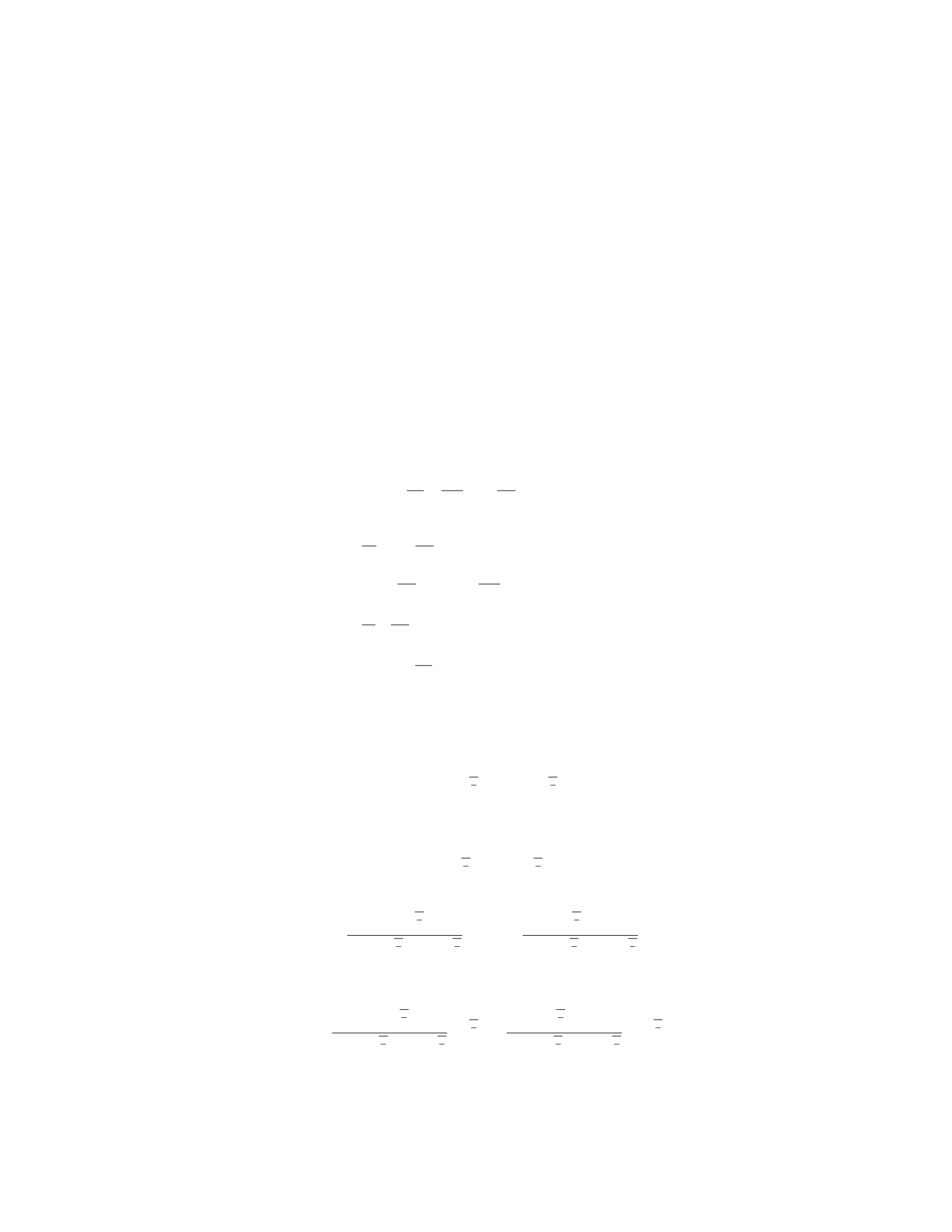
y(x) = c1e√3
2x+c2e−√3
2x
Step 6: Apply the boundary conditions y(0) = 1 and y(1) = 2:
y(0) = c1+c2= 1
y(1) = c1e√3
2+c2e−√3
2= 2
Step 7: Solve the system of equations to find c1and c2:
c1=e−√3
2
1−e√3
2+e−√3
2
, c2=e√3
2−1
1−e√3
2+e−√3
2
Step 8: Substitute the values of c1and c2back into the general solution to
obtain the extremal function y(x).
y(x) = e−√3
2
1−e√3
2+e−√3
2
e√3
2x+e√3
2−1
1−e√3
2+e−√3
2
e−√3
2x
23

Question 24
Question
Consider the functional
J[y] = Z1
0y′2+y2dx
subject to the boundary conditions y(0) = 0 and y(1) = 1. Determine the
function y(x) that minimizes J[y].
Solution
Step 1: Write down the Euler-Lagrange equation
d
dx ∂f
∂y′−∂f
∂y = 0
where f(y, y′, x) = y′2+y2.
Step 2: Compute the partial derivatives
∂f
∂y = 2y
∂f
∂y′= 2y′
d
dx ∂f
∂y′=d
dx (2y′)=2y′′
Step 3: Apply the Euler-Lagrange equation
2y′′ −2y= 0
which simplifies to
y′′ −y= 0
Step 4: Solve the differential equation The general solution to y′′ −y= 0 is
y(x) = c1ex+c2e−x.
Step 5: Apply the boundary conditions Using the boundary conditions
y(0) = 0 and y(1) = 1, we find
0 = c1+c2
1 = c1e+c2e−1
Step 6: Solve for c1and c2Solving the system of equations, we get c1=e
e2−1
and c2=−1
e2−1.
Step 7: Substitute back into the general solution Therefore, the function
that minimizes J[y] is
y(x) = e
e2−1ex−1
e2−1e−x
24

Question 25
Question
Find the extremal for the functional
J[y] = Z1
0y2+y′2dx
subject to the boundary conditions y(0) = 0 and y(1) = 1.
Solution
Step 1: Compute the Euler-Lagrange equation The Euler-Lagrange equation for
minimizing the functional J[y] is given by:
d
dx ∂f
∂y′=∂f
∂y
where f=y2+y′2. Differentiating with respect to yand y′gives us:
∂f
∂y = 2yand ∂f
∂y′= 2y′
d
dx ∂f
∂y′=d
dx(2y′)=2y′′
Therefore, the Euler-Lagrange equation becomes:
2y′′ = 2y
Step 2: Solve the differential equation The general solution to the differential
equation 2y′′ = 2yis given by:
y(x) = Acos(x) + Bsin(x)
Applying the boundary conditions y(0) = 0 and y(1) = 1 gives us:
y(0) = A= 0
y(1) = Bsin(1) = 1
B=1
sin(1)
Step 3: Finalize the extremal Therefore, the extremal for the functional J[y]
subject to the given boundary conditions is:
y(x) = sin(x)
sin(1)
25

Question 26
Question
Find the extremals of the functional
J[y] = Z1
0
(y+y′)2dx
subject to the boundary conditions y(0) = 0 and y(1) = 1.
Solution
Step 1: Compute the functional derivative of J[y] with respect to y(x):
δJ
δy =d
dx ∂f
∂y′−∂f
∂y
where f= (y+y′)2.
Step 2: Calculate the partial derivatives:
∂f
∂y′= 2(y+y′)
∂f
∂y = 2(y+y′)
Step 3: Substitute the partial derivatives back into the functional derivative
formula: δJ
δy =d
dx(2(y+y′)) −2(y+y′)
= 2(y′+y′′)−2(y+y′)
= 2y′′ −2y
Step 4: Set the functional derivative equal to 0 to find the extremals:
2y′′ −2y= 0
y′′ −y= 0
Step 5: Solve the ordinary differential equation y′′−y= 0: The characteristic
equation is r2−1 = 0, which factors as (r−1)(r+ 1) = 0. Thus, the solutions
are y(x) = c1ex+c2e−x.
Step 6: Apply the boundary conditions y(0) = 0 and y(1) = 1:
y(0) = c1e0+c2e0=c1+c2= 0
y(1) = c1e+c2e−1=c1e−c2e= 1
Solving these equations gives c1=e
2and c2=−e
2.
Step 7: The extremal function for the functional J[y] is:
y(x) = e
2ex−e
2e−x
y(x) = e(ex−e−x)
2
26

Question 27
Question
Find the extremal of the functional
J[y] = Z1
0
(2y′2+y2)dx
subject to the boundary conditions y(0) = 1 and y(1) = 2.
Solution
Step 1: Define the Euler-Lagrange equation.
The Euler-Lagrange equation for this problem is given by
d
dx ∂f
∂y′−∂f
∂y = 0
where f= 2y′2+y2.
Step 2: Compute the partial derivatives.
We have ∂f
∂y′= 4y′
and ∂f
∂y = 2y
.
Step 3: Plug the derivatives into the Euler-Lagrange equation.
Substitute the partial derivatives into the Euler-Lagrange equation to get
d
dx(4y′)−2y= 0
which simplifies to
4y′′ −2y= 0
.
Step 4: Solve the differential equation.
The general solution to the differential equation is
y(x) = c1e−√2x+c2e√2x
.
Step 5: Apply the boundary conditions.
Using the boundary conditions y(0) = 1 and y(1) = 2, we find that
c1+c2= 1
27
and
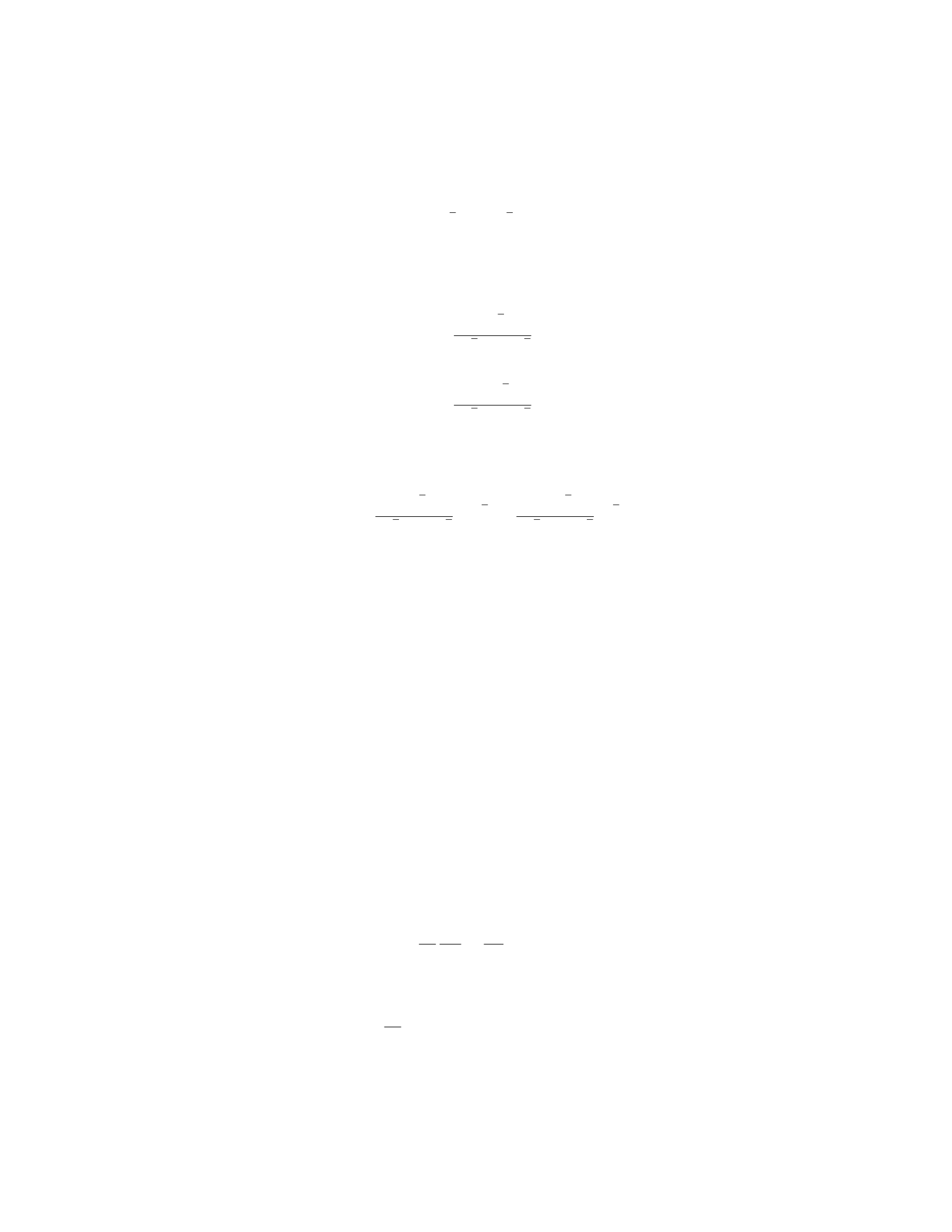
c1e−√2+c2e√2= 2
.
Step 6: Solve for the constants.
By solving the system of equations, we find that
c1=e√2
e√2−e−√2
and
c2=e−√2
e√2−e−√2
.
Step 7: Write down the extremal.
Therefore, the extremal of the functional is
y(x) = e√2
e√2−e−√2e−√2x+e−√2
e√2−e−√2e√2x
.
Question 28
Question
Find the extremals of the functional J[y] = R2
1(y2+y′2)dx subject to the
boundary conditions y(1) = 3 and y(2) = 4.
Solution
Step 1: Define the Lagrangian
The Lagrangian for this problem is given by
L(y, y′;λ) = y2+y′2+λ1(y−3) + λ2(y−4)
where λ1and λ2are the Lagrange multipliers associated with the boundary
conditions.
Step 2: Set up the Euler-Lagrange equation
The Euler-Lagrange equation for this problem is
d
dx
∂L
∂y′−∂L
∂y = 0
Plugging in the values,
d
dx(2y′)−2y+λ1+λ2= 0
28

Step 3: Solve the Euler-Lagrange equation
The solution to the Euler-Lagrange equation gives the extremals. Integrating
the differential equation above, we get
2y′−2y+λ1x+λ2x+C= 0
where Cis the constant of integration.
Step 4: Apply the boundary conditions
Using the boundary conditions y(1) = 3 and y(2) = 4, we can solve for the
constants and Lagrange multipliers.
Step 5: Find the extremals
After finding the constants and Lagrange multipliers, substitute them back into
the solution to obtain the extremals.
Question 29
Question
Find the function y(x) that minimizes the functional
J[y] = Z1
0y′2+y2dx
subject to the boundary conditions y(0) = 0 and y(1) = 1.
Solution
Step 1: Define the Euler-Lagrange equation for the given functional. Let
F(y, y′, x) = y′2+y2. The Euler-Lagrange equation is given by
d
dx ∂F
∂y′−∂F
∂y = 0
Step 2: Compute the partial derivatives of Fwith respect to yand y′.
∂F
∂y = 2yand ∂F
∂y′= 2y′
Step 3: Compute the derivative d
dx ∂F
∂y′.
d
dx ∂F
∂y′=d
dx(2y′)=2y′′
Step 4: Substitute the partial derivatives into the Euler-Lagrange equation.
d
dx(2y′)−2y= 0
29

Step 5: Simplify the equation by taking the derivative and expanding.
2y′′ −2y= 0
Step 6: Solve the differential equation 2y′′ −2y= 0. The general solution
to this differential equation is y(x) = c1cos√2x+c2sin√2x, where c1and
c2are constants.
Step 7: Apply the boundary conditions y(0) = 0 and y(1) = 1. From
y(0) = 0, we have c1= 0.
So, y(x) = c2sin√2x.
Step 8: Use the boundary condition y(1) = 1 to find c2.
y(1) = c2sin√2= 1
c2=1
sin√2
Therefore, the function y(x) that minimizes the functional J[y] subject to
the given boundary conditions is
y(x) = sin√2x
sin√2
Question 30
Question
Find the function y(x) that minimizes the functional:
J[y] = Z1
0
(y′2−y2)dx
subject to the boundary conditions y(0) = 1 and y(1) = 2.
Solution
Step 1: Write down the Euler-Lagrange equation for the given functional:
d
dx ∂f
∂y′−∂f
∂y = 0
where f(y, y′, x) = y′2−y2.
Step 2: Compute the partial derivatives:
∂f
∂y =−2yand ∂f
∂y′= 2y′
30

Step 3: Compute the derivative with respect to y′:
d
dx ∂f
∂y′=d
dx(2y′)=2y′′
Step 4: Now we can write the Euler-Lagrange equation as:
2y′′ + 2y= 0
Step 5: Solve the differential equation with the given boundary conditions:
The general solution to the differential equation is:
y(x) = c1cos(x) + c2sin(x)
Applying the boundary conditions y(0) = 1 and y(1) = 2, we find:
c1= 1 and c2=2−c1
sin(1)
Step 6: Therefore, the function that minimizes the functional is:
y(x) = cos(x) + 2−cos(1)
sin(1) sin(x)
Question 31
Question
Find the extremals for the functional
J[y] = Z1
0
(y′2−y2)dx
subject to the boundary conditions y(0) = 0 and y(1) = 1.
Solution
Step 1: Define the Euler-Lagrange equation. The Euler-Lagrange equation for
a functional of the form J[y] = Rb
aF(x, y, y′)dx is given by
d
dx ∂F
∂y′=∂F
∂y
Step 2: Apply the Euler-Lagrange equation to the given functional. In this
case, F(x, y, y′) = y′2−y2, so
d
dx ∂
∂y′(y′2−y2)=∂
∂y (y′2−y2)
Simplify this expression.
31

Step 3: Evaluate the partial derivatives. We have
∂
∂y′(y′2−y2)=2y′,and ∂
∂y (y′2−y2) = −2y
Thus, our Euler-Lagrange equation becomes
d
dx(2y′) = −2y
Step 4: Solve the differential equation. We have
2y′′ =−2y
Which simplifies to
y′′ +y= 0
This is a second-order linear homogeneous differential equation. The general
solution to this differential equation is
y(x) = c1cos(x) + c2sin(x)
Step 5: Apply the boundary conditions. Using the boundary conditions
y(0) = 0 and y(1) = 1, we find that c1= 0 and c2= 1. Thus, the extremal
satisfying the boundary conditions is
y(x) = sin(x)
Question 32
Question
Find the extremal for the functional
J[y] = Z1
0
(y′2+y2−y)dx
subject to the boundary conditions y(0) = 0 and y(1) = 1.
Solution
Step 1: We begin by finding the Euler-Lagrange equation. Let F=y′2+y2−y
and ∂F
∂y −d
dx ∂F
∂y′= 0, so we have
d
dx(2y′−1) −2y= 0
Step 2: Solving the differential equation from Step 1, we get
2y′′ −2y= 0
32

which simplifies to
y′′ −y= 0
Step 3: The general solution to the above differential equation is given by
y(x) = c1cos x+c2sin x.
Step 4: Applying the boundary conditions y(0) = 0 and y(1) = 1, we find:
y(0) = c1= 0
y(1) = c2sin 1 = 1
c2=1
sin 1
Therefore, the extremal for the given functional is y(x) = sin x
sin 1 .
Question 33
Question
Find the extremals of the functional
J[y] = Z1
0
(y′2+y2)dx
subject to the boundary conditions y(0) = 0 and y(1) = 1.
Solution
Step 1: Define the Euler-Lagrange equation for the given functional. The Euler-
Lagrange equation is given by
d
dx ∂f
∂y′−∂f
∂y = 0
where f(y, y′, x) = y′2+y2.
Step 2: Compute ∂f
∂y′and ∂f
∂y .
∂f
∂y′= 2y′and ∂f
∂y = 2y
Step 3: Plug ∂f
∂y′and ∂f
∂y into the Euler-Lagrange equation and simplify.
d
dx(2y′)−2y= 0
2y′′ −2y= 0
Step 4: Solve the differential equation 2y′′ −2y= 0 to find all solutions to
the Euler-Lagrange equation. The general solution to the differential equation
is
y(x) = c1cos(x) + c2sin(x)
33

Step 5: Apply the boundary conditions y(0) = 0 and y(1) = 1 to find the
specific solution. From y(0) = 0, we have
c1= 0
Substitute c1= 0 into the general solution, so
y(x) = c2sin(x)
From y(1) = 1, we have
c2sin(1) = 1
c2=1
sin(1)
Therefore, the extremal for the given functional is
y(x) = 1
sin(1) sin(x)
Question 34
Question
Find the extremals for the functional
J[y] = Z1
0
[(y′)2−y2]dx
subject to the boundary conditions y(0) = 0 and y(1) = 1.
Solution
Step 1: Define the necessary functions and equations. Let L= (y′)2−y2be the
Lagrangian corresponding to the given functional. The Euler-Lagrange equation
for this variational problem is given by
d
dx ∂L
∂y′−∂L
∂y = 0
Step 2: Compute the partial derivatives. We have
∂L
∂y′= 2y′and ∂L
∂y =−2y
Therefore, the Euler-Lagrange equation becomes
d
dx(2y′)+2y= 0
2y′′ + 2y= 0
34

y′′ +y= 0
Step 3: Solve the differential equation. The general solution to the differen-
tial equation y′′ +y= 0 is given by
y(x) = c1cos(x) + c2sin(x)
Step 4: Apply the boundary conditions. Using the boundary conditions
y(0) = 0 and y(1) = 1, we obtain the system of equations:
c1= 0
c1cos(1) + c2sin(1) = 1
From the first equation, c1= 0. Substituting this into the second equation gives
c2sin(1) = 1
c2=1
sin(1)
Step 5: Final solution. The extremal for the functional J[y] that satisfies
the given boundary conditions is therefore
y(x) = sin(x)
sin(1)
Question 35
Question
Find the extremals of the functional
J[y] = Z1
0
(2y2−y′2)dx
subject to the boundary conditions y(0) = 0 and y(1) = 1.
Solution
Step 1: Compute the Euler-Lagrange equation. The Euler-Lagrange equation
for a functional of the form
J[y] = Zb
a
F(x, y, y′)dx
is given by
d
dx ∂F
∂y′−∂F
∂y = 0.
35

For our functional J[y] = R1
0(2y2−y′2)dx, we have F(x, y, y′)=2y2−y′2.
Thus, the Euler-Lagrange equation becomes
d
dx ∂(2y2−y′2)
∂y′−∂(2y2−y′2)
∂y = 0.
Step 2: Solve the Euler-Lagrange equation. Differentiating with respect to
y′, we get
∂(2y2−y′2)
∂y′= 4y
and differentiating with respect to y, we get
∂(2y2−y′2)
∂y = 4y.
Therefore, the Euler-Lagrange equation simplifies to
d
dx(4y)−4y= 0,
or d
dx(4y) = 4y.
Step 3: Solve the differential equation obtained. The solution to the differ-
ential equation is
y(x) = c1ex+c2e−x,
where c1and c2are constants.
Step 4: Apply the boundary conditions. Using the boundary conditions
y(0) = 0 and y(1) = 1 in the solution y(x) = c1ex+c2e−x, we find:
y(0) = c1+c2= 0
and
y(1) = c1e+c2e−1= 1.
Solving these equations simultaneously, we find c1=e
e−1and c2=−1
e−1.
Step 5: Write down the extremals. Therefore, the extremals of the func-
tional J[y] subject to the boundary conditions are given by
y(x) = e
e−1ex−1
e−1e−x.
36

Question 3
Question
Find the extremals of the functional J[y] = R1
0(y′2−y)dx subject to the bound-
ary conditions y(0) = 0 and y(1) = 1.
Solution
Step 1: Compute the Euler-Lagrange equation. The Euler-Lagrange equation
for this functional is given by:
d
dx ∂f
∂y′−∂f
∂y = 0
where f(y, y′, x) = y′2−y.
Step 2: Find the partial derivatives of f. We have:
∂f
∂y′= 2y′,∂f
∂y =−1
Step 3: Differentiate ∂f
∂y′with respect to x.
d
dx ∂f
∂y′=d
dx(2y′)=2y′′
Step 4: Apply the Euler-Lagrange equation.
2y′′ + 1 = 0
Step 5: Solve the differential equation. The general solution to the differen-
tial equation is y(x) = Asinh(x) + Bcosh(x).
Step 6: Apply the boundary conditions. Using the boundary conditions
y(0) = 0 and y(1) = 1, we find:
(y(0) = Bcosh(0) = B= 0
y(1) = Asinh(1) = 1
Step 7: Solve for the constants. From the second boundary condition, we
find Asinh(1) = 1 =⇒A=1
sinh(1) .
Therefore, the extremal of the functional is y(x) = sinh(x)
sinh(1) .
Question 4
Question
Find the extremals for the functional
J[y] = Z1
0
(y′2+y2)dx
subject to the boundary conditions y(0) = 0 and y(1) = 1.
3

Solution
Step 1: Define the Lagrangian for the given functional J[y]. The Lagrangian
is defined as
L(x, y, y′) = f(x, y, y′)−λg(x, y, y′)
where f(x, y, y′) = y′2+y2and g(x, y, y′) = 0.
Step 2: Find the Euler-Lagrange equation. The Euler-Lagrange equation
is given by
d
dx ∂L
∂y′−∂L
∂y = 0
Step 3: Calculate the partial derivatives of the Lagrangian. We have:
∂L
∂y′=∂
∂y′(y′2+y2)=2y′
∂L
∂y =∂
∂y (y′2+y2)=2y
Step 4: Plug the derivatives into the Euler-Lagrange equation. Substitute
the partial derivatives into the Euler-Lagrange equation to obtain:
d
dx(2y′)−2y= 0
Step 5: Solve the differential equation. Integrating the Euler-Lagrange
equation gives:
2y′′ −2y= 0
y′′ −y= 0
The general solution to this differential equation is:
y(x) = c1ex+c2e−x
Step 6: Apply the boundary conditions. Using the boundary conditions
y(0) = 0 and y(1) = 1, we have:
c1+c2= 0
c1e+c2e−1= 1
Solving these equations simultaneously yields c1=e
e+1 and c2=−1
e+1 .
Step 7: Determine the extremals. Therefore, the extremal that minimizes
the functional J[y] is:
y(x) = e
e+ 1ex−1
e+ 1e−x
4

Question 5
Question
Find the function y(x) that minimizes the functional
J[y] = Z1
0y′2−2ydx
subject to the boundary conditions y(0) = 0 and y(1) = 1.
Solution
Step 1: Write down the Euler-Lagrange equation. The Euler-Lagrange equation
for minimizing the functional J[y] = Rb
aL(x, y, y′)dx is given by
d
dx ∂L
∂y′−∂L
∂y = 0
In this case, L(x, y, y′) = y′2−2y, so the Euler-Lagrange equation becomes
d
dx(2y′)−(−2) = 0
d
dx(2y′) + 2 = 0
Step 2: Solve the differential equation. Integrating the above equation gives
2y′+ 2 = C
where Cis the constant of integration.
Step 3: Apply the boundary conditions. From the boundary conditions
y(0) = 0 and y(1) = 1, we can find the constant C. When x= 0, we have
2y′(0) + 2 = C
Since y(0) = 0, y′(0) = 0, so
2(0) + 2 = C
C= 2
Step 4: Solve for y(x). Substitute C= 2 back into the equation 2y′+ 2 = C
to get
2y′+ 2 = 2
2y′= 0
y′= 0
Integrating y′= 0, we find that y(x) = Dwhere Dis a constant.
Step 5: Apply the boundary condition y(1) = 1. Using the boundary condi-
tion y(1) = 1, we find that D= 1.
Therefore, the function that minimizes the functional is y(x) = 1.
5

Question 6
Question
Find the extremals for the functional
J[y] = Z1
0
(y′′)2−2y dx
subject to the boundary conditions y(0) = 0 and y(1) = 1.
Solution
Step 1: Define the Euler-Lagrange equation. For a functional of the form J[y] =
Rb
aF(x, y, y′)dx, the Euler-Lagrange equation is given by
d
dx ∂F
∂y′−∂F
∂y = 0
Step 2: Given J[y] = R1
0(y′′)2−2y dx, we have F(x, y, y′) = (y′′)2−2y.
Therefore, ∂F
∂y =−2,and ∂F
∂y′= 0
Step 3: Apply the Euler-Lagrange equation to find the extremals. Combining
the above results, we get
d
dx ∂F
∂y′−∂F
∂y =d
dx(0) −(−2) = 2
Step 4: Setting this equal to zero gives the differential equation
2=0
which is a contradiction, indicating that the extremals do not exist for this
functional and boundary conditions.
Question 7
Question
Find the extremals of the functional
J[y] = Z1
0
(y′(x))2−y(x)2dx
subject to the boundary conditions y(0) = 1 and y(1) = 2.
6

Solution
To find the extremals of the given functional, we need to solve the Euler-
Lagrange equation. The Euler-Lagrange equation for a functional of the form
J[y] = Zb
a
F(x, y, y′)dx
is given by
d
dx ∂F
∂y′−∂F
∂y = 0
Step 1: Determine the partial derivatives Let F(x, y, y′)=(y′(x))2−
y(x)2. Then, we have
∂F
∂y′= 2y′(x)
d
dx ∂F
∂y′= 2y′′(x)
∂F
∂y =−2y(x)
Step 2: Set up the Euler-Lagrange equation Plugging these derivatives
back into the Euler-Lagrange equation, we get
d
dx(2y′(x)) + 2y(x)=0
2y′′ + 2y= 0
Step 3: Solve the differential equation The general solution to the
differential equation 2y′′ + 2y= 0 is
y(x) = c1cos(x) + c2sin(x)
Step 4: Apply boundary conditions Given that y(0) = 1 and y(1) = 2,
we have the following equations:
c1= 1
c1cos(1) + c2sin(1) = 2
Solving these equations simultaneously, we find
c1= 1, c2≈1.557
Therefore, the extremal of the functional J[y] that satisfies the given bound-
ary conditions is
y(x) = cos(x)+1.557 sin(x)
7

Question 8
Question
Find the extremals for the functional
J[y] = Z1
0
(y′2−2yy′)dx
subject to the boundary conditions y(0) = 0 and y(1) = 1.
Solution
To find the extremals, we will apply the Euler-Lagrange equation and then solve
the resulting differential equation.
Step 1: Set up the Euler-Lagrange equation The Euler-Lagrange equa-
tion for J[y] = Rb
aF(x, y, y′)dx is given by
d
dx ∂F
∂y′−∂F
∂y = 0
In this case, F(x, y, y′) = y′2−2yy′, so
∂F
∂y′= 2y′and ∂F
∂y =−2y
Thus, the Euler-Lagrange equation becomes
d
dx(2y′)−(−2y)=0
⇒2y′′ + 2y= 0
Step 2: Solve the differential equation The solution to the ODE 2y′′ +
2y= 0 is of the form y(x) = Acos(x) + Bsin(x), where Aand Bare constants
to be determined.
Applying the boundary conditions y(0) = 0 and y(1) = 1, we find: At
x= 0: 0 = Acos(0) + Bsin(0) = AAt x= 1: 1 = Acos(1) + Bsin(1) =
Acos(1) + Bsin(1)
Therefore, A= 0 and B= 1/sin(1).
Step 3: Conclusion The extremal for the functional J[y] subject to the
given boundary conditions is
y(x) = sin(x)
sin(1)
8

Question 9
Question
Find the extremals for the functional
J[y] = Z1
0
(y′2−y2)dx
subject to the boundary conditions y(0) = 0 and y(1) = 1.
Solution
Step 1: Define the Euler-Lagrange equation using the functional J[y]:
d
dx
∂f
∂y′−∂f
∂y = 0
where f=y′2−y2.
Step 2: Calculate the partial derivative of fwith respect to y′:
∂f
∂y′= 2y′
Step 3: Take the derivative of ∂f
∂y′with respect to x:
d
dx ∂f
∂y′=d
dx(2y′)=2y′′
Step 4: Calculate the partial derivative of fwith respect to y:
∂f
∂y =−2y
Step 5: Set up the Euler-Lagrange equation:
d
dx
∂f
∂y′−∂f
∂y = 0
2y′′ + 2y= 0
Step 6: Solve the differential equation obtained in Step 5: The general
solution to the differential equation is y(x) = c1cos(x) + c2sin(x).
Step 7: Apply the boundary conditions y(0) = 0 and y(1) = 1:
y(0) = c1= 0
y(1) = c2sin(1) = 1 ⇒c2=1
sin(1)
Step 8: The extremal that satisfies the boundary conditions is y(x) = sin(x)
sin(1) .
9

Question 10
Question
Find the extremals of the functional
J[y] = Z1
0
(y′2+y2)dx
subject to the boundary conditions y(0) = 0 and y(1) = 1.
Solution
Step 1: Define the Euler-Lagrange equation for the given functional: The
Euler-Lagrange equation for the functional J[y] = Rb
aF(x, y, y′)dx is given by
d
dx ∂F
∂y′−∂F
∂y = 0
Step 2: Compute the partial derivatives of the integrand to apply the Euler-
Lagrange equation: We have F(x, y, y′) = y′2+y2, so
∂F
∂y = 2yand ∂F
∂y′= 2y′
Step 3: Write the Euler-Lagrange equation using the computed partial
derivatives: Substitute the partial derivatives into the Euler-Lagrange equation:
d
dx(2y′)−2y= 0
Step 4: Solve the differential equation obtained in Step 3: The differential
equation becomes 2y′′ −2y= 0, which simplifies to y′′ −y= 0.
Step 5: Find the general solution of the differential equation: The general
solution of y′′ −y= 0 is given by y(x) = c1ex+c2e−x, where c1and c2are
constants.
Step 6: Apply the boundary conditions y(0) = 0 and y(1) = 1: Using
y(0) = 0, we find c1+c2= 0, and using y(1) = 1, we get c1e+c2e−1= 1.
Solving these equations simultaneously gives c1=e
e−1and c2=−1
e−1.
Step 7: Write down the extremal for the functional J[y]: Therefore, the
extremal for the given functional subject to the boundary conditions is
y(x) = e
e−1ex−1
e−1e−x
Question 11
Question
Find the function y(x) that minimizes the functional
J[y] = Z1
0
(y′2−y·y′)dx
10

subject to the boundary conditions y(0) = 1 and y(1) = 2.
Solution
Step 1: Compute the Euler-Lagrange Equation. The Euler-Lagrange equation
for the functional J[y] = R1
0(f(y, y′, x)) dx is given by
d
dx ∂f
∂y′−∂f
∂y = 0
Applying this to the given functional, we have
d
dx (2y′−y)−(−y′)=0⇒2y′′ −y′+y= 0
Step 2: Solve the Euler-Lagrange Equation. The solution to the differential
equation 2y′′ −y′+y= 0 can be found by guessing a solution of the form
y=emx. Plugging this into the differential equation, we get
2m2emx −memx +emx = 0
Solving for m, we obtain m= 1 or m=−1
2. Hence, the general solution to the
differential equation is
y(x) = c1ex+c2e−x
2
Step 3: Apply Boundary Conditions. Using the given boundary conditions,
we find c1and c2. First, we have y(0) = 1 which gives us
c1+c2= 1
Next, we have y(1) = 2 which gives us
c1e+c2e−1
2= 2
Step 4: Solve for c1and c2. Solving the system of equations c1+c2= 1 and
c1e+c2e−1
2= 2, we find c1=2e1
2−2
e−e1
2
and c2=2−2e
e−e1
2
.
Therefore, the function y(x) that minimizes the given functional subject to
the boundary conditions is
y(x) = 2e1
2−2
e−e1
2·ex+2−2e
e−e1
2·e−x
2
Question 12
Question
Find the extremals of the functional
J[y] = Z1
0
(y′2+y2)dx
subject to the boundary conditions y(0) = 0 and y(1) = 1.
11

Solution
Step 1: Define the Euler-Lagrange equation.
The extremals of the functional J[y] satisfy the Euler-Lagrange equation given
by
d
dx ∂f
∂y′−∂f
∂y = 0,
where f(x, y, y′) = y′2+y2.
Step 2: Compute the partial derivatives.
Taking the partial derivatives of fwith respect to yand y′, we have
∂f
∂y = 2yand ∂f
∂y′= 2y′.
Step 3: Apply the Euler-Lagrange equation.
Substitute the partial derivatives into the Euler-Lagrange equation to get
d
dx(2y′)−2y= 0.
Step 4: Solve the differential equation.
Solving the differential equation gives
2y′′ −2y= 0.
This is a second-order linear homogeneous differential equation with constant
coefficients. The characteristic equation is 2r2−2 = 0, which simplifies to
r2−1 = 0. Thus, we have r=±1.
Step 5: Find the general solution.
The general solution of the differential equation is
y(x) = c1ex+c2e−x.
Step 6: Apply the boundary conditions.
Use the boundary conditions y(0) = 0 and y(1) = 1 to find the values of c1
and c2. Solving the system of equations 0 = c1+c2and 1 = c1e+c2/e gives
c1=e
e2−1and c2=−1
e2−1.
Step 7: State the extremal.
Therefore, the extremal of the functional J[y] is
y(x) = ex−e−x
e2−1.
Question 13
Question
Find the extremals of the functional
J[y] = Z2
0
(y′2−y2)dx
subject to the boundary conditions y(0) = 0 and y(2) = 0.
12

Solution
Step 1: Define the Lagrangian.
The Lagrangian for this problem is given by
L(x, y, y′) = y′2−y2
Step 2: Set up the Euler-Lagrange equation.
The Euler-Lagrange equation for this problem is
d
dx ∂L
∂y′−∂L
∂y = 0
Step 3: Compute the partial derivatives.
∂L
∂y′=∂
∂y′(y′2−y2)=2y′
d
dx ∂L
∂y′=d
dx(2y′)=2y′′
∂L
∂y =∂
∂y (y′2−y2) = −2y
Step 4: Plug the derivatives back into the Euler-Lagrange equation.
2y′′ + 2y= 0
Step 5: Solve the differential equation.
The general solution to the differential equation is
y(x) = c1sin(x) + c2cos(x)
Step 6: Apply the boundary conditions.
Using the boundary conditions y(0) = 0 and y(2) = 0, we have
y(0) = c2= 0
y(2) = c1sin(2) = 0
Since c2= 0, the only solution is c1= 0, which gives y(x) = 0.
Step 7: Conclusion.
The extremals of the functional J[y] subject to the given boundary conditions
are the functions y(x) = 0.
Question 14
Question
Find the extremals of the functional
J[y] = Z1
0
(y′2−y2)dx
subject to the boundary conditions y(0) = 1 and y(1) = 2.
13

Solution
Step 1: Compute the Euler-Lagrange equation. The Euler-Lagrange equation
for this functional is given by
d
dx ∂L
∂y′−∂L
∂y = 0
where L=y′2−y2.
Step 2: Compute the partial derivatives. We have
∂L
∂y′= 2y′,d
dx ∂L
∂y′= 2y′′
∂L
∂y =−2y
Step 3: Write out the Euler-Lagrange equation. Substituting these deriva-
tives into the Euler-Lagrange equation gives
2y′′ + 2y= 0
Step 4: Solve the differential equation. The general solution to the differ-
ential equation 2y′′ + 2y= 0 is y(x) = c1cos(x) + c2sin(x).
Step 5: Apply the boundary conditions. Using the boundary conditions
y(0) = 1 and y(1) = 2, we find
c1= 1
c1cos(1) + c2sin(1) = 2
Step 6: Solve for c2. Solving the second equation from Step 5 for c2, we
get c2=2−cos(1)
sin(1) .
Step 7: Write the extremal. Therefore, the extremal of the functional J[y]
subject to the given boundary conditions is
y(x) = cos(x) + 2−cos(1)
sin(1) sin(x)
Question 15
Question
Find the extremals of the functional
J[y] = Z2
1
(y−y′′2)dx
subject to the boundary conditions y(1) = 1 and y(2) = 3.
14

Solution
Step 1: Compute the Euler-Lagrange equation. The Euler-Lagrange equation
for a functional J[y] = Rb
aF(x, y, y′)dx is given by
d
dx ∂F
∂y′−∂F
∂y = 0
Here, F(x, y, y′) = y−y′′2. So, we have
d
dx ∂F
∂y′−∂F
∂y =d
dx(−2y′′)−1=0
Step 2: Solve the ODE obtained from the Euler-Lagrange equation. The
above ODE simplifies to
y′′ =−1
2
The general solution to this ODE is
y=c1x+c2−1
2x2
Step 3: Apply the boundary conditions. Using y(1) = 1, we get
c1+c2−1
2= 1
Using y(2) = 3, we get
2c1+c2−2=3
Step 4: Solve for the constants. From the above equations, we get c1=5
2
and c2=1
2. Thus, the extremal for the given functional is
y=5
2x+1
2−1
2x2
Question 16
Question
Find the extremals of the functional
J[y] = Z1
0y′2−ydx
subject to the boundary conditions y(0) = 0 and y(1) = 1.
15

Solution
Step 1: Set up the Euler-Lagrange equation. The Euler-Lagrange equation for
this functional is given by
d
dx ∂f
∂y′−∂f
∂y = 0
where f=y′2−y.
Step 2: Compute the partial derivatives.
∂f
∂y′= 2y′
d
dx ∂f
∂y′= 2y′′
∂f
∂y =−1
Step 3: Plug the derivatives into the Euler-Lagrange equation to get the
differential equation.
2y′′ −(−1) = 0
2y′′ + 1 = 0
Step 4: Solve the differential equation.
y′′ =−1
2
Integrating with respect to x, we get
y′=−1
2x+c1
Integrating again, we find
y=−1
4x2+c1x+c2
Step 5: Apply the boundary conditions to solve for the constants. Using
y(0) = 0 gives c2= 0. And using y(1) = 1 gives c1=3
4.
Step 6: The extremal that minimizes the functional is
y=−1
4x2+3
4x
Question 17
Question
Let I[y] = R1
0(y′2−y2)dx be a functional on C1([0,1]), where y(0) = 0 and
y(1) = 1. Determine the function y(x) that minimizes I[y].
16

Solution
Step 1: Compute the Euler-Lagrange equation. To find the function y(x) that
minimizes I[y], we need to solve the Euler-Lagrange equation:
d
dx ∂f
∂y′−∂f
∂y = 0
where f(y, y′) = y′2−y2.
Step 2: Compute the partial derivatives of f. The partial derivative of f
with respect to y′is: ∂f
∂y′= 2y′
The partial derivative of fwith respect to yis:
∂f
∂y =−2y
Step 3: Apply the Euler-Lagrange equation. Substitute the partial deriva-
tives into the Euler-Lagrange equation to get:
d
dx(2y′)+2y= 0
which simplifies to:
2y′′ + 2y= 0
Step 4: Solve the differential equation. The general solution to y′′ +y= 0
is:
y(x) = c1cos x+c2sin x
Step 5: Apply the boundary conditions. Using the boundary conditions
y(0) = 0 and y(1) = 1, we find:
y(0) = c1= 0
y(1) = c2sin 1 = 1
So, c2=1
sin 1 .
Step 6: Final solution. Therefore, the function y(x) that minimizes I[y] is:
y(x) = sin x
sin 1
Question 18
Question
Find the function y(x) that minimizes the functional
J[y] = Z1
0
(y′2−2y)dx
subject to the boundary conditions y(0) = 0 and y(1) = 1.
17

Solution
To find the function that minimizes the functional J[y], we will use the Euler-
Lagrange equation. Given that the integrand does not depend explicitly on
y(x), the Euler-Lagrange equation simplifies to:
d
dx ∂f
∂y′−∂f
∂y = 0
where f(y, y′, x) = y′2−2y.
Step 1: Compute partial derivatives
Compute the partial derivatives of fwith respect to yand y′:
∂f
∂y =−2
∂f
∂y′= 2y′
Step 2: Apply Euler-Lagrange equation
Substitute these derivatives into the Euler-Lagrange equation:
d
dx(2y′)−(−2) = 0
Simplify this to obtain the Euler-Lagrange equation:
d
dx(2y′) + 2 = 0
Step 3: Solve the Euler-Lagrange equation
Integrate the ODE by solving for y′:
2y′+ 2 = C1
y′=C1−2
Step 4: Find y(x)
Integrate y′with respect to xto find y(x):
y(x) = Z(C1−2) dx
y(x) = C1x−2x+C2
Step 5: Apply boundary conditions
Using the boundary conditions y(0) = 0 and y(1) = 1, we find C1and C2:
y(0) = C2= 0
y(1) = C1−2 + 0 = 1
C1= 3
Therefore, the function that minimizes the functional J[y] subject to the
given boundary conditions is y(x) = 3x−2x=x.
18

Question 19
Question
Find the extremals of the functional
J[y] = Z1
0
(2y′2+y2)dx
subject to the boundary conditions y(0) = 0 and y(1) = 1.
Solution
Step 1: Define the Euler-Lagrange equation. The Euler-Lagrange equation for
the given functional J[y] is given by
d
dx ∂f
∂y′−∂f
∂y = 0
where f= 2y′2+y2.
Step 2: Compute the partial derivatives. We need to compute the partial
derivatives of fwith respect to yand y′.
∂f
∂y = 2y
∂f
∂y′= 4y′
Step 3: Apply the Euler-Lagrange equation. Substituting the partial deriva-
tives into the Euler-Lagrange equation, we get
d
dx(4y′)−2y= 0
Simplifying,
4y′′ −2y= 0
Step 4: Solve the differential equation. The general solution to the differen-
tial equation 4y′′ −2y= 0 is
y(x) = c1e(1/2)x+c2e(−1/2)x
Step 5: Apply the boundary conditions. Using the boundary conditions
y(0) = 0 and y(1) = 1 we can find the values of c1and c2. From y(0) = 0 we
get
c1+c2= 0
From y(1) = 1 we get
c1e1/2+c2e−1/2= 1
19

Solving these equations simultaneously, we find c1=e1/2
e1−e−1and c2=
−e−1/2
e1−e−1.
Therefore, the extremal for the functional J[y] is
y(x) = e1/2
e1−e−1e(1/2)x−e−1/2
e1−e−1e(−1/2)x
Question 20
Question
Consider the functional J[y] = R1
0(2y3−y′2)dx where y(0) = 0 and y(1) = 1.
Determine the function y(x) that minimizes J[y].
Solution
Step 1: Define the Lagrangian function We define the Lagrangian function Las
L(y, y′, x)=2y3−y′2.
Step 2: Set up the Euler-Lagrange equation The Euler-Lagrange equation
for minimizing the functional J[y] = Rb
aL(y, y′, x)dx is given by
d
dx ∂L
∂y′−∂L
∂y = 0.
Step 3: Compute the partial derivatives We compute the partial derivatives
of the Lagrangian function:
∂L
∂y = 6y2,∂L
∂y′=−2y′.
Step 4: Apply the Euler-Lagrange equation Substitute the partial derivatives
into the Euler-Lagrange equation:
d
dx(−2y′)−6y2= 0.
Step 5: Solve the differential equation This simplifies to d
dx (y′) + 6y2= 0,
or y′′ =−6y2.
Step 6: Solve the differential equation for y(x) Solving this differential equa-
tion gives y(x) = 1
√3x+Cwhere Cis a constant of integration.
Step 7: Apply the boundary conditions Using the boundary conditions
y(0) = 0 and y(1) = 1, we find that C=−1.
Step 8: Determine the function that minimizes the functional Therefore, the
function that minimizes the functional J[y] is y(x) = 1
√3x−1.
20

Question 21
Question
Find the function y(x) that minimizes the functional
J[y] = Z1
0
(y′2−y2)dx
subject to the boundary conditions y(0) = 0 and y(1) = 1.
Solution
Step 1: Define the Lagrangian as the integrand of the functional J[y] along with
the Lagrange multiplier λ.
L[y, y′, λ] = y′2−y2+λ(y(0) −0) + λ(y(1) −1)
Step 2: Find the Euler-Lagrange equation by differentiating Lwith respect
to yand y′and set the result equal to 0.
d
dx ∂L
∂y′−∂L
∂y = 0
d
dx(2y′)+2y= 0
Step 3: Solve the Euler-Lagrange equation above.
2y′′ + 2y= 0
y′′ +y= 0
Step 4: Solve the differential equation y′′ +y= 0 using the characteristic
equation method. The characteristic equation is r2+ 1 = 0, which has solutions
r=±i. Thus, the general solution is
y(x) = c1cos x+c2sin x
Step 5: Apply the boundary conditions y(0) = 0 and y(1) = 1 to solve for
c1and c2.
y(0) = c1= 0
y(1) = c2sin 1 = 1
c2=1
sin 1
Step 6: Therefore, the function that minimizes the functional J[y] is
y(x) = sin x
sin 1
21

Question 22
Question
Find the extremals of the functional
J[y] = Z1
0
(y′2−y2)dx
subject to the boundary conditions y(0) = 0 and y(1) = 1.
Solution
Step 1: Compute the Euler-Lagrange equation. The Euler-Lagrange equation
for this problem is given by
d
dx ∂f
∂y′−∂f
∂y = 0
where f(y, y′, x) = y′2−y2.
Step 2: Compute the partial derivatives.
∂f
∂y′=∂
∂y′(y′2−y2)=2y′
∂f
∂y =∂
∂y (y′2−y2) = −2y
Step 3: Apply the Euler-Lagrange equation.
d
dx(2y′)+2y= 0
2y′′ + 2y= 0
Step 4: Solve the differential equation. The general solution to this differ-
ential equation is of the form y(x) = c1cos x+c2sin x.
Step 5: Apply the boundary conditions. Using the boundary conditions
y(0) = 0 and y(1) = 1, we find the values of c1and c2.
y(0) = c1= 0
y(1) = c2sin 1 = 1 ⇒c2=1
sin 1
Therefore, the extremal for the functional J[y] is
y(x) = sin x
sin 1
22
Question 23
Question
Find the extremals of the functional
J[y] = Z1
0
(3y2−2y′2)dx
subject to the boundary conditions
y(0) = 1, y(1) = 2
Solution
Step 1: Compute the Euler-Lagrange Equation. The Euler-Lagrange equation
for the given functional J[y] is given by:
d
dx ∂f
∂y′−∂f
∂y = 0
where f= 3y2−2y′2.
Step 2: Compute ∂f
∂y and ∂f
∂y′:
∂f
∂y = 6y, ∂f
∂y′=−4y′
Step 3: Compute d
dx ∂f
∂y′:
d
dx (−4y′) = −4y′′
Step 4: Plug the derivatives back into the Euler-Lagrange equation:
−4y′′ −6y= 0
Step 5: The general solution to the differential equation −4y′′ −6y= 0 is
given by:
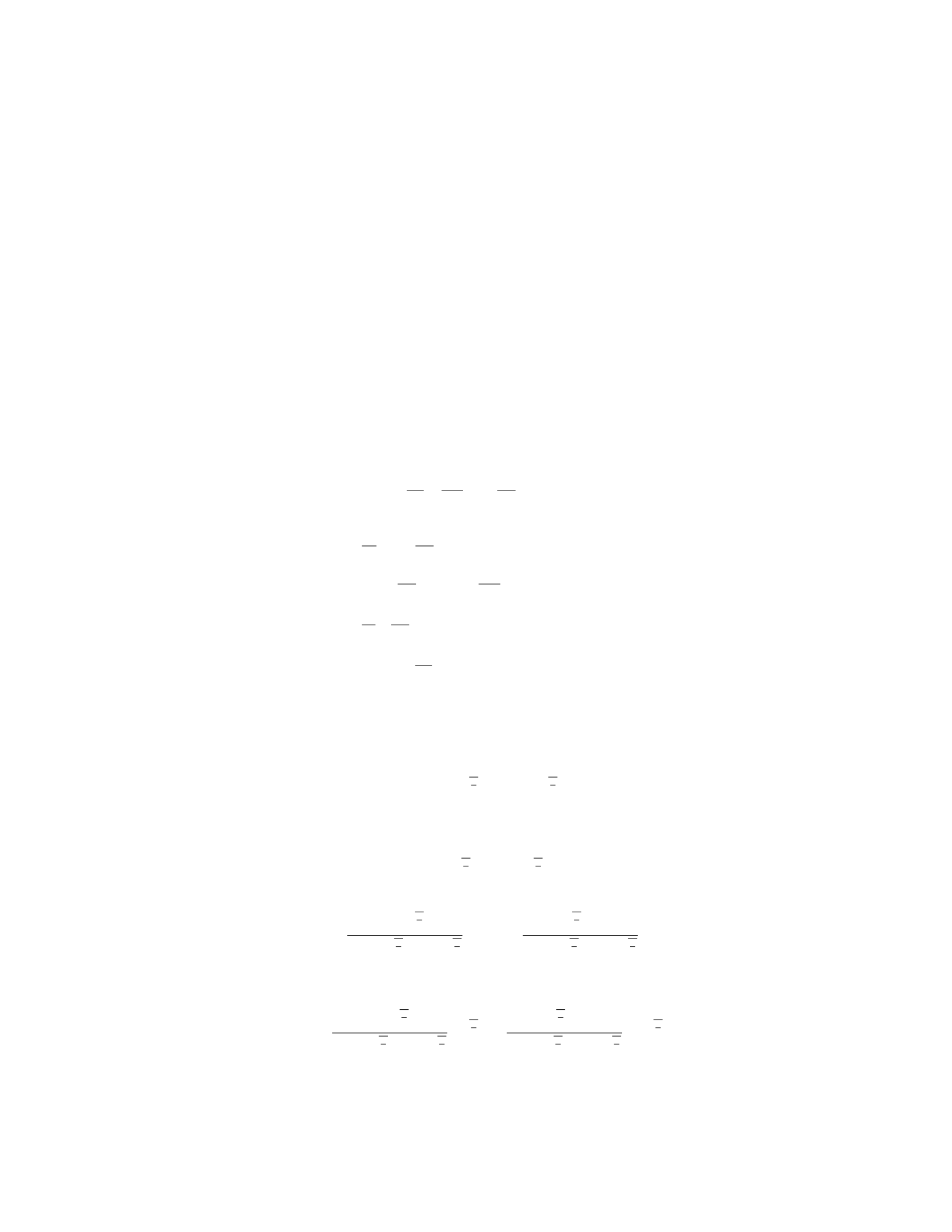
y(x) = c1e√3
2x+c2e−√3
2x
Step 6: Apply the boundary conditions y(0) = 1 and y(1) = 2:
y(0) = c1+c2= 1
y(1) = c1e√3
2+c2e−√3
2= 2
Step 7: Solve the system of equations to find c1and c2:
c1=e−√3
2
1−e√3
2+e−√3
2
, c2=e√3
2−1
1−e√3
2+e−√3
2
Step 8: Substitute the values of c1and c2back into the general solution to
obtain the extremal function y(x).
y(x) = e−√3
2
1−e√3
2+e−√3
2
e√3
2x+e√3
2−1
1−e√3
2+e−√3
2
e−√3
2x
23

Question 24
Question
Consider the functional
J[y] = Z1
0y′2+y2dx
subject to the boundary conditions y(0) = 0 and y(1) = 1. Determine the
function y(x) that minimizes J[y].
Solution
Step 1: Write down the Euler-Lagrange equation
d
dx ∂f
∂y′−∂f
∂y = 0
where f(y, y′, x) = y′2+y2.
Step 2: Compute the partial derivatives
∂f
∂y = 2y
∂f
∂y′= 2y′
d
dx ∂f
∂y′=d
dx (2y′)=2y′′
Step 3: Apply the Euler-Lagrange equation
2y′′ −2y= 0
which simplifies to
y′′ −y= 0
Step 4: Solve the differential equation The general solution to y′′ −y= 0 is
y(x) = c1ex+c2e−x.
Step 5: Apply the boundary conditions Using the boundary conditions
y(0) = 0 and y(1) = 1, we find
0 = c1+c2
1 = c1e+c2e−1
Step 6: Solve for c1and c2Solving the system of equations, we get c1=e
e2−1
and c2=−1
e2−1.
Step 7: Substitute back into the general solution Therefore, the function
that minimizes J[y] is
y(x) = e
e2−1ex−1
e2−1e−x
24

Question 25
Question
Find the extremal for the functional
J[y] = Z1
0y2+y′2dx
subject to the boundary conditions y(0) = 0 and y(1) = 1.
Solution
Step 1: Compute the Euler-Lagrange equation The Euler-Lagrange equation for
minimizing the functional J[y] is given by:
d
dx ∂f
∂y′=∂f
∂y
where f=y2+y′2. Differentiating with respect to yand y′gives us:
∂f
∂y = 2yand ∂f
∂y′= 2y′
d
dx ∂f
∂y′=d
dx(2y′)=2y′′
Therefore, the Euler-Lagrange equation becomes:
2y′′ = 2y
Step 2: Solve the differential equation The general solution to the differential
equation 2y′′ = 2yis given by:
y(x) = Acos(x) + Bsin(x)
Applying the boundary conditions y(0) = 0 and y(1) = 1 gives us:
y(0) = A= 0
y(1) = Bsin(1) = 1
B=1
sin(1)
Step 3: Finalize the extremal Therefore, the extremal for the functional J[y]
subject to the given boundary conditions is:
y(x) = sin(x)
sin(1)
25

Question 26
Question
Find the extremals of the functional
J[y] = Z1
0
(y+y′)2dx
subject to the boundary conditions y(0) = 0 and y(1) = 1.
Solution
Step 1: Compute the functional derivative of J[y] with respect to y(x):
δJ
δy =d
dx ∂f
∂y′−∂f
∂y
where f= (y+y′)2.
Step 2: Calculate the partial derivatives:
∂f
∂y′= 2(y+y′)
∂f
∂y = 2(y+y′)
Step 3: Substitute the partial derivatives back into the functional derivative
formula: δJ
δy =d
dx(2(y+y′)) −2(y+y′)
= 2(y′+y′′)−2(y+y′)
= 2y′′ −2y
Step 4: Set the functional derivative equal to 0 to find the extremals:
2y′′ −2y= 0
y′′ −y= 0
Step 5: Solve the ordinary differential equation y′′−y= 0: The characteristic
equation is r2−1 = 0, which factors as (r−1)(r+ 1) = 0. Thus, the solutions
are y(x) = c1ex+c2e−x.
Step 6: Apply the boundary conditions y(0) = 0 and y(1) = 1:
y(0) = c1e0+c2e0=c1+c2= 0
y(1) = c1e+c2e−1=c1e−c2e= 1
Solving these equations gives c1=e
2and c2=−e
2.
Step 7: The extremal function for the functional J[y] is:
y(x) = e
2ex−e
2e−x
y(x) = e(ex−e−x)
2
26

Question 27
Question
Find the extremal of the functional
J[y] = Z1
0
(2y′2+y2)dx
subject to the boundary conditions y(0) = 1 and y(1) = 2.
Solution
Step 1: Define the Euler-Lagrange equation.
The Euler-Lagrange equation for this problem is given by
d
dx ∂f
∂y′−∂f
∂y = 0
where f= 2y′2+y2.
Step 2: Compute the partial derivatives.
We have ∂f
∂y′= 4y′
and ∂f
∂y = 2y
.
Step 3: Plug the derivatives into the Euler-Lagrange equation.
Substitute the partial derivatives into the Euler-Lagrange equation to get
d
dx(4y′)−2y= 0
which simplifies to
4y′′ −2y= 0
.
Step 4: Solve the differential equation.
The general solution to the differential equation is
y(x) = c1e−√2x+c2e√2x
.
Step 5: Apply the boundary conditions.
Using the boundary conditions y(0) = 1 and y(1) = 2, we find that
c1+c2= 1
27
and
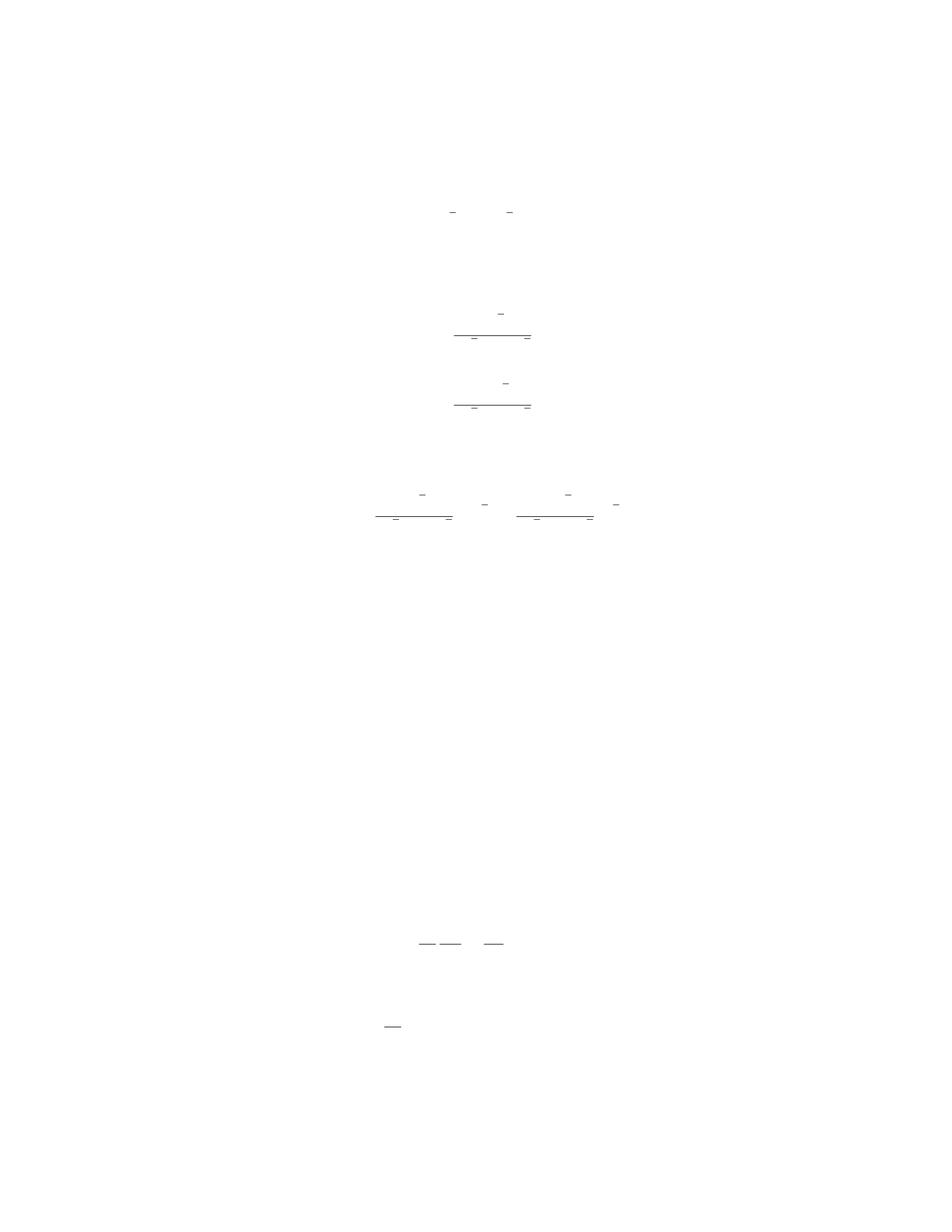
c1e−√2+c2e√2= 2
.
Step 6: Solve for the constants.
By solving the system of equations, we find that
c1=e√2
e√2−e−√2
and
c2=e−√2
e√2−e−√2
.
Step 7: Write down the extremal.
Therefore, the extremal of the functional is
y(x) = e√2
e√2−e−√2e−√2x+e−√2
e√2−e−√2e√2x
.
Question 28
Question
Find the extremals of the functional J[y] = R2
1(y2+y′2)dx subject to the
boundary conditions y(1) = 3 and y(2) = 4.
Solution
Step 1: Define the Lagrangian
The Lagrangian for this problem is given by
L(y, y′;λ) = y2+y′2+λ1(y−3) + λ2(y−4)
where λ1and λ2are the Lagrange multipliers associated with the boundary
conditions.
Step 2: Set up the Euler-Lagrange equation
The Euler-Lagrange equation for this problem is
d
dx
∂L
∂y′−∂L
∂y = 0
Plugging in the values,
d
dx(2y′)−2y+λ1+λ2= 0
28

Step 3: Solve the Euler-Lagrange equation
The solution to the Euler-Lagrange equation gives the extremals. Integrating
the differential equation above, we get
2y′−2y+λ1x+λ2x+C= 0
where Cis the constant of integration.
Step 4: Apply the boundary conditions
Using the boundary conditions y(1) = 3 and y(2) = 4, we can solve for the
constants and Lagrange multipliers.
Step 5: Find the extremals
After finding the constants and Lagrange multipliers, substitute them back into
the solution to obtain the extremals.
Question 29
Question
Find the function y(x) that minimizes the functional
J[y] = Z1
0y′2+y2dx
subject to the boundary conditions y(0) = 0 and y(1) = 1.
Solution
Step 1: Define the Euler-Lagrange equation for the given functional. Let
F(y, y′, x) = y′2+y2. The Euler-Lagrange equation is given by
d
dx ∂F
∂y′−∂F
∂y = 0
Step 2: Compute the partial derivatives of Fwith respect to yand y′.
∂F
∂y = 2yand ∂F
∂y′= 2y′
Step 3: Compute the derivative d
dx ∂F
∂y′.
d
dx ∂F
∂y′=d
dx(2y′)=2y′′
Step 4: Substitute the partial derivatives into the Euler-Lagrange equation.
d
dx(2y′)−2y= 0
29

Step 5: Simplify the equation by taking the derivative and expanding.
2y′′ −2y= 0
Step 6: Solve the differential equation 2y′′ −2y= 0. The general solution
to this differential equation is y(x) = c1cos√2x+c2sin√2x, where c1and
c2are constants.
Step 7: Apply the boundary conditions y(0) = 0 and y(1) = 1. From
y(0) = 0, we have c1= 0.
So, y(x) = c2sin√2x.
Step 8: Use the boundary condition y(1) = 1 to find c2.
y(1) = c2sin√2= 1
c2=1
sin√2
Therefore, the function y(x) that minimizes the functional J[y] subject to
the given boundary conditions is
y(x) = sin√2x
sin√2
Question 30
Question
Find the function y(x) that minimizes the functional:
J[y] = Z1
0
(y′2−y2)dx
subject to the boundary conditions y(0) = 1 and y(1) = 2.
Solution
Step 1: Write down the Euler-Lagrange equation for the given functional:
d
dx ∂f
∂y′−∂f
∂y = 0
where f(y, y′, x) = y′2−y2.
Step 2: Compute the partial derivatives:
∂f
∂y =−2yand ∂f
∂y′= 2y′
30

Step 3: Compute the derivative with respect to y′:
d
dx ∂f
∂y′=d
dx(2y′)=2y′′
Step 4: Now we can write the Euler-Lagrange equation as:
2y′′ + 2y= 0
Step 5: Solve the differential equation with the given boundary conditions:
The general solution to the differential equation is:
y(x) = c1cos(x) + c2sin(x)
Applying the boundary conditions y(0) = 1 and y(1) = 2, we find:
c1= 1 and c2=2−c1
sin(1)
Step 6: Therefore, the function that minimizes the functional is:
y(x) = cos(x) + 2−cos(1)
sin(1) sin(x)
Question 31
Question
Find the extremals for the functional
J[y] = Z1
0
(y′2−y2)dx
subject to the boundary conditions y(0) = 0 and y(1) = 1.
Solution
Step 1: Define the Euler-Lagrange equation. The Euler-Lagrange equation for
a functional of the form J[y] = Rb
aF(x, y, y′)dx is given by
d
dx ∂F
∂y′=∂F
∂y
Step 2: Apply the Euler-Lagrange equation to the given functional. In this
case, F(x, y, y′) = y′2−y2, so
d
dx ∂
∂y′(y′2−y2)=∂
∂y (y′2−y2)
Simplify this expression.
31

Step 3: Evaluate the partial derivatives. We have
∂
∂y′(y′2−y2)=2y′,and ∂
∂y (y′2−y2) = −2y
Thus, our Euler-Lagrange equation becomes
d
dx(2y′) = −2y
Step 4: Solve the differential equation. We have
2y′′ =−2y
Which simplifies to
y′′ +y= 0
This is a second-order linear homogeneous differential equation. The general
solution to this differential equation is
y(x) = c1cos(x) + c2sin(x)
Step 5: Apply the boundary conditions. Using the boundary conditions
y(0) = 0 and y(1) = 1, we find that c1= 0 and c2= 1. Thus, the extremal
satisfying the boundary conditions is
y(x) = sin(x)
Question 32
Question
Find the extremal for the functional
J[y] = Z1
0
(y′2+y2−y)dx
subject to the boundary conditions y(0) = 0 and y(1) = 1.
Solution
Step 1: We begin by finding the Euler-Lagrange equation. Let F=y′2+y2−y
and ∂F
∂y −d
dx ∂F
∂y′= 0, so we have
d
dx(2y′−1) −2y= 0
Step 2: Solving the differential equation from Step 1, we get
2y′′ −2y= 0
32

which simplifies to
y′′ −y= 0
Step 3: The general solution to the above differential equation is given by
y(x) = c1cos x+c2sin x.
Step 4: Applying the boundary conditions y(0) = 0 and y(1) = 1, we find:
y(0) = c1= 0
y(1) = c2sin 1 = 1
c2=1
sin 1
Therefore, the extremal for the given functional is y(x) = sin x
sin 1 .
Question 33
Question
Find the extremals of the functional
J[y] = Z1
0
(y′2+y2)dx
subject to the boundary conditions y(0) = 0 and y(1) = 1.
Solution
Step 1: Define the Euler-Lagrange equation for the given functional. The Euler-
Lagrange equation is given by
d
dx ∂f
∂y′−∂f
∂y = 0
where f(y, y′, x) = y′2+y2.
Step 2: Compute ∂f
∂y′and ∂f
∂y .
∂f
∂y′= 2y′and ∂f
∂y = 2y
Step 3: Plug ∂f
∂y′and ∂f
∂y into the Euler-Lagrange equation and simplify.
d
dx(2y′)−2y= 0
2y′′ −2y= 0
Step 4: Solve the differential equation 2y′′ −2y= 0 to find all solutions to
the Euler-Lagrange equation. The general solution to the differential equation
is
y(x) = c1cos(x) + c2sin(x)
33

Step 5: Apply the boundary conditions y(0) = 0 and y(1) = 1 to find the
specific solution. From y(0) = 0, we have
c1= 0
Substitute c1= 0 into the general solution, so
y(x) = c2sin(x)
From y(1) = 1, we have
c2sin(1) = 1
c2=1
sin(1)
Therefore, the extremal for the given functional is
y(x) = 1
sin(1) sin(x)
Question 34
Question
Find the extremals for the functional
J[y] = Z1
0
[(y′)2−y2]dx
subject to the boundary conditions y(0) = 0 and y(1) = 1.
Solution
Step 1: Define the necessary functions and equations. Let L= (y′)2−y2be the
Lagrangian corresponding to the given functional. The Euler-Lagrange equation
for this variational problem is given by
d
dx ∂L
∂y′−∂L
∂y = 0
Step 2: Compute the partial derivatives. We have
∂L
∂y′= 2y′and ∂L
∂y =−2y
Therefore, the Euler-Lagrange equation becomes
d
dx(2y′)+2y= 0
2y′′ + 2y= 0
34

y′′ +y= 0
Step 3: Solve the differential equation. The general solution to the differen-
tial equation y′′ +y= 0 is given by
y(x) = c1cos(x) + c2sin(x)
Step 4: Apply the boundary conditions. Using the boundary conditions
y(0) = 0 and y(1) = 1, we obtain the system of equations:
c1= 0
c1cos(1) + c2sin(1) = 1
From the first equation, c1= 0. Substituting this into the second equation gives
c2sin(1) = 1
c2=1
sin(1)
Step 5: Final solution. The extremal for the functional J[y] that satisfies
the given boundary conditions is therefore
y(x) = sin(x)
sin(1)
Question 35
Question
Find the extremals of the functional
J[y] = Z1
0
(2y2−y′2)dx
subject to the boundary conditions y(0) = 0 and y(1) = 1.
Solution
Step 1: Compute the Euler-Lagrange equation. The Euler-Lagrange equation
for a functional of the form
J[y] = Zb
a
F(x, y, y′)dx
is given by
d
dx ∂F
∂y′−∂F
∂y = 0.
35

For our functional J[y] = R1
0(2y2−y′2)dx, we have F(x, y, y′)=2y2−y′2.
Thus, the Euler-Lagrange equation becomes
d
dx ∂(2y2−y′2)
∂y′−∂(2y2−y′2)
∂y = 0.
Step 2: Solve the Euler-Lagrange equation. Differentiating with respect to
y′, we get
∂(2y2−y′2)
∂y′= 4y
and differentiating with respect to y, we get
∂(2y2−y′2)
∂y = 4y.
Therefore, the Euler-Lagrange equation simplifies to
d
dx(4y)−4y= 0,
or d
dx(4y) = 4y.
Step 3: Solve the differential equation obtained. The solution to the differ-
ential equation is
y(x) = c1ex+c2e−x,
where c1and c2are constants.
Step 4: Apply the boundary conditions. Using the boundary conditions
y(0) = 0 and y(1) = 1 in the solution y(x) = c1ex+c2e−x, we find:
y(0) = c1+c2= 0
and
y(1) = c1e+c2e−1= 1.
Solving these equations simultaneously, we find c1=e
e−1and c2=−1
e−1.
Step 5: Write down the extremals. Therefore, the extremals of the func-
tional J[y] subject to the boundary conditions are given by
y(x) = e
e−1ex−1
e−1e−x.
36

