


MATH 132 - CALCULUS AND
ANALYTIC GEOMETRY II -
Integration by Parts
Question Bank - Set 3
Liberty University
Question 1
Question
Evaluate the integral ∫x2ln(x)dx using integration by parts.
Solution
To evaluate the integral ∫x2ln(x)dx using integration by parts, we will let
u= ln(x)and dv =x2dx. Then we have:
du =1
xdx and v=1
3x3
Step 1: Apply the integration by parts formula:
∫u dv =uv −∫v du
Step 2: Substitute u,v,du, and dv into the formula:
∫x2ln(x)dx =1
3x3ln(x)−∫1
3x3·1
xdx
Step 3: Simplify the integral:
∫x2ln(x)dx =1
3x3ln(x)−1
3∫x2dx
Step 4: Integrate the remaining term:
∫x2ln(x)dx =1
3x3ln(x)−1
9x3+C
Therefore, ∫x2ln(x)dx =1
3x3ln(x)−1
9x3+C, where Cis the constant of
integration.

Question 2
Question
Evaluate the integral ∫xcos(x)dx using integration by parts.
Solution
To evaluate the integral ∫xcos(x)dx using integration by parts, we will use the
formula:
∫u dv =uv −∫v du
where uand vare differentiable functions of x.
Step 1: Let’s choose u=xand dv = cos(x)dx. Then, we have:
du =dx and v=∫cos(x)dx = sin(x)
Step 2: Now, we can apply the integration by parts formula:
∫xcos(x)dx =uv −∫v du
=xsin(x)−∫sin(x)dx
=xsin(x) + cos(x) + C
Therefore, the integral ∫xcos(x)dx simplifies to xsin(x)+cos(x)+C, where
Cis the constant of integration.
Question 3
Question
Evaluate the integral ∫xln(x)dx using integration by parts.
Solution
To evaluate the given integral ∫xln(x)dx, we will use integration by parts.
Recall the formula for integration by parts:
∫u dv =uv −∫v du
where uand vare differentiable functions of x.
Step 1: Let’s choose u= ln(x)and dv =x dx. Then, we have:
du =1
xdx and v=x2
2
2
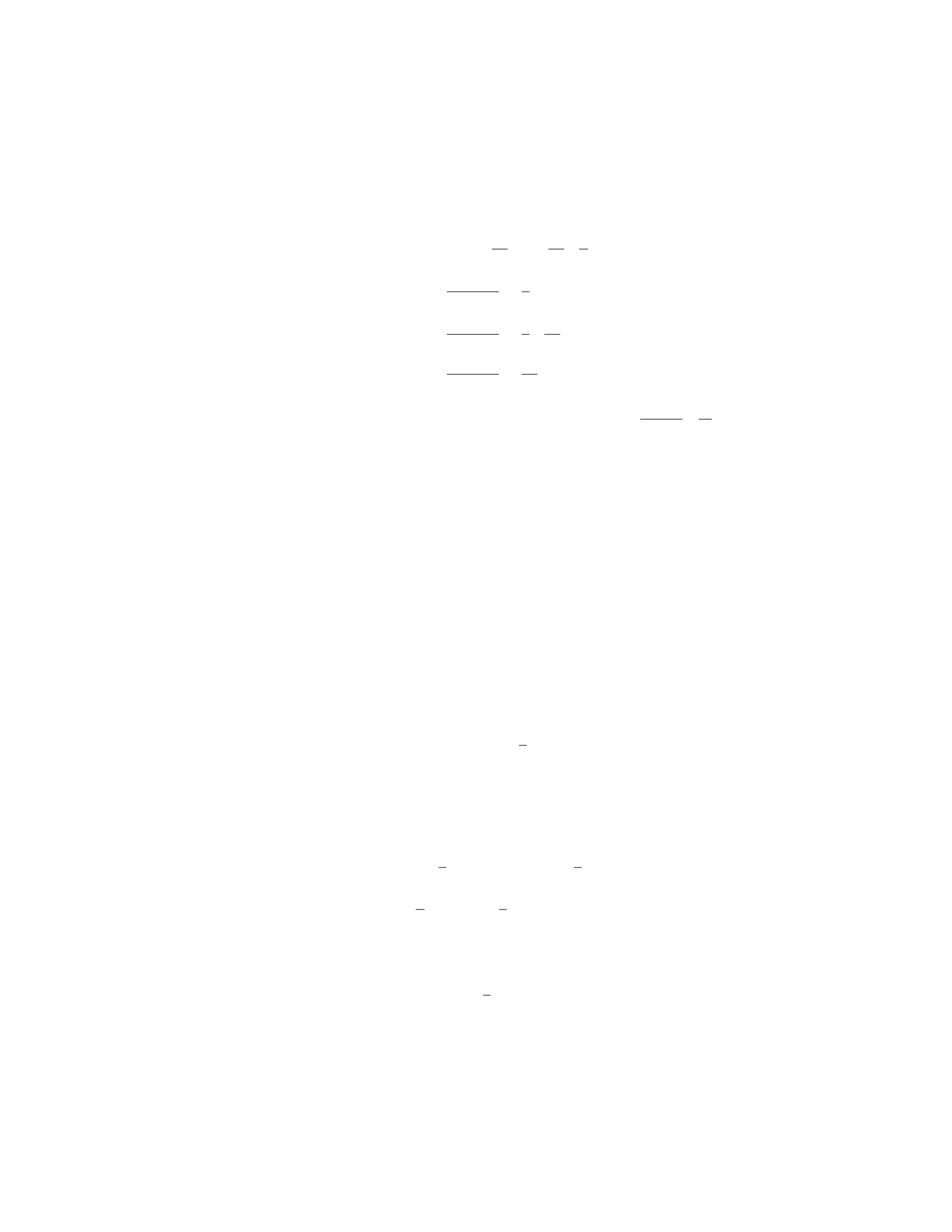
Step 2: Substitute u,dv,du, and vinto the integration by parts formula:
∫xln(x)dx = ln(x)·x2
2−∫x2
2·1
xdx
=x2ln(x)
2−1
2∫x dx
=x2ln(x)
2−1
2·x2
2+C
=x2ln(x)
2−x2
4+C
Step 3: Therefore, the solution to the integral ∫xln(x)dx is x2ln(x)
2−x2
4+C,
where Cis the constant of integration.
Question 4
Question
Evaluate the integral ∫xsin(3x)dx using integration by parts.
Solution
To evaluate the integral ∫xsin(3x)dx using integration by parts, we will use
the formula ∫u dv =uv −∫v du.
Step 1: Choose uand dv. Let u=xand dv = sin(3x)dx. Then, we have:
du =dx and v=−1
3cos(3x).
Step 2: Apply integration by parts:
∫xsin(3x)dx =uv −∫v du
=x(−1
3cos(3x))−∫(−1
3cos(3x))dx
=−x
3cos(3x) + 1
3∫cos(3x)dx.
Step 3: Integrate ∫cos(3x)dx:
∫cos(3x)dx =1
3sin(3x) + C,
where Cis the constant of integration.
3
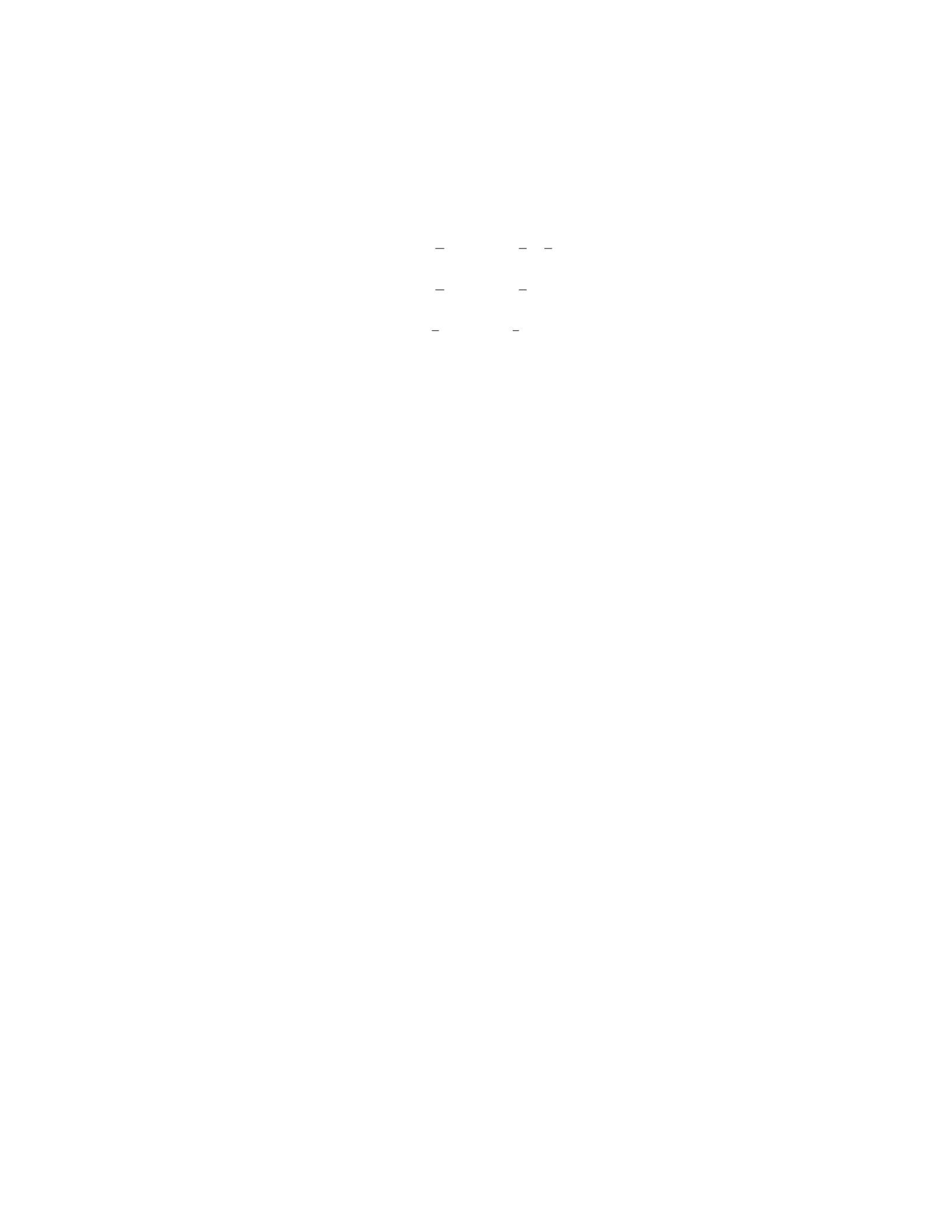
Step 4: Substitute back into the original integral:
∫xsin(3x)dx =−x
3cos(3x) + 1
3(1
3sin(3x) + C)
=−x
3cos(3x) + 1
9sin(3x) + C.
Therefore, ∫xsin(3x)dx =−x
3cos(3x) + 1
9sin(3x) + C, where Cis the con-
stant of integration.
Question 5
Question
Evaluate the integral ∫xcos(x)dx using integration by parts.
Solution
To evaluate the integral ∫xcos(x)dx using integration by parts, we will use
the formula ∫u dv =uv −∫v du where uand vare differentiable functions of
x.
Step 1: Let us choose u=xand dv = cos(x)dx. Then, calculating the
differentials, we get: du =dx and v=∫cos(x)dx = sin(x).
Step 2: Now, using the integration by parts formula, we have: ∫xcos(x)dx =
uv −∫v du =xsin(x)−∫sin(x)dx.
Step 3: Simplifying the integral, we get: ∫xcos(x)dx =xsin(x)+∫sin(x)dx.
Step 4: Finally, integrating ∫sin(x)dx, we have: ∫xcos(x)dx =xsin(x)−
cos(x) + C, where Cis the constant of integration.
Therefore, ∫xcos(x)dx =xsin(x)−cos(x) + C.
Question 6
Question
Evaluate the integral ∫xln(x)dx using integration by parts.
4
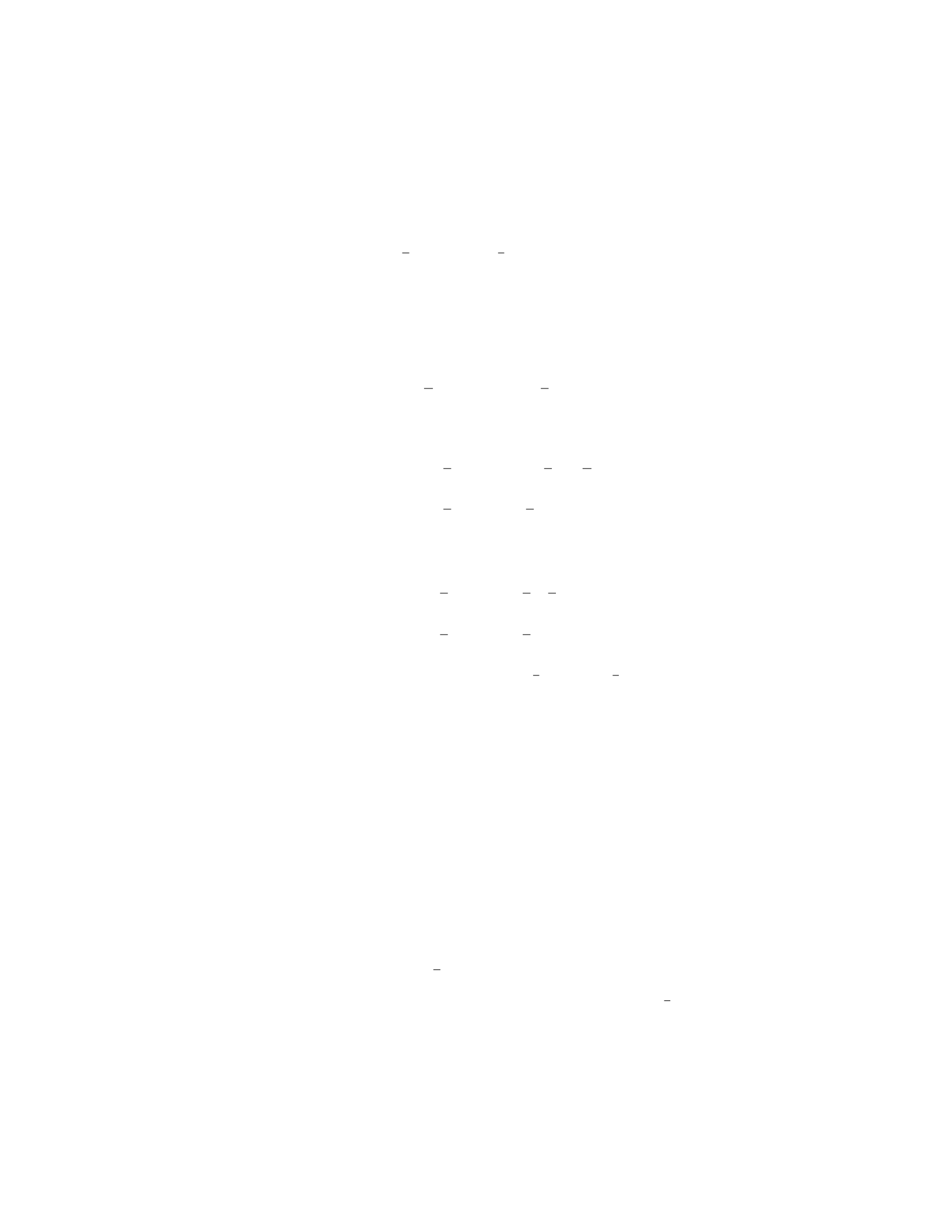
Solution
To evaluate the integral ∫xln(x)dx using integration by parts, we let u= ln(x)
and dv =x dx. Then, du =1
xdx and v=1
2x2. The formula for integration by
parts is:
∫u dv =uv −∫v du
Step 1: Calculate du and v.
du =1
xdx and v=1
2x2
Step 2: Apply integration by parts formula.
∫xln(x)dx =1
2x2ln(x)−∫1
2x2·1
xdx
=1
2x2ln(x)−1
2∫x dx
Step 3: Simplify the result.
∫xln(x)dx =1
2x2ln(x)−1
2(1
2x2)+C
=1
2x2ln(x)−1
4x2+C
Hence, the integral ∫xln(x)dx evaluates to 1
2x2ln(x)−1
4x2+Cwhere Cis
the constant of integration.
Question 7
Question
Evaluate the integral ∫x3ln(x)dx using integration by parts.
Solution
To evaluate the integral ∫x3ln(x)dx using integration by parts, we will let
u= ln(x)and dv =x3dx. Then, we will differentiate uto find du and integrate
dv to find v.
Step 1: Find du and v.
• Let u= ln(x). Then, du =1
xdx.
• Let dv =x3dx. Integrating dv with respect to x, we get v=1
4x4.
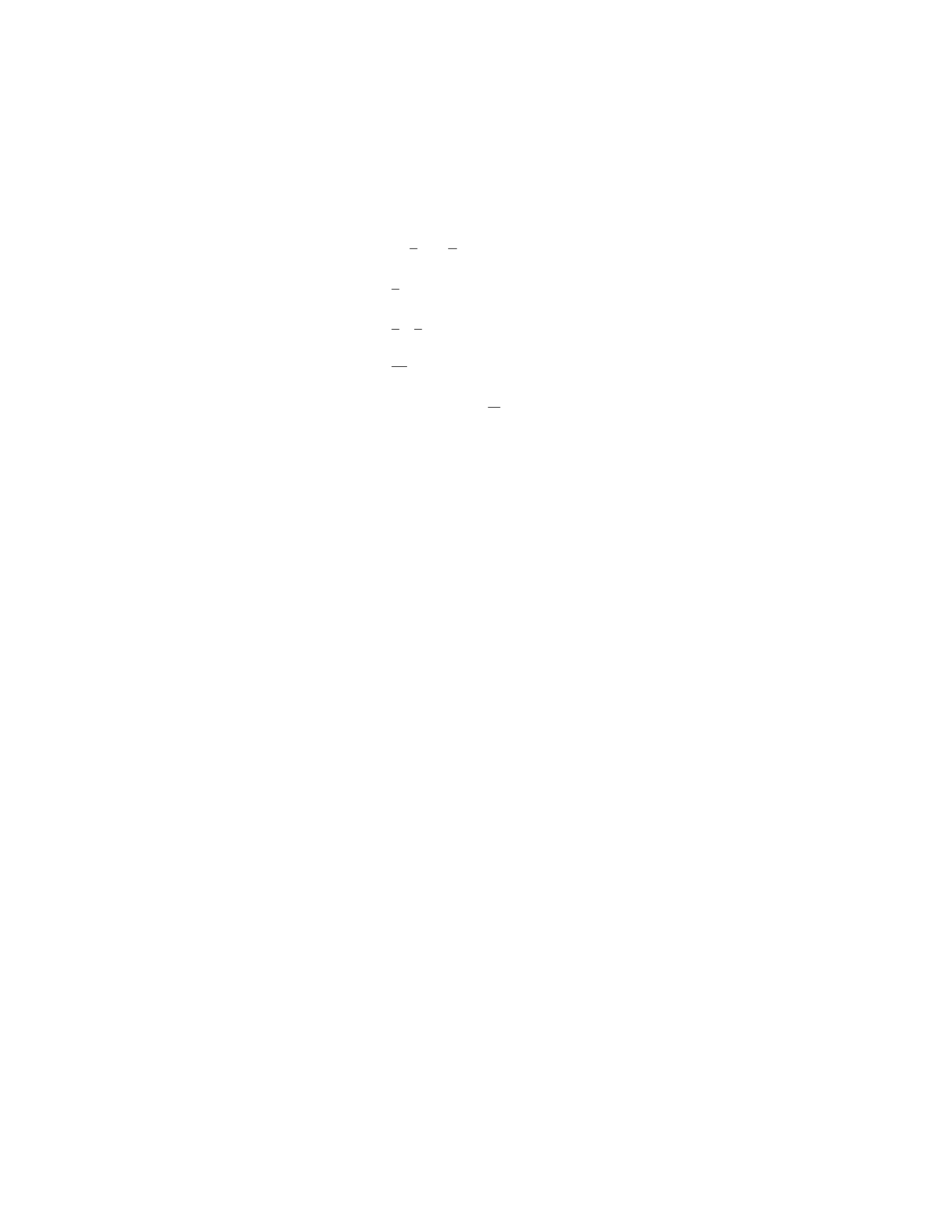
5
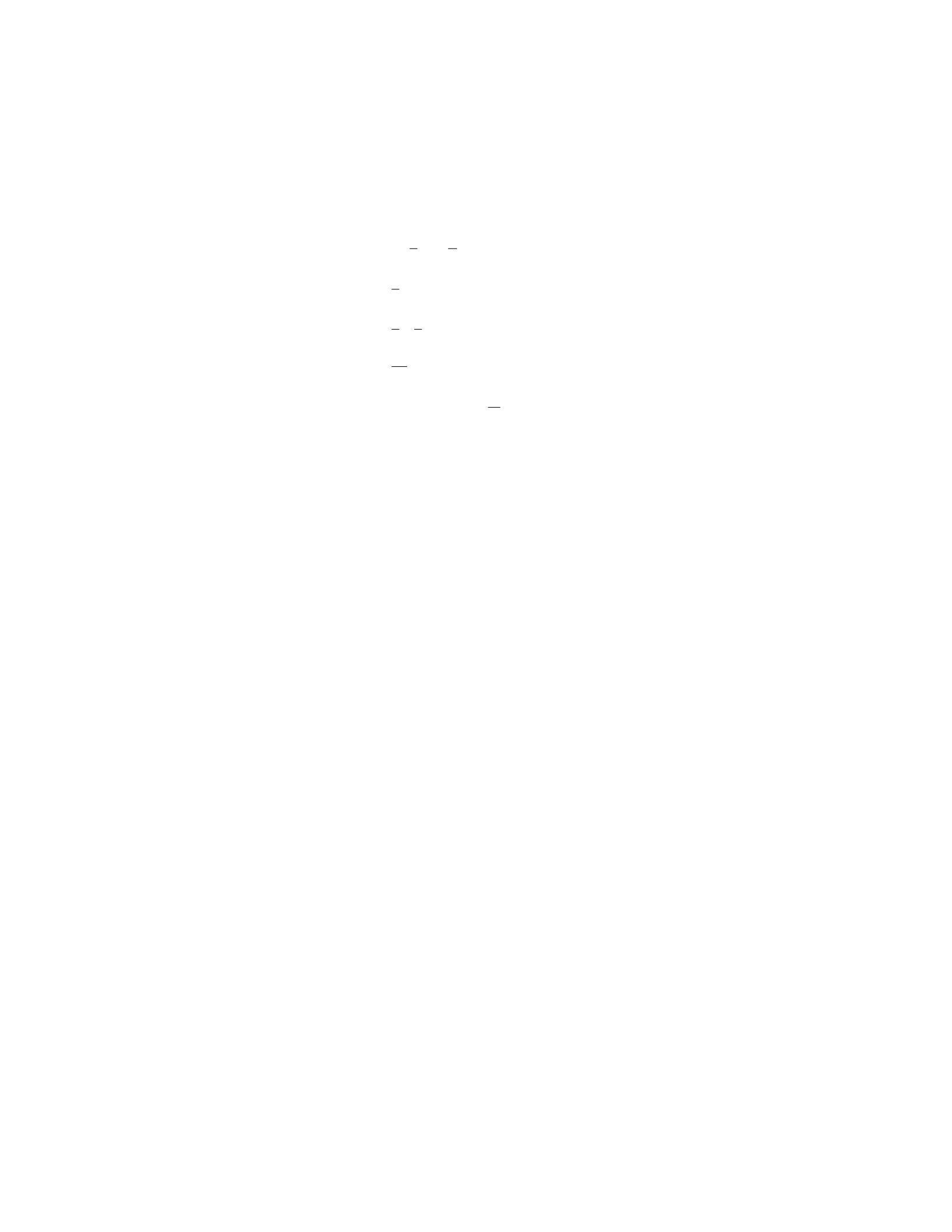
Step 2: Apply integration by parts formula: ∫u dv =uv −∫v du.
∫x3ln(x)dx =x3ln(x)−∫1
4x4·1
xdx
=x3ln(x)−1
4∫x3dx
=x3ln(x)−1
4·1
4x4+Cwhere Cis the constant of integration
=x3ln(x)−1
16x4+C
Therefore, ∫x3ln(x)dx =x3ln(x)−1
16 x4+C, where Cis the constant of
integration.
Question 8
Question
Evaluate the following integral using integration by parts:
∫x2exdx
Solution
To evaluate the integral ∫x2exdx using integration by parts, we will use the
formula: ∫u dv =uv −∫v du
where uand vare differentiable functions of x.
Step 1: Choose u=x2and dv =exdx. Then, we have du = 2x dx and
v=∫exdx =ex.
Step 2: Apply the formula:
∫x2exdx =x2ex−∫2xexdx
Step 3: Now, we have another integral on the right-hand side that can be
further simplified using integration by parts. Let’s apply integration by parts
to ∫2xexdx.
Step 4: Choose u= 2xand dv =exdx. Then, we have du = 2 dx and
v=ex.
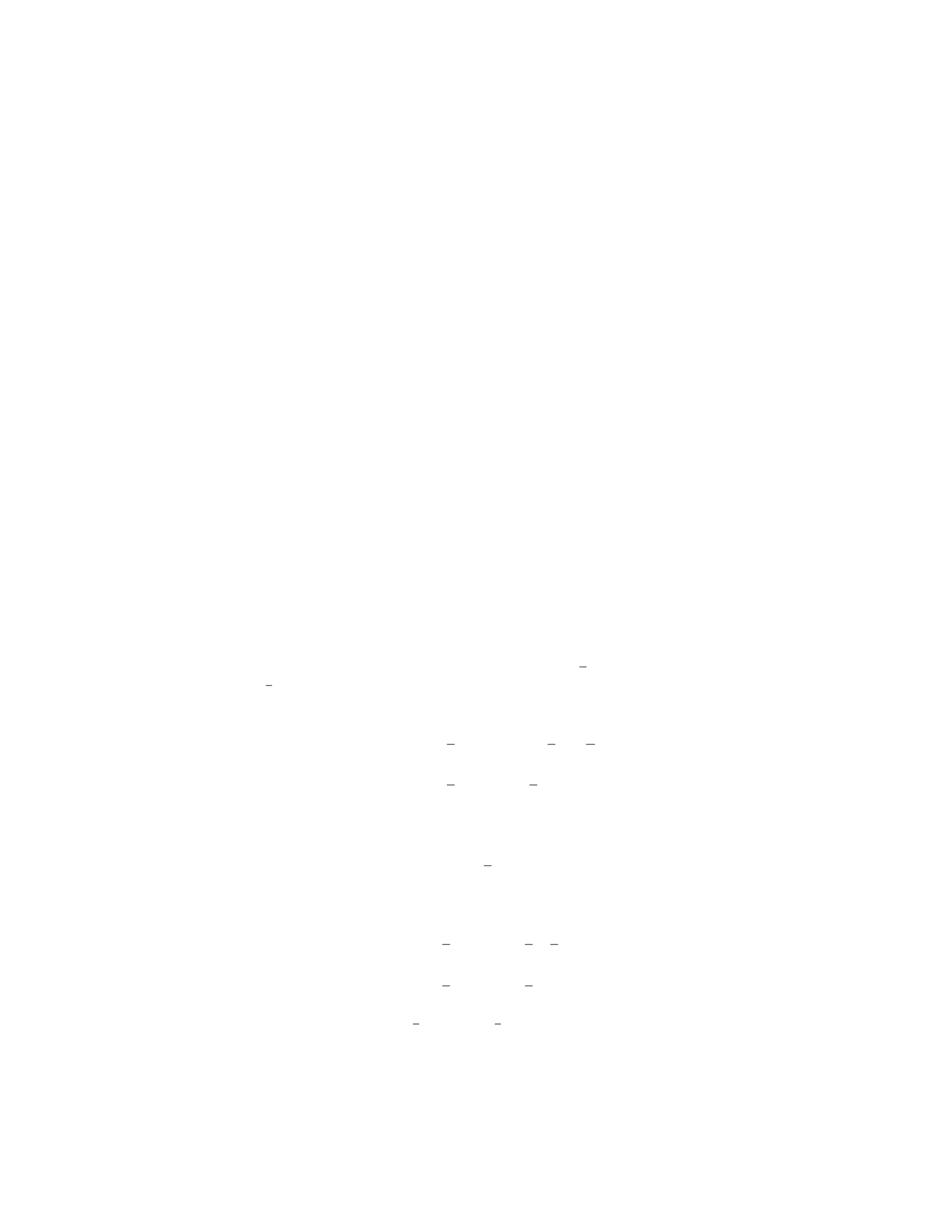
Step 5: Apply the formula again:
∫2xexdx = 2xex−∫2exdx
6
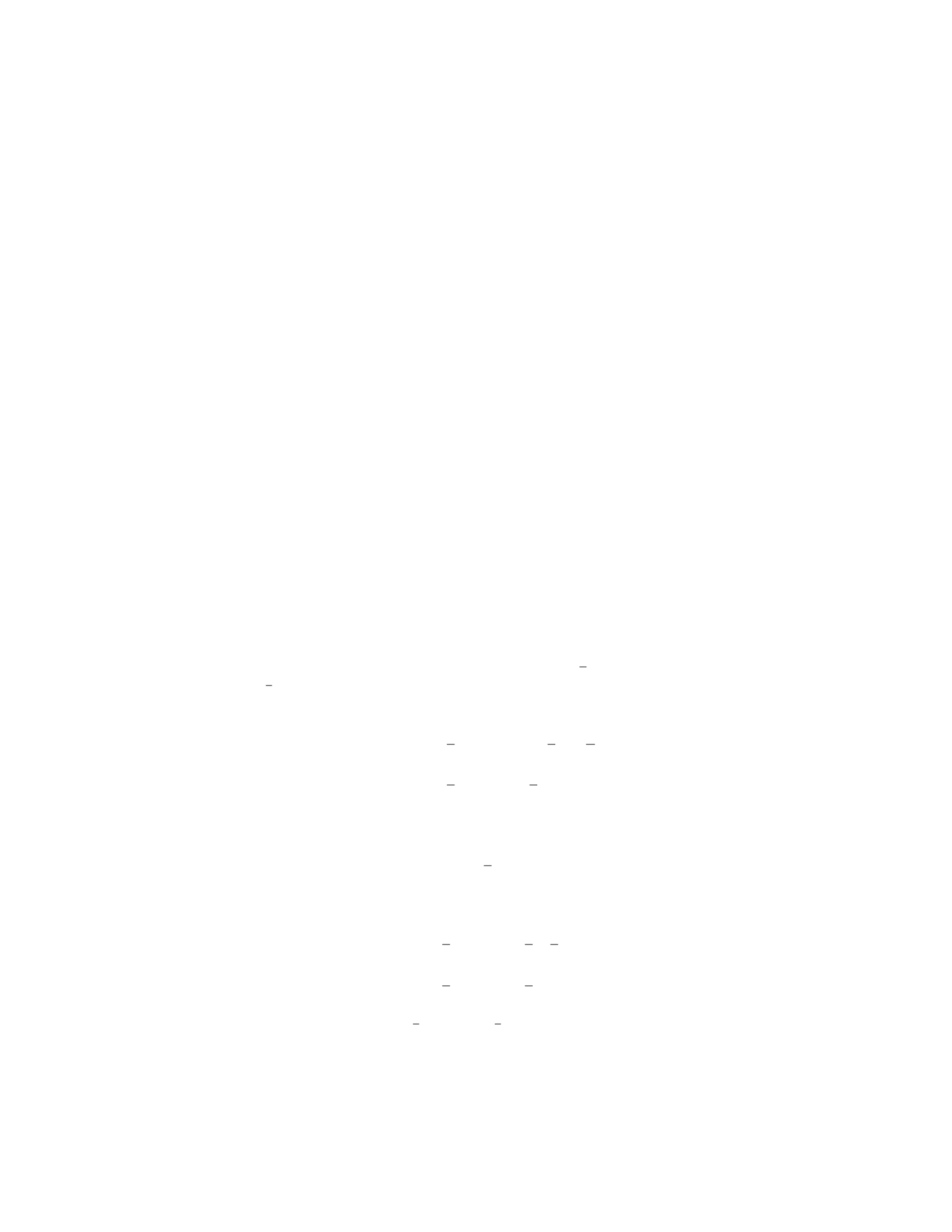
Step 6: Simplify the above expression:
∫2xexdx = 2xex−2ex+C
Step 7: Substitute ∫2xexdx = 2xex−2ex+Cback into the equation from
Step 2:
∫x2exdx =x2ex−(2xex−2ex+C) + C
Step 8: Simplify the expression:
∫x2exdx =x2ex−2xex+ 2ex+C
Therefore, ∫x2exdx =x2ex−2xex+ 2ex+C, where Cis the constant of
integration.
Question 9
Question
Evaluate the integral ∫x2ln(x)dx using integration by parts.
Solution
To evaluate the integral ∫x2ln(x)dx using integration by parts, we let u= ln(x)
and dv =x2dx. Then, we differentiate uto get du =1
xdx and integrate dv to
get v=1
3x3. Substituting these into the integration by parts formula ∫udv =
uv −∫vdu, we have:
∫x2ln(x)dx =1
3x3ln(x)−∫1
3x3·1
xdx
=1
3x3ln(x)−1
3∫x2dx
Step 1: Integrate ∫x2dx.
∫x2dx =1
3x3+C
Step 2: Substituting the result back into the equation, we have:
∫x2ln(x)dx =1
3x3ln(x)−1
3(1
3x3)+C
=1
3x3ln(x)−1
9x3+C
Therefore, ∫x2ln(x)dx =1
3x3ln(x)−1
9x3+C, where Cis the constant of
integration.
7

Question 10
Question
Evaluate the integral ∫exsin(x)dx using integration by parts.
Solution
To evaluate the integral ∫exsin(x)dx, we will use integration by parts. The
formula for integration by parts is:
∫u dv =uv −∫v du
where uand vare differentiable functions of x.
Step 1: Let us choose u=exand dv = sin(x)dx. Then, we have:
du =exdx and v=−cos(x)
Step 2: Apply the integration by parts formula:
∫exsin(x)dx =ex(−cos(x)) −∫(−cos(x))(ex)dx
=−excos(x) + ∫excos(x)dx
Step 3: Now, we need to apply integration by parts again to evaluate
∫excos(x)dx. Let’s choose u=exand dv = cos(x)dx. Then, we have:
du =exdx
v= sin(x)
Step 4: Apply the integration by parts formula once more:
∫excos(x)dx =exsin(x)−∫sin(x)exdx
=exsin(x)−∫exsin(x)dx
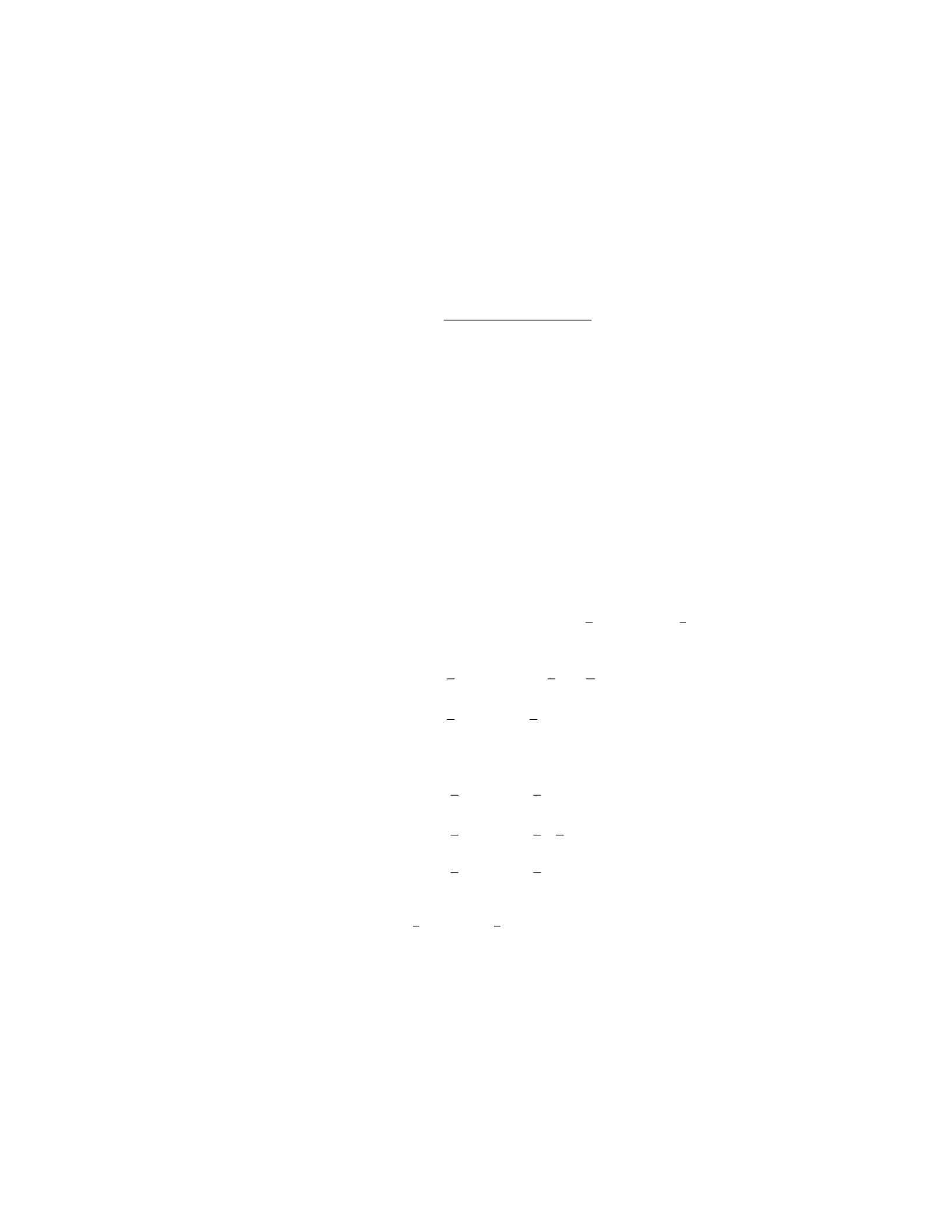
Step 5: Now substitute ∫exsin(x)dx back into the equation:
∫exsin(x)dx =−excos(x) + (exsin(x)−∫exsin(x)dx)
∫exsin(x)dx =−excos(x) + exsin(x)−∫exsin(x)dx
Step 6: Now, add ∫exsin(x)dx to both sides of the equation:
∫exsin(x)dx +∫exsin(x)dx =−excos(x) + exsin(x)
8
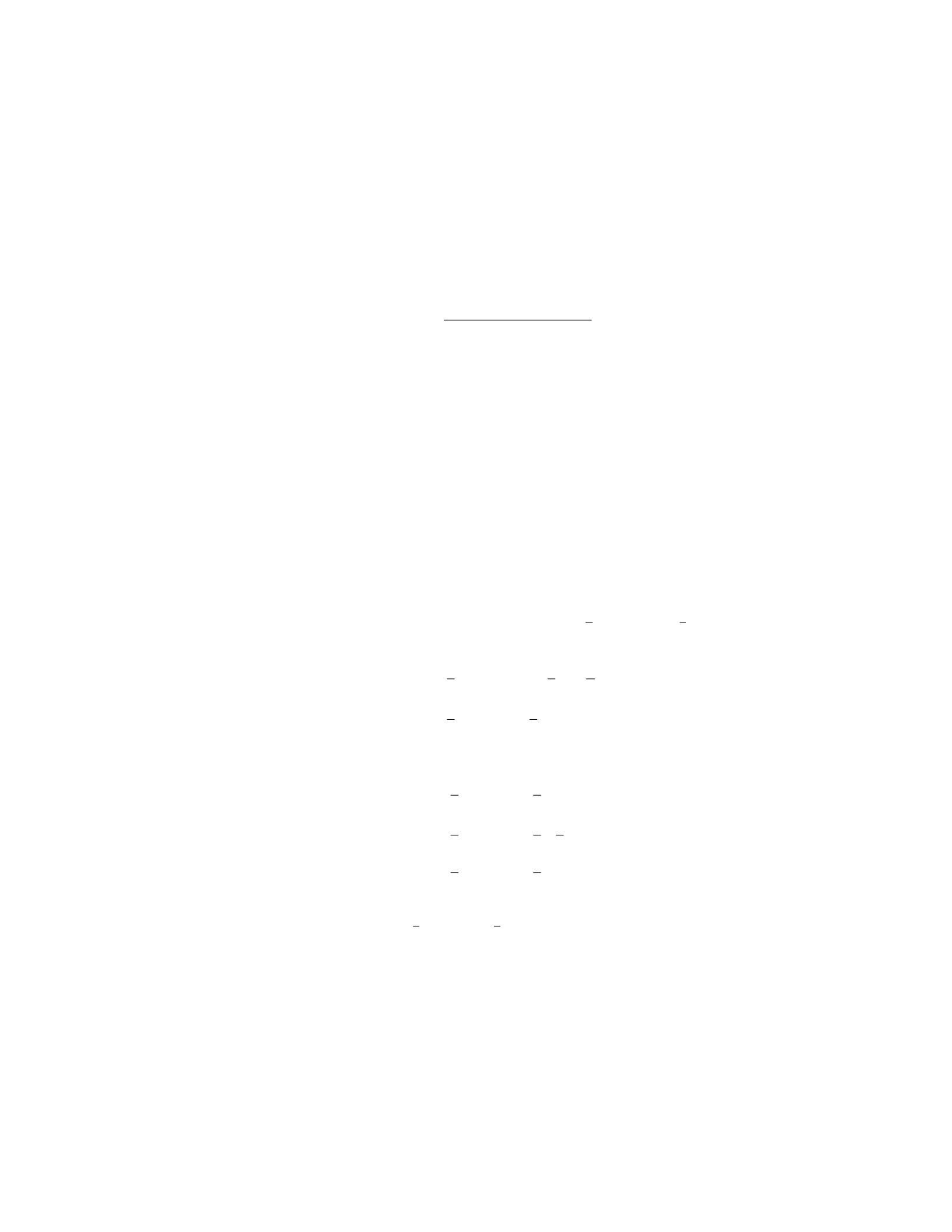
Step 7: Simplify the equation:
2∫exsin(x)dx =−excos(x) + exsin(x)
Step 8: Finally, divide by 2:
∫exsin(x)dx =−excos(x) + exsin(x)
2+C
where Cis the constant of integration.
Question 11
Question
Evaluate the integral ∫x2ln(x)dx.
Solution
To evaluate the integral ∫x2ln(x)dx, we will use integration by parts, which
states: ∫u dv =uv −∫v du.
We will choose u= ln(x)and dv =x2dx, so that du =1
xdx and v=1
3x3.
Step 1: Apply integration by parts:
∫x2ln(x)dx =1
3x3ln(x)−∫1
3x3·1
xdx
=1
3x3ln(x)−1
3∫x2dx.
Step 2: Simplify the integral:
∫x2ln(x)dx =1
3x3ln(x)−1
3∫x2dx
=1
3x3ln(x)−1
3·1
3x3+C
=1
3x3ln(x)−1
9x3+C,
where Cis the constant of integration.
Therefore, ∫x2ln(x)dx =1
3x3ln(x)−1
9x3+C.
Question 12
Question
Evaluate the integral ∫xcos−1x dx using integration by parts.
9
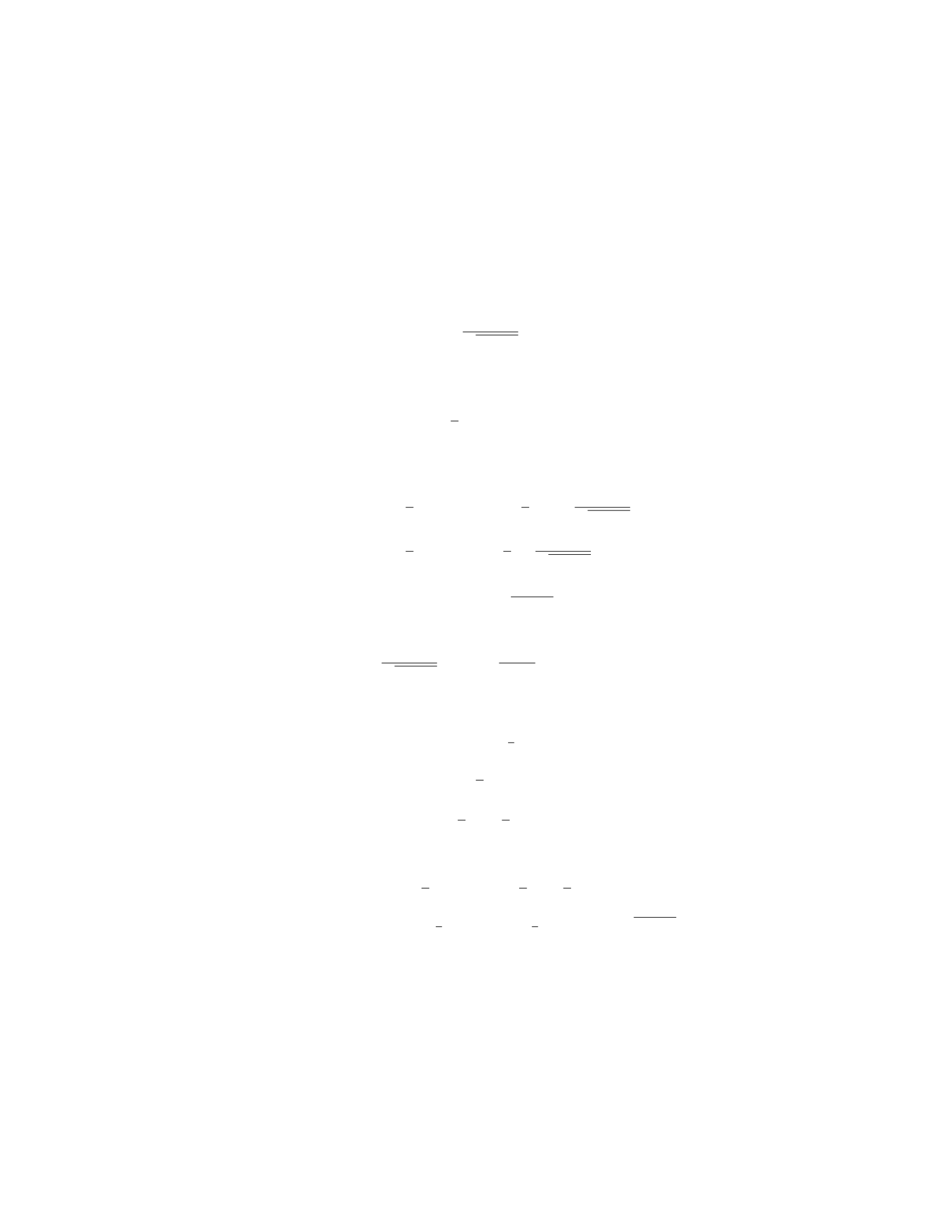
Solution
To evaluate the integral ∫xcos−1x dx using integration by parts, we choose
u= cos−1xand dv =x dx. Then, we find du and v:
Step 1: Find du and v.
u= cos−1x
du =−1
√1−x2dx
dv =x dx
v=1
2x2
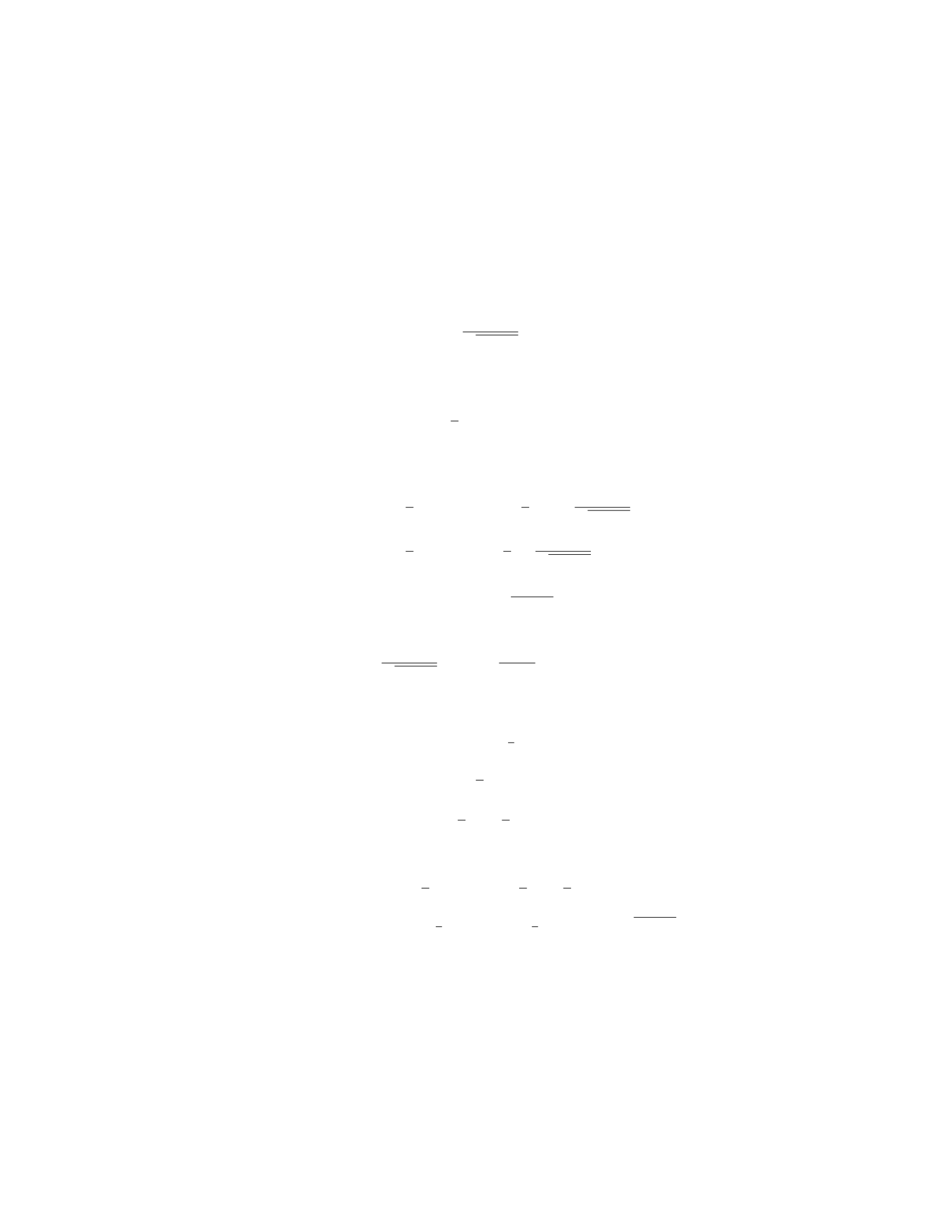
Step 2: Apply integration by parts formula ∫u dv =uv −∫v du.
∫xcos−1x dx =1
2x2cos−1x−∫1
2x2(−1
√1−x2)dx
=1
2x2cos−1x+1
2∫x2
√1−x2dx
Now, we will evaluate the remaining integral using a trigonometric substi-
tution. Let x= sin θ, so dx = cos θ dθ and √1−x2= cos θ.
Step 3: Perform the trigonometric substitution.
∫x2
√1−x2dx =∫sin2θ
cos θcos θ dθ
=∫sin2θ dθ
Using the double angle identity sin2θ=1
2(1 −cos 2θ), we get:
∫sin2θ dθ =∫1
2(1 −cos 2θ)dθ
=1
2(θ−1
2sin 2θ) + C
Step 4: Substitute back x= sin θto get the final answer.
∫xcos−1x dx =1
2x2cos−1x+1
4(θ−1
2sin 2θ) + C
Therefore, the final answer is 1
2x2cos−1x+1
4(sin−1x−x√1−x2) + C.
Question 13
Question
Evaluate the integral ∫xln(x)dx using integration by parts.
10
Solution
To evaluate the integral ∫xln(x)dx using integration by parts, we will follow
the formula: ∫u dv =uv −∫v du
where we choose uand dv appropriately.
Step 1: Let’s choose:
u= ln(x)⇒du =1
xdx
dv =x dx ⇒v=x2
2
Step 2: Apply the integration by parts formula:
∫xln(x)dx =x2
2ln(x)−∫x2
2·1
xdx
Step 3: Simplify the integral:
∫xln(x)dx =x2
2ln(x)−∫x
2dx
=x2
2ln(x)−1
4x2+C
Hence, the solution to the integral ∫xln(x)dx is x2
2ln(x)−1
4x2+C, where
Cis the constant of integration.
Question 14
Question
Evaluate the integral ∫xcos(x)dx using integration by parts.
Solution
To evaluate the integral ∫xcos(x)dx using integration by parts, we will use the
formula: ∫u dv =uv −∫v du
Step 1: Let’s choose u=xand dv = cos(x)dx, then differentiate uto get
du and integrate dv to get v:
•u=x,du =dx
•dv = cos(x)dx,v=∫cos(x)dx = sin(x)
11
Step 2: Now, we can apply the integration by parts formula:
∫xcos(x)dx =uv −∫v du
=xsin(x)−∫sin(x)dx
=xsin(x) + ∫sin(x)dx (since ∫sin(x)dx =−cos(x))
=xsin(x)−cos(x) + C(where Cis the constant of integration)
Therefore, ∫xcos(x)dx =xsin(x)−cos(x) + C.
Question 15
Question
Evaluate the integral ∫x2ln x dx using integration by parts.
Solution
To evaluate ∫x2ln x dx using integration by parts, we will let u= ln xand
dv =x2dx. Then, we can find du and vto proceed with the integration.
Step 1: Calculate du and v
•u= ln x
•dv =x2dx
We differentiate uto get du:
du =1
xdx
We integrate dv to get v:
v=1
3x3
Step 2: Apply integration by parts formula The integration by parts formula
is: ∫u dv =uv −∫v du
Now, we substitute u,dv,v, and du into the formula:
∫x2ln x dx =x2ln x−∫1
3x3·1
xdx
=x2ln x−1
3∫x2dx
12
Step 3: Evaluate the integral Integrate ∫x2dx:
∫x2dx =1
3x3+C
Step 4: Final answer Substitute the result back into the formula:
∫x2ln x dx =x2ln x−1
3(1
3x3+C)
=x2ln x−1
9x3−1
3C+C′
Therefore, ∫x2ln x dx =x2ln x−1
9x3+C, where Cis the constant of
integration.
Question 16
Question
Evaluate the integral ∫x2ln(x)dx using integration by parts.
Solution
To evaluate the integral ∫x2ln(x)dx using integration by parts, we will apply
the formula ∫u dv =uv −∫v du where uand vare chosen functions.
Step 1: Let’s choose u= ln(x)and dv =x2dx. Then, differentiate uand
integrate dv.
du =1
xdx
v=∫x2dx =1
3x3
Step 2: Now, we can use the integration by parts formula to find the
integral.
∫x2ln(x)dx =uv −∫v du
= ln(x)·1
3x3−∫1
3x3·1
xdx
=1
3x3ln(x)−1
3∫x2dx
=1
3x3ln(x)−1
3·1
3x3+C
=1
3x3ln(x)−1
9x3+C
Therefore, the integral ∫x2ln(x)dx evaluates to 1
3x3ln(x)−1
9x3+C, where
Cis the constant of integration.
13
Question 17
Question
Evaluate the integral ∫xcos(2x)dx using integration by parts.
Solution
To evaluate the integral ∫xcos(2x)dx using integration by parts, we will let
u=xand dv = cos(2x)dx. Then, we will differentiate uto get du =dx and
integrate dv to get v=1
2sin(2x).
Step 1: Apply integration by parts formula: ∫u dv =uv −∫v du.
∫xcos(2x)dx =x·1
2sin(2x)−∫1
2sin(2x)dx
Step 2: Integrate the remaining term.
=x
2sin(2x)−1
2∫sin(2x)dx
=x
2sin(2x) + 1
4cos(2x) + C
Therefore, ∫xcos(2x)dx =x
2sin(2x)+ 1
4cos(2x)+C, where Cis the constant
of integration.
Question 18
Question
Evaluate the integral ∫x3ln(x)dx using integration by parts.
Solution
To evaluate the integral ∫x3ln(x)dx using integration by parts, we will choose
u= ln(x)and dv =x3dx. Then, du =1
xdx and v=∫x3dx =x4
4.
Step 1: Apply integration by parts:
∫x3ln(x)dx =uv −∫v du
∫x3ln(x)dx = ln(x)·x4
4−∫x4
4·1
xdx
Step 2: Simplify the integral:
∫x3ln(x)dx =x4ln(x)
4−∫x3
4dx
14
Step 3: Integrate the remaining integral:
∫x3ln(x)dx =x4ln(x)
4−1
4∫x3dx
∫x3ln(x)dx =x4ln(x)
4−x4
16 +C
Therefore, ∫x3ln(x)dx =x4ln(x)
4−x4
16 +C, where Cis the constant of
integration.
Question 19
Question
Evaluate the integral ∫xexcos(x)dx using integration by parts.
Solution
To evaluate the given integral ∫xexcos(x)dx using integration by parts, we will
choose parts to differentiate and integrate.
Step 1: Let’s use integration by parts with u=xand dv =excos(x)dx.
Then, we have:
u=x⇒du =dx,
dv =excos(x)dx ⇒v=∫excos(x)dx.
Step 2: To find v, we need to integrate v=∫excos(x)dx. Let’s use
integration by parts again with u=exand dv = cos(x)dx. Then, we have:
u=ex⇒du =exdx,
dv = cos(x)dx ⇒v=∫cos(x)dx.
Step 3: Finding v, we integrate v=∫cos(x)dx = sin(x).
Step 4: Now, we can find uv −∫v du.
∫xexcos(x)dx =uv −∫v du
=x·exsin(x)−∫exsin(x)dx.
Step 5: To find ∫exsin(x)dx, we will use integration by parts again. Let
u=exand dv = sin(x)dx.
Step 6: After calculating the integration, we find that ∫exsin(x)dx =
ex(sin(x)−cos(x))
2.
15
Step 7: Substituting this back into the previous equation, we have:
∫xexcos(x)dx =x·exsin(x)−∫exsin(x)dx
=x·exsin(x)−ex(sin(x)−cos(x))
2+C,
where Cis the constant of integration.
Therefore, ∫xexcos(x)dx =x·exsin(x)−ex(sin(x)−cos(x))
2+C.
Question 20
Question
Evaluate the integral ∫x2ln(x)dx using integration by parts.
Solution
To evaluate the integral ∫x2ln(x)dx using integration by parts, we will choose
u= ln(x)and dv =x2dx, then apply the integration by parts formula ∫u dv =
uv −∫v du.
Step 1: Let’s determine du and v.
•u= ln(x)
•dv =x2dx To find dv, we integrate dv to get v:
∫x2dx =1
3x3
So, v=1
3x3.
• To find du, we differentiate u:
du =1
xdx
Step 2: Now, we can apply the integration by parts formula.
∫x2ln(x)dx =uv −∫v du
= ln(x)(1
3x3)−∫(1
3x3)(1
x)dx
=1
3x3ln(x)−1
3∫x2dx
=1
3x3ln(x)−1
3·1
3x3+C
=1
3x3ln(x)−1
9x3+C
Therefore, ∫x2ln(x)dx =1
3x3ln(x)−1
9x3+C, where Cis the constant of
integration.
16
Question 21
Question
Evaluate the integral ∫x2ln(x)dx using integration by parts.
Solution
To evaluate the integral ∫x2ln(x)dx using integration by parts, we will use the
formula ∫u dv =uv −∫v du.
Step 1: Let’s choose our function uand our differential dv. Let u= ln(x)
and dv =x2dx.
Step 2: Compute the respective differentials du and v. Calculate du by
taking the derivative of u:du =1
xdx. Integrate dv to find v:v=1
3x3.
Step 3: Apply the integration by parts formula.
∫x2ln(x)dx =uv −∫v du
∫x2ln(x)dx = ln(x)·1
3x3−∫1
3x3·1
xdx
Step 4: Simplify and integrate the remaining integral.
∫x2ln(x)dx =1
3x3ln(x)−1
3∫x2dx
∫x2ln(x)dx =1
3x3ln(x)−1
3·1
3x3+C
∫x2ln(x)dx =1
3x3(ln(x)−1) + C
Therefore, ∫x2ln(x)dx =1
3x3(ln(x)−1) + C, where Cis the constant of
integration.
Question 22
Question
Evaluate the integral ∫xexdx using integration by parts.
Solution
To evaluate the integral ∫xexdx using integration by parts, we will choose
u=xand dv =exdx. Then we will differentiate uonce and integrate dv to
find du and v.
Step 1: Let u=xand dv =exdx. Then du =dx and v=∫exdx =ex.
17
Step 2: Apply the integration by parts formula:
∫u dv =uv −∫v du
∫xexdx =xex−∫exdx
Step 3: Simplify the expression:
∫xexdx =xex−∫exdx =xex−ex+C
Therefore, ∫xexdx =xex−ex+Cwhere Cis the constant of integration.
Question 23
Question
Evaluate the integral ∫xln(x)dx using integration by parts.
Solution
To evaluate ∫xln(x)dx using integration by parts, we will choose u= ln(x)
and dv =x dx.
Step 1: Find du and v.
•u= ln(x)
•du =1
xdx
•dv =x dx =⇒v=1
2x2
Step 2: Apply the integration by parts formula: ∫u dv =uv −∫v du.
∫xln(x)dx = ln(x)·1
2x2−∫1
2x2·1
xdx
=1
2x2ln(x)−1
2∫x dx
=1
2x2ln(x)−1
4x2+C
Therefore, ∫xln(x)dx =1
2x2ln(x)−1
4x2+C, where Cis the constant of
integration.
18
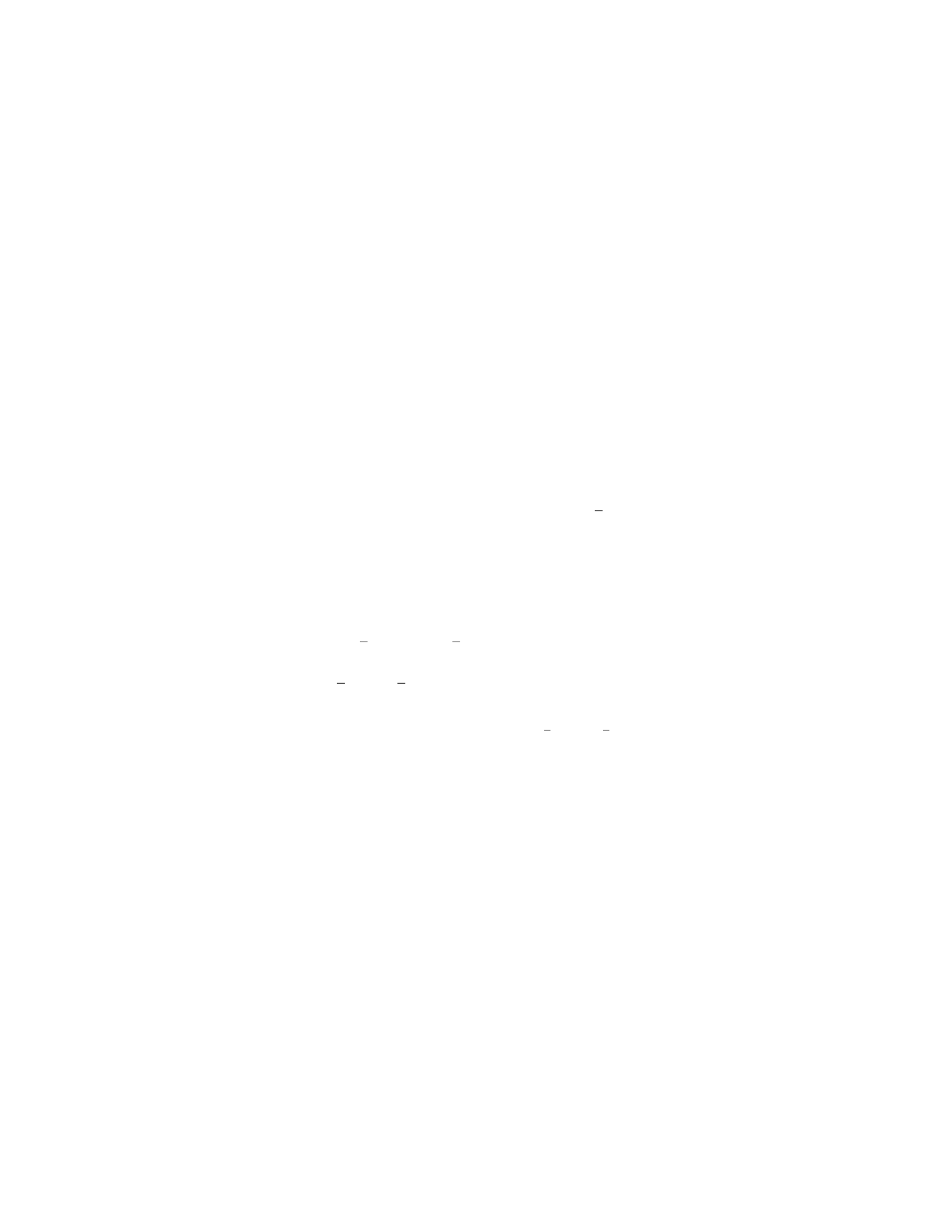
Question 25
Question
Evaluate the integral ∫xe2xdx using integration by parts.
Solution
To evaluate the integral ∫xe2xdx using integration by parts, we will use the
formula: ∫u dv =uv −∫v du
where uand vare differentiable functions of x. Let’s choose u=xand dv =
e2xdx. Then, we’ll find du and v.
1. Step 1: Find du and v.
du = 1 dx and v=∫e2xdx =1
2e2x
2. Step 2: Apply integration by parts formula.
∫xe2xdx =uv −∫v du
=x(1
2e2x)−∫(1
2e2x)dx
=1
2xe2x−1
4e2x+C(where Cis the constant of integration)
Therefore, the integral ∫xe2xdx evaluates to 1
2xe2x−1
4e2x+C.
19

Question 2
Question
Evaluate the integral ∫xcos(x)dx using integration by parts.
Solution
To evaluate the integral ∫xcos(x)dx using integration by parts, we will use the
formula:
∫u dv =uv −∫v du
where uand vare differentiable functions of x.
Step 1: Let’s choose u=xand dv = cos(x)dx. Then, we have:
du =dx and v=∫cos(x)dx = sin(x)
Step 2: Now, we can apply the integration by parts formula:
∫xcos(x)dx =uv −∫v du
=xsin(x)−∫sin(x)dx
=xsin(x) + cos(x) + C
Therefore, the integral ∫xcos(x)dx simplifies to xsin(x)+cos(x)+C, where
Cis the constant of integration.
Question 3
Question
Evaluate the integral ∫xln(x)dx using integration by parts.
Solution
To evaluate the given integral ∫xln(x)dx, we will use integration by parts.
Recall the formula for integration by parts:
∫u dv =uv −∫v du
where uand vare differentiable functions of x.
Step 1: Let’s choose u= ln(x)and dv =x dx. Then, we have:
du =1
xdx and v=x2
2
2
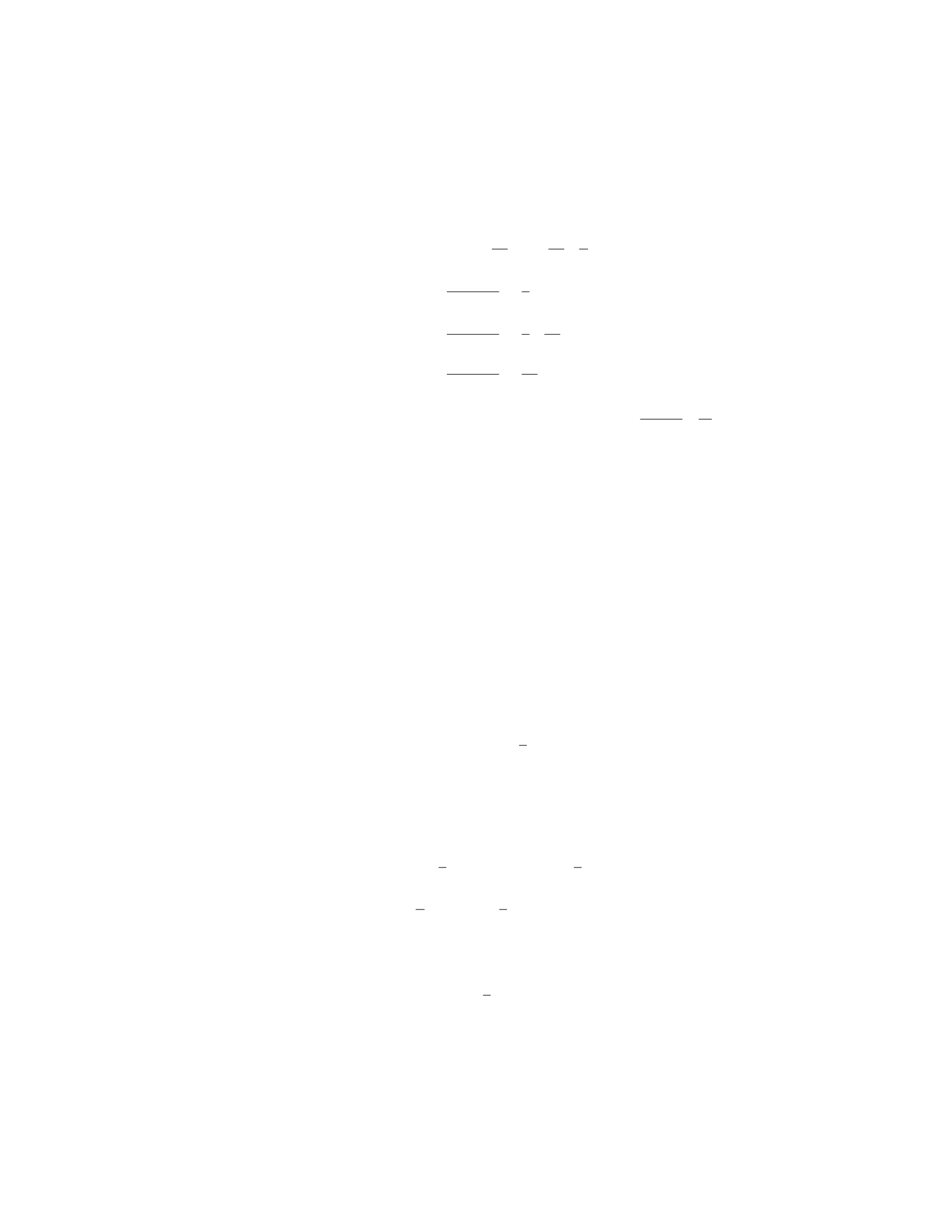
Step 2: Substitute u,dv,du, and vinto the integration by parts formula:
∫xln(x)dx = ln(x)·x2
2−∫x2
2·1
xdx
=x2ln(x)
2−1
2∫x dx
=x2ln(x)
2−1
2·x2
2+C
=x2ln(x)
2−x2
4+C
Step 3: Therefore, the solution to the integral ∫xln(x)dx is x2ln(x)
2−x2
4+C,
where Cis the constant of integration.
Question 4
Question
Evaluate the integral ∫xsin(3x)dx using integration by parts.
Solution
To evaluate the integral ∫xsin(3x)dx using integration by parts, we will use
the formula ∫u dv =uv −∫v du.
Step 1: Choose uand dv. Let u=xand dv = sin(3x)dx. Then, we have:
du =dx and v=−1
3cos(3x).
Step 2: Apply integration by parts:
∫xsin(3x)dx =uv −∫v du
=x(−1
3cos(3x))−∫(−1
3cos(3x))dx
=−x
3cos(3x) + 1
3∫cos(3x)dx.
Step 3: Integrate ∫cos(3x)dx:
∫cos(3x)dx =1
3sin(3x) + C,
where Cis the constant of integration.
3
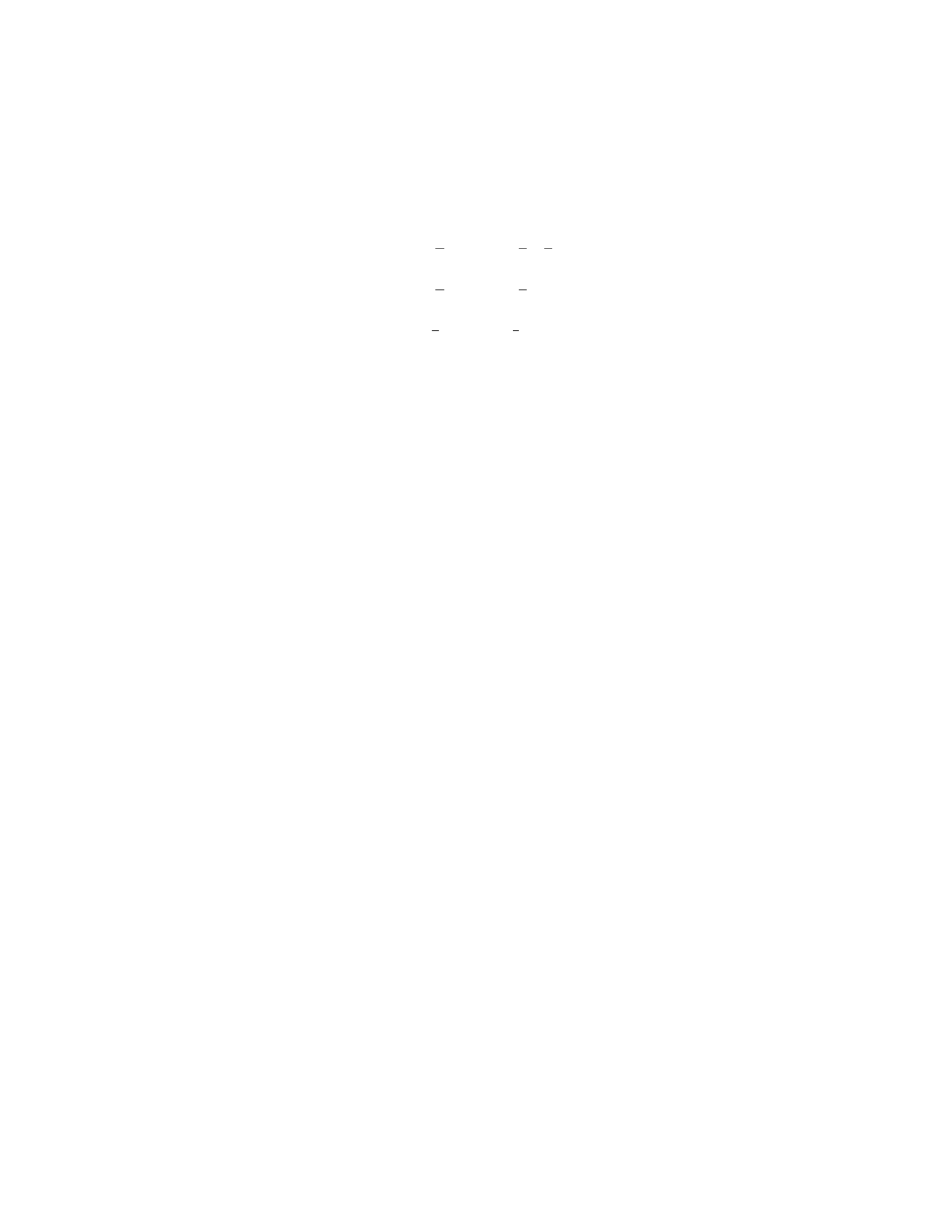
Step 4: Substitute back into the original integral:
∫xsin(3x)dx =−x
3cos(3x) + 1
3(1
3sin(3x) + C)
=−x
3cos(3x) + 1
9sin(3x) + C.
Therefore, ∫xsin(3x)dx =−x
3cos(3x) + 1
9sin(3x) + C, where Cis the con-
stant of integration.
Question 5
Question
Evaluate the integral ∫xcos(x)dx using integration by parts.
Solution
To evaluate the integral ∫xcos(x)dx using integration by parts, we will use
the formula ∫u dv =uv −∫v du where uand vare differentiable functions of
x.
Step 1: Let us choose u=xand dv = cos(x)dx. Then, calculating the
differentials, we get: du =dx and v=∫cos(x)dx = sin(x).
Step 2: Now, using the integration by parts formula, we have: ∫xcos(x)dx =
uv −∫v du =xsin(x)−∫sin(x)dx.
Step 3: Simplifying the integral, we get: ∫xcos(x)dx =xsin(x)+∫sin(x)dx.
Step 4: Finally, integrating ∫sin(x)dx, we have: ∫xcos(x)dx =xsin(x)−
cos(x) + C, where Cis the constant of integration.
Therefore, ∫xcos(x)dx =xsin(x)−cos(x) + C.
Question 6
Question
Evaluate the integral ∫xln(x)dx using integration by parts.
4
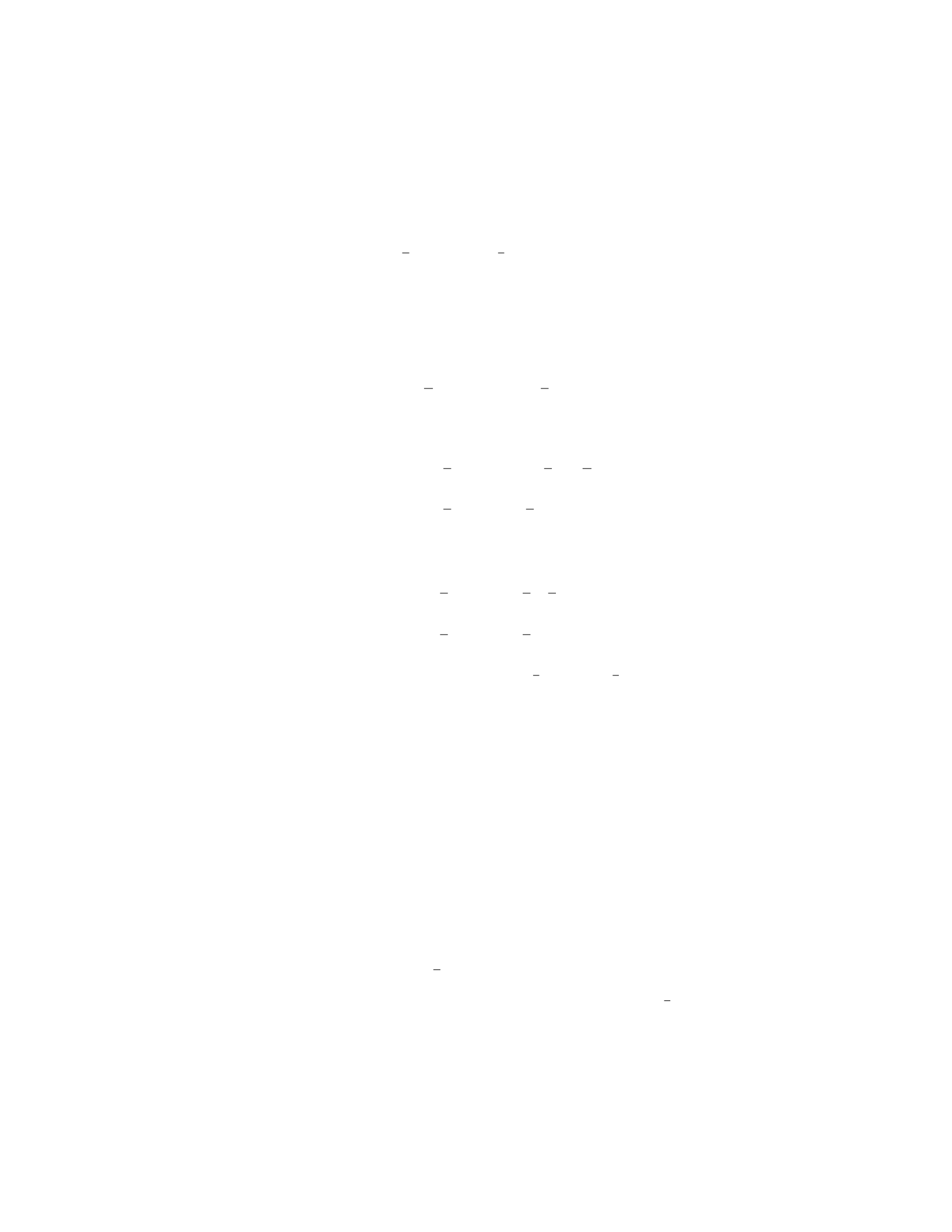
Solution
To evaluate the integral ∫xln(x)dx using integration by parts, we let u= ln(x)
and dv =x dx. Then, du =1
xdx and v=1
2x2. The formula for integration by
parts is:
∫u dv =uv −∫v du
Step 1: Calculate du and v.
du =1
xdx and v=1
2x2
Step 2: Apply integration by parts formula.
∫xln(x)dx =1
2x2ln(x)−∫1
2x2·1
xdx
=1
2x2ln(x)−1
2∫x dx
Step 3: Simplify the result.
∫xln(x)dx =1
2x2ln(x)−1
2(1
2x2)+C
=1
2x2ln(x)−1
4x2+C
Hence, the integral ∫xln(x)dx evaluates to 1
2x2ln(x)−1
4x2+Cwhere Cis
the constant of integration.
Question 7
Question
Evaluate the integral ∫x3ln(x)dx using integration by parts.
Solution
To evaluate the integral ∫x3ln(x)dx using integration by parts, we will let
u= ln(x)and dv =x3dx. Then, we will differentiate uto find du and integrate
dv to find v.
Step 1: Find du and v.
• Let u= ln(x). Then, du =1
xdx.
• Let dv =x3dx. Integrating dv with respect to x, we get v=1
4x4.
5
Step 2: Apply integration by parts formula: ∫u dv =uv −∫v du.
∫x3ln(x)dx =x3ln(x)−∫1
4x4·1
xdx
=x3ln(x)−1
4∫x3dx
=x3ln(x)−1
4·1
4x4+Cwhere Cis the constant of integration
=x3ln(x)−1
16x4+C
Therefore, ∫x3ln(x)dx =x3ln(x)−1
16 x4+C, where Cis the constant of
integration.
Question 8
Question
Evaluate the following integral using integration by parts:
∫x2exdx
Solution
To evaluate the integral ∫x2exdx using integration by parts, we will use the
formula: ∫u dv =uv −∫v du
where uand vare differentiable functions of x.
Step 1: Choose u=x2and dv =exdx. Then, we have du = 2x dx and
v=∫exdx =ex.
Step 2: Apply the formula:
∫x2exdx =x2ex−∫2xexdx
Step 3: Now, we have another integral on the right-hand side that can be
further simplified using integration by parts. Let’s apply integration by parts
to ∫2xexdx.
Step 4: Choose u= 2xand dv =exdx. Then, we have du = 2 dx and
v=ex.
Step 5: Apply the formula again:
∫2xexdx = 2xex−∫2exdx
6
Step 6: Simplify the above expression:
∫2xexdx = 2xex−2ex+C
Step 7: Substitute ∫2xexdx = 2xex−2ex+Cback into the equation from
Step 2:
∫x2exdx =x2ex−(2xex−2ex+C) + C
Step 8: Simplify the expression:
∫x2exdx =x2ex−2xex+ 2ex+C
Therefore, ∫x2exdx =x2ex−2xex+ 2ex+C, where Cis the constant of
integration.
Question 9
Question
Evaluate the integral ∫x2ln(x)dx using integration by parts.
Solution
To evaluate the integral ∫x2ln(x)dx using integration by parts, we let u= ln(x)
and dv =x2dx. Then, we differentiate uto get du =1
xdx and integrate dv to
get v=1
3x3. Substituting these into the integration by parts formula ∫udv =
uv −∫vdu, we have:
∫x2ln(x)dx =1
3x3ln(x)−∫1
3x3·1
xdx
=1
3x3ln(x)−1
3∫x2dx
Step 1: Integrate ∫x2dx.
∫x2dx =1
3x3+C
Step 2: Substituting the result back into the equation, we have:
∫x2ln(x)dx =1
3x3ln(x)−1
3(1
3x3)+C
=1
3x3ln(x)−1
9x3+C
Therefore, ∫x2ln(x)dx =1
3x3ln(x)−1
9x3+C, where Cis the constant of
integration.
7

Question 10
Question
Evaluate the integral ∫exsin(x)dx using integration by parts.
Solution
To evaluate the integral ∫exsin(x)dx, we will use integration by parts. The
formula for integration by parts is:
∫u dv =uv −∫v du
where uand vare differentiable functions of x.
Step 1: Let us choose u=exand dv = sin(x)dx. Then, we have:
du =exdx and v=−cos(x)
Step 2: Apply the integration by parts formula:
∫exsin(x)dx =ex(−cos(x)) −∫(−cos(x))(ex)dx
=−excos(x) + ∫excos(x)dx
Step 3: Now, we need to apply integration by parts again to evaluate
∫excos(x)dx. Let’s choose u=exand dv = cos(x)dx. Then, we have:
du =exdx
v= sin(x)
Step 4: Apply the integration by parts formula once more:
∫excos(x)dx =exsin(x)−∫sin(x)exdx
=exsin(x)−∫exsin(x)dx
Step 5: Now substitute ∫exsin(x)dx back into the equation:
∫exsin(x)dx =−excos(x) + (exsin(x)−∫exsin(x)dx)
∫exsin(x)dx =−excos(x) + exsin(x)−∫exsin(x)dx
Step 6: Now, add ∫exsin(x)dx to both sides of the equation:
∫exsin(x)dx +∫exsin(x)dx =−excos(x) + exsin(x)
8
Step 7: Simplify the equation:
2∫exsin(x)dx =−excos(x) + exsin(x)
Step 8: Finally, divide by 2:
∫exsin(x)dx =−excos(x) + exsin(x)
2+C
where Cis the constant of integration.
Question 11
Question
Evaluate the integral ∫x2ln(x)dx.
Solution
To evaluate the integral ∫x2ln(x)dx, we will use integration by parts, which
states: ∫u dv =uv −∫v du.
We will choose u= ln(x)and dv =x2dx, so that du =1
xdx and v=1
3x3.
Step 1: Apply integration by parts:
∫x2ln(x)dx =1
3x3ln(x)−∫1
3x3·1
xdx
=1
3x3ln(x)−1
3∫x2dx.
Step 2: Simplify the integral:
∫x2ln(x)dx =1
3x3ln(x)−1
3∫x2dx
=1
3x3ln(x)−1
3·1
3x3+C
=1
3x3ln(x)−1
9x3+C,
where Cis the constant of integration.
Therefore, ∫x2ln(x)dx =1
3x3ln(x)−1
9x3+C.
Question 12
Question
Evaluate the integral ∫xcos−1x dx using integration by parts.
9
Solution
To evaluate the integral ∫xcos−1x dx using integration by parts, we choose
u= cos−1xand dv =x dx. Then, we find du and v:
Step 1: Find du and v.
u= cos−1x
du =−1
√1−x2dx
dv =x dx
v=1
2x2
Step 2: Apply integration by parts formula ∫u dv =uv −∫v du.
∫xcos−1x dx =1
2x2cos−1x−∫1
2x2(−1
√1−x2)dx
=1
2x2cos−1x+1
2∫x2
√1−x2dx
Now, we will evaluate the remaining integral using a trigonometric substi-
tution. Let x= sin θ, so dx = cos θ dθ and √1−x2= cos θ.
Step 3: Perform the trigonometric substitution.
∫x2
√1−x2dx =∫sin2θ
cos θcos θ dθ
=∫sin2θ dθ
Using the double angle identity sin2θ=1
2(1 −cos 2θ), we get:
∫sin2θ dθ =∫1
2(1 −cos 2θ)dθ
=1
2(θ−1
2sin 2θ) + C
Step 4: Substitute back x= sin θto get the final answer.
∫xcos−1x dx =1
2x2cos−1x+1
4(θ−1
2sin 2θ) + C
Therefore, the final answer is 1
2x2cos−1x+1
4(sin−1x−x√1−x2) + C.
Question 13
Question
Evaluate the integral ∫xln(x)dx using integration by parts.
10
Solution
To evaluate the integral ∫xln(x)dx using integration by parts, we will follow
the formula: ∫u dv =uv −∫v du
where we choose uand dv appropriately.
Step 1: Let’s choose:
u= ln(x)⇒du =1
xdx
dv =x dx ⇒v=x2
2
Step 2: Apply the integration by parts formula:
∫xln(x)dx =x2
2ln(x)−∫x2
2·1
xdx
Step 3: Simplify the integral:
∫xln(x)dx =x2
2ln(x)−∫x
2dx
=x2
2ln(x)−1
4x2+C
Hence, the solution to the integral ∫xln(x)dx is x2
2ln(x)−1
4x2+C, where
Cis the constant of integration.
Question 14
Question
Evaluate the integral ∫xcos(x)dx using integration by parts.
Solution
To evaluate the integral ∫xcos(x)dx using integration by parts, we will use the
formula: ∫u dv =uv −∫v du
Step 1: Let’s choose u=xand dv = cos(x)dx, then differentiate uto get
du and integrate dv to get v:
•u=x,du =dx
•dv = cos(x)dx,v=∫cos(x)dx = sin(x)
11
Step 2: Now, we can apply the integration by parts formula:
∫xcos(x)dx =uv −∫v du
=xsin(x)−∫sin(x)dx
=xsin(x) + ∫sin(x)dx (since ∫sin(x)dx =−cos(x))
=xsin(x)−cos(x) + C(where Cis the constant of integration)
Therefore, ∫xcos(x)dx =xsin(x)−cos(x) + C.
Question 15
Question
Evaluate the integral ∫x2ln x dx using integration by parts.
Solution
To evaluate ∫x2ln x dx using integration by parts, we will let u= ln xand
dv =x2dx. Then, we can find du and vto proceed with the integration.
Step 1: Calculate du and v
•u= ln x
•dv =x2dx
We differentiate uto get du:
du =1
xdx
We integrate dv to get v:
v=1
3x3
Step 2: Apply integration by parts formula The integration by parts formula
is: ∫u dv =uv −∫v du
Now, we substitute u,dv,v, and du into the formula:
∫x2ln x dx =x2ln x−∫1
3x3·1
xdx
=x2ln x−1
3∫x2dx
12
Step 3: Evaluate the integral Integrate ∫x2dx:
∫x2dx =1
3x3+C
Step 4: Final answer Substitute the result back into the formula:
∫x2ln x dx =x2ln x−1
3(1
3x3+C)
=x2ln x−1
9x3−1
3C+C′
Therefore, ∫x2ln x dx =x2ln x−1
9x3+C, where Cis the constant of
integration.
Question 16
Question
Evaluate the integral ∫x2ln(x)dx using integration by parts.
Solution
To evaluate the integral ∫x2ln(x)dx using integration by parts, we will apply
the formula ∫u dv =uv −∫v du where uand vare chosen functions.
Step 1: Let’s choose u= ln(x)and dv =x2dx. Then, differentiate uand
integrate dv.
du =1
xdx
v=∫x2dx =1
3x3
Step 2: Now, we can use the integration by parts formula to find the
integral.
∫x2ln(x)dx =uv −∫v du
= ln(x)·1
3x3−∫1
3x3·1
xdx
=1
3x3ln(x)−1
3∫x2dx
=1
3x3ln(x)−1
3·1
3x3+C
=1
3x3ln(x)−1
9x3+C
Therefore, the integral ∫x2ln(x)dx evaluates to 1
3x3ln(x)−1
9x3+C, where
Cis the constant of integration.
13
Question 17
Question
Evaluate the integral ∫xcos(2x)dx using integration by parts.
Solution
To evaluate the integral ∫xcos(2x)dx using integration by parts, we will let
u=xand dv = cos(2x)dx. Then, we will differentiate uto get du =dx and
integrate dv to get v=1
2sin(2x).
Step 1: Apply integration by parts formula: ∫u dv =uv −∫v du.
∫xcos(2x)dx =x·1
2sin(2x)−∫1
2sin(2x)dx
Step 2: Integrate the remaining term.
=x
2sin(2x)−1
2∫sin(2x)dx
=x
2sin(2x) + 1
4cos(2x) + C
Therefore, ∫xcos(2x)dx =x
2sin(2x)+ 1
4cos(2x)+C, where Cis the constant
of integration.
Question 18
Question
Evaluate the integral ∫x3ln(x)dx using integration by parts.
Solution
To evaluate the integral ∫x3ln(x)dx using integration by parts, we will choose
u= ln(x)and dv =x3dx. Then, du =1
xdx and v=∫x3dx =x4
4.
Step 1: Apply integration by parts:
∫x3ln(x)dx =uv −∫v du
∫x3ln(x)dx = ln(x)·x4
4−∫x4
4·1
xdx
Step 2: Simplify the integral:
∫x3ln(x)dx =x4ln(x)
4−∫x3
4dx
14
Step 3: Integrate the remaining integral:
∫x3ln(x)dx =x4ln(x)
4−1
4∫x3dx
∫x3ln(x)dx =x4ln(x)
4−x4
16 +C
Therefore, ∫x3ln(x)dx =x4ln(x)
4−x4
16 +C, where Cis the constant of
integration.
Question 19
Question
Evaluate the integral ∫xexcos(x)dx using integration by parts.
Solution
To evaluate the given integral ∫xexcos(x)dx using integration by parts, we will
choose parts to differentiate and integrate.
Step 1: Let’s use integration by parts with u=xand dv =excos(x)dx.
Then, we have:
u=x⇒du =dx,
dv =excos(x)dx ⇒v=∫excos(x)dx.
Step 2: To find v, we need to integrate v=∫excos(x)dx. Let’s use
integration by parts again with u=exand dv = cos(x)dx. Then, we have:
u=ex⇒du =exdx,
dv = cos(x)dx ⇒v=∫cos(x)dx.
Step 3: Finding v, we integrate v=∫cos(x)dx = sin(x).
Step 4: Now, we can find uv −∫v du.
∫xexcos(x)dx =uv −∫v du
=x·exsin(x)−∫exsin(x)dx.
Step 5: To find ∫exsin(x)dx, we will use integration by parts again. Let
u=exand dv = sin(x)dx.
Step 6: After calculating the integration, we find that ∫exsin(x)dx =
ex(sin(x)−cos(x))
2.
15
Step 7: Substituting this back into the previous equation, we have:
∫xexcos(x)dx =x·exsin(x)−∫exsin(x)dx
=x·exsin(x)−ex(sin(x)−cos(x))
2+C,
where Cis the constant of integration.
Therefore, ∫xexcos(x)dx =x·exsin(x)−ex(sin(x)−cos(x))
2+C.
Question 20
Question
Evaluate the integral ∫x2ln(x)dx using integration by parts.
Solution
To evaluate the integral ∫x2ln(x)dx using integration by parts, we will choose
u= ln(x)and dv =x2dx, then apply the integration by parts formula ∫u dv =
uv −∫v du.
Step 1: Let’s determine du and v.
•u= ln(x)
•dv =x2dx To find dv, we integrate dv to get v:
∫x2dx =1
3x3
So, v=1
3x3.
• To find du, we differentiate u:
du =1
xdx
Step 2: Now, we can apply the integration by parts formula.
∫x2ln(x)dx =uv −∫v du
= ln(x)(1
3x3)−∫(1
3x3)(1
x)dx
=1
3x3ln(x)−1
3∫x2dx
=1
3x3ln(x)−1
3·1
3x3+C
=1
3x3ln(x)−1
9x3+C
Therefore, ∫x2ln(x)dx =1
3x3ln(x)−1
9x3+C, where Cis the constant of
integration.
16
Question 21
Question
Evaluate the integral ∫x2ln(x)dx using integration by parts.
Solution
To evaluate the integral ∫x2ln(x)dx using integration by parts, we will use the
formula ∫u dv =uv −∫v du.
Step 1: Let’s choose our function uand our differential dv. Let u= ln(x)
and dv =x2dx.
Step 2: Compute the respective differentials du and v. Calculate du by
taking the derivative of u:du =1
xdx. Integrate dv to find v:v=1
3x3.
Step 3: Apply the integration by parts formula.
∫x2ln(x)dx =uv −∫v du
∫x2ln(x)dx = ln(x)·1
3x3−∫1
3x3·1
xdx
Step 4: Simplify and integrate the remaining integral.
∫x2ln(x)dx =1
3x3ln(x)−1
3∫x2dx
∫x2ln(x)dx =1
3x3ln(x)−1
3·1
3x3+C
∫x2ln(x)dx =1
3x3(ln(x)−1) + C
Therefore, ∫x2ln(x)dx =1
3x3(ln(x)−1) + C, where Cis the constant of
integration.
Question 22
Question
Evaluate the integral ∫xexdx using integration by parts.
Solution
To evaluate the integral ∫xexdx using integration by parts, we will choose
u=xand dv =exdx. Then we will differentiate uonce and integrate dv to
find du and v.
Step 1: Let u=xand dv =exdx. Then du =dx and v=∫exdx =ex.
17
Step 2: Apply the integration by parts formula:
∫u dv =uv −∫v du
∫xexdx =xex−∫exdx
Step 3: Simplify the expression:
∫xexdx =xex−∫exdx =xex−ex+C
Therefore, ∫xexdx =xex−ex+Cwhere Cis the constant of integration.
Question 23
Question
Evaluate the integral ∫xln(x)dx using integration by parts.
Solution
To evaluate ∫xln(x)dx using integration by parts, we will choose u= ln(x)
and dv =x dx.
Step 1: Find du and v.
•u= ln(x)
•du =1
xdx
•dv =x dx =⇒v=1
2x2
Step 2: Apply the integration by parts formula: ∫u dv =uv −∫v du.
∫xln(x)dx = ln(x)·1
2x2−∫1
2x2·1
xdx
=1
2x2ln(x)−1
2∫x dx
=1
2x2ln(x)−1
4x2+C
Therefore, ∫xln(x)dx =1
2x2ln(x)−1
4x2+C, where Cis the constant of
integration.
18
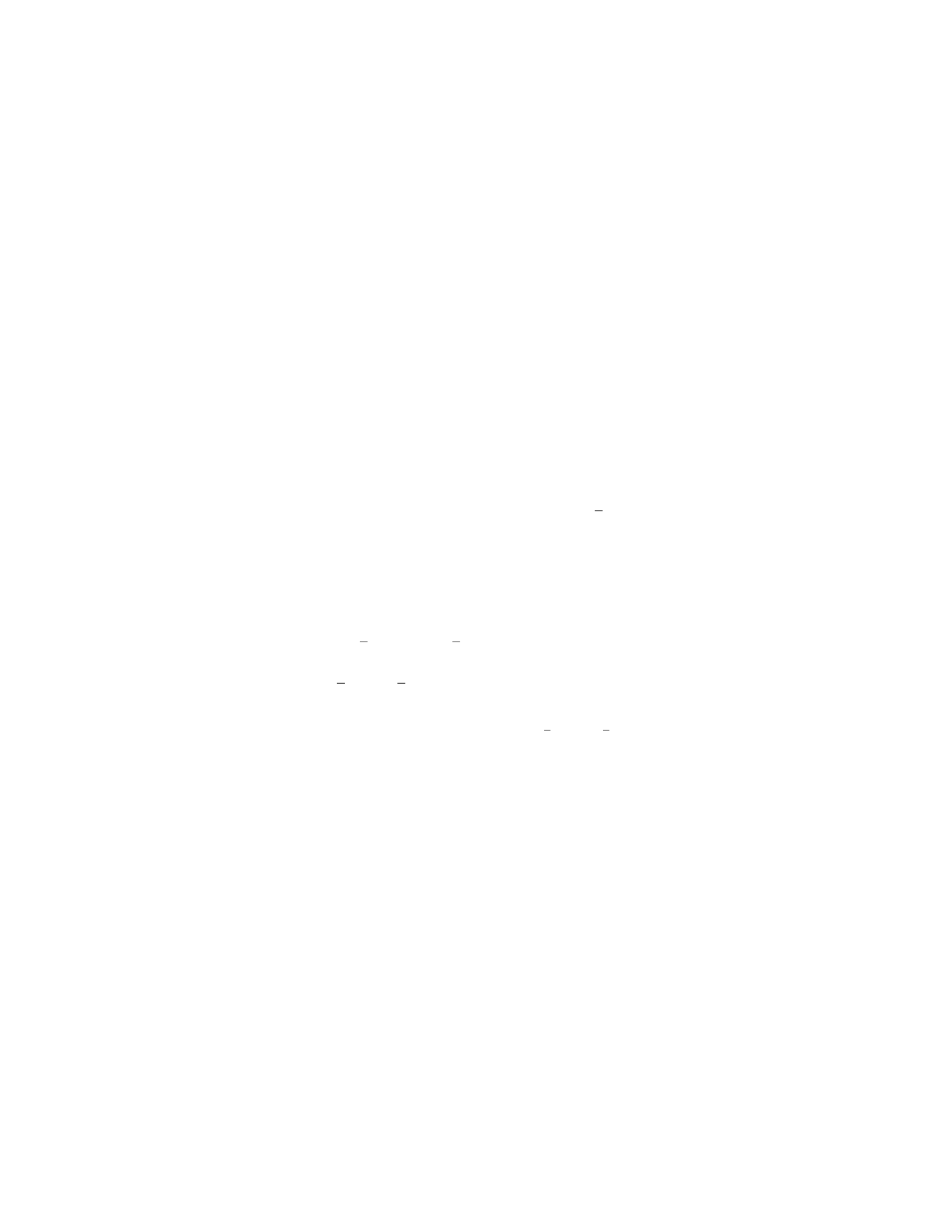
Question 25
Question
Evaluate the integral ∫xe2xdx using integration by parts.
Solution
To evaluate the integral ∫xe2xdx using integration by parts, we will use the
formula: ∫u dv =uv −∫v du
where uand vare differentiable functions of x. Let’s choose u=xand dv =
e2xdx. Then, we’ll find du and v.
1. Step 1: Find du and v.
du = 1 dx and v=∫e2xdx =1
2e2x
2. Step 2: Apply integration by parts formula.
∫xe2xdx =uv −∫v du
=x(1
2e2x)−∫(1
2e2x)dx
=1
2xe2x−1
4e2x+C(where Cis the constant of integration)
Therefore, the integral ∫xe2xdx evaluates to 1
2xe2x−1
4e2x+C.
19

Question 2
Question
Evaluate the integral ∫xcos(x)dx using integration by parts.
Solution
To evaluate the integral ∫xcos(x)dx using integration by parts, we will use the
formula:
∫u dv =uv −∫v du
where uand vare differentiable functions of x.
Step 1: Let’s choose u=xand dv = cos(x)dx. Then, we have:
du =dx and v=∫cos(x)dx = sin(x)
Step 2: Now, we can apply the integration by parts formula:
∫xcos(x)dx =uv −∫v du
=xsin(x)−∫sin(x)dx
=xsin(x) + cos(x) + C
Therefore, the integral ∫xcos(x)dx simplifies to xsin(x)+cos(x)+C, where
Cis the constant of integration.
Question 3
Question
Evaluate the integral ∫xln(x)dx using integration by parts.
Solution
To evaluate the given integral ∫xln(x)dx, we will use integration by parts.
Recall the formula for integration by parts:
∫u dv =uv −∫v du
where uand vare differentiable functions of x.
Step 1: Let’s choose u= ln(x)and dv =x dx. Then, we have:
du =1
xdx and v=x2
2
2
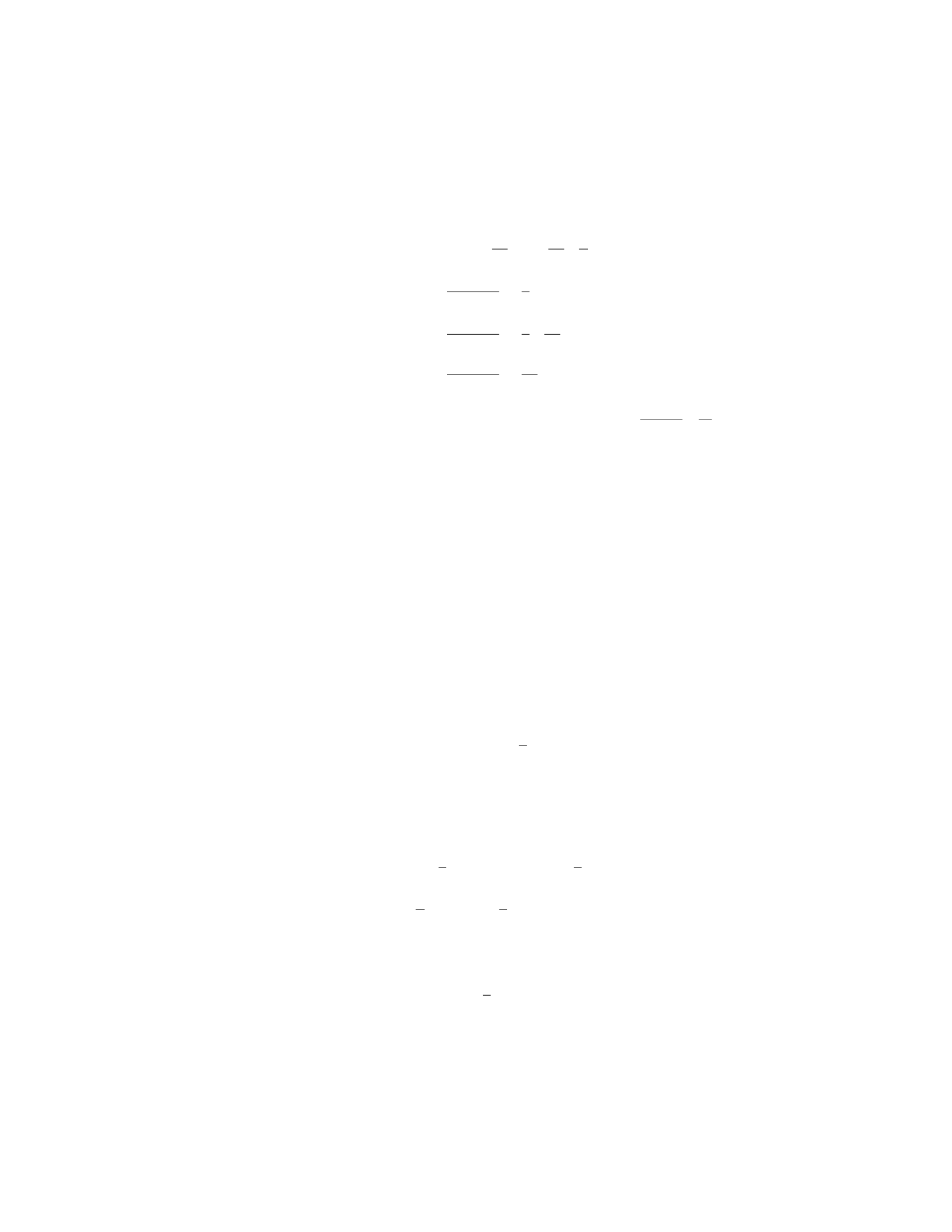
Step 2: Substitute u,dv,du, and vinto the integration by parts formula:
∫xln(x)dx = ln(x)·x2
2−∫x2
2·1
xdx
=x2ln(x)
2−1
2∫x dx
=x2ln(x)
2−1
2·x2
2+C
=x2ln(x)
2−x2
4+C
Step 3: Therefore, the solution to the integral ∫xln(x)dx is x2ln(x)
2−x2
4+C,
where Cis the constant of integration.
Question 4
Question
Evaluate the integral ∫xsin(3x)dx using integration by parts.
Solution
To evaluate the integral ∫xsin(3x)dx using integration by parts, we will use
the formula ∫u dv =uv −∫v du.
Step 1: Choose uand dv. Let u=xand dv = sin(3x)dx. Then, we have:
du =dx and v=−1
3cos(3x).
Step 2: Apply integration by parts:
∫xsin(3x)dx =uv −∫v du
=x(−1
3cos(3x))−∫(−1
3cos(3x))dx
=−x
3cos(3x) + 1
3∫cos(3x)dx.
Step 3: Integrate ∫cos(3x)dx:
∫cos(3x)dx =1
3sin(3x) + C,
where Cis the constant of integration.
3
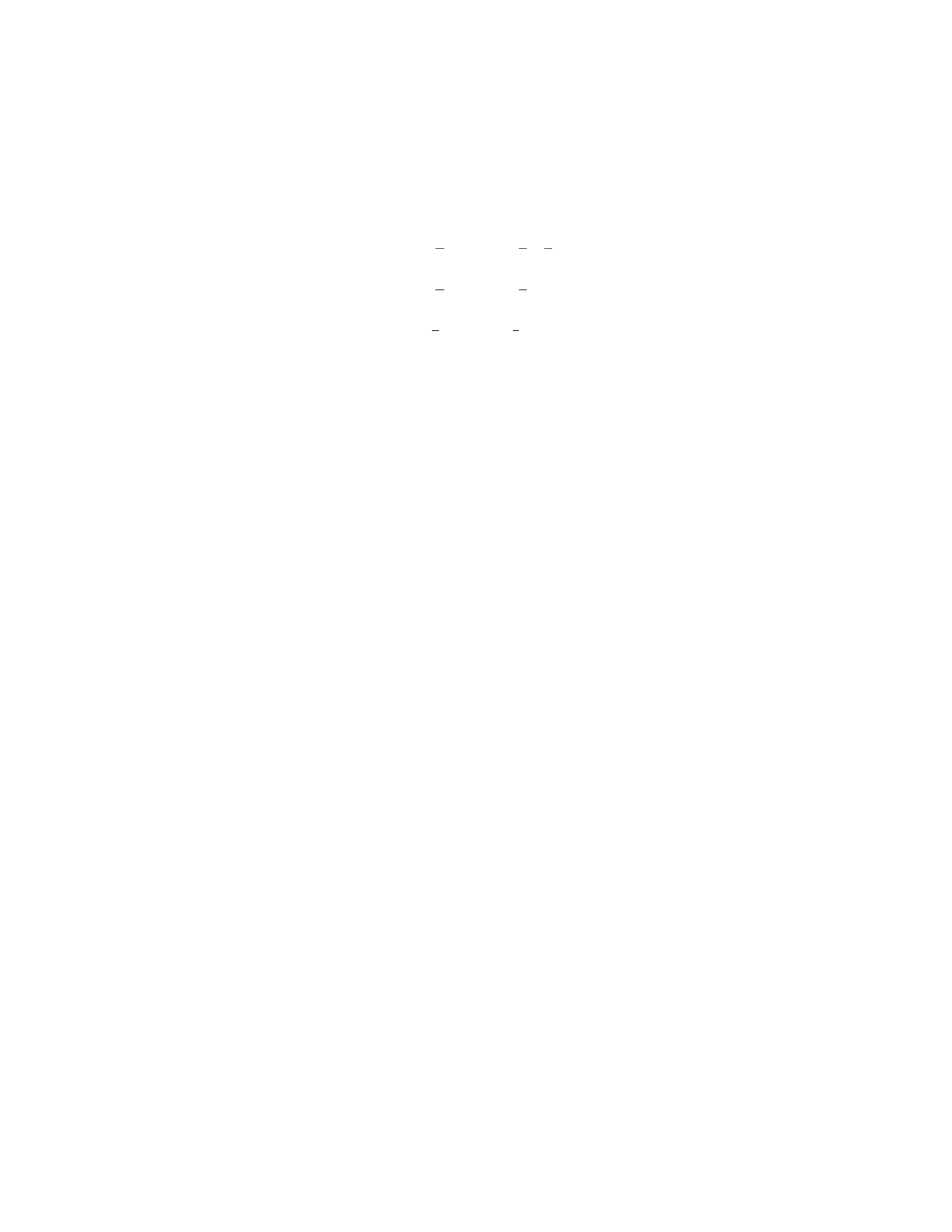
Step 4: Substitute back into the original integral:
∫xsin(3x)dx =−x
3cos(3x) + 1
3(1
3sin(3x) + C)
=−x
3cos(3x) + 1
9sin(3x) + C.
Therefore, ∫xsin(3x)dx =−x
3cos(3x) + 1
9sin(3x) + C, where Cis the con-
stant of integration.
Question 5
Question
Evaluate the integral ∫xcos(x)dx using integration by parts.
Solution
To evaluate the integral ∫xcos(x)dx using integration by parts, we will use
the formula ∫u dv =uv −∫v du where uand vare differentiable functions of
x.
Step 1: Let us choose u=xand dv = cos(x)dx. Then, calculating the
differentials, we get: du =dx and v=∫cos(x)dx = sin(x).
Step 2: Now, using the integration by parts formula, we have: ∫xcos(x)dx =
uv −∫v du =xsin(x)−∫sin(x)dx.
Step 3: Simplifying the integral, we get: ∫xcos(x)dx =xsin(x)+∫sin(x)dx.
Step 4: Finally, integrating ∫sin(x)dx, we have: ∫xcos(x)dx =xsin(x)−
cos(x) + C, where Cis the constant of integration.
Therefore, ∫xcos(x)dx =xsin(x)−cos(x) + C.
Question 6
Question
Evaluate the integral ∫xln(x)dx using integration by parts.
4
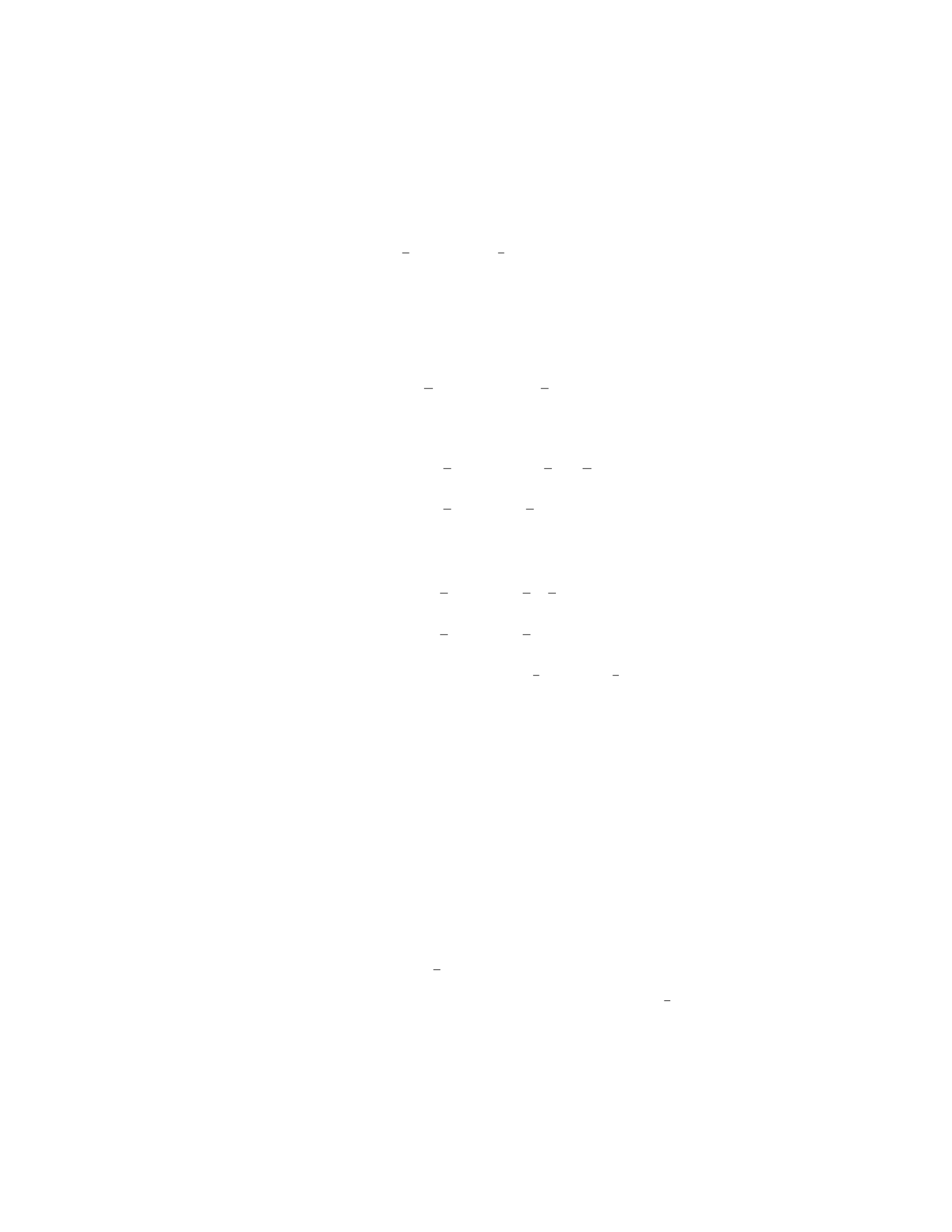
Solution
To evaluate the integral ∫xln(x)dx using integration by parts, we let u= ln(x)
and dv =x dx. Then, du =1
xdx and v=1
2x2. The formula for integration by
parts is:
∫u dv =uv −∫v du
Step 1: Calculate du and v.
du =1
xdx and v=1
2x2
Step 2: Apply integration by parts formula.
∫xln(x)dx =1
2x2ln(x)−∫1
2x2·1
xdx
=1
2x2ln(x)−1
2∫x dx
Step 3: Simplify the result.
∫xln(x)dx =1
2x2ln(x)−1
2(1
2x2)+C
=1
2x2ln(x)−1
4x2+C
Hence, the integral ∫xln(x)dx evaluates to 1
2x2ln(x)−1
4x2+Cwhere Cis
the constant of integration.
Question 7
Question
Evaluate the integral ∫x3ln(x)dx using integration by parts.
Solution
To evaluate the integral ∫x3ln(x)dx using integration by parts, we will let
u= ln(x)and dv =x3dx. Then, we will differentiate uto find du and integrate
dv to find v.
Step 1: Find du and v.
• Let u= ln(x). Then, du =1
xdx.
• Let dv =x3dx. Integrating dv with respect to x, we get v=1
4x4.
5
Step 2: Apply integration by parts formula: ∫u dv =uv −∫v du.
∫x3ln(x)dx =x3ln(x)−∫1
4x4·1
xdx
=x3ln(x)−1
4∫x3dx
=x3ln(x)−1
4·1
4x4+Cwhere Cis the constant of integration
=x3ln(x)−1
16x4+C
Therefore, ∫x3ln(x)dx =x3ln(x)−1
16 x4+C, where Cis the constant of
integration.
Question 8
Question
Evaluate the following integral using integration by parts:
∫x2exdx
Solution
To evaluate the integral ∫x2exdx using integration by parts, we will use the
formula: ∫u dv =uv −∫v du
where uand vare differentiable functions of x.
Step 1: Choose u=x2and dv =exdx. Then, we have du = 2x dx and
v=∫exdx =ex.
Step 2: Apply the formula:
∫x2exdx =x2ex−∫2xexdx
Step 3: Now, we have another integral on the right-hand side that can be
further simplified using integration by parts. Let’s apply integration by parts
to ∫2xexdx.
Step 4: Choose u= 2xand dv =exdx. Then, we have du = 2 dx and
v=ex.
Step 5: Apply the formula again:
∫2xexdx = 2xex−∫2exdx
6
Step 6: Simplify the above expression:
∫2xexdx = 2xex−2ex+C
Step 7: Substitute ∫2xexdx = 2xex−2ex+Cback into the equation from
Step 2:
∫x2exdx =x2ex−(2xex−2ex+C) + C
Step 8: Simplify the expression:
∫x2exdx =x2ex−2xex+ 2ex+C
Therefore, ∫x2exdx =x2ex−2xex+ 2ex+C, where Cis the constant of
integration.
Question 9
Question
Evaluate the integral ∫x2ln(x)dx using integration by parts.
Solution
To evaluate the integral ∫x2ln(x)dx using integration by parts, we let u= ln(x)
and dv =x2dx. Then, we differentiate uto get du =1
xdx and integrate dv to
get v=1
3x3. Substituting these into the integration by parts formula ∫udv =
uv −∫vdu, we have:
∫x2ln(x)dx =1
3x3ln(x)−∫1
3x3·1
xdx
=1
3x3ln(x)−1
3∫x2dx
Step 1: Integrate ∫x2dx.
∫x2dx =1
3x3+C
Step 2: Substituting the result back into the equation, we have:
∫x2ln(x)dx =1
3x3ln(x)−1
3(1
3x3)+C
=1
3x3ln(x)−1
9x3+C
Therefore, ∫x2ln(x)dx =1
3x3ln(x)−1
9x3+C, where Cis the constant of
integration.
7

Question 10
Question
Evaluate the integral ∫exsin(x)dx using integration by parts.
Solution
To evaluate the integral ∫exsin(x)dx, we will use integration by parts. The
formula for integration by parts is:
∫u dv =uv −∫v du
where uand vare differentiable functions of x.
Step 1: Let us choose u=exand dv = sin(x)dx. Then, we have:
du =exdx and v=−cos(x)
Step 2: Apply the integration by parts formula:
∫exsin(x)dx =ex(−cos(x)) −∫(−cos(x))(ex)dx
=−excos(x) + ∫excos(x)dx
Step 3: Now, we need to apply integration by parts again to evaluate
∫excos(x)dx. Let’s choose u=exand dv = cos(x)dx. Then, we have:
du =exdx
v= sin(x)
Step 4: Apply the integration by parts formula once more:
∫excos(x)dx =exsin(x)−∫sin(x)exdx
=exsin(x)−∫exsin(x)dx
Step 5: Now substitute ∫exsin(x)dx back into the equation:
∫exsin(x)dx =−excos(x) + (exsin(x)−∫exsin(x)dx)
∫exsin(x)dx =−excos(x) + exsin(x)−∫exsin(x)dx
Step 6: Now, add ∫exsin(x)dx to both sides of the equation:
∫exsin(x)dx +∫exsin(x)dx =−excos(x) + exsin(x)
8
Step 7: Simplify the equation:
2∫exsin(x)dx =−excos(x) + exsin(x)
Step 8: Finally, divide by 2:
∫exsin(x)dx =−excos(x) + exsin(x)
2+C
where Cis the constant of integration.
Question 11
Question
Evaluate the integral ∫x2ln(x)dx.
Solution
To evaluate the integral ∫x2ln(x)dx, we will use integration by parts, which
states: ∫u dv =uv −∫v du.
We will choose u= ln(x)and dv =x2dx, so that du =1
xdx and v=1
3x3.
Step 1: Apply integration by parts:
∫x2ln(x)dx =1
3x3ln(x)−∫1
3x3·1
xdx
=1
3x3ln(x)−1
3∫x2dx.
Step 2: Simplify the integral:
∫x2ln(x)dx =1
3x3ln(x)−1
3∫x2dx
=1
3x3ln(x)−1
3·1
3x3+C
=1
3x3ln(x)−1
9x3+C,
where Cis the constant of integration.
Therefore, ∫x2ln(x)dx =1
3x3ln(x)−1
9x3+C.
Question 12
Question
Evaluate the integral ∫xcos−1x dx using integration by parts.
9
Solution
To evaluate the integral ∫xcos−1x dx using integration by parts, we choose
u= cos−1xand dv =x dx. Then, we find du and v:
Step 1: Find du and v.
u= cos−1x
du =−1
√1−x2dx
dv =x dx
v=1
2x2
Step 2: Apply integration by parts formula ∫u dv =uv −∫v du.
∫xcos−1x dx =1
2x2cos−1x−∫1
2x2(−1
√1−x2)dx
=1
2x2cos−1x+1
2∫x2
√1−x2dx
Now, we will evaluate the remaining integral using a trigonometric substi-
tution. Let x= sin θ, so dx = cos θ dθ and √1−x2= cos θ.
Step 3: Perform the trigonometric substitution.
∫x2
√1−x2dx =∫sin2θ
cos θcos θ dθ
=∫sin2θ dθ
Using the double angle identity sin2θ=1
2(1 −cos 2θ), we get:
∫sin2θ dθ =∫1
2(1 −cos 2θ)dθ
=1
2(θ−1
2sin 2θ) + C
Step 4: Substitute back x= sin θto get the final answer.
∫xcos−1x dx =1
2x2cos−1x+1
4(θ−1
2sin 2θ) + C
Therefore, the final answer is 1
2x2cos−1x+1
4(sin−1x−x√1−x2) + C.
Question 13
Question
Evaluate the integral ∫xln(x)dx using integration by parts.
10
Solution
To evaluate the integral ∫xln(x)dx using integration by parts, we will follow
the formula: ∫u dv =uv −∫v du
where we choose uand dv appropriately.
Step 1: Let’s choose:
u= ln(x)⇒du =1
xdx
dv =x dx ⇒v=x2
2
Step 2: Apply the integration by parts formula:
∫xln(x)dx =x2
2ln(x)−∫x2
2·1
xdx
Step 3: Simplify the integral:
∫xln(x)dx =x2
2ln(x)−∫x
2dx
=x2
2ln(x)−1
4x2+C
Hence, the solution to the integral ∫xln(x)dx is x2
2ln(x)−1
4x2+C, where
Cis the constant of integration.
Question 14
Question
Evaluate the integral ∫xcos(x)dx using integration by parts.
Solution
To evaluate the integral ∫xcos(x)dx using integration by parts, we will use the
formula: ∫u dv =uv −∫v du
Step 1: Let’s choose u=xand dv = cos(x)dx, then differentiate uto get
du and integrate dv to get v:
•u=x,du =dx
•dv = cos(x)dx,v=∫cos(x)dx = sin(x)
11
Step 2: Now, we can apply the integration by parts formula:
∫xcos(x)dx =uv −∫v du
=xsin(x)−∫sin(x)dx
=xsin(x) + ∫sin(x)dx (since ∫sin(x)dx =−cos(x))
=xsin(x)−cos(x) + C(where Cis the constant of integration)
Therefore, ∫xcos(x)dx =xsin(x)−cos(x) + C.
Question 15
Question
Evaluate the integral ∫x2ln x dx using integration by parts.
Solution
To evaluate ∫x2ln x dx using integration by parts, we will let u= ln xand
dv =x2dx. Then, we can find du and vto proceed with the integration.
Step 1: Calculate du and v
•u= ln x
•dv =x2dx
We differentiate uto get du:
du =1
xdx
We integrate dv to get v:
v=1
3x3
Step 2: Apply integration by parts formula The integration by parts formula
is: ∫u dv =uv −∫v du
Now, we substitute u,dv,v, and du into the formula:
∫x2ln x dx =x2ln x−∫1
3x3·1
xdx
=x2ln x−1
3∫x2dx
12
Step 3: Evaluate the integral Integrate ∫x2dx:
∫x2dx =1
3x3+C
Step 4: Final answer Substitute the result back into the formula:
∫x2ln x dx =x2ln x−1
3(1
3x3+C)
=x2ln x−1
9x3−1
3C+C′
Therefore, ∫x2ln x dx =x2ln x−1
9x3+C, where Cis the constant of
integration.
Question 16
Question
Evaluate the integral ∫x2ln(x)dx using integration by parts.
Solution
To evaluate the integral ∫x2ln(x)dx using integration by parts, we will apply
the formula ∫u dv =uv −∫v du where uand vare chosen functions.
Step 1: Let’s choose u= ln(x)and dv =x2dx. Then, differentiate uand
integrate dv.
du =1
xdx
v=∫x2dx =1
3x3
Step 2: Now, we can use the integration by parts formula to find the
integral.
∫x2ln(x)dx =uv −∫v du
= ln(x)·1
3x3−∫1
3x3·1
xdx
=1
3x3ln(x)−1
3∫x2dx
=1
3x3ln(x)−1
3·1
3x3+C
=1
3x3ln(x)−1
9x3+C
Therefore, the integral ∫x2ln(x)dx evaluates to 1
3x3ln(x)−1
9x3+C, where
Cis the constant of integration.
13
Question 17
Question
Evaluate the integral ∫xcos(2x)dx using integration by parts.
Solution
To evaluate the integral ∫xcos(2x)dx using integration by parts, we will let
u=xand dv = cos(2x)dx. Then, we will differentiate uto get du =dx and
integrate dv to get v=1
2sin(2x).
Step 1: Apply integration by parts formula: ∫u dv =uv −∫v du.
∫xcos(2x)dx =x·1
2sin(2x)−∫1
2sin(2x)dx
Step 2: Integrate the remaining term.
=x
2sin(2x)−1
2∫sin(2x)dx
=x
2sin(2x) + 1
4cos(2x) + C
Therefore, ∫xcos(2x)dx =x
2sin(2x)+ 1
4cos(2x)+C, where Cis the constant
of integration.
Question 18
Question
Evaluate the integral ∫x3ln(x)dx using integration by parts.
Solution
To evaluate the integral ∫x3ln(x)dx using integration by parts, we will choose
u= ln(x)and dv =x3dx. Then, du =1
xdx and v=∫x3dx =x4
4.
Step 1: Apply integration by parts:
∫x3ln(x)dx =uv −∫v du
∫x3ln(x)dx = ln(x)·x4
4−∫x4
4·1
xdx
Step 2: Simplify the integral:
∫x3ln(x)dx =x4ln(x)
4−∫x3
4dx
14
Step 3: Integrate the remaining integral:
∫x3ln(x)dx =x4ln(x)
4−1
4∫x3dx
∫x3ln(x)dx =x4ln(x)
4−x4
16 +C
Therefore, ∫x3ln(x)dx =x4ln(x)
4−x4
16 +C, where Cis the constant of
integration.
Question 19
Question
Evaluate the integral ∫xexcos(x)dx using integration by parts.
Solution
To evaluate the given integral ∫xexcos(x)dx using integration by parts, we will
choose parts to differentiate and integrate.
Step 1: Let’s use integration by parts with u=xand dv =excos(x)dx.
Then, we have:
u=x⇒du =dx,
dv =excos(x)dx ⇒v=∫excos(x)dx.
Step 2: To find v, we need to integrate v=∫excos(x)dx. Let’s use
integration by parts again with u=exand dv = cos(x)dx. Then, we have:
u=ex⇒du =exdx,
dv = cos(x)dx ⇒v=∫cos(x)dx.
Step 3: Finding v, we integrate v=∫cos(x)dx = sin(x).
Step 4: Now, we can find uv −∫v du.
∫xexcos(x)dx =uv −∫v du
=x·exsin(x)−∫exsin(x)dx.
Step 5: To find ∫exsin(x)dx, we will use integration by parts again. Let
u=exand dv = sin(x)dx.
Step 6: After calculating the integration, we find that ∫exsin(x)dx =
ex(sin(x)−cos(x))
2.
15
Step 7: Substituting this back into the previous equation, we have:
∫xexcos(x)dx =x·exsin(x)−∫exsin(x)dx
=x·exsin(x)−ex(sin(x)−cos(x))
2+C,
where Cis the constant of integration.
Therefore, ∫xexcos(x)dx =x·exsin(x)−ex(sin(x)−cos(x))
2+C.
Question 20
Question
Evaluate the integral ∫x2ln(x)dx using integration by parts.
Solution
To evaluate the integral ∫x2ln(x)dx using integration by parts, we will choose
u= ln(x)and dv =x2dx, then apply the integration by parts formula ∫u dv =
uv −∫v du.
Step 1: Let’s determine du and v.
•u= ln(x)
•dv =x2dx To find dv, we integrate dv to get v:
∫x2dx =1
3x3
So, v=1
3x3.
• To find du, we differentiate u:
du =1
xdx
Step 2: Now, we can apply the integration by parts formula.
∫x2ln(x)dx =uv −∫v du
= ln(x)(1
3x3)−∫(1
3x3)(1
x)dx
=1
3x3ln(x)−1
3∫x2dx
=1
3x3ln(x)−1
3·1
3x3+C
=1
3x3ln(x)−1
9x3+C
Therefore, ∫x2ln(x)dx =1
3x3ln(x)−1
9x3+C, where Cis the constant of
integration.
16
Question 21
Question
Evaluate the integral ∫x2ln(x)dx using integration by parts.
Solution
To evaluate the integral ∫x2ln(x)dx using integration by parts, we will use the
formula ∫u dv =uv −∫v du.
Step 1: Let’s choose our function uand our differential dv. Let u= ln(x)
and dv =x2dx.
Step 2: Compute the respective differentials du and v. Calculate du by
taking the derivative of u:du =1
xdx. Integrate dv to find v:v=1
3x3.
Step 3: Apply the integration by parts formula.
∫x2ln(x)dx =uv −∫v du
∫x2ln(x)dx = ln(x)·1
3x3−∫1
3x3·1
xdx
Step 4: Simplify and integrate the remaining integral.
∫x2ln(x)dx =1
3x3ln(x)−1
3∫x2dx
∫x2ln(x)dx =1
3x3ln(x)−1
3·1
3x3+C
∫x2ln(x)dx =1
3x3(ln(x)−1) + C
Therefore, ∫x2ln(x)dx =1
3x3(ln(x)−1) + C, where Cis the constant of
integration.
Question 22
Question
Evaluate the integral ∫xexdx using integration by parts.
Solution
To evaluate the integral ∫xexdx using integration by parts, we will choose
u=xand dv =exdx. Then we will differentiate uonce and integrate dv to
find du and v.
Step 1: Let u=xand dv =exdx. Then du =dx and v=∫exdx =ex.
17
Step 2: Apply the integration by parts formula:
∫u dv =uv −∫v du
∫xexdx =xex−∫exdx
Step 3: Simplify the expression:
∫xexdx =xex−∫exdx =xex−ex+C
Therefore, ∫xexdx =xex−ex+Cwhere Cis the constant of integration.
Question 23
Question
Evaluate the integral ∫xln(x)dx using integration by parts.
Solution
To evaluate ∫xln(x)dx using integration by parts, we will choose u= ln(x)
and dv =x dx.
Step 1: Find du and v.
•u= ln(x)
•du =1
xdx
•dv =x dx =⇒v=1
2x2
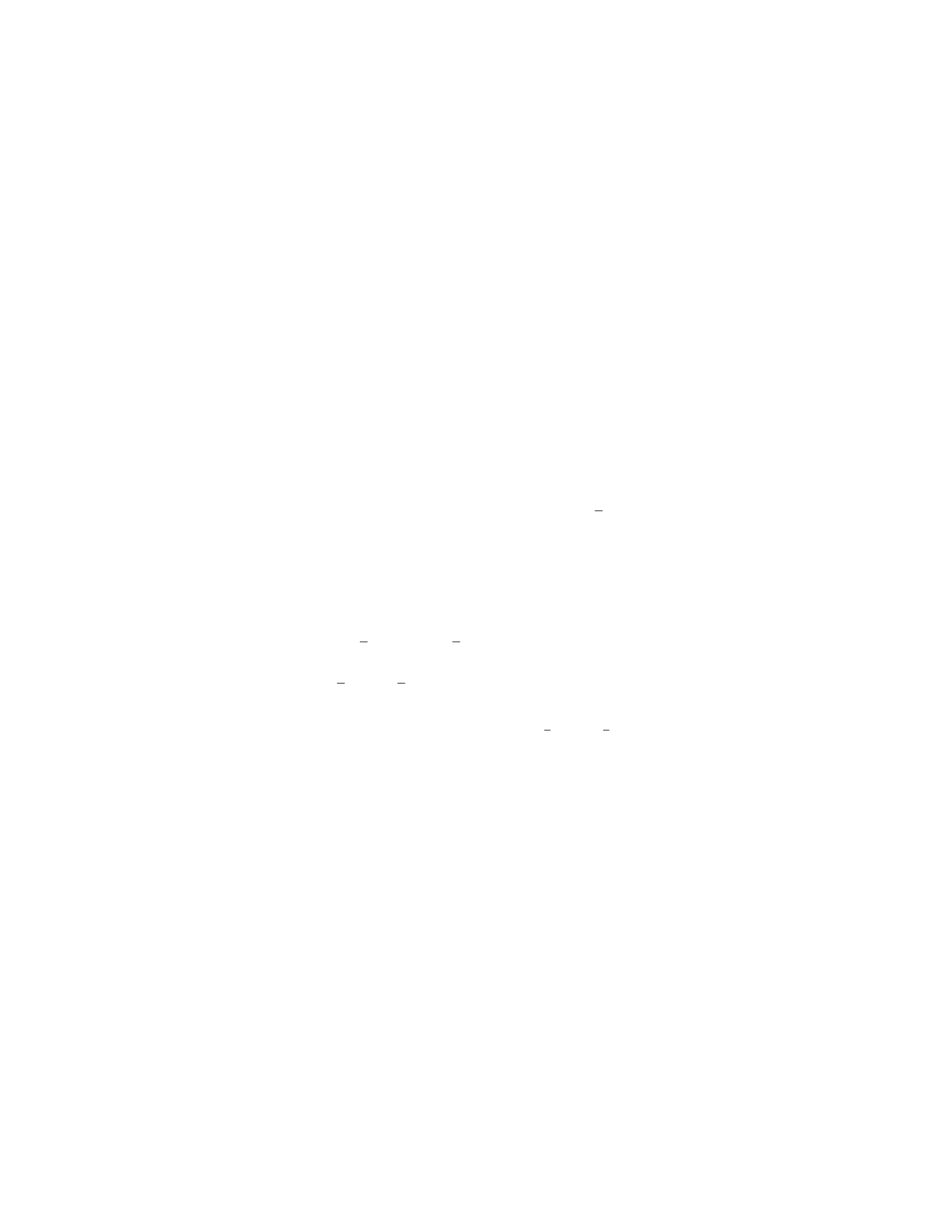
Step 2: Apply the integration by parts formula: ∫u dv =uv −∫v du.
∫xln(x)dx = ln(x)·1
2x2−∫1
2x2·1
xdx
=1
2x2ln(x)−1
2∫x dx
=1
2x2ln(x)−1
4x2+C
Therefore, ∫xln(x)dx =1
2x2ln(x)−1
4x2+C, where Cis the constant of
integration.
18
Question 25
Question
Evaluate the integral ∫xe2xdx using integration by parts.
Solution
To evaluate the integral ∫xe2xdx using integration by parts, we will use the
formula: ∫u dv =uv −∫v du
where uand vare differentiable functions of x. Let’s choose u=xand dv =
e2xdx. Then, we’ll find du and v.
1. Step 1: Find du and v.
du = 1 dx and v=∫e2xdx =1
2e2x
2. Step 2: Apply integration by parts formula.
∫xe2xdx =uv −∫v du
=x(1
2e2x)−∫(1
2e2x)dx
=1
2xe2x−1
4e2x+C(where Cis the constant of integration)
Therefore, the integral ∫xe2xdx evaluates to 1
2xe2x−1
4e2x+C.
19

Question 2
Question
Evaluate the integral ∫xcos(x)dx using integration by parts.
Solution
To evaluate the integral ∫xcos(x)dx using integration by parts, we will use the
formula:
∫u dv =uv −∫v du
where uand vare differentiable functions of x.
Step 1: Let’s choose u=xand dv = cos(x)dx. Then, we have:
du =dx and v=∫cos(x)dx = sin(x)
Step 2: Now, we can apply the integration by parts formula:
∫xcos(x)dx =uv −∫v du
=xsin(x)−∫sin(x)dx
=xsin(x) + cos(x) + C
Therefore, the integral ∫xcos(x)dx simplifies to xsin(x)+cos(x)+C, where
Cis the constant of integration.
Question 3
Question
Evaluate the integral ∫xln(x)dx using integration by parts.
Solution
To evaluate the given integral ∫xln(x)dx, we will use integration by parts.
Recall the formula for integration by parts:
∫u dv =uv −∫v du
where uand vare differentiable functions of x.
Step 1: Let’s choose u= ln(x)and dv =x dx. Then, we have:
du =1
xdx and v=x2
2
2
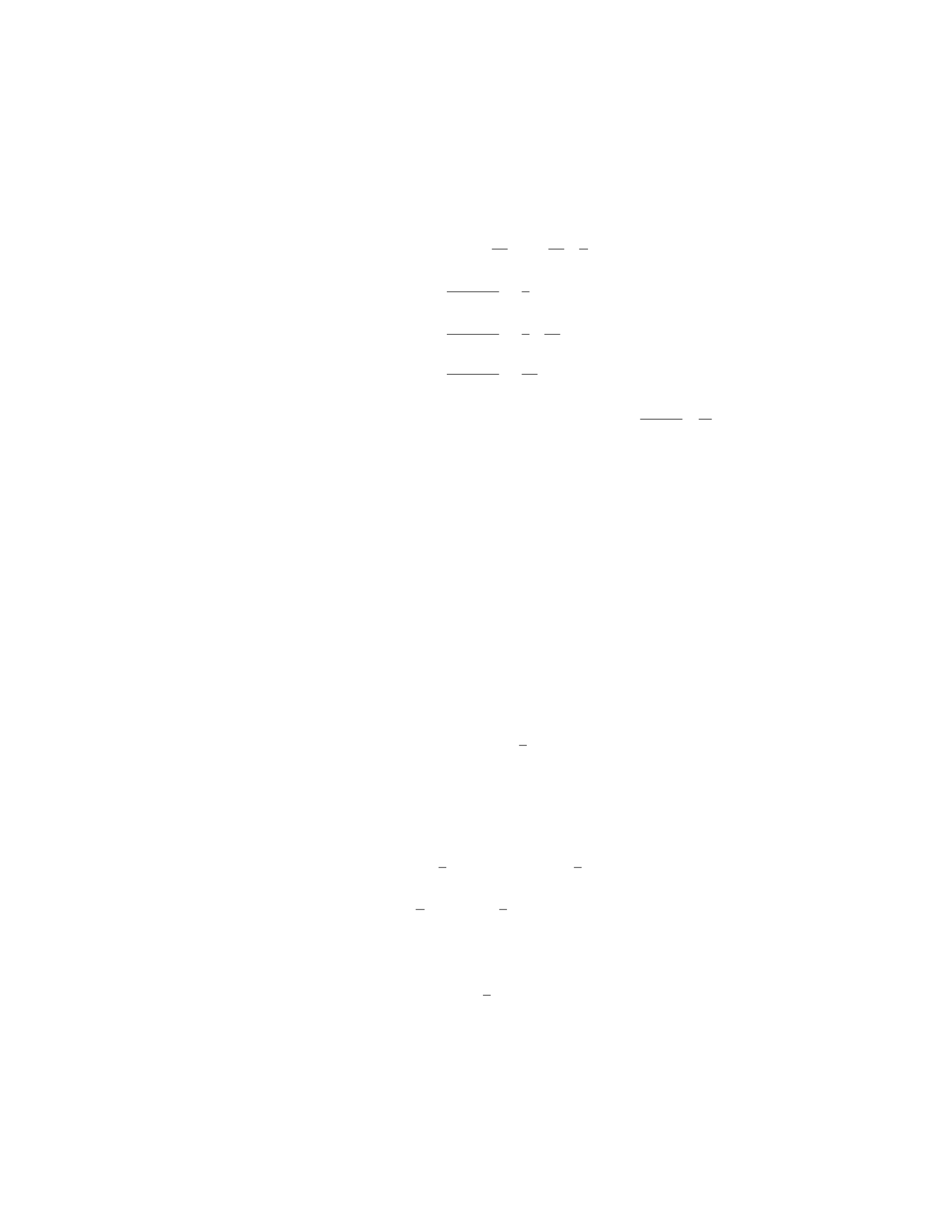
Step 2: Substitute u,dv,du, and vinto the integration by parts formula:
∫xln(x)dx = ln(x)·x2
2−∫x2
2·1
xdx
=x2ln(x)
2−1
2∫x dx
=x2ln(x)
2−1
2·x2
2+C
=x2ln(x)
2−x2
4+C
Step 3: Therefore, the solution to the integral ∫xln(x)dx is x2ln(x)
2−x2
4+C,
where Cis the constant of integration.
Question 4
Question
Evaluate the integral ∫xsin(3x)dx using integration by parts.
Solution
To evaluate the integral ∫xsin(3x)dx using integration by parts, we will use
the formula ∫u dv =uv −∫v du.
Step 1: Choose uand dv. Let u=xand dv = sin(3x)dx. Then, we have:
du =dx and v=−1
3cos(3x).
Step 2: Apply integration by parts:
∫xsin(3x)dx =uv −∫v du
=x(−1
3cos(3x))−∫(−1
3cos(3x))dx
=−x
3cos(3x) + 1
3∫cos(3x)dx.
Step 3: Integrate ∫cos(3x)dx:
∫cos(3x)dx =1
3sin(3x) + C,
where Cis the constant of integration.
3
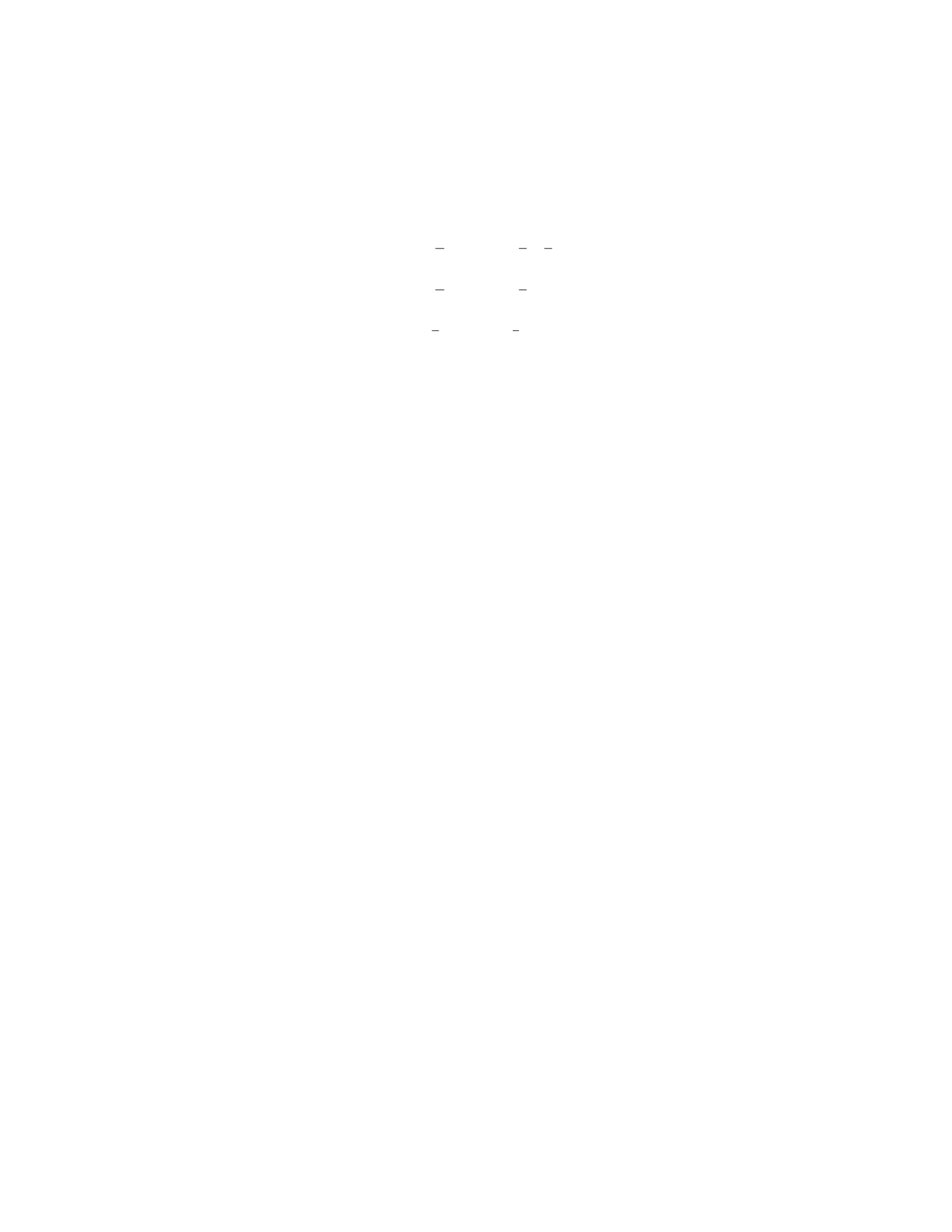
Step 4: Substitute back into the original integral:
∫xsin(3x)dx =−x
3cos(3x) + 1
3(1
3sin(3x) + C)
=−x
3cos(3x) + 1
9sin(3x) + C.
Therefore, ∫xsin(3x)dx =−x
3cos(3x) + 1
9sin(3x) + C, where Cis the con-
stant of integration.
Question 5
Question
Evaluate the integral ∫xcos(x)dx using integration by parts.
Solution
To evaluate the integral ∫xcos(x)dx using integration by parts, we will use
the formula ∫u dv =uv −∫v du where uand vare differentiable functions of
x.
Step 1: Let us choose u=xand dv = cos(x)dx. Then, calculating the
differentials, we get: du =dx and v=∫cos(x)dx = sin(x).
Step 2: Now, using the integration by parts formula, we have: ∫xcos(x)dx =
uv −∫v du =xsin(x)−∫sin(x)dx.
Step 3: Simplifying the integral, we get: ∫xcos(x)dx =xsin(x)+∫sin(x)dx.
Step 4: Finally, integrating ∫sin(x)dx, we have: ∫xcos(x)dx =xsin(x)−
cos(x) + C, where Cis the constant of integration.
Therefore, ∫xcos(x)dx =xsin(x)−cos(x) + C.
Question 6
Question
Evaluate the integral ∫xln(x)dx using integration by parts.
4
Solution
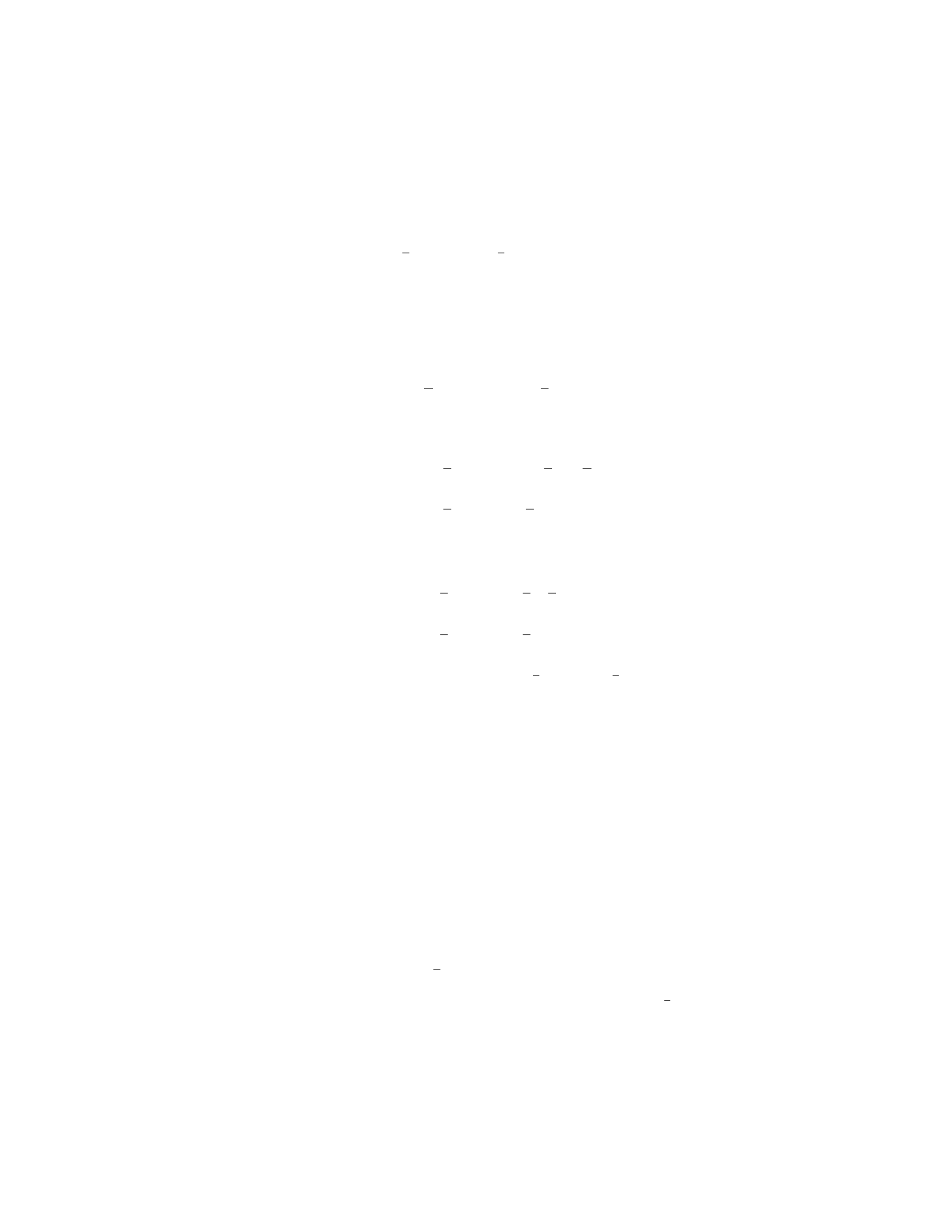
To evaluate the integral ∫xln(x)dx using integration by parts, we let u= ln(x)
and dv =x dx. Then, du =1
xdx and v=1
2x2. The formula for integration by
parts is:
∫u dv =uv −∫v du
Step 1: Calculate du and v.
du =1
xdx and v=1
2x2
Step 2: Apply integration by parts formula.
∫xln(x)dx =1
2x2ln(x)−∫1
2x2·1
xdx
=1
2x2ln(x)−1
2∫x dx
Step 3: Simplify the result.
∫xln(x)dx =1
2x2ln(x)−1
2(1
2x2)+C
=1
2x2ln(x)−1
4x2+C
Hence, the integral ∫xln(x)dx evaluates to 1
2x2ln(x)−1
4x2+Cwhere Cis
the constant of integration.
Question 7
Question
Evaluate the integral ∫x3ln(x)dx using integration by parts.
Solution
To evaluate the integral ∫x3ln(x)dx using integration by parts, we will let
u= ln(x)and dv =x3dx. Then, we will differentiate uto find du and integrate
dv to find v.
Step 1: Find du and v.
• Let u= ln(x). Then, du =1
xdx.
• Let dv =x3dx. Integrating dv with respect to x, we get v=1
4x4.
5
Step 2: Apply integration by parts formula: ∫u dv =uv −∫v du.
∫x3ln(x)dx =x3ln(x)−∫1
4x4·1
xdx
=x3ln(x)−1
4∫x3dx
=x3ln(x)−1
4·1
4x4+Cwhere Cis the constant of integration
=x3ln(x)−1
16x4+C
Therefore, ∫x3ln(x)dx =x3ln(x)−1
16 x4+C, where Cis the constant of
integration.
Question 8
Question
Evaluate the following integral using integration by parts:
∫x2exdx
Solution
To evaluate the integral ∫x2exdx using integration by parts, we will use the
formula: ∫u dv =uv −∫v du
where uand vare differentiable functions of x.
Step 1: Choose u=x2and dv =exdx. Then, we have du = 2x dx and
v=∫exdx =ex.
Step 2: Apply the formula:
∫x2exdx =x2ex−∫2xexdx
Step 3: Now, we have another integral on the right-hand side that can be
further simplified using integration by parts. Let’s apply integration by parts
to ∫2xexdx.
Step 4: Choose u= 2xand dv =exdx. Then, we have du = 2 dx and
v=ex.
Step 5: Apply the formula again:
∫2xexdx = 2xex−∫2exdx
6
Step 6: Simplify the above expression:
∫2xexdx = 2xex−2ex+C
Step 7: Substitute ∫2xexdx = 2xex−2ex+Cback into the equation from
Step 2:
∫x2exdx =x2ex−(2xex−2ex+C) + C
Step 8: Simplify the expression:
∫x2exdx =x2ex−2xex+ 2ex+C
Therefore, ∫x2exdx =x2ex−2xex+ 2ex+C, where Cis the constant of
integration.
Question 9
Question
Evaluate the integral ∫x2ln(x)dx using integration by parts.
Solution
To evaluate the integral ∫x2ln(x)dx using integration by parts, we let u= ln(x)
and dv =x2dx. Then, we differentiate uto get du =1
xdx and integrate dv to
get v=1
3x3. Substituting these into the integration by parts formula ∫udv =
uv −∫vdu, we have:
∫x2ln(x)dx =1
3x3ln(x)−∫1
3x3·1
xdx
=1
3x3ln(x)−1
3∫x2dx
Step 1: Integrate ∫x2dx.
∫x2dx =1
3x3+C
Step 2: Substituting the result back into the equation, we have:
∫x2ln(x)dx =1
3x3ln(x)−1
3(1
3x3)+C
=1
3x3ln(x)−1
9x3+C
Therefore, ∫x2ln(x)dx =1
3x3ln(x)−1
9x3+C, where Cis the constant of
integration.
7

Question 10
Question
Evaluate the integral ∫exsin(x)dx using integration by parts.
Solution
To evaluate the integral ∫exsin(x)dx, we will use integration by parts. The
formula for integration by parts is:
∫u dv =uv −∫v du
where uand vare differentiable functions of x.
Step 1: Let us choose u=exand dv = sin(x)dx. Then, we have:
du =exdx and v=−cos(x)
Step 2: Apply the integration by parts formula:
∫exsin(x)dx =ex(−cos(x)) −∫(−cos(x))(ex)dx
=−excos(x) + ∫excos(x)dx
Step 3: Now, we need to apply integration by parts again to evaluate
∫excos(x)dx. Let’s choose u=exand dv = cos(x)dx. Then, we have:
du =exdx
v= sin(x)
Step 4: Apply the integration by parts formula once more:
∫excos(x)dx =exsin(x)−∫sin(x)exdx
=exsin(x)−∫exsin(x)dx
Step 5: Now substitute ∫exsin(x)dx back into the equation:
∫exsin(x)dx =−excos(x) + (exsin(x)−∫exsin(x)dx)
∫exsin(x)dx =−excos(x) + exsin(x)−∫exsin(x)dx
Step 6: Now, add ∫exsin(x)dx to both sides of the equation:
∫exsin(x)dx +∫exsin(x)dx =−excos(x) + exsin(x)
8
Step 7: Simplify the equation:
2∫exsin(x)dx =−excos(x) + exsin(x)
Step 8: Finally, divide by 2:
∫exsin(x)dx =−excos(x) + exsin(x)
2+C
where Cis the constant of integration.
Question 11
Question
Evaluate the integral ∫x2ln(x)dx.
Solution
To evaluate the integral ∫x2ln(x)dx, we will use integration by parts, which
states: ∫u dv =uv −∫v du.
We will choose u= ln(x)and dv =x2dx, so that du =1
xdx and v=1
3x3.
Step 1: Apply integration by parts:
∫x2ln(x)dx =1
3x3ln(x)−∫1
3x3·1
xdx
=1
3x3ln(x)−1
3∫x2dx.
Step 2: Simplify the integral:
∫x2ln(x)dx =1
3x3ln(x)−1
3∫x2dx
=1
3x3ln(x)−1
3·1
3x3+C
=1
3x3ln(x)−1
9x3+C,
where Cis the constant of integration.
Therefore, ∫x2ln(x)dx =1
3x3ln(x)−1
9x3+C.
Question 12
Question
Evaluate the integral ∫xcos−1x dx using integration by parts.
9
Solution
To evaluate the integral ∫xcos−1x dx using integration by parts, we choose
u= cos−1xand dv =x dx. Then, we find du and v:
Step 1: Find du and v.
u= cos−1x
du =−1
√1−x2dx
dv =x dx
v=1
2x2
Step 2: Apply integration by parts formula ∫u dv =uv −∫v du.
∫xcos−1x dx =1
2x2cos−1x−∫1
2x2(−1
√1−x2)dx
=1
2x2cos−1x+1
2∫x2
√1−x2dx
Now, we will evaluate the remaining integral using a trigonometric substi-
tution. Let x= sin θ, so dx = cos θ dθ and √1−x2= cos θ.
Step 3: Perform the trigonometric substitution.
∫x2
√1−x2dx =∫sin2θ
cos θcos θ dθ
=∫sin2θ dθ
Using the double angle identity sin2θ=1
2(1 −cos 2θ), we get:
∫sin2θ dθ =∫1
2(1 −cos 2θ)dθ
=1
2(θ−1
2sin 2θ) + C
Step 4: Substitute back x= sin θto get the final answer.
∫xcos−1x dx =1
2x2cos−1x+1
4(θ−1
2sin 2θ) + C
Therefore, the final answer is 1
2x2cos−1x+1
4(sin−1x−x√1−x2) + C.
Question 13
Question
Evaluate the integral ∫xln(x)dx using integration by parts.
10
Solution
To evaluate the integral ∫xln(x)dx using integration by parts, we will follow
the formula: ∫u dv =uv −∫v du
where we choose uand dv appropriately.
Step 1: Let’s choose:
u= ln(x)⇒du =1
xdx
dv =x dx ⇒v=x2
2
Step 2: Apply the integration by parts formula:
∫xln(x)dx =x2
2ln(x)−∫x2
2·1
xdx
Step 3: Simplify the integral:
∫xln(x)dx =x2
2ln(x)−∫x
2dx
=x2
2ln(x)−1
4x2+C
Hence, the solution to the integral ∫xln(x)dx is x2
2ln(x)−1
4x2+C, where
Cis the constant of integration.
Question 14
Question
Evaluate the integral ∫xcos(x)dx using integration by parts.
Solution
To evaluate the integral ∫xcos(x)dx using integration by parts, we will use the
formula: ∫u dv =uv −∫v du
Step 1: Let’s choose u=xand dv = cos(x)dx, then differentiate uto get
du and integrate dv to get v:
•u=x,du =dx
•dv = cos(x)dx,v=∫cos(x)dx = sin(x)
11
Step 2: Now, we can apply the integration by parts formula:
∫xcos(x)dx =uv −∫v du
=xsin(x)−∫sin(x)dx
=xsin(x) + ∫sin(x)dx (since ∫sin(x)dx =−cos(x))
=xsin(x)−cos(x) + C(where Cis the constant of integration)
Therefore, ∫xcos(x)dx =xsin(x)−cos(x) + C.
Question 15
Question
Evaluate the integral ∫x2ln x dx using integration by parts.
Solution
To evaluate ∫x2ln x dx using integration by parts, we will let u= ln xand
dv =x2dx. Then, we can find du and vto proceed with the integration.
Step 1: Calculate du and v
•u= ln x
•dv =x2dx
We differentiate uto get du:
du =1
xdx
We integrate dv to get v:
v=1
3x3
Step 2: Apply integration by parts formula The integration by parts formula
is: ∫u dv =uv −∫v du
Now, we substitute u,dv,v, and du into the formula:
∫x2ln x dx =x2ln x−∫1
3x3·1
xdx
=x2ln x−1
3∫x2dx
12
Step 3: Evaluate the integral Integrate ∫x2dx:
∫x2dx =1
3x3+C
Step 4: Final answer Substitute the result back into the formula:
∫x2ln x dx =x2ln x−1
3(1
3x3+C)
=x2ln x−1
9x3−1
3C+C′
Therefore, ∫x2ln x dx =x2ln x−1
9x3+C, where Cis the constant of
integration.
Question 16
Question
Evaluate the integral ∫x2ln(x)dx using integration by parts.
Solution
To evaluate the integral ∫x2ln(x)dx using integration by parts, we will apply
the formula ∫u dv =uv −∫v du where uand vare chosen functions.
Step 1: Let’s choose u= ln(x)and dv =x2dx. Then, differentiate uand
integrate dv.
du =1
xdx
v=∫x2dx =1
3x3
Step 2: Now, we can use the integration by parts formula to find the
integral.
∫x2ln(x)dx =uv −∫v du
= ln(x)·1
3x3−∫1
3x3·1
xdx
=1
3x3ln(x)−1
3∫x2dx
=1
3x3ln(x)−1
3·1
3x3+C
=1
3x3ln(x)−1
9x3+C
Therefore, the integral ∫x2ln(x)dx evaluates to 1
3x3ln(x)−1
9x3+C, where
Cis the constant of integration.
13
Question 17
Question
Evaluate the integral ∫xcos(2x)dx using integration by parts.
Solution
To evaluate the integral ∫xcos(2x)dx using integration by parts, we will let
u=xand dv = cos(2x)dx. Then, we will differentiate uto get du =dx and
integrate dv to get v=1
2sin(2x).
Step 1: Apply integration by parts formula: ∫u dv =uv −∫v du.
∫xcos(2x)dx =x·1
2sin(2x)−∫1
2sin(2x)dx
Step 2: Integrate the remaining term.
=x
2sin(2x)−1
2∫sin(2x)dx
=x
2sin(2x) + 1
4cos(2x) + C
Therefore, ∫xcos(2x)dx =x
2sin(2x)+ 1
4cos(2x)+C, where Cis the constant
of integration.
Question 18
Question
Evaluate the integral ∫x3ln(x)dx using integration by parts.
Solution
To evaluate the integral ∫x3ln(x)dx using integration by parts, we will choose
u= ln(x)and dv =x3dx. Then, du =1
xdx and v=∫x3dx =x4
4.
Step 1: Apply integration by parts:
∫x3ln(x)dx =uv −∫v du
∫x3ln(x)dx = ln(x)·x4
4−∫x4
4·1
xdx
Step 2: Simplify the integral:
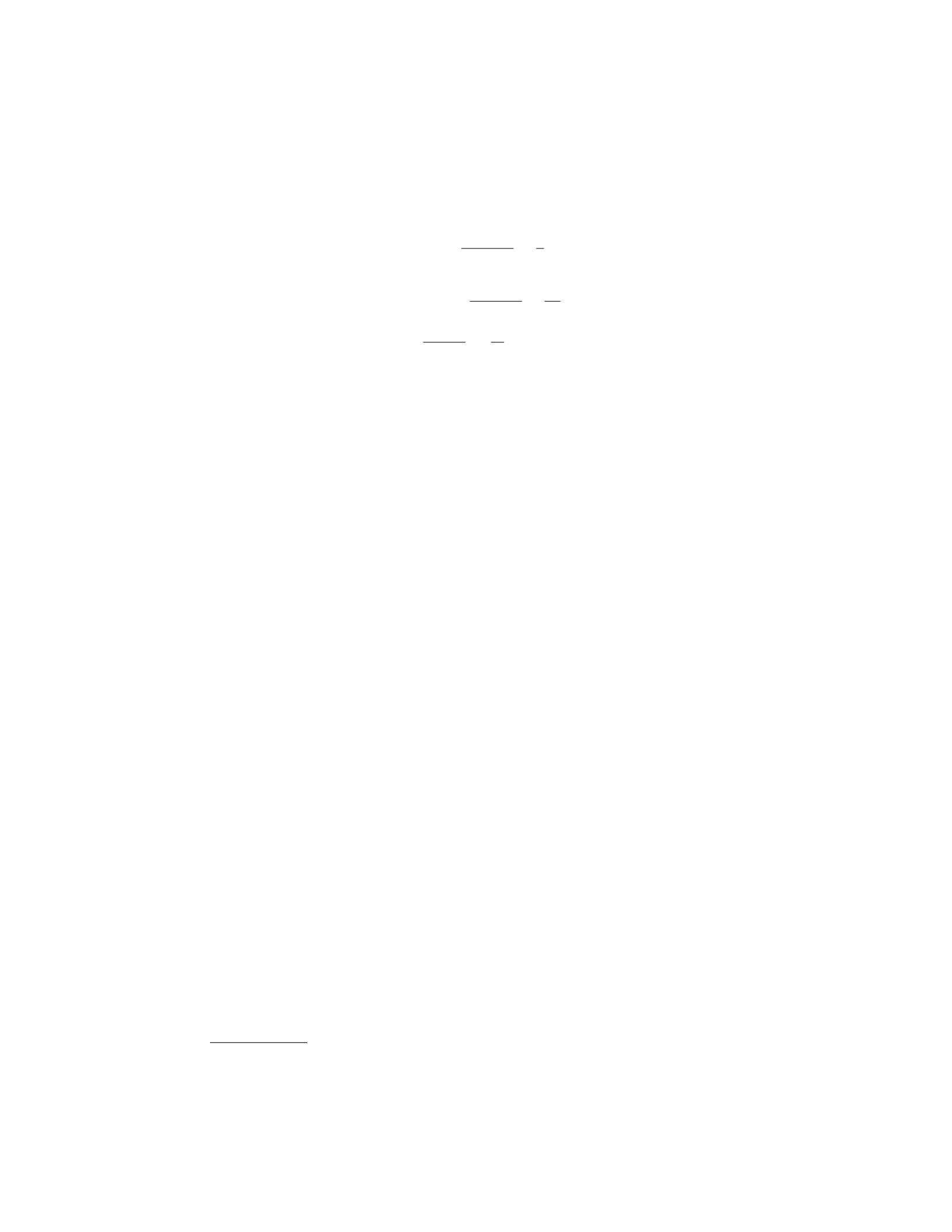
∫x3ln(x)dx =x4ln(x)
4−∫x3
4dx
14
Step 3: Integrate the remaining integral:
∫x3ln(x)dx =x4ln(x)
4−1
4∫x3dx
∫x3ln(x)dx =x4ln(x)
4−x4
16 +C
Therefore, ∫x3ln(x)dx =x4ln(x)
4−x4
16 +C, where Cis the constant of
integration.
Question 19
Question
Evaluate the integral ∫xexcos(x)dx using integration by parts.
Solution
To evaluate the given integral ∫xexcos(x)dx using integration by parts, we will
choose parts to differentiate and integrate.
Step 1: Let’s use integration by parts with u=xand dv =excos(x)dx.
Then, we have:
u=x⇒du =dx,
dv =excos(x)dx ⇒v=∫excos(x)dx.
Step 2: To find v, we need to integrate v=∫excos(x)dx. Let’s use
integration by parts again with u=exand dv = cos(x)dx. Then, we have:
u=ex⇒du =exdx,
dv = cos(x)dx ⇒v=∫cos(x)dx.
Step 3: Finding v, we integrate v=∫cos(x)dx = sin(x).
Step 4: Now, we can find uv −∫v du.
∫xexcos(x)dx =uv −∫v du
=x·exsin(x)−∫exsin(x)dx.
Step 5: To find ∫exsin(x)dx, we will use integration by parts again. Let
u=exand dv = sin(x)dx.
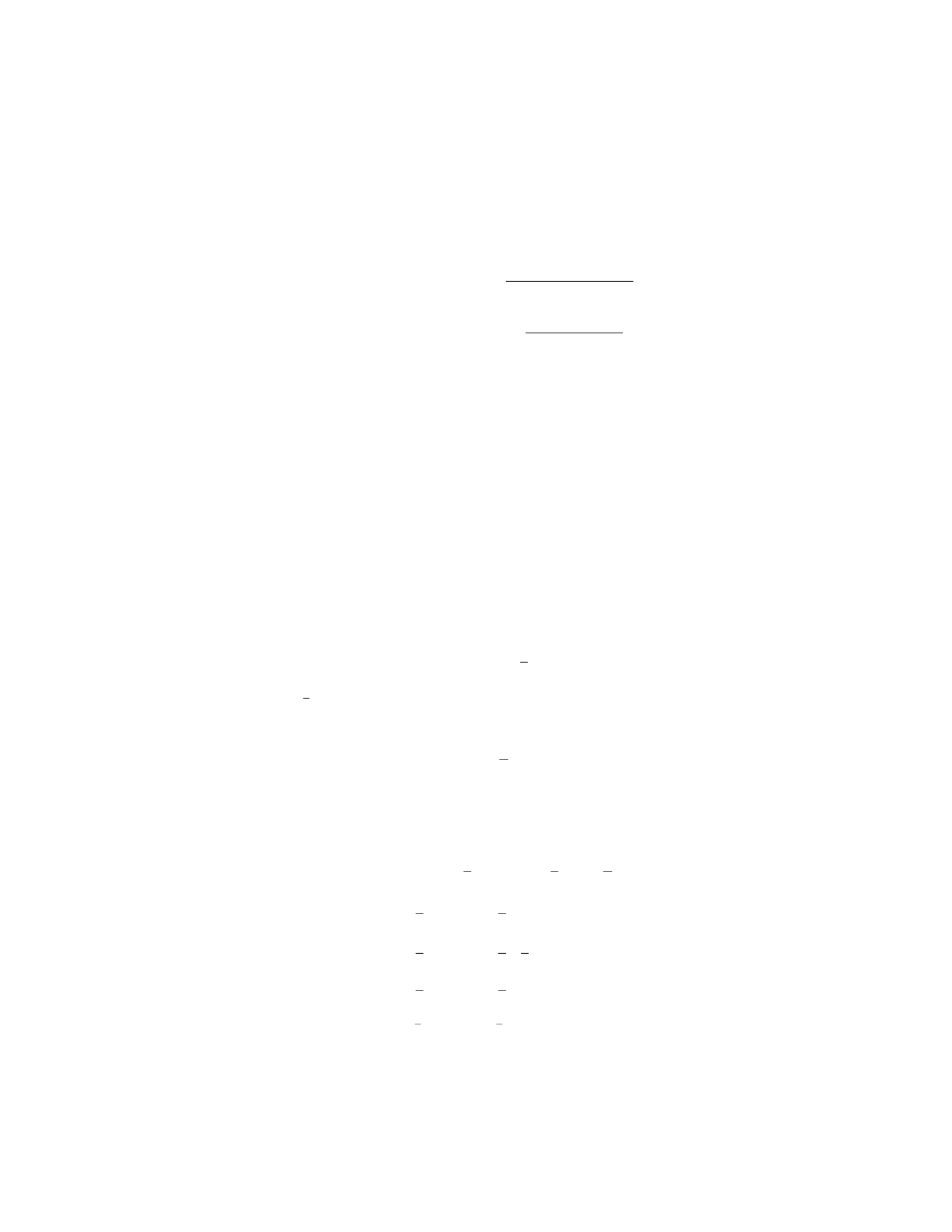
Step 6: After calculating the integration, we find that ∫exsin(x)dx =
ex(sin(x)−cos(x))
2.
15
Step 7: Substituting this back into the previous equation, we have:
∫xexcos(x)dx =x·exsin(x)−∫exsin(x)dx
=x·exsin(x)−ex(sin(x)−cos(x))
2+C,
where Cis the constant of integration.
Therefore, ∫xexcos(x)dx =x·exsin(x)−ex(sin(x)−cos(x))
2+C.
Question 20
Question
Evaluate the integral ∫x2ln(x)dx using integration by parts.
Solution
To evaluate the integral ∫x2ln(x)dx using integration by parts, we will choose
u= ln(x)and dv =x2dx, then apply the integration by parts formula ∫u dv =
uv −∫v du.
Step 1: Let’s determine du and v.
•u= ln(x)
•dv =x2dx To find dv, we integrate dv to get v:
∫x2dx =1
3x3
So, v=1
3x3.
• To find du, we differentiate u:
du =1
xdx
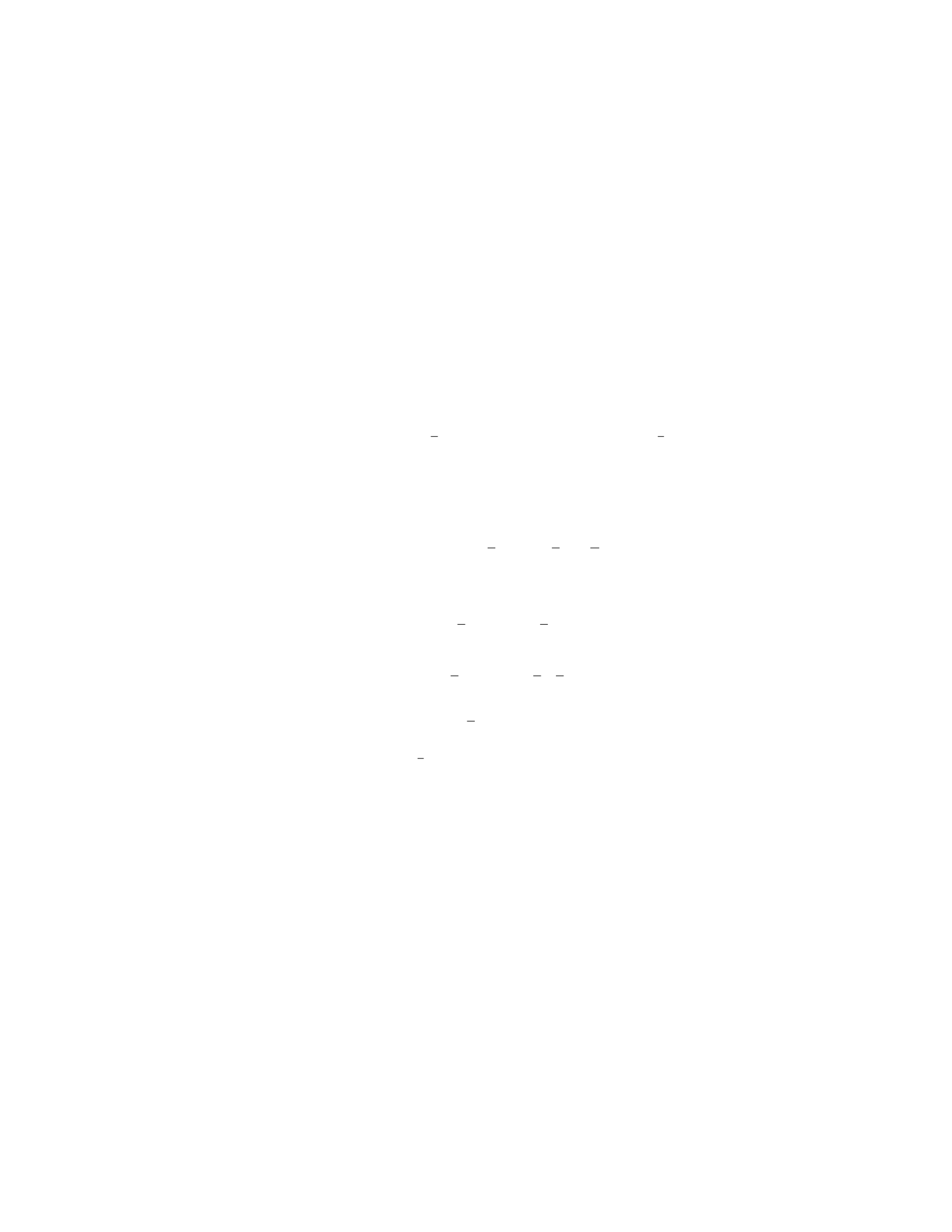
Step 2: Now, we can apply the integration by parts formula.
∫x2ln(x)dx =uv −∫v du
= ln(x)(1
3x3)−∫(1
3x3)(1
x)dx
=1
3x3ln(x)−1
3∫x2dx
=1
3x3ln(x)−1
3·1
3x3+C
=1
3x3ln(x)−1
9x3+C
Therefore, ∫x2ln(x)dx =1
3x3ln(x)−1
9x3+C, where Cis the constant of
integration.
16
Question 21
Question
Evaluate the integral ∫x2ln(x)dx using integration by parts.
Solution
To evaluate the integral ∫x2ln(x)dx using integration by parts, we will use the
formula ∫u dv =uv −∫v du.
Step 1: Let’s choose our function uand our differential dv. Let u= ln(x)
and dv =x2dx.
Step 2: Compute the respective differentials du and v. Calculate du by
taking the derivative of u:du =1
xdx. Integrate dv to find v:v=1
3x3.
Step 3: Apply the integration by parts formula.
∫x2ln(x)dx =uv −∫v du
∫x2ln(x)dx = ln(x)·1
3x3−∫1
3x3·1
xdx
Step 4: Simplify and integrate the remaining integral.
∫x2ln(x)dx =1
3x3ln(x)−1
3∫x2dx
∫x2ln(x)dx =1
3x3ln(x)−1
3·1
3x3+C
∫x2ln(x)dx =1
3x3(ln(x)−1) + C
Therefore, ∫x2ln(x)dx =1
3x3(ln(x)−1) + C, where Cis the constant of
integration.
Question 22
Question
Evaluate the integral ∫xexdx using integration by parts.
Solution
To evaluate the integral ∫xexdx using integration by parts, we will choose
u=xand dv =exdx. Then we will differentiate uonce and integrate dv to
find du and v.
Step 1: Let u=xand dv =exdx. Then du =dx and v=∫exdx =ex.
17
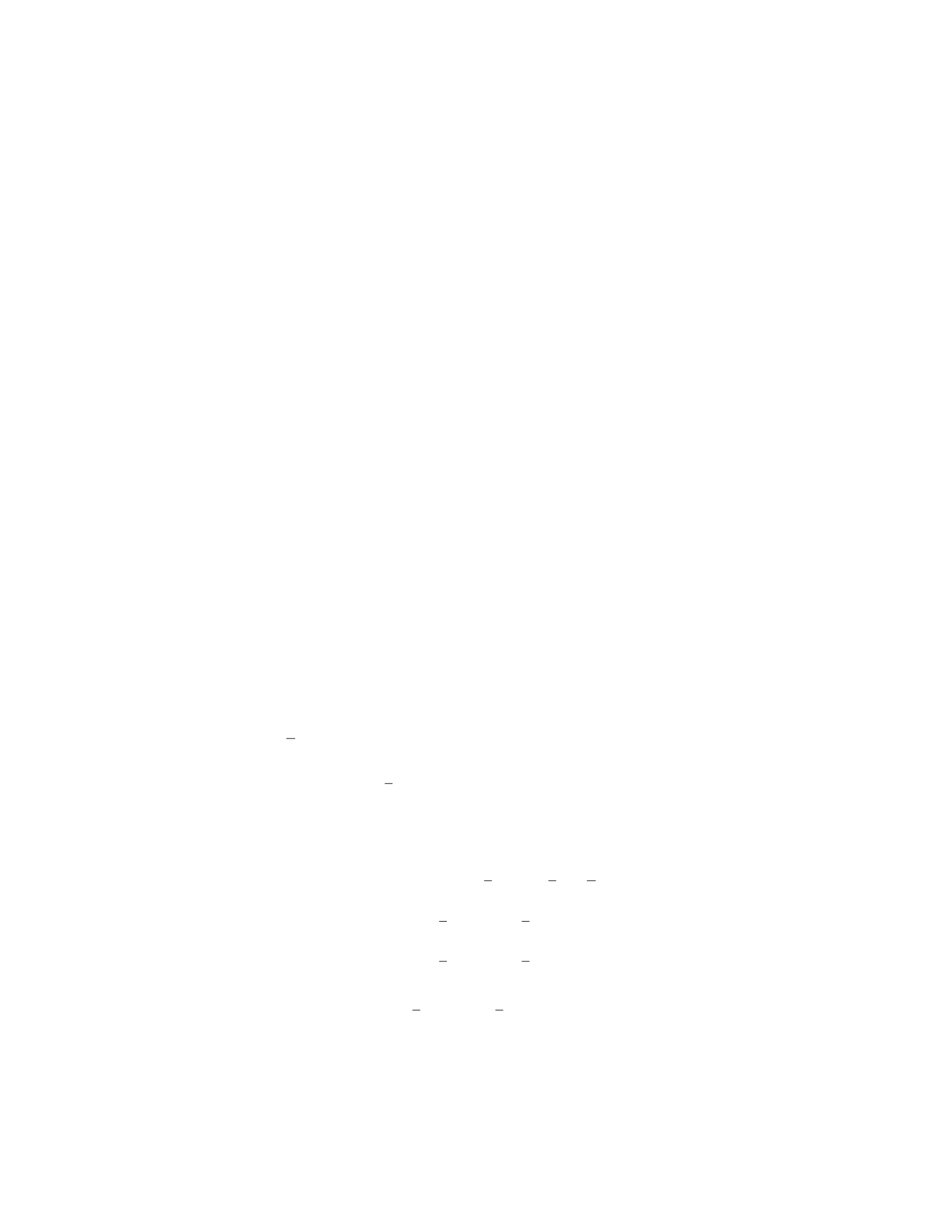
Step 2: Apply the integration by parts formula:
∫u dv =uv −∫v du
∫xexdx =xex−∫exdx
Step 3: Simplify the expression:
∫xexdx =xex−∫exdx =xex−ex+C
Therefore, ∫xexdx =xex−ex+Cwhere Cis the constant of integration.
Question 23
Question
Evaluate the integral ∫xln(x)dx using integration by parts.
Solution
To evaluate ∫xln(x)dx using integration by parts, we will choose u= ln(x)
and dv =x dx.
Step 1: Find du and v.
•u= ln(x)
•du =1
xdx
•dv =x dx =⇒v=1
2x2
Step 2: Apply the integration by parts formula: ∫u dv =uv −∫v du.
∫xln(x)dx = ln(x)·1
2x2−∫1
2x2·1
xdx
=1
2x2ln(x)−1
2∫x dx
=1
2x2ln(x)−1
4x2+C
Therefore, ∫xln(x)dx =1
2x2ln(x)−1
4x2+C, where Cis the constant of
integration.
18
Question 25
Question
Evaluate the integral ∫xe2xdx using integration by parts.
Solution
To evaluate the integral ∫xe2xdx using integration by parts, we will use the
formula: ∫u dv =uv −∫v du
where uand vare differentiable functions of x. Let’s choose u=xand dv =
e2xdx. Then, we’ll find du and v.
1. Step 1: Find du and v.
du = 1 dx and v=∫e2xdx =1
2e2x
2. Step 2: Apply integration by parts formula.
∫xe2xdx =uv −∫v du
=x(1
2e2x)−∫(1
2e2x)dx
=1
2xe2x−1
4e2x+C(where Cis the constant of integration)
Therefore, the integral ∫xe2xdx evaluates to 1
2xe2x−1
4e2x+C.
19

Question 2
Question
Evaluate the integral ∫xcos(x)dx using integration by parts.
Solution
To evaluate the integral ∫xcos(x)dx using integration by parts, we will use the
formula:
∫u dv =uv −∫v du
where uand vare differentiable functions of x.
Step 1: Let’s choose u=xand dv = cos(x)dx. Then, we have:
du =dx and v=∫cos(x)dx = sin(x)
Step 2: Now, we can apply the integration by parts formula:
∫xcos(x)dx =uv −∫v du
=xsin(x)−∫sin(x)dx
=xsin(x) + cos(x) + C
Therefore, the integral ∫xcos(x)dx simplifies to xsin(x)+cos(x)+C, where
Cis the constant of integration.
Question 3
Question
Evaluate the integral ∫xln(x)dx using integration by parts.
Solution
To evaluate the given integral ∫xln(x)dx, we will use integration by parts.
Recall the formula for integration by parts:
∫u dv =uv −∫v du
where uand vare differentiable functions of x.
Step 1: Let’s choose u= ln(x)and dv =x dx. Then, we have:
du =1
xdx and v=x2
2
2
Step 2: Substitute u,dv,du, and vinto the integration by parts formula:
∫xln(x)dx = ln(x)·x2
2−∫x2
2·1
xdx
=x2ln(x)
2−1
2∫x dx
=x2ln(x)
2−1
2·x2
2+C
=x2ln(x)
2−x2
4+C
Step 3: Therefore, the solution to the integral ∫xln(x)dx is x2ln(x)
2−x2
4+C,
where Cis the constant of integration.
Question 4
Question
Evaluate the integral ∫xsin(3x)dx using integration by parts.
Solution
To evaluate the integral ∫xsin(3x)dx using integration by parts, we will use
the formula ∫u dv =uv −∫v du.
Step 1: Choose uand dv. Let u=xand dv = sin(3x)dx. Then, we have:
du =dx and v=−1
3cos(3x).
Step 2: Apply integration by parts:
∫xsin(3x)dx =uv −∫v du
=x(−1
3cos(3x))−∫(−1
3cos(3x))dx
=−x
3cos(3x) + 1
3∫cos(3x)dx.
Step 3: Integrate ∫cos(3x)dx:
∫cos(3x)dx =1
3sin(3x) + C,
where Cis the constant of integration.
3
Step 4: Substitute back into the original integral:
∫xsin(3x)dx =−x
3cos(3x) + 1
3(1
3sin(3x) + C)
=−x
3cos(3x) + 1
9sin(3x) + C.
Therefore, ∫xsin(3x)dx =−x
3cos(3x) + 1
9sin(3x) + C, where Cis the con-
stant of integration.
Question 5
Question
Evaluate the integral ∫xcos(x)dx using integration by parts.
Solution
To evaluate the integral ∫xcos(x)dx using integration by parts, we will use
the formula ∫u dv =uv −∫v du where uand vare differentiable functions of
x.
Step 1: Let us choose u=xand dv = cos(x)dx. Then, calculating the
differentials, we get: du =dx and v=∫cos(x)dx = sin(x).
Step 2: Now, using the integration by parts formula, we have: ∫xcos(x)dx =
uv −∫v du =xsin(x)−∫sin(x)dx.
Step 3: Simplifying the integral, we get: ∫xcos(x)dx =xsin(x)+∫sin(x)dx.
Step 4: Finally, integrating ∫sin(x)dx, we have: ∫xcos(x)dx =xsin(x)−
cos(x) + C, where Cis the constant of integration.
Therefore, ∫xcos(x)dx =xsin(x)−cos(x) + C.
Question 6
Question
Evaluate the integral ∫xln(x)dx using integration by parts.
4
Solution
To evaluate the integral ∫xln(x)dx using integration by parts, we let u= ln(x)
and dv =x dx. Then, du =1
xdx and v=1
2x2. The formula for integration by
parts is:
∫u dv =uv −∫v du
Step 1: Calculate du and v.
du =1
xdx and v=1
2x2
Step 2: Apply integration by parts formula.
∫xln(x)dx =1
2x2ln(x)−∫1
2x2·1
xdx
=1
2x2ln(x)−1
2∫x dx
Step 3: Simplify the result.
∫xln(x)dx =1
2x2ln(x)−1
2(1
2x2)+C
=1
2x2ln(x)−1
4x2+C
Hence, the integral ∫xln(x)dx evaluates to 1
2x2ln(x)−1
4x2+Cwhere Cis
the constant of integration.
Question 7
Question
Evaluate the integral ∫x3ln(x)dx using integration by parts.
Solution
To evaluate the integral ∫x3ln(x)dx using integration by parts, we will let
u= ln(x)and dv =x3dx. Then, we will differentiate uto find du and integrate
dv to find v.
Step 1: Find du and v.
• Let u= ln(x). Then, du =1
xdx.
• Let dv =x3dx. Integrating dv with respect to x, we get v=1
4x4.
5
Step 2: Apply integration by parts formula: ∫u dv =uv −∫v du.
∫x3ln(x)dx =x3ln(x)−∫1
4x4·1
xdx
=x3ln(x)−1
4∫x3dx
=x3ln(x)−1
4·1
4x4+Cwhere Cis the constant of integration
=x3ln(x)−1
16x4+C
Therefore, ∫x3ln(x)dx =x3ln(x)−1
16 x4+C, where Cis the constant of
integration.
Question 8
Question
Evaluate the following integral using integration by parts:
∫x2exdx
Solution
To evaluate the integral ∫x2exdx using integration by parts, we will use the
formula: ∫u dv =uv −∫v du
where uand vare differentiable functions of x.
Step 1: Choose u=x2and dv =exdx. Then, we have du = 2x dx and
v=∫exdx =ex.
Step 2: Apply the formula:
∫x2exdx =x2ex−∫2xexdx
Step 3: Now, we have another integral on the right-hand side that can be
further simplified using integration by parts. Let’s apply integration by parts
to ∫2xexdx.
Step 4: Choose u= 2xand dv =exdx. Then, we have du = 2 dx and
v=ex.
Step 5: Apply the formula again:
∫2xexdx = 2xex−∫2exdx
6
Step 6: Simplify the above expression:
∫2xexdx = 2xex−2ex+C
Step 7: Substitute ∫2xexdx = 2xex−2ex+Cback into the equation from
Step 2:
∫x2exdx =x2ex−(2xex−2ex+C) + C
Step 8: Simplify the expression:
∫x2exdx =x2ex−2xex+ 2ex+C
Therefore, ∫x2exdx =x2ex−2xex+ 2ex+C, where Cis the constant of
integration.
Question 9
Question
Evaluate the integral ∫x2ln(x)dx using integration by parts.
Solution
To evaluate the integral ∫x2ln(x)dx using integration by parts, we let u= ln(x)
and dv =x2dx. Then, we differentiate uto get du =1
xdx and integrate dv to
get v=1
3x3. Substituting these into the integration by parts formula ∫udv =
uv −∫vdu, we have:
∫x2ln(x)dx =1
3x3ln(x)−∫1
3x3·1
xdx
=1
3x3ln(x)−1
3∫x2dx
Step 1: Integrate ∫x2dx.
∫x2dx =1
3x3+C
Step 2: Substituting the result back into the equation, we have:
∫x2ln(x)dx =1
3x3ln(x)−1
3(1
3x3)+C
=1
3x3ln(x)−1
9x3+C
Therefore, ∫x2ln(x)dx =1
3x3ln(x)−1
9x3+C, where Cis the constant of
integration.
7

Question 10
Question
Evaluate the integral ∫exsin(x)dx using integration by parts.
Solution
To evaluate the integral ∫exsin(x)dx, we will use integration by parts. The
formula for integration by parts is:
∫u dv =uv −∫v du
where uand vare differentiable functions of x.
Step 1: Let us choose u=exand dv = sin(x)dx. Then, we have:
du =exdx and v=−cos(x)
Step 2: Apply the integration by parts formula:
∫exsin(x)dx =ex(−cos(x)) −∫(−cos(x))(ex)dx
=−excos(x) + ∫excos(x)dx
Step 3: Now, we need to apply integration by parts again to evaluate
∫excos(x)dx. Let’s choose u=exand dv = cos(x)dx. Then, we have:
du =exdx
v= sin(x)
Step 4: Apply the integration by parts formula once more:
∫excos(x)dx =exsin(x)−∫sin(x)exdx
=exsin(x)−∫exsin(x)dx
Step 5: Now substitute ∫exsin(x)dx back into the equation:
∫exsin(x)dx =−excos(x) + (exsin(x)−∫exsin(x)dx)
∫exsin(x)dx =−excos(x) + exsin(x)−∫exsin(x)dx
Step 6: Now, add ∫exsin(x)dx to both sides of the equation:
∫exsin(x)dx +∫exsin(x)dx =−excos(x) + exsin(x)
8
Step 7: Simplify the equation:
2∫exsin(x)dx =−excos(x) + exsin(x)
Step 8: Finally, divide by 2:
∫exsin(x)dx =−excos(x) + exsin(x)
2+C
where Cis the constant of integration.
Question 11
Question
Evaluate the integral ∫x2ln(x)dx.
Solution
To evaluate the integral ∫x2ln(x)dx, we will use integration by parts, which
states: ∫u dv =uv −∫v du.
We will choose u= ln(x)and dv =x2dx, so that du =1
xdx and v=1
3x3.
Step 1: Apply integration by parts:
∫x2ln(x)dx =1
3x3ln(x)−∫1
3x3·1
xdx
=1
3x3ln(x)−1
3∫x2dx.
Step 2: Simplify the integral:
∫x2ln(x)dx =1
3x3ln(x)−1
3∫x2dx
=1
3x3ln(x)−1
3·1
3x3+C
=1
3x3ln(x)−1
9x3+C,
where Cis the constant of integration.
Therefore, ∫x2ln(x)dx =1
3x3ln(x)−1
9x3+C.
Question 12
Question
Evaluate the integral ∫xcos−1x dx using integration by parts.
9
Solution
To evaluate the integral ∫xcos−1x dx using integration by parts, we choose
u= cos−1xand dv =x dx. Then, we find du and v:
Step 1: Find du and v.
u= cos−1x
du =−1
√1−x2dx
dv =x dx
v=1
2x2
Step 2: Apply integration by parts formula ∫u dv =uv −∫v du.
∫xcos−1x dx =1
2x2cos−1x−∫1
2x2(−1
√1−x2)dx
=1
2x2cos−1x+1
2∫x2
√1−x2dx
Now, we will evaluate the remaining integral using a trigonometric substi-
tution. Let x= sin θ, so dx = cos θ dθ and √1−x2= cos θ.
Step 3: Perform the trigonometric substitution.
∫x2
√1−x2dx =∫sin2θ
cos θcos θ dθ
=∫sin2θ dθ
Using the double angle identity sin2θ=1
2(1 −cos 2θ), we get:
∫sin2θ dθ =∫1
2(1 −cos 2θ)dθ
=1
2(θ−1
2sin 2θ) + C
Step 4: Substitute back x= sin θto get the final answer.
∫xcos−1x dx =1
2x2cos−1x+1
4(θ−1
2sin 2θ) + C
Therefore, the final answer is 1
2x2cos−1x+1
4(sin−1x−x√1−x2) + C.
Question 13
Question
Evaluate the integral ∫xln(x)dx using integration by parts.
10
Solution
To evaluate the integral ∫xln(x)dx using integration by parts, we will follow
the formula: ∫u dv =uv −∫v du
where we choose uand dv appropriately.
Step 1: Let’s choose:
u= ln(x)⇒du =1
xdx
dv =x dx ⇒v=x2
2
Step 2: Apply the integration by parts formula:
∫xln(x)dx =x2
2ln(x)−∫x2
2·1
xdx
Step 3: Simplify the integral:
∫xln(x)dx =x2
2ln(x)−∫x
2dx
=x2
2ln(x)−1
4x2+C
Hence, the solution to the integral ∫xln(x)dx is x2
2ln(x)−1
4x2+C, where
Cis the constant of integration.
Question 14
Question
Evaluate the integral ∫xcos(x)dx using integration by parts.
Solution
To evaluate the integral ∫xcos(x)dx using integration by parts, we will use the
formula: ∫u dv =uv −∫v du
Step 1: Let’s choose u=xand dv = cos(x)dx, then differentiate uto get
du and integrate dv to get v:
•u=x,du =dx
•dv = cos(x)dx,v=∫cos(x)dx = sin(x)
11
Step 2: Now, we can apply the integration by parts formula:
∫xcos(x)dx =uv −∫v du
=xsin(x)−∫sin(x)dx
=xsin(x) + ∫sin(x)dx (since ∫sin(x)dx =−cos(x))
=xsin(x)−cos(x) + C(where Cis the constant of integration)
Therefore, ∫xcos(x)dx =xsin(x)−cos(x) + C.
Question 15
Question
Evaluate the integral ∫x2ln x dx using integration by parts.
Solution
To evaluate ∫x2ln x dx using integration by parts, we will let u= ln xand
dv =x2dx. Then, we can find du and vto proceed with the integration.
Step 1: Calculate du and v
•u= ln x
•dv =x2dx
We differentiate uto get du:
du =1
xdx
We integrate dv to get v:
v=1
3x3
Step 2: Apply integration by parts formula The integration by parts formula
is: ∫u dv =uv −∫v du
Now, we substitute u,dv,v, and du into the formula:
∫x2ln x dx =x2ln x−∫1
3x3·1
xdx
=x2ln x−1
3∫x2dx
12
Step 3: Evaluate the integral Integrate ∫x2dx:
∫x2dx =1
3x3+C
Step 4: Final answer Substitute the result back into the formula:
∫x2ln x dx =x2ln x−1
3(1
3x3+C)
=x2ln x−1
9x3−1
3C+C′
Therefore, ∫x2ln x dx =x2ln x−1
9x3+C, where Cis the constant of
integration.
Question 16
Question
Evaluate the integral ∫x2ln(x)dx using integration by parts.
Solution
To evaluate the integral ∫x2ln(x)dx using integration by parts, we will apply
the formula ∫u dv =uv −∫v du where uand vare chosen functions.
Step 1: Let’s choose u= ln(x)and dv =x2dx. Then, differentiate uand
integrate dv.
du =1
xdx
v=∫x2dx =1
3x3
Step 2: Now, we can use the integration by parts formula to find the
integral.
∫x2ln(x)dx =uv −∫v du
= ln(x)·1
3x3−∫1
3x3·1
xdx
=1
3x3ln(x)−1
3∫x2dx
=1
3x3ln(x)−1
3·1
3x3+C
=1
3x3ln(x)−1
9x3+C
Therefore, the integral ∫x2ln(x)dx evaluates to 1
3x3ln(x)−1
9x3+C, where
Cis the constant of integration.
13
Question 17
Question
Evaluate the integral ∫xcos(2x)dx using integration by parts.
Solution
To evaluate the integral ∫xcos(2x)dx using integration by parts, we will let
u=xand dv = cos(2x)dx. Then, we will differentiate uto get du =dx and
integrate dv to get v=1
2sin(2x).
Step 1: Apply integration by parts formula: ∫u dv =uv −∫v du.
∫xcos(2x)dx =x·1
2sin(2x)−∫1
2sin(2x)dx
Step 2: Integrate the remaining term.
=x
2sin(2x)−1
2∫sin(2x)dx
=x
2sin(2x) + 1
4cos(2x) + C
Therefore, ∫xcos(2x)dx =x
2sin(2x)+ 1
4cos(2x)+C, where Cis the constant
of integration.
Question 18
Question
Evaluate the integral ∫x3ln(x)dx using integration by parts.
Solution
To evaluate the integral ∫x3ln(x)dx using integration by parts, we will choose
u= ln(x)and dv =x3dx. Then, du =1
xdx and v=∫x3dx =x4
4.
Step 1: Apply integration by parts:
∫x3ln(x)dx =uv −∫v du
∫x3ln(x)dx = ln(x)·x4
4−∫x4
4·1
xdx
Step 2: Simplify the integral:
∫x3ln(x)dx =x4ln(x)
4−∫x3
4dx
14
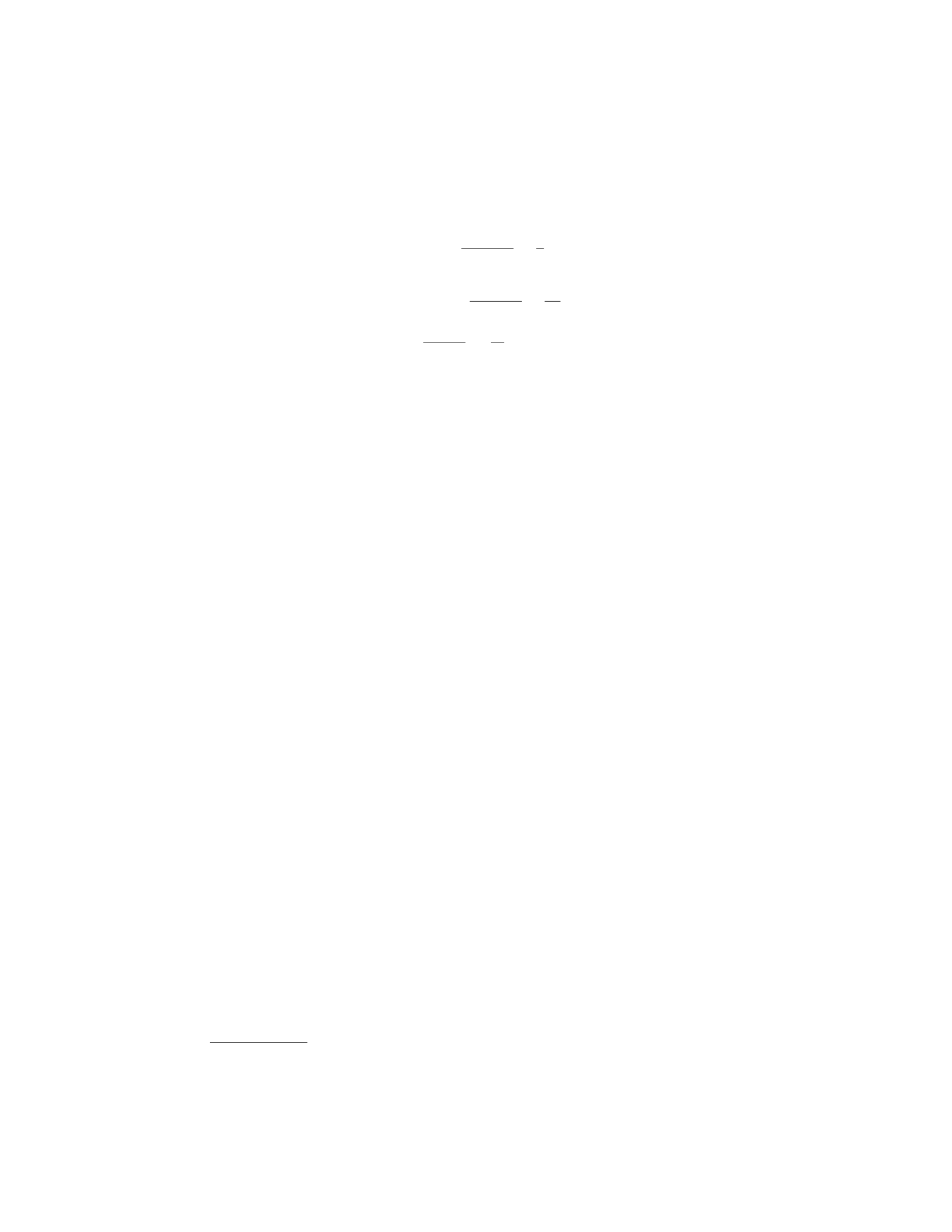
Step 3: Integrate the remaining integral:
∫x3ln(x)dx =x4ln(x)
4−1
4∫x3dx
∫x3ln(x)dx =x4ln(x)
4−x4
16 +C
Therefore, ∫x3ln(x)dx =x4ln(x)
4−x4
16 +C, where Cis the constant of
integration.
Question 19
Question
Evaluate the integral ∫xexcos(x)dx using integration by parts.
Solution
To evaluate the given integral ∫xexcos(x)dx using integration by parts, we will
choose parts to differentiate and integrate.
Step 1: Let’s use integration by parts with u=xand dv =excos(x)dx.
Then, we have:
u=x⇒du =dx,
dv =excos(x)dx ⇒v=∫excos(x)dx.
Step 2: To find v, we need to integrate v=∫excos(x)dx. Let’s use
integration by parts again with u=exand dv = cos(x)dx. Then, we have:
u=ex⇒du =exdx,
dv = cos(x)dx ⇒v=∫cos(x)dx.
Step 3: Finding v, we integrate v=∫cos(x)dx = sin(x).
Step 4: Now, we can find uv −∫v du.
∫xexcos(x)dx =uv −∫v du
=x·exsin(x)−∫exsin(x)dx.
Step 5: To find ∫exsin(x)dx, we will use integration by parts again. Let
u=exand dv = sin(x)dx.
Step 6: After calculating the integration, we find that ∫exsin(x)dx =
ex(sin(x)−cos(x))
2.
15
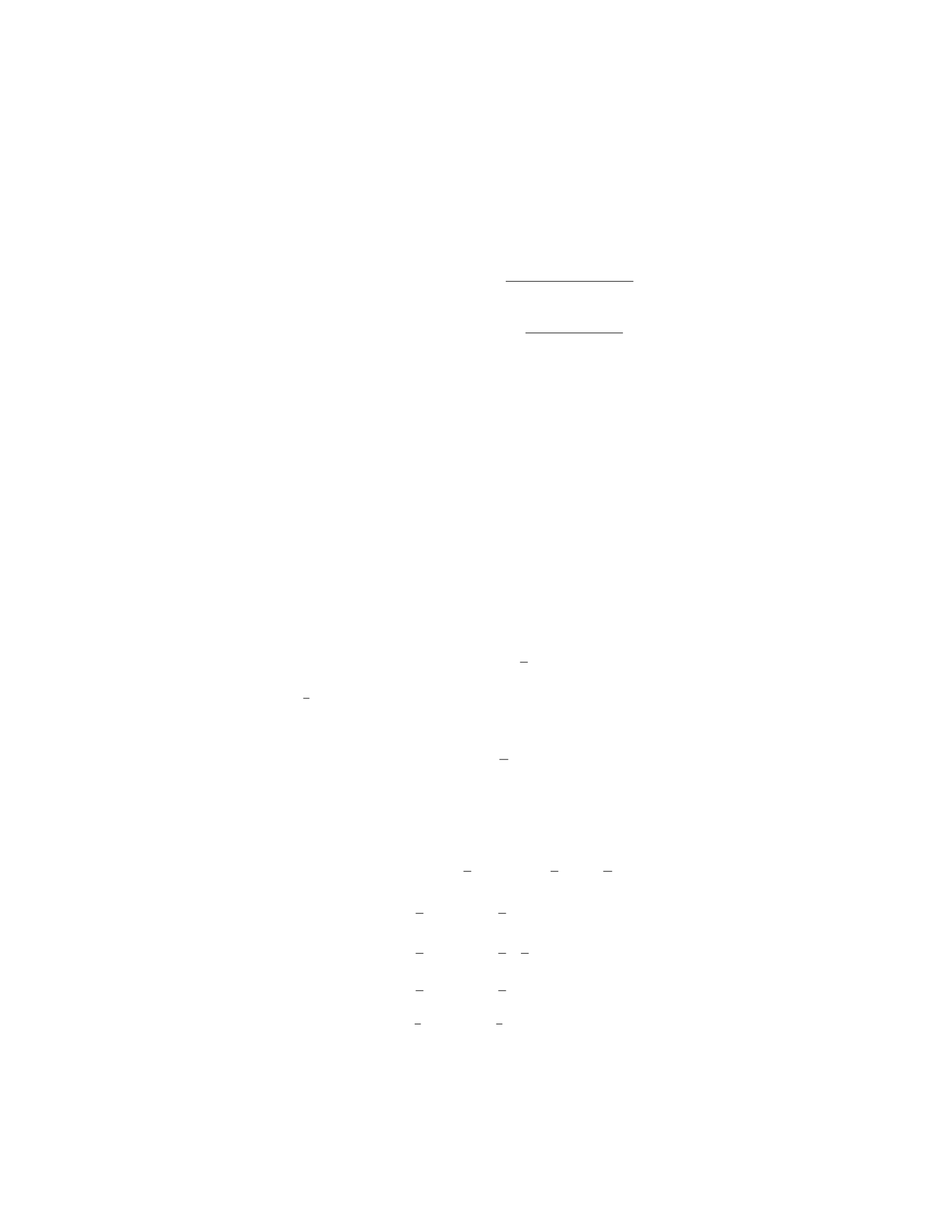
Step 7: Substituting this back into the previous equation, we have:
∫xexcos(x)dx =x·exsin(x)−∫exsin(x)dx
=x·exsin(x)−ex(sin(x)−cos(x))
2+C,
where Cis the constant of integration.
Therefore, ∫xexcos(x)dx =x·exsin(x)−ex(sin(x)−cos(x))
2+C.
Question 20
Question
Evaluate the integral ∫x2ln(x)dx using integration by parts.
Solution
To evaluate the integral ∫x2ln(x)dx using integration by parts, we will choose
u= ln(x)and dv =x2dx, then apply the integration by parts formula ∫u dv =
uv −∫v du.
Step 1: Let’s determine du and v.
•u= ln(x)
•dv =x2dx To find dv, we integrate dv to get v:
∫x2dx =1
3x3
So, v=1
3x3.
• To find du, we differentiate u:
du =1
xdx
Step 2: Now, we can apply the integration by parts formula.
∫x2ln(x)dx =uv −∫v du
= ln(x)(1
3x3)−∫(1
3x3)(1
x)dx
=1
3x3ln(x)−1
3∫x2dx
=1
3x3ln(x)−1
3·1
3x3+C
=1
3x3ln(x)−1
9x3+C
Therefore, ∫x2ln(x)dx =1
3x3ln(x)−1
9x3+C, where Cis the constant of
integration.
16
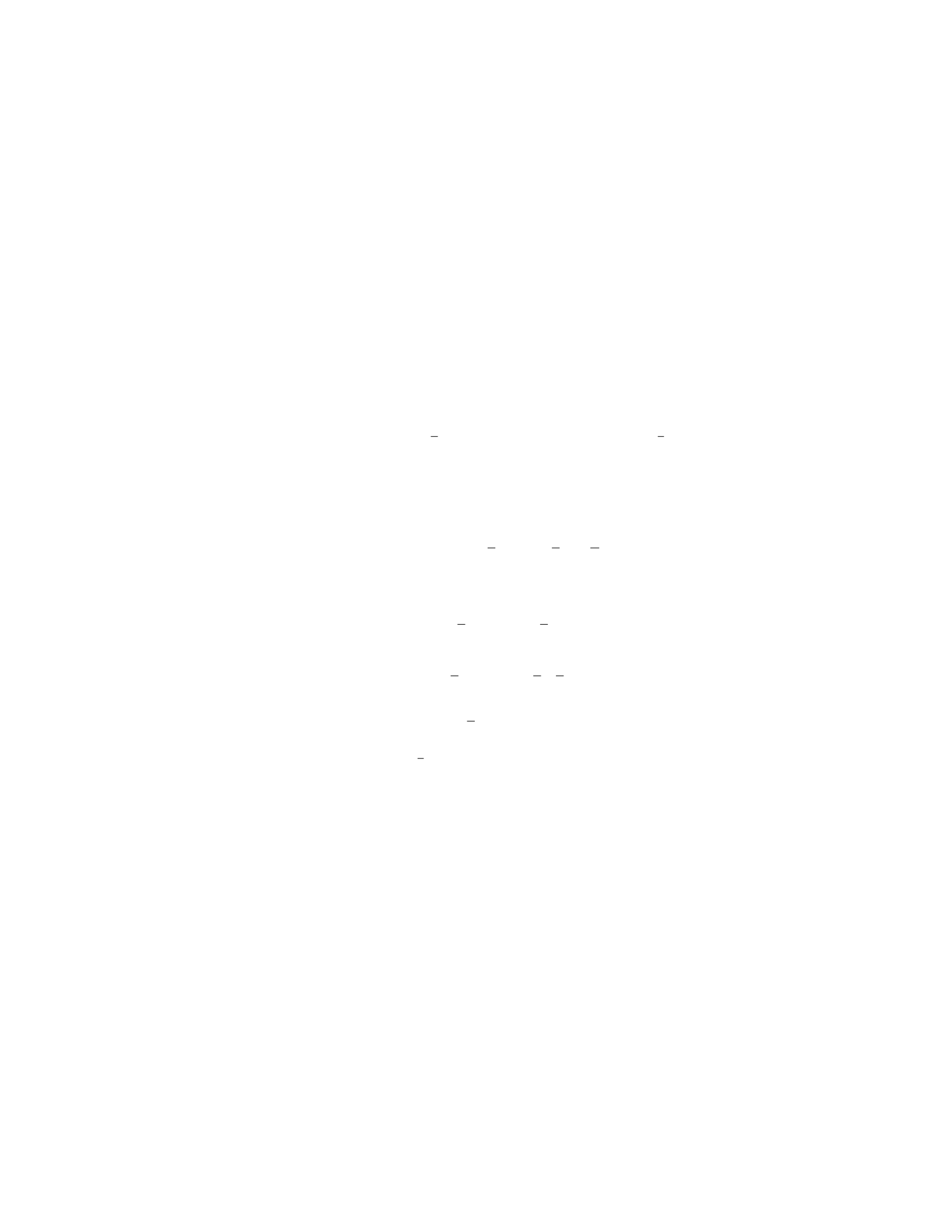
Question 21
Question
Evaluate the integral ∫x2ln(x)dx using integration by parts.
Solution
To evaluate the integral ∫x2ln(x)dx using integration by parts, we will use the
formula ∫u dv =uv −∫v du.
Step 1: Let’s choose our function uand our differential dv. Let u= ln(x)
and dv =x2dx.
Step 2: Compute the respective differentials du and v. Calculate du by
taking the derivative of u:du =1
xdx. Integrate dv to find v:v=1
3x3.
Step 3: Apply the integration by parts formula.
∫x2ln(x)dx =uv −∫v du
∫x2ln(x)dx = ln(x)·1
3x3−∫1
3x3·1
xdx
Step 4: Simplify and integrate the remaining integral.
∫x2ln(x)dx =1
3x3ln(x)−1
3∫x2dx
∫x2ln(x)dx =1
3x3ln(x)−1
3·1
3x3+C
∫x2ln(x)dx =1
3x3(ln(x)−1) + C
Therefore, ∫x2ln(x)dx =1
3x3(ln(x)−1) + C, where Cis the constant of
integration.
Question 22
Question
Evaluate the integral ∫xexdx using integration by parts.
Solution
To evaluate the integral ∫xexdx using integration by parts, we will choose
u=xand dv =exdx. Then we will differentiate uonce and integrate dv to
find du and v.
Step 1: Let u=xand dv =exdx. Then du =dx and v=∫exdx =ex.
17
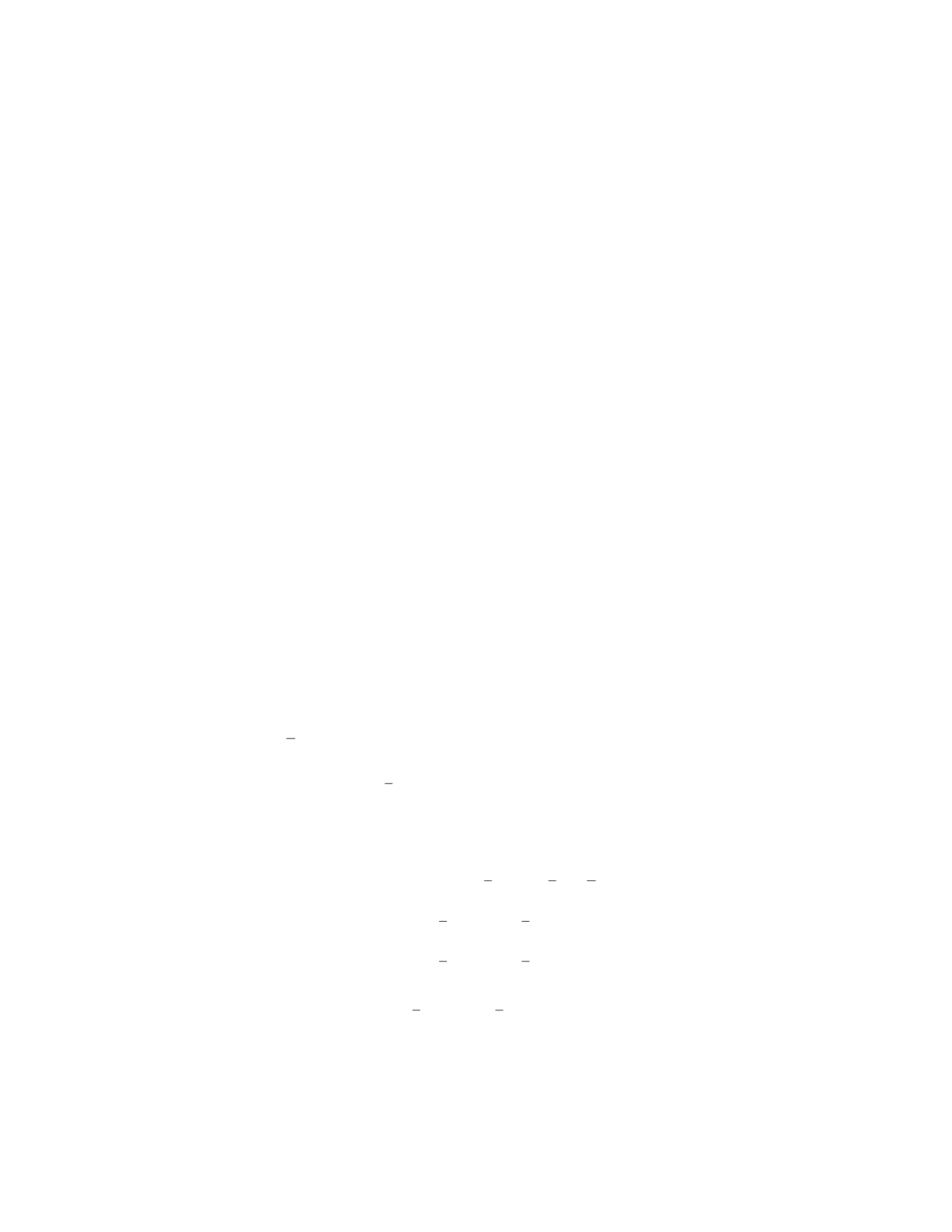
Step 2: Apply the integration by parts formula:
∫u dv =uv −∫v du
∫xexdx =xex−∫exdx
Step 3: Simplify the expression:
∫xexdx =xex−∫exdx =xex−ex+C
Therefore, ∫xexdx =xex−ex+Cwhere Cis the constant of integration.
Question 23
Question
Evaluate the integral ∫xln(x)dx using integration by parts.
Solution
To evaluate ∫xln(x)dx using integration by parts, we will choose u= ln(x)
and dv =x dx.
Step 1: Find du and v.
•u= ln(x)
•du =1
xdx
•dv =x dx =⇒v=1
2x2
Step 2: Apply the integration by parts formula: ∫u dv =uv −∫v du.
∫xln(x)dx = ln(x)·1
2x2−∫1
2x2·1
xdx
=1
2x2ln(x)−1
2∫x dx
=1
2x2ln(x)−1
4x2+C
Therefore, ∫xln(x)dx =1
2x2ln(x)−1
4x2+C, where Cis the constant of
integration.
18
Question 25
Question
Evaluate the integral ∫xe2xdx using integration by parts.
Solution
To evaluate the integral ∫xe2xdx using integration by parts, we will use the
formula: ∫u dv =uv −∫v du
where uand vare differentiable functions of x. Let’s choose u=xand dv =
e2xdx. Then, we’ll find du and v.
1. Step 1: Find du and v.
du = 1 dx and v=∫e2xdx =1
2e2x
2. Step 2: Apply integration by parts formula.
∫xe2xdx =uv −∫v du
=x(1
2e2x)−∫(1
2e2x)dx
=1
2xe2x−1
4e2x+C(where Cis the constant of integration)
Therefore, the integral ∫xe2xdx evaluates to 1
2xe2x−1
4e2x+C.
19

Question 2
Question
Evaluate the integral ∫xcos(x)dx using integration by parts.
Solution
To evaluate the integral ∫xcos(x)dx using integration by parts, we will use the
formula:
∫u dv =uv −∫v du
where uand vare differentiable functions of x.
Step 1: Let’s choose u=xand dv = cos(x)dx. Then, we have:
du =dx and v=∫cos(x)dx = sin(x)
Step 2: Now, we can apply the integration by parts formula:
∫xcos(x)dx =uv −∫v du
=xsin(x)−∫sin(x)dx
=xsin(x) + cos(x) + C
Therefore, the integral ∫xcos(x)dx simplifies to xsin(x)+cos(x)+C, where
Cis the constant of integration.
Question 3
Question
Evaluate the integral ∫xln(x)dx using integration by parts.
Solution
To evaluate the given integral ∫xln(x)dx, we will use integration by parts.
Recall the formula for integration by parts:
∫u dv =uv −∫v du
where uand vare differentiable functions of x.
Step 1: Let’s choose u= ln(x)and dv =x dx. Then, we have:
du =1
xdx and v=x2
2
2
Step 2: Substitute u,dv,du, and vinto the integration by parts formula:
∫xln(x)dx = ln(x)·x2
2−∫x2
2·1
xdx
=x2ln(x)
2−1
2∫x dx
=x2ln(x)
2−1
2·x2
2+C
=x2ln(x)
2−x2
4+C
Step 3: Therefore, the solution to the integral ∫xln(x)dx is x2ln(x)
2−x2
4+C,
where Cis the constant of integration.
Question 4
Question
Evaluate the integral ∫xsin(3x)dx using integration by parts.
Solution
To evaluate the integral ∫xsin(3x)dx using integration by parts, we will use
the formula ∫u dv =uv −∫v du.
Step 1: Choose uand dv. Let u=xand dv = sin(3x)dx. Then, we have:
du =dx and v=−1
3cos(3x).
Step 2: Apply integration by parts:
∫xsin(3x)dx =uv −∫v du
=x(−1
3cos(3x))−∫(−1
3cos(3x))dx
=−x
3cos(3x) + 1
3∫cos(3x)dx.
Step 3: Integrate ∫cos(3x)dx:
∫cos(3x)dx =1
3sin(3x) + C,
where Cis the constant of integration.
3
Step 4: Substitute back into the original integral:
∫xsin(3x)dx =−x
3cos(3x) + 1
3(1
3sin(3x) + C)
=−x
3cos(3x) + 1
9sin(3x) + C.
Therefore, ∫xsin(3x)dx =−x
3cos(3x) + 1
9sin(3x) + C, where Cis the con-
stant of integration.
Question 5
Question
Evaluate the integral ∫xcos(x)dx using integration by parts.
Solution
To evaluate the integral ∫xcos(x)dx using integration by parts, we will use
the formula ∫u dv =uv −∫v du where uand vare differentiable functions of
x.
Step 1: Let us choose u=xand dv = cos(x)dx. Then, calculating the
differentials, we get: du =dx and v=∫cos(x)dx = sin(x).
Step 2: Now, using the integration by parts formula, we have: ∫xcos(x)dx =
uv −∫v du =xsin(x)−∫sin(x)dx.
Step 3: Simplifying the integral, we get: ∫xcos(x)dx =xsin(x)+∫sin(x)dx.
Step 4: Finally, integrating ∫sin(x)dx, we have: ∫xcos(x)dx =xsin(x)−
cos(x) + C, where Cis the constant of integration.
Therefore, ∫xcos(x)dx =xsin(x)−cos(x) + C.
Question 6
Question
Evaluate the integral ∫xln(x)dx using integration by parts.
4
Solution
To evaluate the integral ∫xln(x)dx using integration by parts, we let u= ln(x)
and dv =x dx. Then, du =1
xdx and v=1
2x2. The formula for integration by
parts is:
∫u dv =uv −∫v du
Step 1: Calculate du and v.
du =1
xdx and v=1
2x2
Step 2: Apply integration by parts formula.
∫xln(x)dx =1
2x2ln(x)−∫1
2x2·1
xdx
=1
2x2ln(x)−1
2∫x dx
Step 3: Simplify the result.
∫xln(x)dx =1
2x2ln(x)−1
2(1
2x2)+C
=1
2x2ln(x)−1
4x2+C
Hence, the integral ∫xln(x)dx evaluates to 1
2x2ln(x)−1
4x2+Cwhere Cis
the constant of integration.
Question 7
Question
Evaluate the integral ∫x3ln(x)dx using integration by parts.
Solution
To evaluate the integral ∫x3ln(x)dx using integration by parts, we will let
u= ln(x)and dv =x3dx. Then, we will differentiate uto find du and integrate
dv to find v.
Step 1: Find du and v.
• Let u= ln(x). Then, du =1
xdx.
• Let dv =x3dx. Integrating dv with respect to x, we get v=1
4x4.
5
Step 2: Apply integration by parts formula: ∫u dv =uv −∫v du.
∫x3ln(x)dx =x3ln(x)−∫1
4x4·1
xdx
=x3ln(x)−1
4∫x3dx
=x3ln(x)−1
4·1
4x4+Cwhere Cis the constant of integration
=x3ln(x)−1
16x4+C
Therefore, ∫x3ln(x)dx =x3ln(x)−1
16 x4+C, where Cis the constant of
integration.
Question 8
Question
Evaluate the following integral using integration by parts:
∫x2exdx
Solution
To evaluate the integral ∫x2exdx using integration by parts, we will use the
formula: ∫u dv =uv −∫v du
where uand vare differentiable functions of x.
Step 1: Choose u=x2and dv =exdx. Then, we have du = 2x dx and
v=∫exdx =ex.
Step 2: Apply the formula:
∫x2exdx =x2ex−∫2xexdx
Step 3: Now, we have another integral on the right-hand side that can be
further simplified using integration by parts. Let’s apply integration by parts
to ∫2xexdx.
Step 4: Choose u= 2xand dv =exdx. Then, we have du = 2 dx and
v=ex.
Step 5: Apply the formula again:
∫2xexdx = 2xex−∫2exdx
6
Step 6: Simplify the above expression:
∫2xexdx = 2xex−2ex+C
Step 7: Substitute ∫2xexdx = 2xex−2ex+Cback into the equation from
Step 2:
∫x2exdx =x2ex−(2xex−2ex+C) + C
Step 8: Simplify the expression:
∫x2exdx =x2ex−2xex+ 2ex+C
Therefore, ∫x2exdx =x2ex−2xex+ 2ex+C, where Cis the constant of
integration.
Question 9
Question
Evaluate the integral ∫x2ln(x)dx using integration by parts.
Solution
To evaluate the integral ∫x2ln(x)dx using integration by parts, we let u= ln(x)
and dv =x2dx. Then, we differentiate uto get du =1
xdx and integrate dv to
get v=1
3x3. Substituting these into the integration by parts formula ∫udv =
uv −∫vdu, we have:
∫x2ln(x)dx =1
3x3ln(x)−∫1
3x3·1
xdx
=1
3x3ln(x)−1
3∫x2dx
Step 1: Integrate ∫x2dx.
∫x2dx =1
3x3+C
Step 2: Substituting the result back into the equation, we have:
∫x2ln(x)dx =1
3x3ln(x)−1
3(1
3x3)+C
=1
3x3ln(x)−1
9x3+C
Therefore, ∫x2ln(x)dx =1
3x3ln(x)−1
9x3+C, where Cis the constant of
integration.
7

Question 10
Question
Evaluate the integral ∫exsin(x)dx using integration by parts.
Solution
To evaluate the integral ∫exsin(x)dx, we will use integration by parts. The
formula for integration by parts is:
∫u dv =uv −∫v du
where uand vare differentiable functions of x.
Step 1: Let us choose u=exand dv = sin(x)dx. Then, we have:
du =exdx and v=−cos(x)
Step 2: Apply the integration by parts formula:
∫exsin(x)dx =ex(−cos(x)) −∫(−cos(x))(ex)dx
=−excos(x) + ∫excos(x)dx
Step 3: Now, we need to apply integration by parts again to evaluate
∫excos(x)dx. Let’s choose u=exand dv = cos(x)dx. Then, we have:
du =exdx
v= sin(x)
Step 4: Apply the integration by parts formula once more:
∫excos(x)dx =exsin(x)−∫sin(x)exdx
=exsin(x)−∫exsin(x)dx
Step 5: Now substitute ∫exsin(x)dx back into the equation:
∫exsin(x)dx =−excos(x) + (exsin(x)−∫exsin(x)dx)
∫exsin(x)dx =−excos(x) + exsin(x)−∫exsin(x)dx
Step 6: Now, add ∫exsin(x)dx to both sides of the equation:
∫exsin(x)dx +∫exsin(x)dx =−excos(x) + exsin(x)
8
Step 7: Simplify the equation:
2∫exsin(x)dx =−excos(x) + exsin(x)
Step 8: Finally, divide by 2:
∫exsin(x)dx =−excos(x) + exsin(x)
2+C
where Cis the constant of integration.
Question 11
Question
Evaluate the integral ∫x2ln(x)dx.
Solution
To evaluate the integral ∫x2ln(x)dx, we will use integration by parts, which
states: ∫u dv =uv −∫v du.
We will choose u= ln(x)and dv =x2dx, so that du =1
xdx and v=1
3x3.
Step 1: Apply integration by parts:
∫x2ln(x)dx =1
3x3ln(x)−∫1
3x3·1
xdx
=1
3x3ln(x)−1
3∫x2dx.
Step 2: Simplify the integral:
∫x2ln(x)dx =1
3x3ln(x)−1
3∫x2dx
=1
3x3ln(x)−1
3·1
3x3+C
=1
3x3ln(x)−1
9x3+C,
where Cis the constant of integration.
Therefore, ∫x2ln(x)dx =1
3x3ln(x)−1
9x3+C.
Question 12
Question
Evaluate the integral ∫xcos−1x dx using integration by parts.
9
Solution
To evaluate the integral ∫xcos−1x dx using integration by parts, we choose
u= cos−1xand dv =x dx. Then, we find du and v:
Step 1: Find du and v.
u= cos−1x
du =−1
√1−x2dx
dv =x dx
v=1
2x2
Step 2: Apply integration by parts formula ∫u dv =uv −∫v du.
∫xcos−1x dx =1
2x2cos−1x−∫1
2x2(−1
√1−x2)dx
=1
2x2cos−1x+1
2∫x2
√1−x2dx
Now, we will evaluate the remaining integral using a trigonometric substi-
tution. Let x= sin θ, so dx = cos θ dθ and √1−x2= cos θ.
Step 3: Perform the trigonometric substitution.
∫x2
√1−x2dx =∫sin2θ
cos θcos θ dθ
=∫sin2θ dθ
Using the double angle identity sin2θ=1
2(1 −cos 2θ), we get:
∫sin2θ dθ =∫1
2(1 −cos 2θ)dθ
=1
2(θ−1
2sin 2θ) + C
Step 4: Substitute back x= sin θto get the final answer.
∫xcos−1x dx =1
2x2cos−1x+1
4(θ−1
2sin 2θ) + C
Therefore, the final answer is 1
2x2cos−1x+1
4(sin−1x−x√1−x2) + C.
Question 13
Question
Evaluate the integral ∫xln(x)dx using integration by parts.
10
Solution
To evaluate the integral ∫xln(x)dx using integration by parts, we will follow
the formula: ∫u dv =uv −∫v du
where we choose uand dv appropriately.
Step 1: Let’s choose:
u= ln(x)⇒du =1
xdx
dv =x dx ⇒v=x2
2
Step 2: Apply the integration by parts formula:
∫xln(x)dx =x2
2ln(x)−∫x2
2·1
xdx
Step 3: Simplify the integral:
∫xln(x)dx =x2
2ln(x)−∫x
2dx
=x2
2ln(x)−1
4x2+C
Hence, the solution to the integral ∫xln(x)dx is x2
2ln(x)−1
4x2+C, where
Cis the constant of integration.
Question 14
Question
Evaluate the integral ∫xcos(x)dx using integration by parts.
Solution
To evaluate the integral ∫xcos(x)dx using integration by parts, we will use the
formula: ∫u dv =uv −∫v du
Step 1: Let’s choose u=xand dv = cos(x)dx, then differentiate uto get
du and integrate dv to get v:
•u=x,du =dx
•dv = cos(x)dx,v=∫cos(x)dx = sin(x)
11
Step 2: Now, we can apply the integration by parts formula:
∫xcos(x)dx =uv −∫v du
=xsin(x)−∫sin(x)dx
=xsin(x) + ∫sin(x)dx (since ∫sin(x)dx =−cos(x))
=xsin(x)−cos(x) + C(where Cis the constant of integration)
Therefore, ∫xcos(x)dx =xsin(x)−cos(x) + C.
Question 15
Question
Evaluate the integral ∫x2ln x dx using integration by parts.
Solution
To evaluate ∫x2ln x dx using integration by parts, we will let u= ln xand
dv =x2dx. Then, we can find du and vto proceed with the integration.
Step 1: Calculate du and v
•u= ln x
•dv =x2dx
We differentiate uto get du:
du =1
xdx
We integrate dv to get v:
v=1
3x3
Step 2: Apply integration by parts formula The integration by parts formula
is: ∫u dv =uv −∫v du
Now, we substitute u,dv,v, and du into the formula:
∫x2ln x dx =x2ln x−∫1
3x3·1
xdx
=x2ln x−1
3∫x2dx
12
Step 3: Evaluate the integral Integrate ∫x2dx:
∫x2dx =1
3x3+C
Step 4: Final answer Substitute the result back into the formula:
∫x2ln x dx =x2ln x−1
3(1
3x3+C)
=x2ln x−1
9x3−1
3C+C′
Therefore, ∫x2ln x dx =x2ln x−1
9x3+C, where Cis the constant of
integration.
Question 16
Question
Evaluate the integral ∫x2ln(x)dx using integration by parts.
Solution
To evaluate the integral ∫x2ln(x)dx using integration by parts, we will apply
the formula ∫u dv =uv −∫v du where uand vare chosen functions.
Step 1: Let’s choose u= ln(x)and dv =x2dx. Then, differentiate uand
integrate dv.
du =1
xdx
v=∫x2dx =1
3x3
Step 2: Now, we can use the integration by parts formula to find the
integral.
∫x2ln(x)dx =uv −∫v du
= ln(x)·1
3x3−∫1
3x3·1
xdx
=1
3x3ln(x)−1
3∫x2dx
=1
3x3ln(x)−1
3·1
3x3+C
=1
3x3ln(x)−1
9x3+C
Therefore, the integral ∫x2ln(x)dx evaluates to 1
3x3ln(x)−1
9x3+C, where
Cis the constant of integration.
13
Question 17
Question
Evaluate the integral ∫xcos(2x)dx using integration by parts.
Solution
To evaluate the integral ∫xcos(2x)dx using integration by parts, we will let
u=xand dv = cos(2x)dx. Then, we will differentiate uto get du =dx and
integrate dv to get v=1
2sin(2x).
Step 1: Apply integration by parts formula: ∫u dv =uv −∫v du.
∫xcos(2x)dx =x·1
2sin(2x)−∫1
2sin(2x)dx
Step 2: Integrate the remaining term.
=x
2sin(2x)−1
2∫sin(2x)dx
=x
2sin(2x) + 1
4cos(2x) + C
Therefore, ∫xcos(2x)dx =x
2sin(2x)+ 1
4cos(2x)+C, where Cis the constant
of integration.
Question 18
Question
Evaluate the integral ∫x3ln(x)dx using integration by parts.
Solution
To evaluate the integral ∫x3ln(x)dx using integration by parts, we will choose
u= ln(x)and dv =x3dx. Then, du =1
xdx and v=∫x3dx =x4
4.
Step 1: Apply integration by parts:
∫x3ln(x)dx =uv −∫v du
∫x3ln(x)dx = ln(x)·x4
4−∫x4
4·1
xdx
Step 2: Simplify the integral:
∫x3ln(x)dx =x4ln(x)
4−∫x3
4dx
14
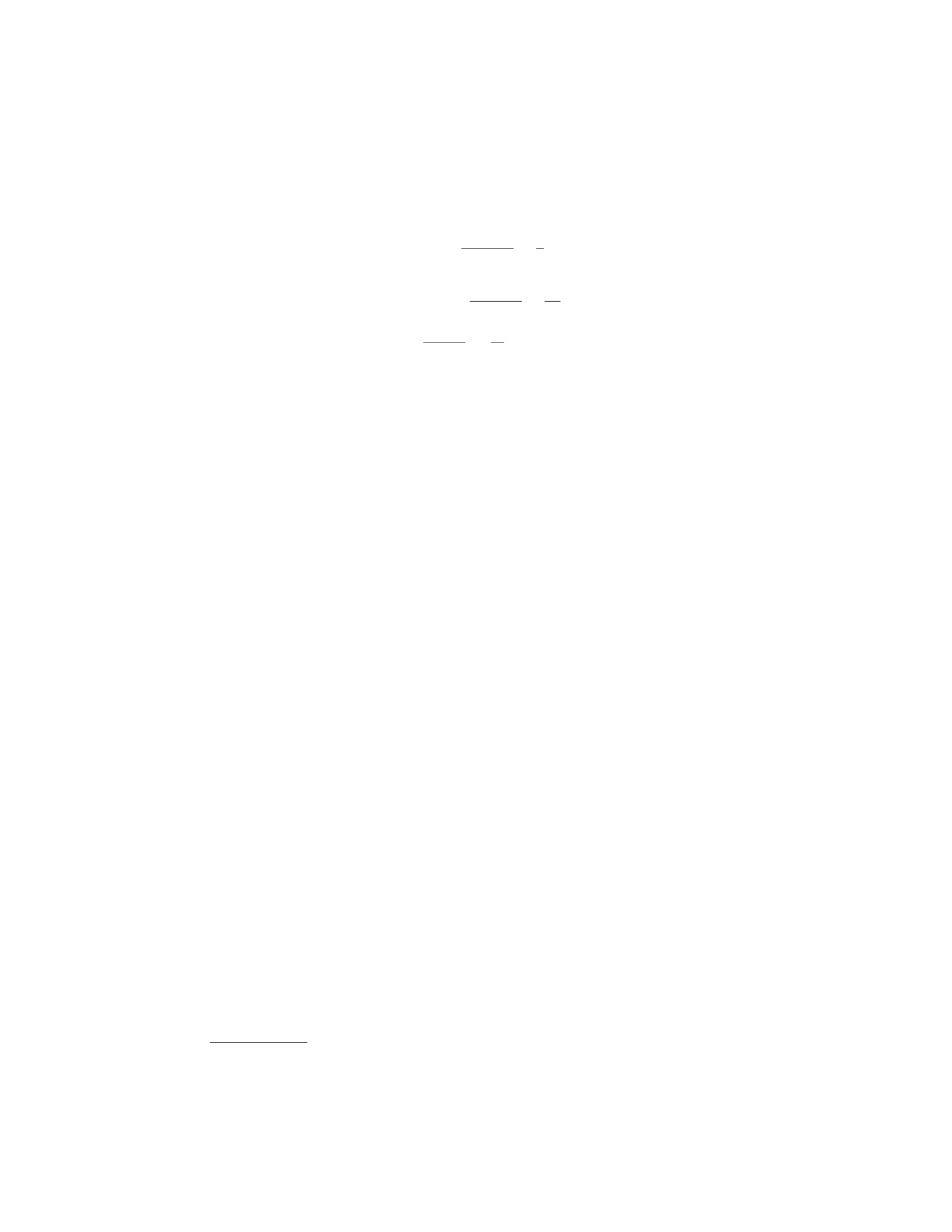
Step 3: Integrate the remaining integral:
∫x3ln(x)dx =x4ln(x)
4−1
4∫x3dx
∫x3ln(x)dx =x4ln(x)
4−x4
16 +C
Therefore, ∫x3ln(x)dx =x4ln(x)
4−x4
16 +C, where Cis the constant of
integration.
Question 19
Question
Evaluate the integral ∫xexcos(x)dx using integration by parts.
Solution
To evaluate the given integral ∫xexcos(x)dx using integration by parts, we will
choose parts to differentiate and integrate.
Step 1: Let’s use integration by parts with u=xand dv =excos(x)dx.
Then, we have:
u=x⇒du =dx,
dv =excos(x)dx ⇒v=∫excos(x)dx.
Step 2: To find v, we need to integrate v=∫excos(x)dx. Let’s use
integration by parts again with u=exand dv = cos(x)dx. Then, we have:
u=ex⇒du =exdx,
dv = cos(x)dx ⇒v=∫cos(x)dx.
Step 3: Finding v, we integrate v=∫cos(x)dx = sin(x).
Step 4: Now, we can find uv −∫v du.
∫xexcos(x)dx =uv −∫v du
=x·exsin(x)−∫exsin(x)dx.
Step 5: To find ∫exsin(x)dx, we will use integration by parts again. Let
u=exand dv = sin(x)dx.
Step 6: After calculating the integration, we find that ∫exsin(x)dx =
ex(sin(x)−cos(x))
2.
15
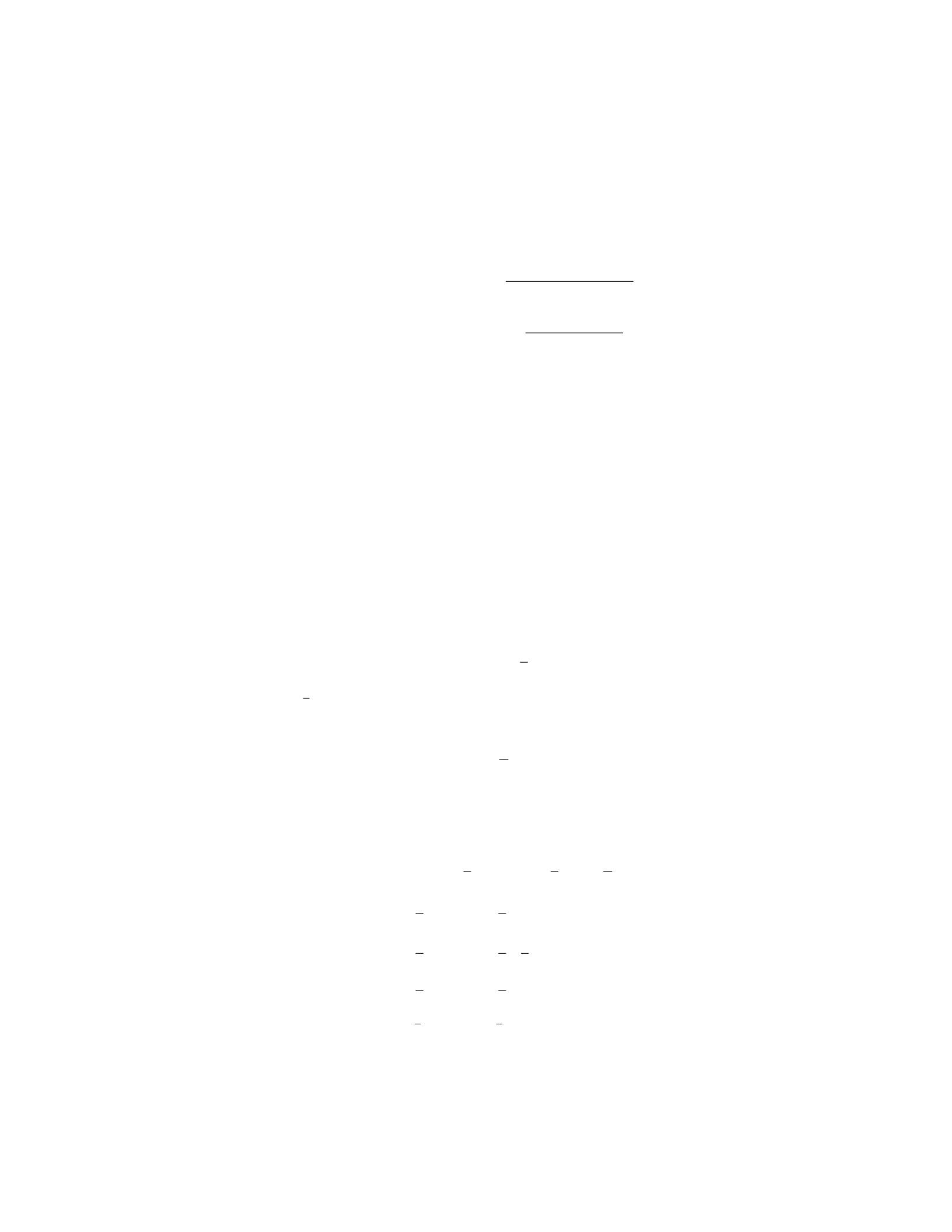
Step 7: Substituting this back into the previous equation, we have:
∫xexcos(x)dx =x·exsin(x)−∫exsin(x)dx
=x·exsin(x)−ex(sin(x)−cos(x))
2+C,
where Cis the constant of integration.
Therefore, ∫xexcos(x)dx =x·exsin(x)−ex(sin(x)−cos(x))
2+C.
Question 20
Question
Evaluate the integral ∫x2ln(x)dx using integration by parts.
Solution
To evaluate the integral ∫x2ln(x)dx using integration by parts, we will choose
u= ln(x)and dv =x2dx, then apply the integration by parts formula ∫u dv =
uv −∫v du.
Step 1: Let’s determine du and v.
•u= ln(x)
•dv =x2dx To find dv, we integrate dv to get v:
∫x2dx =1
3x3
So, v=1
3x3.
• To find du, we differentiate u:
du =1
xdx
Step 2: Now, we can apply the integration by parts formula.
∫x2ln(x)dx =uv −∫v du
= ln(x)(1
3x3)−∫(1
3x3)(1
x)dx
=1
3x3ln(x)−1
3∫x2dx
=1
3x3ln(x)−1
3·1
3x3+C
=1
3x3ln(x)−1
9x3+C
Therefore, ∫x2ln(x)dx =1
3x3ln(x)−1
9x3+C, where Cis the constant of
integration.
16
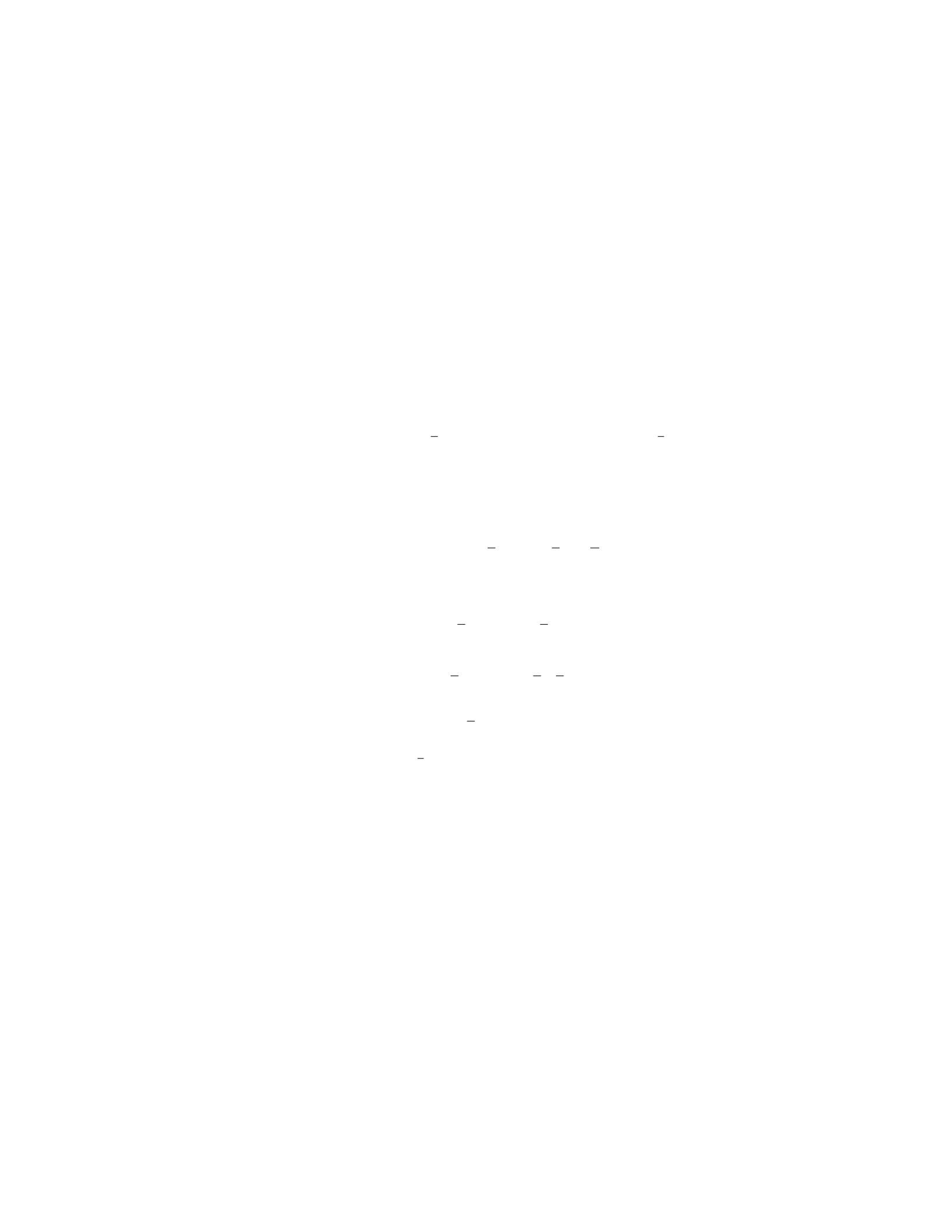
Question 21
Question
Evaluate the integral ∫x2ln(x)dx using integration by parts.
Solution
To evaluate the integral ∫x2ln(x)dx using integration by parts, we will use the
formula ∫u dv =uv −∫v du.
Step 1: Let’s choose our function uand our differential dv. Let u= ln(x)
and dv =x2dx.
Step 2: Compute the respective differentials du and v. Calculate du by
taking the derivative of u:du =1
xdx. Integrate dv to find v:v=1
3x3.
Step 3: Apply the integration by parts formula.
∫x2ln(x)dx =uv −∫v du
∫x2ln(x)dx = ln(x)·1
3x3−∫1
3x3·1
xdx
Step 4: Simplify and integrate the remaining integral.
∫x2ln(x)dx =1
3x3ln(x)−1
3∫x2dx
∫x2ln(x)dx =1
3x3ln(x)−1
3·1
3x3+C
∫x2ln(x)dx =1
3x3(ln(x)−1) + C
Therefore, ∫x2ln(x)dx =1
3x3(ln(x)−1) + C, where Cis the constant of
integration.
Question 22
Question
Evaluate the integral ∫xexdx using integration by parts.
Solution
To evaluate the integral ∫xexdx using integration by parts, we will choose
u=xand dv =exdx. Then we will differentiate uonce and integrate dv to
find du and v.
Step 1: Let u=xand dv =exdx. Then du =dx and v=∫exdx =ex.
17
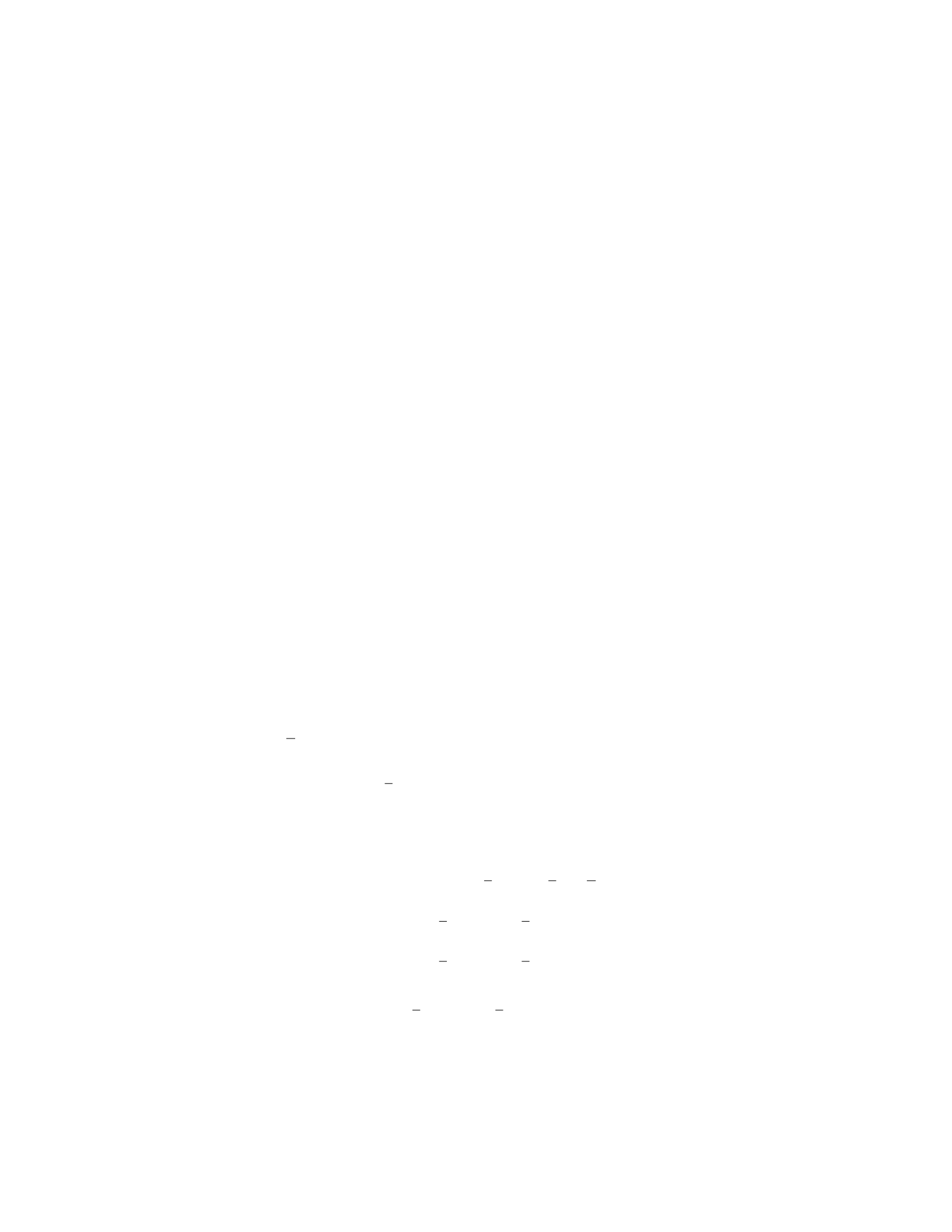
Step 2: Apply the integration by parts formula:
∫u dv =uv −∫v du
∫xexdx =xex−∫exdx
Step 3: Simplify the expression:
∫xexdx =xex−∫exdx =xex−ex+C
Therefore, ∫xexdx =xex−ex+Cwhere Cis the constant of integration.
Question 23
Question
Evaluate the integral ∫xln(x)dx using integration by parts.
Solution
To evaluate ∫xln(x)dx using integration by parts, we will choose u= ln(x)
and dv =x dx.
Step 1: Find du and v.
•u= ln(x)
•du =1
xdx
•dv =x dx =⇒v=1
2x2
Step 2: Apply the integration by parts formula: ∫u dv =uv −∫v du.
∫xln(x)dx = ln(x)·1
2x2−∫1
2x2·1
xdx
=1
2x2ln(x)−1
2∫x dx
=1
2x2ln(x)−1
4x2+C
Therefore, ∫xln(x)dx =1
2x2ln(x)−1
4x2+C, where Cis the constant of
integration.
18
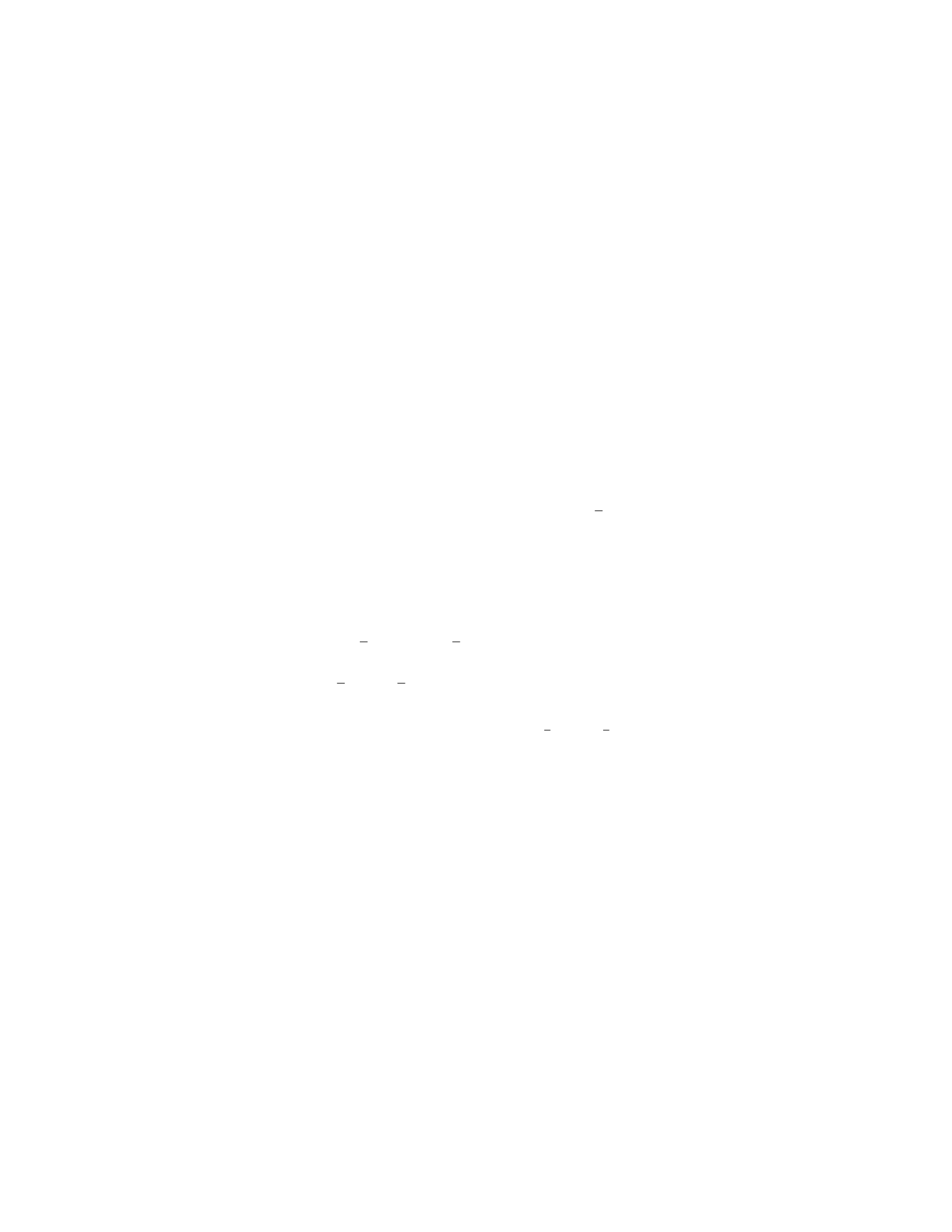
Question 25
Question
Evaluate the integral ∫xe2xdx using integration by parts.
Solution
To evaluate the integral ∫xe2xdx using integration by parts, we will use the
formula: ∫u dv =uv −∫v du
where uand vare differentiable functions of x. Let’s choose u=xand dv =
e2xdx. Then, we’ll find du and v.
1. Step 1: Find du and v.
du = 1 dx and v=∫e2xdx =1
2e2x
2. Step 2: Apply integration by parts formula.
∫xe2xdx =uv −∫v du
=x(1
2e2x)−∫(1
2e2x)dx
=1
2xe2x−1
4e2x+C(where Cis the constant of integration)
Therefore, the integral ∫xe2xdx evaluates to 1
2xe2x−1
4e2x+C.
19

