


MATH 117 - ELEMENTS OF
MATHEMATICS - Gradient,
divergence, and curl
Question Bank - Set 3
Liberty University
Question 1
Question
Let F(x, y, z) = (2xz2+y)i+ (x2z+ 2y)j+ (2xy + 3z2)k. Compute the curl of
F.
Solution
To find the curl of F, denoted by curl(F), we use the formula:
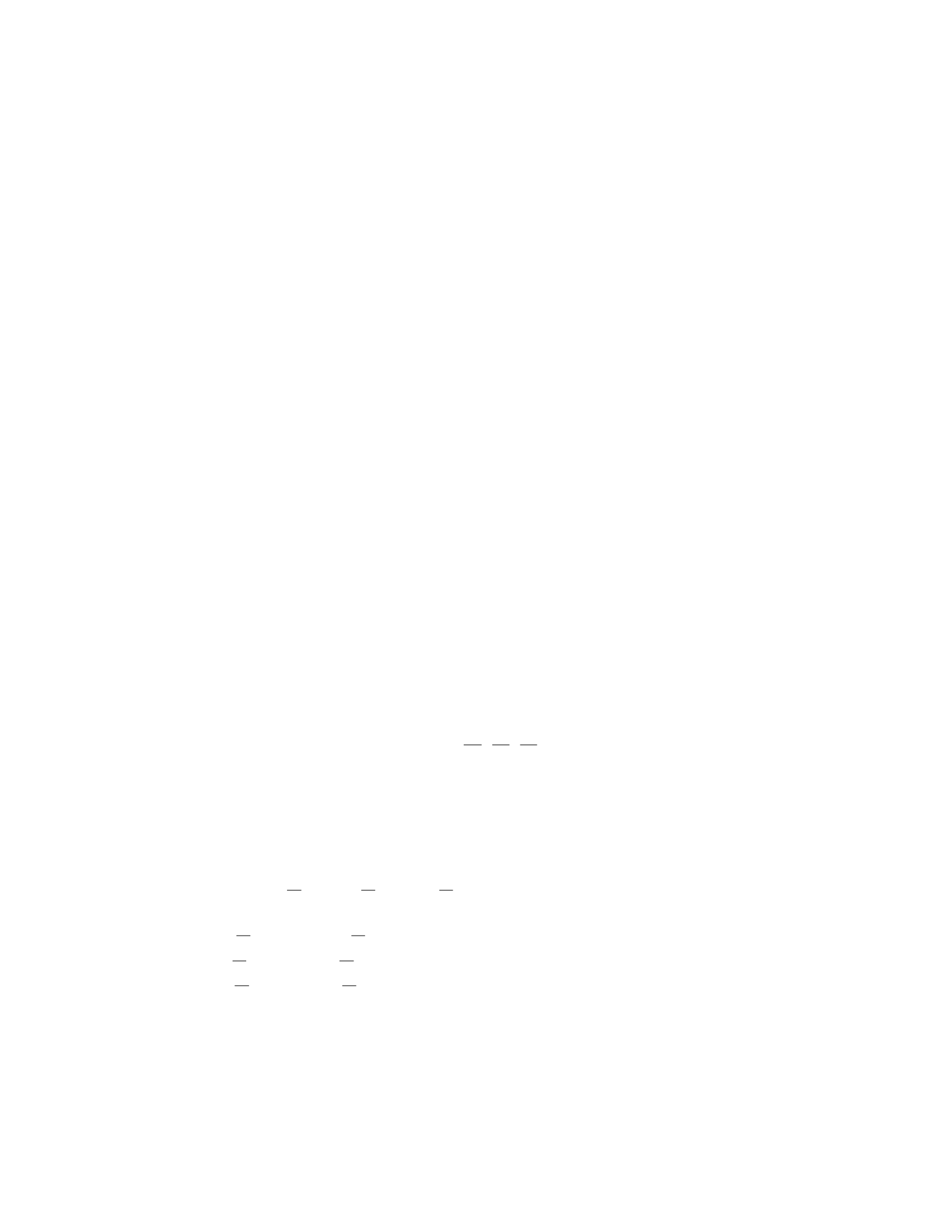
curl(F) = ∇ × F=∂
∂x ,∂
∂y ,∂
∂z ×(P, Q, R),
where F(x, y, z) = Pi+Qj+Rk.
Step 1: Compute the components of the curl.
) =
i j k
∂
∂x
∂
∂y
∂
∂z
2xz2+y x2z+ 2y2xy + 3z2
=∂
∂y (2xy + 3z2)−∂
∂z (x2z+ 2y)i
+∂
∂z (2xz2+y)−∂
∂x (2xy + 3z2)j
+∂
∂x (x2z+ 2y)−∂
∂y (2xz2+y)k.

Step 2: Evaluate the partial derivatives and simplify.
) = (2x - 0)i+ (2z - 0)j+ (x2−2z)k
= 2xi+ 2zj+ (x2−2z)k.
Therefore, the curl of Fis 2xi+ 2zj+ (x2−2z)k.
Question 2
Question
Let Fbe a vector field defined by F(x, y, z) = (2xyz, x2z, xy2). Compute the
curl of F.
Solution
To compute the curl of a vector field F= (P, Q, R), we use the formula:
curl(F) = ∂R
∂y −∂Q
∂z ,∂P
∂z −∂R
∂x ,∂Q
∂x −∂P
∂y
Step 1: Compute partial derivatives of P,Q, and RGiven F(x, y, z) =
(2xyz, x2z, xy2), we have:
P= 2xyz, Q =x2z, R =xy2
Compute the partial derivatives:
∂P
∂z = 2xy
∂Q
∂x = 2xz
∂R
∂y = 2xy
∂P
∂y = 2xz
∂R
∂x =y2
∂Q
∂z =x2
Step 2: Compute the curl of F Now, plug the partial derivatives into
the formula for the curl:
curl(F) = 2xy −2xz, 2xz −y2, x2−2xy
Therefore, the curl of Fis curl(F) = (2xy −2xz, 2xz −y2, x2−2xy).
2

Question 3
Question
Let F(x, y, z) = x3yi+y3zj+z3xk. Calculate the curl of Fat the point (1,2,3).
Solution
Step 1: The curl of a vector field F(x, y, z) = P(x, y, z)i+Q(x, y, z)j+R(x, y, z)k
is given by the formula:
∇ × F=∂R
∂y −∂Q
∂z i−∂R
∂x −∂P
∂z j+∂Q
∂x −∂P
∂y k
Step 2: Let’s find the partial derivatives of F:
P(x, y, z) = x3y, Q(x, y, z) = y3z, R(x, y, z) = z3x
∂P
∂y =x3,∂Q
∂z =y3,∂R
∂x = 3z2
∂Q
∂x = 0,∂P
∂z = 0,∂R
∂y = 3x2
Step 3: Substituting these into the curl formula, we have:
∇ × F=∂R
∂y −∂Q
∂z i−∂R
∂x −∂P
∂z j+∂Q
∂x −∂P
∂y k
= (3x2−y3)i−(3z2−0)j+ (0 −x3)k
= (3 −8)i−(9 −0)j+ (0 −1)k
=−5i−9j−k
Step 4: Finally, computing the curl at (1,2,3):
∇ × F(1,2,3) = −5i−9j−k
Question 4
Question
Let F(x, y, z)=(x2y+yz, xz, y2z) be a vector field in R3. Compute the curl of
F.
Solution
To find the curl of a vector field F(x, y, z)=(P, Q, R) in R3, we use the formula:
curl(F) = ∂R
∂y −∂Q
∂z ,∂P
∂z −∂R
∂x ,∂Q
∂x −∂P
∂y
3
Step 1: Compute the partial derivatives.
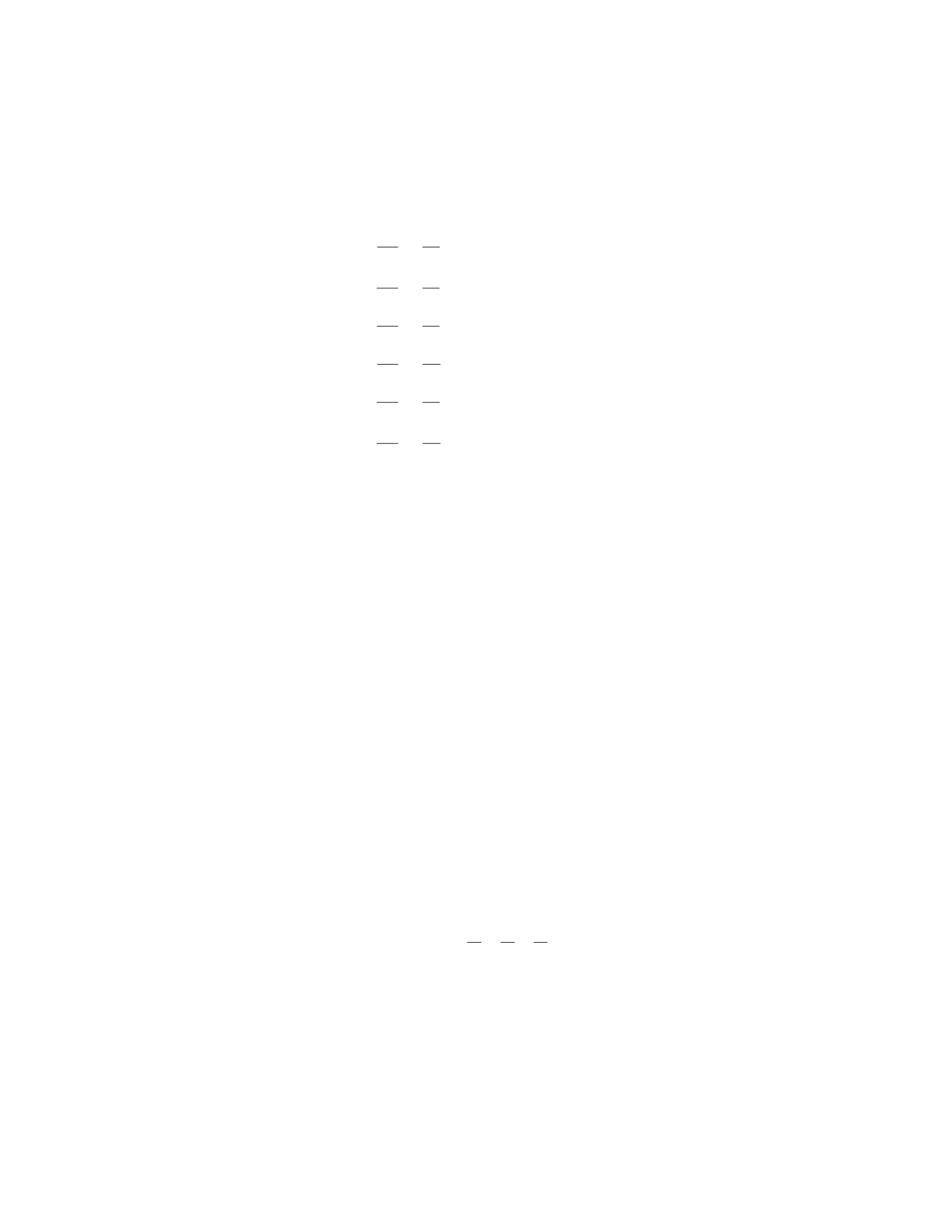
∂R
∂y =∂
∂y (y2z)=2yz
∂Q
∂z =∂
∂z (xz) = x
∂P
∂z =∂
∂z (x2y+yz) = y
∂R
∂x =∂
∂x (y2z)=0
∂P
∂y =∂
∂y (x2y+yz) = x2+z
∂Q
∂x =∂
∂x (xz) = z
Step 2: Substitute the computed partial derivatives into the formula for
the curl.
curl(F) = 2yz −x, y −0, z −(x2+z)
= (2yz −x, y, z −x2−z)
= (2yz −x, y, −x2)
Therefore, the curl of the vector field F(x, y, z)=(x2y+yz, xz, y2z) is
curl(F) = (2yz −x, y, −x2).
Question 5
Question
Let F(x, y, z) = exyzi+x2yj+zexykbe a vector field in three-dimensional space.
Calculate the curl of F.
Solution
To calculate the curl of a vector field F(x, y, z) = P(x, y, z)i+Q(x, y, z)j+
R(x, y, z)k, we use the formula:
∇ × F=
i j k
∂
∂x
∂
∂y
∂
∂z
P Q R
In this case, we have F(x, y, z) = exyzi+x2yj+zexyk, so P(x, y, z) = exyz,
Q(x, y, z) = x2y, and R(x, y, z) = zexy .
4
Step 1: Calculate the partial derivatives:
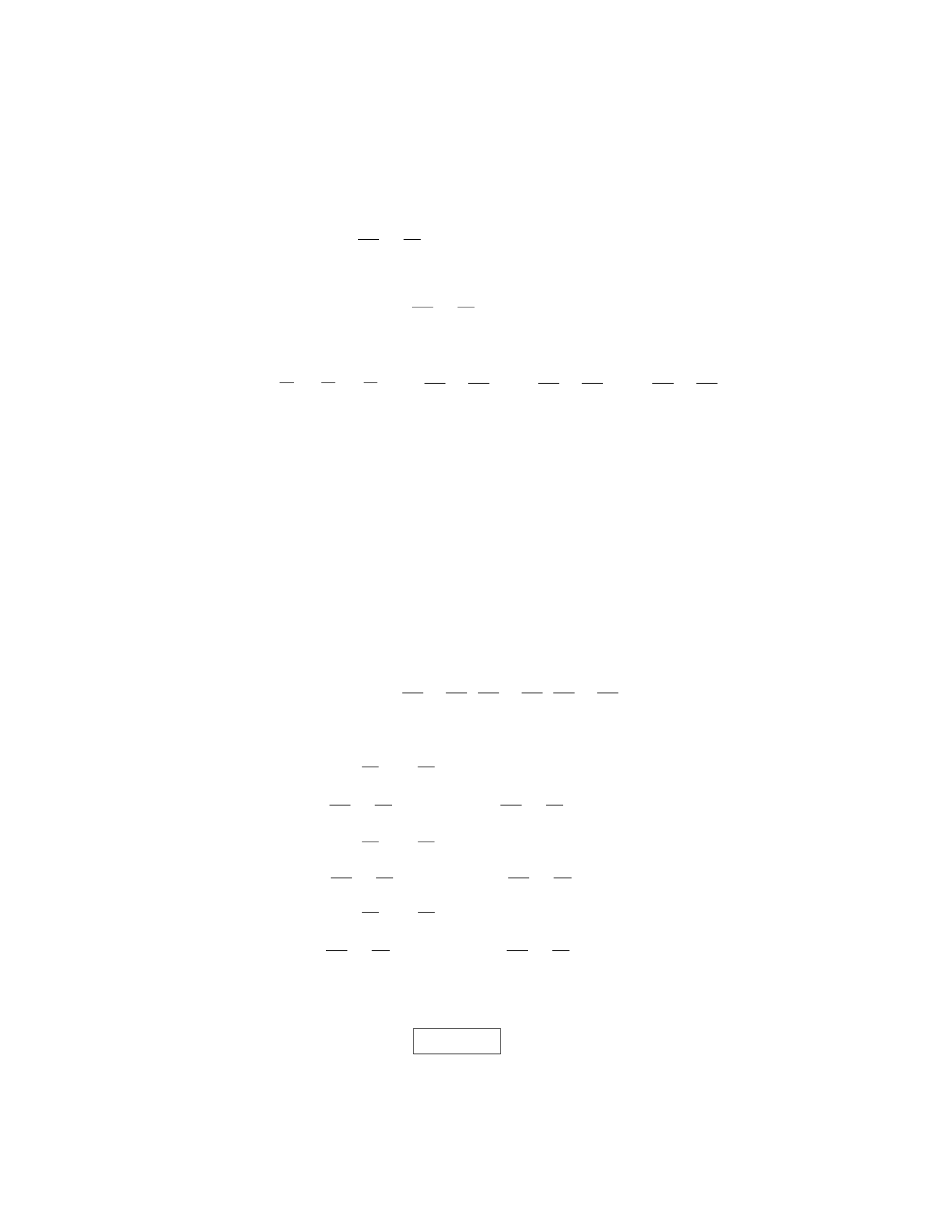
∂R
∂y =∂
∂y (zexy) = z(xexy) = xzexy
Step 2: Continue calculating the partial derivatives:
∂Q
∂z =∂
∂z (x2y)=0
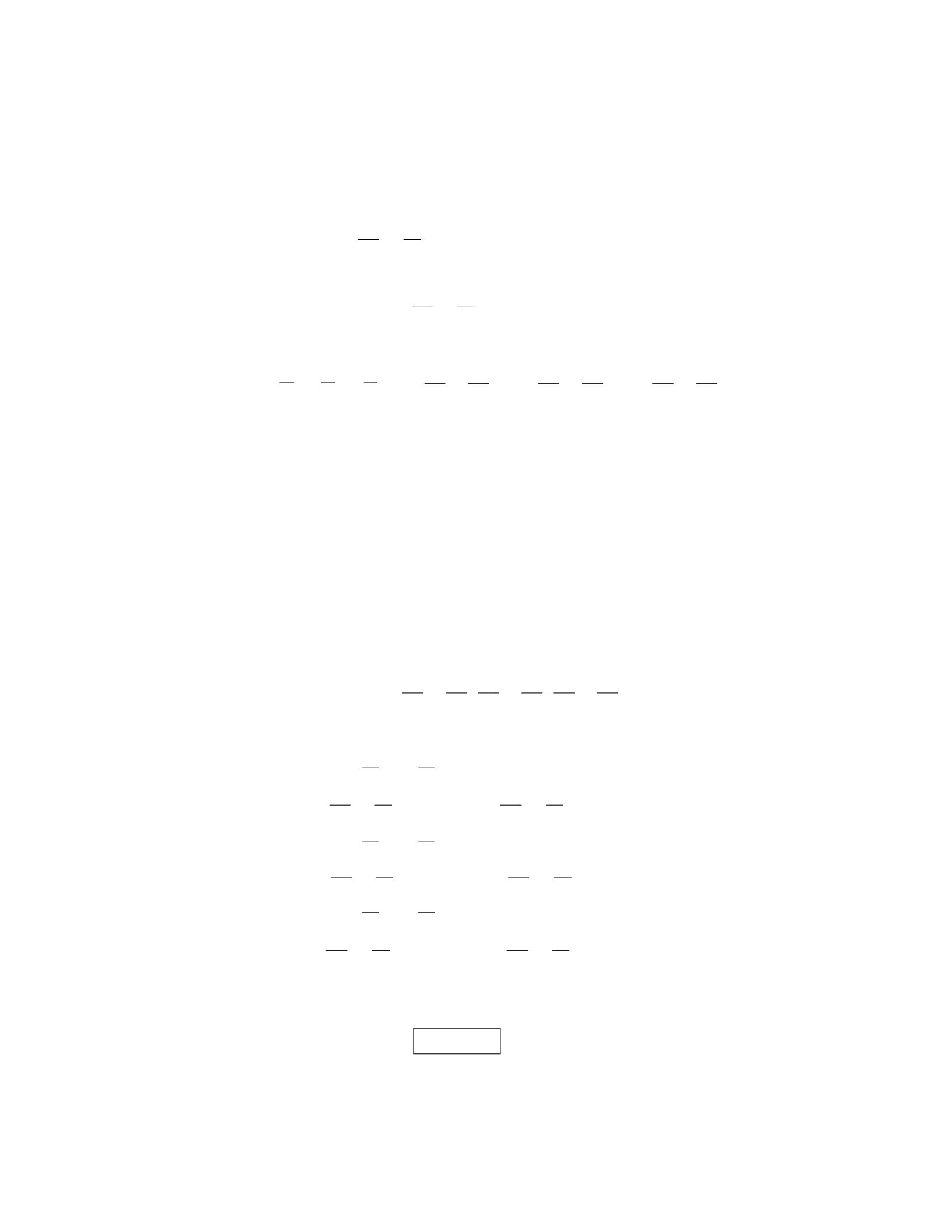
Step 3: Finally, evaluate the determinant to find the curl:
∇×F=
i j k
∂
∂x
∂
∂y
∂
∂z
exyz x2y zexy
=∂R
∂y −∂Q
∂z i−∂R
∂x −∂P
∂z j+∂Q
∂x −∂P
∂y k
= (xzexy )i−(yzexy )j+ (2xy)k
Therefore, the curl of Fis xzexy i−yzexy j+ 2xyk.
Question 6
Question
Let F(x, y, z)=(z2, xz, y) be a vector field in R3. Compute the curl of F.
Solution
To compute the curl of a vector field F(x, y, z)=(P(x, y, z), Q(x, y, z), R(x, y, z))
in R3, we can use the formula:
curl(F) = ∂R
∂y −∂Q
∂z ,∂P
∂z −∂R
∂x ,∂Q
∂x −∂P
∂y
Given F(x, y, z)=(z2, xz, y), we have P(x, y, z) = z2,Q(x, y, z) = xz, and
R(x, y, z) = y.
Step 1: Compute ∂R
∂y and ∂Q
∂z .
∂R
∂y =∂
∂y (y) = 1 and ∂Q
∂z =∂
∂z (xz) = x
Step 2: Compute ∂P
∂z and ∂R
∂x .
∂P
∂z =∂
∂z (z2) = 0 and ∂R
∂x =∂
∂x (y) = 0
Step 3: Compute ∂Q
∂x and ∂P
∂y .
∂Q
∂x =∂
∂x (xz) = zand ∂P
∂y =∂
∂y (z2)=0
Step 4: Assemble the components to find the curl of F.
curl(F) = (1 −x, 0−0, z −0) = (1 −x, 0, z)
Therefore, the curl of Fis (1 −x, 0, z) .
5
Question 7
Question
Let F(x, y, z) = exsin(y) cos(z)i+excos(y) cos(z)j+exsin(z)k. Calculate the
curl of F.
Solution
To find the curl of a vector field F(x, y, z) = P(x, y, z)i+Q(x, y, z)j+R(x, y, z)k,
we use the formula:
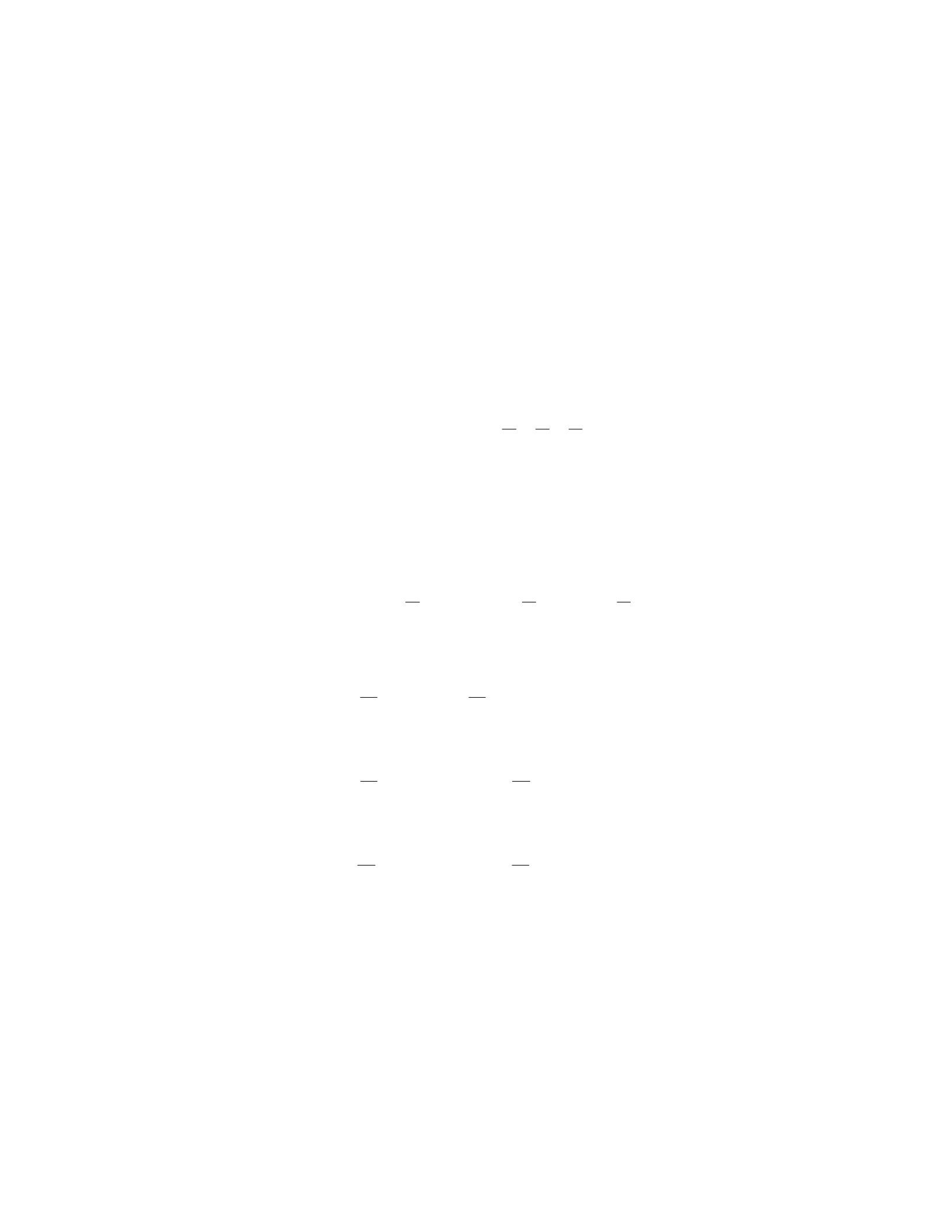
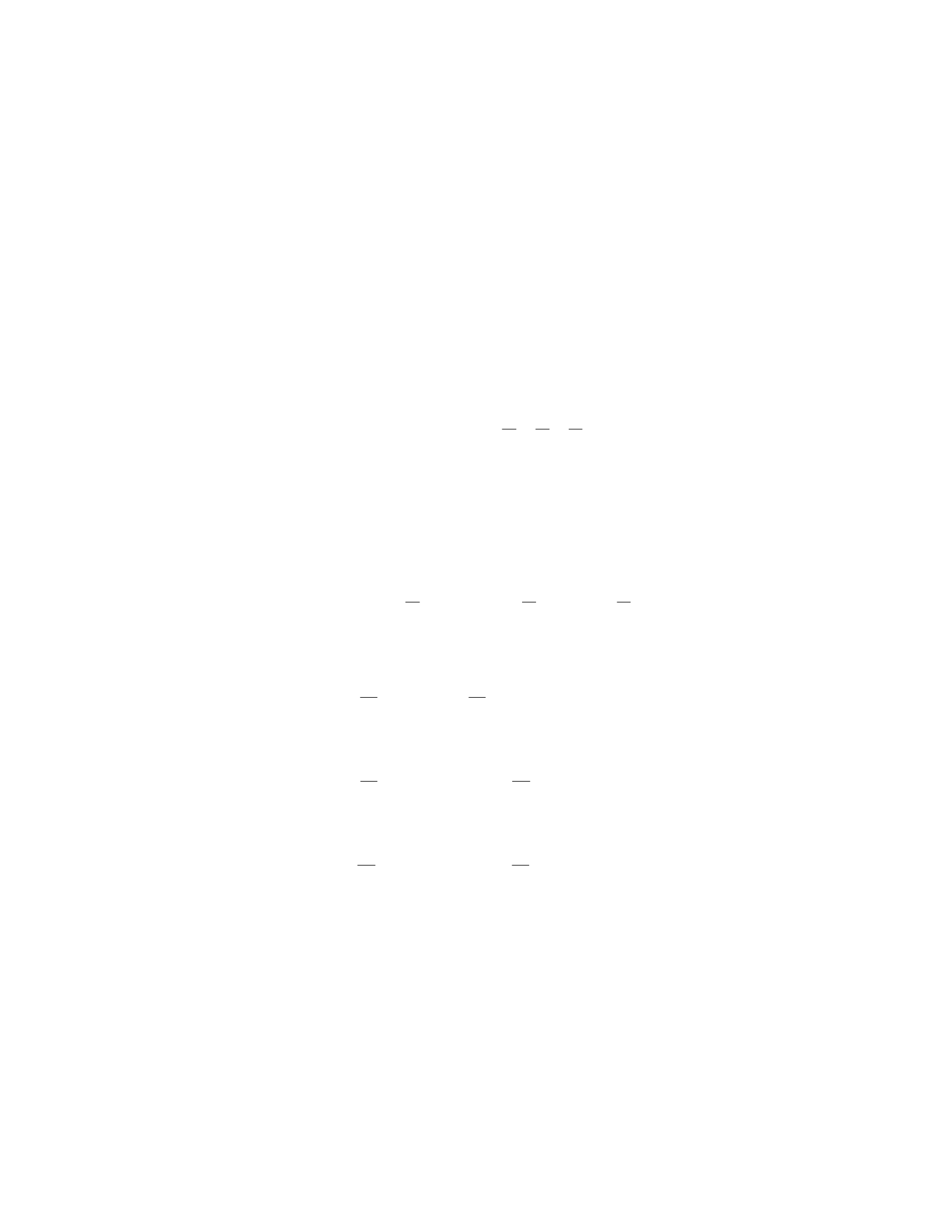
curl(F) = ∇ × F=
i j k
∂
∂x
∂
∂y
∂
∂z
P Q R
Given F(x, y, z) = exsin(y) cos(z)i+excos(y) cos(z)j+exsin(z)k, we have:
P(x, y, z) = exsin(y) cos(z), Q(x, y, z) = excos(y) cos(z), R(x, y, z) = exsin(z)
Now, let’s calculate the curl of F:
∇ × F=
i j k
∂
∂x
∂
∂y
∂
∂z
exsin(y) cos(z)excos(y) cos(z)exsin(z)
Step 1: Calculate the determinant using the iunit vector:
=∂
∂y (exsin(z)) −∂
∂z (excos(y) cos(z))i
Step 2: Calculate the jcomponent:
=∂
∂z (exsin(y) cos(z)) −∂
∂x (exsin(z))j
Step 3: Calculate the kcomponent:
=∂
∂x (excos(y) cos(z)) −∂
∂y (exsin(z))k
After calculating these partial derivatives, we can simplify the expressions
to determine the curl of F.
Question 8
Question
Let F(x, y, z)=(x2+y2+z2)i+yzj+xyk. Calculate the divergence of F.
6

Solution
To find the divergence of F, we need to calculate the dot product of the del
operator (∇) and F.
Step 1: Calculate the del operator: The del operator in Cartesian coordi-
nates is ∇=∂
∂x i+∂
∂y j+∂
∂z k.
Step 2: Calculate the dot product: The dot product of ∇and Fis given
by: ∇ · F=∂
∂x (x2+y2+z2) + ∂
∂y (yz) + ∂
∂z (xy).
Step 3: Calculate the partial derivatives: ∂
∂x (x2+y2+z2) = 2x,∂
∂y (yz) = z,
∂
∂z (xy) = x.
Step 4: Substitute the partial derivatives back into the dot product formula:
∇ · F= 2x+z+x.
Step 5: Simplify the expression: ∇ · F= 3x+z.
Therefore, the divergence of Fis 3x+z.
Question 9
Question
Let F(x, y, z) = yzi+xzj+xykbe a vector field in R3. Compute the gradient,
divergence, and curl of F.
Solution
Step 1: Compute the gradient of F. The gradient of a vector field F=Pi+
Qj+Rkis given by ∇F=∂P
∂x i+∂Q
∂y j+∂R
∂z k. Here, F(x, y, z) = yzi+xzj+xyk,
so P=yz,Q=xz, and R=xy. Therefore, the gradient of Fis:
∇F=∂(yz)
∂x i+∂(xz)
∂y j+∂(xy)
∂z k=zi+xj+yk.
Step 2: Compute the divergence of F. The divergence of a vector field
F=Pi+Qj+Rkis given by div F=∂P
∂x +∂Q
∂y +∂R
∂z . In this case, P=yz,
Q=xz, and R=xy. Therefore, the divergence of Fis:
div F=∂(yz)
∂x +∂(xz)
∂y +∂(xy)
∂z =z+z+x= 2z+x.
Step 3: Compute the curl of F. The curl of a vector field F=Pi+Qj+Rkis
given by curl F=∂R
∂y −∂Q
∂z i+∂P
∂z −∂R
∂x j+∂Q
∂x −∂P
∂y k. For F(x, y, z) =
yzi+xzj+xyk, we have P=yz,Q=xz, and R=xy. Thus, the curl of F
becomes:
curl F=∂(xy)
∂y −∂(xz)
∂z i+∂(yz)
∂z −∂(xy)
∂x j+∂(xz)
∂x −∂(yz)
∂y k= (x−x)i+(z−z)j+(y−y)k=0.
7
Question 10
Question
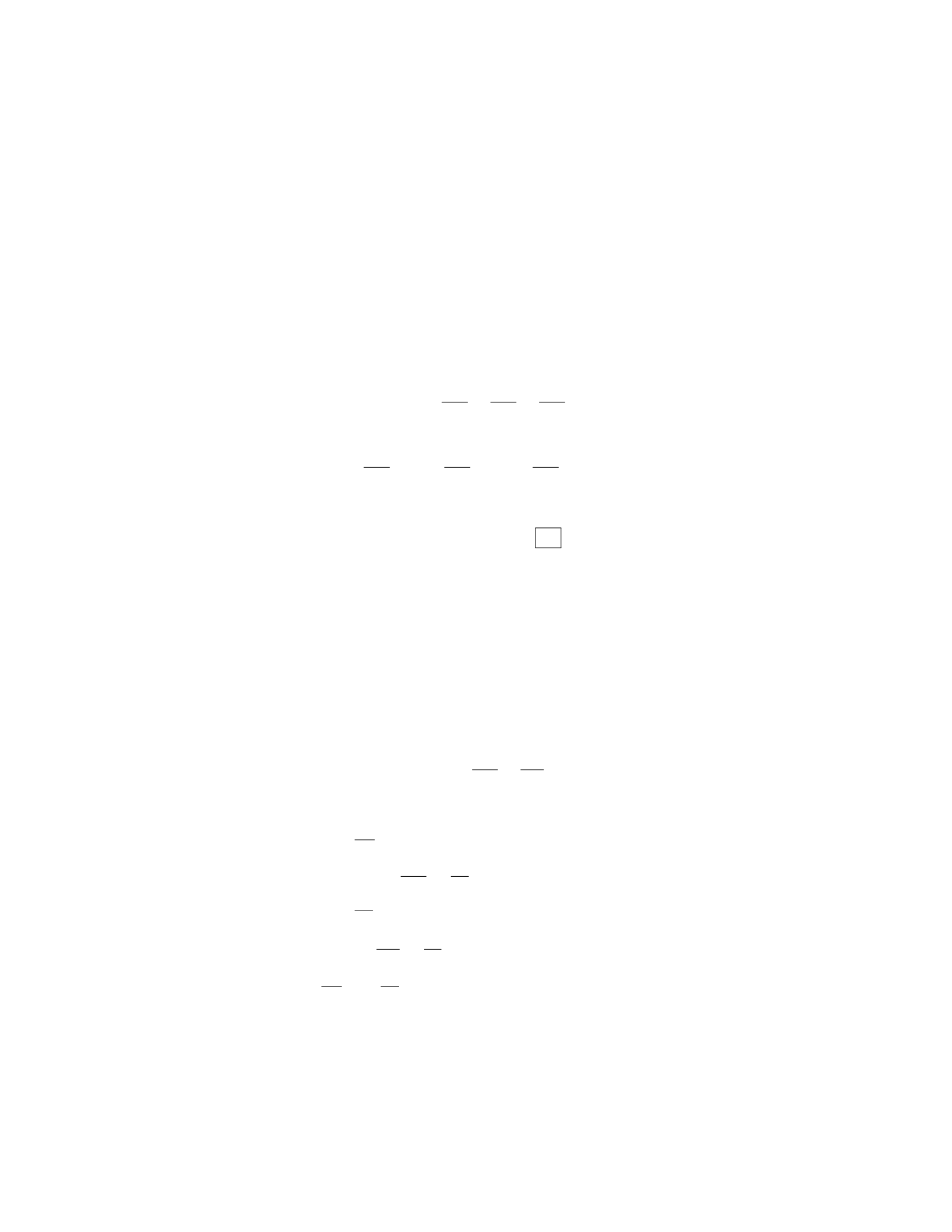
Let F(x, y, z) = (z2sin y, x2+2yz, exy ). Compute ∇·F, where ∇is the gradient
operator and ·denotes the divergence of a vector field.
Solution
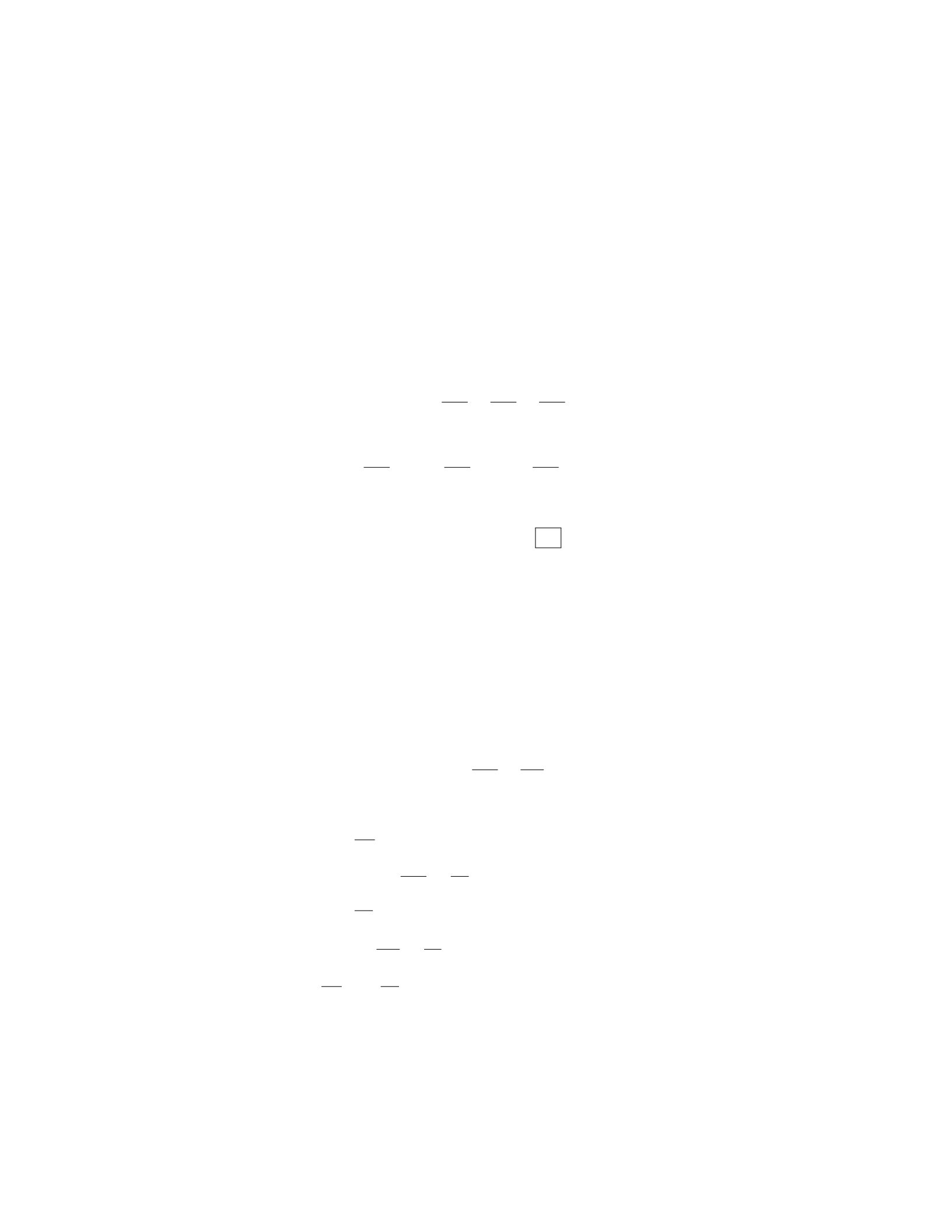
Step 1: Calculate the components of ∇ · Fusing the formula for divergence:
∇ · F=∂F1
∂x +∂F2
∂y +∂F3
∂z
Step 2: Find the partial derivatives of the components of F.
∂F1
∂x = 0,∂F2
∂y = 2z, ∂F3
∂z = 0
Step 3: Add the partial derivatives to find ∇ · F.
∇ · F= 0 + 2z+ 0 = 2z
Question 11
Question
Let F(x, y)=(x2y, 2xy −sin(x)). Compute the divergence of F.
Solution
Step 1: The divergence of a vector field F(x, y) = (M(x, y), N(x, y)) is given by
the following formula:
div(F) = ∂M
∂x +∂N
∂y
Step 2: Given F(x, y)=(x2y, 2xy−sin(x)), let M(x, y) = x2yand N(x, y) =
2xy −sin(x).
Step 3: Compute ∂M
∂x :
∂M
∂x =∂
∂x (x2y)=2xy
Step 4: Compute ∂N
∂y :
∂N
∂y =∂
∂y (2xy −sin(x)) = 2x
Step 5: Add ∂M
∂x and ∂N
∂y to find the divergence:
div(F)=2xy + 2x
Therefore, the divergence of Fis 2xy + 2x.
8
Question 12
Question
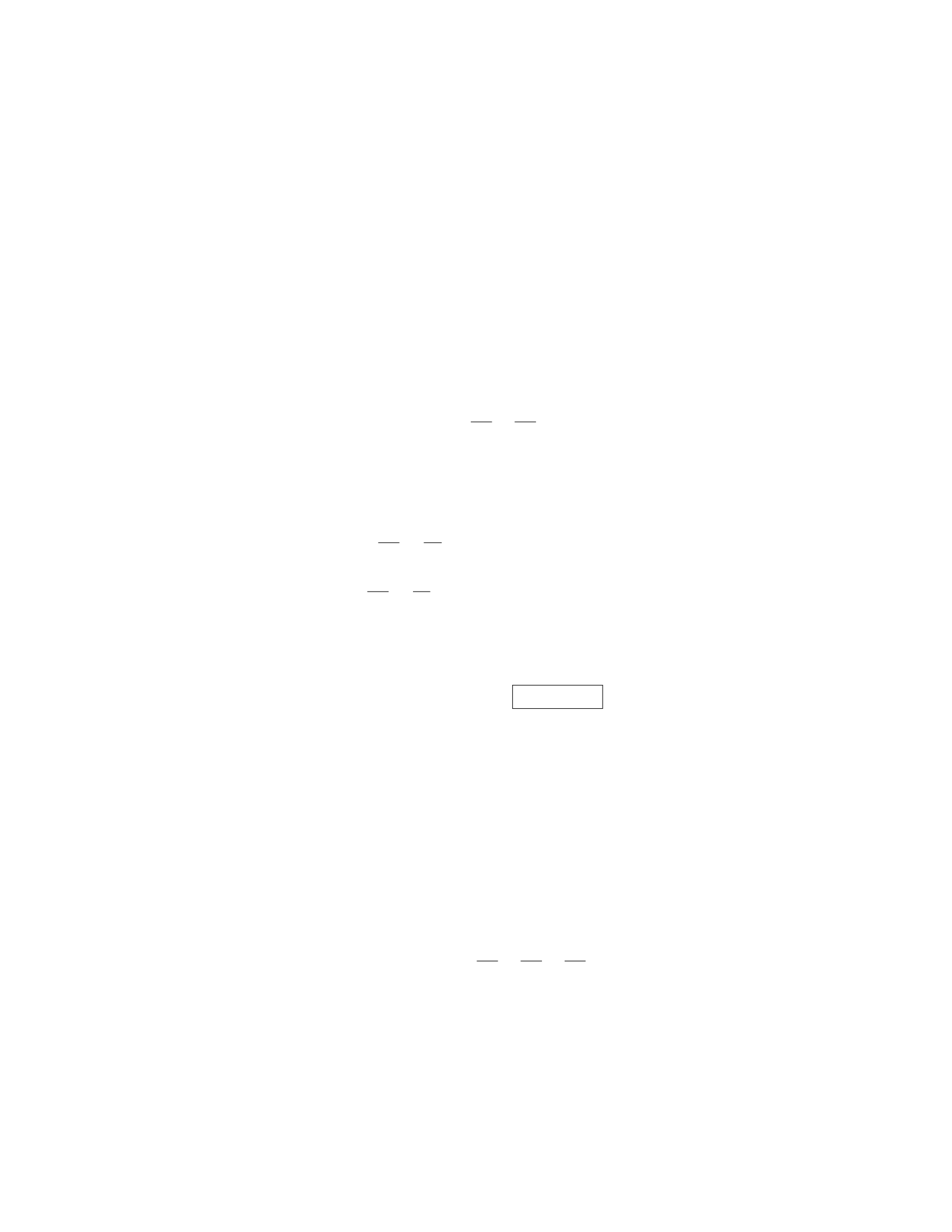
Let F(x, y)=(excos y, −exsin y). Compute ∇ · F.
Solution
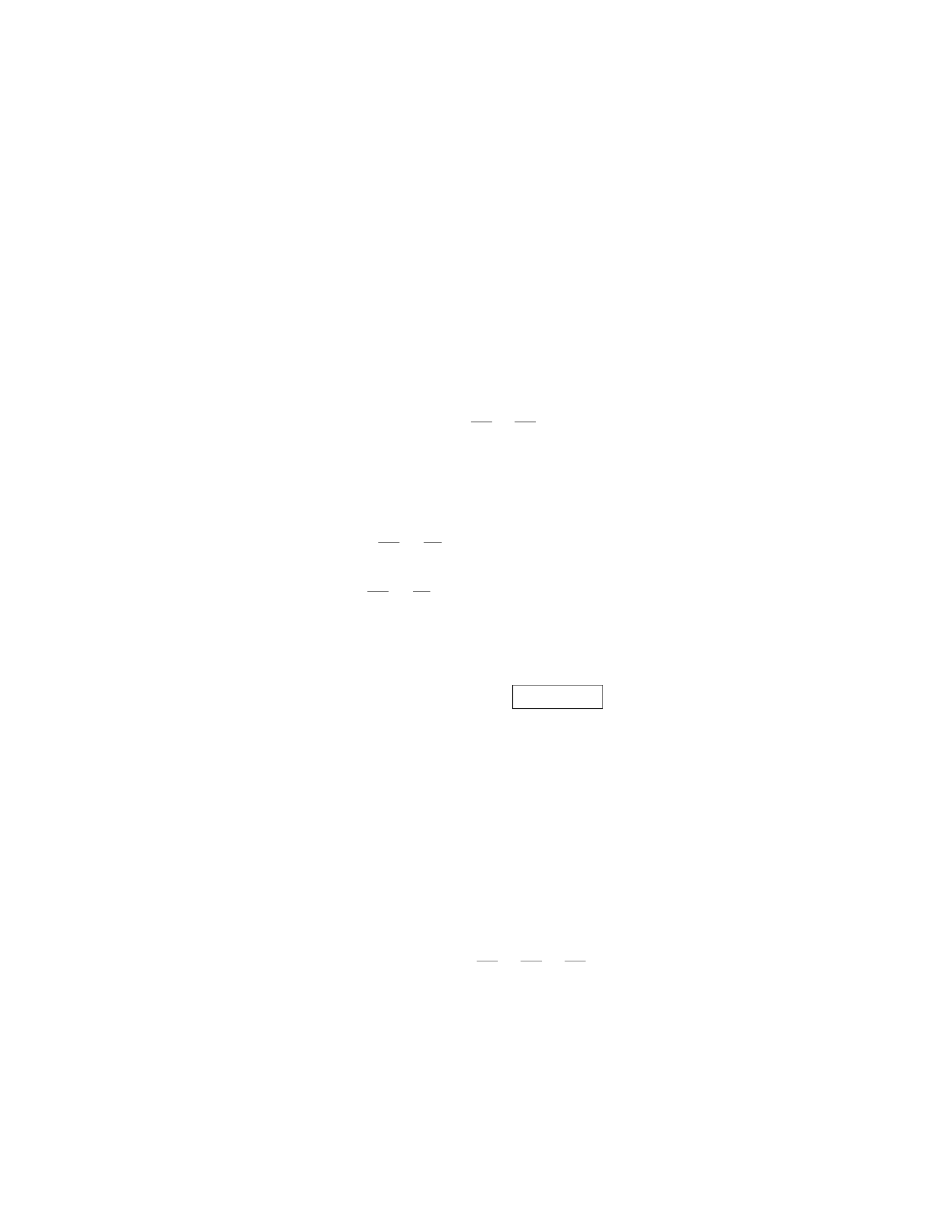
Step 1: We have F(x, y)=(excos y, −exsin y). To find ∇ · F, we need to
compute the divergence of F.
Step 2: The divergence of Fis given by the following formula:
∇ · F=∂P
∂x +∂Q
∂y
where F(x, y)=(P(x, y), Q(x, y)).
Step 3: In this case, P(x, y) = excos yand Q(x, y) = −exsin y.
Step 4: Let’s compute the partial derivatives:
∂P
∂x =∂
∂x (excos y) = excos y
∂Q
∂y =∂
∂y (−exsin y) = −excos y
Step 5: Now, we can find the divergence:
∇ · F=excos y−exsin y
Step 6: Therefore, the divergence of Fis cos y−sin y.
Question 13
Question
Let F(x, y, z) = (2x2y, −x2z, yz2) be a vector field in R3. Calculate the diver-
gence of Fat the point (1,2,3).
Solution
To find the divergence of a vector field F(x, y, z)=(P, Q, R) at a point (x0, y0, z0),
we use the formula:
div F=∇ · F=∂P
∂x +∂Q
∂y +∂R
∂z
Step 1: Write the vector field Fin terms of P,Q, and R:
F(x, y, z) = (2x2y, −x2z, yz2)
9
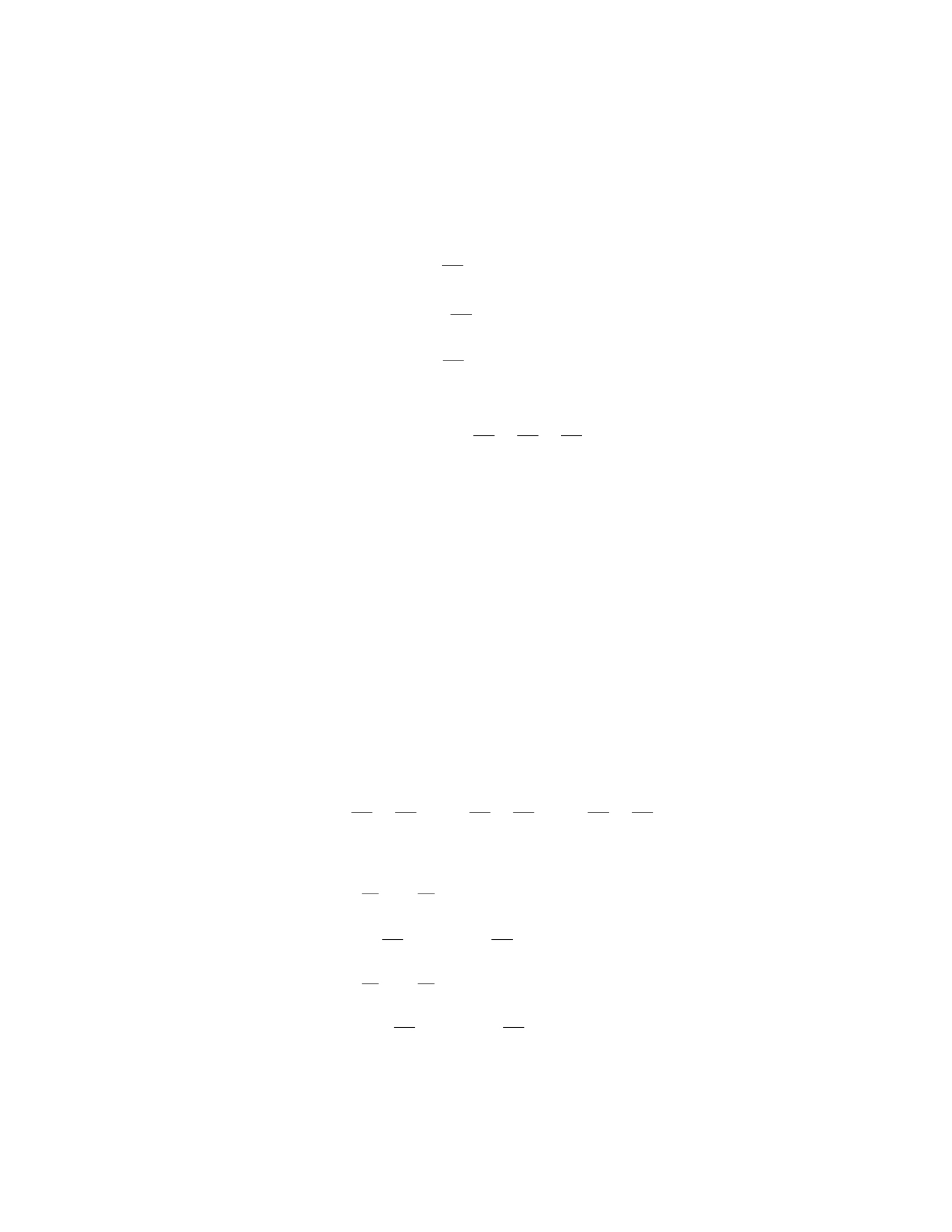
Here, P= 2x2y,Q=−x2z, and R=yz2.
Step 2: Calculate the partial derivatives needed:
∂P
∂x = 4xy
∂Q
∂y = 0
∂R
∂z = 2yz
Step 3: Find the divergence of Fat the point (1,2,3):
div F(1,2,3) = ∂P
∂x +∂Q
∂y +∂R
∂z
= 4(1)(2) + 0 + 2(2)(3)
= 8 + 12
= 20
Therefore, the divergence of Fat the point (1,2,3) is 20.
Question 14
Question
Let F(x, y, z) = xeyi+ex+zj+yzk. Compute the curl of F.
Solution
To compute the curl of a vector field F(x, y, z) = P(x, y, z)i+Q(x, y, z)j+
R(x, y, z)k, we use the formula:
curl(F) = ∂R
∂y −∂Q
∂z i−∂R
∂x −∂P
∂z j+∂Q
∂x −∂P
∂y k.
Given F(x, y, z) = xeyi+ex+zj+yzk, we have P(x, y, z) = xey,Q(x, y, z) =
ex+z, and R(x, y, z) = yz. Now, let’s compute the curl of Fstep-by-step.
Step 1: Compute ∂R
∂y and ∂Q
∂z .
∂R
∂y =zand ∂Q
∂z =ex+z.
Step 2: Compute ∂R
∂x and ∂P
∂z .
∂R
∂x = 0 and ∂P
∂z = 0.
10
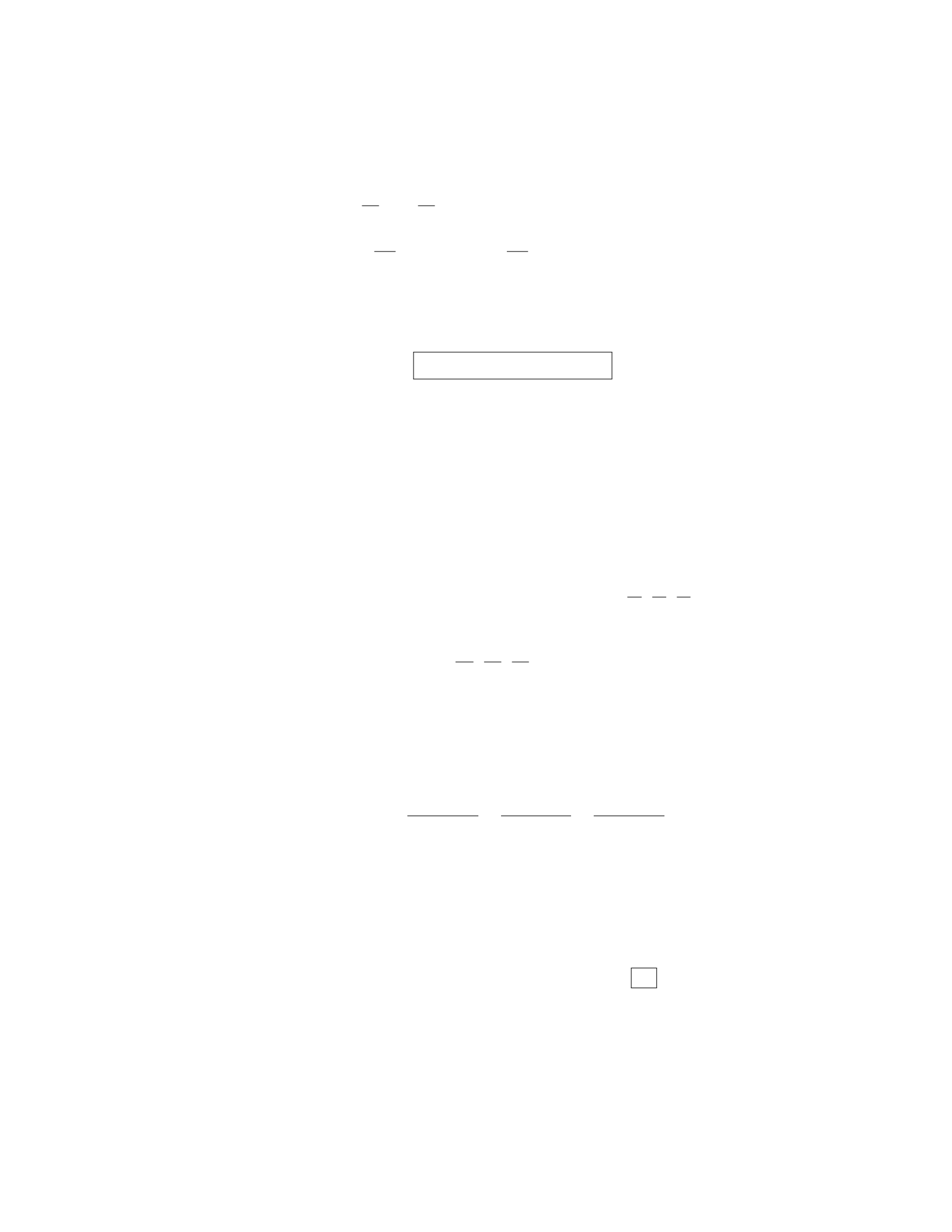
Step 3: Compute ∂Q
∂x and ∂P
∂y .
∂Q
∂x =ex+zand ∂P
∂y =xey.
Step 4: Assemble the components to find the curl of F:
curl(F)=(z−ex+z)i+ (0 −0)j+ (ex+z−xey)k.
Therefore, the curl of Fis (z−ex+z)i+ (ex+z−xey)k.
Question 15
Question
Let F(x, y, z) = (x2+y2)i+ (y2+z2)j+ (z2+x2)kbe a vector field. Calculate
the divergence of Fat the point (1,2,3).
Solution
To find the divergence of Fat a point, we use the formula: div(F) = ∇ · F,
where ∇is the del operator. In Cartesian coordinates, ∇=∂
∂x ,∂
∂y ,∂
∂z .
Step 1: Calculate the del operator ∇.
∇=∂
∂x ,∂
∂y ,∂
∂z
Step 2: Find the components of F.
F(x, y, z) = (x2+y2)i+ (y2+z2)j+ (z2+x2)k
Step 3: Find the divergence of F.
div(F) = ∇ · F=∂(x2+y2)
∂x +∂(y2+z2)
∂y +∂(z2+x2)
∂z
Step 4: Evaluate the divergence at the point (1,2,3).
div(F)(1,2,3) = 2x+ 2y+ 2z
Step 5: Substitute the values x= 1, y= 2, and z= 3 into the divergence
formula.
div(F)(1,2,3) = 2(1) + 2(2) + 2(3) = 2 + 4 + 6 = 12
Therefore, the divergence of Fat the point (1,2,3) is 12.
11
Question 16
Question
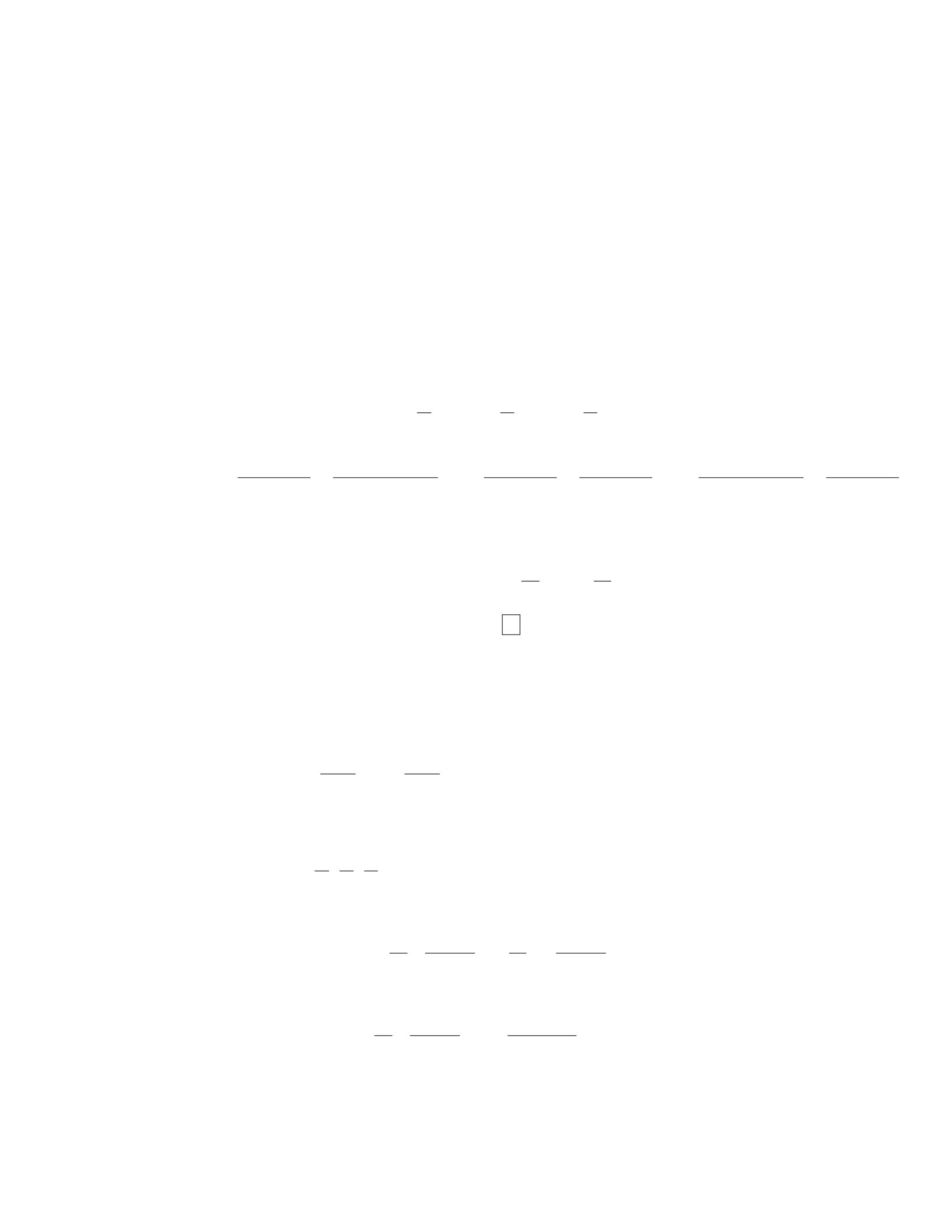
Let F(x, y, z) = (2xy +z)i+ (x2+y2+z2)j+ (xy −2z)k. Compute ∇·∇×F,
where ∇is the del operator.
Solution
Step 1: Compute the curl of F.
∇ × F=
i j k
∂
∂x
∂
∂y
∂
∂z
2xy +z x2+y2+z2xy −2z
=∂(xy −2z)
∂y −∂(x2+y2+z2)
∂z i−∂(2xy +z)
∂x −∂(xy −2z)
∂z j+∂(x2+y2+z2)
∂x −∂(2xy +z)
∂y k
= (−2)i−(−2)j+ (0)k=−2i+ 2j
Step 2: Compute the divergence of the curl of F.
∇ · ∇ × F=∇ · (−2i+ 2j) = ∂
∂x (−2) + ∂
∂y (2)
= 0 + 0 = 0
Therefore, ∇ · ∇ × F= 0.
Question 17
Question
Let F(x, y, z) = 1
x2+y2i+−x
x2+y2j. Compute ∇ · F.
Solution
To compute the divergence of F, we need to take the dot product of the del
operator ∇=∂
∂x ,∂
∂y ,∂
∂z with the vector field Fand then take the sum of the
individual components.
Step 1: Compute the divergence of F:
∇ · F=∂
∂x 1
x2+y2+∂
∂y −x
x2+y2
Step 2: Calculate the partial derivatives:
∂
∂x 1
x2+y2=−2x
(x2+y2)2
12
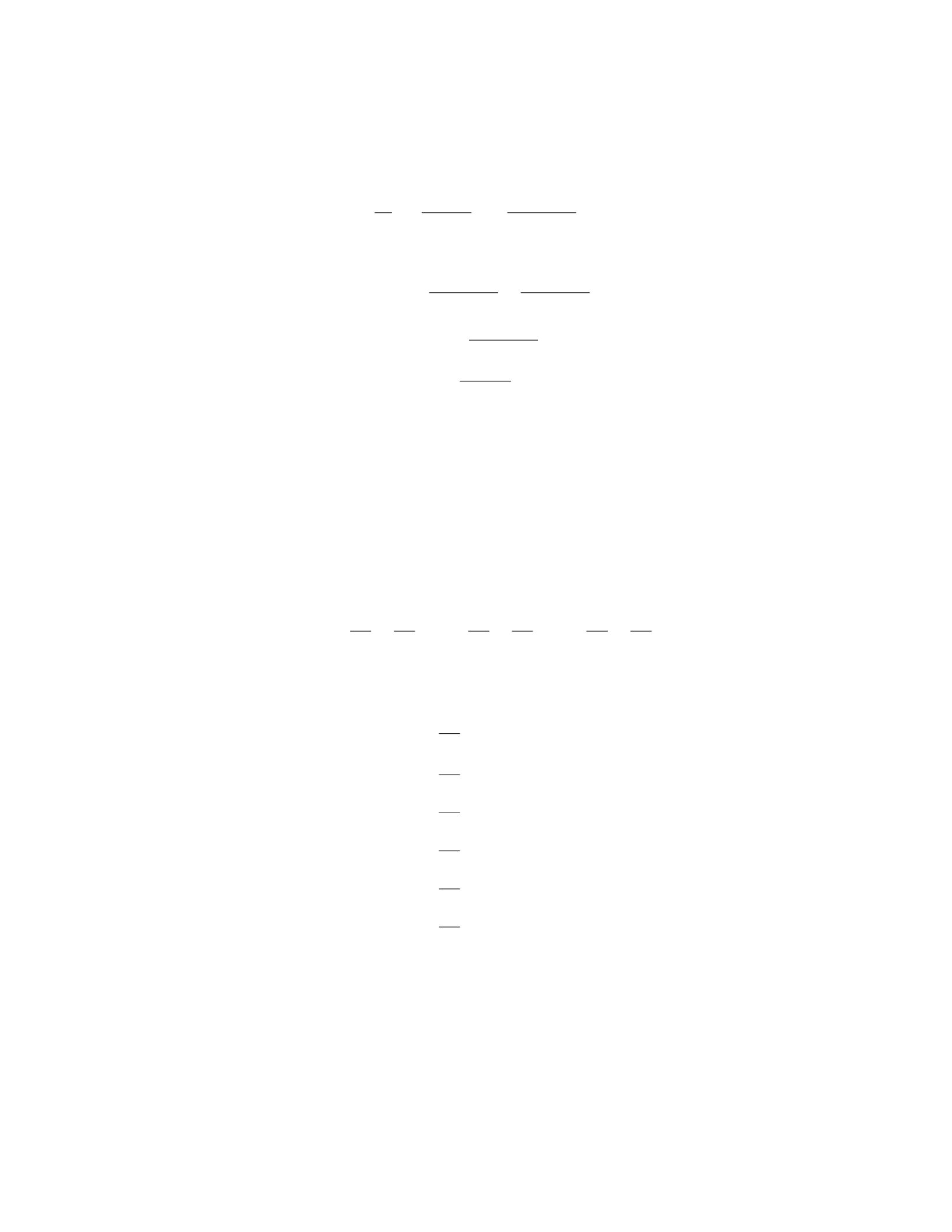
∂
∂y −x
x2+y2=2y
(x2+y2)2
Step 3: Substitute the partial derivatives back into the expression and sim-
plify:
∇ · F=−2x
(x2+y2)2+2y
(x2+y2)2
∇ · F=2(y−x)
(x2+y2)2
Therefore, the divergence of Fis 2(y−x)
(x2+y2)2.
Question 18
Question
Let F= (ey+ sin z)i+ (ez+ cos x)j+ (ex+ sin y)kbe a vector field in R3.
Compute the curl of F.
Solution
To find the curl of a vector field F=Pi+Qj+Rk, we use the formula:
curl F=∂R
∂y −∂Q
∂z i+∂P
∂z −∂R
∂x j+∂Q
∂x −∂P
∂y k
Step 1: Compute the partial derivatives of P,Q, and Rwith respect to x,
y, and z.
∂P
∂y =ey
∂P
∂z = cos z
∂Q
∂x = 0
∂Q
∂z =ez
∂R
∂x =ex
∂R
∂y = cos y
Step 2: Calculate the components of the curl of Fusing the computed
13
partial derivatives:
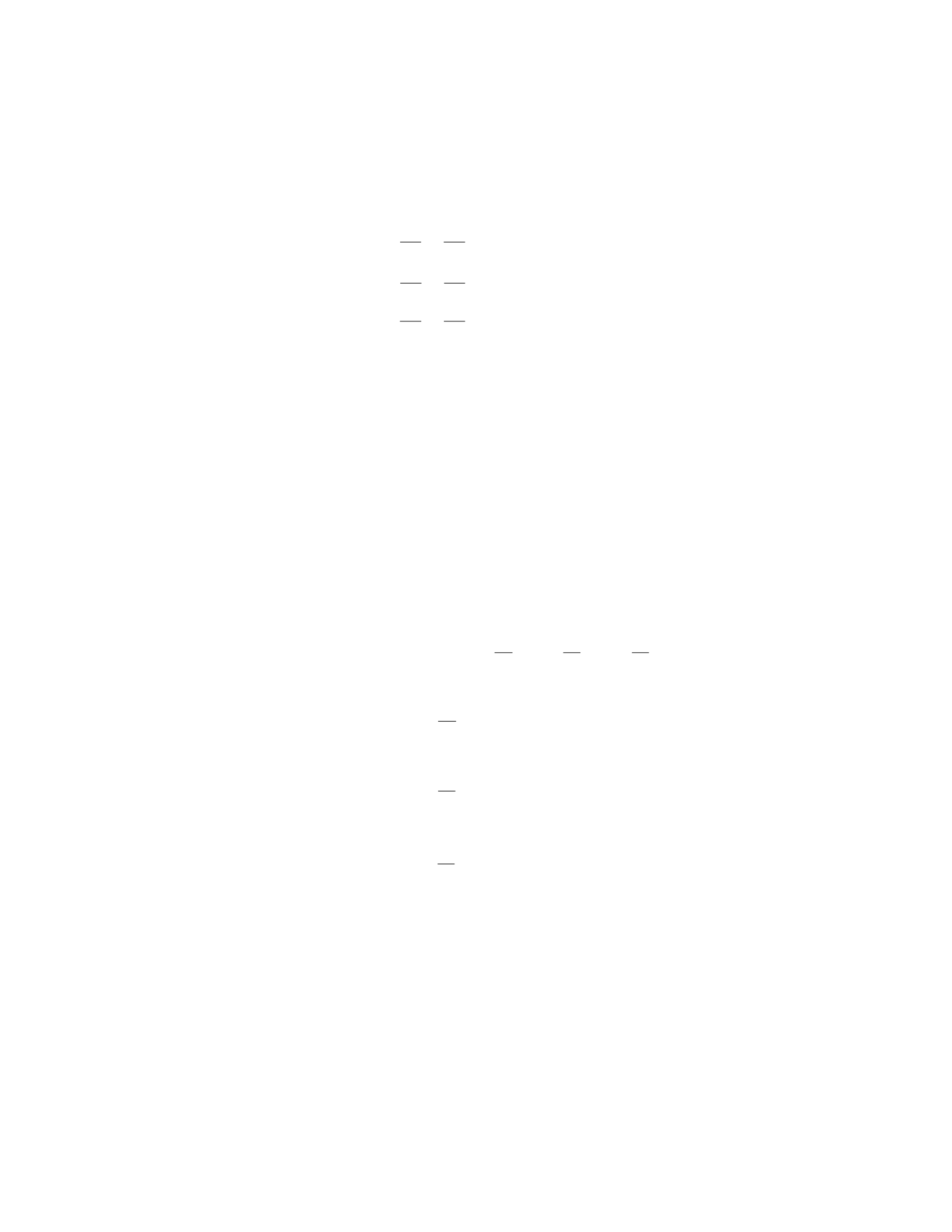
∂R
∂y −∂Q
∂z = cos y−ez
∂P
∂z −∂R
∂x = cos z−ex
∂Q
∂x −∂P
∂y =−ey
Therefore, the curl of Fis:
curl F= (cos y−ez)i+ (cos z−ex)j−eyk
Question 19
Question
Let F(x, y, z) = yzˆ
i+xzˆ
j+xyˆ
k. Find the divergence of F.
Solution
To find the divergence of F, we compute the dot product of the del operator ∇
with Fand then take the dot product of the resulting vector with the vector
function F.
∇ · F=∇ · (yzˆ
i+xzˆ
j+xyˆ
k) = ∂
∂x (yz) + ∂
∂y (xz) + ∂
∂z (xy)
Step 1: Compute the partial derivative with respect to x:
∂
∂x (yz) = z
Step 2: Compute the partial derivative with respect to y:
∂
∂y (xz) = z
Step 3: Compute the partial derivative with respect to z:
∂
∂z (xy) = x
Therefore, the divergence of Fis:
∇ · F=z+z+x= 2z+x
Question 20
Question
Let F(x, y, z)=(exsin y, excos y, z2) be a vector field. Compute the curl of F.
14

Solution
To compute the curl of F, we need to find the determinant of the following
matrix:
curl(F) =
i j k
∂
∂x
∂
∂y
∂
∂z
exsin y excos y z2
Step 1: Compute the partial derivatives Let’s compute the partial
derivatives of the vector field F:
∂
∂x = (exsin y, excos y, 0),
∂
∂y = (excos y, −exsin y, 0),
∂
∂z = (0,0,2z).
Step 2: Calculate the curl Now, we can use these partial derivatives to
find the curl as follows:
curl(F) = ∂
∂y (z2)−∂
∂z (excos y),∂
∂z (exsin y)−∂
∂x (z2),∂
∂x (excos y)−∂
∂y (exsin y)
= (0 −0,0−0, exsin y−(−excos y))
= (0,0,2exsin y).
Therefore, the curl of Fis curl(F) = k·2exsin y= 2exsin yk.
Question 21
Question
Let F(x, y, z) = x2yi+xyzj+x2zkbe a vector field in R3. Compute ∇ · ∇ × F.
Solution
Step 1: Compute ∇ × F.
∇ × F=
i j k
∂
∂x
∂
∂y
∂
∂z
x2y xyz x2z
=∂(x2z)
∂y −∂(xyz)
∂z i−∂(x2z)
∂x −∂(x2y)
∂z j+∂(xyz)
∂x −∂(x2y)
∂y k
= (0 −x)i−(2xz −0)j+ (yz −2xy)k=−xi−2xzj+ (y−2x)k
15

Step 2: Compute ∇ · ∇ × F(divergence of ∇ × F).
∇ · v=∂
∂x (−x) + ∂
∂y (−2xz) + ∂
∂z (y−2x)
=−1−2x+ 0 = −1−2x
Therefore, ∇ · ∇ × F=−1−2x.
Question 22
Question
Let F(x, y, z) = ⟨exy , x2y3z, z2
x2+y2⟩. Find the divergence of F.
Solution
To find the divergence of a vector field F=⟨P, Q, R⟩, we use the formula
div(F) = ∂P
∂x +∂Q
∂y +∂R
∂z .
Step 1: Calculate the partial derivatives of P=exy,Q=x2y3z, and
R=z2
x2+y2.
∂P
∂x =yexy ,∂Q
∂y = 3x2y2z, ∂R
∂z =2z(x2+y2)−z2(2x)
(x2+y2)2
Step 2: Add up the partial derivatives to find the divergence.
div(F) = ∂P
∂x +∂Q
∂y +∂R
∂z
=yexy + 3x2y2z+2z(x2+y2)−z2(2x)
(x2+y2)2
Therefore, the divergence of F(x, y, z) = ⟨exy, x2y3z, z2
x2+y2⟩is yexy+3x2y2z+
2z(x2+y2)−z2(2x)
(x2+y2)2.
Question 23
Question
Let F(x, y, z) = x2y+ 2yz, xz, x2+ 3z2. Calculate the curl of Fat the point
(1,1,1).
16
Solution
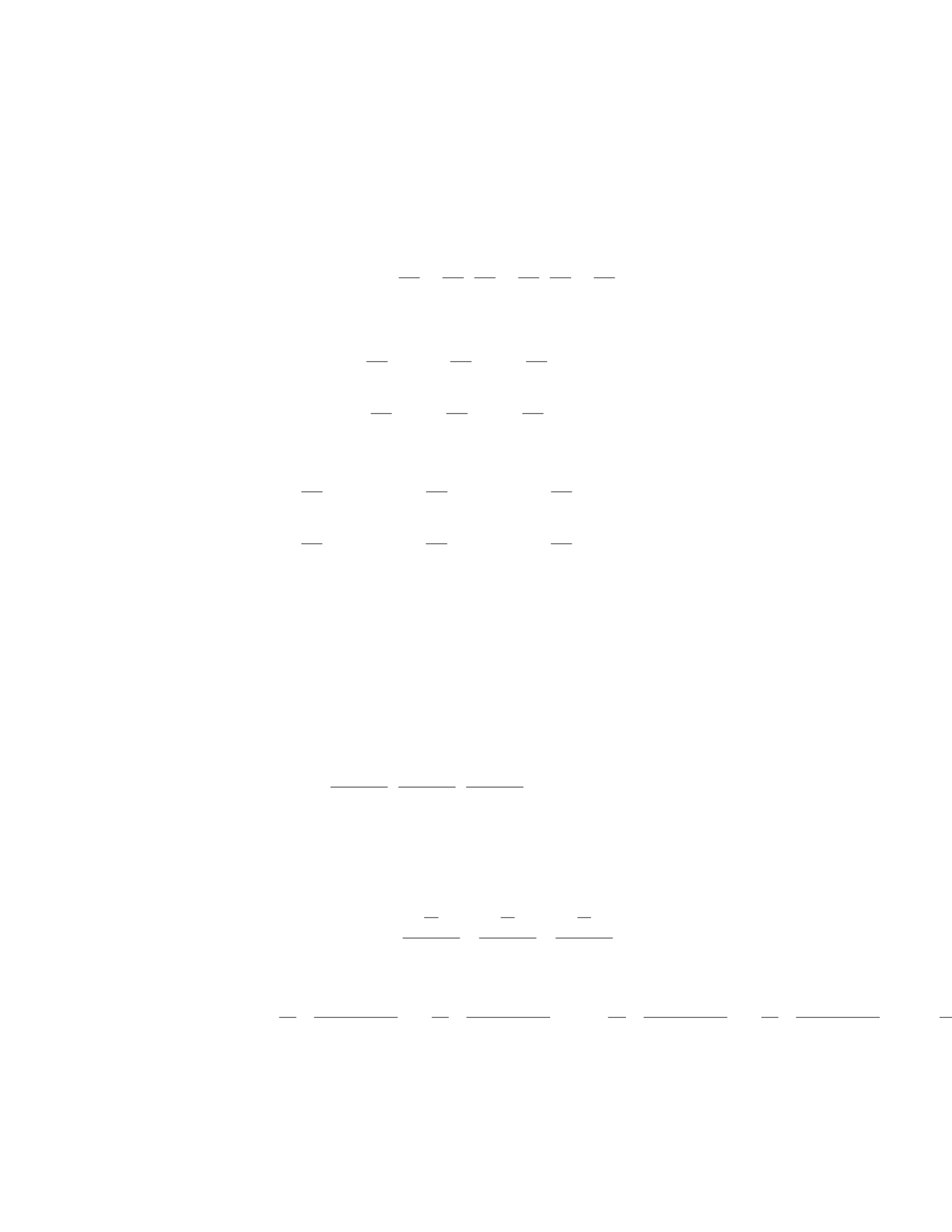
To find the curl of a vector field F= (P, Q, R), we can use the formula:
curl F=∂R
∂y −∂Q
∂z ,∂P
∂z −∂R
∂x ,∂Q
∂x −∂P
∂y
Step 1: Compute the partial derivatives of P,Q, and R:
∂P
∂y =x2,∂Q
∂z = 0,∂R
∂x = 2x
∂R
∂y = 0,∂Q
∂x =z, ∂P
∂z = 2y
Step 2: Evaluate the derivatives at the point (1,1,1):
∂P
∂y (1,1,1) = 1,∂Q
∂z (1,1,1) = 0,∂R
∂x (1,1,1) = 2
∂R
∂y (1,1,1) = 0,∂Q
∂x (1,1,1) = 1,∂P
∂z (1,1,1) = 2
Step 3: Substitute the values into the curl formula and compute the curl
at the point (1,1,1):
curl F(1,1,1) = (1 −0,2−2,1−2) = (1,0,−1)
Therefore, the curl of Fat the point (1,1,1) is (1,0,−1).
Question 24
Question
Let
F(x, y, z) = yz
x2+y2+z2,xz
x2+y2+z2,xy
x2+y2+z2. Find the curl of
F.
Solution
Step 1: Compute the components of the curl, ∇ ×
F.
∇ ×
F=
ˆ
iˆ
jˆ
k
∂
∂x
∂
∂y
∂
∂z
yz
x2+y2+z2
xz
x2+y2+z2
xy
x2+y2+z2
Step 2: Expand the determinant.
∇×
F=∂
∂y xy
x2+y2+z2−∂
∂z xz
x2+y2+z2ˆ
i−∂
∂x yz
x2+y2+z2−∂
∂z xy
x2+y2+z2ˆ
j+∂
∂x xz
x2+y2+z2−∂
∂y yz
x2+y2+z2ˆ
k
17

Step 3: Differentiate each component.
∇×
F=y(x2+y2+z2)−xy(2y)
(x2+y2+z2)2ˆ
i−z(x2+y2+z2)−xz(2z)
(x2+y2+z2)2ˆ
j+x(x2+y2+z2)−xz(2x)
(x2+y2+z2)2ˆ
k
Step 4: Simplify the components.
∇×
F=y(x2+y2+z2)−2xy2
(x2+y2+z2)2ˆ
i−z(x2+y2+z2)−2xz2
(x2+y2+z2)2ˆ
j+x(x2+y2+z2)−2x2z
(x2+y2+z2)2ˆ
k
Therefore, the curl of
Fis ∇×
F=y(x2+y2+z2)−2xy2
(x2+y2+z2)2ˆ
i−z(x2+y2+z2)−2xz2
(x2+y2+z2)2ˆ
j+
x(x2+y2+z2)−2x2z
(x2+y2+z2)2ˆ
k.
Question 25
Question
Let F= (x2+y2, ez,cos(y)) be a vector field in R3. Determine ∇ · F,∇ × F,
and ∇ × (∇ × F).
Solution
Step 1: Calculate ∇ · F
The divergence of a vector field F= (P(x, y, z), Q(x, y, z), R(x, y, z)) is given
by ∇ · F=∂P
∂x +∂Q
∂y +∂R
∂z .
In this case, F= (x2+y2, ez,cos(y)), so we have:
∇ · F=∂
∂x (x2+y2) + ∂
∂y (ez) + ∂
∂z (cos(y))
∇ · F= 2x+ 0 + 0
∇ · F= 2x
Step 2: Calculate ∇ × F
The curl of a vector field F= (P(x, y, z), Q(x, y, z), R(x, y, z)) is given by
∇ × F=∂R
∂y −∂Q
∂z ,∂P
∂z −∂R
∂x ,∂Q
∂x −∂P
∂y .
For our vector field F= (x2+y2, ez,cos(y)), we get:
∇ × F= (0 −0,0−0,0−0) = 0
Step 3: Calculate ∇ × (∇ × F)
The curl of a vector field can be defined as ∇ × (∇ × F) = ∇(∇ · F)− ∇2F,
where ∇2Frepresents the Laplacian operator acting on F.
Since ∇ · F= 2x, we have:
∇ × (∇ × F) = ∇(2x)− ∇2F
The Laplacian operator applied to Fis zero in this case as Fis a vector
field, so:
∇ × (∇ × F)=0−0 = 0
18
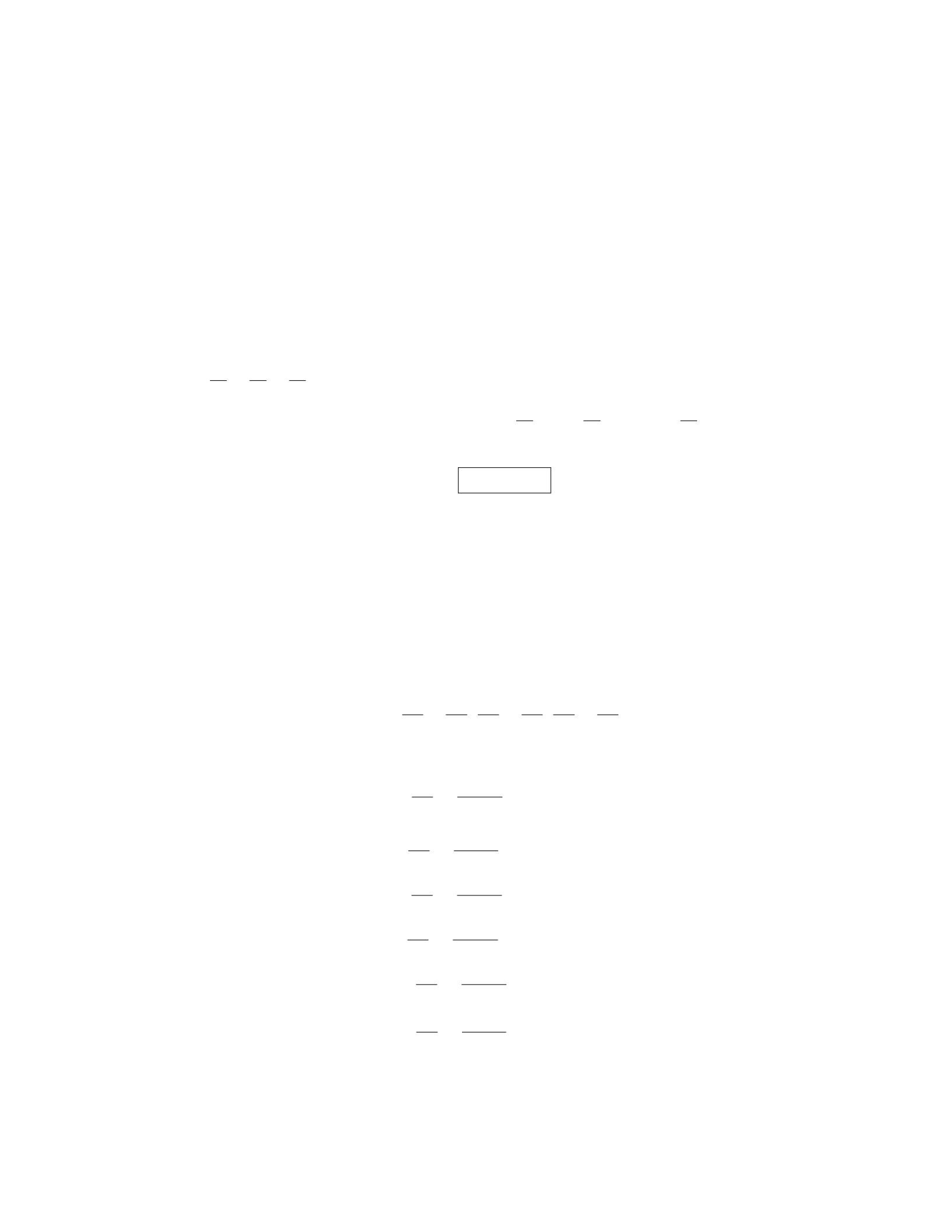
Question 26
Question
Let F(x, y, z) = (x2+y2)i+ (y2+z2)j+ (z2+x2)k. Calculate the divergence
of F.
Solution
Step 1: The divergence of a vector field F=Pi+Qj+Rkis given by ∇ · F=
∂P
∂x +∂Q
∂y +∂R
∂z .
Step 2: In this case, P=x2+y2,Q=y2+z2, and R=z2+x2.
Step 3: Calculate the partial derivatives: ∂P
∂x = 2x,∂Q
∂y = 2y, and ∂R
∂z = 2z.
Step 4: Add the partial derivatives to find the divergence: ∇ · F= 2x+ 2y+
2z= 2(x+y+z).
Therefore, the divergence of Fis 2(x+y+z) .
Question 27
Question
Let F(x, y, z)=(xz2, yz2, x2y) be a vector field in R3. Calculate div(curl(F)).
Solution
Step 1: Calculate the curl of F. The curl of a vector field F(x, y, z)=(P, Q, R)
is given by:
curl(F) = ∂R
∂y −∂Q
∂z ,∂P
∂z −∂R
∂x ,∂Q
∂x −∂P
∂y
In this case, F(x, y, z)=(xz2, yz2, x2y). So we have:
∂R
∂y =∂(x2y)
∂y =x2
∂Q
∂z =∂(yz2)
∂z = 2yz
∂P
∂z =∂(xz2)
∂z =xz
∂R
∂x =∂(x2y)
∂x = 2xy
∂P
∂y =∂(xz2)
∂y = 0
∂Q
∂x =∂(yz2)
∂x = 0
19
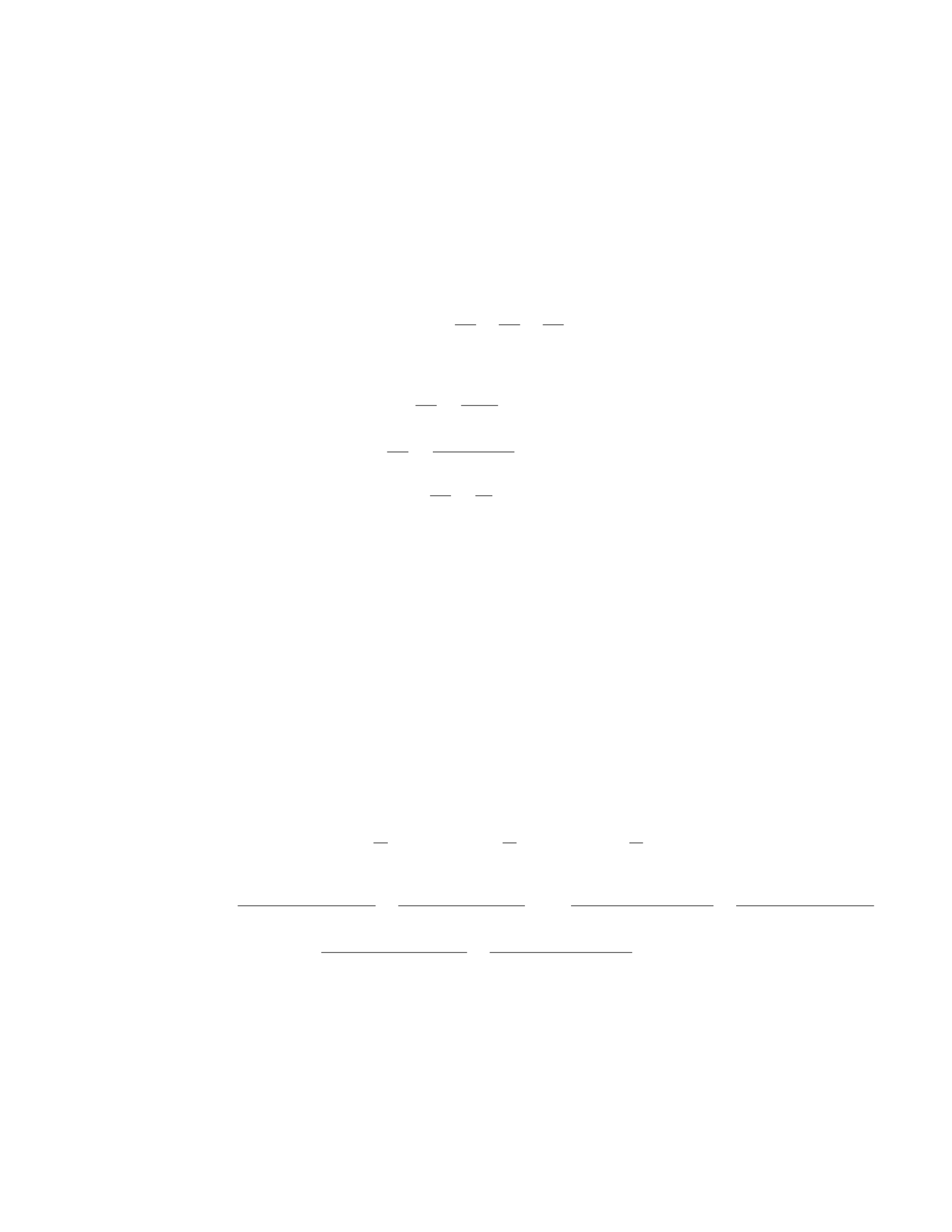
Therefore, the curl of Fis:
curl(F)=(x2−0, xz −2xy, 0−0) = (x2, xz −2xy, 0)
Step 2: Calculate the divergence of the curl of F. The divergence of a vector
field G(x, y, z)=(P, Q, R) is given by:
div(G) = ∂P
∂x +∂Q
∂y +∂R
∂z
In this case, G(x, y, z) = (x2, xz −2xy, 0). So we have:
∂P
∂x =∂(x2)
∂x = 2x
∂Q
∂y =∂(xz −2xy)
∂y =−2x
∂R
∂z =∂0
∂z = 0
Therefore, the divergence of the curl of Fis:
div(curl(F)) = 2x−2x+ 0 = 0
So, div(curl(F)) = 0.
Question 28
Question
Let F= (yexz −zln (y+ 1), xz2−ycos (xz), y ln (x+ 1) −xy2) be a vector field
in R3. Calculate ∇ · ∇ × F.
Solution
Step 1: First, we calculate the curl of F.
∇ × F=
i j k
∂
∂x
∂
∂y
∂
∂z
yexz −zln (y+ 1) xz2−ycos (xz)yln (x+ 1) −xy2
=∂(yln (x+ 1) −xy2)
∂y −∂(xz2−ycos (xz))
∂z i−∂(yexz −zln (y+ 1))
∂x −∂(yln (x+ 1) −xy2)
∂z j
+∂(yz ln (x+ 1) −xy2)
∂x −∂(yexz −zln (y+ 1))
∂y k
Step 2: Simplify the above expression to find ∇ × F.
Step 3: Once we have ∇ × F, we compute ∇ · (∇ × F).
Step 4: Substitute the values we found for ∇ × Finto this expression and
simplify to find the final answer.
20

Question 29
Question
Let F(x, y, z)=(x2, yz, xyz) be a vector field in R3. Find the curl of F.
Solution
To find the curl of F, we can use the formula:
curl F=∂F3
∂y −∂F2
∂z ,∂F1
∂z −∂F3
∂x ,∂F2
∂x −∂F1
∂y
Step 1: Compute the partial derivatives of F:
∂F1
∂x = 2x, ∂F2
∂y =z, ∂F3
∂z =xy
∂F1
∂y = 0,∂F2
∂z =y, ∂F3
∂x =yz
Step 2: Calculate the curl of F:
curl F= (y−0, xy −z, z −2x)
curl F= (y, xy −z, z −2x)
Therefore, the curl of the vector field F(x, y, z) = (x2, yz, xyz) is curl F=
(y, xy −z, z −2x).
Question 30
Question
Let F(x, y, z)=(z2, xz, xy) be a vector field in three-dimensional space. Deter-
mine the gradient, divergence, and curl of F.
Solution
Step 1: Calculate the gradient of F. The gradient of a vector field Fis denoted
by ∇Fand is given by:
∇F=∂F1
∂x ,∂F2
∂y ,∂F3
∂z
where F= (F1, F2, F3). In this case, F(x, y, z)=(z2, xz, xy), so we have:
∇F=∂z2
∂x ,∂xz
∂y ,∂xy
∂z
21

Step 2: Evaluate the partial derivatives and simplify.
) = (2x - 0)i+ (2z - 0)j+ (x2−2z)k
= 2xi+ 2zj+ (x2−2z)k.
Therefore, the curl of Fis 2xi+ 2zj+ (x2−2z)k.
Question 2
Question
Let Fbe a vector field defined by F(x, y, z) = (2xyz, x2z, xy2). Compute the
curl of F.
Solution
To compute the curl of a vector field F= (P, Q, R), we use the formula:
curl(F) = ∂R
∂y −∂Q
∂z ,∂P
∂z −∂R
∂x ,∂Q
∂x −∂P
∂y
Step 1: Compute partial derivatives of P,Q, and RGiven F(x, y, z) =
(2xyz, x2z, xy2), we have:
P= 2xyz, Q =x2z, R =xy2
Compute the partial derivatives:
∂P
∂z = 2xy
∂Q
∂x = 2xz
∂R
∂y = 2xy
∂P
∂y = 2xz
∂R
∂x =y2
∂Q
∂z =x2
Step 2: Compute the curl of F Now, plug the partial derivatives into
the formula for the curl:
curl(F) = 2xy −2xz, 2xz −y2, x2−2xy
Therefore, the curl of Fis curl(F) = (2xy −2xz, 2xz −y2, x2−2xy).
2

Question 3
Question
Let F(x, y, z) = x3yi+y3zj+z3xk. Calculate the curl of Fat the point (1,2,3).
Solution
Step 1: The curl of a vector field F(x, y, z) = P(x, y, z)i+Q(x, y, z)j+R(x, y, z)k
is given by the formula:
∇ × F=∂R
∂y −∂Q
∂z i−∂R
∂x −∂P
∂z j+∂Q
∂x −∂P
∂y k
Step 2: Let’s find the partial derivatives of F:
P(x, y, z) = x3y, Q(x, y, z) = y3z, R(x, y, z) = z3x
∂P
∂y =x3,∂Q
∂z =y3,∂R
∂x = 3z2
∂Q
∂x = 0,∂P
∂z = 0,∂R
∂y = 3x2
Step 3: Substituting these into the curl formula, we have:
∇ × F=∂R
∂y −∂Q
∂z i−∂R
∂x −∂P
∂z j+∂Q
∂x −∂P
∂y k
= (3x2−y3)i−(3z2−0)j+ (0 −x3)k
= (3 −8)i−(9 −0)j+ (0 −1)k
=−5i−9j−k
Step 4: Finally, computing the curl at (1,2,3):
∇ × F(1,2,3) = −5i−9j−k
Question 4
Question
Let F(x, y, z)=(x2y+yz, xz, y2z) be a vector field in R3. Compute the curl of
F.
Solution
To find the curl of a vector field F(x, y, z)=(P, Q, R) in R3, we use the formula:
curl(F) = ∂R
∂y −∂Q
∂z ,∂P
∂z −∂R
∂x ,∂Q
∂x −∂P
∂y
3
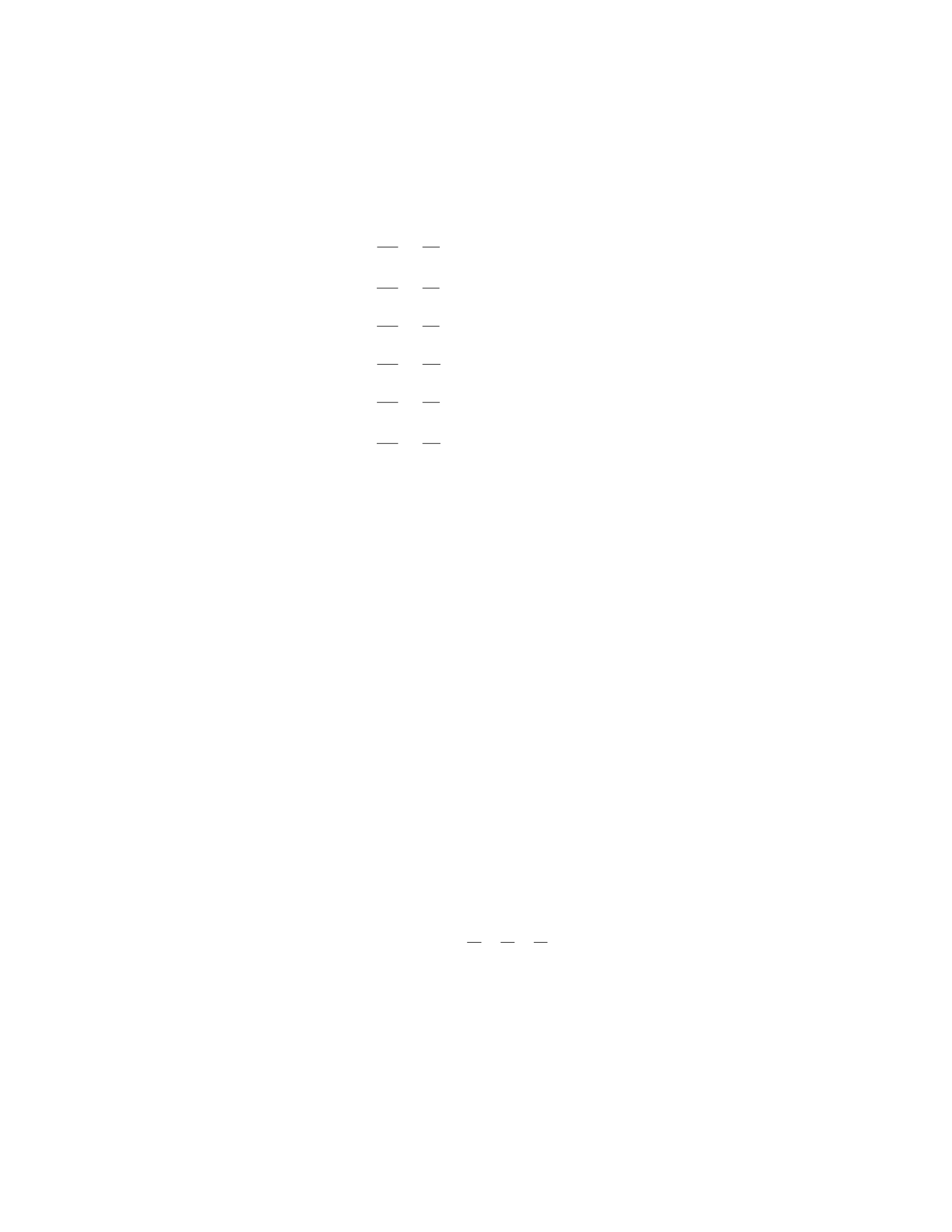
Step 1: Compute the partial derivatives.
∂R
∂y =∂
∂y (y2z)=2yz
∂Q
∂z =∂
∂z (xz) = x
∂P
∂z =∂
∂z (x2y+yz) = y
∂R
∂x =∂
∂x (y2z)=0
∂P
∂y =∂
∂y (x2y+yz) = x2+z
∂Q
∂x =∂
∂x (xz) = z
Step 2: Substitute the computed partial derivatives into the formula for
the curl.
curl(F) = 2yz −x, y −0, z −(x2+z)
= (2yz −x, y, z −x2−z)
= (2yz −x, y, −x2)
Therefore, the curl of the vector field F(x, y, z)=(x2y+yz, xz, y2z) is
curl(F) = (2yz −x, y, −x2).
Question 5
Question
Let F(x, y, z) = exyzi+x2yj+zexykbe a vector field in three-dimensional space.
Calculate the curl of F.
Solution
To calculate the curl of a vector field F(x, y, z) = P(x, y, z)i+Q(x, y, z)j+
R(x, y, z)k, we use the formula:
∇ × F=
i j k
∂
∂x
∂
∂y
∂
∂z
P Q R
In this case, we have F(x, y, z) = exyzi+x2yj+zexyk, so P(x, y, z) = exyz,
Q(x, y, z) = x2y, and R(x, y, z) = zexy .
4
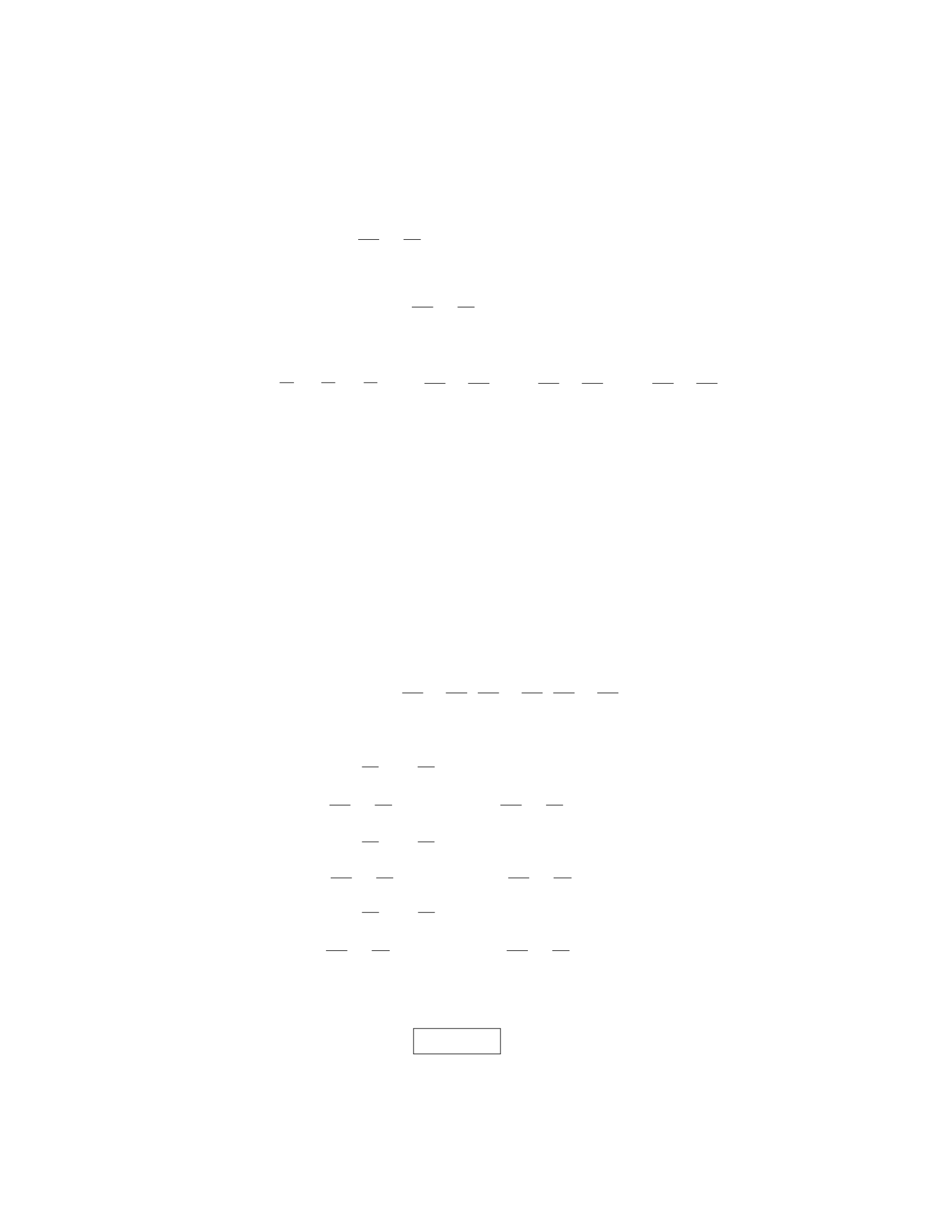
Step 1: Calculate the partial derivatives:
∂R
∂y =∂
∂y (zexy) = z(xexy) = xzexy
Step 2: Continue calculating the partial derivatives:
∂Q
∂z =∂
∂z (x2y)=0
Step 3: Finally, evaluate the determinant to find the curl:
∇×F=
i j k
∂
∂x
∂
∂y
∂
∂z
exyz x2y zexy
=∂R
∂y −∂Q
∂z i−∂R
∂x −∂P
∂z j+∂Q
∂x −∂P
∂y k
= (xzexy )i−(yzexy )j+ (2xy)k
Therefore, the curl of Fis xzexy i−yzexy j+ 2xyk.
Question 6
Question
Let F(x, y, z)=(z2, xz, y) be a vector field in R3. Compute the curl of F.
Solution
To compute the curl of a vector field F(x, y, z)=(P(x, y, z), Q(x, y, z), R(x, y, z))
in R3, we can use the formula:
curl(F) = ∂R
∂y −∂Q
∂z ,∂P
∂z −∂R
∂x ,∂Q
∂x −∂P
∂y
Given F(x, y, z)=(z2, xz, y), we have P(x, y, z) = z2,Q(x, y, z) = xz, and
R(x, y, z) = y.
Step 1: Compute ∂R
∂y and ∂Q
∂z .
∂R
∂y =∂
∂y (y) = 1 and ∂Q
∂z =∂
∂z (xz) = x
Step 2: Compute ∂P
∂z and ∂R
∂x .
∂P
∂z =∂
∂z (z2) = 0 and ∂R
∂x =∂
∂x (y) = 0
Step 3: Compute ∂Q
∂x and ∂P
∂y .
∂Q
∂x =∂
∂x (xz) = zand ∂P
∂y =∂
∂y (z2)=0
Step 4: Assemble the components to find the curl of F.
curl(F) = (1 −x, 0−0, z −0) = (1 −x, 0, z)
Therefore, the curl of Fis (1 −x, 0, z) .
5
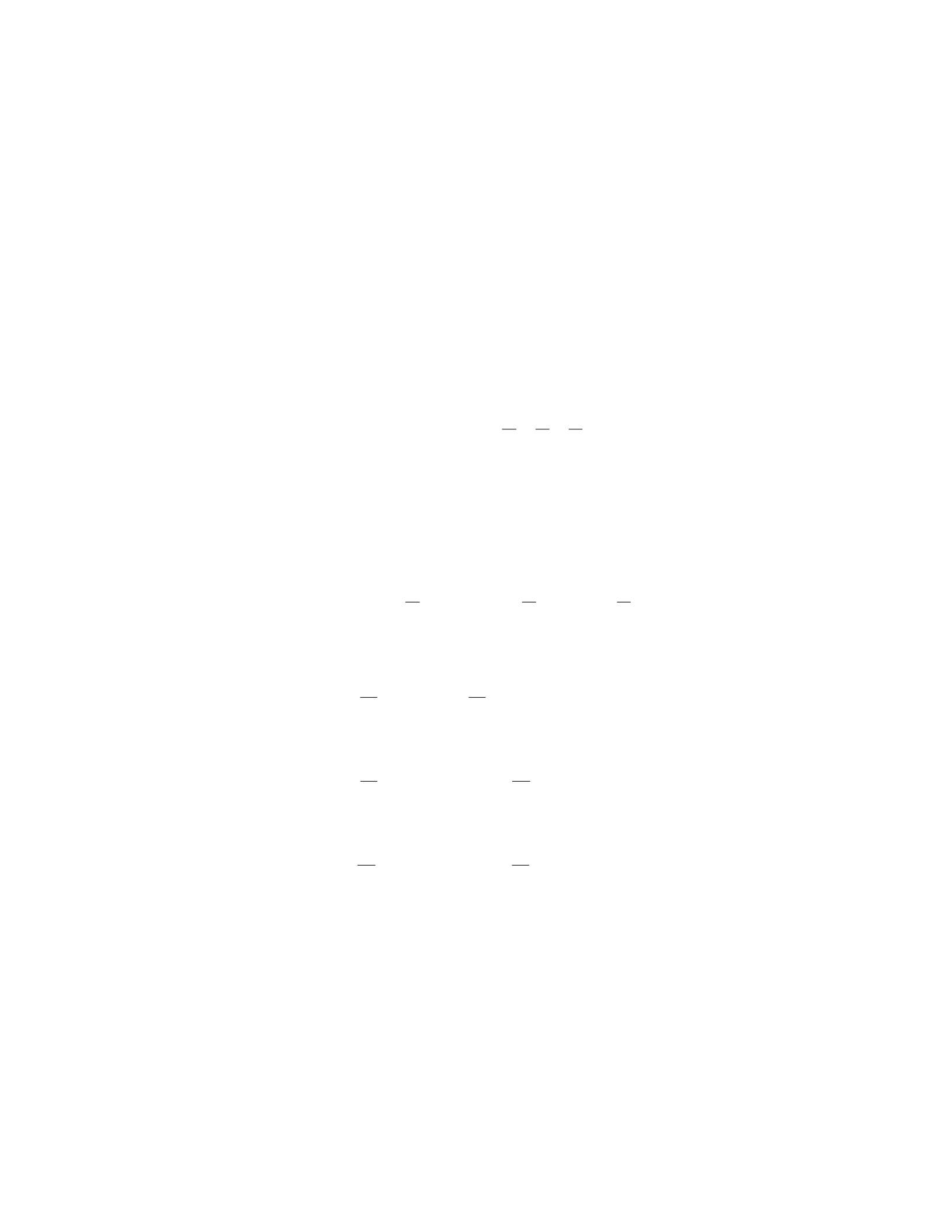
Question 7
Question
Let F(x, y, z) = exsin(y) cos(z)i+excos(y) cos(z)j+exsin(z)k. Calculate the
curl of F.
Solution
To find the curl of a vector field F(x, y, z) = P(x, y, z)i+Q(x, y, z)j+R(x, y, z)k,
we use the formula:
curl(F) = ∇ × F=
i j k
∂
∂x
∂
∂y
∂
∂z
P Q R
Given F(x, y, z) = exsin(y) cos(z)i+excos(y) cos(z)j+exsin(z)k, we have:
P(x, y, z) = exsin(y) cos(z), Q(x, y, z) = excos(y) cos(z), R(x, y, z) = exsin(z)
Now, let’s calculate the curl of F:
∇ × F=
i j k
∂
∂x
∂
∂y
∂
∂z
exsin(y) cos(z)excos(y) cos(z)exsin(z)
Step 1: Calculate the determinant using the iunit vector:
=∂
∂y (exsin(z)) −∂
∂z (excos(y) cos(z))i
Step 2: Calculate the jcomponent:
=∂
∂z (exsin(y) cos(z)) −∂
∂x (exsin(z))j
Step 3: Calculate the kcomponent:
=∂
∂x (excos(y) cos(z)) −∂
∂y (exsin(z))k
After calculating these partial derivatives, we can simplify the expressions
to determine the curl of F.
Question 8
Question
Let F(x, y, z)=(x2+y2+z2)i+yzj+xyk. Calculate the divergence of F.
6

Solution
To find the divergence of F, we need to calculate the dot product of the del
operator (∇) and F.
Step 1: Calculate the del operator: The del operator in Cartesian coordi-
nates is ∇=∂
∂x i+∂
∂y j+∂
∂z k.
Step 2: Calculate the dot product: The dot product of ∇and Fis given
by: ∇ · F=∂
∂x (x2+y2+z2) + ∂
∂y (yz) + ∂
∂z (xy).
Step 3: Calculate the partial derivatives: ∂
∂x (x2+y2+z2) = 2x,∂
∂y (yz) = z,
∂
∂z (xy) = x.
Step 4: Substitute the partial derivatives back into the dot product formula:
∇ · F= 2x+z+x.
Step 5: Simplify the expression: ∇ · F= 3x+z.
Therefore, the divergence of Fis 3x+z.
Question 9
Question
Let F(x, y, z) = yzi+xzj+xykbe a vector field in R3. Compute the gradient,
divergence, and curl of F.
Solution
Step 1: Compute the gradient of F. The gradient of a vector field F=Pi+
Qj+Rkis given by ∇F=∂P
∂x i+∂Q
∂y j+∂R
∂z k. Here, F(x, y, z) = yzi+xzj+xyk,
so P=yz,Q=xz, and R=xy. Therefore, the gradient of Fis:
∇F=∂(yz)
∂x i+∂(xz)
∂y j+∂(xy)
∂z k=zi+xj+yk.
Step 2: Compute the divergence of F. The divergence of a vector field
F=Pi+Qj+Rkis given by div F=∂P
∂x +∂Q
∂y +∂R
∂z . In this case, P=yz,
Q=xz, and R=xy. Therefore, the divergence of Fis:
div F=∂(yz)
∂x +∂(xz)
∂y +∂(xy)
∂z =z+z+x= 2z+x.
Step 3: Compute the curl of F. The curl of a vector field F=Pi+Qj+Rkis
given by curl F=∂R
∂y −∂Q
∂z i+∂P
∂z −∂R
∂x j+∂Q
∂x −∂P
∂y k. For F(x, y, z) =
yzi+xzj+xyk, we have P=yz,Q=xz, and R=xy. Thus, the curl of F
becomes:
curl F=∂(xy)
∂y −∂(xz)
∂z i+∂(yz)
∂z −∂(xy)
∂x j+∂(xz)
∂x −∂(yz)
∂y k= (x−x)i+(z−z)j+(y−y)k=0.
7
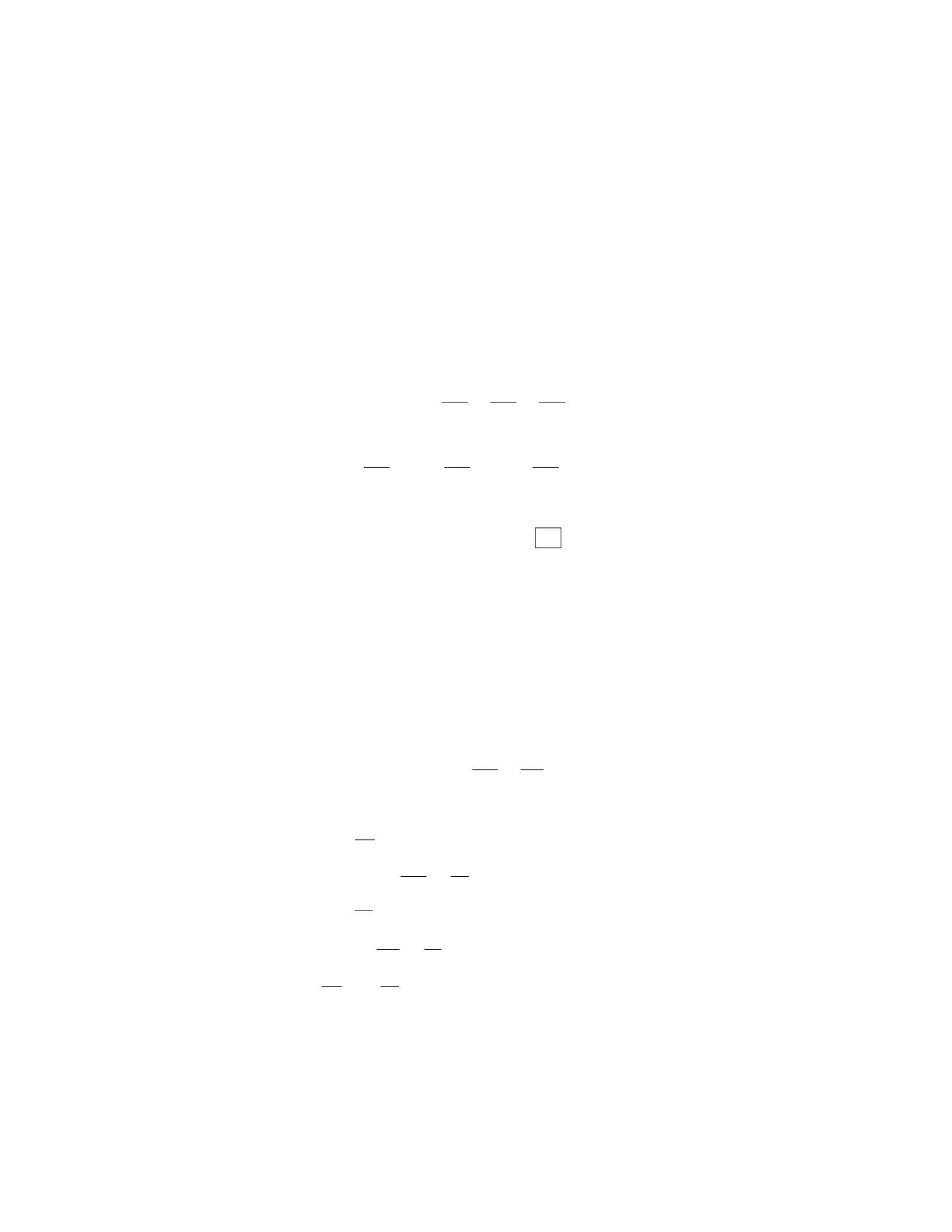
Question 10
Question
Let F(x, y, z) = (z2sin y, x2+2yz, exy ). Compute ∇·F, where ∇is the gradient
operator and ·denotes the divergence of a vector field.
Solution
Step 1: Calculate the components of ∇ · Fusing the formula for divergence:
∇ · F=∂F1
∂x +∂F2
∂y +∂F3
∂z
Step 2: Find the partial derivatives of the components of F.
∂F1
∂x = 0,∂F2
∂y = 2z, ∂F3
∂z = 0
Step 3: Add the partial derivatives to find ∇ · F.
∇ · F= 0 + 2z+ 0 = 2z
Question 11
Question
Let F(x, y)=(x2y, 2xy −sin(x)). Compute the divergence of F.
Solution
Step 1: The divergence of a vector field F(x, y) = (M(x, y), N(x, y)) is given by
the following formula:
div(F) = ∂M
∂x +∂N
∂y
Step 2: Given F(x, y)=(x2y, 2xy−sin(x)), let M(x, y) = x2yand N(x, y) =
2xy −sin(x).
Step 3: Compute ∂M
∂x :
∂M
∂x =∂
∂x (x2y)=2xy
Step 4: Compute ∂N
∂y :
∂N
∂y =∂
∂y (2xy −sin(x)) = 2x
Step 5: Add ∂M
∂x and ∂N
∂y to find the divergence:
div(F)=2xy + 2x
Therefore, the divergence of Fis 2xy + 2x.
8
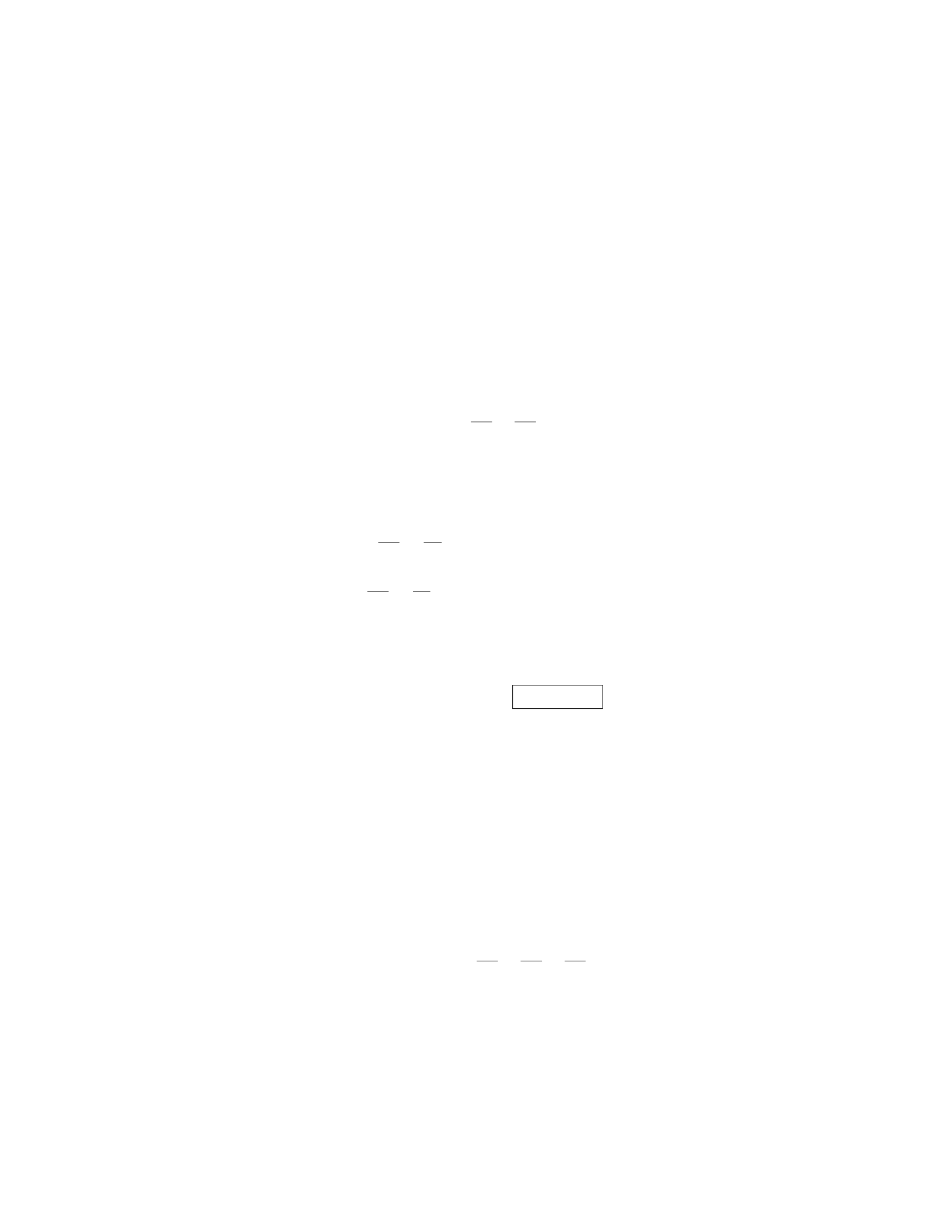
Question 12
Question
Let F(x, y)=(excos y, −exsin y). Compute ∇ · F.
Solution
Step 1: We have F(x, y)=(excos y, −exsin y). To find ∇ · F, we need to
compute the divergence of F.
Step 2: The divergence of Fis given by the following formula:
∇ · F=∂P
∂x +∂Q
∂y
where F(x, y)=(P(x, y), Q(x, y)).
Step 3: In this case, P(x, y) = excos yand Q(x, y) = −exsin y.
Step 4: Let’s compute the partial derivatives:
∂P
∂x =∂
∂x (excos y) = excos y
∂Q
∂y =∂
∂y (−exsin y) = −excos y
Step 5: Now, we can find the divergence:
∇ · F=excos y−exsin y
Step 6: Therefore, the divergence of Fis cos y−sin y.
Question 13
Question
Let F(x, y, z) = (2x2y, −x2z, yz2) be a vector field in R3. Calculate the diver-
gence of Fat the point (1,2,3).
Solution
To find the divergence of a vector field F(x, y, z)=(P, Q, R) at a point (x0, y0, z0),
we use the formula:
div F=∇ · F=∂P
∂x +∂Q
∂y +∂R
∂z
Step 1: Write the vector field Fin terms of P,Q, and R:
F(x, y, z) = (2x2y, −x2z, yz2)
9
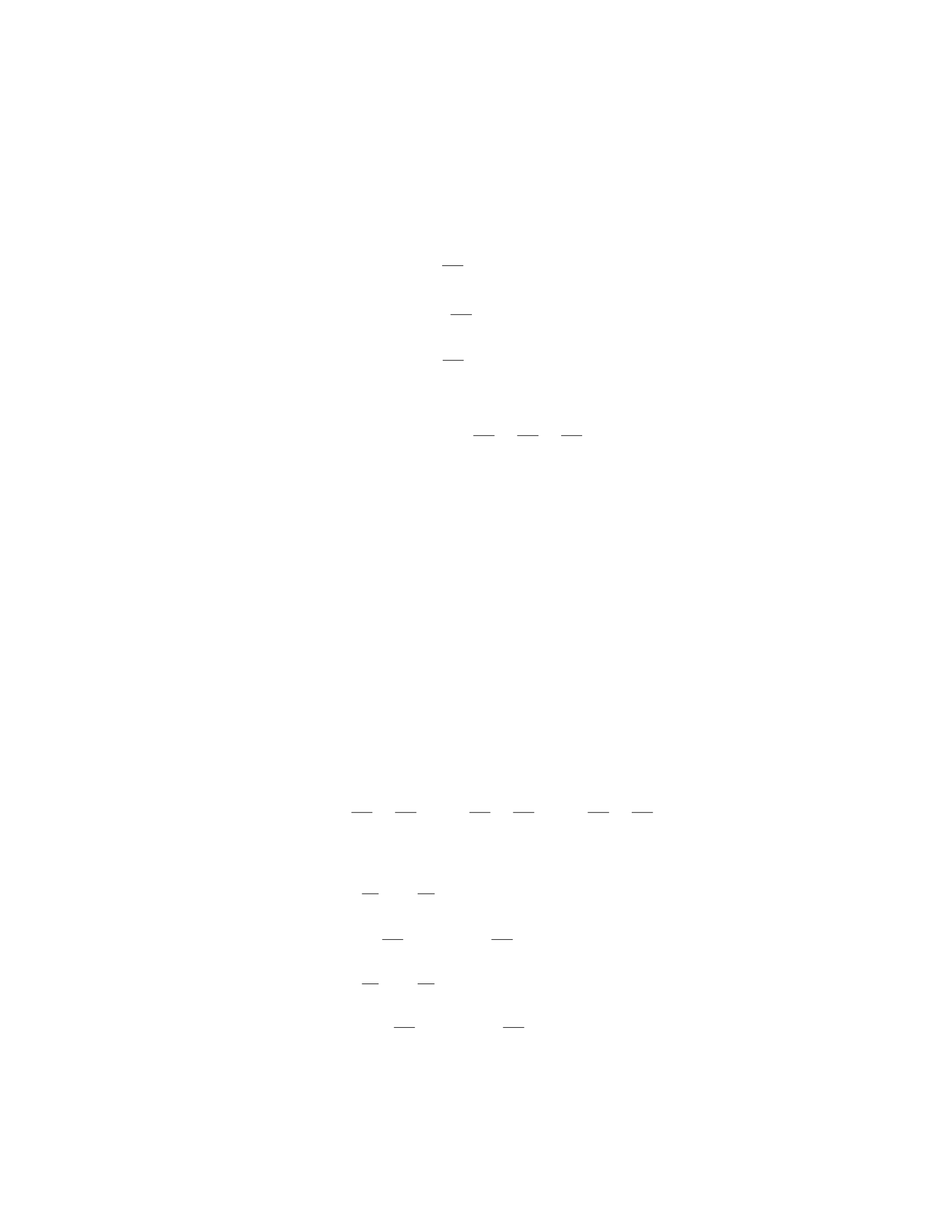
Here, P= 2x2y,Q=−x2z, and R=yz2.
Step 2: Calculate the partial derivatives needed:
∂P
∂x = 4xy
∂Q
∂y = 0
∂R
∂z = 2yz
Step 3: Find the divergence of Fat the point (1,2,3):
div F(1,2,3) = ∂P
∂x +∂Q
∂y +∂R
∂z
= 4(1)(2) + 0 + 2(2)(3)
= 8 + 12
= 20
Therefore, the divergence of Fat the point (1,2,3) is 20.
Question 14
Question
Let F(x, y, z) = xeyi+ex+zj+yzk. Compute the curl of F.
Solution
To compute the curl of a vector field F(x, y, z) = P(x, y, z)i+Q(x, y, z)j+
R(x, y, z)k, we use the formula:
curl(F) = ∂R
∂y −∂Q
∂z i−∂R
∂x −∂P
∂z j+∂Q
∂x −∂P
∂y k.
Given F(x, y, z) = xeyi+ex+zj+yzk, we have P(x, y, z) = xey,Q(x, y, z) =
ex+z, and R(x, y, z) = yz. Now, let’s compute the curl of Fstep-by-step.
Step 1: Compute ∂R
∂y and ∂Q
∂z .
∂R
∂y =zand ∂Q
∂z =ex+z.
Step 2: Compute ∂R
∂x and ∂P
∂z .
∂R
∂x = 0 and ∂P
∂z = 0.
10
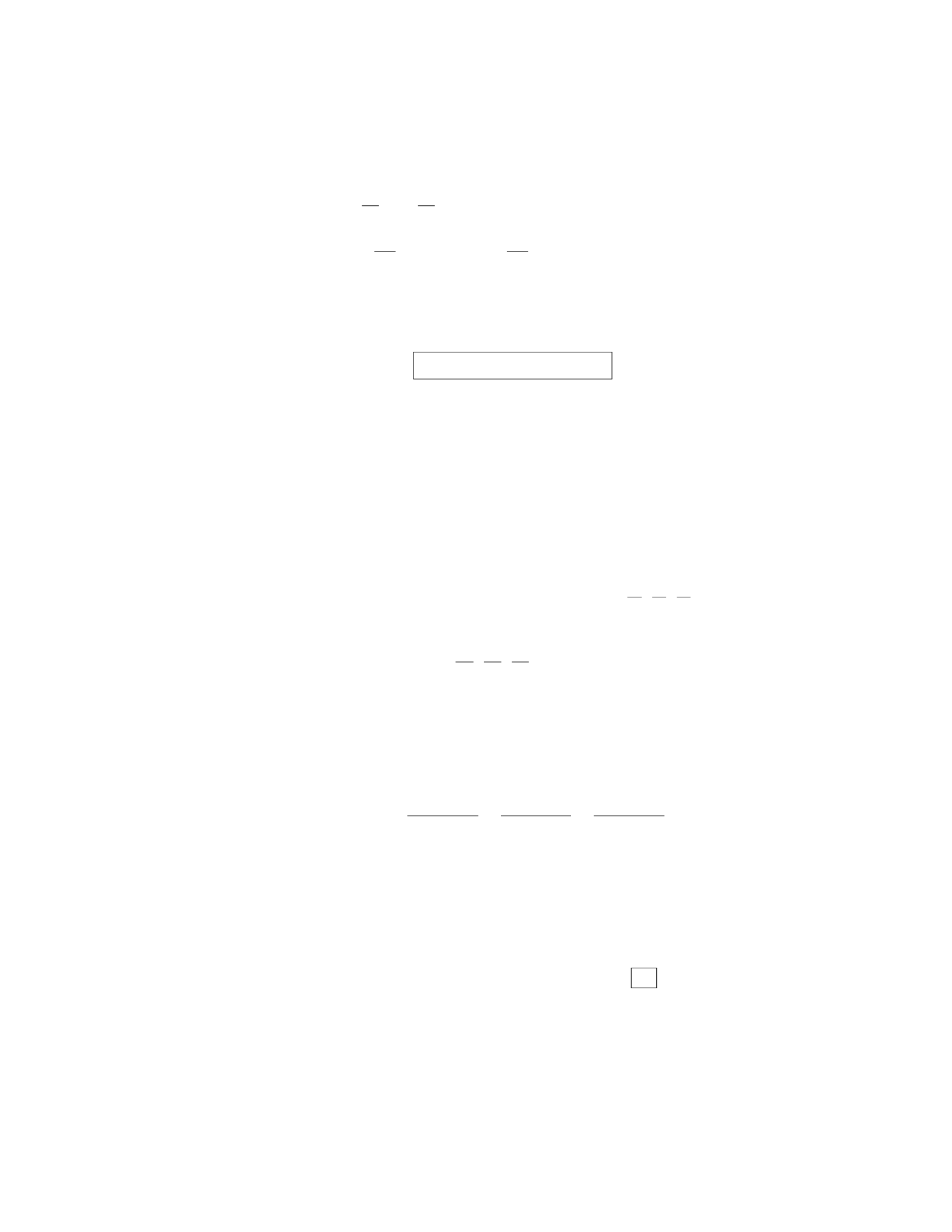
Step 3: Compute ∂Q
∂x and ∂P
∂y .
∂Q
∂x =ex+zand ∂P
∂y =xey.
Step 4: Assemble the components to find the curl of F:
curl(F)=(z−ex+z)i+ (0 −0)j+ (ex+z−xey)k.
Therefore, the curl of Fis (z−ex+z)i+ (ex+z−xey)k.
Question 15
Question
Let F(x, y, z) = (x2+y2)i+ (y2+z2)j+ (z2+x2)kbe a vector field. Calculate
the divergence of Fat the point (1,2,3).
Solution
To find the divergence of Fat a point, we use the formula: div(F) = ∇ · F,
where ∇is the del operator. In Cartesian coordinates, ∇=∂
∂x ,∂
∂y ,∂
∂z .
Step 1: Calculate the del operator ∇.
∇=∂
∂x ,∂
∂y ,∂
∂z
Step 2: Find the components of F.
F(x, y, z) = (x2+y2)i+ (y2+z2)j+ (z2+x2)k
Step 3: Find the divergence of F.
div(F) = ∇ · F=∂(x2+y2)
∂x +∂(y2+z2)
∂y +∂(z2+x2)
∂z
Step 4: Evaluate the divergence at the point (1,2,3).
div(F)(1,2,3) = 2x+ 2y+ 2z
Step 5: Substitute the values x= 1, y= 2, and z= 3 into the divergence
formula.
div(F)(1,2,3) = 2(1) + 2(2) + 2(3) = 2 + 4 + 6 = 12
Therefore, the divergence of Fat the point (1,2,3) is 12.
11
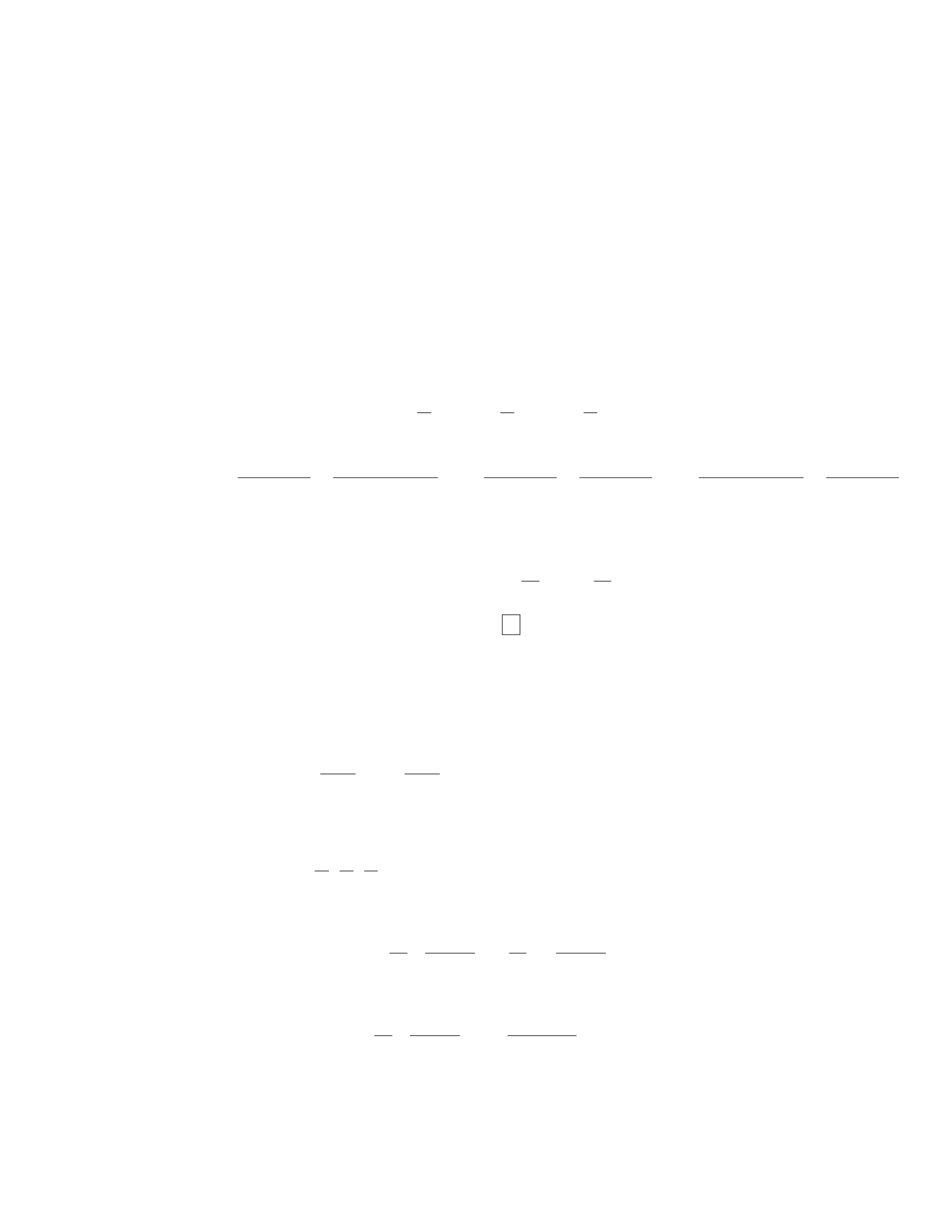
Question 16
Question
Let F(x, y, z) = (2xy +z)i+ (x2+y2+z2)j+ (xy −2z)k. Compute ∇·∇×F,
where ∇is the del operator.
Solution
Step 1: Compute the curl of F.
∇ × F=
i j k
∂
∂x
∂
∂y
∂
∂z
2xy +z x2+y2+z2xy −2z
=∂(xy −2z)
∂y −∂(x2+y2+z2)
∂z i−∂(2xy +z)
∂x −∂(xy −2z)
∂z j+∂(x2+y2+z2)
∂x −∂(2xy +z)
∂y k
= (−2)i−(−2)j+ (0)k=−2i+ 2j
Step 2: Compute the divergence of the curl of F.
∇ · ∇ × F=∇ · (−2i+ 2j) = ∂
∂x (−2) + ∂
∂y (2)
= 0 + 0 = 0
Therefore, ∇ · ∇ × F= 0.
Question 17
Question
Let F(x, y, z) = 1
x2+y2i+−x
x2+y2j. Compute ∇ · F.
Solution
To compute the divergence of F, we need to take the dot product of the del
operator ∇=∂
∂x ,∂
∂y ,∂
∂z with the vector field Fand then take the sum of the
individual components.
Step 1: Compute the divergence of F:
∇ · F=∂
∂x 1
x2+y2+∂
∂y −x
x2+y2
Step 2: Calculate the partial derivatives:
∂
∂x 1
x2+y2=−2x
(x2+y2)2
12
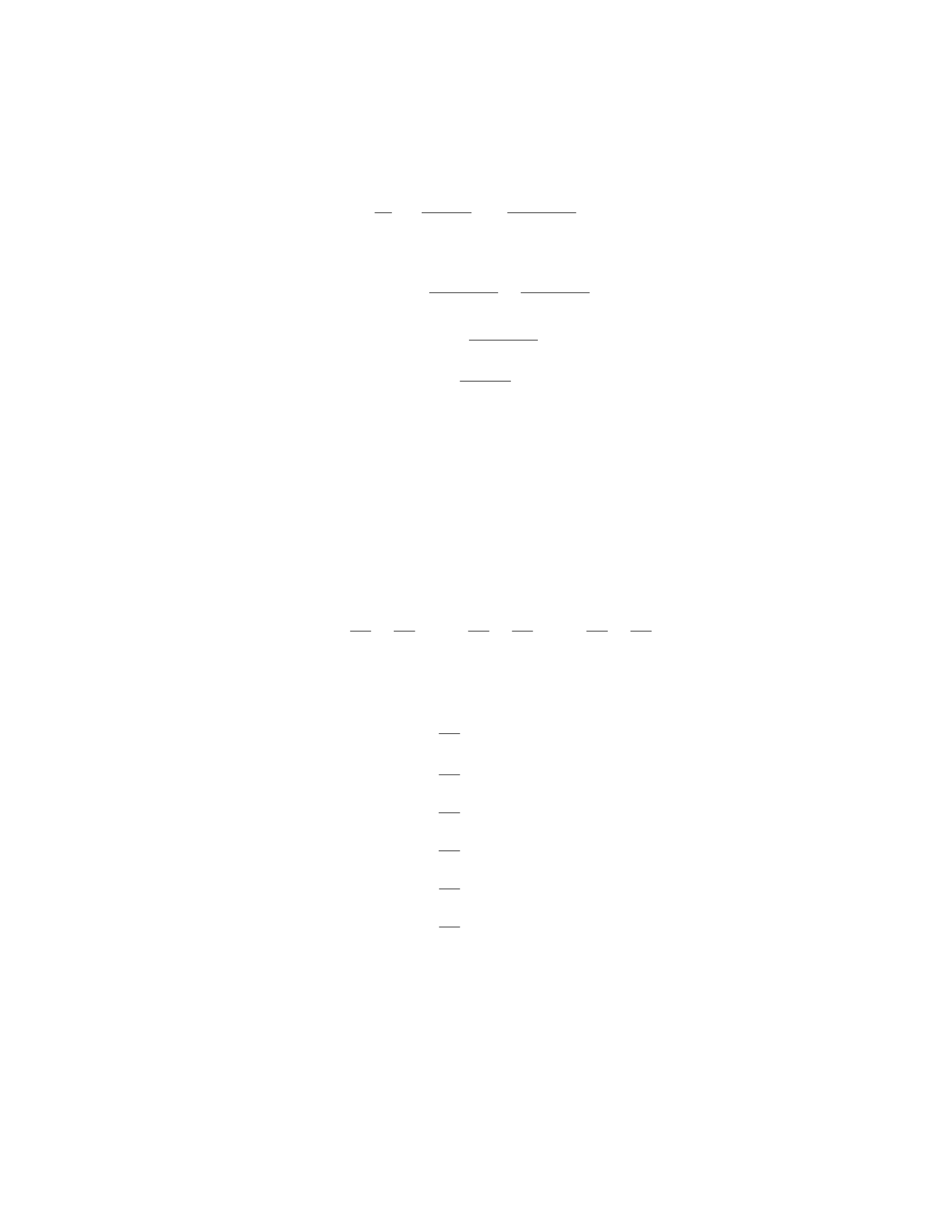
∂
∂y −x
x2+y2=2y
(x2+y2)2
Step 3: Substitute the partial derivatives back into the expression and sim-
plify:
∇ · F=−2x
(x2+y2)2+2y
(x2+y2)2
∇ · F=2(y−x)
(x2+y2)2
Therefore, the divergence of Fis 2(y−x)
(x2+y2)2.
Question 18
Question
Let F= (ey+ sin z)i+ (ez+ cos x)j+ (ex+ sin y)kbe a vector field in R3.
Compute the curl of F.
Solution
To find the curl of a vector field F=Pi+Qj+Rk, we use the formula:
curl F=∂R
∂y −∂Q
∂z i+∂P
∂z −∂R
∂x j+∂Q
∂x −∂P
∂y k
Step 1: Compute the partial derivatives of P,Q, and Rwith respect to x,
y, and z.
∂P
∂y =ey
∂P
∂z = cos z
∂Q
∂x = 0
∂Q
∂z =ez
∂R
∂x =ex
∂R
∂y = cos y
Step 2: Calculate the components of the curl of Fusing the computed
13
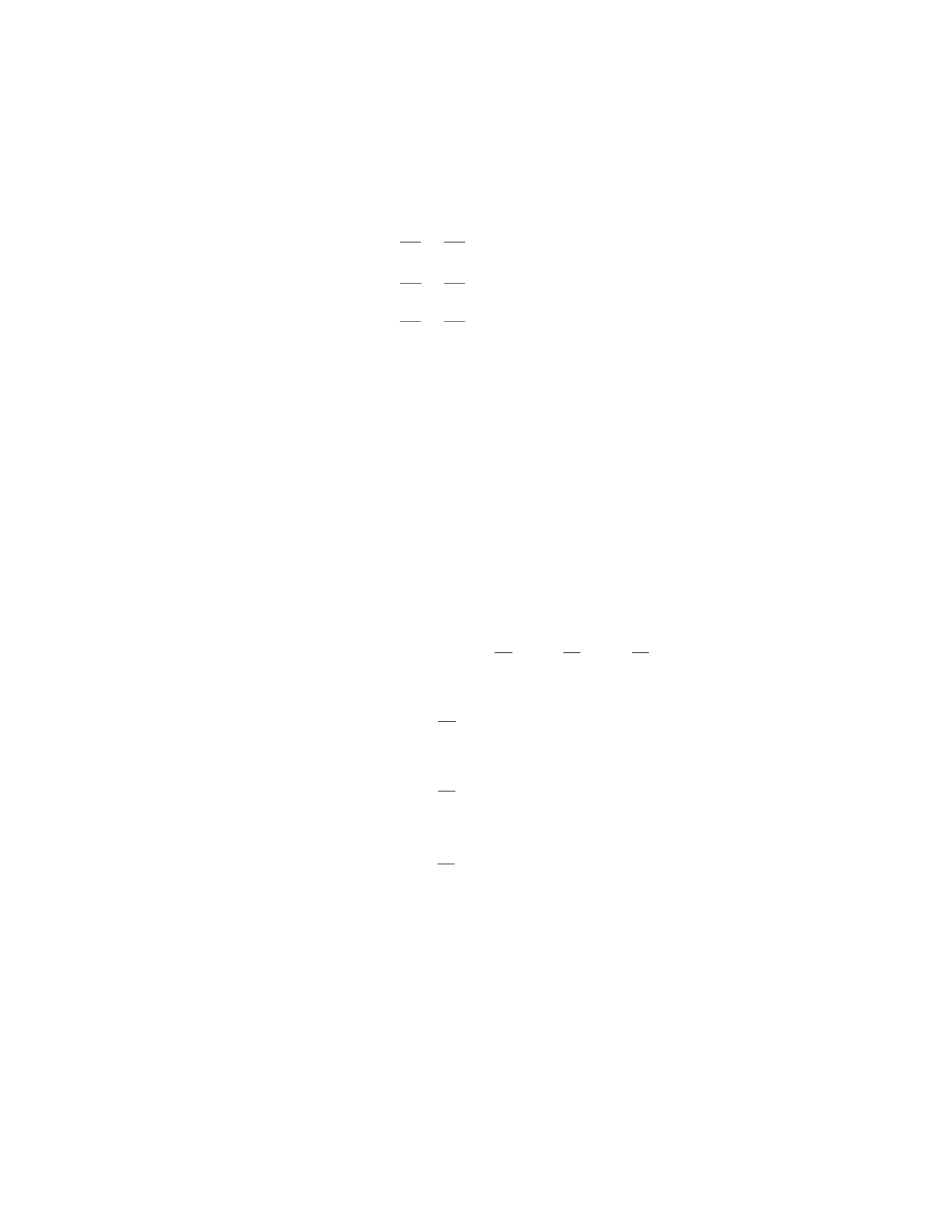
partial derivatives:
∂R
∂y −∂Q
∂z = cos y−ez
∂P
∂z −∂R
∂x = cos z−ex
∂Q
∂x −∂P
∂y =−ey
Therefore, the curl of Fis:
curl F= (cos y−ez)i+ (cos z−ex)j−eyk
Question 19
Question
Let F(x, y, z) = yzˆ
i+xzˆ
j+xyˆ
k. Find the divergence of F.
Solution
To find the divergence of F, we compute the dot product of the del operator ∇
with Fand then take the dot product of the resulting vector with the vector
function F.
∇ · F=∇ · (yzˆ
i+xzˆ
j+xyˆ
k) = ∂
∂x (yz) + ∂
∂y (xz) + ∂
∂z (xy)
Step 1: Compute the partial derivative with respect to x:
∂
∂x (yz) = z
Step 2: Compute the partial derivative with respect to y:
∂
∂y (xz) = z
Step 3: Compute the partial derivative with respect to z:
∂
∂z (xy) = x
Therefore, the divergence of Fis:
∇ · F=z+z+x= 2z+x
Question 20
Question
Let F(x, y, z)=(exsin y, excos y, z2) be a vector field. Compute the curl of F.
14

Solution
To compute the curl of F, we need to find the determinant of the following
matrix:
curl(F) =
i j k
∂
∂x
∂
∂y
∂
∂z
exsin y excos y z2
Step 1: Compute the partial derivatives Let’s compute the partial
derivatives of the vector field F:
∂
∂x = (exsin y, excos y, 0),
∂
∂y = (excos y, −exsin y, 0),
∂
∂z = (0,0,2z).
Step 2: Calculate the curl Now, we can use these partial derivatives to
find the curl as follows:
curl(F) = ∂
∂y (z2)−∂
∂z (excos y),∂
∂z (exsin y)−∂
∂x (z2),∂
∂x (excos y)−∂
∂y (exsin y)
= (0 −0,0−0, exsin y−(−excos y))
= (0,0,2exsin y).
Therefore, the curl of Fis curl(F) = k·2exsin y= 2exsin yk.
Question 21
Question
Let F(x, y, z) = x2yi+xyzj+x2zkbe a vector field in R3. Compute ∇ · ∇ × F.
Solution
Step 1: Compute ∇ × F.
∇ × F=
i j k
∂
∂x
∂
∂y
∂
∂z
x2y xyz x2z
=∂(x2z)
∂y −∂(xyz)
∂z i−∂(x2z)
∂x −∂(x2y)
∂z j+∂(xyz)
∂x −∂(x2y)
∂y k
= (0 −x)i−(2xz −0)j+ (yz −2xy)k=−xi−2xzj+ (y−2x)k
15

Step 2: Compute ∇ · ∇ × F(divergence of ∇ × F).
∇ · v=∂
∂x (−x) + ∂
∂y (−2xz) + ∂
∂z (y−2x)
=−1−2x+ 0 = −1−2x
Therefore, ∇ · ∇ × F=−1−2x.
Question 22
Question
Let F(x, y, z) = ⟨exy , x2y3z, z2
x2+y2⟩. Find the divergence of F.
Solution
To find the divergence of a vector field F=⟨P, Q, R⟩, we use the formula
div(F) = ∂P
∂x +∂Q
∂y +∂R
∂z .
Step 1: Calculate the partial derivatives of P=exy,Q=x2y3z, and
R=z2
x2+y2.
∂P
∂x =yexy ,∂Q
∂y = 3x2y2z, ∂R
∂z =2z(x2+y2)−z2(2x)
(x2+y2)2
Step 2: Add up the partial derivatives to find the divergence.
div(F) = ∂P
∂x +∂Q
∂y +∂R
∂z
=yexy + 3x2y2z+2z(x2+y2)−z2(2x)
(x2+y2)2
Therefore, the divergence of F(x, y, z) = ⟨exy, x2y3z, z2
x2+y2⟩is yexy+3x2y2z+
2z(x2+y2)−z2(2x)
(x2+y2)2.
Question 23
Question
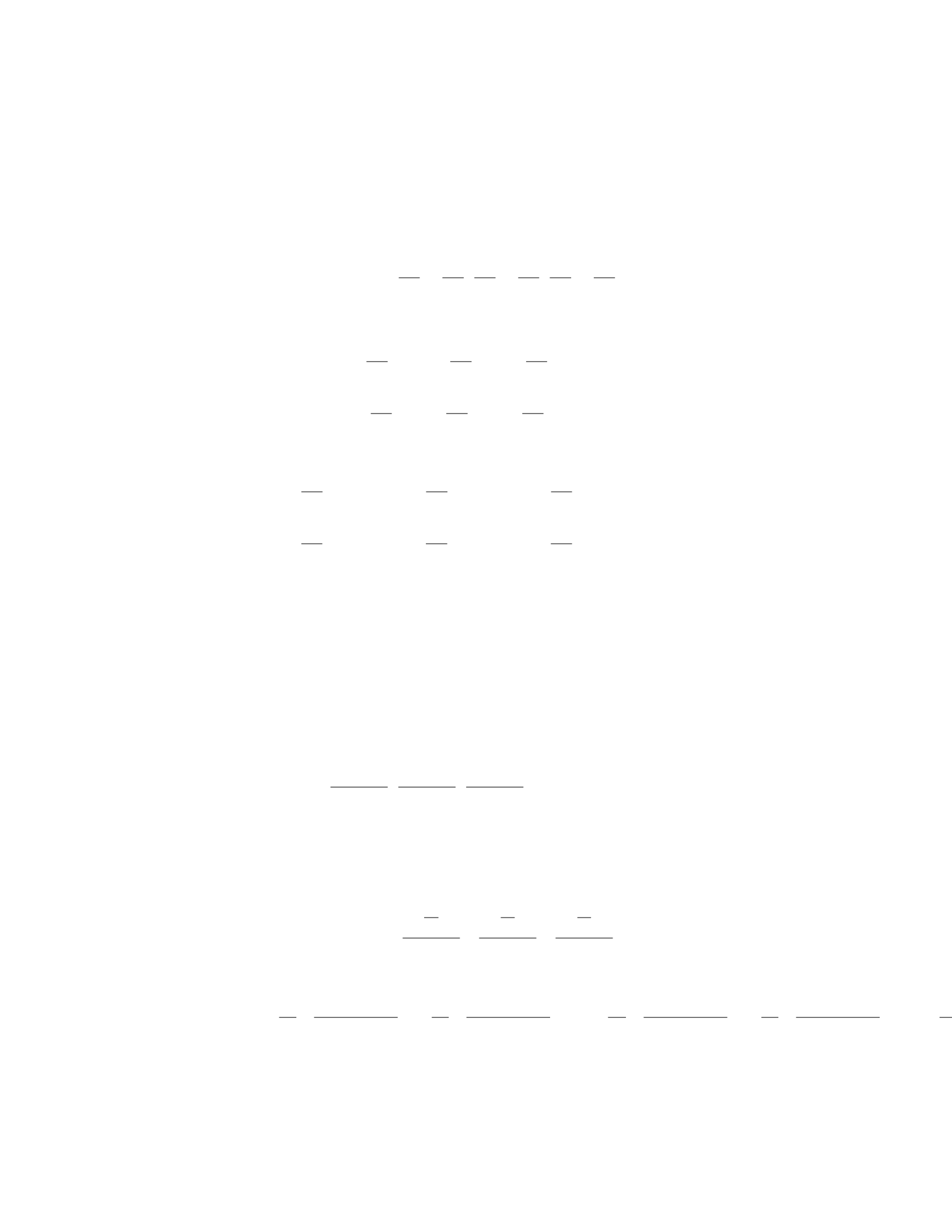
Let F(x, y, z) = x2y+ 2yz, xz, x2+ 3z2. Calculate the curl of Fat the point
(1,1,1).
16
Solution
To find the curl of a vector field F= (P, Q, R), we can use the formula:
curl F=∂R
∂y −∂Q
∂z ,∂P
∂z −∂R
∂x ,∂Q
∂x −∂P
∂y
Step 1: Compute the partial derivatives of P,Q, and R:
∂P
∂y =x2,∂Q
∂z = 0,∂R
∂x = 2x
∂R
∂y = 0,∂Q
∂x =z, ∂P
∂z = 2y
Step 2: Evaluate the derivatives at the point (1,1,1):
∂P
∂y (1,1,1) = 1,∂Q
∂z (1,1,1) = 0,∂R
∂x (1,1,1) = 2
∂R
∂y (1,1,1) = 0,∂Q
∂x (1,1,1) = 1,∂P
∂z (1,1,1) = 2
Step 3: Substitute the values into the curl formula and compute the curl
at the point (1,1,1):
curl F(1,1,1) = (1 −0,2−2,1−2) = (1,0,−1)
Therefore, the curl of Fat the point (1,1,1) is (1,0,−1).
Question 24
Question
Let
F(x, y, z) = yz
x2+y2+z2,xz
x2+y2+z2,xy
x2+y2+z2. Find the curl of
F.
Solution
Step 1: Compute the components of the curl, ∇ ×
F.
∇ ×
F=
ˆ
iˆ
jˆ
k
∂
∂x
∂
∂y
∂
∂z
yz
x2+y2+z2
xz
x2+y2+z2
xy
x2+y2+z2
Step 2: Expand the determinant.
∇×
F=∂
∂y xy
x2+y2+z2−∂
∂z xz
x2+y2+z2ˆ
i−∂
∂x yz
x2+y2+z2−∂
∂z xy
x2+y2+z2ˆ
j+∂
∂x xz
x2+y2+z2−∂
∂y yz
x2+y2+z2ˆ
k
17

Step 3: Differentiate each component.
∇×
F=y(x2+y2+z2)−xy(2y)
(x2+y2+z2)2ˆ
i−z(x2+y2+z2)−xz(2z)
(x2+y2+z2)2ˆ
j+x(x2+y2+z2)−xz(2x)
(x2+y2+z2)2ˆ
k
Step 4: Simplify the components.
∇×
F=y(x2+y2+z2)−2xy2
(x2+y2+z2)2ˆ
i−z(x2+y2+z2)−2xz2
(x2+y2+z2)2ˆ
j+x(x2+y2+z2)−2x2z
(x2+y2+z2)2ˆ
k
Therefore, the curl of
Fis ∇×
F=y(x2+y2+z2)−2xy2
(x2+y2+z2)2ˆ
i−z(x2+y2+z2)−2xz2
(x2+y2+z2)2ˆ
j+
x(x2+y2+z2)−2x2z
(x2+y2+z2)2ˆ
k.
Question 25
Question
Let F= (x2+y2, ez,cos(y)) be a vector field in R3. Determine ∇ · F,∇ × F,
and ∇ × (∇ × F).
Solution
Step 1: Calculate ∇ · F
The divergence of a vector field F= (P(x, y, z), Q(x, y, z), R(x, y, z)) is given
by ∇ · F=∂P
∂x +∂Q
∂y +∂R
∂z .
In this case, F= (x2+y2, ez,cos(y)), so we have:
∇ · F=∂
∂x (x2+y2) + ∂
∂y (ez) + ∂
∂z (cos(y))
∇ · F= 2x+ 0 + 0
∇ · F= 2x
Step 2: Calculate ∇ × F
The curl of a vector field F= (P(x, y, z), Q(x, y, z), R(x, y, z)) is given by
∇ × F=∂R
∂y −∂Q
∂z ,∂P
∂z −∂R
∂x ,∂Q
∂x −∂P
∂y .
For our vector field F= (x2+y2, ez,cos(y)), we get:
∇ × F= (0 −0,0−0,0−0) = 0
Step 3: Calculate ∇ × (∇ × F)
The curl of a vector field can be defined as ∇ × (∇ × F) = ∇(∇ · F)− ∇2F,
where ∇2Frepresents the Laplacian operator acting on F.
Since ∇ · F= 2x, we have:
∇ × (∇ × F) = ∇(2x)− ∇2F
The Laplacian operator applied to Fis zero in this case as Fis a vector
field, so:
∇ × (∇ × F)=0−0 = 0
18
Question 26
Question
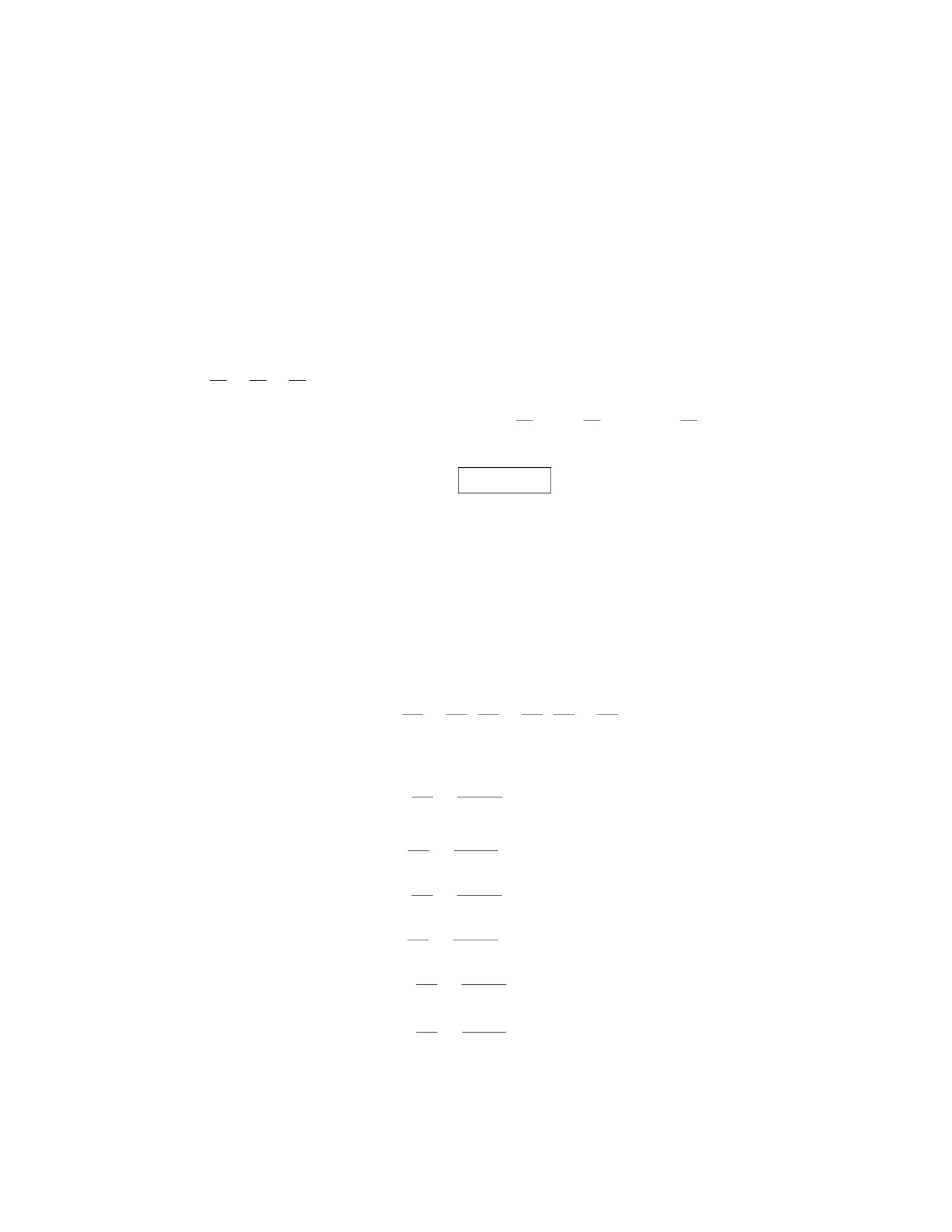
Let F(x, y, z) = (x2+y2)i+ (y2+z2)j+ (z2+x2)k. Calculate the divergence
of F.
Solution
Step 1: The divergence of a vector field F=Pi+Qj+Rkis given by ∇ · F=
∂P
∂x +∂Q
∂y +∂R
∂z .
Step 2: In this case, P=x2+y2,Q=y2+z2, and R=z2+x2.
Step 3: Calculate the partial derivatives: ∂P
∂x = 2x,∂Q
∂y = 2y, and ∂R
∂z = 2z.
Step 4: Add the partial derivatives to find the divergence: ∇ · F= 2x+ 2y+
2z= 2(x+y+z).
Therefore, the divergence of Fis 2(x+y+z) .
Question 27
Question
Let F(x, y, z)=(xz2, yz2, x2y) be a vector field in R3. Calculate div(curl(F)).
Solution
Step 1: Calculate the curl of F. The curl of a vector field F(x, y, z)=(P, Q, R)
is given by:
curl(F) = ∂R
∂y −∂Q
∂z ,∂P
∂z −∂R
∂x ,∂Q
∂x −∂P
∂y
In this case, F(x, y, z)=(xz2, yz2, x2y). So we have:
∂R
∂y =∂(x2y)
∂y =x2
∂Q
∂z =∂(yz2)
∂z = 2yz
∂P
∂z =∂(xz2)
∂z =xz
∂R
∂x =∂(x2y)
∂x = 2xy
∂P
∂y =∂(xz2)
∂y = 0
∂Q
∂x =∂(yz2)
∂x = 0
19
Therefore, the curl of Fis:
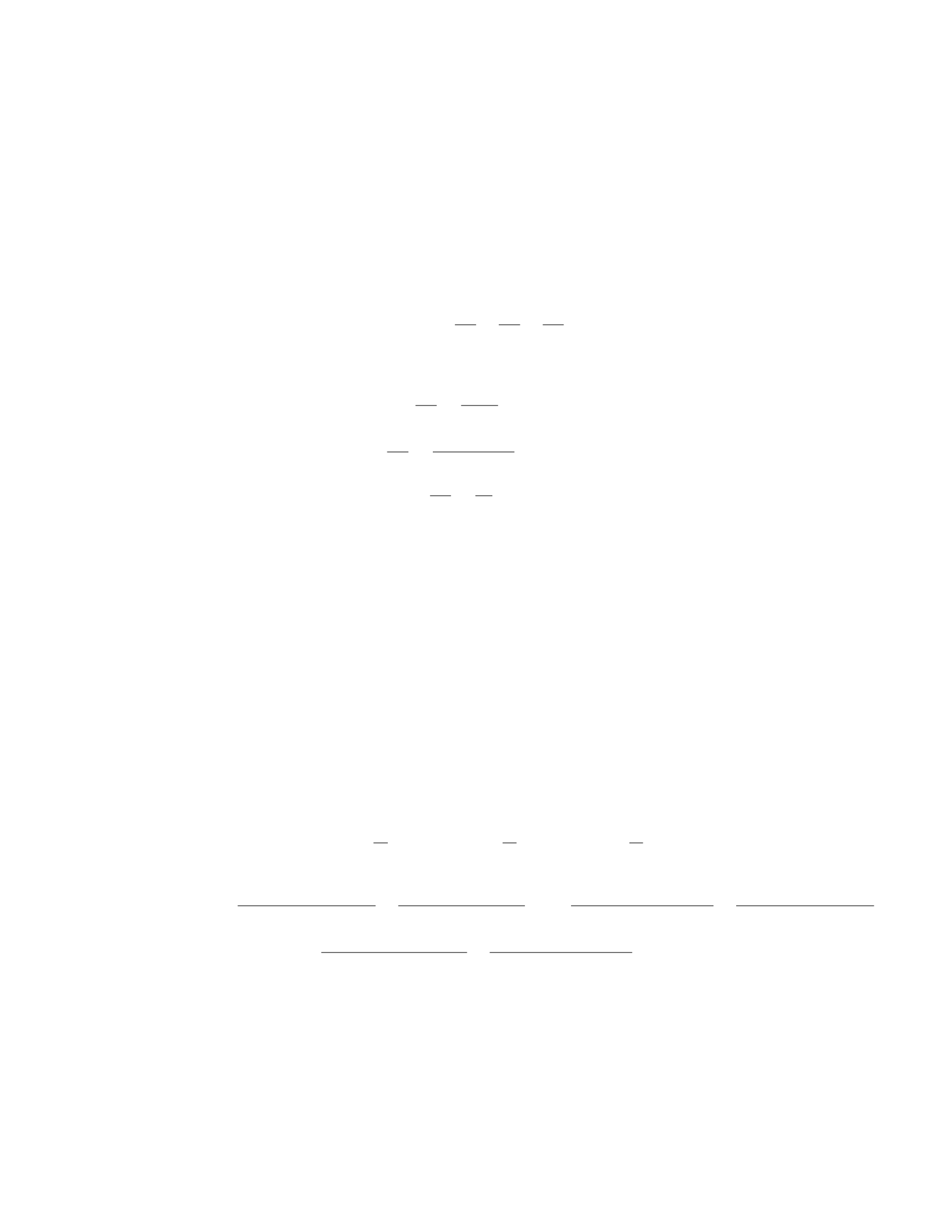
curl(F)=(x2−0, xz −2xy, 0−0) = (x2, xz −2xy, 0)
Step 2: Calculate the divergence of the curl of F. The divergence of a vector
field G(x, y, z)=(P, Q, R) is given by:
div(G) = ∂P
∂x +∂Q
∂y +∂R
∂z
In this case, G(x, y, z) = (x2, xz −2xy, 0). So we have:
∂P
∂x =∂(x2)
∂x = 2x
∂Q
∂y =∂(xz −2xy)
∂y =−2x
∂R
∂z =∂0
∂z = 0
Therefore, the divergence of the curl of Fis:
div(curl(F)) = 2x−2x+ 0 = 0
So, div(curl(F)) = 0.
Question 28
Question
Let F= (yexz −zln (y+ 1), xz2−ycos (xz), y ln (x+ 1) −xy2) be a vector field
in R3. Calculate ∇ · ∇ × F.
Solution
Step 1: First, we calculate the curl of F.
∇ × F=
i j k
∂
∂x
∂
∂y
∂
∂z
yexz −zln (y+ 1) xz2−ycos (xz)yln (x+ 1) −xy2
=∂(yln (x+ 1) −xy2)
∂y −∂(xz2−ycos (xz))
∂z i−∂(yexz −zln (y+ 1))
∂x −∂(yln (x+ 1) −xy2)
∂z j
+∂(yz ln (x+ 1) −xy2)
∂x −∂(yexz −zln (y+ 1))
∂y k
Step 2: Simplify the above expression to find ∇ × F.
Step 3: Once we have ∇ × F, we compute ∇ · (∇ × F).
Step 4: Substitute the values we found for ∇ × Finto this expression and
simplify to find the final answer.
20

Question 29
Question
Let F(x, y, z)=(x2, yz, xyz) be a vector field in R3. Find the curl of F.
Solution
To find the curl of F, we can use the formula:
curl F=∂F3
∂y −∂F2
∂z ,∂F1
∂z −∂F3
∂x ,∂F2
∂x −∂F1
∂y
Step 1: Compute the partial derivatives of F:
∂F1
∂x = 2x, ∂F2
∂y =z, ∂F3
∂z =xy
∂F1
∂y = 0,∂F2
∂z =y, ∂F3
∂x =yz
Step 2: Calculate the curl of F:
curl F= (y−0, xy −z, z −2x)
curl F= (y, xy −z, z −2x)
Therefore, the curl of the vector field F(x, y, z) = (x2, yz, xyz) is curl F=
(y, xy −z, z −2x).
Question 30
Question
Let F(x, y, z)=(z2, xz, xy) be a vector field in three-dimensional space. Deter-
mine the gradient, divergence, and curl of F.
Solution
Step 1: Calculate the gradient of F. The gradient of a vector field Fis denoted
by ∇Fand is given by:
∇F=∂F1
∂x ,∂F2
∂y ,∂F3
∂z
where F= (F1, F2, F3). In this case, F(x, y, z)=(z2, xz, xy), so we have:
∇F=∂z2
∂x ,∂xz
∂y ,∂xy
∂z
21

Step 2: Evaluate the partial derivatives and simplify.
) = (2x - 0)i+ (2z - 0)j+ (x2−2z)k
= 2xi+ 2zj+ (x2−2z)k.
Therefore, the curl of Fis 2xi+ 2zj+ (x2−2z)k.
Question 2
Question
Let Fbe a vector field defined by F(x, y, z) = (2xyz, x2z, xy2). Compute the
curl of F.
Solution
To compute the curl of a vector field F= (P, Q, R), we use the formula:
curl(F) = ∂R
∂y −∂Q
∂z ,∂P
∂z −∂R
∂x ,∂Q
∂x −∂P
∂y
Step 1: Compute partial derivatives of P,Q, and RGiven F(x, y, z) =
(2xyz, x2z, xy2), we have:
P= 2xyz, Q =x2z, R =xy2
Compute the partial derivatives:
∂P
∂z = 2xy
∂Q
∂x = 2xz
∂R
∂y = 2xy
∂P
∂y = 2xz
∂R
∂x =y2
∂Q
∂z =x2
Step 2: Compute the curl of F Now, plug the partial derivatives into
the formula for the curl:
curl(F) = 2xy −2xz, 2xz −y2, x2−2xy
Therefore, the curl of Fis curl(F) = (2xy −2xz, 2xz −y2, x2−2xy).
2

Question 3
Question
Let F(x, y, z) = x3yi+y3zj+z3xk. Calculate the curl of Fat the point (1,2,3).
Solution
Step 1: The curl of a vector field F(x, y, z) = P(x, y, z)i+Q(x, y, z)j+R(x, y, z)k
is given by the formula:
∇ × F=∂R
∂y −∂Q
∂z i−∂R
∂x −∂P
∂z j+∂Q
∂x −∂P
∂y k
Step 2: Let’s find the partial derivatives of F:
P(x, y, z) = x3y, Q(x, y, z) = y3z, R(x, y, z) = z3x
∂P
∂y =x3,∂Q
∂z =y3,∂R
∂x = 3z2
∂Q
∂x = 0,∂P
∂z = 0,∂R
∂y = 3x2
Step 3: Substituting these into the curl formula, we have:
∇ × F=∂R
∂y −∂Q
∂z i−∂R
∂x −∂P
∂z j+∂Q
∂x −∂P
∂y k
= (3x2−y3)i−(3z2−0)j+ (0 −x3)k
= (3 −8)i−(9 −0)j+ (0 −1)k
=−5i−9j−k
Step 4: Finally, computing the curl at (1,2,3):
∇ × F(1,2,3) = −5i−9j−k
Question 4
Question
Let F(x, y, z)=(x2y+yz, xz, y2z) be a vector field in R3. Compute the curl of
F.
Solution
To find the curl of a vector field F(x, y, z)=(P, Q, R) in R3, we use the formula:
curl(F) = ∂R
∂y −∂Q
∂z ,∂P
∂z −∂R
∂x ,∂Q
∂x −∂P
∂y
3
Step 1: Compute the partial derivatives.
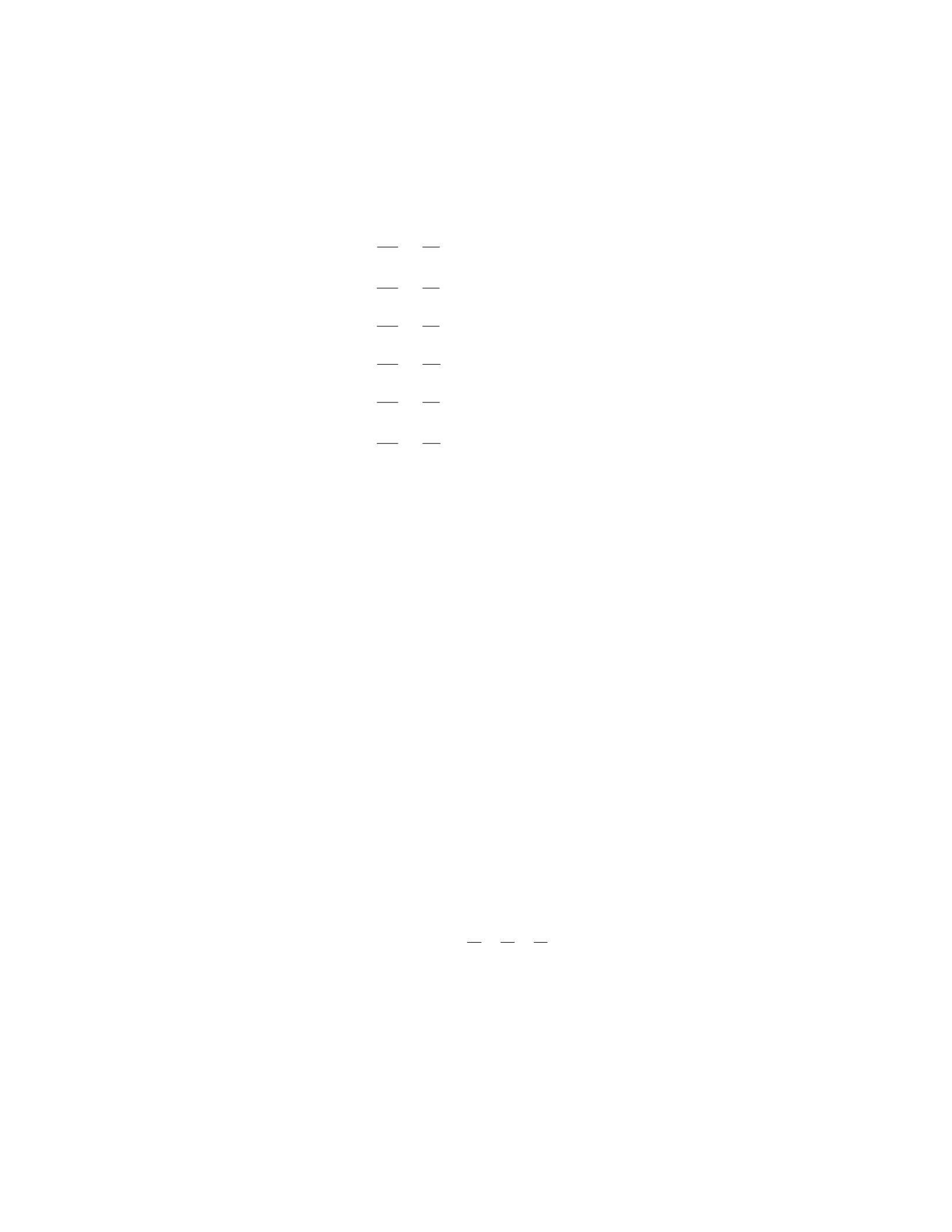
∂R
∂y =∂
∂y (y2z)=2yz
∂Q
∂z =∂
∂z (xz) = x
∂P
∂z =∂
∂z (x2y+yz) = y
∂R
∂x =∂
∂x (y2z)=0
∂P
∂y =∂
∂y (x2y+yz) = x2+z
∂Q
∂x =∂
∂x (xz) = z
Step 2: Substitute the computed partial derivatives into the formula for
the curl.
curl(F) = 2yz −x, y −0, z −(x2+z)
= (2yz −x, y, z −x2−z)
= (2yz −x, y, −x2)
Therefore, the curl of the vector field F(x, y, z)=(x2y+yz, xz, y2z) is
curl(F) = (2yz −x, y, −x2).
Question 5
Question
Let F(x, y, z) = exyzi+x2yj+zexykbe a vector field in three-dimensional space.
Calculate the curl of F.
Solution
To calculate the curl of a vector field F(x, y, z) = P(x, y, z)i+Q(x, y, z)j+
R(x, y, z)k, we use the formula:
∇ × F=
i j k
∂
∂x
∂
∂y
∂
∂z
P Q R
In this case, we have F(x, y, z) = exyzi+x2yj+zexyk, so P(x, y, z) = exyz,
Q(x, y, z) = x2y, and R(x, y, z) = zexy .
4
Step 1: Calculate the partial derivatives:
∂R
∂y =∂
∂y (zexy) = z(xexy) = xzexy
Step 2: Continue calculating the partial derivatives:
∂Q
∂z =∂
∂z (x2y)=0
Step 3: Finally, evaluate the determinant to find the curl:
∇×F=
i j k
∂
∂x
∂
∂y
∂
∂z
exyz x2y zexy
=∂R
∂y −∂Q
∂z i−∂R
∂x −∂P
∂z j+∂Q
∂x −∂P
∂y k
= (xzexy )i−(yzexy )j+ (2xy)k
Therefore, the curl of Fis xzexy i−yzexy j+ 2xyk.
Question 6
Question
Let F(x, y, z)=(z2, xz, y) be a vector field in R3. Compute the curl of F.
Solution
To compute the curl of a vector field F(x, y, z)=(P(x, y, z), Q(x, y, z), R(x, y, z))
in R3, we can use the formula:
curl(F) = ∂R
∂y −∂Q
∂z ,∂P
∂z −∂R
∂x ,∂Q
∂x −∂P
∂y
Given F(x, y, z)=(z2, xz, y), we have P(x, y, z) = z2,Q(x, y, z) = xz, and
R(x, y, z) = y.
Step 1: Compute ∂R
∂y and ∂Q
∂z .
∂R
∂y =∂
∂y (y) = 1 and ∂Q
∂z =∂
∂z (xz) = x
Step 2: Compute ∂P
∂z and ∂R
∂x .
∂P
∂z =∂
∂z (z2) = 0 and ∂R
∂x =∂
∂x (y) = 0
Step 3: Compute ∂Q
∂x and ∂P
∂y .
∂Q
∂x =∂
∂x (xz) = zand ∂P
∂y =∂
∂y (z2)=0
Step 4: Assemble the components to find the curl of F.
curl(F) = (1 −x, 0−0, z −0) = (1 −x, 0, z)
Therefore, the curl of Fis (1 −x, 0, z) .
5
Question 7
Question
Let F(x, y, z) = exsin(y) cos(z)i+excos(y) cos(z)j+exsin(z)k. Calculate the
curl of F.
Solution
To find the curl of a vector field F(x, y, z) = P(x, y, z)i+Q(x, y, z)j+R(x, y, z)k,
we use the formula:
curl(F) = ∇ × F=
i j k
∂
∂x
∂
∂y
∂
∂z
P Q R
Given F(x, y, z) = exsin(y) cos(z)i+excos(y) cos(z)j+exsin(z)k, we have:
P(x, y, z) = exsin(y) cos(z), Q(x, y, z) = excos(y) cos(z), R(x, y, z) = exsin(z)
Now, let’s calculate the curl of F:
∇ × F=
i j k
∂
∂x
∂
∂y
∂
∂z
exsin(y) cos(z)excos(y) cos(z)exsin(z)
Step 1: Calculate the determinant using the iunit vector:
=∂
∂y (exsin(z)) −∂
∂z (excos(y) cos(z))i
Step 2: Calculate the jcomponent:
=∂
∂z (exsin(y) cos(z)) −∂
∂x (exsin(z))j
Step 3: Calculate the kcomponent:
=∂
∂x (excos(y) cos(z)) −∂
∂y (exsin(z))k
After calculating these partial derivatives, we can simplify the expressions
to determine the curl of F.
Question 8
Question
Let F(x, y, z)=(x2+y2+z2)i+yzj+xyk. Calculate the divergence of F.
6

Solution
To find the divergence of F, we need to calculate the dot product of the del
operator (∇) and F.
Step 1: Calculate the del operator: The del operator in Cartesian coordi-
nates is ∇=∂
∂x i+∂
∂y j+∂
∂z k.
Step 2: Calculate the dot product: The dot product of ∇and Fis given
by: ∇ · F=∂
∂x (x2+y2+z2) + ∂
∂y (yz) + ∂
∂z (xy).
Step 3: Calculate the partial derivatives: ∂
∂x (x2+y2+z2) = 2x,∂
∂y (yz) = z,
∂
∂z (xy) = x.
Step 4: Substitute the partial derivatives back into the dot product formula:
∇ · F= 2x+z+x.
Step 5: Simplify the expression: ∇ · F= 3x+z.
Therefore, the divergence of Fis 3x+z.
Question 9
Question
Let F(x, y, z) = yzi+xzj+xykbe a vector field in R3. Compute the gradient,
divergence, and curl of F.
Solution
Step 1: Compute the gradient of F. The gradient of a vector field F=Pi+
Qj+Rkis given by ∇F=∂P
∂x i+∂Q
∂y j+∂R
∂z k. Here, F(x, y, z) = yzi+xzj+xyk,
so P=yz,Q=xz, and R=xy. Therefore, the gradient of Fis:
∇F=∂(yz)
∂x i+∂(xz)
∂y j+∂(xy)
∂z k=zi+xj+yk.
Step 2: Compute the divergence of F. The divergence of a vector field
F=Pi+Qj+Rkis given by div F=∂P
∂x +∂Q
∂y +∂R
∂z . In this case, P=yz,
Q=xz, and R=xy. Therefore, the divergence of Fis:
div F=∂(yz)
∂x +∂(xz)
∂y +∂(xy)
∂z =z+z+x= 2z+x.
Step 3: Compute the curl of F. The curl of a vector field F=Pi+Qj+Rkis
given by curl F=∂R
∂y −∂Q
∂z i+∂P
∂z −∂R
∂x j+∂Q
∂x −∂P
∂y k. For F(x, y, z) =
yzi+xzj+xyk, we have P=yz,Q=xz, and R=xy. Thus, the curl of F
becomes:
curl F=∂(xy)
∂y −∂(xz)
∂z i+∂(yz)
∂z −∂(xy)
∂x j+∂(xz)
∂x −∂(yz)
∂y k= (x−x)i+(z−z)j+(y−y)k=0.
7
Question 10
Question
Let F(x, y, z) = (z2sin y, x2+2yz, exy ). Compute ∇·F, where ∇is the gradient
operator and ·denotes the divergence of a vector field.
Solution
Step 1: Calculate the components of ∇ · Fusing the formula for divergence:
∇ · F=∂F1
∂x +∂F2
∂y +∂F3
∂z
Step 2: Find the partial derivatives of the components of F.
∂F1
∂x = 0,∂F2
∂y = 2z, ∂F3
∂z = 0
Step 3: Add the partial derivatives to find ∇ · F.
∇ · F= 0 + 2z+ 0 = 2z
Question 11
Question
Let F(x, y)=(x2y, 2xy −sin(x)). Compute the divergence of F.
Solution
Step 1: The divergence of a vector field F(x, y) = (M(x, y), N(x, y)) is given by
the following formula:
div(F) = ∂M
∂x +∂N
∂y
Step 2: Given F(x, y)=(x2y, 2xy−sin(x)), let M(x, y) = x2yand N(x, y) =
2xy −sin(x).
Step 3: Compute ∂M
∂x :
∂M
∂x =∂
∂x (x2y)=2xy
Step 4: Compute ∂N
∂y :
∂N
∂y =∂
∂y (2xy −sin(x)) = 2x
Step 5: Add ∂M
∂x and ∂N
∂y to find the divergence:
div(F)=2xy + 2x
Therefore, the divergence of Fis 2xy + 2x.
8
Question 12
Question
Let F(x, y)=(excos y, −exsin y). Compute ∇ · F.
Solution
Step 1: We have F(x, y)=(excos y, −exsin y). To find ∇ · F, we need to
compute the divergence of F.
Step 2: The divergence of Fis given by the following formula:
∇ · F=∂P
∂x +∂Q
∂y
where F(x, y)=(P(x, y), Q(x, y)).
Step 3: In this case, P(x, y) = excos yand Q(x, y) = −exsin y.
Step 4: Let’s compute the partial derivatives:
∂P
∂x =∂
∂x (excos y) = excos y
∂Q
∂y =∂
∂y (−exsin y) = −excos y
Step 5: Now, we can find the divergence:
∇ · F=excos y−exsin y
Step 6: Therefore, the divergence of Fis cos y−sin y.
Question 13
Question
Let F(x, y, z) = (2x2y, −x2z, yz2) be a vector field in R3. Calculate the diver-
gence of Fat the point (1,2,3).
Solution
To find the divergence of a vector field F(x, y, z)=(P, Q, R) at a point (x0, y0, z0),
we use the formula:
div F=∇ · F=∂P
∂x +∂Q
∂y +∂R
∂z
Step 1: Write the vector field Fin terms of P,Q, and R:
F(x, y, z) = (2x2y, −x2z, yz2)
9
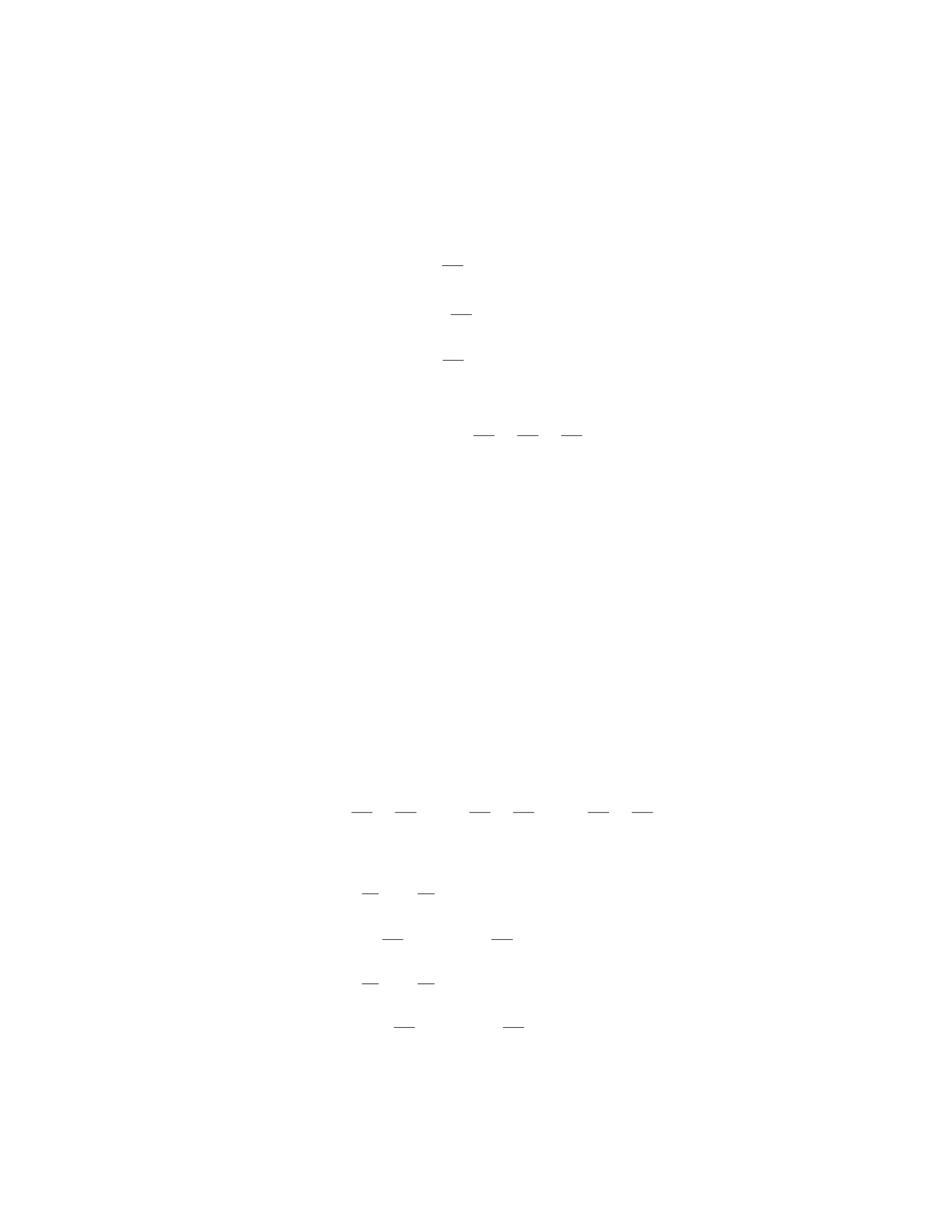
Here, P= 2x2y,Q=−x2z, and R=yz2.
Step 2: Calculate the partial derivatives needed:
∂P
∂x = 4xy
∂Q
∂y = 0
∂R
∂z = 2yz
Step 3: Find the divergence of Fat the point (1,2,3):
div F(1,2,3) = ∂P
∂x +∂Q
∂y +∂R
∂z
= 4(1)(2) + 0 + 2(2)(3)
= 8 + 12
= 20
Therefore, the divergence of Fat the point (1,2,3) is 20.
Question 14
Question
Let F(x, y, z) = xeyi+ex+zj+yzk. Compute the curl of F.
Solution
To compute the curl of a vector field F(x, y, z) = P(x, y, z)i+Q(x, y, z)j+
R(x, y, z)k, we use the formula:
curl(F) = ∂R
∂y −∂Q
∂z i−∂R
∂x −∂P
∂z j+∂Q
∂x −∂P
∂y k.
Given F(x, y, z) = xeyi+ex+zj+yzk, we have P(x, y, z) = xey,Q(x, y, z) =
ex+z, and R(x, y, z) = yz. Now, let’s compute the curl of Fstep-by-step.
Step 1: Compute ∂R
∂y and ∂Q
∂z .
∂R
∂y =zand ∂Q
∂z =ex+z.
Step 2: Compute ∂R
∂x and ∂P
∂z .
∂R
∂x = 0 and ∂P
∂z = 0.
10
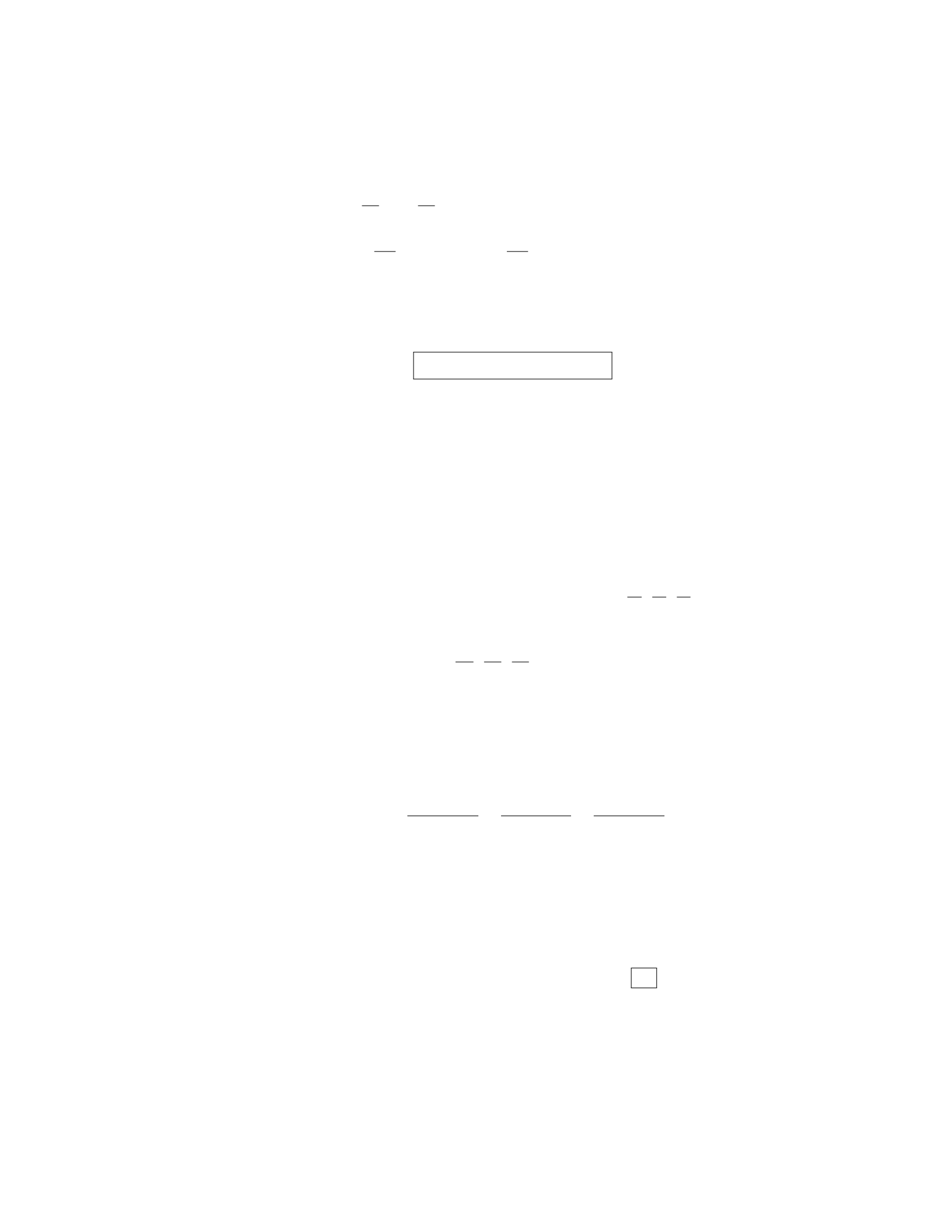
Step 3: Compute ∂Q
∂x and ∂P
∂y .
∂Q
∂x =ex+zand ∂P
∂y =xey.
Step 4: Assemble the components to find the curl of F:
curl(F)=(z−ex+z)i+ (0 −0)j+ (ex+z−xey)k.
Therefore, the curl of Fis (z−ex+z)i+ (ex+z−xey)k.
Question 15
Question
Let F(x, y, z) = (x2+y2)i+ (y2+z2)j+ (z2+x2)kbe a vector field. Calculate
the divergence of Fat the point (1,2,3).
Solution
To find the divergence of Fat a point, we use the formula: div(F) = ∇ · F,
where ∇is the del operator. In Cartesian coordinates, ∇=∂
∂x ,∂
∂y ,∂
∂z .
Step 1: Calculate the del operator ∇.
∇=∂
∂x ,∂
∂y ,∂
∂z
Step 2: Find the components of F.
F(x, y, z) = (x2+y2)i+ (y2+z2)j+ (z2+x2)k
Step 3: Find the divergence of F.
div(F) = ∇ · F=∂(x2+y2)
∂x +∂(y2+z2)
∂y +∂(z2+x2)
∂z
Step 4: Evaluate the divergence at the point (1,2,3).
div(F)(1,2,3) = 2x+ 2y+ 2z
Step 5: Substitute the values x= 1, y= 2, and z= 3 into the divergence
formula.
div(F)(1,2,3) = 2(1) + 2(2) + 2(3) = 2 + 4 + 6 = 12
Therefore, the divergence of Fat the point (1,2,3) is 12.
11
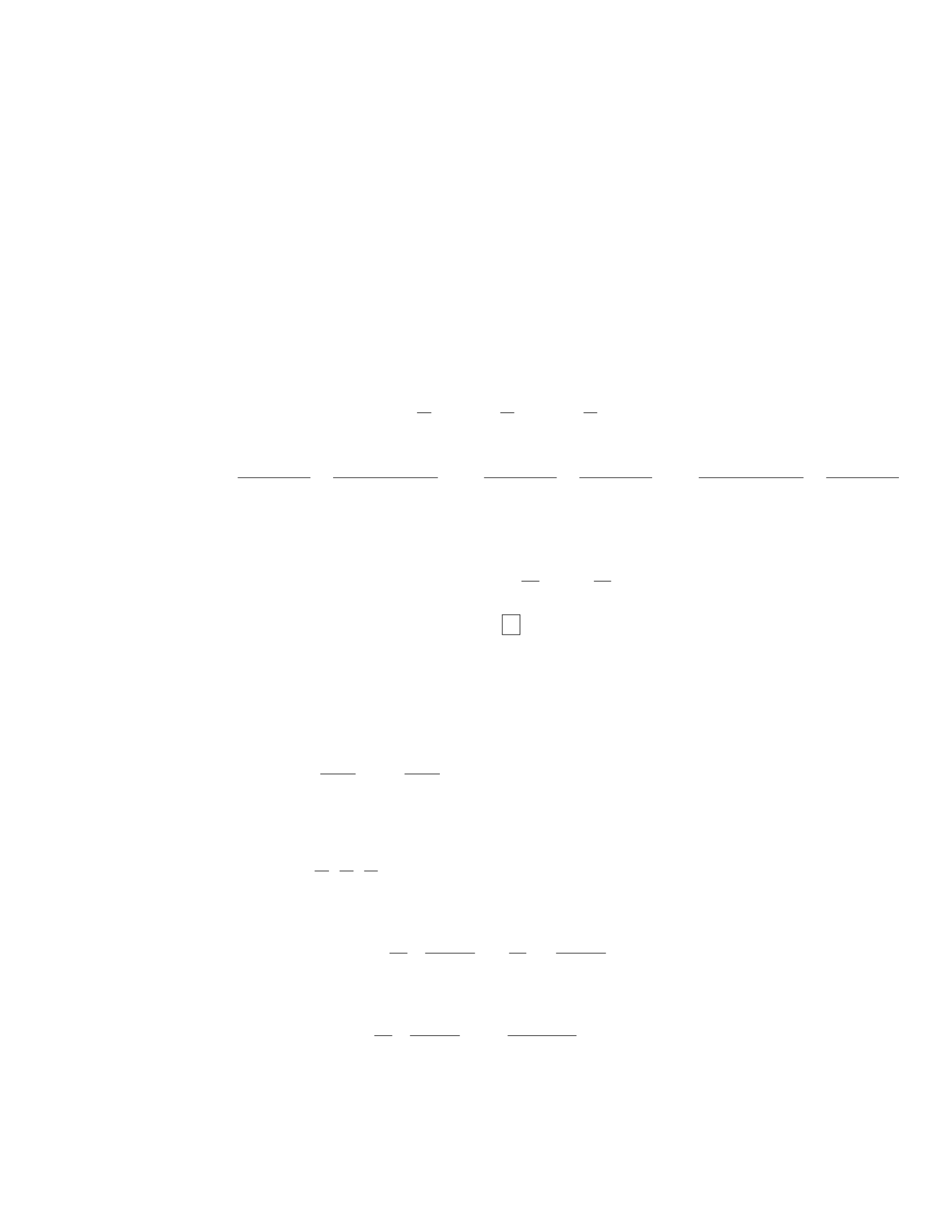
Question 16
Question
Let F(x, y, z) = (2xy +z)i+ (x2+y2+z2)j+ (xy −2z)k. Compute ∇·∇×F,
where ∇is the del operator.
Solution
Step 1: Compute the curl of F.
∇ × F=
i j k
∂
∂x
∂
∂y
∂
∂z
2xy +z x2+y2+z2xy −2z
=∂(xy −2z)
∂y −∂(x2+y2+z2)
∂z i−∂(2xy +z)
∂x −∂(xy −2z)
∂z j+∂(x2+y2+z2)
∂x −∂(2xy +z)
∂y k
= (−2)i−(−2)j+ (0)k=−2i+ 2j
Step 2: Compute the divergence of the curl of F.
∇ · ∇ × F=∇ · (−2i+ 2j) = ∂
∂x (−2) + ∂
∂y (2)
= 0 + 0 = 0
Therefore, ∇ · ∇ × F= 0.
Question 17
Question
Let F(x, y, z) = 1
x2+y2i+−x
x2+y2j. Compute ∇ · F.
Solution
To compute the divergence of F, we need to take the dot product of the del
operator ∇=∂
∂x ,∂
∂y ,∂
∂z with the vector field Fand then take the sum of the
individual components.
Step 1: Compute the divergence of F:
∇ · F=∂
∂x 1
x2+y2+∂
∂y −x
x2+y2
Step 2: Calculate the partial derivatives:
∂
∂x 1
x2+y2=−2x
(x2+y2)2
12
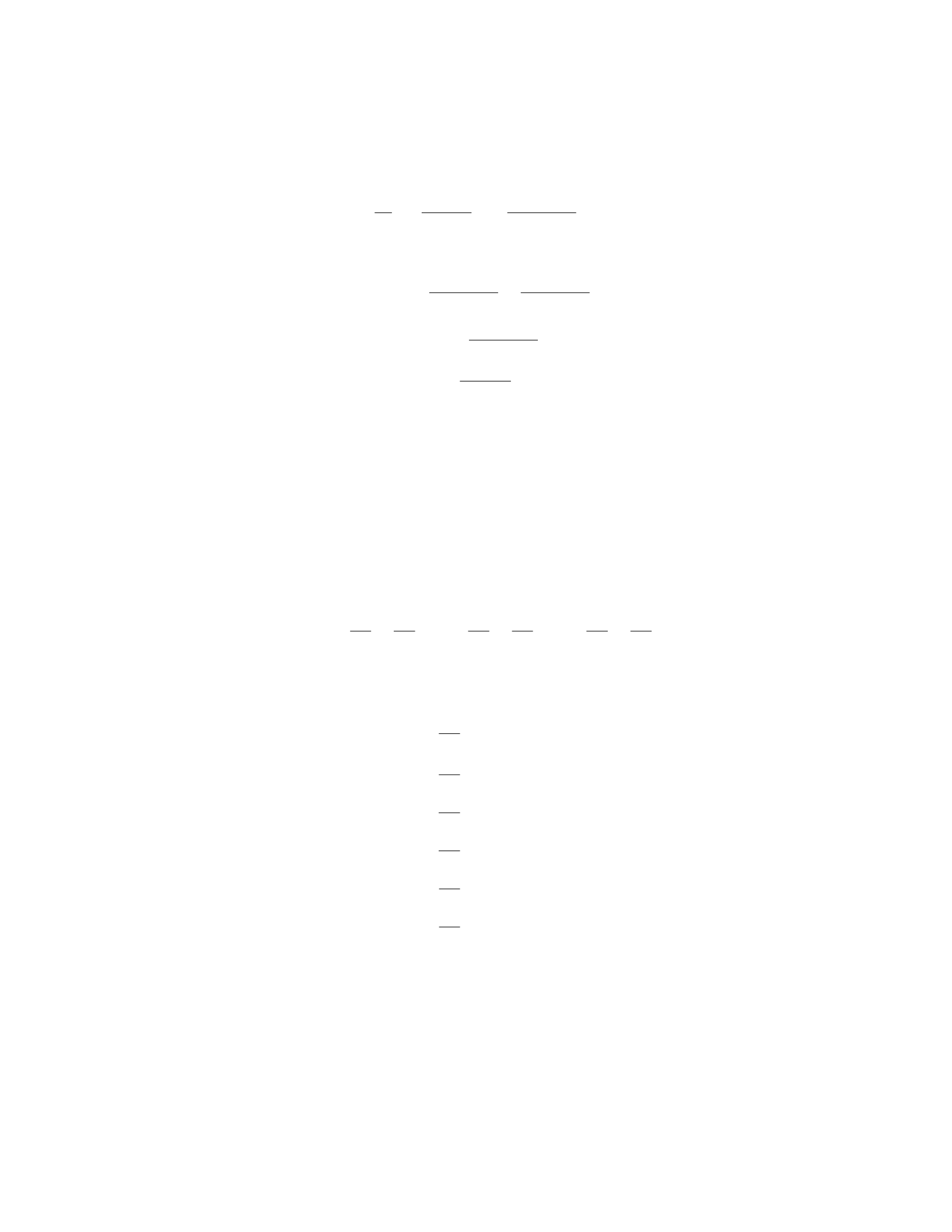
∂
∂y −x
x2+y2=2y
(x2+y2)2
Step 3: Substitute the partial derivatives back into the expression and sim-
plify:
∇ · F=−2x
(x2+y2)2+2y
(x2+y2)2
∇ · F=2(y−x)
(x2+y2)2
Therefore, the divergence of Fis 2(y−x)
(x2+y2)2.
Question 18
Question
Let F= (ey+ sin z)i+ (ez+ cos x)j+ (ex+ sin y)kbe a vector field in R3.
Compute the curl of F.
Solution
To find the curl of a vector field F=Pi+Qj+Rk, we use the formula:
curl F=∂R
∂y −∂Q
∂z i+∂P
∂z −∂R
∂x j+∂Q
∂x −∂P
∂y k
Step 1: Compute the partial derivatives of P,Q, and Rwith respect to x,
y, and z.
∂P
∂y =ey
∂P
∂z = cos z
∂Q
∂x = 0
∂Q
∂z =ez
∂R
∂x =ex
∂R
∂y = cos y
Step 2: Calculate the components of the curl of Fusing the computed
13
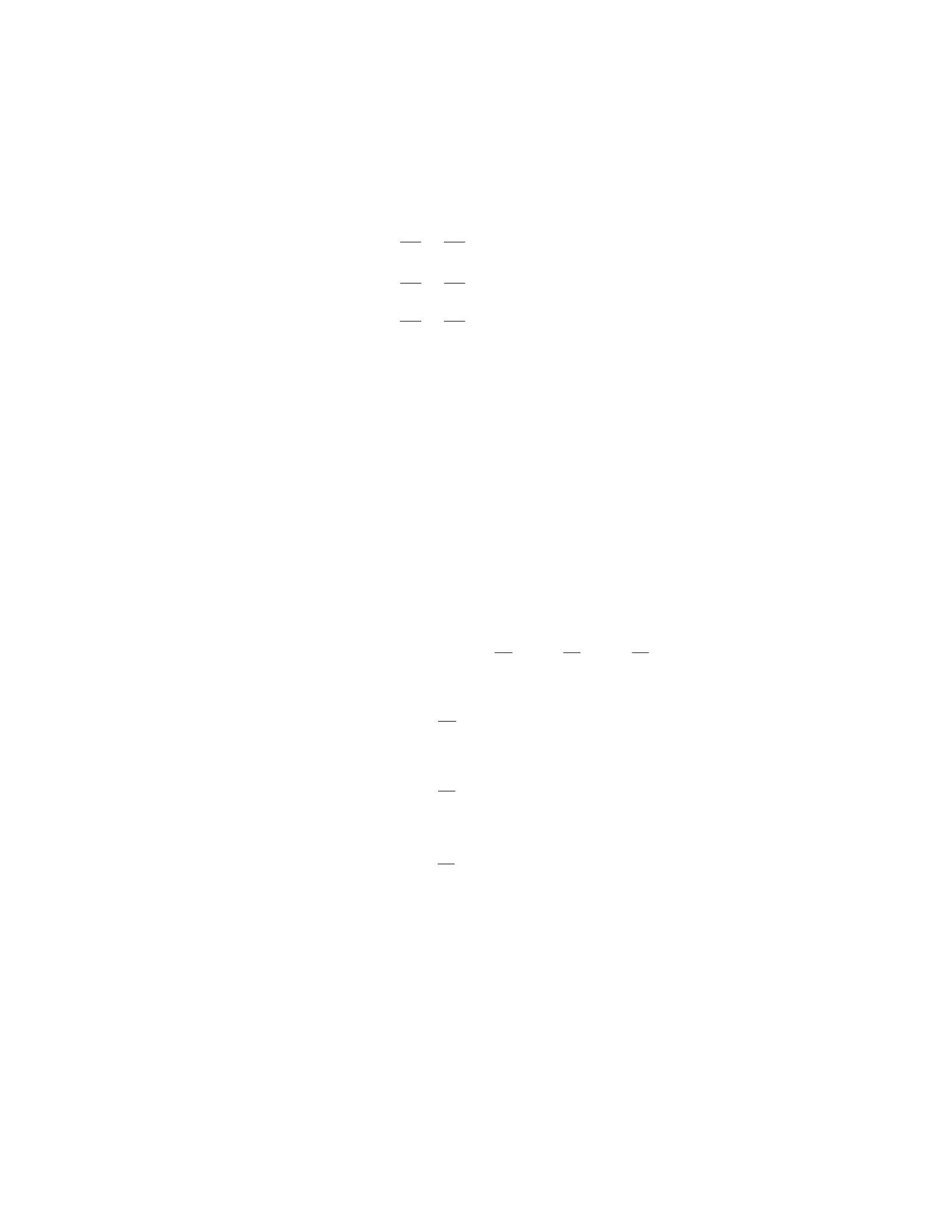
partial derivatives:
∂R
∂y −∂Q
∂z = cos y−ez
∂P
∂z −∂R
∂x = cos z−ex
∂Q
∂x −∂P
∂y =−ey
Therefore, the curl of Fis:
curl F= (cos y−ez)i+ (cos z−ex)j−eyk
Question 19
Question
Let F(x, y, z) = yzˆ
i+xzˆ
j+xyˆ
k. Find the divergence of F.
Solution
To find the divergence of F, we compute the dot product of the del operator ∇
with Fand then take the dot product of the resulting vector with the vector
function F.
∇ · F=∇ · (yzˆ
i+xzˆ
j+xyˆ
k) = ∂
∂x (yz) + ∂
∂y (xz) + ∂
∂z (xy)
Step 1: Compute the partial derivative with respect to x:
∂
∂x (yz) = z
Step 2: Compute the partial derivative with respect to y:
∂
∂y (xz) = z
Step 3: Compute the partial derivative with respect to z:
∂
∂z (xy) = x
Therefore, the divergence of Fis:
∇ · F=z+z+x= 2z+x
Question 20
Question
Let F(x, y, z)=(exsin y, excos y, z2) be a vector field. Compute the curl of F.
14

Solution
To compute the curl of F, we need to find the determinant of the following
matrix:
curl(F) =
i j k
∂
∂x
∂
∂y
∂
∂z
exsin y excos y z2
Step 1: Compute the partial derivatives Let’s compute the partial
derivatives of the vector field F:
∂
∂x = (exsin y, excos y, 0),
∂
∂y = (excos y, −exsin y, 0),
∂
∂z = (0,0,2z).
Step 2: Calculate the curl Now, we can use these partial derivatives to
find the curl as follows:
curl(F) = ∂
∂y (z2)−∂
∂z (excos y),∂
∂z (exsin y)−∂
∂x (z2),∂
∂x (excos y)−∂
∂y (exsin y)
= (0 −0,0−0, exsin y−(−excos y))
= (0,0,2exsin y).
Therefore, the curl of Fis curl(F) = k·2exsin y= 2exsin yk.
Question 21
Question
Let F(x, y, z) = x2yi+xyzj+x2zkbe a vector field in R3. Compute ∇ · ∇ × F.
Solution
Step 1: Compute ∇ × F.
∇ × F=
i j k
∂
∂x
∂
∂y
∂
∂z
x2y xyz x2z
=∂(x2z)
∂y −∂(xyz)
∂z i−∂(x2z)
∂x −∂(x2y)
∂z j+∂(xyz)
∂x −∂(x2y)
∂y k
= (0 −x)i−(2xz −0)j+ (yz −2xy)k=−xi−2xzj+ (y−2x)k
15

Step 2: Compute ∇ · ∇ × F(divergence of ∇ × F).
∇ · v=∂
∂x (−x) + ∂
∂y (−2xz) + ∂
∂z (y−2x)
=−1−2x+ 0 = −1−2x
Therefore, ∇ · ∇ × F=−1−2x.
Question 22
Question
Let F(x, y, z) = ⟨exy , x2y3z, z2
x2+y2⟩. Find the divergence of F.
Solution
To find the divergence of a vector field F=⟨P, Q, R⟩, we use the formula
div(F) = ∂P
∂x +∂Q
∂y +∂R
∂z .
Step 1: Calculate the partial derivatives of P=exy,Q=x2y3z, and
R=z2
x2+y2.
∂P
∂x =yexy ,∂Q
∂y = 3x2y2z, ∂R
∂z =2z(x2+y2)−z2(2x)
(x2+y2)2
Step 2: Add up the partial derivatives to find the divergence.
div(F) = ∂P
∂x +∂Q
∂y +∂R
∂z
=yexy + 3x2y2z+2z(x2+y2)−z2(2x)
(x2+y2)2
Therefore, the divergence of F(x, y, z) = ⟨exy, x2y3z, z2
x2+y2⟩is yexy+3x2y2z+
2z(x2+y2)−z2(2x)
(x2+y2)2.
Question 23
Question
Let F(x, y, z) = x2y+ 2yz, xz, x2+ 3z2. Calculate the curl of Fat the point
(1,1,1).
16
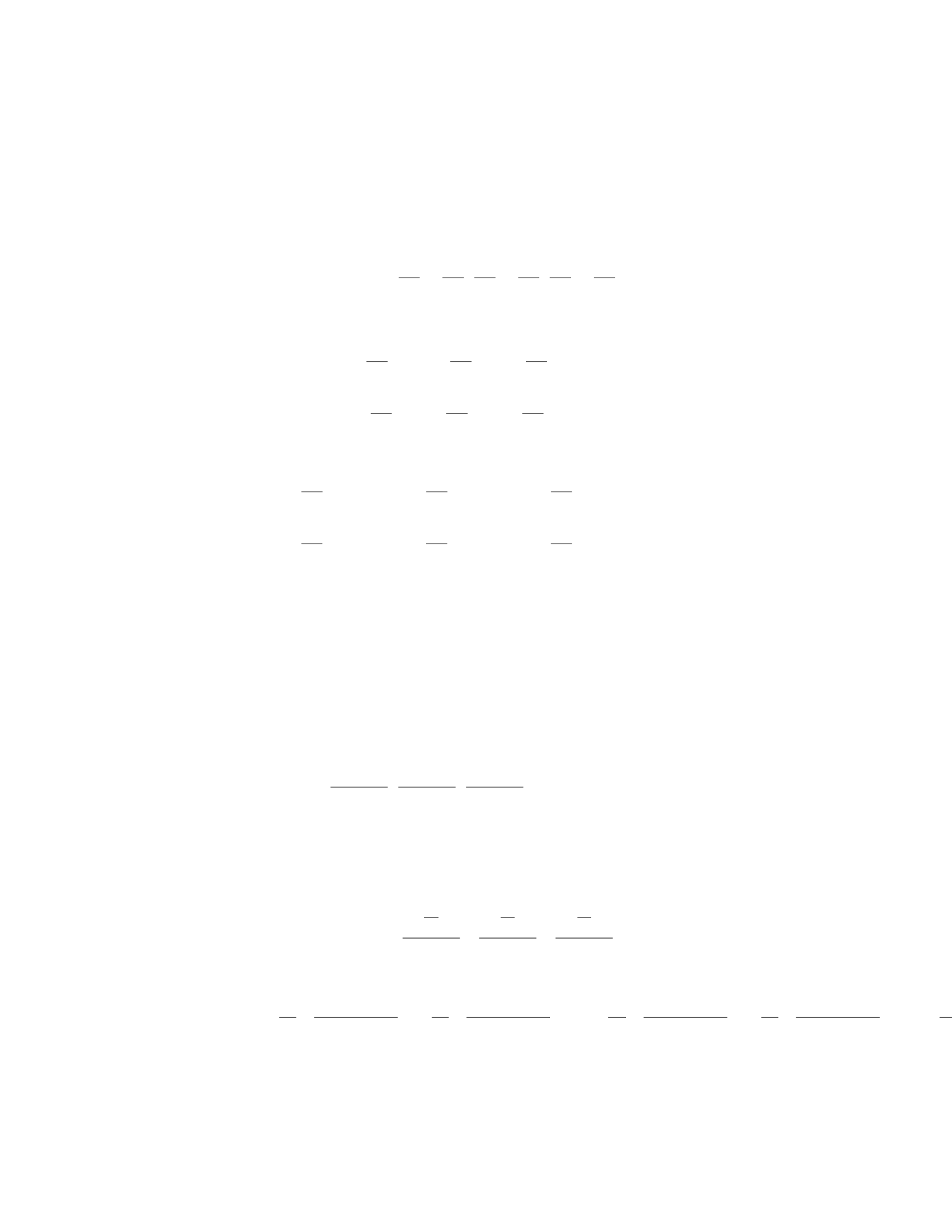
Solution
To find the curl of a vector field F= (P, Q, R), we can use the formula:
curl F=∂R
∂y −∂Q
∂z ,∂P
∂z −∂R
∂x ,∂Q
∂x −∂P
∂y
Step 1: Compute the partial derivatives of P,Q, and R:
∂P
∂y =x2,∂Q
∂z = 0,∂R
∂x = 2x
∂R
∂y = 0,∂Q
∂x =z, ∂P
∂z = 2y
Step 2: Evaluate the derivatives at the point (1,1,1):
∂P
∂y (1,1,1) = 1,∂Q
∂z (1,1,1) = 0,∂R
∂x (1,1,1) = 2
∂R
∂y (1,1,1) = 0,∂Q
∂x (1,1,1) = 1,∂P
∂z (1,1,1) = 2
Step 3: Substitute the values into the curl formula and compute the curl
at the point (1,1,1):
curl F(1,1,1) = (1 −0,2−2,1−2) = (1,0,−1)
Therefore, the curl of Fat the point (1,1,1) is (1,0,−1).
Question 24
Question
Let
F(x, y, z) = yz
x2+y2+z2,xz
x2+y2+z2,xy
x2+y2+z2. Find the curl of
F.
Solution
Step 1: Compute the components of the curl, ∇ ×
F.
∇ ×
F=
ˆ
iˆ
jˆ
k
∂
∂x
∂
∂y
∂
∂z
yz
x2+y2+z2
xz
x2+y2+z2
xy
x2+y2+z2
Step 2: Expand the determinant.
∇×
F=∂
∂y xy
x2+y2+z2−∂
∂z xz
x2+y2+z2ˆ
i−∂
∂x yz
x2+y2+z2−∂
∂z xy
x2+y2+z2ˆ
j+∂
∂x xz
x2+y2+z2−∂
∂y yz
x2+y2+z2ˆ
k
17

Step 3: Differentiate each component.
∇×
F=y(x2+y2+z2)−xy(2y)
(x2+y2+z2)2ˆ
i−z(x2+y2+z2)−xz(2z)
(x2+y2+z2)2ˆ
j+x(x2+y2+z2)−xz(2x)
(x2+y2+z2)2ˆ
k
Step 4: Simplify the components.
∇×
F=y(x2+y2+z2)−2xy2
(x2+y2+z2)2ˆ
i−z(x2+y2+z2)−2xz2
(x2+y2+z2)2ˆ
j+x(x2+y2+z2)−2x2z
(x2+y2+z2)2ˆ
k
Therefore, the curl of
Fis ∇×
F=y(x2+y2+z2)−2xy2
(x2+y2+z2)2ˆ
i−z(x2+y2+z2)−2xz2
(x2+y2+z2)2ˆ
j+
x(x2+y2+z2)−2x2z
(x2+y2+z2)2ˆ
k.
Question 25
Question
Let F= (x2+y2, ez,cos(y)) be a vector field in R3. Determine ∇ · F,∇ × F,
and ∇ × (∇ × F).
Solution
Step 1: Calculate ∇ · F
The divergence of a vector field F= (P(x, y, z), Q(x, y, z), R(x, y, z)) is given
by ∇ · F=∂P
∂x +∂Q
∂y +∂R
∂z .
In this case, F= (x2+y2, ez,cos(y)), so we have:
∇ · F=∂
∂x (x2+y2) + ∂
∂y (ez) + ∂
∂z (cos(y))
∇ · F= 2x+ 0 + 0
∇ · F= 2x
Step 2: Calculate ∇ × F
The curl of a vector field F= (P(x, y, z), Q(x, y, z), R(x, y, z)) is given by
∇ × F=∂R
∂y −∂Q
∂z ,∂P
∂z −∂R
∂x ,∂Q
∂x −∂P
∂y .
For our vector field F= (x2+y2, ez,cos(y)), we get:
∇ × F= (0 −0,0−0,0−0) = 0
Step 3: Calculate ∇ × (∇ × F)
The curl of a vector field can be defined as ∇ × (∇ × F) = ∇(∇ · F)− ∇2F,
where ∇2Frepresents the Laplacian operator acting on F.
Since ∇ · F= 2x, we have:
∇ × (∇ × F) = ∇(2x)− ∇2F
The Laplacian operator applied to Fis zero in this case as Fis a vector
field, so:
∇ × (∇ × F)=0−0 = 0
18
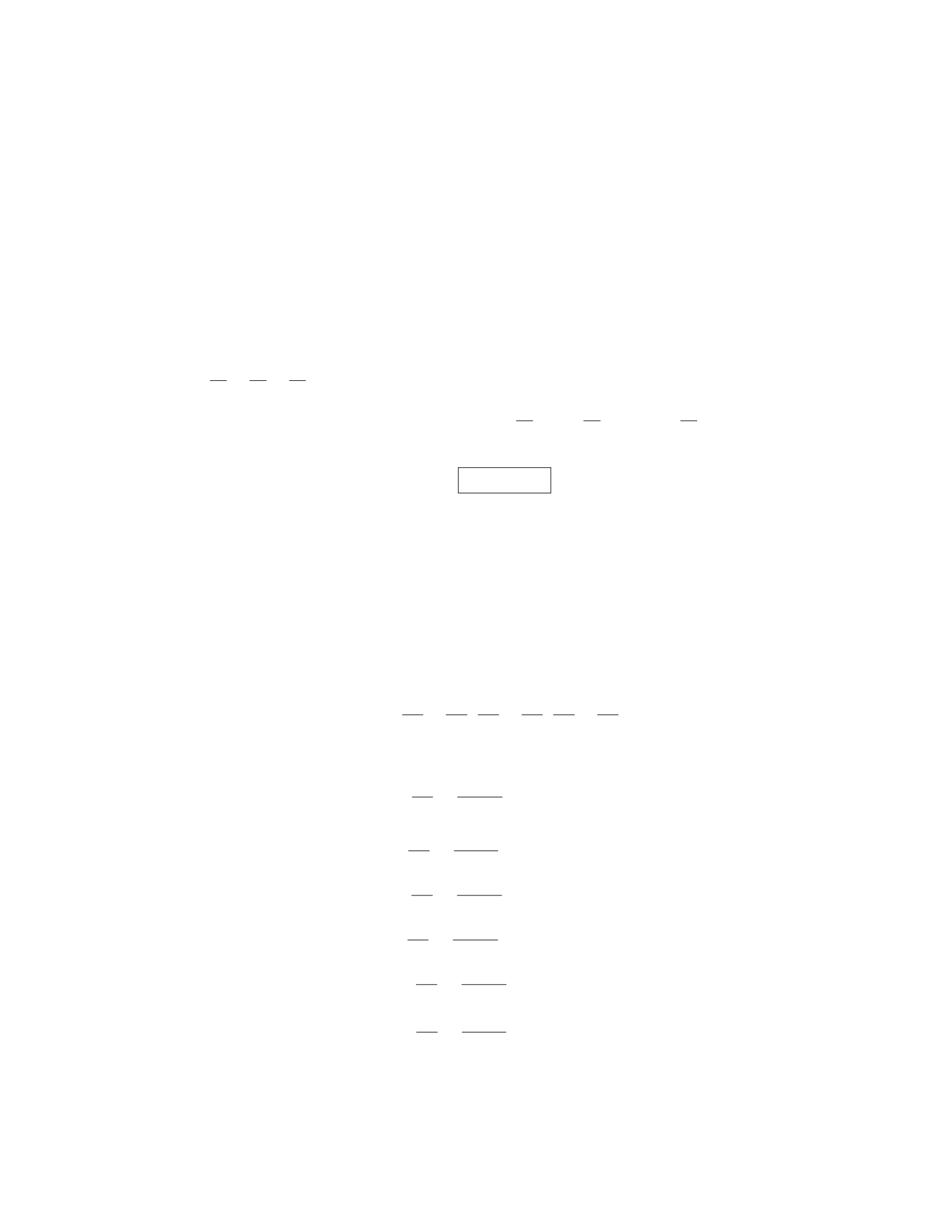
Question 26
Question
Let F(x, y, z) = (x2+y2)i+ (y2+z2)j+ (z2+x2)k. Calculate the divergence
of F.
Solution
Step 1: The divergence of a vector field F=Pi+Qj+Rkis given by ∇ · F=
∂P
∂x +∂Q
∂y +∂R
∂z .
Step 2: In this case, P=x2+y2,Q=y2+z2, and R=z2+x2.
Step 3: Calculate the partial derivatives: ∂P
∂x = 2x,∂Q
∂y = 2y, and ∂R
∂z = 2z.
Step 4: Add the partial derivatives to find the divergence: ∇ · F= 2x+ 2y+
2z= 2(x+y+z).
Therefore, the divergence of Fis 2(x+y+z) .
Question 27
Question
Let F(x, y, z)=(xz2, yz2, x2y) be a vector field in R3. Calculate div(curl(F)).
Solution
Step 1: Calculate the curl of F. The curl of a vector field F(x, y, z)=(P, Q, R)
is given by:
curl(F) = ∂R
∂y −∂Q
∂z ,∂P
∂z −∂R
∂x ,∂Q
∂x −∂P
∂y
In this case, F(x, y, z)=(xz2, yz2, x2y). So we have:
∂R
∂y =∂(x2y)
∂y =x2
∂Q
∂z =∂(yz2)
∂z = 2yz
∂P
∂z =∂(xz2)
∂z =xz
∂R
∂x =∂(x2y)
∂x = 2xy
∂P
∂y =∂(xz2)
∂y = 0
∂Q
∂x =∂(yz2)
∂x = 0
19
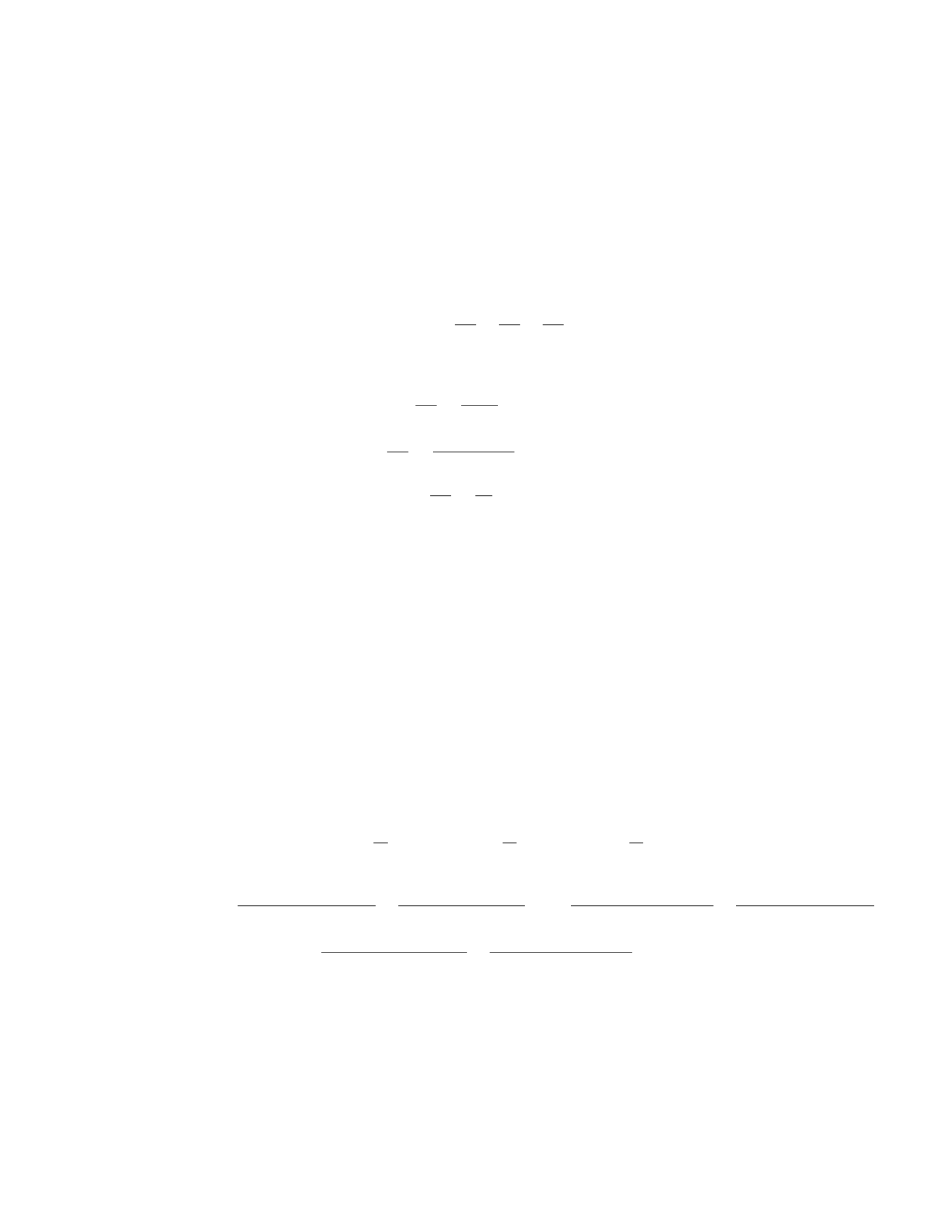
Therefore, the curl of Fis:
curl(F)=(x2−0, xz −2xy, 0−0) = (x2, xz −2xy, 0)
Step 2: Calculate the divergence of the curl of F. The divergence of a vector
field G(x, y, z)=(P, Q, R) is given by:
div(G) = ∂P
∂x +∂Q
∂y +∂R
∂z
In this case, G(x, y, z) = (x2, xz −2xy, 0). So we have:
∂P
∂x =∂(x2)
∂x = 2x
∂Q
∂y =∂(xz −2xy)
∂y =−2x
∂R
∂z =∂0
∂z = 0
Therefore, the divergence of the curl of Fis:
div(curl(F)) = 2x−2x+ 0 = 0
So, div(curl(F)) = 0.
Question 28
Question
Let F= (yexz −zln (y+ 1), xz2−ycos (xz), y ln (x+ 1) −xy2) be a vector field
in R3. Calculate ∇ · ∇ × F.
Solution
Step 1: First, we calculate the curl of F.
∇ × F=
i j k
∂
∂x
∂
∂y
∂
∂z
yexz −zln (y+ 1) xz2−ycos (xz)yln (x+ 1) −xy2
=∂(yln (x+ 1) −xy2)
∂y −∂(xz2−ycos (xz))
∂z i−∂(yexz −zln (y+ 1))
∂x −∂(yln (x+ 1) −xy2)
∂z j
+∂(yz ln (x+ 1) −xy2)
∂x −∂(yexz −zln (y+ 1))
∂y k
Step 2: Simplify the above expression to find ∇ × F.
Step 3: Once we have ∇ × F, we compute ∇ · (∇ × F).
Step 4: Substitute the values we found for ∇ × Finto this expression and
simplify to find the final answer.
20

Question 29
Question
Let F(x, y, z)=(x2, yz, xyz) be a vector field in R3. Find the curl of F.
Solution
To find the curl of F, we can use the formula:
curl F=∂F3
∂y −∂F2
∂z ,∂F1
∂z −∂F3
∂x ,∂F2
∂x −∂F1
∂y
Step 1: Compute the partial derivatives of F:
∂F1
∂x = 2x, ∂F2
∂y =z, ∂F3
∂z =xy
∂F1
∂y = 0,∂F2
∂z =y, ∂F3
∂x =yz
Step 2: Calculate the curl of F:
curl F= (y−0, xy −z, z −2x)
curl F= (y, xy −z, z −2x)
Therefore, the curl of the vector field F(x, y, z) = (x2, yz, xyz) is curl F=
(y, xy −z, z −2x).
Question 30
Question
Let F(x, y, z)=(z2, xz, xy) be a vector field in three-dimensional space. Deter-
mine the gradient, divergence, and curl of F.
Solution
Step 1: Calculate the gradient of F. The gradient of a vector field Fis denoted
by ∇Fand is given by:
∇F=∂F1
∂x ,∂F2
∂y ,∂F3
∂z
where F= (F1, F2, F3). In this case, F(x, y, z)=(z2, xz, xy), so we have:
∇F=∂z2
∂x ,∂xz
∂y ,∂xy
∂z
21
Calculating the partial derivatives, we get:
∇F= (0, z, y)
Step 2: Calculate the divergence of F. The divergence of a vector field
F= (P, Q, R) is given by:
∇ · F=∂P
∂x +∂Q
∂y +∂R
∂z
In this case, F(x, y, z)=(z2, xz, xy), so we have:
∇ · F=∂z2
∂x +∂xz
∂y +∂xy
∂z
Calculating the partial derivatives, we get:
∇ · F= 0 + z+ 0 = z
Step 3: Calculate the curl of F. The curl of a vector field F= (P, Q, R) is
given by:
∇ × F=∂R
∂y −∂Q
∂z ,∂P
∂z −∂R
∂x ,∂Q
∂x −∂P
∂y
In this case, F(x, y, z)=(z2, xz, xy), so we have:
∇ × F= (0 −z, 0−0, x −z)=(−z, 0, x −z)
22

