



MATH 112 - TECHNICAL
MATHEMATICS - Vector operations
Question Bank - Set 4
Liberty University
Question 1
Question
Let a = 3ˆ
i−2ˆ
j+ 4ˆ
kand
b= 2ˆ
i+ 5ˆ
j−3ˆ
kbe two vectors in three-dimensional
space. Find the angle between the vectors a and
b.
Solution
Step 1: The dot product of two vectors a and
bis given by:
a ·
b=|a||
b|cos θ
where θis the angle between the two vectors. Calculating the dot product:
a ·
b= (3ˆ
i−2ˆ
j+ 4ˆ
k)·(2ˆ
i+ 5ˆ
j−3ˆ
k)
= 3(2) + (−2)(5) + 4(−3)
= 6 −10 −12
=−16
Step 2: The magnitudes of vectors a and
bare:
|a|=p32+ (−2)2+ 42=√9 + 4 + 16 = √29
|
b|=p22+ 52+ (−3)2=√4 + 25 + 9 = √38
Step 3: Substituting the dot product and magnitudes back into the dot
product formula:
−16 = √29√38 cos θ
cos θ=−16
√29√38
θ= cos−1−16
√29√38
Therefore, the angle between the vectors a and
bis θ≈123.43◦.

Question 2
Question
Let a= 2i−3j+ 4kand b=−i+ 5j−2kbe two vectors in R3. Find a vector
csuch that cis perpendicular to both aand b.
Solution
Step 1: To find a vector cthat is perpendicular to both aand b, we must take
the cross product of aand b.
Step 2: The cross product of two vectors u=u1i+u2j+u3kand v=
v1i+v2j+v3kin R3is given by:
u×v= (u2v3−u3v2)i−(u1v3−u3v1)j+ (u1v2−u2v1)k
Step 3: Calculating the cross product of aand b:
a×b=
i j k
2−3 4
−1 5 −2
= ((−3)(−2) −4(5))i−(2(−2) −4(−1))j+ (2(5) −(−3)(−1))k
= (6 −20)i−(−4 + 4)j+ (10 −3)k
=−14i+ 0j+ 7k
=−14i+ 7k
Therefore, a vector c=−14i+ 7kis perpendicular to both aand b.
Question 3
Question
Let a=2
−1and b=−3
4. Find the scalar ksuch that the vector ka+ 2b
is orthogonal to the vector 1
1.
Solution
Step 1: Find the vector ka+ 2b.
ka+ 2b=k2
−1+ 2 −3
4
=2k
−k+−6
8
=2k−6
−k+ 8
2

Step 2: Find the dot product of ka+ 2band 1
1.
2k−6
−k+ 8·1
1= (2k−6)(1) + (−k+ 8)(1)
= 2k−6−k+ 8
=k+ 2
Step 3: Set the dot product equal to zero to find k.
k+ 2 = 0
k=−2
Therefore, the scalar ksuch that the vector ka+ 2bis orthogonal to the
vector 1
1is k=−2.
Question 4
Question
Let u =4
−1and v =−2
3. Determine the angle between u and v.
Solution
Step 1: Calculate the dot product of vectors u and v:
u ·v = 4(−2) + (−1)(3) = −8−3 = −11
Step 2: Calculate the magnitudes of vectors u and v:
|u|=p42+ (−1)2=√16 + 1 = √17
|v|=p(−2)2+ 32=√4 + 9 = √13
Step 3: Calculate the angle θbetween u and v using the formula:
cos(θ) = u ·v
|u||v|
cos(θ) = −11
√17√13
Step 4: Solve for the angle θ:
θ= cos−1−11
√17√13
θ≈135.5◦
Therefore, the angle between vectors u and v is approximately 135.5◦.
3

Question 5
Question
Let a=2
1and b=−1
3. Determine the angle between vectors aand b.
Solution
Step 1: Calculate the dot product of vectors aand b.
a·b= 2(−1) + 1(3) = −2 + 3 = 1
Step 2: Calculate the magnitudes of vectors aand b.
|a|=p22+ 12=√4 + 1 = √5
|b|=p(−1)2+ 32=√1 + 9 = √10
Step 3: Calculate the angle θbetween vectors aand busing the dot product
formula:
cos θ=a·b
|a||b|
cos θ=1
√5√10 =1
√50 =1
5√2=√2
10
θ= arccos √2
10 !≈78.69◦
Therefore, the angle between vectors aand bis approximately 78.69◦.
Question 6
Question
Let a = 3ˆ
i−2ˆ
j+ 4ˆ
kand
b=ˆ
i−3ˆ
j+λˆ
kbe two vectors. If the angle between a
and
bis 60 degrees, find the value of λ.
Solution
Given that the angle between a and
bis 60 degrees, we can use the dot product
to find λ:
a ·
b=|a|·|
b| · cos(60◦)
4

Step 1: Find a ·
b
a ·
b= (3ˆ
i−2ˆ
j+ 4ˆ
k)·(ˆ
i−3ˆ
j+λˆ
k)
= 3 ·1+(−2) ·(−3) + 4 ·λ
= 3 + 6 + 4λ
= 9 + 4λ
Step 2: Find |a|and |
b|
|a|=p32+ (−2)2+ 42=√9 + 4 + 16 = √29
|
b|=p12+ (−3)2+λ2=p1 + 9 + λ2=p10 + λ2
Step 3: Solve for λPlugging back into the formula for dot product:
9+4λ=√29 ·p10 + λ2·cos(60◦)
9+4λ=√29 ·p10 + λ2·1
2
18 + 8λ=√29 ·p10 + λ2
Squaring both sides:
(18 + 8λ)2= 29 ·(10 + λ2)
324 + 288λ+ 64λ2= 290 + 29λ2
35λ2−288λ+ 34 = 0
Solving this quadratic equation, we find:
λ=288 ±√2882−4×35 ×34
2×35
Calculating this gives:
λ≈288 ±√8296
70
λ≈288 ±91
70
λ≈379
70 or λ≈197
70
Therefore, the possible values of λare λ=379
70 or λ=197
70 .
Question 7
Question
Let a =
2
−3
1
and
b=
−1
4
−2
. Find a unit vector u in the direction of a +
b.
5

Solution
Step 1: Find a +
b.
a +
b=
2
−3
1
+
−1
4
−2
=
2+(−1)
−3+4
1+(−2)
=
1
1
−1
Step 2: Find the magnitude of a +
b.
∥a +
b∥=p12+ 12+ (−1)2=√3
Step 3: Find the unit vector u in the direction of a +
b.
u =a +
b
∥a +
b∥=1
√3
1
1
−1
=
1
√3
1
√3
−1
√3
Therefore, the unit vector u in the direction of a +
bis
1
√3
1
√3
−1
√3
.
Question 8
Question
Let a = 2ˆ
i−3ˆ
j+ 4ˆ
kand
b=−ˆ
i+ 2ˆ
j−2ˆ
k. Find the angle between the vectors
a and
b.
Solution
Step 1: Find the dot product of vectors a and
b:
a ·
b= (2)(−1) + (−3)(2) + (4)(−2)
a ·
b=−2−6−8
a ·
b=−16
Step 2: Find the magnitude of vector a and vector
b:
∥a∥=p(2)2+ (−3)2+ (4)2
∥a∥=√4 + 9 + 16
∥a∥=√29
Similarly,
∥
b∥=p(−1)2+ (2)2+ (−2)2
6
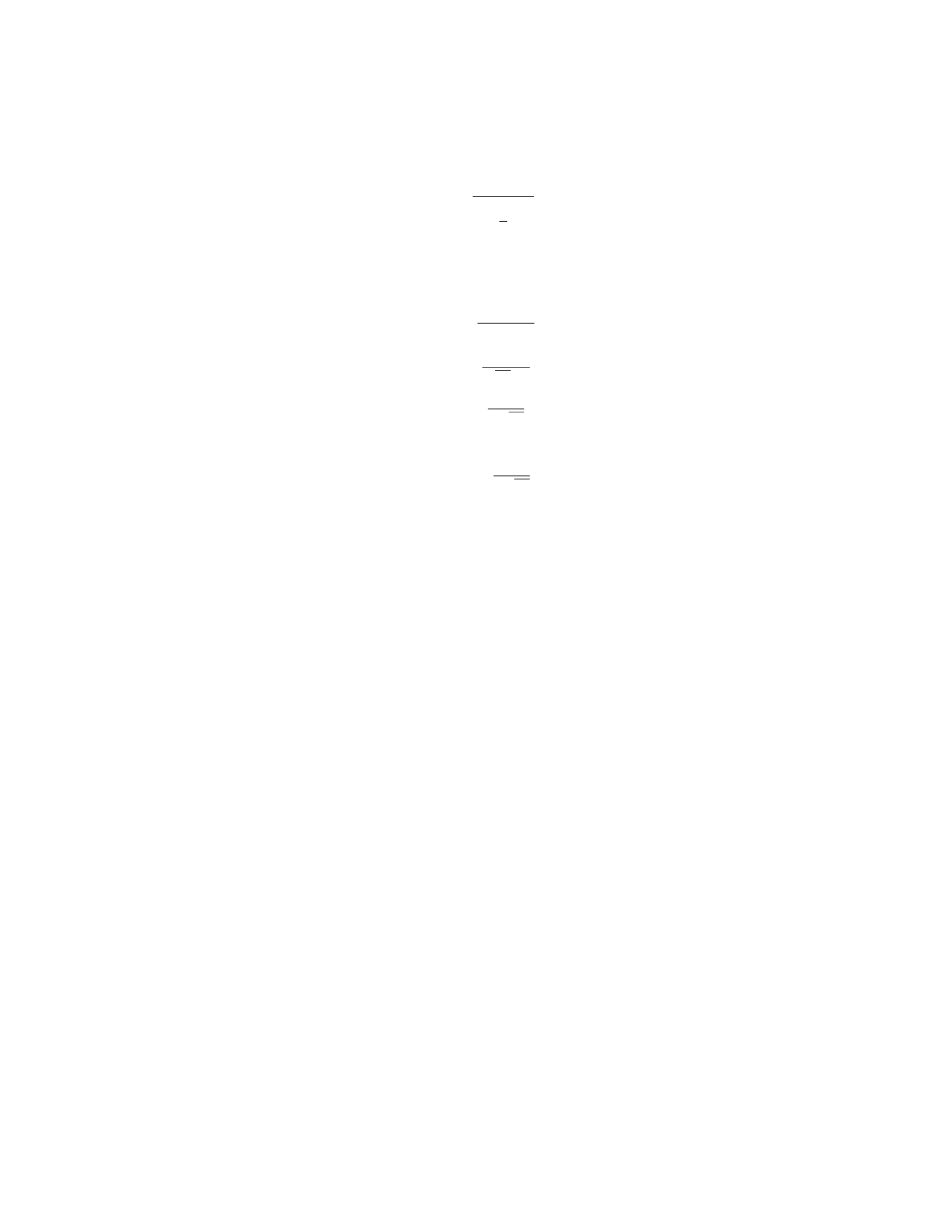
∥
b∥=√1+4+4
∥
b∥=√9
Hence, ∥
b∥= 3.
Step 3: Find the angle between vectors a and
busing the dot product for-
mula:
cos(θ) = a ·
b
∥a∥·∥
b∥
cos(θ) = −16
√29 ·3
cos(θ) = −16
3√29
Step 4: Calculate the angle θ:
θ= arccos −16
3√29
θ≈121.8◦
Therefore, the angle between the vectors a and
bis approximately 121.8◦.
Question 9
Question
Let u =⟨3,−1,2⟩and v =⟨−2,4,1⟩. Find a vector w such that w ·u = 7 and
w ×v =⟨−6,5,−16⟩.
Solution
Step 1: Let w =⟨a, b, c⟩. The dot product of vectors w and u is:
w ·u =a(3) + b(−1) + c(2) = 7
3a−b+ 2c= 7
Step 2: The cross product of vectors w and v is:
w ×v =
i j k
a b c
−2 4 1
=⟨−6,5,−16⟩
Step 3: Expand the determinant to get three equations:
i: 4c−b=−16
j:a+ 2c=−6
k:−2b−3a= 5
Step 4: Solve the system of equations obtained in Step 1 and Step 3. By
solving the system, we get a= 5, b=−2, and c=−1.
Therefore, the vector w =⟨5,−2,−1⟩.
7
Question 10
Question
Let u =−3
4and v =1
−5. Determine the magnitude of the vector projection
of u onto v.
Solution
Step 1: Calculate the dot product of u and v.
u ·v = (−3)(1) + (4)(−5) = −3−20 = −23
Step 2: Calculate the magnitude of v.
∥v∥=p12+ (−5)2=√1 + 25 = √26
Step 3: Calculate the magnitude of the vector projection of u onto v using
the formula:
projv (u) = u ·v
∥v∥2v
projv (u) = −23
26 1
−5=−23/26
115/26
Step 4: Calculate the magnitude of the vector projection.
∥projv (u)∥=p(−23/26)2+ (115/26)2=p529/676 + 13225/676 = p13754/676 = √203
Therefore, the magnitude of the vector projection of u onto v is √203 .
Question 11
Question
Let a=
2
−3
5
,b=
−1
4
−2
, and c=
3
1
−4
. Compute 2a−3b+c.
Solution
Step 1: Compute 2a.
2
−3
5
·2 =
4
−6
10
Step 2: Compute 3b.
−1
4
−2
·3 =
−3
12
−6
8

Step 3: Compute 2a−3b.
4
−6
10
−
−3
12
−6
=
7
−18
16
Step 4: Add cto 2a−3b.
7
−18
16
+
3
1
−4
=
10
−17
12
Therefore, 2a−3b+c=
10
−17
12
.
Question 12
Question
Let a = 3ˆ
i−4ˆ
j+5ˆ
kand
b=ˆ
i+2ˆ
j−ˆ
k. Determine the angle between the vectors
a and
b.
Solution
Step 1: Find the dot product of vectors a and
b.
a ·
b= (3)(1) + (−4)(2) + (5)(−1) = 3 −8−5 = −10
Step 2: Find the magnitudes of vectors a and
b.
|a|=p(3)2+ (−4)2+ (5)2=√9 + 16 + 25 = √50
|
b|=p(1)2+ (2)2+ (−1)2=√1 + 4 + 1 = √6
Step 3: Use the formula cos(θ) = a·
b
|a|·|
b|to find the cosine of the angle θ
between vectors a and
b.
cos(θ) = −10
√50 ·√6=−10
√300 =−10
√300 =−10√300
300
Step 4: Find the angle θby taking the arccosine of the value computed in
Step 3.
θ= arccos −10√300
300 != arccos −10√3
10 != arccos−√3
So, the angle between the vectors a and
bis arccos−√3.
9

Question 13
Question
Given two vectors u=
−2
3
5
and v=
4
−1
2
, find the angle between the two
vectors.
Solution
Step 1: Calculate the dot product of uand v.
u·v= (−2)(4) + (3)(−1) + (5)(2) = −8−3 + 10 = −1
Step 2: Calculate the magnitudes of vectors uand v.
|u|=p(−2)2+ 32+ 52=√4 + 9 + 25 = √38
|v|=p42+ (−1)2+ 22=√16 + 1 + 4 = √21
Step 3: Use the formula cos(θ) = u
·v|u||v|to find the cosine of the angle
between the vectors.
cos(θ) = −1
√38 ·√21 =−1
√798
Step 4: Find the angle θusing the inverse cosine function.
θ= cos−1−1
√798≈108.9◦
Therefore, the angle between the vectors uand vis approximately 108.9◦.
Question 14
Question
A force F1with magnitude 50 N acts at a point (1,2) in the xy-plane. Another
force F2with magnitude 30 N acts at a point (−1,3). Determine the resultant
force Facting at the origin and find its magnitude and direction.
Solution
Step 1: Write the vector representation of the forces. Let F1=50 cos(α)
50 sin(α)
represent the force F1where αis the angle that F1makes with the positive
x-axis. Similarly, let F2=30 cos(β)
30 sin(β)represent the force F2where βis the
angle that F2makes with the positive x-axis.
10

Step 2: Find the angles αand β.α= arctan 2
1= arctan(2) ≈63.43◦
β= arctan 3
−1= arctan(−3) ≈ −71.57◦
Step 3: Calculate the components of the resulting force. F=F1+F2
F=50 cos(63.43)
50 sin(63.43)+30 cos(−71.57)
30 sin(−71.57)F≈21.87
68.18
Step 4: Find the magnitude and direction of the resulting force F.∥F∥=
√21.872+ 68.182≈71.46 N The angle θthat Fmakes with the positive x-axis
is given by: θ= arctan 68.18
21.87 ≈73.29◦
Therefore, the resultant force acting at the origin is approximately 71.46 N,
at an angle of 73.29 degrees with the positive x-axis.
Question 15
Question
Let u =2
−1and v =−3
4. Determine the angle between vectors u and v.
Solution
To find the angle θbetween two vectors u and v, we can use the dot product
formula:
u ·v =|u|·|v| · cos(θ)
Step 1: Calculate the dot product of vectors u and v.
u ·v = (2) ·(−3) + (−1) ·(4) = −6−4 = −10
Step 2: Calculate the magnitudes of vectors u and v.
|u|=p22+ (−1)2=√4 + 1 = √5
|v|=p(−3)2+ 42=√9 + 16 = √25 = 5
Step 3: Substitute the dot product and magnitudes into the dot product
formula to solve for θ.
−10 = (√5) ·(5) ·cos(θ)
−10 = 5√5·cos(θ)
cos(θ) = −10
5√5=−2
√5=−2√5
5
Step 4: Find the angle θby taking the arccosine of the value calculated in
step 3.
θ= arccos −2√5
5!≈arccos(−0.632455532)
θ≈131.8◦
Therefore, the angle between vectors u and v is approximately 131.8◦.
11

Question 16
Question
Let a=
2
−1
3
,b=
−1
4
2
, and c=
3
0
−2
. Determine whether the vectors
a,b, and care linearly independent or linearly dependent.
Solution
Step 1: To determine whether the vectors a,b, and care linearly independent or
linearly dependent, we will set up a linear combination equation. Let constants
x,y, and zbe such that:
x
y
z
=x
2
−1
3
+y
−1
4
2
+z
3
0
−2
Step 2: This can be simplified to:
x
y
z
=
2x−y+ 3z
−x+ 4y
3x+ 2y−2z
Step 3: Equating the components of the two vectors, we get the following
system of equations:
2x−y+ 3z=x
−x+ 4y=y
3x+ 2y−2z=z
Step 4: Solving the system of equations, we find the unique solution x= 1,
y=−1, z=1
2. Since this unique solution exists (other than the trivial solution
where x= 0, y= 0, z= 0), the vectors a,b, and care linearly dependent.
Question 17
Question
Let a =
2
−1
3
and
b=
4
0
−2
. Determine the angle between vectors a and
b
in degrees.
12

Solution
Step 1: Find the dot product of a and
b:
a ·
b= (2)(4) + (−1)(0) + (3)(−2) = 8 + 0 −6=2
Step 2: Calculate the magnitudes of a and
b:
|a|=p22+ (−1)2+ 32=√4 + 1 + 9 = √14
|
b|=p42+ 02+ (−2)2=√16 + 0 + 4 = √20
Step 3: Use the formula for the angle between two vectors, θ= cos−1a·
b
|a||
b|:
θ= cos−12
√14 ·√20= cos−12
√280= cos−12
2√70= cos−11
√70
Step 4: Convert the angle from radians to degrees:
θ=180
πcos−11
√70≈180
π×0.5191 ≈29.74◦
Therefore, the angle between vectors a and
bis approximately 29.74 degrees.
Question 18
Question
Let v =
2
−1
3
and w =
−3
2
4
. Find ∥v −w∥.
Solution
Step 1: Subtract the vectors v and w.
v −w =
2
−1
3
−
−3
2
4
=
2+3
−1−2
3−4
=
5
−3
−1
Step 2: Find the norm (magnitude) of the resulting vector v −w.
∥v −w∥=p52+ (−3)2+ (−1)2=√25 + 9 + 1 = √35
Therefore, ∥v −w∥=√35.
13

Question 19
Question
Let a =
3
−1
4
,
b=
−2
5
1
, and c =
0
2
−3
. Determine the angle between a
and the projection of
bonto c.
Solution
Step 1: Find the projection of
bonto c. The projection of
bonto c is given by:
projc(
b) =
b·c
∥c∥2!c
where
b·c is the dot product of
band c and ∥c∥is the magnitude of c.
Calculating the dot product:
b·c =
−2
5
1
·
0
2
−3
=−2(0) + 5(2) + 1(−3) = 7
Calculating the magnitude of c:
∥c∥=p02+ 22+ (−3)2=√13
Thus, the projection of
bonto c is:
projc(
b) = 7
13
0
2
−3
=
0
14
13
−21
13
Step 2: Find the angle between a and the projection of
bonto c. The angle
between two vectors u and v can be found using the formula:
cos θ=u ·v
∥u∥∥v∥
Let u =a and v = projc(
b). Now, calculate the angle:
cos θ=
3
−1
4
·
0
14
13
−21
13
√26 ·q620
169
cos θ=3(0) + (−1) 14
13 + 4 −21
13
√26 ·q620
169
14

cos θ=−29
√26 ·620
169
=−29 ·169
26 ·620
θ= cos−1−29 ·169
26 ·620
So, the angle between a and the projection of
bonto c is θ= cos−1−29·169
26·620 .
Question 20
Question
Given two vectors a= 2i−3j+ 4kand b=i+ 5j−2k, find the angle between
the two vectors in degrees.
Solution
Step 1: Calculate the dot product of vectors aand b.
a·b= (2)(1) + (−3)(5) + (4)(−2)
a·b= 2 −15 −8 = −21
Step 2: Calculate the magnitudes of vectors aand b.
|a|=p22+ (−3)2+ 42=√4 + 9 + 16 = √29
|b|=p12+ 52+ (−2)2=√1 + 25 + 4 = √30
Step 3: Calculate the angle between the two vectors using the dot product
formula a·b=|a||b|cos θ.
−21 = √29 ·√30 ·cos θ
cos θ=−21
√29 ·√30
θ= cos−1−21
√29 ·√30
Step 4: Calculate the angle in degrees.
θ≈cos−1−21
√29 ·√30≈100.7◦
Therefore, the angle between the two vectors aand bis approximately
100.7◦.
15

Question 21
Question
Let v=
3
−1
2
and w=
1
4
−2
. Determine the angle between the vectors v
and w.
Solution
Step 1: Find the dot product of vectors vand w.
v·w= (3)(1) + (−1)(4) + (2)(−2) = 3 −4−4 = −5
Step 2: Calculate the magnitudes of vectors vand w.
|v|=p32+ (−1)2+ 22=√14
|w|=p12+ 42+ (−2)2=√21
Step 3: Use the dot product formula to find the angle θbetween vectors v
and w.
cos θ=v
·w|v|·|w|=−5
√14 ·√21
θ= arccos −5
√14 ·√21≈124.47◦
Therefore, the angle between vectors vand wis approximately 124.47◦.
Question 22
Question
Let u= 3i−2j+kand v=i+ 4j−2k. Find the angle between vectors uand
v.
Solution
To find the angle between two vectors, we can use the dot product formula:
u·v=|u||v|cos(θ)
where θis the angle between the vectors uand v.
Step 1: Calculate the dot product u·v.
u·v= (3)(1) + (−2)(4) + (1)(−2) = 3 −8−2 = −7
16

Step 2: Calculate the magnitudes |u|and |v|.
|u|=p32+ (−2)2+ 12=√14
|v|=p12+ 42+ (−2)2=√21
Step 3: Substitute the dot product and magnitudes into the dot product
formula to solve for θ.
−7 = √14 ·√21 ·cos(θ)
Step 4: Solve for θ.
cos(θ) = −7
√14 ·√21 =−7
√294 =−7
√294 =−7
√49 ·6=−7
7√6=−1
√6
Step 5: Find the angle θ.
θ= cos−1−1
√6≈150.96◦
Therefore, the angle between vectors uand vis approximately 150.96◦.
Question 23
Question
Let a=2
−3and b=−4
5. Find the magnitude of the vector a+ 3b.
Solution
Step 1: Find the vector a+ 3b.
a+ 3b=2
−3+ 3 −4
5=2
−3+−12
15 =−10
12
Step 2: Find the magnitude of the vector a+ 3b. The magnitude of a 2D
vector v=a
bis given by ∥v∥=√a2+b2.
Thus, the magnitude of −10
12 is:
∥−10
12 ∥=p(−10)2+ 122=√100 + 144 = √244 = 2√61
Therefore, the magnitude of the vector a+ 3bis 2√61.
17

Question 24
Question
Let v =
3
−4
5
and w =
1
2
−1
. Find a vector u that is orthogonal to both v
and w.
Solution
Step 1: Find the cross product of v and w:
v ×w =
3
−4
5
×
1
2
−1
=
(−4)(−1) −(5)(2)
(5)(1) −(3)(−1)
(3)(2) −(−4)(1)
=
−3−10
5+3
6+4
=
−13
8
10
Step 2: Let u =
a
b
c
be a vector orthogonal to both v and w. The dot
product of u with v and w will be 0:
u ·v =
a
b
c
·
3
−4
5
= 0
3a−4b+ 5c= 0
u ·w =
a
b
c
·
1
2
−1
= 0
a+ 2b−c= 0
Step 3: Solve the system of equations: From u·v = 0, we get 3a−4b+5c= 0,
which simplifies to:
3a= 4b−5c
(1)
From u ·w = 0, we get a+ 2b−c= 0, which simplifies to:
a=−2b+c
18
(2)
Substitute equation (2) into equation (1):
3(−2b+c) = 4b−5c
−6b+ 3c= 4b−5c
10b= 8c
5b= 4c
So, the general form of a vector orthogonal to both v and w is u =
4
−5
5
.
Question 25
Question
Let a=2
−3and b=−1
4. Determine the angle between vectors aand bto
the nearest degree.
Solution
To find the angle between vectors aand b, we can use the formula:
cos(θ) = a·b
∥a∥∥b∥
Step 1: Calculate the dot product of aand b:
a·b= (2)(−1) + (−3)(4) = −2−12 = −14
Step 2: Calculate the magnitude (length) of vector a:
∥a∥=p(2)2+ (−3)2=√4 + 9 = √13
Step 3: Calculate the magnitude of vector b:
∥b∥=p(−1)2+ 42=√1 + 16 = √17
Step 4: Substitute the values into the formula for the cosine of the angle
between vectors:
cos(θ) = −14
√13 ·√17 =−14
√13 ·17 =−14
√221
Step 5: Solve for θby taking the arccosine of both sides:
θ= arccos −14
√221≈97◦
Therefore, the angle between vectors aand bis approximately 97◦.
19

Question 26
Question
Let u=
1
−2
3
,v=
4
0
−1
, and w=
2
1
−2
be three vectors. Determine if the
vectors u,v, and ware linearly independent.
Solution
Step 1: To determine if the vectors u,v, and ware linearly independent, we set
up the equation c1u+c2v+c3w=0, where c1,c2, and c3are scalar constants.
Step 2: Substitute the given vectors into the equation:
c1
1
−2
3
+c2
4
0
−1
+c3
2
1
−2
=
0
0
0
Step 3: Simplify the equation:
c1
−2c1
3c1
+
4c2
0
−c2
+
2c3
c3
−2c3
=
0
0
0
Step 4: Combine the vectors on the left side of the equation:
c1+ 4c2+ 2c3
−2c1+c3
3c1−c2−2c3
=
0
0
0
Step 5: Set up a system of equations by equating the components of the
vectors to zero: c1+ 4c2+ 2c3= 0 (1)
−2c1+c3= 0 (2)
3c1−c2−2c3= 0 (3)
Step 6: Solve the system of equations by row reducing the augmented matrix:
1420
−2 0 1 0
3−1−2 0
Row reducing, we get:
1 0 0 0
0 1 0 0
0 0 1 0
Step 7: Since the system has a unique solution c1=c2=c3= 0, the vectors
u,v, and ware linearly independent.
20

Question 27
Question
Let u=
2
−3
1
and v=
−1
4
−2
. Find the angle between vectors uand v.
Solution
Step 1: Find the dot product of vectors uand v.
u·v= (2)(−1) + (−3)(4) + (1)(−2) = −2−12 −2 = −16
Step 2: Find the magnitudes of vectors uand v.
|u|=p22+ (−3)2+ 12=√4 + 9 + 1 = √14
|v|=p(−1)2+ 42+ (−2)2=√1 + 16 + 4 = √21
Step 3: Find the angle between vectors uand v. Using the formula cos θ=
u
·v|u||v|.
cos θ=−16
√14 ·√21 =−16
√294 =−16
√294
Step 4: Calculate the angle between vectors uand v.
θ= cos−1−16
√294≈114.62◦
Therefore, the angle between vectors uand vis approximately 114.62◦.
Question 28
Question
Let u =
−2
4
1
and v =
3
−5
2
. Find u ·v and ∥u ×v∥.
Solution
Step 1: To find the dot product u·v, we use the formula u·v =u1v1+u2v2+u3v3.
u ·v = (−2)(3) + (4)(−5) + (1)(2)
u ·v =−6−20 + 2
u ·v =−24
21

Step 2: To find the cross product u ×v, we use the formula
u ×v =
u2v3−u3v2
u3v1−u1v3
u1v2−u2v1
u ×v =
(4)(2) −(1)(−5)
(1)(3) −(−2)(2)
(−2)(−5) −(4)(3)
u ×v =
8+5
3+4
10 −12
u ×v =
13
7
−2
Step 3: To find the magnitude of a vector, we use the formula ∥u∥=
pu2
1+u2
2+u2
3.
∥u ×v∥=p132+ 72+ (−2)2
∥u ×v∥=√169 + 49 + 4
∥u ×v∥=√222
∥u ×v∥=√2·111
∥u ×v∥= 3√37
Therefore, the dot product u ·v =−24 and the magnitude of the cross
product u ×v = 3√37.
Question 29
Question
Let v =
2
−1
3
and w =
1
4
0
. Find the angle between vectors v and w in
degrees.
Solution
Step 1: Find the dot product of v and w.
v ·w = (2)(1) + (−1)(4) + (3)(0) = 2 −4 + 0 = −2
Step 2: Find the magnitude of v and w.
|v|=p22+ (−1)2+ 32=√4 + 1 + 9 = √14
22

|w|=p12+ 42+ 02=√1 + 16 = √17
Step 3: Use the formula cos(θ) = v·w
|v|·|w|to find the cosine of the angle
between v and w.
cos(θ) = −2
√14 ·√17 =−2
√238
Step 4: Find the angle θin degrees using the inverse cosine function.
θ= arccos −2
√238≈113.38◦
Therefore, the angle between vectors v and w is approximately 113.38◦.
Question 30
Question
Let a = 2ˆ
i−3ˆ
j+ˆ
kand
b=−ˆ
i+ 2ˆ
j−4ˆ
kbe two vectors in R3. Find a unit
vector c such that c is perpendicular to both a and
b.
Solution
Step 1: Find the cross product of vectors a and
b:
a ×
b=
ˆ
iˆ
jˆ
k
2−3 1
−1 2 −4
= (−3·(−4) −1·2)ˆ
i−(2 ·(−4) −1·(−1))ˆ
j+ (2 ·2−(−3) ·(−1))ˆ
k
= (12 −2)ˆ
i−(−8 + 1)ˆ
j+ (4 + 3)ˆ
k
= 10ˆ
i+ 7ˆ
j+ 7ˆ
k
Step 2: Calculate the magnitude of a ×
b:
|a ×
b|=p102+ 72+ 72=√100 + 49 + 49 = √198
Step 3: Find the unit vector c:
c =a ×
b
|a ×
b|=10ˆ
i+ 7ˆ
j+ 7ˆ
k
√198
c =10
√198
ˆ
i+7
√198
ˆ
j+7
√198
ˆ
k
Therefore, the unit vector c perpendicular to both a and
bis 10
√198ˆ
i+7
√198 ˆ
j+
7
√198 ˆ
k.
23

Question 31
Question
Let u=
2
−1
4
and v=
−3
0
5
. Determine the angle between vectors uand v.
Solution
To find the angle between two vectors uand v, we can use the formula
cos θ=u·v
∥u∥∥v∥,
where θis the angle between the vectors, u·vis the dot product of uand v,
and ∥u∥and ∥v∥are the magnitudes of uand vrespectively.
Step 1: Calculate the dot product of uand v.
u·v= (2)(−3) + (−1)(0) + (4)(5) = −6 + 0 + 20 = 14.
Step 2: Calculate the magnitudes of uand v.
∥u∥=p22+ (−1)2+ 42=√4 + 1 + 16 = √21,
∥v∥=p(−3)2+ 02+ 52=√9 + 0 + 25 = √34.
Step 3: Substitute the dot product and magnitudes into the formula to find
θ.
cos θ=14
√21√34 =14
√714.
Step 4: Solve for θ.
θ= arccos 14
√714≈35.99◦.
Therefore, the angle between vectors uand vis approximately 35.99◦.
Question 32
Question
Let a=3
4and b=−1
2. Find the angle between vectors aand b.
24

Solution
To find the angle between vectors aand b, we can use the dot product formula:
a·b=∥a∥∥b∥cos(θ)
where θis the angle between vectors aand b.
Step 1: Calculate a·b:
a·b= (3)(−1) + (4)(2) = −3 + 8 = 5
Step 2: Calculate ∥a∥and ∥b∥:
∥a∥=p32+ 42=√9 + 16 = √25 = 5
∥b∥=p(−1)2+ 22=√1 + 4 = √5
Step 3: Plug a·b= 5 and ∥a∥= 5, ∥b∥=√5 into the dot product formula
to solve for θ:
5 = (5)(√5) cos(θ)
Step 4: Solve for θ:
cos(θ) = 5
5√5=1
√5
θ= arccos 1
√5
Therefore, the angle between vectors aand bis arccos 1
√5.
Question 33
Question
Let a =
3
−2
1
,
b=
1
4
−3
, and c =
−2
−1
2
. Determine if the vectors a,
b, and
c are linearly independent.
Solution
Step 1: Set up the equation k1a +k2
b+k3c =
0, where k1,k2, and k3are
constants.
Step 2: The equation becomes:
3
−2
1
k1+
1
4
−3
k2+
−2
−1
2
k3=
0
0
0
25

Step 3: Simplify the equation:
3k1+k2−2k3
−2k1+ 4k2−k3
k1−3k2+ 2k3
=
0
0
0
Step 4: This leads to a system of equations:
3k1+k2−2k3= 0
−2k1+ 4k2−k3= 0
k1−3k2+ 2k3= 0
Step 5: Solve the system of equations to determine if there are non-trivial
solutions.
Step 6: The determinant of the coefficient matrix is not zero, which implies
that the only solution is the trivial one. Therefore, the vectors a,
b, and c are
linearly independent.
Question 34
Question
Let a=
2
−3
1
,b=
5
0
−4
, and c=
−1
2
3
. If d= 3a−2b+c, find the
magnitude of vector d.
Solution
Step 1: Calculate 3a.
3a= 3
2
−3
1
=
6
−9
3
Step 2: Calculate 2b.
2b= 2
5
0
−4
=
10
0
−8
26

Step 3: Add the results from Step 1 and Step 2.
3a−2b=
6
−9
3
−
10
0
−8
=
−4
−9
11
Step 4: Add vector c=
−1
2
3
.
d=
−4
−9
11
+
−1
2
3
=
−5
−7
14
Step 5: Calculate the magnitude of vector d.
|d|=p(−5)2+ (−7)2+ 142
=√25 + 49 + 196
=√270
= 3√30
Thus, the magnitude of vector dis 3√30.
Question 35
Question
Let a=
2
1
−3
,b=
−1
4
2
, and c=
3
−2
1
. Determine if the vectors a,b,
and care linearly independent.
Solution
Step 1: To determine if the vectors a,b, and care linearly independent, we set
up the equation:
k1a+k2b+k3c=0
where 0is the zero vector and k1, k2, k3are scalar coefficients.
27

Question 2
Question
Let a= 2i−3j+ 4kand b=−i+ 5j−2kbe two vectors in R3. Find a vector
csuch that cis perpendicular to both aand b.
Solution
Step 1: To find a vector cthat is perpendicular to both aand b, we must take
the cross product of aand b.
Step 2: The cross product of two vectors u=u1i+u2j+u3kand v=
v1i+v2j+v3kin R3is given by:
u×v= (u2v3−u3v2)i−(u1v3−u3v1)j+ (u1v2−u2v1)k
Step 3: Calculating the cross product of aand b:
a×b=
i j k
2−3 4
−1 5 −2
= ((−3)(−2) −4(5))i−(2(−2) −4(−1))j+ (2(5) −(−3)(−1))k
= (6 −20)i−(−4 + 4)j+ (10 −3)k
=−14i+ 0j+ 7k
=−14i+ 7k
Therefore, a vector c=−14i+ 7kis perpendicular to both aand b.
Question 3
Question
Let a=2
−1and b=−3
4. Find the scalar ksuch that the vector ka+ 2b
is orthogonal to the vector 1
1.
Solution
Step 1: Find the vector ka+ 2b.
ka+ 2b=k2
−1+ 2 −3
4
=2k
−k+−6
8
=2k−6
−k+ 8
2

Step 2: Find the dot product of ka+ 2band 1
1.
2k−6
−k+ 8·1
1= (2k−6)(1) + (−k+ 8)(1)
= 2k−6−k+ 8
=k+ 2
Step 3: Set the dot product equal to zero to find k.
k+ 2 = 0
k=−2
Therefore, the scalar ksuch that the vector ka+ 2bis orthogonal to the
vector 1
1is k=−2.
Question 4
Question
Let u =4
−1and v =−2
3. Determine the angle between u and v.
Solution
Step 1: Calculate the dot product of vectors u and v:
u ·v = 4(−2) + (−1)(3) = −8−3 = −11
Step 2: Calculate the magnitudes of vectors u and v:
|u|=p42+ (−1)2=√16 + 1 = √17
|v|=p(−2)2+ 32=√4 + 9 = √13
Step 3: Calculate the angle θbetween u and v using the formula:
cos(θ) = u ·v
|u||v|
cos(θ) = −11
√17√13
Step 4: Solve for the angle θ:
θ= cos−1−11
√17√13
θ≈135.5◦
Therefore, the angle between vectors u and v is approximately 135.5◦.
3

Question 5
Question
Let a=2
1and b=−1
3. Determine the angle between vectors aand b.
Solution
Step 1: Calculate the dot product of vectors aand b.
a·b= 2(−1) + 1(3) = −2 + 3 = 1
Step 2: Calculate the magnitudes of vectors aand b.
|a|=p22+ 12=√4 + 1 = √5
|b|=p(−1)2+ 32=√1 + 9 = √10
Step 3: Calculate the angle θbetween vectors aand busing the dot product
formula:
cos θ=a·b
|a||b|
cos θ=1
√5√10 =1
√50 =1
5√2=√2
10
θ= arccos √2
10 !≈78.69◦
Therefore, the angle between vectors aand bis approximately 78.69◦.
Question 6
Question
Let a = 3ˆ
i−2ˆ
j+ 4ˆ
kand
b=ˆ
i−3ˆ
j+λˆ
kbe two vectors. If the angle between a
and
bis 60 degrees, find the value of λ.
Solution
Given that the angle between a and
bis 60 degrees, we can use the dot product
to find λ:
a ·
b=|a|·|
b| · cos(60◦)
4

Step 1: Find a ·
b
a ·
b= (3ˆ
i−2ˆ
j+ 4ˆ
k)·(ˆ
i−3ˆ
j+λˆ
k)
= 3 ·1+(−2) ·(−3) + 4 ·λ
= 3 + 6 + 4λ
= 9 + 4λ
Step 2: Find |a|and |
b|
|a|=p32+ (−2)2+ 42=√9 + 4 + 16 = √29
|
b|=p12+ (−3)2+λ2=p1 + 9 + λ2=p10 + λ2
Step 3: Solve for λPlugging back into the formula for dot product:
9+4λ=√29 ·p10 + λ2·cos(60◦)
9+4λ=√29 ·p10 + λ2·1
2
18 + 8λ=√29 ·p10 + λ2
Squaring both sides:
(18 + 8λ)2= 29 ·(10 + λ2)
324 + 288λ+ 64λ2= 290 + 29λ2
35λ2−288λ+ 34 = 0
Solving this quadratic equation, we find:
λ=288 ±√2882−4×35 ×34
2×35
Calculating this gives:
λ≈288 ±√8296
70
λ≈288 ±91
70
λ≈379
70 or λ≈197
70
Therefore, the possible values of λare λ=379
70 or λ=197
70 .
Question 7
Question
Let a =
2
−3
1
and
b=
−1
4
−2
. Find a unit vector u in the direction of a +
b.
5

Solution
Step 1: Find a +
b.
a +
b=
2
−3
1
+
−1
4
−2
=
2+(−1)
−3+4
1+(−2)
=
1
1
−1
Step 2: Find the magnitude of a +
b.
∥a +
b∥=p12+ 12+ (−1)2=√3
Step 3: Find the unit vector u in the direction of a +
b.
u =a +
b
∥a +
b∥=1
√3
1
1
−1
=
1
√3
1
√3
−1
√3
Therefore, the unit vector u in the direction of a +
bis
1
√3
1
√3
−1
√3
.
Question 8
Question
Let a = 2ˆ
i−3ˆ
j+ 4ˆ
kand
b=−ˆ
i+ 2ˆ
j−2ˆ
k. Find the angle between the vectors
a and
b.
Solution
Step 1: Find the dot product of vectors a and
b:
a ·
b= (2)(−1) + (−3)(2) + (4)(−2)
a ·
b=−2−6−8
a ·
b=−16
Step 2: Find the magnitude of vector a and vector
b:
∥a∥=p(2)2+ (−3)2+ (4)2
∥a∥=√4 + 9 + 16
∥a∥=√29
Similarly,
∥
b∥=p(−1)2+ (2)2+ (−2)2
6
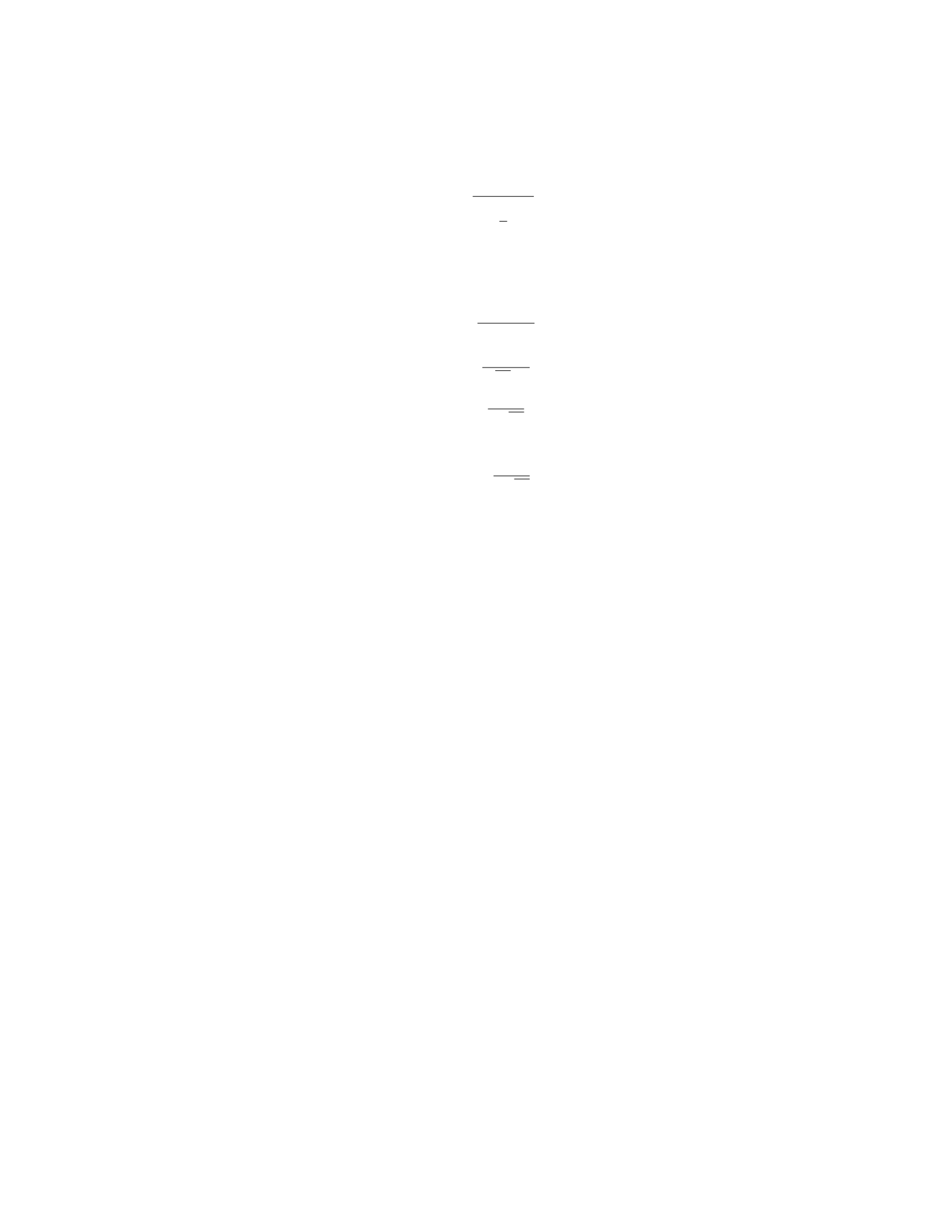
∥
b∥=√1+4+4
∥
b∥=√9
Hence, ∥
b∥= 3.
Step 3: Find the angle between vectors a and
busing the dot product for-
mula:
cos(θ) = a ·
b
∥a∥·∥
b∥
cos(θ) = −16
√29 ·3
cos(θ) = −16
3√29
Step 4: Calculate the angle θ:
θ= arccos −16
3√29
θ≈121.8◦
Therefore, the angle between the vectors a and
bis approximately 121.8◦.
Question 9
Question
Let u =⟨3,−1,2⟩and v =⟨−2,4,1⟩. Find a vector w such that w ·u = 7 and
w ×v =⟨−6,5,−16⟩.
Solution
Step 1: Let w =⟨a, b, c⟩. The dot product of vectors w and u is:
w ·u =a(3) + b(−1) + c(2) = 7
3a−b+ 2c= 7
Step 2: The cross product of vectors w and v is:
w ×v =
i j k
a b c
−2 4 1
=⟨−6,5,−16⟩
Step 3: Expand the determinant to get three equations:
i: 4c−b=−16
j:a+ 2c=−6
k:−2b−3a= 5
Step 4: Solve the system of equations obtained in Step 1 and Step 3. By
solving the system, we get a= 5, b=−2, and c=−1.
Therefore, the vector w =⟨5,−2,−1⟩.
7
Question 10
Question
Let u =−3
4and v =1
−5. Determine the magnitude of the vector projection
of u onto v.
Solution
Step 1: Calculate the dot product of u and v.
u ·v = (−3)(1) + (4)(−5) = −3−20 = −23
Step 2: Calculate the magnitude of v.
∥v∥=p12+ (−5)2=√1 + 25 = √26
Step 3: Calculate the magnitude of the vector projection of u onto v using
the formula:
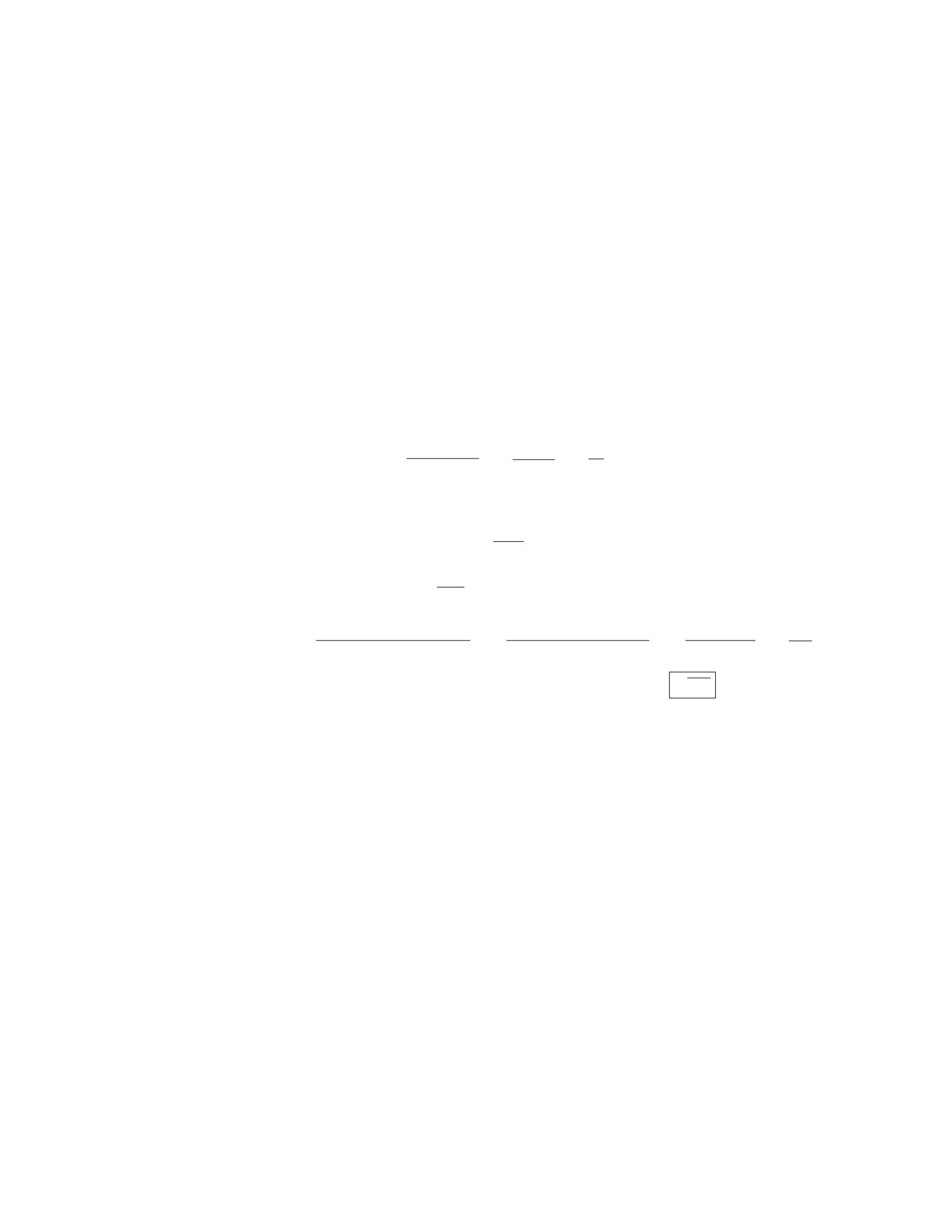
projv (u) = u ·v
∥v∥2v
projv (u) = −23
26 1
−5=−23/26
115/26
Step 4: Calculate the magnitude of the vector projection.
∥projv (u)∥=p(−23/26)2+ (115/26)2=p529/676 + 13225/676 = p13754/676 = √203
Therefore, the magnitude of the vector projection of u onto v is √203 .
Question 11
Question
Let a=
2
−3
5
,b=
−1
4
−2
, and c=
3
1
−4
. Compute 2a−3b+c.
Solution
Step 1: Compute 2a.
2
−3
5
·2 =
4
−6
10
Step 2: Compute 3b.
−1
4
−2
·3 =
−3
12
−6
8

Step 3: Compute 2a−3b.
4
−6
10
−
−3
12
−6
=
7
−18
16
Step 4: Add cto 2a−3b.
7
−18
16
+
3
1
−4
=
10
−17
12
Therefore, 2a−3b+c=
10
−17
12
.
Question 12
Question
Let a = 3ˆ
i−4ˆ
j+5ˆ
kand
b=ˆ
i+2ˆ
j−ˆ
k. Determine the angle between the vectors
a and
b.
Solution
Step 1: Find the dot product of vectors a and
b.
a ·
b= (3)(1) + (−4)(2) + (5)(−1) = 3 −8−5 = −10
Step 2: Find the magnitudes of vectors a and
b.
|a|=p(3)2+ (−4)2+ (5)2=√9 + 16 + 25 = √50
|
b|=p(1)2+ (2)2+ (−1)2=√1 + 4 + 1 = √6
Step 3: Use the formula cos(θ) = a·
b
|a|·|
b|to find the cosine of the angle θ
between vectors a and
b.
cos(θ) = −10
√50 ·√6=−10
√300 =−10
√300 =−10√300
300
Step 4: Find the angle θby taking the arccosine of the value computed in
Step 3.
θ= arccos −10√300
300 != arccos −10√3
10 != arccos−√3
So, the angle between the vectors a and
bis arccos−√3.
9

Question 13
Question
Given two vectors u=
−2
3
5
and v=
4
−1
2
, find the angle between the two
vectors.
Solution
Step 1: Calculate the dot product of uand v.
u·v= (−2)(4) + (3)(−1) + (5)(2) = −8−3 + 10 = −1
Step 2: Calculate the magnitudes of vectors uand v.
|u|=p(−2)2+ 32+ 52=√4 + 9 + 25 = √38
|v|=p42+ (−1)2+ 22=√16 + 1 + 4 = √21
Step 3: Use the formula cos(θ) = u
·v|u||v|to find the cosine of the angle
between the vectors.
cos(θ) = −1
√38 ·√21 =−1
√798
Step 4: Find the angle θusing the inverse cosine function.
θ= cos−1−1
√798≈108.9◦
Therefore, the angle between the vectors uand vis approximately 108.9◦.
Question 14
Question
A force F1with magnitude 50 N acts at a point (1,2) in the xy-plane. Another
force F2with magnitude 30 N acts at a point (−1,3). Determine the resultant
force Facting at the origin and find its magnitude and direction.
Solution
Step 1: Write the vector representation of the forces. Let F1=50 cos(α)
50 sin(α)
represent the force F1where αis the angle that F1makes with the positive
x-axis. Similarly, let F2=30 cos(β)
30 sin(β)represent the force F2where βis the
angle that F2makes with the positive x-axis.
10

Step 2: Find the angles αand β.α= arctan 2
1= arctan(2) ≈63.43◦
β= arctan 3
−1= arctan(−3) ≈ −71.57◦
Step 3: Calculate the components of the resulting force. F=F1+F2
F=50 cos(63.43)
50 sin(63.43)+30 cos(−71.57)
30 sin(−71.57)F≈21.87
68.18
Step 4: Find the magnitude and direction of the resulting force F.∥F∥=
√21.872+ 68.182≈71.46 N The angle θthat Fmakes with the positive x-axis
is given by: θ= arctan 68.18
21.87 ≈73.29◦
Therefore, the resultant force acting at the origin is approximately 71.46 N,
at an angle of 73.29 degrees with the positive x-axis.
Question 15
Question
Let u =2
−1and v =−3
4. Determine the angle between vectors u and v.
Solution
To find the angle θbetween two vectors u and v, we can use the dot product
formula:
u ·v =|u|·|v| · cos(θ)
Step 1: Calculate the dot product of vectors u and v.
u ·v = (2) ·(−3) + (−1) ·(4) = −6−4 = −10
Step 2: Calculate the magnitudes of vectors u and v.
|u|=p22+ (−1)2=√4 + 1 = √5
|v|=p(−3)2+ 42=√9 + 16 = √25 = 5
Step 3: Substitute the dot product and magnitudes into the dot product
formula to solve for θ.
−10 = (√5) ·(5) ·cos(θ)
−10 = 5√5·cos(θ)
cos(θ) = −10
5√5=−2
√5=−2√5
5
Step 4: Find the angle θby taking the arccosine of the value calculated in
step 3.
θ= arccos −2√5
5!≈arccos(−0.632455532)
θ≈131.8◦
Therefore, the angle between vectors u and v is approximately 131.8◦.
11

Question 16
Question
Let a=
2
−1
3
,b=
−1
4
2
, and c=
3
0
−2
. Determine whether the vectors
a,b, and care linearly independent or linearly dependent.
Solution
Step 1: To determine whether the vectors a,b, and care linearly independent or
linearly dependent, we will set up a linear combination equation. Let constants
x,y, and zbe such that:
x
y
z
=x
2
−1
3
+y
−1
4
2
+z
3
0
−2
Step 2: This can be simplified to:
x
y
z
=
2x−y+ 3z
−x+ 4y
3x+ 2y−2z
Step 3: Equating the components of the two vectors, we get the following
system of equations:
2x−y+ 3z=x
−x+ 4y=y
3x+ 2y−2z=z
Step 4: Solving the system of equations, we find the unique solution x= 1,
y=−1, z=1
2. Since this unique solution exists (other than the trivial solution
where x= 0, y= 0, z= 0), the vectors a,b, and care linearly dependent.
Question 17
Question
Let a =
2
−1
3
and
b=
4
0
−2
. Determine the angle between vectors a and
b
in degrees.
12

Solution
Step 1: Find the dot product of a and
b:
a ·
b= (2)(4) + (−1)(0) + (3)(−2) = 8 + 0 −6=2
Step 2: Calculate the magnitudes of a and
b:
|a|=p22+ (−1)2+ 32=√4 + 1 + 9 = √14
|
b|=p42+ 02+ (−2)2=√16 + 0 + 4 = √20
Step 3: Use the formula for the angle between two vectors, θ= cos−1a·
b
|a||
b|:
θ= cos−12
√14 ·√20= cos−12
√280= cos−12
2√70= cos−11
√70
Step 4: Convert the angle from radians to degrees:
θ=180
πcos−11
√70≈180
π×0.5191 ≈29.74◦
Therefore, the angle between vectors a and
bis approximately 29.74 degrees.
Question 18
Question
Let v =
2
−1
3
and w =
−3
2
4
. Find ∥v −w∥.
Solution
Step 1: Subtract the vectors v and w.
v −w =
2
−1
3
−
−3
2
4
=
2+3
−1−2
3−4
=
5
−3
−1
Step 2: Find the norm (magnitude) of the resulting vector v −w.
∥v −w∥=p52+ (−3)2+ (−1)2=√25 + 9 + 1 = √35
Therefore, ∥v −w∥=√35.
13

Question 19
Question
Let a =
3
−1
4
,
b=
−2
5
1
, and c =
0
2
−3
. Determine the angle between a
and the projection of
bonto c.
Solution
Step 1: Find the projection of
bonto c. The projection of
bonto c is given by:
projc(
b) =
b·c
∥c∥2!c
where
b·c is the dot product of
band c and ∥c∥is the magnitude of c.
Calculating the dot product:
b·c =
−2
5
1
·
0
2
−3
=−2(0) + 5(2) + 1(−3) = 7
Calculating the magnitude of c:
∥c∥=p02+ 22+ (−3)2=√13
Thus, the projection of
bonto c is:
projc(
b) = 7
13
0
2
−3
=
0
14
13
−21
13
Step 2: Find the angle between a and the projection of
bonto c. The angle
between two vectors u and v can be found using the formula:
cos θ=u ·v
∥u∥∥v∥
Let u =a and v = projc(
b). Now, calculate the angle:
cos θ=
3
−1
4
·
0
14
13
−21
13
√26 ·q620
169
cos θ=3(0) + (−1) 14
13 + 4 −21
13
√26 ·q620
169
14

cos θ=−29
√26 ·620
169
=−29 ·169
26 ·620
θ= cos−1−29 ·169
26 ·620
So, the angle between a and the projection of
bonto c is θ= cos−1−29·169
26·620 .
Question 20
Question
Given two vectors a= 2i−3j+ 4kand b=i+ 5j−2k, find the angle between
the two vectors in degrees.
Solution
Step 1: Calculate the dot product of vectors aand b.
a·b= (2)(1) + (−3)(5) + (4)(−2)
a·b= 2 −15 −8 = −21
Step 2: Calculate the magnitudes of vectors aand b.
|a|=p22+ (−3)2+ 42=√4 + 9 + 16 = √29
|b|=p12+ 52+ (−2)2=√1 + 25 + 4 = √30
Step 3: Calculate the angle between the two vectors using the dot product
formula a·b=|a||b|cos θ.
−21 = √29 ·√30 ·cos θ
cos θ=−21
√29 ·√30
θ= cos−1−21
√29 ·√30
Step 4: Calculate the angle in degrees.
θ≈cos−1−21
√29 ·√30≈100.7◦
Therefore, the angle between the two vectors aand bis approximately
100.7◦.
15

Question 21
Question
Let v=
3
−1
2
and w=
1
4
−2
. Determine the angle between the vectors v
and w.
Solution
Step 1: Find the dot product of vectors vand w.
v·w= (3)(1) + (−1)(4) + (2)(−2) = 3 −4−4 = −5
Step 2: Calculate the magnitudes of vectors vand w.
|v|=p32+ (−1)2+ 22=√14
|w|=p12+ 42+ (−2)2=√21
Step 3: Use the dot product formula to find the angle θbetween vectors v
and w.
cos θ=v
·w|v|·|w|=−5
√14 ·√21
θ= arccos −5
√14 ·√21≈124.47◦
Therefore, the angle between vectors vand wis approximately 124.47◦.
Question 22
Question
Let u= 3i−2j+kand v=i+ 4j−2k. Find the angle between vectors uand
v.
Solution
To find the angle between two vectors, we can use the dot product formula:
u·v=|u||v|cos(θ)
where θis the angle between the vectors uand v.
Step 1: Calculate the dot product u·v.
u·v= (3)(1) + (−2)(4) + (1)(−2) = 3 −8−2 = −7
16

Step 2: Calculate the magnitudes |u|and |v|.
|u|=p32+ (−2)2+ 12=√14
|v|=p12+ 42+ (−2)2=√21
Step 3: Substitute the dot product and magnitudes into the dot product
formula to solve for θ.
−7 = √14 ·√21 ·cos(θ)
Step 4: Solve for θ.
cos(θ) = −7
√14 ·√21 =−7
√294 =−7
√294 =−7
√49 ·6=−7
7√6=−1
√6
Step 5: Find the angle θ.
θ= cos−1−1
√6≈150.96◦
Therefore, the angle between vectors uand vis approximately 150.96◦.
Question 23
Question
Let a=2
−3and b=−4
5. Find the magnitude of the vector a+ 3b.
Solution
Step 1: Find the vector a+ 3b.
a+ 3b=2
−3+ 3 −4
5=2
−3+−12
15 =−10
12
Step 2: Find the magnitude of the vector a+ 3b. The magnitude of a 2D
vector v=a
bis given by ∥v∥=√a2+b2.
Thus, the magnitude of −10
12 is:
∥−10
12 ∥=p(−10)2+ 122=√100 + 144 = √244 = 2√61
Therefore, the magnitude of the vector a+ 3bis 2√61.
17

Question 24
Question
Let v =
3
−4
5
and w =
1
2
−1
. Find a vector u that is orthogonal to both v
and w.
Solution
Step 1: Find the cross product of v and w:
v ×w =
3
−4
5
×
1
2
−1
=
(−4)(−1) −(5)(2)
(5)(1) −(3)(−1)
(3)(2) −(−4)(1)
=
−3−10
5+3
6+4
=
−13
8
10
Step 2: Let u =
a
b
c
be a vector orthogonal to both v and w. The dot
product of u with v and w will be 0:
u ·v =
a
b
c
·
3
−4
5
= 0
3a−4b+ 5c= 0
u ·w =
a
b
c
·
1
2
−1
= 0
a+ 2b−c= 0
Step 3: Solve the system of equations: From u·v = 0, we get 3a−4b+5c= 0,
which simplifies to:
3a= 4b−5c
(1)
From u ·w = 0, we get a+ 2b−c= 0, which simplifies to:
a=−2b+c
18
(2)
Substitute equation (2) into equation (1):
3(−2b+c) = 4b−5c
−6b+ 3c= 4b−5c
10b= 8c
5b= 4c
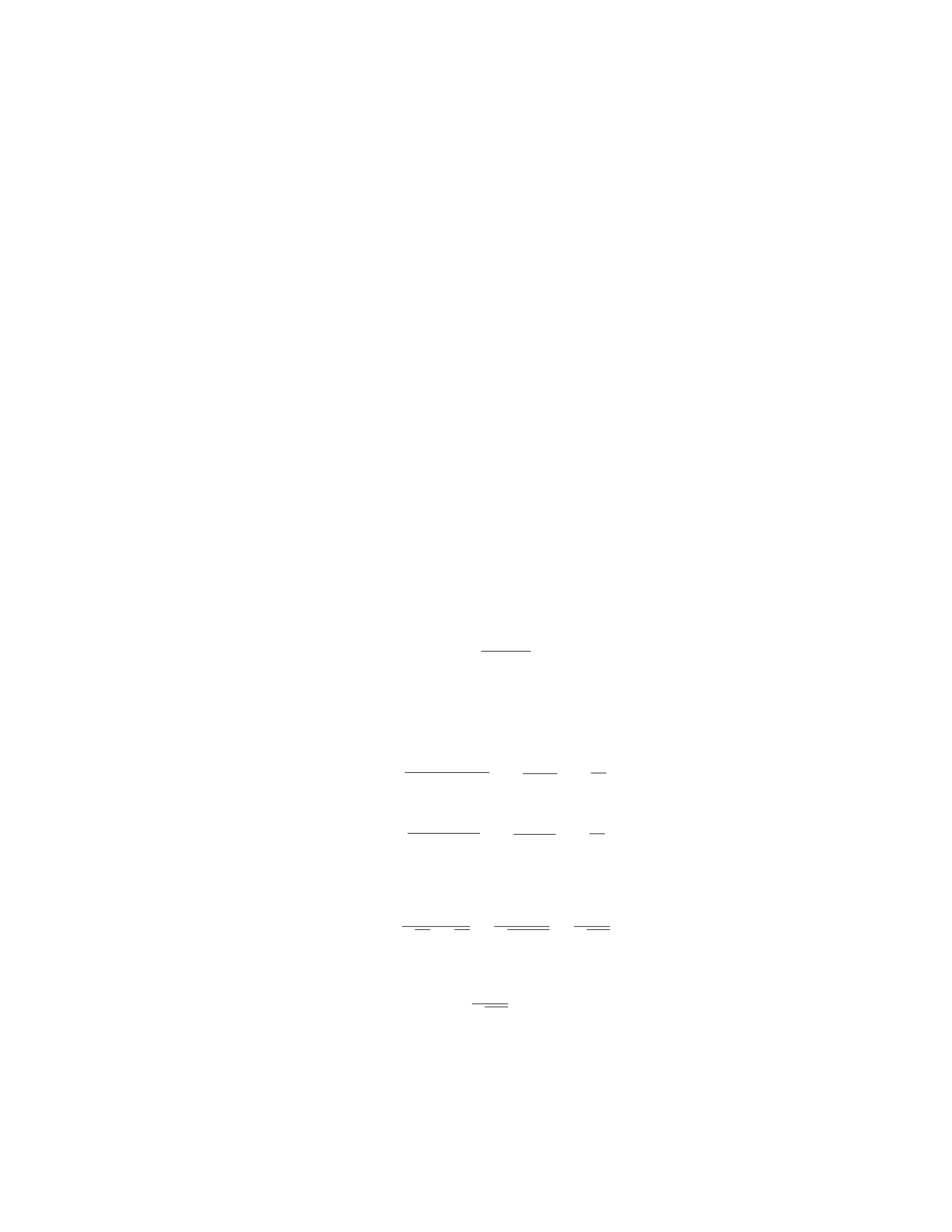
So, the general form of a vector orthogonal to both v and w is u =
4
−5
5
.
Question 25
Question
Let a=2
−3and b=−1
4. Determine the angle between vectors aand bto
the nearest degree.
Solution
To find the angle between vectors aand b, we can use the formula:
cos(θ) = a·b
∥a∥∥b∥
Step 1: Calculate the dot product of aand b:
a·b= (2)(−1) + (−3)(4) = −2−12 = −14
Step 2: Calculate the magnitude (length) of vector a:
∥a∥=p(2)2+ (−3)2=√4 + 9 = √13
Step 3: Calculate the magnitude of vector b:
∥b∥=p(−1)2+ 42=√1 + 16 = √17
Step 4: Substitute the values into the formula for the cosine of the angle
between vectors:
cos(θ) = −14
√13 ·√17 =−14
√13 ·17 =−14
√221
Step 5: Solve for θby taking the arccosine of both sides:
θ= arccos −14
√221≈97◦
Therefore, the angle between vectors aand bis approximately 97◦.
19

Question 26
Question
Let u=
1
−2
3
,v=
4
0
−1
, and w=
2
1
−2
be three vectors. Determine if the
vectors u,v, and ware linearly independent.
Solution
Step 1: To determine if the vectors u,v, and ware linearly independent, we set
up the equation c1u+c2v+c3w=0, where c1,c2, and c3are scalar constants.
Step 2: Substitute the given vectors into the equation:
c1
1
−2
3
+c2
4
0
−1
+c3
2
1
−2
=
0
0
0
Step 3: Simplify the equation:
c1
−2c1
3c1
+
4c2
0
−c2
+
2c3
c3
−2c3
=
0
0
0
Step 4: Combine the vectors on the left side of the equation:
c1+ 4c2+ 2c3
−2c1+c3
3c1−c2−2c3
=
0
0
0
Step 5: Set up a system of equations by equating the components of the
vectors to zero: c1+ 4c2+ 2c3= 0 (1)
−2c1+c3= 0 (2)
3c1−c2−2c3= 0 (3)
Step 6: Solve the system of equations by row reducing the augmented matrix:
1420
−2 0 1 0
3−1−2 0
Row reducing, we get:
1 0 0 0
0 1 0 0
0 0 1 0
Step 7: Since the system has a unique solution c1=c2=c3= 0, the vectors
u,v, and ware linearly independent.
20

Question 27
Question
Let u=
2
−3
1
and v=
−1
4
−2
. Find the angle between vectors uand v.
Solution
Step 1: Find the dot product of vectors uand v.
u·v= (2)(−1) + (−3)(4) + (1)(−2) = −2−12 −2 = −16
Step 2: Find the magnitudes of vectors uand v.
|u|=p22+ (−3)2+ 12=√4 + 9 + 1 = √14
|v|=p(−1)2+ 42+ (−2)2=√1 + 16 + 4 = √21
Step 3: Find the angle between vectors uand v. Using the formula cos θ=
u
·v|u||v|.
cos θ=−16
√14 ·√21 =−16
√294 =−16
√294
Step 4: Calculate the angle between vectors uand v.
θ= cos−1−16
√294≈114.62◦
Therefore, the angle between vectors uand vis approximately 114.62◦.
Question 28
Question
Let u =
−2
4
1
and v =
3
−5
2
. Find u ·v and ∥u ×v∥.
Solution
Step 1: To find the dot product u·v, we use the formula u·v =u1v1+u2v2+u3v3.
u ·v = (−2)(3) + (4)(−5) + (1)(2)
u ·v =−6−20 + 2
u ·v =−24
21

Step 2: To find the cross product u ×v, we use the formula
u ×v =
u2v3−u3v2
u3v1−u1v3
u1v2−u2v1
u ×v =
(4)(2) −(1)(−5)
(1)(3) −(−2)(2)
(−2)(−5) −(4)(3)
u ×v =
8+5
3+4
10 −12
u ×v =
13
7
−2
Step 3: To find the magnitude of a vector, we use the formula ∥u∥=
pu2
1+u2
2+u2
3.
∥u ×v∥=p132+ 72+ (−2)2
∥u ×v∥=√169 + 49 + 4
∥u ×v∥=√222
∥u ×v∥=√2·111
∥u ×v∥= 3√37
Therefore, the dot product u ·v =−24 and the magnitude of the cross
product u ×v = 3√37.
Question 29
Question
Let v =
2
−1
3
and w =
1
4
0
. Find the angle between vectors v and w in
degrees.
Solution
Step 1: Find the dot product of v and w.
v ·w = (2)(1) + (−1)(4) + (3)(0) = 2 −4 + 0 = −2
Step 2: Find the magnitude of v and w.
|v|=p22+ (−1)2+ 32=√4 + 1 + 9 = √14
22

|w|=p12+ 42+ 02=√1 + 16 = √17
Step 3: Use the formula cos(θ) = v·w
|v|·|w|to find the cosine of the angle
between v and w.
cos(θ) = −2
√14 ·√17 =−2
√238
Step 4: Find the angle θin degrees using the inverse cosine function.
θ= arccos −2
√238≈113.38◦
Therefore, the angle between vectors v and w is approximately 113.38◦.
Question 30
Question
Let a = 2ˆ
i−3ˆ
j+ˆ
kand
b=−ˆ
i+ 2ˆ
j−4ˆ
kbe two vectors in R3. Find a unit
vector c such that c is perpendicular to both a and
b.
Solution
Step 1: Find the cross product of vectors a and
b:
a ×
b=
ˆ
iˆ
jˆ
k
2−3 1
−1 2 −4
= (−3·(−4) −1·2)ˆ
i−(2 ·(−4) −1·(−1))ˆ
j+ (2 ·2−(−3) ·(−1))ˆ
k
= (12 −2)ˆ
i−(−8 + 1)ˆ
j+ (4 + 3)ˆ
k
= 10ˆ
i+ 7ˆ
j+ 7ˆ
k
Step 2: Calculate the magnitude of a ×
b:
|a ×
b|=p102+ 72+ 72=√100 + 49 + 49 = √198
Step 3: Find the unit vector c:
c =a ×
b
|a ×
b|=10ˆ
i+ 7ˆ
j+ 7ˆ
k
√198
c =10
√198
ˆ
i+7
√198
ˆ
j+7
√198
ˆ
k
Therefore, the unit vector c perpendicular to both a and
bis 10
√198ˆ
i+7
√198 ˆ
j+
7
√198 ˆ
k.
23

Question 31
Question
Let u=
2
−1
4
and v=
−3
0
5
. Determine the angle between vectors uand v.
Solution
To find the angle between two vectors uand v, we can use the formula
cos θ=u·v
∥u∥∥v∥,
where θis the angle between the vectors, u·vis the dot product of uand v,
and ∥u∥and ∥v∥are the magnitudes of uand vrespectively.
Step 1: Calculate the dot product of uand v.
u·v= (2)(−3) + (−1)(0) + (4)(5) = −6 + 0 + 20 = 14.
Step 2: Calculate the magnitudes of uand v.
∥u∥=p22+ (−1)2+ 42=√4 + 1 + 16 = √21,
∥v∥=p(−3)2+ 02+ 52=√9 + 0 + 25 = √34.
Step 3: Substitute the dot product and magnitudes into the formula to find
θ.
cos θ=14
√21√34 =14
√714.
Step 4: Solve for θ.
θ= arccos 14
√714≈35.99◦.
Therefore, the angle between vectors uand vis approximately 35.99◦.
Question 32
Question
Let a=3
4and b=−1
2. Find the angle between vectors aand b.
24

Solution
To find the angle between vectors aand b, we can use the dot product formula:
a·b=∥a∥∥b∥cos(θ)
where θis the angle between vectors aand b.
Step 1: Calculate a·b:
a·b= (3)(−1) + (4)(2) = −3 + 8 = 5
Step 2: Calculate ∥a∥and ∥b∥:
∥a∥=p32+ 42=√9 + 16 = √25 = 5
∥b∥=p(−1)2+ 22=√1 + 4 = √5
Step 3: Plug a·b= 5 and ∥a∥= 5, ∥b∥=√5 into the dot product formula
to solve for θ:
5 = (5)(√5) cos(θ)
Step 4: Solve for θ:
cos(θ) = 5
5√5=1
√5
θ= arccos 1
√5
Therefore, the angle between vectors aand bis arccos 1
√5.
Question 33
Question
Let a =
3
−2
1
,
b=
1
4
−3
, and c =
−2
−1
2
. Determine if the vectors a,
b, and
c are linearly independent.
Solution
Step 1: Set up the equation k1a +k2
b+k3c =
0, where k1,k2, and k3are
constants.
Step 2: The equation becomes:
3
−2
1
k1+
1
4
−3
k2+
−2
−1
2
k3=
0
0
0
25

Step 3: Simplify the equation:
3k1+k2−2k3
−2k1+ 4k2−k3
k1−3k2+ 2k3
=
0
0
0
Step 4: This leads to a system of equations:
3k1+k2−2k3= 0
−2k1+ 4k2−k3= 0
k1−3k2+ 2k3= 0
Step 5: Solve the system of equations to determine if there are non-trivial
solutions.
Step 6: The determinant of the coefficient matrix is not zero, which implies
that the only solution is the trivial one. Therefore, the vectors a,
b, and c are
linearly independent.
Question 34
Question
Let a=
2
−3
1
,b=
5
0
−4
, and c=
−1
2
3
. If d= 3a−2b+c, find the
magnitude of vector d.
Solution
Step 1: Calculate 3a.
3a= 3
2
−3
1
=
6
−9
3
Step 2: Calculate 2b.
2b= 2
5
0
−4
=
10
0
−8
26

Step 3: Add the results from Step 1 and Step 2.
3a−2b=
6
−9
3
−
10
0
−8
=
−4
−9
11
Step 4: Add vector c=
−1
2
3
.
d=
−4
−9
11
+
−1
2
3
=
−5
−7
14
Step 5: Calculate the magnitude of vector d.
|d|=p(−5)2+ (−7)2+ 142
=√25 + 49 + 196
=√270
= 3√30
Thus, the magnitude of vector dis 3√30.
Question 35
Question
Let a=
2
1
−3
,b=
−1
4
2
, and c=
3
−2
1
. Determine if the vectors a,b,
and care linearly independent.
Solution
Step 1: To determine if the vectors a,b, and care linearly independent, we set
up the equation:
k1a+k2b+k3c=0
where 0is the zero vector and k1, k2, k3are scalar coefficients.
27

Step 2: Substituting the given vectors into the equation, we have:
k1
2
1
−3
+k2
−1
4
2
+k3
3
−2
1
=
0
0
0
Step 3: This equation leads to a system of linear equations. Solving this
system will help determine if the vectors are linearly independent. Let’s set up
and solve the system of equations in augmented matrix form.
2−1 3 |0
1 4 −2|0
−3 2 1 |0
Step 4: Applying row operations to bring it to row-echelon form:
1 0 −1|0
0 1 −1|0
0 0 0 |0
Step 5: Since the system has a free variable (k3), the vectors are linearly
dependent. Therefore, a,b, and care linearly dependent.
28

