


MATH 110 - INTERMEDIATE
ALGEBRA - Applications of quadratic
equations
Question Bank - Set 5
Liberty University
Question 1
Question
A rectangular garden has a fixed perimeter of 40 meters. The length of the
garden is 2 meters longer than its width. If the area of the garden is 70 square
meters, find the dimensions of the garden.
Solution
Let’s assume that the width of the garden is xmeters. Since the length is 2
meters longer than the width, the length can be represented as x+ 2 meters.
Step 1: Given that the perimeter of the garden is 40 meters, we can set up
the equation:
2x+ 2(x+ 2) = 40
Step 2: Solving the equation:
2x+ 2x+ 4 = 40
4x+ 4 = 40
4x= 36
x= 9
So, the width of the garden is 9 meters.
Step 3: The length of the garden is x+ 2 meters, so the length is:
9 + 2 = 11

Step 4: To verify the dimensions, let’s check if the area is indeed 70 square
meters. The area of a rectangle is given by length times width. So, the area is:
9×11 = 99
Since the area is not 70 square meters, there may have been a mistake in
the calculations. Let’s go back and check our work.
Question 2
Question
A rectangular garden is 30 meters long and 20 meters wide. The garden is to
be expanded by adding the same amount xto each side. If the new area is 1200
square meters larger than the original, what is the value of x?
Solution
Let’s denote the original width of the garden as w, the original length as l, and
the amount added to each side as x. Therefore, the new length and width of
the garden will be l+xand w+xrespectively.
Step 1: Write the equation for the original area of the garden. The original
area, A1, is the product of the length and width:
A1=l·w= 30 ×20 = 600 square meters
Step 2: Write the equation for the new area of the expanded garden. The
new area, A2, is the product of the new length and new width:
A2= (l+x)(w+x)
Step 3: Write the equation based on the given information that the new area
is 1200 square meters larger than the original area. We know that:
A2=A1+ 1200
Step 4: Substitute the expressions for A1and A2into the equation.
(30 + x)(20 + x) = 600 + 1200
Step 5: Expand and simplify the equation.
600 + 50x+x2= 1800
Step 6: Rearrange the equation into standard form.
x2+ 50x−1200 = 0
2

Step 7: Solve the quadratic equation for x. Factor the quadratic equation:
(x+ 60)(x−10) = 0
Setting each factor to zero gives us two possible solutions:
x+ 60 = 0 =⇒x=−60
x−10 = 0 =⇒x= 10
Step 8: Discard the negative solution as it doesn’t make sense in this context.
Therefore, the value of xis 10 meters.
Question 3
Question
A rectangular garden is to be created using a straight river as one side and a
fence for the other three sides. The total area of the garden is 500 m2. The cost
of the fence is
$
10 per meter and the cost of the river is
$
15 per meter. Find
the dimensions of the garden that minimize the cost.
Solution
Let xbe the length of the garden perpendicular to the river, and let ybe the
width of the garden parallel to the river. Given that the total area is 500 m2,
we have:
xy = 500
The cost of the fence Cfis 10x+ 2(10y) (since there are three sides in need
of fencing), and the cost of the river Cris 15x. So, the total cost Cis:
C=Cf+Cr= 10x+ 2(10y) + 15x
Now, we need to express yin terms of xso we can minimize C. From the
area equation, we can express yas:
y=500
x
Substitute y=500
xinto the total cost equation C:
C= 10x+ 2(10 500
x) + 15x
Simplify C:
C= 10x+ 1000x−1+ 20 + 15x
3

To minimize C, we need to find where dC
dx = 0:
dC
dx = 10 −1000x−2+ 15
Setting dC
dx to zero yields:
0 = 10 −1000x−2+ 15
Solving for x:
1000x−2= 25
x−2=25
1000
x−2=1
40
x=√40
x= 2√10
Therefore, the dimensions that minimize the cost are 2√10 m by 500
2√10 =
√200 m.
Question 4
Question
A rectangle has an area of 72 square inches. The length of the rectangle is 5
inches longer than the width. Find the dimensions of the rectangle.
Solution
Let’s denote the width of the rectangle as winches. Since the length is 5 inches
longer than the width, we can express the length as w+ 5 inches.
We know that the area of a rectangle is given by the formula:
Area = Length ×Width
We are given that the area of the rectangle is 72 square inches, so we have:
72 = (w+ 5) ·w
Now, we can solve this equation to find the dimensions of the rectangle.
Step 1: Expand the equation.
72 = w2+ 5w
Step 2: Rearrange the equation into standard quadratic form.
w2+ 5w−72 = 0
4

Step 3: Factor the quadratic equation.
(w+ 12)(w−7) = 0
Step 4: Set each factor to zero and solve for w.
w+ 12 = 0 =⇒w=−12 (extraneous solution)
w−7 = 0 =⇒w= 7
Step 5: Check the solution. Since the width cannot be negative, the width
of the rectangle is w= 7 inches.
Step 6: Find the length of the rectangle. The length is w+ 5 = 7 + 5 = 12
inches.
Therefore, the dimensions of the rectangle are width = 7 inches and length
= 12 inches.
Question 5
Question
A rectangular garden is to be constructed using a fence on three sides, with the
fourth side being a wall. If the area of the garden is 200 square meters and the
perimeter is 60 meters, find the dimensions of the garden.
Solution
Let the length of the garden be xmeters and the width be ymeters.
Step 1: Write down the equations based on the given information. Since
the area of the garden is 200 square meters, we have:
x·y= 200
And since the perimeter is 60 meters (with one side being the wall), we have:
x+ 2y= 60
Step 2: Solve the second equation for xin terms of y.
x= 60 −2y
Step 3: Substitute the expression for xin terms of yinto the area equation.
(60 −2y)·y= 200
Step 4: Expand and rearrange the equation to form a quadratic equation.
60y−2y2= 200
5
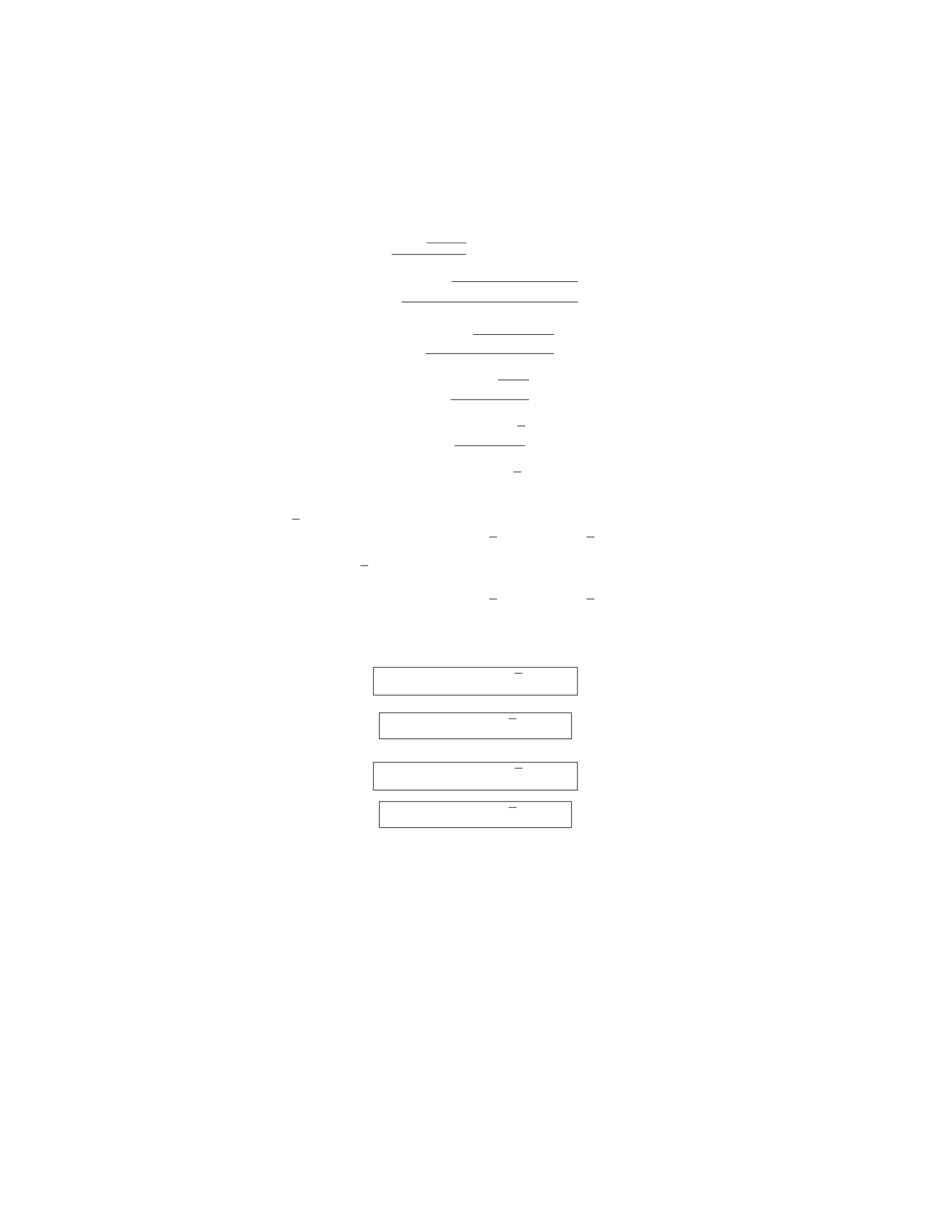
2y2−60y+ 200 = 0
Step 5: Solve the quadratic equation to find the possible values of y. Using
the quadratic formula y=−b±√b2−4ac
2awith a= 2, b =−60, c = 200, we get:
y=60 ±p(−60)2−4·2·200
2·2
y=60 ±√3600 −1600
4
y=60 ±√2000
4
y=60 ±20√5
4
y= 15 ±5√5
Step 6: Find the corresponding values of xusing x= 60 −2y. When
y= 15 + 5√5:
x= 60 −2(15 + 5√5) = 30 −10√5
When y= 15 −5√5:
x= 60 −2(15 −5√5) = 30 + 10√5
Step 7: Therefore, the dimensions of the garden are:
Length = 30 −10√5 meters
Width = 15 + 5√5 meters
or
Length = 30 + 10√5 meters
Width = 15 −5√5 meters
Question 6
Question
A rectangular garden has an area of 120 square meters. The length of the garden
is 2 meters more than its width. Find the dimensions of the garden.
6
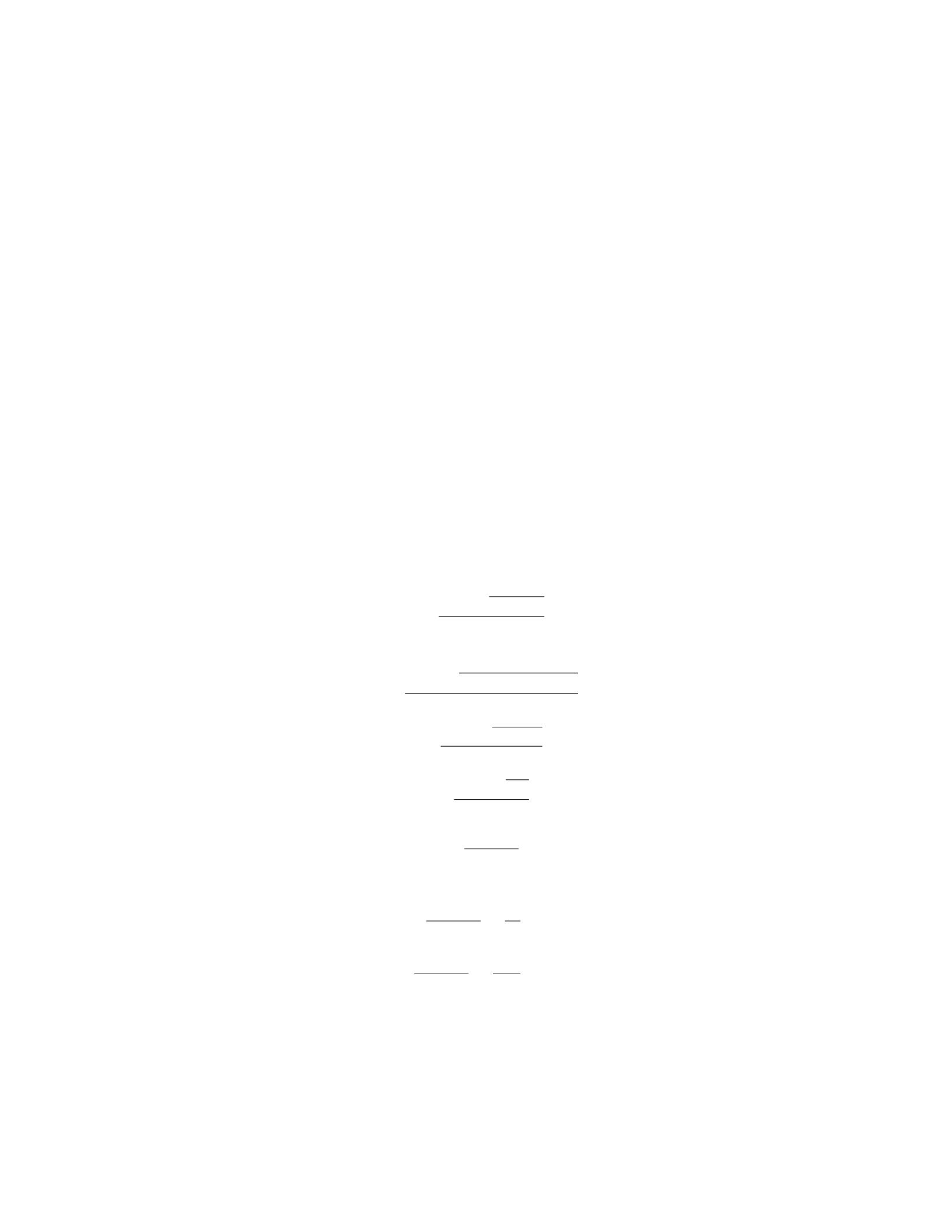
Solution
Let’s denote the width of the garden as wmeters. Since the length of the garden
is 2 meters more than its width, the length can be represented as w+ 2 meters.
We are given that the area of the garden is 120 square meters, so we have the
equation:
w(w+ 2) = 120
Expanding the left side of the equation gives:
w2+ 2w= 120
This is a quadratic equation in standard form. Let’s solve for wusing the
quadratic formula:
Step 1: Identify the coefficients
a= 1
b= 2
c=−120
Step 2: Apply the quadratic formula The quadratic formula is given
by
w=−b±√b2−4ac
2a
Substitute the values of a,b, and cinto the formula:
w=−2±p22−4·1·(−120)
2·1
w=−2±√4 + 480
2
w=−2±√484
2
w=−2±22
2
So, we have two possible solutions for w:
1.
w=−2 + 22
2=20
2= 10
2.
w=−2−22
2=−24
2=−12
Since the width cannot be negative, we discard the solution w=−12.
Step 3: Find the dimensions of the garden We found that the width
w= 10 meters. Now, we can find the length:
7

length = w+ 2 = 10 + 2 = 12
So, the dimensions of the garden are: width = 10 meters and length = 12
meters.
Question 7
Question
A rectangular garden is 20 meters longer than it is wide. If the garden’s area is
384 square meters, find the dimensions of the garden.
Solution
Let wbe the width of the garden in meters. Then the length of the garden is
w+ 20 meters.
Step 1: Write an equation based on the given information. The area of a
rectangle is given by the formula A= length ×width. We are given that the
area is 384 square meters, so we have:
384 = (w+ 20)w
Step 2: Simplify the equation. Expanding the right side of the equation, we
get:
384 = w2+ 20w
Step 3: Rearrange the equation into standard quadratic form. Subtracting
384 from both sides, we get:
w2+ 20w−384 = 0
Step 4: Solve the quadratic equation. To solve the quadratic equation w2+
20w−384 = 0, we can factorize or use the quadratic formula:
w=−20 ±p202−4(1)(−384)
2(1)
w=−20 ±√400 + 1536
2
w=−20 ±√1936
2
w=−20 ±44
2
Step 5: Find the possible values of w. The possible values of ware:
w1=−20 + 44
2= 12
8

w2=−20 −44
2=−32
Step 6: Check for extraneous solutions. Since the width cannot be negative,
we discard the negative solution w2=−32.
Step 7: Find the length of the garden. Using w= 12, the length is:
w+ 20 = 12 + 20 = 32
Therefore, the dimensions of the garden are 12 meters by 32 meters.
Question 8
Question
A rectangular garden has a length that is 4 meters longer than its width. If the
area of the garden is 60 square meters, find the dimensions of the garden.
Solution
Step 1: Let’s denote the width of the garden as xmeters. Since the length is 4
meters longer than the width, the length can be represented as x+ 4 meters.
Step 2: We know that the area of a rectangle is given by the formula A=
length ×width. In this case, the area of the garden is 60 square meters. Thus,
we have the equation:
x(x+ 4) = 60
Step 3: Simplifying the equation, we get:
x2+ 4x−60 = 0
Step 4: To solve the quadratic equation x2+ 4x−60 = 0, we can factor it
as (x+ 10)(x−6) = 0.
Step 5: Setting each factor to zero, we find:
x+ 10 = 0 ⇒x=−10
x−6=0⇒x= 6
Step 6: Since the width cannot be negative, we discard x=−10 and only
consider x= 6. Therefore, the width of the garden is 6 meters.
Step 7: Substituting x= 6 back into the expression for length (x+ 4), we
find:
x+ 4 = 6 + 4 = 10
So, the dimensions of the garden are width = 6 meters and length = 10
meters.
9

Question 9
Question
A rectangular garden is to be created along the side of a house. If the garden is
to have an area of 200 square feet, and one side of the garden will be the house
itself, which is 10 feet long, then what dimensions should the other three sides
of the garden have in order to minimize the amount of fencing used?
Solution
Let the length of the garden be xfeet and the width of the garden be yfeet.
Step 1: Write the equation for the area of the garden. The area of the
garden is given by A=xy = 200.
Step 2: Write an equation for the amount of fencing used. The amount of
fencing used is 2x+yfeet.
Step 3: Substitute the value of yfrom the area equation into the fencing
equation. From the area equation, we have y=200
x. Substitute this into the
fencing equation: f= 2x+200
x.
Step 4: Find the critical points by taking the derivative of the fencing
equation and setting it equal to zero. To find the critical points, we take the
derivative of fwith respect to x:df
dx = 2 −200
x2. Setting this derivative equal to
zero gives 2 −200
x2= 0.
Step 5: Solve for x. Solving 2 −200
x2= 0 gives x2= 100 and x=±10.
However, since the dimensions of the garden should be positive, x= 10.
Step 6: Find the corresponding value of y. Using the area equation xy =
200, we find y=200
x=200
10 = 20.
Step 7: Answer Therefore, the dimensions that minimize the amount of
fencing used are a length of 10 feet and a width of 20 feet.
Question 10
Question
A rectangular garden is to be designed to have a fixed area of 400 square meters.
One side of the garden will be bounded by a building and so no fencing is needed.
If the cost of the fencing is 50permeterfortheotherthreesides, findthedimensionsofthegardenthatwillminimizethecostofthefencing.
Solution
Let the length of the garden be xmeters and the width be ymeters. Since the
area of the garden is 400 square meters, we have xy = 400.
The cost of fencing the three sides is 50 ·(x+ 2y) = 50x+ 100y.
We want to minimize the cost of the fencing, so we need to minimize the
cost function C(x, y) = 50x+ 100ysubject to the constraint xy = 400.
From the constraint, we can express yin terms of x:y=400
x.
10
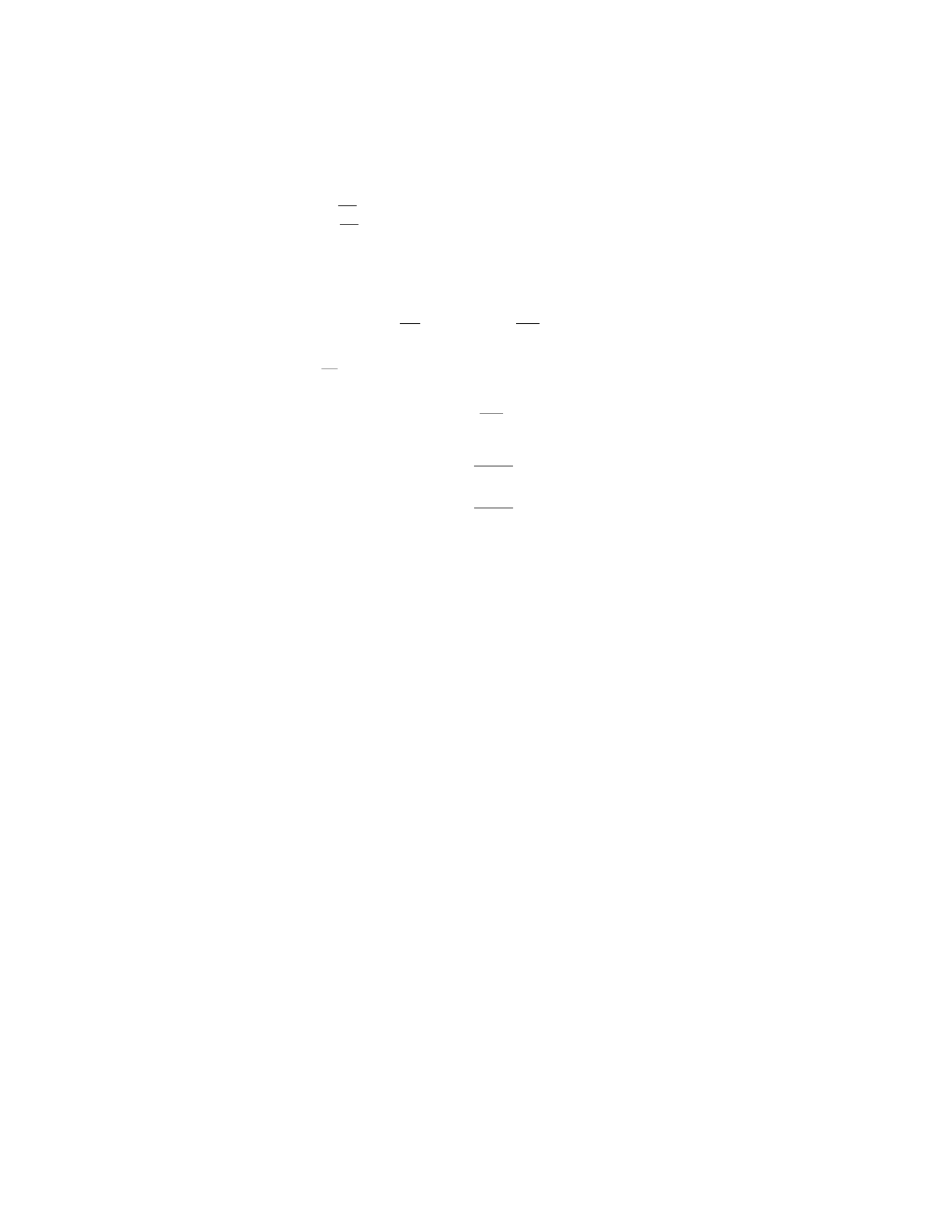
Substitute y=400
xinto the cost function to get it in terms of one variable:
C(x) = 50x+ 100 400
x.
To find the minimum cost, we differentiate C(x) with respect to x, set the
derivative equal to zero, and solve for x.
Step 1: Find the derivative of C(x).
dC
dx = 50 −100 400
x2
Step 2: Set dC
dx = 0 and solve for x.
50 −100 400
x2= 0
50 = 40000
x2
x2=40000
50
x= 20
So, the dimensions of the garden that will minimize the cost of the fencing
are 20 meters by 20 meters.
Question 11
Question
A rectangle has a perimeter of 30 cm. If the length of the rectangle is 3 cm
longer than the width, find the dimensions of the rectangle.
Solution
Step 1: Let’s denote the width of the rectangle as xcm. Since the length is 3
cm longer than the width, the length can be represented as x+ 3 cm.
Step 2: The perimeter of a rectangle is given by the formula 2(length +
width). Given that the perimeter is 30 cm, we can write the following equation:
2(x+ (x+ 3)) = 30
Step 3: Simplifying the equation, we get:
2(2x+ 3) = 30
4x+ 6 = 30
4x= 24
x= 6
11

Step 4: Now that we have found the width (x= 6 cm), we can find the
length using x+ 3:
x+ 3 = 6 + 3 = 9
Step 5: Therefore, the width of the rectangle is 6 cm and the length is 9 cm.
Question 12
Question
A rectangular garden has a width that is 4 meters less than its length. If the
area of the garden is 120 square meters, find the dimensions of the garden.
Solution
Let’s denote the length of the garden as xmeters. Since the width is 4 meters
less than the length, we can represent the width as x−4 meters.
Given that the area of the garden is 120 square meters, we can write the
equation:
x(x−4) = 120
To solve for x, we need to expand the left side of the equation:
x2−4x= 120
Rearranging the equation to set it equal to zero:
x2−4x−120 = 0
To factor the quadratic equation, we look for two numbers that multiply to
-120 and add up to -4. The two numbers are -12 and 10. So we rewrite the
equation as:
(x−12)(x+ 10) = 0
Setting each factor to zero:
x−12 = 0 or x+ 10 = 0
Solving for xin each case:
Step 1: x−12 = 0
x= 12
Step 2: x+ 10 = 0
x=−10
Since the length of the garden cannot be negative, we disregard x=−10.
Therefore, the length of the garden is x= 12 meters and the width is 12−4 =
8 meters. Thus, the dimensions of the garden are 12 meters by 8 meters.
12

Question 13
Question
A rectangular garden is three times as long as it is wide. If the perimeter of the
garden is 48 meters, find the dimensions of the garden.
Solution
Let xbe the width of the garden. Since the length is three times the width, the
length of the garden is 3x.
Step 1: Write the equation for the perimeter of the garden. The perimeter
of a rectangle is given by the formula: P= 2(l+w). Substituting in the length
3xand width x, we have:
48 = 2(3x+x)
Step 2: Simplify the equation and solve for x.
48 = 2(4x)
48 = 8x
x= 6
Step 3: Find the dimensions of the garden. The width of the garden is
x= 6 m, and the length is 3x= 18 m.
Step 4: Verify the solution by checking the perimeter.
P= 2(18 + 6) = 2(24) = 48
Therefore, the dimensions of the garden are 6 meters by 18 meters.
Question 14
Question
A rectangular garden has a fixed perimeter of 40 meters. The length of the
garden is 4 meters longer than its width. Find the dimensions of the garden
that maximize its area.
Solution
Step 1: Assign variables to the width and length of the garden. Let wbe the
width (in meters) and lbe the length (in meters). Step 2: Write down the given
information in terms of the variables: Given perimeter = 40 meters
2w+ 2l= 40
l=w+ 4
Step 3: Write the equation for the area of the garden in terms of w: Area
A=w×l
13

Step 4: Substitute the expression for lfrom step 2 into the equation for the
area: A=w×(w+ 4)
A=w2+ 4w
Step 5: Express the perimeter in terms of a single variable using the given
perimeter equation: 2w+ 2l= 40
2w+ 2(w+ 4) = 40
2w+ 2w+ 8 = 40
Step 6: Simplify the equation derived from the perimeter to solve for w:
4w+ 8 = 40
4w= 32
w= 8
Step 7: Find the length of the garden using the expression l=w+4: l= 8+4
l= 12
Step 8: Calculate the maximum area by substituting w= 8 back into the
area equation: A= 82+ 4 ×8
A= 64 + 32
A= 96
Therefore, the dimensions of the garden that maximize its area are width
w= 8 meters and length l= 12 meters, with a maximum area of 96 square
meters.
Question 15
Question
A rectangular garden has a length that is 4 meters longer than its width. If the
area of the garden is 96 m2, find the dimensions of the garden.
Solution
Let xrepresent the width of the garden in meters. Since the length is 4 meters
longer than the width, the length can be expressed as x+ 4 meters.
The area of a rectangle is given by the formula A= length ×width. In this
case, we have 96 = (x+ 4)x.
Step 1: Rewrite the equation using the area formula.
(x+ 4)x= 96
Step 2: Expand the left side of the equation.
x2+ 4x= 96
Step 3: Rearrange the equation into standard form.
x2+ 4x−96 = 0
14
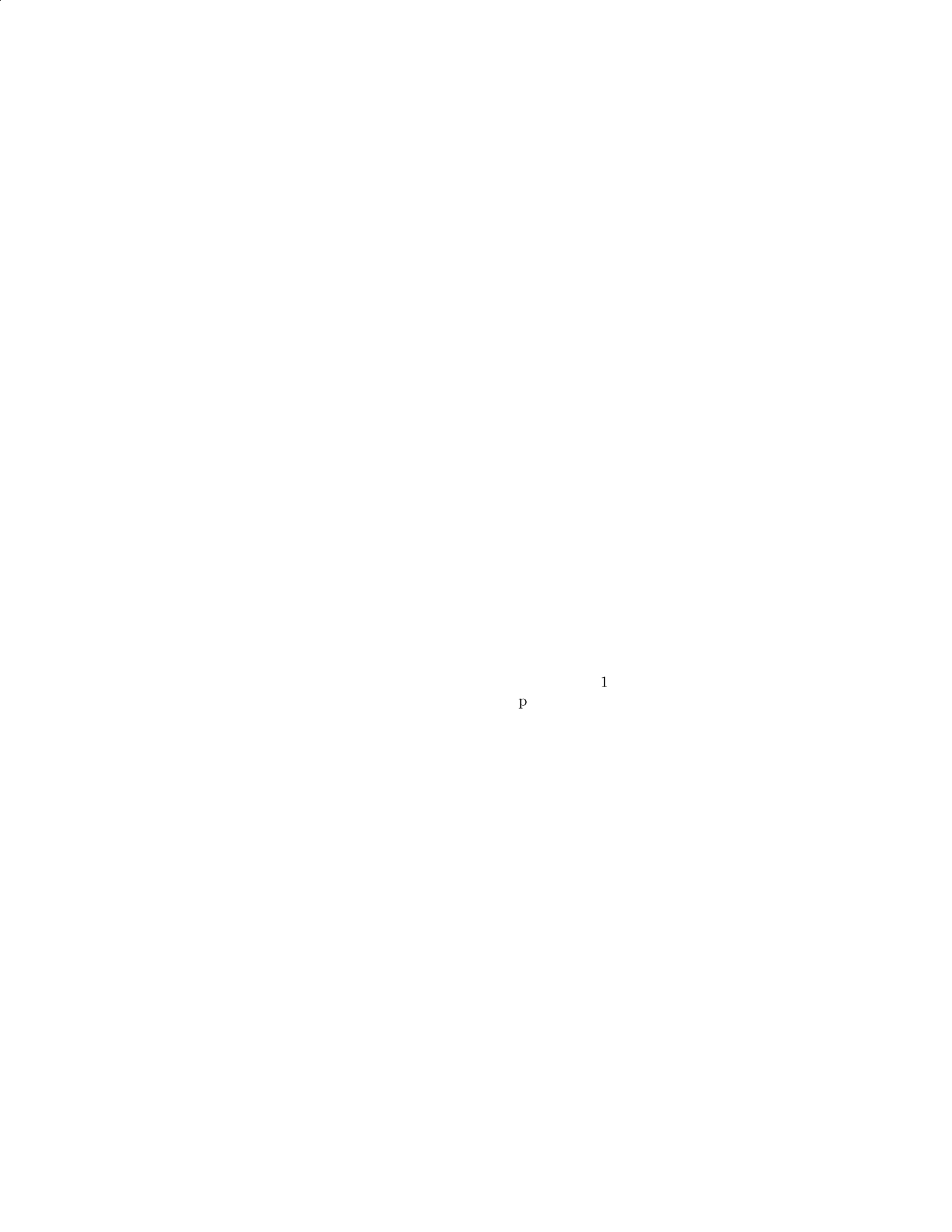
Step 4: Factor the quadratic equation.
(x+ 12)(x−8) = 0
Step 5: Find the possible values for x.
x+ 12 = 0 or x−8=0
Step 6: Solve for x. For x+ 12 = 0:
x=−12
For x−8 = 0:
x= 8
Step 7: Check for extraneous solutions. Since the width cannot be negative,
the only valid solution is x= 8.
Step 8: Find the length. The length of the garden is x+ 4 = 8 + 4 = 12
meters.
Step 9: Conclusion: Therefore, the dimensions of the garden are width 8
meters and length 12 meters.
Question 16
Question
A rectangular garden is to be fenced in with two kinds of fencing. Two opposite
sides will be fenced with a rose-covered iron grill costing
$
10 per meter and the
other two sides with a wire fencing costing
$
4 per meter. If the total cost of the
iron grill is 3 times the cost of the wire fencing and the area of the garden is
200 square meters, find the dimensions of the garden that minimize the cost of
the fencing.
Solution
Let xbe the length of the garden (in meters) and ybe the width of the garden
(in meters).
Step 1: Define the cost function The total cost Cof the fencing is given
by:
C= 10(2x) + 4(2y)
Simplify:
C= 20x+ 8y
Given that the total cost of the iron grill is 3 times the cost of the wire
fencing, we have:
10(2x) = 3(4(2y))
20x= 24y
15

x=6
5y
Step 2: Define the area constraint The area of the rectangular garden
is given by:
A=xy
Given that the area of the garden is 200 square meters, we have:
xy = 200
Step 3: Express the cost function in terms of a single variable
Substitute x=6
5yinto xy = 200 to get:
6
5y2= 200
y2=1000
3
y=r1000
3=10√10
√3=10√30
3
Substitute y=10√30
3into x=6
5yto get:
x=6
5 10√30
3!= 4√30
Thus, the dimensions of the garden that minimize the cost of the fencing are
4√30 meters ×10√30
3meters .
Question 17
Question
A rectangular garden is to be created using a fence along the x-axis and a fence
perpendicular to the x-axis. If the area of the garden is 24 square units, find
the dimensions of the garden that minimize the amount of fencing used.
Solution
Let the length of the garden parallel to the x-axis be xunits, and let the width
perpendicular to the x-axis be yunits. Since the area of the garden is given to
be 24 square units, we have the equation: xy = 24.
The amount of fencing used is the sum of the two sides along the x-axis and
the two sides perpendicular to the x-axis. Therefore, the amount of fencing, F,
is given by:
F= 2x+ 2y
16

To find the dimensions of the garden that minimize the amount of fencing,
we need to minimize the function F(x, y) = 2x+ 2ysubject to the constraint
xy = 24.
Step 1: Express Fin terms of one variable using the constraint xy = 24.
Since y=24
x, we can rewrite Fas:
F(x)=2x+ 2 24
x
Step 2: Find the critical points of F(x) by finding where its derivative is
zero.
Calculate F′(x):
F′(x) = 2 −48
x2
Set F′(x) = 0:
2−48
x2= 0
2 = 48
x2
x2= 24
x=±√24
x=±2√6
Step 3: Evaluate the endpoints and critical points to find the minimum
amount of fencing.
Since the length of a side cannot be negative, we only consider x= 2√6.
Calculate yusing the constraint xy = 24:
y=24
x=24
2√6= 2√6
Therefore, the dimensions that minimize the amount of fencing used are:
length 2√6 units and width 2√6 units.
Question 18
Question
A rectangular garden is to be constructed using a fence on three sides and a
wall on the fourth side. The area of the garden is to be 400 square meters. If
the cost of the fence is
$
20 per meter and the cost of the wall is
$
100 per meter,
find the dimensions of the garden that will minimize the cost of enclosing it.
17
Solution
Let xbe the length of the garden (in meters) and ybe the width of the garden
(in meters). The area of the garden is given by the product of the length and
the width, that is, xy = 400. We want to minimize the cost of enclosing the
garden, which is given by the cost of the fence and the wall.
Step 1: Write the cost function to be minimized.
The cost function C(x, y) is the sum of the cost of the fence (3 sides) and the
cost of the wall (1 side). The cost of the fence is 20x+ 40y(2 sides along the
length at 20permeterandonesidealongthewidthat20 per meter) and the cost of
the wall is 100x. Therefore, the cost function to be minimized is:
C(x, y) = 20x+ 40y+ 100x
Step 2: Write yin terms of x.
From the equation xy = 400, we have y=400
x.
Step 3: Substitute yin terms of xinto the cost function.
Substitute yin terms of xinto the cost function C(x) to get:
C(x) = 20x+ 40 400
x+ 100x
Step 4: Simplify the cost function.
C(x) = 20x+16000
x+ 100x= 120x+16000
x
Step 5: Find the derivative of the cost function.
dC
dx = 120 −16000
x2
Step 6: Set the derivative to zero and solve for x.
120 −16000
x2= 0
16000
x2= 120
x2=16000
120 = 133.33
x≈11.55 meters
Step 7: Find the corresponding yvalue.
y=400
11.55 ≈34.63 meters
Therefore, the dimensions of the garden that will minimize the cost of en-
closing it are approximately 11.55 meters by 34.63 meters.
18

Question 19
Question
A rectangular garden is to be created using 80 meters of fencing. If the length
of the garden is three times its width, find the dimensions of the garden that
will maximize the area enclosed by the fencing.
Solution
Let the width of the garden be xmeters. Then, the length of the garden would
be 3xmeters. The perimeter of the garden is equal to the fencing available, so
we have the equation: 2x+ 2(3x) = 80.
Step 1: Simplify the equation and solve for x. The equation simplifies to
2x+ 6x= 80, which further simplifies to 8x= 80. Solving for x, we get x= 10.
Step 2: Find the dimensions of the garden. The width of the garden is
x= 10 meters, and the length is 3x= 3(10) = 30 meters. Therefore, the
dimensions of the garden are 10 meters by 30 meters.
Step 3: Find the maximum area enclosed by the fencing. The area enclosed
by the fencing is given by A=x×3x= 3x2. Substituting x= 10, we get
A= 3(10)2= 300 square meters.
Thus, the dimensions of the garden that will maximize the area enclosed by
the fencing are 10 meters by 30 meters, with a maximum area of 300 square
meters.
Question 20
Question
A rectangular field has a perimeter of 100 meters. The length of the field is 10
meters longer than its width. Find the dimensions of the field.
Solution
Step 1: Let’s denote the width of the field as xmeters. Since the length of the
field is 10 meters longer than its width, the length can be expressed as x+ 10
meters.
Step 2: The perimeter of a rectangle is given by 2(length + width). We can
create an equation using the given perimeter of 100 meters:
2(x+x+ 10) = 100
Step 3: Simplifying the equation, we get:
2(2x+ 10) = 100
4x+ 20 = 100
19
Step 4: Solving for x:
4x= 100 −20
4x= 80
x= 20
Step 5: Now that we have found x, we can find the width of the field:
Width = x= 20 meters
Step 6: Using the width, we can find the length of the field:
Length = x+ 10 = 20 + 10 = 30 meters
Step 7: Therefore, the dimensions of the field are: width = 20 meters and
length = 30 meters.
Question 21
Question
A company manufactures and sells a certain type of smartphone at
$
500 per
unit. The total cost (in dollars) to produce xunits of this smartphone is given
by the function C(x)=0.01x2+ 100x+ 10000. Determine the number of units
the company needs to sell in order to break even.
Solution
Let’s first recall that the company breaks even when the total revenue equals
the total cost. The total revenue is given by the product of the selling price and
the number of units sold. In this case, the total revenue is R(x) = 500x.
Step 1: Set up the equation for the break-even point. To find the break-even
point, we need to solve the equation R(x) = C(x) for x:
500x= 0.01x2+ 100x+ 10000
Step 2: Rearrange the equation. Subtract 500x from both sides to get the
quadratic equation in standard form:
0.01x2+ 100x+ 10000 −500x= 0
0.01x2−400x+ 10000 = 0
Step 3: Solve the quadratic equation. To solve the equation 0.01x2−400x+
10000 = 0, we can either use the quadratic formula or factorize. Let’s use the
quadratic formula:
x=−(−400) ±p(−400)2−4(0.01)(10000)
2(0.01)
Calculating this out gives 200 and 2000. Since we are looking for the number
of units sold, the company needs to sell 200 and 2000 units to break even.
20

Question 22
Question
A rectangular garden is to be created using a brick wall on one side. If the
length of the wall is 10 meters longer than the width of the garden, and the
area of the garden is 300 square meters, find the dimensions of the garden.
Solution
Let’s denote the width of the garden as xmeters. Since the length of the wall
is 10 meters longer than the width, the length of the garden is x+ 10 meters.
Given that the area of the garden is 300 square meters, we can create the
equation:
x(x+ 10) = 300
Step 1: Expand the equation and simplify.
x2+ 10x= 300
Step 2: Rearrange the equation into standard form.
x2+ 10x−300 = 0
Step 3: Factor the quadratic equation.
(x+ 20)(x−15) = 0
Step 4: Solve for x. Setting each factor to zero gives x=−20 or x= 15.
Since the width cannot be negative, the width of the garden is 15 meters.
Step 5: Find the length of the garden. The length is x+ 10 = 15 + 10 = 25
meters.
Thus, the dimensions of the garden are 15 meters by 25 meters.
Question 23
Question
A rectangular garden has a length of 20 meters and a width of 10 meters. The
garden has a uniform border of flowers surrounding it which has a width of x
meters on all sides. If the total area of the garden and the border of flowers is
512 square meters, determine the width of the border of flowers.
Solution
Let Abe the area of the garden and Bbe the area of the border of flowers.
Given that the total area is 512 square meters, we have:
21

A+B= 512
The area of the garden is given by:
A= length ×width = 20 ×10 = 200 square meters
The area of the garden and the border of flowers is given by:
A+B= (20 + 2x)(10 + 2x)
Substitute the expressions for Aand A+Binto the equation A+B= 512
to get:
200 + 4x2+ 60x= 512
Simplify the equation:
4x2+ 60x−312 = 0
Next, we need to solve the quadratic equation 4x2+ 60x−312 = 0 to find
the width of the border of flowers.
Step 1: Find the roots of the quadratic equation 4x2+ 60x−312 = 0 by
factoring or using the quadratic formula.
Step 2: Factor the quadratic equation:
4(x2+ 15x−78) = 0
4(x+ 26)(x−3) = 0
Setting each factor to zero gives us the possible solutions:
x+ 26 = 0 or x−3=0
So, the solutions are x=−26 and x= 3. Since the width cannot be negative,
the width of the border of flowers is x= 3 meters.
Question 24
Question
A rectangular garden is to be fenced on three sides using 120 meters of fencing.
If the length of the garden is 20 meters more than its width, find the dimensions
of the garden that will maximize the area.
22

Solution
Let the width of the garden be xmeters. Since the length is 20 meters more
than the width, the length is x+ 20 meters.
The perimeter of the rectangular garden is given by P= 2(length + width).
So, from the given information, we have:
120 = 2((x+ 20) + x)
120 = 2(2x+ 20)
60 = 2x+ 20
40 = 2x
x= 20
So, the width of the garden is 20 meters and the length is x+ 20 = 20 +20 =
40 meters.
The area of a rectangle is given by A= length ×width. Now, we can find
the area of the rectangle:
A= (20)(40)
A= 800 m2
Therefore, the dimensions of the garden that will maximize the area are
width = 20 meters and length = 40 meters, resulting in a maximum area of 800
square meters.
Question 25
Question
A rectangular garden is to be created using a river as one side of the garden. If
the garden is to have a perimeter of 200 meters and the area of the garden is
1600 square meters, what are the dimensions of the garden?
Solution
Let’s denote the length of the garden as land the width as w. Since one side of
the garden is formed by the river, the perimeter of the garden can be expressed
as l+ 2w= 200. Also, the area of the garden can be expressed as lw = 1600.
Step 1: Express the perimeter equation in terms of one variable. From
l+ 2w= 200, we can express lin terms of was l= 200 −2w.
Step 2: Substitute linto the area equation. Substitute l= 200 −2winto
the area equation:
(200 −2w)w= 1600
Step 3: Solve for w. Simplify the equation:
200w−2w2= 1600
23

−2w2+ 200w−1600 = 0
Step 4: Solve the quadratic equation. We can solve the quadratic equation
using the quadratic formula:
w=−b±√b2−4ac
2a
where a=−2, b= 200, and c=−1600. Plugging these values in:
w=−200 ±p2002−4(−2)(−1600)
2(−2)
w=−200 ±√40000 −12800
−4
w=−200 ±√27200
−4
w=−200 ±164.98
−4
Step 5: Find the possible values for w. We have two possible values for w:
w1=−200 + 164.98
−4=−35.02
−4= 8.75
or
w2=−200 −164.98
−4=−364.98
−4= 91.25
Step 6: Find the corresponding values for l. Using l= 200 −2w: For
w= 8.75:
l= 200 −2(8.75) = 182.5
For w= 91.25:
l= 200 −2(91.25) = 17.5
Step 7: Check the dimensions. Since wrepresents the width, we have w=
8.75 and l= 182.5. Since the dimensions should be positive, the dimensions of
the garden are 8.75 meters by 182.5 meters.
Question 26
Question
A rectangular garden is 24 meters long and 10 meters wide. It is desired to
increase the area of the garden by 100 square meters by adding mulch around
the perimeter. If the width of the mulch strip is the same all around, find the
width of the strip.
24

Solution
Let xdenote the width of the strip. The new length of the garden will be 24+2x
meters and the new width will be 10 + 2xmeters. Since the area of the garden
is length times width, we have the equation:
(24 + 2x)(10 + 2x) = 24 ×10 + 100
240 + 48x+ 20x+ 4x2= 240 + 100
4x2+ 68x−100 = 0
To solve this quadratic equation, we can divide the entire equation by 4:
x2+ 17x−25 = 0
Now, we can find the solutions using the quadratic formula:
x=−b±√b2−4ac
2a
where a= 1, b= 17, and c=−25.
x=−17 ±p172−4·1·(−25)
2·1
x=−17 ±√289 + 100
2
x=−17 ±√389
2
So, the possible widths of the strip are x=−17+√389
2and x=−17−√389
2. Since
we are looking for a positive width, the width of the strip is −17+√389
2meters.
Question 27
Question
A rectangular garden is 5 meters longer than it is wide. The area of the garden
is 180 square meters. Find the dimensions of the garden.
Solution
Let’s denote the width of the garden as xmeters. Therefore, the length of the
garden is x+ 5 meters. We know that the area of a rectangle is given by the
formula: area = length ×width. In this case, the area is 180 square meters.
Step 1: Write the equation representing the area of the garden.
x(x+ 5) = 180
25

Step 2: Expand and rearrange the equation.
x2+ 5x−180 = 0
Step 3: Solve the quadratic equation by factoring or using the quadratic
formula. The factors of -180 that add up to 5 are 20 and -15. So, the factors
of the quadratic equation are (x+ 20) and (x−15). Thus, the solutions are
x=−20 or x= 15.
However, the width cannot be negative, so x= 15 is the valid solution.
Step 4: Find the dimensions of the garden. Since the width, x, is 15 meters,
the length is 15 + 5 = 20 meters.
Therefore, the dimensions of the garden are 15 meters by 20 meters.
Question 28
Question
A rectangular garden has a fixed perimeter of 80 meters. If the length of the
garden is 10 meters greater than its width, find the dimensions of the garden
that maximize the area.
Solution
Step 1: Let’s first set up the equations based on the given information. Let the
width of the rectangular garden be xmeters. Then the length is x+ 10 meters.
We know that the perimeter is given by P= 2L+ 2W, where Lis the length
and Wis the width. Therefore, we have: 80 = 2(x+ 10) + 2xSimplify this
equation: 80 = 2x+ 20 + 2x
Step 2: Solve for xto find the width of the garden. 80 = 4x+ 20 4x= 60
x= 15
Step 3: Now that we have found the width (x= 15), we can find the length
of the garden. Length = x+ 10 = 15 + 10 = 25 meters
Step 4: Calculate the area of the garden using the width and length obtained.
Area = width ×length = 15 ×25 = 375 square meters
Therefore, the dimensions of the garden that maximize the area are width
= 15 meters and length = 25 meters, resulting in an area of 375 square meters.
Question 29
Question
A rectangular garden is to be surrounded by a path of uniform width. The
dimensions of the garden are in the ratio 3:2. If the area of the path is 150
square meters, find the dimensions of the garden.
26

Solution
Step 1: Let the width of the path be xmeters. Then the width of the garden is
3xmeters and the length of the garden is 2xmeters.
Step 2: The area of the garden is given by the product of its length and
width, which is 2x×3x= 6x2square meters.
Step 3: The outer dimensions of the rectangle, including the path, are (2x+
2,3x+ 2) meters. The area of the outer rectangle is given by the product of its
length and width, which is (2x+ 2)(3x+ 2) square meters.
Step 4: The area of the path is the difference between the areas of the outer
rectangle and the garden:
(2x+ 2)(3x+ 2) −6x2= 150
Step 5: Expand and simplify the equation:
6x2+ 10x+ 4 −6x2= 150
10x+ 4 = 150
Step 6: Solve for x:
10x= 146
x= 14.6 meters
Step 7: Therefore, the dimensions of the garden are 29.2 meters by 43.8
meters.
Question 30
Question
A farmer wants to create a rectangular enclosure for his livestock using 200
meters of fencing. He plans to use a straight river as one of the sides of the
enclosure. If the farmer does not need to use fencing along the river, what are
the dimensions of the enclosure that will maximize the area?
Solution
Let xbe the width of the enclosure and ybe the length of the enclosure.
Step 1: We need to express the total length of fencing in terms of xand y.
Given that one side of the enclosure is along the river, the length of fencing is
x+y+x= 200.
Step 2: Simplify the equation to find the relationship between xand y:
2x+y= 200 ⇒y= 200 −2x.
Step 3: The area of the rectangular enclosure is given by A=xy. Sub-
stituting the expression for yin terms of xinto the area formula, we get
A=x(200 −2x) = 200x−2x2.
27
Step 4: To find the dimensions that maximize the area, we take the deriva-
tive of Awith respect to xand set it equal to zero:
dA
dx = 200 −4x
200 −4x= 0
4x= 200
x= 50
Step 5: To ensure that this point corresponds to a maximum (and not
a minimum or a point of inflection), we find the second derivative of Awith
respect to x:
d2A
dx2=−4
Since the second derivative is negative, the critical point at x= 50 corre-
sponds to a maximum area.
Step 6: Now that we have the width, we can find the length using y=
200 −2x.
y= 200 −2(50)
y= 100
Step 7: Therefore, the dimensions of the enclosure that maximize the area
are a width of 50 meters and a length of 100 meters.
Question 31
Question
A rectangular garden is to be created along the side of a house. If the length
of the garden is three times its width, and the area of the garden is 200 square
meters, find the dimensions of the garden.
Solution
Step 1: Let’s denote the width of the garden as xmeters. Since the length is
three times the width, the length can be represented as 3xmeters.
Step 2: We know that the area of a rectangle is given by the formula A=
length ×width. Substituting the given values, we have:
200 = (3x)(x)
Step 3: Simplifying the equation, we get:
200 = 3x2
28

Step 4: Rearranging the equation, we find:
x2=200
3
Step 5: Taking the square root of both sides, we have:
x=r200
3=10√6
3
Step 6: Therefore, the width of the garden is 10√6
3meters.
Step 7: To find the length, we substitute the width back into the expression
for the length:
3x= 3 10√6
3!= 10√6
Step 8: Thus, the dimensions of the garden are width = 10√6
3meters, and
length = 10√6 meters.
Question 32
Question
A rectangular garden has a length that is 4 meters longer than its width. If the
area of the garden is 180 square meters, find the dimensions of the garden.
Solution
Step 1: Let’s denote the width of the garden as xmeters. Since the length is 4
meters longer than the width, we can express the length in terms of xas x+ 4
meters.
Step 2: The area of a rectangle is given by the formula A= length ×width.
We are given that the area is 180 square meters, so we can set up the equation:
180 = (x+ 4) ×x.
Step 3: Simplifying the equation, we get:
180 = x2+ 4x
Step 4: Rearranging the equation in standard form:
x2+ 4x−180 = 0
Step 5: To solve the quadratic equation, we can use the quadratic formula:
x=−b±√b2−4ac
2a, where the equation is in the form ax2+bx +c= 0.
Step 6: In our equation, a= 1, b= 4, and c=−180. Substituting these
values into the formula gives us:
x=−4±p42−4(1)(−180)
2(1)
29

Step 7: Calculating under the square root:
x=−4±√16 + 720
2=−4±√736
2
Step 8: Further simplifying, we have two possible solutions:
x=−4 + 24
2or x=−4−24
2
Step 9: These give us:
x= 10 or x=−14
Step 10: Since the width of the garden cannot be negative, the width is 10
meters.
Step 11: Now, we can find the length by adding 4 to the width:
x+ 4 = 10 + 4 = 14
Step 12: Therefore, the dimensions of the garden are width = 10 meters and
length = 14 meters.
Question 33
Question
A rectangular garden is to be enclosed with 180 meters of fencing. One side of
the garden will be against the side of a house, so only three sides need to be
fenced. If the length of the garden is twice the width, what dimensions should
the garden have in order to maximize the area?
Solution
Step 1: Let’s denote the width of the garden as w. Since the length of the
garden is twice the width, we can represent the length as 2w.
Step 2: The perimeter of the garden is given by P= 2w+ 2(2w) = 180.
Simplifying, we get 6w= 180, which implies w= 30.
Step 3: Now, substitute w= 30 back into the length equation to find the
length: 2w= 2(30) = 60.
Step 4: The area of the rectangular garden is given by A= length ×width =
60 ×30. Calculate the area to find the maximum area possible.
Step 5: The maximum area of the garden occurs when w= 30 and l= 60.
Therefore, the dimensions of the garden that maximize the area are 30 meters
by 60 meters.
30
Question 34
Question
A farmer plans to create a rectangular pen for her chickens using a long existing
fence for one side of the pen. If she has a total of 120 meters of fencing and
wants to maximize the area of the pen, what should be the dimensions of the
pen?
Solution
Let xbe the length of the side of the pen perpendicular to the existing fence,
and let ybe the length of the side parallel to the existing fence.
Step 1: Write the constraint equation. The constraint is that the total
length of fencing used is 120 meters:
2x+y= 120
Step 2: Express yin terms of x. Solve the constraint equation for y:
y= 120 −2x
Step 3: Write the area equation. The area of the rectangular pen is given
by:
A=xy
Step 4: Express the area in terms of x. Substitute y= 120 −2xinto the
area equation:
A=x(120 −2x) = 120x−2x2
Step 5: Determine the critical points. To find the maximum area, we find
the critical points of the area function by taking the derivative with respect to
xand setting it equal to 0:
dA
dx = 120 −4x
Setting the derivative equal to 0 and solving for x:
120 −4x= 0
x= 30
Step 6: Find the dimensions for the maximum area. Substitute the critical
point x= 30 back into the constraint equation to find y:
2(30) + y= 120
60 + y= 120
y= 60
Therefore, the dimensions of the rectangular pen that maximize the area are
30 meters by 60 meters.
31

Step 4: To verify the dimensions, let’s check if the area is indeed 70 square
meters. The area of a rectangle is given by length times width. So, the area is:
9×11 = 99
Since the area is not 70 square meters, there may have been a mistake in
the calculations. Let’s go back and check our work.
Question 2
Question
A rectangular garden is 30 meters long and 20 meters wide. The garden is to
be expanded by adding the same amount xto each side. If the new area is 1200
square meters larger than the original, what is the value of x?
Solution
Let’s denote the original width of the garden as w, the original length as l, and
the amount added to each side as x. Therefore, the new length and width of
the garden will be l+xand w+xrespectively.
Step 1: Write the equation for the original area of the garden. The original
area, A1, is the product of the length and width:
A1=l·w= 30 ×20 = 600 square meters
Step 2: Write the equation for the new area of the expanded garden. The
new area, A2, is the product of the new length and new width:
A2= (l+x)(w+x)
Step 3: Write the equation based on the given information that the new area
is 1200 square meters larger than the original area. We know that:
A2=A1+ 1200
Step 4: Substitute the expressions for A1and A2into the equation.
(30 + x)(20 + x) = 600 + 1200
Step 5: Expand and simplify the equation.
600 + 50x+x2= 1800
Step 6: Rearrange the equation into standard form.
x2+ 50x−1200 = 0
2

Step 7: Solve the quadratic equation for x. Factor the quadratic equation:
(x+ 60)(x−10) = 0
Setting each factor to zero gives us two possible solutions:
x+ 60 = 0 =⇒x=−60
x−10 = 0 =⇒x= 10
Step 8: Discard the negative solution as it doesn’t make sense in this context.
Therefore, the value of xis 10 meters.
Question 3
Question
A rectangular garden is to be created using a straight river as one side and a
fence for the other three sides. The total area of the garden is 500 m2. The cost
of the fence is
$
10 per meter and the cost of the river is
$
15 per meter. Find
the dimensions of the garden that minimize the cost.
Solution
Let xbe the length of the garden perpendicular to the river, and let ybe the
width of the garden parallel to the river. Given that the total area is 500 m2,
we have:
xy = 500
The cost of the fence Cfis 10x+ 2(10y) (since there are three sides in need
of fencing), and the cost of the river Cris 15x. So, the total cost Cis:
C=Cf+Cr= 10x+ 2(10y) + 15x
Now, we need to express yin terms of xso we can minimize C. From the
area equation, we can express yas:
y=500
x
Substitute y=500
xinto the total cost equation C:
C= 10x+ 2(10 500
x) + 15x
Simplify C:
C= 10x+ 1000x−1+ 20 + 15x
3

To minimize C, we need to find where dC
dx = 0:
dC
dx = 10 −1000x−2+ 15
Setting dC
dx to zero yields:
0 = 10 −1000x−2+ 15
Solving for x:
1000x−2= 25
x−2=25
1000
x−2=1
40
x=√40
x= 2√10
Therefore, the dimensions that minimize the cost are 2√10 m by 500
2√10 =
√200 m.
Question 4
Question
A rectangle has an area of 72 square inches. The length of the rectangle is 5
inches longer than the width. Find the dimensions of the rectangle.
Solution
Let’s denote the width of the rectangle as winches. Since the length is 5 inches
longer than the width, we can express the length as w+ 5 inches.
We know that the area of a rectangle is given by the formula:
Area = Length ×Width
We are given that the area of the rectangle is 72 square inches, so we have:
72 = (w+ 5) ·w
Now, we can solve this equation to find the dimensions of the rectangle.
Step 1: Expand the equation.
72 = w2+ 5w
Step 2: Rearrange the equation into standard quadratic form.
w2+ 5w−72 = 0
4

Step 3: Factor the quadratic equation.
(w+ 12)(w−7) = 0
Step 4: Set each factor to zero and solve for w.
w+ 12 = 0 =⇒w=−12 (extraneous solution)
w−7 = 0 =⇒w= 7
Step 5: Check the solution. Since the width cannot be negative, the width
of the rectangle is w= 7 inches.
Step 6: Find the length of the rectangle. The length is w+ 5 = 7 + 5 = 12
inches.
Therefore, the dimensions of the rectangle are width = 7 inches and length
= 12 inches.
Question 5
Question
A rectangular garden is to be constructed using a fence on three sides, with the
fourth side being a wall. If the area of the garden is 200 square meters and the
perimeter is 60 meters, find the dimensions of the garden.
Solution
Let the length of the garden be xmeters and the width be ymeters.
Step 1: Write down the equations based on the given information. Since
the area of the garden is 200 square meters, we have:
x·y= 200
And since the perimeter is 60 meters (with one side being the wall), we have:
x+ 2y= 60
Step 2: Solve the second equation for xin terms of y.
x= 60 −2y
Step 3: Substitute the expression for xin terms of yinto the area equation.
(60 −2y)·y= 200
Step 4: Expand and rearrange the equation to form a quadratic equation.
60y−2y2= 200
5
2y2−60y+ 200 = 0
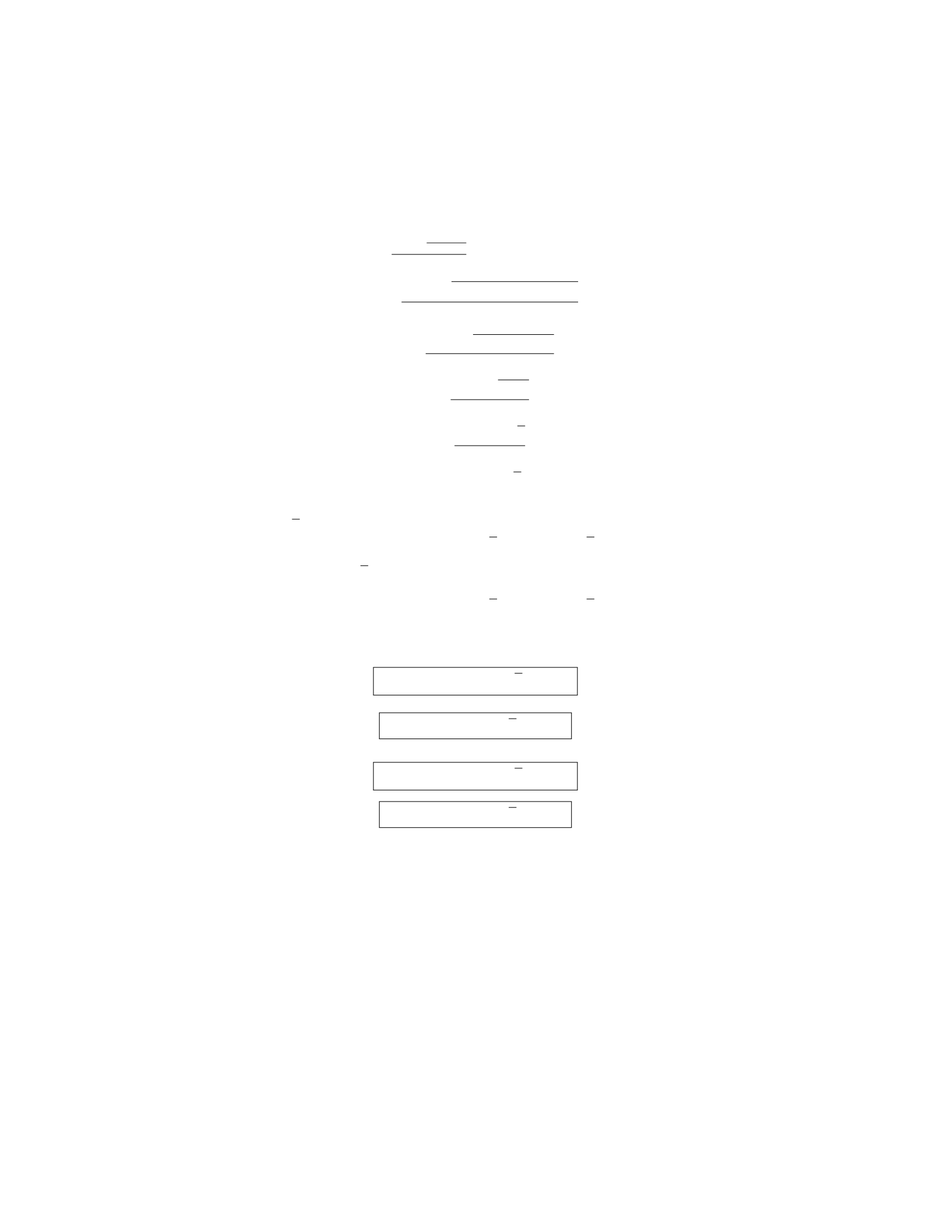
Step 5: Solve the quadratic equation to find the possible values of y. Using
the quadratic formula y=−b±√b2−4ac
2awith a= 2, b =−60, c = 200, we get:
y=60 ±p(−60)2−4·2·200
2·2
y=60 ±√3600 −1600
4
y=60 ±√2000
4
y=60 ±20√5
4
y= 15 ±5√5
Step 6: Find the corresponding values of xusing x= 60 −2y. When
y= 15 + 5√5:
x= 60 −2(15 + 5√5) = 30 −10√5
When y= 15 −5√5:
x= 60 −2(15 −5√5) = 30 + 10√5
Step 7: Therefore, the dimensions of the garden are:
Length = 30 −10√5 meters
Width = 15 + 5√5 meters
or
Length = 30 + 10√5 meters
Width = 15 −5√5 meters
Question 6
Question
A rectangular garden has an area of 120 square meters. The length of the garden
is 2 meters more than its width. Find the dimensions of the garden.
6
Solution
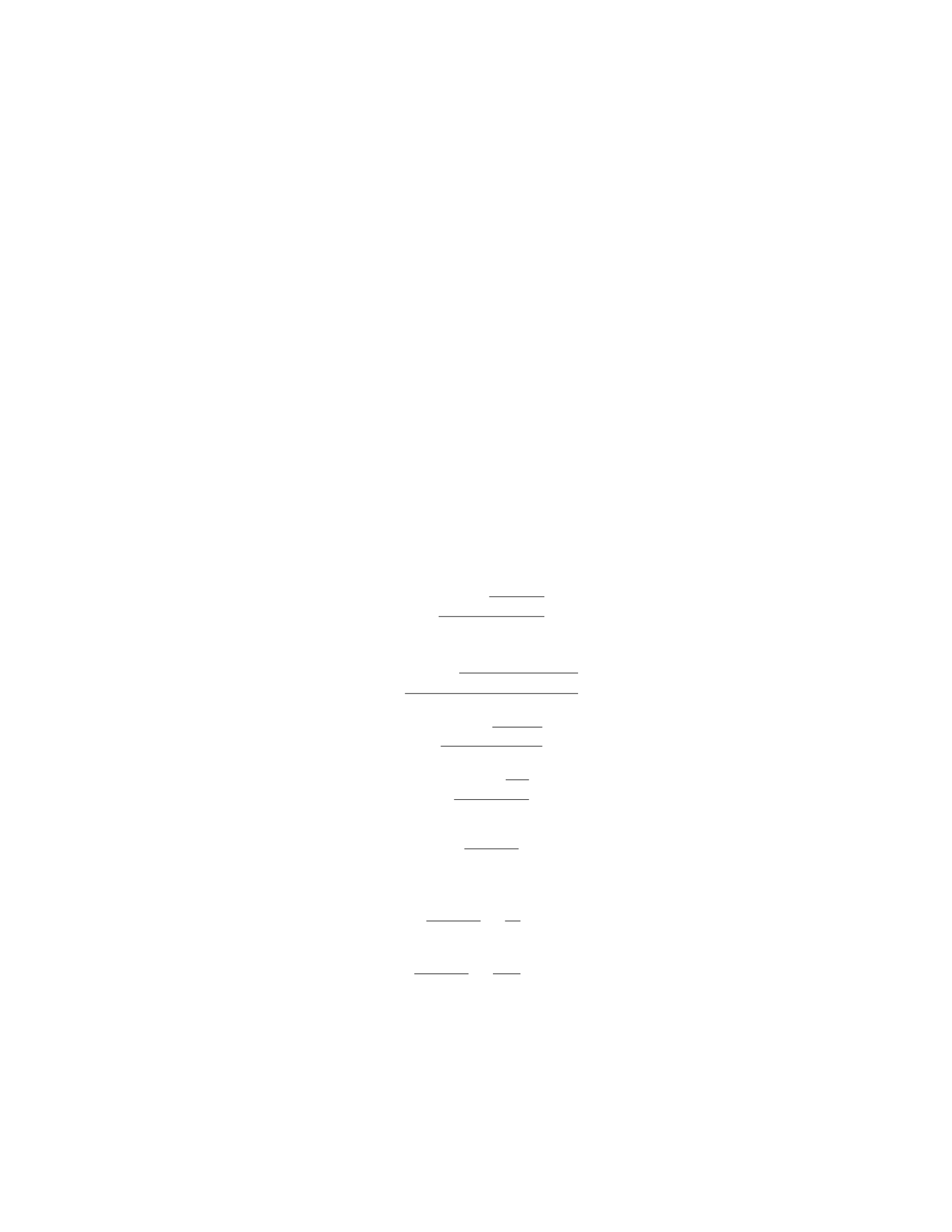
Let’s denote the width of the garden as wmeters. Since the length of the garden
is 2 meters more than its width, the length can be represented as w+ 2 meters.
We are given that the area of the garden is 120 square meters, so we have the
equation:
w(w+ 2) = 120
Expanding the left side of the equation gives:
w2+ 2w= 120
This is a quadratic equation in standard form. Let’s solve for wusing the
quadratic formula:
Step 1: Identify the coefficients
a= 1
b= 2
c=−120
Step 2: Apply the quadratic formula The quadratic formula is given
by
w=−b±√b2−4ac
2a
Substitute the values of a,b, and cinto the formula:
w=−2±p22−4·1·(−120)
2·1
w=−2±√4 + 480
2
w=−2±√484
2
w=−2±22
2
So, we have two possible solutions for w:
1.
w=−2 + 22
2=20
2= 10
2.
w=−2−22
2=−24
2=−12
Since the width cannot be negative, we discard the solution w=−12.
Step 3: Find the dimensions of the garden We found that the width
w= 10 meters. Now, we can find the length:
7

length = w+ 2 = 10 + 2 = 12
So, the dimensions of the garden are: width = 10 meters and length = 12
meters.
Question 7
Question
A rectangular garden is 20 meters longer than it is wide. If the garden’s area is
384 square meters, find the dimensions of the garden.
Solution
Let wbe the width of the garden in meters. Then the length of the garden is
w+ 20 meters.
Step 1: Write an equation based on the given information. The area of a
rectangle is given by the formula A= length ×width. We are given that the
area is 384 square meters, so we have:
384 = (w+ 20)w
Step 2: Simplify the equation. Expanding the right side of the equation, we
get:
384 = w2+ 20w
Step 3: Rearrange the equation into standard quadratic form. Subtracting
384 from both sides, we get:
w2+ 20w−384 = 0
Step 4: Solve the quadratic equation. To solve the quadratic equation w2+
20w−384 = 0, we can factorize or use the quadratic formula:
w=−20 ±p202−4(1)(−384)
2(1)
w=−20 ±√400 + 1536
2
w=−20 ±√1936
2
w=−20 ±44
2
Step 5: Find the possible values of w. The possible values of ware:
w1=−20 + 44
2= 12
8

w2=−20 −44
2=−32
Step 6: Check for extraneous solutions. Since the width cannot be negative,
we discard the negative solution w2=−32.
Step 7: Find the length of the garden. Using w= 12, the length is:
w+ 20 = 12 + 20 = 32
Therefore, the dimensions of the garden are 12 meters by 32 meters.
Question 8
Question
A rectangular garden has a length that is 4 meters longer than its width. If the
area of the garden is 60 square meters, find the dimensions of the garden.
Solution
Step 1: Let’s denote the width of the garden as xmeters. Since the length is 4
meters longer than the width, the length can be represented as x+ 4 meters.
Step 2: We know that the area of a rectangle is given by the formula A=
length ×width. In this case, the area of the garden is 60 square meters. Thus,
we have the equation:
x(x+ 4) = 60
Step 3: Simplifying the equation, we get:
x2+ 4x−60 = 0
Step 4: To solve the quadratic equation x2+ 4x−60 = 0, we can factor it
as (x+ 10)(x−6) = 0.
Step 5: Setting each factor to zero, we find:
x+ 10 = 0 ⇒x=−10
x−6=0⇒x= 6
Step 6: Since the width cannot be negative, we discard x=−10 and only
consider x= 6. Therefore, the width of the garden is 6 meters.
Step 7: Substituting x= 6 back into the expression for length (x+ 4), we
find:
x+ 4 = 6 + 4 = 10
So, the dimensions of the garden are width = 6 meters and length = 10
meters.
9

Question 9
Question
A rectangular garden is to be created along the side of a house. If the garden is
to have an area of 200 square feet, and one side of the garden will be the house
itself, which is 10 feet long, then what dimensions should the other three sides
of the garden have in order to minimize the amount of fencing used?
Solution
Let the length of the garden be xfeet and the width of the garden be yfeet.
Step 1: Write the equation for the area of the garden. The area of the
garden is given by A=xy = 200.
Step 2: Write an equation for the amount of fencing used. The amount of
fencing used is 2x+yfeet.
Step 3: Substitute the value of yfrom the area equation into the fencing
equation. From the area equation, we have y=200
x. Substitute this into the
fencing equation: f= 2x+200
x.
Step 4: Find the critical points by taking the derivative of the fencing
equation and setting it equal to zero. To find the critical points, we take the
derivative of fwith respect to x:df
dx = 2 −200
x2. Setting this derivative equal to
zero gives 2 −200
x2= 0.
Step 5: Solve for x. Solving 2 −200
x2= 0 gives x2= 100 and x=±10.
However, since the dimensions of the garden should be positive, x= 10.
Step 6: Find the corresponding value of y. Using the area equation xy =
200, we find y=200
x=200
10 = 20.
Step 7: Answer Therefore, the dimensions that minimize the amount of
fencing used are a length of 10 feet and a width of 20 feet.
Question 10
Question
A rectangular garden is to be designed to have a fixed area of 400 square meters.
One side of the garden will be bounded by a building and so no fencing is needed.
If the cost of the fencing is 50permeterfortheotherthreesides, findthedimensionsofthegardenthatwillminimizethecostofthefencing.
Solution
Let the length of the garden be xmeters and the width be ymeters. Since the
area of the garden is 400 square meters, we have xy = 400.
The cost of fencing the three sides is 50 ·(x+ 2y) = 50x+ 100y.
We want to minimize the cost of the fencing, so we need to minimize the
cost function C(x, y) = 50x+ 100ysubject to the constraint xy = 400.
From the constraint, we can express yin terms of x:y=400
x.
10
Substitute y=400
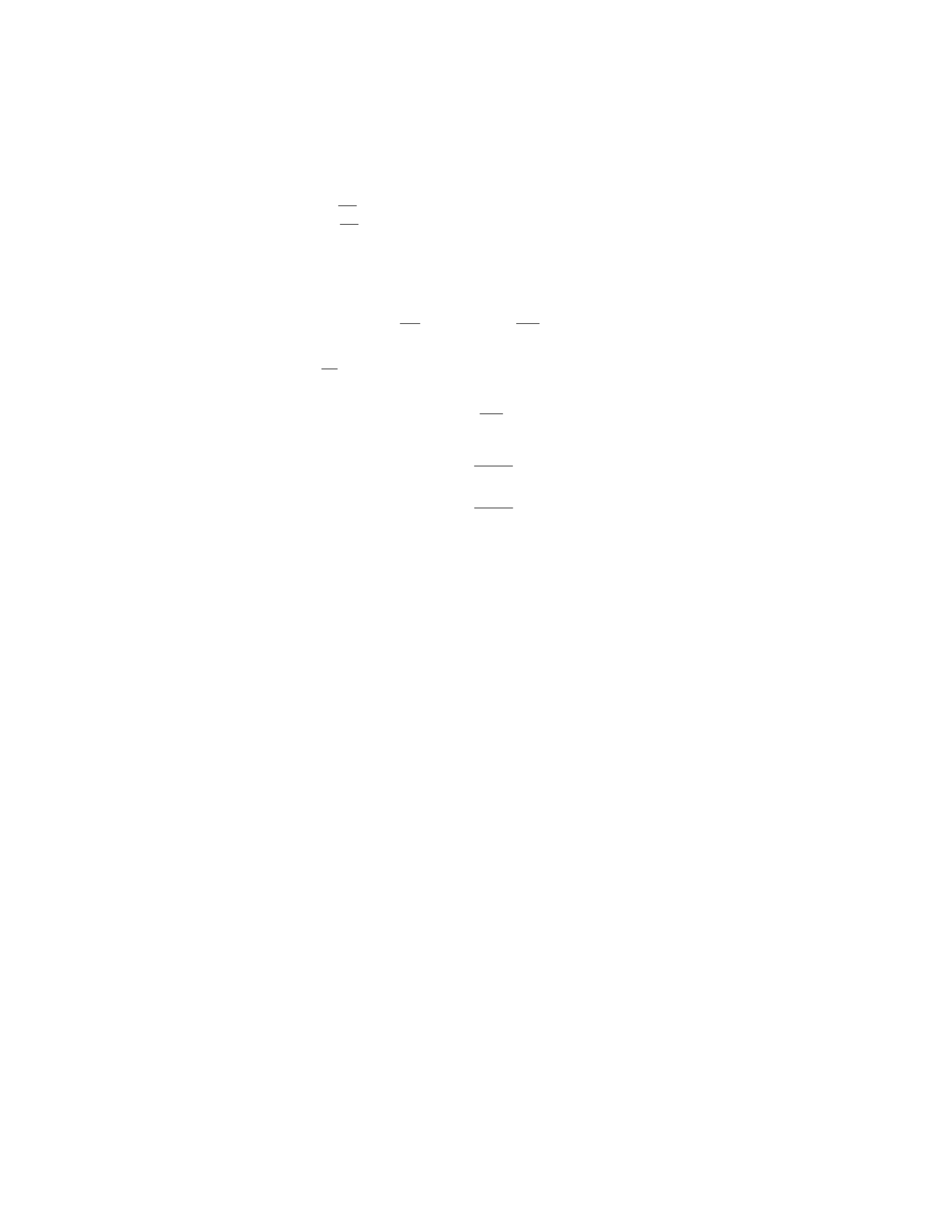
xinto the cost function to get it in terms of one variable:
C(x) = 50x+ 100 400
x.
To find the minimum cost, we differentiate C(x) with respect to x, set the
derivative equal to zero, and solve for x.
Step 1: Find the derivative of C(x).
dC
dx = 50 −100 400
x2
Step 2: Set dC
dx = 0 and solve for x.
50 −100 400
x2= 0
50 = 40000
x2
x2=40000
50
x= 20
So, the dimensions of the garden that will minimize the cost of the fencing
are 20 meters by 20 meters.
Question 11
Question
A rectangle has a perimeter of 30 cm. If the length of the rectangle is 3 cm
longer than the width, find the dimensions of the rectangle.
Solution
Step 1: Let’s denote the width of the rectangle as xcm. Since the length is 3
cm longer than the width, the length can be represented as x+ 3 cm.
Step 2: The perimeter of a rectangle is given by the formula 2(length +
width). Given that the perimeter is 30 cm, we can write the following equation:
2(x+ (x+ 3)) = 30
Step 3: Simplifying the equation, we get:
2(2x+ 3) = 30
4x+ 6 = 30
4x= 24
x= 6
11

Step 4: Now that we have found the width (x= 6 cm), we can find the
length using x+ 3:
x+ 3 = 6 + 3 = 9
Step 5: Therefore, the width of the rectangle is 6 cm and the length is 9 cm.
Question 12
Question
A rectangular garden has a width that is 4 meters less than its length. If the
area of the garden is 120 square meters, find the dimensions of the garden.
Solution
Let’s denote the length of the garden as xmeters. Since the width is 4 meters
less than the length, we can represent the width as x−4 meters.
Given that the area of the garden is 120 square meters, we can write the
equation:
x(x−4) = 120
To solve for x, we need to expand the left side of the equation:
x2−4x= 120
Rearranging the equation to set it equal to zero:
x2−4x−120 = 0
To factor the quadratic equation, we look for two numbers that multiply to
-120 and add up to -4. The two numbers are -12 and 10. So we rewrite the
equation as:
(x−12)(x+ 10) = 0
Setting each factor to zero:
x−12 = 0 or x+ 10 = 0
Solving for xin each case:
Step 1: x−12 = 0
x= 12
Step 2: x+ 10 = 0
x=−10
Since the length of the garden cannot be negative, we disregard x=−10.
Therefore, the length of the garden is x= 12 meters and the width is 12−4 =
8 meters. Thus, the dimensions of the garden are 12 meters by 8 meters.
12

Question 13
Question
A rectangular garden is three times as long as it is wide. If the perimeter of the
garden is 48 meters, find the dimensions of the garden.
Solution
Let xbe the width of the garden. Since the length is three times the width, the
length of the garden is 3x.
Step 1: Write the equation for the perimeter of the garden. The perimeter
of a rectangle is given by the formula: P= 2(l+w). Substituting in the length
3xand width x, we have:
48 = 2(3x+x)
Step 2: Simplify the equation and solve for x.
48 = 2(4x)
48 = 8x
x= 6
Step 3: Find the dimensions of the garden. The width of the garden is
x= 6 m, and the length is 3x= 18 m.
Step 4: Verify the solution by checking the perimeter.
P= 2(18 + 6) = 2(24) = 48
Therefore, the dimensions of the garden are 6 meters by 18 meters.
Question 14
Question
A rectangular garden has a fixed perimeter of 40 meters. The length of the
garden is 4 meters longer than its width. Find the dimensions of the garden
that maximize its area.
Solution
Step 1: Assign variables to the width and length of the garden. Let wbe the
width (in meters) and lbe the length (in meters). Step 2: Write down the given
information in terms of the variables: Given perimeter = 40 meters
2w+ 2l= 40
l=w+ 4
Step 3: Write the equation for the area of the garden in terms of w: Area
A=w×l
13

Step 4: Substitute the expression for lfrom step 2 into the equation for the
area: A=w×(w+ 4)
A=w2+ 4w
Step 5: Express the perimeter in terms of a single variable using the given
perimeter equation: 2w+ 2l= 40
2w+ 2(w+ 4) = 40
2w+ 2w+ 8 = 40
Step 6: Simplify the equation derived from the perimeter to solve for w:
4w+ 8 = 40
4w= 32
w= 8
Step 7: Find the length of the garden using the expression l=w+4: l= 8+4
l= 12
Step 8: Calculate the maximum area by substituting w= 8 back into the
area equation: A= 82+ 4 ×8
A= 64 + 32
A= 96
Therefore, the dimensions of the garden that maximize its area are width
w= 8 meters and length l= 12 meters, with a maximum area of 96 square
meters.
Question 15
Question
A rectangular garden has a length that is 4 meters longer than its width. If the
area of the garden is 96 m2, find the dimensions of the garden.
Solution
Let xrepresent the width of the garden in meters. Since the length is 4 meters
longer than the width, the length can be expressed as x+ 4 meters.
The area of a rectangle is given by the formula A= length ×width. In this
case, we have 96 = (x+ 4)x.
Step 1: Rewrite the equation using the area formula.
(x+ 4)x= 96
Step 2: Expand the left side of the equation.
x2+ 4x= 96
Step 3: Rearrange the equation into standard form.
x2+ 4x−96 = 0
14
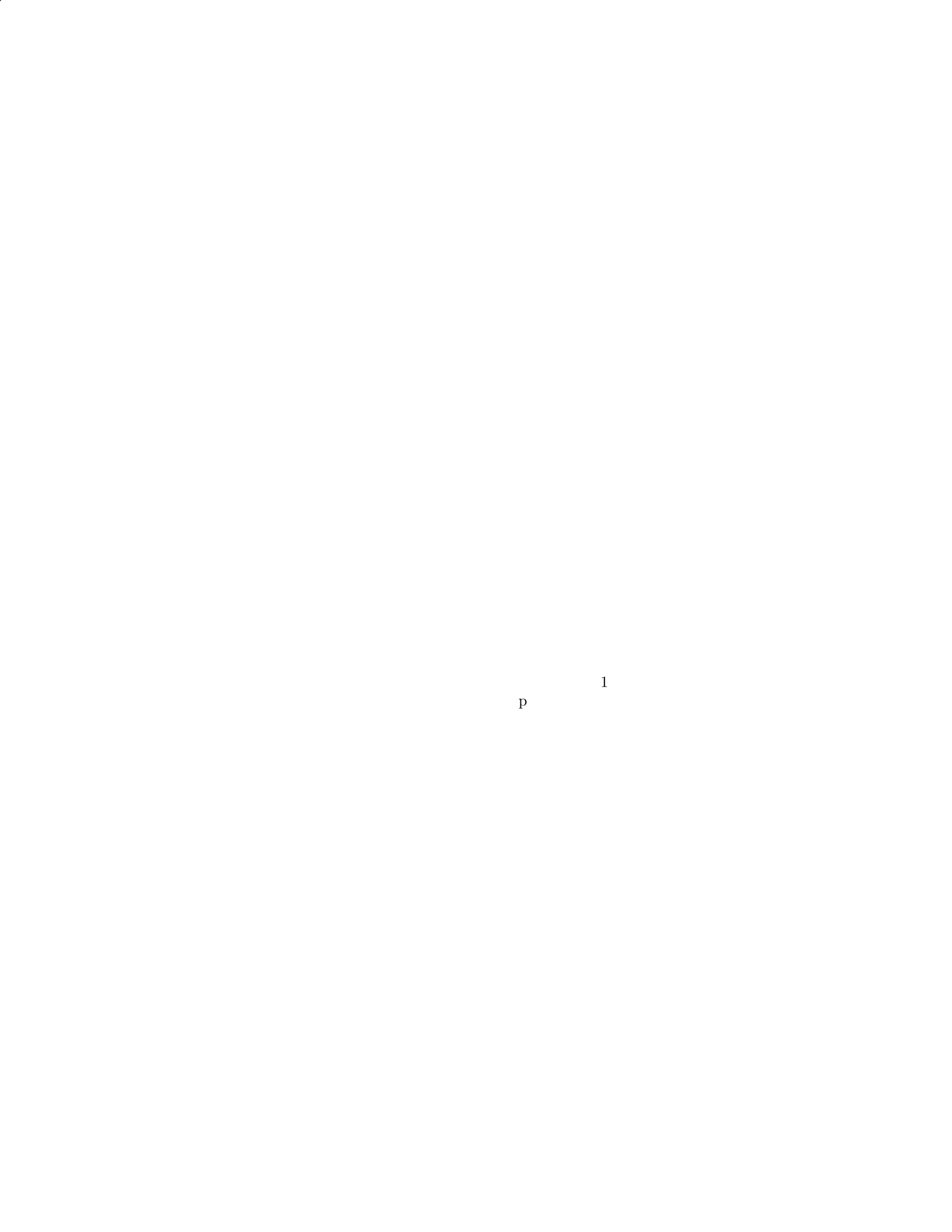
Step 4: Factor the quadratic equation.
(x+ 12)(x−8) = 0
Step 5: Find the possible values for x.
x+ 12 = 0 or x−8=0
Step 6: Solve for x. For x+ 12 = 0:
x=−12
For x−8 = 0:
x= 8
Step 7: Check for extraneous solutions. Since the width cannot be negative,
the only valid solution is x= 8.
Step 8: Find the length. The length of the garden is x+ 4 = 8 + 4 = 12
meters.
Step 9: Conclusion: Therefore, the dimensions of the garden are width 8
meters and length 12 meters.
Question 16
Question
A rectangular garden is to be fenced in with two kinds of fencing. Two opposite
sides will be fenced with a rose-covered iron grill costing
$
10 per meter and the
other two sides with a wire fencing costing
$
4 per meter. If the total cost of the
iron grill is 3 times the cost of the wire fencing and the area of the garden is
200 square meters, find the dimensions of the garden that minimize the cost of
the fencing.
Solution
Let xbe the length of the garden (in meters) and ybe the width of the garden
(in meters).
Step 1: Define the cost function The total cost Cof the fencing is given
by:
C= 10(2x) + 4(2y)
Simplify:
C= 20x+ 8y
Given that the total cost of the iron grill is 3 times the cost of the wire
fencing, we have:
10(2x) = 3(4(2y))
20x= 24y
15

x=6
5y
Step 2: Define the area constraint The area of the rectangular garden
is given by:
A=xy
Given that the area of the garden is 200 square meters, we have:
xy = 200
Step 3: Express the cost function in terms of a single variable
Substitute x=6
5yinto xy = 200 to get:
6
5y2= 200
y2=1000
3
y=r1000
3=10√10
√3=10√30
3
Substitute y=10√30
3into x=6
5yto get:
x=6
5 10√30
3!= 4√30
Thus, the dimensions of the garden that minimize the cost of the fencing are
4√30 meters ×10√30
3meters .
Question 17
Question
A rectangular garden is to be created using a fence along the x-axis and a fence
perpendicular to the x-axis. If the area of the garden is 24 square units, find
the dimensions of the garden that minimize the amount of fencing used.
Solution
Let the length of the garden parallel to the x-axis be xunits, and let the width
perpendicular to the x-axis be yunits. Since the area of the garden is given to
be 24 square units, we have the equation: xy = 24.
The amount of fencing used is the sum of the two sides along the x-axis and
the two sides perpendicular to the x-axis. Therefore, the amount of fencing, F,
is given by:
F= 2x+ 2y
16

To find the dimensions of the garden that minimize the amount of fencing,
we need to minimize the function F(x, y) = 2x+ 2ysubject to the constraint
xy = 24.
Step 1: Express Fin terms of one variable using the constraint xy = 24.
Since y=24
x, we can rewrite Fas:
F(x)=2x+ 2 24
x
Step 2: Find the critical points of F(x) by finding where its derivative is
zero.
Calculate F′(x):
F′(x) = 2 −48
x2
Set F′(x) = 0:
2−48
x2= 0
2 = 48
x2
x2= 24
x=±√24
x=±2√6
Step 3: Evaluate the endpoints and critical points to find the minimum
amount of fencing.
Since the length of a side cannot be negative, we only consider x= 2√6.
Calculate yusing the constraint xy = 24:
y=24
x=24
2√6= 2√6
Therefore, the dimensions that minimize the amount of fencing used are:
length 2√6 units and width 2√6 units.
Question 18
Question
A rectangular garden is to be constructed using a fence on three sides and a
wall on the fourth side. The area of the garden is to be 400 square meters. If
the cost of the fence is
$
20 per meter and the cost of the wall is
$
100 per meter,
find the dimensions of the garden that will minimize the cost of enclosing it.
17
Solution
Let xbe the length of the garden (in meters) and ybe the width of the garden
(in meters). The area of the garden is given by the product of the length and
the width, that is, xy = 400. We want to minimize the cost of enclosing the
garden, which is given by the cost of the fence and the wall.
Step 1: Write the cost function to be minimized.
The cost function C(x, y) is the sum of the cost of the fence (3 sides) and the
cost of the wall (1 side). The cost of the fence is 20x+ 40y(2 sides along the
length at 20permeterandonesidealongthewidthat20 per meter) and the cost of
the wall is 100x. Therefore, the cost function to be minimized is:
C(x, y) = 20x+ 40y+ 100x
Step 2: Write yin terms of x.
From the equation xy = 400, we have y=400
x.
Step 3: Substitute yin terms of xinto the cost function.
Substitute yin terms of xinto the cost function C(x) to get:
C(x) = 20x+ 40 400
x+ 100x
Step 4: Simplify the cost function.
C(x) = 20x+16000
x+ 100x= 120x+16000
x
Step 5: Find the derivative of the cost function.
dC
dx = 120 −16000
x2
Step 6: Set the derivative to zero and solve for x.
120 −16000
x2= 0
16000
x2= 120
x2=16000
120 = 133.33
x≈11.55 meters
Step 7: Find the corresponding yvalue.
y=400
11.55 ≈34.63 meters
Therefore, the dimensions of the garden that will minimize the cost of en-
closing it are approximately 11.55 meters by 34.63 meters.
18

Question 19
Question
A rectangular garden is to be created using 80 meters of fencing. If the length
of the garden is three times its width, find the dimensions of the garden that
will maximize the area enclosed by the fencing.
Solution
Let the width of the garden be xmeters. Then, the length of the garden would
be 3xmeters. The perimeter of the garden is equal to the fencing available, so
we have the equation: 2x+ 2(3x) = 80.
Step 1: Simplify the equation and solve for x. The equation simplifies to
2x+ 6x= 80, which further simplifies to 8x= 80. Solving for x, we get x= 10.
Step 2: Find the dimensions of the garden. The width of the garden is
x= 10 meters, and the length is 3x= 3(10) = 30 meters. Therefore, the
dimensions of the garden are 10 meters by 30 meters.
Step 3: Find the maximum area enclosed by the fencing. The area enclosed
by the fencing is given by A=x×3x= 3x2. Substituting x= 10, we get
A= 3(10)2= 300 square meters.
Thus, the dimensions of the garden that will maximize the area enclosed by
the fencing are 10 meters by 30 meters, with a maximum area of 300 square
meters.
Question 20
Question
A rectangular field has a perimeter of 100 meters. The length of the field is 10
meters longer than its width. Find the dimensions of the field.
Solution
Step 1: Let’s denote the width of the field as xmeters. Since the length of the
field is 10 meters longer than its width, the length can be expressed as x+ 10
meters.
Step 2: The perimeter of a rectangle is given by 2(length + width). We can
create an equation using the given perimeter of 100 meters:
2(x+x+ 10) = 100
Step 3: Simplifying the equation, we get:
2(2x+ 10) = 100
4x+ 20 = 100
19
Step 4: Solving for x:
4x= 100 −20
4x= 80
x= 20
Step 5: Now that we have found x, we can find the width of the field:
Width = x= 20 meters
Step 6: Using the width, we can find the length of the field:
Length = x+ 10 = 20 + 10 = 30 meters
Step 7: Therefore, the dimensions of the field are: width = 20 meters and
length = 30 meters.
Question 21
Question
A company manufactures and sells a certain type of smartphone at
$
500 per
unit. The total cost (in dollars) to produce xunits of this smartphone is given
by the function C(x)=0.01x2+ 100x+ 10000. Determine the number of units
the company needs to sell in order to break even.
Solution
Let’s first recall that the company breaks even when the total revenue equals
the total cost. The total revenue is given by the product of the selling price and
the number of units sold. In this case, the total revenue is R(x) = 500x.
Step 1: Set up the equation for the break-even point. To find the break-even
point, we need to solve the equation R(x) = C(x) for x:
500x= 0.01x2+ 100x+ 10000
Step 2: Rearrange the equation. Subtract 500x from both sides to get the
quadratic equation in standard form:
0.01x2+ 100x+ 10000 −500x= 0
0.01x2−400x+ 10000 = 0
Step 3: Solve the quadratic equation. To solve the equation 0.01x2−400x+
10000 = 0, we can either use the quadratic formula or factorize. Let’s use the
quadratic formula:
x=−(−400) ±p(−400)2−4(0.01)(10000)
2(0.01)
Calculating this out gives 200 and 2000. Since we are looking for the number
of units sold, the company needs to sell 200 and 2000 units to break even.
20

Question 22
Question
A rectangular garden is to be created using a brick wall on one side. If the
length of the wall is 10 meters longer than the width of the garden, and the
area of the garden is 300 square meters, find the dimensions of the garden.
Solution
Let’s denote the width of the garden as xmeters. Since the length of the wall
is 10 meters longer than the width, the length of the garden is x+ 10 meters.
Given that the area of the garden is 300 square meters, we can create the
equation:
x(x+ 10) = 300
Step 1: Expand the equation and simplify.
x2+ 10x= 300
Step 2: Rearrange the equation into standard form.
x2+ 10x−300 = 0
Step 3: Factor the quadratic equation.
(x+ 20)(x−15) = 0
Step 4: Solve for x. Setting each factor to zero gives x=−20 or x= 15.
Since the width cannot be negative, the width of the garden is 15 meters.
Step 5: Find the length of the garden. The length is x+ 10 = 15 + 10 = 25
meters.
Thus, the dimensions of the garden are 15 meters by 25 meters.
Question 23
Question
A rectangular garden has a length of 20 meters and a width of 10 meters. The
garden has a uniform border of flowers surrounding it which has a width of x
meters on all sides. If the total area of the garden and the border of flowers is
512 square meters, determine the width of the border of flowers.
Solution
Let Abe the area of the garden and Bbe the area of the border of flowers.
Given that the total area is 512 square meters, we have:
21

A+B= 512
The area of the garden is given by:
A= length ×width = 20 ×10 = 200 square meters
The area of the garden and the border of flowers is given by:
A+B= (20 + 2x)(10 + 2x)
Substitute the expressions for Aand A+Binto the equation A+B= 512
to get:
200 + 4x2+ 60x= 512
Simplify the equation:
4x2+ 60x−312 = 0
Next, we need to solve the quadratic equation 4x2+ 60x−312 = 0 to find
the width of the border of flowers.
Step 1: Find the roots of the quadratic equation 4x2+ 60x−312 = 0 by
factoring or using the quadratic formula.
Step 2: Factor the quadratic equation:
4(x2+ 15x−78) = 0
4(x+ 26)(x−3) = 0
Setting each factor to zero gives us the possible solutions:
x+ 26 = 0 or x−3=0
So, the solutions are x=−26 and x= 3. Since the width cannot be negative,
the width of the border of flowers is x= 3 meters.
Question 24
Question
A rectangular garden is to be fenced on three sides using 120 meters of fencing.
If the length of the garden is 20 meters more than its width, find the dimensions
of the garden that will maximize the area.
22

Solution
Let the width of the garden be xmeters. Since the length is 20 meters more
than the width, the length is x+ 20 meters.
The perimeter of the rectangular garden is given by P= 2(length + width).
So, from the given information, we have:
120 = 2((x+ 20) + x)
120 = 2(2x+ 20)
60 = 2x+ 20
40 = 2x
x= 20
So, the width of the garden is 20 meters and the length is x+ 20 = 20 +20 =
40 meters.
The area of a rectangle is given by A= length ×width. Now, we can find
the area of the rectangle:
A= (20)(40)
A= 800 m2
Therefore, the dimensions of the garden that will maximize the area are
width = 20 meters and length = 40 meters, resulting in a maximum area of 800
square meters.
Question 25
Question
A rectangular garden is to be created using a river as one side of the garden. If
the garden is to have a perimeter of 200 meters and the area of the garden is
1600 square meters, what are the dimensions of the garden?
Solution
Let’s denote the length of the garden as land the width as w. Since one side of
the garden is formed by the river, the perimeter of the garden can be expressed
as l+ 2w= 200. Also, the area of the garden can be expressed as lw = 1600.
Step 1: Express the perimeter equation in terms of one variable. From
l+ 2w= 200, we can express lin terms of was l= 200 −2w.
Step 2: Substitute linto the area equation. Substitute l= 200 −2winto
the area equation:
(200 −2w)w= 1600
Step 3: Solve for w. Simplify the equation:
200w−2w2= 1600
23

−2w2+ 200w−1600 = 0
Step 4: Solve the quadratic equation. We can solve the quadratic equation
using the quadratic formula:
w=−b±√b2−4ac
2a
where a=−2, b= 200, and c=−1600. Plugging these values in:
w=−200 ±p2002−4(−2)(−1600)
2(−2)
w=−200 ±√40000 −12800
−4
w=−200 ±√27200
−4
w=−200 ±164.98
−4
Step 5: Find the possible values for w. We have two possible values for w:
w1=−200 + 164.98
−4=−35.02
−4= 8.75
or
w2=−200 −164.98
−4=−364.98
−4= 91.25
Step 6: Find the corresponding values for l. Using l= 200 −2w: For
w= 8.75:
l= 200 −2(8.75) = 182.5
For w= 91.25:
l= 200 −2(91.25) = 17.5
Step 7: Check the dimensions. Since wrepresents the width, we have w=
8.75 and l= 182.5. Since the dimensions should be positive, the dimensions of
the garden are 8.75 meters by 182.5 meters.
Question 26
Question
A rectangular garden is 24 meters long and 10 meters wide. It is desired to
increase the area of the garden by 100 square meters by adding mulch around
the perimeter. If the width of the mulch strip is the same all around, find the
width of the strip.
24

Solution
Let xdenote the width of the strip. The new length of the garden will be 24+2x
meters and the new width will be 10 + 2xmeters. Since the area of the garden
is length times width, we have the equation:
(24 + 2x)(10 + 2x) = 24 ×10 + 100
240 + 48x+ 20x+ 4x2= 240 + 100
4x2+ 68x−100 = 0
To solve this quadratic equation, we can divide the entire equation by 4:
x2+ 17x−25 = 0
Now, we can find the solutions using the quadratic formula:
x=−b±√b2−4ac
2a
where a= 1, b= 17, and c=−25.
x=−17 ±p172−4·1·(−25)
2·1
x=−17 ±√289 + 100
2
x=−17 ±√389
2
So, the possible widths of the strip are x=−17+√389
2and x=−17−√389
2. Since
we are looking for a positive width, the width of the strip is −17+√389
2meters.
Question 27
Question
A rectangular garden is 5 meters longer than it is wide. The area of the garden
is 180 square meters. Find the dimensions of the garden.
Solution
Let’s denote the width of the garden as xmeters. Therefore, the length of the
garden is x+ 5 meters. We know that the area of a rectangle is given by the
formula: area = length ×width. In this case, the area is 180 square meters.
Step 1: Write the equation representing the area of the garden.
x(x+ 5) = 180
25

Step 2: Expand and rearrange the equation.
x2+ 5x−180 = 0
Step 3: Solve the quadratic equation by factoring or using the quadratic
formula. The factors of -180 that add up to 5 are 20 and -15. So, the factors
of the quadratic equation are (x+ 20) and (x−15). Thus, the solutions are
x=−20 or x= 15.
However, the width cannot be negative, so x= 15 is the valid solution.
Step 4: Find the dimensions of the garden. Since the width, x, is 15 meters,
the length is 15 + 5 = 20 meters.
Therefore, the dimensions of the garden are 15 meters by 20 meters.
Question 28
Question
A rectangular garden has a fixed perimeter of 80 meters. If the length of the
garden is 10 meters greater than its width, find the dimensions of the garden
that maximize the area.
Solution
Step 1: Let’s first set up the equations based on the given information. Let the
width of the rectangular garden be xmeters. Then the length is x+ 10 meters.
We know that the perimeter is given by P= 2L+ 2W, where Lis the length
and Wis the width. Therefore, we have: 80 = 2(x+ 10) + 2xSimplify this
equation: 80 = 2x+ 20 + 2x
Step 2: Solve for xto find the width of the garden. 80 = 4x+ 20 4x= 60
x= 15
Step 3: Now that we have found the width (x= 15), we can find the length
of the garden. Length = x+ 10 = 15 + 10 = 25 meters
Step 4: Calculate the area of the garden using the width and length obtained.
Area = width ×length = 15 ×25 = 375 square meters
Therefore, the dimensions of the garden that maximize the area are width
= 15 meters and length = 25 meters, resulting in an area of 375 square meters.
Question 29
Question
A rectangular garden is to be surrounded by a path of uniform width. The
dimensions of the garden are in the ratio 3:2. If the area of the path is 150
square meters, find the dimensions of the garden.
26

Solution
Step 1: Let the width of the path be xmeters. Then the width of the garden is
3xmeters and the length of the garden is 2xmeters.
Step 2: The area of the garden is given by the product of its length and
width, which is 2x×3x= 6x2square meters.
Step 3: The outer dimensions of the rectangle, including the path, are (2x+
2,3x+ 2) meters. The area of the outer rectangle is given by the product of its
length and width, which is (2x+ 2)(3x+ 2) square meters.
Step 4: The area of the path is the difference between the areas of the outer
rectangle and the garden:
(2x+ 2)(3x+ 2) −6x2= 150
Step 5: Expand and simplify the equation:
6x2+ 10x+ 4 −6x2= 150
10x+ 4 = 150
Step 6: Solve for x:
10x= 146
x= 14.6 meters
Step 7: Therefore, the dimensions of the garden are 29.2 meters by 43.8
meters.
Question 30
Question
A farmer wants to create a rectangular enclosure for his livestock using 200
meters of fencing. He plans to use a straight river as one of the sides of the
enclosure. If the farmer does not need to use fencing along the river, what are
the dimensions of the enclosure that will maximize the area?
Solution
Let xbe the width of the enclosure and ybe the length of the enclosure.
Step 1: We need to express the total length of fencing in terms of xand y.
Given that one side of the enclosure is along the river, the length of fencing is
x+y+x= 200.
Step 2: Simplify the equation to find the relationship between xand y:
2x+y= 200 ⇒y= 200 −2x.
Step 3: The area of the rectangular enclosure is given by A=xy. Sub-
stituting the expression for yin terms of xinto the area formula, we get
A=x(200 −2x) = 200x−2x2.
27
Step 4: To find the dimensions that maximize the area, we take the deriva-
tive of Awith respect to xand set it equal to zero:
dA
dx = 200 −4x
200 −4x= 0
4x= 200
x= 50
Step 5: To ensure that this point corresponds to a maximum (and not
a minimum or a point of inflection), we find the second derivative of Awith
respect to x:
d2A
dx2=−4
Since the second derivative is negative, the critical point at x= 50 corre-
sponds to a maximum area.
Step 6: Now that we have the width, we can find the length using y=
200 −2x.
y= 200 −2(50)
y= 100
Step 7: Therefore, the dimensions of the enclosure that maximize the area
are a width of 50 meters and a length of 100 meters.
Question 31
Question
A rectangular garden is to be created along the side of a house. If the length
of the garden is three times its width, and the area of the garden is 200 square
meters, find the dimensions of the garden.
Solution
Step 1: Let’s denote the width of the garden as xmeters. Since the length is
three times the width, the length can be represented as 3xmeters.
Step 2: We know that the area of a rectangle is given by the formula A=
length ×width. Substituting the given values, we have:
200 = (3x)(x)
Step 3: Simplifying the equation, we get:
200 = 3x2
28

Step 4: Rearranging the equation, we find:
x2=200
3
Step 5: Taking the square root of both sides, we have:
x=r200
3=10√6
3
Step 6: Therefore, the width of the garden is 10√6
3meters.
Step 7: To find the length, we substitute the width back into the expression
for the length:
3x= 3 10√6
3!= 10√6
Step 8: Thus, the dimensions of the garden are width = 10√6
3meters, and
length = 10√6 meters.
Question 32
Question
A rectangular garden has a length that is 4 meters longer than its width. If the
area of the garden is 180 square meters, find the dimensions of the garden.
Solution
Step 1: Let’s denote the width of the garden as xmeters. Since the length is 4
meters longer than the width, we can express the length in terms of xas x+ 4
meters.
Step 2: The area of a rectangle is given by the formula A= length ×width.
We are given that the area is 180 square meters, so we can set up the equation:
180 = (x+ 4) ×x.
Step 3: Simplifying the equation, we get:
180 = x2+ 4x
Step 4: Rearranging the equation in standard form:
x2+ 4x−180 = 0
Step 5: To solve the quadratic equation, we can use the quadratic formula:
x=−b±√b2−4ac
2a, where the equation is in the form ax2+bx +c= 0.
Step 6: In our equation, a= 1, b= 4, and c=−180. Substituting these
values into the formula gives us:
x=−4±p42−4(1)(−180)
2(1)
29

Step 7: Calculating under the square root:
x=−4±√16 + 720
2=−4±√736
2
Step 8: Further simplifying, we have two possible solutions:
x=−4 + 24
2or x=−4−24
2
Step 9: These give us:
x= 10 or x=−14
Step 10: Since the width of the garden cannot be negative, the width is 10
meters.
Step 11: Now, we can find the length by adding 4 to the width:
x+ 4 = 10 + 4 = 14
Step 12: Therefore, the dimensions of the garden are width = 10 meters and
length = 14 meters.
Question 33
Question
A rectangular garden is to be enclosed with 180 meters of fencing. One side of
the garden will be against the side of a house, so only three sides need to be
fenced. If the length of the garden is twice the width, what dimensions should
the garden have in order to maximize the area?
Solution
Step 1: Let’s denote the width of the garden as w. Since the length of the
garden is twice the width, we can represent the length as 2w.
Step 2: The perimeter of the garden is given by P= 2w+ 2(2w) = 180.
Simplifying, we get 6w= 180, which implies w= 30.
Step 3: Now, substitute w= 30 back into the length equation to find the
length: 2w= 2(30) = 60.
Step 4: The area of the rectangular garden is given by A= length ×width =
60 ×30. Calculate the area to find the maximum area possible.
Step 5: The maximum area of the garden occurs when w= 30 and l= 60.
Therefore, the dimensions of the garden that maximize the area are 30 meters
by 60 meters.
30
Question 34
Question
A farmer plans to create a rectangular pen for her chickens using a long existing
fence for one side of the pen. If she has a total of 120 meters of fencing and
wants to maximize the area of the pen, what should be the dimensions of the
pen?
Solution
Let xbe the length of the side of the pen perpendicular to the existing fence,
and let ybe the length of the side parallel to the existing fence.
Step 1: Write the constraint equation. The constraint is that the total
length of fencing used is 120 meters:
2x+y= 120
Step 2: Express yin terms of x. Solve the constraint equation for y:
y= 120 −2x
Step 3: Write the area equation. The area of the rectangular pen is given
by:
A=xy
Step 4: Express the area in terms of x. Substitute y= 120 −2xinto the
area equation:
A=x(120 −2x) = 120x−2x2
Step 5: Determine the critical points. To find the maximum area, we find
the critical points of the area function by taking the derivative with respect to
xand setting it equal to 0:
dA
dx = 120 −4x
Setting the derivative equal to 0 and solving for x:
120 −4x= 0
x= 30
Step 6: Find the dimensions for the maximum area. Substitute the critical
point x= 30 back into the constraint equation to find y:
2(30) + y= 120
60 + y= 120
y= 60
Therefore, the dimensions of the rectangular pen that maximize the area are
30 meters by 60 meters.
31

Question 35
Question
A rectangular garden has a fixed perimeter of 80 meters. If the length of the
garden is 5 meters longer than its width, find the dimensions of the garden that
maximize the area.
Solution
Step 1: Let’s denote the width of the garden as xmeters. Since the length is 5
meters longer than the width, the length can be expressed as x+ 5 meters.
Step 2: The perimeter of the rectangular garden is given by 2(x+x+5) = 80.
Simplifying, we get 4x+ 10 = 80. Solving for xgives x= 17.5 meters.
Step 3: So, the width of the garden is 17.5 meters, and the length is 17.5+5 =
22.5 meters.
Step 4: The area of the garden is given by A= length×width = 17.5×22.5 =
393.75 square meters.
Therefore, the dimensions of the garden that maximize the area are 17.5
meters by 22.5 meters, with a maximum area of 393.75 square meters.
32

