


MATH 110 - INTERMEDIATE
ALGEBRA - Applications of quadratic
equations
Question Bank - Set 2
Liberty University
Question 1
Question
A farmer wants to create a rectangular pen for his animals using one side of his
barn as one side of the pen, and 60 meters of fencing for the other three sides.
If the area of the pen is 600 square meters, what are the dimensions of the pen?
Solution
Let xbe the width of the pen and ybe the length of the pen.
Step 1: Write down the equations based on the given information. Since one
side of the pen is against the barn, we only need to consider the fencing for the
other three sides. The perimeter of the rectangular pen would be 2x+y= 60,
and the area would be xy = 600.
Step 2: Solve the first equation for yin terms of x. From the perimeter
equation, we can solve for yas y= 60 −2x.
Step 3: Substitute the expression for yinto the area equation. Substitute
y= 60 −2xinto the area equation to get x(60 −2x) = 600.
Step 4: Simplify and solve the quadratic equation. Expanding the left side
gives 60x−2x2= 600, which simplifies to −2x2+ 60x−600 = 0.
Step 5: Find the solutions for x. Divide the equation by −2 to simplify it
to x2−30x+ 300 = 0. We can factor this equation as (x−20)(x−10) = 0.
Step 6: Determine the dimensions of the pen. Since x= 20 implies y=
60−2(20) = 20, and x= 10 implies y= 60−2(10) = 40, the possible dimensions
are 20m by 20m or 10m by 40m.

Question 2
Question
A rectangular garden is to be created using 120 feet of fencing. If one side of
the garden is along a river and does not need fencing, find the dimensions of
the garden that will maximize the area.
Solution
Step 1: Let’s denote the length of the two parallel sides of the rectangular
garden as xand the width of the garden as y. Step 2: Since one side of the
garden is along the river and does not need fencing, the total amount of fencing
used is x+ 2y= 120. Step 3: Solve the equation x+ 2y= 120 for xto get
x= 120 −2y. Step 4: The area of the garden, A, is given by A=xy. Step 5:
Substitute x= 120 −2yinto the area formula to get A= (120 −2y)y. Step 6:
Expand the expression for the area to get A= 120y−2y2. Step 7: To find the
dimensions that maximize the area, we need to find the critical points. Take the
derivative of Awith respect to yand set it equal to 0. Step 8: dA
dy = 120 −4y.
Step 9: Set dA
dy = 0 and solve for y: 120 −4y= 0 ⇒y= 30. Step 10: Find the
corresponding value of x:x= 120 −2(30) = 60. Step 11: So, the dimensions of
the garden that maximize the area are 60 feet by 30 feet.
Question 3
Question
A company produces and sells a certain product. The revenue Rgenerated
by selling xunits of the product can be modeled by the quadratic equation
R(x) = −2x2+ 50x. Find the number of units that must be sold to maximize
the revenue.
Solution
Step 1: To find the number of units that must be sold to maximize the revenue,
we need to find the vertex of the quadratic function R(x) = −2x2+ 50x.
Step 2: The x-coordinate of the vertex of a quadratic function in the form
ax2+bx +cis given by x=−b
2a.
Step 3: In this case, a=−2 and b= 50. So, the x-coordinate of the vertex
is x=−50
2(−2) =50
4= 12.5.
Step 4: Therefore, the number of units that must be sold to maximize the
revenue is 12.5 units. However, since we can’t sell a fraction of a unit, we need
to round to the nearest whole number.
Step 5: So, the company should sell 13 units of the product to maximize the
revenue.
2

Question 4
Question
A farmer plans to create a rectangular vegetable garden by adding length to one
side of his existing square garden. He needs 180 meters of fencing material to
enclose both gardens. If the length of the rectangular garden is twice the length
of the square garden, find the dimensions of both gardens.
Solution
Let xbe the length of one side of the square garden. Since the length of the
rectangular garden is twice the length of the square garden, the length of the
rectangular garden is 2x. Since the square garden has four equal sides, the total
length of fencing material used for the square garden is 4x. The total length
of fencing material used for the rectangular garden is 2x+ 2(2x) = 6x. Given
that the total length of fencing material used for both gardens is 180 meters,
we have the equation:
4x+ 6x= 180
10x= 180
x= 18
So, the length of one side of the square garden is 18 meters, and the length of
the rectangular garden is 2(18) = 36 meters.
Therefore, the dimensions of the square garden are 18 ×18 meters, and the
dimensions of the rectangular garden are 36 ×18 meters.
Question 5
Question
A rectangular garden is to be created along the side of a house. If 40 meters
of fencing are available, what dimensions should the garden have in order to
maximize the area?
Solution
Let xrepresent the width of the garden and yrepresent the length of the garden.
Step 1: Write the perimeter equation. The perimeter of the rectangular
garden is given by:
2x+y= 40
Step 2: Write the area equation. The area of the rectangular garden is
given by:
A=xy
3

Step 3: Express yin terms of x. From the perimeter equation, y= 40 −2x.
Substitute this into the area equation:
A=x(40 −2x) = 40x−2x2
Step 4: Find the critical points. To find the maximum area, we need to
find the critical point of the function. Take the derivative of the area function:
dA
dx = 40 −4x
Set this derivative equal to zero and solve for x:
40 −4x= 0
4x= 40
x= 10
Step 5: Determine the dimensions. Substitute x= 10 back into the perime-
ter equation to find y:
2(10) + y= 40
20 + y= 40
y= 20
Therefore, the dimensions that would maximize the area are 10 meters by
20 meters.
Question 6
Question
A rectangular garden is 12 meters longer than it is wide. If the area of the
garden is 180 square meters, find the dimensions of the garden.
Solution
Let wbe the width of the garden. Since the garden is 12 meters longer than it
is wide, the length of the garden is w+ 12.
We know that the area of a rectangle is given by the formula A= length ×
width. Given that the area of the garden is 180 square meters, we can set up
the following equation:
w(w+ 12) = 180
Step 1: Expand the left side of the equation.
w2+ 12w= 180
4
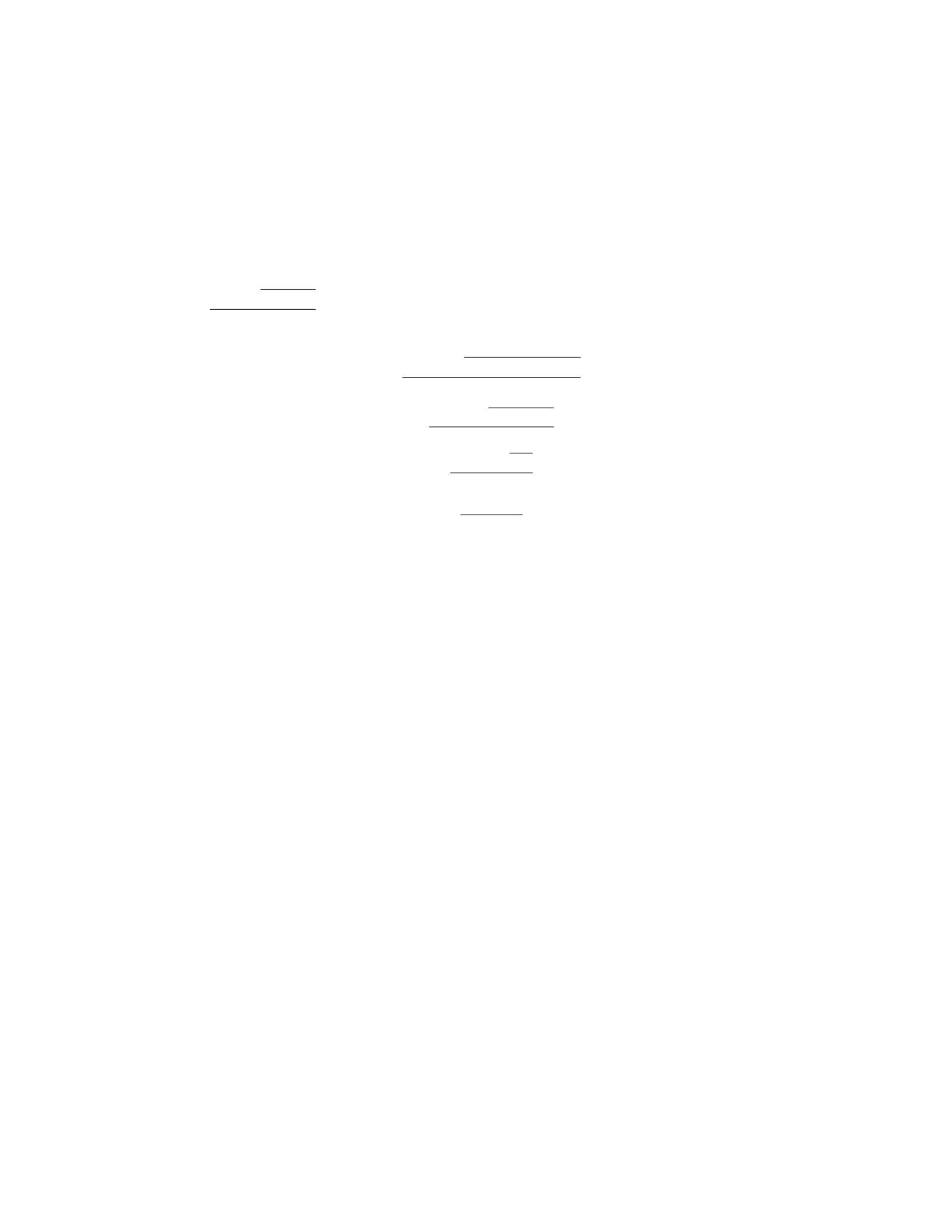
Step 2: Rearrange the quadratic equation into the standard form, w2+
12w−180 = 0.
Step 3: To solve the quadratic equation, we can either factor it or use
the quadratic formula. Let’s use the quadratic formula, which states that for
an equation in the form ax2+bx +c= 0, the solutions are given by x=
−b±√b2−4ac
2a.
In this case, a= 1, b= 12, and c=−180. Substituting into the quadratic
formula:
w=−12 ±p122−4(1)(−180)
2(1)
w=−12 ±√144 + 720
2
w=−12 ±√864
2
w=−12 ±24
2
The possible values for ware w1= 6 and w2=−30. Since the width cannot
be negative, we take w= 6.
Step 4: Find the length of the garden. The length of the garden is w+12 =
6 + 12 = 18 meters.
Step 5: State the dimensions of the garden. Therefore, the dimensions of
the garden are width 6 meters and length 18 meters.
Question 7
Question
A rectangular garden has a fixed perimeter of 40 meters. The length of the
garden is 6 meters longer than the width. Find the dimensions of the garden
that maximize the area.
Solution
Let’s denote the width of the garden as wmeters. Since the length is 6 meters
longer than the width, we can express the length in terms of was l=w+ 6.
Step 1: Write an equation based on the fixed perimeter of the garden. The
perimeter Pof a rectangle is given by 2×(length + width). Since the perimeter
is fixed at 40 meters, we have:
2(w+ (w+ 6)) = 40
Step 2: Find the value of w. Simplify the equation:
2w+ 2w+ 12 = 40
5
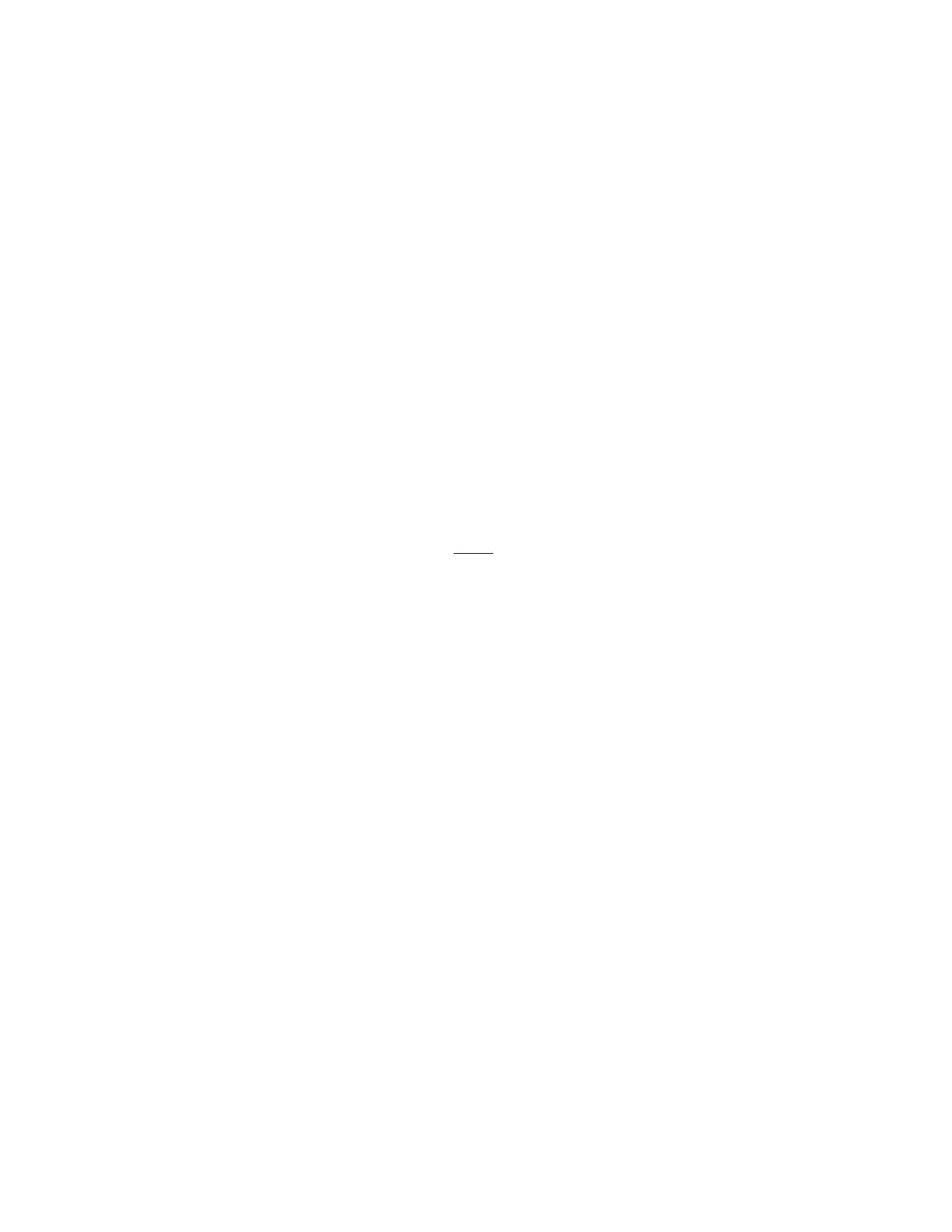
4w+ 12 = 40
4w= 28
w= 7
Step 3: Find the length of the garden. Using the value of w, we can find
the length:
l=w+ 6 = 7 + 6 = 13
Step 4: Calculate the area of the garden as a function of w. The area Aof
a rectangle is given by length ×width. Substituting w= 7 into the expression
for A, we have:
A(w) = 7 ×13 −91
Step 5: Determine the maximum area. To find the dimensions that maxi-
mize the area, we need to find the maximum of the quadratic function A(w).
The maximum occurs at the vertex of the parabola, which is given by w=
−b/(2a), where the quadratic function is in the form y=ax2+bx +c. In this
case, our quadratic function is A(w) = −w2+ 20w−91, so a=−1, b= 20.
w=−20
2(−1) = 10
Step 6: Find the maximum area. Now that we have the value of wthat
maximizes the area, we can find the corresponding length and calculate the
maximum area:
l= 10 + 6 = 16
Amax = 10 ×16 = 160
Therefore, the dimensions of the garden that maximize the area are 10 meters
by 16 meters, with a maximum area of 160 square meters.
Question 8
Question
A rectangular garden has a length that is 4 meters more than its width. The
area of the garden is 144 square meters. Find the dimensions of the garden.
Solution
Let’s denote the width of the rectangular garden as wmeters. Since the length
is 4 meters more than the width, we can express the length as w+ 4 meters.
Step 1: Write the equation for the area of the garden. The area of a rectangle
is given by the formula: Area = length ×width. Substitute the given values
into the formula:
144 = (w+ 4)w
6

Step 2: Simplify the equation. Expand the right side of the equation:
144 = w2+ 4w
Rearrange the equation into a quadratic equation form by setting it equal to
zero:
w2+ 4w−144 = 0
Step 3: Solve the quadratic equation. We can solve this quadratic equation
by factoring or using the quadratic formula. Let’s use the quadratic formula:
w=−b±√b2−4ac
2a
where a= 1, b= 4, and c=−144.
w=−4±p42−4(1)(−144)
2(1)
w=−4±√16 + 576
2
w=−4±√592
2
w=−4±24.33
2
Step 4: Determine the possible values for the width. Since the width cannot
be negative, we take the positive value:
w=−4 + 24.33
2=20.33
2= 10.17
Step 5: Calculate the length. The length of the rectangular garden is w+ 4
meters.
Length = 10.17 + 4 = 14.17
Therefore, the dimensions of the rectangular garden are width = 10.17 me-
ters and length = 14.17 meters.
Question 9
Question
A ball is thrown horizontally from the top of a building 40 m high with an initial
speed of 20 m/s. The ball lands on the ground tseconds later. Find the total
time the ball is in the air.
7

Solution
Let’s denote the total time the ball is in the air as Tseconds.
Step 1: Find the time it takes for the ball to reach the ground horizontally.
This can be done by using the fact that the ball was thrown horizontally. The
equation to find the time using the displaced distance xis given by:
x=vt
Where xis the horizontal distance, vis the initial horizontal velocity, and tis
the time taken. In this case, x= 40 m and v= 20 m/s. Therefore, we can
rearrange the formula to solve for t.
t=x
v=40
20 = 2 seconds
Step 2: Find the total time the ball is in the air. Since the ball was in
the air for 2 seconds horizontally, we need to consider the time it was also in
the air vertically. This can be found using the height of the building and the
acceleration due to gravity. The equation to find the time using the height his
given by:
h=1
2gt2
Where his the height, gis the acceleration due to gravity, and tis the total
time taken. In this case, h= 40 m and g= 9.8 m/s2. We will solve for t.
40 = 1
2×9.8×T2
T2=40 ×2
9.8
T2=80
9.8
T2≈8.1633
T≈√8.1633 ≈2.8596
Therefore, the total time the ball is in the air is approximately 2.8596 sec-
onds.
Question 10
Question
A rectangular garden is to be enclosed with 120 meters of fencing. If one side
of the garden is against the side of a barn and so doesn’t need fencing, find the
dimensions of the garden that will maximize the area.
8
Solution
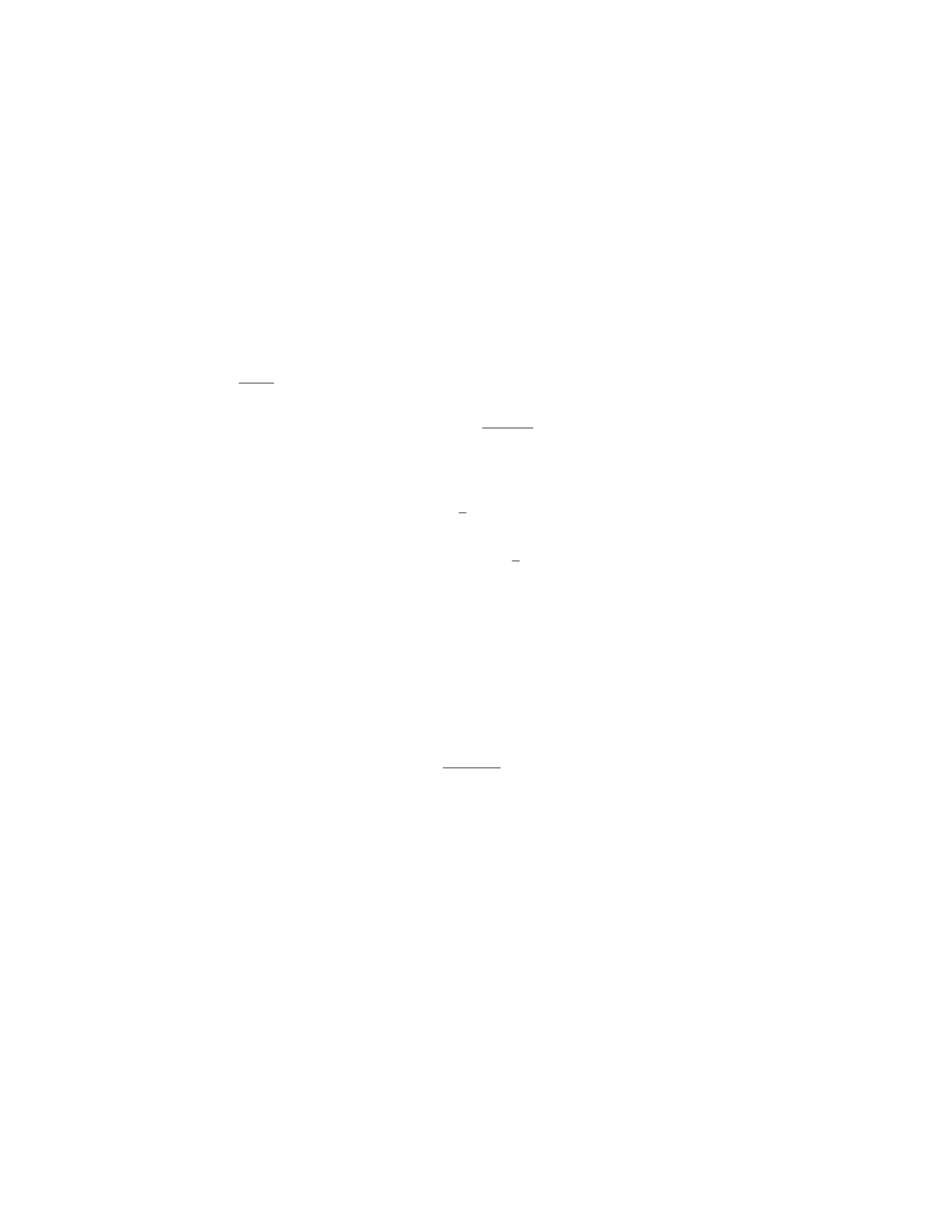
Let xrepresent the width of the rectangular garden and yrepresent the length
of the rectangular garden. Since one side of the garden is against the barn, only
three sides need to be fenced with a total length of 120 meters. Therefore, the
perimeter of the garden is given by the equation x+ 2y= 120.
To find the dimensions that will maximize the area, we need to express the
area of the garden in terms of one variable. The area Aof the garden is given
by A=xy.
Step 1: Express yin terms of xusing the perimeter equation. Substitute
y=120−x
2into the area equation:
A(x) = x120 −x
2
Step 2: Expand A(x) and simplify. Expand the area function:
A(x) = 1
2(120x−x2)
A(x) = 60x−1
2x2
Step 3: Find the critical points of A(x). To find the critical points, set the
derivative of A(x) equal to zero:
A′(x) = 60 −x= 0
x= 60
Step 4: Determine the dimensions that maximize the area. Since x= 60,
we can find yusing the perimeter equation:
y=120 −60
2= 30
Therefore, the dimensions of the garden that will maximize the area are width
60 meters and length 30 meters.
Question 11
Question
A rectangular field is 60 meters longer than it is wide. If the length of the field
is increased by 10 meters and the width is increased by 5 meters, the new area
is 1920 square meters. Find the dimensions of the original rectangular field.
9

Solution
Let the width of the original field be wmeters. Then, the length of the original
field is w+ 60 meters.
Step 1: Represent the area of the original field in terms of w. The area of
a rectangle is given by the formula A= length ×width. For the original field,
the area is given by:
Aoriginal = (w+ 60)w=w2+ 60w
Step 2: Represent the area of the new field in terms of w. After increasing
the length by 10 meters and the width by 5 meters, the new dimensions are
w+ 60 + 10 = w+ 70 meters for the length and w+ 5 meters for the width.
Therefore, the area of the new field is given by:
Anew = (w+ 70)(w+ 5) = w2+ 75w+ 350
Step 3: Equate the areas and solve for w. Since the new area is 1920 square
meters, we have the equation:
w2+ 75w+ 350 = 1920
w2+ 75w−1570 = 0
Step 4: Solve the quadratic equation to find the width of the original field.
Using the quadratic formula w=−b±√b2−4ac
2awith a= 1, b= 75, and c=
−1570, we get:
w=−75 ±p752−4(−1570)
2
w=−75 ±√5625 + 6280
2
w=−75 ±√11905
2
Step 5: Since negative width does not make sense in this context, the width
of the original field is:
w=−75 + √11905
2≈25.96 meters
Step 6: Calculate the length of the original field. Using the width w≈
25.96, the length of the original field is:
Length = w+ 60 ≈25.96 + 60 = 85.96 meters
Step 7: The dimensions of the original rectangular field are approximately
25.96 meters by 85.96 meters.
10

Question 12
Question
A person standing on a bridge 100 meters above the ground sees a boat floating
directly underneath. The person drops a stone from the bridge just as the boat
passes below. The stone hits the water 5 seconds later. Find the speed of the
boat.
Solution
Let’s denote the speed of the boat as vm/s.
Step 1: Determine the time taken for the stone to hit the water. The
distance the stone falls is equal to the height of the bridge, which is 100 meters.
Using the formula for distance fallen under gravity s=1
2gt2, where sis the
distance fallen, gis the acceleration due to gravity (approximately 9.8 m/s2),
and tis the time taken, we have:
100 = 1
2×9.8×t2
Solving for tgives us t=q200
9.8≈4.52 seconds.
Step 2: Find the distance covered by the boat during the time it took the
stone to fall. Given the time taken for the stone to hit the water is 5 seconds,
the boat would have traveled a distance of 5vmeters during this time.
Step 3: Set up an equation using the relative positions of the boat and
the stone. Since the boat was directly below the person when the stone was
dropped, the boat’s distance traveled in 5 seconds would be the same as the
distance the stone fell. Hence, we have the equation: 5v= 100
Step 4: Solve the equation to find the speed of the boat. From the equation
5v= 100, we can solve for v:
v=100
5= 20 m/s
Therefore, the speed of the boat is 20 m/s.
Question 13
Question
A rectangular garden is to be constructed along a riverbank. If 480 meters of
fencing are available and the riverbank will serve as one side of the garden, what
dimensions will maximize the area of the garden?
11
Solution
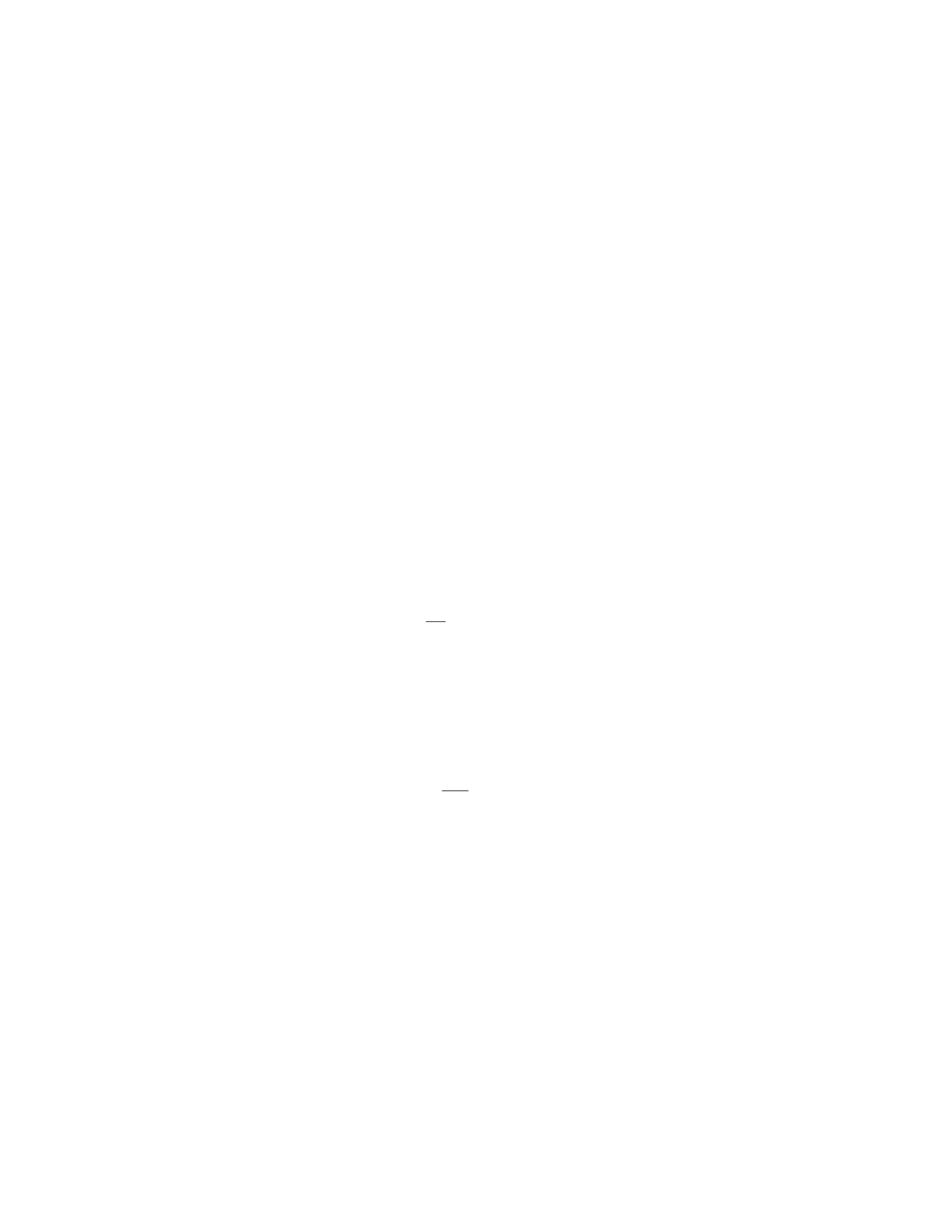
Let xbe the width of the garden perpendicular to the riverbank, and ybe the
length of the garden along the riverbank. The perimeter of the garden is given
as 480 meters, so we have the equation:
2x+y= 480
The area of the garden is given by A=xy. We need to find the dimensions
that will maximize this area.
Step 1: Solve the perimeter equation for yin terms of x.
2x+y= 480
y= 480 −2x
Step 2: Rewrite the area equation in terms of xonly.
A=x(480 −2x)
A= 480x−2x2
Step 3: Find the critical points of the area function by taking the derivative
with respect to xand setting it equal to zero.
dA
dx = 480 −4x
0 = 480 −4x
4x= 480
x= 120
Step 4: Determine if this critical point gives a maximum area. To do this,
we can use the second derivative test.
d2A
dx2=−4
Since the second derivative is negative, the critical point at x= 120 gives a
maximum area.
Step 5: Find the dimensions that maximize the area. Substitute x= 120
back into the equation y= 480 −2x.
y= 480 −2(120) = 240
So, the dimensions that maximize the area of the garden are 120 meters by
240 meters.
12

Question 14
Question
A rectangular garden is to be created using a wall as one side and a hedge for
the other three sides. The area of the garden is 120 square meters. If the length
of the garden is xmeters and the cost of the hedge is 3 dollars per meter, express
the cost of the hedge as a function of x.
Solution
Let the length of the garden be xmeters and the width be ymeters. Since the
area of the garden is given by xy = 120, we can express yin terms of x.
Step 1: Express the width yin terms of the length x. Given that xy = 120,
solve for y:
y=120
x
Step 2: Determine the perimeter of the garden. The perimeter of the
rectangular garden is given by P= 2(x+y+x) = 2(2x+120
x) = 4x+240
x.
Step 3: Express the cost of the hedge as a function of the length x. Since
the cost of the hedge is 3 dollars per meter, the cost function C(x) is given by
C(x) = 3 ×perimeter = 3(4x+240
x).
Therefore, the cost of the hedge as a function of the length xis C(x) =
12x+ 720/x.
Question 15
Question
A rectangular garden is to be constructed against the wall of a house. The
owner has 60 meters of fencing material to enclose three sides of the garden,
with the house acting as the fourth side. If the length of the garden is 3 times
its width, what should the dimensions of the garden be to maximize the area?
Solution
Let’s denote the width of the garden as wmeters. Since the length of the garden
is 3 times its width, the length can be represented as 3wmeters. We are looking
to maximize the area of the rectangular garden.
Step 1: Express the total length of fencing in terms of the width w. The
total length of fencing is the sum of the lengths of the three sides, two sides of
length weach and one side of length 3w. This can be expressed as:
2w+ 3w= 60
Step 2: Solve for the width w. Combining like terms, we get:
5w= 60
13

w=60
5
w= 12
Step 3: Find the dimensions and area of the garden. Since the length is 3
times the width, the length is:
3w= 3(12) = 36 meters
Therefore, the dimensions of the garden should be 12 meters by 36 meters to
maximize the area.
Step 4: Calculate the maximum area. The area Aof the rectangle can be
calculated as:
A= width ×length
Substitute the values of width and length:
A= 12 ×36
A= 432 square meters
Thus, the maximum area of the rectangular garden is 432 square meters
when the dimensions are 12 meters by 36 meters.
Question 16
Question
A rectangular garden has a fixed perimeter of 60 meters. If the length of the
garden is 6 more than its width, find the dimensions of the garden that maximize
its area.
Solution
Step 1: Let wbe the width of the garden. Since the length is 6 more than the
width, the length can be represented as w+ 6.
Step 2: The perimeter of the garden is given by 2w+ 2(w+ 6) = 60, which
simplifies to 4w+ 12 = 60. Solving for w, we find w= 12.
Step 3: Substituting w= 12 back into the expression for the length, we can
find the length: w+ 6 = 12 + 6 = 18.
Step 4: The area of the garden can be found by multiplying the width and
length, A=w×(w+ 6) = 12 ×18 = 216 square meters.
Step 5: To find the dimensions that maximize the area, we take the derivative
of the area function with respect to wand set it equal to 0.
Step 6: The derivative of the area function, A= 12w+ 6w, is A′= 12 + 6 =
18.
Step 7: Setting A′= 18 equal to 0 and solving for wgives us w= 0. However,
a width of 0 is not feasible in this context.
14

Step 8: Since the area of a rectangle is maximized when its width is half its
perimeter, and the width is 12 meters, the dimensions that maximize the area
are 12 meters by 18 meters.
Question 17
Question
A rectangular garden has a fixed perimeter of 60 meters. If the length of the
garden is 5 meters longer than the width, what dimensions should the garden
have to maximize the area it encloses?
Solution
Let xbe the width of the garden. Since the length is 5 meters longer than the
width, the length can be represented as x+ 5.
Step 1: Write an equation for the perimeter of the garden in terms of x. The
perimeter of a rectangle is given by the formula 2(length) + 2(width). Since the
length is x+ 5 and the width is x, the perimeter can be expressed as:
2(x+ 5) + 2x= 60
Step 2: Simplify the equation and solve for x.
2x+ 10 + 2x= 60
4x+ 10 = 60
4x= 50
x= 12.5
Step 3: Calculate the length. Since the length is x+ 5, the length of the
garden is 12.5 + 5 = 17.5 meters.
Step 4: Calculate the area of the garden. The area of a rectangle is given
by the formula length ×width. In this case, the area is:
12.5×17.5 = 218.75 m2
Therefore, to maximize the area the garden encloses, the dimensions should
be 12.5 meters by 17.5 meters.
Question 18
Question
A rectangular garden is three times as long as it is wide. The garden is to be
expanded so that each side is increased by 5 meters. If the area of the new
garden is 189 square meters more than the original garden, find the dimensions
of the original garden.
15
Solution
Let wbe the original width of the garden and 3wbe the original length of the
garden.
Step 1: Express the areas of the original and new gardens in terms of the
dimensions.
The area of the original garden is A=w×3w= 3w2square meters.
The expanded garden will have dimensions (w+ 5) and (3w+ 5), so its area
will be (w+ 5)(3w+ 5) square meters.
Step 2: Write an equation based on the given information.
The area of the new garden is 189 square meters more than the original
garden, so we have the equation:
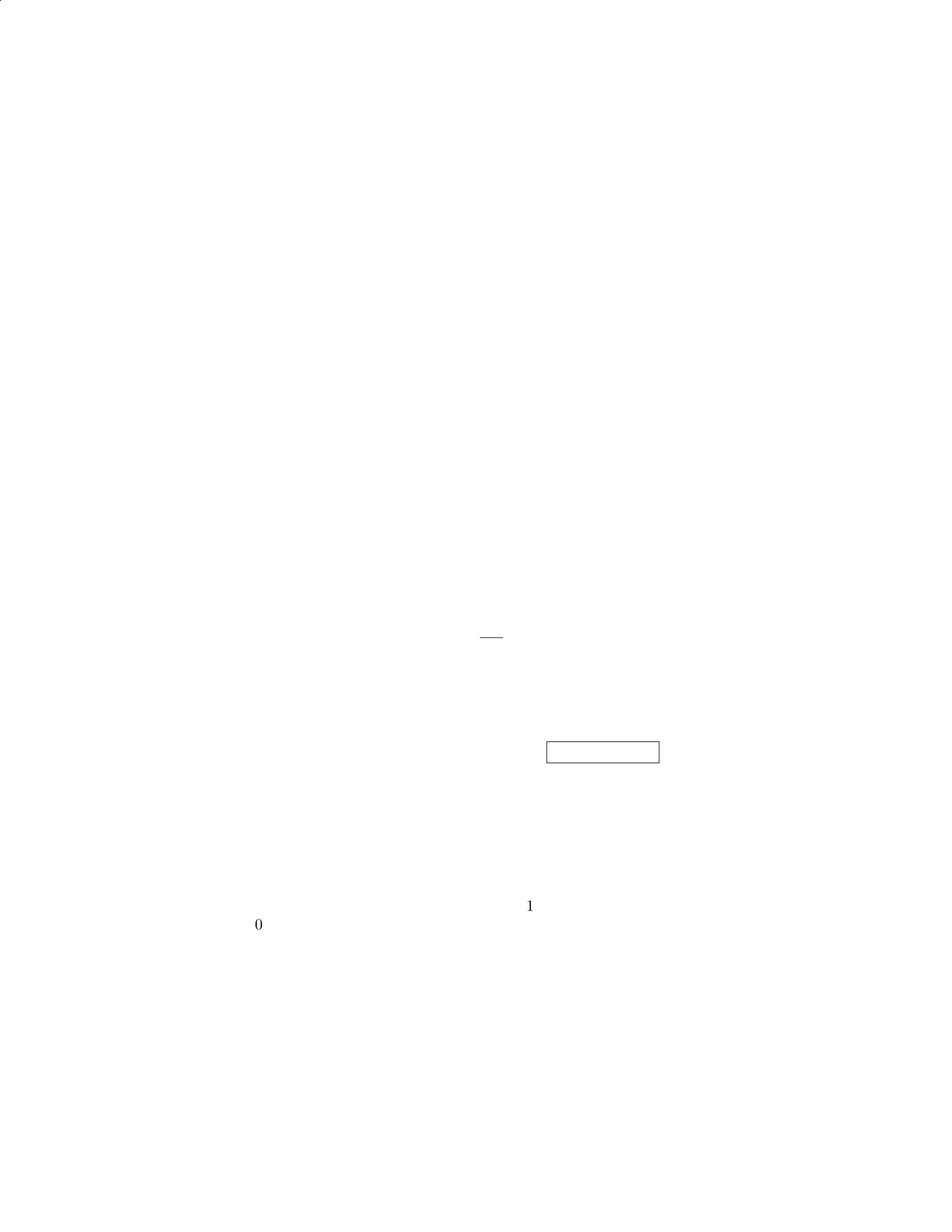
(w+ 5)(3w+ 5) = 3w2+ 189
Step 3: Solve the equation.
Expanding the left side of the equation gives:
3w2+ 5w+ 15w+ 25 = 3w2+ 189
3w2+ 20w+ 25 = 3w2+ 189
20w+ 25 = 189
20w= 164
w=164
20
w= 8.2
Step 4: Find the dimensions of the original garden.
Since the original length is three times the width, the original length is
3×8.2 = 24.6 meters.
Therefore, the original garden has dimensions 8.2 m ×24.6 m .
Question 19
Question
A rectangular garden is to be created with a fixed area of 1000 square meters.
One side of the garden will be bounded by a building, so only three sides need
to be enclosed by fencing. If the fencing costs
$
10 per meter for the two lengths
and
$
20 per meter for the width, find the dimensions of the garden that will
minimize the cost of the fencing.
16

Solution
Let xbe the length of the building side, ybe the width of the garden, and A
be the area of the garden.
Step 1: Write the equations for the area and cost of the fencing. The area
of the garden is given by A=xy = 1000 square meters. The cost Cof the
fencing is given by C= 10(2x) + 20y= 20x+ 20y.
Step 2: Express the width yin terms of the length xusing the area con-
straint. From the area constraint xy = 1000, we have y=1000
x.
Step 3: Rewrite the cost equation in terms of one variable using the width
expression. Substitute the width expression into the cost equation to get C=
20x+ 20 1000
x.
Step 4: Find the critical points of the cost function. To find the critical
points, we differentiate the cost function with respect to xand set it to zero.
dC
dx = 20 −20000
x2= 0
20x2−20000 = 0
x2= 1000
x=±√1000 = ±10√10
Step 5: Determine the values of xthat minimize the cost. Since the length
must be positive, we take x= 10√10. Calculate the corresponding width using
y=1000
x:
y=1000
10√10 = 10√10
Step 6: State the dimensions that minimize the cost. Therefore, the dimen-
sions of the garden that will minimize the cost of the fencing are length 10√10
meters and width 10√10 meters.
Question 20
Question
A rectangular garden is to be enclosed with a fence on three sides and a straight
stone wall on the fourth side. If the total length of the fence used is 40 meters,
find the dimensions of the garden that maximize the enclosed area.
Solution
Step 1: Let’s denote the length of the garden as xmeters and the width of the
garden as ymeters.
Step 2: The total length of the fence used is equal to the perimeter of the
garden, which is given by 40 = 2x+y.
17

Step 3: To maximize the enclosed area, we need to express the area of the
garden in terms of one variable. The area Aof the garden is given by A=xy.
Step 4: Express yin terms of xfrom the perimeter equation: y= 40 −2x.
Step 5: Substitute y= 40 −2xinto the area equation to get A=x(40 −2x).
Step 6: Simplify the expression: A= 40x−2x2.
Step 7: To find the dimensions that maximize the area, we need to find the
critical points of the area function. We take the derivative of Awith respect to
x:dA
dx = 40 −4x.
Step 8: Set the derivative equal to zero and solve for x: 40−4x= 0 ⇒x= 10.
Step 9: Check that this critical point is a maximum by using the second
derivative test. The second derivative of Ais d2A
dx2=−4 which is negative,
indicating a maximum.
Step 10: Calculate the corresponding value of y:y= 40 −2(10) = 20.
Step 11: Therefore, the dimensions of the garden that maximize the enclosed
area are length x= 10 meters and width y= 20 meters.
Question 21
Question
A rectangular garden is to be enclosed with a fence on three sides and a wall on
the fourth side. If the length of the garden is xmeters, and the total area en-
closed is 300 square meters, find the dimensions of the garden that will minimize
the amount of fencing used.
Solution
Let the width of the garden be ymeters. Since the total area enclosed is 300
square meters, we have the equation:
x∗y= 300
We want to minimize the amount of fencing used, which consists of three
sides (the length x, the width y, and the width again). Thus, the total amount
of fencing is given by the function:
F(x, y) = x+ 2y
To minimize F(x, y), we need to express Fin terms of a single variable.
Using the area equation, we can write the width yin terms of x:
y=300
x
Substitute this expression for yin the function F(x, y) to get F(x):
F(x) = x+ 2 ∗300
x
18

To minimize F(x), we find its critical points by setting its derivative to zero:
F′(x)=1−600
x2= 0
x2= 600
x=√600 = 10√6 m
To verify this critical point corresponds to a minimum, we can use the second
derivative test:
F′′(x) = 1200
x3
Since F′′(x)>0, the critical point x= 10√6 corresponds to a minimum for the
function F(x).
Thus, the dimensions of the garden that minimize the amount of fencing
used are x= 10√6 meters (length) and y=300
x=300
10√6= 5√6 meters (width).
Question 22
Question
A rectangular garden is to be created using a brick wall on one side and a hedge
on the remaining three sides. If the area of the garden is 200 square meters and
the cost of the brick wall is
$
30 per meter while the cost of the hedge is
$
10 per
meter, find the dimensions of the garden that minimize the cost of enclosing it.
Solution
Let the length of the garden be xmeters and the width be ymeters.
Step 1: Write down the equations representing the information given.
The area of the garden is 200 square meters:
xy = 200
The cost of the brick wall is
$
30 per meter and the cost of the hedge is
$
10
per meter. The cost function C(x, y) for enclosing the garden is:
C(x, y) = 30x+ 10(2x+ 2y) = 30x+ 20x+ 20y= 50x+ 20y
Step 2: Express the cost function in terms of a single variable using the
area constraint.
From the area constraint xy = 200, we can express yin terms of x:y=200
x.
Substitute this into the cost function:
C(x) = 50x+ 20 200
x= 50x+4000
x
19

Step 3: Find the critical points by differentiating C(x) with respect to x
and setting it equal to zero:
dC
dx = 50 −4000
x2= 0
50 = 4000
x2
x2=4000
50
x2= 80
x=√80 = 4√5
Step 4: Determine the corresponding yvalues using the area constraint:
y=200
x=200
4√5= 50 ·1
√5= 10√5
Step 5: Calculate the minimum cost:
C(4√5) = 50(4√5) + 20(10√5) = 200√5 + 200√5 = 400√5≈894.43
Therefore, the dimensions of the garden that minimize the cost of enclosing
it are length 4√5 meters and width 10√5 meters, with a minimum cost of
approximately
$
894.43.
Question 23
Question
A rectangular garden has one side 5 meters longer than the other. If the area
of the garden is 156 square meters, find the dimensions of the garden.
Solution
Let xbe the length of the shorter side of the garden in meters. Therefore, the
length of the longer side can be expressed as x+ 5.
Given that the area of the garden is 156 square meters, we have the equation:
x(x+ 5) = 156
We now solve this quadratic equation to find the dimensions of the garden.
Step 1: Expand the left side of the equation.
x2+ 5x= 156
Step 2: Rearrange the equation into standard form.
x2+ 5x−156 = 0
20

Step 3: Factor the quadratic equation.
(x+ 13)(x−8) = 0
Step 4: Solve for xby setting each factor to zero.
x+ 13 = 0 or x−8=0
Step 5: Solve for xin each equation. For x+ 13 = 0:
x=−13
Since the length of a side cannot be negative, we disregard this solution.
For x−8 = 0:
x= 8
Step 6: Calculate the length of the longer side.
Longer side = x+ 5 = 8 + 5 = 13
Step 7: Final Answer: The dimensions of the garden are 8 meters by 13
meters.
Question 24
Question
A rectangular garden is to be created using 100 meters of fencing. If one side of
the garden is along a straight river, find the dimensions of the garden that will
give the largest possible area.
Solution
Step 1: Let xbe the length of the garden perpendicular to the river, and let y
be the width of the garden along the river. We want to maximize the area of
the garden, which is given by A=x·y.
Step 2: The perimeter of the garden is given by 100 = 2x+y, since we have
two sides of length xand one side of length y(along the river).
Step 3: Solving the perimeter equation for y, we get y= 100 −2x.
Step 4: Substitute the expression for yinto the area equation: A=x(100 −
2x) = 100x−2x2.
Step 5: To find the maximum area, we need to find the critical points of A
by taking the derivative of Awith respect to xand setting it equal to zero:
dA
dx = 100 −4x
Setting this equal to zero and solving for x, we get x= 25.
21

Step 6: To confirm that this point gives a maximum area, we will use the
second derivative test. d2A
dx2=−4
Since the second derivative is negative, x= 25 corresponds to a local maximum.
Step 7: Find the corresponding yvalue using y= 100 −2x:
y= 100 −2(25) = 50
Step 8: Therefore, the dimensions of the garden that will give the largest
possible area are 25 meters by 50 meters.
Question 25
Question
A rectangular garden is to be created with one side along a river and the other
sides enclosed with a fence. If only 200 meters of fencing is available and the
area of the garden needs to be 1500 square meters, find the dimensions of the
garden that maximize the area.
Solution
Let the length of the garden along the river be xmeters and the width be y
meters.
Step 1: Write the equations for the perimeter and the area of the garden.
The total length of fencing available is twice the length of the garden and the
width, with the length along the river requiring no fencing. Therefore, we can
write:
2y+x= 200
The area of the garden is given by:
xy = 1500
Step 2: Rewrite the perimeter equation in terms of y. Solve the perimeter
equation for xto get:
x= 200 −2y
Step 3: Substitute xfrom the previous step into the formula for the area.
Substitute x= 200 −2yinto the area equation to get:
(200 −2y)y= 1500
200y−2y2= 1500
Step 4: Rearrange the equation to form a quadratic equation. Rearrange
the equation to form a quadratic equation in standard form:
2y2−200y+ 1500 = 0
22
Step 5: Solve the quadratic equation to find the width y. Using the
quadratic formula, we find:
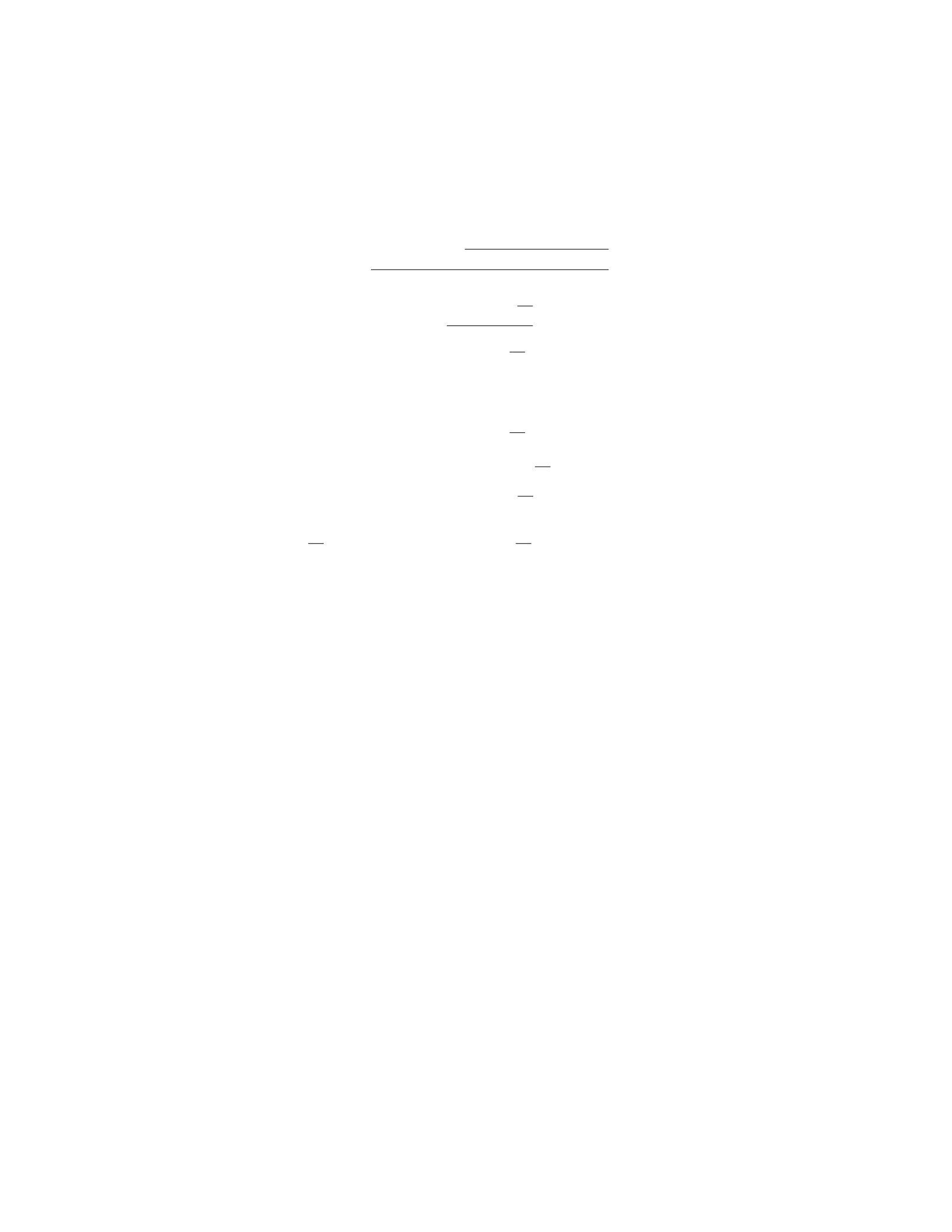
y=−(−200) ±p(−200)2−4(2)(1500)
2(2)
y=200 ±20√10
4
y= 50 ±5√10
Step 6: Determine the dimensions that maximize the area. Since yrepre-
sents the width of the garden, we choose the positive value for y:
y= 50 + 5√10
x= 200 −2(50 + 5√10)
x= 100 −10√10
Therefore, the dimensions that maximize the area of the garden are: Length
x= 100 −10√10 meters, Width y= 50 + 5√10 meters.
Question 26
Question
A rectangular garden is 20 meters long and 15 meters wide. A walkway of
uniform width is added around the garden, increasing the total area to 500
square meters. Find the width of the walkway.
Solution
Let xbe the width of the walkway.
Step 1: First, we find the total area of the original garden without the
walkway. This can be calculated as the product of the original length and
width:
Original Area = Length ×Width = 20 ×15 = 300 sq meters
Step 2: We can express the dimensions of the entire garden, including the
walkway, in terms of x: Length: 20 + 2xmeters Width: 15 + 2xmeters
Step 3: The total area of the garden with the walkway is given as 500
square meters. We can set up an equation using the total area formula:
Total Area = Length ×Width
500 = (20 + 2x)(15 + 2x)
23

Step 4: Expand the expression on the right side and simplify the quadratic
equation:
500 = 300 + 70x+ 40x+ 4x2
4x2+ 110x−200 = 0
Step 5: Solve the quadratic equation using the quadratic formula:
x=−110 ±p1102−4×4×(−200)
2×4
x=−110 ±√12100 + 3200
8
x=−110 ±√15300
8
x=−110 ±90
8
Step 6: The width of the walkway must be positive, so we take the positive
solution:
x=−110 + 90
8=−20
8=−2.5
Step 7: Since the width of the walkway cannot be negative, we must discard
the negative solution. Hence, the width of the walkway is 2.5 meters.
Question 27
Question
A rectangular garden is 30 meters long and 20 meters wide. The garden is
expanded by planting a uniform border of flowers around it, increasing the area
of the garden by 50
Solution
Let the width of the border be xmeters. The new dimensions of the garden
will be (30 + 2x) meters by (20 + 2x) meters.
Step 1: The original area of the garden is 30 ×20 = 600 square meters.
Step 2: The new area of the garden after adding the border is 600 +
0.5(600) = 900 square meters.
Step 3: The new area of the garden can also be expressed as the product
of its new dimensions:
(30 + 2x)(20 + 2x) = 900
Step 4: Expand the left side of the equation:
600 + 100x+ 60x+ 4x2= 900
24
Step 5: Simplify the equation:
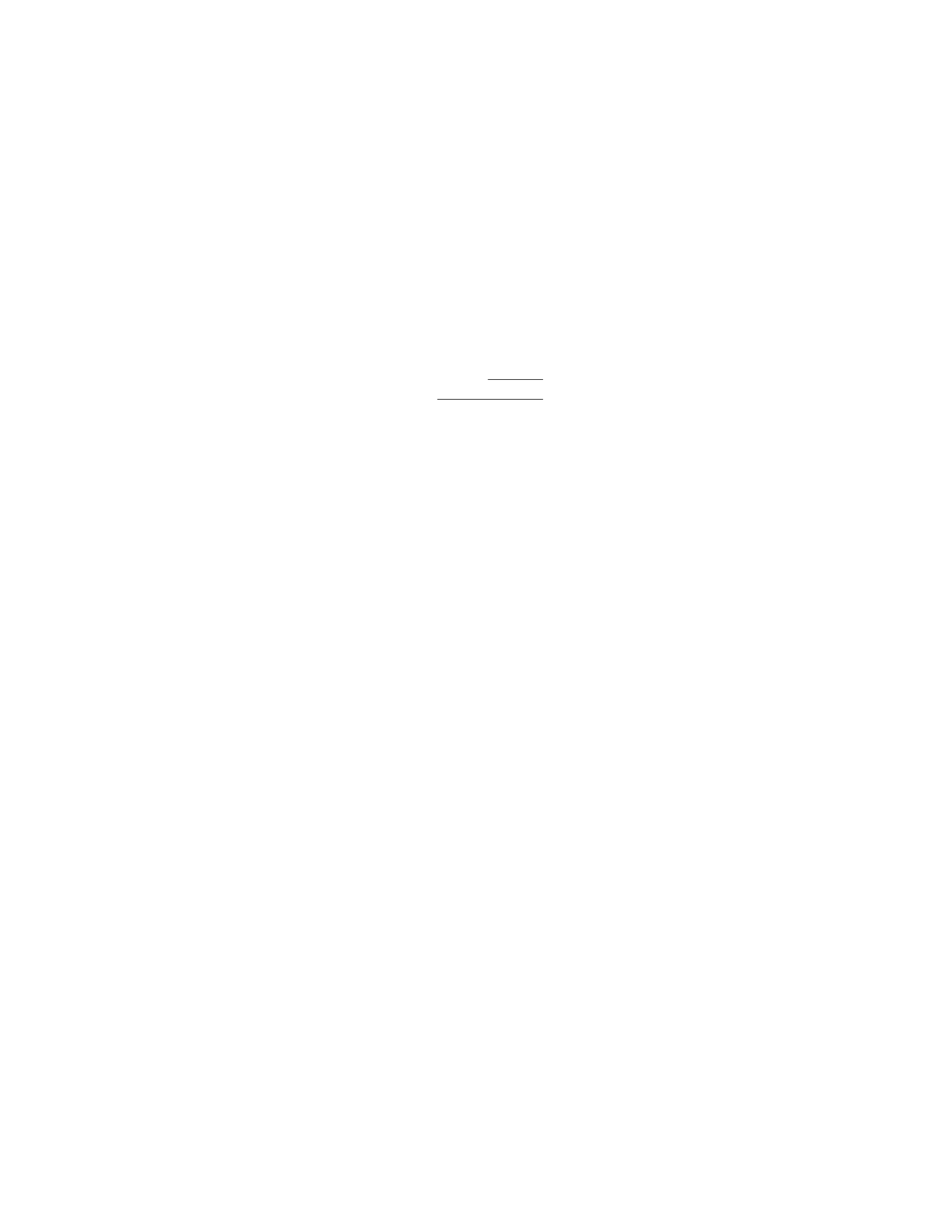
4x2+ 160x−300 = 0
Step 6: To solve the quadratic equation 4x2+ 160x−300 = 0, we can
simplify it by dividing each term by 4:
x2+ 40x−75 = 0
Step 7: Use the quadratic formula to solve for x:
x=−b±√b2−4ac
2a
where a= 1, b= 40, and c=−75.
Step 8: Substitute a,b, and cinto the formula and simplify to find the
solutions for x. The width of the border should be a positive number, so the
negative solution can be discarded.
Step 9: Calculate the width of the border to get the final answer.
Question 28
Question
A rectangular garden is 10 meters longer than it is wide. If the area of the
garden is 192 square meters, find the dimensions of the garden.
Solution
Let xbe the width of the garden (in meters). Since the garden is 10 meters
longer than it is wide, the length of the garden can be expressed as x+ 10.
We are given that the area of the garden is 192 square meters. The area of
a rectangle is given by the formula:
Area = length ×width
Substituting in the expressions for length and width:
x(x+ 10) = 192
Now, we will solve the quadratic equation to find the dimensions of the
garden.
Step 1: Expand the left side of the equation.
x2+ 10x= 192
Step 2: Rearrange the equation into standard form.
x2+ 10x−192 = 0
25

Step 3: Factor the quadratic equation.
(x−12)(x+ 16) = 0
Setting each factor to zero:
x−12 = 0 =⇒x= 12
x+ 16 = 0 =⇒x=−16
Since the width cannot be negative, the width of the garden is 12 meters.
Step 4: Find the length of the garden.
Length = x+ 10 = 12 + 10 = 22 meters.
Step 5: Write the final answer.
The dimensions of the garden are 12 meters by 22 meters.
Question 29
Question
A rectangular garden is to be constructed using a wall as one side and a hedge
as the other three sides. The length of the wall is 20 meters. The area of the
garden is to be 240 square meters. Find the dimensions of the garden that will
minimize the amount of hedge used.
Solution
Let xbe the length of the garden perpendicular to the wall, and let ybe the
width of the garden parallel to the wall. The area of the garden can be expressed
as A=xy = 240.
Step 1: Express the amount of hedge used in terms of xand y. The amount
of hedge used will be the sum of the lengths of the three sides that need hedge:
Hedge used = x+ 2y
Step 2: Express the amount of hedge used in terms of one variable. Since
A= 240, we can express yin terms of x:
y=240
x
Substitute yin the expression for the amount of hedge used:
Hedge used = x+ 2 240
x
Simplify the expression:
Hedge used = x+480
x
26

Step 3: Find the minimum amount of hedge used. To find the minimum
amount of hedge used, we can find the critical points of the function by finding
where the derivative is equal to zero:
d
dx(Hedge used) = 1 −480
x2= 0
Solve for x:
x2= 480
x=√480 = 4√30
Step 4: Determine the corresponding value of y. Using the relationship
y=240
x, we can find:
y=240
4√30 = 60√30
Step 5: Verify the minimum. To verify that this point is a minimum, we can
use the second derivative test. The second derivative of the function is positive,
confirming that the point is a minimum.
Step 6: State the dimensions of the garden that minimize the amount of
hedge used. Therefore, the dimensions of the garden that minimize the amount
of hedge used are 4√30 m ×60√30 m.
Question 30
Question
A farmer wants to build a rectangular enclosure for his animals using a long
barn as one side of the enclosure. If he has 100 meters of fencing material and
wants to maximize the area of the enclosure, what should the dimensions of the
enclosure be?
Solution
Let the length of the barn be xmeters, and the width of the enclosure be y
meters. Since the barn is used as one side, there are only three sides that need
fencing. Thus, the total amount of fencing material used is x+ 2y= 100.
To maximize the area of the enclosure, we need to maximize A=xy. From
the information given, we can express xin terms of yas x= 100 −2y. Substi-
tuting into the area formula gives A= (100 −2y)y= 100y−2y2.
To maximize the area, we need to find the critical points by taking the
derivative of Awith respect to yand setting it equal to zero.
dA
dy = 100 −4y= 0
4y= 100
27

y= 25
To ensure that this value yields a maximum area, we need to check the
endpoints of the possible range for y: 0 ≤y≤50. At y= 0, x= 100 and A= 0,
and at y= 50, x= 0 and A= 0. So, the maximum area occurs when y= 25.
Therefore, the dimensions of the enclosure that maximize the area are 25
meters by 50 meters.
Question 31
Question
A rectangular garden has a fixed perimeter of 40 meters. The area of the garden
is to be maximized. Let xand yrepresent the dimensions of the garden. Write
an equation that represents the area of the garden in terms of xand y, and then
use quadratic equations to find the dimensions that maximize the area.
Solution
Step 1: Let’s write an equation for the area of the garden in terms of xand
y. The perimeter of the rectangular garden is given by 2x+ 2y= 40, which
simplifies to x+y= 20. Solving for y, we get y= 20 −x. The area of the
rectangular garden is given by A=xy. Substituting y= 20 −xinto this
equation gives A=x(20 −x).
Step 2: Expand the equation for the area. A= 20x−x2
Step 3: To find the dimensions that maximize the area, we need to find the
critical points of A. The critical points occur where the derivative of Ais zero.
dA
dx = 20 −2x
Setting dA
dx = 0 and solving for x: 20 −2x= 0
2x= 20
x= 10
Step 4: To determine if x= 10 corresponds to a maximum or minimum,
we will use the second derivative test. d2A
dx2=−2 Since the second derivative is
negative, x= 10 corresponds to a maximum.
Step 5: Substitute x= 10 into y= 20 −xto find the corresponding value of
y.y= 20 −10
y= 10
Therefore, the dimensions that maximize the area of the garden are x= 10
meters and y= 10 meters.
Question 32
Question
A rectangular garden with a length of 20 meters and a width of 10 meters is
going to be expanded by the same amount on all sides to form a new rectangular
28

garden with an area of 400 square meters. Find the width of the expanded
garden.
Solution
Let the amount by which the garden is expanded on all sides be xmeters. Then
the new length of the garden will be 20 + 2xmeters and the new width will be
10 + 2xmeters.
The area of the expanded garden is the product of the new length and the
new width, which is given to be 400 square meters. Therefore, we have the
equation:
(20 + 2x)(10 + 2x) = 400
Expanding the left side gives:
200 + 40x+ 40x+ 4x2= 400
4x2+ 80x+ 200 = 400
4x2+ 80x−200 = 0
Now we need to solve this quadratic equation. We can simplify it by dividing
through by 4:
x2+ 20x−50 = 0
Next, we solve for xusing the quadratic formula x=−b±√b2−4ac
2a.
Step 1: Identify a,b, and cin the equation ax2+bx +c= 0.
Here, a= 1, b= 20, and c=−50.
Step 2: Substitute a= 1, b= 20, and c=−50 into the quadratic formula.
x=−20 ±p202−4∗1∗(−50)
2∗1
x=−20 ±√400 + 200
2
x=−20 ±√600
2
x=−20 ±10√6
2
Therefore, the width of the expanded garden is 10 + x= 10 + −20±10√6
2.
Thus, the width could be 5 −5√6 or 15 + 5√6 meters.
29

Question 33
Question
A rectangular photograph is to be enlarged. The length of the photograph is to
be increased by 20
Solution
Let the original length of the photograph be Linches and the original width be
Winches.
Step 1: Calculate the area of the original photograph. The area of the
original photograph is given by Aoriginal =L×W.
Step 2: Calculate the new dimensions of the photograph. After the en-
largement, the new length will be 1.2L(increased by 20
Step 3: Write an equation for the area of the new photograph. The area of
the new photograph is given by Anew = 1.2L×0.8W= 0.96LW .
Step 4: Write down the equation given in the problem. We are given that
the area of the new photograph is 144 square inches larger than the original
photograph: 0.96LW =LW + 144.
Step 5: Solve the equation to find the dimensions of the original photograph.
Subtract LW from both sides of the equation: 0.96LW −LW = 144
0.04LW = 144
LW =144
0.04
LW = 3600
Thus, the area of the original photograph is 3600 square inches.
Step 6: Find the original dimensions. Since Aoriginal =L×W= 3600, and
we know from Step 1 that Aoriginal =LW , we have: LW = 3600.
This means the dimensions of the original photograph are 60 inches by 60
inches.
Question 34
Question
A rectangular garden is to be created along the side of a house. The area of the
garden must be 300 square meters, and one of the sides will be against the wall of
the house. If fencing costs 10permeter, whatdimensionsshouldthegardenhaveinordertominimizethecostofthef encing?
Solution
Let xbe the width of the garden (perpendicular to the house) and ybe the
length of the garden (parallel to the house). We are given that the area of the
garden is 300 square meters, so we have the equation xy = 300.
30
The cost of fencing is given by C= 10(2x+y), as there are two sides of
length xand one side of length y. We want to minimize this cost, i.e., find the
minimum of C.
Step 1: Express the cost function in terms of a single variable. From the
area equation xy = 300, we can express yin terms of xas y=300
x. Substitute
this into the cost function:
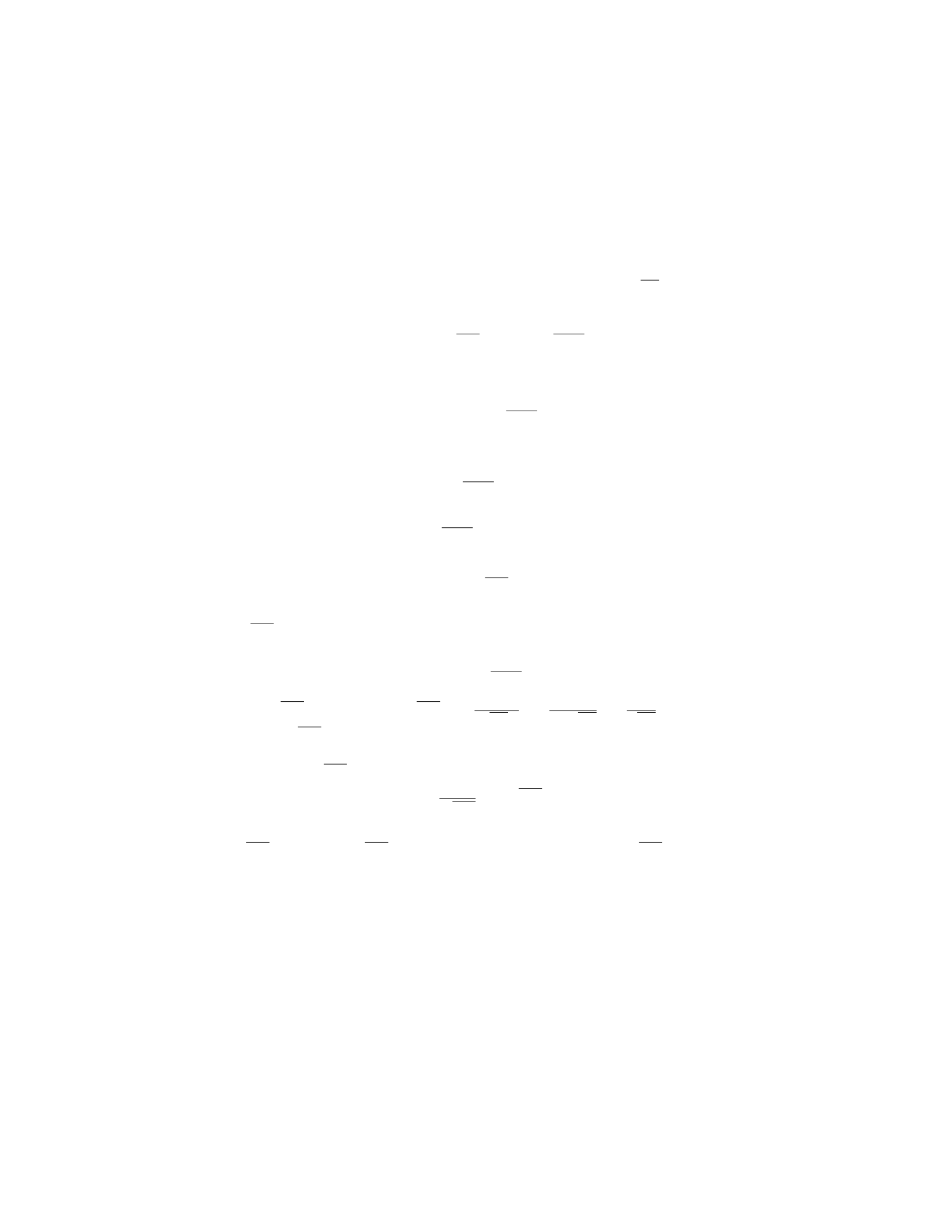
C= 10(2x+300
x) = 20x+3000
x
Step 2: Find the critical points by taking the derivative of Cwith respect
to x.
C′(x) = 20 −3000
x2
Set C′(x) = 0 to find critical points:
20 −3000
x2= 0
3000
x2= 20
x2= 150
x=√150
Step 3: Determine if the critical point is a minimum. To determine if
x=√150 is a minimum, we need to check the second derivative.
C′′(x) = 6000
x3
At x=√150, we have C′′(√150) = 6000
(√150)3=6000
150√150 =40
√150 >0, which
means x=√150 is a minimum.
Step 4: Calculate the corresponding length and minimum cost. From xy =
300, when x=√150:
y=300
√150 = 2√150
Therefore, the dimensions of the garden that minimize the cost of fencing
are √150 meters by 2√150 meters, with a minimum cost of 20√150 (or approx-
imately 120.0)m.
Question 35
Question
A rectangular garden is to be created along the side of a house. The area of
the garden must be 200 square meters. If the house wall will serve as one of the
sides of the garden, find the dimensions of the garden that would require the
least amount of fencing.
31

Question 2
Question
A rectangular garden is to be created using 120 feet of fencing. If one side of
the garden is along a river and does not need fencing, find the dimensions of
the garden that will maximize the area.
Solution
Step 1: Let’s denote the length of the two parallel sides of the rectangular
garden as xand the width of the garden as y. Step 2: Since one side of the
garden is along the river and does not need fencing, the total amount of fencing
used is x+ 2y= 120. Step 3: Solve the equation x+ 2y= 120 for xto get
x= 120 −2y. Step 4: The area of the garden, A, is given by A=xy. Step 5:
Substitute x= 120 −2yinto the area formula to get A= (120 −2y)y. Step 6:
Expand the expression for the area to get A= 120y−2y2. Step 7: To find the
dimensions that maximize the area, we need to find the critical points. Take the
derivative of Awith respect to yand set it equal to 0. Step 8: dA
dy = 120 −4y.
Step 9: Set dA
dy = 0 and solve for y: 120 −4y= 0 ⇒y= 30. Step 10: Find the
corresponding value of x:x= 120 −2(30) = 60. Step 11: So, the dimensions of
the garden that maximize the area are 60 feet by 30 feet.
Question 3
Question
A company produces and sells a certain product. The revenue Rgenerated
by selling xunits of the product can be modeled by the quadratic equation
R(x) = −2x2+ 50x. Find the number of units that must be sold to maximize
the revenue.
Solution
Step 1: To find the number of units that must be sold to maximize the revenue,
we need to find the vertex of the quadratic function R(x) = −2x2+ 50x.
Step 2: The x-coordinate of the vertex of a quadratic function in the form
ax2+bx +cis given by x=−b
2a.
Step 3: In this case, a=−2 and b= 50. So, the x-coordinate of the vertex
is x=−50
2(−2) =50
4= 12.5.
Step 4: Therefore, the number of units that must be sold to maximize the
revenue is 12.5 units. However, since we can’t sell a fraction of a unit, we need
to round to the nearest whole number.
Step 5: So, the company should sell 13 units of the product to maximize the
revenue.
2

Question 4
Question
A farmer plans to create a rectangular vegetable garden by adding length to one
side of his existing square garden. He needs 180 meters of fencing material to
enclose both gardens. If the length of the rectangular garden is twice the length
of the square garden, find the dimensions of both gardens.
Solution
Let xbe the length of one side of the square garden. Since the length of the
rectangular garden is twice the length of the square garden, the length of the
rectangular garden is 2x. Since the square garden has four equal sides, the total
length of fencing material used for the square garden is 4x. The total length
of fencing material used for the rectangular garden is 2x+ 2(2x) = 6x. Given
that the total length of fencing material used for both gardens is 180 meters,
we have the equation:
4x+ 6x= 180
10x= 180
x= 18
So, the length of one side of the square garden is 18 meters, and the length of
the rectangular garden is 2(18) = 36 meters.
Therefore, the dimensions of the square garden are 18 ×18 meters, and the
dimensions of the rectangular garden are 36 ×18 meters.
Question 5
Question
A rectangular garden is to be created along the side of a house. If 40 meters
of fencing are available, what dimensions should the garden have in order to
maximize the area?
Solution
Let xrepresent the width of the garden and yrepresent the length of the garden.
Step 1: Write the perimeter equation. The perimeter of the rectangular
garden is given by:
2x+y= 40
Step 2: Write the area equation. The area of the rectangular garden is
given by:
A=xy
3

Step 3: Express yin terms of x. From the perimeter equation, y= 40 −2x.
Substitute this into the area equation:
A=x(40 −2x) = 40x−2x2
Step 4: Find the critical points. To find the maximum area, we need to
find the critical point of the function. Take the derivative of the area function:
dA
dx = 40 −4x
Set this derivative equal to zero and solve for x:
40 −4x= 0
4x= 40
x= 10
Step 5: Determine the dimensions. Substitute x= 10 back into the perime-
ter equation to find y:
2(10) + y= 40
20 + y= 40
y= 20
Therefore, the dimensions that would maximize the area are 10 meters by
20 meters.
Question 6
Question
A rectangular garden is 12 meters longer than it is wide. If the area of the
garden is 180 square meters, find the dimensions of the garden.
Solution
Let wbe the width of the garden. Since the garden is 12 meters longer than it
is wide, the length of the garden is w+ 12.
We know that the area of a rectangle is given by the formula A= length ×
width. Given that the area of the garden is 180 square meters, we can set up
the following equation:
w(w+ 12) = 180
Step 1: Expand the left side of the equation.
w2+ 12w= 180
4
Step 2: Rearrange the quadratic equation into the standard form, w2+
12w−180 = 0.
Step 3: To solve the quadratic equation, we can either factor it or use
the quadratic formula. Let’s use the quadratic formula, which states that for
an equation in the form ax2+bx +c= 0, the solutions are given by x=
−b±√b2−4ac
2a.
In this case, a= 1, b= 12, and c=−180. Substituting into the quadratic
formula:
w=−12 ±p122−4(1)(−180)
2(1)
w=−12 ±√144 + 720
2
w=−12 ±√864
2
w=−12 ±24
2
The possible values for ware w1= 6 and w2=−30. Since the width cannot
be negative, we take w= 6.
Step 4: Find the length of the garden. The length of the garden is w+12 =
6 + 12 = 18 meters.
Step 5: State the dimensions of the garden. Therefore, the dimensions of
the garden are width 6 meters and length 18 meters.
Question 7
Question
A rectangular garden has a fixed perimeter of 40 meters. The length of the
garden is 6 meters longer than the width. Find the dimensions of the garden
that maximize the area.
Solution
Let’s denote the width of the garden as wmeters. Since the length is 6 meters
longer than the width, we can express the length in terms of was l=w+ 6.
Step 1: Write an equation based on the fixed perimeter of the garden. The
perimeter Pof a rectangle is given by 2×(length + width). Since the perimeter
is fixed at 40 meters, we have:
2(w+ (w+ 6)) = 40
Step 2: Find the value of w. Simplify the equation:
2w+ 2w+ 12 = 40
5
4w+ 12 = 40
4w= 28
w= 7
Step 3: Find the length of the garden. Using the value of w, we can find
the length:
l=w+ 6 = 7 + 6 = 13
Step 4: Calculate the area of the garden as a function of w. The area Aof
a rectangle is given by length ×width. Substituting w= 7 into the expression
for A, we have:
A(w) = 7 ×13 −91
Step 5: Determine the maximum area. To find the dimensions that maxi-
mize the area, we need to find the maximum of the quadratic function A(w).
The maximum occurs at the vertex of the parabola, which is given by w=
−b/(2a), where the quadratic function is in the form y=ax2+bx +c. In this
case, our quadratic function is A(w) = −w2+ 20w−91, so a=−1, b= 20.
w=−20
2(−1) = 10
Step 6: Find the maximum area. Now that we have the value of wthat
maximizes the area, we can find the corresponding length and calculate the
maximum area:
l= 10 + 6 = 16
Amax = 10 ×16 = 160
Therefore, the dimensions of the garden that maximize the area are 10 meters
by 16 meters, with a maximum area of 160 square meters.
Question 8
Question
A rectangular garden has a length that is 4 meters more than its width. The
area of the garden is 144 square meters. Find the dimensions of the garden.
Solution
Let’s denote the width of the rectangular garden as wmeters. Since the length
is 4 meters more than the width, we can express the length as w+ 4 meters.
Step 1: Write the equation for the area of the garden. The area of a rectangle
is given by the formula: Area = length ×width. Substitute the given values
into the formula:
144 = (w+ 4)w
6

Step 2: Simplify the equation. Expand the right side of the equation:
144 = w2+ 4w
Rearrange the equation into a quadratic equation form by setting it equal to
zero:
w2+ 4w−144 = 0
Step 3: Solve the quadratic equation. We can solve this quadratic equation
by factoring or using the quadratic formula. Let’s use the quadratic formula:
w=−b±√b2−4ac
2a
where a= 1, b= 4, and c=−144.
w=−4±p42−4(1)(−144)
2(1)
w=−4±√16 + 576
2
w=−4±√592
2
w=−4±24.33
2
Step 4: Determine the possible values for the width. Since the width cannot
be negative, we take the positive value:
w=−4 + 24.33
2=20.33
2= 10.17
Step 5: Calculate the length. The length of the rectangular garden is w+ 4
meters.
Length = 10.17 + 4 = 14.17
Therefore, the dimensions of the rectangular garden are width = 10.17 me-
ters and length = 14.17 meters.
Question 9
Question
A ball is thrown horizontally from the top of a building 40 m high with an initial
speed of 20 m/s. The ball lands on the ground tseconds later. Find the total
time the ball is in the air.
7

Solution
Let’s denote the total time the ball is in the air as Tseconds.
Step 1: Find the time it takes for the ball to reach the ground horizontally.
This can be done by using the fact that the ball was thrown horizontally. The
equation to find the time using the displaced distance xis given by:
x=vt
Where xis the horizontal distance, vis the initial horizontal velocity, and tis
the time taken. In this case, x= 40 m and v= 20 m/s. Therefore, we can
rearrange the formula to solve for t.
t=x
v=40
20 = 2 seconds
Step 2: Find the total time the ball is in the air. Since the ball was in
the air for 2 seconds horizontally, we need to consider the time it was also in
the air vertically. This can be found using the height of the building and the
acceleration due to gravity. The equation to find the time using the height his
given by:
h=1
2gt2
Where his the height, gis the acceleration due to gravity, and tis the total
time taken. In this case, h= 40 m and g= 9.8 m/s2. We will solve for t.
40 = 1
2×9.8×T2
T2=40 ×2
9.8
T2=80
9.8
T2≈8.1633
T≈√8.1633 ≈2.8596
Therefore, the total time the ball is in the air is approximately 2.8596 sec-
onds.
Question 10
Question
A rectangular garden is to be enclosed with 120 meters of fencing. If one side
of the garden is against the side of a barn and so doesn’t need fencing, find the
dimensions of the garden that will maximize the area.
8
Solution
Let xrepresent the width of the rectangular garden and yrepresent the length
of the rectangular garden. Since one side of the garden is against the barn, only
three sides need to be fenced with a total length of 120 meters. Therefore, the
perimeter of the garden is given by the equation x+ 2y= 120.
To find the dimensions that will maximize the area, we need to express the
area of the garden in terms of one variable. The area Aof the garden is given
by A=xy.
Step 1: Express yin terms of xusing the perimeter equation. Substitute
y=120−x
2into the area equation:
A(x) = x120 −x
2
Step 2: Expand A(x) and simplify. Expand the area function:
A(x) = 1
2(120x−x2)
A(x) = 60x−1
2x2
Step 3: Find the critical points of A(x). To find the critical points, set the
derivative of A(x) equal to zero:
A′(x) = 60 −x= 0
x= 60
Step 4: Determine the dimensions that maximize the area. Since x= 60,
we can find yusing the perimeter equation:
y=120 −60
2= 30
Therefore, the dimensions of the garden that will maximize the area are width
60 meters and length 30 meters.
Question 11
Question
A rectangular field is 60 meters longer than it is wide. If the length of the field
is increased by 10 meters and the width is increased by 5 meters, the new area
is 1920 square meters. Find the dimensions of the original rectangular field.
9

Solution
Let the width of the original field be wmeters. Then, the length of the original
field is w+ 60 meters.
Step 1: Represent the area of the original field in terms of w. The area of
a rectangle is given by the formula A= length ×width. For the original field,
the area is given by:
Aoriginal = (w+ 60)w=w2+ 60w
Step 2: Represent the area of the new field in terms of w. After increasing
the length by 10 meters and the width by 5 meters, the new dimensions are
w+ 60 + 10 = w+ 70 meters for the length and w+ 5 meters for the width.
Therefore, the area of the new field is given by:
Anew = (w+ 70)(w+ 5) = w2+ 75w+ 350
Step 3: Equate the areas and solve for w. Since the new area is 1920 square
meters, we have the equation:
w2+ 75w+ 350 = 1920
w2+ 75w−1570 = 0
Step 4: Solve the quadratic equation to find the width of the original field.
Using the quadratic formula w=−b±√b2−4ac
2awith a= 1, b= 75, and c=
−1570, we get:
w=−75 ±p752−4(−1570)
2
w=−75 ±√5625 + 6280
2
w=−75 ±√11905
2
Step 5: Since negative width does not make sense in this context, the width
of the original field is:
w=−75 + √11905
2≈25.96 meters
Step 6: Calculate the length of the original field. Using the width w≈
25.96, the length of the original field is:
Length = w+ 60 ≈25.96 + 60 = 85.96 meters
Step 7: The dimensions of the original rectangular field are approximately
25.96 meters by 85.96 meters.
10

Question 12
Question
A person standing on a bridge 100 meters above the ground sees a boat floating
directly underneath. The person drops a stone from the bridge just as the boat
passes below. The stone hits the water 5 seconds later. Find the speed of the
boat.
Solution
Let’s denote the speed of the boat as vm/s.
Step 1: Determine the time taken for the stone to hit the water. The
distance the stone falls is equal to the height of the bridge, which is 100 meters.
Using the formula for distance fallen under gravity s=1
2gt2, where sis the
distance fallen, gis the acceleration due to gravity (approximately 9.8 m/s2),
and tis the time taken, we have:
100 = 1
2×9.8×t2
Solving for tgives us t=q200
9.8≈4.52 seconds.
Step 2: Find the distance covered by the boat during the time it took the
stone to fall. Given the time taken for the stone to hit the water is 5 seconds,
the boat would have traveled a distance of 5vmeters during this time.
Step 3: Set up an equation using the relative positions of the boat and
the stone. Since the boat was directly below the person when the stone was
dropped, the boat’s distance traveled in 5 seconds would be the same as the
distance the stone fell. Hence, we have the equation: 5v= 100
Step 4: Solve the equation to find the speed of the boat. From the equation
5v= 100, we can solve for v:
v=100
5= 20 m/s
Therefore, the speed of the boat is 20 m/s.
Question 13
Question
A rectangular garden is to be constructed along a riverbank. If 480 meters of
fencing are available and the riverbank will serve as one side of the garden, what
dimensions will maximize the area of the garden?
11
Solution
Let xbe the width of the garden perpendicular to the riverbank, and ybe the
length of the garden along the riverbank. The perimeter of the garden is given
as 480 meters, so we have the equation:
2x+y= 480
The area of the garden is given by A=xy. We need to find the dimensions
that will maximize this area.
Step 1: Solve the perimeter equation for yin terms of x.
2x+y= 480
y= 480 −2x
Step 2: Rewrite the area equation in terms of xonly.
A=x(480 −2x)
A= 480x−2x2
Step 3: Find the critical points of the area function by taking the derivative
with respect to xand setting it equal to zero.
dA
dx = 480 −4x
0 = 480 −4x
4x= 480
x= 120
Step 4: Determine if this critical point gives a maximum area. To do this,
we can use the second derivative test.
d2A
dx2=−4
Since the second derivative is negative, the critical point at x= 120 gives a
maximum area.
Step 5: Find the dimensions that maximize the area. Substitute x= 120
back into the equation y= 480 −2x.
y= 480 −2(120) = 240
So, the dimensions that maximize the area of the garden are 120 meters by
240 meters.
12

Question 14
Question
A rectangular garden is to be created using a wall as one side and a hedge for
the other three sides. The area of the garden is 120 square meters. If the length
of the garden is xmeters and the cost of the hedge is 3 dollars per meter, express
the cost of the hedge as a function of x.
Solution
Let the length of the garden be xmeters and the width be ymeters. Since the
area of the garden is given by xy = 120, we can express yin terms of x.
Step 1: Express the width yin terms of the length x. Given that xy = 120,
solve for y:
y=120
x
Step 2: Determine the perimeter of the garden. The perimeter of the
rectangular garden is given by P= 2(x+y+x) = 2(2x+120
x) = 4x+240
x.
Step 3: Express the cost of the hedge as a function of the length x. Since
the cost of the hedge is 3 dollars per meter, the cost function C(x) is given by
C(x) = 3 ×perimeter = 3(4x+240
x).
Therefore, the cost of the hedge as a function of the length xis C(x) =
12x+ 720/x.
Question 15
Question
A rectangular garden is to be constructed against the wall of a house. The
owner has 60 meters of fencing material to enclose three sides of the garden,
with the house acting as the fourth side. If the length of the garden is 3 times
its width, what should the dimensions of the garden be to maximize the area?
Solution
Let’s denote the width of the garden as wmeters. Since the length of the garden
is 3 times its width, the length can be represented as 3wmeters. We are looking
to maximize the area of the rectangular garden.
Step 1: Express the total length of fencing in terms of the width w. The
total length of fencing is the sum of the lengths of the three sides, two sides of
length weach and one side of length 3w. This can be expressed as:
2w+ 3w= 60
Step 2: Solve for the width w. Combining like terms, we get:
5w= 60
13

w=60
5
w= 12
Step 3: Find the dimensions and area of the garden. Since the length is 3
times the width, the length is:
3w= 3(12) = 36 meters
Therefore, the dimensions of the garden should be 12 meters by 36 meters to
maximize the area.
Step 4: Calculate the maximum area. The area Aof the rectangle can be
calculated as:
A= width ×length
Substitute the values of width and length:
A= 12 ×36
A= 432 square meters
Thus, the maximum area of the rectangular garden is 432 square meters
when the dimensions are 12 meters by 36 meters.
Question 16
Question
A rectangular garden has a fixed perimeter of 60 meters. If the length of the
garden is 6 more than its width, find the dimensions of the garden that maximize
its area.
Solution
Step 1: Let wbe the width of the garden. Since the length is 6 more than the
width, the length can be represented as w+ 6.
Step 2: The perimeter of the garden is given by 2w+ 2(w+ 6) = 60, which
simplifies to 4w+ 12 = 60. Solving for w, we find w= 12.
Step 3: Substituting w= 12 back into the expression for the length, we can
find the length: w+ 6 = 12 + 6 = 18.
Step 4: The area of the garden can be found by multiplying the width and
length, A=w×(w+ 6) = 12 ×18 = 216 square meters.
Step 5: To find the dimensions that maximize the area, we take the derivative
of the area function with respect to wand set it equal to 0.
Step 6: The derivative of the area function, A= 12w+ 6w, is A′= 12 + 6 =
18.
Step 7: Setting A′= 18 equal to 0 and solving for wgives us w= 0. However,
a width of 0 is not feasible in this context.
14

Step 8: Since the area of a rectangle is maximized when its width is half its
perimeter, and the width is 12 meters, the dimensions that maximize the area
are 12 meters by 18 meters.
Question 17
Question
A rectangular garden has a fixed perimeter of 60 meters. If the length of the
garden is 5 meters longer than the width, what dimensions should the garden
have to maximize the area it encloses?
Solution
Let xbe the width of the garden. Since the length is 5 meters longer than the
width, the length can be represented as x+ 5.
Step 1: Write an equation for the perimeter of the garden in terms of x. The
perimeter of a rectangle is given by the formula 2(length) + 2(width). Since the
length is x+ 5 and the width is x, the perimeter can be expressed as:
2(x+ 5) + 2x= 60
Step 2: Simplify the equation and solve for x.
2x+ 10 + 2x= 60
4x+ 10 = 60
4x= 50
x= 12.5
Step 3: Calculate the length. Since the length is x+ 5, the length of the
garden is 12.5 + 5 = 17.5 meters.
Step 4: Calculate the area of the garden. The area of a rectangle is given
by the formula length ×width. In this case, the area is:
12.5×17.5 = 218.75 m2
Therefore, to maximize the area the garden encloses, the dimensions should
be 12.5 meters by 17.5 meters.
Question 18
Question
A rectangular garden is three times as long as it is wide. The garden is to be
expanded so that each side is increased by 5 meters. If the area of the new
garden is 189 square meters more than the original garden, find the dimensions
of the original garden.
15
Solution
Let wbe the original width of the garden and 3wbe the original length of the
garden.
Step 1: Express the areas of the original and new gardens in terms of the
dimensions.
The area of the original garden is A=w×3w= 3w2square meters.
The expanded garden will have dimensions (w+ 5) and (3w+ 5), so its area
will be (w+ 5)(3w+ 5) square meters.
Step 2: Write an equation based on the given information.
The area of the new garden is 189 square meters more than the original
garden, so we have the equation:
(w+ 5)(3w+ 5) = 3w2+ 189
Step 3: Solve the equation.
Expanding the left side of the equation gives:
3w2+ 5w+ 15w+ 25 = 3w2+ 189
3w2+ 20w+ 25 = 3w2+ 189
20w+ 25 = 189
20w= 164
w=164
20
w= 8.2
Step 4: Find the dimensions of the original garden.
Since the original length is three times the width, the original length is
3×8.2 = 24.6 meters.
Therefore, the original garden has dimensions 8.2 m ×24.6 m .
Question 19
Question
A rectangular garden is to be created with a fixed area of 1000 square meters.
One side of the garden will be bounded by a building, so only three sides need
to be enclosed by fencing. If the fencing costs
$
10 per meter for the two lengths
and
$
20 per meter for the width, find the dimensions of the garden that will
minimize the cost of the fencing.
16

Solution
Let xbe the length of the building side, ybe the width of the garden, and A
be the area of the garden.
Step 1: Write the equations for the area and cost of the fencing. The area
of the garden is given by A=xy = 1000 square meters. The cost Cof the
fencing is given by C= 10(2x) + 20y= 20x+ 20y.
Step 2: Express the width yin terms of the length xusing the area con-
straint. From the area constraint xy = 1000, we have y=1000
x.
Step 3: Rewrite the cost equation in terms of one variable using the width
expression. Substitute the width expression into the cost equation to get C=
20x+ 20 1000
x.
Step 4: Find the critical points of the cost function. To find the critical
points, we differentiate the cost function with respect to xand set it to zero.
dC
dx = 20 −20000
x2= 0
20x2−20000 = 0
x2= 1000
x=±√1000 = ±10√10
Step 5: Determine the values of xthat minimize the cost. Since the length
must be positive, we take x= 10√10. Calculate the corresponding width using
y=1000
x:
y=1000
10√10 = 10√10
Step 6: State the dimensions that minimize the cost. Therefore, the dimen-
sions of the garden that will minimize the cost of the fencing are length 10√10
meters and width 10√10 meters.
Question 20
Question
A rectangular garden is to be enclosed with a fence on three sides and a straight
stone wall on the fourth side. If the total length of the fence used is 40 meters,
find the dimensions of the garden that maximize the enclosed area.
Solution
Step 1: Let’s denote the length of the garden as xmeters and the width of the
garden as ymeters.
Step 2: The total length of the fence used is equal to the perimeter of the
garden, which is given by 40 = 2x+y.
17

Step 3: To maximize the enclosed area, we need to express the area of the
garden in terms of one variable. The area Aof the garden is given by A=xy.
Step 4: Express yin terms of xfrom the perimeter equation: y= 40 −2x.
Step 5: Substitute y= 40 −2xinto the area equation to get A=x(40 −2x).
Step 6: Simplify the expression: A= 40x−2x2.
Step 7: To find the dimensions that maximize the area, we need to find the
critical points of the area function. We take the derivative of Awith respect to
x:dA
dx = 40 −4x.
Step 8: Set the derivative equal to zero and solve for x: 40−4x= 0 ⇒x= 10.
Step 9: Check that this critical point is a maximum by using the second
derivative test. The second derivative of Ais d2A
dx2=−4 which is negative,
indicating a maximum.
Step 10: Calculate the corresponding value of y:y= 40 −2(10) = 20.
Step 11: Therefore, the dimensions of the garden that maximize the enclosed
area are length x= 10 meters and width y= 20 meters.
Question 21
Question
A rectangular garden is to be enclosed with a fence on three sides and a wall on
the fourth side. If the length of the garden is xmeters, and the total area en-
closed is 300 square meters, find the dimensions of the garden that will minimize
the amount of fencing used.
Solution
Let the width of the garden be ymeters. Since the total area enclosed is 300
square meters, we have the equation:
x∗y= 300
We want to minimize the amount of fencing used, which consists of three
sides (the length x, the width y, and the width again). Thus, the total amount
of fencing is given by the function:
F(x, y) = x+ 2y
To minimize F(x, y), we need to express Fin terms of a single variable.
Using the area equation, we can write the width yin terms of x:
y=300
x
Substitute this expression for yin the function F(x, y) to get F(x):
F(x) = x+ 2 ∗300
x
18

To minimize F(x), we find its critical points by setting its derivative to zero:
F′(x)=1−600
x2= 0
x2= 600
x=√600 = 10√6 m
To verify this critical point corresponds to a minimum, we can use the second
derivative test:
F′′(x) = 1200
x3
Since F′′(x)>0, the critical point x= 10√6 corresponds to a minimum for the
function F(x).
Thus, the dimensions of the garden that minimize the amount of fencing
used are x= 10√6 meters (length) and y=300
x=300
10√6= 5√6 meters (width).
Question 22
Question
A rectangular garden is to be created using a brick wall on one side and a hedge
on the remaining three sides. If the area of the garden is 200 square meters and
the cost of the brick wall is
$
30 per meter while the cost of the hedge is
$
10 per
meter, find the dimensions of the garden that minimize the cost of enclosing it.
Solution
Let the length of the garden be xmeters and the width be ymeters.
Step 1: Write down the equations representing the information given.
The area of the garden is 200 square meters:
xy = 200
The cost of the brick wall is
$
30 per meter and the cost of the hedge is
$
10
per meter. The cost function C(x, y) for enclosing the garden is:
C(x, y) = 30x+ 10(2x+ 2y) = 30x+ 20x+ 20y= 50x+ 20y
Step 2: Express the cost function in terms of a single variable using the
area constraint.
From the area constraint xy = 200, we can express yin terms of x:y=200
x.
Substitute this into the cost function:
C(x) = 50x+ 20 200
x= 50x+4000
x
19

Step 3: Find the critical points by differentiating C(x) with respect to x
and setting it equal to zero:
dC
dx = 50 −4000
x2= 0
50 = 4000
x2
x2=4000
50
x2= 80
x=√80 = 4√5
Step 4: Determine the corresponding yvalues using the area constraint:
y=200
x=200
4√5= 50 ·1
√5= 10√5
Step 5: Calculate the minimum cost:
C(4√5) = 50(4√5) + 20(10√5) = 200√5 + 200√5 = 400√5≈894.43
Therefore, the dimensions of the garden that minimize the cost of enclosing
it are length 4√5 meters and width 10√5 meters, with a minimum cost of
approximately
$
894.43.
Question 23
Question
A rectangular garden has one side 5 meters longer than the other. If the area
of the garden is 156 square meters, find the dimensions of the garden.
Solution
Let xbe the length of the shorter side of the garden in meters. Therefore, the
length of the longer side can be expressed as x+ 5.
Given that the area of the garden is 156 square meters, we have the equation:
x(x+ 5) = 156
We now solve this quadratic equation to find the dimensions of the garden.
Step 1: Expand the left side of the equation.
x2+ 5x= 156
Step 2: Rearrange the equation into standard form.
x2+ 5x−156 = 0
20

Step 3: Factor the quadratic equation.
(x+ 13)(x−8) = 0
Step 4: Solve for xby setting each factor to zero.
x+ 13 = 0 or x−8=0
Step 5: Solve for xin each equation. For x+ 13 = 0:
x=−13
Since the length of a side cannot be negative, we disregard this solution.
For x−8 = 0:
x= 8
Step 6: Calculate the length of the longer side.
Longer side = x+ 5 = 8 + 5 = 13
Step 7: Final Answer: The dimensions of the garden are 8 meters by 13
meters.
Question 24
Question
A rectangular garden is to be created using 100 meters of fencing. If one side of
the garden is along a straight river, find the dimensions of the garden that will
give the largest possible area.
Solution
Step 1: Let xbe the length of the garden perpendicular to the river, and let y
be the width of the garden along the river. We want to maximize the area of
the garden, which is given by A=x·y.
Step 2: The perimeter of the garden is given by 100 = 2x+y, since we have
two sides of length xand one side of length y(along the river).
Step 3: Solving the perimeter equation for y, we get y= 100 −2x.
Step 4: Substitute the expression for yinto the area equation: A=x(100 −
2x) = 100x−2x2.
Step 5: To find the maximum area, we need to find the critical points of A
by taking the derivative of Awith respect to xand setting it equal to zero:
dA
dx = 100 −4x
Setting this equal to zero and solving for x, we get x= 25.
21

Step 6: To confirm that this point gives a maximum area, we will use the
second derivative test. d2A
dx2=−4
Since the second derivative is negative, x= 25 corresponds to a local maximum.
Step 7: Find the corresponding yvalue using y= 100 −2x:
y= 100 −2(25) = 50
Step 8: Therefore, the dimensions of the garden that will give the largest
possible area are 25 meters by 50 meters.
Question 25
Question
A rectangular garden is to be created with one side along a river and the other
sides enclosed with a fence. If only 200 meters of fencing is available and the
area of the garden needs to be 1500 square meters, find the dimensions of the
garden that maximize the area.
Solution
Let the length of the garden along the river be xmeters and the width be y
meters.
Step 1: Write the equations for the perimeter and the area of the garden.
The total length of fencing available is twice the length of the garden and the
width, with the length along the river requiring no fencing. Therefore, we can
write:
2y+x= 200
The area of the garden is given by:
xy = 1500
Step 2: Rewrite the perimeter equation in terms of y. Solve the perimeter
equation for xto get:
x= 200 −2y
Step 3: Substitute xfrom the previous step into the formula for the area.
Substitute x= 200 −2yinto the area equation to get:
(200 −2y)y= 1500
200y−2y2= 1500
Step 4: Rearrange the equation to form a quadratic equation. Rearrange
the equation to form a quadratic equation in standard form:
2y2−200y+ 1500 = 0
22
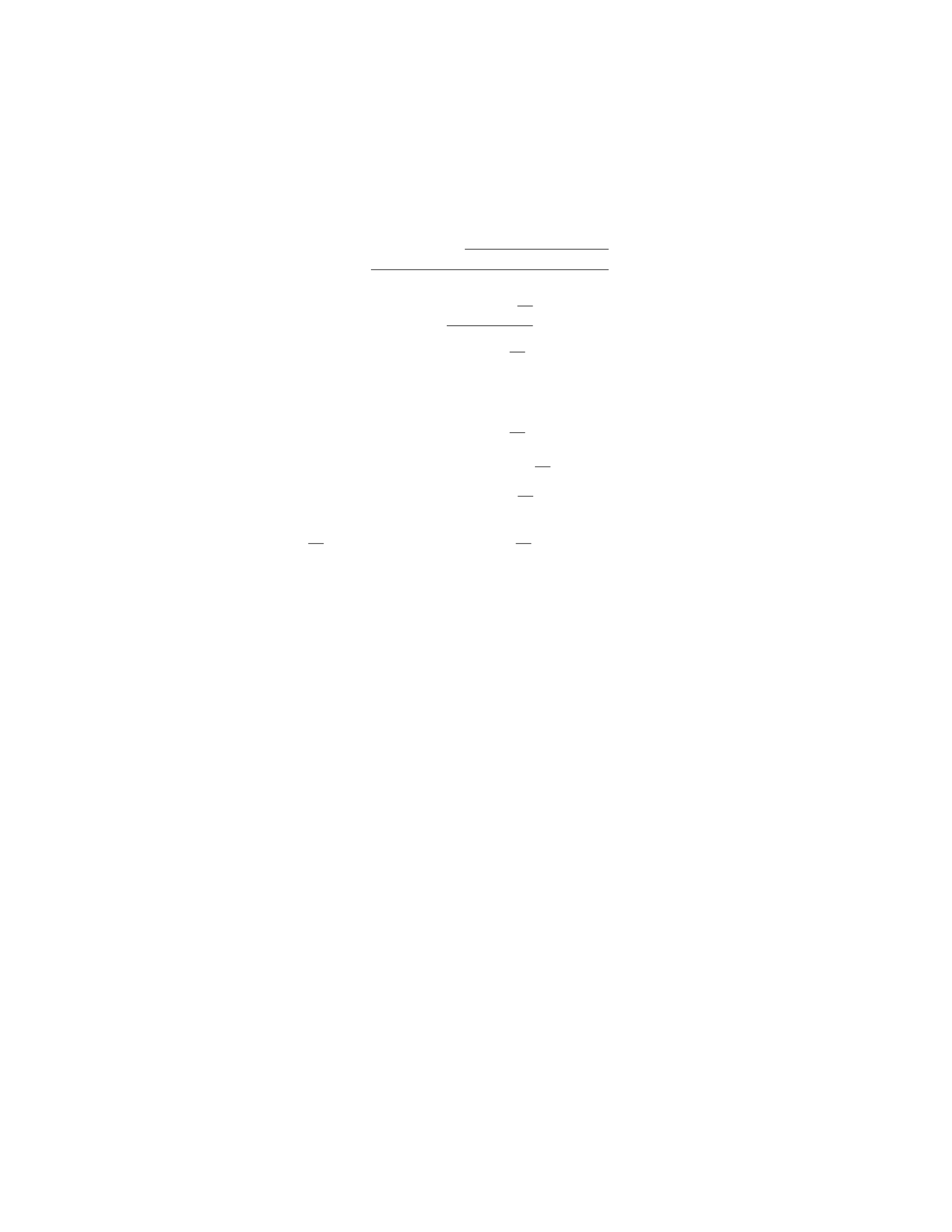
Step 5: Solve the quadratic equation to find the width y. Using the
quadratic formula, we find:
y=−(−200) ±p(−200)2−4(2)(1500)
2(2)
y=200 ±20√10
4
y= 50 ±5√10
Step 6: Determine the dimensions that maximize the area. Since yrepre-
sents the width of the garden, we choose the positive value for y:
y= 50 + 5√10
x= 200 −2(50 + 5√10)
x= 100 −10√10
Therefore, the dimensions that maximize the area of the garden are: Length
x= 100 −10√10 meters, Width y= 50 + 5√10 meters.
Question 26
Question
A rectangular garden is 20 meters long and 15 meters wide. A walkway of
uniform width is added around the garden, increasing the total area to 500
square meters. Find the width of the walkway.
Solution
Let xbe the width of the walkway.
Step 1: First, we find the total area of the original garden without the
walkway. This can be calculated as the product of the original length and
width:
Original Area = Length ×Width = 20 ×15 = 300 sq meters
Step 2: We can express the dimensions of the entire garden, including the
walkway, in terms of x: Length: 20 + 2xmeters Width: 15 + 2xmeters
Step 3: The total area of the garden with the walkway is given as 500
square meters. We can set up an equation using the total area formula:
Total Area = Length ×Width
500 = (20 + 2x)(15 + 2x)
23

Step 4: Expand the expression on the right side and simplify the quadratic
equation:
500 = 300 + 70x+ 40x+ 4x2
4x2+ 110x−200 = 0
Step 5: Solve the quadratic equation using the quadratic formula:
x=−110 ±p1102−4×4×(−200)
2×4
x=−110 ±√12100 + 3200
8
x=−110 ±√15300
8
x=−110 ±90
8
Step 6: The width of the walkway must be positive, so we take the positive
solution:
x=−110 + 90
8=−20
8=−2.5
Step 7: Since the width of the walkway cannot be negative, we must discard
the negative solution. Hence, the width of the walkway is 2.5 meters.
Question 27
Question
A rectangular garden is 30 meters long and 20 meters wide. The garden is
expanded by planting a uniform border of flowers around it, increasing the area
of the garden by 50
Solution
Let the width of the border be xmeters. The new dimensions of the garden
will be (30 + 2x) meters by (20 + 2x) meters.
Step 1: The original area of the garden is 30 ×20 = 600 square meters.
Step 2: The new area of the garden after adding the border is 600 +
0.5(600) = 900 square meters.
Step 3: The new area of the garden can also be expressed as the product
of its new dimensions:
(30 + 2x)(20 + 2x) = 900
Step 4: Expand the left side of the equation:
600 + 100x+ 60x+ 4x2= 900
24
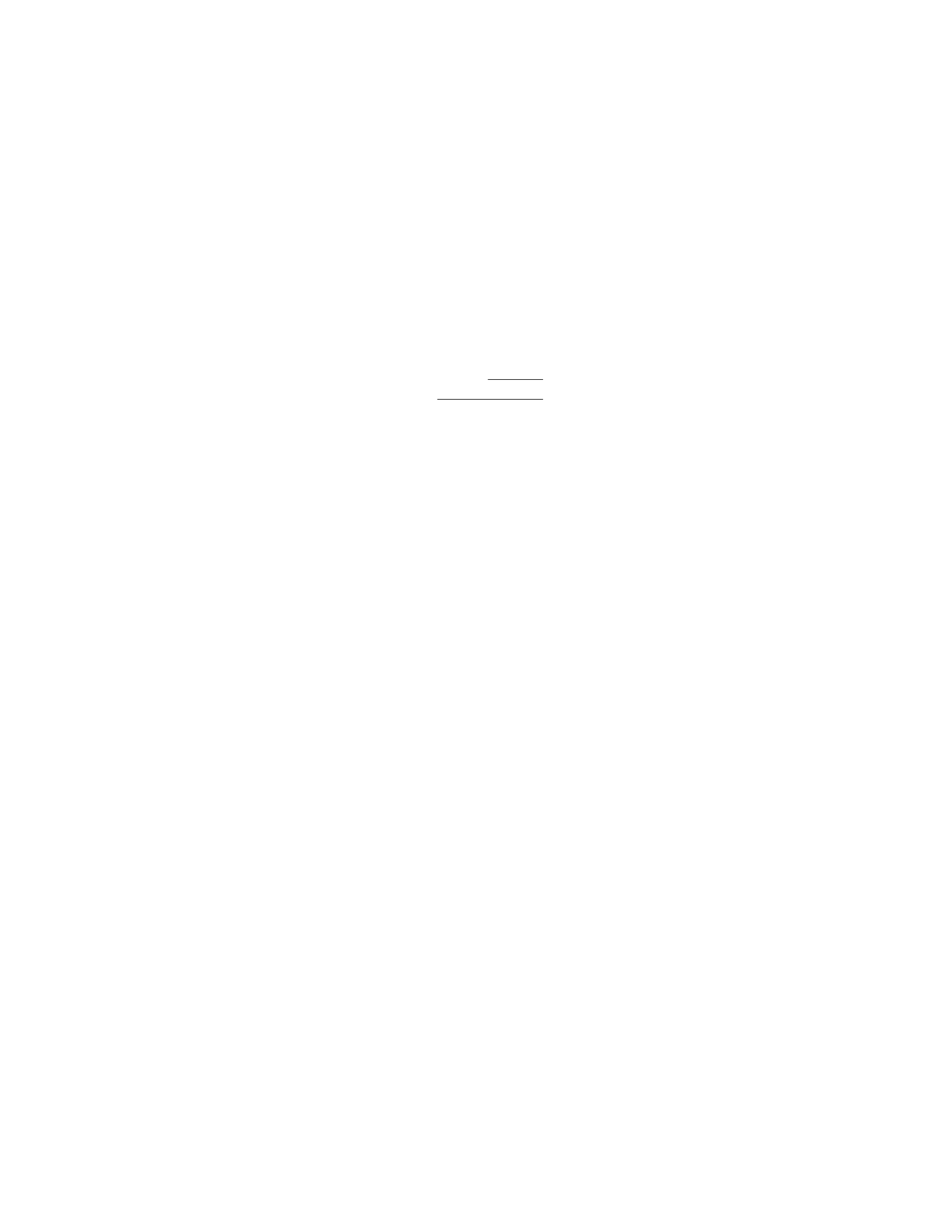
Step 5: Simplify the equation:
4x2+ 160x−300 = 0
Step 6: To solve the quadratic equation 4x2+ 160x−300 = 0, we can
simplify it by dividing each term by 4:
x2+ 40x−75 = 0
Step 7: Use the quadratic formula to solve for x:
x=−b±√b2−4ac
2a
where a= 1, b= 40, and c=−75.
Step 8: Substitute a,b, and cinto the formula and simplify to find the
solutions for x. The width of the border should be a positive number, so the
negative solution can be discarded.
Step 9: Calculate the width of the border to get the final answer.
Question 28
Question
A rectangular garden is 10 meters longer than it is wide. If the area of the
garden is 192 square meters, find the dimensions of the garden.
Solution
Let xbe the width of the garden (in meters). Since the garden is 10 meters
longer than it is wide, the length of the garden can be expressed as x+ 10.
We are given that the area of the garden is 192 square meters. The area of
a rectangle is given by the formula:
Area = length ×width
Substituting in the expressions for length and width:
x(x+ 10) = 192
Now, we will solve the quadratic equation to find the dimensions of the
garden.
Step 1: Expand the left side of the equation.
x2+ 10x= 192
Step 2: Rearrange the equation into standard form.
x2+ 10x−192 = 0
25

Step 3: Factor the quadratic equation.
(x−12)(x+ 16) = 0
Setting each factor to zero:
x−12 = 0 =⇒x= 12
x+ 16 = 0 =⇒x=−16
Since the width cannot be negative, the width of the garden is 12 meters.
Step 4: Find the length of the garden.
Length = x+ 10 = 12 + 10 = 22 meters.
Step 5: Write the final answer.
The dimensions of the garden are 12 meters by 22 meters.
Question 29
Question
A rectangular garden is to be constructed using a wall as one side and a hedge
as the other three sides. The length of the wall is 20 meters. The area of the
garden is to be 240 square meters. Find the dimensions of the garden that will
minimize the amount of hedge used.
Solution
Let xbe the length of the garden perpendicular to the wall, and let ybe the
width of the garden parallel to the wall. The area of the garden can be expressed
as A=xy = 240.
Step 1: Express the amount of hedge used in terms of xand y. The amount
of hedge used will be the sum of the lengths of the three sides that need hedge:
Hedge used = x+ 2y
Step 2: Express the amount of hedge used in terms of one variable. Since
A= 240, we can express yin terms of x:
y=240
x
Substitute yin the expression for the amount of hedge used:
Hedge used = x+ 2 240
x
Simplify the expression:
Hedge used = x+480
x
26

Step 3: Find the minimum amount of hedge used. To find the minimum
amount of hedge used, we can find the critical points of the function by finding
where the derivative is equal to zero:
d
dx(Hedge used) = 1 −480
x2= 0
Solve for x:
x2= 480
x=√480 = 4√30
Step 4: Determine the corresponding value of y. Using the relationship
y=240
x, we can find:
y=240
4√30 = 60√30
Step 5: Verify the minimum. To verify that this point is a minimum, we can
use the second derivative test. The second derivative of the function is positive,
confirming that the point is a minimum.
Step 6: State the dimensions of the garden that minimize the amount of
hedge used. Therefore, the dimensions of the garden that minimize the amount
of hedge used are 4√30 m ×60√30 m.
Question 30
Question
A farmer wants to build a rectangular enclosure for his animals using a long
barn as one side of the enclosure. If he has 100 meters of fencing material and
wants to maximize the area of the enclosure, what should the dimensions of the
enclosure be?
Solution
Let the length of the barn be xmeters, and the width of the enclosure be y
meters. Since the barn is used as one side, there are only three sides that need
fencing. Thus, the total amount of fencing material used is x+ 2y= 100.
To maximize the area of the enclosure, we need to maximize A=xy. From
the information given, we can express xin terms of yas x= 100 −2y. Substi-
tuting into the area formula gives A= (100 −2y)y= 100y−2y2.
To maximize the area, we need to find the critical points by taking the
derivative of Awith respect to yand setting it equal to zero.
dA
dy = 100 −4y= 0
4y= 100
27

y= 25
To ensure that this value yields a maximum area, we need to check the
endpoints of the possible range for y: 0 ≤y≤50. At y= 0, x= 100 and A= 0,
and at y= 50, x= 0 and A= 0. So, the maximum area occurs when y= 25.
Therefore, the dimensions of the enclosure that maximize the area are 25
meters by 50 meters.
Question 31
Question
A rectangular garden has a fixed perimeter of 40 meters. The area of the garden
is to be maximized. Let xand yrepresent the dimensions of the garden. Write
an equation that represents the area of the garden in terms of xand y, and then
use quadratic equations to find the dimensions that maximize the area.
Solution
Step 1: Let’s write an equation for the area of the garden in terms of xand
y. The perimeter of the rectangular garden is given by 2x+ 2y= 40, which
simplifies to x+y= 20. Solving for y, we get y= 20 −x. The area of the
rectangular garden is given by A=xy. Substituting y= 20 −xinto this
equation gives A=x(20 −x).
Step 2: Expand the equation for the area. A= 20x−x2
Step 3: To find the dimensions that maximize the area, we need to find the
critical points of A. The critical points occur where the derivative of Ais zero.
dA
dx = 20 −2x
Setting dA
dx = 0 and solving for x: 20 −2x= 0
2x= 20
x= 10
Step 4: To determine if x= 10 corresponds to a maximum or minimum,
we will use the second derivative test. d2A
dx2=−2 Since the second derivative is
negative, x= 10 corresponds to a maximum.
Step 5: Substitute x= 10 into y= 20 −xto find the corresponding value of
y.y= 20 −10
y= 10
Therefore, the dimensions that maximize the area of the garden are x= 10
meters and y= 10 meters.
Question 32
Question
A rectangular garden with a length of 20 meters and a width of 10 meters is
going to be expanded by the same amount on all sides to form a new rectangular
28

garden with an area of 400 square meters. Find the width of the expanded
garden.
Solution
Let the amount by which the garden is expanded on all sides be xmeters. Then
the new length of the garden will be 20 + 2xmeters and the new width will be
10 + 2xmeters.
The area of the expanded garden is the product of the new length and the
new width, which is given to be 400 square meters. Therefore, we have the
equation:
(20 + 2x)(10 + 2x) = 400
Expanding the left side gives:
200 + 40x+ 40x+ 4x2= 400
4x2+ 80x+ 200 = 400
4x2+ 80x−200 = 0
Now we need to solve this quadratic equation. We can simplify it by dividing
through by 4:
x2+ 20x−50 = 0
Next, we solve for xusing the quadratic formula x=−b±√b2−4ac
2a.
Step 1: Identify a,b, and cin the equation ax2+bx +c= 0.
Here, a= 1, b= 20, and c=−50.
Step 2: Substitute a= 1, b= 20, and c=−50 into the quadratic formula.
x=−20 ±p202−4∗1∗(−50)
2∗1
x=−20 ±√400 + 200
2
x=−20 ±√600
2
x=−20 ±10√6
2
Therefore, the width of the expanded garden is 10 + x= 10 + −20±10√6
2.
Thus, the width could be 5 −5√6 or 15 + 5√6 meters.
29

Question 33
Question
A rectangular photograph is to be enlarged. The length of the photograph is to
be increased by 20
Solution
Let the original length of the photograph be Linches and the original width be
Winches.
Step 1: Calculate the area of the original photograph. The area of the
original photograph is given by Aoriginal =L×W.
Step 2: Calculate the new dimensions of the photograph. After the en-
largement, the new length will be 1.2L(increased by 20
Step 3: Write an equation for the area of the new photograph. The area of
the new photograph is given by Anew = 1.2L×0.8W= 0.96LW .
Step 4: Write down the equation given in the problem. We are given that
the area of the new photograph is 144 square inches larger than the original
photograph: 0.96LW =LW + 144.
Step 5: Solve the equation to find the dimensions of the original photograph.
Subtract LW from both sides of the equation: 0.96LW −LW = 144
0.04LW = 144
LW =144
0.04
LW = 3600
Thus, the area of the original photograph is 3600 square inches.
Step 6: Find the original dimensions. Since Aoriginal =L×W= 3600, and
we know from Step 1 that Aoriginal =LW , we have: LW = 3600.
This means the dimensions of the original photograph are 60 inches by 60
inches.
Question 34
Question
A rectangular garden is to be created along the side of a house. The area of the
garden must be 300 square meters, and one of the sides will be against the wall of
the house. If fencing costs 10permeter, whatdimensionsshouldthegardenhaveinordertominimizethecostofthef encing?
Solution
Let xbe the width of the garden (perpendicular to the house) and ybe the
length of the garden (parallel to the house). We are given that the area of the
garden is 300 square meters, so we have the equation xy = 300.
30
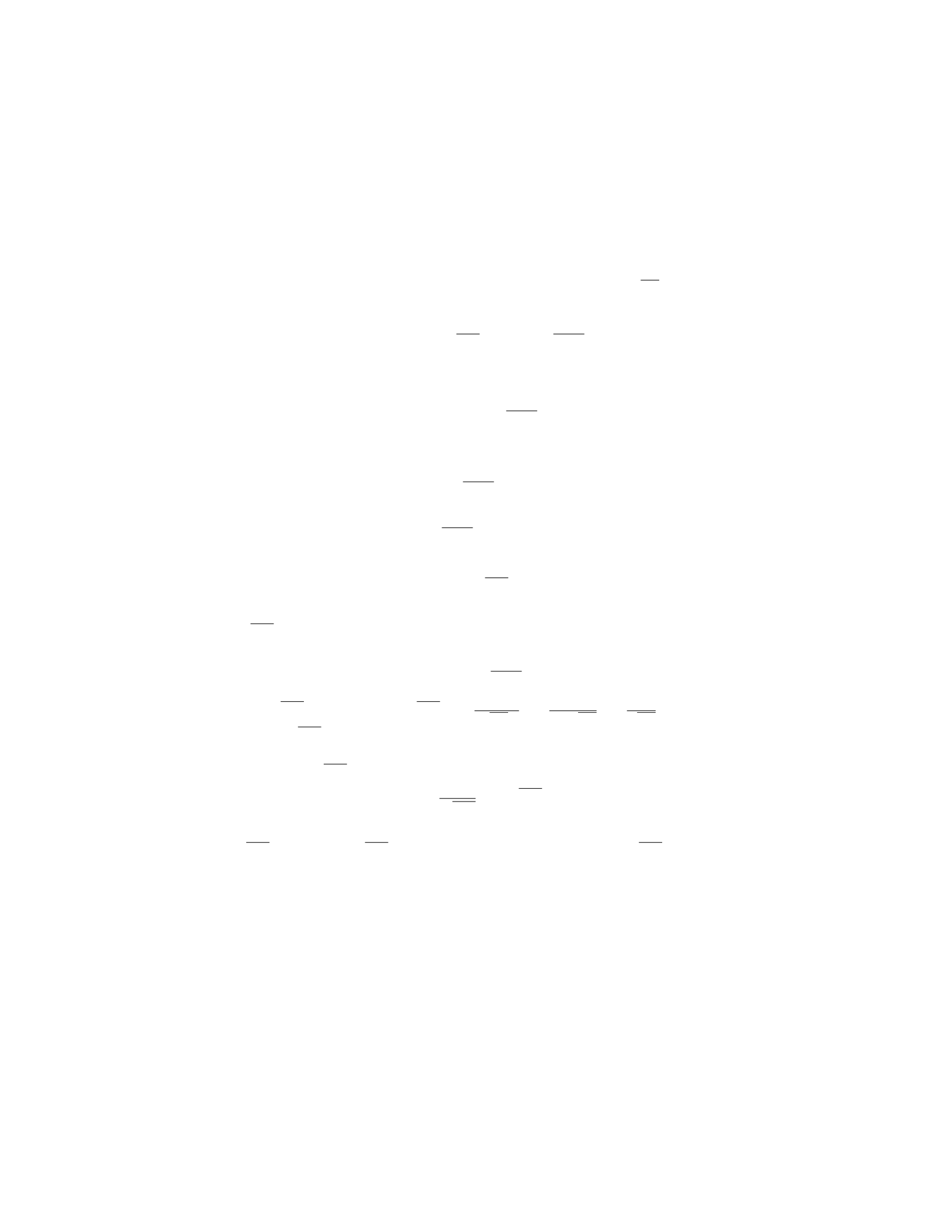
The cost of fencing is given by C= 10(2x+y), as there are two sides of
length xand one side of length y. We want to minimize this cost, i.e., find the
minimum of C.
Step 1: Express the cost function in terms of a single variable. From the
area equation xy = 300, we can express yin terms of xas y=300
x. Substitute
this into the cost function:
C= 10(2x+300
x) = 20x+3000
x
Step 2: Find the critical points by taking the derivative of Cwith respect
to x.
C′(x) = 20 −3000
x2
Set C′(x) = 0 to find critical points:
20 −3000
x2= 0
3000
x2= 20
x2= 150
x=√150
Step 3: Determine if the critical point is a minimum. To determine if
x=√150 is a minimum, we need to check the second derivative.
C′′(x) = 6000
x3
At x=√150, we have C′′(√150) = 6000
(√150)3=6000
150√150 =40
√150 >0, which
means x=√150 is a minimum.
Step 4: Calculate the corresponding length and minimum cost. From xy =
300, when x=√150:
y=300
√150 = 2√150
Therefore, the dimensions of the garden that minimize the cost of fencing
are √150 meters by 2√150 meters, with a minimum cost of 20√150 (or approx-
imately 120.0)m.
Question 35
Question
A rectangular garden is to be created along the side of a house. The area of
the garden must be 200 square meters. If the house wall will serve as one of the
sides of the garden, find the dimensions of the garden that would require the
least amount of fencing.
31

Solution
Let xbe the width of the garden and ybe the length of the garden. Since the
area of the garden is 200 square meters, we have xy = 200.
We want to minimize the amount of fencing required, which is given by 2x+y.
We can rewrite this in terms of one variable using the given area equation.
Step 1: Express the amount of fencing in terms of only one variable. We
write y=200
xand substitute into the expression for the amount of fencing:
f(x) = 2x+200
x
Step 2: Find the critical points. To find the minimum of f(x), we take the
derivative and set it equal to zero:
f′(x)=2−200
x2= 0
2 = 200
x2
x2= 100
x= 10
Step 3: Determine if the critical point is a minimum. To ensure that x= 10
is a minimum, we use the second derivative test. Since f′′(x) = 400
x3is positive
at x= 10, then x= 10 is a minimum.
Step 4: Find the dimensions of the garden. Since x= 10, we can find y
using the area equation:
10y= 200
y= 20
Therefore, the dimensions of the garden that require the least amount of
fencing are 10 meters by 20 meters.
32

