


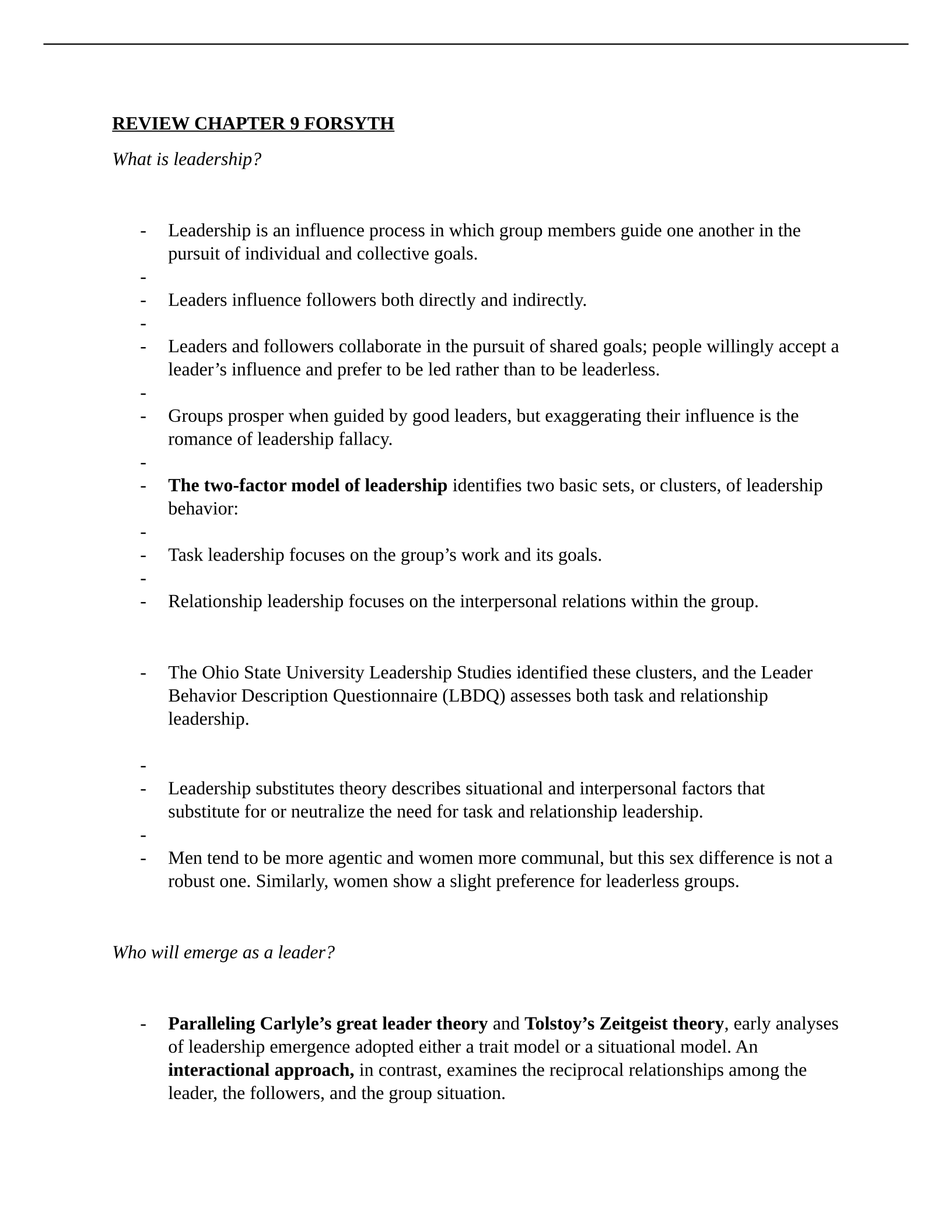
REVIEW CHAPTER 9 FORSYTH
What is leadership?
- Leadership is an influence process in which group members guide one another in the
pursuit of individual and collective goals.
-
- Leaders influence followers both directly and indirectly.
-
- Leaders and followers collaborate in the pursuit of shared goals; people willingly accept a
leader’s influence and prefer to be led rather than to be leaderless.
-
- Groups prosper when guided by good leaders, but exaggerating their influence is the
romance of leadership fallacy.
-
-The two-factor model of leadership identifies two basic sets, or clusters, of leadership
behavior:
-
- Task leadership focuses on the group’s work and its goals.
-
- Relationship leadership focuses on the interpersonal relations within the group.
- The Ohio State University Leadership Studies identified these clusters, and the Leader
Behavior Description Questionnaire (LBDQ) assesses both task and relationship
leadership.
-
- Leadership substitutes theory describes situational and interpersonal factors that
substitute for or neutralize the need for task and relationship leadership.
-
- Men tend to be more agentic and women more communal, but this sex difference is not a
robust one. Similarly, women show a slight preference for leaderless groups.
Who will emerge as a leader?
-Paralleling Carlyle’s great leader theory and Tolstoy’s Zeitgeist theory, early analyses
of leadership emergence adopted either a trait model or a situational model. An
interactional approach, in contrast, examines the reciprocal relationships among the
leader, the followers, and the group situation.
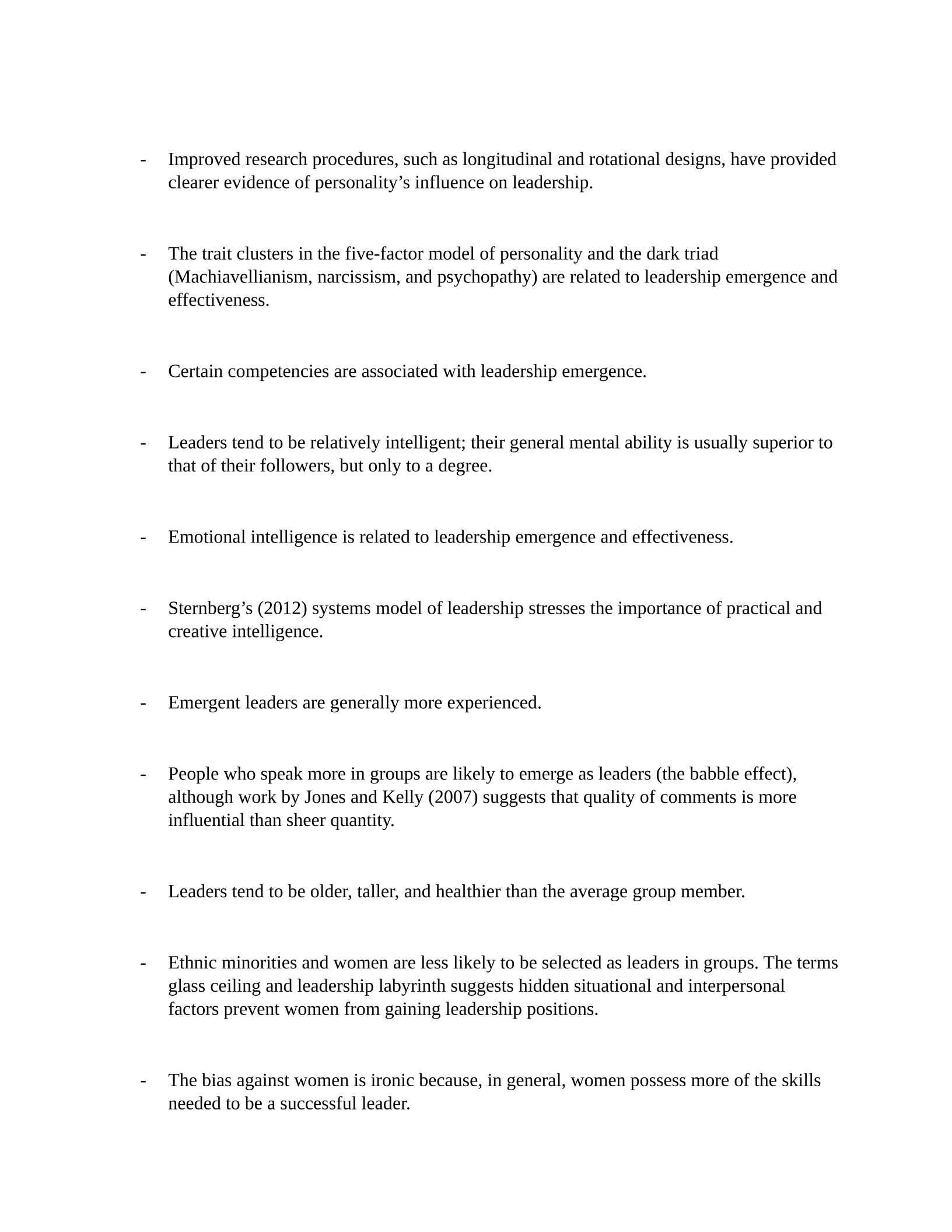
- Improved research procedures, such as longitudinal and rotational designs, have provided
clearer evidence of personality’s influence on leadership.
- The trait clusters in the five-factor model of personality and the dark triad
(Machiavellianism, narcissism, and psychopathy) are related to leadership emergence and
effectiveness.
- Certain competencies are associated with leadership emergence.
- Leaders tend to be relatively intelligent; their general mental ability is usually superior to
that of their followers, but only to a degree.
- Emotional intelligence is related to leadership emergence and effectiveness.
- Sternberg’s (2012) systems model of leadership stresses the importance of practical and
creative intelligence.
- Emergent leaders are generally more experienced.
- People who speak more in groups are likely to emerge as leaders (the babble effect),
although work by Jones and Kelly (2007) suggests that quality of comments is more
influential than sheer quantity.
- Leaders tend to be older, taller, and healthier than the average group member.
- Ethnic minorities and women are less likely to be selected as leaders in groups. The terms
glass ceiling and leadership labyrinth suggests hidden situational and interpersonal
factors prevent women from gaining leadership positions.
- The bias against women is ironic because, in general, women possess more of the skills
needed to be a successful leader.
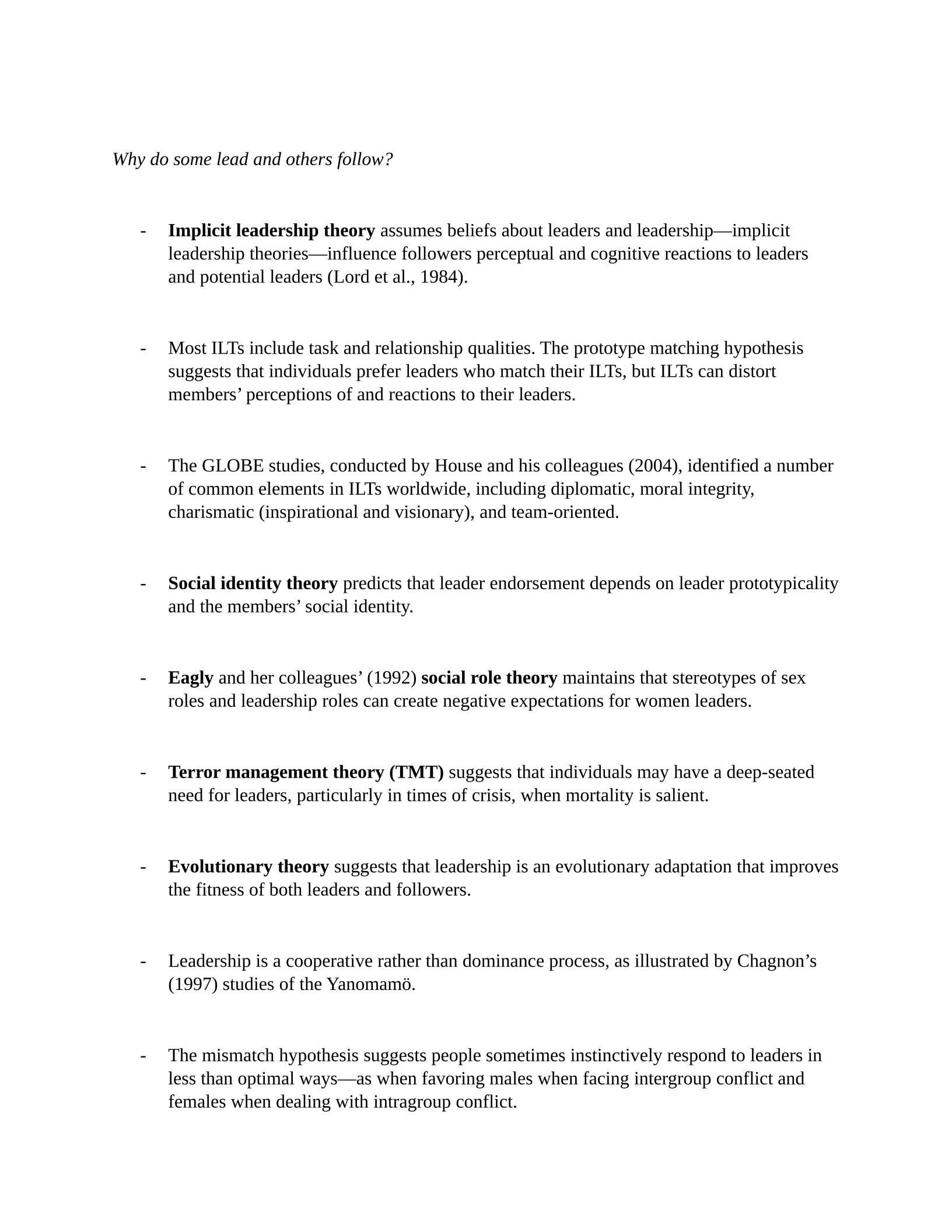
Why do some lead and others follow?
-Implicit leadership theory assumes beliefs about leaders and leadership—implicit
leadership theories—influence followers perceptual and cognitive reactions to leaders
and potential leaders (Lord et al., 1984).
- Most ILTs include task and relationship qualities. The prototype matching hypothesis
suggests that individuals prefer leaders who match their ILTs, but ILTs can distort
members’ perceptions of and reactions to their leaders.
- The GLOBE studies, conducted by House and his colleagues (2004), identified a number
of common elements in ILTs worldwide, including diplomatic, moral integrity,
charismatic (inspirational and visionary), and team-oriented.
-Social identity theory predicts that leader endorsement depends on leader prototypicality
and the members’ social identity.
-Eagly and her colleagues’ (1992) social role theory maintains that stereotypes of sex
roles and leadership roles can create negative expectations for women leaders.
-Terror management theory (TMT) suggests that individuals may have a deep-seated
need for leaders, particularly in times of crisis, when mortality is salient.
-Evolutionary theory suggests that leadership is an evolutionary adaptation that improves
the fitness of both leaders and followers.
- Leadership is a cooperative rather than dominance process, as illustrated by Chagnon’s
(1997) studies of the Yanomamö.
- The mismatch hypothesis suggests people sometimes instinctively respond to leaders in
less than optimal ways—as when favoring males when facing intergroup conflict and
females when dealing with intragroup conflict.

Why are some leaders more effective than others?
- Leadership style theorists assume that effectiveness depends on the leader’s task and
relationship behaviors.
-The Leadership Grid, proposed by Blake and Mouton (1982), assumes that people
vary in their concern for results and in their concern for people and that individuals who
are high on both dimensions (9,9) are the best leaders.
-The situational leadership® theory, proposed by Hersey and Blanchard (1976),
suggests that groups benefit from leadership that meshes with the developmental stage of
the group.
-Fiedler’s (1964) contingency theory suggests that leadership effectiveness is
determined by the leader’s motivational style and the favorability of the situation.
- The leader’s motivational style can be either task-motivated or relationship-motivated,
as measured by the Least Preferred Coworker Scale.
- Situational favorability is determined by the leader–member relations, the task structure,
and the leader’s power.
-Fiedler’s theory predicts that task-motivated (low-LPC) leaders will be most effective
in situations that are either extremely unfavorable or extremely favorable, whereas
relationship-motivated leaders are most effective in intermediate situations.
Leader–member exchange theory (LMX) focuses on the dyadic relationship linking the leader
to each member of the group.
In many cases, two subgroups of linkages exist (the inner group and the outer group). Groups
with more inner-group members are more productive.
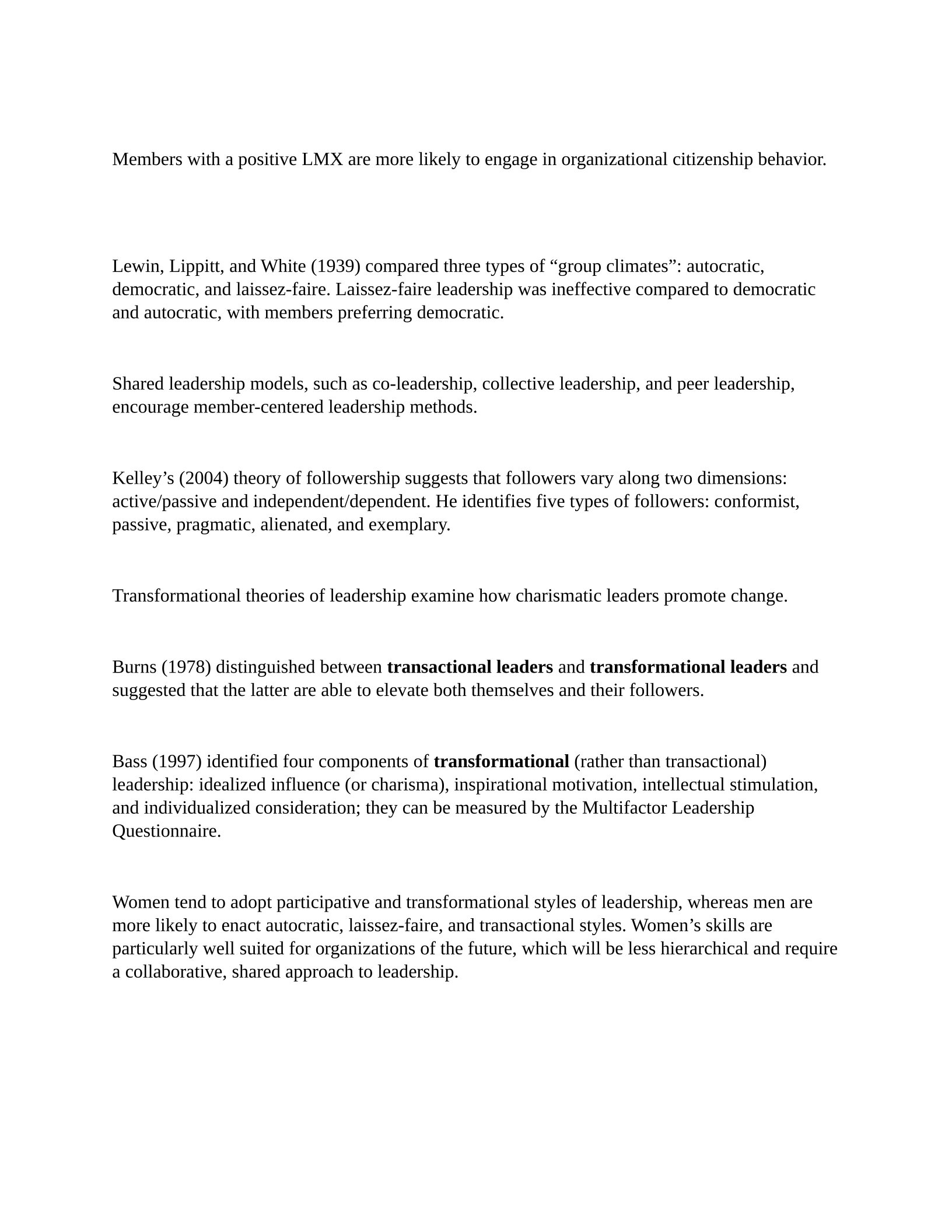
Members with a positive LMX are more likely to engage in organizational citizenship behavior.
Lewin, Lippitt, and White (1939) compared three types of “group climates”: autocratic,
democratic, and laissez-faire. Laissez-faire leadership was ineffective compared to democratic
and autocratic, with members preferring democratic.
Shared leadership models, such as co-leadership, collective leadership, and peer leadership,
encourage member-centered leadership methods.
Kelley’s (2004) theory of followership suggests that followers vary along two dimensions:
active/passive and independent/dependent. He identifies five types of followers: conformist,
passive, pragmatic, alienated, and exemplary.
Transformational theories of leadership examine how charismatic leaders promote change.
Burns (1978) distinguished between transactional leaders and transformational leaders and
suggested that the latter are able to elevate both themselves and their followers.
Bass (1997) identified four components of transformational (rather than transactional)
leadership: idealized influence (or charisma), inspirational motivation, intellectual stimulation,
and individualized consideration; they can be measured by the Multifactor Leadership
Questionnaire.
Women tend to adopt participative and transformational styles of leadership, whereas men are
more likely to enact autocratic, laissez-faire, and transactional styles. Women’s skills are
particularly well suited for organizations of the future, which will be less hierarchical and require
a collaborative, shared approach to leadership.
Powered by TCPDF (www.tcpdf.org)

