


Process factors that influence perceived quality of emergency mental healthcare
Descriptive analysis
The factors related to process in the delivery of mental healthcare are summarized in Table
4.6. Majority (67.3%) claimed that there was effective triaging of patient in the outpatient
department. Ninety five (59.7%) of the respondents were adhering to standard operating
procedure and 55.3% said they were adhering to referral protocol when providing psychiatric
emergency care.
Almost half of the respondents (50.9%) indicated the provider-patient interaction was
satisfactory. Nevertheless, most (64.8%) reported inadequate privacy. Even though, 58.5%
of the respondents indicated that the rights of patients are upheld, considerable percentage
(40.3%) reported otherwise. Most (81.1) believe that psychiatric emergency patients were
handled with respect by the staffs. About half (53.5%) indicated informed consent is sought
during treatment whereas 44.7% reported they treat without consent.

The highest percentage (57.2%) pointed out that the waiting time for emergency psychiatric
patients was in line with the service delivery charter. Majority (62.9%) did not feel sufficient
provider safety measures when attending to emergency mental health patients. Similarly,
most (74.8%) indicated that they do not feel safe when attending to a patient presenting with
emergency mental health. Most, (86.2%) reported there was monitoring of emergency mental
health patients who are secluded. More than half (57.2%) indicated inadequate treatment of
emergency mental ghealth patients. However, most (86.2%) of the respondents were
documenting the occurrences and 75.5% indicated the documentation was done consistently.
Table: Descriptive analysis of process factors that influence perceived quality of
emergency mental healthcare
Variable Yes, n(%) No, n(%) I don’t
Know,n(%)
There is an effective triaging of patient in the outpatient department 107(67.3) 47(29.6) 5(3.1)
The SOPs (if available) properly are adhered to when providing
psychiatric emergency care
54(34.0) 95(59.7) 10(6.3)
The referral protocol (if available) is adhered to when referring
emergency psychiatric patients
88(55.3) 64(40.3) 7(4.4)
The provider-patient interaction with patients presenting with psychiatric
emergencies is satisfactory
81(50.9) 74(46.5) 4(2.5)
The patients are presenting with psychiatric emergency cases provided
with privacy adequately
53(33.3) 103(64.8) 3(1.9)
The rights of patients are presenting with psychiatric emergency is
upheld
93(58.5) 64(40.3) 2(1.3)
Staffs handle psychiatric emergency patients with respect 129(81.1) 28(17.6) 2(1.3)
During treatment of psychiatric emergency patients, is informed consent
sought
85(53.5) 71(44.7) 3(1.9)
The waiting time for emergency psychiatric patients is in line with the
service delivery charter
55(34.6) 91(57.2) 13(8.2)
There are sufficient provider safety measures when attending to
psychiatric emergency patients
56(35.2) 100(62.9) 3(1.9)
Whether feeling safe when attending to a patient presenting with
psychiatric emergency
40(25.2) 119(74.8) 0(0.0)
There is monitoring of psychiatric emergency patients who are secluded 137(86.2) 19(11.90 3(1.9)
There is regular monitoring 103(64.8) 53(33.3) 3(1.9)
There is adequate treatment of emergency psychiatric patients 66(41.5) 91(57.2) 2(1.3)
The psychiatric emergency occurrences are documented 137(86.2) 18(11.3) 4(2.5)
Whether the documentation of occurrences is done consistently 120(75.5) 34(21.4) 5(3.1)
In the occurrence of a psychiatric emergency, is the patients deescalated
before restraint?
72(45.3) 80(50.3) 7(4.4)
4.0.1: Overall score of process factors that influence perceived quality of emergency
mental healthcare
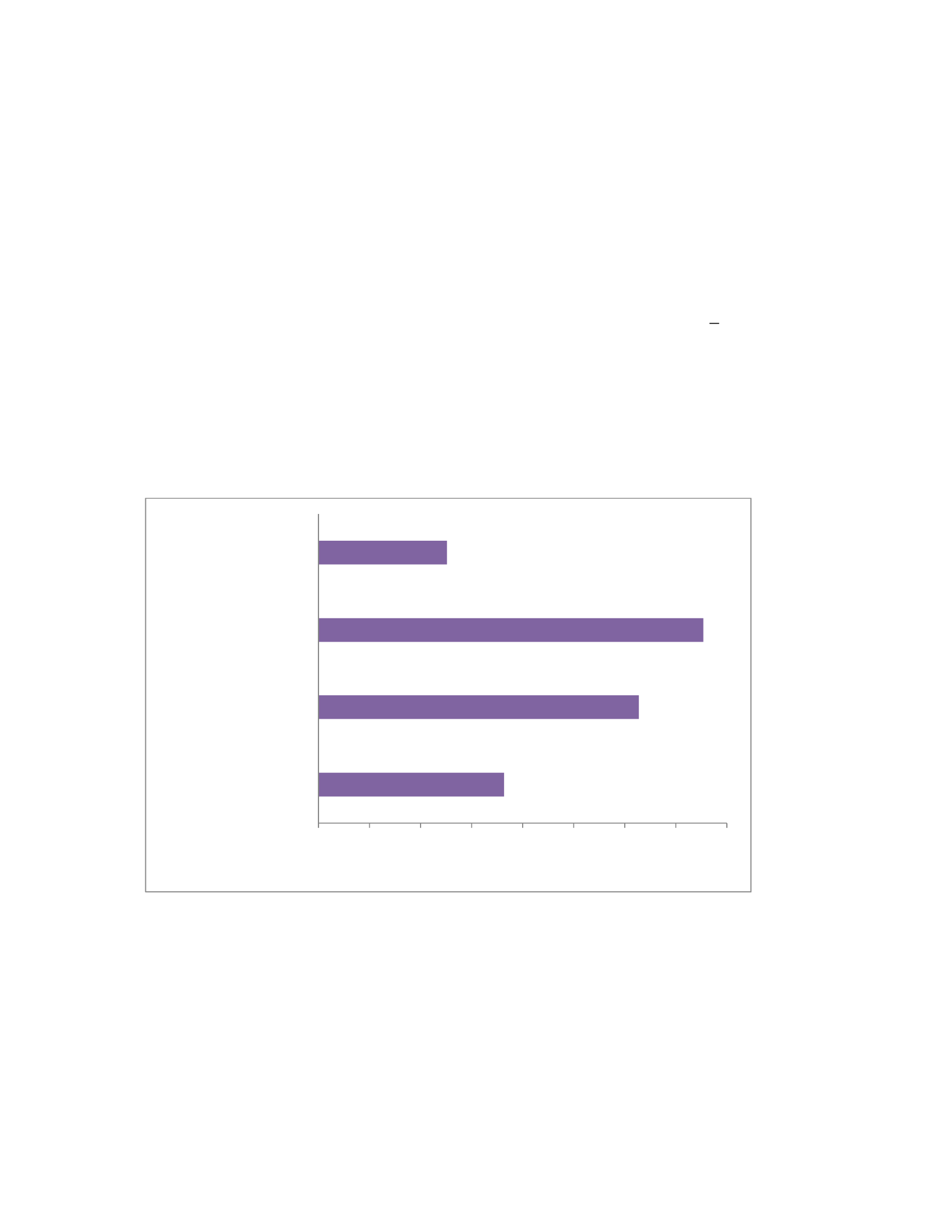
The overall score of process-related factors in the delivery of emergency mental health care
was determined by using a score of responses. Seventeen (17) variables presented in Table
4.3 were considered together and scores are structured in Appendix 12. The maximum
attainable total score was 17 and minimum score was 0. A percentage score was generated
and classified as very poor (<25%), poor (25-49%), moderate (50 – 74%), good (>75%).
Figure 4.3 shows overall score of process-related factors in the delivery of psychiatric care.
The highest percentage (37.7%) of the respondents reported that the process for psychiatric
emergency care was moderate/average. However, considerable percentage (31.4%) and
(18.2%) scored the process system as low and very low respectively.
Figure: Overall score of process-related factors in the delivery of emergency mental health
care
Good (75% and above) 12.6
Moderate (50-74%) 37.7
Low (25-49%) 31.4
Very low (<25%) 18.2
0 5 10 15 2025
Percent
30 35 40
4.0.2 Method mainly used to manage the patients, if there is no de-escalation
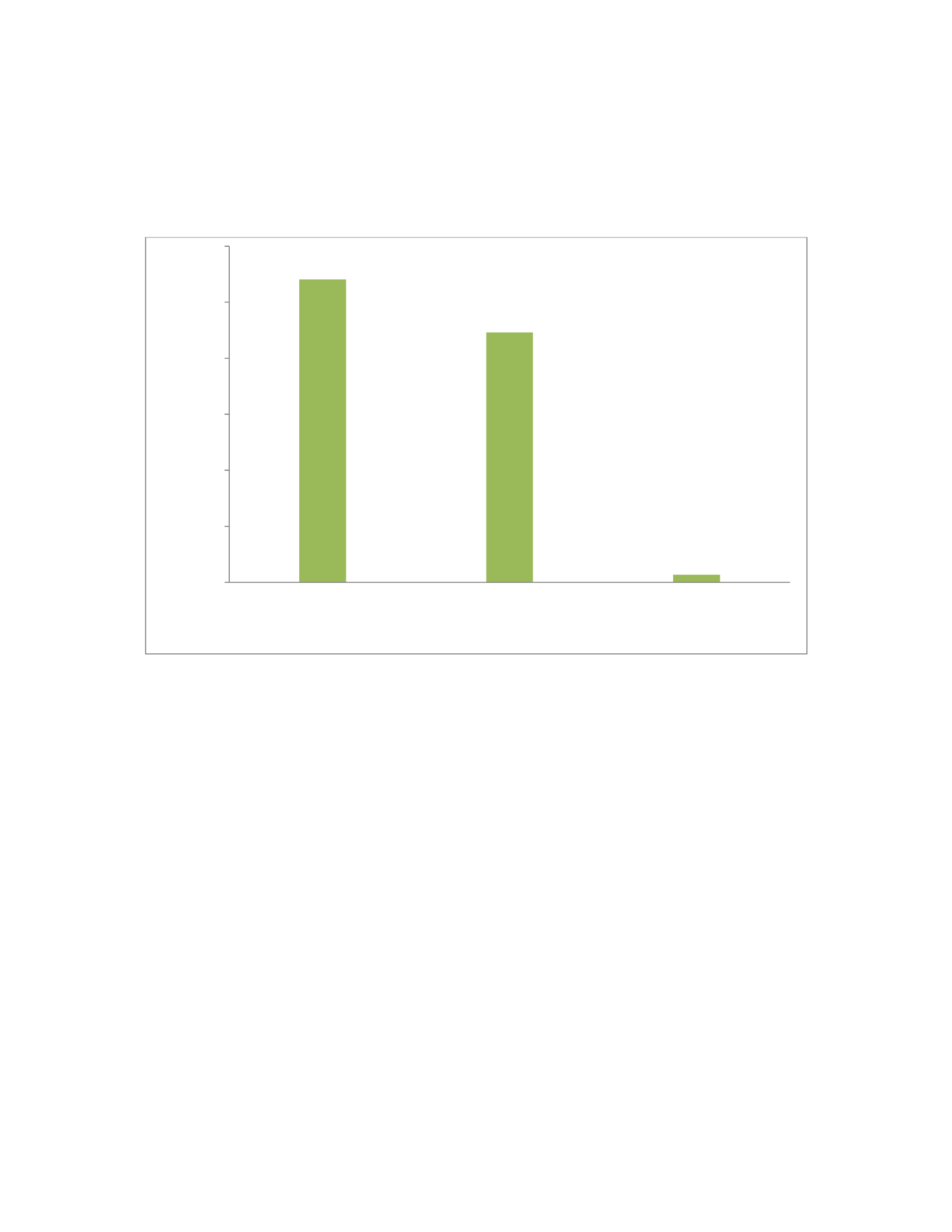
As indicated in Figure 4.3, the main mentioned methods used to manage the patients, if there
is no de-escalation were chemical restraint (54.1%) and physical restraint (44.6%).
Figure: Method mainly used to manage the patients, if there is no de-escalation
Bivariate analysis of process factors that influence perceived quality of emergency mental
healthcare
As indicated in Table 4.7, all the process factors were significantly associated with perceived
quality of emergency mental healthcare except sufficient provider safety measures when
attending to emergency mental health patients and whether feeling safe when attending to a
patient presenting with emergency mental health.
Moreover, there was significantly high proportion of perceived good quality of emergency
mental healthcare among respondents with high and moderate overall score of process than
those with very low overall score of process (p=0.000).
54.1
44.6
1.4
60.0
50.0
40.0
30.0
20.0
10.0
0.0
Chemical restraint Physical restraint Seclusion
Method mainly used to manage the patients, if there is no de-escalation
Percent

Table 4.7: Bivariate analysis of process factors stratified perceived quality of emergency
mental healthcare
Variables Perceived good
quality
Perceived poor
quality
χ2
value
df P value
n % n %
There is an effective triaging of patient in the outpatient department
Yes 66 61.7% 41 38.3%
No 15 31.9% 32 68.1% 16.94
2
0.000
Don't know
0
0.0%
5
100.0%
The SOPs (if available) properly are adhered to when providing emergency mental health care
Yes 37 68.5% 17 31.5%
No 43 45.3% 52 54.7% 14.61
2
0.001
Don't know
1
10.0%
9
90.0%
The referral protocol (if available) is adhered to when referring emergency mental health patients
Yes 59 67.0% 29 33.0%
No 20 31.3% 44 68.8% 20.46
2
0.000
Don't know
2
28.6%
5
71.4%
The provider-patient interaction with patients presenting with emergency mental health is satisfactory
Yes 56 69.1% 25 30.9%
No 23 31.1% 51 68.9% 22.41
2
0.000
Don't know
2
50.0%
2
50.0%
The patients are presenting with emergency mental health cases provided with privacy adequately
Yes 36 67.9% 17 32.1%
No 43 41.7% 60 58.3% 9.90
2
0.007
Don't know
2
66.7%
1
33.3%
The rights of patients are presenting with emergency mental health is upheld
Yes 61 65.6% 32 34.4%
No 19 29.7% 45 70.3% 19.56
2
0.000
Don't know
1
50.0%
1
50.0%
Staffs handle emergency mental health patients with respect
Yes 74 57.4% 55 42.6%
No
7
25.0% 21 75.0% 11.75
2
0.003
Don't know
0
0.0%
2
100.0%
During treatment of emergency mental health patients, is informed consent sought
Yes 53 62.4% 32 37.6%
No 27 38.0% 44 62.0% 9.54
2
0.008

Don't know 1 33.3% 2 66.7%
The waiting time for emergency mental health patients is in line with the service delivery charter
Yes 35 63.6% 20 36.4%
No 37 40.7% 54 59.3% 9.14
2
0.010
Don't know
9
69.2%
4
30.8%
There are sufficient provider safety measures when attending to emergency mental health patients
Yes 33 58.9% 23 41.1%
No 47 47.0% 53 53.0% 2.42
2
0.298
Don't know
1
33.3%
2
66.7%
Whether feeling safe when attending to a patient presenting with emergency mental health
Yes 24 60.0% 16 40.0% 1.75
1
0.185
No 57 47.9% 62 52.1%
There is monitoring of emergency mental health patients who are secluded
Yes 75 54.7% 62 45.3%
No
4
21.1% 15 78.9% 7.88
2
0.019
Don't know
2
66.7%
1
33.3%
There is regular monitoring
Yes 60 58.3% 43 41.7%
No 19 35.8% 34 64.2% 7.33
2
0.026
Don't know
2
66.7%
1
33.3%
There is adequate treatment of emergency mental health patients
Yes 46 69.7% 20 30.3%
No 34 37.4% 57 62.6% 16.01
2
0.000
Don't know
1
50.0%
1
50.0%
The emergency mental health occurrences are documented
Yes 76 55.5% 61 44.5%
No
4
22.2% 14 77.8% 8.14
2
0.017
Don't know
1
25.0%
3
75.0%
Whether the documentation of occurrences is done consistently
Yes 69 57.5% 51 42.5%
No 10 29.4% 24 70.6% 8.61
2
0.013
Don't know
2
40.0%
3
60.0%
Overall score of process-related factors in the delivery of care
Very low (<25%)
4
13.8% 25 86.2%
Low (25-49%) 20 40.0% 30 60.0% 32.43
3
0.000
Moderate (50-74%) 41 68.3% 19 31.7%
High (75% and above) 16 80.0%
4
20.0%


