


Critical Race Theory
Dr. Kelly Hamren is an assistant professor of English at Liberty University. She received her
undergraduate and graduate degrees from Liberty University and her doctorate from the Indiana
University of Pennsylvania. Most of her research has emphasized placing literature in historical
contexts and includes a primary focus on Russian poets and novelists. She currently lives in
Roanoke, VA with her husband and half a dozen cats and spends her free time cooking, studying
languages, and training for her second marathon.]
Anyone exploring the conversations about racial and ethnic tension in North America these days
will almost inevitably run across the term critical race theory (CRT). A person exploring these
conversations within evangelical communities, whether online or otherwise, is just as likely to
come across one of two responses: 1) a wholesale rejection of CRT as not only unbiblical but
dangerous, largely due to its foundations in critical (read: Marxist) theory; 2) an embracing of
CRT as a helpful corrective to a woeful neglect, within the church, to respond to or even
acknowledge systemic injustice.
Before responding to either of these threads in the ongoing discourse, I would like to define CRT
in more detail.
What is CRT?
CRT developed in the late twentieth century as a way of processing race-based oppression,
principally in the United States. It developed first among legal scholars investigating the failure
of certain court cases—such as Brown vs. Board of Education—to deliver on their promise of
greater racial equality in the US (Delgado and Stefancic, 4-5). CRT theorists sought to
understand the interplay of cultural forces which thwarted attempts to rectify racial injustice.
While acknowledging that CRT is a diverse movement, Richard Delgado and Jean Stefancic
have helpfully isolated five key emphases of CRT:
Racism is not the exception to the rule in American society—racism is the rule.
The oppressive majority will typically make concessions to the oppressed minority only
when they themselves benefit.
Race is the product of “social construction.”
People can participate in multiple categories of oppression (a phenomenon known as
intersectionality).
People of colour usually have more insight about racial oppression than white people do
(7-11).
Each of the above points is complex and deserves detailed study in its own right. I will
respond to a few of them in due course, but I would encourage readers to explore them
further using the list of recommended sources at the end of this article. In the meantime, I
will attempt to answer questions regarding the theory as a whole.
So, is CRT Marxist?
The short answer is yes—CRT theorists drew heavily from Marxist assumptions in formulating
their arguments, including the following:
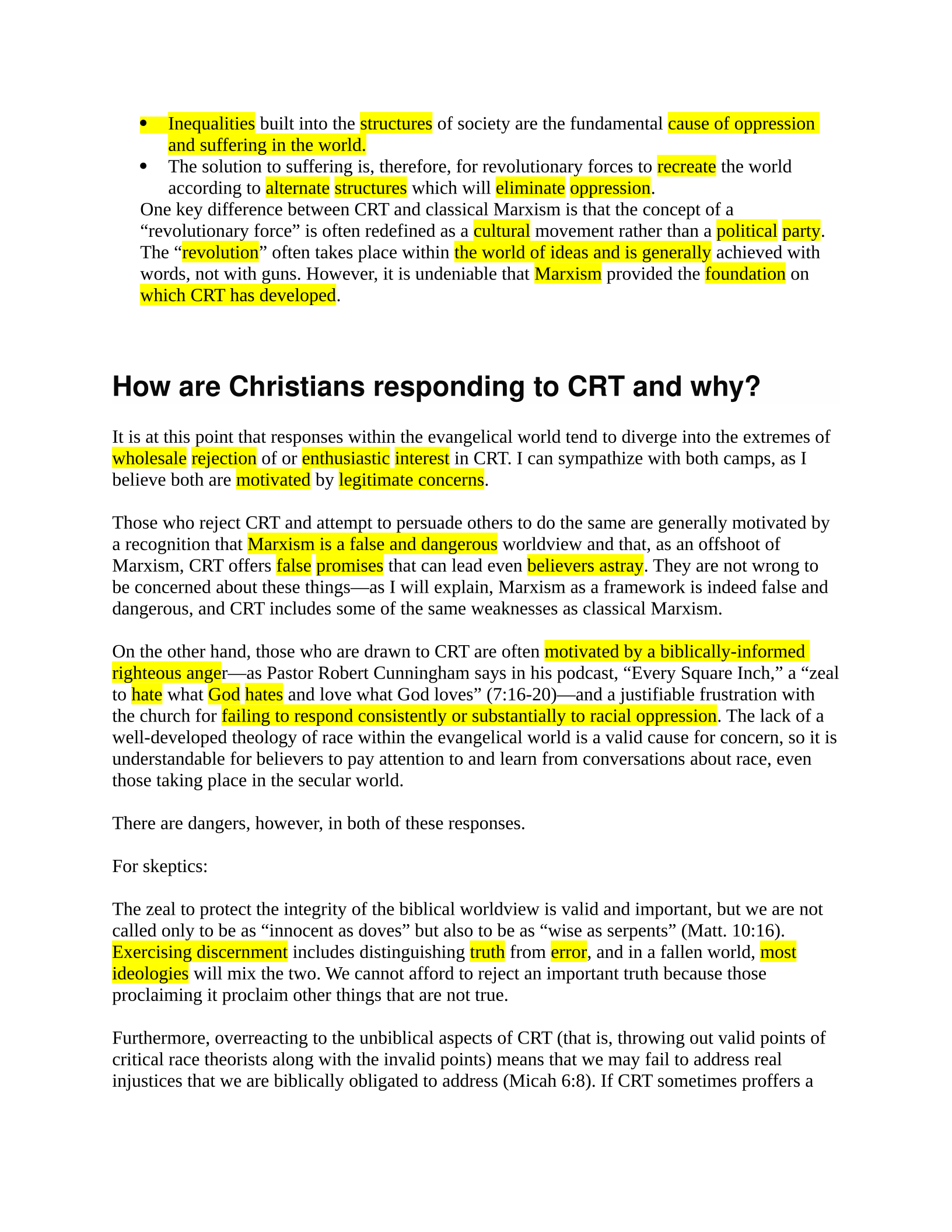
Inequalities built into the structures of society are the fundamental cause of oppression
and suffering in the world.
The solution to suffering is, therefore, for revolutionary forces to recreate the world
according to alternate structures which will eliminate oppression.
One key difference between CRT and classical Marxism is that the concept of a
“revolutionary force” is often redefined as a cultural movement rather than a political party.
The “revolution” often takes place within the world of ideas and is generally achieved with
words, not with guns. However, it is undeniable that Marxism provided the foundation on
which CRT has developed.
How are Christians responding to CRT and why?
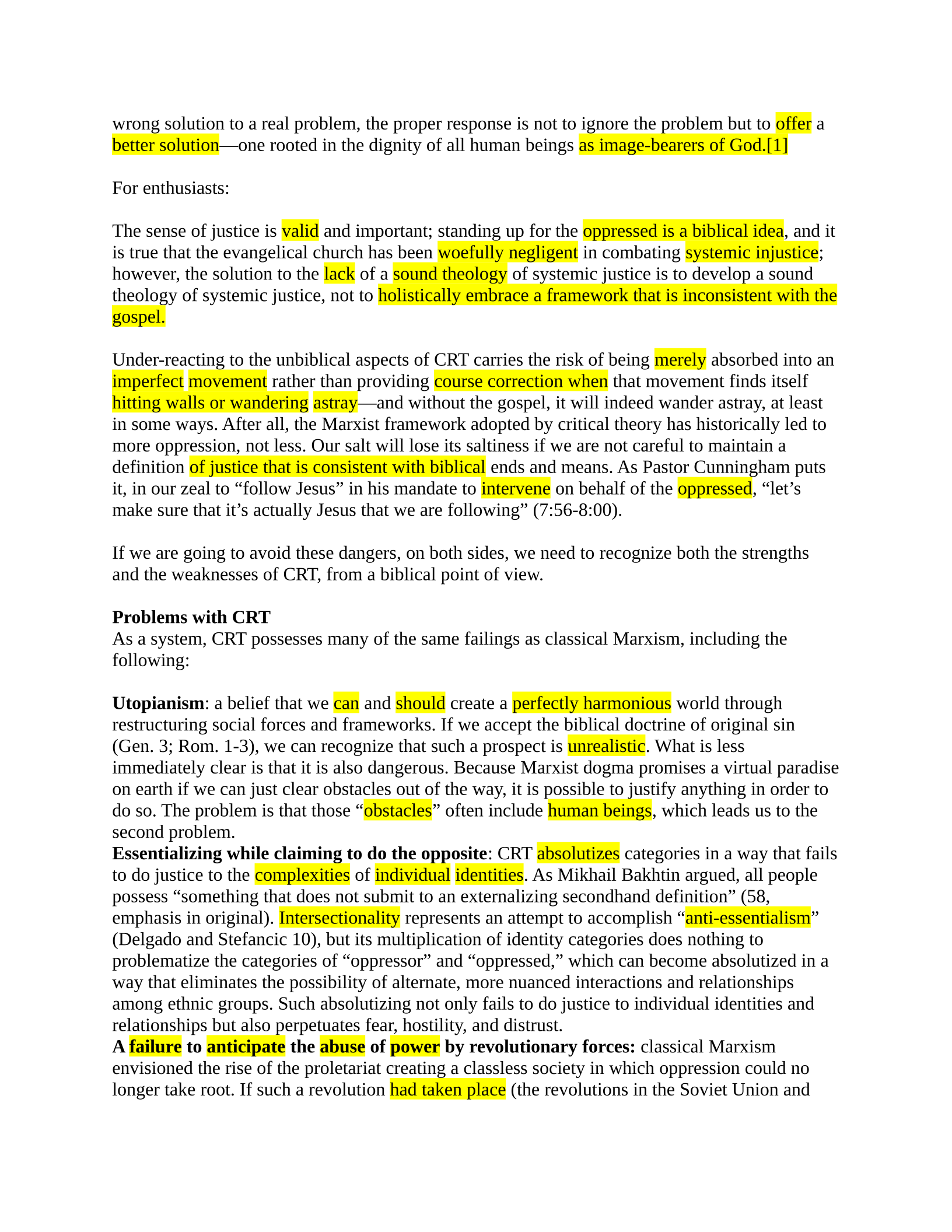
It is at this point that responses within the evangelical world tend to diverge into the extremes of
wholesale rejection of or enthusiastic interest in CRT. I can sympathize with both camps, as I
believe both are motivated by legitimate concerns.
Those who reject CRT and attempt to persuade others to do the same are generally motivated by
a recognition that Marxism is a false and dangerous worldview and that, as an offshoot of
Marxism, CRT offers false promises that can lead even believers astray. They are not wrong to
be concerned about these things—as I will explain, Marxism as a framework is indeed false and
dangerous, and CRT includes some of the same weaknesses as classical Marxism.
On the other hand, those who are drawn to CRT are often motivated by a biblically-informed
righteous anger—as Pastor Robert Cunningham says in his podcast, “Every Square Inch,” a “zeal
to hate what God hates and love what God loves” (7:16-20)—and a justifiable frustration with
the church for failing to respond consistently or substantially to racial oppression. The lack of a
well-developed theology of race within the evangelical world is a valid cause for concern, so it is
understandable for believers to pay attention to and learn from conversations about race, even
those taking place in the secular world.
There are dangers, however, in both of these responses.
For skeptics:
The zeal to protect the integrity of the biblical worldview is valid and important, but we are not
called only to be as “innocent as doves” but also to be as “wise as serpents” (Matt. 10:16).
Exercising discernment includes distinguishing truth from error, and in a fallen world, most
ideologies will mix the two. We cannot afford to reject an important truth because those
proclaiming it proclaim other things that are not true.
Furthermore, overreacting to the unbiblical aspects of CRT (that is, throwing out valid points of
critical race theorists along with the invalid points) means that we may fail to address real
injustices that we are biblically obligated to address (Micah 6:8). If CRT sometimes proffers a
wrong solution to a real problem, the proper response is not to ignore the problem but to offer a
better solution—one rooted in the dignity of all human beings as image-bearers of God.[1]
For enthusiasts:
The sense of justice is valid and important; standing up for the oppressed is a biblical idea, and it
is true that the evangelical church has been woefully negligent in combating systemic injustice;
however, the solution to the lack of a sound theology of systemic justice is to develop a sound
theology of systemic justice, not to holistically embrace a framework that is inconsistent with the
gospel.
Under-reacting to the unbiblical aspects of CRT carries the risk of being merely absorbed into an
imperfect movement rather than providing course correction when that movement finds itself
hitting walls or wandering astray—and without the gospel, it will indeed wander astray, at least
in some ways. After all, the Marxist framework adopted by critical theory has historically led to
more oppression, not less. Our salt will lose its saltiness if we are not careful to maintain a
definition of justice that is consistent with biblical ends and means. As Pastor Cunningham puts
it, in our zeal to “follow Jesus” in his mandate to intervene on behalf of the oppressed, “let’s
make sure that it’s actually Jesus that we are following” (7:56-8:00).
If we are going to avoid these dangers, on both sides, we need to recognize both the strengths
and the weaknesses of CRT, from a biblical point of view.
Problems with CRT
As a system, CRT possesses many of the same failings as classical Marxism, including the
following:
Utopianism: a belief that we can and should create a perfectly harmonious world through
restructuring social forces and frameworks. If we accept the biblical doctrine of original sin
(Gen. 3; Rom. 1-3), we can recognize that such a prospect is unrealistic. What is less
immediately clear is that it is also dangerous. Because Marxist dogma promises a virtual paradise
on earth if we can just clear obstacles out of the way, it is possible to justify anything in order to
do so. The problem is that those “obstacles” often include human beings, which leads us to the
second problem.
Essentializing while claiming to do the opposite: CRT absolutizes categories in a way that fails
to do justice to the complexities of individual identities. As Mikhail Bakhtin argued, all people
possess “something that does not submit to an externalizing secondhand definition” (58,
emphasis in original). Intersectionality represents an attempt to accomplish “anti-essentialism”
(Delgado and Stefancic 10), but its multiplication of identity categories does nothing to
problematize the categories of “oppressor” and “oppressed,” which can become absolutized in a
way that eliminates the possibility of alternate, more nuanced interactions and relationships
among ethnic groups. Such absolutizing not only fails to do justice to individual identities and
relationships but also perpetuates fear, hostility, and distrust.
A failure to anticipate the abuse of power by revolutionary forces: classical Marxism
envisioned the rise of the proletariat creating a classless society in which oppression could no
longer take root. If such a revolution had taken place (the revolutions in the Soviet Union and
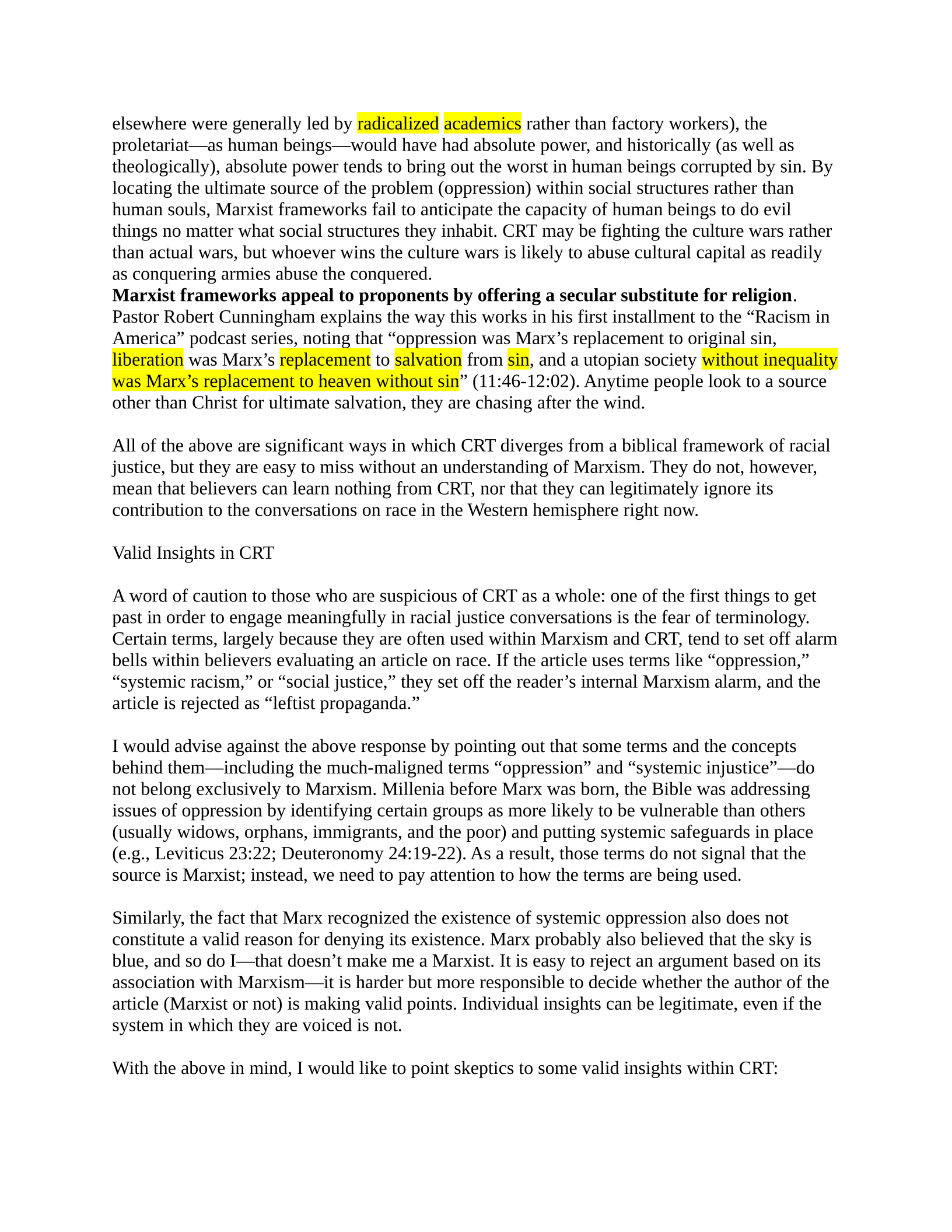
elsewhere were generally led by radicalized academics rather than factory workers), the
proletariat—as human beings—would have had absolute power, and historically (as well as
theologically), absolute power tends to bring out the worst in human beings corrupted by sin. By
locating the ultimate source of the problem (oppression) within social structures rather than
human souls, Marxist frameworks fail to anticipate the capacity of human beings to do evil
things no matter what social structures they inhabit. CRT may be fighting the culture wars rather
than actual wars, but whoever wins the culture wars is likely to abuse cultural capital as readily
as conquering armies abuse the conquered.
Marxist frameworks appeal to proponents by offering a secular substitute for religion.
Pastor Robert Cunningham explains the way this works in his first installment to the “Racism in
America” podcast series, noting that “oppression was Marx’s replacement to original sin,
liberation was Marx’s replacement to salvation from sin, and a utopian society without inequality
was Marx’s replacement to heaven without sin” (11:46-12:02). Anytime people look to a source
other than Christ for ultimate salvation, they are chasing after the wind.
All of the above are significant ways in which CRT diverges from a biblical framework of racial
justice, but they are easy to miss without an understanding of Marxism. They do not, however,
mean that believers can learn nothing from CRT, nor that they can legitimately ignore its
contribution to the conversations on race in the Western hemisphere right now.
Valid Insights in CRT
A word of caution to those who are suspicious of CRT as a whole: one of the first things to get
past in order to engage meaningfully in racial justice conversations is the fear of terminology.
Certain terms, largely because they are often used within Marxism and CRT, tend to set off alarm
bells within believers evaluating an article on race. If the article uses terms like “oppression,”
“systemic racism,” or “social justice,” they set off the reader’s internal Marxism alarm, and the
article is rejected as “leftist propaganda.”
I would advise against the above response by pointing out that some terms and the concepts
behind them—including the much-maligned terms “oppression” and “systemic injustice”—do
not belong exclusively to Marxism. Millenia before Marx was born, the Bible was addressing
issues of oppression by identifying certain groups as more likely to be vulnerable than others
(usually widows, orphans, immigrants, and the poor) and putting systemic safeguards in place
(e.g., Leviticus 23:22; Deuteronomy 24:19-22). As a result, those terms do not signal that the
source is Marxist; instead, we need to pay attention to how the terms are being used.
Similarly, the fact that Marx recognized the existence of systemic oppression also does not
constitute a valid reason for denying its existence. Marx probably also believed that the sky is
blue, and so do I—that doesn’t make me a Marxist. It is easy to reject an argument based on its
association with Marxism—it is harder but more responsible to decide whether the author of the
article (Marxist or not) is making valid points. Individual insights can be legitimate, even if the
system in which they are voiced is not.
With the above in mind, I would like to point skeptics to some valid insights within CRT:
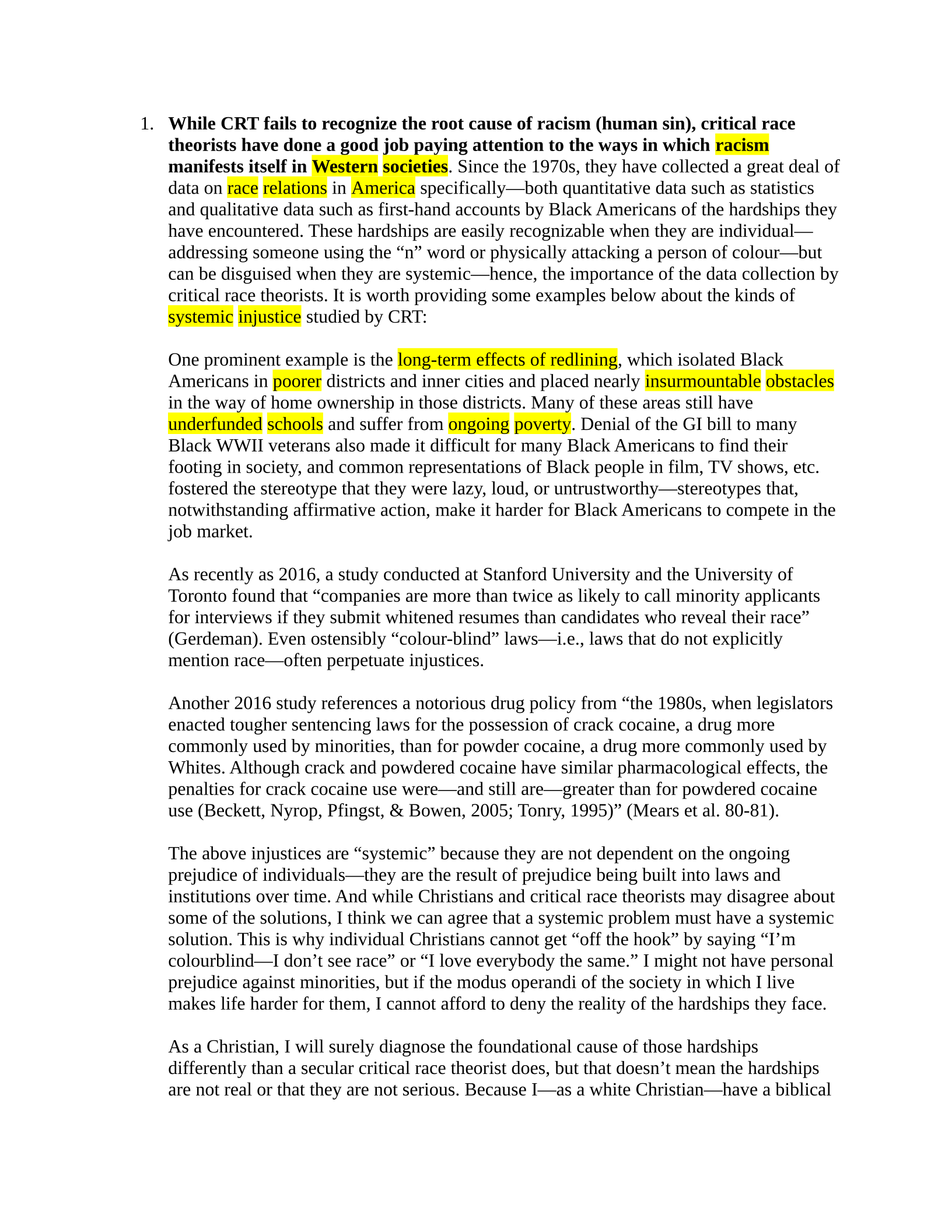
1. While CRT fails to recognize the root cause of racism (human sin), critical race
theorists have done a good job paying attention to the ways in which racism
manifests itself in Western societies. Since the 1970s, they have collected a great deal of
data on race relations in America specifically—both quantitative data such as statistics
and qualitative data such as first-hand accounts by Black Americans of the hardships they
have encountered. These hardships are easily recognizable when they are individual—
addressing someone using the “n” word or physically attacking a person of colour—but
can be disguised when they are systemic—hence, the importance of the data collection by
critical race theorists. It is worth providing some examples below about the kinds of
systemic injustice studied by CRT:
One prominent example is the long-term effects of redlining, which isolated Black
Americans in poorer districts and inner cities and placed nearly insurmountable obstacles
in the way of home ownership in those districts. Many of these areas still have
underfunded schools and suffer from ongoing poverty. Denial of the GI bill to many
Black WWII veterans also made it difficult for many Black Americans to find their
footing in society, and common representations of Black people in film, TV shows, etc.
fostered the stereotype that they were lazy, loud, or untrustworthy—stereotypes that,
notwithstanding affirmative action, make it harder for Black Americans to compete in the
job market.
As recently as 2016, a study conducted at Stanford University and the University of
Toronto found that “companies are more than twice as likely to call minority applicants
for interviews if they submit whitened resumes than candidates who reveal their race”
(Gerdeman). Even ostensibly “colour-blind” laws—i.e., laws that do not explicitly
mention race—often perpetuate injustices.
Another 2016 study references a notorious drug policy from “the 1980s, when legislators
enacted tougher sentencing laws for the possession of crack cocaine, a drug more
commonly used by minorities, than for powder cocaine, a drug more commonly used by
Whites. Although crack and powdered cocaine have similar pharmacological effects, the
penalties for crack cocaine use were—and still are—greater than for powdered cocaine
use (Beckett, Nyrop, Pfingst, & Bowen, 2005; Tonry, 1995)” (Mears et al. 80-81).
The above injustices are “systemic” because they are not dependent on the ongoing
prejudice of individuals—they are the result of prejudice being built into laws and
institutions over time. And while Christians and critical race theorists may disagree about
some of the solutions, I think we can agree that a systemic problem must have a systemic
solution. This is why individual Christians cannot get “off the hook” by saying “I’m
colourblind—I don’t see race” or “I love everybody the same.” I might not have personal
prejudice against minorities, but if the modus operandi of the society in which I live
makes life harder for them, I cannot afford to deny the reality of the hardships they face.
As a Christian, I will surely diagnose the foundational cause of those hardships
differently than a secular critical race theorist does, but that doesn’t mean the hardships
are not real or that they are not serious. Because I—as a white Christian—have a biblical

obligation to care about and fight against the conditions that perpetuate suffering in my
fellow human beings, I have a biblical obligation to pay attention to and do something
about the specific ways in which the society in which I live has denigrated the humanity
of Black people and other ethnic minorities.
The fact that critical race theorists have often done a better job of documenting these
injustices than many Christians have does not give me an excuse to ignore them—
instead, it creates a greater urgency for those of us in the church to do a better job at
paying attention to these things and processing them within a biblical framework.
2. Critical theory in general has developed helpful terminology for describing how
structural oppression manifests within a society. For instance, the term “hegemony”
helps us understand the ways in which some voices in a society tend to dominate our
discourse. As defined by Italian philosopher Antonio Gramsci, “hegemony” refers to the
ways in which the views of one group become “diffus[ed]…throughout…society as a
whole, thus equating one’s own interests with the interests of society at large” (qtd. in
Eagleton 116).
In a layperson’s terms, what is best for the powerful ends up being seen as what is best
for everyone. As a result, people can be brainwashed into subverting their own interests
(116). While I disagree with Marxist scholars on many levels, they are not wrong that the
ways in which human beings process their experiences are strongly influenced by social
forces—news and social media, political rhetoric, commercial advertisements, family
dynamics, etc. And it makes sense to also believe that those forces can be deceitful. I do
not, like Marx, believe that human beings are created from the ground up by those forces,
which he called a superstructure and other Marxist scholars refer to as “ideology”
(another important term).
However, one does not have to be a Marxist to recognize that, just as we attempt to
influence our environment, we are also susceptible to its influence. If we were not, the
Bible would not have said that “bad company ruins good morals” (1 Cor. 15:33). Those
we surround ourselves with can influence how we think and behave, and the most
powerful voices in our culture are likely to have a powerful influence. While it is possible
to overcorrect and suggest that the voices being drowned out by the hegemonic discourse
in Western culture are valid simply by virtue of being silenced, it is equally problematic
to accept that the dominant voices in our culture are right about everything merely
because they have the microphone.[2]
3. CRT’s emphasis on the “voice of colour” posits that people who experience race-
based oppression should be given a platform to share their experiences, often
through storytelling. Storytelling as a way of challenging accepted norms and
highlighting existing injustices has biblical precedents in the parables of Jesus (e.g., the
Good Samaritan, Lazarus and the Rich Man). Therefore, the emphasis on storytelling is
another aspect of CRT that I as a Christian can get behind.
Where do we go from here?
It is important to recognize that we’ve only scratched the surface of CRT. There are other valid
observations made by critical race theorists, as well as additional problems with CRT as a
framework. Both CRT and the issues it attempts to address are complex and worthy of serious
study. So how can we continue to grow in our understanding?
First, I would encourage believers to educate themselves about biblical principles regarding race
and racism. The Bible challenges ethnic stereotypes (the Good Samaritan), affirms interracial
marriage (Moses and Zipporah, Boaz and Ruth), promotes racial diversity in the early church
(Gal 3:28), affirms the dignity of all human beings (Gen. 1-2), and repeatedly prohibits Old
Testament Israel from discriminating against foreigners, which would have included ethnic
minorities (e.g., Lev. 19:34).
Secondly, I would encourage believers to educate themselves about the history of race and
racism in North America. I have listed some resources below that would be good starting points.
Thirdly, we must be committed to listening—for white Christians, we have a responsibility to
listen to our brothers and sisters of colour, for whom it is often painful and draining enough to
share trauma without being dismissed for “playing the race card.”
And lastly, we must look for specific and active ways to address racism on both systemic and
individual levels. Avenues for action/activism may differ, depending on an individual’s position
in the world.
As someone blessed with an education in literature, critical theory, and Marxist (Soviet)
oppression, I am attempting to apply this education to questions of race in America. Because I
am a university professor, I am attempting to make a difference primarily through teaching and
writing. I would challenge every reader to ask the question, “What difference can I make within
my community and/or my field?” And of course, don’t just ask the question of yourself—ask the
Lord for guidance too, regarding all these hard and important questions about race.
Powered by TCPDF (www.tcpdf.org)

