


GLST 290
My ethnographic interview was done on my unit’s colonel, COL Miriam Hayden. We work
in the same section in my unit. She is Filipino and Hispanic, who group up on the Southwest
before relocating here to North Carolina. The interview on Miriam was conducted in her office at
our place of work. I prepared for this interview by doing the research on her racial culture as well
as her regional culture. I then created questions that I believed would give the best answers to
understand her culture. After preparing these questions, I had a friend proofread my questions
ensuring that all my questions got my point across in a grammatically correct and effective way.
Finally, I coordinated with Miriam to choose the best date that would allow us to have the full
interview without interruptions.
Miriam is a Christian and believes God is our Lord and Savior.1 She doesn’t look down or
think negatively of other religions. She doesn’t believe in judging others; she believes that
ultimately no matter what religion you are God will give you a choice whether or not to accept
Him when your time is up on this Earth.2 This core belief of hers stems from her grandfather.
Growing up her grandfather was a preacher and gave her the choice of finding her own religion.3
Doing so allowed her to find her own understanding and beliefs within Christianity. Her beliefs
impacts her values and practices by accepting and respecting others no matter their beliefs. They
also allow her to have an openness with any person no matter their background.
In general, the Hispanic culture expresses the importance of family. Miriam’s family as a
whole is valued. All of Miriam’s aunts and uncles on her dad side were considered her
immediate family. Her family is very close in ways like a cousin being seen more as a sibling.4
The society Miriam grew up in were direct communicators but were friendly. So, when they
1 Hayden, Miriam. Interview by Ablessing King. Ethnograpic Interview. North Carolina, November 19,
2021.
2 Ibid.
3 Ibid.
4 Ibid.
Page 2 of 7
GLST 290
would speak directly it was never with malice.5 These values are significant because they can
define the way a person views family dynamics in their own family and different cultures. These
values impacted Miriam by allowing her to have family she could lean on when she needed it.
Because of her family being so tight knit, when she needed help with her children her mom and
aunt would fly out when she would have to do training with the military.6
Miriam is very open and accepting of others beliefs and opinions. So, when it comes to her
rationale in times of conflict, she believes that when there is conflict that you should find where
both parties agree first and then try to have a conversation from there.7 She believes that if you
start where you both agree there will be a mutual respect and rapport in the initial start of the
conversation. There is a statement that Miriam made that I think fits our culture here in America
well but also exhibits her understanding of others well. She said, “The United States is not a
melting pot but a tossed salad.”8 Meaning that we are all different and have our own individual
qualities but that’s what makes us who we are. Miriam’s rationale reminds me of some of the
teachings found in Duane Elmer’s Cross Cultural Servanthood: Serving the World in Christlike
Humility. Chapter 5 of Elmer’s book he speaks of acceptance and how we should communicate
respect for others.9 Miriam’s response on how she handles conflict exhibits his teachings by
accepting what others believe and by not looking down on them because they believe differently.
My knowledge of the anthropological perspective and rapport impacted my interview by
ensuring I was prepared for this interview with the right questions and creating an atmosphere
where the interviewee was able to be open. Participant observation is defined as an approach to
5 Hayden, Miriam. Interview by Ablessing King. Ethnograpic Interview. North Carolina, November 19,
2021.
6 Ibid.
7 Ibid.
8 Ibid.
9 Elmer, Duane. 2009. Cross-Cultural Servanthood: Serving the World in Christlike Humility. Westmont,
IL: IVP Books.
Page 3 of 7
GLST 290
research that combines participation and observation in various ways to optimize understanding
of the culture being studied.10 In this case participant observation did not help me in this
interview because I was not able to participate or directly observe her culture. My knowledge of
rapport allowed for a free flow of communication between the two of us. The interview didn’t
feel like an interview, but more like a conversation between two colleagues. Anthropological
perspective is an approach to social research that seeks to understand culture from the point of
view of the people within that cultural context.11 So my knowledge of this perspective helped me
to create the appropriate questions to ask her in the interview that was tied to her culture by
researching specific topics that would explain her worldview and culture. The research
conducted before the interview played a vital role in me learning about Miriam. The pre-
interview research didn’t impact my perception as much as my personal worldview did.
Knowing Miriam from work, the pre-interview questions made me curious, if anything, about
how her culture made her who she is but did not at all effect the way I might think she would
respond. My personal worldview impacted my perception of how she might respond because I
have met many different Christians and you never know how they view God or the people
around them. So, my personal worldview made me open and eager to hear her response to my
pre-interview questions. There were some surprises, such as her view on humanity and the
afterlife. There are few times that I find someone from her generation with the same viewpoint
on the afterlife as I do.
From the teachings I have learned through this process and class I will apply the
ethnographic interview concepts to my interactions in my coaching job field by learning about
my athletes’ culture and practices. I think REAP, rapid ethnographic assessment procedures,
10 Howell, Brian M., and Jenell Paris. 2019.EEEIntroducing Cultural Anthropology: A Christian
Perspective. Second Edition. Grand Rapids, MI: Baker Academic: A Division of Baker Publishing Group.
11 Ibid.
Page 4 of 7
GLST 290
would be most effective in my job field. When it comes to coaching, you have the off season to
recruit but this is not a lot of time to research all possible prospects for a team. The time
compressed use of ethnographic interviews and other methods of prospect observation would
allow me the short amount of time that I am given to learn about each prospect but still giving
me a general understanding of their culture and values.12 Learning about the prospects for my
team through these processes will determine whether I believe that their values and practices will
ultimately help me and my team or not. Also by learning about my prospects through these
processes I will be able to know how to coach and interact with them to make them better in the
sport and in life.
12 Howell, Brian M., and Jenell Paris. 2019.EEEIntroducing Cultural Anthropology: A Christian
Perspective. Second Edition. Grand Rapids, MI: Baker Academic: A Division of Baker Publishing Group.
Page 5 of 7
GLST 290
Bibliography
Elmer, Duane. 2009. Cross-Cultural Servanthood: Serving the World in Christlike Humility.
Westmont, IL: IVP Books.
Hayden, Miriam. Interview by Ablessing King. Ethnograpic Interview. North Carolina,
November 19, 2021.
Howell, Brian M., and Jenell Paris. 2019.EEEIntroducing Cultural Anthropology: A Christian
Perspective. Second Edition. Grand Rapids, MI: Baker Academic: A Division of Baker
Publishing Group.
Page 6 of 7
GLST 290
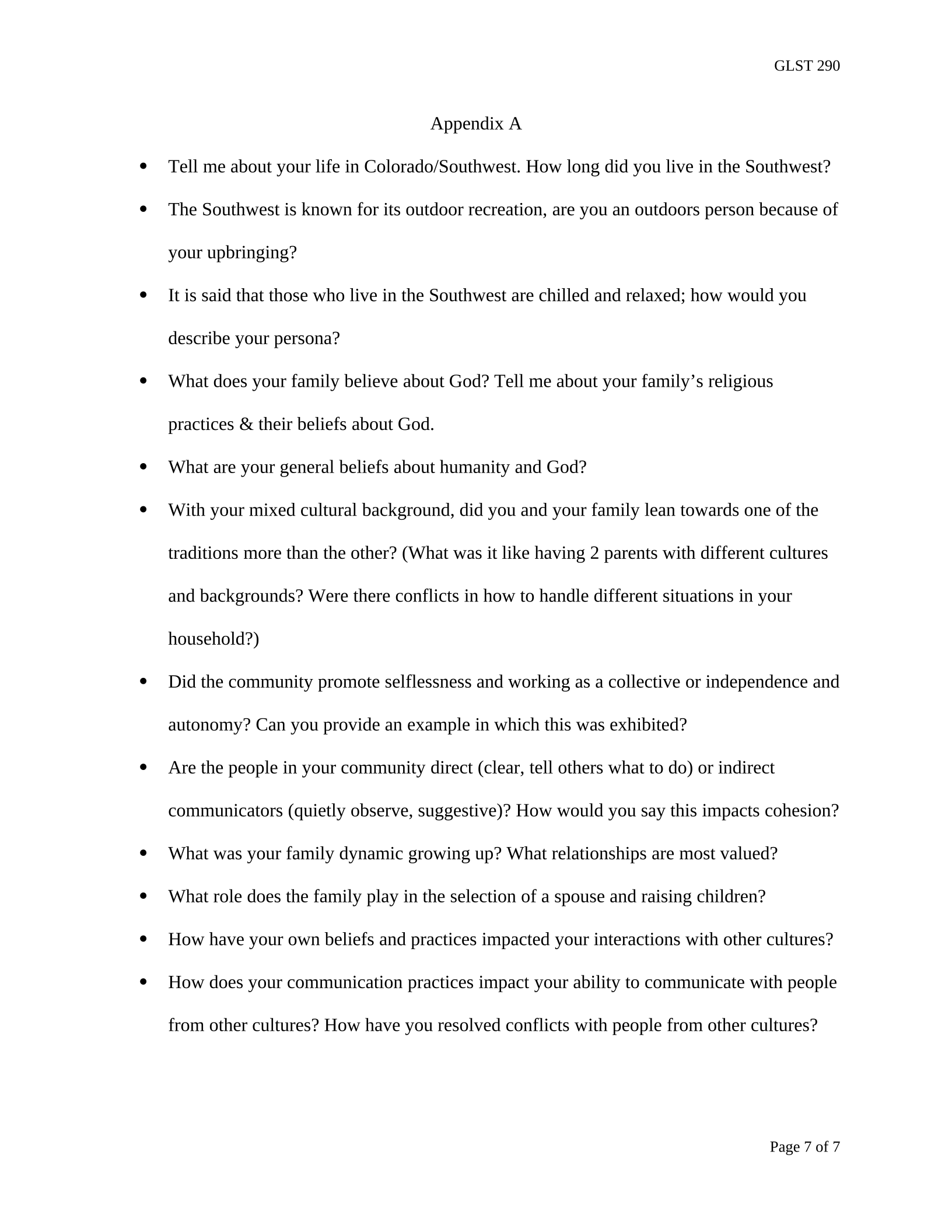
Appendix A
Tell me about your life in Colorado/Southwest. How long did you live in the Southwest?
The Southwest is known for its outdoor recreation, are you an outdoors person because of
your upbringing?
It is said that those who live in the Southwest are chilled and relaxed; how would you
describe your persona?
What does your family believe about God? Tell me about your family’s religious
practices & their beliefs about God.
What are your general beliefs about humanity and God?
With your mixed cultural background, did you and your family lean towards one of the
traditions more than the other? (What was it like having 2 parents with different cultures
and backgrounds? Were there conflicts in how to handle different situations in your
household?)
Did the community promote selflessness and working as a collective or independence and
autonomy? Can you provide an example in which this was exhibited?
Are the people in your community direct (clear, tell others what to do) or indirect
communicators (quietly observe, suggestive)? How would you say this impacts cohesion?
What was your family dynamic growing up? What relationships are most valued?
What role does the family play in the selection of a spouse and raising children?
How have your own beliefs and practices impacted your interactions with other cultures?
How does your communication practices impact your ability to communicate with people
from other cultures? How have you resolved conflicts with people from other cultures?
Page 7 of 7
Powered by TCPDF (www.tcpdf.org)

