


Amie Farmer
Liberty University
ENGL 101
Professor Audrey Hess
April 01, 2024
Eliminate Worldwide Cybercrime
1.Introduction
A. Cybercrime on the rise
1. Consider a time where millions of data is stolen or compromised due to a
lack of privacy and cyber security. This is not a dream; rather, it is the startling
truth.
B. Prominent experts in cybersecurity and threat intelligence concur that there is a sharp
rise in internet criminal behavior.
1. Cybercriminals can obtain personal and corporate information, including
trade secrets, by using computer technology (Cascavilla, 2021)
2. The enormous expenses and lack of understanding about cyberattacks makes
it almost impossible to alleviate.
C. Thesis Statement
It is critical to prioritize public awareness and education backed by results from
reliable sources, international collaboration, and the development of innovative
technology to successfully tackle the global cybercrime problem.
II. Improving Technology
A. One way to lessen the chances of attacks is to create new cybersecurity technologies.
1. To combat cybercrime in today's world, cutting-edge cyber technology is
essential. The need for technological solutions to counter threats is growing as criminals
become more intelligent (Firdaus 2022).
B. AI-powered cybersecurity tools and services like MDR can better detect and notify
security teams of threats (Al-khateeb 2020).
1. Cybersecurity systems can detect and respond to threats faster and more
accurately with AI. This proactive approach greatly reduces online system cyberattack
vulnerability.
D. Investing in better technology strengthens cybersecurity.
III. Internation Collaboration
A. To meet the ever-increasing difficulties posed by cyber threats, cybersecurity
collaboration is an effective strategy.
1. Organizations can improve their security posture, incident response, and threat detection by
collaborating and sharing information, resources, and expertise.
B. All of these cases illustrate how cybercrime is a global problem and how important it
is for countries to work together to catch cybercriminals.
C. The only way to successfully fight cybercrime on a worldwide scale is for the
international community to collaborate and share information.
D. The demand for international collaborations is increasing in the field of cybersecurity.
It is a crucial element in eradicating cybercrime.
IIII. Educating the public
A. An important part of improving cyber defenses is raising public awareness.
1. By acquiring knowledge about cyber security threats and best practices, individuals can
impede cybercriminals' ability to access sensitive personal information (Lessig 2021).
B. Cyber threat education in schools helps bring attention to the issue among the general
public.
C. People can learn to protect themselves from cyber threats through effective
cybersecurity awareness training.
D. Individuals can safeguard themselves online in a variety of ways, such as by installing
software updates regularly, creating strong passwords, being wary about sharing personal
information online, and educating themselves and others around them.
E. Raising public awareness is important, but personal accountability is even more
crucial in making cybersecurity stronger.
IV. The accountability of the cyber-attackers
A. Those responsible for cyberattacks need to face consequences.
B. More laws need to be in place to prosecute cyber attackers.
1. It is challenging to establish technical laws due to the presence of cybercrimes in the digital
realm. That is why catching and punishing criminals is so challenging. Collecting evidence is
also challenging (Zhang 2012).
C. Cyber criminal activity and conflict have flourished in the digital world because no one is
held responsible for their actions online.
1. In cybercrime investigations, digital forensics is essential for uncovering the identity of a
cyber attacker.
D. Like stated above a combination of digital forensics, advanced technologies, international
cooperation, and public education and awareness are required to identify a cyber attacker.
V. The potential for cybercriminals to utilize AI to facilitate their illicit endeavors, such as
password guessing, could make it harmful.
A. The utility of Artificial Intelligence is greater in safeguarding data and identifying cyber
threats, as opposed to benefiting criminals.
1. is capable of detecting oddities and taking appropriate action, such as halting the attack.
B. Internet space is growing at an astounding rate. There is no way that humans could ever verify
all of the data individually given the exponential growth. Consequently, AI is essential for a
functional system (Muhammad 2021).
C. Accelerating response times of a cyber-attack is another benefit of Artificial Intelligence.
D. The benefits of AI in improving cybersecurity much exceed the risks associated with its
possible abuse by cybercriminals.
E. Ultimately, the use of AI will make us safer and further our technology. We must also be
consistent with other measures to reduce cybercrime.
VI. The pervasive danger of cybercrime can be collectively mitigated and the internet made safer
for all users if we work together, develop new technologies, hold cyberattackers accountable, and
raise awareness and education.
A. In an ideal world, our personal information would be safe from prying eyes. We can shape the
future of a safer internet by gaining knowledge and working together.
Works Cited
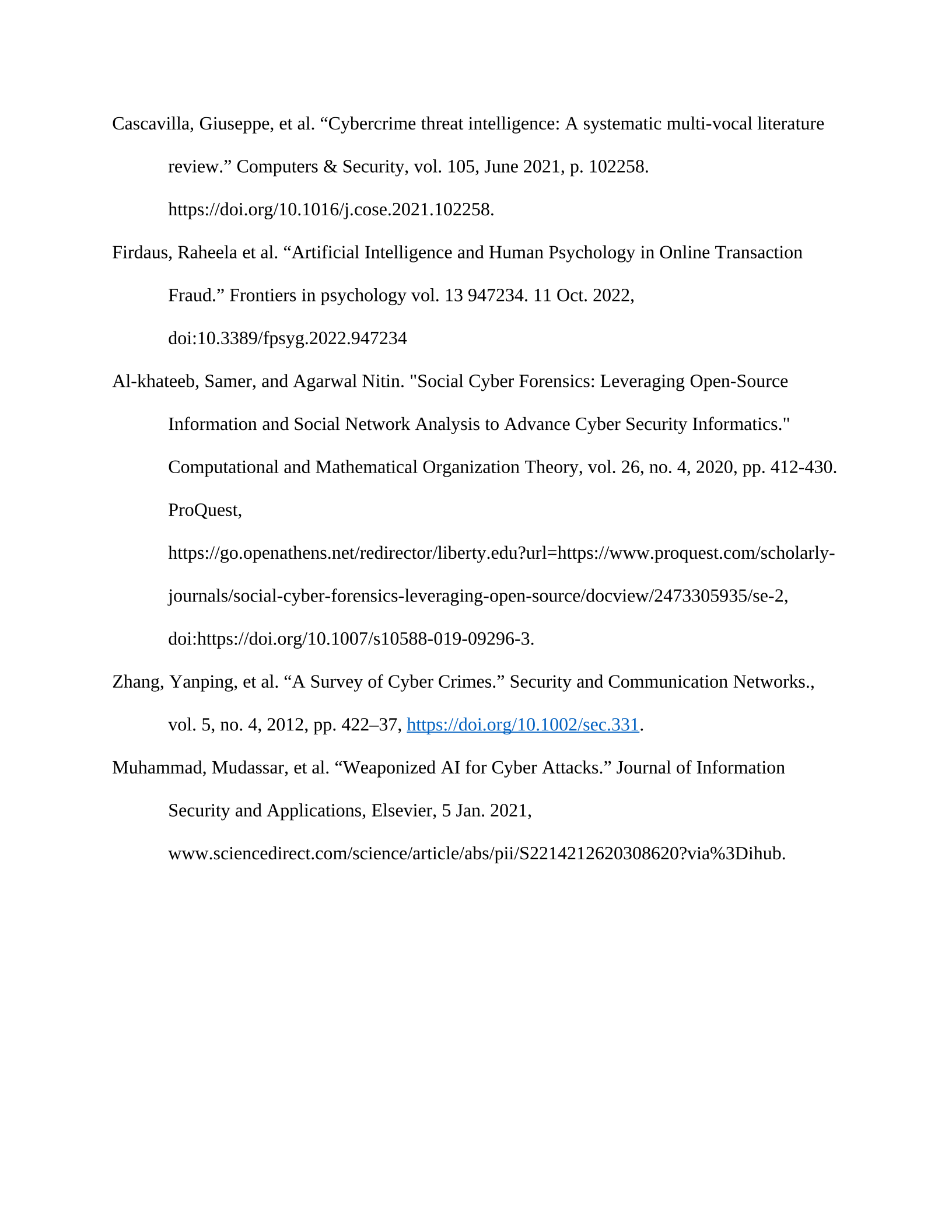
Cascavilla, Giuseppe, et al. “Cybercrime threat intelligence: A systematic multi-vocal literature
review.” Computers & Security, vol. 105, June 2021, p. 102258.
https://doi.org/10.1016/j.cose.2021.102258.
Firdaus, Raheela et al. “Artificial Intelligence and Human Psychology in Online Transaction
Fraud.” Frontiers in psychology vol. 13 947234. 11 Oct. 2022,
doi:10.3389/fpsyg.2022.947234
Al-khateeb, Samer, and Agarwal Nitin. "Social Cyber Forensics: Leveraging Open-Source
Information and Social Network Analysis to Advance Cyber Security Informatics."
Computational and Mathematical Organization Theory, vol. 26, no. 4, 2020, pp. 412-430.
ProQuest,
https://go.openathens.net/redirector/liberty.edu?url=https://www.proquest.com/scholarly-
journals/social-cyber-forensics-leveraging-open-source/docview/2473305935/se-2,
doi:https://doi.org/10.1007/s10588-019-09296-3.
Zhang, Yanping, et al. “A Survey of Cyber Crimes.” Security and Communication Networks.,
vol. 5, no. 4, 2012, pp. 422–37, https://doi.org/10.1002/sec.331.
Muhammad, Mudassar, et al. “Weaponized AI for Cyber Attacks.” Journal of Information
Security and Applications, Elsevier, 5 Jan. 2021,
www.sciencedirect.com/science/article/abs/pii/S2214212620308620?via%3Dihub.
Powered by TCPDF (www.tcpdf.org)

