SCIENCE EXPERIMENT PROJECT: FINAL ASSIGNMENT
Purpose
How will varying levels of nitrogen content in the soil affect the growth of planted bean
seeds?
Science Content
Students will need to know a few basic concepts. One is decomposition. Students will need to
understand how decomposition breaks down dead organism and returns nutrients to the soil.
Another concept is photosynthesis. Students will need to have an understanding of how plants
produce energy from the suns light. Students will also need a base understanding of different soil
components such as pH levels, nitrogen, carbon, and phosphorous. Nitrogen is incredibly
important for plant growth, and many soils are found to have insufficient amounts of nitrogen
(Fernandez and Kaiser, n.d.). Nitrogen can be lost from a variety of reasons, including erosion,
leeching, and crop removal (Fernandez and Kaiser, n.d.).
Hypothesis
If bean plants are grown in soil with a higher nitrogen level, then they will show an
increased amount of growth than those in with a lower nutrient content.
Variables
The Independent Variable will be the soil composition. Different compositions tested will
include vegetable compost, manure compost, and chemical fertilizer. The Dependent Variable
will be the growth of the bean plants, measured as centimeters of height rounded to the nearest
quarter of a centimeter. Control variables will include the type of bean plant, the amount of water
given to plants, the amount of light exposure, and the temperature.

SCIENCE EXPERIMENT PROJECT: FINAL ASSIGNMENT
Materials and Tools
Materials will include four 4” planting pots, one pack of Blue Lake bean seeds, two and a
half cups of plain yard soil, one half a cup of vegetable compost, one half a cup of manure
compost, and one half a cup of chemically enriched soil. Also needed will be a measuring cup, a
measuring tape, and an excel spreadsheet.
Plan and Procedure
Each pot will have a total of one cup of soil placed in it. One pot will contain only yard
soil, the other three will be half soil and half soil amendments; vegetable compost, manure
compost, and chemically enriched soil. The chemically enriched soil will be Miracle Gro Potting
Soil. Each pot will be labeled based on its soil composition. The bean seeds will all be planted
one-half inch deep, and placed on the same window sill. This will ensure they all receive equal
light exposure, and the same temperature. Each pot will receive one fourth of a cup of water
daily at 6:00 pm. At that time the height of each plant will be measured in centimeters with a
measuring tape, and rounded to the nearest quarter of a centimeter. The results will be put in an
excel spreadsheet to track the data. At the end of two weeks the final height will be measured,
and conclusions will be drawn on how soil composition influenced plant growth.
SCIENCE EXPERIMENT PROJECT: FINAL ASSIGNMENT
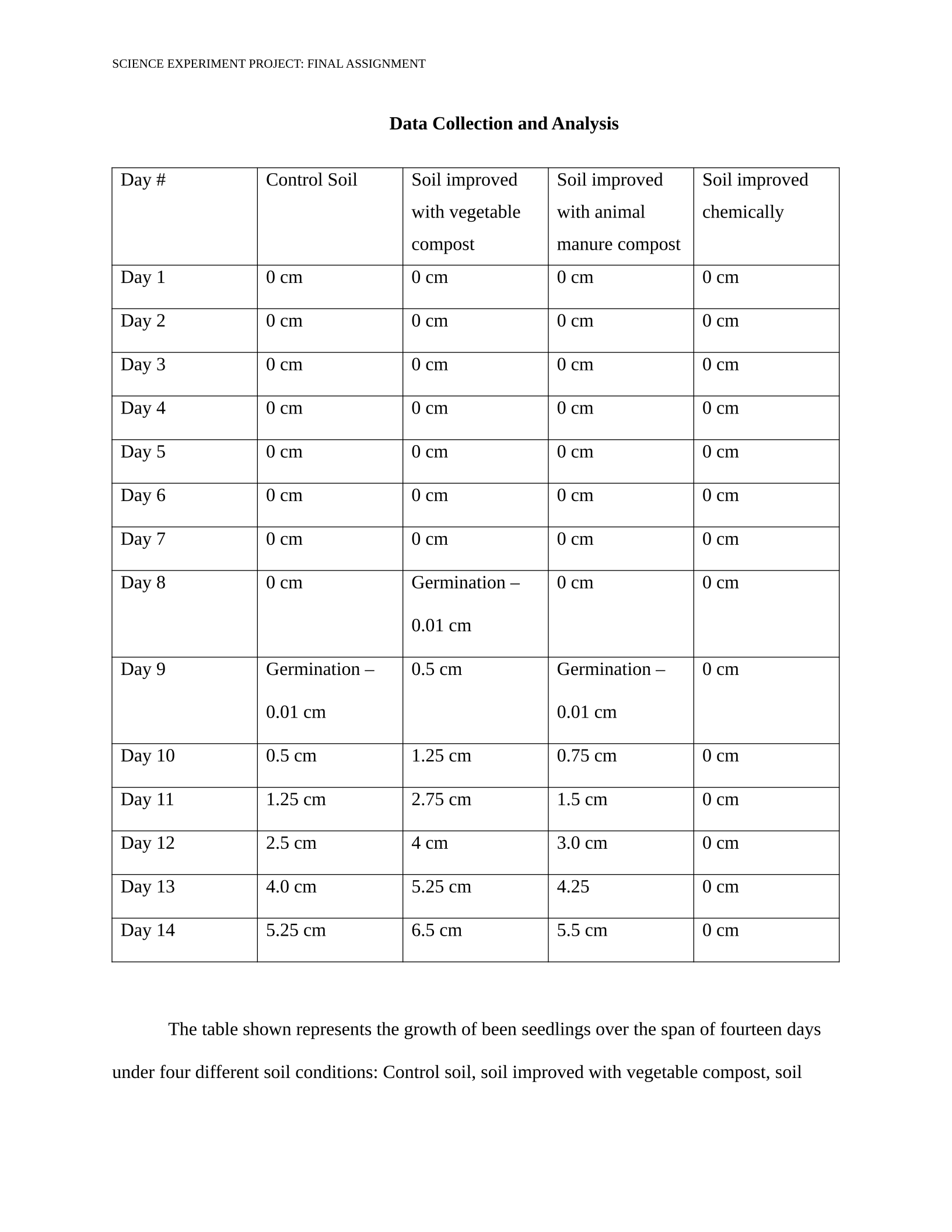
Data Collection and Analysis
Day # Control Soil Soil improved
with vegetable
compost
Soil improved
with animal
manure compost
Soil improved
chemically
Day 1 0 cm 0 cm 0 cm 0 cm
Day 2 0 cm 0 cm 0 cm 0 cm
Day 3 0 cm 0 cm 0 cm 0 cm
Day 4 0 cm 0 cm 0 cm 0 cm
Day 5 0 cm 0 cm 0 cm 0 cm
Day 6 0 cm 0 cm 0 cm 0 cm
Day 7 0 cm 0 cm 0 cm 0 cm
Day 8 0 cm Germination –
0.01 cm
0 cm 0 cm
Day 9 Germination –
0.01 cm
0.5 cm Germination –
0.01 cm
0 cm
Day 10 0.5 cm 1.25 cm 0.75 cm 0 cm
Day 11 1.25 cm 2.75 cm 1.5 cm 0 cm
Day 12 2.5 cm 4 cm 3.0 cm 0 cm
Day 13 4.0 cm 5.25 cm 4.25 0 cm
Day 14 5.25 cm 6.5 cm 5.5 cm 0 cm
The table shown represents the growth of been seedlings over the span of fourteen days
under four different soil conditions: Control soil, soil improved with vegetable compost, soil
SCIENCE EXPERIMENT PROJECT: FINAL ASSIGNMENT
improved with animal manure compost, and soil improved chemically. Growth measurements
are observed and recorded in centimeters daily. There was no initial growth during the first
seven days. Day eight showed the first signs of germination in the soil improved with vegetable
compost, with the first bit of the seedling showing. There was no significant amount of height to
measure. Day nine showed the first signs of germination in the control soil and the soil
improved with animal manure compost, with the seed in vegetable compost improved soil
reaching 0.5 centimeters. Subsequent days saw growth patterns become much more pronounced,
ending with the seed planted in soil improved with vegetable compost showing the most growth
at 6.5 cm. This was followed by the soil improved with animal manure compost at 5.5
centimeters and the control soil showing 5.25 centimeters of growth. The seed in the chemically
enriched soil failed to germinate.
Conclusion and Inferences
The data collected from the experiment does provide some insight to the impact of
different soil conditions on the growth of been seeds. It appears from the evidence that the
addition of organic materials such as vegetable compost and animal manure compost positively
influences the growth of seedlings compared to the control soil. This would suggest that organic
matter enhances soil fertility and increases the amount of nitrogen available to plants. The
experiment would also suggest that vegetable compost is superior to animal compost in the affect
it has on plant growth. The experiment also might suggest that the use of chemically enriched
soil has a negative effect on the growth rate of bean seedlings as there was a failure to germinate
for the seed planted in chemically enriched soil.
However, this experiment is plausibly too small in scale to be taken as an accurate
reflection. It is quite possible that the increased growth seen in the vegetable compost is simply
SCIENCE EXPERIMENT PROJECT: FINAL ASSIGNMENT
due to the fact that it germinated a day sooner than the other two seeds that successfully
germinated. The increased growth in the seed planted in soil improved with animal manure
compost compared to the control soil is minimal as well. When comparing the three seeds on the
fifth day after germination instead of the total days since the experiment began, the growth rate is
all within a quarter of a centimeter, arguably not a significant difference. The differences in
growth could be due to the different germination dates of the seeds, and due to variation in the
individual seeds themselves. It could also be the seed that failed to germinate in the chemically
enriched soil, rather than the soil itself. If the experiment was to be conducted again in the future,
it should be conducted at a much larger scale to take out the variability of the seed themselves.