


Running head: FUNCTIONAL BEHAVIOR ASSESSMENT
Functional Behavior Assessment
Bianca Yarde
School of Education, Liberty University
EDCL 623: Principles of Behavior Management
Dr. Jose Arturo Puga
School of Education, Liberty University
2
FUNCTIONAL BEHAVIOR ASSESSMENT
Student’s Name: Braylon Sanchez
Gender: Male
Interviewer: Bianca Yarde
A. DESCRIBE THE BEHAVIORS
1. For EACH of the behaviors of concern, define the topography (how it is performed), frequency
(how often it occurs per day, week, or month), duration (how long it lasts when it occurs), and
intensity (how damaging or destructive the behaviors are when they occur). You must include at
least three behaviors on this list. You are NOT required to provide behaviors for rows D-J.
Behavior: Provide
a name for the
behavior
Topography: How
is the behavior
performed?
Frequency: How
often does the
behavior occur?
Duration: How
long does each
behavior episode
last?
Intensity: Mild,
moderate, severe
a. Interrupted
routine.
Crying and
tantrums
When needs
aren’t met
10-15 minutes. Severe
b. Delay in
starting new
tasks.
Silence After transitions
occur
30-45 minutes Moderate
c. Upset Crying, yelling,
Anxiety
When transitions
are pending
15 minutes Moderate
d.
e.
f.
g.
h.
i.
j.
2. Which of the behaviors described above are likely to occur together in some way? Do they occur
at about the same time? In some kind of predictable sequence or “chain”? In response to the same
type of situation? Discuss in detail.
Braylon’s anger, interrupted routin and delay in tasks are all likely to occur chronologically. They are
a predicatable sequence in response to his routin being interrupted in the morning.
B. DEFINE ECOLOGICAL EVENTS (SETTING EVENTS) THAT PREDICT OR SET UP THE
PROBLEM BEHAVIORS
1. What medications is the person taking (if any), and how do you believe these may affect their
behavior?
N/A
3
2. What medical or physical conditions (if any) does the person experience that may affect their
behavior (e.g., asthma, allergies, rashes, sinus infections, seizures, problems related to
menstruation)?
N/A
3. Describe the sleep patterns of the individual and the extent to which these patterns may affect
their behavior.
Braylon may not be getting sufficient sleep at night before arriving to school. This may be
affecting his behavior during school hours.
4. Describe the eating routines and diet of the person and the extent to which these may affect their
behavior.
Braylon eats very well. His mother packs healthy lunches however, his mother can pack high in
sugar snacks and candy. The snacks and candy I do not think are beneficial to his behavior.
5.
a. Briefly list below the person’s typical daily schedule of activities. (Check the boxes by those
activities the person enjoys and those activities most associated with problems.). Please do not
invent any information for this section. If no information is available on the student’s
activities during a particular time of the day, please leave the space blank.
Time Activity Description Enjoys Problems
6:00 AM Braylon wakes up for school. X
7:00 Braylon waits for his mother to bring him to school. X
8:00 Braylon begins working on morning work. X
9:00 Braylon begins tantruming during transitions from morning
work.
X
10:00 Braylon delays and shuts down during his transition into
mathematics.
X
11:00 Braylon goes to lunch. X
12:00 PM Braylon goes to specials. X
1:00 Braylon goes to recess. X
2:00 Braylon has snack time and transitions to science or social
studies. He sleeps during this time.
X
3:00 Braylon goes home. X
4;00 N/A
5:00 N/A
6:00 N/A
7:00 N/A
8:00 N/A
4
9:00 N/A
10:00 N/A
b. To what extent are the activities on the daily schedule predictable for the person, with regard
to what will be happening, when it will occur, with whom, and for how long?
Braylon’s day is
predictable Monday – Friday but it is not noted whether there is a routine on the weekends.
c. To what extent does the person have the opportunity during the day to make choices about
their activities and reinforcing events? (e.g., food, clothing, social companions, leisure
activities)
Recess may be the only time Braylon can choose activities on his own. Who he wants to play with, if
he wants to play or walk around instead. Everything else is chosen for Braylon while at school
including lunch and his daily schedule.
6. How many other persons are typically around the individual at home, school, or work (including
staff, classmates, and housemates)? Does the person typically seem bothered in situations that are
more crowded and noisy?
There is always 1 or more persons with Braylon at all times. Home – 6; School – 2 or more. He
doesn’t always act out only when he has issues transitioning and doing assignments.
7. What is the pattern of staffing support that the person receives in home, school, work, and other
settings (e.g., 1:1, 2:1)? Do you believe that the number of staff, the training of staff, or their
social interactions with the person affect the problem behaviors?
Home 1:6 I believe that this is where Braylon is most comfortable and the training of his family
keeps him calm but I but I do believe it hinders him as well because he does not have to come out of
his comfort zone arounf his family. He is more likely, to have things done for him and be given more
time to complete assignments because he is not under the restrictions of the classroom environment.
School 1:2 I believe the training here is placed to benefit however Braylon is placed under moments
of distress especially in the morning because he is not accustomed to the routine.
C. DEFINE SPECIFIC, IMMEDIATE ANTECEDENT EVENTS THAT PREDICT WHEN THE
BEHAVIORS ARE LIKELY AND NOT LIKELY TO OCCUR.
1. Times of Day: When are the behaviors most and least likely to happen?
Most likely: Morning
Least likely:Afternoon
2. Settings: Where are the behaviors most and least likely to happen?
Most likely:School
Least likely:Home
3. People: With whom are the behaviors most and least likely to happen?
Most likely: Teachers and strangers
Least likely:Family and friends
4. Activity: What activities are most and least likely to produce the behaviors?

5
Most likely:Transitioning for assignments
Least likely:Recess, snack time and dismissal.
5. Are there particular or idiosyncratic situations or events not listed above that sometimes seem to
“set off” the behaviors, such as particular demands, noises, lights, clothing?
No.
6. What one thing could you do that would most likely make the undesirable behaviors occur?
Give Braylon more time to finish work. Consider support from an EIP teacher.
7. Briefly describe how the person’s behavior would be affected if...
a. You asked them to perform a difficult task.
Braylon may become frustrated and outburst or he may shutdown entirely/
b. You interrupted a desired activity, such as eating ice cream or watching TV.
Braylon may have an outburst.
c. You unexpectedly changed their typical routine or schedule of activities.
Braylon may have an outburst, tantrum or shutdown.
d. She or he wanted something but wasn’t able to get it (e.g., a food item up on a shelf).
Braylon may shutdown.
e. You didn’t pay attention to the person or left them alone for a while (e.g., 15 minutes).
Braylon may get upset if he is not given attention or assistance (15 minutes).
D. IDENTIFY THE CONSEQUENCES OF OUTCOMES OF THE PROBLEM BEHAVIORS THAT
MAY BE MAINTAINING THEM (I.E., THE FUNCTIONS THEY SERVE FOR THE PERSON IN
PARTICULAR SITUATIONS)
1. Think of EACH of the behaviors listed in Section A, and try to identify the specific consequences
or outcomes the person gets when the behaviors occur in different situations.
Behavior: List all
behaviors from section A
Particular situations What exactly
do they get?
What exactly
do they avoid?
a. Crying and tantrums Being told to finish
classwork.
Attention from peers
and teacher.
Interruption in routine.
b. Silence and shutting
down
Being asked to
transition into
assignments.
Attention from peers
and teacher.
Going to a comfort
place.
c. Anxiety Seeing other students
completing tasks
faster than he can.
Attention from
teacher.
Interruption in routine.
d.
e.
f.
g.
h.
i.
6
j.
E. CONSIDER THE OVERALL EFFICIENCY OF THE PROBLEM BEHAVIORS. EFFICIENCY IS
THE COMBINED RESULT OF (1) HOW MUCH PHYSICAL EFFORT IS REQUIRED, (2) HOW
OFTEN THE BEHAVIOR IS PERFORMED BEFORE IT IS REWARDED, AND (3) HOW LONG
THE PERSON MUST WAIT TO GET THE REWARD
Problem Behavior: List all behaviors from
section A.
Low
Efficiency
High
Efficiency
a. Crying and tantrums 1 2 3 4 5
b. Silence and shutting down 1 2 3 4 5
c. Anxiety 1 2 3 4 5
d. 1 2 3 4 5
e. 1 2 3 4 5
f. 1 2 3 4 5
g. 1 2 3 4 5
h. 1 2 3 4 5
i. 1 2 3 4 5
F. WHAT FUNCTIONAL ALTERNATIVE BEHAVIORS DOES THE PERSON ALREADY KNOW
HOW TO DO?
1. What socially appropriate behaviors or skills can the person already perform that may generate
the same outcomes or reinforcers produced by the problem behaviors?
Braylom does well with expressing himself and you can tell when something is wrong but he does it
in a “socially inappropriate” manner by yelling and throwing tantrums. Braylon has to express
himself in a “socially appropriate” manner.
G. WHAT ARE THE PRIMARY WAYS THE PERSON COMMUNICATES WITH OTHER PEOPLE?
1. What are the general expressive communication strategies used by or available to the person?
These might include vocal speech, signs and gestures, communication boards and books, or
electronic devices. How consistently are the strategies used?
There are no communication strategies currently in place for Braylon.
7
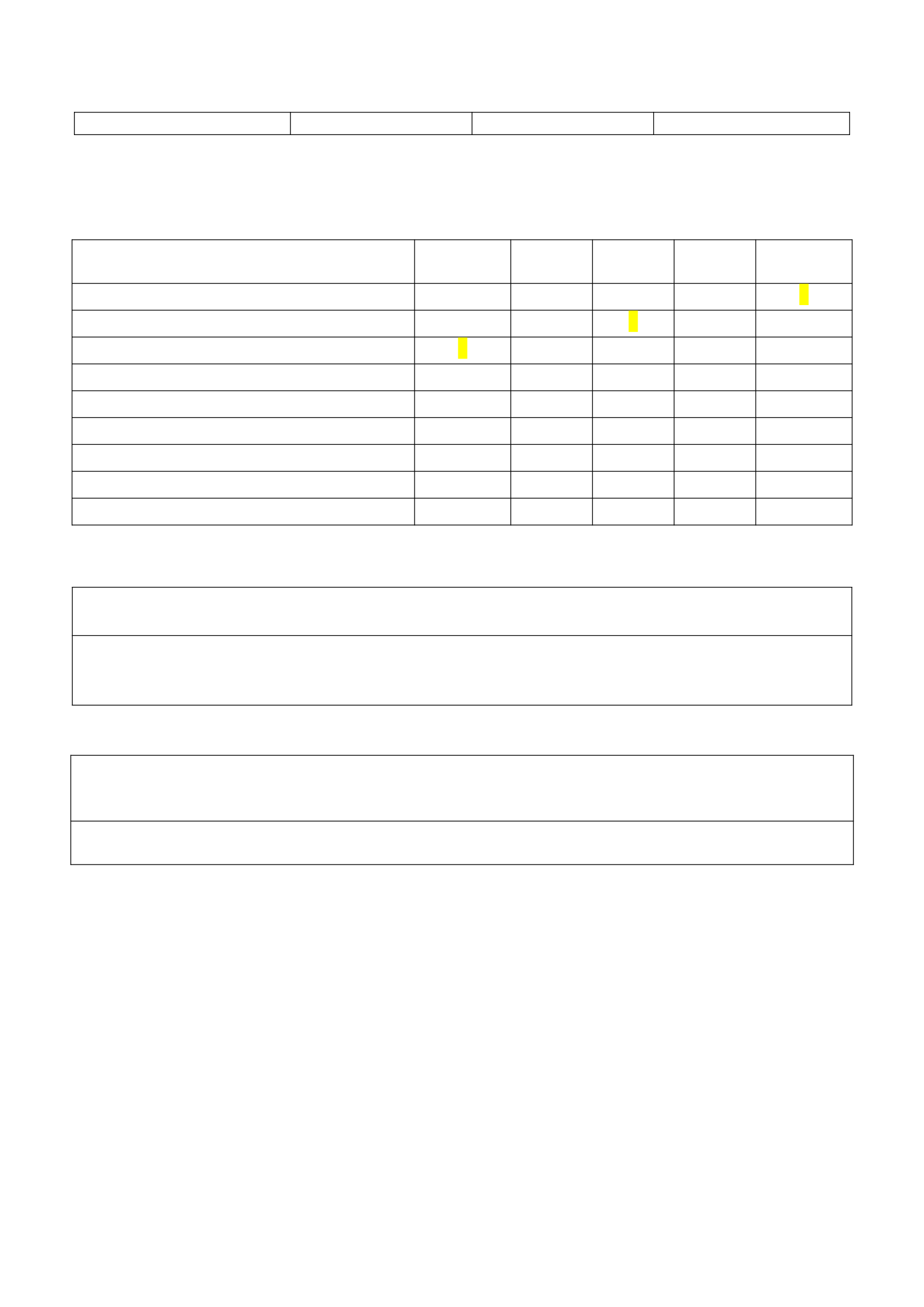
2. On the following chart, indicate the behaviors the person uses to achieve the communicative
outcomes listed:
Communicative
Functions
Complex speech (sentences)
Multiple-word phrases
One-word utterances
Echolalia
Other vocalizing
Complex signing
Single signs
Pointing
Leading
Shaking head
Grabbing/reaching
Giving objects
Increased movement
Moving close to you
Moving away or leaving
Fixed gaze
Facial expression
Aggression
Self-injury
Other
Request
attention
X X X
Request help X X X
Request
preferred
food/objects/
activities
Request break X X X
Show you
something
or some place
Indicate
physical pain
(e.g., headache,
illness)
Indicate
confusion
or unhappiness
X X X
Protest or reject
a
situation or
activity
X X X
3. With regard to the person’s receptive communication, or ability to understand other persons...
a. Does the person follow spoken requests or instructions? If so, approximately how many? (List if
only a few.)
No.
b. Does the person respond to signed or gestural requests or instructions? If so, approximately how
many? (List if only a few.)
N/A
c. Is the person able to imitate if you provide physical models for various tasks or activities? (List
if only a few.)
Yes. If you sit with Braylon and explain to him one on one a task he is able to model the work. He needs
extra support.
d. How does the person typically indicate yes or no when asked if they want something, want to go
8
somewhere, etc.?
Yes. He will tell you yes or no when he is asked if he wants something or wants to go somewhere.
H. WHAT ARE THINGS YOU SHOULD DO AND THINGS YOU SHOULD AVOID IN WORKING
WITH AND SUPPORTING THIS PERSON?
1. What things can you do to improve the likelihood that a teaching session or other activity will go
well with this person?
Offer Braylon extra support. I believe with extra support that he can be successful.
2. What things should you avoid that might interfere with or disrupt a teaching session or activity
with this person?
I believe not working with him in a small group or one on one initially to get desired changes in his
behavior will cause a disruption in the teaching session.
I. WHAT ARE THINGS THE PERSON LIKES AND ARE REINFORCING FOR THEM?
1. Food items: Candy and chips.
2. Toys and objects:Racecars, and manipulatives.
3. Activities at home He enjoys hands on activities and helping.
4. Activities/outings in the community He enjoys sports such as soccer and recess.
5. Other
J. WHAT DO YOU KNOW ABOUT THE HISTORY OF THE UNDESIRABLE BEHAVIORS, THE
PROGRAMS THAT HAVE BEEN ATTEMPTED TO DECREASE OR ELIMINATE THEM, AND
THE EFFECTS OF THOSE PROGRAMS?
Behavior: List all
behaviors from section
A.
How long has this
been a problem?
Programs Effects
a. Crying and Tantrums Since the beginning of
the school year.
No programs have
been put into place yet.
N/A
b. Anxiety Since the beginning of
the school year.
No programs have
been put into place yet.
N/A
c. Yelling and outburts Since the beginning of
the school year.
No programs have
been put into place yet.
N/A
d.
e.
f.
g.
h.
i.
j.

9

10
K. DEVELOP ONE SUMMARY STATEMENT FOR EACH BEHAVIOR LISTED IN SECTION A.
YOU ARE NOT REQUIRED TO PROVIDE SUMMARY STATEMENTS FOR ROWS D-J.
INFORMATION SHOULD BE INCLUDED IN EACH CELL FOR DISTANT SETTING EVENT,
IMMEDIATE ANTECEDENT, PROBLEM BEHAVIOR, AND MAINTAINING CONSEQUENCE.
THERE SHOULD ALSO BE A COMPLETE, ONE SENTENCE SUMMARY STATEMENT THAT
INCLUDES ALL FOUR COMPONENTS (DISTANT SETTING EVENT, IMMEDIATE
ANTECEDENT, PROBLEM BEHAVIOR, AND MAINTAINING CONSEQUENCE).
Distant Setting
Event:An event that
occurs before the target
behavior (may not be
immediately prior to the
behavior) that influences
the target behavior.
Immediate
Antecedent
(Predictor): An event
that occurs
immediately prior to
the target behavior
and may have
triggered the use of
the target behavior.
Problem Behavior: A
description of the
tbehavior from
section A.
Maintaining
Consequence: The
outcome of the
behavior (teacher’s
response or decision)
that gives the student
what they want. The
student will continue
to use the behavior
because of this
response.
a. Teacher instructs class
that it is almost time
to finish work and
transition.
Braylon is prompted to
begin finishing
assignment.
Braylon begins to
show anxiety.
Teacher is not
acknowledging
Braylon’s anxiety prior
to tantrums.
Write summary statement
A in a complete sentence:
When the teacher tells the class that it is coming time to start wrapping up
morning work, Braylon begins showing signs of anxiety. He is not being
checked on during morning work so the teacher is not seeing where he is
not making progress until after a tantrum occurs.
b. Teacher instructs class
that it is time to
transition from
morning work to
mathematics.
Braylon is asked to put
away his work.
Braylon begins to
throw a tantrum
The teacher tries to
calm him but does not
help him to finish or
ask if he having issues
comprehending.
Write summary statement
B in a complete sentence.
Once it is time for Braylon to put away his morning work. He begins to
throw a tantrum. The teacher is not acknowledging that his uncomfortable
in not being able to finish his task. She does not do anything to help, aside
from comforting him.
c. The class is asked to
transition to
mathematics.
Braylon is asked begin
transtioning to
mathematics and pay
attention.
Braylon is silent and
shutdown.
The teacher does not
come to Braylon until
he says he does not
understand his task. She
shows frustration with
Braylon.
Write summary statement
C in a complete sentence.
Braylon shuts down after morning work and has difficulty transitioning to
the next subjects. He shuts down and then he does not understand what he
is supposed to be doing during his task. The teacher expresses frustration
when he says he does not understand and he continues to shutdown even
further.
d.
Write summary statement
D in a complete sentence.
11
e.
Write summary statement
E in a complete sentence.
f.
Write summary statement
F in a complete sentence.
g.
Write summary statement
G in a complete sentence.
h.
Write summary statement
H in a complete sentence.
i.
Write summary statement
I in a complete sentence.
j.
Write summary statement
J in a complete sentence.
How confident are you that Summary Statement A is accurate?
Not very confident Very Confident
1 2 3 4 5 6
How confident are you that Summary Statement B is accurate?
Not very confident Very Confident
1 2 3 4 5 6
How confident are you that Summary Statement C is accurate?
Not very confident Very Confident
1 2 3 4 5 6
How confident are you that Summary Statement D is accurate?
Not very confident Very Confident
1 2 3 4 5 6
How confident are you that Summary Statement E is accurate?
Not very confident Very Confident
1 2 3 4 5 6
How confident are you that Summary Statement F is accurate?
Not very confident Very Confident
1 2 3 4 5 6
How confident are you that Summary Statement G is accurate?
Not very confident Very Confident
1 2 3 4 5 6
How confident are you that Summary Statement H is accurate?
Not very confident Very Confident
1 2 3 4 5 6
How confident are you that Summary Statement I is accurate?
Not very confident Very Confident
1 2 3 4 5 6
How confident are you that this Summary Statement J is accurate?
Not very confident Very Confident
1 2 3 4 5 6

12
BEHAVIOR INTERVENTION PLAN
Student’s Name: Braylon
Gender: Male
Description of Target Behavior: The target behavior is the unwanted behavior that needs to change.
Choose ONE behavior from section A of the FBA (operationally defined, easily observable and
measurable, include examples, as well as duration, frequency, and intensity):
Braylon is overwhelmed when he has to complete tasks in the morning in the timeframe given.
Hypothesis/Summary Statement of the Function of the Behavior: Use the summary statement from
section K that aligns with the behavior listed above: (developed based on information gathered from FBA
section K):
Braylon is ignored during the behavior episode until he begins transitioning into other behaviors as a result
of the anxiety.
Antecedent Modifications (What can be done to support the student and prevent the occurrence of this
behavior? What changes can be implemented by teachers or support staff to create a safe, inclusive, and
culturally responsive learning environment that engages the student in meaningful learning activities and
social interactions? Describe the modifications in enough detail for them to be implemented):
Braylon needs to be observed during morning work. The teacher and paraprofessional need to go around the
room to check the progress of the morning assignnments. The teacher or paraprofessional need to ask Braylon
what he is struggling with in the morning so that he can transition through his assighments faster. The lead
teacher should recommend EIP services for Braylon so that he is provided one on one support to help him to
be successful academically and to minimalize disruptions in the classroom environment.
Replacement Behaviors (What new behavior will be taught or what current behavior will be increased that
serves the same function as the target behavior and allows the student to achieve the same outcome). How
will the replacement behavior be taught to the student? The replacement behavior described in this section
must be specific. The plan for teaching the replacement behavior must be specific:
The replacement behavior should be encouraging Braylon to understand that he is in a safe environment to
ask for help when he does not understand something. This way support can be given to him when needed.

13
Strategies for Reinforcing Replacement Behavior (What is the immediate benefit to the student? How will
the student be rewarded for engaging in the new or emerging behavior in a way that addresses the function of
the behavior?):
When Braylon is showing that he can ask for help he should be rewarded with a sticker or praise. He should
be rewarded once he starts to understand his task and complete the task as well this can be done verbally.
Strategies for Reducing the Target Behavior (What will be the response should the target behavior occur?
This response should not maintain the behavior):
If Braylon's target behavior reoccurs, his teacher will respond by gently reminding him that it is okay to ask
for help, and providing support as needed. Braylon should also be instructed to take a deep breath and relax
to help with his anxiety. Reinforce positive behavior immediately with praise or a small reward.
Crisis Plan (How should others respond if the strategies for reducing the target behavior are not effective
or if the target behavior occurs in a manner that jeopardizes the safety of the student or others? Include the
procedures for safely and appropriately intervening when the student is in crisis):
If strategies for reducing the target behavior are ineffective or if the behavior jeopardizes safety, others
will implement crisis intervention procedures promptly. This includes ensuring the safety of Braylon and
others, calmly removing Braylon from the situation if necessary, and providing support while following
established safety protocols. Communication with relevant staff and caregivers will occur to address
immediate needs and adjust strategies for future prevention and support.
Laws (Describe the laws and procedures required for suspending a student with a disability.
Specifically describe the Manifest Determination Review (MDR) as it relates to the FBA/BIP.):
When considering suspending a student with a disability, schools must adhere to the Individuals with
Disabilities Education Act (IDEA) and Section 504 of the Rehabilitation Act. These laws mandate that
schools conduct a Manifestation Determination Review (MDR) before imposing long-term suspensions or
expulsions on students with disabilities. (Turnbull, A., et al., 2017)
The MDR process involves a team meeting to determine if the behavior leading to the suspension is related to
the student's disability. If it's determined that the behavior is a manifestation of the disability or was caused by
a failure to implement the student's Individualized Education Program (IEP) or Section 504 Plan, disciplinary
actions cannot proceed as initially planned. Instead, the team must conduct a Functional Behavior Assessment
(FBA) and develop a Behavior Intervention Plan (BIP) if one is not already in place to address the behavior.
(Yell, M. L., et al., 1998)
Benefits of the Plan (How does this BIP encourage the student’s emotional well-being, positive social
interactions, and self-determination? independence, self-awareness, self-management, self-control, self-
reliance, self-esteem, and self-advocacy?):
Implementing a Behavior Intervention Plan (BIP) centered around teaching Braylon to ask for help and
recommending him for EIP to self-regulate not only addresses the immediate behavioral challenges but also
fosters a range of positive outcomes for the student. By equipping Braylon with tools like EIP support and
additional teacher support, he should learn to breathe deeply whenever he has anxiety and ask for help the
BIP promotes his emotional well-being by providing effective coping mechanisms in overwhelming situations.
This empowers Braylon to manage his stress and anxiety levels that could otherwise impede his social

14
interactions and academic engagement.
Moreover, the BIP supports Braylon’s self-determination and independence by teaching him to recognize
himself and that he is safe to ask for support.
Culturally Responsive Practices How does the plan demonstrate an understanding of the student’s language,
culture, and family background?:
Braylon's family's participation in the creation and execution of the BIP highlights family involvement and
cultural awareness. Given how crucial family support is to Braylon's wellbeing, the strategy probably involves
talking with his family about the sensory aids selected, whether they are culturally suitable, and how to
reinforce their use at home. In addition to honoring Braylon's cultural background, this cooperative method
fortifies family-school ties and guarantees uniformity and support in various settings. The BIP is made more
successful and relevant by customizing interventions to fit Jill's language, culture, and family background. This
creates a welcoming and inclusive learning environment for Braylon. The BIP is made more successful and
relevant by customizing interventions to fit Braylon's language, culture, and family background. This creates a
welcoming and inclusive learning environment for Braylon.
Generalization (How can this plan be carried out in different settings? Emphasize the development,
maintenance, and generalization of behavioral skills and teaching the student to adapt to different
environments):
Braylon's behavioral skills must be developed, maintained, and generalized in a methodical strategy when
using the BIP in various contexts. First, throughout classroom activities, transitions, and social interactions,
teachers and support personnel can consistently carry out the plan in a school setting. They can offer Braylon
organized chances to practice asking for assistance and calming techniques so he can practice utilizing his
tools in a variety of settings, including group conversations and alone work. Consistent positive reinforcement
and feedback are necessary to support his adaptive behavior.
Regular monitoring and recurring BIP reviews are crucial to guaranteeing the preservation of these abilities.
Instructors can monitor Braylon's development, modify their methods as necessary, and work with his family to
encourage tool use at home. This continuity helps Braylom generalize her skills beyond the school
environment, fostering independence and self-regulation in different contexts. Generalization efforts will
include gradually exposing Braylon to new settings and ensuring that the strategies learned are transferable.
Role-playing exercises, real-life scenarios, and community outings can further support Braylon in adapting his
self-regulation techniques to diverse environments, promoting his confidence and ability to manage transition
challenges effectively.
Progress Monitoring Data Collection and monitoring of the target and replacement behaviors (What type
of data will be collected, when, and by whom? Once the data are collected, how often will the data be
monitored, and by whom? Based on the data, how often will updates be made to the BIP?:
Data collection and monitoring of Braylon's target and replacement behaviors will involve systematic
recording of specific behaviors and responses to interventions. The types of data collected will include:
• Target Behaviors: Instances of Braylon having tanrtums, yelling, being silent and shutting down.
• Replacement Behavior: Use of breathing techniques and EIP to promote calmness of anxiety
levels and support.
Data will be collected during identified times whe Braylon is likely to encounter challenging
environments, such as during classroom transitions, group activities and independent work. Teachers,
paraprofessionals, or designated support staff will be responsible for recording these behaviors
immediately after they occur, using a behavior recording form.
After data collection, monitoring will occur on a regular basis to track Braylon's progress. Typically,

15
data will be reviewed weekly by the classroom teacher and any relevant support personnel, such as
special education staff or counselors.
Updates to the BIP will be made based on the data analysis and ongoing observations of Braylon's
behavior. Initially, adjustments might be considered more frequently, perhaps every 2-4 weeks, to ensure
the interventions are appropriately addressing Braylon's needs. As she demonstrates progress and
stability in using his tools, updates to the BIP may become less frequent, transitioning to a monthly or
quarterly review schedule to maintain consistency and effectiveness in supporting his self-regulation
skills.
Communication How will the BIP be communicated to other teachers and paraprofessionals? How will
daily and weekly progress be communicated with parents/guardians?:
Communicating Braylon's Behavior Intervention Plan (BIP) to teachers and paraprofessionals involves
documenting it clearly, and outlining specific behaviors, replacement strategies, and implementation
details. This document will be easily accessible to all school staff, either digitally.
For parents/guardians, weekly progress reports are vital to keep them informed about Braylon's
behavior data, intervention outcomes, and any adjustments made to the BIP. These reports will be clear
and concise, detailing Braylon's improvements, challenges, and strategies being employed. Scheduled
meetings on a regular basis provide opportunities to discuss overall progress, review data trends, and
solicit parental feedback to refine strategies and ensure alignment between home and school. Ongoing
communication channels will be established to encourage parents to share observations and concerns
promptly, fostering a supportive partnership in Braylon's behavioral development.
ATTACHMENTS
(a) behavioral contract
Behavioral Contract
Name:____________________________ Date:_____________
My Personal Goals Are:
1. Using Breathing Techmiques Independently
2. Engaging in Group Activities
3. Seeking Assistance Appropriately
If I meet my goals I can earn(choose one):
Color Time Race Cars Stickers
Please place a check in the box if I met the goal in class today.

16
Goal 1: Use Breathing
techniques independently
Goal 2: Engaging in
Group Activities
Goal 3: Seeking
Assistance Appropriately
Morning Class
Lunch
Specials Class
Afternoon Class
Additional Notes
___________________________________________________________________________
___________________________________________________________________________
____________
___________________________________________________________________________
______
___________________________________________________________________________
______
___________________________________________________________________________
______
___________________________________________________________________________
______
___________________________________________________________________________
______
(b) Record keeping document
Behavior Recording Sheet
Date Time Location Antecedent Behavior
Displayed
Was the
Behavior a
Targeted or
Replacement
Behavior
17
10/21/24 8:30 AM Classroom It is time to
being finishing
morning work.
Braylon asks
for help and
begins
breathing.
Replacement
Behavior
(c) Communication with family
Dear Mr. and Mrs. Sanchez,
I hope this letter finds you well. I wanted to take a moment to share with you the Behavior
Intervention Plan (BIP) we have developed to support Braylon in managing his reactions to
transitions, as well as to enhance her overall school experience.

18
Overview of the Plan:
Braylon will be using breathing techniques and verbally asking for help. The goal is to teach
Braylon to use these tools proactively when he begins to feel overwhelmed. This approach
aims to replace behaviors like yelling, having tantrums, shutting down, and crying with more
socially appropriate self-soothing techniques.
Daily Goals:
1. Independently use his breathing techniques when feeling overwhelmed.
2. Actively participate in group activities without withdrawing.
3. Seek assistance from peer buddies or teachers when needed.
Ongoing Communication:
To ensure you are fully informed of Braylon's progress, we will implement a system of
regular communication:
Daily Reports: At the end of each school day, a brief report will be sent home detailing
Braylon's use of breathing techniques, her participation in group activities, and any assistance
he sought. This report will include positive reinforcement for his achievements and note any
areas needing additional support.
Weekly Summaries: Every Friday, I will provide a more comprehensive summary of
Braylon's progress. This will include a review of his daily reports, overall improvements, and
any adjustments made to his BIP based on the week's observations.
Your involvement and feedback are crucial to Braylon's success, and I encourage you to
share any insights or concerns you may have. If you have any questions or need further
information, please do not hesitate to contact me.
Thank you for your continued support and collaboration in helping Braylon thrive.
Warm regards,
Ms. Yarde
Weekly Progress Report
Monday’s Summary(improvements, challenges, and strategies)
___________________________________________________________________________
______

19
___________________________________________________________________________
______
___________________________________________________________________________
______
Tuesday’s Summary(improvements, challenges, and strategies)
___________________________________________________________________________
______
___________________________________________________________________________
______
___________________________________________________________________________
______
Wednesday’s Summary(improvements, challenges, and strategies)
___________________________________________________________________________
______
___________________________________________________________________________
______
___________________________________________________________________________
______
Thursday’s Summary(improvements, challenges, and strategies)
___________________________________________________________________________
______
___________________________________________________________________________
______
___________________________________________________________________________
______
Friday’s Summary(improvements, challenges, and strategies)
___________________________________________________________________________
______
___________________________________________________________________________
______
___________________________________________________________________________
______
Notes/Questions/Concerns from Parents:

20
___________________________________________________________________________
______
___________________________________________________________________________
______
___________________________________________________________________________
______
___________________________________________________________________________
______
Parent Signature:____________________________________ Date:__________________

21
REFERENCES
American Psychiatric Association. (2013). Diagnostic and statistical manual of mental
disorders (5th ed.). American Psychiatric Publishing.
Benton, D. (2007). The impact of diet on anti-social, violent, and criminal behavior.
Neuroscience & Biobehavioral Reviews, 31(5), 752–774.
https://doi.org/10.1016/j.neubiorev.2007.02.002
Carter, E. W., Sisco, L. G., Chung, Y.-C., & Stanton-Chapman, T. L. (2016). Peer-mediated
support interventions for students with intellectual disabilities in inclusive classrooms:
A systematic review. American Journal on Intellectual and Developmental
Disabilities, 121(5), 405–431. https://doi.org/10.1352/1944-7558-121.5.405
Turnbull, A., Turnbull, R., & Wehmeyer, M. L. (2017). Exceptional lives: Special education
in today's schools (8th ed.). Pearson.
Walker, M. P. (2017). Why we sleep: Unlocking the power of sleep and dreams. Scribner.
Yell, M. L., Rogers, D., & Rogers, E. L. (1998). The legal meaning of "manifestation
determination" under the Individuals with Disabilities Education Act. Journal of
Special Education, 32(4), 194–202. https://doi.org/10.1177/002246699803200401

