



Quiz 1 : Week 1 Introduction to tests and measurements CH 1,4
Question 1. 2 / 2 pts
Recent history and current trends all suggest that the use of testing and assessment in the schools is
likely to:
decrease.
increase.
remain the same.
vary unpredictably.
Question 2. 2 / 2 pts
Which of the following is NOT a factor that can affect a test’s usefulness?
Diversity considerations
Education reform
Technical adequacy
Test user competency
Question 3. 2 / 2 pts
Which of the following best describes the current status of performance-based assessment? It is:
about to be implemented on a national basis.
an idea that once was considered innovative but is no longer in vogue.
a currently popular idea that awaits further debate and development.
destined to replace norm- and criterion-referenced testing in the schools.
Question 4. 2 / 2 pts
Assessment that is intended to inform day to day instructional decision-making in the classroom is
referred to as:
curriculum-based assessment.
formative assessment.
performance assessment.
summative assessment.
Question 5. 2 / 2 pts
Increased use of portfolio and performance assessment techniques in the schools has been suggested
to:
eliminate the need for traditional multiple choice and true-false tests.
increase the self-esteem of student test-takers.
reduce stress by minimizing the need for critical thinking and reasoning
reduce pressure to test only for facts and specific skills.
Question 6. 2 / 2 pts
The main purpose of testing in education is to:
assign student grades.
encourage students to study.
help determine the best types of curricula.
provide objective achievement data.

Question 7. 2 / 2 pts
This type of test has uniform administration and scoring procedures:
Objective
Standardized
Teacher-made
Verbal
Question 8. 2 / 2 pts
Robert, a ninth-grader, has just been told, “The reason you’re having so much trouble with division is
that you have never mastered compound multiplication. The Math Basic Skills Tests have indicated
this quite clearly. We are going to provide you with instruction in multiplication immediately.” Robert’s
teacher made what kind of decision relative to his skill level?
Diagnostic
Instructional
Placement
Selection
Question 9. 2 / 2 pts
A teacher has a new foreign student and wishes to obtain an estimate of the student’s math skills.
What kind of test should be used?
Non-verbal
Objective
Subjective
Verbal
Question 10
2 / 2 pts
Teachers are most frequently involved in what kind of decision?
Grading
Instructional
Placement
Program or curriculum
Quiz 2 : Week 2 – High-Stakes Testing and RTI, CH 2-3
Question 1. 2 / 2 pts
Which of the following statement is true about the No Child Left Behind Act (NCLB) and state high-
stakes testing programs?
Academic proficiency criteria for states are set under NCLB.
NCLB requires states to report high-stakes testing results separately for specific groups of students,
such as minorities, economically advantaged, et.
NCLB requires states to use their high-stakes testing programs to make decisions about promotion,
retention, and financial incentives or penalties for school staff.
State high-stakes testing programs were created by NCLB.

Question 2. 2 / 2 pts
Under NCLB, “adequate yearly progress” for a school is measured by the success of which group?
Low-performing students only
Students with disabilities only
Students with limited English proficiency only
100% of the students in the school
Question 3. 2 / 2 pts
According to the text, which statement about high-stakes testing (HST) is true?
HST is the use of a summative standardized test for educational decision making.
HST began as a state level initiative.
With the enactment of NCLB, HST became a requirement under federal law.
All of the above.
Question 4. 2 / 2 pts
To prevent states from violating federal law after the 2013-2014 school year; in return, states were
required to:
focus academic improvement efforts on the lowest performing 15% of schools
emphasize attain of college and career readiness standards
develop teacher evaluation plans based in part on student test performance
All of the above
Question 5. 2 / 2 pts
In high-stakes testing, alignment refers to the degree to which a high-stakes test measures a state’s:
academic standards.
criterion-referenced standards.
norm-based standards.
performance standards.
Question 6. 2 / 2 pts
What does RTI stand for?
Readiness for instruction
Resistance to innovation
Response to intervention
None of the above
Question 7. 2 / 2 pts
For progress monitoring, it is important that multiple CBM data points are used to inform decision-
making to compensate for the:
limited focus of most Tier 1 instruction.
poor reliability of single CBM probes.
uncertainties associated with universal screening.
uneven implementation that continues to characterize RTI today.

Question 8. 2 / 2 pts
Universal screening is intended to:
assess all students to identify those at educational risk.
be used to ensure that all students profit from Tier 3 instruction.
ensure that the use of screening measures is not discriminatory.
require the screening of interventions to be sure they are research-based.
Question 9. 2 / 2 pts
According to the text, one of the challenges facing RTI is the lack of:
appropriate summative assessment instruments.
culturally responsive measures and research-based interventions.
interest in implementation at the federal level.
norm-referenced trend lines for elementary age students.
Question 10. 2 / 2 pts
One of the advantages of the standard protocol approach to RTI is:
individualized research-based instruction.
less reliance on formative assessment.
the use of team-based decision-making.
training teachers to implement this approach is easier.
Quiz 3: Week 3 – Standardized Referenced Tests and Learning Outcomes, CH 5-
6
Question 1. 2 / 2 pts
At the completion of first grade, Mary will demonstrate an increase between pre- and post-test scores
in reading comprehension equivalent to one grade placement year. This statement may best be
classified as a(n)
educational goal.
expressive objective.
instructional objective.
program objective.
Question 2. 2 / 2 pts
Mr. Reacher wants to know if his class is achieving at an above or below average rate. Which type of
test will help him to get this information?
criterion-referenced
mastery
norm-referenced
none of these
Question 3. 2 / 2 pts
Which of the following is a disadvantage of expressive objectives?
They are difficult to evaluate objectively.
They describe educational encounters.

They encourage heterogeneous responses.
They specify observable behaviors.
Question 4. 2 / 2 pts
Educational objectives should guide classroom activities and evaluation. To accomplish this
effectively, the objectives should be:
formulated by the teacher alone.
largely uniform throughout the nation.
reviewed and revised by concerned laymen.
stated in terms of specific, observable behaviors.
Question 5. 2 / 2 pts
In a criterion-referenced test, we are interested in:
how a pupil compares with national norms.
how a pupil compares with others in his school system.
how a pupil compares with others in his class.
whether a pupil has achieved mastery of the skill.
Question 6. 2 / 2 pts
The term to describe the extent to which test items match a teacher’s instructional objective is:
content validity
funneling
three-stage model
none of these
Question 7. 2 / 2 pts
The following list contains important criteria for evaluating instructional objectives with one
exception. Which of the following is NOT an essential standard for evaluating instructional objectives?
a. The objectives are related to course purposes.
b. The objectives are sequential in their requiring of skills and enabling behaviors.
c. The objectives have been developed in consultation with students.
d. The objectives are stated in behavioral terms.
Question 8. 2 / 2 pts
For an item to match its objective
the conditions must match.
the learning outcome must match.
both the conditions and the learning outcome must match.
either the conditions or the learning outcome must match.

Question 9. 2 / 2 pts
According to the text, which of the following is NOT one of the components of a well-written
behavioral objective?
Behavior
Conditions
Content
Criterion
Question 10. 2 / 2 pts
Which one of the following test attributes is most likely to be improved by use of a table of
specifications?
Difficulty
Objectivity
Reliability
Sampling
Quiz 4: Week 4 – Constructing Different Types of Tests and Assessments, CH 7-
10
Question 1. 4 / 4 pts
The use of “none of these” as an option in a multiple-choice item is only appropriate when:
guessing is apt to be a serious problem.
more than five correct answers can be provided.
the number of possible answer choices is limited to two or three.
the opinions provide absolutely correct or incorrect answers.
Question 2. 4 / 4 pts
Which of the following item types is least subject to guessing?
Completion
Context-dependent
Matching
Multiple-choice
Question 3. 4 / 4 pts
A teacher constructed the following item for a geography test: “A large body of water is an:
A – ocean
B – stream
C – creek
D – pond”
The item is faulty in what way?
It has a grammatical clue.

Not all of these choices are plausible.
The choices are too similar.
The stem fails to focus the item.
Question 4. 4 / 4 pts
To test a student’s ability to use higher mental processes of logical reasoning, and critical thinking,
a(n) ___________test should be used?
essay
completion
matching
true-false
Question 5. 4 / 4 pts
One prominent limitation of essay tests is:
the amount of construction time required.
the difficulty of analyzing the subparts of the correct response.
the extent to which they are subject to guessing.
the lack of objectivity in the construction of the test.
Question 6. 4 / 4 pts
In an extended essay, your detailed scoring criteria should at least assign weights to organization,
process and:
congruence.
correspondence.
content.
criticism.
Question 7. 4 / 4 pts
What is the rationale behind specification of testing constraints in performance assessments?
In the real world, individuals have opportunities to check and improve on their work.
It enables the performance test to be scored more quickly.
Testers are better able to distinguish between creative and non-creative learners.
This provides a realistic situation that mimics real life situations.
Question 8. 4 / 4 pts
The dimensions that a scale measures should:
be chosen by subject matter specialists.
be chosen from examples in textbooks.
be flexible, varying with subject matter, grade, and objectives.

follow those on previously used instruments, provided these have been recently developed.
Question 9. 4 / 4 pts
Ownership refers to the perception that the portfolio contains:
the cognitive skills and dispositions that are taught.
what parents want and the school curriculum requires.
what the teacher wants.
what the students want.
Question 10. 4 / 4 pts
In rating the portfolio as a whole, which among the following would you want to emphasize most?
Cooperativeness
Growth in skill or performance
Number of entries
Sharing of materials
Quiz 5 – Week 5: Central Tendency, Variability, and Correlation, CH 13-15
Question 1. 3 / 3 pts
With which term is the mean synonymous?
Average
Frequency
Interval
Midpoint
Question 2. 3 / 3 pts
The median is a point on the scale that divides the:
median interval in halves.
number of intervals in halves.
number of scores in halves.
score scale in halves.
Question 3. 3 / 3 pts
The distribution below is :
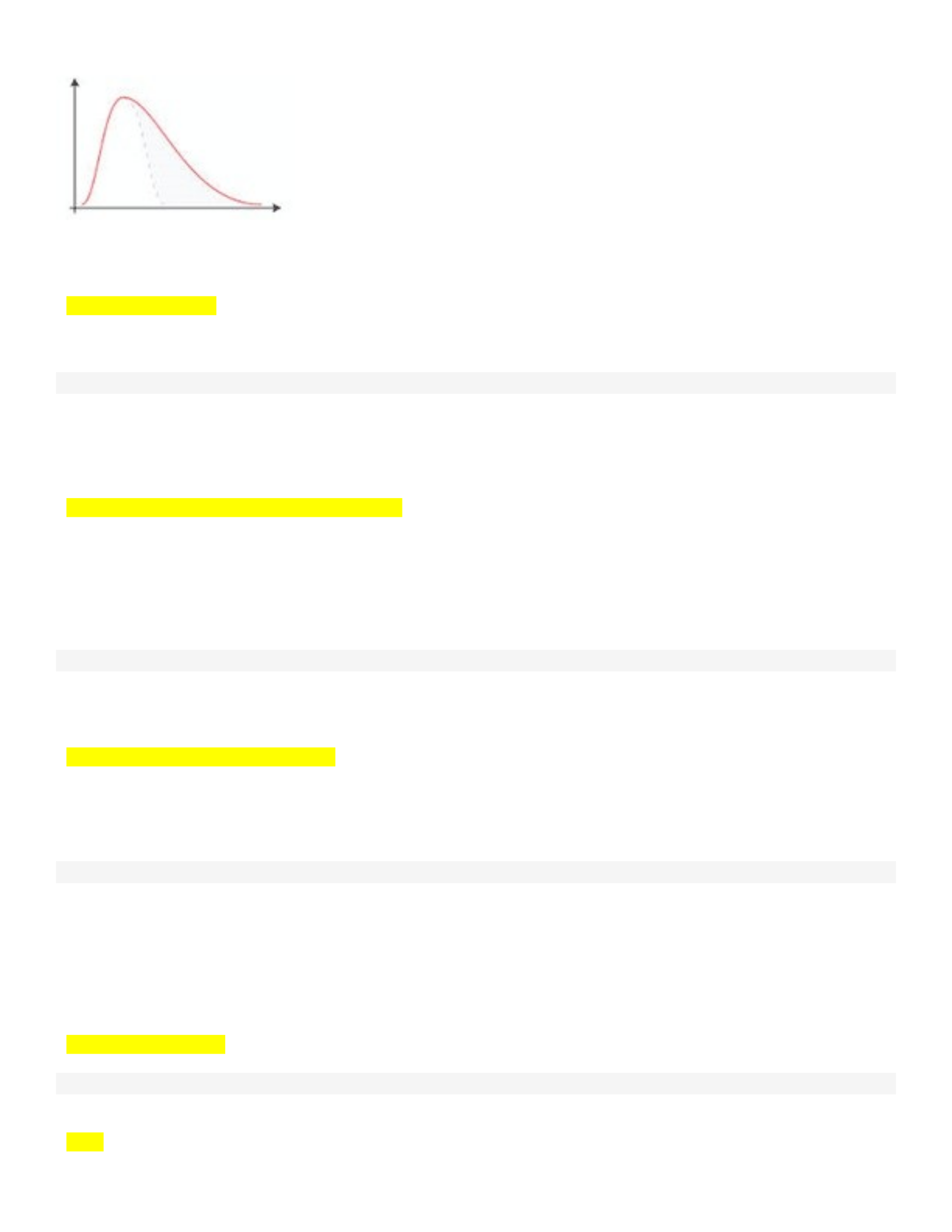
negatively skewed.
normal.
positively skewed.
rectangular.
Question 4. 3 / 3 pts
In high school, a teacher gave two sections of a class the same arithmetic test. The results were as
follows:
Section I: Mean 45, Standard deviation 6.5
Section II: Mean 45, Standard deviation 3.1
Which of the following conclusions is correct?
Section I is more variable than Section II.
Section II is more variable than Section I.
Both sections are equally variable.
Section II has brighter students than Section I.
Question 5. 3 / 3 pts
A pupil’s reading achievement score is one standard deviation above the national norm. How could
you best interpret this finding to her parents?
She has a percentile rank of about 60.
She is above average in reading.
She is in the upper 10% of the U.S. population.
She is one grade level above the mean in reading.
Question 6. 3 / 3 pts
The most dependable derived unit for measuring how far a score varies from the mean for the group
is called the:
average deviation.
quartile deviation.
standard error.
standard deviation.
Question 7. 3 / 3 pts
A student scores 35 on a vocabulary test. The mean for the class is 37 and the standard deviation is
8. His z-score is:
- .25

- .20
.20
.25
Question 8. 3 / 3 pts
Which of the following correlation coefficients indicates the highest degree of linear relationship?
.00
.10
.81
.87
Question 9. 3 / 3 pts
The coefficient of determination is used to:
compute correlations for truncated ranges.
compare the relative strength of coefficients.
identify curvilinear relationships.
test correlations for causality.
Question 10. 3 / 3 pts
An individual reported a correlation of 1.25 between form A and form B of an intelligence test. From
this coefficient one would conclude that:
a mistake has been made; correlations can’t be greater than 1.
the test includes no measurement error.
the test is unusually reliable.
the test would be a good predictor of school achievement.
Quiz 6 – Week 6: Marking Systems, CH 11-12
Question 1. 2 / 2 pts
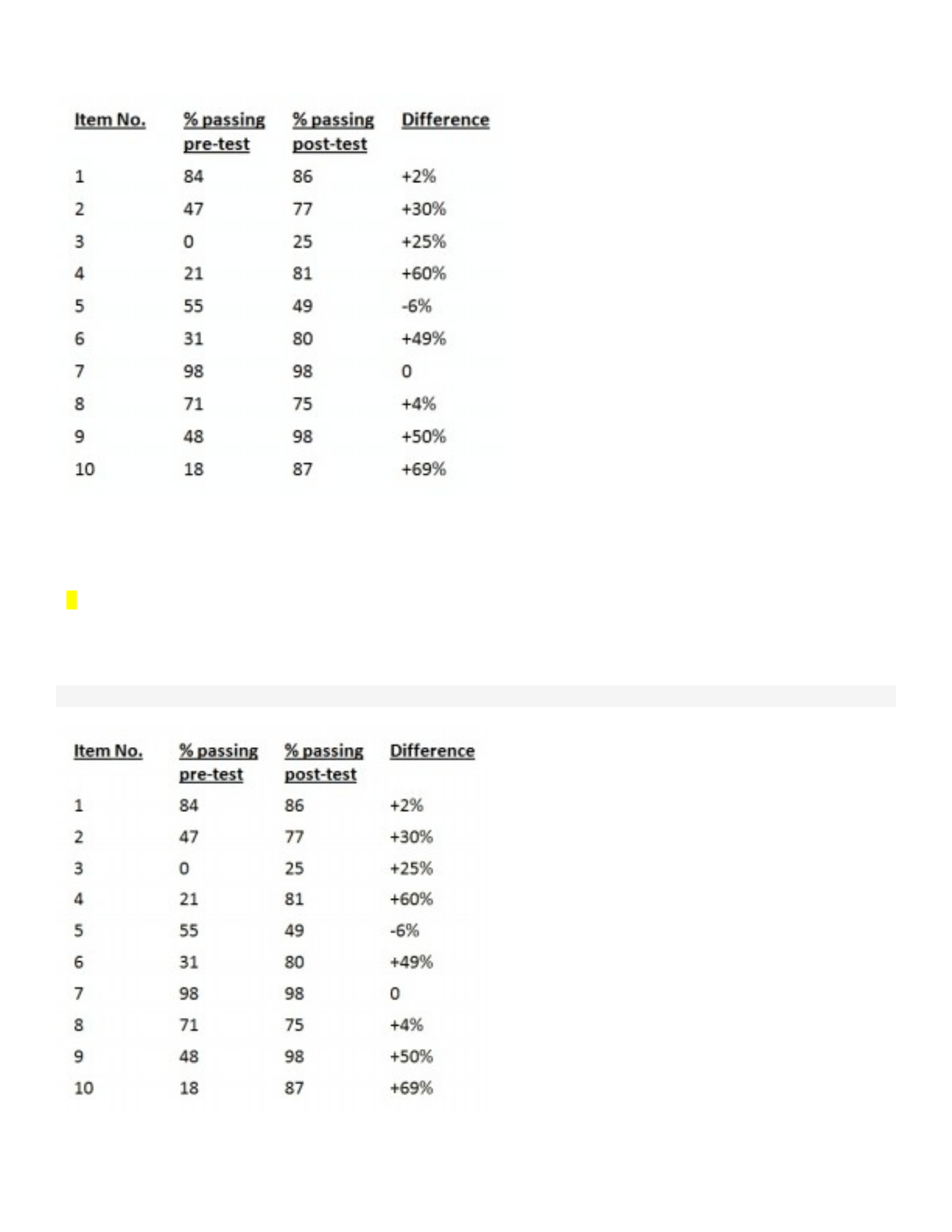
Use the following set of data from a criterion-referenced test; which item should probably be
eliminated?
2
6
7
10
Question 2. 2 / 2 pts
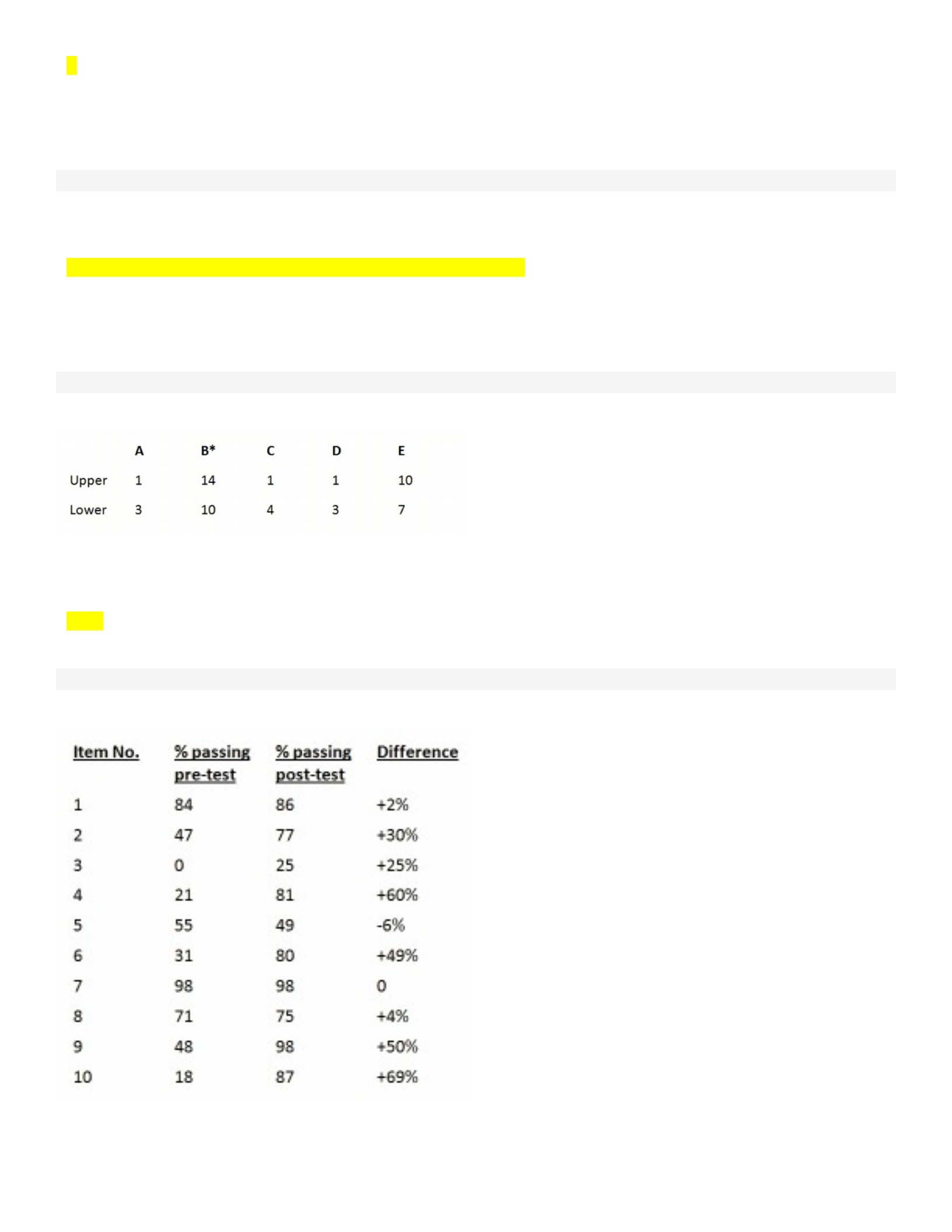
Use the following set of data from a criterion-referenced test; which item is probably too difficult?
1
3
5
7
Question 3. 2 / 2 pts
The item discrimination index is used in test construction to ensure that there is:
maximum consistency in the passing of test items.
maximum variation in performance between individuals.
opportunity for competitive achievement in education.
opportunity to show which instructional goals have been attained.
Question 4. 2 / 2 pts
Given the following item analysis data, with the correct answer marked with an asterisk, what is the
discrimination index of this item?
24/27
24/54
4/27
4/54
Question 5. 2 / 2 pts
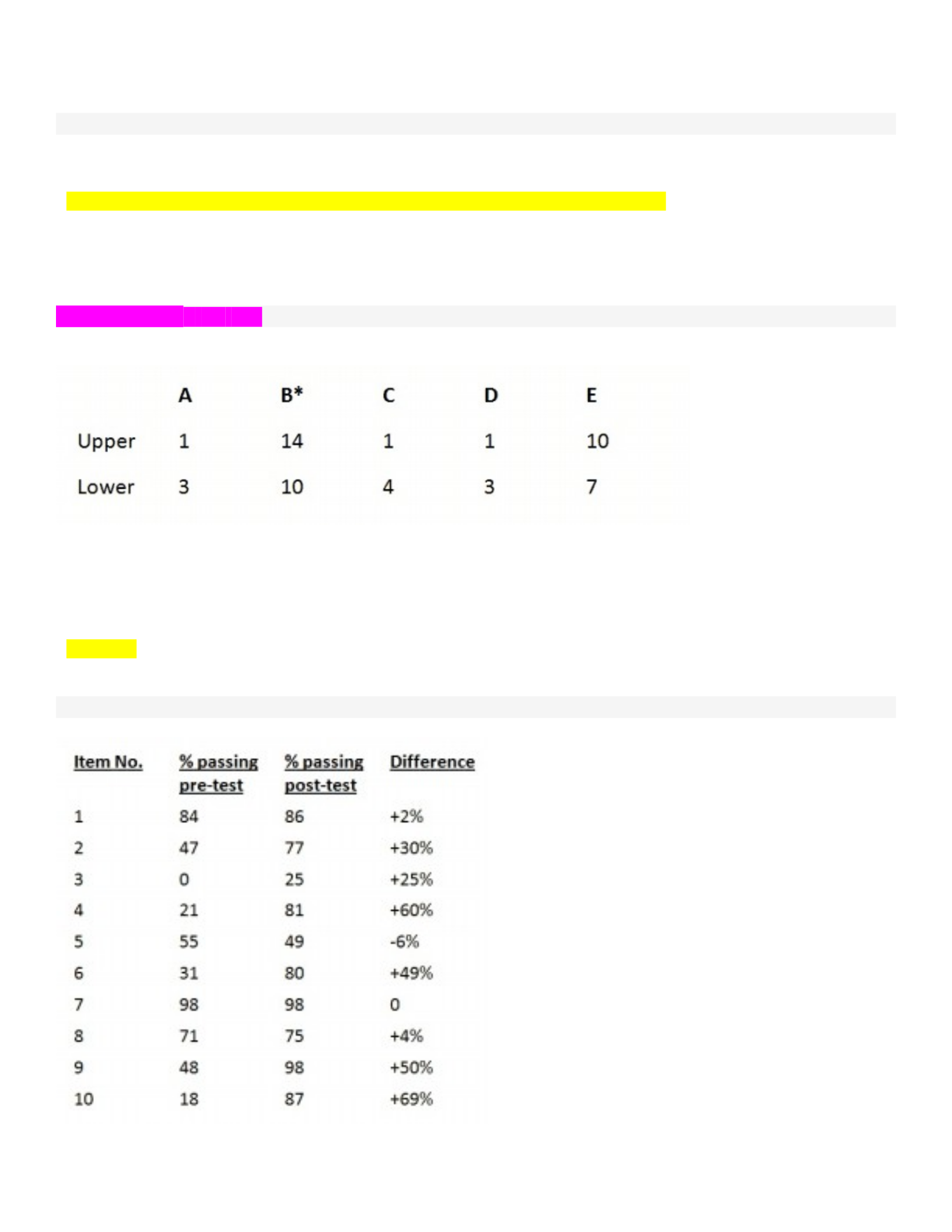
Use the following set of data from a criterion-referenced test; which item appears best for a criterion-
referenced test?
1

4
5
9
Question 6. 2 / 2 pts
The first decision made by the test constructor is determining the:
difficulty of the test.
number of test-items to use.
purpose of the test.
types of test-items to use.
Question 7. 2 / 2 pts
One of the disadvantages of using a pass/fail grading system is that:
it alienates low-achieving students.
it forces a large percentage of students to fail.
it has a detrimental effect on classroom discipline.
it makes interpretation on passing grades difficult.
Question 8. 2 / 2 pts
The most effective marking and reporting systems are those designed to provide the information
needed by
classroom teachers.
parents of pupils.
school counselors.
users of the report.
Question 9. 2 / 2 pts
Which of the following would require the greatest amount of teacher time?
Basing marks on performance standards
Basing marks on student improvement
Grading by use of the normal curve
Grading on a pass-fail system
Question 10. 2 / 2 pts
All other things being equal, which of the following marking practices results in the most reliable
grades?
A, B, C, D, or F
Pass or fail grades
Percentile ranks
Using 1-100
Question 2. 2 / 2 pts
What is meant by “a given test item is highly discriminating?
It requires complex thought and high-cognitive processes for solution.
More high-scoring students than low-scoring students answer it correctly.
Only a few of the students are able to answer it correctly.
Only students having some training are able to answer it correctly.
Question 3. 2 / 2 pts
Given the following item analysis data, with the correct answer marked with an asterisc, which, if any,
of the distractors should be replaced?
Option A
Option C
Option D
Option E
Question 4 2 / 2 pts
Use the following set of data from a criterion-referenced test; which item is probably too difficult?
1

3
5
7
Question 5. 2 / 2 pts
Within a given item format, the items of a test should be arranged by:
increasing level of complexity.
information provided.
level of reading difficulty.
subject matter content.
Question 6. 2 / 2 pts
Which of the following is a recommendation to help prepare students for a test?
equalize the advantages between test-wise and non test-wise students.
reduce anxiety by minimizing the test’s importance.
remind students that poor performance will mean even more tests.
use “pop” quizzes frequently, but be sure they are easy.
Question 7. 2 / 2 pts
Marking and reporting systems should benefit the pupil in all of the following ways EXCEPT:
clarifying objectives of the educational program.
enhancing and maintaining pupil motivations.
indicating pupil’s strengths and weaknesses.
negatively reinforcing undesirable behavior.
Question 8. 2 / 2 pts
Each mark in a course should be assigned and interpreted as:
a combination of measures of attitude and achievement.
a combination of measure of growth and attitude.
a measure of the level of achievement.
indicating similar achievement levels across schools.
Question 9. 2 / 2 pts
The factor that most seriously limits the value of grades for certification is that grades:
are not comparable between classes and schools.
cannot be assigned for some attributes.
emphasize only academics factors.
emphasize only behavioral factors.

Quiz 7 – Week 7: Test Validity and Reliability, CH 16-18
Question 1. 3 / 3 pts
Which type of validity coefficient is most important for personality tests?
Concurrent validity
Construct validity
Content validity
Predictive validity
Question 2. 3 / 3 pts
The content validity of a teacher-constructed achievement test is:
about equivalent to that of similar standardized tests.
generally low despite the teacher’s knowledge of his class.
high if the teacher has matched items to objectives.
usually unacceptable due to lack of expert input.
Question 3. 3 / 3 pts
The correlation between test scores and a criterion is a measure of
causation.
objectivity.
reliability.
validity.
Question 4. 3 / 3 pts
Which type of validity coefficient is most appropriately used for selection purposes?
concurrent
construct
content
predictive
Question 5. 3 / 3 pts
You administer the Quick and Dirty Personality Test on January 16, 1984, and March 1, 1984, to the
same group of subjects and correlate the results. This gives you an estimate of:
alternate forms reliability.
concurrent validity.
predictive validity.
test-retest reliability
Question 6. 3 / 3 pts
If a thermometer measured the temperature in an oven as 400oF five days in a row when the
temperature was actually 397oF, this measuring instrument would be considered quite:
reliable and valid.
reliable but not valid.
unreliable and invalid.
valid but not reliable.
Question 7. 3 / 3 pts
Instead of giving a test to a single grade level, it is administered to the whole school. The reliability
coefficient will:
be unaffected.
be very unpredictable.
decrease.
increase.
Question 8
3 / 3 pts
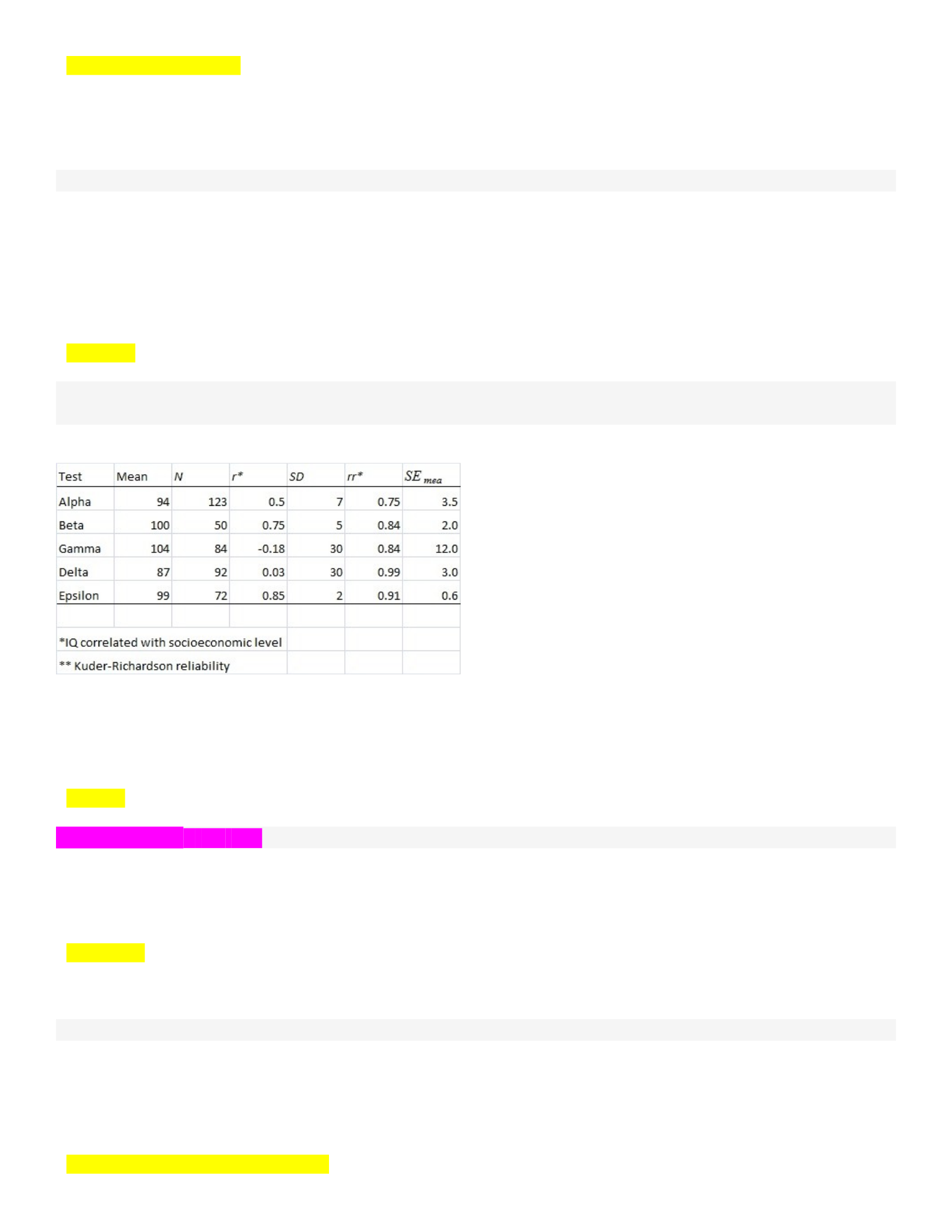
The five tests in the following table represent IQ tests. Which test demonstrates the strongest
correlation with socioeconomic status?
Beta
Gamma
Delta
Epsilon
Question 9. 3 / 3 pts
The standard error of measurement is closely related to:
central tendency.
objectivity.
reliability.
validity.
Question 10 3 / 3 pts
The index which estimates the extent to which a score obtained on a test approximates the
individual’s true score on the test is the:
error score distribution.
standard deviation.
standard error of measurement.

variance.
Quiz 8 – Week 8:Standardized Tests, CH 19-20
Question 1. 2 / 2 pts
The term “aptitude” means that the individual:
has developed cognitive skills prerequisite to learn a task.
has high “scholastic ability” to be successful in school.
has the innate capability to learn and to be successful in school.
is likely to be “successful” if the aptitude is present and is likely to be unsuccessful if not.
Question 2. 2 / 2 pts
Most standardized test publishers today distribute reports like the “Criterion-Reference Skills
Analysis” included in your text. While such reports contain a wealth of information, they often are
ignored because the
cluster approach to test analysis no longer enjoys its previous popularity.
information reported is of little use to parents, teachers, and students.
reports are complex and difficult for parents, teachers, and students to understand.
validity, other than content validity, of standardized tests is unknown.
Question 3. 2 / 2 pts
Which of the following is NOT a characteristic of teacher-made tests?
Content determined by the classroom teacher
Enables interclass comparisons within a school
Hurried, often haphazard construction
Uniform directions are not specified
Question 4. 2 / 2 pts
Which of the following types of test results may be given to parents without interpretation?
Inventoried interests
Norms on an achievement test
Personality measures
None of the above
Question 5. 2 / 2 pts
Which of the following represents the highest degree of relative performance?
A percentile rank of 75
A stanine score of 5
A T-score of 72
A z-score of 1.6
Question 6. 2 / 2 pts

National, regional, and state norms for a standardized achievement test are appropriate for
interpreting test results only when the test is administered:
by a trained specialist in testing.
by the regular classroom teacher.
under locally developed instructions.
under the same instructions used for the norm group.
Question 7. 2 / 2 pts
Inferences about individuals based on the results of group data on the stability of intelligence test
scores may be misleading because:
reliability of group data may not be high enough for individual interpretation.
scores for a single person can still vary widely.
the group may not be representative of the population.
the individual may not be part of the group.
Question 8. 2 / 2 pts
As distinguished from achievement tests, aptitude tests are used mainly for:
classification.
description.
diagnosis.
prediction.
Question 9. 2 / 2 pts
The Wechsler Full Scale IQ is an example of:
a percentile rank.
a raw score.
a standard score.
an anticipated achievement score.
Question 10. 2 / 2 pts
One advantage of individual tests of scholastic aptitude is that they provide opportunities for:
clinical insights regarding pupil’s typical behavior.
pupil insights regarding their own behaviors.
the pupils to demonstrate their learned abilities.
the examiner to demonstrate his testing skill.

