


HBCU
2
Historically, Black Colleges and Universities (HBCUs) have been a symbol of success
and pride for the entire African American community and the nation. An HBCU is defined by the
Higher Education Act (1965) as: "any institution of higher education that was established before
1964 and whose primary purpose is to educate black Americans and which is accredited by an
accrediting body designated by the Secretary of Education as a reliable authority on the quality
of the training offered or, according to the accrediting body, is making reasonable progress
towards accreditation." (Freeman, 2021) HBCUs provide students of all races and ethnicities
opportunities to develop their talents and skills.
Students who attend HBCUs are more likely to pursue careers in the private and public
sectors and professions. Students who attend HBCUs experience a sense of inclusion, belonging,
trust, and welcome. This leads to what Jay Kumar calls "the happy brain," a state where students
can think deeply, innovate, and learn. (Hayes, 2019). Faculty and staff also contribute to students
students' ability to dream bigger. Their students'students' success further increases student
confidence, resilience, and satisfaction. For many African American students, an HBCU is a
culturally relevant and safe environment, free of the racial hostility they experience at PWIs.
(Hayes, 2019)
Therefore, it is unsurprising that students who start training at HBCUs are more likely to
finish their programs and earn advanced or terminal degrees. The blanket provided by the HBCU
faculty and experience gives students the warmth they need to survive in less hospitable and
sometimes cold environments where they may experience benign neglect. Students become able
to survive in environments where no one else looks like them because they have gained strength
from being surrounded by HBCU peers and faculty who encouraged them to reach new heights.
Absence of Marginalization in School
One of the most significant aspects of the climate was the presence of an educational
setting where students were not discriminated against based on their race, as well as a place that
provided a counter-narrative to the stereotypical and negative representations of African
HBCU
3
Americans in popular culture. Many students compared their experiences in predominantly white
schools to those at HBCUs, and some mentioned the positive effects of HBCUs compared to
their experiences in all-white schools.(Thyden, 2023) The following were some of the responses
to this type of context: "I needed to get out of my all-white environment because I felt like I was
disadvantaged compared to my non-black peers." "HBCU is a school with no bias, where I could
be evaluated based on my work." "Many people think that it's impossible to be successful and
"black" all at once. This can change your perspective and boost your self-esteem."
HBCU students describe how they see Black success in the space, which dispelled
preconceived notions about African Americans, made them feel proud, raised their self-esteem
and expectations for success, and was inspiring. At HBCUs, we break down the barriers of racial
marginalization and stereotyping and master narratives of African Americans' intellectual
inferiority. (Hayes, 2019) Culturally relevant pedagogy disrupts inequities in educational and
economic opportunity for African Americans. The STEMM workforce remains predominantly
white. For example, in 2019, the physician workforce was 56% White, with only 9% African
American and 8% Hispanic, according to the Association of American Medical Colleges
(AAMC), compared to 11% African Americans and 14% Hispanics in the same year in the US
workforce. (Nguemeni, 2023) In medical schools, most full-time faculty members conducting
research are White, with 54.6% White and 14.7% Asian. Only 4.8% were African American in
2019, with 3.3% being Hispanic, Latino, or Spanish origin. (Nguemeni, 2023)
HBCUs have fewer resources, a higher teaching load, and many other challenges. Despite
this, they continue to produce high-quality graduates and offer high-quality academic jobs.
NonHBCUs, however, do not graduate as many African American students as they do, even
though they have more money and resources. (Younge, 2019). So, what can we learn from
HBCUs' faculty and structure that can enhance the experiences of our African American students
HBCU
4
and, more importantly, help them launch their careers in STEM? Can the formula that HBCUs
use for success in (STEM) be understood and implemented by PWIs so that all schools can enroll
students of all backgrounds and levels of mentorship and give them the support and guidance
they need to succeed? One way to do this is to follow the strategies that HBCUs have used to
prepare students for STEM careers. (Younge, 2019).
HBCUs provide safe spaces; students feel valued, meaningful, and part of a larger
community. More investment is needed in HBCUs to have a more significant educational impact;
before the civil rights movement, HBCUs were the only option for Black Americans to obtain a
college degree. HBCUs enabled Black Americans to pursue professional careers, obtain graduate
degrees, and further their education in an inclusive environment. However, the nature of an
institution is not as impactful to God as the acquisition of knowledge and wisdom. Proverbs
16:16 states, "It is better to have wisdom than gold and insight than silver!" While nice and
expensive things can be enjoyed, very few in life are irreplaceable. Education is one of these
things. However, earning a degree offers more than just financial benefits. It invigorates your
mind and allows you to meet new people, explore new places, and explore new ways of thinking.
References
Freeman KE, Winston-Proctor CE, Gangloff-Bailey F, Jones JM. Racial Identity-Rooted
Academic Motivation of First-Year African American Students Majoring in STEM at an
HBCU. Front Psychol. 2021 Jun 8;12:669407. doi: 10.3389/fpsyg.2021.669407. PMID:
34168596; PMCID: PMC8217429.
Hayes BD, Holliday RC, Wade BH, Trawick C, Hodge M, Caplan L, Younge S, Quarshie A,
Satcher D. A comprehensive examination of the health knowledge, attitudes and
behaviors of students attending historically black colleges and universities. J Health Care
Poor Underserved. 2019 May;20(2 Suppl):69-84. doi: 10.1353/hpu.0.0159. PMID:
19711494; PMCID: PMC3920453.
HBCU
5
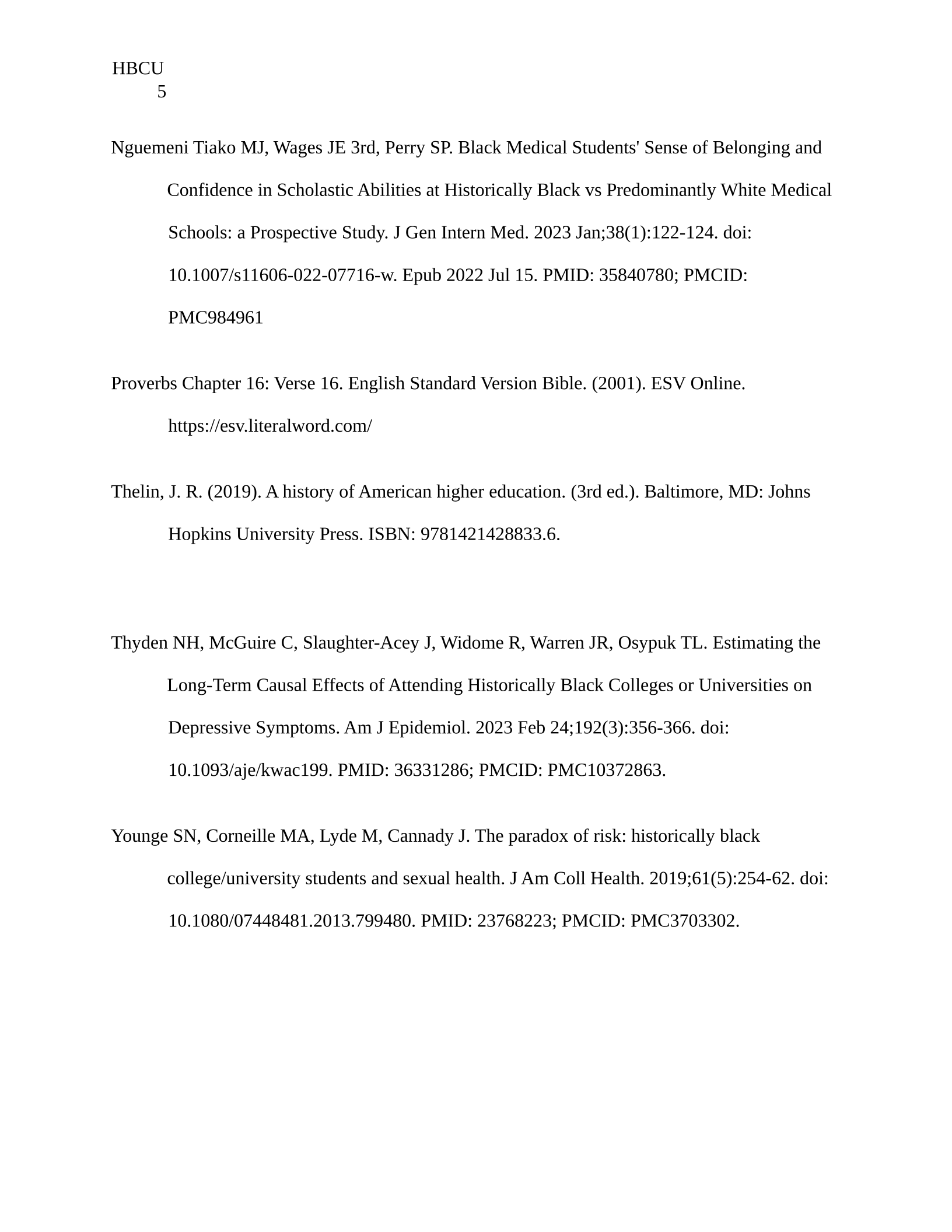
Nguemeni Tiako MJ, Wages JE 3rd, Perry SP. Black Medical Students' Sense of Belonging and
Confidence in Scholastic Abilities at Historically Black vs Predominantly White Medical
Schools: a Prospective Study. J Gen Intern Med. 2023 Jan;38(1):122-124. doi:
10.1007/s11606-022-07716-w. Epub 2022 Jul 15. PMID: 35840780; PMCID:
PMC984961
Proverbs Chapter 16: Verse 16. English Standard Version Bible. (2001). ESV Online.
https://esv.literalword.com/
Thelin, J. R. (2019). A history of American higher education. (3rd ed.). Baltimore, MD: Johns
Hopkins University Press. ISBN: 9781421428833.6.
Thyden NH, McGuire C, Slaughter-Acey J, Widome R, Warren JR, Osypuk TL. Estimating the
Long-Term Causal Effects of Attending Historically Black Colleges or Universities on
Depressive Symptoms. Am J Epidemiol. 2023 Feb 24;192(3):356-366. doi:
10.1093/aje/kwac199. PMID: 36331286; PMCID: PMC10372863.
Younge SN, Corneille MA, Lyde M, Cannady J. The paradox of risk: historically black
college/university students and sexual health. J Am Coll Health. 2019;61(5):254-62. doi:
10.1080/07448481.2013.799480. PMID: 23768223; PMCID: PMC3703302.
Powered by TCPDF (www.tcpdf.org)

