



EDUC 323
Page 2 of 8
MATHEMATICS STRAND PROJECT LESSON PLAN
LESSON # 1
Subject/Topic: Algebra- Variables and
Equations
Grade Level: 5
Lesson Structure or Grouping:
Whole Class ☒ Small Group ☐ 1:1 ☒
Other (specify): Partner work
Learning Segment Theme:
Understanding and modeling quantitative
relationships with variables and equations.
Resources and Materials:
Dry erase boards and markers
Equation cards with missing values
Hands-on balance scale or virtual balance tool
Counters/manipulatives
Anchor chart of symbols (=, <, >)
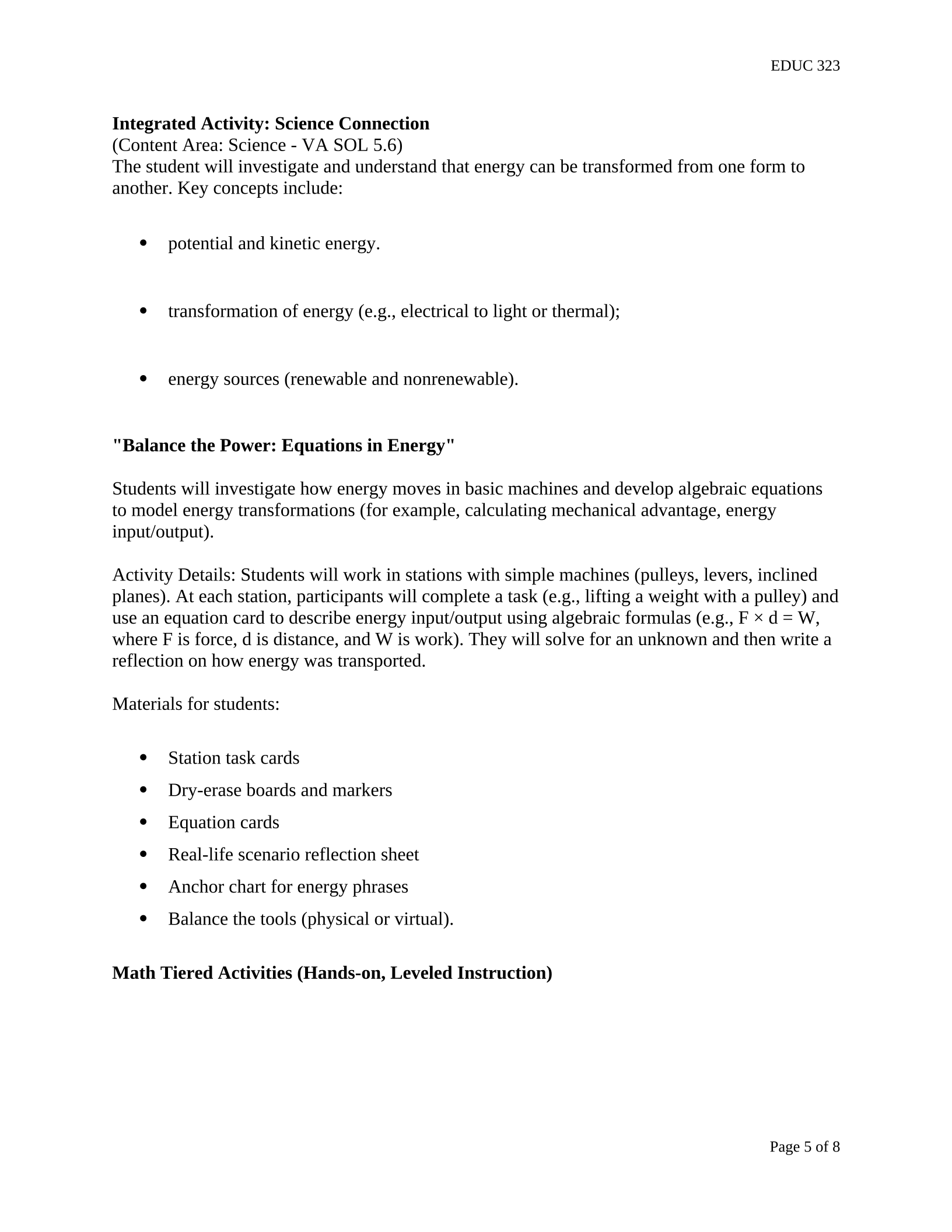
Graphic organizer for notes
Interactive whiteboard or projector
Standards:
State: VA SOL 5.19 The student will investigate and describe the relationships between and
among two or more quantities using expressions, equations, and inequalities.
National: NCTM- Understand patterns, relations, and functions; represent and analyze
mathematical situations and structures using algebraic symbols.
Objective:
Students will be able to write and solve simple algebraic expressions and equations with
variables representing unknown quantities, as well as evaluate the solution in a real-world
context.
ACADEMIC LANGUAGE DEMANDS
Language Demands: Students will use and understand terms like variable, equation,
expression, greater than, less than, equal to.
Language Supports: Visual supports (anchor charts, symbols)
Essential Vocabulary: Variable, Expression, Equation, Inequality, Equal to, Greater than,
Less than
INSTRUCTION
Set: Begin with a relatable story problem (e.g., “I had some pencils, then bought 3 more. Now
I have 8. How many did I start with?”). Write it as an equation: x + 3 = 8. Ask students what x
could be. Have them guess and check with counters.
Direct Instruction/Modeling: Introduce the concept of a variable as a “placeholder” for an
unknown. Model wirting and solving one step equations using visuals.
Guided Practice: Use dry erase boards and manipulatives to model solutions.
Independent Practice: Challenge: Write their own real-world equation and swap with a
partner to solve.
Closure: Students answer exit question: “What does the variable represent in your favorite
problem today?”
DIFFERENTIATION
EDUC 323
Page 3 of 8
Supporting Students with Special Needs: Click or tap here to enter text.
Challenging Above-Average Students: Click or tap here to enter text.
Facilitating a Classroom Environment that Supports Student Learning: Use
manipulatives and visual models. Provide fill-in-the-blank guided equation sheets.
Extension: Use real-life scenarios (e.g., earning money per hour) to build and solve algebraic
models.
ASSESSMENT
Diagnostic/Pre-Assessment: Ask students to solve a simple unknown (e.g., “x + 2 = 5”) and
explain what x could be. Use this to gauge prior understanding of variables.
Formative Assessment: Monitor partner discussions and equation card work. Use a checklist
to note use of correct terminology and problem-solving steps.
Summative Assessment: Students solve 5 equations and explain one solution in writing.
Must include correct variable use and justification.
BIG IDEA:
Complete the BIG IDEA statement for your plan. This should be at the end of your lesson
plan.
Today I will learn how to use variables and write equations to show how quantities are
related.
So that I can solve real-world problems and understand how unknowns work in math and
life.
I know you've got it when you can explain what a variable means and solve equations using
it correctly.
EDUC 323
Page 5 of 8
Integrated Activity: Science Connection
(Content Area: Science - VA SOL 5.6)
The student will investigate and understand that energy can be transformed from one form to
another. Key concepts include:
potential and kinetic energy.
transformation of energy (e.g., electrical to light or thermal);
energy sources (renewable and nonrenewable).
"Balance the Power: Equations in Energy"
Students will investigate how energy moves in basic machines and develop algebraic equations
to model energy transformations (for example, calculating mechanical advantage, energy
input/output).
Activity Details: Students will work in stations with simple machines (pulleys, levers, inclined
planes). At each station, participants will complete a task (e.g., lifting a weight with a pulley) and
use an equation card to describe energy input/output using algebraic formulas (e.g., F × d = W,
where F is force, d is distance, and W is work). They will solve for an unknown and then write a
reflection on how energy was transported.
Materials for students:
Station task cards
Dry-erase boards and markers
Equation cards
Real-life scenario reflection sheet
Anchor chart for energy phrases
Balance the tools (physical or virtual).
Math Tiered Activities (Hands-on, Leveled Instruction)
EDUC 323
Page 6 of 8
Group 1: Lower Grade Level Strand: Algebra - Expressions and Equations Activity:
"Equation Sort & Build"
Students will collaborate with a partner and utilize color-coded cards. Some cards have variable
expressions, while others display real-world word problems. Students match the cards and then
construct the equation with number tiles and counters. The emphasis is on visual comprehension
and problem solving with support. The teacher circulates to scaffold language and guide equation
development.
Group Dynamics: Based on previous formative information, students will be divided into groups
and will work in pairs to provide support. Anchor charts help to model directions. A checklist
facilitates completion. Students who are struggling may benefit from one-on-one conferencing.
Group 2: Grade Level Strand: Algebra - Writing Equations from Context Activity: "Equation
Scavenger Hunt"
Students roam about the classroom, tackling posted story problems that require them to create
and solve one-step equations. Each correctly solved issue takes them to the next clue. Problems
are linked to real-world circumstances (such as money and distance).
Group Dynamics: Mixed-ability pairings are encouraged to promote conversation. Students must
write their calculations on dry erase boards and explain their processes before receiving the next
clue.
Group 3: Above Grade Level: Algebra - Multi-Step Reasoning with Expressions "Design a
Game with Equations"
Students will collaborate in pairs or small groups to design a board game that incorporates
algebraic expressions. They must produce question cards that require solving equations with
variables, develop a set of rules, and simulate at least three real-world scenarios.

EDUC 323
Page 7 of 8
Group Dynamics: We encourage independent collaboration. The teacher checks in to challenge
thinking, provide extensions, and ensure that math jargon is utilized correctly.
Assessments
Formative Assessment #1: Equation Talk Cards Details: Students draw a card containing a visual
or verbal stimulus (for example, "x + 4 = 9"). They must write the equation, answer it, and
explain their reasoning to a partner. Teachers supervise talks to ensure proper vocabulary,
problem-solving methods, and rationale. A rubric with three criteria (equation accuracy,
vocabulary utilization, and explanation clarity) is used to provide quick feedback.
Formative Assessment 2: Math Exit Slip. Details: At the end of the class, students solve a quick
issue (for example, "I had x apples and then bought 5 more. Now I have twelve. What is x?").
They must figure out and explain what the variable means in the context. Teachers look for
precise solutions and contextual explanations. Used to organize students for the following day's
lesson.
Summative Assessment: "Equation Expert Challenge"
Details: Students finish a mini project by solving five different real-world equations using
variables. They must write an equation, answer it, and explain their reasoning in a brief
paragraph. At least one equation must come from a student-created scenario. The rubric
measures equation writing, solution correctness, vocabulary, and written reasoning. To
demonstrate mastery, students present one problem to a peer or the entire class.
EDUC 323
Page 8 of 8
References
National Council of Teachers of Mathematics (NCTM). (2000). Principles and standards for
school mathematics. Reston, VA: Author.
Virginia Department of Education. (2018). Mathematics standards of learning for Virginia public
schools. https://www.doe.virginia.gov/home/showdocument?id=4364
Powered by TCPDF (www.tcpdf.org)

