


SHORTENED TITLE 2
Title Goes Here
Discussion Post
During my last visit to my fifth-grade math classroom, I asked if I could teach a student a
math intervention during their enrichment time. My host teacher gave me a small group of kids
that could benefit from learning how to multiply. I had prepped lots of paper buses to use as
manipulatives – the focus student loves buses and has been displaying a lot of math anxiety even
though he loves numbers and is very smart. He demonstrates complete work avoidance anytime
he thinks he may be wrong. I was hoping to utilize the third problem solving strategy that
Johnson and Tipps (2017) talked about in this week’s reading. Although the student didn’t need
the manipulatives (he can count in his head quite well), the manipulatives were something he
enjoyed. I let him pick the groups of the buses that we were going to multiply. Of course, he
picked 11 and 12. Then I showed him that multiplication is just a shorter way to do addition. I
pointed out the 10 columns on a multiplication chart and how it’s just counting by tens. I then
wrote the long addition problem out and when I start adding 12 + 12 = 24 + 12 = 36, he says 132.
He had done the operation in his head. The students were able to explore working through
problems by using manipulatives. If I had been planning to use a problem-solving method, I
would give him the prompt, “Your mom is in a hurry and you want to know how many busses
are in the parking lot. You know there are 12 buses in a row. You count 11 rows. Can you figure
out how many busses are there?”
According to Rodley and Bailey (2021), teachers have found it difficult to differentiate
instruction for a wide range of learners with a problem-solving model. I would agree with that. In
my small group example (although the others didn’t mind the buses), it held little meaning to
them. This is unlike the experience of the focus child that just had a good day with math because
it revolved around his favorite things, and he felt smart. It can be done with some creativity, but
SHORTENED TITLE 3
being able to support multiple students across multiple groups would be very difficult.
Fortunately, the educational field allows teachers to build a skill-base in much easier ways than
in the past (internet, meta-analyses, etc.) with the right initiative. As offered in Roman2 2:21,
“you, then, who teach others, do you not teach yourself?” (NIV).
References
Johnson, A., & Tipps, S. (2017). Guiding Children’s Learning of Mathematics, Loose-Leaf
version. Wadsworth Publishing.
Rodley, H., & Bailey, J. (2021). The challenge of teaching children mathematics through
meaningful problem-solving. Research Information for Teachers, 1, 43–51.
https://doi.org/10.18296/set.0195
Romans 2:21 (NIV). (n.d.). Bible Gateway. https://www.biblegateway.com/passage/?
search=1%20Thessalonians%205:21-23&version=NIV
Reply #1- Regina Law
Thank you for your explanation of how you would model the problem you presented. I
must admit that when I read your example problem, the way you solved the problem was not the
way I would have solved it. I guess this is one reason why presenting multiple ways of solving a
problem is important. In your example, I would have added the two amounts and then subtracted
that amount from the 350 roses that Mr. Reynolds started with. After students learn how to build
with base ten blocks, they can easily draw out a representation for those. That is one of the
reasons I choose to use base 10 blocks with my younger students. But (again), your method
definitely works.
SHORTENED TITLE 4
Problem-based learning can be beneficial, but it can have its challenges. Paired and group
work comes with explicit training and social skills practice, to maintain productive learning. If
the students get bored or do not understand the problem, it will result in disruptive behavior. I
have spent lots of time in multiple classrooms over the years. I have noticed that some teachers
that lack classroom management may need to rely on a traditional style learning, so they feel “in
control” of their class. Their students get the most of what their teacher can offer. Thanks for
your thoughts!
Reply #2- Nathan Fowler
Nathan, thank you for your interesting perspective on problem solving in the classroom. I
enjoyed reading about the connection you made between Polya’s four step method and the
twelve strategies discussed by Johnson et al. (2017). I agree with how you split up the twelve
strategies among the four steps. I had a similar understanding of how the strategies were building
upon the knowledge from the previous strategy. Drawing a diagram helps one understand a
problem, but until you have the basic understanding of the problem at hand you won’t be able to
synthesize the problem to restate it. Once you can understand and state the problem you can
devise a plan which involves guess/check and working backwards. Students could then work
through the remaining twelve strategies as the knowledge is gained.
I have enjoyed seeing that educators in my school district have been following the current
research. I have seen more collaborative work among students. Luckily, the curriculum that my
school district has chosen follows some of the research. It is easy for teachers to adapt to
encourage problem-solving based learning. The math problems students are being asked to work
SHORTENED TITLE 5
with and the strategies that are taught encourages problem solving skills and ways that they can
apply them in their own life.
References
Johnson, A., & Tipps, S. (2017). Guiding Children’s Learning of Mathematics, Loose-Leaf
version. Wadsworth Publishing.
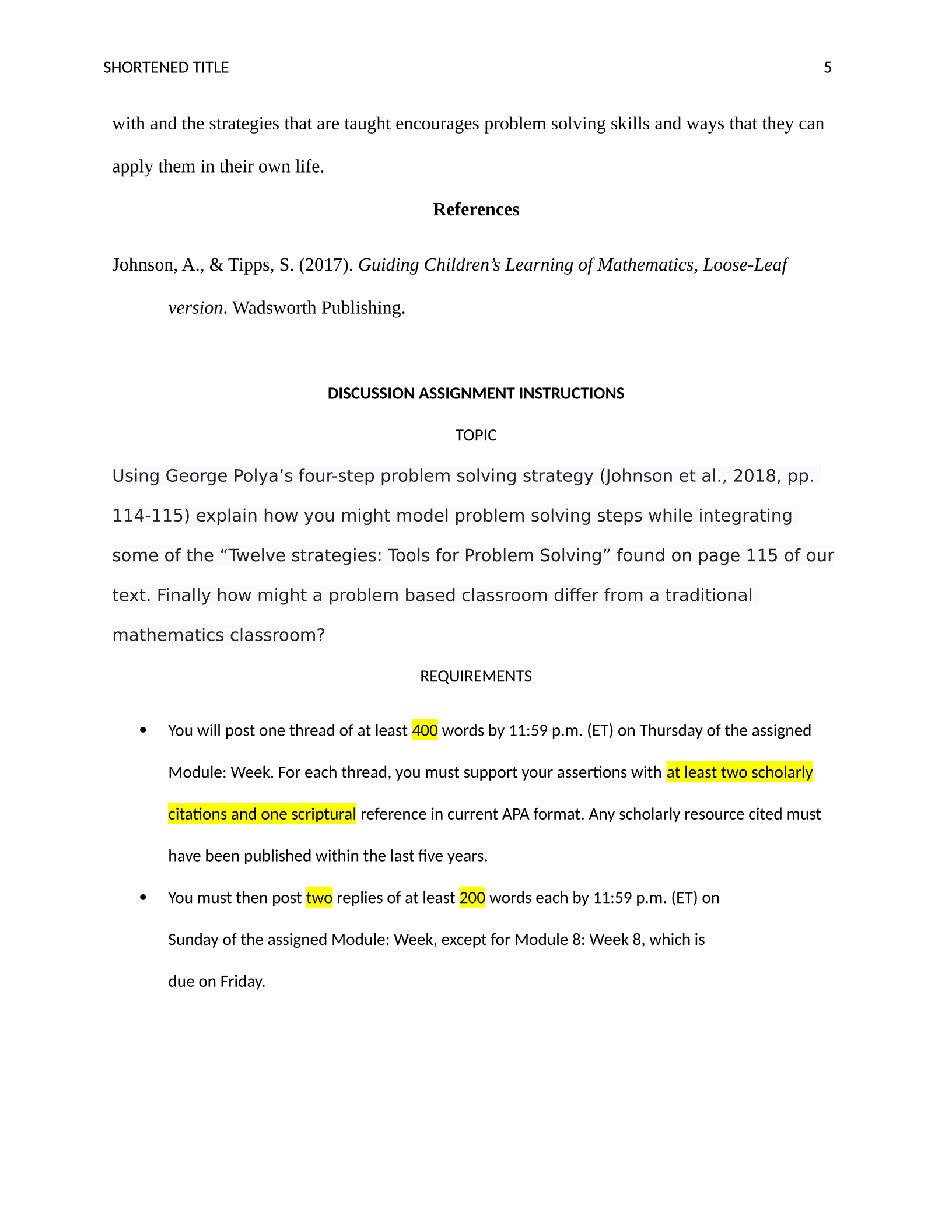
DISCUSSION ASSIGNMENT INSTRUCTIONS
TOPIC
Using George Polya’s four-step problem solving strategy (Johnson et al., 2018, pp.
114-115) explain how you might model problem solving steps while integrating
some of the “Twelve strategies: Tools for Problem Solving” found on page 115 of our
text. Finally how might a problem based classroom differ from a traditional
mathematics classroom?
REQUIREMENTS
You will post one thread of at least 400 words by 11:59 p.m. (ET) on Thursday of the assigned
Module: Week. For each thread, you must support your assertions with at least two scholarly
citations and one scriptural reference in current APA format. Any scholarly resource cited must
have been published within the last five years.
You must then post two replies of at least 200 words each by 11:59 p.m. (ET) on
Sunday of the assigned Module: Week, except for Module 8: Week 8, which is
due on Friday.
Powered by TCPDF (www.tcpdf.org)

