


Welcome to Module/Week 4.
Thankfully we have a relatively light week for this Module! I hope that you are able to
catch your breath as we prepare for the second half of this class. There is a lot to
absorb, so thank you for your persistence with reading and your thoughtful
contributions in the forums and course assignment.
The reading schedule for this week is provided below. Take some time to plan
out how you will continue to stay on top of it. We’ll submit another Reading
Report next module.
Balswick: chs. 6, 14, 16 Amazon kindle
Carter & McGoldrick: chs. 9, 14–15 ch. 9 pg 172 -186 Ch 14-15 pg 259
-300 desktop
Garland: ch. 6 Freda
Kostenberger: ch. 7 red book pg 129-152
Yarhouse: chs. 7–8 white big book pg 166-217
The only assignment due this week is Family Development Scenario Forum 2. Take a
look back at my feedback from your first initial post to guide you. As a group, you did
very well on this assignment. The initial thread is due by midnight (EST) on
Thursday, and replies are due by midnight (EST) on Sunday.
I know that many of you continue to experience challenges related to COVID 19. Please reach
out to let me know how I can support you.
Warmly,
Dr. Boatner
FAMILY DEVELOPMENT SCENARIO FORUMS INSTRUCTIONS
Purpose:
The Family Development Scenario Forums are designed to give you the opportunity to interact with real-
life examples/scenarios affecting the family and its development. You will read and interact with course
texts and articles supplied with the course materials using the Discussion Board Forum tool and
addressing the prescribed questions associated with each scenario.
You will create a thread in response to the provided prompt for each forum. Each thread must be at least
400 words, demonstrate course-related knowledge, and include at least 2 scholarly references. In
addition to the thread, you are required to reply to a minimum of 2 other classmates’ threads. Each reply
must be at least 250 words and include at least 1 scholarly reference in current APA format.
Instructions:
Respond to the following for each family development scenario:
Present your initial impressions.
What are the concerns in this scenario?

Welcome to Module/Week 4
Family Development Scenario Forum 2
This week’s reading included Balswick: chs. 6, 14, 16, Carter & McGoldrick: chs. 9, 14–
15, Garland: ch. 6, Kostenberger: ch. 7, and Yarhouse: chs. 7–8 gave me a lot to think about.
The family system seems to be a very fluid system these days. Melisa Hurst PhD. States that
what one person see as a family can be very different than another person’s view. During the
1990’s when a man and women meet and feel a connection their relationship could end up in a
marriage and children; making a family, however, in the 2020’s a man may met another man, a
woman might be attracted to another women or a man and women my become a couple. The
changes between what makes a couple has dramatically affected what makes a family. “Couples
come in many varieties: gay and straight, married and unmarried, ambitious tall wives and short,
nurturing homebody husbands, in spite of stereotypes of the husband as a stronger, taller,
smarter, with more earning power, and the wife as the physically attractive “helpmeet” (Carter &
McGoldrick, 2016). Many families may only have one parent or might have two same sex
parents, their siblings may not have any blood relation between them but could still be
considered a family.
What makes a family, who parents and what is the right way to parent are questions often
ask. When my children were little they grew up in a household with a mother, father and
siblings. For a period of time, their grandmother also lived with us. Parenting was primarily
done by the me and my husband worked outside the home full time. My children’s grandmother
got to enjoy being just that – the grandmother, she could have fun with the kids and did not have

to worry about parenting the kids. However, my husband’s mother was raising two of her
grandkids, as their mother was in jail and on drugs. She did not get to enjoy being their
grandmother as she needed to be their mother. These are just two styles of what a family can be.
Garland, D. (2012) states that “each family must work out for themselves who they are created to
be and how God is calling them” (ch. 11, pg 245). There are five elementary kids at a school that
I worked at (prior to the Corona19 virus) along with two at the middle school who all lived with
a single woman who was their foster mom. The kids in elementary school referred to each other
as foster brothers and sisters despite the fact than none of them were biologically related to each
other. But they considered each other to be family. Another example is a flight attendant we
know, he and his partner were helping a single mother who was also a flight attendant raise her
two boys. The boys consider the men they stay with when their mom is gone to be their family.
Thus, family does not need to be biological nor does it need to be adopted, family can be what
you fell and that may change over time.
“Except for those who are called by God to a life of singleness, God’s ideal is that of a
monogamous, lifelong marriage crowned with the gift of children” (Kostenberger, 2010 pg. 129).
Some people desperately want children and are unable to have their own, while other individuals
do not want children but continue to get pregnant. One such women had seven biological
children; however, drugs were more important to her than her children. She had undergone
several abortions; a couple miscarriages and the state had taken all seven of her live births. To
me that is not a mother. Others may disagree but a mother puts her children first and does
everything in her means to ensure she has healthy happy children (Kostenberger, 2010, ch. 7, pg
129-135).
Balswick states “Strong families are not those that never experience conflict but those
that successfully manage conflict when it does arise” (2014, pg 252). In other words, there are no
marriages that run smooth and never suffer from struggles. However, it is these struggles that
show what type of family you have. Some will undergo a struggle and simply throw their hands
in the air and walk away, while others will have a conflict but will dig in deeper to solve the
issue and to move forward stronger. However as Mark Yarhouse states, “couples and families
who have successfully constructed relationship by the exhibition of negotiation, patience,
sacrifice, acceptance, vulnerability, discipline, forgiveness, reconciliation, honesty, and
truthfulness experience a stability, security, and significance in their lives” (2017, ch. 7, pg. 167).
Despite your religion, sexual orientation or marital status people do determine what they
want, who they love and how they want to live. There should not be anyone who has the right to
tell you how to live, who to love or how to be. Many may disagree with me but as “Christians
have argued for centuries regarding the nature of free versus determined will” (Yarhouse, 2017).
I believe you fall in love and that your love grows over the time you are with your significant
other, I do not believe in love at first site, nor do I believe that a marriage cannot be fixed if both
parties are invested. Marriage is one of the few things that you vow to be together forever till
death do you part, but it is one of the things that about 50% of the time the individuals involved
fail to fulfill the vows they made in the beginning of their marriage. If only people would hold
up their lives to those vows the way they did on their wedding day.
References
Balswick, J. O. (2014). The family: A Christian perspective on the contemporary home, 4th ed.
Grand Rapids, MI: Baker Academic. ISBN: 9780801049347.
Carter & McGoldrick. (2016). The expanded family life cycle: Individual, family, and social
perspectives, 5th ed. Columbus, OH: Allyn and Bacon. ISBN: 9780205968060.
Garland, D. (2012). Family ministry: A comprehensive guide, 2nd ed. Downers Grove, IL: IVP
Academic. ISBN: 9780830839711.
Hurst, M. (n.d.) Family System Theory. Retrieved April 5, 2020, from
https://study.com/academy/lesson/family-system-theory-definition-and-change-over-
time.html
Kostenberger, A. J. (2010). God, marriage, and family: Rebuilding the biblical foundation, 2nd
ed. Wheaton, IL: Crossway. ISBN: 9781433503641.
Yarhouse, M. A. & Sells. (2017). Family therapies: A comprehensive Christian appraisal.
Downers Grove, IL: IVP Academic. ISBN: 9780830828548.
Relying upon Balswick, Chapters 17–18, discuss how Balswick’s content either should or
should not alter your current working definition for family. Respond to the following for
the family development scenario: Present your initial impressions. What are the concerns
in this scenario? What are the tensions in this scenario? What are the implications for
family development? What is your response in this scenario? What is the most important
take-away?

After reading this weeks’ chapters, I remain confident in my working family definition: It
is a combination of both structural and functional roles as it applies to close relationships, either
by marriage, biological, adoption, extended, etc., that nurture, support, teach, and provide
security for one another. I believe that family is what you consider family instead of the tradition
nuclear family definition. “There is an assumption that people with children do not even have
families, yet it is not unusual for this population to have what is called created kinships or
families of choice” (Cherlin, 2013). As generic as that sounds, I believe it is the foundational
basis for the family unit. This week’s readings didn’t necessary change my viewpoint. Growing
up in a multiple divorce family it was interesting to read. I believe we have a tendency of getting
stuck on “what” versus “who” constitutes a family unit. It is the “what” and “who” that provide
both structural and functional roles within a family. It is the active engagement of both, that
contribute to the overall health of the family unit. Chapters 17 and 18 both resonated with my
own childhood memories. There’s one thing to read about the statistical outcomes of divorced
families and the ill effects on children, economical dilemmas, psychological, relational,
emotional and interpersonal conflicts, etc., versus the reality of living through such obstacles.
During my teenage years, my friends and I compared whose family was most
“dysfunctional” as if it were a badge of honor; when in reality we were making light of our home
environment to ease the pain of not having both parents in the household, the derogatory and
belittling comments overheard, lack of residential parents presence due to work, decreased
family “fun” activities, additional responsibilities as the oldest sibling, the longing for the absent
parent, sibling rivalry, etc. As stated by Kim (2011), the “in-divorce” stage is the onset of when a
relationship with between the mother and child/children are negatively impacted. Looking back,
I can truly relate to that statement. During the divorce process, for my family, both parents were
still living in the same household and I was the mediator as a child (Balswick & Balswick,
2014). The tension was suffocating; however, it was as if there was a white elephant in the room
that no one dared to speak of because it would invite further hurt, discomfort, pain or anger
regarding the situation.
I did not completely agree with Balswick’s opening paragraph in chapter 17. Yes, I agree
that families are resilient and can overcome “insurmountable challenges” in survival mode
(Balswick & Balswick, 2014); however, being resilient because the situation calls for resiliency
doesn’t necessarily denote that the emotional, mental and psychological challenges have been
addressed and overcome. Many times, those latent emotions do not surface until much later in
life; especially when faced with our own pursuit of marriage or family (Balswick & Balswick,
2014). I do agree however that divorce does not necessarily bring greater happiness. The stress of
what prompted the divorce may be removed and replaced with other stressors, especially when
children are involved. Case in point, welfare versus workfare (Balswick & Balswick, 2014). I
most agree that there is a “double-exposure effect” (Balswick & Balswick, 2014, p. 307),
children are emotionally, psychologically, socially and spiritually impacted by the continuous
conflicts of married parents and negatively impacted by divorce. The positive outcomes from
these situations, I believe is “how” the circumstances are addressed and resolved. Ahrons (2004),
has a valid point in divorce should recognize the family and “not destroy it”.
Recognizing that the dissolve of marriage is not entirely about two people having
irreconcilable differences, but rather a family structure that must now be altered in order to
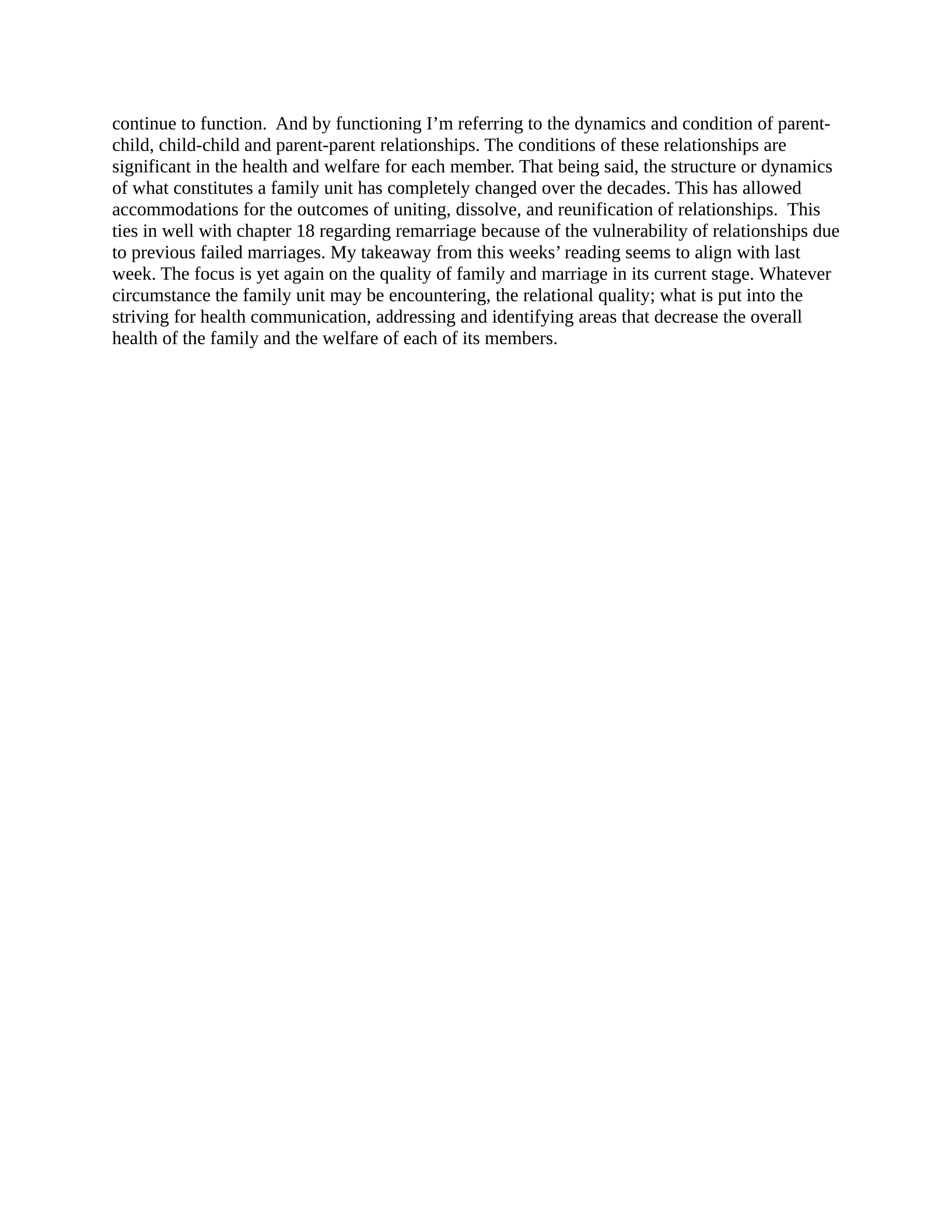
continue to function. And by functioning I’m referring to the dynamics and condition of parent-
child, child-child and parent-parent relationships. The conditions of these relationships are
significant in the health and welfare for each member. That being said, the structure or dynamics
of what constitutes a family unit has completely changed over the decades. This has allowed
accommodations for the outcomes of uniting, dissolve, and reunification of relationships. This
ties in well with chapter 18 regarding remarriage because of the vulnerability of relationships due
to previous failed marriages. My takeaway from this weeks’ reading seems to align with last
week. The focus is yet again on the quality of family and marriage in its current stage. Whatever
circumstance the family unit may be encountering, the relational quality; what is put into the
striving for health communication, addressing and identifying areas that decrease the overall
health of the family and the welfare of each of its members.
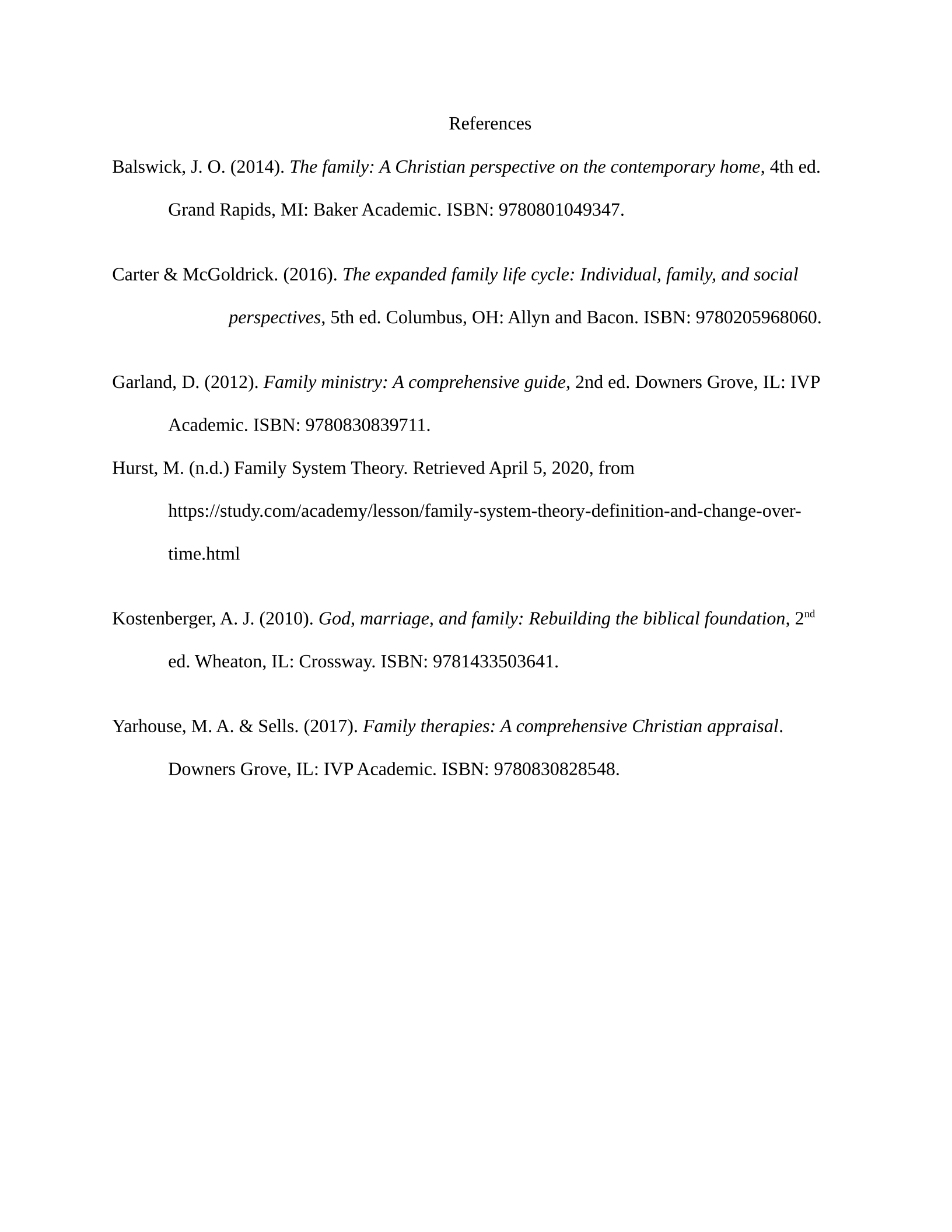
References
Balswick, J. O. (2014). The family: A Christian perspective on the contemporary home, 4th ed.
Grand Rapids, MI: Baker Academic. ISBN: 9780801049347.
Carter & McGoldrick. (2016). The expanded family life cycle: Individual, family, and social
perspectives, 5th ed. Columbus, OH: Allyn and Bacon. ISBN: 9780205968060.
Garland, D. (2012). Family ministry: A comprehensive guide, 2nd ed. Downers Grove, IL: IVP
Academic. ISBN: 9780830839711.
Hurst, M. (n.d.) Family System Theory. Retrieved April 5, 2020, from
https://study.com/academy/lesson/family-system-theory-definition-and-change-over-
time.html
Kostenberger, A. J. (2010). God, marriage, and family: Rebuilding the biblical foundation, 2nd
ed. Wheaton, IL: Crossway. ISBN: 9781433503641.
Yarhouse, M. A. & Sells. (2017). Family therapies: A comprehensive Christian appraisal.
Downers Grove, IL: IVP Academic. ISBN: 9780830828548.
Powered by TCPDF (www.tcpdf.org)

