


10/14/23, 12:23 AM
Topic: Discussion Thread: Jesus and Higher Order Thinking
https://canvas.liberty.edu/courses/523268/discussion_topics/4579424
1/26
Skip to Main Content
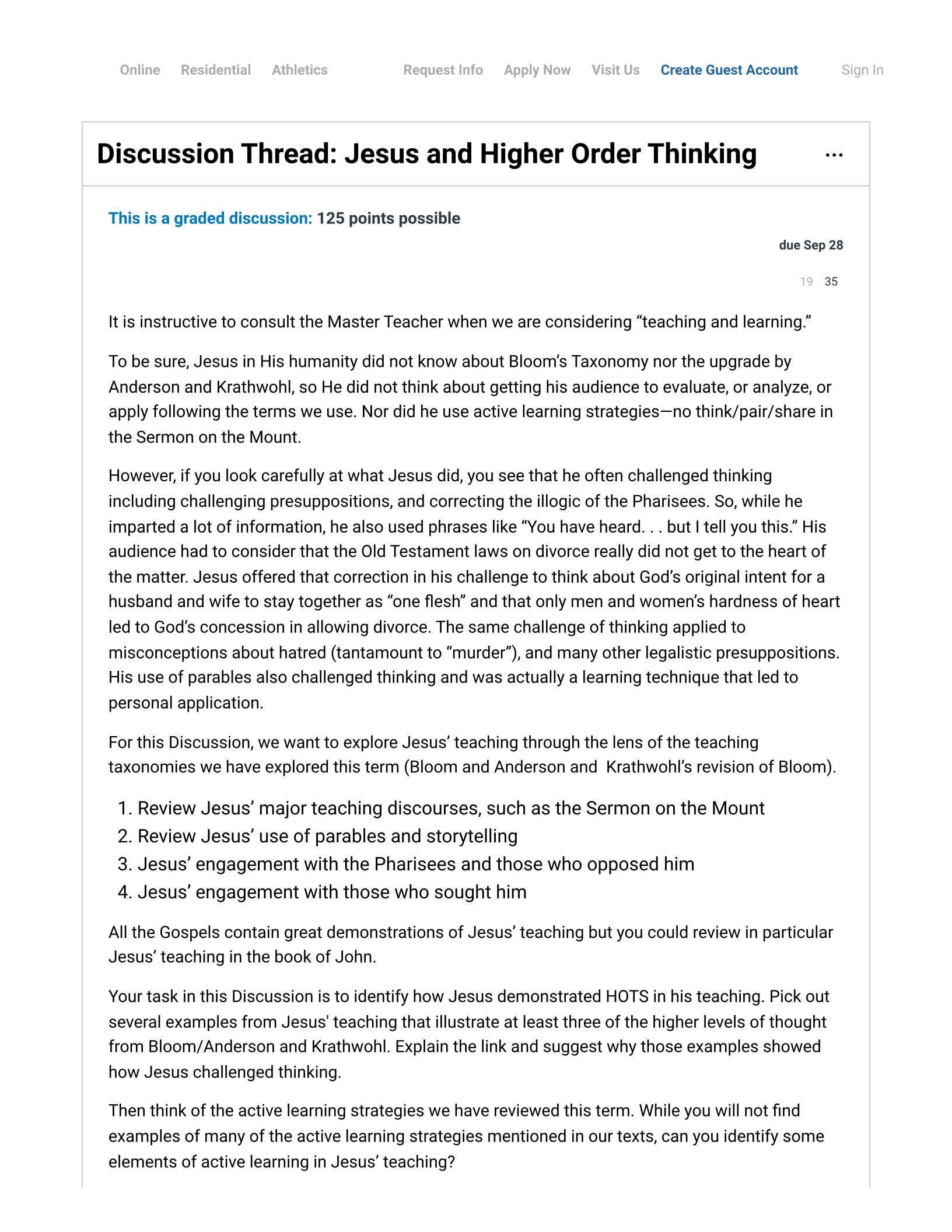
Discussion Thread: Jesus and Higher Order Thinking
This is a graded discussion: 125 points possible
due Sep 28
19 35
It is instructive to consult the Master Teacher when we are considering “teaching and learning.”
To be sure, Jesus in His humanity did not know about Bloom’s Taxonomy nor the upgrade by
Anderson and Krathwohl, so He did not think about getting his audience to evaluate, or analyze, or
apply following the terms we use. Nor did he use active learning strategies—no think/pair/share in
the Sermon on the Mount.
However, if you look carefully at what Jesus did, you see that he often challenged thinking
including challenging presuppositions, and correcting the illogic of the Pharisees. So, while he
imparted a lot of information, he also used phrases like “You have heard. . . but I tell you this.” His
audience had to consider that the Old Testament laws on divorce really did not get to the heart of
the matter. Jesus offered that correction in his challenge to think about God’s original intent for a
husband and wife to stay together as “one esh” and that only men and women’s hardness of heart
led to God’s concession in allowing divorce. The same challenge of thinking applied to
misconceptions about hatred (tantamount to “murder”), and many other legalistic presuppositions.
His use of parables also challenged thinking and was actually a learning technique that led to
personal application.
For this Discussion, we want to explore Jesus’ teaching through the lens of the teaching
taxonomies we have explored this term (Bloom and Anderson and Krathwohl’s revision of Bloom).
1. Review Jesus’ major teaching discourses, such as the Sermon on the Mount
2. Review Jesus’ use of parables and storytelling
3. Jesus’ engagement with the Pharisees and those who opposed him
4. Jesus’ engagement with those who sought him
All the Gospels contain great demonstrations of Jesus’ teaching but you could review in particular
Jesus’ teaching in the book of John.
Your task in this Discussion is to identify how Jesus demonstrated HOTS in his teaching. Pick out
several examples from Jesus' teaching that illustrate at least three of the higher levels of thought
from Bloom/Anderson and Krathwohl. Explain the link and suggest why those examples showed
how Jesus challenged thinking.
Then think of the active learning strategies we have reviewed this term. While you will not nd
examples of many of the active learning strategies mentioned in our texts, can you identify some
elements of active learning in Jesus’ teaching?
Online
Residential
Athletics
Sign InRequest Info Apply Now Visit Us Create Guest Account
10/14/23, 12:23 AM
Topic: Discussion Thread: Jesus and Higher Order Thinking
https://canvas.liberty.edu/courses/523268/discussion_topics/4579424
2/26
Search entries or author
Start a Thread
Please review the Discussion Assignment Instructions
(https://canvas.liberty.edu/courses/523268/les/96258730/download?wrap=1)
(https://canvas.liberty.edu/courses/523268/les/96258730/download?download_frd=1) prior to posting.
You may also click the three dots in the upper corner to Show Rubric.
Submit your thread by 11:59 p.m. (ET) on Thursday of Module 6: Week 6.
UNREAD
SUBSCRIBED
(https://c
Read More
Lorrie Strong (https://canvas.liberty.edu/courses/523268/users/1227491)
Sep 27, 2023
Discussion Thread: Jesus and Higher Order Thinking How did Jesus
demonstrate HOTS in His teaching? – Describe examples from Jesus’
teaching that illustrate 3 higher levels of thought and explain the link and
how Jesus challenged thinking: Jesus’ masterful teaching was…
(https://c
Reply
Jackie Craft (https://canvas.liberty.edu/courses/523268/users/246009)
Sep 30, 2023
Lorrie,
Did you glean any insight from the module reading that was specic to our
topic this week?
Lee,H.(2006).Jesus Teaching Through Discovery.International Christian
Community of Teacher Educators,1(2).1-7.
Robertson, W. H. (2008). The Greatest Constructivist Educator Ever: The
Pedagogy of Jesus Christ in the Gospel of Matthew in the Context of the
5Es.Christian Perspectives in Education, 1(2), 1-17.
(https://c
Louise Melendez
(https://canvas.liberty.edu/courses/523268/users/1078739)
10/14/23, 12:23 AM
Topic: Discussion Thread: Jesus and Higher Order Thinking
https://canvas.liberty.edu/courses/523268/discussion_topics/4579424
3/26
Sep 30, 2023
Hello Laurie,
Thank you for your post that illustrated higher order thinking and elements
of active learning in a well stated and helpful manner. You made some great
points regarding the heart of JESUS and HIS love that was conveyed through
HIS communication that encompassed a higher order thinking methodology.
JESUS is clearly a masterful Creator of communication and critical thought!
Robertson (2008) notes that the instruction of JESUS is centered on
understanding that is developed as the hearer is able to conceptualize
TRUTH. To your point, JESUS came to save us from our sins through a
transformative process of regeneration in HIM (English Standard Version,
2001, Rom 10:9-10, 2Cor 5:17). JESUS brought TRUTH to the hearers in a
manner that challenged the hearers to think through what they had
previously understood, believed, and experienced. They became active
participants and not passive in the critical thinking engagement. As
Christian educators, this highly important, as we model CHRIST and
empower the learner to come through the process of discovery as
independent critical thinkers in an active learning environment that
transforms (Lee, 2006; Merriam & Baumgartner, 2020).
Robertson (2008) also notes that the constructivist approach facilitates
learning in the classroom through a foundation of problem solving,
exploration, and guided inquiry. To your point, regarding the wedding and the
changing of water into wine (English Standard Version, 2001, John 2:1-12)
This seems to set the stage for a constructivist approach in the classroom
of learning. A problem was posed (no more wine) the disciples and the
guests were then served the best wine. Exploration, John 2:10: “Everyone
serves the good wine rst, and when people have drunk freely, then the poor
wine. But you have kept the good wine until now” (English Standard Version,
2001, John 2:10). Guided inquiry, John 2:11: “This was the rst signs, JESUS
did at Cana in Galilee, and manifested HIS glory. And the disciples believed
in HIM” (English Standard Version, 2001, John 2:11).
Lastly, Lee (2006) notes in phase three of the discovery process, exploration
is needed to examine a hypothesis. JESUS was not giving direct knowledge
of TRUTH in a forceful manner of communication but was speaking
creatively to draw the listener into a deeper level of critical thinking and
engaging the heart (mind, will, and emotion). To your point, JESUS cares
most about our heart and the transformational process of active learning,
John 8:31-32: “ So Jesus said to the Jews who had believed him, “If you
abide in my word, you are truly my disciples, and you will know the truth, and
the truth will set you free” (English Standard Version, 2001, John 8:31-32).
10/14/23, 12:23 AM
Topic: Discussion Thread: Jesus and Higher Order Thinking
https://canvas.liberty.edu/courses/523268/discussion_topics/4579424
4/26
Hide 2 Replies (0 Unread)
Reply
Blessings!
References
English Standard Version. (2001). English Standard Version online.
https://biblia.com/bible/esv (https://biblia.com/bible/esv%20)
Links to an external site. (https://biblia.com/bible/esv%20)
Lee, H. (2006). JESUS teaching through discover. Internal Christian
Community of Teacher Educators Journal, 1(2):1–7.
Merriam, S. & Baumgartner, L. (2020). Learning in adulthood; A
comprehensive guide
(4th edition). Jossey-Bass.
Roberston, W. H. (2008). The greatest constructivist educator ever. The
pedagogy of JESUS CHRIST in the Gospel of Matthew in the context of the
5Es. Christian perspective in education, 1(2): 1-17.
(https://c
Marcy Hill (https://canvas.liberty.edu/courses/523268/users/997845)
Sep 28, 2023
10/14/23, 12:23 AM
Topic: Discussion Thread: Jesus and Higher Order Thinking
https://canvas.liberty.edu/courses/523268/discussion_topics/4579424
5/26
Read More
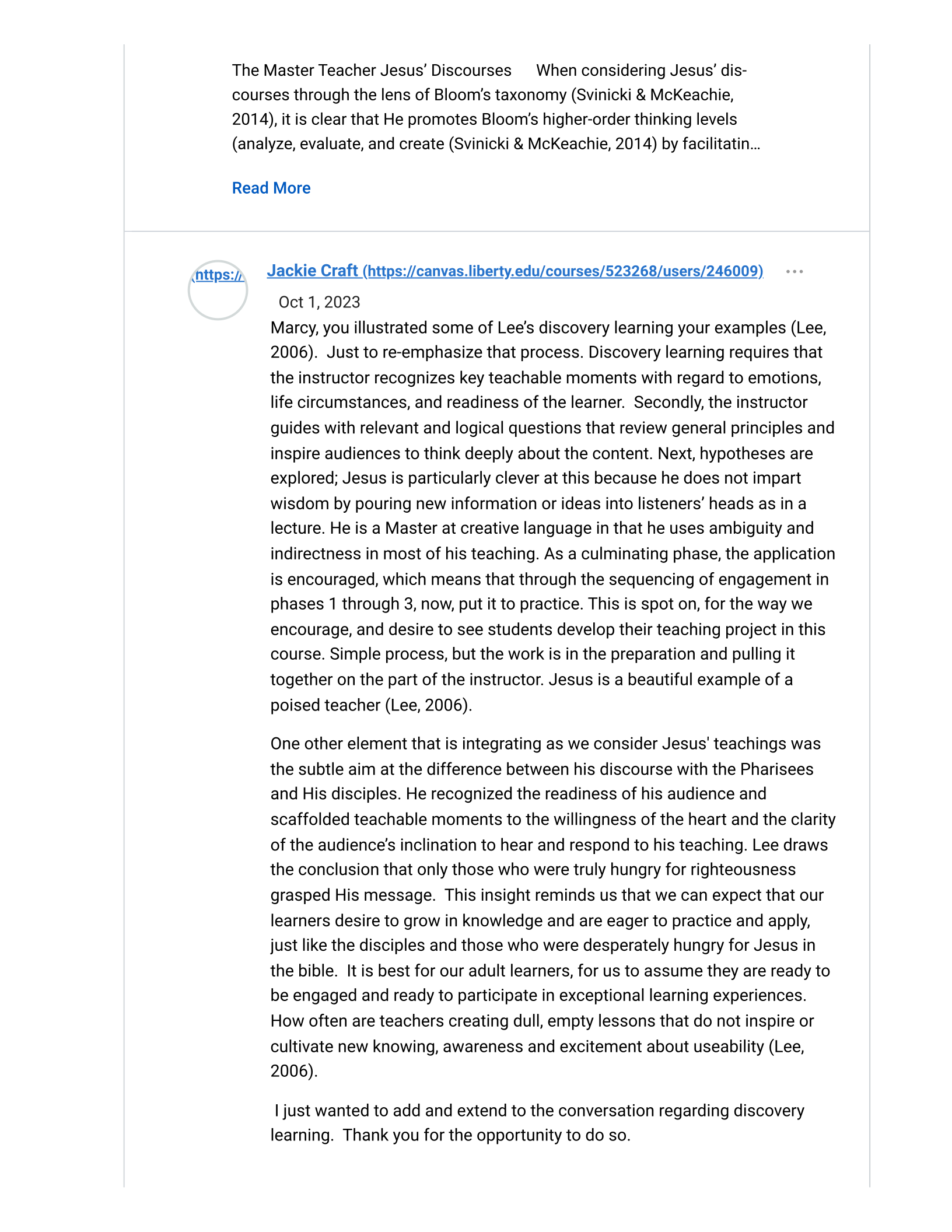
The Master Teacher Jesus’ Discourses When considering Jesus’ dis-
courses through the lens of Bloom’s taxonomy (Svinicki & McKeachie,
2014), it is clear that He promotes Bloom’s higher-order thinking levels
(analyze, evaluate, and create (Svinicki & McKeachie, 2014) by facilitatin…
(https://c
Jackie Craft (https://canvas.liberty.edu/courses/523268/users/246009)
Oct 1, 2023
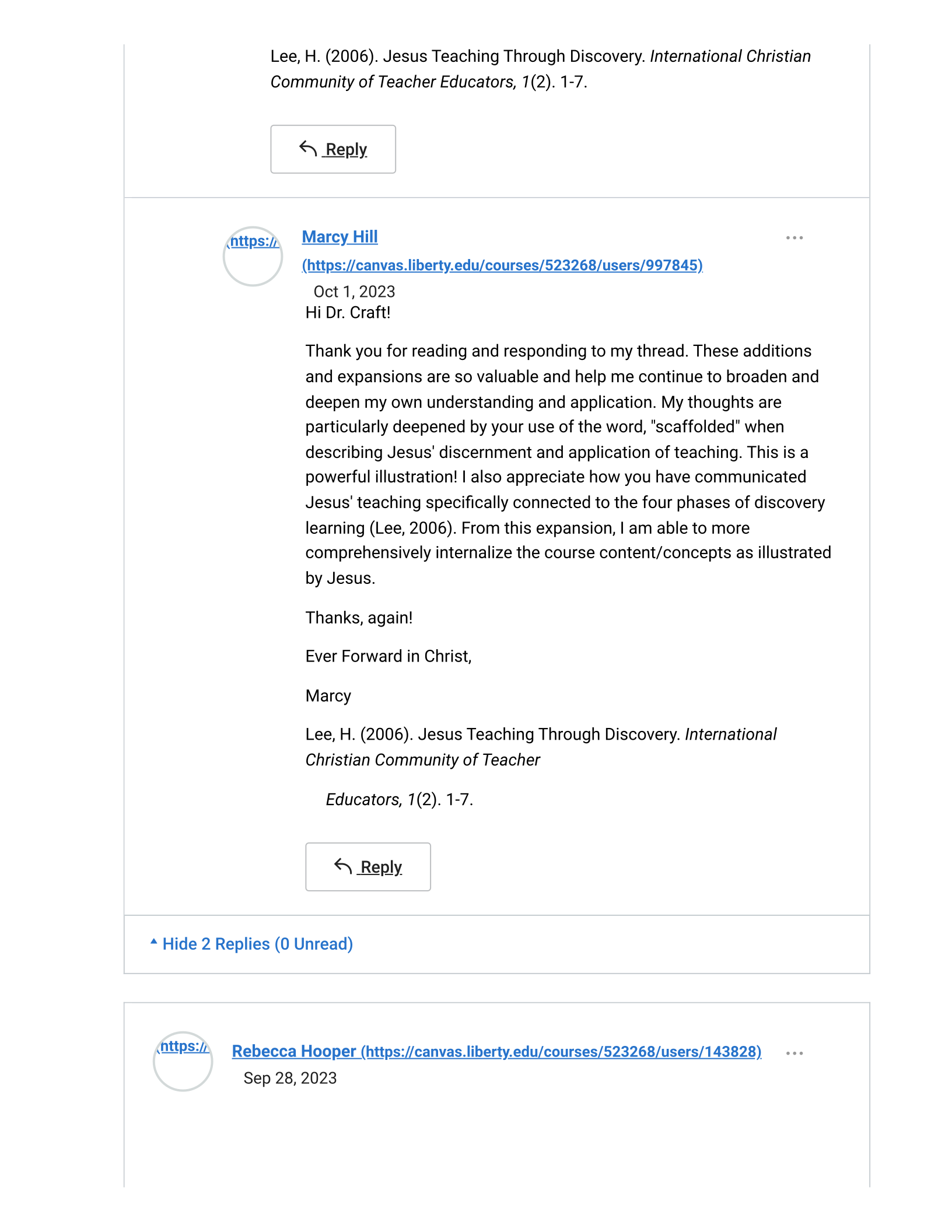
Marcy, you illustrated some of Lee’s discovery learning your examples (Lee,
2006). Just to re-emphasize that process. Discovery learning requires that
the instructor recognizes key teachable moments with regard to emotions,
life circumstances, and readiness of the learner. Secondly, the instructor
guides with relevant and logical questions that review general principles and
inspire audiences to think deeply about the content. Next, hypotheses are
explored; Jesus is particularly clever at this because he does not impart
wisdom by pouring new information or ideas into listeners’ heads as in a
lecture. He is a Master at creative language in that he uses ambiguity and
indirectness in most of his teaching. As a culminating phase, the application
is encouraged, which means that through the sequencing of engagement in
phases 1 through 3, now, put it to practice. This is spot on, for the way we
encourage, and desire to see students develop their teaching project in this
course. Simple process, but the work is in the preparation and pulling it
together on the part of the instructor. Jesus is a beautiful example of a
poised teacher (Lee, 2006).
One other element that is integrating as we consider Jesus' teachings was
the subtle aim at the difference between his discourse with the Pharisees
and His disciples. He recognized the readiness of his audience and
scaffolded teachable moments to the willingness of the heart and the clarity
of the audience’s inclination to hear and respond to his teaching. Lee draws
the conclusion that only those who were truly hungry for righteousness
grasped His message. This insight reminds us that we can expect that our
learners desire to grow in knowledge and are eager to practice and apply,
just like the disciples and those who were desperately hungry for Jesus in
the bible. It is best for our adult learners, for us to assume they are ready to
be engaged and ready to participate in exceptional learning experiences.
How often are teachers creating dull, empty lessons that do not inspire or
cultivate new knowing, awareness and excitement about useability (Lee,
2006).
I just wanted to add and extend to the conversation regarding discovery
learning. Thank you for the opportunity to do so.
10/14/23, 12:23 AM
Topic: Discussion Thread: Jesus and Higher Order Thinking
https://canvas.liberty.edu/courses/523268/discussion_topics/4579424
6/26
Hide 2 Replies (0 Unread)
Reply
Lee,H.(2006).Jesus Teaching Through Discovery.International Christian
Community of Teacher Educators,1(2).1-7.
(https://c
Reply
Marcy Hill
(https://canvas.liberty.edu/courses/523268/users/997845)
Oct 1, 2023
Hi Dr. Craft!
Thank you for reading and responding to my thread. These additions
and expansions are so valuable and help me continue to broaden and
deepen my own understanding and application. My thoughts are
particularly deepened by your use of the word, "scaffolded" when
describing Jesus' discernment and application of teaching. This is a
powerful illustration! I also appreciate how you have communicated
Jesus' teaching specically connected to the four phases of discovery
learning (Lee, 2006). From this expansion, I am able to more
comprehensively internalize the course content/concepts as illustrated
by Jesus.
Thanks, again!
Ever Forward in Christ,
Marcy
Lee,H.(2006).Jesus Teaching Through Discovery.International
Christian Community of Teacher
Educators,1(2).1-7.
(https://c
Rebecca Hooper (https://canvas.liberty.edu/courses/523268/users/143828)
Sep 28, 2023
10/14/23, 12:23 AM
Topic: Discussion Thread: Jesus and Higher Order Thinking
https://canvas.liberty.edu/courses/523268/discussion_topics/4579424
7/26
Read More
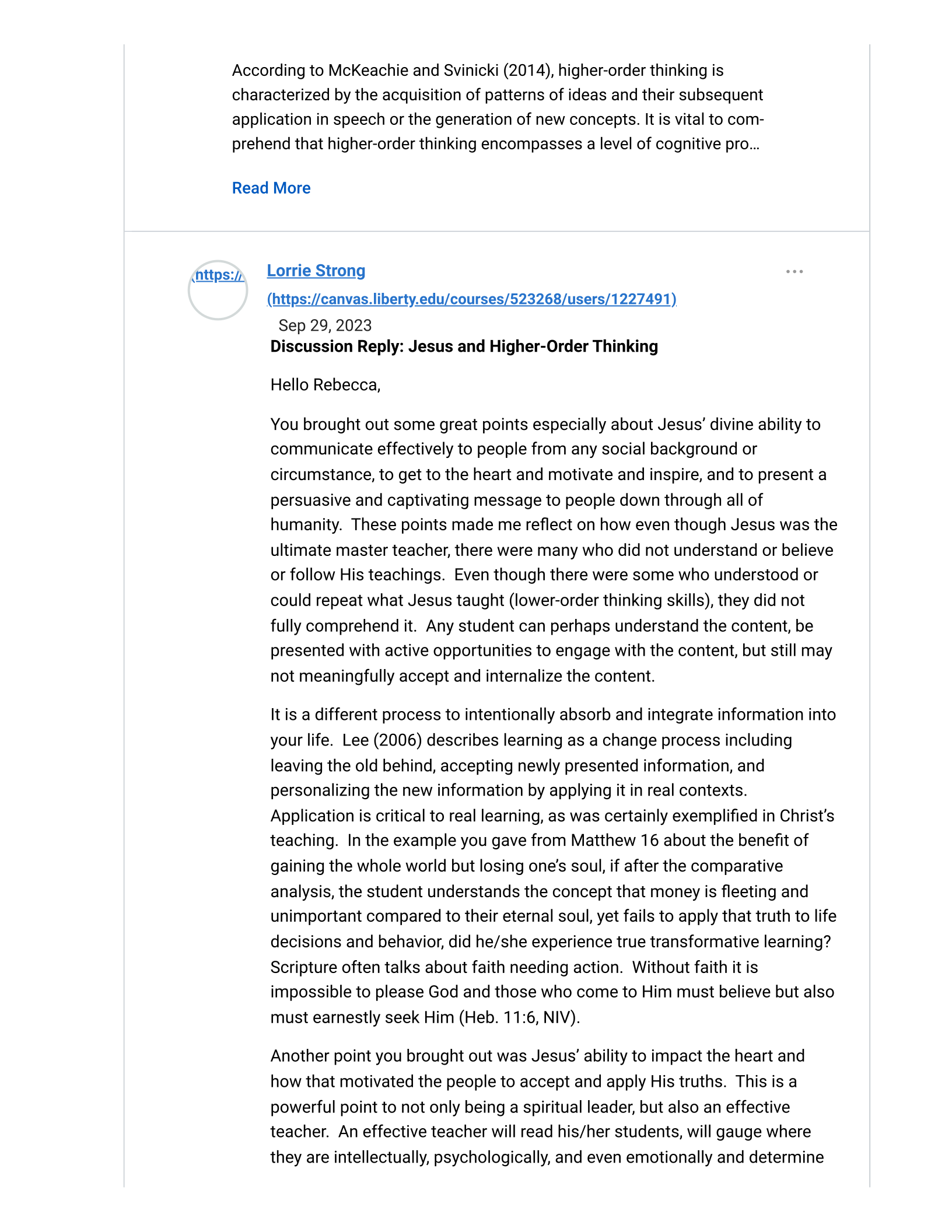
According to McKeachie and Svinicki (2014), higher-order thinking is
characterized by the acquisition of patterns of ideas and their subsequent
application in speech or the generation of new concepts. It is vital to com-
prehend that higher-order thinking encompasses a level of cognitive pro…
(https://c
Lorrie Strong
(https://canvas.liberty.edu/courses/523268/users/1227491)
Sep 29, 2023
Discussion Reply: Jesus and Higher-Order Thinking
Hello Rebecca,
You brought out some great points especially about Jesus’ divine ability to
communicate effectively to people from any social background or
circumstance, to get to the heart and motivate and inspire, and to present a
persuasive and captivating message to people down through all of
humanity. These points made me reect on how even though Jesus was the
ultimate master teacher, there were many who did not understand or believe
or follow His teachings. Even though there were some who understood or
could repeat what Jesus taught (lower-order thinking skills), they did not
fully comprehend it. Any student can perhaps understand the content, be
presented with active opportunities to engage with the content, but still may
not meaningfully accept and internalize the content.
It is a different process to intentionally absorb and integrate information into
your life. Lee (2006) describes learning as a change process including
leaving the old behind, accepting newly presented information, and
personalizing the new information by applying it in real contexts.
Application is critical to real learning, as was certainly exemplied in Christ’s
teaching. In the example you gave from Matthew 16 about the benet of
gaining the whole world but losing one’s soul, if after the comparative
analysis, the student understands the concept that money is eeting and
unimportant compared to their eternal soul, yet fails to apply that truth to life
decisions and behavior, did he/she experience true transformative learning?
Scripture often talks about faith needing action. Without faith it is
impossible to please God and those who come to Him must believe but also
must earnestly seek Him (Heb. 11:6, NIV).
Another point you brought out was Jesus’ ability to impact the heart and
how that motivated the people to accept and apply His truths. This is a
powerful point to not only being a spiritual leader, but also an effective
teacher. An effective teacher will read his/her students, will gauge where
they are intellectually, psychologically, and even emotionally and determine

10/14/23, 12:23 AM
Topic: Discussion Thread: Jesus and Higher Order Thinking
https://canvas.liberty.edu/courses/523268/discussion_topics/4579424
8/26
Reply
how to communicate relevantly and in meaningful ways to them. Jesus was
also able to speak more profoundly into people’s hearts because of the
power of His everyday spiritual example. Scripture, and notably the book of
Luke, points to the effectiveness of the unity and consistency of Jesus’ life
and His teaching for spiritual instruction (Wright, 2023). He taught about,
but also perfectly lived every day, the principles of prayer, being in total
reliance on God and His will, and of simplicity, of living out love for the sick,
widowed, and poor without the love for material wealth. I believe Jesus’
perfectly lived-out applications of His teaching principles in very real
contexts were also critical elements of why His teachings were so deeply
profound and impactful. As instructors in classrooms, even though this has
different application than Jesus living with His disciples, I feel we are also
called to develop relationships with our students, to live out the principles
we are expounding, and to set up a classroom environment fostering care
for the heart of the students and also the heart of, the true spirit behind the
content we are teaching and believe is important.
Blessings to you.
Lorrie Strong
References
Lee, H. (2006). Jesus teaching through discovery. International Christian
Community of Teacher Educators
Journal, 1(2).
https://digitalcommons.georgefox.edu/icctej/vol1/iss2/5
(https://digitalcommons.georgefox.edu/icctej/vol1/iss2/5)
New International Version. (2011). BibleGateway.com.
http://www.biblegateway.com/versions/New-International-Version-NIV-
Bible/#booklist (http://www.biblegateway.com/versions/New-International-
Version-NIV-Bible/#booklist) .
Wright, C. (2023). The power of example: Following Jesus on the path of
spirituality in Luke-Acts.
Religions, 14 (161), 1-15. https://doi.org/10.3390/rel14020161
(https://doi.org/10.3390/rel14020161) .

10/14/23, 12:23 AM
Topic: Discussion Thread: Jesus and Higher Order Thinking
https://canvas.liberty.edu/courses/523268/discussion_topics/4579424
9/26
Hide 1 Reply (0 Unread)
(https://c
Read More
Michelle Mesa (https://canvas.liberty.edu/courses/523268/users/112150)
Sep 28, 2023
Discussion Thread: Jesus And Higher Order Thinking There are several
teachings of Jesus that display higher order thinking skills. However, dur-
ing this period of time higher order thinking skills were no set-in place as
they are throughout this course. Jesus was known as a legendary teach…
(https://c
Reply
Jackie Craft (https://canvas.liberty.edu/courses/523268/users/246009)
Oct 1, 2023
Michelle, you point to Matthew 5 as a great illustration of Jesus’s teaching.
In the sermon on the Mount, he denitely uses some of the most creative
and vivid literary strategies to create examples, and maximize thought. Lee
(2016) spells these instances out for us in Mat 5:14 b and in Mt 5:29. Jesus
used the English interpretation of a metonymy and a hyperbole. A
metonymy is the use of symbolic language to describe or explain the truth.
We see that in Mat 5:14-16: You are the light of the world.A town built on a
hill cannot be hidden.Neither do people light a lamp and put it under a bowl.
Instead, they put it on its stand, and it gives light to everyone in the house.
Additionally, a Hyperbole uses exaggeration to emphasize a truth or principle
and we see a graphic example of that in Mat 5:29 - If your right eye causes
you to stumble,gouge it out and throw it away. It is better for you to lose one
part of your body than for your whole body to be thrown into hell.
Wonder if we used similar strategies when teaching counseling-education?
How powerful might that be, and how clever and insightful must we be as
instructors to develop such illustrative teaching examples? The examples
Jesus uses are not black and white, but rather cause ambiguity and some
uncertainty to the exact point being made. It was a process of discovery
through inquiry. We can learn so much from the teachings of Jesus and I
appreciate you pointing us to this specic passage.
Lee,H.(2006).Jesus Teaching Through Discovery.International Christian
Community of Teacher Educators,1(2).1-7.
10/14/23, 12:23 AM
Topic: Discussion Thread: Jesus and Higher Order Thinking
https://canvas.liberty.edu/courses/523268/discussion_topics/4579424
10/26
Hide 1 Reply (0 Unread)
(https://c
Read More
Louise Melendez
(https://canvas.liberty.edu/courses/523268/users/1078739)
Sep 28, 2023
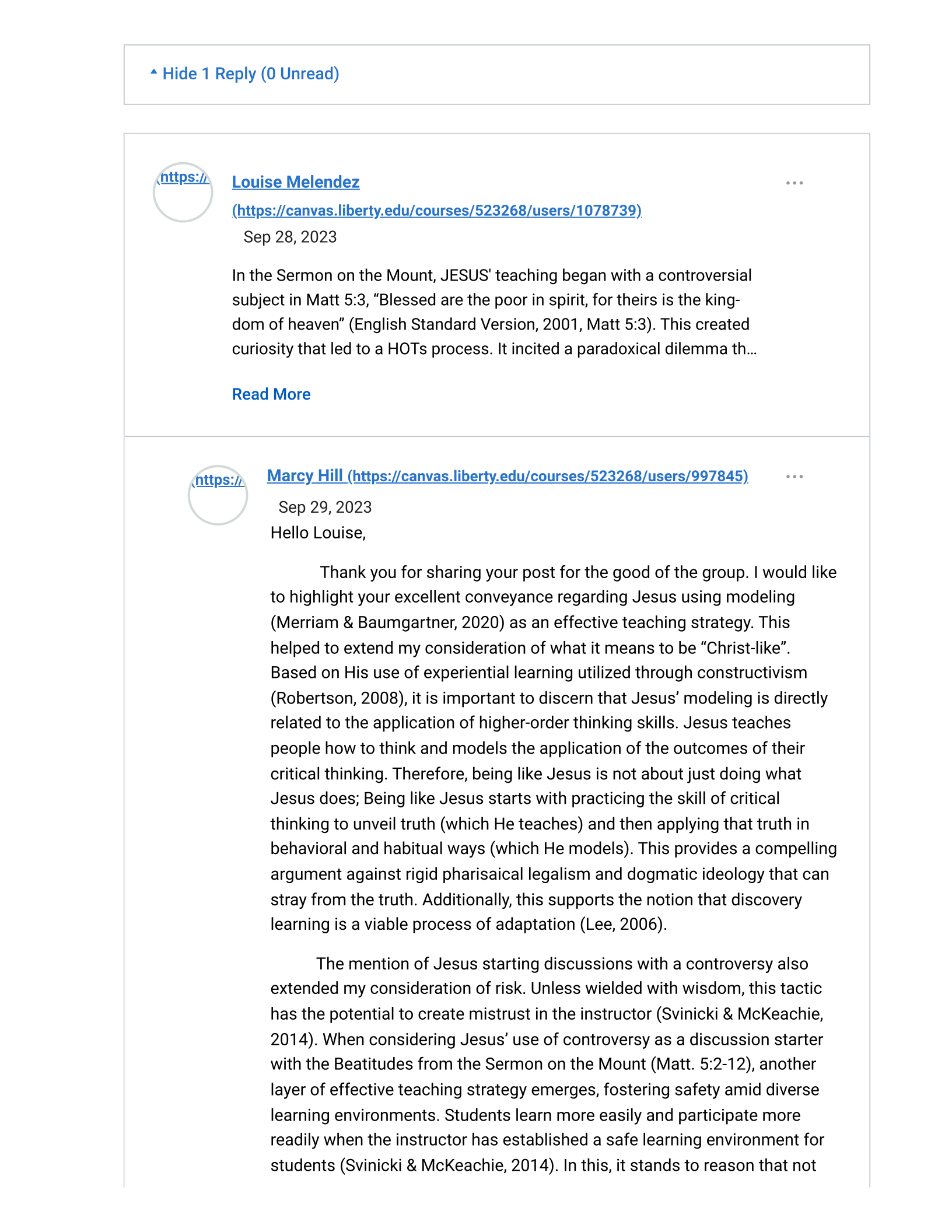
In the Sermon on the Mount, JESUS' teaching began with a controversial
subject in Matt 5:3, “Blessed are the poor in spirit, for theirs is the king-
dom of heaven” (English Standard Version, 2001, Matt 5:3). This created
curiosity that led to a HOTs process. It incited a paradoxical dilemma th…
(https://c
Marcy Hill (https://canvas.liberty.edu/courses/523268/users/997845)
Sep 29, 2023
Hello Louise,
Thank you for sharing your post for the good of the group. I would like
to highlight your excellent conveyance regarding Jesus using modeling
(Merriam & Baumgartner, 2020) as an effective teaching strategy. This
helped to extend my consideration of what it means to be “Christ-like”.
Based on His use of experiential learning utilized through constructivism
(Robertson, 2008), it is important to discern that Jesus’ modeling is directly
related to the application of higher-order thinking skills. Jesus teaches
people how to think and models the application of the outcomes of their
critical thinking. Therefore, being like Jesus is not about just doing what
Jesus does; Being like Jesus starts with practicing the skill of critical
thinking to unveil truth (which He teaches) and then applying that truth in
behavioral and habitual ways (which He models). This provides a compelling
argument against rigid pharisaical legalism and dogmatic ideology that can
stray from the truth. Additionally, this supports the notion that discovery
learning is a viable process of adaptation (Lee, 2006).
The mention of Jesus starting discussions with a controversy also
extended my consideration of risk. Unless wielded with wisdom, this tactic
has the potential to create mistrust in the instructor (Svinicki & McKeachie,
2014). When considering Jesus’ use of controversy as a discussion starter
with the Beatitudes from the Sermon on the Mount (Matt. 5:2-12), another
layer of effective teaching strategy emerges, fostering safety amid diverse
learning environments. Students learn more easily and participate more
readily when the instructor has established a safe learning environment for
students (Svinicki & McKeachie, 2014). In this, it stands to reason that not
10/14/23, 12:23 AM
Topic: Discussion Thread: Jesus and Higher Order Thinking
https://canvas.liberty.edu/courses/523268/discussion_topics/4579424
11/26
only did Jesus use controversy to start a discussion with eager learners, He
also rst established a safe physical, and emotional space for them to learn.
This relationship building removed cultural barriers and put all students in a
position of being equally loved and valued. Positive regard for students is an
effective way to remove barriers and foster critical thinking in adult learning
settings (Svinicki & McKeachie, 2014). It is no surprise that Jesus was
exceptional at creating effective learning environments.
Lastly, I appreciate your illustrating how students who have
experiences of marginalization may have barriers to learning (Svinicki &
McKeachie, 2014). Though experiential learning is an effective andragogical
theory, that does not mean that all student experiences are going to promote
learning (Merriam & Baumgartner, 2020). This expanded my thoughts
regarding Jesus as a teacher, but also as a friend. The twelve disciples were
extremely diverse. Jesus not only served as their teacher, but they cared
about one another, as people. It is not uncommon for students to be
interested in what kind of person lls the role of their instructors (Svinicki &
McKeachie, 2014). In this, Jesus did not withhold Himself and formed true,
genuine relationships with those He encountered and instructed, which
bolstered the transformative learning process by dispelling shame (Merriam
& Baumgartner, 2020) through acceptance, love, and renement.
Ever Forward in Christ,
Dr. Marcy Hill
References
Lee, H. (2006). Jesus Teaching through discovery. International Christian
Community of Teacher
Educators Journal, 1(2).
Merriam, S., & Baumgartner, L. (2020).Learning in adulthood: A
comprehensive guide (4th ed.).
Jossey-Bass.
Robertson, W. H. (2008). The greatest constructivist educator ever: The
pedagogy of Jesus Christ
in the Gospel of Matthew in the context of the 5Es. Christian perspectives
in education, 1(2), 1-18.

10/14/23, 12:23 AM
Topic: Discussion Thread: Jesus and Higher Order Thinking
https://canvas.liberty.edu/courses/523268/discussion_topics/4579424
12/26
Reply
https://digitalcommons.liberty.edu/cpe/vol1/iss2/5
(https://digitalcommons.liberty.edu/cpe/vol1/iss2/5)
Svinicki, M., & McKeachie, W. (2014).McKeachie's teaching tips: Strategies,
research, and theory for
college and university teachers. Cengage Learning.
(https://c
Reply
Louise Melendez
(https://canvas.liberty.edu/courses/523268/users/1078739)
Sep 30, 2023
Thank you Dr.Hill!
Blessings!
Louise
(https://c
Cherese Mbila
(https://canvas.liberty.edu/courses/523268/users/912908)
Sunday
Good evening Louise
One of the things I love about Jesus and His teachings is that He did not shy
away from those tough discussions or questions. The example you provided
on the teaching on the sermon on the mount, was a prime example of a
controversial subject discussed in the New Testament. His questions as you
said awakened many emotions in the listeners and continue to do so as we
are here discussing them in our classes. I believe many instances Jesus’s
teachings were not directly for the person He was speaking to but rather for
the people spectating while He was speaking. The scriptural reference you
noted of the Canaanite woman, Jesus’s refusal to turn her away provoked
thought in His disciples. They likely did not understand what was occurring
initially but were forced to think deeper about their beliefs and
interpretations of their experiences. I agree with your assessment that the
woman’s response to Jesus was to deduce, appraise, and reconstruct the
underlying truth. She had to remove the emotion that may have stumped
others, and provide a response based on reconstruct her truth. She did not
struggle with imposter syndrome as one might assume despite the trials she
was facing. This imposter syndrome may have caused a reaction that was
10/14/23, 12:23 AM
Topic: Discussion Thread: Jesus and Higher Order Thinking
https://canvas.liberty.edu/courses/523268/discussion_topics/4579424
13/26
Hide 3 Replies (0 Unread)
Reply
not conducive to her learning experience, but she was committed to active
learning and provided a response that got her the blessing she desired
(Mckeachi & Svinick, 2013). I believe some of the answers we are seeking to
those dicult questions and situations require critical thinking before
responding as the Canaanite woman was able to do effectively.
Reference
Svinicki, M., & McKeachie, W. (2014).McKeachie’s teaching tips: Strategies,
research, and theory for college and university teachers.Belmont, CA:
Cengage Learning.
(https://c
Willie Eaton (https://canvas.liberty.edu/courses/523268/users/288094)
Sep 28, 2023
Discussion Thread: Jesus and Higher Order Thinking
This week’s discussion focuses on Jesus as the Master Teacher and how
he applied Higher-Order Thinking Skills (HOTS) in his teaching strategies.
Scholars present many denitions for the term critical thinking. Dami et al.
(2020) dene critical thinking as a reective way of thinking that creates
understanding based on logic to determine what is believed and done. Higher-
order thinking has a tradition of integrating philosophical research on critical
thinking and psychological research for problem-solving (Jansen & Möller, 2022).
Bloom’s taxonomy (Blooms, 1956) is one of the most ongoing thinking
frameworks inuencing American higher education pedagogy. 2001 Anderson
and Krathwohl revised Bloom's taxonomy to improve its pedagogical accuracy. I
observed that Anderson and Krathwohl changed the subject matter (noun) and
cognitive processes to a (verb) to reect a different thinking nature for each
category.
Jesus realized how analyzing, evaluating, and creating (HOTS) effectively
inuenced his message and created critical thinking. Jesus also realized how
culture and context alone would affect his message. Svinicki & Mckeachie (2014)
state that understanding culture and stressors (i.e., the unschooled, disciples,
ordinary people, the Pharisees, or scribes) can enhance a person’s learning
environment. Jesus demonstrated high-order communication skills and effective
HOTS in every situation when teaching or having conversations. Jesus' desired
10/14/23, 12:23 AM
Topic: Discussion Thread: Jesus and Higher Order Thinking
https://canvas.liberty.edu/courses/523268/discussion_topics/4579424
14/26
outcome, as it relates to Bloom's Taxonomy, was to “Create," which is the highest
level of thinking. After applying HOTS, Jesus wanted the audience to create
something new within themselves or create/become a new creation. For
discussion, we will explore Jesus' teaching through the lens of the teaching
taxonomies of (Bloom and Anderson and Krathwohl's revision of Bloom).
Part 1- Review Jesus' major teaching discourses, such as the Sermon on the
Mount from prompt one instructions
Jesus’ Sermon on the Mount is perhaps one of the most signicant
discourses ever given, and today, it is still considered revolutionary regarding its
teaching and message. No other sermon of Jesus can compare to helping us
understand the attributes and characteristics of Christ the Savior. Jesus realized
that learning was not simply memorizing facts (Bloom and Anderson and
Krathwohl Taxonomy (Revised) but involved learning new facts and ways to apply
the new knowledge. Jesus’ teaching strategy is also derived from the
cognitivism-based learning process used as a pedagogy approach. Jesus uses
the constructivism ve-phase process known as the 5Es to make learning
effective. The 5Es include the engagement phase, the exploration phase, the
explanation phase, the elaboration phase, and the evaluation phase (Robertson,
2008).
Jesus starts his teachings with a series of beatitudes. The Editors of
Encyclopedia Britannica (2019) dene beatitudes as any blessings Jesus said
during the Sermon on the Mount. Beatitudes can also be dened as being
blessed, prosperous, or abundant. During the Sermon on the Mount, beatitudes
were a series of phrases beginning with the words “Blessed are the_______,” by
which Jesus identies those individuals who were indeed recipients of God's
blessings. This type of discussion could be controversial since the Pharisees
considered themselves righteous and experts of the Law of Moses. Svinicki &
Mckeachie (2014) state that a certain degree of surprise, disagreement, or
uncertainty creates a motivation for learning.
Jesus’ teaching is typically used as a discovery learning process. During
the discovery learning process, the teacher (1) identies the teachable moments
by asking open-ended questions (2) guides the student by presenting examples,
non-examples, and learning material. The predened learning procedures guide
this and (3) applying the lesson learned to practical situations. Learning is
signicant when transferred to another situation (Lee, 2006). Jesus understood
his audience and encouraged them to engage in the conversation using prior
experience and knowledge. Jesus also asked open-ended questions that
triggered HOTS and active learning through reections on underlying principles in
his messages.
Part 2- Review Jesus’ use of parables and storytelling
Merriam-Webster (2014) denes a parable as "a short ctitious story that
illustrates a moral attitude or a religious principle, as told by Jesus in the
10/14/23, 12:23 AM
Topic: Discussion Thread: Jesus and Higher Order Thinking
https://canvas.liberty.edu/courses/523268/discussion_topics/4579424
15/26
Gospels." Jesus used parables and storytelling to challenge thought and enhance
teaching effectiveness. Jesus' parables encompassed the use of the
imagination. This learning theory is considered the Brain/memory/cognitive
theory, which includes the conscious and unconscious process of recognizing
knowledge and experience (Merriam & Baumgartner, 2020, p. 416). Parables
typically consist of two distinct layers or two-fold. On the top layer is an exciting
story that is easily understood based on one's experience. On the bottom layer is
a deeper meaning or understanding of the spiritual truth that deals with the
kingdom of heaven. The King James Bible, 1769/2021, Matthew 13: 11-13 states,
"He answered and said unto them, Because it is given unto you to know the
mysteries of the kingdom of heaven, but to them, it is not given. For whosoever
hath, to him shall be given, and he shall have more abundance: but whosoever
hath not, from him shall be taken away even that he hath. Therefore, speak I to
them in parables: because they seeing see not; and hearing they hear not, neither
do they understand. Parables allow those who have faith, along with the
instruction of the Holy Spirit, to learn more about the kingdom of heaven and the
opposite to those who do not.
Part 3- Jesus’ engagement with the Pharisees and those who opposed him
The Pharisees were the religious people among the Jews during Jesus' life
on earth. They wanted not to break God's laws and considered themselves
righteous and obedient toward the law and scriptures. For them, the Old
Testament was the set of rules that must always be kept. When teaching the
Pharisees, Jesus used the constructivist ve-phase process known as the 5Es.
When Jesus discussed the situation of the adulterous woman being stoned, he
applied the 5Es to the discussion. The 5Es activated the critical thinking process
toward a deeper spiritual thinking process. The engagement phase started the
critical thinking toward a real-world topic or situation. The exploration phase
allowed those to retain facts through the critical thinking process by logically
making a real-world connection. The most vital explanation phase regarding the
topic permitted the Pharisees to arrive at a new way of thinking and
understanding. This way of thinking required the Pharisees to apply HOTS,
changing their mindset and standards. The elaboration phase allowed the
Pharisees to build on a new way of thinking/learning and processes. Last, the
evaluation phase taught the Pharisees how to analyze, synthesize, and evaluate
(HOTS) the situation and look deeper within themselves.
Part 4- Jesus’ engagement with those who sought him
The gospels have recorded some fascinating stories of Jesus and his
interaction with people. One of the most popular stories is The Woman at the
Well. Jesus already knew the woman’s background and situation. Also, from the
cultural and historical tradition during this time, women typically drew water in
the morning in groups. The fact that she drew water in the afternoon showed she
was a social outcast. Svinicki & Mckeachie (2014) state that understanding
culture and stressors can enhance a person’s learning environment. The
10/14/23, 12:23 AM
Topic: Discussion Thread: Jesus and Higher Order Thinking
https://canvas.liberty.edu/courses/523268/discussion_topics/4579424
16/26
Samaritan woman felt comfortable enough to have a conversation with Jesus.
Afterwards, he asked open-ended questions, started the critical thinking process,
and created trust. Svinicki & Mckeachie (2014) state individuals with dicult life
experiences sometimes learn to be observant due to survival before trust is
created.
Svinicki & Mckeachie (2014) state teachers should be sensitive to cultural
differences among students. The Samaritan woman is an excellent example of
an ethnic student (e.g., gender, race, marital status, handicap, etc.) and ways the
Master Teacher applied another teaching principle toward active learning and
critical thinking through the woman's personal life experiences. Svinicki &
Mckeachie (2014) state that “Understanding the cultural experiences of an ethnic
student can help bring academic material to life in concrete ways” (p. 166).
Jesus' active learning strategy showed the importance of understanding cultural
beliefs and stressors and enhancing performance or the desired outcome when
applied correctly. The Samaritan woman left and told others what happened, and
her testimony led others to salvation. This was another way of analyzing,
evaluating, and creating higher thinking skills.
Summary
Jesus's Higher Order of Thinking using Bloom's Revised Taxonomy
teaches us the relationship between critical thinking and biblical worldviews. You
can utilize Biblical principles within the six categories. For example, we can take
one of the Ten Commandments (You shall have no other gods before Me) and
apply Bloom's Revised Taxonomy. Category 1: Remember. Even though this is a
lower-order thinking skill, it is important because it is the foundational level of
understanding. We memorize the commandments as the foundation. Category 2:
Understand. We remember and restate the meaning of the commandment.
Category 3: We apply the commandment in a concrete way, or what does the
action look like? Svinicki & Mckeachie (2014) state that concrete is another
generic teaching principle, but you can use examples of a person’s personal life
experience to enforce the learning. Category 4: Analyze. We break down the
scripture into a deeper meaning to gain more knowledge while seeking God’s will.
Category 5: Evaluate. We judge based on what we know to be facts or
correct/wrong. Category 6: Create. We create a new approach and process while
creating something new within ourselves. Renewing the mind is another
denition of creating in this tense. Dami et al. (2020) state that the Biblical
perspective for critical thinking deals with (1) the incarnation and Scriptures.
Christians must maintain a sense of human reasoning. We have God-given
reasoning abilities to know and discover despite sin, (2) have the presence of the
Holy Spirit. The Holy Spirit teaches believers in an educational/spiritual and
thinking process. We should read and study the bible while relying on the Holy
Spirit for guidance, and (3) we should discern and distinguish the will of God, not
simply gain knowledge or please ourselves, but Jesus teaches us to be more like
him in thinking and inuence.
10/14/23, 12:23 AM
Topic: Discussion Thread: Jesus and Higher Order Thinking
https://canvas.liberty.edu/courses/523268/discussion_topics/4579424
17/26
References
Bloom, B. S. (1956). Taxonomy of Educational Objectives: The Classication of
Educational Goals. Handbook 1, Cognitive Domain. Longman.
Dami, Z. A., Alexander, F., & Manafe, Y. Y. (2020). Jesus’ Questions in the Gospel
of Matthew: Promoting Critical Thinking Skills. Christian Education Journal:
Research on Educational Ministry, 18(1), 073989132097129.
https://doi.org/10.1177/0739891320971295
(https://doi.org/10.1177/0739891320971295)
Jansen, T., & Möller, J. (2022). Teacher judgments in school exams: Inuences of
students’ lower-order-thinking skills on the assessment of students’ higher-order-
thinking skills. Teaching and Teacher Education, 111, 103616.
https://doi.org/10.1016/j.tate.2021.103616
(https://doi.org/10.1016/j.tate.2021.103616)
King James Bible. (2021). King James Bible Online.
https://www.biblestudytools.com (https://www.biblestudytools.com/)
(Original work published 1769)
Lee, H. (2006). Jesus Teaching Through Discovery. International Christian
Community of Teacher Educators Journal, 1(2). https://doi.org/-
Merriam, S. B., Caffarella, R. S., Baumgartner, L., & Jossey-Bass Inc. (2020).
Learning in Adulthood: A Comprehensive Guide (4th ed., pp 1-458). Jossey-Bass.
Merriam-Webster. (2014). Denition of PARABLE. Merriam-Webster.com.
https://www.merriam-webster.com/dictionary/parable (https://www.merriam-
webster.com/dictionary/parable)
Robertson, W. H. (2008). The Greatest Constructivist Educator Ever: The
Pedagogy of Jesus Christ in the Gospel of Matthew in the Context of the 5Es.
CPE, 1(2), 5.
Svinicki, M. D., & Mckeachie, W. J. (2014). McKeachie’s Teaching Tips: Strategies,
Research, and Theory for College and University Teachers (14th ed., pp. 3–339).
Wadsworth, Cengage Learning.
The Editors of Encyclopedia Britannica. (2019). Beatitude | Denition, Etymology,
List, & Facts. In Encyclopædia Britannica.
https://www.britannica.com/topic/Beatitude-biblical-literature
(https://www.britannica.com/topic/Beatitude-biblical-literature)
10/14/23, 12:23 AM
Topic: Discussion Thread: Jesus and Higher Order Thinking
https://canvas.liberty.edu/courses/523268/discussion_topics/4579424
18/26
Read Less
Reply
(https://c
James Johnson
(https://canvas.liberty.edu/courses/523268/users/1518692)
Sep 28, 2023
Jesus and Higher Order Thinking
Greetings to you all,
Jesus participated in discovery learning. He encouraged his hearers to reect
on general concepts, often unclear, and nd new relationships between what was
normal in their culture and the religious teachings (Lee, 2006). Jesus
accomplished this through complex reasoning in metaphors, syllogisms, and
parables (Valdez, 2020). Jesus used questions to address his accusers and
address practical problems. The Gospel of John records examples of higher-
order thinking skills, HOTS, and applications of Bloom's taxonomy.
In John 8:1-11 (Good News Bible, 1993), the Scribes and Pharisees attempted
to present Jesus with a dilemma as spelled out in Valdez (2020). Jesus was
confronted with a situation where a woman was accused of breaking a law
created under the old covenant commanded by Moses. Jesus employed HOTS in
applying Bloom's taxonomy to the context of the intended trap and the intent of
the Scribes and Pharisees. After this, he further employed evaluating what would
be the best way for him to respond. He compared the consequences of
answering the questions with a question to engaging in a conict when providing
a direct response. He chose to ask a question, not seeking clarication toward
deeper understanding; he challenged the law's application and the authority to
bring the law into the discourse. In this lesson, the woman's accusers were
invited to reect on their own lives and the sins they may have committed. This
reection may have encouraged them to make a new decision and remove
themselves from the judge's seat.
During the conversation with the woman at the well, recorded in John 4:7-41
(Good New Bible, 1993), Jesus analyzes many aspects of the woman's life and
encourages her to engage in a deeper assessment and application of her faith
(Good et al., 1993). This pericope also evaluated and examined the long-standing
cultural norms of who is permitted to share cups and bowls. Throughout this
discourse, Jesus asked questions requiring the Samaritan woman to think on the
long-held concepts to create new ways of thinking and new relationships
10/14/23, 12:23 AM
Topic: Discussion Thread: Jesus and Higher Order Thinking
https://canvas.liberty.edu/courses/523268/discussion_topics/4579424
19/26
regarding faith (Lee, 2006); another example is the relationship between life-
giving water and eternal life.
In feeding the 5000, John 6-14 (Good News Bible, 1993), Jesus applied
creating, as used following Bloom's taxonomy (Svinicki & McKeachie, 2014), to
solve the problem of feeding a large crowd of people with limited resources. At
least two problems are preset and warrant addressing. The practical question
regarding providing food for the people needing to eat. The ethical question
asked, who was responsible for seeing the people fed? The HOTS came not in
performing the miracle but in creating a plan and organizing its implementation
(Svinicki & McKeachie, 2014). Creating was also demonstrated in John 9: 1-7
(Good News Bible, 1993), where the blind man's sight was restored. In a
simplied manner, Jesus created an "off-label" use of mud and spittle. Mud has
many purposes; up to this time, using it to restore one's sight had not been
recorded. Additionally, according to Tiwari (2011), spittle is used to lubricate oral
tissues when speaking, initiate food digestion, and prevent bacterial growth in
the mouth. Jesus uses many off-label uses in the Bible to invite souls to the
Kingdom.
A recurring theme in Jesus's ministry is spiritual rebirth and Kingdom building
(Valdez, 2020). John 3:1-21 records Jesus conversing with Nicodemus regarding
spiritual rebirth (Good News Bible, 1993). The Socratic method accompanies
deep and analytical discussion between Jesus and Nicodemus in this
conversation. Asked questions generate additional questions; critical thinking
occurs (Svinicki & McKeachie, 2014). In many instances, critical thinking
challenges conventional wisdom (Svinicki & McKeachie, 2014), long-held
religious norms, and Pharisaic legalistic interpretations of the law. This dialogue
represents evaluating and analytical thinking.
Bruce Lee was known for saying, "My style? I call it that art of ghting without
ghting." Jesus engaged the Pharisees in conict without himself engaging in the
conict. Jesus challenged the Pharisees and those who sought after him through
the art of questions, as explained in Svinicki & McKeachie (2014). This challenge
required those groups to employ critical thinking.
As a sidebar, there are times when humans complain about and criticize the
actions and beliefs of others. After some self-reection, critical thinking, and
evaluation, the complainers bring to the surface the things they dislike in
themselves. I have found this to occur often in interpersonal conicts.
Many active learning elements can be identied in Jesus's teachings: Socratic
questioning, dialogue and discourse, open-ended questioning, challenging of
personal and cultural norms, and engaging in Bloom's taxonomy to execute HOTS
(Brookeld, 2013; Merriam & Baumgartner, 2020; Svinicki & McKeachie, 2014).
That's Just my few thoughts
Grace & Peace,
10/14/23, 12:23 AM
Topic: Discussion Thread: Jesus and Higher Order Thinking
https://canvas.liberty.edu/courses/523268/discussion_topics/4579424
20/26
Show 6 Replies (0 Unread)
Read Less
Reply
James
Reference
Brookeld, S. D. (2013). Powerful techniques for teaching adults. Jossey-Bass.
Good New Study Bible with Deuterocanonicals/Apocrypha.(1993). Today's
English Version. American Bible Society.
Merriam, S. B. & Baumgartner, L. M. (2020). Learning in adulthood:A
comprehensive guide (3rd ed). Jossey-Bass.
Svinicki, M.D. & McKeachie, W. J.(2014). McKeachie's teaching tips: Strategies,
research, and theory for college and university teachers, (14th ed). Cengage
Learning.
Tiwari, M. (2011). Science behind human saliva. Journal of Natural Science,
Biology, and Medicine, 2(1), 53-58. https://doi.org/10.4103/0976-9668.82322
Valdez, J. (2020). How to think: Jesus: A master critical thinker, Academy of
Hope.
https://www.youtube.com/watch?v=-zAbN9RhRxQ&t=1s
(https://www.youtube.com/watch?v=-zAbN9RhRxQ&t=1s)
(https://www.youtube.com/watch?v=-zAbN9RhRxQ&t=1s)
.
(https://c
Natalie Swoveland
(https://canvas.liberty.edu/courses/523268/users/87009)
Sep 28, 2023
Jesus and Higher Order thinking Jesus repeatedly says, "You have heard
it said, but I say to you." (Matthew 5, NIV). He uses examples of the law
saying not to murder, but Jesus telling them not hate. The law told them
not to commit adultery, but He told them that if they lusted after someo…
10/14/23, 12:23 AM
Topic: Discussion Thread: Jesus and Higher Order Thinking
https://canvas.liberty.edu/courses/523268/discussion_topics/4579424
21/26
Read More
(https://c
Rebecca Hooper
(https://canvas.liberty.edu/courses/523268/users/143828)
Oct 1, 2023
Hi Natalie, thank you for sharing an insightful post! I agree discovery
learning teaches through teachable moments and illustrations. Jesus taught
through parables, analogies, comparisons, and similes. It involved deeper
thought than just basic recognition and understanding, but the ability to
question, analyze, and evaluate what they are taught in comparison to what
they know. The contrast of Jesus' teachings with higher order thinking skills
proved to be intellectually stimulating. In the absence of a comprehensive
understanding of higher order thinking capabilities, it would pose a
challenge to establish a connection between his teachings and these
cognitive abilities. An additional aspect that might be incorporated into the
discussion is to the identication of higher order thinking skills employed in
the instructor's pedagogical approach. Comprehension resides at the lower
spectrum of higher-order cognitive processes. This cognitive skill is
commonly referred to as the capacity to comprehend, elucidate, or reiterate
concepts (Anderson & Krathwohl, 2001). Through his teachings, particularly
The Sermon on the Mount, he conveyed his perspectives on life and
articulated his vision for the conduct of his followers in their earthly
existence. Consequently, it was imperative for every recipient of the
instruction to comprehend the subject matter in order to afterwards
disseminate that knowledge to individuals they interacted with.
Another cognitive skill that could be incorporated into your post is
evaluation. Evaluation refers to the cognitive capacity to assess and
compare information provided, as described by Anderson and Krathwohl
(2001). This aligns with your assertion regarding the practical application of
knowledge acquired via adherence to the teachings of Christ. to this
juncture, we arrive to the concept of Faith. Upon encountering the narratives
of the Bible, the parables, and the teachings of Christ, individuals are tasked
with the responsibility of critically evaluating the veracity and validity of the
conveyed messages. Once we have determined the value and credibility of
this material and these teachings, we proceed to apply Faith. Faith
empowers individuals to adhere to the teachings of Christ, especially in the
face of uncertain or unfamiliar doctrines. The temporal disparity between
the era of Christ and the contemporary period engenders a sense of doubt
among certain individuals. As adherents of the Christian faith, it is
imperative that we possess both knowledge and faith. One notable aspect
highlighted in the text is to Jesus' pedagogical approach of imparting
knowledge through the process of discovery. According to Lee (2006), the
10/14/23, 12:23 AM
Topic: Discussion Thread: Jesus and Higher Order Thinking
https://canvas.liberty.edu/courses/523268/discussion_topics/4579424
22/26
Reply
author asserted that Jesus had the ability to transform the hearts of those
who listened to him. This demonstrates the ecacy of his instructional
methods.
It is evident that Jesus demonstrated the utilization of higher order cognitive
talents. It is fascinating to ascertain that his ideas have exerted a profound
inuence on the contemporary environment in which we reside. The
aforementioned ndings indicate that students possess the potential to
inuence even modest-sized groups of individuals through the utilization of
higher-order cognitive abilities during the process of acquiring knowledge
and imparting it to others. Numerous Biblical ideas contribute signicantly
to the development and sustenance of one's faith. Utilizing the principles of
Faith, it is advisable to impart knowledge to others by incorporating both
Biblical teachings and the educational curriculum we are now pursuing. The
future appears to hold great promise when faith is included and greater
contemplation is undertaken.
References
Anderson, L.W., & Krathwohl (Eds.). (2001). A Taxonomy for Learning,
Teaching, and Assessing: A Revision of Bloom's Taxonomy of Educational
Objectives. New York: Longman.
English Standard Version. (2001). English Standard Version
online.https://biblia.com/bible/esv Links to an external site.
(https://biblia.com/bible/esv%20)
Lee, H. (2006). Jesus teaching through discovery.International Christian
Community of Teacher Educators Journal,1(2).
Robertson, W. H. (2008). The greatest constructivist educator ever: The
pedagogy of Jesus Christ in the gospel of Matthew in the context of the
5Es.Christian Perspectives in Education,1(2).
https://digitalcommons.liberty.edu/cpe/vol1/iss2/5
Svinicki, M., & McKeachie, W. (2014).McKeachie's teaching tips: Strategies,
research, and theory for college and university teachers.Belmont, CA:
Cengage Learning.
(https://c
James Johnson
(https://canvas.liberty.edu/courses/523268/users/1518692)
Oct 1, 2023
Greetings Natalie,
10/14/23, 12:23 AM
Topic: Discussion Thread: Jesus and Higher Order Thinking
https://canvas.liberty.edu/courses/523268/discussion_topics/4579424
23/26
I appreciate your thoughts. Since Jesus was a carpenter by trade,
appropriate, you hit the nail on the head regarding the points you brought
forth in the discussion thread. Jesus challenged his followers, the Pharisees,
his disciples, and those who sought him ill will. The resources used in this
course invite us to inventory preconceptions and reect on our experiences
employing higher-order thinking and Bloom's Taxonomy. The act of
challenging one's current understanding is the impetus toward motivation
for learning (Svinicki & McKeachie, 2014). As mentioned, Jesus challenged
the followers and the crowd present at the Sermon on the Mount to think
deeper about the law taught by the teachers of the law, individuals who held
their own biases regarding the law and Jesus. Matthew 5:18 (Good News
Bible, 1993) records that the law will not change. However, Jesus
encouraging higher level thinking urges creating a new way of implementing
and prosecuting the law. Employing Bloom's Taxonomy, Jesus encouraged
constructing new meanings of the current laws and customs. These
meanings are ltered through the current level of understanding to create
new applications. New applications demonstrate a level of competency
through the actions that developed from analyzing their hearts' motives. I
am on the same page as you in connecting Discovering Learning to the
teachable moments availed by Jesus. Discovery Learning supports
understanding the relationships between concepts and their application to
problem-solving (Lee, 2006).
It was insightful that your discussion on Discovering Learning
generated unintentional comparisons with Cognitive Behavioral Therapy
(CBT), challenging cognitive distortions, and establishing a sense of self.
Beck's approach to CBT targeted energy toward limited thinking and
engaging a thought process that disregards facts and believes in falsehoods
as fact, leading people to experience emotions resulting in poor choices or
engaging in unacceptable behaviors (Tang, 2014). Jesus seized on those
moments and encouraged people to begin thinking. Thinking at a sucient
competency level counters the dysfunction that non-thinking plagues
specic community sectors.
The teachers of the law weaponized cognitive distortions for their
purposes, which may be to oppress, control, subjugate, or a host of other
reasons. It appeared the Scribes and Pharisees wanted the people not to
think but to memorize and comply. Some cognitive distortions that come to
mind are mental ltering, over-generalizations, "musturbation" (shoulds and
musts declarations), and tunnel vision (Kress, 2021).
One's sense of self is directly related to one's belief or what is in one's
heart (Kress, 2021) and, by extension, what one believes about their creator.
As you stated, Jesus called them into a new belief system that gave the
hearers permission to think and a model to engage in thinking.
10/14/23, 12:23 AM
Topic: Discussion Thread: Jesus and Higher Order Thinking
https://canvas.liberty.edu/courses/523268/discussion_topics/4579424
24/26
Hide 2 Replies (0 Unread)
Reply
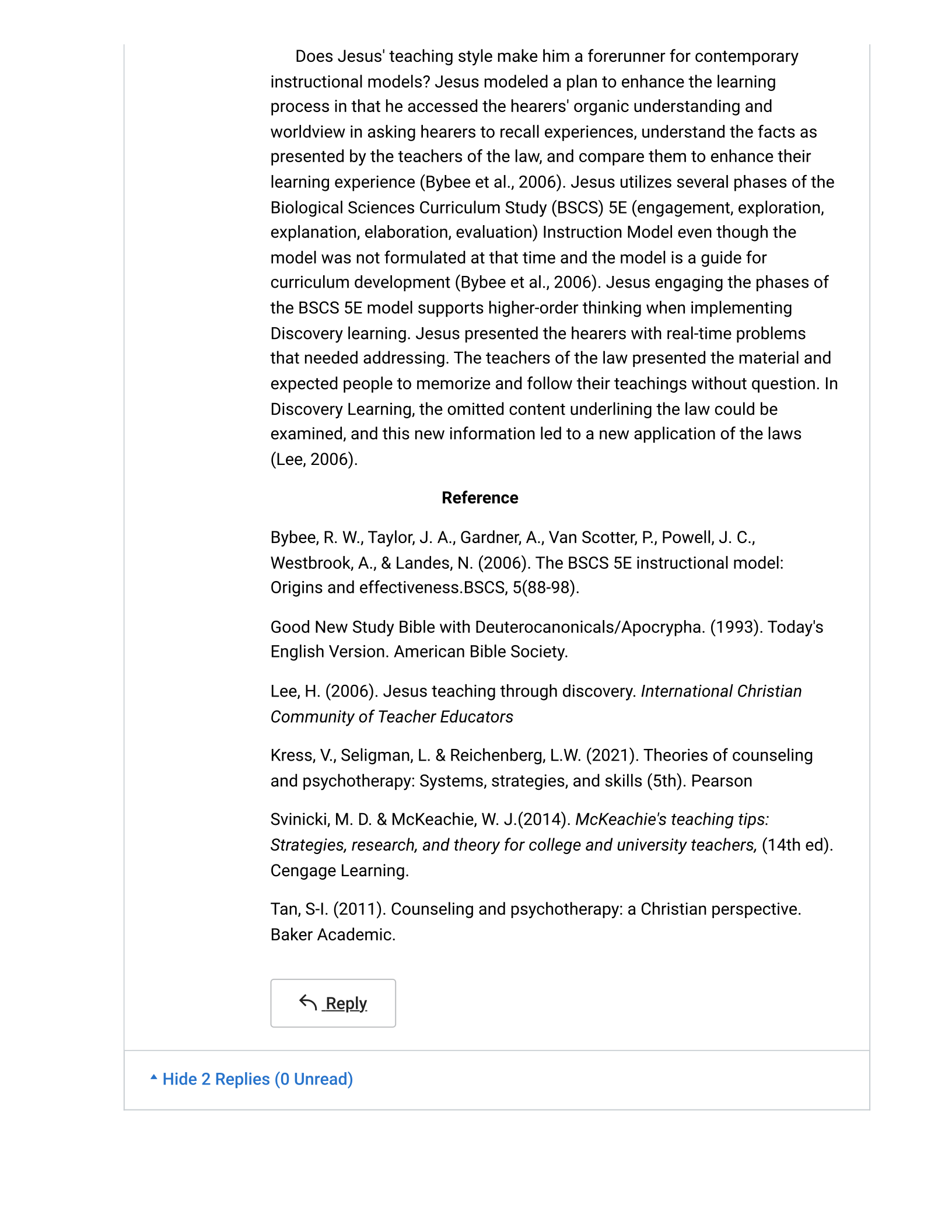
Does Jesus' teaching style make him a forerunner for contemporary
instructional models? Jesus modeled a plan to enhance the learning
process in that he accessed the hearers' organic understanding and
worldview in asking hearers to recall experiences, understand the facts as
presented by the teachers of the law, and compare them to enhance their
learning experience (Bybee et al., 2006). Jesus utilizes several phases of the
Biological Sciences Curriculum Study (BSCS) 5E (engagement, exploration,
explanation, elaboration, evaluation) Instruction Model even though the
model was not formulated at that time and the model is a guide for
curriculum development (Bybee et al., 2006). Jesus engaging the phases of
the BSCS 5E model supports higher-order thinking when implementing
Discovery learning. Jesus presented the hearers with real-time problems
that needed addressing. The teachers of the law presented the material and
expected people to memorize and follow their teachings without question. In
Discovery Learning, the omitted content underlining the law could be
examined, and this new information led to a new application of the laws
(Lee, 2006).
Reference
Bybee, R. W., Taylor, J. A., Gardner, A., Van Scotter, P., Powell, J. C.,
Westbrook, A., & Landes, N. (2006). The BSCS 5E instructional model:
Origins and effectiveness.BSCS,5(88-98).
Good New Study Bible with Deuterocanonicals/Apocrypha.(1993). Today's
English Version. American Bible Society.
Lee, H. (2006). Jesus teaching through discovery.International Christian
Community of Teacher Educators
Kress, V., Seligman, L. & Reichenberg, L.W. (2021). Theories of counseling
and psychotherapy: Systems, strategies, and skills (5th). Pearson
Svinicki, M. D. & McKeachie, W. J.(2014). McKeachie's teaching tips:
Strategies, research, and theory for college and university teachers, (14th ed).
Cengage Learning.
Tan, S-I. (2011). Counseling and psychotherapy: a Christian perspective.
Baker Academic.
10/14/23, 12:23 AM
Topic: Discussion Thread: Jesus and Higher Order Thinking
https://canvas.liberty.edu/courses/523268/discussion_topics/4579424
25/26
Show 4 Replies (0 Unread)
Show 2 Replies (0 Unread)
(https://c
Read More
Lauren Manley (https://canvas.liberty.edu/courses/523268/users/1313886)
Sep 29, 2023
Higher-order thinking (HOTS) stimulates the learner to "think out of the
box, and Parables stretch the imagination to correlate the lesson being
taught and make it applicable to use. The thought opens the eyes and
minds to ignorant perspectives or a topic completely unlearned. Parable…
(https://c
Read More
Jackie Craft (https://canvas.liberty.edu/courses/523268/users/246009)
Sep 30, 2023
I wanted to share with you an endearing example of active learning that I
have particularly noticed. I think one of the "greatest" examples of active
learning is when Jesus called Peter out of the boat to come to him. Can
you imagine being asked to "act" in that regard? Peter was commanded…
(https://c
Read More
Cherese Mbila (https://canvas.liberty.edu/courses/523268/users/912908)
Sunday
Jesus has always been described as the teacher of all teachers. There
were other great philosophers and timeless teachers that people often
quote, believe in, and follow, but none as profound as the Messiah. If any-
one in history can be used as an example of provoking thought, it would…
(https://c
Cherese Mbila
(https://canvas.liberty.edu/courses/523268/users/912908)
Sunday
My apologies I forgot one citation

10/14/23, 12:23 AM
Topic: Discussion Thread: Jesus and Higher Order Thinking
https://canvas.liberty.edu/courses/523268/discussion_topics/4579424
26/26
Hide 1 Reply (0 Unread)
Reply
Pembroke, Neil(2018)Artistry in Jesus’ parables and in preaching
on them,Practical Theology,11:2,127-
140,DOI:10.1080/1756073X.2017.1415576
(https://doi.org/10.1080/1756073X.2017.1415576)

