


DSMN 500
LIBERTY UNIVERSITY SCHOOL OF DIVINITY
WRITTEN ASSIGNMENT 5 – PHILOSOPHY OF SMALL GROUPS
SUBMITTED TO DR. R. A. GOWINS
IN PARTIAL FULFILLMENT OF THE REQUIREMENTS FOR
THE COURSE DSMN 500 LUO-D06
DISCIPLESHIP MINISTRIES
LIBERTY UNIVERSITY THEOLOGICAL SEMINARY
BY
FACULTY OF LIBERTY UNIVERSITY SCHOOL OF DIVINITY
MAY 7, 2017
Page 1 of 9

DSMN 500
Philosophy of Small Groups
Introduction
In most churches, small groups have not always been the central focus of their vision, and
whenever they feel the need for this group, it is thrown together in a haphazard without proper
planning. For most churches, they consider Sunday school as a form of small group, while this
can be beneficial to the church in the short term, the frequency of the meeting is not always
sustained as most only meet couple of hours prior to the beginning of the class and most only see
it as a form of meeting place.
Small group ministries empower the process of growing and multiplying disciples in a
church as well as in the family of God as it reaches both inward and outward to the community.
To build personal relationships is not an easy task, and to earn the right to speak into someone’s
life takes time to develop and are impossible to form within the four walls of the church during
weekly services like Bible study and Sunday school, therefor the need for an approach that the
church can use to train disciples and at the same time, turning them into disciple makers.
Small groups should be the tool by which every aspect of ministry is driven in a church
as it allows for every member of the congregation to be involved in a close small knit group of
people linked together not by social organizations but by deep relationships of prayer and
discipleship, praying for each other as well as seeking the lost for Christ.
Philosophy of Small Groups
Jesus began the first small group when he called the disciples in Matthew 4:18-22 to
follow him. He taught and trained them before sending them out to the lost sheep of Israel. As
you go he said, proclaim this message: “The kingdom of heaven is at hand.”
Page 2 of 9

DSMN 500
The early church followed the example that was handed down by the Jesus as evidenced
in Acts 6:4 when they devoted themselves to prayer and teaching the Word, and the Word of God
increased; and the number of the disciples multiplied exceedingly. The apostles’ decision to
withdraw from the other tasks that they felt were creating a distraction, allowed them to focus on
praying and delivering the Word of God to the people, which in turn resulted in the number of
the disciples multiplying exceedingly.
Bonhoeffer expounded on this principle by stating, “But the incarnate Son of God needs
not only ears or even hearts; he needs actual, living human beings who follow him. That is why
he called his disciples into following him bodily. His community with them was something
everyone could see.”1 And according to Putnam, “small group ministries encourage, train,
spiritually nourish believers and prepare them for the work of reaching outside the walls of the
church to begin the multiplication process as evidenced in Pauls’ letter in I Corinthians 4:1.”2
While small groups are essential, they will not accomplish all that the church stands for,
as the goal of these group is to enrich the life of the believers through discipleship and
community service. The philosophy of small group begins with the vision of the leadership of the
church seeking how best to accomplish the call of the Great Commission and passing it along to
its members. This process is by no means a quick one, there is a lot of planning that is involved
from when the vision is first developed to when it begins to bear fruits.
1 Bonhoeffer, Dietrich. Dietrich Bonhoeffer Works, Volume 4: Discipleship. Minneapolis, MN: Fortress Press, 2003.
2 Putman, Jim, Bobby Harrington, and Robert E. Coleman. Disciple shif. Grand Rapids, MI: Zondervan, 2013
Page 3 of 9

DSMN 500
The Importance of the Relational Group in Authentic Disciple Making
For the disciple making process to be authentic, members of the relational groups must
have a clear understating of its purpose and importance. This is because the purpose of a church-
based small group has always been to stimulate the development or spiritual maturity of its
members through showing Gods’ love and through edification and discipleship that allows
people to connect relationally, to provide support, encouragement and fellowship in order to
glorify God and make disciples of all nations.
Putnam illustrates that “the relational group forms the backbone for discipleship the key
is that the small group’s purpose is defined as encouraging discipleship – not primarily
fellowship or counseling or even outreach.”3 From the beginning, the nature of the small group
must be defined because if this is not established, it opens the door for the group to constantly be
in transition and lacking purpose. He identifies the leader of the group as a shepherd with the
primary goal of, “Creating an environment in which people shepherd one another [And] in the
end, he [or she] seeks to teach the group’s members to become shepherds themselves in their
families and in future groups they may lead.”4
The ideal is for each group to start at the relational level, but must strive to evolve into
fulfilling some part of the vision and mission of the church they are attached to. Being relational
is all about having things together as a group, meaning helping to strengthening the weak, caring
and praying for the sick, and sharing one another’s burdens much like Jesus during His ministry
days when He was on earth. All the members of the relational group are a spiritual family that
3 Ibid
4 Ibid
Page 4 of 9

DSMN 500
caters to the needs of each other through teachings as well as holding each other accountable
when it is necessary. It is these traits of togetherness and brotherly love that make it possible for
people to feel safe within the group setting while also allowing for truth speaking without the
natural human defenses coming in-between.
To be successful and relational, Dempsey offers the acronym “SMALL GROUPS” to
highlight each trait or characteristic, which are imperative:
Secure God’s vision in fulfilling the Great Commission by enacting the Great Commandment
while also engaging the entire body of Christ in the vision.
Make sure the senior pastor is in the lead position casting the vision and the group is part of the
team working towards the same common goal. Without the support and backing of leadership,
small group ministry is doomed to fail.
Adopt the model that fits who you are and where you are. This means you must understand the
history of your church, location, and context, while also discovering and recognizing the DNA of
the organization.
Leader training is essential as well as learning to recruit, empower, and deploy. The training
process should be a fun positive experience if done correctly, because you are not imposing or
forcing someone outside their comfort zone; you are simply helping them develop the gifts God
has already given them through the indwelling of the Spirit.
Launch the groups with the goal being groups forming new groups, as members become leaders
through the discipleship process.
Page 5 of 9
DSMN 500
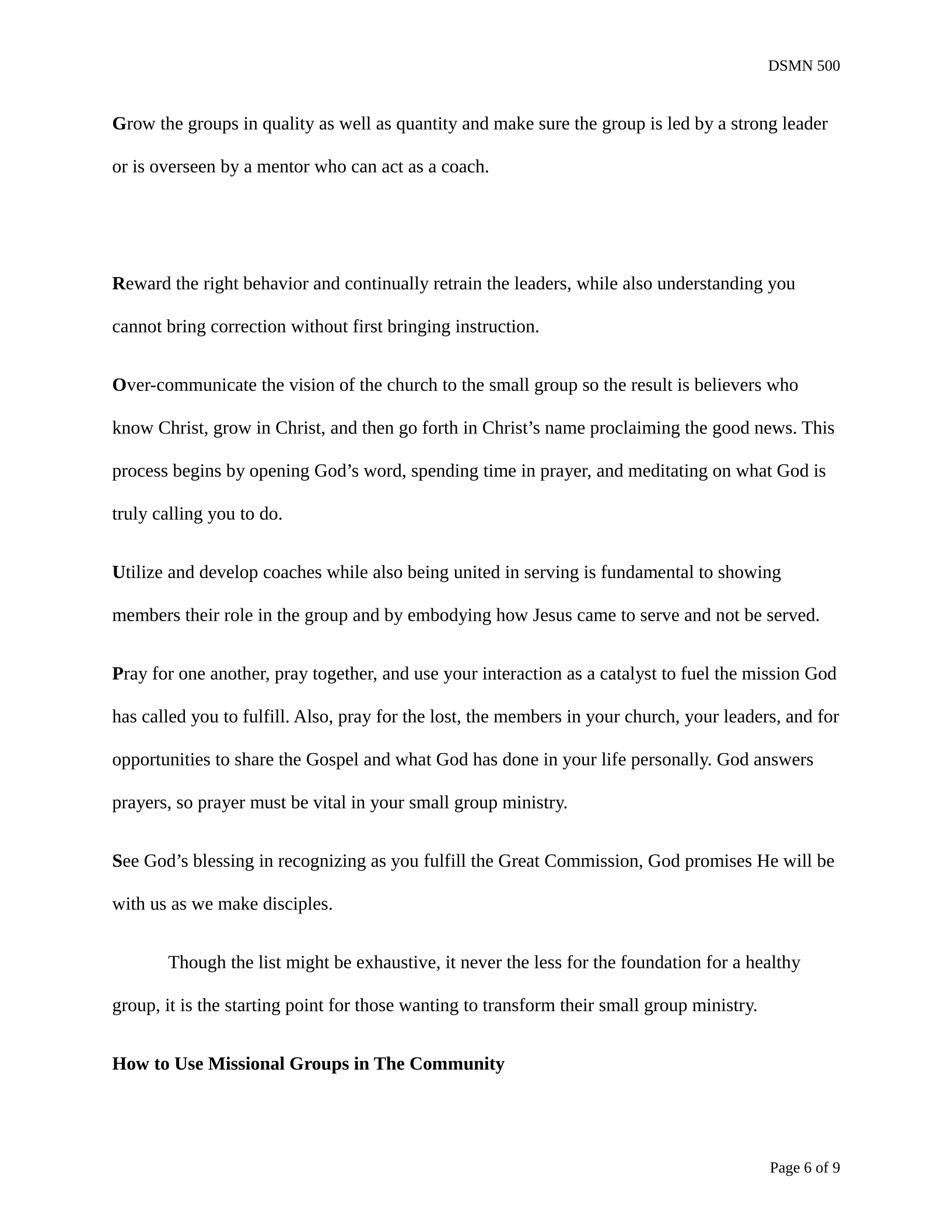
Grow the groups in quality as well as quantity and make sure the group is led by a strong leader
or is overseen by a mentor who can act as a coach.
Reward the right behavior and continually retrain the leaders, while also understanding you
cannot bring correction without first bringing instruction.
Over-communicate the vision of the church to the small group so the result is believers who
know Christ, grow in Christ, and then go forth in Christ’s name proclaiming the good news. This
process begins by opening God’s word, spending time in prayer, and meditating on what God is
truly calling you to do.
Utilize and develop coaches while also being united in serving is fundamental to showing
members their role in the group and by embodying how Jesus came to serve and not be served.
Pray for one another, pray together, and use your interaction as a catalyst to fuel the mission God
has called you to fulfill. Also, pray for the lost, the members in your church, your leaders, and for
opportunities to share the Gospel and what God has done in your life personally. God answers
prayers, so prayer must be vital in your small group ministry.
See God’s blessing in recognizing as you fulfill the Great Commission, God promises He will be
with us as we make disciples.
Though the list might be exhaustive, it never the less for the foundation for a healthy
group, it is the starting point for those wanting to transform their small group ministry.
How to Use Missional Groups in The Community
Page 6 of 9
DSMN 500
One of the best examples in scripture of missions in the community comes from the
parable of the Good Samaritan. Prior to this story in Luke 10:25-37, we are presented with a
scholar that was attempting to confuse Jesus by asking the question, who is my neighbor. Jesus
told the man what a neighbor was instead of answering the man’s question directly with a
response to who his neighbor was. He responded with what the neighbor needs, what a neighbor
looks like, and then He told the man to go and be a good neighbor.
The reason that this story resonates to illustrate one’s neighbor is because at the time, the
Jews hated and despised the Samaritans, often calling them names and would intentionally go
out of their way to avoid traveling through Samaria, as is common amongst Christiana’s today,
calling unbelievers all kinds of name and not really paying attention to how best to reach them
with the gospel. God is love and as children of God, we are expected to show this love also in
reaching our communities for God.
For missional groups in the community to be effective, it must first start with prayer and
sound spiritual disciplines. Praying about what God is calling you and your group to do must be
the priority because as believers, we must continue steadfastly in prayer and pray without
ceasing so that the line of communication with God is never broken. Dave Earley demonstrates,
“After 25 years of leading small groups and coaching small group leaders, I have come to one
clear conviction: prayer is the most important activity of the small group leader.”5
Knowing who the needy are in the community is key to understanding your missional
focus as it affords you the opportunity to meet their needs. Orphans, widows, the poor, the sick,
5 Earley, Dave, and Rod Dempsey. Disciple Making Is–: How to Live the Great Commission with Passion and
Confidence. Pasadena, CA: B&H Academic, 2013
Page 7 of 9
DSMN 500
the unpopular, the outcasts, and the neglected, are the ones that as Christians we should be
seeking out to help because God hears their cry. Christianity has already changed the world and
it still has the power to continue doing so, but not until believers become active in evangelizing
their communities.
Conclusion
Small groups are all about establishing relationships and it takes time to develop these
personal relationships. Because these relationships are impossible to form within the four walls
on the church during weekly services, small groups have become the main stay for most
churches in establishing this relationship.
As a new disciple, proper discipleship along with involvement in a small group is crucial
growth and in reproducing healthy disciples. As demonstrated, everyone is our neighbor,
meaning the people we like, the people we dislike, and even the people who hate us. Jesus died
on the cross for all of humanity, He gave his life even for the people who spat on Him, beat Him,
and crucified Him.
Acts 2:46-47 sums this up: ‘They broke bread from house to house and ate together with
glad and generous hearts, praising God and having the goodwill of all the people.’”
Page 8 of 9
DSMN 500
Bibliography
1. Earley, Dave, and Rod Dempsey. Disciple Making Is–: How to Live the Great
Commission with Passion and Confidence. Pasadena, CA: B&H Academic, 2013.
2. Dietrich Bonhoeffer, Dietrich Bonhoeffer Works, ed. Gerhard Ludwig Müller and
Albrecht Schönherr. Minneapolis, MN: Fortress Press, 1996-2014.
3. Putnam, Jim, Bobby Harrington, and Robert E. Coleman. Discipleshift: Five Steps That
Help Your Church to Make Disciples Who Make Disciples. Grand Rapids, MI:
Zondervan, 2013.
Page 9 of 9
Powered by TCPDF (www.tcpdf.org)

