


LIBERTY UNIVERSITY SCHOOL OF DIVINITY
Writing Assignment 5 – Philosophy of Small Groups
Submitted to Dr. Gary Waller
in partial fulfillment of the requirements for the completion of
DSMN 500 – B03
Discipleship Ministries
By
David J. Miller
Introduction
For the most part, small groups have functioned as social groups with a devotional specific to a
gender or age group. The onset of which typically came from some conference the group attended and
typically fades away after 6 to 12 weeks depending on how long the devotional material lasts. The other
form these small groups have taken is the Sunday school hour at church. While Sunday school can be a
beneficial small group ministry it is not when none of the groups have any contact other than the hour
prior to worship, the class material does not promote the vision of the church, and the class itself does
no ministry other than meeting.
Small groups should be vehicle in which every aspect of ministry driven. The ideal philosophy of
small groups, for me, is not a church “with” or “of” small groups, but a church that is small groups. The
goal is to have every staff and congregation member deeply involved in a small close knit group of
people. These groups are not social bodies, but people linked in deep relationships of prayer and
discipleship praying for one another and seeking the lost for the cause of Christ.
Philosophy of Small Groups
While small groups should be the driving force of the church they will not accomplish all that the
church is. The goal of the small group is to enrich the life of the believer in discipleship and community,
but as the Christian Education Journal points out:
“It must be emphasized that the small group experience, by itself, will not be able to facilitate everything
necessary for life and godliness. Groups cannot do it all, though at times some advocates of group life
appear to promote this perspective. Each group must have a stated purpose, collaborating with other
church ministries of complementary purposes (i.e., focused teaching times, larger corporate worship
environments, leadership development experiences, etc.). Despite being a core expression of church life,
small groups are not its only expression and must not be viewed, touted, or misrepresented as such.”1
My ideal philosophy of small groups begins with the pastoral leadership seeking what The Great
Commission looks like for their congregation and communicating that vision to the congregation. This
vision will be prayerfully and intentionally organized and planned so that the local church can share
salvation and make disciples in the community it is planted in. This is by no means a quick process and is
not a patented program that can be cut and pasted to fit any body of believers. After the vision has been
cast and the organization developed there needs to be an emphasis on developing meaningful
relationships within the groups. Tom Holladay, teaching pastor at Saddleback Church, says this about
emphasizing relationships:
“Place the highest value on relationships. Imagine someone saying to you, ‘Without a friend like you, I
wouldn’t have made it through.’ Imagine your grown kids looking you in the eye and saying, ‘No matter
how busy you were when we were growing up, I always knew I was more important than any project or
job.”2
Small Group Organization
When the pastoral leadership of the local church has cast the vision for the local church planning
and organization of the small groups needs to take place. In the early stages of the organizational process
the pastoral staff needs to identify potential leaders and bring them in on the planning and organization
process. This will allow the potential leadership to take ownership and buy into the small group strategy
and organization, and allow the pastoral staff an opportunity to develop relationships with and train the
1 Donahue, Bill, and Charles Gowler. “SMALL GROUPS: THE SAME YESTERDAY, TODAY, AND FOREVER?”
Christian Education Journal 11, no. 1 (Spring 2014): 118-133.
2 Holladay, Tom. The Relationship Principles of Jesus. Grand Rapids, Michigan: Zondervan, 208
leaders that will be carrying out the small group strategy. Stephanie Spellers, writing for the Anglican
Theological Review, talks of the need for trained leaders.
“Jesus speaks in the Gospel of Matthew of ‘scribes who are trained for the kingdom’ (Matt. 13:52). We
need to form leaders who are trained for the kingdom, that is, trained to facilitate our collective
development as missional communities devoted to the reign of God.”3
This newly formed small group leadership team will need to plan for movement, structure and
growth. Movement is how a non-church member moves from being a spectator in worship, to joining
the church and then becoming involved in a small group ministry. This will not look the same in every
church, but there will need to be a definite process for movement. Next the structure of the groups will
need to be considered, this is the when, where, how often and group composition. The structure could
look like a weekly home bible study group of young single adults meeting in the evening. They most
important aspect of the structure is consistency. The groups should consistently meet and consist of the
same group of people for a designated amount of time. The groups should also study the same material
to keep the congregation at large on the same page. This will also allow the pastoral staff to know what
each and every group is studying to make sure it is doctrinally sound. Having consistent discipleship
material will avoid a problem noted by Roger Walton in his article in the Journal of Adult Theological
Education.
“Finally, the quest for spirituality, often the driving force of the small group movement, is not stemming
the tide of secularity as some claim but rather secular values may be infiltrating members’ thought forms
and lifestyles via the small group. Articles of the belief that in an earlier time were foundational (e.g., sin,
hell and exclusive salvation for Christians), together with some moral positions and lifestyles that would
have been identifiably Christian and some of the social and national issues of justice are less central to
3 Spellers, Stephanie. “The Church Awake: Becoming the Missional People of God.” Anglican Theological
Review 92, no. 1 (Winter 2010) pg. 38
the small groups surveyed. Rather the meetings provide a place where doubts about certain truth claims
may be strengthened by the group’s corporate lack of attention to these items, and thus gently laid to
one side, and where moral crises and dilemmas can be navigated with the help and support of others
without a sense of betraying one’s Christian commitment. This “secularization from within” is what
Wuthnow sees as the most worrying.”4
The goal of the small group is to promote discipleship and develop a deeper personal
relationship with Christ in a community fellowship with believers. Consistency in sound curriculum is
crucial. Finally a plan for growth within the small groups is necessary. Constant leadership training is
needed to help the leaders in the small groups identify potential leaders and train them to in turn start
small groups of their own. The other aspect of growth within the small groups is to develop intentional
evangelism within each group to prospective members. Not just to evangelize to the lost, but to also
encourage congregation members not in a small group discipleship setting to come and be a part of a
close knit relational experience.
Emphasis on Relationships
All the planning and origination of the small groups will be for not if there is not a relational
environment of the love of Christ fostered within the small group setting. This is the new command given
to us by Jesus in John 13:34-35.
“34 A new commandment I give to you, that you love one another: just as I have loved you, you also are
to love one another. 35 By this all people will know that you are my disciples, if you have love for one
another.”
Then John echoes this in 2 John 1:6-7:
4 Walton, Roger. “Disciples Together: The Small Group as a Vehicle for Discipleship Formation.” Journal
Of Adult Theological Education 8, no. 2 (2011) pg. 107
“6 And this is love, that we walk according to his commandments; this is the commandment, just as you
have heard from the beginning, so that you should walk in it. 7 For many deceivers have gone out into
the world, those who do not confess the coming of Jesus Christ in the flesh. Such a one is the deceiver
and the antichrist.”
It is of the utmost importance that the small groups emphasize a Christ like loving relationship
with one another. Love is the utmost distinguishing mark of Christ’s disciples. This emphasis on
relationship is not relegated to the typical conversational fare. “How are you doing? Are you well? Are
the kids well?” Emphasis on relational small groups requires the members of the groups to personal
invest action and deed in the life of someone else. These group members hold one another accountable
in love, and pray for each other continuously. Stephanie Spellers poignantly describes this kind of
relationship as such:
“The whole church is called to stand with those who are hungry, wounded, marginalized, and oppressed.
We are defined as a community of people who are passionate about God’s mission, not only within our
church walls, not only in our spoken words, but in our actions in the world. Whenever we engage in the
movement for transformation and healing in God’s world, we pursue God’s mission and thus live more
deeply into our own.”5
With everything the world throws against followers of Christ this kind of relationship in love is
vital to the small group ministry.
On Mission
5 Spellers 2010, 38
The Focus of the church is to share the salvation of Jesus Christ and make disciples of the
redeemed. Each and every small group must be on mission to seek out the lost. Not to merely invite
people to church, but to reach out to the lost where they live. This is not just a message spoken about
Jesus; it is living the message in everything that the believer does. A small group on mission is a group of
believers not only testifying of the Gospel through word but in action as well. This missional approach is
founded in Christ like living, and application of the living word of God. In an article for Pacifica: Journal of
the Melbourne College of Divinity the best missionary is described as this:
“Ultimately, God’s best missionary is not the gifted individual evangelist; but the local church that has
the capacity to validate its gospel through its own life, and to manifest the life of Christ in its alternate,
counter-cultural visible community.”6
The small group discipleship ministry should be the outreach program of the church. Evangelism
is not separate from Christian discipleship. They are intricately woven together. Through discipleship
Christ begins to surgically change the life of the believer and make healthy what was sinking into death
and decay. This is the basis of evangelism the testimony of Christ’s healing and saving grace working in
the life of the believer. In the Pacifica article the author says the church falls short when evangelism is
not at the central of discipleship.
“Reclaiming the centrality of evangelism means that local churches need to prioritize evangelism as a
central part of their ministries, understanding that evangelism is countercultural and often produces
discomfort. Evangelism is often the ‘missing step’ between delivering the package of the gospel to its
needy recipients. Churches that refuse to take this missing step for reasons of embarrassment, personal
6 Cronshaw, Darren, and Stuart Devenish. “The continuing conversion of the Australian Church: A
missional conversation with Darrell Guder.” Pacifica : Journal of the Melbourne College of Divinity 27, no.
1 (2014): pg. 90
inconvenience and corporate placing of priorities elsewhere – fall short in their fulfilling of their
obligation to make disciples.”7
Conclusion: The Functioning Body
The small group ministry of the church should represent a close knit community of believers on
mission to impact the local secular community for the cause of Christ. This is the body of Christ in action.
As the small groups grow different ministries will arise from the need of the environment around the
group. Churches may form from these groups, not as a negative reactive split from the parent church,
but as a group answering the call of ministry with the blessing of the parent church. The undeniable
truth will be that the church that is composed of missional focused small groups will impact the
community and will be the visible body of Christ in action. “Thus the body of Jesus Christ can only be a
visible body, or else it is not a body at all.”8
7 Ibid,. pg 92
8 Bonhoeffer, Dietrich. Dietrich Bonhoeffer Works, Volume 4: Discipleship. Edited by Geffrey B. Kelly, &
John D. Godsey. Translated by Barbara Green, & Reinhard Krauss. Vol. 4. Minneapolis, MN: Fortress
Press, 2003. Pg 225
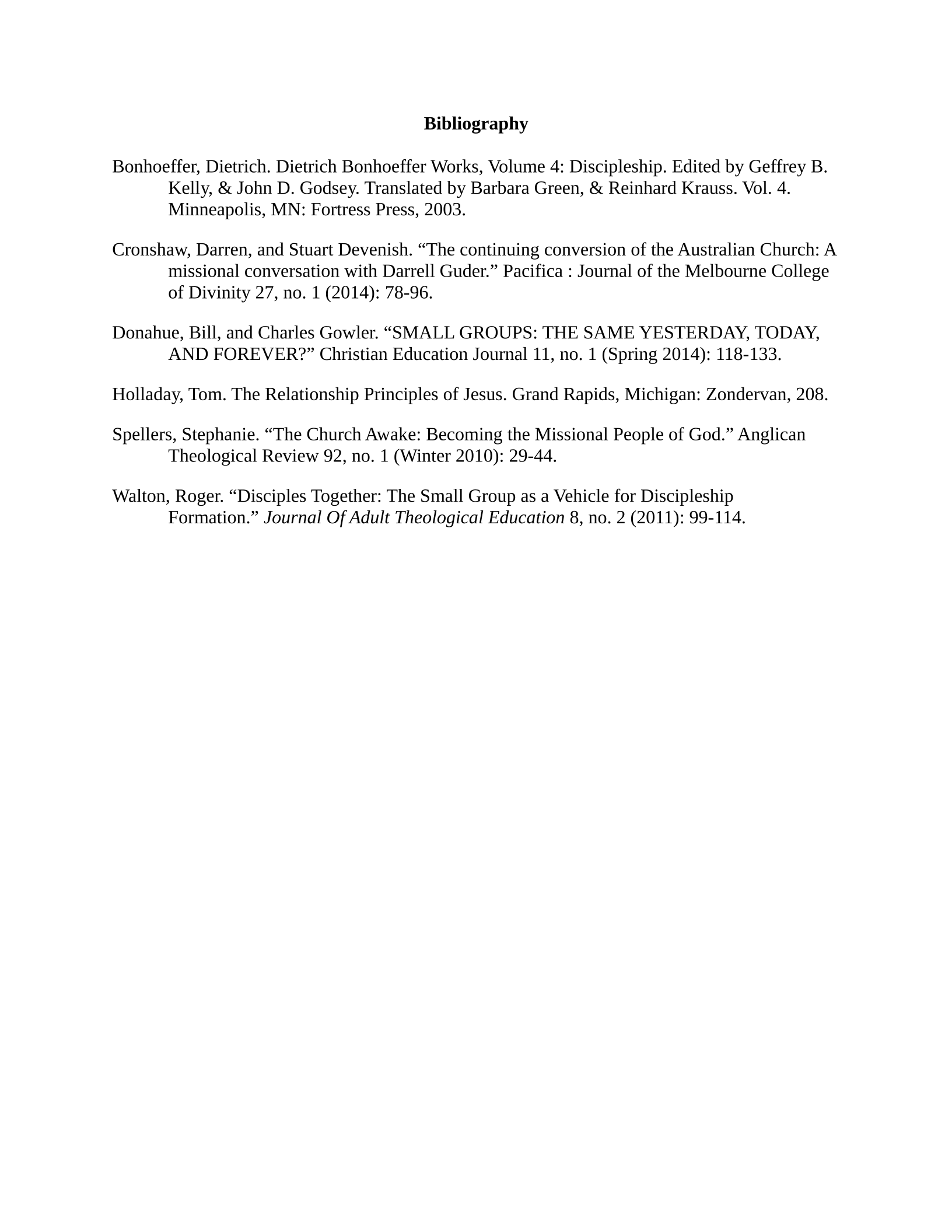
Bibliography
Bonhoeffer, Dietrich. Dietrich Bonhoeffer Works, Volume 4: Discipleship. Edited by Geffrey B.
Kelly, & John D. Godsey. Translated by Barbara Green, & Reinhard Krauss. Vol. 4.
Minneapolis, MN: Fortress Press, 2003.
Cronshaw, Darren, and Stuart Devenish. “The continuing conversion of the Australian Church: A
missional conversation with Darrell Guder.” Pacifica : Journal of the Melbourne College
of Divinity 27, no. 1 (2014): 78-96.
Donahue, Bill, and Charles Gowler. “SMALL GROUPS: THE SAME YESTERDAY, TODAY,
AND FOREVER?” Christian Education Journal 11, no. 1 (Spring 2014): 118-133.
Holladay, Tom. The Relationship Principles of Jesus. Grand Rapids, Michigan: Zondervan, 208.
Spellers, Stephanie. “The Church Awake: Becoming the Missional People of God.” Anglican
Theological Review 92, no. 1 (Winter 2010): 29-44.
Walton, Roger. “Disciples Together: The Small Group as a Vehicle for Discipleship
Formation.” Journal Of Adult Theological Education 8, no. 2 (2011): 99-114.
Powered by TCPDF (www.tcpdf.org)

