



Writing Persuasive Messages
In
this
lecture
we
will
learn
to
•Strengthen your persuasive messages with an appropriate appeal
•Gain credibility by supporting your persuasive message with rele vant facts
•Use attention, interest, desire, and action (the AIDA plan) to
organize persuasive messages
•Write a message persuading your audience to take action or
grant you an adjustment
•Design a sales letter around selling points and benefits
Motivating with persuasive messages
•The business meaning of persuasion is the influencing an audience by
information them aiding their understanding – the audience is free to chose.
•Ethical business people inform customers of the benefits of a product or an
action so that customers can recognize how well that product or action will fill
a need they truly have.
•Your consideration of customer needs is more than ethical; it’s the
proper use of persuasion.
•Also, it’s more likely to evoke the desired response from your
customers and colleagues.
•Persuasive messages aim to influence audiences who are inclined to
resist, so they depend heavily on strategic planning.
•Before you begin to write a persuasive message, ask yourself wha t

you’re writing about, who you’re writing to, and what you want to
happen as a result.
•When analyzing your audience, take into account their cultural
expectations and practices so that you don’t undermine your persuasive
message by using an inappropriate appeal
or by organizing your message in a way that seems unfamiliar or uncomfortable.
• When writing persuasive messages, four things to keep in mind about
your
audience are:
- Needs and appeals
- Emotion and logic
- Credibility
- Semantics
Needs and Appeals
• Some researches believe that certain needs have priority and tha t the
most basic needs (such as safety and security) must be met before a
person will seek to fulfill
higher-level needs (such as esteem and status).
• Because everyone’s needs differ, people respond differently to any given
message.

• Not everyone is interested in economy, for instance, or fair pla y.
• Some people’s innermost needs make appeals to status and greed
much more effective.
• To accommodate these individual differences, analyze the
members of your audience and then construct a message that
appeals to their needs.
Emotion and Logic
• When people’s needs are not being met, they’re likely to respond
emotionally.
• For example, a person who lacks a feeling of self-worth is likely to be
sensitive to the tone of respect in a message.
• A collection letter to such a person carefully avoids any hint that the
person might be considered dishonorable.
• Although emotional issues can be a pitfall for persuasive
messages, you can
actually call on human emotion, as long as
your emotional appeal is subtle.
• You can make use of the emotion surrounding certain words, for
instance, freedom brings forth strong feelings, as do words such as
success, prestige, credit record, etc.
• Emotion works with logic in a unique way: people need to find rational
support for an attitude they’ ve already embraced emotionally.
• To help satisfy this need, a logical appeal calls on human reason.

Credibility
• Your credibility is your capability of being believed because you’re
reliable and worthy of confidence.
• For you to persuade skeptical or hostile audience members, they
must believe that you know what you’re talking about and that
you’re not trying to mislead
them.
• One of the best ways to gain credibility is to support your message with
facts.
• Testimonials, documents, guarantees, statistics, research results,
and the like all provide seemingly objective evidence for what you
have to say, so they make your message more credible.
• The more and relevant your proof, the better.
• It also helps to name you resources, especially if they’re
respected by your audience.
• Other ways of gaining credibility are:
–Being enthusiastic: Your excitement about the subject of your
message can infect your audience.
–Being sincere. Your honest, genuineness, good faith, and
truthfulness helps you focus on your audience’s needs.
–Being an expert. Your knowledge of your message’s subject area
(or even of some other area) helps you give your audience the
quality information necessary to make a decision.

–Having good intentions. Your willingness to keep your audience’s best
interest at heart helps you create persuasive messages that are
ethical.
–Being trustworthy. Your honesty and dependability help you earn your
audience’s respect.
–Establishing common ground. Your beliefs, attitudes, and background
experiences that are like those of your audience help them identify with
you.
Semantics
• The words you choose to state your message say much more than their
dictionary
definitions.
• For instance, useful, beneficial, and advantageous may be considered
synonyms, yet these three words are not interchangeable.
• She suggested a useful compromise. (The compromise allowed the
parties to get to work.)
• She suggested a beneficial compromise. (the compromise not only
revolved but also had a positive effect, perhaps for both parties.)
• She suggested an advantageous compromise. (The compromise
benefited her or her company more than it benefited the other party).
• Another way semantics can affect persuasive messages in the variety of
meanings that people attribute to certain words.

• Abstractions are subject to interpretation because they refer to things
that people cannot experience with their senses.
• You may be able to sell more lags by appealing to your audience's
patriotism (which may be interpreted in many ways) than by describing
the color and size of the flags.
• You may have better luck collecting an overdue bill by mentioning
honesty and fair play than by repeating the sum owed and the date it
was due.
Organizing persuasive messages
• Persuasion requires the indirect approach.
• One specialized version is the AIDA plan, which has four phases
– Attention
– Interest
– Desire
– Action
• In the attention phase, you convince the audience right at the
beginning that you have something useful or interesting to say.
• The audience wants to know “what’s in this message for me?”
• Try to tell them without making extravagant claims or threats and
without bringing up irrelevant points.

• For example
You’ve mentioned several times in the past two weeks
that constructing an employee schedule become
increasingly difficult. Let me share an idea that
could substantially reduce the time you spend making
and revising schedules.
• In the interest phase, you explain how your messages related to the
audience.
• Continuing the theme you started with, you paint a more detailed
picture with words.
• Your goal is to get the audience thinking “This is an interesting idea.
Couldn’t it possibly solve my problems?”
• For example
Inc. magazine ran an article in the July 2 issue
about a scheduling concept called flextime. It gives
employees leeway to schedule their own work, within
certain guidelines. Two companies profiled in the
article were having problems (as we have been) with
late arrivals, long lunches, early departures, and
too many “sick days.” They found it nearly impossible
to set up a schedule everyone would adhere to.
However, once these companies instituted flextime,
their problems practically disappeared.

• This interest section ties together a factual description and the
benefits of instituting the program.
• Also, the benefits relate specifically to the attention phase that
precedes this paragraph.
• Even though the flextime system might help improve employee
morale, that benefit is secondary to the main interest of the
intended audience (to reduce the frustration of devising useless
schedules) and is therefore not mentioned.
•
In the desire phase of a persuasive message, you back up claims and
thereby
increase your audience's willingness to take the action that
you’ll suggest in the next section.
• Whatever you use to prove your claim, make sure the evidence
is directly relevant to your point.
•
For example
One of the people interviewed in the article, the heard of
manufacturing for a $10 million company, said: “I seemed to be
spending all my time making schedules and then tearing them
up. Now I let my employees figure out their own schedules. I
have more time to oversee the work that’s being done and to
track the quality of the products we ship.” This company had a
flextime program in full operation within three months of
deciding to start it. Attached is a copy of an article about
the factors to consider before going to flextime and the three
steps involved in instituting it.

• In the action, you suggest the action you want your audience to take.
• All persuasive messages end with a section that urges specific
action, but the ending is more than a statement such as “Institute
this program as soon as possible” or “Send me a refund.”
• In fact, this section offers a good opportunity for one last reminder
of the main benefit the audience will realize from taking the action
you want:
Let’s meet early next week (Monday, 3:00 p.m.?) to see
how we might implement a flextime schedule. With a little
bit of extra effort, now you could soon be concentrating
on something more important than scheduling.
Writing Persuasive Request for Action
• Many persuasive messages are written to solicit funds, favors,
information, or cooperation.
• In an organization, persuasive techniques are often required to get
someone to change policies or procedures, to spend money on new
equipment a nd service to promote a person or to protect turf.
• An external persuasive message is one of the most difficult
persuasive tasks you could undertake.
• First, people are busy, so they’re reluctant to do something new; it
takes time and offers no guarantee of any reward in return.

• Second, competing requests are plentiful
• In fact, the public relations departments of many large
corporations receive so many requests for donations to worthy
causes that they must sometimes resort to lotteries to decide
which to support.
• If you’re lucky, they may believe in the project or cause that
you’re writing about.
• If you’re lucky, they may believe in the project or cause that
some benefit,
perhaps an intangible benefit down the road or a
chance to make a
meaningful contribution.
• Also, especially in the case of requests for professional favors or
information, people may believe that they are obliged to “pay their
dues” by helping others.
• When making a persuasive request, therefore, take special care
to highlight direct and indirect benefits.
• Diret benefits might include a reduced workload for a
supervisor who institute flextime or a premium for someone
who responds to a survey.
• Indirect benefits might include better employee morale or the
prestige of giving free workshops to small businesses.

• The attention-getting device at the beginning of a persuasive request
for action usually shows the reader that you know something about his
or he r concerns and that you have some reason for making such a
request.
• In this type of persuasive message, more than in most others,
flattering comment about the reader is acceptable, especially if it is
sincere.
• The body of the letter or memo covers what you know about the
problem you’re trying to solve with the reader’s help: the facts and
figures, the benefits of helping your experience in attacking the
problem.
• The goal is to give you and your request credibility, to make the
reader believe that helping you will indeed help solve a significant
problem.
• The most important thing to remember when preparing a
persuasive request action is to keep your request within bounds.
• Nothing is so distressing as a request so general-all-
encompassing, or inconsiderate that it seems impossible to
grant, no matter how worthy the cause.
• Also, be careful not to doom your request to failure by asking your reader
to do all
your work for you: to provide information that you were too lazy to
seek, to spend time saving you from embarrassment or inconvenience,

or to provide total financial support for a cause that nobody else is
supporting.
Writing Sales Letters
• By and large, sales letters are written by specialized and
highly skilled professionals.
• The letters come in letter-size or larger envelopes, with brochures or
without.
• Knowing the laws that govern sales letters can help you avoid
serious legal problems.
• Making a false statement in a sales letter is fraud if the recipient can
prove
– That your intent was to deceive
– That you made the statement regarding a fact rather than an
opinion or a speculation
– That the recipient was justified in relying on the statement
– That the recipient was damaged by it
• Using a person’s name, photograph, or other identity in a sales
letter without permission constitutes invasion of privacy – with
some exceptions.
• Using a photo of the members of a local softball team in a chamber of
commerce mailer may be perfectly legal if team members are public
figures in the community.

• Legal problems can also result from publicizing a person’s
private life in a sales letter.
• Stating that the president of a local bank (mentioned by name)
served six months in prison for income tax evasion is a
potentially damaging fact that may be considered an invasion of
privacy.

Planning Sales Letters
• The three steps involved in planning a sales letter are similar to those
involved in planning any other persuasive message
–
Determine the main idea (in sales letters, it revolves around a
selling
point and related benefits)
– Define the audience
– Choose the approach and format
Determining Selling Points and Benefits
• Selling points are the most attractive features of a product; consumer
benefits are the particular advantages that buyers will realize from those
features.
• One selling point of a personal computer might be its numeric keypad.
• The consumer benefit of this selling point is that the user
doesn’t need a separate calculator or the skill to type numbers
on the regular keyboard.
• Obviously, you can’t write about selling points or benefits without a
thorough understanding of your subject.
• The first step in writing any sales letter is to take a good look at the product.
• Ask yourself (or someone else, if necessary) everything you
think a potential buyer might want to know about it.

Defining the Audience
• Marketers seek to define consumer in terms of
– Demographics: age, gender, occupation, income, and education
– Psychographics: personality, attitudes, and lifestyle
In this lecture we learnt to
• Strengthen your persuasive messages with an appropriate appeal
• Gain credibility by supporting your persuasive message with rele vant facts
• Use attention, interest, desire, and action (the AIDA plan) to
organize persuasive messages
• Write a message persuading your audience to take action or
grant you an adjustment
• Design a sales letter around selling points and benefits
Writing Bad-News Messages

In this lecture you will learn to
• Choose correctly between indirect and direct approaches to a bad-news
• Establish the proper tone from the beginning of your message
• Use neutral lead-ins to put your audience in an accepting mood
• Present bad news in a reasonable and understandable way
• Write message that motivate your audience to take constructive action
• Close messages so that your audience is willing to continue a
business relationship with your firm
Organizing bad-news messages
• It’s important that you realize that some people interpret being
rejected as a personal failure; being turned down for a job or for credit,
or even being rejected in less sensitive areas, usually complicate
people’s lives.
• Business decisions should not be made solely to avoid hurting
someone’s feelings, but mixing bad news with consideration for your
reader’s needs helps your audience understand that the unfavorable
decision is based on a business judgment, not on a personal one.
• As with direct requests and routine, good-news, and goodwill
messages, bad- news messages are best communicated across
cultures by using the tone, organization, and other cultural

conventions that your audience expects.
• People in Germany tend to be more direct with bad news, but in Japan
bad news can be presented so positively that a U.S. businessperson
may not detect it at all.
•Your tone contributes to your message's effectiveness
by supporting three specific goals:
– Helping your audience understand that your bad-news message
represents a firm decision
– Helping your audience understand that under the
circumstances, your decision was fair and reasonable.
– Helping your audience remain will disposed toward your
business and possibly toward you
• With the right tone, you can make an unwelcome point while
preserving your audience’s ego.
• One key is to make liberal use of the “you” attitude, for example,
by pointing out how your decision might actually further your
audience's goals.

• Another key is to convey concern by looking for the best in your
audience; assume your audience is interested in being fair, even
when they are at fault.
• Finally, you can ease disappointment by using positive words
rather than negative ones.
•The two basic strategies described are
– The indirect plan, which presents supporting data before the main idea
– The direct plan, which presents the main idea before the
supporting data
Indirect Plan
• Instead of beginning a business message with a blunt no, which might
keep your audience from reading or listening to your reasons, use the
indirect plan to ease your audience into the part of your message that
demonstrates how you’re fair- minded and eager to do business on
some other terms.
•The indirect plan consists of four parts
– A buffer
– Reasons supporting the negative decision
– A clear, diplomatic statement of the negative decision
– A helpful, friendly, and positive close

• By presenting the reasons for your decision before the bad news
itself, you gradually prepare the audience for disappointment.
•
In most cases, this approach is more appropriate than an abrupt
statement of the
bad news.
Buffer
• The first step in using the indirect plan is to put the audience in an
accepting mood by making a neutral, non-controversial statement
closely related o the point of the message.
• If possible, base the buffer on statements made by the person yo u’re
responding to, since using an unrelated buffer makes you seem to be
“beating around the bush” ; you appear unethical, so you lose your
audience’s respect.
• When composing your buffer, avoid giving the impression that
good news will follow.
• Building up the audience at the beginning only makes the
subsequent letdown even more painful.
• Consider the example on the following slide:

Buffer –
example
• Imagine your reaction if you were to get a letter from Schulz’s
Creative Associates with this opening: “Your resume indicates
that you would be well suited as a vendor for our Peanuts
characters.”
• Now compare that opening with this: “Your resume shows very
clearly why you are interested in becoming a vendor for our Peanuts
characters.”
• The second opening emphasizes the applicant’s favorable
interpretation of her or his qualifications rather than the company’s
evaluation, so it’s less misleading while still being positive.
Buffer
•Avoid saying no: An audience encountering the unpleasant news
right at the beginning will react negatively to the rest of the
message, no matter how reasonable and well phrased it is.
•Avoid using a know-it-all tone: When you use phrases such as “you
should be aware that,” the audience will expect your lecture to lead
to a negative response and will therefore become resistant to the rest
of your message.
•Avoid wordy and irrelevant phrases and sentences: Sentences such as “We have
received your letter,” “This letter is in reply to your request,” and “We are

writing in response to your request” are irrelevant; you make better use of
the space by referring directly to the subject of the letter.
•Avoid apologizing: An apology weakens your explanation of the
unfavorable decision.
•Avoid writing a buffer that is too long: The point is to identify briefly
something that both you and the audience are interested in and
agree on before proceeding in a businesslike way.
•Agreement: Find a point on which you and the
reader share similar views.
– For example “We both know how hard it is to make a
profit in this industry. ”
•Appreciation: Express sincere thanks for receiving
something.
– For example “Your check for $127.17 arrived yesterday. Thank you.”
•Cooperation: Convey your willingness to help in
any way you realistically can.
– For example “Employee Services is here to smooth the way for
those who work to achieve the company’s goals”
•Good news: Start with the part of your message that is

favorable .
– For example “A replacement knob for your range is on its
way, shipped February 10 via UPS.”

•Fairness: Assure the reader that you’ve carefully
examined and
considered the problem or mention
an appropriate action that has already been taken.
– For example “For the past week, we have carefully monitored
those using the photocopier to see whether we can detect any
pattern o f use to explain its frequent breakdowns.”
•Praise: Find an attribute or achievement to compliment
– For example “Your resume shows an admirable breadth of
experience, which should serve you well as you progress in
your career.”
•Understanding: Demonstrate that you understand the
reader’s goals and needs.
– For example “So that you can more easily find the
typewriter with the features you need, we are enclosing a
brochure that describes all the Olsen typewriters currently
available.”
•Resale: Favorably discuss the product or company
related to the subject of the letter
– For example “With the heavy-duty, full-suspension hardware

and fine veneers, the desks and file cabinets in our Montclair
line have become a hit with value-conscious professionals”
Reasons
• If you’ ve done a good job of composing the buffer, the reasons
will follow naturally.
• Cover the more positive points first; then move on to the less positive ones.
• Provide enough detail for the audience to understand your
reasons, but be concise; a long roundabout explanation may
make your audience impatient.
• It is more important to explain why you have reached your decision
before you explain what that decision is.
• If you present your reasons effectively, they will help convince
audience members that your decision is justified, fair, and
logical.
• Present reasons to show that your decision is reasonable and fair.
• When giving your reasons, be tactful by highlighting the benefits of
the decision to the audience, instead of focusing on the company.
• For example, when saying no to a credit request, show how your
decision will keep the person from becoming overextended
financially.
• As you explain your reasons, don’t try to cushion bad news by
hiding behind a company policy.

• Although skilled and sympathetic communicators may sometimes
quo te company policy, they also briefly explain it so that the
audience can try to meet the requirement at later time.

• Don’t apologize when giving your reasons, apologies are appropriate
only when someone in your company has made a severe mistake or
done something terribly wrong.
• If no one in the company is at fault, an apology gives the wrong impression.
• The tone of the language you use to explain your reasons greatly
influences your audience's reception of the bad news that follows,
so avoid negative, counterproductive words like ‘error’,
‘dissatisfied’, ‘shocked’ etc.
• Don’t adopt an accusing tone.
• Product the audience’s pride by using language that conveys respect.
• Say “The appliance won’t work after being immersed in water”
instead of “you shouldn’t have immersed the appliance in water.”
•When refusing the application of a management
trainee, a
tactfully worded letter might give these
reasons for the decision not to hire:
– Because these management trainee positions are quite
challenging, our human relations department has researched
the qualifications needed to succeed in them. The findings
show that the two most important qualifications are a
bachelor’s degree in business administration and two years’
supervisory experience.
•The paragraph does a good job of stating the
reasons for the refusal:

– It provides enough detail to make the reason for the
refusal logically acceptable.
– It implies that the applicant is better off avoiding a program in
which he or she would probably fail, given the background of
others who would be working alongside him or her.
– It doesn’t rest solely on company policy. A relevant policy
exists but is presented as logical rather than rigid.
– It offers no apology for the decision.
– It avoids negative personal expressions (“You do not
meet our requirements”).
• Although specific reasons help the audience accept bad news,
reasons cannot always be given.
• When reasons involve confidential, excessively complicated, or p urely
negative information or when the reasons benefit only you or your firm
(such as enhancing the company’s profits), don’t include them,
instead move directly to the next section..

The Bad News
• When the bad news is a logical outcome of the reasons that come
before it, the audience is psychologically prepared to receive it.
• However, the audience may still react emotionally if the bad news
is handled carelessly.
•Here are some methods for deemphasizing the bad news:
– Minimize the space or time devoted to it.
– Subordinate it in a complex or compound sentence (“My
department is already shorthanded, so I’ll need all my staff
for at least the next two months ”)
– Embed it in the middle of a paragraph.
•Two other techniques are especially useful for
saying no as clearly but painlessly as possible.
– First, using a conditional (if or when) statement that implies the
audience could possibly have received or might someday receive
a favorable answer: “When you have more managerial
experience, you are welcome to reapply”
– The other technique is to tell the audience what you did do, can
do, or will do rather than what you did not do, cannot do, or won’t
do. Say “We sell exclusively through retailers, and the one nearest
you that carries our merchandise is …” rather than “We are unable

to serve you, so please call your nearest dealer.”
• A statement like this need not be followed by the explicit news that
you won’t be hiring the reader.
• By focusing on the positive and only implying the bad news, you soften the
blow.
• Of course, when implying bad news, be sure your audience
understands the message – including the bad news.
•It would not be ethical to overemphasize the positive.
• Be sure to avoid blunt statements that are likely to cause
pain and anger.
•The following phrases are likely to offend and should be
avoided:
– I must refuse we must deny
– We cannot allow we must reject
Positive Close
• After giving the bad news, your job is to end the message on a more upbeat
note.
• If you’ ve asked someone to decide between alternatives or to take
some action, make sure she or he knows what to do, when to do it,

and how to do it with ease.

•Whatever type of close you choose, follow these
guidelines:
– Don’t refer to or repeat the bad news.
– Don’t apologize for the decision or reveal any doubt that the
reasons will be accepted (avoid statements such as “I trust our
decision is satisfactory”)
–
Don’t urge additional communication (avoid saying anything like
“IF you
have further questions, please write”) unless you’re
really to discuss your decision.
– Don’t anticipate problems (avoid statements such as “Should
you have further problems, please let us know”)
– Don’t include clichés that are insincere in view of the bad
news (avoid saying “If we can be of any help, please contact
us”).
– Don’t reveal any doubt that you will keep the person as a
customer (avoid phrases such as “We hope you will continue
to do business with us”).
Direct Plan
•A bad news message organized on the direct plan
would start with
a clear statement of the bad news,
proceed to the reasons for the
decision, and end with

a courteous close.
• Stating the bad news at the beginning has two potential
advantages:
– It makes a shorter message possible
– The audience needs less time to reach the main idea of the
message, the bad news itself.
• Although the indirect approach is preferable in most bad news
messages, you may sometimes want to move right to the point.
• Memos are often organized so that the bad news comes before the reasons.
• Some managers even expect all internal correspondence to be brief
and direct, regardless of whether the message is positive or
negative.
• Routine bad news messages to other companies often follow the
direct plan, especially if they relay decisions that have little or no
personal impact.
• The direct plan is also appropriate when you want to present an
image of firmness and strength; for example, the last message in a
collection series, just before the matter is turned over to an
attorney, usually gets right to the point.
Conveying bad news about orders
•For several reasons, businesses must sometimes

convey bad news concerning orders.
– To work toward an eventual sale along the lines of the original order
– To keep instructions or additional information as clear as possible
– To maintain an optimistic, confident tone so that your reader
wo n’t lose interest

•When you must back-order for a customer, you have
one of the two types of bad news to convey
– You’re able to send only part of the order
– You’re able to send none of the order
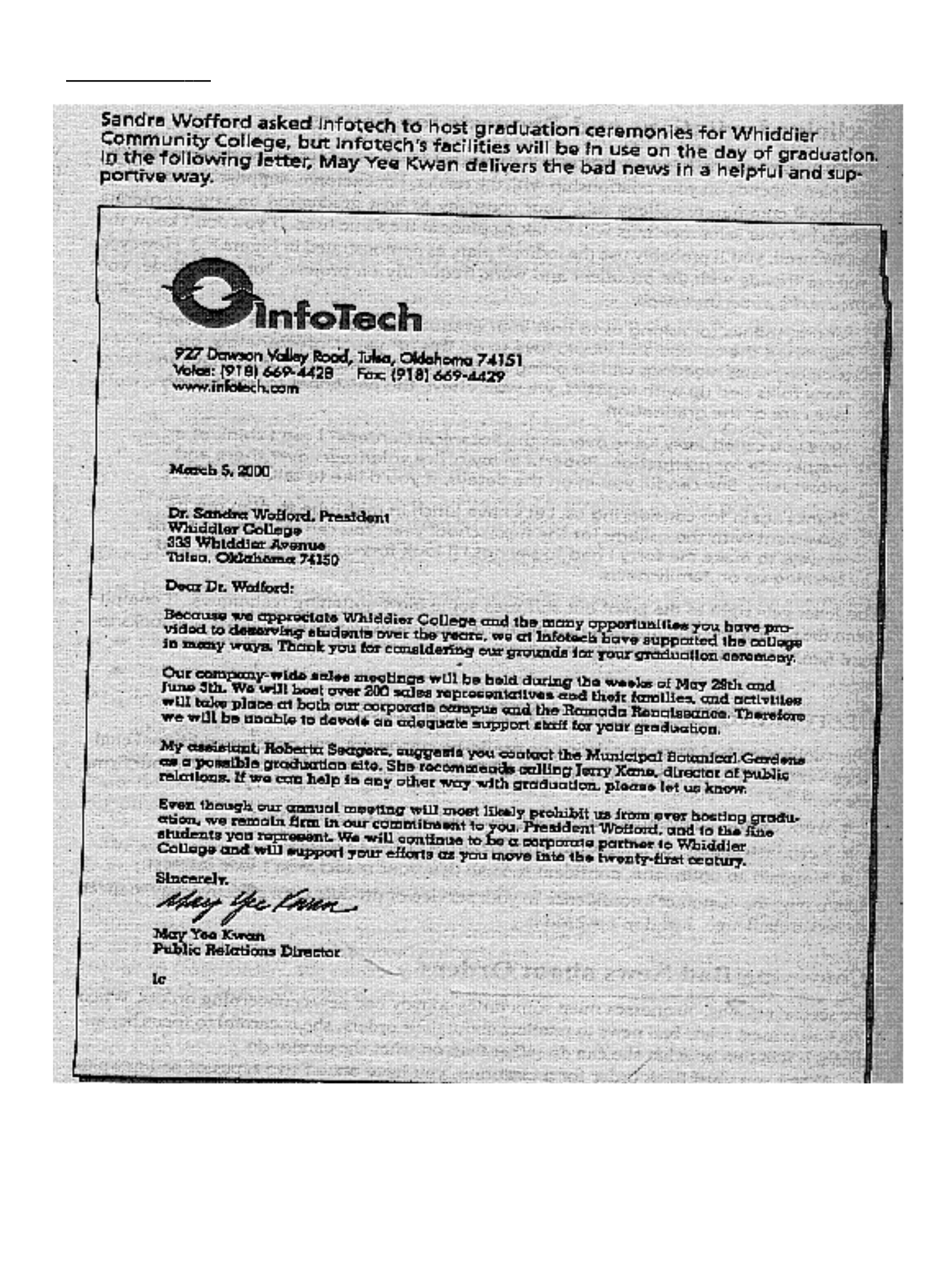
Example 1

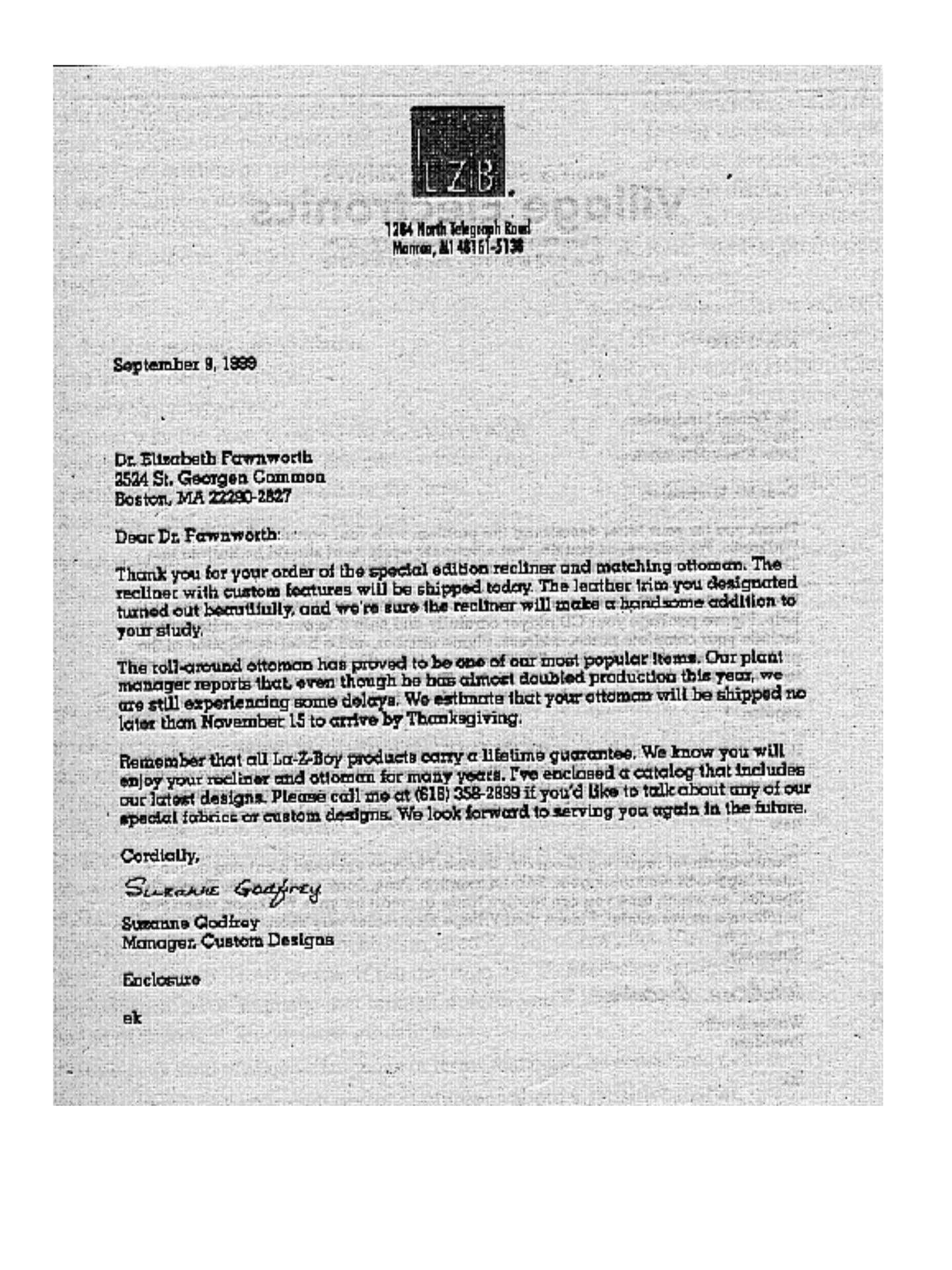
Example 2
For a customer whose order for a recliner and ottoman will be partly
filled , your letter might read like this one.

In this lecture you have learnt to
• Choose correctly between indirect and direct approaches to a bad-news
• Establish the proper tone from the beginning of your message
• Use neutral lead-ins to put your audience in an accepting mood
• Present bad news in a reasonable and understandable way
• Write message that motivate your audience to take constructive action
• Close messages so that your audience is willing to continue
a business relationship with your firm

