



Planning Business Messages
In this lecture you will learn to
•Describe the basic tasks in the composition process
•Define both general and specific purposes of your business message
•Test the purpose of your message
•Develop an audience profile
•Analyze the needs of your audience
•Establish the main idea of your message
•Select an appropriate channel or medium for transmitting a
particular message to a particular audience
The Composition Process
•The composition process helps you gain control over your message
•
The composition process is flexible, not a fixed prescription of sequenced
steps.
•The composition process can be viewed as ten separate stages tha t
fall into three simple categories.
-Planning
-Composing
-Revising
•Planning
-Define purpose
-Analyze Audience

-Establish main idea
•
Composin
g-
Select
Channel
and
medium
-Organize message
-Formulate message
•Revising
-Edit message
-Rewrite message
-Produce message
-Proof message
Sharpening Your Skill
• Sharpening Your Skill (Overcoming the fear of Blank page)
– Use positive self talk
– Know your purpose
– Visualize your audience
– Create a productive environment
– Make an outline
– Just start
– Write the middle first
– Push obstacles aside

Technology
•Technology affects the composing process.
– For example Microsoft Word increases
productivity and effectiveness by streamlining
the process.
Collaboration
•Collaboration
– In many organizations the final piece of writing is a team
effort, with more than one writer working on a document.
Scheduling
•Scheduling
– Allotting time properly is very important.
– Especially when time is short, carefully schedule yourself and
stick to it.
Defining your purpose
• The purpose of the document helps you decide whether to
proceed, how to proceed, how to respond to the audience, which
information to focus on, and which channel or medium to use.
Why do you need to clear a

purpose ? Example
• Suppose your boss asks you to write a memo describing the
company's policy on vacation time. This is a fairly broad topic.
What should you say ? Knowing the purpose of your message
will help you make important decision about it.
Decide whether to proceed
• To decide whether to proceed
– Many business messages have little practicle purpose and
should not be composed at all.
– They should be put hold until you have a more practical purpose.
Respond to the audience
• To respond to the audience
– If you are not certain that your purpose in composing a
message is compatible with the audience's purpose, you
are likely to delive r irrelevant material.

Focus on the content
• To focus on the content
– If you include extra information in your message, you are likely
to overload the audience.
Establish a channel and Medium
• To establish the channel and medium
– The choice of channel and medium has a direct
influence on the purpose.
– For example writing a message for whole department would
most likely make you e-mail it for ease of distribution.
Common purpose of Business Message
• Business messages have the following general purposes:
– Inform
– Persuade
– Collabora
te Specific Purpose
• Beyond having a general purpose, your message might have a specific
purpose.
• To determine the specific purpose, think of how the audience's ideas
or behavior should be affected by the message.
Example

• General Purpose
– To inform
• Specific Purpose
– To present last month's sales figures to the Vice president of
marketing.
• General Purpose
– To persuade
• Specific Purpose
– To convince the marketing director of the need to hire more
Software Engineers.
• General Purpose
– To collaborate
• Specific Purpose
– To help the personnel department develop a training
program for new members of a Software Team.

How should you test your purpose?
Test your Purpose
• Is the purpose realistic?
– If your purpose involves a major/radical change, you better
go slow, as most people resist change.
• Is it the right time?
– Timing matters a lot.
– An idea is more likely to win approval when the profits are up.
• Is the right person delivering the message?
– Some people have more leverage in an organization, and
hence have a better shot at getting the purpose achieved.
• Is the purpose acceptable to the organization?
– As a representative of your company you are obligated to
work for it's goals.
Analyze the Audience
• Ask your self some key questions about your audience.
– who are they ?
– what is their probable reaction to your message ?
– How much do they already know about the subject ?
– What is their relationship to you ?

• Determine the Audience Size and Composition
– Focus on the common interest of the audience, but be
alert to their individual concerns.
• Identify primary Audience
– Try to identify the people who are most important to your purpose.
• Estimate the Audience's probable reaction
– A gradual approach and plenty of evidence is required to
win over a skeptical audience.
• Gauge the audience's level of Understanding
– If you and your audience share the same general
background, you can assume that they will understand the
subject without any difficulty.
• Define your relationship with the Audience
– Are you communicating with people inside or outside your
organization?
– How much credibility do you have?

Satisfy your Audience's information needs
– What does the audience want to know?
– What does the audience need to know?
– Have I provided all the desired and necessary information?
– Is the information accurate?
– Have I emphasized the information of greatest interest?
•What does the audience want to know?
– By restating a vague request in more specific terms, you
can get the requester to define his or her needs more
precisely.
•Anticipate unstated questions
– Include any additional information that might be helpful, even
though the reader didn’t specifically ask for it.
• Have I provided all the desired and necessary
information?
–Test the completeness of your message by
making sure it answers all the important questions:
• who,
• what,
• when,
• where,
• why and

• how.
•Is the information accurate?
– Be sure that the information you provide is accurate
and that the commitments you make can be kept.
•Have I emphasized the information of greatest interest?
– Try to figure out what points will specifically interest your
audience; then give these points the most attention.
Make your Message easier to comprehend
• Devices that make your message easier to comprehend include
summaries, and overviews, headings, lists, enclosures, appendixes,
handouts, charts and graphs.
Establishing the Main Idea
•Establishing the Main Idea
– The main idea is the 'hook' that sums up why a particular
audience should do or think as you suggest.
•Use Brainstorming Techniques
– Storyteller's tour
– Random List
– FCR worksheet
– Journalistic Approach
– Question and Answer Chain

•Limit the Scope
– The main idea should be geared to the length of the message.
Select Appropriate Channel and Medium
• Selecting the Appropriate Channel and Medium is very important
• The mediums could be
– Oral
– Written
– Electronic
Oral medium
• Oral medium is best when
– You want immediate feedback.
– Your message is relatively simple.
– You don’t need a permanent record.
– You can assemble audience easily.
– You want to encourage interaction.
Written medium
• Written medium is best when
– You don’t need immediate feedback.
– Your message is detailed and complex.

– You need a permanent record.
– You are trying to reach an audience over large distance.
– You want minimize the distortion when a message is passed
from person to person.
Electronic Message
• Electronic Message is best when
– You don’t need immediate feedback, but you do need speed.
– You don’t need a permanent record, but want to overcome
time zone barriers.
– You want to minimize oral distortion.
Composing Business Messages

In this lecture you will learn to
• Identify the characteristics of a well organized message.
• Explain why organization is important to both the
audience and the communicator.
• Break a main idea into subdivisions grouped under logical categories.
• Arrange ideas in direct or indirect order, depending on the
audience possible reaction.
• Compose a message using a style and tone that are appropriate to
your subject, purpose, audience and format.
• Use the ‘ you’ article to interest the audience in your message.
Organizing your message

• People simply don’t remember disassociated facts and figures,
successful communicators rely on organization to make their
message meaning ful.
What does good organization mean?
•Most disorganized communication suffer from problems with
– Content
– Grouping
– Sequence
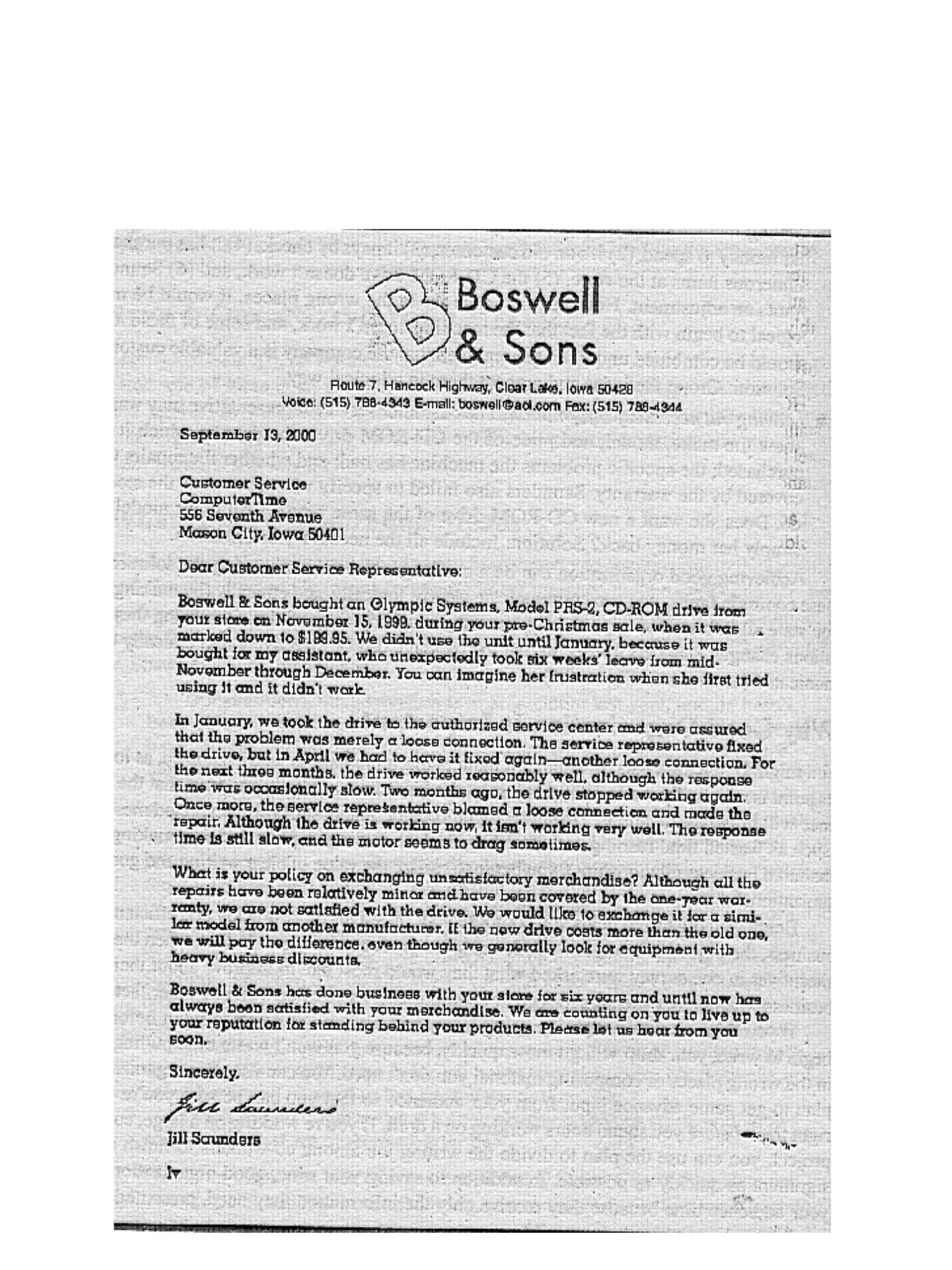
Letter

Problems
• Taking too long to get to the point
– The writer of the letter took too long to get to the point.
– She waited until the final paragraph to state her purpose.
• Including Irrelevant Material
– No information should be introduced which has no purpose.
• Getting ideas mixed up
– The ideas should not be in the wrong place
– A sequence should be followed in which ideas are built upon
previous ones.
•Leaving out necessary Information
– The prime focus should be include the information required by the
reader.
– Leaving out reader’s desired information would be highly
undesirable.
What Good organization means
• The subject and purpose are clear.
• All information is related to the subject and purpose.
• The ideas are grouped and presented in a logical way.

• All necessary information is included.
Why Good information is important
• Why does it matter to put information in any way and leave it to
the reader to grasp the information ?
• By arranging the ideas in a logical and diplomatic and way, you
will increase the chances of satisfying the audience’s needs.
Helping your audience understand the message
• The main reason for being organized is to improve your
chances that people will understand exactly what you
mean.
• Good organization also helps you get your ideas across without
upsetting the audience.
• Good organization helps motivate the audience to accept your message.
Saving your Audience’s Time
• Well organized messages are efficient.
• They only contain relevant information, so the audience does not
waste time with superfluous information.

Simplifying your Communication Tasks
• Finally being well organized helps you compose your message more
quickly and efficiently.
• before you start to write makes the Organizing what you are going
to say job much easier.
Letter
Computer Time
556 Seventh Avenue, N.W.
Mason City, Iowa50401
(515) 979-8870
September 17, 1995
Ms. Jill Sunders
Boswell &
Sons
Route 7, Hancock Highway
Clear Lake, IA 50401 Dear
Ms. Saunders:
Thank you for letting us know about your experience with the Olympic disk drive that your bought last
November. It’s important that we learn of unusual problems with the equipment we stock.

As you know, regularly priced equipment returned to Comutertime within 30 days is covered by the
unconditional refund that has been our tradition for 22 years. Your machine, however, is still
covered by the manufacturer’s warranty. Your needs will receive immediate attention if you write
to
Mr. George Bander
Olympic Systems
P.O. Box 7761, Terminal Annex Los
Angeles, CA 90010
From experience, I know that the people at Olympic truly care about having satisfied customers.
We, too, value your business, Ms. Saunders. Please don’t miss our Tax Days sale in April, which will
features more of the low prices and high-quality equipment that you’ve come to rely on.
Sincerely, Linda
Davis
Customer Service

How good organization is achieved
• To organize a message first group the ideas and then put them in
sequence.
• In business, deciding what to say is more important than deciding how to
say it.
Define and group Ideas
• An outline or a schematic diagram will help you visualize the
relationship among the parts of a message.
– Start with the main idea
– State the major points
– Illustrate with evidence
Start with the Main Idea
• The main idea is the starting point for constructing an outline.
– What you want your audience to do or think ?
– Why they should do so ?
State the Major points
• The main idea should be supported by three to five major points.
• The breakdown of the Main idea into major points and major
points into evidences is best represented with a organization
chart.
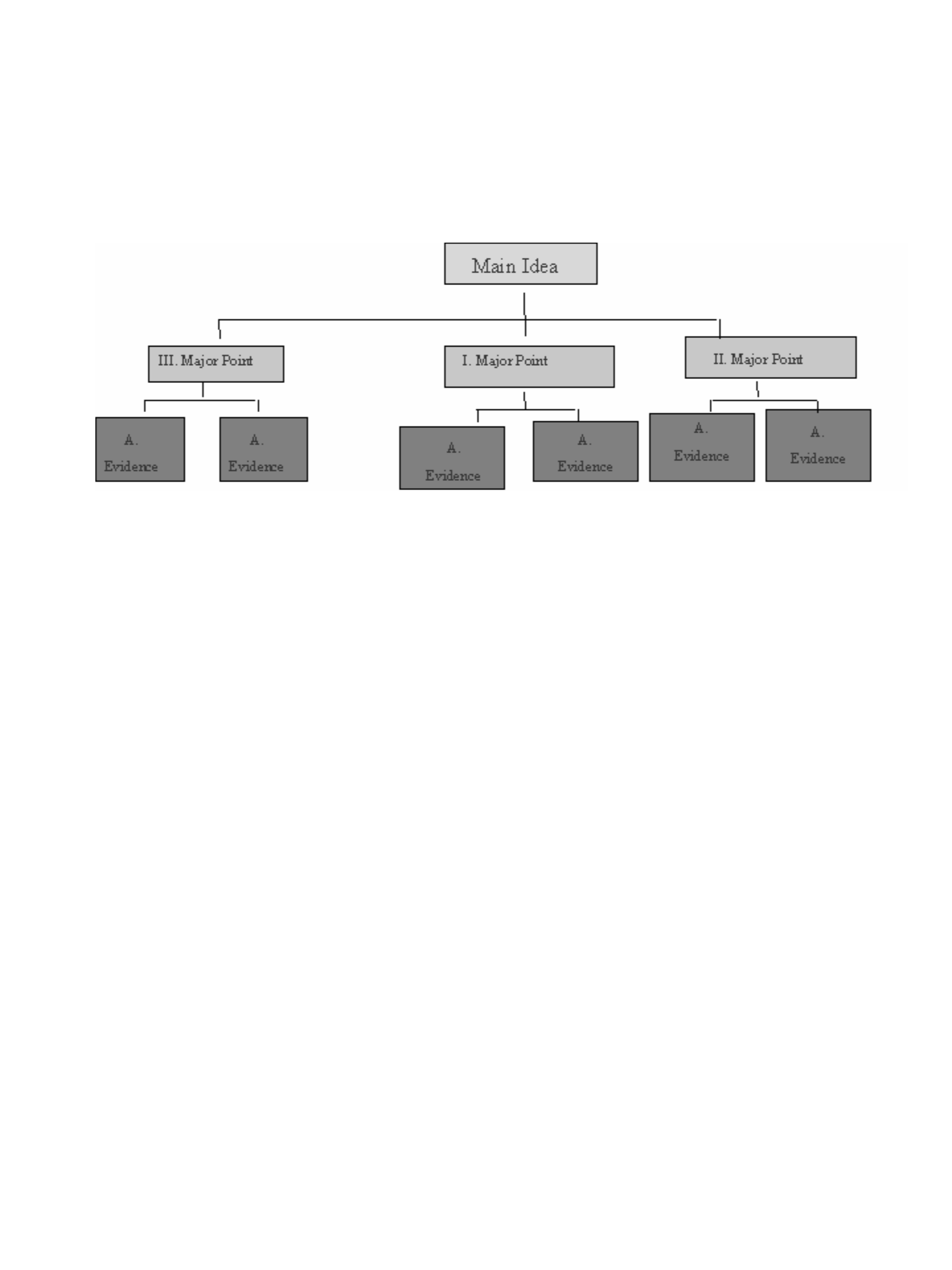
• Chart shown on next slide.
Organization Chart
Illustrate with Evidence
• Each major point should be supported with enough specific
evidence to be convincing, but not so much that it becomes
boring!
Establish Sequence with Organizational Patterns
• You have two options after you have defined and grouped your ideas
– Direct Approach
– Indirect Approach

•Direct Approach (deductive)
– Putting the main idea first followed by evidence.
• Indirect Approach (inductive)
– Putting the main idea first and evidence later.
• Use direct order if the audience’s reaction is likely to be positive
and indirect order if it is likely to be negative.
• Short messages follow one of four organizational plans,
depending on the audience’s probable reaction.
• Direct requests
– Direct requests get straight to the point because the
audience usually wants to respond.
• Routine, Good-News and Goodwill Messages
– The direct approach is effective for messages that will please
the reader or will cause no particular reaction.
Direct Request Format
The letter begins with the main idea.
The midsection makes a request and provides essential details.
In closing the letter refers to the main point and states the desired action.
Routine, Good-News and Goodwill Message Format

The letter begins with the good news.
All necessary details are provided in the middle part.
This paragraph gives additional specifics.
In closing the letter refers to the main point and states the desired action.
Establish Sequence with Organizational Patterns
• Bad-News Messages
– If you have bad news, try to put it somewhere in the middle, cus
hioned by other, more positive ideas.

Establish Sequence with Organizational Patterns
• Bad-News Messages
– If you have bad news, try to put it somewhere in the middle, cus
hioned by other, more positive ideas.
Bad-News Message Format
The letter begins with a neutral statement that provides a transmission to the refusal.
The midsection explains the reason for refusal and then states the bad news.
The writer takes care to introduce a positive thought.
The letter closes on a cordial note.
Establish Sequence with Organizational Patterns
•Persuasive Messages
– Using the indirect approach gives you an opportunity to get
your message across to a skeptical or hostile audience.
Persuasive Message Format
The letter begins with questions to catch the readers attention.
The letter leads up to the main point by arousing the reader’s interest.
This section gives the reader a motive for complying with the
request. The letter closes with an appeal .

Establish Sequence with Organizational Patterns
•Longer Message
– The organization of a longer message should reflect both the
purpose of the message and the audience’s probable reaction.
–
When your purpose is to inform, the major points are based on a
natural order
implied by the subject’s characteristics.
Organizational plan should depend on the reaction you anticipate
• Your audience may respond in two ways to your material.
– If you expect your audience to agree with you, use a structure
that focuses attention on conclusion
– If you expect your audience to be skeptical about your
conclusions, use a structure that focuses on rational that
supports your point of view.

Formulating your Message
• Your first draft
– Composition is the process of drafting your message;
polishing it is a latter step.
•Your style and Tone
– When composing the message vary the style to create a tone
that suits the occasion.
•Think about the relationship you want to establish
– Don’t be too familiar
– Use humor only with great care
– Don’t flatter the other person
– Don’t preach
– Don’t brag
– Be yourself
Use the ‘you’ attitude
• The ‘you’ attitude is best implemented by expressing your message in
terms of the audience’s interests and needs.
•Avoid using the ‘you’ and ‘yours’
– To excess
– When assigning the blame

– If your organization prefers a more formal style.
Example
• Instead of this
– To help us process in this order, we must ask for another
copy of the requisition
• Use this
– So that your order can be filled promptly, please send another
copy of the requisition.
•Instead of this
– We prefer typewriter ribbons in three colors: black, blue and green.
•Use this
– Take your pick of type writer ribbons in three colors: black, blue and
green.
Remember!
• The word ‘you’ does not always indicate a ‘you’ attitude, and the
‘you’ attitude can be displayed without using the word ‘ you’.

Example
• Instead of this
– You should never use that kind of paper in the machine.
•Use this
– That kind of paper doesn’t work very well in the machine.
•Instead of this
– You need to make sure the staff follows instructions.
•Use this
– The staff may need guidance in the following instructions.
Emphasize the positive
• Explain what you have done, what you can do, and what you will do
– not what you haven’t done, cant do or wont do.
• When you are offering criticism or advice, focus on what the person
can do to improve.
Example
• Instead of this
– The problem with this department is a failure to control costs.
•Use this
– The performance of this department can be improved by

tightening up cost controls.
Establish Credibility
• Don’t make a false promise
• People are more likely to react positively to your message when
they have confidence in you.
Example
• Instead of this
– We hope this recommendation will be helpful.
•Use this
– We’re glad to make this recommendation.
Be Polite
• Try to express facts in a kind and thoughtful manner.
• Use extra tact when writing and when communicating with higher-ups.
• Promptness is a form of courtesy.

Project the Company Image
• Subordinate your own style to that of the company.
Revision
•Identify the characteristics of a well organized message.
• Explain why organization is important to both the
audience and the communicator.
•Break a main idea into subdivisions grouped under logical
categories.
• Arrange ideas in direct or indirect order, depending on the
audience possible reaction.
• Compose a message using a style and tone that are appropriate to
your subject, purpose, audience and format.
• Use the ‘ you’ article to interest the audience in your message.
**************************************************************

