


Quiz: Crime Mapping, Crime Patterns,
and Policy Analysis
Instructions
The quiz:
Covers the Textbook material from Module 6: Week 6.
Contains 15 multiple-choice and essay questions.
Is limited to 1 hour.
Allows 1 attempt.
Is worth 30 points.
Question 1
1.5 / 1.5 pts
A type of evaluation research that is conducted to determine whether it is
feasible to evaluate a program's effects with available time and resources is
known as
An assessment evaluation
An evaluability assessment
A needs assessment
An operational assessment
Question 2
1.5 / 1.5 pts
Thacher's study (2011) studied whether racial/ethnic distribution and
socioeconomic status had an influence on the degree to which a jurisdiction
protected these resources by utilizing
UCR police data
U.S. Census data
Both A and B
None of the above
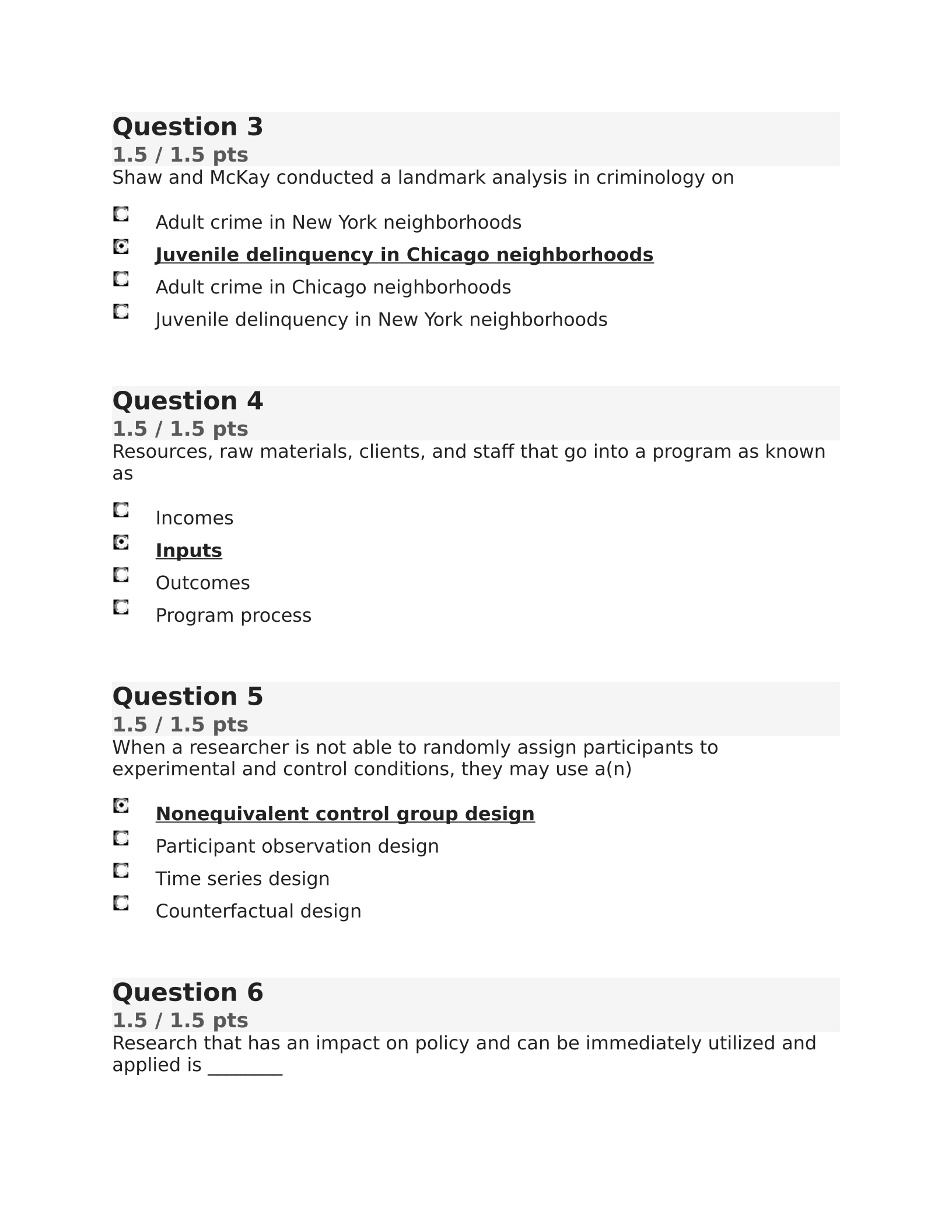
Question 3
1.5 / 1.5 pts
Shaw and McKay conducted a landmark analysis in criminology on
Adult crime in New York neighborhoods
Juvenile delinquency in Chicago neighborhoods
Adult crime in Chicago neighborhoods
Juvenile delinquency in New York neighborhoods
Question 4
1.5 / 1.5 pts
Resources, raw materials, clients, and staff that go into a program as known
as
Incomes
Inputs
Outcomes
Program process
Question 5
1.5 / 1.5 pts
When a researcher is not able to randomly assign participants to
experimental and control conditions, they may use a(n)
Nonequivalent control group design
Participant observation design
Time series design
Counterfactual design
Question 6
1.5 / 1.5 pts
Research that has an impact on policy and can be immediately utilized and
applied is ________
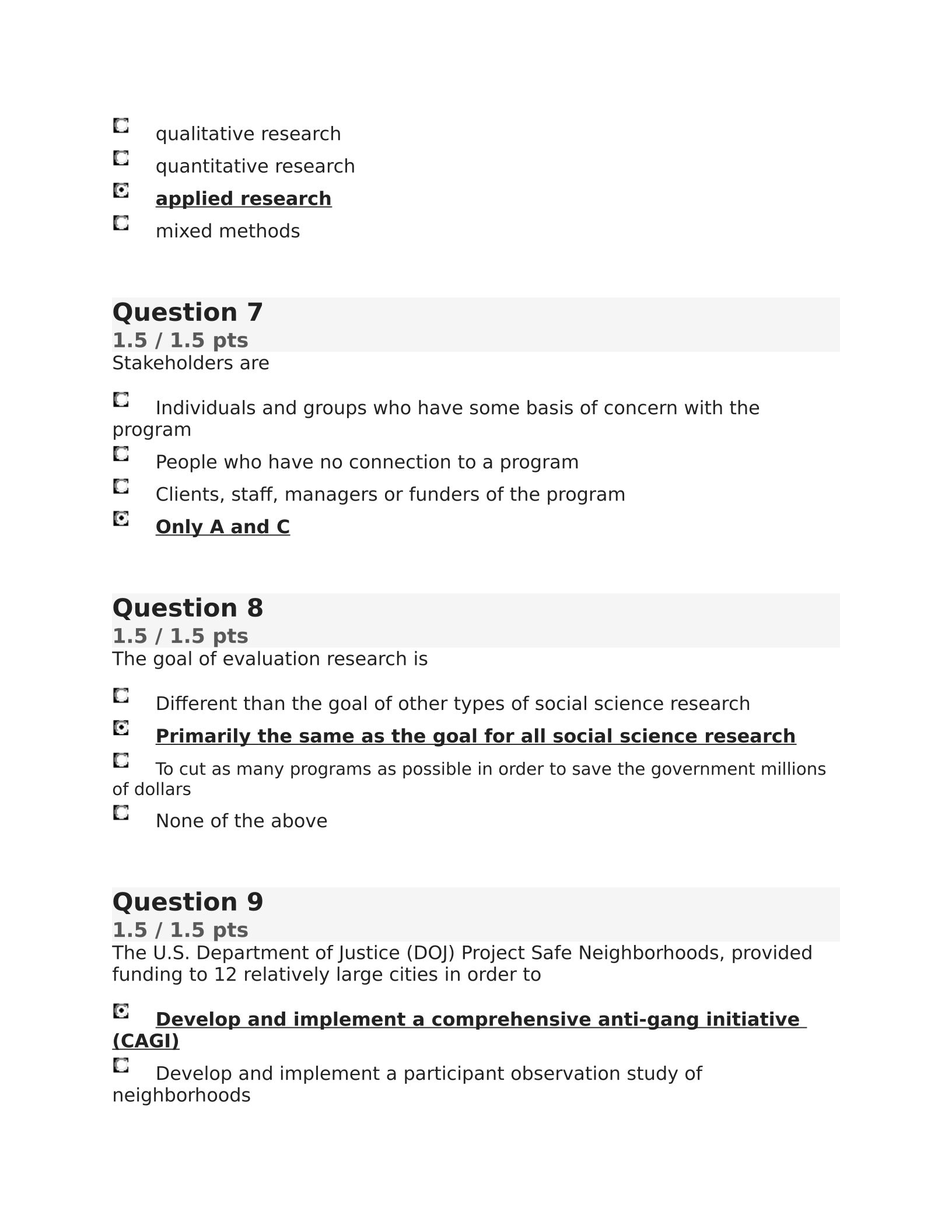
qualitative research
quantitative research
applied research
mixed methods
Question 7
1.5 / 1.5 pts
Stakeholders are
Individuals and groups who have some basis of concern with the
program
People who have no connection to a program
Clients, staff, managers or funders of the program
Only A and C
Question 8
1.5 / 1.5 pts
The goal of evaluation research is
Different than the goal of other types of social science research
Primarily the same as the goal for all social science research
To cut as many programs as possible in order to save the government millions
of dollars
None of the above
Question 9
1.5 / 1.5 pts
The U.S. Department of Justice (DOJ) Project Safe Neighborhoods, provided
funding to 12 relatively large cities in order to
Develop and implement a comprehensive anti-gang initiative
(CAGI)
Develop and implement a participant observation study of
neighborhoods
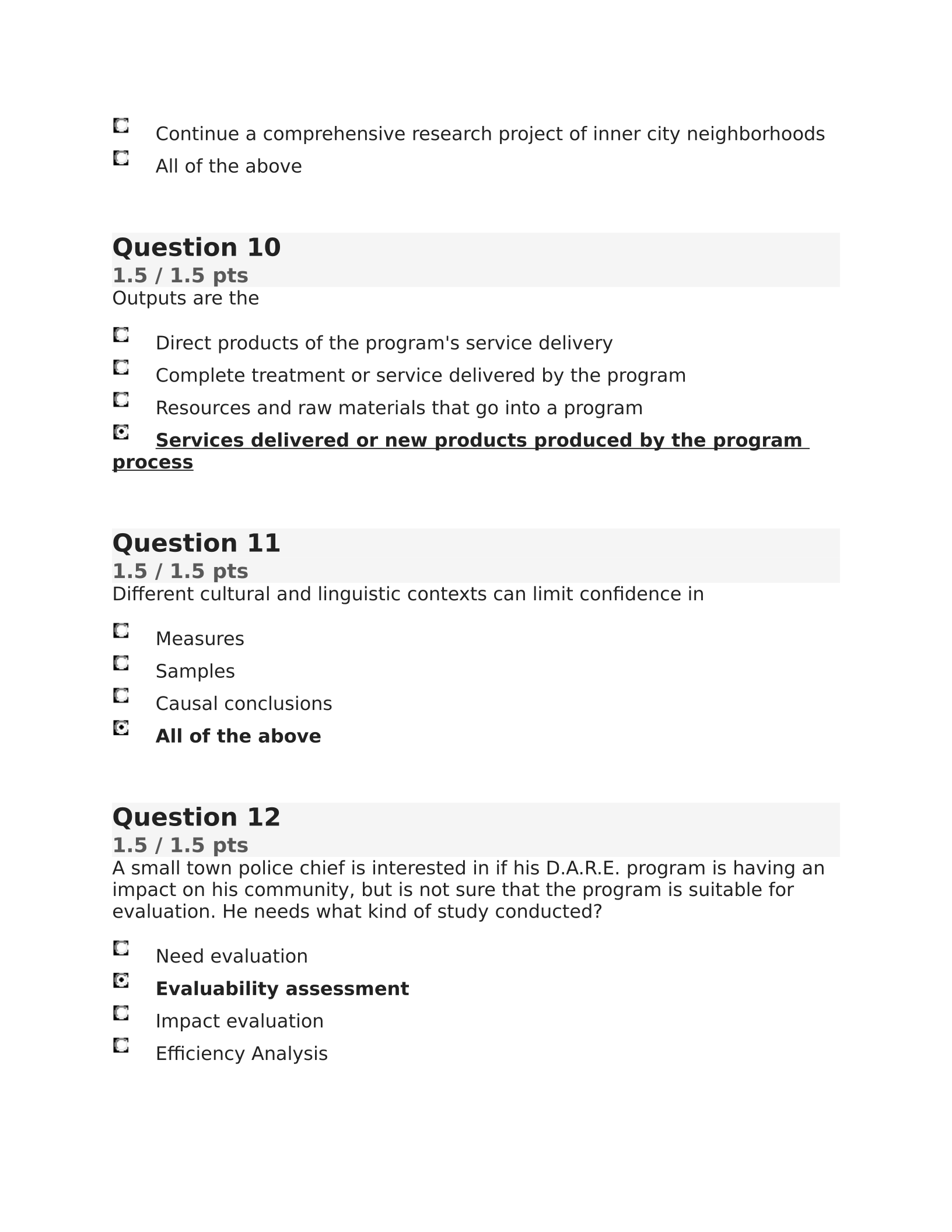
Continue a comprehensive research project of inner city neighborhoods
All of the above
Question 10
1.5 / 1.5 pts
Outputs are the
Direct products of the program's service delivery
Complete treatment or service delivered by the program
Resources and raw materials that go into a program
Services delivered or new products produced by the program
process
Question 11
1.5 / 1.5 pts
Different cultural and linguistic contexts can limit confidence in
Measures
Samples
Causal conclusions
All of the above
Question 12
1.5 / 1.5 pts
A small town police chief is interested in if his D.A.R.E. program is having an
impact on his community, but is not sure that the program is suitable for
evaluation. He needs what kind of study conducted?
Need evaluation
Evaluability assessment
Impact evaluation
Efficiency Analysis

Question 13
1.5 / 1.5 pts
The National Archive of Criminal Justice Data provides
More than 1,000 criminal justice data collections to private researchers
600+ criminal justice data collections to the public
The FBI Uniform Crime Reporting program data
Both B and C
Question 14
1.5 / 1.5 pts
Information about service delivery system outputs, outcomes or operations is
_____
Looped information
Feedback
Stakeholding information
confidential
Question 15
9 / 9 pts
The National Institute of Justice would like to request proposals for the
evaluation of a police department's mandatory arrest policy for domestic
violence. The Institute is interested in a wide array of evaluation research.
Describe four research projects that could significantly enhance our
understanding of the effect of mandatory arrest policies for domestic
violence. More precisely, describe one research project to evaluate impact,
one to evaluate need, one to evaluate process, and one to evaluate
efficiency.
Your Answer:
To evaluate the impact of a police department's mandatory arrest policy for
domestic violence, one could conduct a quasi-experimental study in which
two similar police departments are compared. One department would have a
mandatory arrest policy for domestic violence, while the other would not.
Researchers could collect data on the number of reported incidents of
domestic violence, the number of arrests made, and the number of

subsequent incidents after each department implemented the policy. The
study would aim to determine whether the mandatory arrest policy leads to
decreased domestic violence incidents and whether it increases the
likelihood of victims reporting the incidents (Bachman & Schutt, 2021).
To evaluate the need for a mandatory arrest policy, one could survey victims
of domestic violence to determine their attitudes toward mandatory arrest
policies. The survey could ask questions about the victims' experiences with
the criminal justice system, their views on the effectiveness of mandatory
arrest policies, and their willingness to report domestic violence incidents if
such a policy were in place (Bachman & Schutt, 2021).
To evaluate the process of implementing a mandatory arrest policy, one
could conduct a qualitative study using interviews with police officers,
victims, and advocates for victims of domestic violence. The study would aim
to identify the challenges and successes of implementing the policy,
including any barriers to its implementation and unintended consequences
(Bachman & Schutt, 2021).
One could conduct a cost-benefit analysis to evaluate the efficiency of a
mandatory arrest policy. The analysis would compare the costs of
implementing the policy (e.g., training police officers, and providing
resources to victims) to the policy's benefits (e.g., decreased domestic
violence incidents and increased victim safety). The study would aim to
determine whether the policy's benefits outweigh the costs and whether the
policy represents a cost-effective use of resources (Bachman & Schutt,
2021).
Reference
Bachman, R., & Schutt, R. K. (2021). Fundamentals of research in
criminology and criminal justice (5th ed.). Los Angeles, CA: Sage
Publications, Inc.
Powered by TCPDF (www.tcpdf.org)

