


CJUS 601 Quiz 4
Question 1 1.5 out of 1.5 points
A researcher determines whether an association exists between the independent and
dependent variables in a true experiment because two or more groups differ in terms of their
value on the
Selected Answer:
independent variable
Question 2 1.5 out of 1.5 points
The list of all elements of a population from which a sample is actually selected is known as
the
Selected Answer:
sample frame
Question 3 1.5 out of 1.5 points
When a conclusion based on a sample of a larger population holds true for that population is
known as
Selected Answer:
sample generalizability
Question 4 1.5 out of 1.5 points
Using a Solomon four-group design, subjects are randomly assigned to
Selected Answer:
two experimental groups and two comparison groups
Question 5 1.5 out of 1.5 points
A researcher who draws conclusions about individual-level processes from group-level data
is constructing
Selected Answer:
an ecological fallacy
Question 6 1.5 out of 1.5 points
When subjects develop or change during the experiment as part of an ongoing process
independent of the experimental treatment is known as
Selected Answer:
endogenous change
Question 7
Selected Answer:
1.5 out of 1.5 points
If you complete a survey in a magazine entitled "What Do You Think About the Death Penalty for
Teenagers? and mail it in to the publisher, you have participated in survey research
Selected Answer: with an availability sample
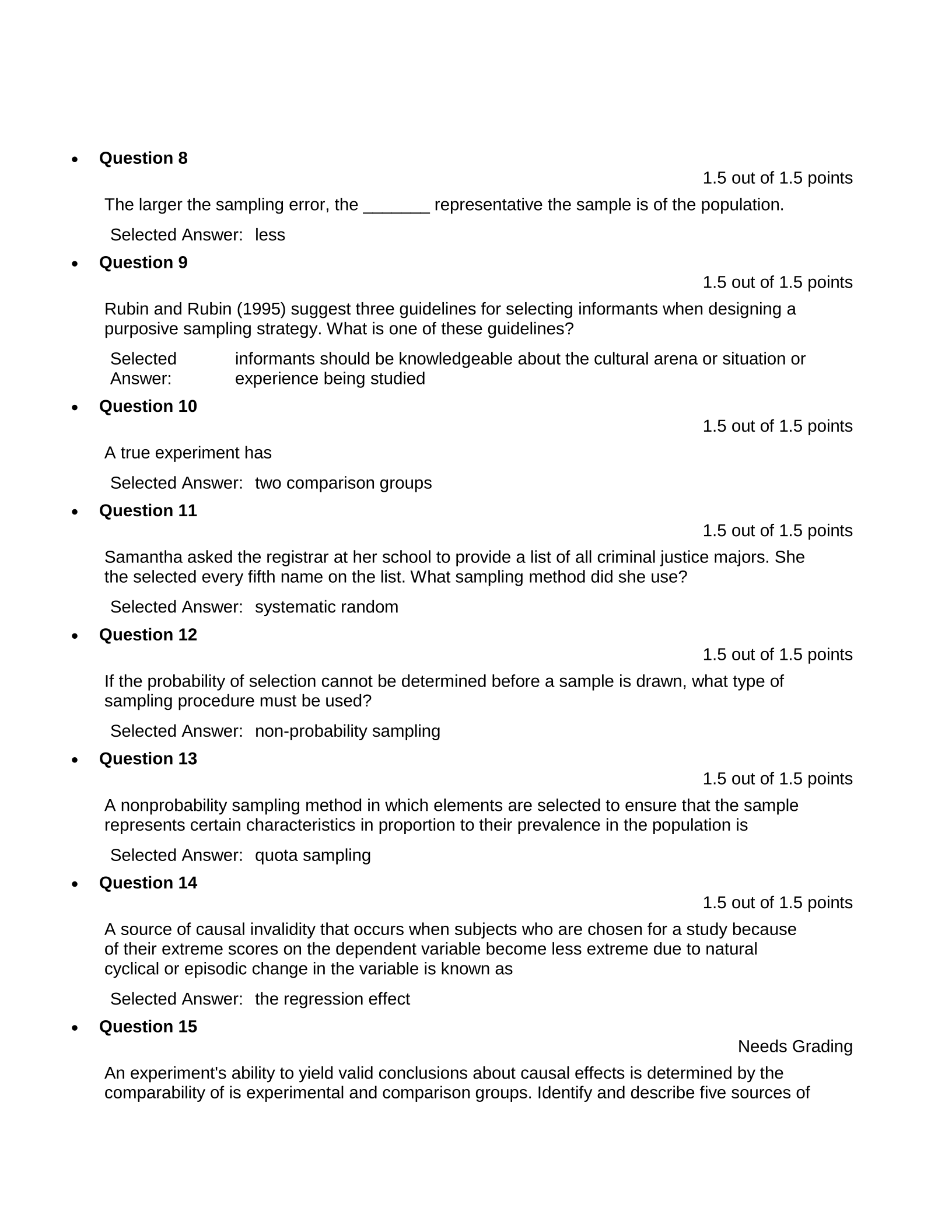
Question 8 1.5 out of 1.5 points
The larger the sampling error, the _______ representative the sample is of the population.
Selected Answer:
less
Question 9 1.5 out of 1.5 points
Rubin and Rubin (1995) suggest three guidelines for selecting informants when designing a
purposive sampling strategy. What is one of these guidelines?
Selected
Answer:
informants should be knowledgeable about the cultural arena or situation or
experience being studied
Question 10 1.5 out of 1.5 points
A true experiment has
Selected Answer:
two comparison groups
Question 11 1.5 out of 1.5 points
Samantha asked the registrar at her school to provide a list of all criminal justice majors. She
the selected every fifth name on the list. What sampling method did she use?
Selected Answer:
systematic random
Question 12 1.5 out of 1.5 points
If the probability of selection cannot be determined before a sample is drawn, what type of
sampling procedure must be used?
Selected Answer:
non-probability sampling
Question 13 1.5 out of 1.5 points
A nonprobability sampling method in which elements are selected to ensure that the sample
represents certain characteristics in proportion to their prevalence in the population is
Selected Answer:
quota sampling
Question 14 1.5 out of 1.5 points
A source of causal invalidity that occurs when subjects who are chosen for a study because
of their extreme scores on the dependent variable become less extreme due to natural
cyclical or episodic change in the variable is known as
Selected Answer:
the regression effect
Question 15 Needs Grading
An experiment's ability to yield valid conclusions about causal effects is determined by the
comparability of is experimental and comparison groups. Identify and describe five sources of

internal invalidity.
Selected
Answer:
The five sources of internal validity are:
Selection Bias which is the characteristics of treatment and comparison group
subjects differ in any way that influences the outcome.
Endogenous Change which occurs when natural developments or changes in the
subject (independent if the experiment treatment itself) account for some or all of
the observed changes between pretest and posttest.
External Events or history effects is the events that happen outside the
experiment can affect the subject outcomes scores.
Contamination occurs when the control groups is in some way affected by, or
affects, the treatment group.
Treatment misidentification occurs when the treatment itself does not cause the
outcome but does cause some other process the research is not aware of.
Response
Feedback:
[None Given]
Question 1
1.5 out of 1.5 points
A discernable process that creates a causal connection between two variables is
Selected Answer: a mechanism
Question 6
1.5 out of 1.5 points
The method of sampling in which sample elements are selected separately from population
strata identified in advance by the researcher is
Selected Answer: stratified random sampling
Question 7
1.5 out of 1.5 points
Social experiments conducted in the 'real world' are known as
Selected Answer: field experiments
Question 11

Question 13
1.5 out of 1.5 points
In order to keep experimental staff from subtly conveying their enthusiasm for an experimental
program to subjects, experimenters may
Selected Answer: use double-blind procedures so that neither the experimenter nor the subjects
know who is receiving the treatment
Question 15
Needs Grading
Two samples are drawn from an urban population. One sample is a quota sample. Comparisons
of the demographic characteristics of this sample to those of the urban population show an
almost perfect match. The other sample is a disproportionate random sample. Comparisons of
the demographic characteristics of this sample to those of the urban population show marked
differences on the distributions of race and gender. Which sample provides a better base for
developing a representative description of the urban population from which the sample was
drawn? Explain your reasoning. Which sample provides a better base for developing a
representative description of other urban populations? Explain your reasoning.
Selected Answer:
I believe the quota sample provides a better base for developing a representative description of
the urban population. The capacity of this sample to provide almost a flawless match to pre-
selected characteristics within the population gives it reliability and validity. The
disproportionate random sample would provide errors if attempting to describe a specific urban
population. Quota sampling is essential to the ability it has to ensure to include
representativeness of all the strata in the population. Defining an urban population is complex,
and it demands inclusivity. To confirm inclusivity, it is indispensable to use a quota sample.
Here, the research practitioner should be able to compile proportionate strata. They can then
group the urban demographics on the basis of race, sex, occupation and residence. For
example, a research practitioner can sample the same number of boys and girls that belong to
the same school grade. When describing this sample, it becomes easy to compare and
contrast it. This controverts a disproportionate random sample - which would ignore equal
representation of the populations. Quota sample provides a better base for the development of
a representative description of other urban populations as well. A researcher can use equal
representation of strata. For example, if they wish to describe the demographic characteristics
of the children in different schools, they will ensure that all the schools are represented equally.
This will achieve reliable results. The most common reason to use a disproportionate random
sample would be to ensure that cases from smaller strata are included in the sample in
sufficient numbers if too few members of a particular group are in the part of the population,
because they need to be oversampled; one determinant of sample quality is its size.

•Question 5
1.5 out of 1.5 points
In ex post facto control group designs, the groups are
Selected Answer: designated after the treatment has occurred
•Question 11
1.5 out of 1.5 points
When treatment group members compare their situation to that of the control group members
who are not receiving the treatment; experimental group members feel special simply because
they are in the experiment. This effect is known as
Selected Answer: the hawthorne effect
•Question 12
1.5 out of 1.5 points
When comparison group members become aware that they are being denied some advantage,
they may increase efforts to compensate, creating a problem known as
Selected Answer: both A and B
•Question 15
Needs Grading
Explain the ecological fallacy and reductionism. What can be done to reduce these concerns
Selected Answer: An ecological fallacy is a logical fallacy in the interpretation of
statistical data where inferences about the nature of individuals are deduced from inference for
the group to which those individuals belong. Ecological fallacy is due to imprecise reasoning
and generalizing well beyond what the evidence justifies. Whereas reductionism is the practice
of analyzing and describing a complex phenomenon in terms of phenomena that are held to
represent a simpler or more fundamental level, especially when this is said to provide a
sufficient explanation. Reductionism occurs when a person observes a lower unit of analysis but
makes statements about the operations of higher units. Both ecological fallacy and reductionism
are mismatch of units of analysis.
Response Feedback: [None Given]
Powered by TCPDF (www.tcpdf.org)

