


CJUS 601
DISCUSSION ASSIGNMENT INSTRUCTIONS
The student will complete 8 Discussions in this course.
The student will post one thread of at least 250 words by 11:59 p.m. (ET) on Thursday
day of the assigned Module: Week. For each thread, students must support
their assertions with at least 2 scholarly citations in APA format.
The student must then post 2 replies of at least 150 words by 11:59 p.m. (ET)
on Sunday of the assigned Module: Week. Each reply must incorporate at least
1 scholarly citation in APA format.
Any sources cited must have been published within the last five years. Acceptable
sources include the textbook, the Bible, and scholarly peer-reviewed research articles..
---------------------------------------------------------------------
Read the article "The Street-level Information Economics Activities: Estimating the Yield of
Begging in Brussels."
Based on the principles of survey research noted in Chapter 1 of The Mismeasure of Crime
textbook, describe your thoughts on trusting the research used in the article.
Describe the limitations of the research and article.
Would you base public policy with respect to beggars off of this article?
Reading the article Street-level Informal Economic Activities: Estimating the Yield of
Begging in Brussels which included research and data by Stef Adriaenssens and Jef
Hendrickx (2011), helped me to have a better and more thorough understanding of the
mismeasurement of crime and the different aspects of the topic. Below, I have outlined
a few main points we have been led to discuss.
Trusting the Research:
Reading the article “The Street-Level Information Economics Activities:
Estimating the Yield of Begging in Brussels” was definitely a solid attempt of the article
to convince readers of its scientific or extensive research methods to prove a
hypothesis. While the individuals who conducted the research did well in ensuring they
emphasized attention to detail to help convince a smaller margin of error, ultimately,
many of their researched claims were not detailed but narrow and vague, which led to
questions about the validity of results.
Regarding begging, regardless of country, it cannot be outlawed, but it also
cannot become a primary focus or task for law enforcement agencies or personnel.
There are no clear indications or firm data statistics proving beggars to be rooted in
criminal activity or if they are good human beings facing real struggles and crises. A
lack of employment opportunities is not the sole reason behind a beggar’s actions.
People can gather thousands of dollars annually from hustling the employed than they
could at certain job professions. It’s similar to being a freelance employee. It is a form of
passive income that cannot be tracked or accounted for. Also, gifts given to a beggar
are not accounted for, nor are the meals, shelter, clothing, or transportation one might
receive.

CJUS 601
Limitations of the Research:
The study's credibility was compromised due to inherent factors that introduced
unreliability. This was primarily attributed to the various variables and unpredictable
elements inherent in the research. The study focused on three distinct categories of
beggars within the specified area rather than addressing the broader concept of
begging. Consequently, the numerical data from the study cannot be deemed reliable
for making assumptions about the returns associated with begging. Per our readings, it
is emphasized that both reliability and validity are essential in research. Reliability,
being a crucial component, is defined by questions of the stability and consistency of
measurements across multiple trials (Mosher et al., 2011).
The Research and Public Policy:
When considering public policy implications, relying solely on the study's findings is not
advisable. Beggars who involve their entire family or specifically have children present
tend to garner more support from sympathetic individuals. Therefore, when formulating
public policy, it becomes imperative to establish clear parameters and guidelines
outlining permissible and impermissible actions for beggars. This entails defining the
circumstances under which begging constitutes a legal source of income. The primary
challenge in crafting such a policy is evaluating and monitoring begging activities. While
begging can yield financial gains, discerning the genuine needs of individuals versus
those attempting to accumulate extra cash poses a significant dilemma. This raises
questions about accountability for the funds received, including determining taxes and
other financial obligations tied to an individual's income. Begging is often viewed as a
survival tactic, making a complete prohibition challenging to argue; hence, a need for
regulation through public policy. The key challenge lies in developing a system that can
effectively distinguish between those genuinely in need and those engaging in
deceptive practices.
Biblical Worldview and Application:
Proverbs 14:15 (ESV, 2001) encourages the application of discernment, stating, "The
simple believes everything, but the prudent gives thought to his steps.” This verse
underscores the importance of critically evaluating information and claims, echoing the
concerns raised about the limitations and narrowness of the research in estimating the
yield of begging. Matthew 25:35-36 (ESV, 2001) emphasizes compassion for those
facing challenges, stating, " For I was hungry, and you gave me food, I was thirsty, and
you gave me drink, I was a stranger, and you welcomed me, 36I was naked, and you
clothed me, I was sick, and you visited me, I was in prison, and you came to me." This
teaching encourages a holistic view of needy individuals, considering factors beyond
mere criminality. Moreover, the biblical perspective on compassion and understanding
individual struggles aligns with the acknowledgment that begging cannot be universally
outlawed.
CJUS 601
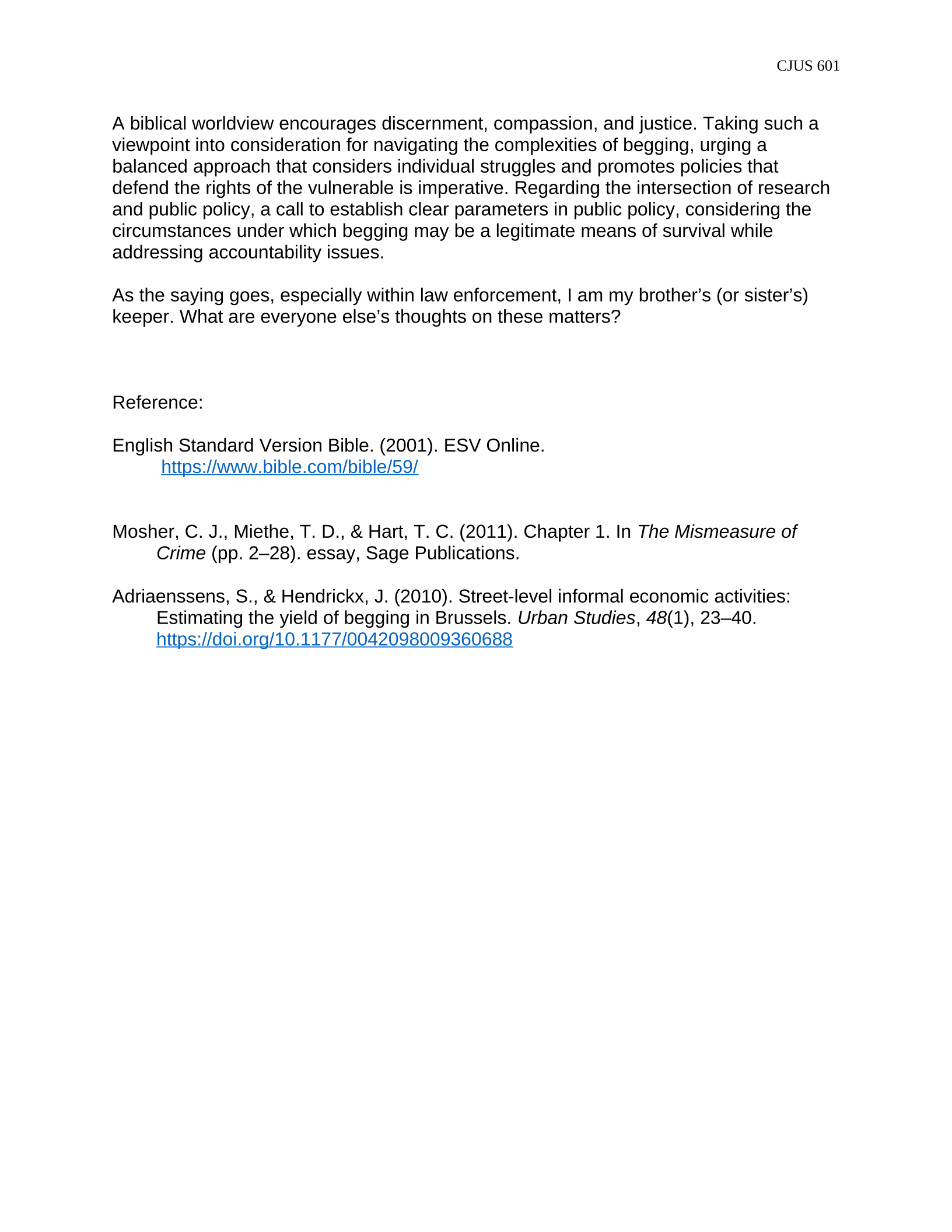
A biblical worldview encourages discernment, compassion, and justice. Taking such a
viewpoint into consideration for navigating the complexities of begging, urging a
balanced approach that considers individual struggles and promotes policies that
defend the rights of the vulnerable is imperative. Regarding the intersection of research
and public policy, a call to establish clear parameters in public policy, considering the
circumstances under which begging may be a legitimate means of survival while
addressing accountability issues.
As the saying goes, especially within law enforcement, I am my brother’s (or sister’s)
keeper. What are everyone else’s thoughts on these matters?
Reference:
English Standard Version Bible. (2001). ESV Online.
https://www.bible.com/bible/59/
Mosher, C. J., Miethe, T. D., & Hart, T. C. (2011). Chapter 1. In.The Mismeasure of
Crime.(pp. 2–28). essay, Sage Publications..
Adriaenssens, S., & Hendrickx, J. (2010). Street-level informal economic activities:
Estimating the yield of begging in Brussels..Urban Studies,.48(1), 23–40.
https://doi.org/10.1177/0042098009360688
CJUS 601
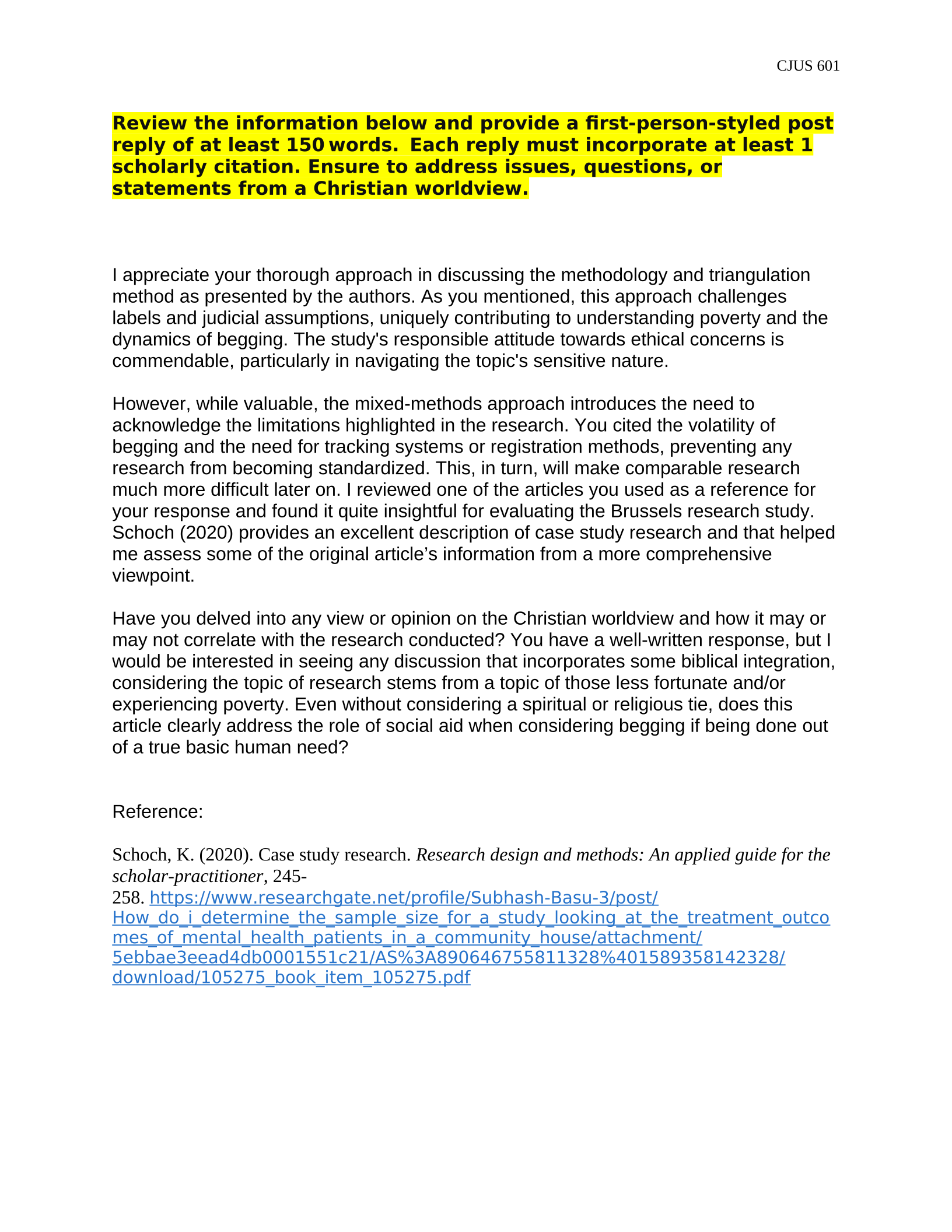
Review the information below and provide a first-person-styled post
reply of at least 150 words. Each reply must incorporate at least 1
scholarly citation. Ensure to address issues, questions, or
statements from a Christian worldview.
I appreciate your thorough approach in discussing the methodology and triangulation
method as presented by the authors. As you mentioned, this approach challenges
labels and judicial assumptions, uniquely contributing to understanding poverty and the
dynamics of begging. The study's responsible attitude towards ethical concerns is
commendable, particularly in navigating the topic's sensitive nature.
However, while valuable, the mixed-methods approach introduces the need to
acknowledge the limitations highlighted in the research. You cited the volatility of
begging and the need for tracking systems or registration methods, preventing any
research from becoming standardized. This, in turn, will make comparable research
much more difficult later on. I reviewed one of the articles you used as a reference for
your response and found it quite insightful for evaluating the Brussels research study.
Schoch (2020) provides an excellent description of case study research and that helped
me assess some of the original article’s information from a more comprehensive
viewpoint.
Have you delved into any view or opinion on the Christian worldview and how it may or
may not correlate with the research conducted? You have a well-written response, but I
would be interested in seeing any discussion that incorporates some biblical integration,
considering the topic of research stems from a topic of those less fortunate and/or
experiencing poverty. Even without considering a spiritual or religious tie, does this
article clearly address the role of social aid when considering begging if being done out
of a true basic human need?
Reference:
Schoch, K. (2020). Case study research.Research design and methods: An applied guide for the
scholar-practitioner, 245-
258.https://www.researchgate.net/profile/Subhash-Basu-3/post/
How_do_i_determine_the_sample_size_for_a_study_looking_at_the_treatment_outco
mes_of_mental_health_patients_in_a_community_house/attachment/
5ebbae3eead4db0001551c21/AS%3A890646755811328%401589358142328/
download/105275_book_item_105275.pdf

CJUS 601
I appreciated that you began your discussion post by sharing the harsh reality of your
personal knowledge and experience related to the assignment’s article. I noticed that
you addressed briefly how the research provided some attention to the multifaceted
reasons behind begging. Would you agree or disagree that the research study
debunked predominant stereotypes and miscalculations of begging?
Based on Christian values, a foundational need exists to understand how or why
individuals may resort to begging. Whether that act comes from a place of deceit or truly
from a deep-rooted need to survive. I am reminded of a passage in Romans that tells
us, “Contribute to the needs of the saints and seek to show hospitality” (ESV, 2001).
Even outside the scope of conducting research, when considering the topic, we have
looked at this week, as Christians, it is our duty to be Christ-like and follow his example.
What better way can we do this than seeking to understand while simultaneously
showing hospitality to God’s people?
In considering data reliability, I agree with your viewpoint that the principles as they
have been outlined for us by Mosher, Miethe, and Hart (2010) become relevant. Based
on my understanding of the principles we refer to, while there is much of the data in the
Brussels study that should be reliable, it is essential to recognize this study as a “case
study,” acknowledging that results and conclusions drawn from this study cannot be
used to generalize the concept of begging in across all cultures and all environments.
The argument to me would be similar to how we do not seek to punish the masses for
the actions of a few. In this case, there are some relative assumptions and ideas from
the information the Brussels study presented for application elsewhere, but such an
approach would not be definitive. Further research in varied settings is essential to
develop a more comprehensive perspective.
References:
English Standard Version Bible. (2001). ESV Online.
https://www.bible.com/bible/59/
Mosher, C. J., Miethe, T. D., & Hart, T. C. (2011). Chapter 1. In.The Mismeasure of
Crime.(pp. 2–28). essay, Sage Publications..
Powered by TCPDF (www.tcpdf.org)

