


1
Discipleship Curriculum Assignment
Derius Woods
CHPL 655: Chaplain Evangelism and Discipleship
March 14, 2024

2
Contents
Introduction...................................................................................................................................1
Discipleship Covenant...................................................................................................................2
Curriculum Components...............................................................................................................3
Week 1: What Happened?............................................................................................................4
Lesson 1: What is salvation?.......................................................................................................4
Lesson 1 (Pt 2): Justification.......................................................................................................6
Lesson 1(Pt 3): Regeneration......................................................................................................6
Lesson 2: Assurance of Salvation..............................................................................................11
Lesson 2 (Pt. 2) Scripture (Inerrancy and Inspiration).............................................................11
Week 2: What is Next?................................................................................................................15
Lesson 1: Obedience to Christ..................................................................................................15
Lesson 2: Sanctification............................................................................................................19
Week 3: Growth in Christ............................................................................................................23
Lesson 1: The Spiritual Disciplines...........................................................................................23
Lesson 2: Serving in the Church................................................................................................31
Week 4: Share your Faith............................................................................................................34
Lesson 1: Techniques................................................................................................................34
Lesson 2: Apologetics................................................................................................................40
Conclusion...................................................................................................................................42

3
Bibliography.................................................................................................................................43
ii
The purpose of this discipleship curriculum is to provide a tool for the new believer that
will aid them in the infancy stage of their walk with Christ. The curriculum is designed to
implement small, reproducible discipleship units. The intention that stands behind this tool is
closely connected with God’s purpose for discipleship in the Great Commission. Matthew
28:1920 reads “Go therefore and make disciples of all nations, baptizing them in the name of
the
Father and of the Son and the Holy Spirit, teaching them to observe all that I have commanded
you. And behold, I am with you always, to the end of the age” (ESV). The primary essential to
discipleship is the unchanging truth of God’s word. Decades before the post-modernism
movement in the West it was assumed that there was such a thing as a reviled or at least a
scientific objective truth backed by all. Unfortunately, relativism has taken over the social,
economic, and religious spheres of society. Ideas surrounding gender, politics, and even God’s
word are now viewed more as subjective social constructs rather than objective truths. It is
assumed that all lifestyles and moral convictions are equal in value due to the modern belief
that all truth is personal. My personal goal in this curriculum is to combat the modern lie of “live
and let be” by presenting God’s core truth through key topics such as the effect of sin, salvation,
obedience to Christ, and many more. To whoever is joining me in this curriculum,
congratulations on accepting the call to salvation. I look forward to working with you through
this infancy stage and pray that these lessons will strengthen your walk with God going forward.

4
- Derius Woods
D Covenan
In order to grow toward maturity in Christ and complete this discipleship curriculum, I commit
myself to the following standards:
1. Complete all assignments on a weekly basis prior to my discipleship meeting in order to
contribute fully.
2. Meet weekly with my discipleship partner for approximately one hour or more to
dialogue over the content of the assignments.
3. Offer myself fully to the Lord with the anticipation of accelerated growth and
transformation during this discipleship period.
4. Contribute to a climate of honesty, trust and personal vulnerability.
5. Give strong consideration of continuing the discipling chain. Once you finish this
cirruculum you will be willing to disciple whoever God calls you to.
Name (Print):
Signature:
Date:
“Commit to the Lord whatever you do, and he will establish your plans” Proverbs 16:3
“Jesus was a great worker, and His disciples must not be afraid of hard work”, Charles Spurgeon
C Components
The Core Truth

5
The core truth is presented in scripture and is intended to justify all points made in the
curriculum lessons.
Memory Verses
Are the verses presented in the lessons, most have blank fill-ins that the teacher and
discipleship mentee with fill in while covering the lessons. The mentee is also encouraged to re-
study the verses outside of scheduled meetings.
Discussion Questions
Discussion questions are presented after every lesson. The Mentee is encouraged to answer the
questions to the best of their ability.
Prayer
While not presented in the lesson book, prayer will be conducted prior and after each session.
The teacher is also encouraged to record prayer requests presented by the mentee.
W 1: What Happened?
Lesson 1: What is salvation?
The sin problem?
To understand salvation, we must first understand the reason why we needed it in the first
place. In our modern society, there are many issues that we face daily. This could range from
racism to bad government, to economic trouble. Regardless of what this issue is we must
understand that they are all rooted in a problem known as sin. So, what is sin you ask? Well, the
bible defines sin as simply disobedience to God (rebellion). In Exodus 20: 1-17 God gave us the
10 commandments (the law) to know what sin is. Below listed is what these commandments
are.
1. You shall have no other Gods but me.
2. You shall not make for yourself any idol, nor bow down to it or worship it.
3. You shall not misuse the name of the Lord your God.
4. You shall remember and keep the Sabbath day holy.

6
5. Respect your father and mother.
6. You must not commit murder.
7. You must not commit adultery.
8. You must not steal.
9. You must not give false evidence against your neighbor.
10. You must not be envious of your neighbor’s goods. You shall not be envious of his house
nor his wife, nor anything that belongs to your neighbor.
All Have Sinned
We all have been guilty of breaking God’s Law at some point in our lives. Romans
3:23
For all have and fall short of the of God.
Romans 3:10-11
None is righteous, no, not one; no one understands; no one seeks for God.
The Consequences of Sin
It is important to remember that all sins have a punishment since they are violations of God’s
Law. While God is all loving he is also all just.
Romans 6:23
“For the wages of sin are ; but the gift of God is through Jesus
Christ our Lord”.
Revelation 21:8
“But the cowardly, ______________, abominable, murderers, sexually immoral,
sorcerers, idolaters, and all _____________ shall have their part in the lake which burns
with fire and brimstone, which is the ____________ death.”
The Bible says God takes sin very seriously and there is punishment, the punishment is
death.
What is Salvation?
The simplest definition of salvation is to be rescued or delivered from something. The most
common understanding of salvation is to be saved by God from the consequences of our sin.
while this is most certainly true the bible speaks of salvation in fuller terms. One term of
salvation means that those redeemed are saved from God’s wrath in Hell. Verses such as 1

7
Thessalonians 5:1-11 speak of those who have been redeemed not being destined for God’s
coming wrath. Salvation is that it restores our relationship with God the Father (Isaiah 44:22).
John 3:16
“For God so the world, that he his only Son, that whosoever
In him should not perish but have everlasting life.”
Romans 6:23 (B)
“For the of sin is death, but the gift of God is through Christ
Jesus”.
Colossians 1:13
“He has delivered us from the domain of darkness and transferred us to the kingdom of
his beloved Son.
Salvation Provided by God Through Jesus!
It is important to remember that God is all Just and loving. Because of his love for humanity,
God has provided an atonement for sin through the sacrifice of Jesus on the cross (Galatians
1:4).
Throughout scripture we see a need for a blood sacrifice for the atonement of sins (Leviticus 16)
The Passover lamb (Exodus 12) had to be spotless without blemish.
Ephesians 1:7
“In Him, we have redemption through his blood, the forgiveness of our trespasses,
according to the riches of his grace.”
Hebrews 7:25
Consequently, he is able to save to the uttermost those who draw near to God through
him, since he always lives to make intercession for them.
Lesson 1 (Pt 2): Justification
Salvation is justified by faith.
The word “justified” means to be declared righteous. As believers we are justified by the
sacrifice of Christ on the cross rather than our own works.
Ephesians 2:8-9
For by you have been saved through . And this is not your own
doing; it is the of God, not a result of works, so that no one may boast.
Romans 11:6

8
“But if it by grace, it is no longer on the basis of works; otherwise, grace would no
longer be grace”.
The gift of salvation did not come at a cheap price. This gift cost God greatly because he had to
give up his only begotten Son Jesus to die on our behalf. Ultimately the freeness of salvation
brings God more glory because we as humans cannot take credit for it.
Lesson 1(Pt 3): Regeneration
What is Regeneration?
Regeneration is the work of the Holy Spirit to unite an elect sinner to Christ by breathing life into
the dead soul. In regeneration God does a complete change of our character. He implants a new
heart along with new desires that align with his will and holy nature. Because mankind needs
grace along with resurrecting power, any work including faith alone would not be enough to
regenerate them from a state of spiritual death.
2 Corinthians 5:17
“Therefore, if anyone is in Christ, he is a . The old has passed away; behold,
the new has come”.
Ephesians 4:21-22
“Assuming that you have heard about him and were taught in him, as the truth is in
Jesus, to put off the old self, which belongs to your former manner of life and is
corrupt through deceitful desires.
Why is Regeneration Needed?
Due to the sins of our ancestors Adam and Eve, mankind was born into a sin nature where we
are naturally wicked (Psalm 51:5). Because of this the natural man or woman is unable to see
the kingdom of God (John 3:3). In scripture Jesus explains that a man must be born again in
order to see the kingdom of God.
Psalm 58:3
“The wicked are estranged from the womb; they go astray from birth, speaking lies”.
Romans 5:12
“Therefore, just as sin came into the world through one man, and death spread to all
men because all sinned.
Receiving the Holy Spirit

9
In addition to receiving eternal life and God’s righteous nature, believers will also receive a
permanent indwelling of God’s spirit. During your walk with Christ, the Holy Spirt will guide you
in all aspects of life.
John 14:26
“But the Helper, , whom the Father will send in my name, he will teach you
all things and bring to your remembrance all I have said to you”.
2 Corinthians 3:17
“ Now the Lord is the Spirit, and where the Spirit of the Lord is, there is freedom”.
Acts 1:8
“ But you will receive when the Holy Spirit comes on you; and you will be my
witnesses in Jerusalem, and in all Judea and Samaria, and to the ends of the earth”. Having
God’s Spirit within us allows us to live in freedom and victory. At times we feel defeated by sin,
but the Holy Spirit is here to empower us to live the lives God has called us to. Paul wrote that
“where the Spirit of the Lord is, there is liberty” (2 Corinthians 3:17). He also wrote that when
we walk by the Spirit our sinful desires will be overcome (Galatians 5:16). In salvation God truly
has given us everything we need for life and godliness (2 Peter 1:3).
Response
Throughout the 4-week course, we will continue to discover what discipleship consists of and its
meaning. Discipleship is a strong commitment to the Lord Jesus Christ. Remember that before
we continue that commitment does not equal salvation. Isaiah tells us that “all our
righteousness’s are like filthy rags” (Isaiah 64:6). Paul also says, “not by works of righteousness
which we have done, but according to His mercy He saved us, through the washing of
regeneration and renewing of the Holy Spirit” (Titus 3:5). It is important to remember that we
do not serve God simply for salvation, but we serve him because of what he did on the cross.
Our response to this amazing gift should be to share the good news to all who have yet to hear.
As we move forward in these lessons pray to God that he opens the door for opportunity to
share the Gospel with a non-believer. You never know, this could be a way for God to establish a
potential discipleship relationship.
Discussion Questions

10
1. What was the original sin problem?
2. Have you ever thought about the seriousness of sin? what about the consequences of
sin?
3. Do you ever have a hard time accepting the fact that eternal life is a free gift? Define
grace in your own words.
4. Briefly tell your salvation story.
5. Read through John 3:16, Romans 4:5 and Ephesians 2:8-9. What words pop out to you in
each verse? How does God want us to respond to the Gospel, and how does this impact
the way it is shared?
6. Who has God placed in your heart to share the Gospel with? Write their names below.

9

12
Lesson 1 Worksheet

13
Lesson 2: Assurance of Salvation
How Can I Be Sure of Salvation?
The issue that many Christians especially new believers face is doubts about their
salvation. God wants us to know that we belong to him forever and that Jesus assures us
that those who believe have eternal life.
John 11:25-26
Jesus said to her, “I am the resurrection and the life. He who believes in Me,
though he may die, he ______. And whoever lives and believes in Me
___________. Do you believe this?”
1 John 5:13
“These things I have written to you who ________ in the name of the Son of
God, that you may ______ that you have eternal life”.
Romans 10:13
For “whoever __________ on the name of the Lord shall be saved.”
Jesus also promised that once we have received eternal life we can never lose our salvation.
John 5:24 24
“Most assuredly, I say to you, he who hears My word and believes in Him who
sent Me _____ everlasting life, and shall not come into
judgment, but has passed from death into life.”
John 10:28-29 28
“And I give them eternal life, and they shall ______ perish; neither shall anyone
______ them out of My hand. My Father, who has given them
to Me, is greater than all; and no one is able to _______ them out of My Father’s
hand.”
God never lies. Because of this Jesus can promise that all believers who have decided to place
their trust in him shall never lose their salvation.
Lesson 2 (Pt. 2) Scripture (Inerrancy and Inspiration)
The inerrancy and inspiration of scripture are important because they confirm that scripture is
accurate and truly comes from God. Throughout scripture, God has made himself known to man
on various occasions. This is why the bible itself is a special revelation. Inspiration of scripture is

14
connected to their authors because all biblical authors such as Moses and Paul were inspired by
the Holy Spirit to record received revelation. Inerrancy means that biblical scripture is free from
error due to its divine inspiration.
Reliability of the Bible
Rather than being a single book, the Bible is a collection of 66 different books written over a
span of 1500 years by many different authors living in different locations and speaking different
languages. Yet from beginning to end the Bible has a unified theme and purpose. But is the
Bible reliable?
What is your Answer, yes or no and why?
Regardless of your answer, here are a few reasons why scripture is reliable. First, It
is God Breathed
2 Timothy 3:16-17
“All scripture is breathed out by God and profitable for teaching, for reproof, for
correction, and for training in righteousness, that the man of God may be complete,
equipped for every good work. Second, it is God-inspired
2 Peter 1:21
“For no prophecy was ever produced by the will of man, but men spoke from God as
they were carried along by the Holy Spirit”.
Third, there are multiple accounts of fulfilled prophecy (Below are a few examples).
P F
Isaiah 44:28-45:13 -Predicts that a king
named Cyrus would send the Jews home to
rebuild Jerusalem and the Temple around 150
years before it took place
Ezra 1:1-4 -Records the decree by king Cyrus
of Persia allowing the Jews to go back to their
land and rebuild the Temple.
Luke 21:20-24 -Jesus predicts the destruction
of Jerusalem and the Temple by foreign
armies, and that the Jews will be taken
captive into other nations.
Josephus (1st Century Jewish Historian)
-Wrote a detailed account of the
JewishRoman war (A.D. 66-70), which
culminated in the destruction of Jerusalem
and the
Temple in A.D. 70, the scattering of the nation,
and the deaths of around 1 million
Jews

15
Discussion Questions
1. Have you ever struggled with knowing you’re saved? Read through John 5:24; 6:47; and
11:25-26. What does Jesus say about how to know we have eternal life? Why is
assurance important in our lives?
2. What is the difference between the inerrancy and inspiration of scripture?
3. Read 2 Corinthians 3:12-18. How have you seen the glory of Christ in the Bible? How has
the Spirit transformed you with Scripture?
4. In your own words, describe how it looks to love God’s word and people who may bash
it.

16
Lesson 2 Worksheet

17
W 2: What is Ne ?
Lesson 1: Obedience to Christ
One major part of the Christian life is obedience to God. Completely surrendering to God in all
aspects of our lives is paramount because only God knows what is best for us (Psalm 1:1-2).
When we attempt to do things in our way, then we are vulnerable to mistakes and falling to sin.
the word obedience comes from the Latin word which means “to hear”1. So when we decide to
fully submit to the will of God then we are more open to hearing his voice. This week we will
focus on how to completely submit to God through areas such as baptism, church and
communion.
Baptism What
is Baptism?
Traditionally baptism in the Baptist church is the full immersion of the body into a body of water.
When we enter water baptism, we proclaim the gospel message. Baptism represents the how
Jesus died for our sins, was buried, and rose on the third day. Romans 6:4 says that we have
been buried with him in baptism into death. Being raised up out of the water expresses new life
and union with Christ.
Romans 6:4
“We were therefore with him through baptism into death in order that, just as Christ
was raised from the dead through the glory of the Father, we too may live a new life”.
Acts 2:38
“And Peter said to them, Repent and be baptized every one of you in the name of Jesus Christ
for the forgiveness of your sins, and you will receive the gift of the Holy Spirit”.
Galatians 3:27
“ For as many of you as were baptized into Christ have put on Christ”.
Biblical Baptism is Water Baptism
Water baptism is something Jesus commanded His disciples to do when making other disciples
(Matthew 28:19-20). Baptism isn’t a condition for salvation, but it is the first step of obedience
to God that a new believer is to take. The early church was faithful to baptize new believers
(Acts 2:41; 8:12).
1 “What Is Obedience to God?,” C.S. Lewis Institute, 2020, https://www.cslewisinstitute.org/resources/what-
is obedience-to-god/ .

18
The Church What
is the Church?
When most people think of the church they probably think of a building where believers meet
to worship and hear a sermon. It is important to know that the church is more than that. It is
the overall body of believers. The early church had no buildings, and most services were
conducted within private homes. Many first century Christians were persecuted so there were
not many opportunities for them to meet in public. In the church fellowship, worship and
ministry are all conducted by people, not buildings. While building is important, they do not
fulfill the role of God’s people. The bible describes the church in various aspects.
The Church is a Unified Body
Colossians 1:24 24
“I now rejoice in my sufferings for you, and fill up in my flesh what is lacking in the
afflictions of Christ, for the sake of His _________, which is the __________.
1 Corinthians 12:12-13 12
“For as the body is one and has many members, but all the members of that one body,
being many, are one body, so also is Christ. For by ___________ we were all baptized
into ___________—whether Jews or Greeks, whether slaves or free—and have all been
made to drink into one Spirit”.
The church is a unit where each member supports the others so the whole body can
function. Romans 12:3-8 3
“For I say, through the grace given to me, to everyone who is among you, not to think of himself
more highly than he ought to think, but to think soberly, as God has dealt to ___________ a
measure of faith. For as we have many members in one body, but all the members do not have
the same _________, so we, being many, are one body in Christ, and individually members of
one another. Having then ________ differing according to the grace that is given to us, let us
_______ them: if prophecy, let us prophesy in proportion to our faith; or ministry, let us use it in
our ministering; he who teaches, in teaching; 8 he who exhorts, in exhortation; he who gives,
with liberality; he who leads, with diligence; he who shows mercy, with cheerfulness”.
The Church is the Light of the World
The local church is what God uses to advance the gospel in the world. It’s the primary way God
intends unbelievers to hear about Jesus and grow as disciples.
Philippians 1:27 27

19
“Only let your conduct be worthy of the _________ of Christ, so that whether I come
and see you or am absent, I may hear of your affairs, that you stand fast in ______ spirit,
with ______ mind striving ____________ for the ________________”.
Philippians 2:14-16 14
Do all things without complaining and disputing, that you may become blameless and
harmless, children of God without fault in the midst of a _________ and
________________________, among whom you shine as
_________ in the world, 16 holding fast the __________ of life”.
Communion What
is Communion?
The meaning of communion is to remember what Jesus did for us on the cross. Jesus died to pay
for our sins and to guarantee the “new covenant” (see Hebrews 7:22). We eat the bread and
drink the cup together to remember that His sacrifice is what unites us.
1 Corinthians 11:23-26 23
“For I received from the Lord that which I also delivered to you: that the Lord
Jesus on the same night in which He was betrayed took ________; and when He had
given thanks, He broke it and said, “Take, eat; this is My body which is broken for
you; do this in _________________ of Me.” In the same manner He also took the
______ after supper, saying, “This cup is the new
covenant in My blood. This do, as often as you drink it, in __________________ of
Me.” 26 For as often as you eat this bread and drink this cup, you proclaim the
Lord’s death till He comes”.
Response
The Christian life is one that is not meant to be lived in isolation. As believers we are meant to
live life together and share our burdens (Galatians 6:2). Communion, baptism, and the church
tie into each other because the first two functions will be conducted within the church. Even
though baptism and communion are not requirements for salvation we are still commanded by
Christ to observe these traditions in remembrance of what he did on the cross. As a new
believer it is essential that you find a church that teaches sound doctrine and provides a stable
Christian community. Discussion Questions

20
1. Read Romans 12:3-8. What does it mean that the church is the body of Christ? How can
you serve your role as a member of His body?
2. What do you think leads to a divided church? How do you think we can prevent this?
3. Read John 3:5 and Acts 2:38-41. Why is water baptism important?
4. Reread 1 Corinthians 11:23-26, why is communion important?
Lesson 1 Worksheet
Lesson 2: Sanctification
What is Sanctification?
Sanctification is the on-going process to where a person is renewed in the whole image of God.
Sanctification is the work of God’s grace that enables a believer to be set apart from sin and
transition into the righteous image of God.
The word “sanctification” typically has two meanings in the New Testament:
1. To be set apart (Hebews 10:14), this is positional sanctification. The moment we are
justified in Christ then we become sanctified.
2. To purify and make holy (John 17:17). This is progressive sanctification. As our walk
progresses then we are molded more into the image of Christ.
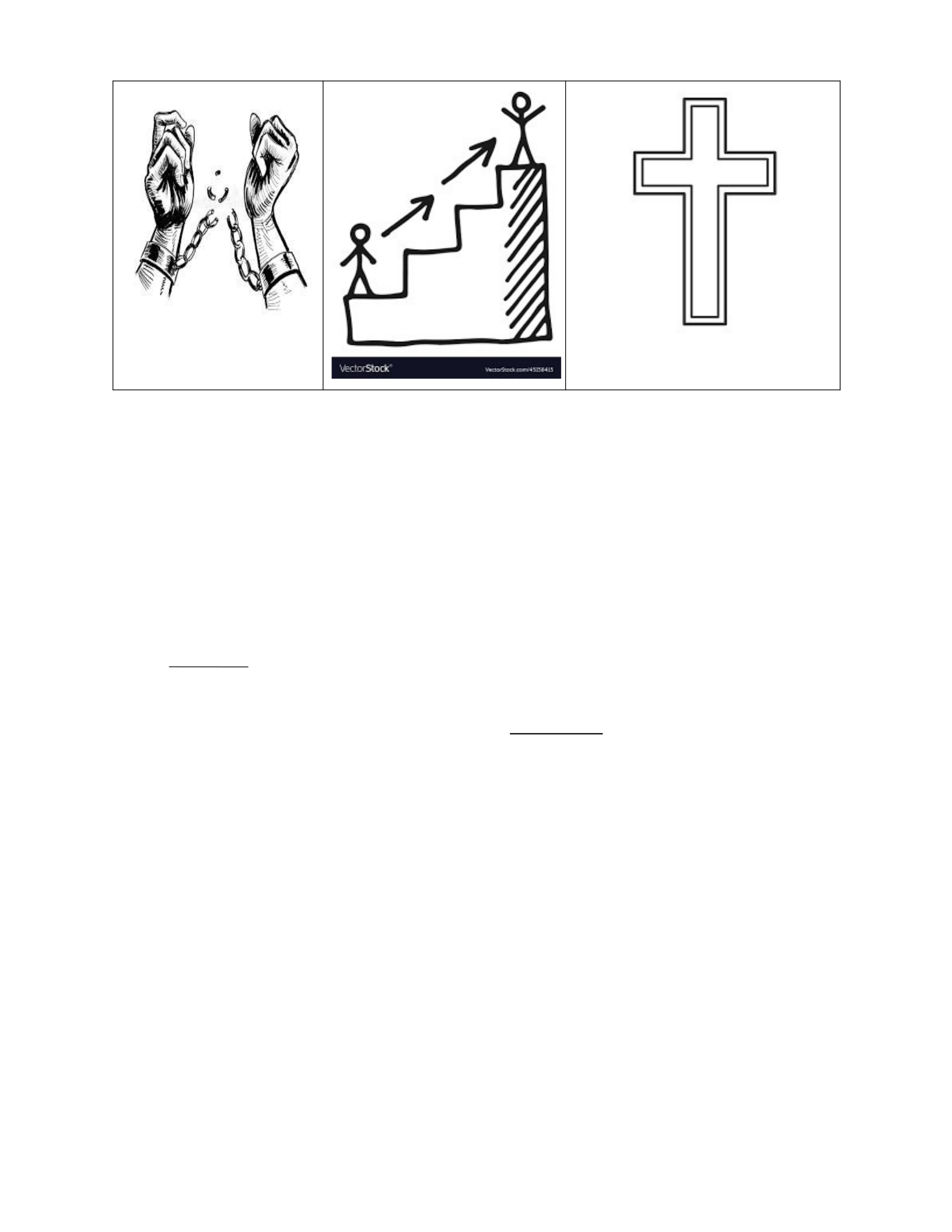
The Progress of Sanctification in Steps
S 1 (P ) S 2 (Pre ) S 3 (Futur )
Salvation from sins
Penalty
(Positional)
Salvation from sins
Power
(Progressive)
Salvation from sins
Presence
(Permanent)
21
God’s Call to Sanctification
Scripture demands that all believers reflect God’s holy character. God’s ultimate purpose in your
life is to make you holy so that you can live in his presence (1 Peter 1:15-16). Unfortunately,
many modern professing Christians believe that it is God’s job to make them happy rather than
holy. This is why false doctrines such as the prosperity Gospel have become popular. Many want
a Guinee Jesus rather than the real deal. Verses on Sanctification
1 Corinthians 6:11
“And such were some of you. But you were washed, you were sanctified, you were
in the name of the Lord Jesus Christ and by the Spirit of our God”.
2 Corinthians 5:17
“Therefore, if anyone is in Christ, he is a new . The old has passed away;
behold, the new has come”.
1 Thessalonians 5:23
“Now may the God of peace himself sanctify you completely and may your whole spirit
and soul and body be kept blameless and the coming of our Lord Jesus Christ”.
Response
It is important for new believers to remember that sanctification is a gradual process that will
take place for the remainder of their lives. When I became a new believer at the age of 10 I
assumed that all my actions had to be perfect. This caused a great deal of anxiety for years, and
it wasn’t until I was 19 when I realized that only God had the power to change my character, and
that me being conformed to the image of Christ was a gradual progress. Discussion Questions
1. In your own words, what does sanctification mean? Reread 2 Corinthians 5:17 along with
verses 18-21.

22
2. What are the 3 steps of sanctification?
3. What is the difference between sanctification and justification? How can we know?
4. When looking at your own process of sanctification, what are some stumbling blocks
that you feel you need to overcome? Be honest, there is no judgment.

23
Lesson 2 Worksheet

24
W 3: Gro in Chris
Lesson 1: The Spiritual Disciplines
What are Spiritual Disciplines and
why are they Important?
The goal for all believers is to eventually become like God. As stated in the last unit, this process
is known as sanctification. Along with sanctification and justification there are multiple other
components that contribute to the building of a Christian’s character. These are known as
spiritual disciplines. According to Donald Whitney, spiritual disciplines are scriptural practices
that promote growth among believers2. They are broken up into two categories which are
personal and interpersonal disciplines. The interpersonal disciplines are those which aid in your
spiritual growth and personal relationship with God. These include quiet time, fasting, prayer
and meditation. Personal disciplines are those which aid you in personal decision making. These
could include stewardship of resources, journaling, and rest. In this lesson we will primarily
focus on the disciplines such as quiet and solitude, prayer, worship, journaling, and stewardship.
Romans 12:1-2 reads, “I appeal to you therefore, brothers, by the mercies of God, to present
your bodies as a living sacrifice, holy and acceptable to God, which is your spiritual worship. Do
not be conformed to this world, but be transformed by the renewal of your mind, that by
testing you may discern what is the will of God, what is good and acceptable and perfect”. The
Spiritual Disciplines
Prayer
Prayer is undoubtably a necessary part of life. Many throughout scripture prayed to God for
guidance and help in difficult situations. One instance of this was in 2 Kings 19:19 when
Hezekiah prayed to God to save his people from the siege of King Sennacherib. Another was in
Luke 22:42 when Jesus prays to God the Father to ask for mercy to fulfill his will to the cross. In
scripture many understood the basics of prayer and its impact. Basics of Prayer
Prayer is simply talking to God
The essence of prayer is simply talking to God. Just as you would communicate with a close
friend or family member, this is the primary way believers communicate to God. This is an act to
which a believer has decided to fully submit themselves for a short period of time and
2 Donald S. Whitney, Spiritual Disciplines for the Christian Life (Colorado Springs, CO: Navpress, 2014)pg. 5.

25
communicate openly to God. It could be a simple call of thanks and worship, to a petition for
guidance or help.
You can pray about anything at any time in any place.
1 John 5:14 (Anything)
“This is the confidence which we have before Him, if we ask anything according to His
will, He hears us”.
o Note: God is not a Genie, while he can bless you with many great things, we must
remember that God’s will is paramount to human happiness.
Psalm 55:17 (Anytime)
“Evening, morning and noon I cry out in distress, and He hears my voice”.
1 Timothy 2:8 (Anywhere)
“I desire then that in every place the men should pray, lifting holy hands without anger
or quarreling”.
God does hear our Prayers.
Psalm 65:2
“O You hear prayer, to you all men come.”
Psalm 145:18-19
“The Lord is near to all who call upon him. To all who call upon him in truth. He fulfills
the desire of those who fear Him; He will also hear their cry and will save them”.
Prayer is expected.
The Lord Jesus Christ expects us to pray in all situations. As a believer, it would be against our
best interest to not engage in prayer due to it being the primary source of communion between
God and believers. For Jesus prayer wasn’t just a daily routine, but an outward expression of his
relationship with God the Father. Throughout His ministry, Jesus constantly made time for
prayer even to the point that he teaches how to pray in Matthew 6:9-11.
Matthew 6:9-11
“Pray then like this: Our Father hallowed be your name. Your kingdom come, your will
be done on earth as it is in heaven. Give us this day our daily bread”.
o In prayer Jesus was primarily concerned about the will of God, this is one
important purpose for prayer.
1 Thessalonians 5:16-18

26
“Rejoice always, pray , give thanks in all circumstances; for this is the
will of God in Christ Jesus for you.
Worship
When defining worship, it is important to understand that there are different definitions for it.
Many assume that worship is all about music. This is understandable because many churches
throughout the years have labeled it as a vocal expression of son. Another assumption about
worship is that worship is a public demonstration of admiration to God. While this is somewhat
the case it is more than that. Worship requires that all believers are completely sold out to their
master3. In Matthew 16:24 Jesus tells us that of anyone is willing to follow him that they must
“deny himself and take up his cross”. True biblical worship is following God unto death.
Someone can easily express feeling through son, but not be a true follower of Christ. This is not
me saying that song couldn’t be an expression of worship. Even David worshiped God in song (2
Samuel 22). If one seeks to truly worship God, then they will do so by following his standard of
living in all aspects. Actions do speak louder than words.
1 Chronicles 16:34
“Give thanks to the Lord for he is good; his love endures forever”.
Romans 12:2
“ And do not be conformed to this world, but be transformed by the renewing of
your mind, that you may prove what us that good and acceptable and perfect will of God”. o
As mentioned before true worship is obedience to God.
1 Samuel 15:22
“Does the LORD delight In burnt offerings and sacrifices as much as obeying the LORD?
To obey is better than sacrifice, and to heed is better than the fat of rams”.
Quiet and Solitude
The noisy and distracting world we currently live in can sometimes make it difficult for believers
to discern the voice of God, this is why quiet, and solitude is important. Periods of quiet and
solitude, known as quiet time, is a time set aside to connect with God through his word, prayer,
and worship. During the ministry of Jesus he regularly set aside time for this disciple. Before
choosing his 12 disciples he spends the night alone in the desert (Luke 6:12). Another instance
3 David A Wheeler and Vernon M Whaley, The Great Commission to Worship : Biblical Principles for WorshipBased
Evangelism (Nashville, Tenn.: B & H Academic, 2011) pg. 23.

27
of Jesus having quiet time was in the Garden of Gethsemane when he prayed to God the Father
for relief prior to his execution on the cross (Matthew 26:36-46).
The Method for Carrying out Quiet time.
Find the Proper Period
It is important to find the right time to carry it out. It is suggested that your quiet time
should be scheduled between 30 minutes to an hour a day. If you cannot begin with 30
minutes then begin with 10, because some time is better than not time.
Regardless of the length you should give the
Lord your best. The goal is not to find time, but to make it your priority. It is best to find a time
early in the day, typically after your wake up. This way you will have something positive to
begin your day with.
Prepare in advance.
Quiet time is a period of fellowship with God. Since this is the case, it is important to
properly prepare for this moment. One way to do this is being physically alert. For
instance, if your quiet time is in the morning then make sure that get plenty of
rest prior to your meeting with God. Second, be mentally aware. If your emotional state is
out of line, then it will be very difficult to stay focused during quiet time. If something is on
your mind, then write it down and pray to God about it. In some instances, the Holy Spirit can
use that mental issues to guide your bible study.
Find a Proper Place.
It is important that you find a quiet place to conduct quiet time. In Matthew 6:6 Jesus
tells us to find a quiet place to where you a God can connect. Find a place of isolation to
where you can shut the door and focus solely on God. Less distractions equals more
clarity.
Find a proper procedure.
Organization is key when conducting a proper quiet time. Certain procedures can help
this time be easier and more productive. First, get still and quiet. Find a
comfortable and quiet place within reach
where
you can remain for 30 minutes or more. Calm down and relax and begin to ease into
the presence of God. Take a deep breath and focus your thoughts on God. Playing
worship music can also help set the atmosphere. Second, get into the word of God. While
prayer is important, it is better for you to hear from God at the start rather than him

28
hearing from you. Devotional books are also a great way to dive into scripture. Third,
meditate and focus on what God is trying to say to you. This can range from a command to
obey to a sin being exposed, a lesson to learn or a promise to claim. Fourth, record what
God has revealed to you. Journaling is important because it can provide important
information that you may want to reference later. This information can assist in times of
spiritual warfare or be a reference of things to praise God for. Lastly, end the session with
prayer. Thank God for all he has done and make petition on behalf of yourself or someone else.
Also use prayer to confess sins and acknowledge what you learned from the session.
Stewardship
As believers God has appointed us to stewardship. Stewardship is the care and management of
something that belongs to another. Hebrews 2:10 tells us that “everything belongs to God, and
all things were created by his power”. As humans we tend to think all we possess is ours. This
can range from time, people, talent, and resources. Regardless of what it is we must remember
that all things we posses were given to us by God, who is the rightful owner of it. Because of this
we are responsible for properly stewarding what is his. One analogy I like to use is one of the
tenant and landlord. When someone signs a lease and rents a property, they are responsible for
keeping it in a livable condition. While it is the landlord’s job to fix what is broken the tenant still
must keep the property clean and even do some yardwork such as mowing the lawn. In our case
God is the “landlord” of all gifts and we are the “tenants”. He allows us to use the gifts, but we
must treat them with proper care, otherwise they will be destroyed.
Things God has us Steward Properly
Time
Many say that time is the greatest currency because once you lose it there is no getting it back.
The time we have on this earth is limited and should be used wisely. One way for believers to
use time wisely is to prepare for eternity. The life we live is uncertain and could end at any
moment. Proverbs 27:1 reads “don’t brag about tomorrow! Each day brings its own surprise”.
While today may seem peaceful and certain tomorrow can bring chaos and trouble. This is why
we must live everyday according to the will of God so that we can stand before him on the last
day with confidence. Also use your time to do something productive instead of wasting it on
Netflix and other meaningless things. While there is a time for relaxation and rest there is also
a time for work. We will also be held accountable for wasting the time God has given us.
Romans 14:12

29
“And so, each of us must be give an account to God for what we do”.
Money and Resources
Another gift that God has blessed us with is the gift of money and tangible resources. Scripture
requires that we properly manage our money and resources so that the needs of ourselves and
others are properly met. The bible denounces those who refuse call themselves Christians but
refuse to handle responsibilities regarding their finances. 1 Timothy 5:8 states that a man who
refuses to take care his family is “worse than an unbeliever”. The issue that many face today is
that they assume all financial resources belong to them and that they can use it however they
please. Truth be told, I struggle with this mindset myself at times. It is important to remember
that all resources belong to God and that he requires them to be used in a proper manner.
Haggai 2:8
“All silver and gold belong to me”.
Deuteronomy 10:14
“Everything belongs to the Lord your God. The heavens, even the highest heavens,
belong to him. The earth and everything on it belong to him”.
1 Timothy 5:8
“But if anyone does not provide for his own, and especially for those in his household,
he has denied the faith and is worse than an unbeliever”.
Discussion Questions:
1. Which spiritual discipline is most important to you and why?
2. Read Matthew 6:9-13, how did Jesus’ structure prayer?
3. Why is it important to be a good steward of our gifts?
4. Challenge: think of all the spiritual disciples listed above and then focus on the one you
struggle with the most? Write 3 action steps that can be used to help you improve in this
area.

30
Lesson 1 Worksheet

31
Lesson 2: Serving in the Church
Serving in the Church is Important
On a weekly basis the Gospel is enacted throughout many local churches across the world. The
church itself is the body of believers who are united and redeemed by the love of Christ. Serving
in the local church can provide a way for believers to discover how God can use them in various
circumstances and environments. When serving in the church you can discover your strengths
and weakness through performing different assigned tasks. This is important especially for new
believers because the knowledge gained will aid them not only in ministry but also in the
workplace and in their personal lives. When serving in the church God is growing us while he
uses us to serve the needs of others. In Matthew 20:28 Jesus tells us that he came to serve
rather than be served. Being obedient to follow Christ in this way allows us to get to know him
on a deeper level because we experience his ministry model firsthand.
Why Believers Should serve in the church.
Serving is discipleship in action.
In Matthew 28:19 Jesus gives the command of the great commission, which mandates that all
believers go among the nations and make disciples. When serving in the local church you will
have opportunities to influence people from all walks of life. Once they see Jesus in you then
it will encourage them to follow him also. Serving is part of our Christian Identity
During his ministry Jesus served those closest to him, mainly those in his community. As
believers we have been given a gift for the purpose of building God’s church through
community. When serving in the local church you will also have the same opportunity. The
strength in most believers is through service rather than status. It is our job as believers to serve
others within the flock, especially those who are new or unbelievers (Romans 15:1). God gave
us gifts to bless other people.
Serving exposes character flaws
As believers we all fall short in some area of our lives. When serving in the church there most
certainly will be times when you are inconvenienced, and your patience is tested. For instance,
you may run into someone who has a bad attitude or be asked to stay later and help after a 5-
hour Sunday. Regardless of inconvenience we must remember that God is using this time of
service to strengthen our character and mold it like his. 2 Peter 3:9 tells us that “God is patient
with you,

32
not wanting you to perish, but everyone to come to repentance”. The same grace that God
shows us in difficult times we are expected to show others in all situations.
Ways you can serve in the local church.
1. In a ministry position (if called).
2. On the worship team
3. On the production team
4. Missional outreach
5. Christian educational opportunities (ex: Sunday school, VBS, small groups).
6. Church usher
7. Greeter
8. Deacon or elder
Response
As a believer it is of upmost importance that you get involved in the local church. Serving is a
way for God to show you your strengths and weaknesses and could also be used as a time of
training for future roles in the church or a secular setting.
Discussion Questions
1. List some reasons why it is important to serve in the local church.
2. Read Matthew 20:28, why is it important to serve as Jesus did?
3. What is the great commission in Matthew 28:19, and how is it related to ministry in the
local church, explain in your own words.

33
Lesson 2 Worksheet

34
W 4: Shar F
Lesson 1: Techniques
The importance of evangelism
As believers we are called to share our faith with non-believers. Mandates such as the great
commission in Matthew 28 command all followers of Christ to go out in the world and preach
the Gospel along with making disciples. To fulfill the mission of evangelism it must become a
priority. Evangelism is not just about winning converts, but sharing the good news in a way that
transforms lives. It helps people experience the forgiveness, healing and joy which comes from a
relationship with the Lord Jesus Christ. As believers we want to help others grow in their faith
and become more like Christ. Sharing faith can be done in many ways. In this lesson I will briefly
demonstrate a few methods of evangelism such as the Romans Road to salvation, the three
circles method, and the bride method.
The Romans Road Method
We are all sinners by nature and by choice. Romans
3:23
“for all have sinned, and come short of the glory of God”.
We receive eternal life as a free gift!
Romans 6:23
“For the wadges of sin is death; but the gift of God is eternal life through Christ Jesus”
God demonstrated His love for us while we were sinners. Romans
5:8
“But God shows his love for us in that while we were still sinners, Christ died for us”.
What must we do to be saved?
Romans 10:9-10
“Because if you confess with your mouth that Jesus is Lord and believe in your heart that God
raised him from the dead, you will be saved. For with the heart one believes and is justified,
and with the mouth one confesses and is saved”.

35
The Sinner’s Prayer for Forgiveness
“Dear God, I know I am a sinner. I know my sin deserves to be punished. I believe Christ is the
son of God, who died for me and rose from the grave. I want to turn way from my sin and
trust Jesus Christ alone as my savior. Thank You for the forgiveness and everlasting life I can
now have full faith in Jesus. In Jesus name, Amen”.
The Three Circles Method
Method Explained
First Circle
- God created the world and mankind in his own image, and it was good. The world was in
a perfect state. (Gen 1:26-31).
- Eventually Adam and Eve were deceived by the serpent in the garden, and they ate of
the forbidden fruit introducing sin into the world (Gen 3:7-24).
Second Circle
- Because of sin the world is in a broken state, man tries to fix it but fails. Without God
mankind does not know how to live right (Romans 1:21-25, 3:23, 6:23, Matt 7:21-23).
Jesus Comes and Restores (Third Circle)
- Jesus brings God’s kingdom to earth through his ministry and restores mankind to God
by dying on the cross for the remission of sins (John 1:14, 3:16, Romans 5:6-8).
36
Turn, Trust and Repent from Sin
- Mankind must quit their own way of living and trust in Christ for salvation.
o(Matt 3:1-2, 4:17, Mark 1:14-18, 1 John 1:9).
Back to the first circle
- By the power of the Holy Spirit, we can be restored to God’s good and original design.
o(Romans 12:1-2, Ephesians 2:10, Colossians 3:1-17).
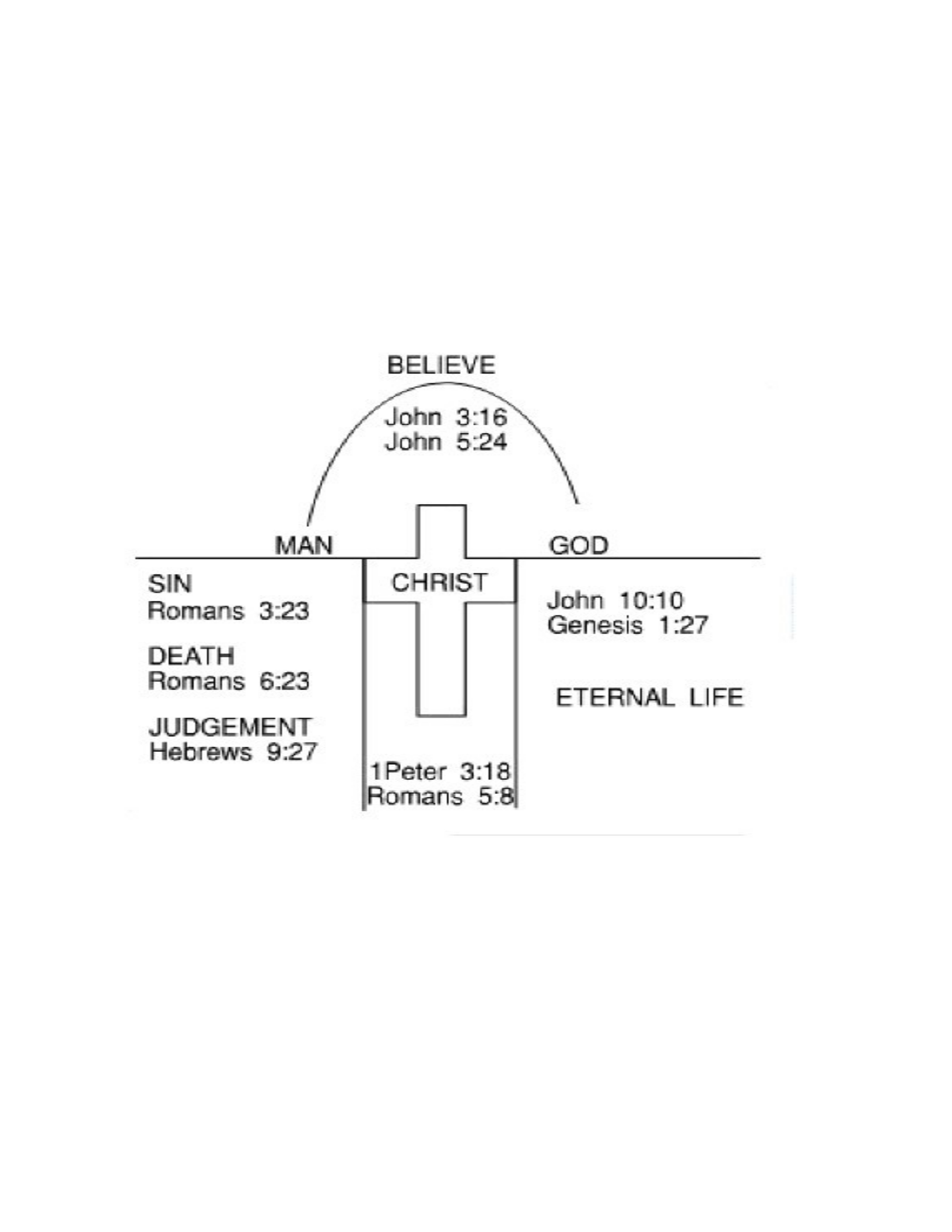
The Bridge Method
Method Explained
The Bridge Step 1: God
God created us with purpose, to be in relationship with Him and to enjoy all the fullness of life
with Him.
o John 3:16
The Bridge Step 2: Our Problem
We have a problem we can’t fix on our own.
- Humanities Problem – all have sinned (Romans 3:23)

37
- What is sin – to miss the mark or fall short of God’s standard. All men have guilty of this.
- The result of sin- eternal separation from God in Hell (Romans 6:23).
The Bridge Step 3: God’s Solution
We cannot build a bridge to God, but Christ is God’s bridge to us.
- Jesus died to pay for the penalty of sin.
oRomans 5:8
- How is this the Good News?
oBecause Jesus conquered both death and sin and rose from the dead all men
now have access back to God.
1 Peter 3:18
The Bridge Step 4: Our Response
- It is our job to respond to God’s offer for salvation.
- How do you become a child of God?
oBy believing and receiving Jessus Christ as our Lord and Savior and trusting in his
sacrifice for the payment of sin (John 1:12).
-We must walk across the bridge.
Discussion Questions
1. What is your favorite method of evangelism?
2. Demonstrate your chosen method of evangelism in the text box below.

3
8

39
Lesson 1 Worksheet

40
Lesson 2: Apologetics
What is Apologetics and
why it’s Necessary.
Apologetics refers to the intellectual argumentative discourse in defense of the Christian faith.
When Christians engage in apologetics, they are simply trying to prove to skeptics why the faith
is true. In evangelism there will be a time when non-believers will question your beliefs. Some
will even use bad past experiences such as church hurt to discount your witness. When
objections to the faith come it is important that you know how to combat them.
Ways to combat objections.
Ask a clarifying question.
Many Christians believe that when an objection is presented that they have a short time to
present an answer. When someone makes an objection the best course of action is not to
present an outright answer but to ask a clarifying question. For instance, if someone presents
you with an objection like “I don’t have a good reason to believe in God”, then you can follow up
with a response like “thanks for being open, but may I ask what do you mean by God”? Not only
are you being respectful by acknowledging the other person’s question, but you also open the
door to a deeper gospel conversation. Colossians 4:5-6 tells us to respond to unbelievers with
gentleness during Gospel conversations.
Colossians 4:5-6
“Be wise in the way you act toward outsiders; make the most of every opportunity. Let
your conversation be always full of grace, seasoned with salt, so that you may know how
to answer everyone”
Acknowledge the objection and advance the conversation.
If the person you are witnessing to continues to deny your witness by saying things like “I still
don’t thing God is real”, then acknowledge their objection by stating something like “I
understand your thoughts, but can I briefly share what I believe about God”? In this
conversation you aren’t trying to prove the other person wrong but you’re also not avoiding
objection. Since you asked for permission then the other person can either continue the
conversation or end it. Matthew 10:14 tells us that anyone who refuses to listen “knock the dust
off of our feet” and move on the next.
Matthew 10:14

41
“And if anyone will not receive you or listen to your words, shake off the dust from your
feet when you leave that house or town”.
Discussion Questions
1. Why do you think that apologetics is necessary in evangelism?
2. Do you think that acknowledging objections is throwing pearls to swine as mentioned in
Matthew 7:6? Read Mathew 7:6 and then respond.
3. Have you ever encountered an objection to your faith? If so, how did you respond?
Lesson 2 Worksheet

42
Conclusion
The word disciple means “student” or “learner.” In Jesus’ day Jewish teachers called
Rabbis had students they would take under their wing, and these were called their
disciples. Jesus Himself was called a Rabbi on several occasions (Mark 9:5; John 1:38).
The goal of a disciple was to learn the teachings of their Rabbi so they could be like him
(Luke 6:40). In this curriculum we covered various topics such as salvation, sin,
justification, components of the evangelism efforts and other topics. While this
curriculum does not cover all topics the goal is for whoever will participate in these
lessons to have a deeper understanding of the Christian life and to be able to use the
knowledge gained in discipling to others.

43
Bibliography
“Justified by Faith | Reformed Bible Studies & Devotionals at Ligonier.org | Reformed Bible
Studies & Devotionals at Ligonier.org.” Ligonier Ministries, 2001.
https://www.ligonier.org/learn/devotionals/justified-by-faith.
Wheeler, David A, and Vernon M Whaley. The Great Commission to Worship : Biblical
Principles for Worship-Based Evangelism. Nashville, Tenn.: B & H Academic, 2011.
Whitney, Donald S. Spiritual Disciplines for the Christian Life. Colorado Springs, CO:
Navpress, 2014.

