


Assignment Title: How to Develop an Effective Church Communications Plan
Course: CHMN 699 - Internship
Student: Kristine Sage
Date: January 29, 2022
Professor: Dr. Mary Smith
Liberty University
Why develop a church communications plan?
So why should you bother developing a church communications plan? In short, it's because
the good news of the gospel is at stake. We all know the gospel is ‘good news.’ But news like
the gospel, as good as it is, cannot be called ‘news’ in the first place without also having hands,
feet, and mouths planning to communicate it (c.f. Romans 10:14-17). Here comes the local
church: the planner, articulator, and communicator of the message that Jesus Christ laid down
his life for those who couldn’t earn God’s love (c.f. Romans 5:8).
Local churches communicate, inside and outside of themselves, in ways that are creative
and distinct from one another. But regardless of any creative differences, each church needs to
consider how to develop an effective communications plan. If it doesn’t, the gospel--the news
to be communicated--may itself be at stake.
What is church communications?
Church communications are the ways in which a local church expresses and makes known
its mission and message.
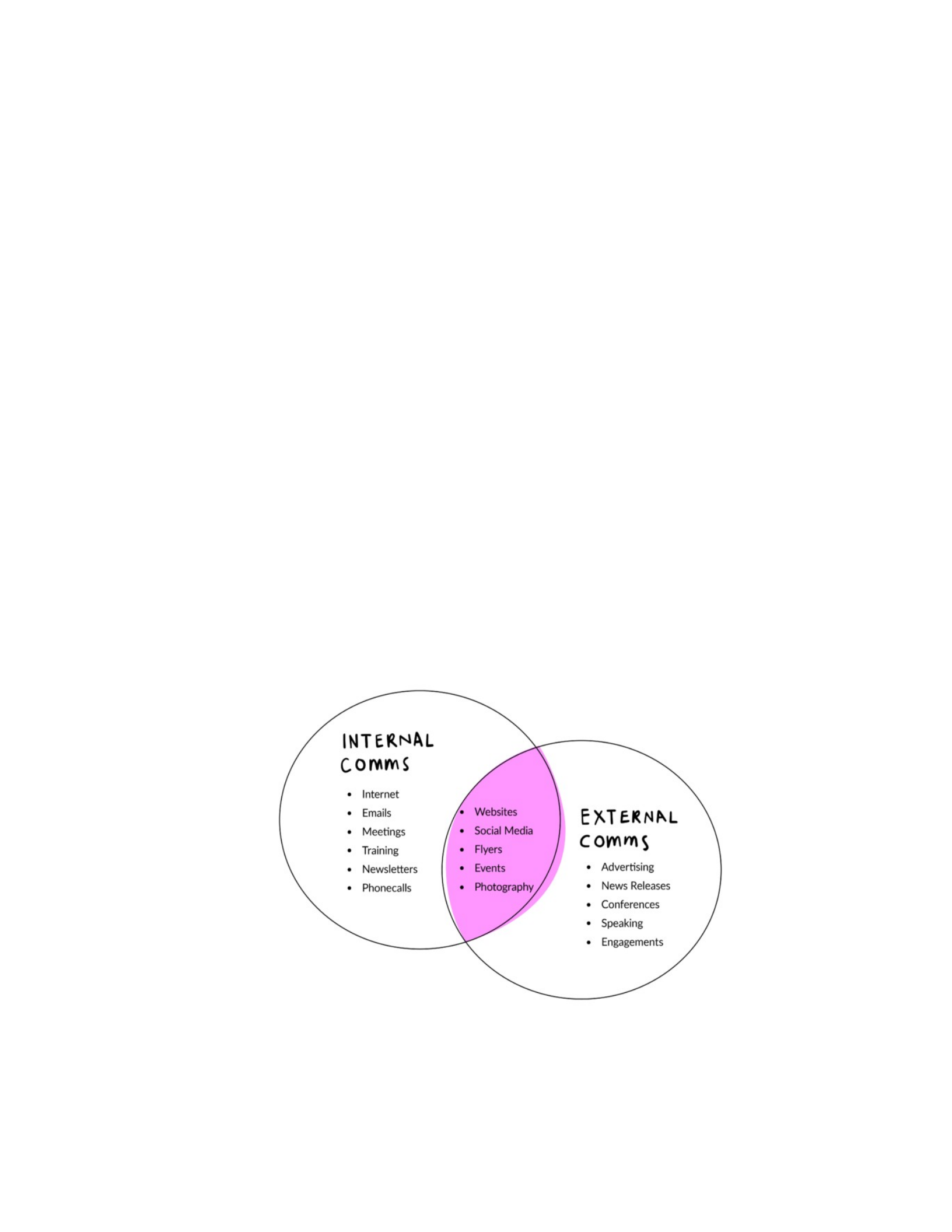
Internal and External Communications
Church communications can both internal communications and external communications.
There are two forms of communications: internal and external.

Internal church communications are typically within and on behalf of the local church, who
makes its messaging known to its own people, like:
church staff,
church leaders,
volunteers,
small groups
and church members.
Internal people embrace and advance the mission and the message.
But church communications is also understood by way of external communications, when
the church makes known the right message, beyond itself. This could be by way of evangelism
or outreach, to the de-churched, unchurched, and so on, using:
social media,
podcasts,
text messages,
live streaming,
the church's website, and many other options.
For the local church, people are the mission (c.f. Matt 28:19; 1 Chron 16:24; Matt 9:35-36).
So, having people inside the church reaching people outside of it is also an 'ends' of the
communications plan. People reaching people. This is significant because we can think of
communications plans simply as a 'means.' But they aren't. Here's a link explaining the idea of
fulfilling the mission of God through the multiplication of people via church plants. Good
communications help make a 'means' also an 'end'.
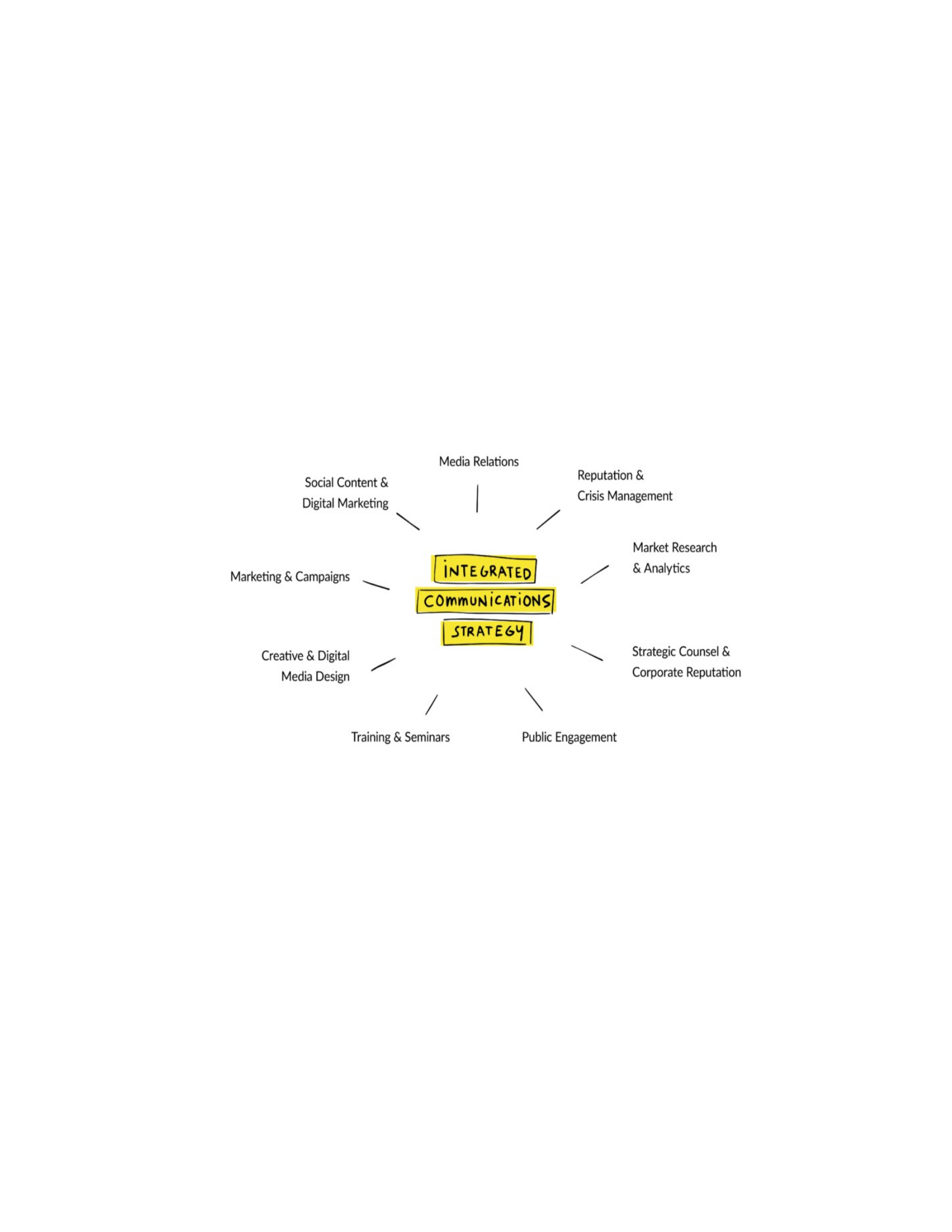
Integrated Communications
The internal and external forms of church communications require a little further thought
and explanation. They can be discussed separately only in theory because in practice they are
highly dependent upon each other.
For example, let's say a local church's goal is to increase outreach and evangelism. This is a
communication channel we probably think of as external.
Yet, the best way to ramp up outreach could actually be by addressing an area not outside,
but inside--like improving internal church software to better communicate the vision and how
this goal is going to be achieved and addressed through ministry. My local church has just
upgraded to the new Planning Center software. This suite of products has helped us keep-on-
top-of everything from what's going on in a ministry team all the way to first-time follow-ups
with guests.
It has also been super helpful for scheduling and registering people in church events, like
Christmas and Easter, which are especially complicated to plan, communicate, and manage
during COVID!
C
hurches need to decide how their communications are integrated, as typified above.
Each church needs to wrestle with the degree to which its internal and externals
communications plans are linked. But it's hard to think of a good external communications plan
without there also being a robust and cohesive team working together behind-the-scenes, with
the right tools. So, church communications require integration and a blended value approach.
This also relates to the churches overall goals, objectives, and strategy.
How to develop a church communications strategy
The best church communication strategy uses multiple mediums to reach its intended
audience with an integrated, foundational idea or message.

Here are 5 steps you can ask in order to develop an integrated communications strategy:
Step 1: Who is the target audience?
A blended church communications strategy first identifies who is being communicated
with. This makes sense when talking about the mission and message of the gospel because, in
the end, the intended audience of the gospel is everyone (c.f. Rev 7:9). Jesus Christ came into
the world so that everyone would come to know and experience his love (c.f. Ps 67:2; John
3:16; and 1 Tim 2:4). As we discussed above, the local church owns this communication.
Step 2: Why this target audience?
This is your opportunity to refine your audience. In the case of the gospel, "everyone" is far
too large a demographic for any single, local church to bite-off-and-chew on its own. So, with
this step, you can ask why or why not this person or group of persons. "Everyone" has different
habits, preferences, and areas of interest, meaning that reaching them with one medium or one
strategy in isolation of others is literally impossible. So, understanding that local churches can
rely upon one another, and we can see the capital "C," universal Church working across the
globe. Also, understanding that there are different mediums through which different people
can be reached helps you know why one audience can be targeted and another cannot.
After asking the question of why your audience can become more focused and narrow.
Step 3: What to communicate to them?
This is where you clarify your medium and message. The gospel message itself isn't brand
spanking new. But it can be thought of as old news that brings new life in new ways.
So, answering what to communicate is more a matter of what emphasis of the gospel is on
display. You can figure that out be addressing these questions:
What truth or truths of the gospel are being articulated or supported by this
communication?
How is Jesus revealed by what I am saying or how I am treating people with what I say?
Where is there room for new life to be brought into this medium?
Step 4: When to communicate with the target audience?
The "when" we see in the Bible can be called an "occasion." It can be reactive or proactive.
But the best time to communicate is proactive.

If the Apostle Paul's writings teach us anything, it is that local churches in different areas of
the world work together and, at the same time, focus on specific messaging to specific people
on specific occasions (c.f. Gal 1:6-9). We see biblical authors writing towards a "future" of things
that will happen on planned or foreseen occasions. Some examples of this include the Prophetic
literature in the Old Testament, but also how believers in a community should behave in the
New Testament (e.g. see Gal 5-6 for proactive communications).
Step 5: How to communicate with the audience?
This can be called a 'Big Idea.' In his book, The Social Church: A Theology of Digital
Communication, Justin Wise suggests that each church needs to develop a "Big Idea" that is
"foundational," from whom every other act of communication flows from the base of a
pyramid. The "Big Idea" that informs strategic communications is developed, for Wise, by
receiving life and being breathed on by God the Father. This is no trivial point. Unless the
reason why we are communicating is important enough to communicate and empowered by
the one who 'communicated' life into being, then it doesn't have much hope of success. But
Wise also gets practical too. He suggests that a "Big Idea" can be formed by approaching the
question: "What objectives are we trying to accomplish as a community?" This is integrated not
only by things "to do" but by an identity "to be."

