




This week’s assignment examines the Human dignity-centered framework and will
outline its adoption by business leaders in building an ethos of humanistic
management and the use of a conceptual framework and discusses the ethical
and legal foundations that are found within biblical scripture and its
appropriateness with the human dignity center framework.
Introduction
Business ethics is not considered to be a new phenomenon and many
organizations have experienced ethical violations over time as some struggle
with unethical decision-making and business practices. People are naturally
outraged by wickedness and are motivated by goodness, beauty, and
philosophy. Natural law is considered to be a higher kind of law and it is quite
relevant when dealing with the ethical issues faced by business leaders such as
moral and corporate behavior and consists of the understanding of human
behavior and conduct that the creator built into nature that is distinguishable
through natural reason (Engelland 2017, p. 31). Human dignity is considered
to be a device used to convey the idea that businesses are made up of dynamic
social networks that aim for serving human needs that inspire excellence and
lay a foundation for long-term business accomplishments with principles and
virtues.
In recent years, human dignity has become an appropriate pressing topic due
to the devastating effects of World War 11 and in particular as a result of the
exposure of the crimes Nazis committed against civilians in the Holocaust.
Natural law stems from natural sources that every human knows intuitively
which states that evil must be avoided and good must be done and pursued

(Aquinas 1981a, I–II, q. 94, a. 2), and most of the time it is considered to be a
commonsense manual for life’s conduct. Ethical reasoning needs a foundation
for good decision-making for conducting good ethical reasoning. Natural law
forms a basis for Catholic social teachings that provides a foundation that
considers a faith base perspective on ethics with traces back to Aristotle.
Natural law began in the ancient philosophies of Plato, Stoics, and Aristotle
(George and Tollefsen 2013), and it further developed principles by examining
how people without faith can live moral lives when they act logically in
accordance with natural loss by Aquinas. Natural law provides feasible
principles of choice and the fulfillment of persons which includes economics.
The fulfillment of members’ eventual needs is through businesses for self-
actualization.
The human dignity framework provides a guide for corporate leaders to seek
in becoming more ethical and impact humanistic management practices, and it
allows corporate leaders to reference it when they seek to understand the
impact of principles and virtues on leadership relating to strategic direction,
ethical renewal, and organizational structure. The fundamental virtues of
human dignity frameworks are fairness which represents giving each other
what is due to them, wisdom, and courage which guide business leaders in
focusing on the long-term view, self-control which involves the management
of passions, and determination.
The human dignity framework incorporates magnanimity and humility
leadership virtues, magnanimity represents the virtue of that aim for achieving
greatness with a person’s natural talents and humility is responsible for

helping business leaders recognize basic human rights. The human dignity
framework has power and relationships with the marketplace that are more
effective and useful for empirical analysis.
As stated by Mea and Wall 2016, p.8, quoted as “There is a natural law whose
common principles—universal, indemonstrable, self-evident, and immutable
—command always and without exception” (p. 98) and it is comprehensive,
“analytical and entrenched in the human heart”. Further, George and Tollefsent
(2013, p.3 stated that the first principles of practical reason are underived and
self-evident” For example in earlier societies killing was considered evil,
Schockenhoff, and McNeil (2003) noted that insights of natural law are not
simply unrelated to anthropological constructions of meaning that offer us an
image of successful human existence” (pp. 290-291).
Natural law is prominently placed in Catholic Social Doctrine and Teaching
ethics and the human dignity-centered framework through visual
representation. There are other different approaches to ethics which included
relativism, utilitarianism, egotism, and deontology which assert that they all
lack natural law’s well-integrated appeal. There is an affirmation that natural
law and catholic social doctrine and teachings are relevant to modern ethics
business and the social economy in particular, although religious premises of
CSD/T principles and virtues can provide a set of ethical concepts which is
relevant to contribute to human flourishing in business is not accepted by
business leaders. Human dignity represents the idea and is a unifying
rhetorical device that every human being has a transcendent value that resides
within his/her essence representing an indispensable aspect that makes them a
person through business operations that should serve human needs in society.

Rossouw (1994) more than two decades ago noted that some Christian ethics
establishments appeal to postmodern business culture, and with the current
failure of legalistic norms, there is an interest in considering the contribution
that can be realized from religious sources. The bringing together of faith and
reason, there is potential for a more nuanced business character. Christians
made significant contributions to business ethics over the centuries as argued
by De George (2006). The was a considerable focus on the development of
fairness in contracts and transactions back in the early thirteenth up to the
seventeenth century Alves and Moreira 2013 by Christian thinkers. Universal
human rights were safeguarded by Theologian Bartolome de las Casas, and
international law was pioneered by Francisco de Vitoria (Scott in 1934) back
in the sixteenth century. Labor rights were explicitly defended by the church in
the nineteenth century, in which the Catholic social doctrine and teaching
offered ideas for ethical management practices and decision-making, social
justice which included issues of wealth and poverty, economics, the role of the
state, and social organization (Curran 2002) and responds to important
relationship matters related to people and institutions (Clarke et al. 2005) in
providing a coherent set of ethical principles to deal with the increased
complexity of the global and technologically driven business world.
The global reach of the Catholic Church is responsible for explaining why
morals are relevant in society today particularly as it relates to insights into
personal communication on natural law (Doak 2016) and the guiding of
ethical economic behavior by Leo’s encyclical Rerum Novarum (Leo XIII
1891), and the concept of human dignity and was referred to as the guiding
principle in the Catholic social doctrine (Lutz 1995, p. 173) examining the

behavior of Christians with a focus on greater integrity in economic activities
(Melé 2012).
Human dignity encompassed four core principles that human beings have
supernatural values that reside within his/her essence, it is a fundamental
aspect of what makes a human person. Humans have the right to treatment
which is reflective of a right that dwells in them as humans, however, this was
considered to be unhelpful disarray by Mattson and Clark (2011) and viewed
as a consequence, a value, an experience from a philosophical perspective (p.
303). Smith (1995) suggests that Human dignity may well be contrary to the
common good however, he avers that it is perfected by the common good (p.
1). Melé (2015) suggested that human dignity represents the idea that human
beings are worthy of respect, honor, and esteem which traces back to the Latin
dignitas (imposed an obligation of recognition), (Novak 1998). According to
John Paul 11’s formulation, humans are both ends in themselves, they are
responsible subjects with conscience and freedom, who are called to live
responsibly in society and history (p. 119).
While Stark (2009) observes a difference in the human dignity arguments, he
did not make any contribution regarding the same, however, Lutz (1995)
provided a secular explanation emphasizing the social economy. Susib et al.
(2016) outline that dignity will be developed to its fullness at the point where
human beings exercise free choice and reason through skillful and effective
actions in order words rationality underpins the foundation for acts of
solidarity which leads to the attainment of human flourishing and a common
goal (p.509). The argument that there are two dimensions of human dignity
was suggested by Bolton (2010), one is dignity “in” which focuses on work

autonomy, satisfaction, respect, and personal development while
meaningfulness of work itself and dignity “at” work encompasses the
wellbeing, voice, security, just reward and equal opportunity (p.19).
Gronbacher 1998, p.8 outlines that people are humans with a purpose, while
Wojtyla (1979) believes that each person must be accepted for his/her own
sake. The idea that human dignity is shaped by relationships with others
contained in the physical world with values was proposed by Mattson and
Clark (2011) p. 303. The contribution to this discussion recognized the many
themes from both contemporary and classical appreciations of human dignity
which outlined that economics must be interconnected with human life in
collaboration with nature, culture, and society and human existence together
with the fluidity and uncertainty of human knowledge was suggested by
Dierksmeier (2015) in his contribution in which he outlined that virtues and
values are not insignificant to economic action (p.32). Focusing on Tripartite
Model of Society Novak’s (1996) and Drucker’s (1994), noted that a business
must simultaneously focus on its basic mission while being aware of social
needs which are core to the firm existence for managers and leaders to
recognize and respect the human dignity of providing a common good.
Dierksmeier and Celano (2012) outlined that Aquinas virtue ethics focuses on
the advancement of the natural goods of humans, they noted that any unnatural
forms of wealth-seeking will upset the social order if it becomes a means to an
end rather than becoming an end to itself. In recent time contribution from
Pirson et al. (2-16) broaden the meaning of dignity relating to business ethics,
they outlined that human dignity is universal and constitutional, while this
concept gained the understanding of many psychologists, this understanding

failed as it ignored the social nature of humans with its focus on utilitarian
outcomes alone.
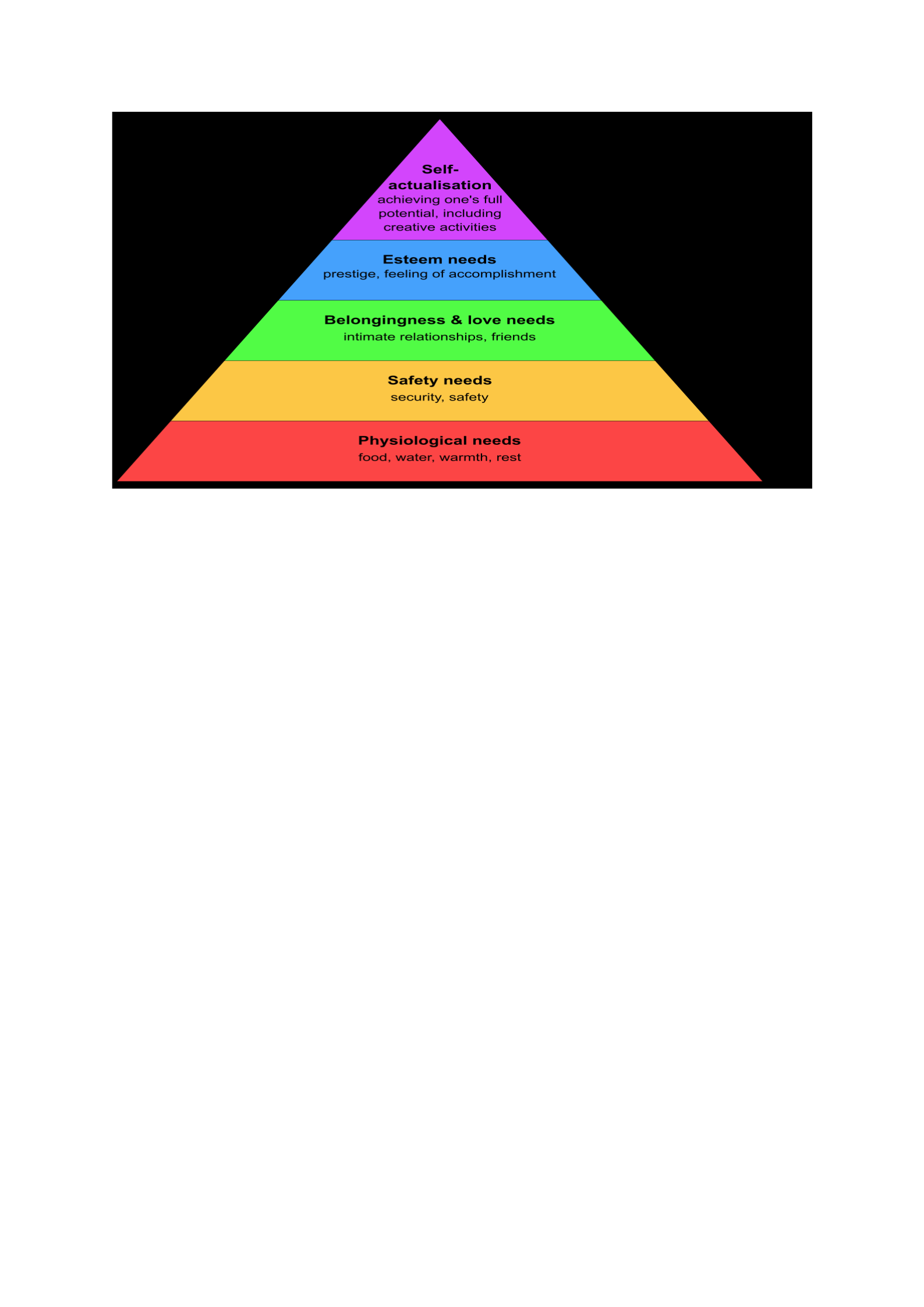
Exploring the connection between human dignity and motivational theory,
with a focus on Maslow, 1943 need-hierarchy which focuses on five levels of
human needs for self-actualization and belongings which must be satisfied in
order to feel fulfillment and how it can be effective in the workplace.
Maslow’s need hierarchy is a depiction of a pyramid representing an
individual’s need for fulfillment in each level in ascending order and is
applicable to many aspects of life inclusive of the workplace. For employees
who do not achieve the lowest level of needs, their decision-making can be
done on the basis of compensation, safety, and job security. This need
hierarchy is applicable to all aspects of life, and often time one can find areas
for improvement. While fulfilling these needs, there is a need for awareness of
the impact your need has on the overall success within certain roles, for
example, struggling with rejection as a person, or in a sales job may add to this
struggle and this may challenge your efforts in achieving your goals and
needs. In this need hierarchy, we see that the highest level of needs is represented
and tied to the human dignity framework, which is represented by human values, as
an engaged workforce is filled with self-actualized individuals whose basic needs
were met and there is the feeling of safety and supported, with a sense of belonging
at your full potential which emphasizes the individual needs with organizational
benefits of teaming shared objectives.
Biblical Scripture – Need-Hierarchy
With the need for hierarchy self-actualization, the human dignity concept can be
incorporated into spiritual leadership and intrinsic motivation theory to
explore spiritual leadership on the performance of tasks effectiveness through
knowledge sharing and incorporates hope, faith, vision, and love aimed at
motivating oneself in obtaining spiritual survival. We know that human dignity
was created by God and is of God as we are told in the bible that we are made
in the image and likeness of God (Gen 1: 26-27) and that our life is sacred as a
result of us being the most central and clearest reflection of among us.
Humans have intrinsic dignity which is tied to the biblical concept of God’s
glory, weightiness, importance, and significance and this is what represents
dignity which only God has eternal value in and of himself.

The Bible teaches that we came for the dust of the earth, the significance came
when God took the dust and molded it into a human and breathes into him the
breath of life. Human has eternal significance because God gave it to all
human beings, and this is the reason God deals with our relationship with him
but also with our relationship dealing with others as indicated by (Mat 12:30).
A human who takes the life of another will be held accountable and is
punishable by God Gen. 9: 5-6, Rom. 13: 1-7, and as outlined in scriptures
which state you shall not murder (Ex. 20:13), the value of human life, a
number of ethical issues such as abortion, treatment of children, elderly and
disabled.
We are encouraged by (Lev. 21: 16-23), for the prohibition of disabled humans
to serve as priests may be considered prejudice against them, however, this
refers to symbolic wholeness to God’s holiness and this is confirmation in
scripture (Lev. 19:14, 32). Human value and dignity of human life come from
God our creator and are rooted in the fact that all human beings are created in
God’s image and likeness. We are called to uphold the life given to us by God
from the beginning of times to the grave. Killing someone is a violation of
God’s order (1 Pet. 4:19). Our hope and strength is Christ, who conquered
death and endured human suffering Heb. 2:14–18; 4:15). As Christians we are
called to extend self-giving compassion and care to the downtrodden,
suffering, and vulnerable.
Considering the analysis of universal international standards and national
legislation, the right of humans to social protection is natural inalienable, the
right to social security is considered human dignity and is enshrined in the
constitution s human dignity becomes the main value and it should be
combined with the formation of a legal culture aimed at upholding the socio-

economic rights by peaceful means. Active participation of humans in their
own development areas and social and political thinking starts with an
endeavor to promote human rights in decency and in order.
A useful methodological approach through the prism of human rights to dignify
life is particularly important for the critical role it plays in the formation and
further development of human rights which improves the normative form of
human interactions for the orderliness and effectiveness of a functioning
society.
Conclusion
The key component of the human right to a dignified life legally, is his claim to
material wealth, security, safety, and health care and this is recognized legally
as a tight to an adequate and dignified standard of living derivative from
human dignity as outlined in Maslow’s need for safety.

