


BUSI 680 Case Study 1
Case Study: Montview Stadium Case
Nathan Dotson
School of Engineering, Liberty University
BUSI 680 – Advanced Project Management I
Author Note
Nathan Dotson, School of Engineering, Liberty University.
I have no known conflict of interest to disclose.
Correspondence concerning this article should be addressed to Nathan Dotson.
Email: nbdotson@liberty.edu
BUSI 680 Case Study 2
Introduction
The G&E Company is considering taking on the project of building the Montview
baseball stadium. This stadium will contain 47,000 seats. The intended start for construction is
July 1, 2020. The stadium is required to be completed before the start of the 2024 baseball
season. After April 3, 2024, there is a penalty of $100,000 per day for every day that the project
is not completed. Initially, the project looks to net the G&E Company $3 million if they can
provide the finished project by the deadline. Beyond the monetary gain this project would bring
to the company, this would allow the company to be highly considered for future projects on
other ballparks. G&E Company has the potential to be the forerunner in ballpark renovations and
construction if this project goes well.
Will the project be able to be completed by the April 3rd deadline? How long will it take?
How many working days are projected?
Without any delays in the project, the Montview Stadium could be completed by April
29, 2024. This is 26 days beyond the April 3, 2024 deadline and would cost the G&E Company
$2.6 million due to the contractual penalty clause. This project is projected to require 975
working days to complete. However, when taking weekends and holidays into consideration the
total number of days for the project is 1399. This is also based on a best-case scenario where
there are no delays to the project. Weather is one of the leading causes of delaying construction
projects. I would expect that this project is shifted and delayed due to weather issues.
What is the critical path for the project? List the activities on the critical path.
According to Larson and Gray (2021), the critical path is the longest activity path through
the network. The critical path can be distinguished by identifying the collection of activities that
all have the same minimum slack (Larson & Gray, 2021). In this project, there is a total slack of
BUSI 680 Case Study 3
minus 26 days. This project has several critical path activities which include clearing the stadium
site, demolishing the present stadium, establishing the construction site, driving support piling,
installing the lower bowl, constructing the upper steel bowl, installing seats, building the steel
canopy, constructing the roof racks, installing the roof racks, and completing the final inspection.
Each of these critical path activities has a direct impact on the project timeline. Because there are
so many critical path activities, the ripple effect caused by any change in the schedule of these
items would be amplified throughout the project (Lucko et al., 2021).
Based on the schedule would you recommend that G&E pursue this contract? Why or why
not?
As previously stated, the calculation presented is based on a best-case scenario. If there
are any delays to the project, then it would cost G&E Company another $100,000 for each day
that the project is delayed. Assuming that this almost four-year-long project would not face any
delays is a strong assumption and is taking a great risk. Project managers need to be able to
assess and manage risks throughout the project and understand how the project timeline will be
affected when there are changes made. There are several ways that risk can be mitigated and
prevented; however, construction sites are at the mercy of the weather and resource availability
(Kim, 2023). Neither of these two risks can be avoided. Based on this fact alone, I would expect
that the project would shift to the right by at least four days. At this point, there is not only no
profit to be made for this project, but it would be a loss. Because of this, I would not recommend
that G&E Company pursue this endeavor.
The budget as a risk also needs to be considered. There is little information given for
calculating, but if the expected budget does not err on the side of overestimating cost there is
another potential for losing more money. DeBaise (2010) states that you should always err on the

BUSI 680 Case Study 4
side of overestimating the cost and underestimating the sales if there is any doubt in the projected
budget. The risk of having an inaccurate budget is one more reason to stay away from this
project.
BUSI 680 Case Study 5
References
Acebes, F., Pajares, J., González-Varona, J. M., & López-Paredes, A. (2021). Project risk
management from the bottom-up: Activity risk index. Central European Journal of
Operations Research, 29(4), 1375-1396. https://doi.org/10.1007/s10100-020-00703-8
DeBaise, C. (2010, March 22). How to Calculate Start-Up Costs. Retrieved from
https://www.wsj.com/articles/SB10001424052748703580904575132121921803004
Kim, B. (2023). Dependence Modeling for Large-scale Project Cost and Time Risk Assessment:
Additive Risk Factor Approaches. IEEE Transactions on Engineering
Management, 70(2), 1-20. 10.1109/TEM.2020.3046542
Larson, E. W., & Gray, C. F. (2021). Project management: The managerial process (8th ed.). New
York, NY: McGraw-Hill
Lucko, G., Su, Y., & Thompson Jr., R.C. (2021) Theoretical quantification of ripple effect of
delays in network schedules via activity cruciality. Automation in Construction, 129. 1-
15. https://doi- org.ezproxy.liberty.edu/10.1016/j.autcon.2021.103789
BUSI 680 Case Study 6
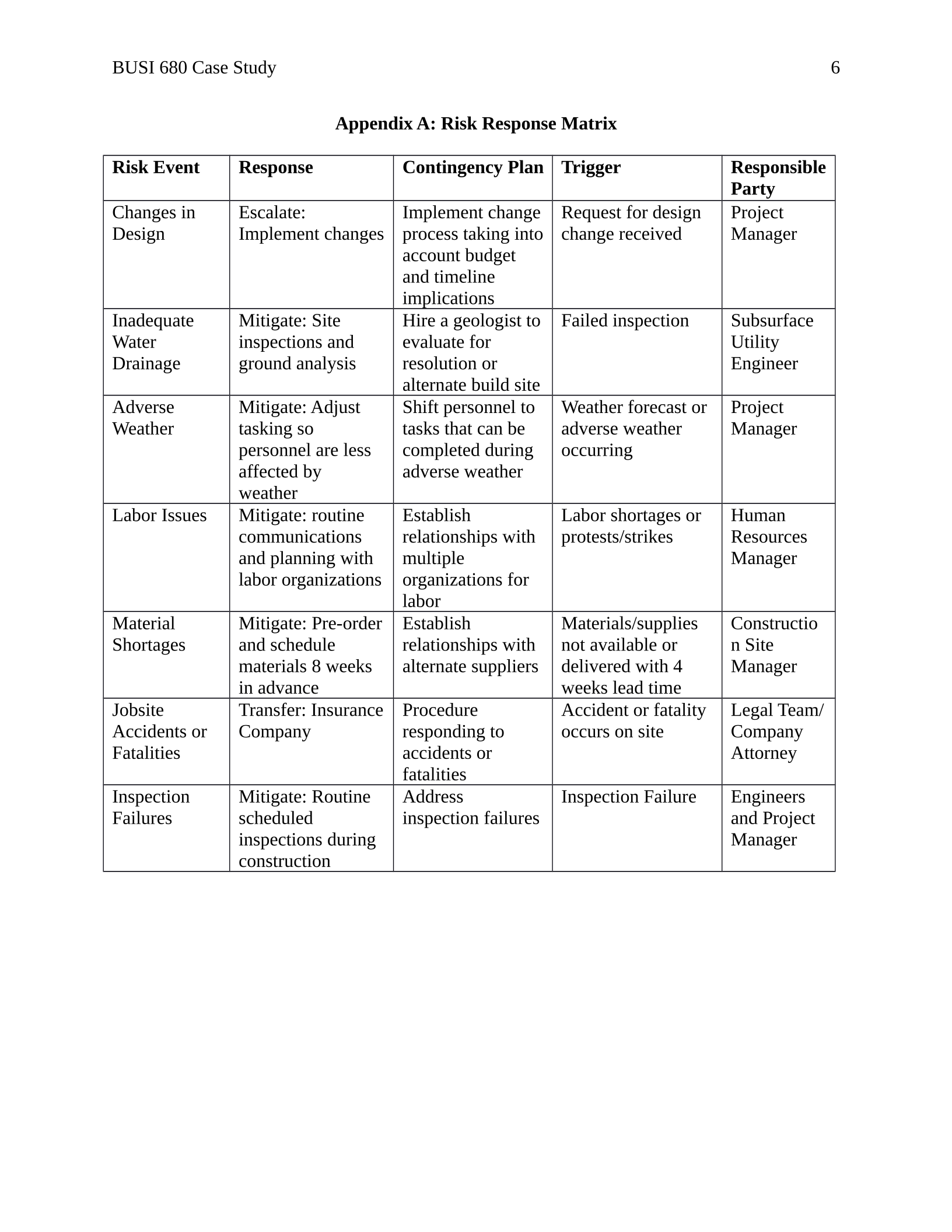
Appendix A: Risk Response Matrix
Risk Event Response Contingency Plan Trigger Responsible
Party
Changes in
Design
Escalate:
Implement changes
Implement change
process taking into
account budget
and timeline
implications
Request for design
change received
Project
Manager
Inadequate
Water
Drainage
Mitigate: Site
inspections and
ground analysis
Hire a geologist to
evaluate for
resolution or
alternate build site
Failed inspection Subsurface
Utility
Engineer
Adverse
Weather
Mitigate: Adjust
tasking so
personnel are less
affected by
weather
Shift personnel to
tasks that can be
completed during
adverse weather
Weather forecast or
adverse weather
occurring
Project
Manager
Labor Issues Mitigate: routine
communications
and planning with
labor organizations
Establish
relationships with
multiple
organizations for
labor
Labor shortages or
protests/strikes
Human
Resources
Manager
Material
Shortages
Mitigate: Pre-order
and schedule
materials 8 weeks
in advance
Establish
relationships with
alternate suppliers
Materials/supplies
not available or
delivered with 4
weeks lead time
Constructio
n Site
Manager
Jobsite
Accidents or
Fatalities
Transfer: Insurance
Company
Procedure
responding to
accidents or
fatalities
Accident or fatality
occurs on site
Legal Team/
Company
Attorney
Inspection
Failures
Mitigate: Routine
scheduled
inspections during
construction
Address
inspection failures
Inspection Failure Engineers
and Project
Manager
Powered by TCPDF (www.tcpdf.org)

