


GIBSON, INC. 1
Gibson, Inc. Processes
Alan P. Suggs
School of Business, Liberty University
Author Note
Alan P. Suggs
I have no known conflict of interest to disclose.
Correspondence concerning this article should be addressed to
Alan P. Suggs
Email: [email protected]

GIBSON, INC. 2
Contents
Abstract............................................................................................................................................5
Introduction .................................................................................................................................. ....6
Organizational Setting.....................................................................................................................6
Mission................................................................................................................................6
Customers............................................................................................................................7
Value Added........................................................................................................................7
Role of Christianity..............................................................................................................8
Integration of Chapter Concepts......................................................................................................8
Customer Perceived Value...................................................................................................8
Description...............................................................................................................8
Benefit......................................................................................................................9
Implementation......................................................................................................10
Biblical References................................................................................................10
Innovation..........................................................................................................................10
Description.............................................................................................................10
Benefit....................................................................................................................11
Implementation......................................................................................................12
Biblical References................................................................................................12
Market Segmentation ........................................................................................................12
Description.............................................................................................................12
Benefit....................................................................................................................13
Implementation......................................................................................................13

GIBSON, INC. 3
Biblical References................................................................................................14
Mass Customization...........................................................................................................14
Description.............................................................................................................14
Benefit....................................................................................................................15
Implementation......................................................................................................15
Biblical References................................................................................................15
Sustainability......................................................................................................................16
Description.............................................................................................................16
Benefit....................................................................................................................16
Implementation......................................................................................................16
Biblical References................................................................................................17
Responsiveness..................................................................................................................18
Description.............................................................................................................18
Benefit....................................................................................................................18
Implementation......................................................................................................19
Biblical References................................................................................................19
Lean Supply Chain Management.......................................................................................19
Description.............................................................................................................19
Benefit....................................................................................................................20
Implementation......................................................................................................20
Biblical References................................................................................................21
Value Creation Processes...................................................................................................21
Description.............................................................................................................21

GIBSON, INC. 4
Benefit....................................................................................................................22
Implementation......................................................................................................22
Biblical References................................................................................................22
Conclusion ....................................................................................... ..............................................23
References ...................................................................................................... ................................24
Appendix A: Gibson, Inc. September 2024 Financial Report ........................................... ............27
Appendix B: Communication of the Plan......................................................................................28
Appendix C: Monitoring and Evaluation of the Plan....................................................................29

GIBSON, INC. 5
Abstract
Gibson, Inc. is at the forefront of the music industry, manufacturing both musical instruments
and sound equipment used by the industry’s top professionals worldwide. The purpose of this
paper is to examine current processes of operations and supply chain management and make
recommendations to improve those processes to ensure sustainability and growth for the
foreseeable future. A review of current literature on process improvement options was conducted
to gather peer-reviewed approaches that have proven to be effective to enhance firm
performance. The results create a clear plan that the organization should consider that will
benefit all stakeholders, continue to ensure the highest level of quality, and add value to an
already storied firm. This paper will be valuable to Gibson, Inc., as it will clearly inform
managers of the critical role of operations management and direct the design of processes
moving forward.
Keywords: customer perceived value, innovation, market segmentation, mass
customization, sustainability, responsiveness, value creation

GIBSON, INC. 6
Gibson, Inc. Processes
Gibson instruments and sound equipment are synonymous with quality, and the long-
accepted gold standard in the music industry. Despite this track record of excellence, every
organization from the mom-and-pop main street diner to the Fortune 500 powerhouses have
room for improvement in the way they operate. Business operating processes need constant
monitoring and improvements to maximize an organization’s potential in order to remain
competitive, particularly in today’s ever-expanding global market. The following paper will
examine the firm’s current practices and make several recommendations for consideration based
off literary review of eight key concepts: customer value, innovation, market segmentation, mass
customization, sustainability, responsiveness, supply chain management, and value creation.
Adaptation of these recommend-ations will give Gibson, Inc. the tools necessary to improve their
current business processes, maximize earnings without sacrificing quality, and continue to
dominate its industry for the foreseeable future.
Organizational Setting
Mission
For over a century and a quarter, Gibson, Inc., the world’s most iconic guitar brand, has
been the gold standard in the music industry. Our lasting legacy is one of world-class
craftsmanship, legendary music partnerships, and progressive product evolution that is unrivaled
among musical instrument companies. Our mission is to continue to shape music for generations
to come through exceptional quality, groundbreaking innovation, and peak sound excellence. We
believe that in order to achieve this mission, we must continuously develop our products with the
latest cutting-edge technology, provide outstanding customer service before, during, and after the
sale, and stand by our commitment to achieving unmatched customer satisfaction throughout

GIBSON, INC. 7
every stage of our products’ life cycles. Our portfolio consists of not only the number one guitar
brand in the world, but other recognizable and beloved music brands, including Epiphone,
Kramer, MESA/Boogie, Steinberger, and our pro audio division, KRK Systems. Providing top
class musical instruments at a wide variety of price points has allowed Gibson to expand its
presence in music industry markets all over the globe. Our signature styles and unmatched
quality and customer service set us apart from our competitors, and the Gibson brand continues
to be synonymous with excellence and innovation generation after generation.
Customers
Gibson customers include anyone and everyone with a passion for music, from musical
novices just starting out on their journeys, to lifelong enthusiasts who demand only the best, all
the way to world famous legendary metal musicians like Metallica’s Kirk Hammett and James
Hetfield. When someone is deciding to purchase an instrument or pro audio equipment, whether
for themselves or as the best gift imaginable, we want them to know that Gibson has their back,
and their decision to go with our company is not one that they will ever regret making. Some of
our most dedicated customers are internal, as being a part of the Gibson family and having
special insight into what we do informs our employees, colleagues, patrons, investors, and other
stakeholders of the consummate professionalism and quality assurance inherent in what we
produce. For example, our CEO, Cesar Gueikian, is an avid collector of vintage guitars. He owns
over 150, most of which are Gibson that are actively used in the development of the Gibson
Original, Historic, and Vault Collections.
Value Added
In my role as special assistant to Gibson’s Chief Operating Officer, I add value to the
organization in many ways. I offer broad experience in global production, operations

GIBSON, INC. 8
procurement, enterprise solutions, and operational excellence. My education and experience give
me the tools necessary to assist our COO, Luke Ericson, by combining a strategic operational
excellence vision with real actions to set conditions for success. Together, we have saved the
company millions by reducing redundant costs in our supply chain, production, storage,
marketing, and sales of Gibson products. By minimizing production costs, we can continue to
offer the best price for our customers without sacrificing quality.
Role of Christianity
Christianity is the guiding light and inspiration in all that we do at Gibson, Inc. God said
to praise him with tambourines, strings, and pipes, and that is exactly the atmosphere we provide.
You can find Gibson products in houses of worship all over the world, raising cheerful voices in
praise of God. Our Gibson family lives by the “Golden Rule,” treating everyone within and
outside of our organization as we would like to be treated. We embrace sustainable business
practices, remaining good stewards of our environment. We share the gift of music to those less
fortunate among us through our 501C, the Gibson Gives Foundation, committed to introducing,
inspiring, and amplifying the power of music through guitars across all generations and genres.
By God’s example and through His grace, Gibson, Inc. will continue to be a beacon for
inspiration and an amplifier of His love throughout the world.
Integration of Chapter Concepts
Customer Perceived Value
Description
One of the key reasons business organizations exist is to provide value to the customers
who purchase their goods and services. Blut et al. define (2023) customer perceived value (CPV)
as a “a trade-off between the benefits of the offering and the sacrifices perceived by the

GIBSON, INC. 9
customer” (p. 1). They further describe CPV as a “customer’s overall assessment of the utility of
a product based on perceptions of what is received and what is given” (p.4). Misra et al. (2022)
explain that the concept of CPV is a central theme in economics as well as marketing and is
distinguished by two value dimensions: form value and exchange value. Form value is the value
that is gained when properties are added to matter, while exchange value is gained when
customers actually use the products purchased. For Gibson, Inc., the combination of wood,
metal, electrical components, rubber, magnetic pickups, etc. come together to create the form
value of its products. The exchange value is felt by the customers when they pick up that guitar,
plug it into an amplifier, and hear the sound quality as they play their favorite songs. The overall
assessment of the utility of that guitar is based on what the customer feels like they received (the
guitar) for what they had to give up; money and the number of hours spent working to earn that
money. Customer perceived value, then, is the relevant trade-off between give and get
components (Misra et al., 2022, p. 5).
Benefit
The benefits of CPV for Gibson, Inc. are fairly self-evident. The organization can assign
whatever value they see fit for a product or service, but if the CPV does not match or exceed the
organizational perceived value, then there are no customers, and the firm will eventually stop
earning profits and be forced to reinvent their strategy and products from the ground up. Gibson
is in a uniquely advantageous position, as the company has effectively been synonymous with
quality since its inception over 130 years ago. More than the products themselves, when a
customer purchases anything with the Gibson brand on it, they are buying into the aura of the
industry’s leader in instruments and sound equipment. There is a certain coolness associated with
owning Gibson, and that is an aspect of CVP that simply cannot be understated.

GIBSON, INC. 10
Implementation
The ‘cool aura’ aspect of Gibson, Inc.’s CVP should be front and center in marketing to
capitalize on its potential, and the great thing about Gibson’s aura is its authenticity. The
organization just needs to make certain that aa current and potential future customers never
forget that aspect of the products’ value. Marketing is simply “the art and science of choosing
markets and getting, keeping, and growing customers through creating, delivering, and
communicating superior customer value” (Misra et al., 2022, p. 10). Through marketing efforts,
the organization should place a greater focus on certain benefits constructs of Blut et al.’s (2023)
CPV model; excellence, status, social, aesthetic, escapism, and novelty (p. 7). By emphasizing
these intangible values associated with owning a Gibson product, the firm will be able to get,
keep, and grow its customer base.
Biblical References
One issue that often arises when an organization enjoys an aura is that its managers take
that benefit for granted and count on its continuity with minimal effort. However, as the Bible
teaches us, we must as managers remain humble and thankful for our blessings given by God.
Philippians 2:3 tells us, “Do nothing from selfish ambition or conceit, but in humility count
others more significant than yourselves” (English Standard Version Bible, 2001). Living this
guidance will help us achieve God’s plan for us while also ensuring that the customer perceived
value of the company and its products does not evaporate.
Innovation
Description
Gibson, Inc.’s position atop the music industry players can be attributed to many factors.
Two of those factors are seemingly at odds. On the one hand, it’s Gibson’s classic looks and

GIBSON, INC. 11
design of its guitars that keep bringing customers to the table. Much like the Converse Chuck
Taylors, the Les Paul is infinitely cool and never goes out of fashion. On the flip side of the
classics, however, is the willingness and motivation to keep bringing innovation to a brand that
has already achieved perfection. Innovation is “an idea, a product, or process system or device
that is perceived to be new to an individual, a group of people or firms, an industrial sector or a
society as a whole” (Do et al., 2022, p. 1394). Organizational innovation is a process used by
organizations to transform current climates and inspire new and improved offerings for its
customers, setting themselves apart from competitors. Innovation can also improve production
processes, change administrative settings, and improve marketing techniques (Migdadi, 2022, p.
183). Business model innovation (BMI) plays a critical role in the success and performance of an
organization and is defined as a “set of deliberate acts that managers and entrepreneurs perform
over time to change the business model components and architecture in a consistent and
innovative way” (Andreini et al., 2022, p. 1092).
Benefit
There are many benefits to adapting BMI. Key among those benefits is innovation’s
capability to inspire a firm to achieve a competitive advantage and sustain success (Migdadi,
2022). Additionally, innovation develops leadership competences and cultivates organizational
learning to develop new knowledge as a team to improve performance objectives. According to
Do et al. (2022), organizational learning positively affects innovation and business performance,
creating a cycle of creativity and inspiration within the company. Andreini et al. (2022) describe
the greatest benefit to BMI as the creation of new and sustainable business value through four
transitional stages of innovation: exploration, evolution, embedment, and unification. Exciting
new products and technologies will aid in Gibson’s sustained success for the foreseeable future.

GIBSON, INC. 12
Implementation
Gibson, Inc. should place as much emphasis on the future of what the organization can do
for music as they do in past achievements. Seeking new ways to excite existing and potential
future customers is needed to sustain the legendary status that the organization has created for
itself. This can be achieved by listening to stakeholder suggestions and competing for innovative
human capital in science and technology. Customer surveys, employee feedback, social media
outreach, and a renewed focus on top engineering university recruitment will set the stage for the
evolution of the Gibson brand and create value beyond current financial standards. After all,
everyone loves Coca-Cola classic, but every now and again a cherry vanilla Coke hits the spot,
too.
Biblical References
As in life, business should be an evolving experience to test boundaries and create value.
Romans 12:2 tells us, “Do not be conformed to this world, but be transformed by the renewal of
your mind, that by testing you may discern what is the will of God, what is good and acceptable”
(English Standard Version Bible, 2001). We must use the tools made available by God to
innovate existing processes and foster inspiration and creativity.
Market Segmentation
Description
Market Segmentation is a concept which recognizes that every customer is different, and
in order to attract as many as possible, an organization must develop attractive offerings to bring
them to the table. It is “the idea that individuals in a population are distinguishable and can be
grouped strategically according to their characteristics” (Edgerly & Thornson, 2024, p. 1679).

GIBSON, INC. 13
These varying groups of potential customers represent market segments and can be reached
through employment of innovative techniques to grow a brand and expand its financial value.
Benefit
The benefit of market segmentation is attraction of new customers in previously untapped
markets. This strategy could result in more revenue and growth of the Gibson brand. Moreover,
with the influx of new market segments come new ideas and diverse points of view on offerings,
which in turn drives innovation.
Implementation
To implement the market segmentation strategy, two initial campaigns are proposed. The
first, freemium marketing, is a concept that has already been employed by many digital
platforms. Rafaat & Sciglimpaglia (2022) describe the strategy as the utilization of no-cost or
low-cost entry pricing to generate downstream profit. Freemium marketing is generally done in
two phases. In the first phase, no-cost or low-cost is used to attract as many customers as
possible. In the second phase, a portion of those customers are converted to a premium service.
For example, websites like Ancestry will allow a new user to build a few branches of a family
tree using their database. Predicting the user’s curiosity about their family will be piqued, the
company then offers more access to records on several tiers of membership. One way that
Gibson can utilize a similar strategy would be to rent its products to potential customers for a
low monthly fee and then offer the opportunity to convert their rental into a purchase, applying
paid rental fees to the buying price. Predicting the customer will fall in love with the quality and
durability of the instrument or sound equipment they have been paying to borrow, Gibson can
expect a fair number of customers to convert to the premium status of owning a piece of music
history.

GIBSON, INC. 14
Another market segmentation strategy recommended for implementation is brand-social
media influencer (SMI) collaboration. Mehmood et al. (2023) describe this recent phenomenon
as “a clear strategy to enhance customers’ experiences and perceptions of their products” (p. 1)
in which organizations partner with SMIs discuss, demonstrate, and endorse products for
untapped markets. While everyone over the age of 40 is perplexed by the appeal of these often-
obnoxious talking heads on YouTube, TikTok, Instagram, and more, they do not appear to be
going anywhere anytime soon. This is why Gibson should get into the brand-SMI collaboration
game to market its products rapidly and efficiently. After researching appropriate candidates for
partnership consideration, Gibson marketing needs to budget for deals with several far-reaching
SMIs.
Biblical References
Ephesians 4:11-12 says, “and He gave the apostles, the prophets, the evangelists, the
shepherds and the teachers, to equip the saints for the work of ministry, for building up the body
of Christ” (English Standard Version Bible, 2001). By spreading the word of God far and wide
through various vessels, God used the strategy of market segmentation give the gift of eternal life
to untapped markets. By showing the people that a pious life would lead to eternal reward, he
converted segments of the population to the premium service of salvation.
Mass Customization
Description
Mass customization is a concept in manufacturing is an “efficient, low-cost production
capable of delivering a customized product in high volume” (Abdulnour et al., 2023, p. 11). With
this approach, organizations seek to produce customized products at or near mass production
costs. Chen et al. (2022) describe mass customization capability as “the ability to rapidly design,

GIBSON, INC. 15
produce and deliver high-quality customized products or services to meet different customer
needs at lower cost” (p. 290). A guitar is a very personal thing for many people, so in Gibson’s
case, mass customization would offer customers the opportunity to tweak predetermined aspects
of the instruments in a way that best represents their individual style.
Benefit
The implementation of a mass customization strategy could be a real gamechanger for
Gibson, Inc. There are many people who appreciate the sound quality and durability of Gibson
products but aren’t quite sold on the styles currently offered. Conversely, there are many who
love the style but desire a different quality of sound to meet their individual needs. Opening
products to customization has the potential to draw in new segments of customers. Customers
must also pay extra for customizations, offsetting added costs and adding new revenue.
Implementation
To implement the strategy of mass customization, Gibson should identify and provide a
limited number of individual customization options during the production using advanced
automated manufacturing technology. The cost of alterations should be clearly displayed through
the online portal, giving customers a clear picture of the value trade-off associated with making
their very own one-of-a-kind Gibson product.
Biblical References
Everyone is different. God does not expect His followers to act as a lockstepping
monolith of robots, which is why we were given free will and individuality. In 1 Peter 4:10 we
are told, “as each has received a gift, use it to serve one another, as good stewards of God’s
varied grace” (English Standard Version Bible, 2001). We must use these gifts of individuality to
spread His word and fulfill His plan for us.

GIBSON, INC. 16
Sustainability
Description
Business sustainability is a focus on an organization’s ability to remain relevant and
fostering growth. It is defined as “a business continuity system that includes growth, continuity,
and approaches to protect business continuity and business expansion” (Nawangsari et al., 2023,
p. 514). It creates long-term value for shareholders with concern for social and environmental
factors and is essential for opportunities, benefits, risks, and costs (Walecka-Jankowska et al.,
2024). Organizations must take great caution to not leave negative impacts on the environments
in which they operate as stewards of the earth and their employees and customers, and active
application of sustainable business practices are critical to long-term success for any firm
operating in the world today.
Benefit
Sustainability is very beneficial to any organization as it is critical to prolonged
relevance. Eco-friendly manufacturing processes avoid heavy fines, exhaustion of precious
resources, and damage to employees and customers. Moreover, a commitment to sustainability
fosters an image of caring and unity while ensuring an organization will not find itself on the
receiving end of social and political backlash. Sustainability practices also saves on the cost of
manufacturing by limiting energy and resource consumption. It engages employees, inspires
innovation, improves supply chain performance, and may even provide lucrative tax incentives.
Implementation
To implement sustainability practices into Gibson Inc.’s operations, there are many
options from which to choose. The first recommendation has to do with the amount of and types
of materials in product packaging. While we recognize that the products must ship from the plant

GIBSON, INC. 17
to the stores and finally to the customers’ hands undamaged, adjustments can be made to do so
with minimal environmental impact. Gibson should commit to using 100% recycled paper
materials and eliminating all unnecessary plastics. This will reduce waste and demonstrate the
organization’s commitment to being a driver of a cleaner world. Second, we should make going
paperless a priority, as there is no reasonable need to print much of anything in today’s digital
marketplace. Gibson must invest in local (where possible), ethical sourcing so that transparency
is possible, and damage is not being done in the company’s name outside its scope of
observation. Lastly, a concerted effort must be made to educate employees and customers about
sustainable initiatives. One way to do so is to promise for every Gibson guitar sold, three trees
will be planted in a protected space to source future guitars and reduce the company’s carbon
footprint.
Biblical References
As business leaders, we must remember that we do not own the land in which we operate
or the people we employ. God did not bless us with these gifts so that we may endanger or
destroy them, but to use them in a way which glorifies Him and helps us achieve His mission.
Psalm 95:4-5 states, “In His hand are the depths of the earth; the heights of the mountains are His
also. The sea is His, for He made it, and His hands formed the dry land” (English Standard
Version Bible, 2001). In Genesis 8:17, God commands us, “Bring out with you every living thing
that is with you of all flesh; birds and animals and every creeping thing that creeps on the earth
that they may swarm on the earth, and be fruitful” (English Standard Version Bible, 2001). We
must do our part to leave the earth as beautiful or more beautiful than when we arrived so that
God’s creation may continue to be fruitful. By engaging in sustainable practices, we keep our
promise to God to glorify Him in all that we do.

GIBSON, INC. 18
Responsiveness
Description
Responsiveness is an organization’s ability to adapt to changes in customers’ needs and
wants rapidly to maintain its competitive advantage. Mise et al. (2023) describe responsiveness
as “a market-driven exploitation strategy” (p. 2) that must be developed while simultaneously
exploring and innovating for the future. While challenging, it is possible through dynamic
capabilities and ambidexterity. Dynamic capability is the ability to use both exploitation and
exploration strategies at the same time. Exploitation is “associated with efficiency, growth in
productivity, control, and safety, while exploration is related to discovery, autonomy, and
innovation” (p. 4) An effective ambidextrous responsiveness strategy makes these diverging
focuses possible.
Benefit
The benefits of responsiveness are that it provides for excellent, reliable customer service
and encourages innovative capabilities required to sustain a competitive advantage in the future.
As stated previously, every customer is different, but those differences are also not frozen in
time. As change inevitably happens, customers’ needs and wants require constant attention.
Being able to effectively respond to those changes is essential to success for any business. In
addition to existing customers, Gibson must be able to respond to new markets as well as prepare
for even newer markets they hope to reach. After all, a company will never grow if it lacks the
ability to introduce its products to new market segments. With proper research and appropriate
actions, Gibson can be prepared for the eventual emergence into new areas not previously
exploited. This preparedness is a critical benefit to any organization hoping to succeed and to
maintain that success moving forward.

GIBSON, INC. 19
Implementation
In order for Gibson to develop its responsiveness strategy, leadership must listen and
observe in order to know what exactly warrants a response. This should be done through
customer outreach, satisfaction surveying, research of potential reachable markets, and
comparisons of existing competitors in those markets. This also will require internal processes
preparedness. Employees and equipment must be agile, and possible additional resources must
be identified and factored into supply chain planning. By focusing on an ambidextrous approach
to organizational planning, Gibson, Inc. will continue its legacy quality and innovation.
Biblical References
Preparing for future customer markets while effectively responding to current customers’
needs and wants is daunting and challenging goal, but not one that is unattainable. In Matthew
19:26 of the English Standard Version Bible (2001), gospel tells us that, “with God, all things are
possible.” Philippians 4:6 says, “do not be anxious about anything, but in everything by prayer
and supplication with thanksgiving let your requests be made to God.” Finally, 1 Chronicles
16:11 instructs, “seek the Lord and His strength; seek His presence continually!” Knowing that
God walks beside us through all challenges will remind us that the mission He gave us is not an
unattainable task.
Lean Supply Chain Management
Description
Lean supply chain management (LSCM) is a supply chain orientation “work closely with
their upstream and downstream operational system partners to eliminate waste and create
customer value” (Johnson et al., 2023, p. 1456). It is an objective-based approach emphasizing
efficiency, cost reduction, time reduction, and eliminating activities that are not value-adding to

GIBSON, INC. 20
realize maximum profit most effectively. By cutting waste, LSCM levels supply chain
scheduling and provides a steady flow of resources from the suppliers all the way to the
customers. It highlights relationships among organizations, reduces inventory, and focuses on
ways to solve problems while encouraging collaboration across the entire supply chain. Finally,
LSCM is a strategic way to improve efficiency and flexibility in operations, processes, and
supply chains (Johnson et al., 2023).
Benefit
There are many benefits to this approach to supply chain management. An LSCM
strategy decreases errors, streamlines procedures, and facilitates decision-making that is timely,
precise, thorough, and data-driven, reducing costly waste and providing on-time delivery of
products to customers (Luthra et al., 2024). Additionally, the use of cutting-edge technology for
LSCM improves resource usage, streamlines supply procedures, and decreases errors. Johnson et
al. (2023) summarize the benefits of LSCM as cost reduction, waste elimination, and
collaboration.
Implementation
For Gibson, Inc. to implement LSCM, we must adapt an alignment association approach
to adopt and deploy lean management while prioritizing lean objectives for performance when
addressing emergent upstream or downstream supply chain barriers (Johnson et al., 2023, p.
1462). We must also invest in technologies that reduce cost, eliminate waste, and enable
collaboration between all supply chain players. While LSCM represents a significant cultural
shift for Gibson, Inc., it is a strategy that, when properly implemented and fully accepted, will
more than make up for initial costs over time.

GIBSON, INC. 21
Biblical References
The Bible teaches us to waste neither time nor resources when seeking to achieve God’s
mission. Colossians 3:23 from the English Standard Version Bible (2001) says, “whatever you
do, work heartily, as for the Lord and not for man.” This is a reminder that we are here only
temporarily, and our time on this earth must be used wisely. Psalm 90:12 adds to this, stating,
“so teach us to number our days that we may get a heart of wisdom.” Regarding the wasting or
resources, Numbers 35:33 commands, “you shall not pollute the land in which you live, for
blood pollutes the land, and no atonement can be made for the land for the blood that is shed in
it, except by the blood of the one who shed it.” Finally, 2 Timothy 2:7 encourages effective
communication and collaboration with, “think over what I say, for the Lord will give you
understanding in everything.”
Value Creation Processes
Description
Value creation processes are, simply put, anything that happens from the beginning of a
products creation to the final product that adds any value beyond the sum of the cost of
resources. A Gibson guitar is not born a guitar. There is a mahogany tree. When it is cut down to
the shape of a Gibson SG body, value is added. When the wood is treated, stained, lacquered, or
painted, value is added. When it is combined with a neck, tuning keys, pickups, a bridge, a nut,
tuning knobs, neck inlays etc., value is added. When is transported from the factory to a local
guitar shop, value is added. These are all parts of the overall value-adding process.

GIBSON, INC. 22
Benefit
The benefit of adding value to raw materials is that Gibson, Inc. has a product to sell.
Without these processes, there simply would be no company. Without Gibson, employees would
have no jobs, our suppliers would have no demand, and untold numbers of people would never
create music. Value creation is perhaps the most important operational process of them all.
Implementation
Gibson, Inc. obviously already has value creation processes in place. What we propose to
improve those processes can be achieved through adoption of the previous suggestions. An
organization’s business model is the entire “architecture of value creation, delivery, and capture
mechanism…a boundary-spanning activity system, conducted by a set of actors linked by
transaction mechanisms” (Climent & Haftor, 2021, p. 353). Committing to recommendations
laid out in this framework we have proposed will result in a more streamlined and sustainable
value creation process.
Biblical References
From the moment of mankind’s conception, God has been in charge of our individual
value creation processes. Genesis 2:7 in the English Standard Version Bible (2001) says, “then
the Lord God formed the man of dust from the ground and breathed into his nostrils the breath of
life, and the man became a living creature.” Before God, we were dirt. He created value by
forming a man from that dirt. Then God, seeing how little value a pile of dirt shaped like a man
held, breathed life into his lungs, creating even more value. He gave us more value by placing us
over all living creatures of the earth. Finally, God gave us the greatest value imaginable by
sending Jesus Christ to die for our sins so that we may live forever by His side in eternal
salvation.

GIBSON, INC. 23
Conclusion
In closing, we reiterate the acknowledgment of Gibson, Inc.’s storied history and
unmatched quality in the music industry. We also must recognize that there is always room for
improvement in business operations processes. A focused commitment to increase customer
perceived value will increase actual value for Gibson products. Driving innovation through
stakeholder feedback and investment in human capital will increase value for Gibson products.
Utilizing market segmentation techniques like freemium marketing and brand-SMI collaboration
will reach new segments of potential customers. Mass customization options will add perceived
customer value and personalize clients’ relationships with the company and their guitars.
Sustainable practices engage employees, inspire innovation, improve supply chain performance,
provide lucrative tax incentives, and protect our environment. Dynamic responsive capabilities
will prepare Gibson for changing customer needs and wants while preparing the company for
future entry into untapped markets. Lean supply chain management will reduce costs, eliminate
waste, and improve collaboration among key players. Finally, building on value creation
processes with the tools provided will guarantee a bright and fruitful future for Gibson, Inc.

GIBSON, INC. 24
References
Andreini, D., Bettinelli, C., Foss, N. J., & Mismetti, M. (2022). Business model innovation: A
review of the process-based literature. Journal of Management and Governance, 26(4),
1089-1121. https://doi.org/10.1007/s10997-021-09590-w
Abdulnour, G., Bouchard, S, & Gamache, S. (2023). Operationalizing mass customization in
manufacturing SMEs: A systematic literature review. Sustainability, 15(4), 1-21.
https://doi.org/10.3390/su15043028
Blut, M., Chaney, D., Grewal, D., Lunardo, R., & Mencarelli, R. (2023). Customer perceived
value: A comprehensive meta-analysis. Journal of Service Research, 0(0), 1-24.
https://doi.org/10.1177/10946705231222295
Chen, L., Chu, D., Feng, T., & Sheng, H. (2022). Operational coordination and mass
customization capability: The double-edged sword effect of customer need diversity. The
International Journal of Logistics Management, 33(1), 289-310.
https://doi.org/10.1108/IJLM-11-2020-0417
Climent, R. C., & Haftor, D. M. (2021). Value creation through the evolution of business model
themes. Journal of Business Research, 122(2021), 353-361.
https://doi.org/10.1016/j.jbusres.2020.09.007
Do, T. T., Ho Nguyen, D. T., & Mai, N. K. (2022). The impact of leadership competences,
organizational learning and organizational innovation on business performance. Business
Process Management Journal, 28(5/6), 1391-1411. https://doi.org/10.1108/BPMJ-10-
2021-0659

GIBSON, INC. 25
Edgerly, S., & Thorson, K. (2024). Speaking the language of market segmentation: How
newsworkers describe their organization’s target audience. Journalism, 25(8), 1603-1834.
https://doi.org/10.1177/14648849231194128
English Standard Version Bible. (2001). The Bible Gateway Online.
https://www.biblegateway.com/versions/english-standard-version-esv-bible/#booklist
Johnson, P. F., Menor, L. J., & Naranjo, F. (2023). Lean supply chain management: A contextual
contingent reconceptualization and Delphi method study. International Journal of
Operations & Production Management, 43(9), 1456-1480.
https://doi.org/10.1108/IJOPM-07-2022-0436
Luthra, S., Singh, S., Virmani, N., Upadhyay, A., & Upadhyay, M. (2024). Assessing solutions
to overcome quality 4.0 barriers: A decision-making framework. TQM Journal, 36(6),
1460-1485. https://doi.org/10.1108/TQM-06-2023-0170
Mehmood, F., Qaiser, T., & Syed, T. A. (2023). Brand–SMI collaboration in influencer
marketing campaigns: A transaction cost economics perspective. Technological
Forecasting & Social Change, 192(122580), 1-15.
https://doi.org/10.1016/j.techfore.2023.122580
Migdadi, M. M. (2022). Knowledge management processes, innovation capability and
organizational performance. International Journal of Productivity and Performance
Management, 71(1), 182-210. https://doi.org/10.1108/IJPPM-04-2020-0154
Mise, N., Škokić, V., & Talaja, A. (2023). Organizational change capability and ambidexterity:
The mediating role of innovativeness and responsiveness. Cogent Business &
Management, 10(3), 1-21. https://doi.org/10.1080/23311975.2023.2279380

GIBSON, INC. 26
Misra, S., Pedada, K., & Sinha, A. (2022). A theory of marketing’s contribution to customers’
perceived value. Journal of Creating Value, 8(2), 219-240.
https://doi.org/10.1177/23949643221118152
Nawangsari, L. C., Siswanti, I., & Soelton, M. (2023). Human resources management strategy
for business sustainability in MSMES. International Conference on Community
Development, 5(1), 514-518. https://doi.org/10.33068/iccd.v5i1.599
Raafat, F., & Sciglimpaglia, D. (2022). Freemium marketing: Use of demand-side research in
market segmentation strategy. Journal of Strategic Marketing, 30(7), 667-690.
https://doi.org/10.1080/0965254X.2020.1824013
Walecka-Jankowska, K. A., Zgrzywa-Ziemak, A. H., & Zimmer, J. (2024). The effect of
organizational learning on business sustainability: The role of distributed leadership. The
Learning Organization, https://doi.org/10.1108/TLO-11-2022-0135
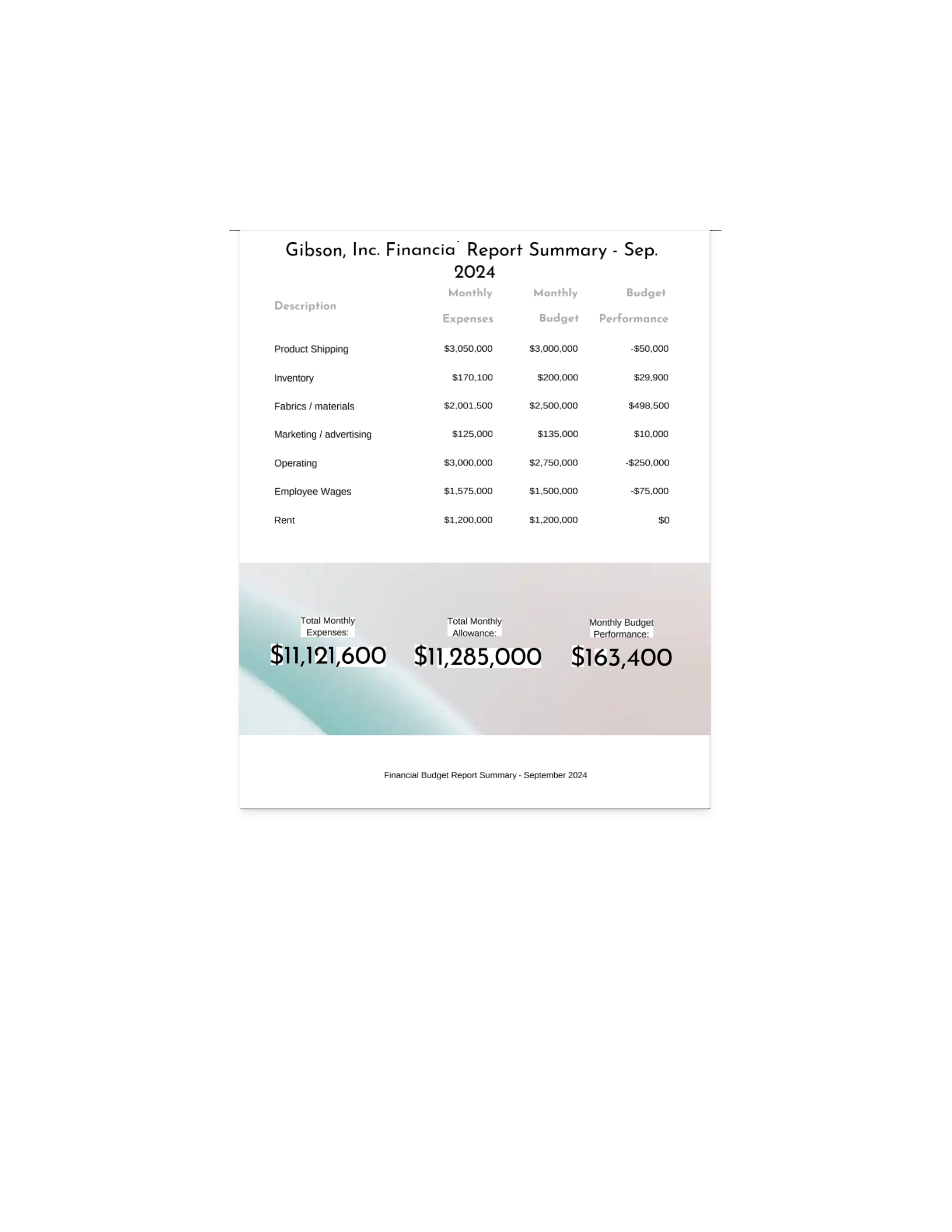
GIBSON, INC. 27
Appendix A
Gibson, Inc. September 2024 Financial Report

GIBSON, INC. 28
Appendix B
Communication of the Plan
Project: Implementation of Key Operations Planning Recommendations
Summary
Based off strategic research, Gibson, Inc. will implement recommended changes to operating procedures.
Communication Goals
Inform key stakeholders of benchmarked events and expected results of the implementation processes.
Key Stakeholders
Cesar Gueikian, CEO, [email protected], 575-369-2581.
Beth Heidt, CMO, [email protected], 575-369-1473.
Armin Boehm, CCO, [email protected], 575-369-6543.
Luke Ericson, COO, [email protected], 575-369-9876.
Team Members
Alan Suggs, Operational Advisor, [email protected], 704-785-0642
Derek Hopkins, Assistant Operational Advisor, [email protected], 910-396-2583
Key Communications
Initial stakeholders meeting on 10/30/2024.
Weekly Project Communications
Alan and Derek will regularly email all stakeholders with updates and projected results. All key
stakeholders are encouraged to call Derek with any questions. Derek will communicate with Alan for the
most up-to-date information.
Project Updates
Stakeholders will be invited to a virtual meeting via Zoom at 1000 hours on the first Monday of each
month. Quarterly in-person updates will be coordinated between Alan and Cesar on the last Friday of the
month in which the quarter falls. A final project summary will be conducted between all stakeholders and
team members on the last day of the 2024 fiscal year.
Appendix C
Monitoring and Evaluation of the Plan

GIBSON, INC. 29
Metric Monitored Expectation Data Collection
Method
Updates and
Responsibility
Budget Profit/Loss Net Gains Monthly
Financial
Statements
Monthly (Derek)
Quarterly (Alan)
Customers Satisfaction Continued/
Improvement
Questionnaires
on Every Gibson
Product Purchase
Monthly (Derek)
Quarterly (Alan)
Employees Satisfaction Continued/
Improvement
Monthly Climate
Surveys Monthly
(Derek)
End-of-Project
Outcomes
All Metrics Significant Financial
Gains, and Satisfied
Customers/Employees
All Financial
Statements,
Questionnaires,
and Climate
Surveys
End of FY24
(Alan)

GIBSON, INC. 30
<Insert Appendix Title Here>

