


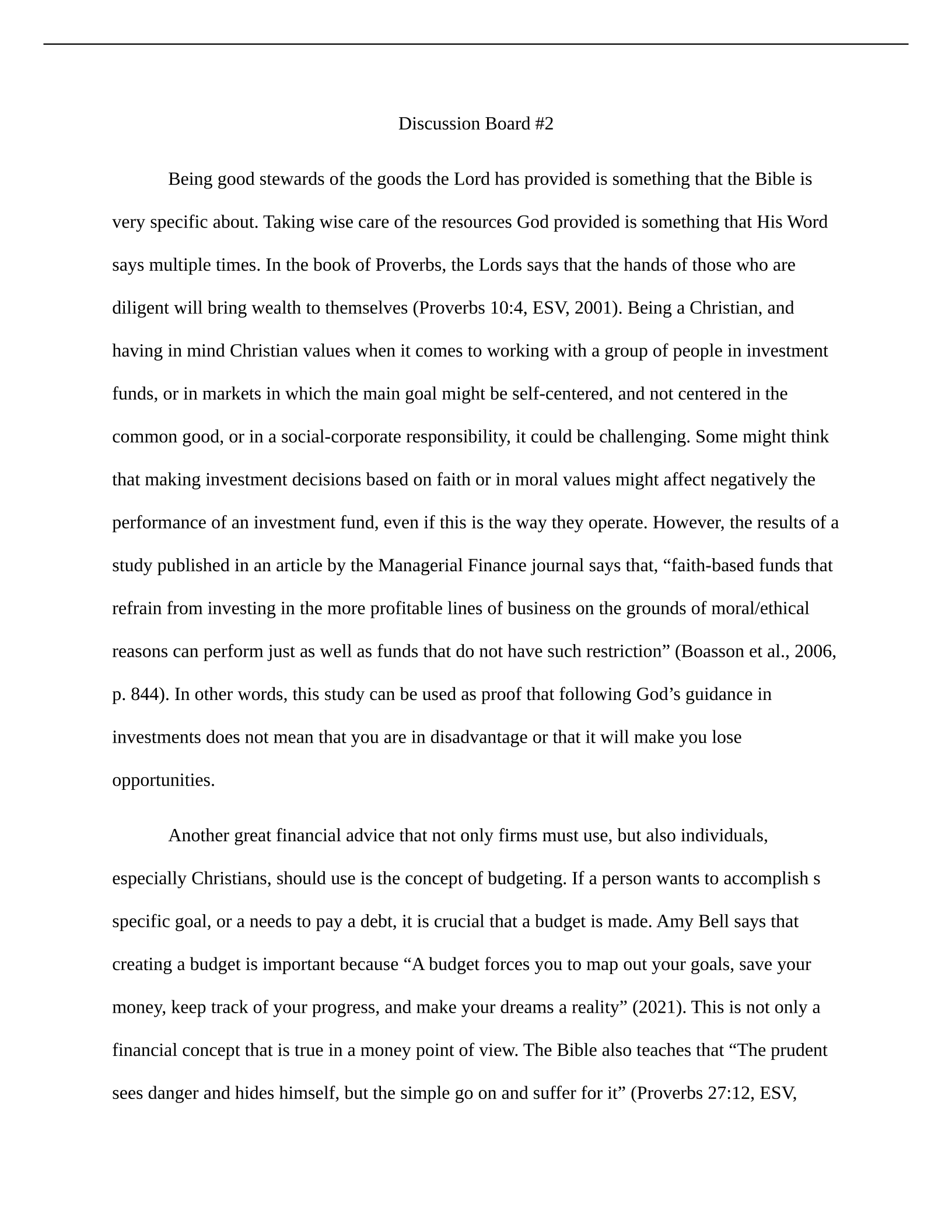
Discussion Board #2
Being good stewards of the goods the Lord has provided is something that the Bible is
very specific about. Taking wise care of the resources God provided is something that His Word
says multiple times. In the book of Proverbs, the Lords says that the hands of those who are
diligent will bring wealth to themselves (Proverbs 10:4, ESV, 2001). Being a Christian, and
having in mind Christian values when it comes to working with a group of people in investment
funds, or in markets in which the main goal might be self-centered, and not centered in the
common good, or in a social-corporate responsibility, it could be challenging. Some might think
that making investment decisions based on faith or in moral values might affect negatively the
performance of an investment fund, even if this is the way they operate. However, the results of a
study published in an article by the Managerial Finance journal says that, “faith-based funds that
refrain from investing in the more profitable lines of business on the grounds of moral/ethical
reasons can perform just as well as funds that do not have such restriction” (Boasson et al., 2006,
p. 844). In other words, this study can be used as proof that following God’s guidance in
investments does not mean that you are in disadvantage or that it will make you lose
opportunities.
Another great financial advice that not only firms must use, but also individuals,
especially Christians, should use is the concept of budgeting. If a person wants to accomplish s
specific goal, or a needs to pay a debt, it is crucial that a budget is made. Amy Bell says that
creating a budget is important because “A budget forces you to map out your goals, save your
money, keep track of your progress, and make your dreams a reality” (2021). This is not only a
financial concept that is true in a money point of view. The Bible also teaches that “The prudent
sees danger and hides himself, but the simple go on and suffer for it” (Proverbs 27:12, ESV,
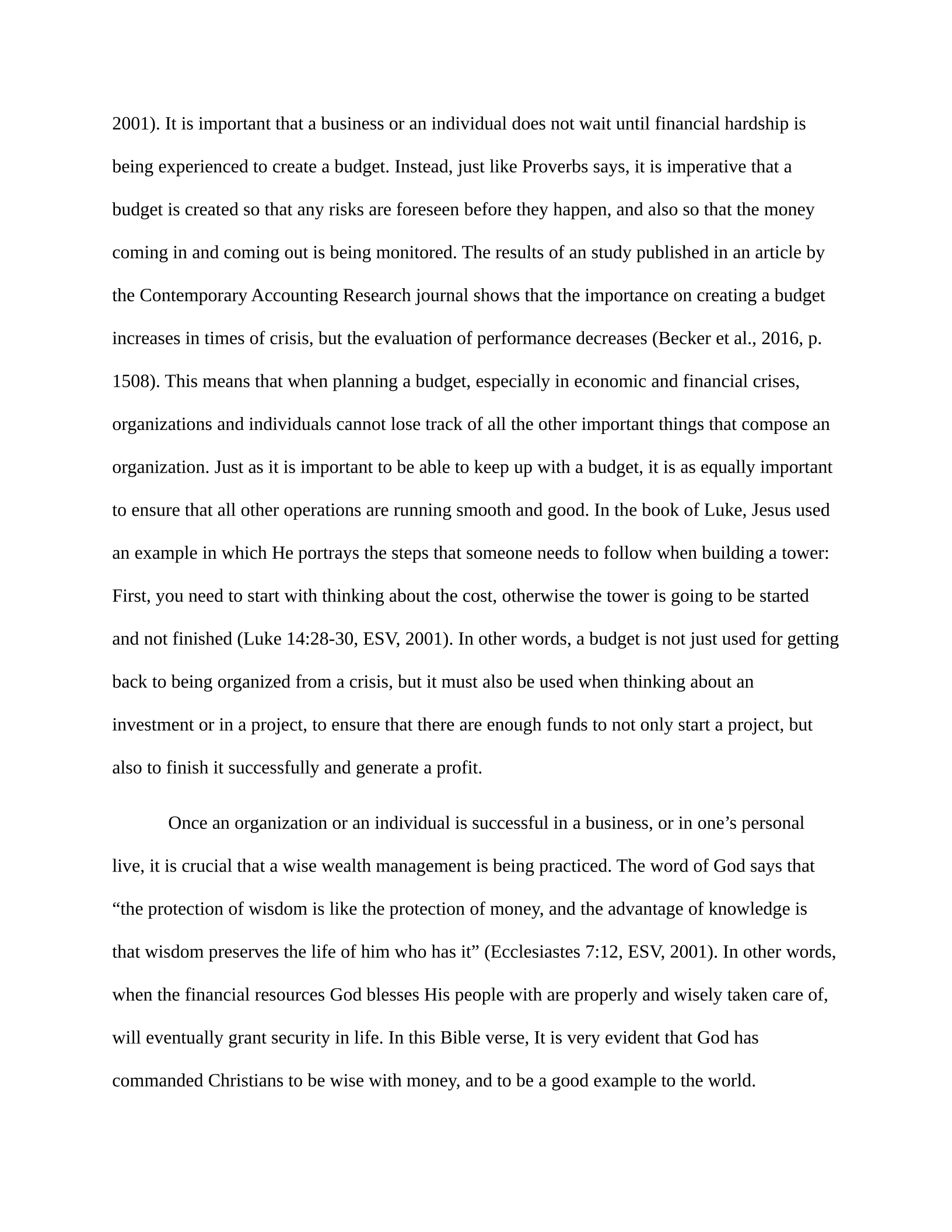
2001). It is important that a business or an individual does not wait until financial hardship is
being experienced to create a budget. Instead, just like Proverbs says, it is imperative that a
budget is created so that any risks are foreseen before they happen, and also so that the money
coming in and coming out is being monitored. The results of an study published in an article by
the Contemporary Accounting Research journal shows that the importance on creating a budget
increases in times of crisis, but the evaluation of performance decreases (Becker et al., 2016, p.
1508). This means that when planning a budget, especially in economic and financial crises,
organizations and individuals cannot lose track of all the other important things that compose an
organization. Just as it is important to be able to keep up with a budget, it is as equally important
to ensure that all other operations are running smooth and good. In the book of Luke, Jesus used
an example in which He portrays the steps that someone needs to follow when building a tower:
First, you need to start with thinking about the cost, otherwise the tower is going to be started
and not finished (Luke 14:28-30, ESV, 2001). In other words, a budget is not just used for getting
back to being organized from a crisis, but it must also be used when thinking about an
investment or in a project, to ensure that there are enough funds to not only start a project, but
also to finish it successfully and generate a profit.
Once an organization or an individual is successful in a business, or in one’s personal
live, it is crucial that a wise wealth management is being practiced. The word of God says that
“the protection of wisdom is like the protection of money, and the advantage of knowledge is
that wisdom preserves the life of him who has it” (Ecclesiastes 7:12, ESV, 2001). In other words,
when the financial resources God blesses His people with are properly and wisely taken care of,
will eventually grant security in life. In this Bible verse, It is very evident that God has
commanded Christians to be wise with money, and to be a good example to the world.
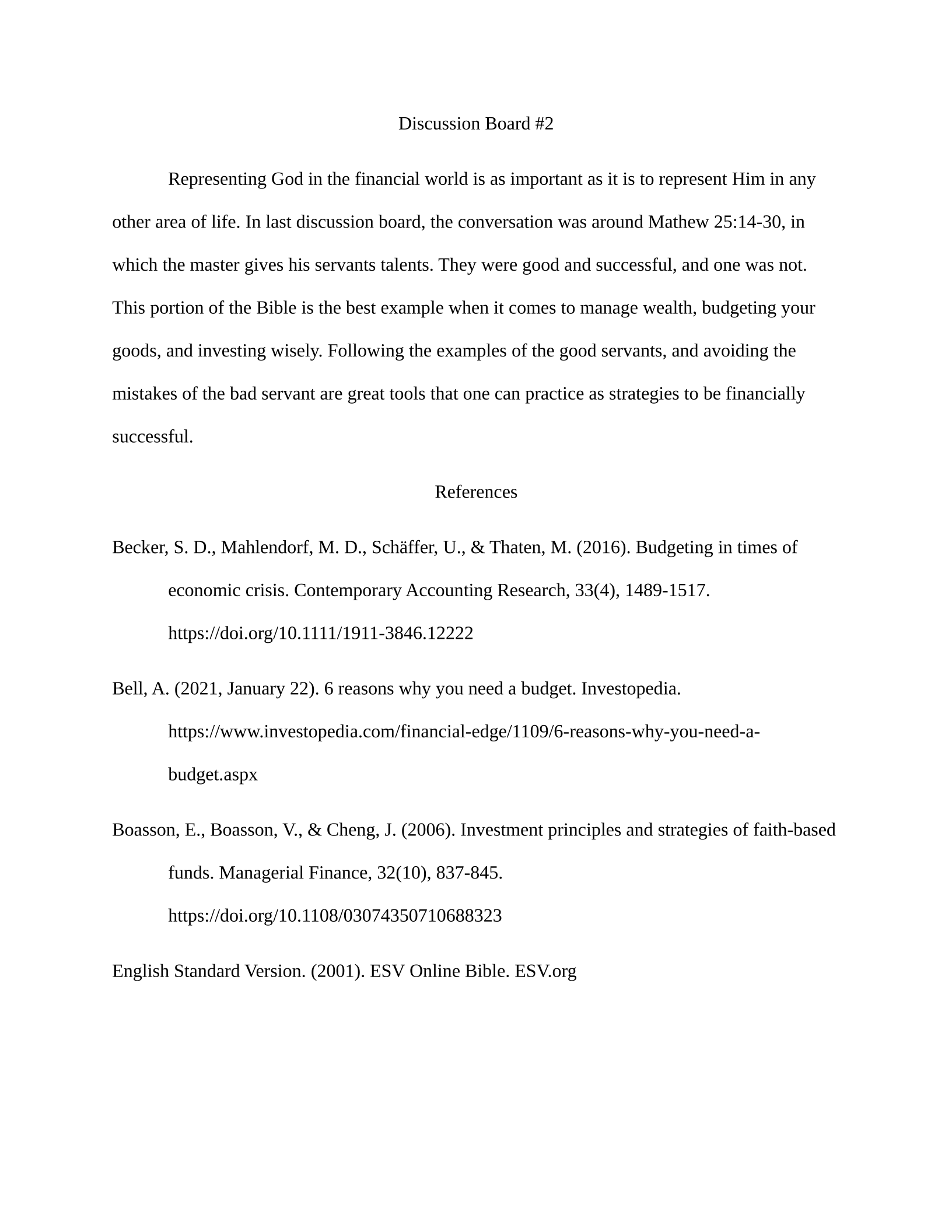
Discussion Board #2
Representing God in the financial world is as important as it is to represent Him in any
other area of life. In last discussion board, the conversation was around Mathew 25:14-30, in
which the master gives his servants talents. They were good and successful, and one was not.
This portion of the Bible is the best example when it comes to manage wealth, budgeting your
goods, and investing wisely. Following the examples of the good servants, and avoiding the
mistakes of the bad servant are great tools that one can practice as strategies to be financially
successful.
References
Becker, S. D., Mahlendorf, M. D., Schäffer, U., & Thaten, M. (2016). Budgeting in times of
economic crisis. Contemporary Accounting Research, 33(4), 1489-1517.
https://doi.org/10.1111/1911-3846.12222
Bell, A. (2021, January 22). 6 reasons why you need a budget. Investopedia.
https://www.investopedia.com/financial-edge/1109/6-reasons-why-you-need-a-
budget.aspx
Boasson, E., Boasson, V., & Cheng, J. (2006). Investment principles and strategies of faith‐based
funds. Managerial Finance, 32(10), 837-845.
https://doi.org/10.1108/03074350710688323
English Standard Version. (2001). ESV Online Bible. ESV.org
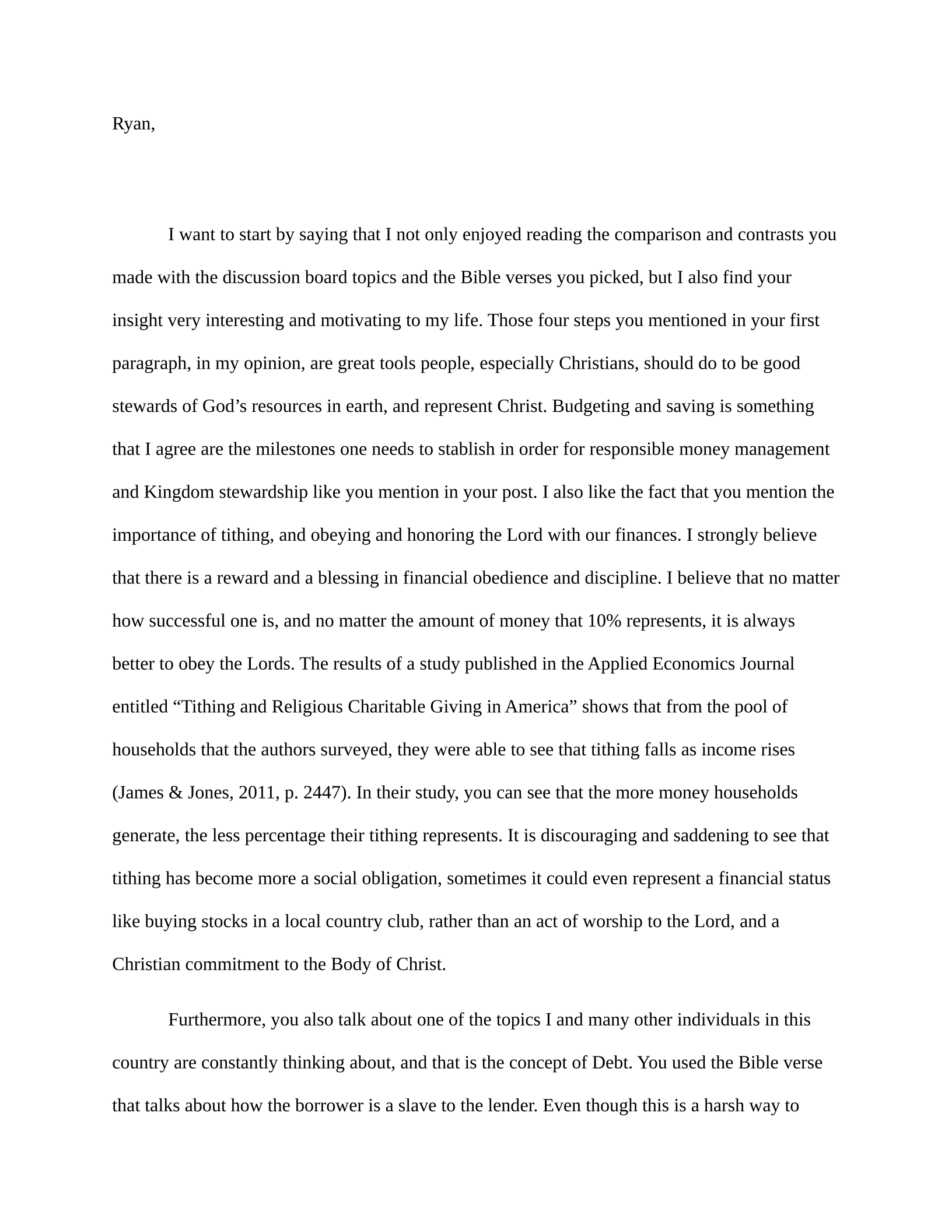
Ryan,
I want to start by saying that I not only enjoyed reading the comparison and contrasts you
made with the discussion board topics and the Bible verses you picked, but I also find your
insight very interesting and motivating to my life. Those four steps you mentioned in your first
paragraph, in my opinion, are great tools people, especially Christians, should do to be good
stewards of God’s resources in earth, and represent Christ. Budgeting and saving is something
that I agree are the milestones one needs to stablish in order for responsible money management
and Kingdom stewardship like you mention in your post. I also like the fact that you mention the
importance of tithing, and obeying and honoring the Lord with our finances. I strongly believe
that there is a reward and a blessing in financial obedience and discipline. I believe that no matter
how successful one is, and no matter the amount of money that 10% represents, it is always
better to obey the Lords. The results of a study published in the Applied Economics Journal
entitled “Tithing and Religious Charitable Giving in America” shows that from the pool of
households that the authors surveyed, they were able to see that tithing falls as income rises
(James & Jones, 2011, p. 2447). In their study, you can see that the more money households
generate, the less percentage their tithing represents. It is discouraging and saddening to see that
tithing has become more a social obligation, sometimes it could even represent a financial status
like buying stocks in a local country club, rather than an act of worship to the Lord, and a
Christian commitment to the Body of Christ.
Furthermore, you also talk about one of the topics I and many other individuals in this
country are constantly thinking about, and that is the concept of Debt. You used the Bible verse
that talks about how the borrower is a slave to the lender. Even though this is a harsh way to
portray this reality, it is a very simple way to see it. The other side on this principle is that in
today’s day and age, especially in this country, debt and credit is almost necessary for living. The
current application of this Bible passage, in my opinion, could be translated o responsible debt. I
believe that you do become a slave of the lender when all you do is work and work to be able to
pay debt, when in the first place maybe you should have not gotten into that debt. This is why I
agree with you that budgeting is so essential, because it lets you see what you can afford. An
article from the Perspectives on Psychological Science journal says that their studies shown that
“People have a tendency to underpredict future expenses, rely too heavily on values presented on
billing statements, and fail to take into account overall wealth by categorizing debt and saving
into separate mental accounts” (Hershfield et al., 2015, p. 751). It is very sad to see people
failing financially because of bad money management and lack of professional advice. However,
this happens when people do not organize their priorities. The Bible says that one needs to first
get the fields ready, and then build the house (Proverbs 24:27, ESV, 2001). This principle shows
us that there is an order for everything. I believe that we need to make sure that our income and
our resources are secure and ready, in other words, that the fields are ready, and then after that is
when we can make the move on completing a financial transaction, or how the Bible describes it
as building the house.
References
English Standard Version. (2001). ESV Online Bible. ESV.org
Hershfield, H. E., Sussman, A. B., O’Brien, R. L., & Bryan, C. J. (2015). Leveraging
psychological insights to encourage the responsible use of consumer debt. Perspectives
on Psychological Science, 10(6), 749-752. https://doi.org/10.1177/1745691615598514
James, R. N., & Jones, K. S. (2011). Tithing and religious charitable giving in America. Applied
Economics, 43(19), 2441-2450. https://doi.org/10.1080/00036840903213384
Bonn,
I like the route you took on developing this discussion board. I also talked about
stewardship, and hos it is not only a financial principle, but also most importantly a Biblical
principle. I must say that I totally agree with you and with the Bible when it says that when we
are faithful in the little, we will be entrusted in bigger things. I have not only seen this Biblical
promise in my family and friends, but I have experienced it myself. It is refreshing to see how
the Lord keeps these promises true through the ages. This principle could be also use when
managers, accountants or financial evaluators get together to create or analyze a company’s
financial statements. It is discouraging to understand that it has become common knowledge that
accountants and financial professionals have become less ethical and have lost their integrity.
This is why an article published by the Journal of Accounting Finance and Auditing Studies
suggest that the presence of independent commissioners, especially in a large corporation, is not
enough to ensure integrity in processes; they propose a larger participation of independent
commissioners, shareholders and company management (Pradika & Hoesada, 2019, p. 73). In
other words, because individuals in multiple corporations have not been faithful in the little,
upper management has had to entrust these type of processes to outside and independent auditors
that can be trusted.
Another topic you talked about is the importance of saving in fruitful times so that when
drought comes, we are prepared. Although we cannot ensure what will happen in the future, we
can certainly look at the past as historical evidence for how we need to get ready and prepared
for possible and probable future scenarios. This is why that the Church, as the body of Christ,
comes together and cooperate with one another. In a bigger scale, I believe that countries need to
work together so that, and using your words, when the next pandemic happens the worlds is
financially more stable and prepare so be able to support their population. An article from the
Journal of Risk Management in Financial Institutions say that reducing global trade can
“partially offset the benefits of geographic diversification” (Douglas, 2017, p. 317). In other
words, we will see less success if we create individual preparedness instead of global and
cooperative-based preparedness. I believe that building wealth together will make not only a
stronger economy, but ultimately will lead countries and communities to invest in opportunities
that will positively affect the growth of the next generations. The Bible says that, “Two are better
than one, because they have a good reward for their toil” (Proverbs 4:9, ESV, 2001). In other
words, and once again, when we work together we will see greater rewards, and better
preparedness for future crises.
References
Douglas, E. (2017). Risk management for financial institutions in an age of populism. Journal of
Risk Management in Financial Institutions, 10(4), 314-318.
https://www.ingentaconnect.com/content/hsp/jrmfi/2017/00000010/00000004/art00002#
English Standard Version. (2001). ESV Online Bible. ESV.org
Pradika, E., & Hoesada, J. (2019). Integrity of financial statement: Big and independent are not
guarantee. journal of accounting finance and auditing studies (JAFAS), 5(1), 59-79.
https://doi.org/10.32602/jafas.2019.3
Powered by TCPDF (www.tcpdf.org)

