


Quality of Working Life
One of the most interesting approaches to motivation is the QWL program, which is a
systems approach to job design and a promising development in the broad area of job
enrichment, combined with grounding in the socio-technical systems approach to
management. QWL has received enthusiastic support from a number of sources. Managers
have regarded it as a means of dealing with stagnating productivity especially in the U.S. and
Europe. Workers and union representatives have also seen it as a means of improving
working conditions and productivity and as a means of justifying higher pay. Government
agencies have been attracted to quality to as a means of increasing productivity and reducing
inflation and as a way of obtaining industrial democracy and minimizing labor disputes
(Mullins, 1996).
Job Enrichment
In job enrichment factors such as challenge, achievement, recognition and responsibility are
seen as the real motivation. Job enrichment is the attempt to build into jobs a higher sense of
challenge and achievement. Jobs may be enriched by:
i. Job variety and by giving workers more freedom to decide about such things as work
methods, sequence and pace or the acceptance or rejection of materials.
ii. Encouraging participation of subordinate and interaction between workers.
iii. Giving the workers a feeling of personal responsibility for their risk.
iv. Taking a step to make sure that the workers can see how their task contributes to a
finished product and the welfare of the enterprise.
v. Giving people a feedback on their job performance preferably before the supervisor
gets it.
vi. Involving workers in the analysis and change of physical aspect of the work
environment such as office layout or plant temperature, lighting and cleanliness

(Mullins, 1996)
Motivation/Performance Relationship
The link between performance and motivation is a positive one; increased motivation results
in more effort and improved performance. However, it can be argued that while higher
motivation will produce better performance, improvements in performance will increase
motivation due to resulting sense of achievement.
Figure 2: Motivation/Performance Relationship
y
P
x
KEY:
P-
Performance
M- Motivation
Motivation influences performance, for example when feedback is communicated to the
employees or mostly when recognition of achievement of an individual‟s performance is
realized then the output of the individual is likely to increase. Motivation has that
attractiveness of certain kinds of rewards, which performance (Miner, 1980).
Productivity expresses the relationship between output from systems and inputs, which go
into their creation. Performance is related to productivity when productivity is used as a
means of measuring actual operations thus used as a way of analyzing and evaluating
M

performance.
Productivity is the relationship of output to input i.e. productivity = Output
Input
If positive attitudes are developed, then productivity will increase, therefore, improved
motivation leads to high productivity (Miner, 1980).
Review of Empirical Data
Drawing from studies conducted by other researchers, several motivational factors are
suggested as possible contributors to the poor performance of organizations in general.
Ochola and Ngige (2002) portrays employee satisfaction and motivation as major influences
on employee on performance in general. The two go further to reveal that job enrichment
factors such as challenge, achievement, recognition and responsibility are the real motivators.
However, Mullins (1996) argues that, giving people a feedback on their job performance
preferably before the supervisor gets it, involving workers in the analysis and change of
physical aspects of work environment such as office layout or plant temperature, lighting and
cleanliness leads to positive and improved performance in organizations.
Conceptual Framework
The model below illustrates some of the motivating factors which affect organizational
performance. These factors will form the independent variables of the study and will be
manipulated to positively or negatively affect the dependent variable, which is organizational
performance. These independent variables have been broadly covered in the literature
review.
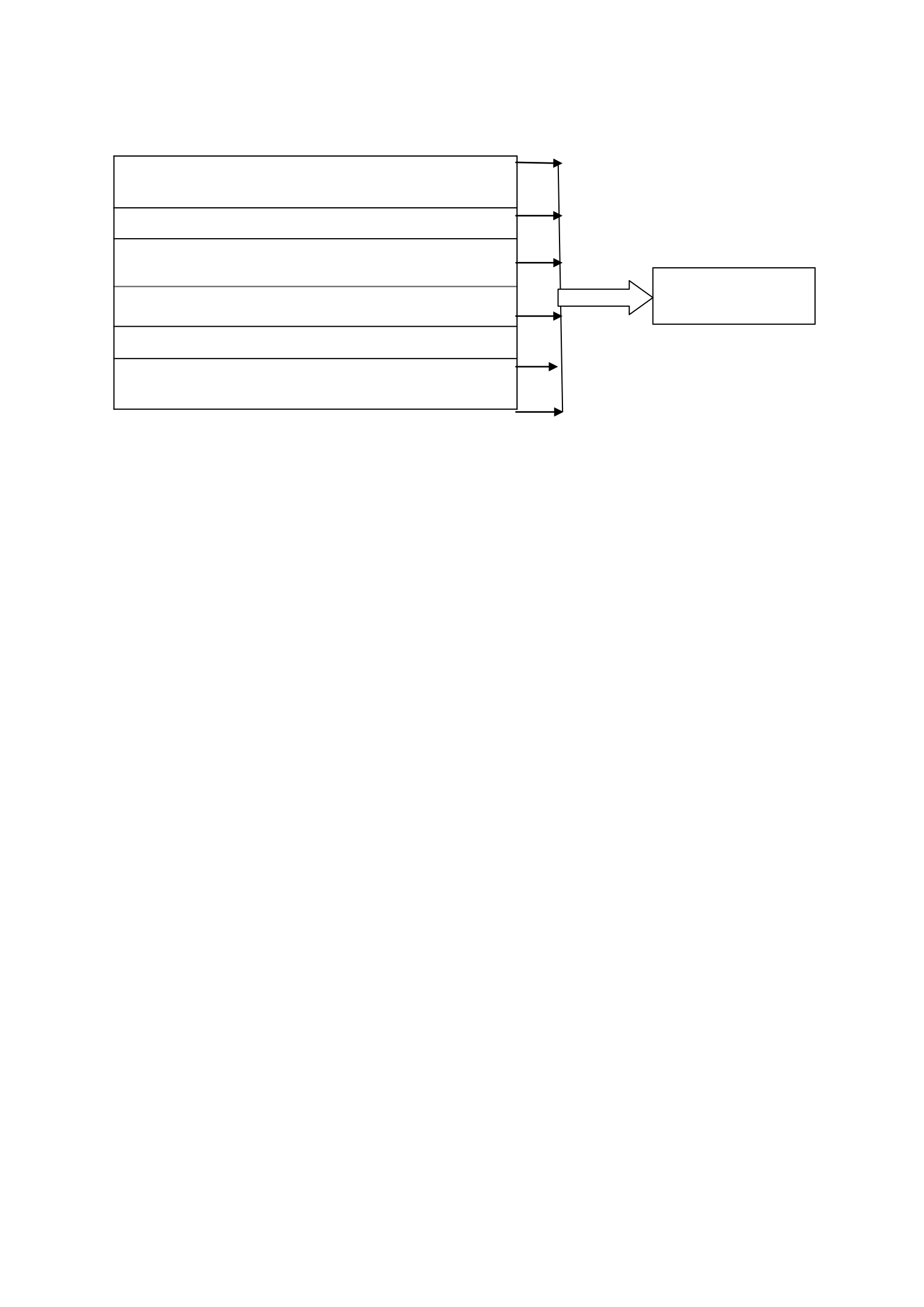
Affects
Organizational
performance
Figure 3: The Conceptual Framework
Employee Reward and Compensation
(Money)
Employee Participation
Training
Job Enrichment/Satisfaction
Responsibility/Recognition
Quality of Working Life /Fulfillment
Independent Variables Dependent Variable
Source: Researcher, (2022)
REFERENCES
Alderfer C (1972). Existence Relatedness and Growth. 4th Edition. Collier Macmillan
London.
Armstrong M (1992). Human Resource Management Strategy and Action. 2nd Edition. Ltd
London.
Armstrong M (1996). A Handbook of Personnel Management Practice. Kogan
Cole G. A. (1995). Management Theory and Practice, DP Publishers, New York, USA.
Cole G. A. (1996). Management Theory and Practice. 5th Edition. Ashford Color Press
London.
Curtis C. W. (1982). Guidelines For Managing Motivation. 3rd Edition. South Western
Publishing Company pg 373.
Beach D. S. (1980). Managing People at Work. Macmillan Publishing Co. Inc. New York,
USA.

Davis E. L & Cherns B. A (1975). Quality of Working Life. 4th Edition. Free Press New
York.
Gary Dessler (2000). Human Resource Management. 7th Edition. Prentice Hall, Inc
Douglas H. J. and Hall N. K. (1968). An Examination of Maslows Hierarchy in an
Organizational Setting, Organization Behavior and Human Performance. 5th
Edition pg 12 – 35.
Herzberg F. (1974). Work and the Nature of Man. Granada Publishing. New Jersey
USA. Herzberg F. (1959). The Motivation to Work. 2nd Edition. John Wiley‟s. London.
Reynolds L. G. (1978). Labor Economics and Labor Relations. Prentice Hall Ltd., London.
Foulks L. (2001). Managing People, Foulks lynch Ltd, London
Mamoria C.B (1992). Personnel Management. Himalayan Publishing House.

Miner B. J. (1980). Theories of Organizational Behaviour. 4th Edition. Chinspale III
Drypress, Istanbul pg 40-45
Mullins L. J. (1996). Management and Organizational Behavior, Prentice Hall. London,
UK. NSSF, (2004). Members Guide Book Nairobi, Kenya.
Ochola B.O. P & Ngige W. L. (2002). SCV 600 Research Methods. Institute of
Open Learning. Kenyatta University, Nairobi.
Warentho O. T. ( 2003). CBA 503: Organizational Behaviour. Institute of Open Learning,
Kenyatta University, Nairobi
Weihnrich H. (1993). Management. A Global Perspective. 2nd Edition. McGraw Hill
Inc U.S.A.

