


1. Define organizational behavior (OB)
The systematic study of the actions and attitudes that people exhibit within organizations
2. Discuss three goals of OB:Explanation、Prediction、Control
3、Discuss why work force diversity is an important issue in management
4、OB:
(1)Actions or Behaviors :Productivity 、Absenteeism 、Turnover 、Organizational citizenship
Behavior
Organizational citizenship Behavior
Examples:
•Helping others in the work team
•Volunteering for extra job activities
•Avoiding unnecessary conflicts
•Making constructive statements about workgroup and overall organization
(2)Attitudes:Job Satisfaction
•Possible link between satisfaction and productivity
•Satisfaction appears to be negatively related to absenteeism and productivity
•Humanistic responsibility to provide employees with challenging, intrinsically rewarding,
and satisfying jobs
5、Organization
•Consciously coordinated social unit
•Composed of two or more people
•Functions to achieve a common goal or set of goals
•Formal roles define and shape the behavior of its members
OB Encompasses Behavior in Diverse Organizations
•Manufacturing
•Service firms
•Schools
•Hospitals
•Churches
•Military units
•Charitable organizations
•Local, state, and federal government
agencies
6、Levels of OB Analysis
Individual Level、Group Level、Organization System Level
CHAPTER 2
1、Personality:The sum total of ways in which an individual reacts to and interacts with others
Most often described in terms of measurable traits that a person exhibits, such as shy, aggressive,
submissive, lazy, ambitious, loyal and timid.
2. Measuring Personality Traits: Myers-Briggs Type Indicator
•Most widely used personality-assessment instrument in the world
•Individuals are classified as:
Extroverted or Introverted (E/I)
Sensing or Intuitive (S/N)
Thinking or Feeling (T/F)

Judging or Perceiving (J/P)
•Classifications combined into 16 personality types (i.e. INTJ or ESTJ)
•Unrelated to job performance
3、Measuring Personality Traits: The Big-Five Model
•Five Traits:
Extraversion
Agreeableness
Conscientiousness
Emotional Stability
Openness to Experience
•Strongly supported relationship to job performance (especially Conscientiousness)
4、Major Personality Attributes Influencing OB
•Core self-evaluation
Self like/dislike
•Type A personality
Competitive, urgent, and driven
•Self-monitoring
Adjusts behavior to meet external, situational factors
•Proactive personality
Identifies opportunities, shows initiative, takes action and perseveres
5、Value Systems
•Represent a prioritizing of individual values by:
Content – importance to the individual
Intensity – relative importance with other values
•The hierarchy tends to be relatively stable
•Values are the foundation for attitudes, motivation, and behavior
•Influence perception and cloud objectivity
Rokeach Value Survey
•Terminal values
refers to desirable end-states of existence.Goals that a person would like to achieve
during his or her lifetime
•Instrumental values
refers to preferable modes of behavior, or means of achieving the terminal values
Examples of Terminal Values
•A comfortable life (a prosperous life)
•An exciting life (stimulating, active life)
•A sense of accomplishment (lasting contribution)
•A world of peace (free of war and conflict)
•A world of beauty (beauty of nature and the arts)
•Equality (brotherhood, equal opportunity for all)
•Family security (taking care of loved ones)
•Freedom (independence, free choice)
•Happiness (contentedness)
Examples of Instrumental Values
•Ambitious (hard working, aspiring)
•Broad-minded (open-minded)
•Capable (competent, efficient)
•Cheerful (lighthearted, joyful)
•Clean (neat, tidy)
•Courageous (standing up for your beliefs)
•Forgiving (willing to pardon others)
•Helpful (working for the welfare of others)
•Honest (sincere, truthful)
6、Contemporary Work Cohorts
C E the W D W V
Veterans 1950s or early 1960s Hard working, conservative, conforming; loyalty to the organization
Boomers 1965-1985 Success, achievement, ambition, dislike of authority; loyalty to career
Xers 1985-2000 Work/life balance, team-oriented, dislike of rules; loyalty to relationships
Nexters 2000 to present Confident, financial success, self-reliant but team-oriented;
loyalty to both self and relationships
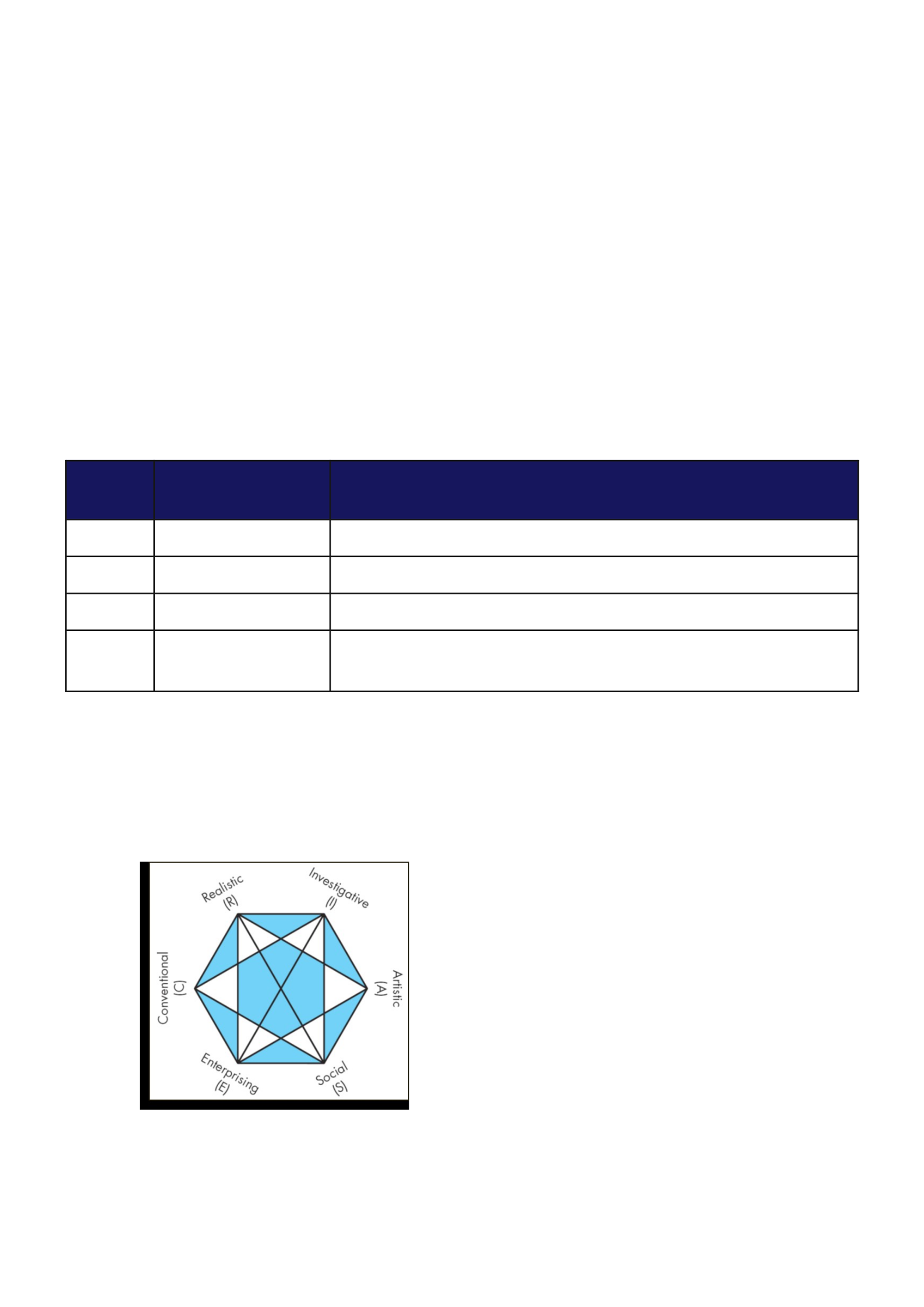
7、Personality-Job Fit: Holland’s Hexagon
•Job satisfaction and turnover depend on congruency between personality and task
Fields adjacent are similar
Field opposite are dissimilar
•Job satisfaction and turnover depend on congruency between personality and task
Fields adjacent are similar
Field opposite are dissimilar
•It is more important that employees’ personalities fit with the organizational culture
than with the characteristics of any specific job.

•The fit predicts job satisfaction, organizational commitment and turnover.
8、Hofstede’s Framework for Assessing Cultures
Five factors:
Power Distance
Individualism vs. Collectivism
Masculinity vs. Femininity
Uncertainty Avoidance
Long-term vs. Short-term Orientation
●Individualism and collectivism orientation: whether activities are carried out as individuals or as
a group;
●Power distance acceptance: the degree of acceptance or rejection of power distribution and
status differences;
●Quantity of life and quality of life: the former refers to people's emphasis on money and
material benefits, and the latter refers to people's emphasis on interpersonal relationships and
their sensitivity and concern for the happiness of others;
●Uncertainty avoidance: the degree to which a country's people tolerate risks and non-routine
situations;
●Short-term and long-term orientation: the degree to which they focus on the past, present or
future

