



Bible 450 – Daniel Notes
Introduction to Daniel
Chapter 1, 8-12 written in Hebrew
Chapters 2-7 written in Aramaic/Syriac
Chapter 2: Statues – 4 Empires/ Chapter 7 Beasts – 4 Empires
Chapter 3: Fiery Furnace/ Chapter 6: Lion’s Den
Chapter 4: King Repents/ Chapter 5: King Not
Chapters 1, 8-12: Jewish/Israel
Chapter2-7: How the gentile kingdoms deal with the Jews
Daniel 1-6: Personal Story
Daniel 7-12: Prophetic Messages
o4 Visions (7,8,9,10-12)
oAbout Israel and its future
oPersonal Hope for Daniel
oPersonal Resurrection for Daniel
Jewish – Gentiles – Jews
25 % of the Bible is prophetic
o“Daniel” means “God is my judge”
oA statesman and prophet during the sixth century
oLived during Babylonian captivity and the beginning of the Persian era (from 15-
85 years old.)
oWas the contemporary of Jeremiah and Ezekiel
Daniel was captured in 605
Ezekiel was captured in 597
Jeremiah was captured in 586
Background of Daniel
Babylonian setting indicated by language, culture and history of Neo-Babylonian empire
Nebuchadnezzar’s rule (605-562)
Genre of the Book
Court Narrative: (Daniel 1-6): These narratives have a clear purpose in revealing Gods
plan and Gods instruction on how to live in a context of oppression (Examples in Old
Testament: Joseph and Moses)
Apocalyptic Prophecy: (Daniel 7-12): Only non-disputed apocalypse in the Old
Testament; looks beyond historical process in the “end times”
Authorship and Date

Traditional Scholarship has held that Daniel wrote the book and the prophecy is
historically reliable, and its predictions are supernatural and accurate.
Critical Scholarship: has challenged the tradition view by suggesting that the book in its
present form was produced by an anonymous Jew under the pseudonym Daniel in the
second century.
Critical Position Rational
oOften labeled as the Maccabean thesis”
oLatest of the written Old Testament scriptures
oAuthorship prescribed to second-century writer as a member of religious sect
known as the Hasidim (church leaders)
oPurpose of writing was to encourage Jewish believers in their struggle against the
tyrant Antiochus IV Epiphanes (175-163 BC)
oDaniel exhibited extensive knowledge of sixth-century events that would seem
impossible for a second-century writer
oDaniel does not present a hostile view toward authorities (inconsistent with
Maccabean setting)
oOrigin of Persian words in Daniel indicate setting before 300 B.C.
oAramaic does not conform to later usage
o20 Fragments from Qumran of Daniel
oNine complete manuscripts of Daniel from Qumran
oHighly unlikely that the book of Daniel composed during this same period (2
nd
century)
Daniel was not a prophet, not in the prophetic section in the Hebrew Bible but in the
writer’s section. This is due to the fact that half of the Book of Daniel is about History, half
is prophecy.
Structure of the book
Gods rule in Brining Daniel to Babylon (Dan. 1)
Gods Rule over world Empires (Dan. 2-7)
Gods rule over Israel’s future (Dan. 8-12)
Theological themes in Daniel
The sovereignty of God
The Messiah
The Kingdom of God
Pride and its destructive forces

DANIEL 1 - The training of Daniel in Babylon
Background
At some point between the defeat of the Egyptians at the battle of Carchemish in May-
June 605 BC and the death of his father Nabopolossar
The Babylonian Chronicle, Nebuchadnezzar’s Cylinder
Cultural Assimilation in Babylon (named after the Babylonian Gods) Jewish – Babylonian
Names
Daniel – Belteshazzar
Hananiah – Shadrach
Mishael – Meshach
Azariah – Abednego
*KNOW THE JEWISH NAMES*
*DANIEL 1:8* - “But Daniel resolved not to defile himself with the royal food and wine, and he
asked the chief official for permission not to defile himself this way.”
This scripture sets the tone for the book of Daniel. This is the beginning of the lifetime of
integrity throughout the book of Daniel. God keeps intervening throughout chapter 1 in Daniel
Overview that the teens did the right things and the Lord proves them worthy to the King.
Structure of Daniel 1
Numbers in Daniel/Revelation
Gentiles: 4/Worldly Matters
Israel: 7/Heavenly Matters
They were already detached from their immediate authority (Their parents and priests). Now
they are only with their peers, while they were still under pressure.
Daniel is brought to Babylon (Dan. 1:1-5)
The decision of Daniel in Babylon (Dan. 1:6-16)
The progress of Daniel in Babylon (Dan. 1:17-21) (“They entered into the kings service”)
Theological Implications
God is in control of world events (Daniel 1:2 “the Lord handed Jehoiakim”)
Godly people must decide the appropriate level of cultural assimilation (Kosher Diet)
God rewards those who strive toward fidelity to Him (Purposed in his heart)

Daniel Chapter 2: Nebuchadnezzar’s Dream of the Great Image
Ancient Dream Report
A diviner normally interpreted a dream by consulting a book of “dream omens” in which
the significance of different things and events might be seen in a dream were recorded.
Daniel does not do this but rather relies directly on God to give him the interpretation
Structure of Daniel 2
The receiving of the dream (Dan. 2:1-9)
The recovery of the dream (Dan. 2:10-23)
The revelation of the dream (Dan 2:24-35)
The interpretation of the dream (Dan. 2:36-49)
The text switches from Hebrew to Aramaic in Daniel 2:5 through chapter 7
Mielah – Aramaic word for command
Asda – Aramaic word for from mouth
Daniel 2:16 “God of Heaven”
Daniel always points people back to God. It wasn’t Daniel that interpreted the dream, it was God
giving it to him.
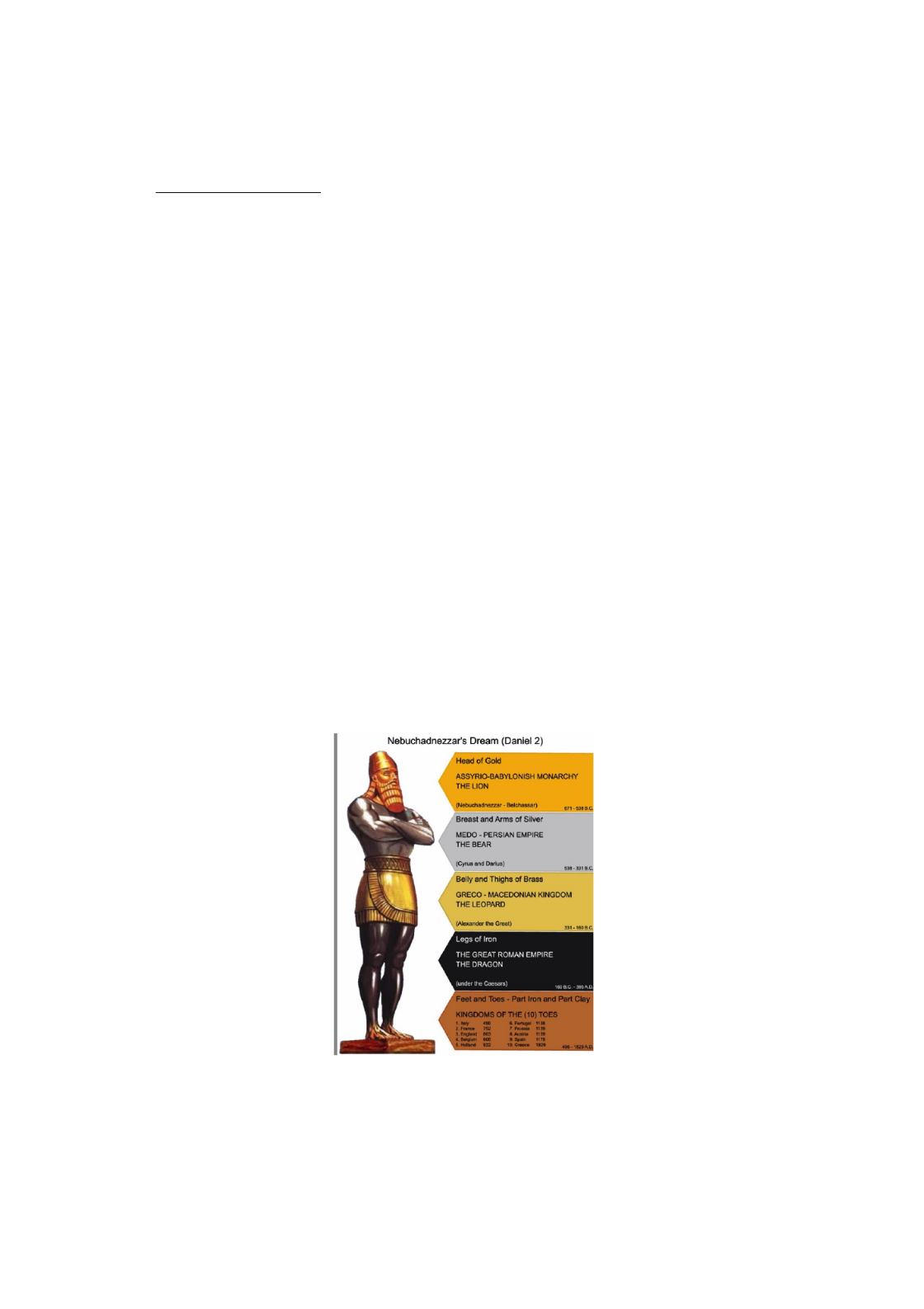
“It struck the statue on the feet” Daniel 2:34
He has feet of clay saying comes from this.
The stone represents the kingdom of God, and it crushes the statue and takes over, replaces it
with God’s kingdom. A prophecy of the second coming of Christ.
Gold – Babylon/Winged Lion
Silver – Mediapersia/Lopsided Bear
Brass – Greece/4-Winged Leopard
Iron – Rome/ 10-Horned Monster with Iron teeth
Iron and Clay – Divided kingdoms
Stone cut out without man’s hands – Judgement
Stone fills whole earth – Christ’s kingdom
All four empires deal with Israel and the Jews
The Babylonians destroyed (Solomon’s) First Temple
The Persian allowed them to build the second temple (under Cyrus)
The Romans destroyed the second temple
Theological Implications
God is able to get the attention of the leaders of the world
God is able to use godly people to communicate His truth to the leads of the world.
Gods kingdom will be victorious over all the kingdoms of the world.
The stone is of divine origin. It does not fall on the top four places of the statute but on
the ten toes where the statue is most vulnerable.
Aramaic Word – Kacheda “At once” (About the stone crashing the feet)
Pre-Millennial – Literal Return and Literal Kingdom
Post-Millennial – Church is already in the millennial/Christ is already ruling, church is to
bring in the kingdom on earth before Jesus can return
Amillennialism – it is all spiritual, not an actual kingdom, just spiritual talk
oCatholic – Pope and Roman Church will bring in the Kingdom (Sub-ruler/ Vicar for
Christ here on earth)
oPost-Millennium Reform – Imposing Christian legal standards on society
(reconstructionism – reconstruct society by law, make people behave like
Christians or penalize them)
oPentecostal/Charismatic – A great revival will cause this to happen
Daniel 2:47 “FUTURE” Daniel 2:49 “Daniel remained at the high court” – This is why Daniel
doesn’t end up in the fiery furnace. Daniel was not at the dedication of the statue; he was still
in the royal court.

Daniel Chapter 3: Daniel’s Three Friends in the Fiery Furnace
90 x 9 Ft.
60 x 6 Cubits – 18 Inches
The king is the autocrat over everybody over him, repetition shows this is the Babylonian
system – Daniel 3:2
Greek terms (Lyre) – 6 century
th
oMusical instruments imported from Greece into Babylon
Persian Terms (9 words) – Governmental terms
Anti-Semite (Jew) – The astrologers wanted to get rid of the Jews
Three obstacles to evangelizing with Jews
oThe deity of Christ
oThe history of Christian treatment of Jews
Crusades, Inquisitions, Holocaust
oAnti-Semitic attitude throughout the world
oDo they have to give up their Jewishness to become a Christian?
Governmental Structure in Babylon
Senior Officials
oSatraps
oPrefects
oGovernor’s
Secondary Officials
oAdvisors
oTreasurers
oJudges
oMagistrates
Plain of Dura
Likely an area outside the city but close to a fortified wall
Duru means “Walled Place”
Ancient Instruments
Wind Instruments
oHorn
oFlute
String Instruments
oZither
oLyre
oHarp
Either specific instrument or an ensemble playing together

oPipes, drum, dulcimer, full consort (disagreement between translations)
Structure of Daniel 3
The erection of the golden image (Dan 3:1-7)
The accusation against the three friends (Dan 3:8-12)
The examination of Nebuchadnezzar (Dan 3:13-18)
The experience of the fiery furnace (Dan 3:19-30)
“Able to deliver us” – Daniel 3:17
“But even if He does not” – Daniel 3:18
Sovereign God – God is able to … me, but if He does not He is still God.
Able to deliver,
But if NOT…
oKeep the balance with what God wants to do
Aramaic Word – Levar Elahin “sons of God”
KJV – Son of God
Angel? Christ?
Theological implications
Pride brings about harmful results
Godly people must have faith in God in difficult situations
God is able to save his people from harm but does not always choose to do so.
Daniel Chapter 4: Nebuchadnezzar’s Dream of the High Tree
Structure of Daniel 4
The circumstances of the dream (Dan. 4:1-9)
The content of the dream (Dan 4:10-18)
The interpretation of the dream (Dan 4:19-27)
The fulfilling of the dream (Dan 4:28-37)
“Stump”
“7 times” – 7 Years
At what point does this dream occur and how does it relate to the destruction of Jerusalem in 586
BC?
Daniel Chapter 5: Belshazzar’s Feast
Who is Belshazzar?
Son and Coregent of Nabonidus
Belshazzar was the ‘acting king’ even though his father was the actual king

Daniel is aware of this fact (Dan. 5:7,16,29 “The third highest ruler in the kingdom”)
Who is Nabonidus?
Last king of the Neo-Babylonian empire (556-539 BC)
Had an extended stay in Teyma (an important oasis for Arabian trade)
Known for his archaeology; excavating ancient buildings and displaying his
archaeological discoveries in a museum
Worshipped the moon god, Sin
Nabonidus’ Cylinder
Describes how he repaired three temples: the sanctuary of the moon god Sin in Harran,
the sanctuary of the warrior goddess Anunitu in Sippar, and the temple of Samas in
Sippar
The terms “father” and “son”
Numerous suggestions have been offered to explain the father-son relationship between
Nebuchadnezzar and Belshazzar
oLeopold suggested that the new king may have taken a wife of Neb. Who had
already had a son by the kind and adopted the child
oArcher suggested that Nabonidus may have married a daughter of Neb. making
Belshazzar the earlier king’s grandson
A less complicated solution is the term “son” merely means successor
The Black Obelisk of Shalmaneser lll calls Jehu “son of Omri” although Jehu is not a
descendent of Omri (son can unquestionably used as a successor)
Cyrus the Great
Overthrowing the Median King Astyages (in 550 BC) instituted the Persian Empire
Defeated Babylonian Empire under Nabonidus (539/538 BC)
Cyrus’ Cylinder (The Fall of Babylon)
“In the month of Tishri when Cyrus did battle …the people of Akkad retreated. On the
fourteenth day … Nabonidus fled. On the sixteenth day … the army of Cyrus entered
Babylon without a battle
2 Chronicles 36:22-23 and Ezra 1:1-4
Who is Darius the Mede? – Possible Identifications
Same person as Cyrus the Great
A fictional person
The Persian King Darius l (problem with dates – reigned during 522 to 486 BC)
The uncle and father in-law of Cyrus the great

Goyryas is mentioned in the Cyropedia of the Greek historian Xenophon as a general
who actually led Cyrus’s army that captured Babylon (Goyryas = Darius)
Structure of Daniel 5
The description of the feast (Dan 5:1-4)
The handwriting on the wall (Dan. 5:5-12)
The interpretation of the writing (Dan. 5:13-28)
The consequences of the feast (Dan 5:29-31)
Condemnation: “God has numbered your kingdom and finished it (Ch. 5)
Feast (5:1-4)
Fingers (5:5-16)
Fiasco
oNumbered - mene
oNumbered - mene
oWeighed - tekel
oDivided – peres
Finality
Theological Implication’s
It is unwise to flaunt our ungodliness
It is unwise to fail to deal with a serious threat
A day will come where God will deal with us according to our sin
Jesus wrote with his hand three times throughout the Bible – not what he wrote but that he wrote
Law
Judgement
Grace
Daniel 6: Daniel in the Lion’s Den
Introductory issues of Daniel Chapter 6
The prominence of Daniel (Dan 6:1-3)
The plot against Daniel (Dan 6:4-9)
The prayer of Daniel (Dan 6:10-17)
The protection of Daniel (Dan 6:18-28)
Trial by Ordeal
Accusation – Survive – Trial
Corporate personality
Group – individual

Theological Implications
God is able to turn the evil intentions of others as an opportunity for our faith
God is able to turn the evil intentions of others as an opportunity to display his
deliverance
God uses all situations in an attempt to bring more people to worship him
Daniel Chapter 7: The Four Kingdoms and the Little Horn
Lion – Babylon
Bear – Meads/Persians
Leopard – Greece (Four Generals of Alexander) – Antiochus
Beast – “Iron Teeth” = Iron Legs on statue, “Ten Horns” – Rome - Horn
Change of Genre – (Daniel 7-12)
Apocalyptic Prophecy
o(Daniel 7-12) – Only non-disputed apocalypse in the Old Testament; looks
beyond historical process to the “end times”
Chronology of the book
This apocalyptic book vision occurs during the first year of Belshazzar king of Babylon
(553 BC)
Structure of Daniel 7
Daniels vision (Dan 7:1-8)
The ancient of days and Son of Man (Dan 7:9-15)
The interpretation of the vision (Dan 7:16-27)
Concluding Remark (Dan 7:28)
Lion with Eagles Wings
The Nation of Babylon
This symbol was placed on the gates of Babylon
Lopsided Bear
The nation of Media-Persia
Three ribs – Babylon, Lydia and Egypt
Leopard with four heads and four wings
The Nation of Greece
Four Generals – After Alexander the Great died
oAntigonus (Syria – Antioch)

oPtolemy (Egypt – Cleopatra)
oLysimacus
oCassander
Monster with Iron Teeth
The nation of Rome
10 horns – divisions of the Roman empire
“Little Horn” – Anti-Christ
Ancient of Days – God the Father on the throne, White represents purity and holiness
Revelation 4 = Daniel 7
Only that which is Holy and divine is worthy of praise and worship – Agios and Axios – (Greek
for Holy and Worthy) Worship = Worth-Ship
Anti-Christ Profile
Emerges from the roots of the Roman Empire
Great Orator
Military Genius
Promises Peace
Persecutes the saints
Ancient of Days and Son of Man
Ancient of Days – God the Father
Son of Man – God the Son (Jesus)
See Revelation 1:13, 14, 5:5, 11 and Matthew 11:30, 24:30
Theological Implications
The kingdoms of the earth will become more sinful as time progresses to the end
The Anti-Christ will eventually arrive and take his stand against God
Gods kingdom will prevail over the kingdoms of the world
The Aramaic Section: Daniel 2-7 Chiasm
Daniel 2: Dream of Metallic Statue
oDaniel 3: Fiery Furnace
Daniel 4: Nebuchadnezzar’s Failure
Daniel 5: Belshazzar’s Failure
oDaniel 6: Lion’s Den
Daniel 7: Vision of Coming Beasts

The Hebrew Section: Daniel 8-12 Visions of the End (About the Jews that’s why they are in
Hebrew)
Daniel 8: Ram and Goat
Daniel 9: 70 Sevens
Daniel 10: Angelic Conflict
Daniel 11: Kings of North and South
Daniel 12: The End of Days
Daniel Chapter 8: The Ram, The Male Goat and the Little Horn
Goat coming from the West moving East – Greece – Alexander the Great
oAnother Horn will come out and desecrate the temple within six (6) years
This little Horn is Antiochus IV Epiphanes
Ram coming from the East moving West – Persia
Judah caught in the middle
Chronology of the book
This apocalyptic vision occurs during the third year of King of Belshazzar
Daniel receives this vision in Susa
Structure of Daniel 8
The ram and male goat (Dan 8:1-8)
The little horn (Dan 8:9-14)
The interpretation of the vision (Dan 8:15-27)
The Ram and Male Goat
Ram with two horns – Media-Persia
Goat with one horn – Greece (Alexander the Great)
Four Notable Ones – 4 Generals of Alexander the Great
oMacedonia and Greece
Ruled by Cassander
oThrace and Asia Minor
Ruled by Lysimachus
oNorthern Syria, Mesopotamia and regions to the east,
Ruled by Seleucus
oSouthern Syria, Palestine and Egypt
Ruled by Ptolemy
The Little Horn
Little horn – Antiochus IV Epiphanes

A Type of the Antichrist
First Temple – Solomon in 586 BC
Second Temple – Zerubbabel 515 – Herod – 70 AD
No Third Temple Yet
2,300 Evening and Mornings? – 3 Possible Options
Option #1
oAntiochus had pagan sacrifices offered in the temple on the 15 of Chislev and
th
the Jews consecrated the temple on the 25 of Chislev (Hanukah) but he had
th
stopped Jewish rituals sometime before the 15 of Chislev
th
Option #2
oOthers suggested it is the period between the removal of the High Priest Onias III
from office
Option #3
oThis occurred between the fall of 170 BC and December 25 164 BC when the
th
temple was restored and rededicated after being polluted by Antiochus IV
(Epiphanes)
oAlso, the number may have symbolic meaning that is now not clear to us
Javan (Hebrew for Greece) – First time Greece is mentioned in the Bible Daniel 8:21
Theological Implications
Human conflict and struggle will continue on until the end of time
The final conflict will be Satanic in nature as the Anti-Christ stands against God and His
people
Three Key things predicted in this passage – in 550 BC
Persia would conquer Babylon
Greece would conquer Persia
A Greek king would desecrate the Temple
Daniel Chapter 9: 70 Sevens (Most Important Prophecy in Daniel)
Prophecy of Jeremiah (Dan 1-3)
Prayer of Daniel (Dan 4-19)
Prediction of Gabriel (Dan 20-27)
Chronology of the Book
This apocalyptic vision occurs during the first year of Darius, son of Ahasuerus, who was
a Mede by birth and ruler of the Chaldeans (539/538 BC)

Structure of Daniel 9
Prophecy of Jeremiah (Dan 9:1-2) – Written in 586 BC read by Daniel in 538/539 BC
Prayer of Daniel: Confession and Intercession (Dan 9:3-19)
Provision of Gabriel (Dan 9:20-23)
Prophecy of the Seventy Weeks (Dan 9:24-27)
Jeremiah 25:12 Jeremiah 29:10
Daniel and his men taken captive – 605 – 535 BC Cyrus releases them (70 Years)
Verse 4 – Israel has sinned and needs to repent
Verse 5 – Plural pronouns over all of Israel
Verse 10 – The Prayer shifts from Southern Kingdom of Judea, but all of Israel
Verse 11 – Blessings and Cursing’s from the Law of Moses
Deuteronomy 28:45-47 – (In time of Prosperity you did not serve the Lord joyfully, and
thus, the curses come upon the nation)
Malachi 4:5-6 – Old Testament ends with the threat of a curse
God allows the disaster to happen to the state of Israel, even though the Babylonians and
Nebuchadnezzar were the instruments He uses.
Daniel 9:16 – Your city, Your holy hill – Jerusalem
The name of God is also being reproached, not just the city of Jerusalem
The Prayer identifies the Lord God as a real person who hears, sees etc. = Exodus 3 – Burning
Bush
Daniel is still keeping the time of the Jewish Temple even though it wasn’t still there (during the
time of the evening sacrifice)
Daniel never mentions that Gabriel has wings although he is flying. Most of the angels in the
Bible come in the form of men.
Daniel is highly esteemed – Our works don’t save us, but they are the evidence of salvation
Seventy Sevens are decreed for YOUR people and YOUR holy city – about the Jewish people
and the Jewish temple. The years of transgression are about over
ΤΙΜING PROPHECY
Gen 15 – 400 Years
Jer. 25/29 – 70 Years
Dan. 9 – 70 x 7 = 490 Years

oKJV – 70 Weeks
Hebrew – Shavnah = Heptad
Until the time of the ruler comes
o62+7=69x7= 483 Years
oDecree Rebuild until the Messiah Comes (and is killed)
oTemple that is rebuilt will be destroyed (The second temple)
Second Temple destroyed in 70 AD by the Romans – 4 Empire in Dan.
th
Jesus predicted that not one stone would remain standing – all stones have
been removed
Prince = AC = 7 Years = Tribulation
The Seventy Weeks
70 weeks are divided into 3 groups
o7 “weeks” = 49 Years
o62 “weeks” = 434 Years
o1 ‘week’ = 7 Years
Nehemiah – Death
o445 BC – 32 AD
o444 BC – 30 AD
Major Events of the Seventy Weeks
oFinish the Transgression
oMake an end of sin
oMake reconciliation for iniquity
oBring in everlasting righteousness
oSeal up visions and prophecies
oAnoint the “Most Holy Place”
Theological Implications
God desires for us to seek Him to understand the application of His word
God has a plan/timetable for His world
God controls the future and asks us to trust Him in order to fulfill it
Eschatology – Israel in Prophecy
Creation of God – – “I am the Lord, your Holy One, the CREATOR OF Isaiah 43:15
ISRAEL, your King”

Covenant with Abraham – – “And I will make of you a great nation… Genesis 12:1-3
name… blessing”
oGenesis 15:18 – “Lord made a covenant with Abram … unto your seed I have
given this land”
Confirmation to Isaac – – “Isaac… I will establish my covenant with him Genesis 17:19
for an everlasting covenant and with his seed after him”
Confirmation to Jacob – Genesis 28:3-4
Confirmation to Israel – Genesis 35:10-12
Confirmation with David – 2 Samuel 7:8-16
Concern of the Prophets – Jeremiah 23:5-6, Isaiah 11:10
Question of the disciples – Acts 1:6
Criticism of Replacement theologians –
oFrancis Piper: Lutheran
oAlbertus Pieters: Reformed
oLoraine Boettner: Presbyterian
Compassion of Paul – Romans 10:1, Romans 11:25-27
Clear Distinction – 1 Corinthians 10:32
Eschatology – Return of Christ
Pre-Millennium View: Christ will return before the Millennial and reign in His kingdom
for 1000 years (future 1000-year kingdom)
Post-Millennium View: The Church = The Kingdom, Satan is already bound so the
church is able to go out and preach the Gospel and convert people this is the 1000-year
reign in which will bring the return of Christ after. Kingdom is already here, Satan is
already bound by Rome in 325 will be released in 1325, thus Christ will return.
oPope
oLaw – Theonomy
oRevival
A millennium View: no millennium, Jesus will eventually return at the end of the church
age and take everyone to heaven.
Why Study Prophecy?
1. 25% of the Bible

2. Promised Blessing – Rev 1:3
3. Jesus = Main Subject
a. 1st Coming – 109 different
b. 2nd – 333 different
4. End of Biblical Story
5. Reveals Sovereignty of God over Human History
Daniel Chapters 10-12: Daniel’s Final Vision of the Latter Days
Daniel Chapter 10:1 is the last date given in the book of Daniel
Daniel falls into a deep sleep – A trance almost like that of Adam
Daniel called Highly esteemed again
Christophany – An appearance of Christ in the Old Testament
Daniel 10:14 “…to Your People” for the Israelites and God’s people
Human resistance against the plans of God not only physical but a spiritual war
Book of truth – only time in the Bible this is used
Chronology of the Book
This apocalyptic vision occurs during the third year of Cyrus, King of Persia (536 BC)
Location of Vision
Banks of Hiddekel (Tigris) River in the Province of Babylon
King of the North: Syria – Seleucus in which Antiochus Epiphanes will come
King of the South: Egypt - Ptolemy
Alexanders Empire Divided:
oMacedon
oPergama
oSeleucus
oPtolemy
Structure of Daniel 10-12
Daniels Fasting (Dan 10:1-3)
Daniels vision of a heavenly being (Dan 10:4-9)
Daniels first strengthening (Dan 10:10-17)
Daniels Second strengthening (Dan 10:18-11:1)
Prophetic preface: Medo-Persia (Dan 11:2-4)
The King of the south versus the King of the north (Dan 11:5-20)
Antiochus Epiphanes – the despicable person (Dan 11:21-35)
The Willful king – The Antichrist (Dan. 11:36-3)
Promise of deliverance for Israel (Dan 12:1-3)
Preserving the written revelation (Dan 12:4)
Prophetic question: How Long until the end (Dan 12:5-7)

Promise: Bodily Resurrection (12:8-13)
1,290 Days
3 ½ Years = 42 Months – 1,260 Days

