


FORMULATION OF LINEAR PROGRAMMING PROBLEMS,
GRAPHICAL METHODS, AND THE SIMPLEX METHOD.
2. Consider the following linear programming problem:
Maximize Z= 3x+ 4y
subject to
2x+ 3y≤12,x+ 2y≤8,x, y ≥0
Which of the following points is NOT a feasible solution to the given problem?
a) (2, 3)
b) (4, 2)
c) (0, 5)
d) (3, 1)
Answer: c) (0, 5)
3. Given the linear programming problem:
Minimize Z= 5x−2y
subject to
3x+ 4y≥24,2x−y≥2,x, y ≥0
What is the objective function value at the optimal solution?
a) 10
b) 12
c) 14
d) 16
Answer: a) 10
1. A manufacturing company produces two types of products: Product A and Product B. Each
unit of Product A contributes $5 to profit, and each unit of Product B contributes $8 to profit. The
company has 200 machine hours and 150 labor hours available. Product A requires 1 machine
hour and 2 labor hours per unit, while Product B requires 2 machine hours and 1 labor hour per
unit.
Formulate the linear programming model to maximize profit for the manufacturing company.
a) Maximize 5A+ 8Bsubject to A≥0,B≥0,A+ 2B≤200, and 2A+B≤150
b) Maximize 5A+ 8Bsubject to A≥0,B≥0,A+ 2B≥200, and 2A+B≥150
c) Maximize 5A+ 8Bsubject to A≥0,B≥0,A+ 2B≥150, and 2A+B≥200
d) Maximize 5A+ 8Bsubject to A≥0,B≥0,A+ 2B≥200, and 2A+B≥150
Answer: a) Maximize 5A+ 8Bsubject to A≥0,B≥0,A+ 2B≤200, and 2A+B≤150
2. In a linear programming problem with two decision variables, the feasible region is a convex
set if:
a) The objective function is linear
b) The constraints are linear
c) The constraints are not binding
d) The feasible region is bounded
Answer: d) The feasible region is bounded
Question 1: Consider the following linear programming problem:

Maximize Z= 2x1+ 3x2
Subject to
x1+x2≤5
2x1+x2≤8
x1, x2≥0
Which of the following points does not satisfy the given constraints?
a) (0,6)
b) (4,1)
c) (2,3)
d) (3,4)
Answer: a) (0,6)
Question 2: The feasible region of a linear programming problem is defined by the constraints
x1≥0,x2≥0,2x1+x2≤8, and x1+ 2x2≤6. What is the feasible region in the x1x2plane?
a) a triangular region
b) a rectangular region
c) a pentagonal region
d) a circular region
Answer: a) a triangular region
Question 3: In the Simplex method, if at any iteration the value of the objective function remains
the same with changing basic feasible solution, the problem is:
a) Infeasible
b) Unbounded
c) Degenerate
d) Optimal
Answer: c) Degenerate
1. Consider the following linear programming problem:
Maximize Z= 3x+ 5ySubject to: 2x+ 3y≤12 4x+y≤8x, y ≥0
Which of the following points does not lie in the feasible region of the problem?
a) (0, 3) b) (2, 2) c) (4, 1) d) (1, 4)
Answer: a) (0, 3)
2. Solve the following linear programming problem using the graphical method:
Maximize Z= 4x+ 3ySubject to: 2x+y≤18 x+ 2y≤14 x, y ≥0
What is the optimal solution for the problem?
a) (6,6) b) (5,6) c) (4,5) d) (3,4)
Answer: c) (4,5)
3. Consider the linear programming problem:
Maximize Z= 8x+ 6ySubject to: 2x+ 3y≤12 5x+ 2y≤15 3x+ 8y≤24 x, y ≥0
Using the Simplex method, what is the optimal value of Z?
a) 24 b) 28 c) 30 d) 32
Answer: b) 28
1. Consider the following linear programming problem:
Maximize Z= 3x+ 2y
Subject to: 2x+y≤10 x+ 3y≤15 x, y ≥0
Which of the following represents the feasible region for the given problem?
a) A triangle with vertices at (0, 0), (5, 0), and (0, 10)
b) A triangle with vertices at (0, 0), (10, 0), and (0, 5)
c) A triangle with vertices at (0, 0), (3, 6), and (6, 3)

d) A triangle with vertices at (0, 0), (6, 0), and (0, 3)
Answer: b) A triangle with vertices at (0, 0), (10, 0), and (0, 5)
2. Consider the following linear programming problem:
Minimize Z= 4x+ 3y
Subject to: 2x+ 3y≥12 3x+y≥9x, y ≥0
Which of the following represents the objective function line for the given problem?
a) 3x+ 4y= 12
b) 4x+ 3y= 12
c) 3x+ 4y= 9
d) 4x+ 3y= 9
Answer: d) 4x+ 3y= 9
3. Consider the following linear programming problem:
Maximize Z= 2x+ 5y
Subject to: 3x+y≤6 2x+ 3y≤9x, y ≥0
Which of the following points lies in the feasible region for the given problem?
a) (0, 2)
b) (1, 3)
c) (2, 1)
d) (3, 0)
Answer: c) (2, 1)
1. Consider the following linear programming problem:
Maximize Z= 3x+ 5ysubject to the constraints:
2x+ 3y≤12
4x+y≤8
x, y ≥0
Which point is not a corner point of the feasible region?
a) (2,2)
b) (2,4)
c) (0,4)
d) (0,3)
Answer: c) (0,4)
2. In a linear programming problem with two variables xand y, the feasible region is unbounded.
Which of the following statements is correct?
a) The optimal solution must lie at a corner point.
b) The problem has multiple optimal solutions.
c) The problem is infeasible.
d) The objective function is unbounded.
Answer: a) The optimal solution must lie at a corner point.
1. Consider the following maximization linear programming problem:
Maximize Z= 3x+ 4y
Subject to: 2x+ 3y≤12 4x+ 2y≤16 x, y ≥0
Which of the following is a feasible solution to the linear programming problem?
a) x= 2, y = 3
b) x= 1, y = 4
c) x= 3, y = 2
d) x= 4, y = 1

Answer: a) x= 2, y = 3
2. Solve the following linear programming problem graphically:
Maximize Z= 5x+ 4y
Subject to: 2x+ 3y≤12 4x+y≤8x, y ≥0
Which point on the graph represents the optimal solution?
a) (0,4)
b) (2,3)
c) (3,2)
d) (4,0)
Answer: b) (2,3)
3. In the Simplex method, what is the initial tableau for a maximization linear programming
problem with the following constraints?
Maximize Z= 3x+ 4y
Subject to: 2x+ 3y≤12 4x−y≤8x, y ≥0
a)
Z x y s1s2RHS
1−3−4 0 0 0
0 2 3 1 0 12
0 4 −1 0 1 8
b)
Z x y s1s2RHS
1 3 4 0 0 0
0−2−3 1 0 −12
0−4 1 0 1 −8
c)
Z x y s1s2RHS
1−3−4 0 0 0
0 2 3 1 0 12
0−4 1 0 −1 8
d)
Z x y s1s2RHS
1 3 4 0 0 0
0 2 3 1 0 12
0−4 1 0 −1 8
Answer: c)
Z x y s1s2RHS
1−3−4 0 0 0
0 2 3 1 0 12
0−4 1 0 −1 8
1. Consider a production planning problem with the following constraints:
Maximize Z= 4x+ 3y
Subject to:
2x+y≤10
x+ 2y≤8
x, y ≥0
What is the feasible region for this problem? a) Quadrant I b) Quadrant II c) Quadrant III d)
Quadrant IV
Answer: a) Quadrant I

2. Solve the following linear programming problem graphically:
Maximize Z= 3x+ 2y
Subject to:
2x+y≤6
x+ 2y≤5
x, y ≥0
What is the optimal solution for this problem? a) (x, y) = (0,2.5) b) (x, y) = (1,2) c) (x, y) =
(2,1) d) (x, y) = (2.5,0)
Answer: b) (x, y) = (1,2)
3. Consider the following linear programming problem in standard form:
Maximize Z= 2x+ 3y
Subject to:
x+y≤4
x−y≤2
x, y ≥0
What is the solution to this linear programming problem using the Simplex method? a) Zmax =
10 at (x, y) = (2,2) b) Zmax = 8 at (x, y) = (3,1) c) Zmax = 9 at (x, y) = (2,2) d) Zmax = 6 at
(x, y) = (2,1)
Answer: a) Zmax = 10 at (x, y) = (2,2)
10. Consider the following linear programming problem:
Maximize Z= 2x+ 3y
Subject to: 3x+ 4y≤24 2x+ 3y≤18 x≥0, y ≥0
What is the optimal solution to this problem?
a) (x= 4, y = 3)
b) (x= 2, y = 3)
c) (x= 3, y = 4)
d) (x= 2, y = 2)
Answer: d) (x= 2, y = 2)
1. Consider the following linear programming problem:
Maximize Z= 3x+ 4y
Subject to:
2x+y≤10
x+ 3y≤12
x, y ≥0
What is the optimal solution for this problem?
a) (x= 4, y = 2)
b) (x= 2, y = 4)
c) (x= 3, y = 3)
d) (x= 5, y = 1)
Answer: a) (x= 4, y = 2)

2. Solve the following linear programming problem using the graphical method:
Maximize Z= 5x+ 3y
Subject to:
3x+ 2y≤18
x+ 2y≤12
x, y ≥0
What is the optimal value of Zat the optimal solution?
a) Z= 33
b) Z= 30
c) Z= 27
d) Z= 24
Answer: b) Z= 30
3. Use the Simplex method to solve the following linear programming problem:
Maximize Z= 2x+ 3y
Subject to:
2x+y≤6
x+ 2y≤7
x, y ≥0
What is the optimal solution for this problem?
a) (x= 2, y = 3)
b) (x= 3, y = 2)
c) (x= 1, y = 4)
d) (x= 4, y = 1)
Answer: a) (x= 2, y = 3)
12. Consider the following linear programming problem:
Maximize Z= 3x+ 2ysubject to:
2x+y≤10
x+ 2y≤12
x, y ≥0
Which of the following points is the graphical solution to the linear programming problem?
a) (0,8)
b) (4,3)
c) (5,5)
d) (7,6)
Answer: b) (4,3)
13. The feasible region for a linear programming problem is:
Maximize Z= 4x+ 3ysubject to:
2x+y≤10
x+ 2y≤12
x, y ≥0
a) An unbounded region
b) A region with no feasible solutions
c) A feasible region with a unique optimal solution
d) A region with multiple optimal solutions
Answer: c) A feasible region with a unique optimal solution
14. For the following linear programming problem:
Maximize Z= 5x+ 3ysubject to:
2x+y≤10
x+ 2y≤12
x, y ≥0
Which of the following is true regarding the optimal solution?
a) It is at the intersection of two constraints
b) It is always at a corner point of the feasible region
c) It may exist in the interior of the feasible region
d) It cannot be determined without solving the problem
Answer: b) It is always at a corner point of the feasible region
13.
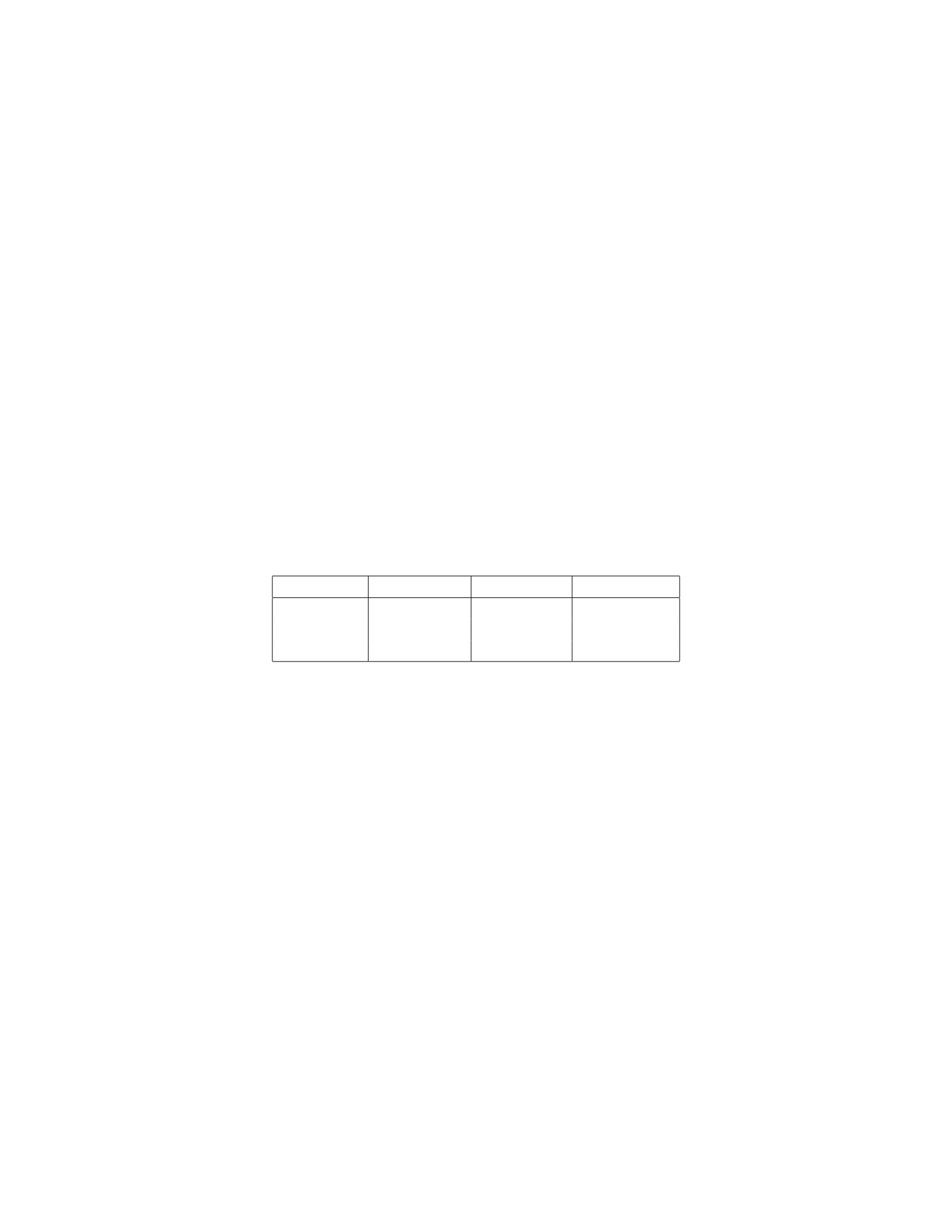
A company produces two products, Xand Y, using three resources A,B, and C. The profit
per unit of Xis $10 and for Yis $15. The resource requirements and availability are as follows:
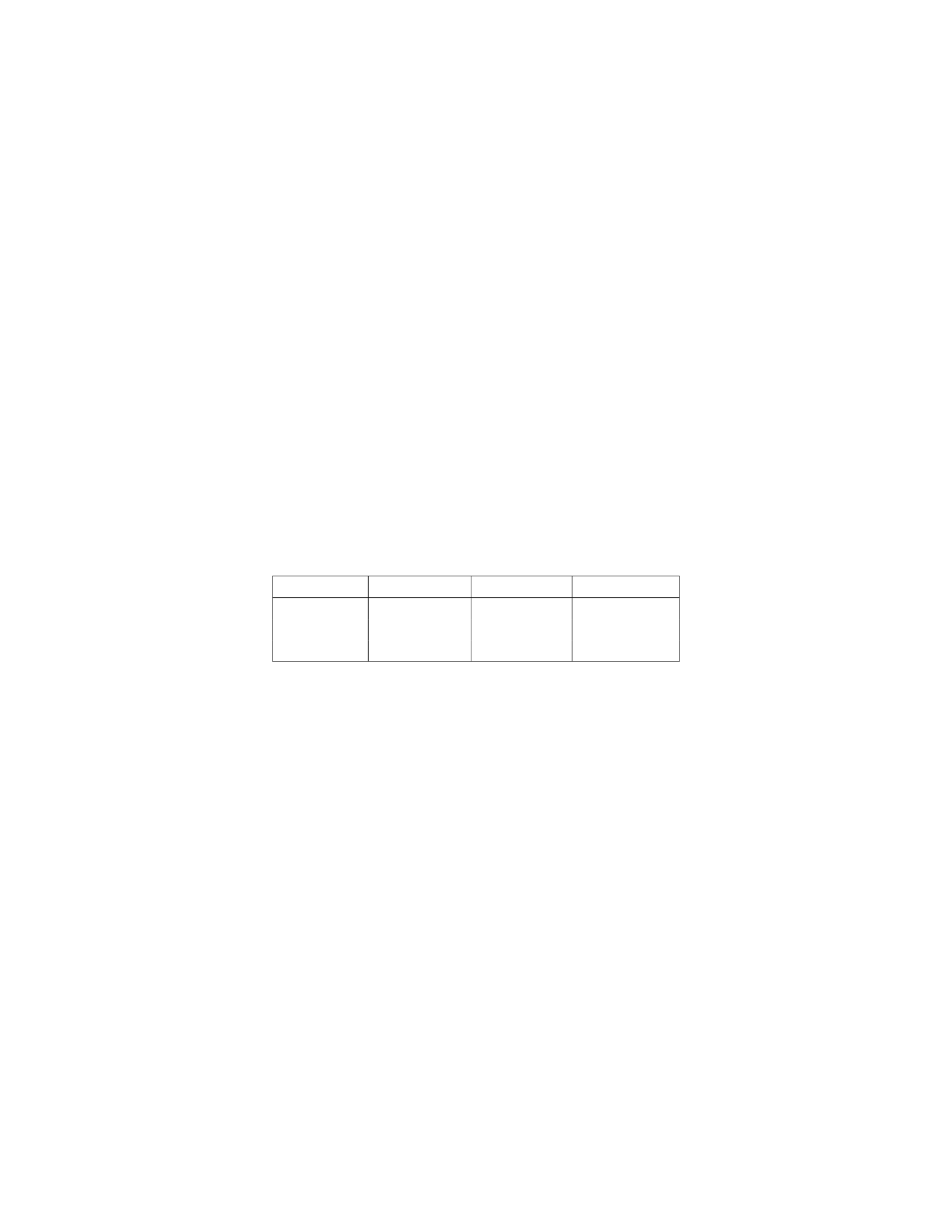
Resource Product XProduct YAvailability
A2 3 150
B4 2 160
C3 3 180
Formulate the linear programming problem to maximize the profit.
a) Maximize 10X+ 15Ysubject to 2X+ 3Y≤150,4X+ 2Y≤160, and 3X+ 3Y≤180
b) Maximize 10X+ 15Ysubject to 2X+ 3Y≥150,4X+ 2Y≤160, and 3X+ 3Y≤180
c) Maximize 10X+ 15Ysubject to 2X+ 3Y≤150,4X+ 2Y≤160, and 3X+ 3Y≥180
Answer: a) Maximize 10X+15Ysubject to 2X+3Y≤150,4X+2Y≤160, and 3X+3Y≤180
Question 1:
Consider the following linear programming problem:
Maximize Z= 3x1+ 2x2subject to:
2x1+ 3x2≤12
x1+x2≤6
x1, x2≥0
Which of the following is a feasible region for this problem?
a) x1≥0, x2≥0, x1+x2≤6
b) x1≥0, x2≥0,2x1+ 3x2≤12
c) x1≥0, x2≥0,3x1+ 2x2≤12
d) x1≥0, x2≥0,2x1+ 3x2≤6
Answer: b) x1≥0, x2≥0,2x1+ 3x2≤12
—
Question 2:
Consider the simplex method for solving a linear programming problem. At each iteration, the
pivot element is chosen as the:
a) Smallest negative entry in the objective row
b) Smallest positive entry in the objective row
c) Largest positive entry in the objective row
d) Largest negative entry in the objective row
Answer: c) Largest positive entry in the objective row
15. Consider the following linear programming problem: Maximize Z= 3x+ 4ysubject to the
constraints: 2x+y≤10 x+ 3y≤12 x, y ≥0
Which of the below points is not a vertex of the feasible region?
a) (3, 4) b) (2, 3) c) (0, 6) d) (5, 1)
Answer: c) (0, 6)
16. In a linear programming problem, a feasible solution is said to be degenerate if:
a) The solution lies on the boundary of the feasible region b) The solution is unbounded c) The
solution violates the non-negativity constraint d) The solution is not unique
Answer: a) The solution lies on the boundary of the feasible region
17. The Simplex method is used to:
a) Minimize the objective function in linear programming problems b) Graphically represent
the solution space of a linear programming problem c) Optimize the allocation of resources in
production planning d) Solve linear equations in one variable
Answer: c) Optimize the allocation of resources in production planning
16. Consider a manufacturing company that produces two types of products: Product A and
Product B. Each unit of Product A requires 2 hours of labor and 1 hour of machine time, while each
unit of Product B requires 1 hour of labor and 3 hours of machine time. The company has 80 hours
of labor and 120 hours of machine time available each week. The profit earned per unit of Product
A is $50 and per unit of Product B is $60.
What is the objective function for maximizing profit for the manufacturing company?
a) 50A+ 60B
b) 60A+ 50B
c) 2A+ 3B
d) 3A+ 2B
Answer: a) 50A+ 60B
17. In the above scenario, if the manufacturing company wants to maximize profit subject to
the constraints given, which of the following represents the constraint for labor hours?
a) 2A+B≤80
b) 2A+ 3B≤80
c) A+ 3B≤80
d) 2A+B≤120
Answer: a) 2A+B≤80
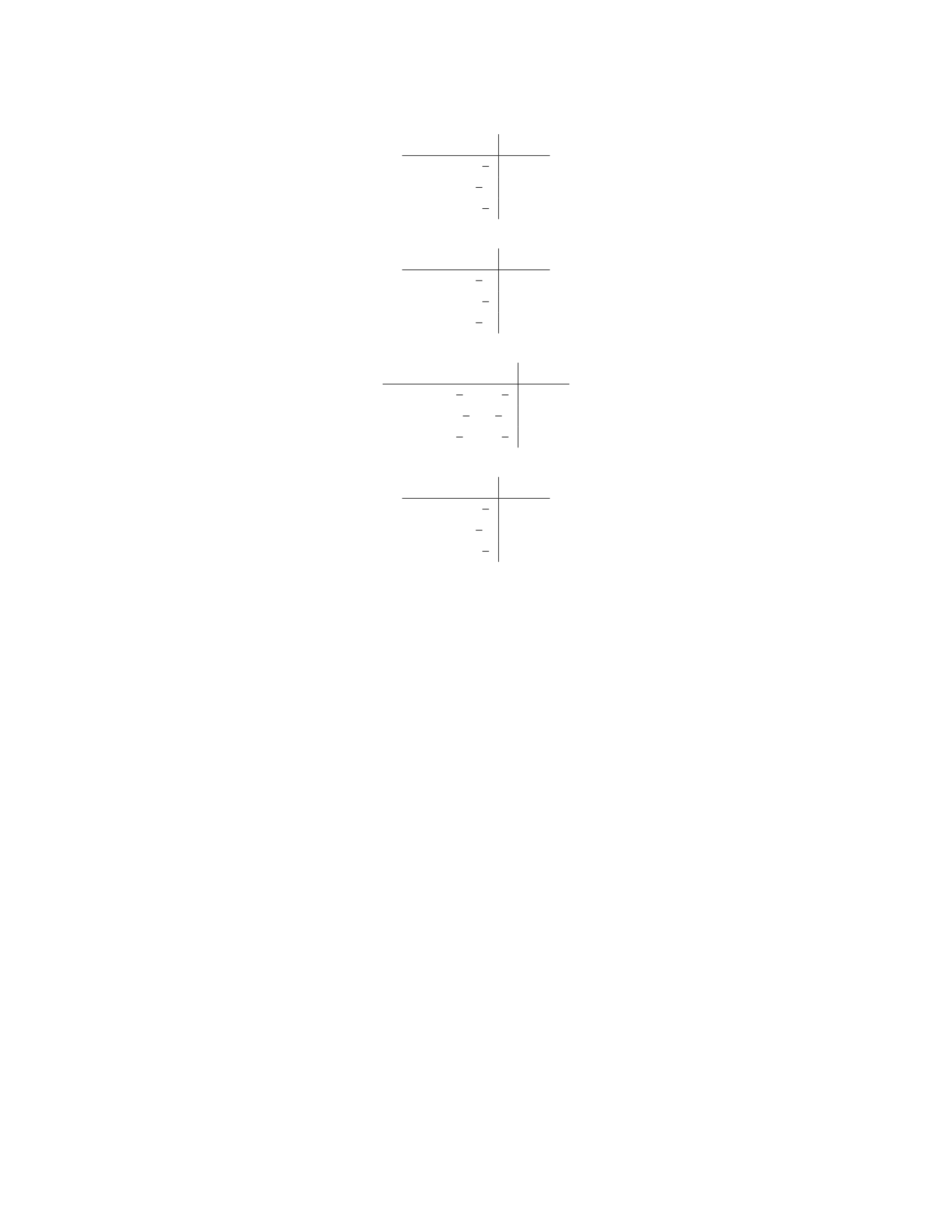
18. Using the Simplex method, if the initial feasible solution is A= 20, B = 10, what is the next
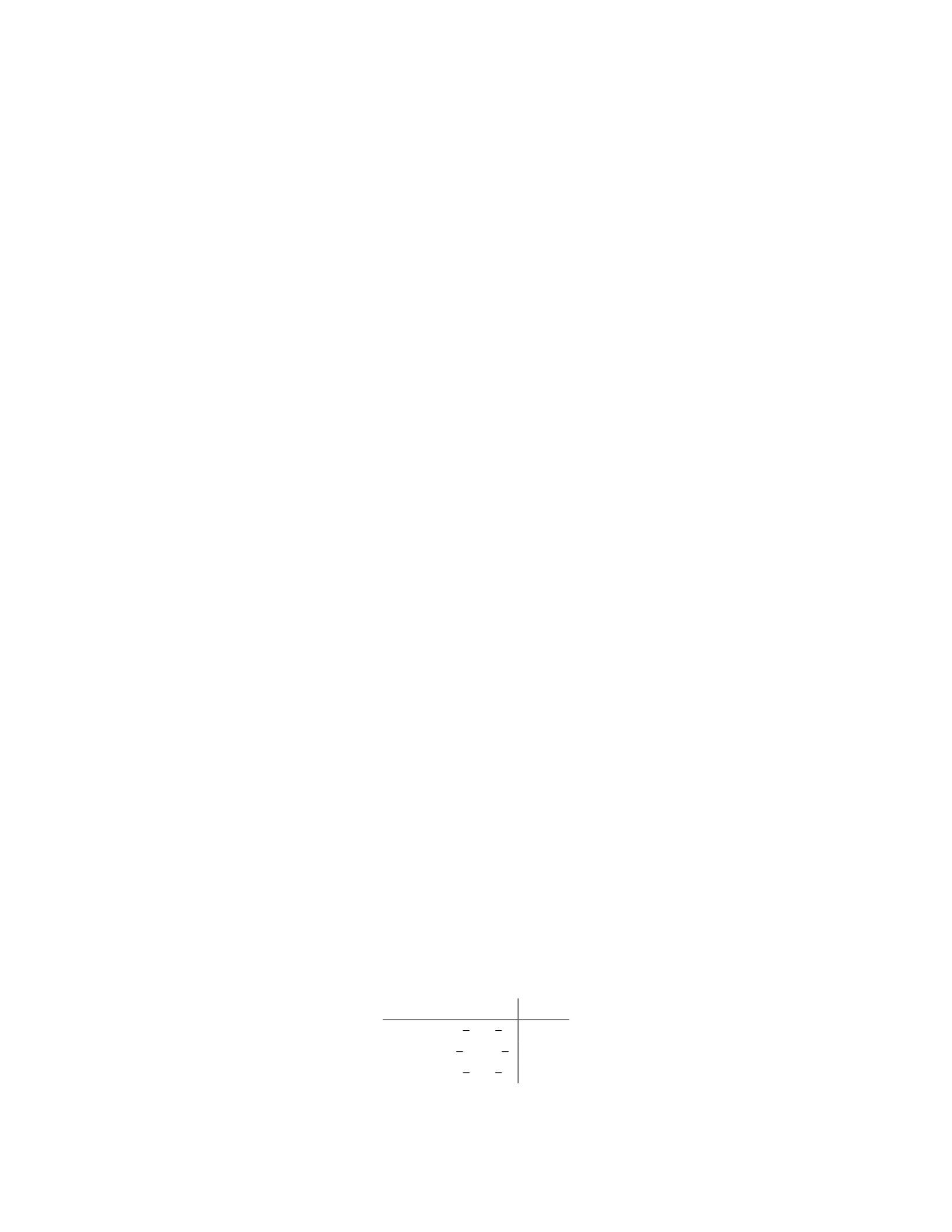
tableau in the Simplex method after one iteration (assuming maximization)?
a)
A B S1 S2 RHS
1 0 −1
2
1
240
0 1 1
6−1
610
0 0 −2
3
1
30
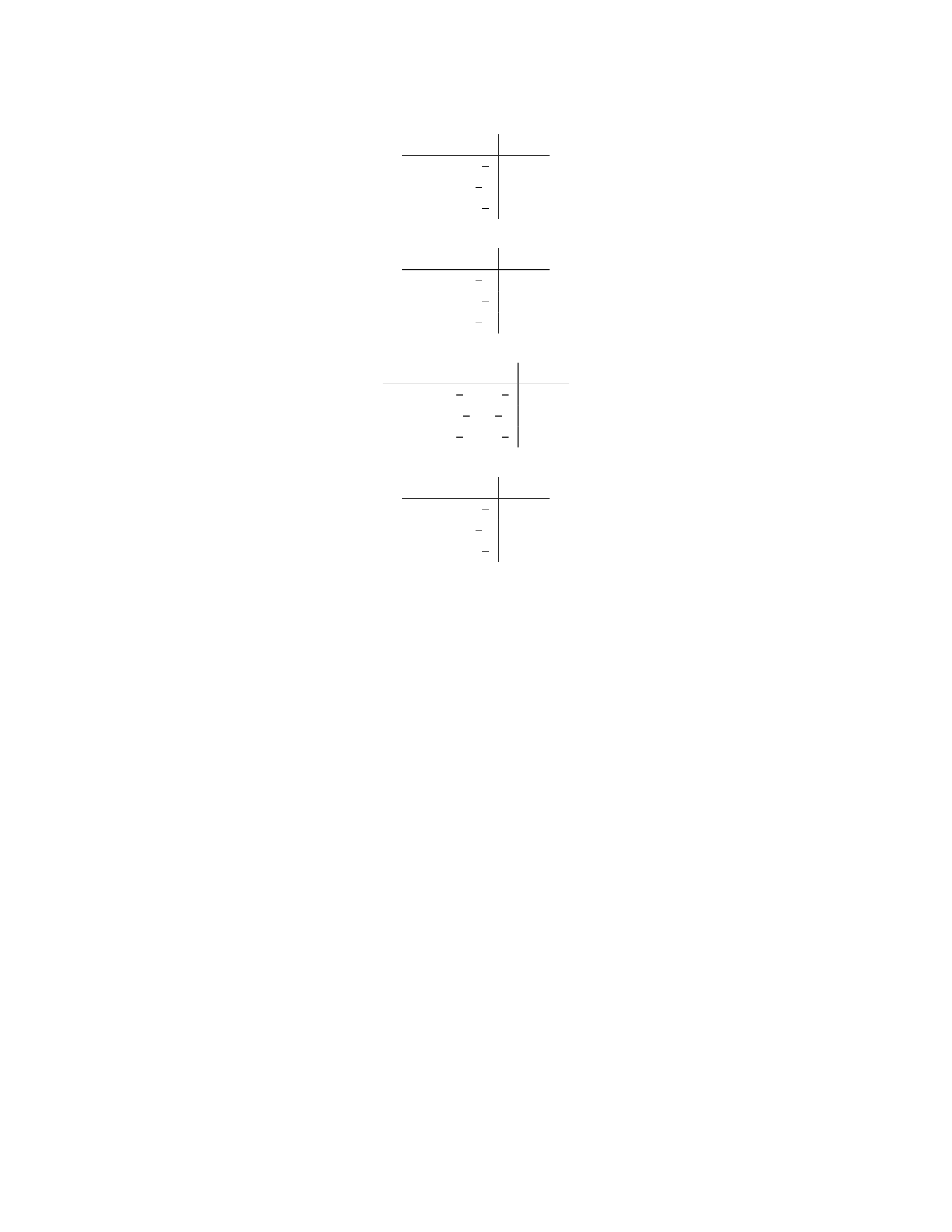
b)
A B S1 RHS
1 0 −1
240
0 1 1
610
0 0 −2
30
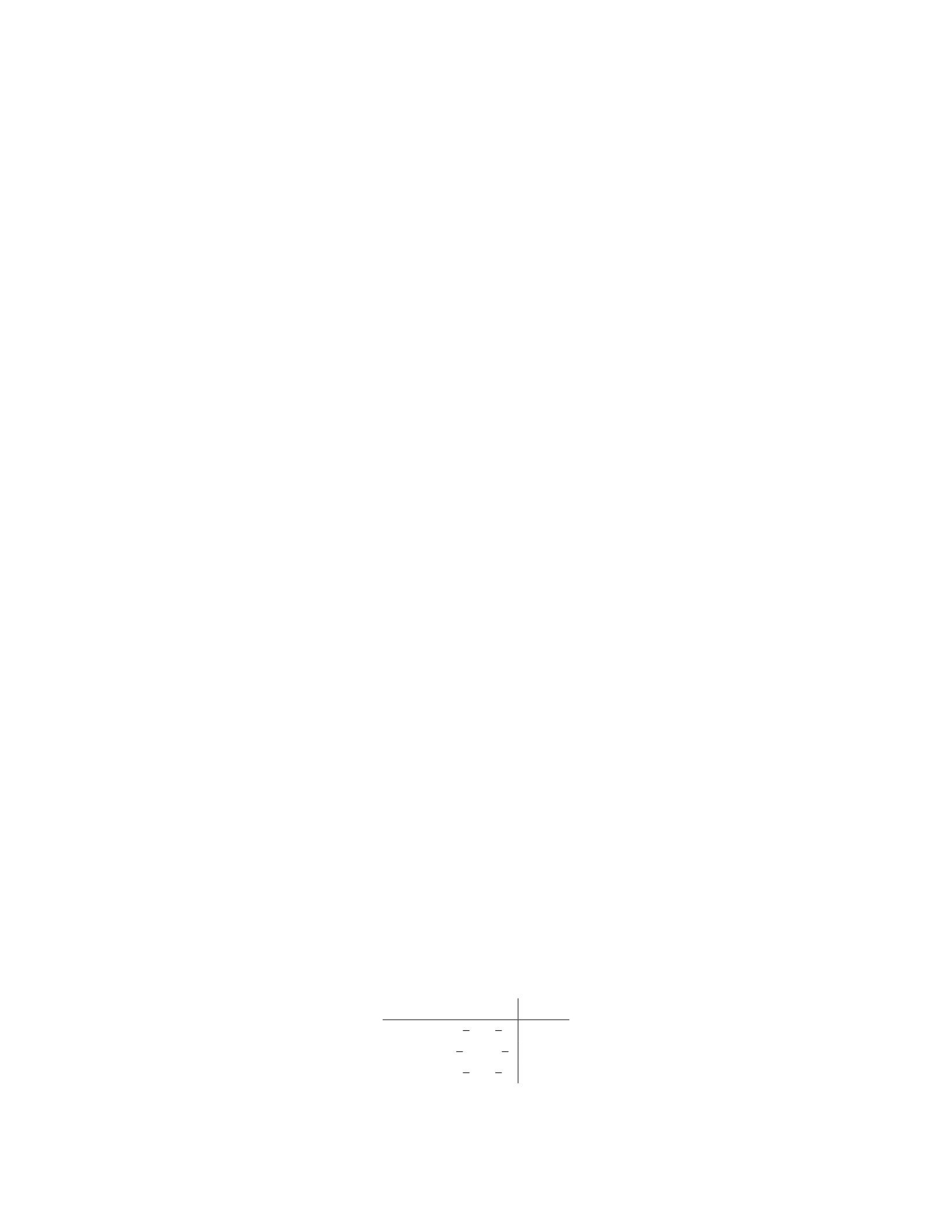
c)
A B S2 RHS
1 0 1
240
0 1 −1
610
0 0 2
30
d)
A B S1 S2 RHS
1 0 1
2−1
240
0 1 −1
6
1
610
0 0 2
3−1
30
Answer: b)
A B S1 RHS
1 0 −1
240
0 1 1
610
0 0 −2
30
17. Consider the following linear programming problem:
Maximize Z= 3x+ 2ysubject to the constraints:
2x+y≤10
x+ 2y≤8
x, y ≥0
Which of the following is the feasible region for this problem?
a) A triangle with vertices at (0, 0), (0, 8), and (5, 0)
b) A triangle with vertices at (0, 0), (4, 0), and (0, 10)
c) A rectangle with vertices at (0, 0), (8, 0), (0, 10), and (5, 0)
d) A quadrilateral with vertices at (0, 0), (0, 8), (4, 0), and (8, 0)
Answer: a) A triangle with vertices at (0, 0), (0, 8), and (5, 0)
18. Which of the following statements is true about the Simplex method?
a) It is only applicable to linear programming problems with two decision variables.
b) It always converges to the optimal solution in a finite number of steps.
c) It is a direct search method that evaluates all possible solutions within the feasible region.
d) It involves moving from one basic feasible solution to another in a way that improves the
objective function.
Answer: d) It involves moving from one basic feasible solution to another in a way that improves
the objective function.
1. Consider the following linear programming problem:
Maximize Z= 3x+ 2y
Subject to: 2x+ 3y≤12 3x+ 2y≤10 x, y ≥0
Which of the following is a feasible region for this problem?
a) Quadrant II only

b) Quadrants I and IV only
c) Quadrants I, II, and IV
d) Quadrants I, II, III, and IV
Answer: b) Quadrants I and IV only
2. Consider the linear programming problem:
Maximize Z= 4x+ 3y
Subject to: 2x+y≤8 3x+ 4y≤12 x, y ≥0
What is the optimal solution for this problem?
a) Zopt = 20 at (x= 2, y = 4)
b) Zopt = 18 at (x= 3, y = 2)
c) Zopt = 16 at (x= 2, y = 5)
d) Zopt = 15 at (x= 4, y = 0)
Answer: b) Zopt = 18 at (x= 3, y = 2)
3. For a linear programming problem with three decision variables, how many dimensions does
the feasible region have?
a) 3
b) 1
c) 2
d) 4
Answer: a) 3
1. Consider the following linear programming problem:
Maximize Z= 3x+ 5y
Subject to:
2x+y≤10
x+ 3y≤12
x, y ≥0
Which of the following points satisfies all the given constraints?
a) (1,3)
b) (2,4)
c) (3,2)
d) (4,1)
Answer: c) (3,2)
2. A company produces two types of products A and B. The profit per unit of product A is $5
and for product B is $8. Each unit of product A requires 2 hours for processing and each unit of
product B requires 1 hour. If the company can afford only 50 hours of processing time, what is the
optimal combination of products to maximize profit?
a) Produce 8 units of A and 6 units of B
b) Produce 10 units of A and 5 units of B
c) Produce 12 units of A and 4 units of B
d) Produce 15 units of A and 3 units of B
Answer: a) Produce 8 units of A and 6 units of B
3. In the simplex method, what is the initial tableau setup for a maximization problem with 3
variables and 2 constraints?
a) 3x3 matrix
b) 2x4 matrix
c) 2x5 matrix

d) 3x4 matrix
Answer: b) 2x4 matrix
1. Consider the following linear programming problem:
Maximize Z= 3x1+ 5x2
Subject to:
x1+x2≤6
2x1+x2≤8
x1, x2≥0
Which of the following points satisfies all the constraints?
a) (0,7)
b) (2,4)
c) (5,2)
d) (1,1)
Answer: c) (5,2)
2. In a graphical solution of a linear programming problem with two decision variables, the
feasible region is:
a) A straight line
b) A point
c) An area
d) An infinite region
Answer: c) An area
3. The optimal solution of a linear programming problem:
a) Must lie at the intersection of two constraint lines
b) Can lie at a corner point of the feasible region
c) Always lies at the center of the feasible region
d) Is unbounded
Answer: b) Can lie at a corner point of the feasible region
21.
Consider the following linear programming problem:
Maximize Z= 3x+ 2y
subject to
2x+y≤10
x+y≤8
x≥0,y≥0
What is the optimal solution to this problem?
a) (x= 2, y = 6)
b) (x= 4, y = 4)
c) (x= 3, y = 4)
d) (x= 5, y = 3)
Answer: b) (x= 4, y = 4)
22.
In a production process, a company can produce product A and product B. Each unit of product
A requires 3 units of resource X and 2 units of resource Y. Each unit of product B requires 2 units
of resource X and 4 units of resource Y. If the company has at most 120 units of resource X and
80 units of resource Y available, and the profit per unit of product A is $5 and product B is $8, what
is the optimal production mix to maximize profit?
a) Produce 20 units of A and 10 units of B
b) Produce 15 units of A and 20 units of B

c) Produce 10 units of A and 15 units of B
d) Produce 25 units of A and 5 units of B
Answer: c) Produce 10 units of A and 15 units of B
23.
Solve the following linear programming problem using the Simplex method:
Maximize Z= 2x+ 3y
subject to
4x+ 3y≤12
2x+ 5y≤10
x, y ≥0
a) The optimal solution is (x= 2, y = 2)
b) The optimal solution is (x= 1, y = 3)
c) The optimal solution is (x= 3, y = 1)
d) The optimal solution is (x= 4, y = 2)
Answer: a) The optimal solution is (x= 2, y = 2)

Maximize Z= 2x1+ 3x2
Subject to
x1+x2≤5
2x1+x2≤8
x1, x2≥0
Which of the following points does not satisfy the given constraints?
a) (0,6)
b) (4,1)
c) (2,3)
d) (3,4)
Answer: a) (0,6)
Question 2: The feasible region of a linear programming problem is defined by the constraints
x1≥0,x2≥0,2x1+x2≤8, and x1+ 2x2≤6. What is the feasible region in the x1x2plane?
a) a triangular region
b) a rectangular region
c) a pentagonal region
d) a circular region
Answer: a) a triangular region
Question 3: In the Simplex method, if at any iteration the value of the objective function remains
the same with changing basic feasible solution, the problem is:
a) Infeasible
b) Unbounded
c) Degenerate
d) Optimal
Answer: c) Degenerate
1. Consider the following linear programming problem:
Maximize Z= 3x+ 5ySubject to: 2x+ 3y≤12 4x+y≤8x, y ≥0
Which of the following points does not lie in the feasible region of the problem?
a) (0, 3) b) (2, 2) c) (4, 1) d) (1, 4)
Answer: a) (0, 3)
2. Solve the following linear programming problem using the graphical method:
Maximize Z= 4x+ 3ySubject to: 2x+y≤18 x+ 2y≤14 x, y ≥0
What is the optimal solution for the problem?
a) (6,6) b) (5,6) c) (4,5) d) (3,4)
Answer: c) (4,5)
3. Consider the linear programming problem:
Maximize Z= 8x+ 6ySubject to: 2x+ 3y≤12 5x+ 2y≤15 3x+ 8y≤24 x, y ≥0
Using the Simplex method, what is the optimal value of Z?
a) 24 b) 28 c) 30 d) 32
Answer: b) 28
1. Consider the following linear programming problem:
Maximize Z= 3x+ 2y
Subject to: 2x+y≤10 x+ 3y≤15 x, y ≥0
Which of the following represents the feasible region for the given problem?
a) A triangle with vertices at (0, 0), (5, 0), and (0, 10)
b) A triangle with vertices at (0, 0), (10, 0), and (0, 5)
c) A triangle with vertices at (0, 0), (3, 6), and (6, 3)

d) A triangle with vertices at (0, 0), (6, 0), and (0, 3)
Answer: b) A triangle with vertices at (0, 0), (10, 0), and (0, 5)
2. Consider the following linear programming problem:
Minimize Z= 4x+ 3y
Subject to: 2x+ 3y≥12 3x+y≥9x, y ≥0
Which of the following represents the objective function line for the given problem?
a) 3x+ 4y= 12
b) 4x+ 3y= 12
c) 3x+ 4y= 9
d) 4x+ 3y= 9
Answer: d) 4x+ 3y= 9
3. Consider the following linear programming problem:
Maximize Z= 2x+ 5y
Subject to: 3x+y≤6 2x+ 3y≤9x, y ≥0
Which of the following points lies in the feasible region for the given problem?
a) (0, 2)
b) (1, 3)
c) (2, 1)
d) (3, 0)
Answer: c) (2, 1)
1. Consider the following linear programming problem:
Maximize Z= 3x+ 5ysubject to the constraints:
2x+ 3y≤12
4x+y≤8
x, y ≥0
Which point is not a corner point of the feasible region?
a) (2,2)
b) (2,4)
c) (0,4)
d) (0,3)
Answer: c) (0,4)
2. In a linear programming problem with two variables xand y, the feasible region is unbounded.
Which of the following statements is correct?
a) The optimal solution must lie at a corner point.
b) The problem has multiple optimal solutions.
c) The problem is infeasible.
d) The objective function is unbounded.
Answer: a) The optimal solution must lie at a corner point.
1. Consider the following maximization linear programming problem:
Maximize Z= 3x+ 4y
Subject to: 2x+ 3y≤12 4x+ 2y≤16 x, y ≥0
Which of the following is a feasible solution to the linear programming problem?
a) x= 2, y = 3
b) x= 1, y = 4
c) x= 3, y = 2
d) x= 4, y = 1

Answer: a) x= 2, y = 3
2. Solve the following linear programming problem graphically:
Maximize Z= 5x+ 4y
Subject to: 2x+ 3y≤12 4x+y≤8x, y ≥0
Which point on the graph represents the optimal solution?
a) (0,4)
b) (2,3)
c) (3,2)
d) (4,0)
Answer: b) (2,3)
3. In the Simplex method, what is the initial tableau for a maximization linear programming
problem with the following constraints?
Maximize Z= 3x+ 4y
Subject to: 2x+ 3y≤12 4x−y≤8x, y ≥0
a)
Z x y s1s2RHS
1−3−4 0 0 0
0 2 3 1 0 12
0 4 −1 0 1 8
b)
Z x y s1s2RHS
1 3 4 0 0 0
0−2−3 1 0 −12
0−4 1 0 1 −8
c)
Z x y s1s2RHS
1−3−4 0 0 0
0 2 3 1 0 12
0−4 1 0 −1 8
d)
Z x y s1s2RHS
1 3 4 0 0 0
0 2 3 1 0 12
0−4 1 0 −1 8
Answer: c)
Z x y s1s2RHS
1−3−4 0 0 0
0 2 3 1 0 12
0−4 1 0 −1 8
1. Consider a production planning problem with the following constraints:
Maximize Z= 4x+ 3y
Subject to:
2x+y≤10
x+ 2y≤8
x, y ≥0
What is the feasible region for this problem? a) Quadrant I b) Quadrant II c) Quadrant III d)
Quadrant IV
Answer: a) Quadrant I

2. Solve the following linear programming problem graphically:
Maximize Z= 3x+ 2y
Subject to:
2x+y≤6
x+ 2y≤5
x, y ≥0
What is the optimal solution for this problem? a) (x, y) = (0,2.5) b) (x, y) = (1,2) c) (x, y) =
(2,1) d) (x, y) = (2.5,0)
Answer: b) (x, y) = (1,2)
3. Consider the following linear programming problem in standard form:
Maximize Z= 2x+ 3y
Subject to:
x+y≤4
x−y≤2
x, y ≥0
What is the solution to this linear programming problem using the Simplex method? a) Zmax =
10 at (x, y) = (2,2) b) Zmax = 8 at (x, y) = (3,1) c) Zmax = 9 at (x, y) = (2,2) d) Zmax = 6 at
(x, y) = (2,1)
Answer: a) Zmax = 10 at (x, y) = (2,2)
10. Consider the following linear programming problem:
Maximize Z= 2x+ 3y
Subject to: 3x+ 4y≤24 2x+ 3y≤18 x≥0, y ≥0
What is the optimal solution to this problem?
a) (x= 4, y = 3)
b) (x= 2, y = 3)
c) (x= 3, y = 4)
d) (x= 2, y = 2)
Answer: d) (x= 2, y = 2)
1. Consider the following linear programming problem:
Maximize Z= 3x+ 4y
Subject to:
2x+y≤10
x+ 3y≤12
x, y ≥0
What is the optimal solution for this problem?
a) (x= 4, y = 2)
b) (x= 2, y = 4)
c) (x= 3, y = 3)
d) (x= 5, y = 1)
Answer: a) (x= 4, y = 2)

2. Solve the following linear programming problem using the graphical method:
Maximize Z= 5x+ 3y
Subject to:
3x+ 2y≤18
x+ 2y≤12
x, y ≥0
What is the optimal value of Zat the optimal solution?
a) Z= 33
b) Z= 30
c) Z= 27
d) Z= 24
Answer: b) Z= 30
3. Use the Simplex method to solve the following linear programming problem:
Maximize Z= 2x+ 3y
Subject to:
2x+y≤6
x+ 2y≤7
x, y ≥0
What is the optimal solution for this problem?
a) (x= 2, y = 3)
b) (x= 3, y = 2)
c) (x= 1, y = 4)
d) (x= 4, y = 1)
Answer: a) (x= 2, y = 3)
12. Consider the following linear programming problem:
Maximize Z= 3x+ 2ysubject to:
2x+y≤10
x+ 2y≤12
x, y ≥0
Which of the following points is the graphical solution to the linear programming problem?
a) (0,8)
b) (4,3)
c) (5,5)
d) (7,6)
Answer: b) (4,3)
13. The feasible region for a linear programming problem is:
Maximize Z= 4x+ 3ysubject to:
2x+y≤10
x+ 2y≤12
x, y ≥0
a) An unbounded region
b) A region with no feasible solutions
c) A feasible region with a unique optimal solution
d) A region with multiple optimal solutions
Answer: c) A feasible region with a unique optimal solution
14. For the following linear programming problem:
Maximize Z= 5x+ 3ysubject to:
2x+y≤10
x+ 2y≤12
x, y ≥0
Which of the following is true regarding the optimal solution?
a) It is at the intersection of two constraints
b) It is always at a corner point of the feasible region
c) It may exist in the interior of the feasible region
d) It cannot be determined without solving the problem
Answer: b) It is always at a corner point of the feasible region
13.
A company produces two products, Xand Y, using three resources A,B, and C. The profit
per unit of Xis $10 and for Yis $15. The resource requirements and availability are as follows:
Resource Product XProduct YAvailability
A2 3 150
B4 2 160
C3 3 180
Formulate the linear programming problem to maximize the profit.
a) Maximize 10X+ 15Ysubject to 2X+ 3Y≤150,4X+ 2Y≤160, and 3X+ 3Y≤180
b) Maximize 10X+ 15Ysubject to 2X+ 3Y≥150,4X+ 2Y≤160, and 3X+ 3Y≤180
c) Maximize 10X+ 15Ysubject to 2X+ 3Y≤150,4X+ 2Y≤160, and 3X+ 3Y≥180
Answer: a) Maximize 10X+15Ysubject to 2X+3Y≤150,4X+2Y≤160, and 3X+3Y≤180
Question 1:
Consider the following linear programming problem:
Maximize Z= 3x1+ 2x2subject to:
2x1+ 3x2≤12
x1+x2≤6
x1, x2≥0
Which of the following is a feasible region for this problem?
a) x1≥0, x2≥0, x1+x2≤6
b) x1≥0, x2≥0,2x1+ 3x2≤12
c) x1≥0, x2≥0,3x1+ 2x2≤12
d) x1≥0, x2≥0,2x1+ 3x2≤6
Answer: b) x1≥0, x2≥0,2x1+ 3x2≤12
—
Question 2:
Consider the simplex method for solving a linear programming problem. At each iteration, the
pivot element is chosen as the:
a) Smallest negative entry in the objective row
b) Smallest positive entry in the objective row
c) Largest positive entry in the objective row
d) Largest negative entry in the objective row
Answer: c) Largest positive entry in the objective row
15. Consider the following linear programming problem: Maximize Z= 3x+ 4ysubject to the
constraints: 2x+y≤10 x+ 3y≤12 x, y ≥0
Which of the below points is not a vertex of the feasible region?
a) (3, 4) b) (2, 3) c) (0, 6) d) (5, 1)
Answer: c) (0, 6)
16. In a linear programming problem, a feasible solution is said to be degenerate if:
a) The solution lies on the boundary of the feasible region b) The solution is unbounded c) The
solution violates the non-negativity constraint d) The solution is not unique
Answer: a) The solution lies on the boundary of the feasible region
17. The Simplex method is used to:
a) Minimize the objective function in linear programming problems b) Graphically represent
the solution space of a linear programming problem c) Optimize the allocation of resources in
production planning d) Solve linear equations in one variable
Answer: c) Optimize the allocation of resources in production planning
16. Consider a manufacturing company that produces two types of products: Product A and
Product B. Each unit of Product A requires 2 hours of labor and 1 hour of machine time, while each
unit of Product B requires 1 hour of labor and 3 hours of machine time. The company has 80 hours
of labor and 120 hours of machine time available each week. The profit earned per unit of Product
A is $50 and per unit of Product B is $60.
What is the objective function for maximizing profit for the manufacturing company?
a) 50A+ 60B
b) 60A+ 50B
c) 2A+ 3B
d) 3A+ 2B
Answer: a) 50A+ 60B
17. In the above scenario, if the manufacturing company wants to maximize profit subject to
the constraints given, which of the following represents the constraint for labor hours?
a) 2A+B≤80
b) 2A+ 3B≤80
c) A+ 3B≤80
d) 2A+B≤120
Answer: a) 2A+B≤80
18. Using the Simplex method, if the initial feasible solution is A= 20, B = 10, what is the next
tableau in the Simplex method after one iteration (assuming maximization)?
a)
A B S1 S2 RHS
1 0 −1
2
1
240
0 1 1
6−1
610
0 0 −2
3
1
30
b)
A B S1 RHS
1 0 −1
240
0 1 1
610
0 0 −2
30
c)
A B S2 RHS
1 0 1
240
0 1 −1
610
0 0 2
30
d)
A B S1 S2 RHS
1 0 1
2−1
240
0 1 −1
6
1
610
0 0 2
3−1
30
Answer: b)
A B S1 RHS
1 0 −1
240
0 1 1
610
0 0 −2
30
17. Consider the following linear programming problem:
Maximize Z= 3x+ 2ysubject to the constraints:
2x+y≤10
x+ 2y≤8
x, y ≥0
Which of the following is the feasible region for this problem?
a) A triangle with vertices at (0, 0), (0, 8), and (5, 0)
b) A triangle with vertices at (0, 0), (4, 0), and (0, 10)
c) A rectangle with vertices at (0, 0), (8, 0), (0, 10), and (5, 0)
d) A quadrilateral with vertices at (0, 0), (0, 8), (4, 0), and (8, 0)
Answer: a) A triangle with vertices at (0, 0), (0, 8), and (5, 0)
18. Which of the following statements is true about the Simplex method?
a) It is only applicable to linear programming problems with two decision variables.
b) It always converges to the optimal solution in a finite number of steps.
c) It is a direct search method that evaluates all possible solutions within the feasible region.
d) It involves moving from one basic feasible solution to another in a way that improves the
objective function.
Answer: d) It involves moving from one basic feasible solution to another in a way that improves
the objective function.
1. Consider the following linear programming problem:
Maximize Z= 3x+ 2y
Subject to: 2x+ 3y≤12 3x+ 2y≤10 x, y ≥0
Which of the following is a feasible region for this problem?
a) Quadrant II only

b) Quadrants I and IV only
c) Quadrants I, II, and IV
d) Quadrants I, II, III, and IV
Answer: b) Quadrants I and IV only
2. Consider the linear programming problem:
Maximize Z= 4x+ 3y
Subject to: 2x+y≤8 3x+ 4y≤12 x, y ≥0
What is the optimal solution for this problem?
a) Zopt = 20 at (x= 2, y = 4)
b) Zopt = 18 at (x= 3, y = 2)
c) Zopt = 16 at (x= 2, y = 5)
d) Zopt = 15 at (x= 4, y = 0)
Answer: b) Zopt = 18 at (x= 3, y = 2)
3. For a linear programming problem with three decision variables, how many dimensions does
the feasible region have?
a) 3
b) 1
c) 2
d) 4
Answer: a) 3
1. Consider the following linear programming problem:
Maximize Z= 3x+ 5y
Subject to:
2x+y≤10
x+ 3y≤12
x, y ≥0
Which of the following points satisfies all the given constraints?
a) (1,3)
b) (2,4)
c) (3,2)
d) (4,1)
Answer: c) (3,2)
2. A company produces two types of products A and B. The profit per unit of product A is $5
and for product B is $8. Each unit of product A requires 2 hours for processing and each unit of
product B requires 1 hour. If the company can afford only 50 hours of processing time, what is the
optimal combination of products to maximize profit?
a) Produce 8 units of A and 6 units of B
b) Produce 10 units of A and 5 units of B
c) Produce 12 units of A and 4 units of B
d) Produce 15 units of A and 3 units of B
Answer: a) Produce 8 units of A and 6 units of B
3. In the simplex method, what is the initial tableau setup for a maximization problem with 3
variables and 2 constraints?
a) 3x3 matrix
b) 2x4 matrix
c) 2x5 matrix

d) 3x4 matrix
Answer: b) 2x4 matrix
1. Consider the following linear programming problem:
Maximize Z= 3x1+ 5x2
Subject to:
x1+x2≤6
2x1+x2≤8
x1, x2≥0
Which of the following points satisfies all the constraints?
a) (0,7)
b) (2,4)
c) (5,2)
d) (1,1)
Answer: c) (5,2)
2. In a graphical solution of a linear programming problem with two decision variables, the
feasible region is:
a) A straight line
b) A point
c) An area
d) An infinite region
Answer: c) An area
3. The optimal solution of a linear programming problem:
a) Must lie at the intersection of two constraint lines
b) Can lie at a corner point of the feasible region
c) Always lies at the center of the feasible region
d) Is unbounded
Answer: b) Can lie at a corner point of the feasible region
21.
Consider the following linear programming problem:
Maximize Z= 3x+ 2y
subject to
2x+y≤10
x+y≤8
x≥0,y≥0
What is the optimal solution to this problem?
a) (x= 2, y = 6)
b) (x= 4, y = 4)
c) (x= 3, y = 4)
d) (x= 5, y = 3)
Answer: b) (x= 4, y = 4)
22.
In a production process, a company can produce product A and product B. Each unit of product
A requires 3 units of resource X and 2 units of resource Y. Each unit of product B requires 2 units
of resource X and 4 units of resource Y. If the company has at most 120 units of resource X and
80 units of resource Y available, and the profit per unit of product A is $5 and product B is $8, what
is the optimal production mix to maximize profit?
a) Produce 20 units of A and 10 units of B
b) Produce 15 units of A and 20 units of B

c) Produce 10 units of A and 15 units of B
d) Produce 25 units of A and 5 units of B
Answer: c) Produce 10 units of A and 15 units of B
23.
Solve the following linear programming problem using the Simplex method:
Maximize Z= 2x+ 3y
subject to
4x+ 3y≤12
2x+ 5y≤10
x, y ≥0
a) The optimal solution is (x= 2, y = 2)
b) The optimal solution is (x= 1, y = 3)
c) The optimal solution is (x= 3, y = 1)
d) The optimal solution is (x= 4, y = 2)
Answer: a) The optimal solution is (x= 2, y = 2)

Maximize Z= 2x1+ 3x2
Subject to
x1+x2≤5
2x1+x2≤8
x1, x2≥0
Which of the following points does not satisfy the given constraints?
a) (0,6)
b) (4,1)
c) (2,3)
d) (3,4)
Answer: a) (0,6)
Question 2: The feasible region of a linear programming problem is defined by the constraints
x1≥0,x2≥0,2x1+x2≤8, and x1+ 2x2≤6. What is the feasible region in the x1x2plane?
a) a triangular region
b) a rectangular region
c) a pentagonal region
d) a circular region
Answer: a) a triangular region
Question 3: In the Simplex method, if at any iteration the value of the objective function remains
the same with changing basic feasible solution, the problem is:
a) Infeasible
b) Unbounded
c) Degenerate
d) Optimal
Answer: c) Degenerate
1. Consider the following linear programming problem:
Maximize Z= 3x+ 5ySubject to: 2x+ 3y≤12 4x+y≤8x, y ≥0
Which of the following points does not lie in the feasible region of the problem?
a) (0, 3) b) (2, 2) c) (4, 1) d) (1, 4)
Answer: a) (0, 3)
2. Solve the following linear programming problem using the graphical method:
Maximize Z= 4x+ 3ySubject to: 2x+y≤18 x+ 2y≤14 x, y ≥0
What is the optimal solution for the problem?
a) (6,6) b) (5,6) c) (4,5) d) (3,4)
Answer: c) (4,5)
3. Consider the linear programming problem:
Maximize Z= 8x+ 6ySubject to: 2x+ 3y≤12 5x+ 2y≤15 3x+ 8y≤24 x, y ≥0
Using the Simplex method, what is the optimal value of Z?
a) 24 b) 28 c) 30 d) 32
Answer: b) 28
1. Consider the following linear programming problem:
Maximize Z= 3x+ 2y
Subject to: 2x+y≤10 x+ 3y≤15 x, y ≥0
Which of the following represents the feasible region for the given problem?
a) A triangle with vertices at (0, 0), (5, 0), and (0, 10)
b) A triangle with vertices at (0, 0), (10, 0), and (0, 5)
c) A triangle with vertices at (0, 0), (3, 6), and (6, 3)

d) A triangle with vertices at (0, 0), (6, 0), and (0, 3)
Answer: b) A triangle with vertices at (0, 0), (10, 0), and (0, 5)
2. Consider the following linear programming problem:
Minimize Z= 4x+ 3y
Subject to: 2x+ 3y≥12 3x+y≥9x, y ≥0
Which of the following represents the objective function line for the given problem?
a) 3x+ 4y= 12
b) 4x+ 3y= 12
c) 3x+ 4y= 9
d) 4x+ 3y= 9
Answer: d) 4x+ 3y= 9
3. Consider the following linear programming problem:
Maximize Z= 2x+ 5y
Subject to: 3x+y≤6 2x+ 3y≤9x, y ≥0
Which of the following points lies in the feasible region for the given problem?
a) (0, 2)
b) (1, 3)
c) (2, 1)
d) (3, 0)
Answer: c) (2, 1)
1. Consider the following linear programming problem:
Maximize Z= 3x+ 5ysubject to the constraints:
2x+ 3y≤12
4x+y≤8
x, y ≥0
Which point is not a corner point of the feasible region?
a) (2,2)
b) (2,4)
c) (0,4)
d) (0,3)
Answer: c) (0,4)
2. In a linear programming problem with two variables xand y, the feasible region is unbounded.
Which of the following statements is correct?
a) The optimal solution must lie at a corner point.
b) The problem has multiple optimal solutions.
c) The problem is infeasible.
d) The objective function is unbounded.
Answer: a) The optimal solution must lie at a corner point.
1. Consider the following maximization linear programming problem:
Maximize Z= 3x+ 4y
Subject to: 2x+ 3y≤12 4x+ 2y≤16 x, y ≥0
Which of the following is a feasible solution to the linear programming problem?
a) x= 2, y = 3
b) x= 1, y = 4
c) x= 3, y = 2
d) x= 4, y = 1

Answer: a) x= 2, y = 3
2. Solve the following linear programming problem graphically:
Maximize Z= 5x+ 4y
Subject to: 2x+ 3y≤12 4x+y≤8x, y ≥0
Which point on the graph represents the optimal solution?
a) (0,4)
b) (2,3)
c) (3,2)
d) (4,0)
Answer: b) (2,3)
3. In the Simplex method, what is the initial tableau for a maximization linear programming
problem with the following constraints?
Maximize Z= 3x+ 4y
Subject to: 2x+ 3y≤12 4x−y≤8x, y ≥0
a)
Z x y s1s2RHS
1−3−4 0 0 0
0 2 3 1 0 12
0 4 −1 0 1 8
b)
Z x y s1s2RHS
1 3 4 0 0 0
0−2−3 1 0 −12
0−4 1 0 1 −8
c)
Z x y s1s2RHS
1−3−4 0 0 0
0 2 3 1 0 12
0−4 1 0 −1 8
d)
Z x y s1s2RHS
1 3 4 0 0 0
0 2 3 1 0 12
0−4 1 0 −1 8
Answer: c)
Z x y s1s2RHS
1−3−4 0 0 0
0 2 3 1 0 12
0−4 1 0 −1 8
1. Consider a production planning problem with the following constraints:
Maximize Z= 4x+ 3y
Subject to:
2x+y≤10
x+ 2y≤8
x, y ≥0
What is the feasible region for this problem? a) Quadrant I b) Quadrant II c) Quadrant III d)
Quadrant IV
Answer: a) Quadrant I

2. Solve the following linear programming problem graphically:
Maximize Z= 3x+ 2y
Subject to:
2x+y≤6
x+ 2y≤5
x, y ≥0
What is the optimal solution for this problem? a) (x, y) = (0,2.5) b) (x, y) = (1,2) c) (x, y) =
(2,1) d) (x, y) = (2.5,0)
Answer: b) (x, y) = (1,2)
3. Consider the following linear programming problem in standard form:
Maximize Z= 2x+ 3y
Subject to:
x+y≤4
x−y≤2
x, y ≥0
What is the solution to this linear programming problem using the Simplex method? a) Zmax =
10 at (x, y) = (2,2) b) Zmax = 8 at (x, y) = (3,1) c) Zmax = 9 at (x, y) = (2,2) d) Zmax = 6 at
(x, y) = (2,1)
Answer: a) Zmax = 10 at (x, y) = (2,2)
10. Consider the following linear programming problem:
Maximize Z= 2x+ 3y
Subject to: 3x+ 4y≤24 2x+ 3y≤18 x≥0, y ≥0
What is the optimal solution to this problem?
a) (x= 4, y = 3)
b) (x= 2, y = 3)
c) (x= 3, y = 4)
d) (x= 2, y = 2)
Answer: d) (x= 2, y = 2)
1. Consider the following linear programming problem:
Maximize Z= 3x+ 4y
Subject to:
2x+y≤10
x+ 3y≤12
x, y ≥0
What is the optimal solution for this problem?
a) (x= 4, y = 2)
b) (x= 2, y = 4)
c) (x= 3, y = 3)
d) (x= 5, y = 1)
Answer: a) (x= 4, y = 2)

2. Solve the following linear programming problem using the graphical method:
Maximize Z= 5x+ 3y
Subject to:
3x+ 2y≤18
x+ 2y≤12
x, y ≥0
What is the optimal value of Zat the optimal solution?
a) Z= 33
b) Z= 30
c) Z= 27
d) Z= 24
Answer: b) Z= 30
3. Use the Simplex method to solve the following linear programming problem:
Maximize Z= 2x+ 3y
Subject to:
2x+y≤6
x+ 2y≤7
x, y ≥0
What is the optimal solution for this problem?
a) (x= 2, y = 3)
b) (x= 3, y = 2)
c) (x= 1, y = 4)
d) (x= 4, y = 1)
Answer: a) (x= 2, y = 3)
12. Consider the following linear programming problem:
Maximize Z= 3x+ 2ysubject to:
2x+y≤10
x+ 2y≤12
x, y ≥0
Which of the following points is the graphical solution to the linear programming problem?
a) (0,8)
b) (4,3)
c) (5,5)
d) (7,6)
Answer: b) (4,3)
13. The feasible region for a linear programming problem is:
Maximize Z= 4x+ 3ysubject to:
2x+y≤10
x+ 2y≤12
x, y ≥0
a) An unbounded region
b) A region with no feasible solutions
c) A feasible region with a unique optimal solution
d) A region with multiple optimal solutions
Answer: c) A feasible region with a unique optimal solution
14. For the following linear programming problem:
Maximize Z= 5x+ 3ysubject to:
2x+y≤10
x+ 2y≤12
x, y ≥0
Which of the following is true regarding the optimal solution?
a) It is at the intersection of two constraints
b) It is always at a corner point of the feasible region
c) It may exist in the interior of the feasible region
d) It cannot be determined without solving the problem
Answer: b) It is always at a corner point of the feasible region
13.
A company produces two products, Xand Y, using three resources A,B, and C. The profit
per unit of Xis $10 and for Yis $15. The resource requirements and availability are as follows:
Resource Product XProduct YAvailability
A2 3 150
B4 2 160
C3 3 180
Formulate the linear programming problem to maximize the profit.
a) Maximize 10X+ 15Ysubject to 2X+ 3Y≤150,4X+ 2Y≤160, and 3X+ 3Y≤180
b) Maximize 10X+ 15Ysubject to 2X+ 3Y≥150,4X+ 2Y≤160, and 3X+ 3Y≤180
c) Maximize 10X+ 15Ysubject to 2X+ 3Y≤150,4X+ 2Y≤160, and 3X+ 3Y≥180
Answer: a) Maximize 10X+15Ysubject to 2X+3Y≤150,4X+2Y≤160, and 3X+3Y≤180
Question 1:
Consider the following linear programming problem:
Maximize Z= 3x1+ 2x2subject to:
2x1+ 3x2≤12
x1+x2≤6
x1, x2≥0
Which of the following is a feasible region for this problem?
a) x1≥0, x2≥0, x1+x2≤6
b) x1≥0, x2≥0,2x1+ 3x2≤12
c) x1≥0, x2≥0,3x1+ 2x2≤12
d) x1≥0, x2≥0,2x1+ 3x2≤6
Answer: b) x1≥0, x2≥0,2x1+ 3x2≤12
—
Question 2:
Consider the simplex method for solving a linear programming problem. At each iteration, the
pivot element is chosen as the:
a) Smallest negative entry in the objective row
b) Smallest positive entry in the objective row
c) Largest positive entry in the objective row
d) Largest negative entry in the objective row
Answer: c) Largest positive entry in the objective row
15. Consider the following linear programming problem: Maximize Z= 3x+ 4ysubject to the
constraints: 2x+y≤10 x+ 3y≤12 x, y ≥0
Which of the below points is not a vertex of the feasible region?
a) (3, 4) b) (2, 3) c) (0, 6) d) (5, 1)
Answer: c) (0, 6)
16. In a linear programming problem, a feasible solution is said to be degenerate if:
a) The solution lies on the boundary of the feasible region b) The solution is unbounded c) The
solution violates the non-negativity constraint d) The solution is not unique
Answer: a) The solution lies on the boundary of the feasible region
17. The Simplex method is used to:
a) Minimize the objective function in linear programming problems b) Graphically represent
the solution space of a linear programming problem c) Optimize the allocation of resources in
production planning d) Solve linear equations in one variable
Answer: c) Optimize the allocation of resources in production planning
16. Consider a manufacturing company that produces two types of products: Product A and
Product B. Each unit of Product A requires 2 hours of labor and 1 hour of machine time, while each
unit of Product B requires 1 hour of labor and 3 hours of machine time. The company has 80 hours
of labor and 120 hours of machine time available each week. The profit earned per unit of Product
A is $50 and per unit of Product B is $60.
What is the objective function for maximizing profit for the manufacturing company?
a) 50A+ 60B
b) 60A+ 50B
c) 2A+ 3B
d) 3A+ 2B
Answer: a) 50A+ 60B
17. In the above scenario, if the manufacturing company wants to maximize profit subject to
the constraints given, which of the following represents the constraint for labor hours?
a) 2A+B≤80
b) 2A+ 3B≤80
c) A+ 3B≤80
d) 2A+B≤120
Answer: a) 2A+B≤80
18. Using the Simplex method, if the initial feasible solution is A= 20, B = 10, what is the next
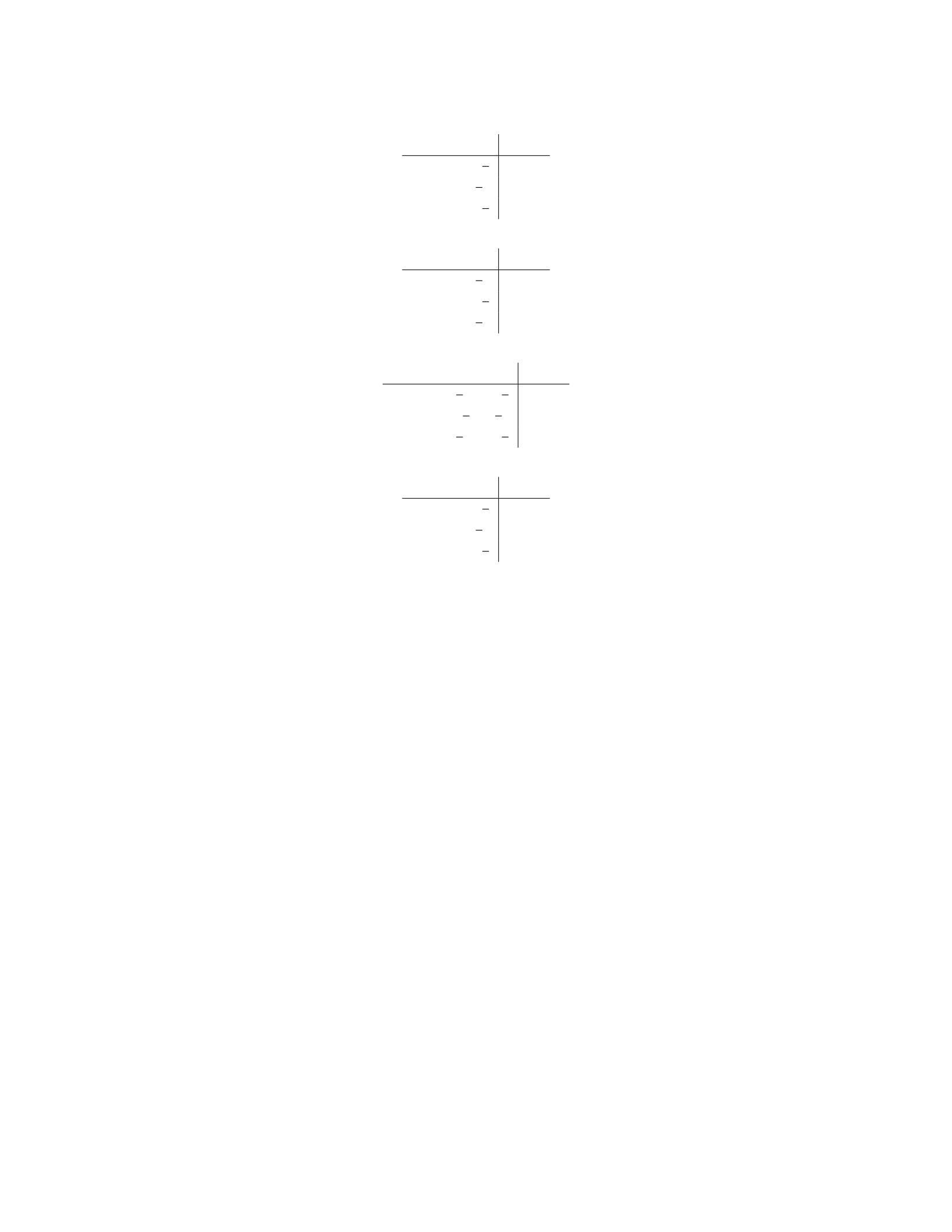
tableau in the Simplex method after one iteration (assuming maximization)?
a)
A B S1 S2 RHS
1 0 −1
2
1
240
0 1 1
6−1
610
0 0 −2
3
1
30
b)
A B S1 RHS
1 0 −1
240
0 1 1
610
0 0 −2
30
c)
A B S2 RHS
1 0 1
240
0 1 −1
610
0 0 2
30
d)
A B S1 S2 RHS
1 0 1
2−1
240
0 1 −1
6
1
610
0 0 2
3−1
30
Answer: b)
A B S1 RHS
1 0 −1
240
0 1 1
610
0 0 −2
30
17. Consider the following linear programming problem:
Maximize Z= 3x+ 2ysubject to the constraints:
2x+y≤10
x+ 2y≤8
x, y ≥0
Which of the following is the feasible region for this problem?
a) A triangle with vertices at (0, 0), (0, 8), and (5, 0)
b) A triangle with vertices at (0, 0), (4, 0), and (0, 10)
c) A rectangle with vertices at (0, 0), (8, 0), (0, 10), and (5, 0)
d) A quadrilateral with vertices at (0, 0), (0, 8), (4, 0), and (8, 0)
Answer: a) A triangle with vertices at (0, 0), (0, 8), and (5, 0)
18. Which of the following statements is true about the Simplex method?
a) It is only applicable to linear programming problems with two decision variables.
b) It always converges to the optimal solution in a finite number of steps.
c) It is a direct search method that evaluates all possible solutions within the feasible region.
d) It involves moving from one basic feasible solution to another in a way that improves the
objective function.
Answer: d) It involves moving from one basic feasible solution to another in a way that improves
the objective function.
1. Consider the following linear programming problem:
Maximize Z= 3x+ 2y
Subject to: 2x+ 3y≤12 3x+ 2y≤10 x, y ≥0
Which of the following is a feasible region for this problem?
a) Quadrant II only

b) Quadrants I and IV only
c) Quadrants I, II, and IV
d) Quadrants I, II, III, and IV
Answer: b) Quadrants I and IV only
2. Consider the linear programming problem:
Maximize Z= 4x+ 3y
Subject to: 2x+y≤8 3x+ 4y≤12 x, y ≥0
What is the optimal solution for this problem?
a) Zopt = 20 at (x= 2, y = 4)
b) Zopt = 18 at (x= 3, y = 2)
c) Zopt = 16 at (x= 2, y = 5)
d) Zopt = 15 at (x= 4, y = 0)
Answer: b) Zopt = 18 at (x= 3, y = 2)
3. For a linear programming problem with three decision variables, how many dimensions does
the feasible region have?
a) 3
b) 1
c) 2
d) 4
Answer: a) 3
1. Consider the following linear programming problem:
Maximize Z= 3x+ 5y
Subject to:
2x+y≤10
x+ 3y≤12
x, y ≥0
Which of the following points satisfies all the given constraints?
a) (1,3)
b) (2,4)
c) (3,2)
d) (4,1)
Answer: c) (3,2)
2. A company produces two types of products A and B. The profit per unit of product A is $5
and for product B is $8. Each unit of product A requires 2 hours for processing and each unit of
product B requires 1 hour. If the company can afford only 50 hours of processing time, what is the
optimal combination of products to maximize profit?
a) Produce 8 units of A and 6 units of B
b) Produce 10 units of A and 5 units of B
c) Produce 12 units of A and 4 units of B
d) Produce 15 units of A and 3 units of B
Answer: a) Produce 8 units of A and 6 units of B
3. In the simplex method, what is the initial tableau setup for a maximization problem with 3
variables and 2 constraints?
a) 3x3 matrix
b) 2x4 matrix
c) 2x5 matrix

d) 3x4 matrix
Answer: b) 2x4 matrix
1. Consider the following linear programming problem:
Maximize Z= 3x1+ 5x2
Subject to:
x1+x2≤6
2x1+x2≤8
x1, x2≥0
Which of the following points satisfies all the constraints?
a) (0,7)
b) (2,4)
c) (5,2)
d) (1,1)
Answer: c) (5,2)
2. In a graphical solution of a linear programming problem with two decision variables, the
feasible region is:
a) A straight line
b) A point
c) An area
d) An infinite region
Answer: c) An area
3. The optimal solution of a linear programming problem:
a) Must lie at the intersection of two constraint lines
b) Can lie at a corner point of the feasible region
c) Always lies at the center of the feasible region
d) Is unbounded
Answer: b) Can lie at a corner point of the feasible region
21.
Consider the following linear programming problem:
Maximize Z= 3x+ 2y
subject to
2x+y≤10
x+y≤8
x≥0,y≥0
What is the optimal solution to this problem?
a) (x= 2, y = 6)
b) (x= 4, y = 4)
c) (x= 3, y = 4)
d) (x= 5, y = 3)
Answer: b) (x= 4, y = 4)
22.
In a production process, a company can produce product A and product B. Each unit of product
A requires 3 units of resource X and 2 units of resource Y. Each unit of product B requires 2 units
of resource X and 4 units of resource Y. If the company has at most 120 units of resource X and
80 units of resource Y available, and the profit per unit of product A is $5 and product B is $8, what
is the optimal production mix to maximize profit?
a) Produce 20 units of A and 10 units of B
b) Produce 15 units of A and 20 units of B

c) Produce 10 units of A and 15 units of B
d) Produce 25 units of A and 5 units of B
Answer: c) Produce 10 units of A and 15 units of B
23.
Solve the following linear programming problem using the Simplex method:
Maximize Z= 2x+ 3y
subject to
4x+ 3y≤12
2x+ 5y≤10
x, y ≥0
a) The optimal solution is (x= 2, y = 2)
b) The optimal solution is (x= 1, y = 3)
c) The optimal solution is (x= 3, y = 1)
d) The optimal solution is (x= 4, y = 2)
Answer: a) The optimal solution is (x= 2, y = 2)

Maximize Z= 2x1+ 3x2
Subject to
x1+x2≤5
2x1+x2≤8
x1, x2≥0
Which of the following points does not satisfy the given constraints?
a) (0,6)
b) (4,1)
c) (2,3)
d) (3,4)
Answer: a) (0,6)
Question 2: The feasible region of a linear programming problem is defined by the constraints
x1≥0,x2≥0,2x1+x2≤8, and x1+ 2x2≤6. What is the feasible region in the x1x2plane?
a) a triangular region
b) a rectangular region
c) a pentagonal region
d) a circular region
Answer: a) a triangular region
Question 3: In the Simplex method, if at any iteration the value of the objective function remains
the same with changing basic feasible solution, the problem is:
a) Infeasible
b) Unbounded
c) Degenerate
d) Optimal
Answer: c) Degenerate
1. Consider the following linear programming problem:
Maximize Z= 3x+ 5ySubject to: 2x+ 3y≤12 4x+y≤8x, y ≥0
Which of the following points does not lie in the feasible region of the problem?
a) (0, 3) b) (2, 2) c) (4, 1) d) (1, 4)
Answer: a) (0, 3)
2. Solve the following linear programming problem using the graphical method:
Maximize Z= 4x+ 3ySubject to: 2x+y≤18 x+ 2y≤14 x, y ≥0
What is the optimal solution for the problem?
a) (6,6) b) (5,6) c) (4,5) d) (3,4)
Answer: c) (4,5)
3. Consider the linear programming problem:
Maximize Z= 8x+ 6ySubject to: 2x+ 3y≤12 5x+ 2y≤15 3x+ 8y≤24 x, y ≥0
Using the Simplex method, what is the optimal value of Z?
a) 24 b) 28 c) 30 d) 32
Answer: b) 28
1. Consider the following linear programming problem:
Maximize Z= 3x+ 2y
Subject to: 2x+y≤10 x+ 3y≤15 x, y ≥0
Which of the following represents the feasible region for the given problem?
a) A triangle with vertices at (0, 0), (5, 0), and (0, 10)
b) A triangle with vertices at (0, 0), (10, 0), and (0, 5)
c) A triangle with vertices at (0, 0), (3, 6), and (6, 3)

d) A triangle with vertices at (0, 0), (6, 0), and (0, 3)
Answer: b) A triangle with vertices at (0, 0), (10, 0), and (0, 5)
2. Consider the following linear programming problem:
Minimize Z= 4x+ 3y
Subject to: 2x+ 3y≥12 3x+y≥9x, y ≥0
Which of the following represents the objective function line for the given problem?
a) 3x+ 4y= 12
b) 4x+ 3y= 12
c) 3x+ 4y= 9
d) 4x+ 3y= 9
Answer: d) 4x+ 3y= 9
3. Consider the following linear programming problem:
Maximize Z= 2x+ 5y
Subject to: 3x+y≤6 2x+ 3y≤9x, y ≥0
Which of the following points lies in the feasible region for the given problem?
a) (0, 2)
b) (1, 3)
c) (2, 1)
d) (3, 0)
Answer: c) (2, 1)
1. Consider the following linear programming problem:
Maximize Z= 3x+ 5ysubject to the constraints:
2x+ 3y≤12
4x+y≤8
x, y ≥0
Which point is not a corner point of the feasible region?
a) (2,2)
b) (2,4)
c) (0,4)
d) (0,3)
Answer: c) (0,4)
2. In a linear programming problem with two variables xand y, the feasible region is unbounded.
Which of the following statements is correct?
a) The optimal solution must lie at a corner point.
b) The problem has multiple optimal solutions.
c) The problem is infeasible.
d) The objective function is unbounded.
Answer: a) The optimal solution must lie at a corner point.
1. Consider the following maximization linear programming problem:
Maximize Z= 3x+ 4y
Subject to: 2x+ 3y≤12 4x+ 2y≤16 x, y ≥0
Which of the following is a feasible solution to the linear programming problem?
a) x= 2, y = 3
b) x= 1, y = 4
c) x= 3, y = 2
d) x= 4, y = 1

Answer: a) x= 2, y = 3
2. Solve the following linear programming problem graphically:
Maximize Z= 5x+ 4y
Subject to: 2x+ 3y≤12 4x+y≤8x, y ≥0
Which point on the graph represents the optimal solution?
a) (0,4)
b) (2,3)
c) (3,2)
d) (4,0)
Answer: b) (2,3)
3. In the Simplex method, what is the initial tableau for a maximization linear programming
problem with the following constraints?
Maximize Z= 3x+ 4y
Subject to: 2x+ 3y≤12 4x−y≤8x, y ≥0
a)
Z x y s1s2RHS
1−3−4 0 0 0
0 2 3 1 0 12
0 4 −1 0 1 8
b)
Z x y s1s2RHS
1 3 4 0 0 0
0−2−3 1 0 −12
0−4 1 0 1 −8
c)
Z x y s1s2RHS
1−3−4 0 0 0
0 2 3 1 0 12
0−4 1 0 −1 8
d)
Z x y s1s2RHS
1 3 4 0 0 0
0 2 3 1 0 12
0−4 1 0 −1 8
Answer: c)
Z x y s1s2RHS
1−3−4 0 0 0
0 2 3 1 0 12
0−4 1 0 −1 8
1. Consider a production planning problem with the following constraints:
Maximize Z= 4x+ 3y
Subject to:
2x+y≤10
x+ 2y≤8
x, y ≥0
What is the feasible region for this problem? a) Quadrant I b) Quadrant II c) Quadrant III d)
Quadrant IV
Answer: a) Quadrant I

2. Solve the following linear programming problem graphically:
Maximize Z= 3x+ 2y
Subject to:
2x+y≤6
x+ 2y≤5
x, y ≥0
What is the optimal solution for this problem? a) (x, y) = (0,2.5) b) (x, y) = (1,2) c) (x, y) =
(2,1) d) (x, y) = (2.5,0)
Answer: b) (x, y) = (1,2)
3. Consider the following linear programming problem in standard form:
Maximize Z= 2x+ 3y
Subject to:
x+y≤4
x−y≤2
x, y ≥0
What is the solution to this linear programming problem using the Simplex method? a) Zmax =
10 at (x, y) = (2,2) b) Zmax = 8 at (x, y) = (3,1) c) Zmax = 9 at (x, y) = (2,2) d) Zmax = 6 at
(x, y) = (2,1)
Answer: a) Zmax = 10 at (x, y) = (2,2)
10. Consider the following linear programming problem:
Maximize Z= 2x+ 3y
Subject to: 3x+ 4y≤24 2x+ 3y≤18 x≥0, y ≥0
What is the optimal solution to this problem?
a) (x= 4, y = 3)
b) (x= 2, y = 3)
c) (x= 3, y = 4)
d) (x= 2, y = 2)
Answer: d) (x= 2, y = 2)
1. Consider the following linear programming problem:
Maximize Z= 3x+ 4y
Subject to:
2x+y≤10
x+ 3y≤12
x, y ≥0
What is the optimal solution for this problem?
a) (x= 4, y = 2)
b) (x= 2, y = 4)
c) (x= 3, y = 3)
d) (x= 5, y = 1)
Answer: a) (x= 4, y = 2)

2. Solve the following linear programming problem using the graphical method:
Maximize Z= 5x+ 3y
Subject to:
3x+ 2y≤18
x+ 2y≤12
x, y ≥0
What is the optimal value of Zat the optimal solution?
a) Z= 33
b) Z= 30
c) Z= 27
d) Z= 24
Answer: b) Z= 30
3. Use the Simplex method to solve the following linear programming problem:
Maximize Z= 2x+ 3y
Subject to:
2x+y≤6
x+ 2y≤7
x, y ≥0
What is the optimal solution for this problem?
a) (x= 2, y = 3)
b) (x= 3, y = 2)
c) (x= 1, y = 4)
d) (x= 4, y = 1)
Answer: a) (x= 2, y = 3)
12. Consider the following linear programming problem:
Maximize Z= 3x+ 2ysubject to:
2x+y≤10
x+ 2y≤12
x, y ≥0
Which of the following points is the graphical solution to the linear programming problem?
a) (0,8)
b) (4,3)
c) (5,5)
d) (7,6)
Answer: b) (4,3)
13. The feasible region for a linear programming problem is:
Maximize Z= 4x+ 3ysubject to:
2x+y≤10
x+ 2y≤12
x, y ≥0
a) An unbounded region
b) A region with no feasible solutions
c) A feasible region with a unique optimal solution
d) A region with multiple optimal solutions
Answer: c) A feasible region with a unique optimal solution
14. For the following linear programming problem:
Maximize Z= 5x+ 3ysubject to:
2x+y≤10
x+ 2y≤12
x, y ≥0
Which of the following is true regarding the optimal solution?
a) It is at the intersection of two constraints
b) It is always at a corner point of the feasible region
c) It may exist in the interior of the feasible region
d) It cannot be determined without solving the problem
Answer: b) It is always at a corner point of the feasible region
13.
A company produces two products, Xand Y, using three resources A,B, and C. The profit
per unit of Xis $10 and for Yis $15. The resource requirements and availability are as follows:
Resource Product XProduct YAvailability
A2 3 150
B4 2 160
C3 3 180
Formulate the linear programming problem to maximize the profit.
a) Maximize 10X+ 15Ysubject to 2X+ 3Y≤150,4X+ 2Y≤160, and 3X+ 3Y≤180
b) Maximize 10X+ 15Ysubject to 2X+ 3Y≥150,4X+ 2Y≤160, and 3X+ 3Y≤180
c) Maximize 10X+ 15Ysubject to 2X+ 3Y≤150,4X+ 2Y≤160, and 3X+ 3Y≥180
Answer: a) Maximize 10X+15Ysubject to 2X+3Y≤150,4X+2Y≤160, and 3X+3Y≤180
Question 1:
Consider the following linear programming problem:
Maximize Z= 3x1+ 2x2subject to:
2x1+ 3x2≤12
x1+x2≤6
x1, x2≥0
Which of the following is a feasible region for this problem?
a) x1≥0, x2≥0, x1+x2≤6
b) x1≥0, x2≥0,2x1+ 3x2≤12
c) x1≥0, x2≥0,3x1+ 2x2≤12
d) x1≥0, x2≥0,2x1+ 3x2≤6
Answer: b) x1≥0, x2≥0,2x1+ 3x2≤12
—
Question 2:
Consider the simplex method for solving a linear programming problem. At each iteration, the
pivot element is chosen as the:
a) Smallest negative entry in the objective row
b) Smallest positive entry in the objective row
c) Largest positive entry in the objective row
d) Largest negative entry in the objective row
Answer: c) Largest positive entry in the objective row
15. Consider the following linear programming problem: Maximize Z= 3x+ 4ysubject to the
constraints: 2x+y≤10 x+ 3y≤12 x, y ≥0
Which of the below points is not a vertex of the feasible region?
a) (3, 4) b) (2, 3) c) (0, 6) d) (5, 1)
Answer: c) (0, 6)
16. In a linear programming problem, a feasible solution is said to be degenerate if:
a) The solution lies on the boundary of the feasible region b) The solution is unbounded c) The
solution violates the non-negativity constraint d) The solution is not unique
Answer: a) The solution lies on the boundary of the feasible region
17. The Simplex method is used to:
a) Minimize the objective function in linear programming problems b) Graphically represent
the solution space of a linear programming problem c) Optimize the allocation of resources in
production planning d) Solve linear equations in one variable
Answer: c) Optimize the allocation of resources in production planning
16. Consider a manufacturing company that produces two types of products: Product A and
Product B. Each unit of Product A requires 2 hours of labor and 1 hour of machine time, while each
unit of Product B requires 1 hour of labor and 3 hours of machine time. The company has 80 hours
of labor and 120 hours of machine time available each week. The profit earned per unit of Product
A is $50 and per unit of Product B is $60.
What is the objective function for maximizing profit for the manufacturing company?
a) 50A+ 60B
b) 60A+ 50B
c) 2A+ 3B
d) 3A+ 2B
Answer: a) 50A+ 60B
17. In the above scenario, if the manufacturing company wants to maximize profit subject to
the constraints given, which of the following represents the constraint for labor hours?
a) 2A+B≤80
b) 2A+ 3B≤80
c) A+ 3B≤80
d) 2A+B≤120
Answer: a) 2A+B≤80
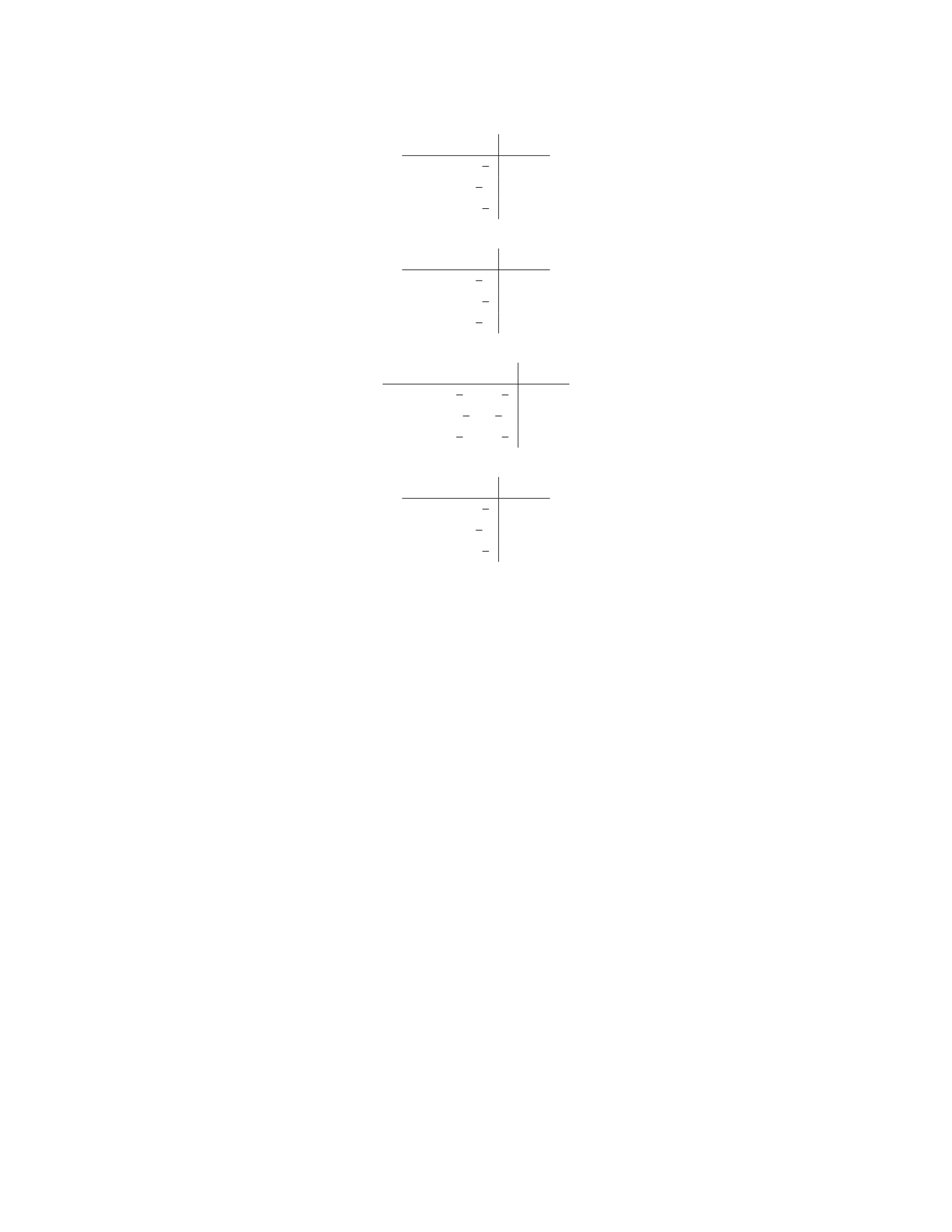
18. Using the Simplex method, if the initial feasible solution is A= 20, B = 10, what is the next
tableau in the Simplex method after one iteration (assuming maximization)?
a)
A B S1 S2 RHS
1 0 −1
2
1
240
0 1 1
6−1
610
0 0 −2
3
1
30
b)
A B S1 RHS
1 0 −1
240
0 1 1
610
0 0 −2
30
c)
A B S2 RHS
1 0 1
240
0 1 −1
610
0 0 2
30
d)
A B S1 S2 RHS
1 0 1
2−1
240
0 1 −1
6
1
610
0 0 2
3−1
30
Answer: b)
A B S1 RHS
1 0 −1
240
0 1 1
610
0 0 −2
30
17. Consider the following linear programming problem:
Maximize Z= 3x+ 2ysubject to the constraints:
2x+y≤10
x+ 2y≤8
x, y ≥0
Which of the following is the feasible region for this problem?
a) A triangle with vertices at (0, 0), (0, 8), and (5, 0)
b) A triangle with vertices at (0, 0), (4, 0), and (0, 10)
c) A rectangle with vertices at (0, 0), (8, 0), (0, 10), and (5, 0)
d) A quadrilateral with vertices at (0, 0), (0, 8), (4, 0), and (8, 0)
Answer: a) A triangle with vertices at (0, 0), (0, 8), and (5, 0)
18. Which of the following statements is true about the Simplex method?
a) It is only applicable to linear programming problems with two decision variables.
b) It always converges to the optimal solution in a finite number of steps.
c) It is a direct search method that evaluates all possible solutions within the feasible region.
d) It involves moving from one basic feasible solution to another in a way that improves the
objective function.
Answer: d) It involves moving from one basic feasible solution to another in a way that improves
the objective function.
1. Consider the following linear programming problem:
Maximize Z= 3x+ 2y
Subject to: 2x+ 3y≤12 3x+ 2y≤10 x, y ≥0
Which of the following is a feasible region for this problem?
a) Quadrant II only

b) Quadrants I and IV only
c) Quadrants I, II, and IV
d) Quadrants I, II, III, and IV
Answer: b) Quadrants I and IV only
2. Consider the linear programming problem:
Maximize Z= 4x+ 3y
Subject to: 2x+y≤8 3x+ 4y≤12 x, y ≥0
What is the optimal solution for this problem?
a) Zopt = 20 at (x= 2, y = 4)
b) Zopt = 18 at (x= 3, y = 2)
c) Zopt = 16 at (x= 2, y = 5)
d) Zopt = 15 at (x= 4, y = 0)
Answer: b) Zopt = 18 at (x= 3, y = 2)
3. For a linear programming problem with three decision variables, how many dimensions does
the feasible region have?
a) 3
b) 1
c) 2
d) 4
Answer: a) 3
1. Consider the following linear programming problem:
Maximize Z= 3x+ 5y
Subject to:
2x+y≤10
x+ 3y≤12
x, y ≥0
Which of the following points satisfies all the given constraints?
a) (1,3)
b) (2,4)
c) (3,2)
d) (4,1)
Answer: c) (3,2)
2. A company produces two types of products A and B. The profit per unit of product A is $5
and for product B is $8. Each unit of product A requires 2 hours for processing and each unit of
product B requires 1 hour. If the company can afford only 50 hours of processing time, what is the
optimal combination of products to maximize profit?
a) Produce 8 units of A and 6 units of B
b) Produce 10 units of A and 5 units of B
c) Produce 12 units of A and 4 units of B
d) Produce 15 units of A and 3 units of B
Answer: a) Produce 8 units of A and 6 units of B
3. In the simplex method, what is the initial tableau setup for a maximization problem with 3
variables and 2 constraints?
a) 3x3 matrix
b) 2x4 matrix
c) 2x5 matrix

d) 3x4 matrix
Answer: b) 2x4 matrix
1. Consider the following linear programming problem:
Maximize Z= 3x1+ 5x2
Subject to:
x1+x2≤6
2x1+x2≤8
x1, x2≥0
Which of the following points satisfies all the constraints?
a) (0,7)
b) (2,4)
c) (5,2)
d) (1,1)
Answer: c) (5,2)
2. In a graphical solution of a linear programming problem with two decision variables, the
feasible region is:
a) A straight line
b) A point
c) An area
d) An infinite region
Answer: c) An area
3. The optimal solution of a linear programming problem:
a) Must lie at the intersection of two constraint lines
b) Can lie at a corner point of the feasible region
c) Always lies at the center of the feasible region
d) Is unbounded
Answer: b) Can lie at a corner point of the feasible region
21.
Consider the following linear programming problem:
Maximize Z= 3x+ 2y
subject to
2x+y≤10
x+y≤8
x≥0,y≥0
What is the optimal solution to this problem?
a) (x= 2, y = 6)
b) (x= 4, y = 4)
c) (x= 3, y = 4)
d) (x= 5, y = 3)
Answer: b) (x= 4, y = 4)
22.
In a production process, a company can produce product A and product B. Each unit of product
A requires 3 units of resource X and 2 units of resource Y. Each unit of product B requires 2 units
of resource X and 4 units of resource Y. If the company has at most 120 units of resource X and
80 units of resource Y available, and the profit per unit of product A is $5 and product B is $8, what
is the optimal production mix to maximize profit?
a) Produce 20 units of A and 10 units of B
b) Produce 15 units of A and 20 units of B

c) Produce 10 units of A and 15 units of B
d) Produce 25 units of A and 5 units of B
Answer: c) Produce 10 units of A and 15 units of B
23.
Solve the following linear programming problem using the Simplex method:
Maximize Z= 2x+ 3y
subject to
4x+ 3y≤12
2x+ 5y≤10
x, y ≥0
a) The optimal solution is (x= 2, y = 2)
b) The optimal solution is (x= 1, y = 3)
c) The optimal solution is (x= 3, y = 1)
d) The optimal solution is (x= 4, y = 2)
Answer: a) The optimal solution is (x= 2, y = 2)

Maximize Z= 2x1+ 3x2
Subject to
x1+x2≤5
2x1+x2≤8
x1, x2≥0
Which of the following points does not satisfy the given constraints?
a) (0,6)
b) (4,1)
c) (2,3)
d) (3,4)
Answer: a) (0,6)
Question 2: The feasible region of a linear programming problem is defined by the constraints
x1≥0,x2≥0,2x1+x2≤8, and x1+ 2x2≤6. What is the feasible region in the x1x2plane?
a) a triangular region
b) a rectangular region
c) a pentagonal region
d) a circular region
Answer: a) a triangular region
Question 3: In the Simplex method, if at any iteration the value of the objective function remains
the same with changing basic feasible solution, the problem is:
a) Infeasible
b) Unbounded
c) Degenerate
d) Optimal
Answer: c) Degenerate
1. Consider the following linear programming problem:
Maximize Z= 3x+ 5ySubject to: 2x+ 3y≤12 4x+y≤8x, y ≥0
Which of the following points does not lie in the feasible region of the problem?
a) (0, 3) b) (2, 2) c) (4, 1) d) (1, 4)
Answer: a) (0, 3)
2. Solve the following linear programming problem using the graphical method:
Maximize Z= 4x+ 3ySubject to: 2x+y≤18 x+ 2y≤14 x, y ≥0
What is the optimal solution for the problem?
a) (6,6) b) (5,6) c) (4,5) d) (3,4)
Answer: c) (4,5)
3. Consider the linear programming problem:
Maximize Z= 8x+ 6ySubject to: 2x+ 3y≤12 5x+ 2y≤15 3x+ 8y≤24 x, y ≥0
Using the Simplex method, what is the optimal value of Z?
a) 24 b) 28 c) 30 d) 32
Answer: b) 28
1. Consider the following linear programming problem:
Maximize Z= 3x+ 2y
Subject to: 2x+y≤10 x+ 3y≤15 x, y ≥0
Which of the following represents the feasible region for the given problem?
a) A triangle with vertices at (0, 0), (5, 0), and (0, 10)
b) A triangle with vertices at (0, 0), (10, 0), and (0, 5)
c) A triangle with vertices at (0, 0), (3, 6), and (6, 3)

d) A triangle with vertices at (0, 0), (6, 0), and (0, 3)
Answer: b) A triangle with vertices at (0, 0), (10, 0), and (0, 5)
2. Consider the following linear programming problem:
Minimize Z= 4x+ 3y
Subject to: 2x+ 3y≥12 3x+y≥9x, y ≥0
Which of the following represents the objective function line for the given problem?
a) 3x+ 4y= 12
b) 4x+ 3y= 12
c) 3x+ 4y= 9
d) 4x+ 3y= 9
Answer: d) 4x+ 3y= 9
3. Consider the following linear programming problem:
Maximize Z= 2x+ 5y
Subject to: 3x+y≤6 2x+ 3y≤9x, y ≥0
Which of the following points lies in the feasible region for the given problem?
a) (0, 2)
b) (1, 3)
c) (2, 1)
d) (3, 0)
Answer: c) (2, 1)
1. Consider the following linear programming problem:
Maximize Z= 3x+ 5ysubject to the constraints:
2x+ 3y≤12
4x+y≤8
x, y ≥0
Which point is not a corner point of the feasible region?
a) (2,2)
b) (2,4)
c) (0,4)
d) (0,3)
Answer: c) (0,4)
2. In a linear programming problem with two variables xand y, the feasible region is unbounded.
Which of the following statements is correct?
a) The optimal solution must lie at a corner point.
b) The problem has multiple optimal solutions.
c) The problem is infeasible.
d) The objective function is unbounded.
Answer: a) The optimal solution must lie at a corner point.
1. Consider the following maximization linear programming problem:
Maximize Z= 3x+ 4y
Subject to: 2x+ 3y≤12 4x+ 2y≤16 x, y ≥0
Which of the following is a feasible solution to the linear programming problem?
a) x= 2, y = 3
b) x= 1, y = 4
c) x= 3, y = 2
d) x= 4, y = 1

Answer: a) x= 2, y = 3
2. Solve the following linear programming problem graphically:
Maximize Z= 5x+ 4y
Subject to: 2x+ 3y≤12 4x+y≤8x, y ≥0
Which point on the graph represents the optimal solution?
a) (0,4)
b) (2,3)
c) (3,2)
d) (4,0)
Answer: b) (2,3)
3. In the Simplex method, what is the initial tableau for a maximization linear programming
problem with the following constraints?
Maximize Z= 3x+ 4y
Subject to: 2x+ 3y≤12 4x−y≤8x, y ≥0
a)
Z x y s1s2RHS
1−3−4 0 0 0
0 2 3 1 0 12
0 4 −1 0 1 8
b)
Z x y s1s2RHS
1 3 4 0 0 0
0−2−3 1 0 −12
0−4 1 0 1 −8
c)
Z x y s1s2RHS
1−3−4 0 0 0
0 2 3 1 0 12
0−4 1 0 −1 8
d)
Z x y s1s2RHS
1 3 4 0 0 0
0 2 3 1 0 12
0−4 1 0 −1 8
Answer: c)
Z x y s1s2RHS
1−3−4 0 0 0
0 2 3 1 0 12
0−4 1 0 −1 8
1. Consider a production planning problem with the following constraints:
Maximize Z= 4x+ 3y
Subject to:
2x+y≤10
x+ 2y≤8
x, y ≥0
What is the feasible region for this problem? a) Quadrant I b) Quadrant II c) Quadrant III d)
Quadrant IV
Answer: a) Quadrant I

2. Solve the following linear programming problem graphically:
Maximize Z= 3x+ 2y
Subject to:
2x+y≤6
x+ 2y≤5
x, y ≥0
What is the optimal solution for this problem? a) (x, y) = (0,2.5) b) (x, y) = (1,2) c) (x, y) =
(2,1) d) (x, y) = (2.5,0)
Answer: b) (x, y) = (1,2)
3. Consider the following linear programming problem in standard form:
Maximize Z= 2x+ 3y
Subject to:
x+y≤4
x−y≤2
x, y ≥0
What is the solution to this linear programming problem using the Simplex method? a) Zmax =
10 at (x, y) = (2,2) b) Zmax = 8 at (x, y) = (3,1) c) Zmax = 9 at (x, y) = (2,2) d) Zmax = 6 at
(x, y) = (2,1)
Answer: a) Zmax = 10 at (x, y) = (2,2)
10. Consider the following linear programming problem:
Maximize Z= 2x+ 3y
Subject to: 3x+ 4y≤24 2x+ 3y≤18 x≥0, y ≥0
What is the optimal solution to this problem?
a) (x= 4, y = 3)
b) (x= 2, y = 3)
c) (x= 3, y = 4)
d) (x= 2, y = 2)
Answer: d) (x= 2, y = 2)
1. Consider the following linear programming problem:
Maximize Z= 3x+ 4y
Subject to:
2x+y≤10
x+ 3y≤12
x, y ≥0
What is the optimal solution for this problem?
a) (x= 4, y = 2)
b) (x= 2, y = 4)
c) (x= 3, y = 3)
d) (x= 5, y = 1)
Answer: a) (x= 4, y = 2)

2. Solve the following linear programming problem using the graphical method:
Maximize Z= 5x+ 3y
Subject to:
3x+ 2y≤18
x+ 2y≤12
x, y ≥0
What is the optimal value of Zat the optimal solution?
a) Z= 33
b) Z= 30
c) Z= 27
d) Z= 24
Answer: b) Z= 30
3. Use the Simplex method to solve the following linear programming problem:
Maximize Z= 2x+ 3y
Subject to:
2x+y≤6
x+ 2y≤7
x, y ≥0
What is the optimal solution for this problem?
a) (x= 2, y = 3)
b) (x= 3, y = 2)
c) (x= 1, y = 4)
d) (x= 4, y = 1)
Answer: a) (x= 2, y = 3)
12. Consider the following linear programming problem:
Maximize Z= 3x+ 2ysubject to:
2x+y≤10
x+ 2y≤12
x, y ≥0
Which of the following points is the graphical solution to the linear programming problem?
a) (0,8)
b) (4,3)
c) (5,5)
d) (7,6)
Answer: b) (4,3)
13. The feasible region for a linear programming problem is:
Maximize Z= 4x+ 3ysubject to:
2x+y≤10
x+ 2y≤12
x, y ≥0
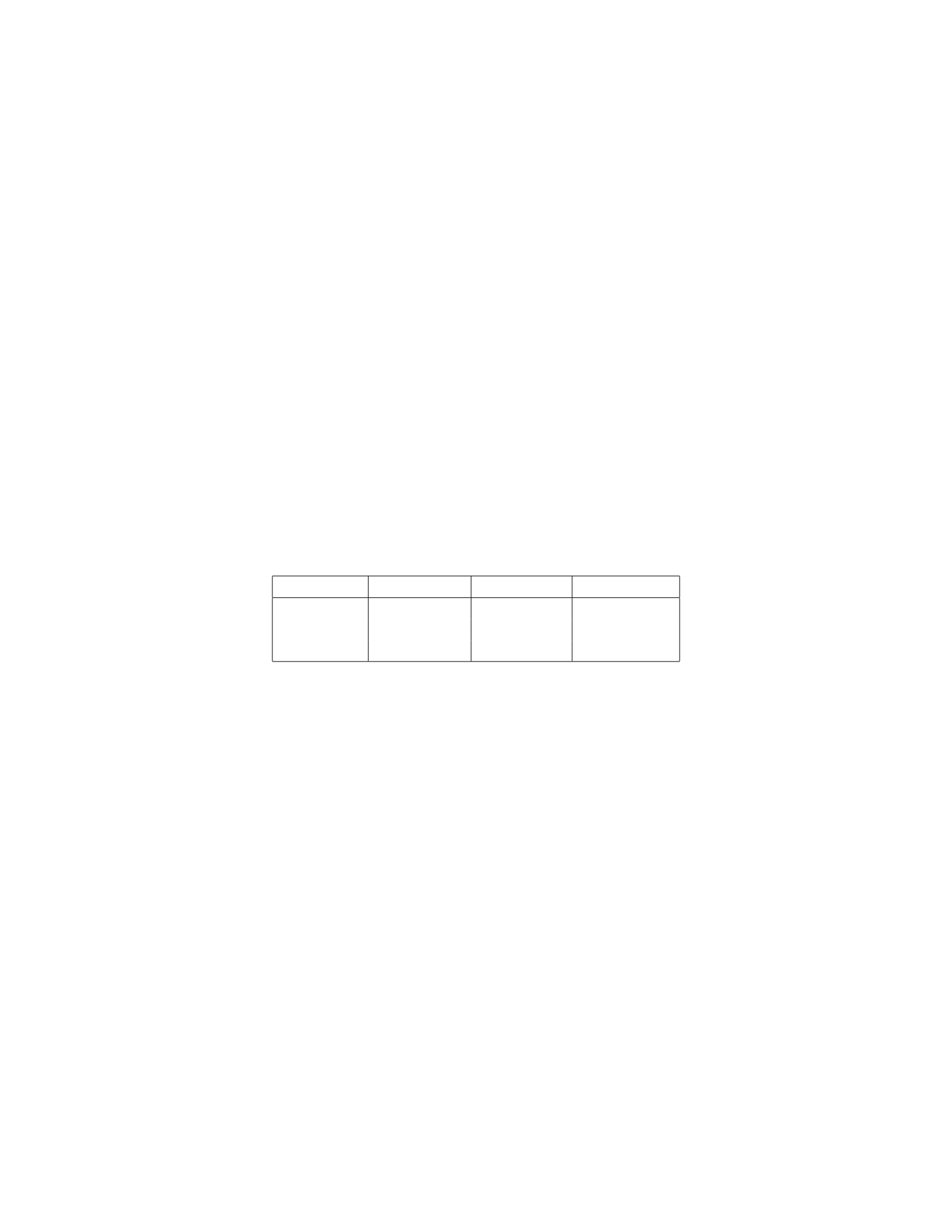
a) An unbounded region
b) A region with no feasible solutions
c) A feasible region with a unique optimal solution
d) A region with multiple optimal solutions
Answer: c) A feasible region with a unique optimal solution
14. For the following linear programming problem:
Maximize Z= 5x+ 3ysubject to:
2x+y≤10
x+ 2y≤12
x, y ≥0
Which of the following is true regarding the optimal solution?
a) It is at the intersection of two constraints
b) It is always at a corner point of the feasible region
c) It may exist in the interior of the feasible region
d) It cannot be determined without solving the problem
Answer: b) It is always at a corner point of the feasible region
13.
A company produces two products, Xand Y, using three resources A,B, and C. The profit
per unit of Xis $10 and for Yis $15. The resource requirements and availability are as follows:
Resource Product XProduct YAvailability
A2 3 150
B4 2 160
C3 3 180
Formulate the linear programming problem to maximize the profit.
a) Maximize 10X+ 15Ysubject to 2X+ 3Y≤150,4X+ 2Y≤160, and 3X+ 3Y≤180
b) Maximize 10X+ 15Ysubject to 2X+ 3Y≥150,4X+ 2Y≤160, and 3X+ 3Y≤180
c) Maximize 10X+ 15Ysubject to 2X+ 3Y≤150,4X+ 2Y≤160, and 3X+ 3Y≥180
Answer: a) Maximize 10X+15Ysubject to 2X+3Y≤150,4X+2Y≤160, and 3X+3Y≤180
Question 1:
Consider the following linear programming problem:
Maximize Z= 3x1+ 2x2subject to:
2x1+ 3x2≤12
x1+x2≤6
x1, x2≥0
Which of the following is a feasible region for this problem?
a) x1≥0, x2≥0, x1+x2≤6
b) x1≥0, x2≥0,2x1+ 3x2≤12
c) x1≥0, x2≥0,3x1+ 2x2≤12
d) x1≥0, x2≥0,2x1+ 3x2≤6
Answer: b) x1≥0, x2≥0,2x1+ 3x2≤12
—
Question 2:
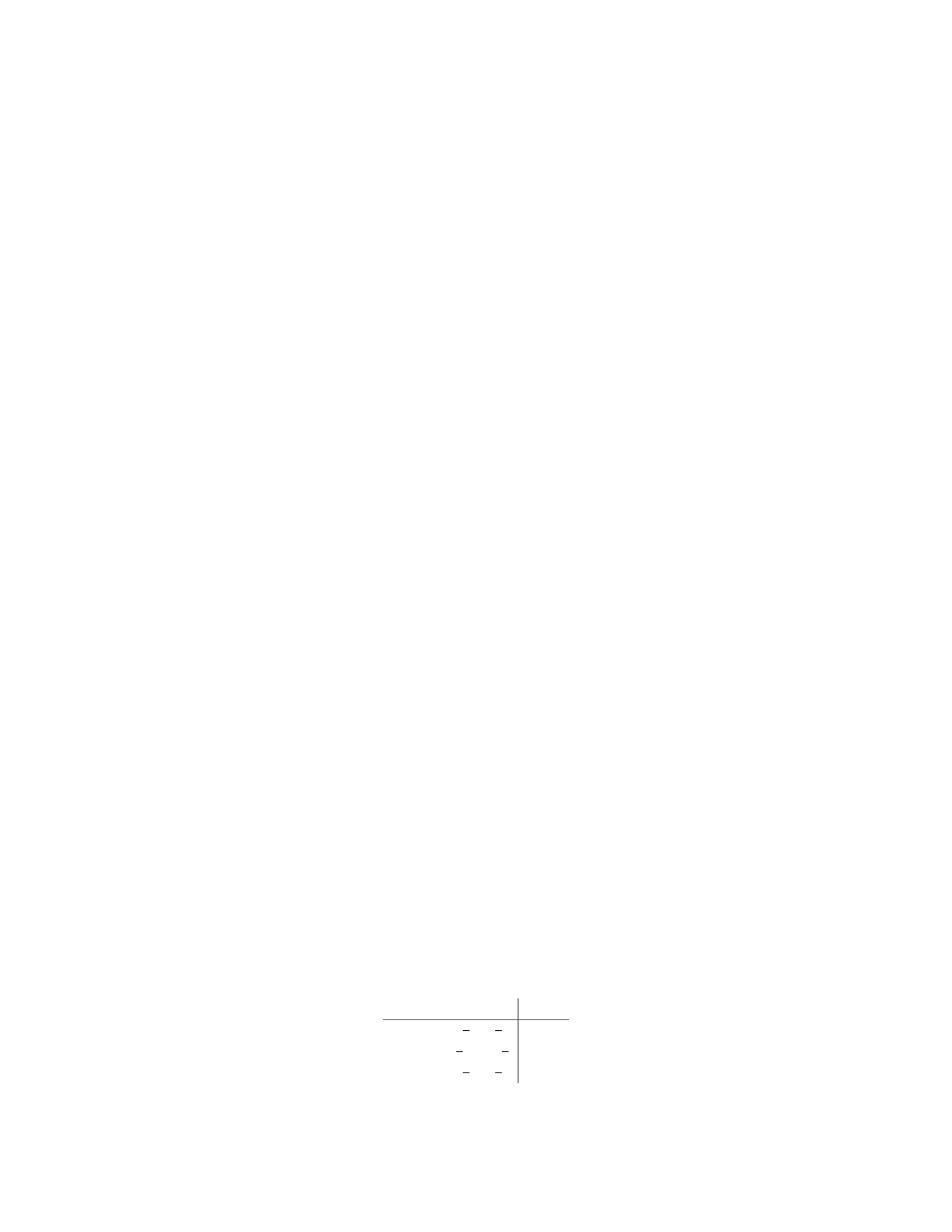
Consider the simplex method for solving a linear programming problem. At each iteration, the
pivot element is chosen as the:
a) Smallest negative entry in the objective row
b) Smallest positive entry in the objective row
c) Largest positive entry in the objective row
d) Largest negative entry in the objective row
Answer: c) Largest positive entry in the objective row
15. Consider the following linear programming problem: Maximize Z= 3x+ 4ysubject to the
constraints: 2x+y≤10 x+ 3y≤12 x, y ≥0
Which of the below points is not a vertex of the feasible region?
a) (3, 4) b) (2, 3) c) (0, 6) d) (5, 1)
Answer: c) (0, 6)
16. In a linear programming problem, a feasible solution is said to be degenerate if:
a) The solution lies on the boundary of the feasible region b) The solution is unbounded c) The
solution violates the non-negativity constraint d) The solution is not unique
Answer: a) The solution lies on the boundary of the feasible region
17. The Simplex method is used to:
a) Minimize the objective function in linear programming problems b) Graphically represent
the solution space of a linear programming problem c) Optimize the allocation of resources in
production planning d) Solve linear equations in one variable
Answer: c) Optimize the allocation of resources in production planning
16. Consider a manufacturing company that produces two types of products: Product A and
Product B. Each unit of Product A requires 2 hours of labor and 1 hour of machine time, while each
unit of Product B requires 1 hour of labor and 3 hours of machine time. The company has 80 hours
of labor and 120 hours of machine time available each week. The profit earned per unit of Product
A is $50 and per unit of Product B is $60.
What is the objective function for maximizing profit for the manufacturing company?
a) 50A+ 60B
b) 60A+ 50B
c) 2A+ 3B
d) 3A+ 2B
Answer: a) 50A+ 60B
17. In the above scenario, if the manufacturing company wants to maximize profit subject to
the constraints given, which of the following represents the constraint for labor hours?
a) 2A+B≤80
b) 2A+ 3B≤80
c) A+ 3B≤80
d) 2A+B≤120
Answer: a) 2A+B≤80
18. Using the Simplex method, if the initial feasible solution is A= 20, B = 10, what is the next
tableau in the Simplex method after one iteration (assuming maximization)?
a)
A B S1 S2 RHS
1 0 −1
2
1
240
0 1 1
6−1
610
0 0 −2
3
1
30
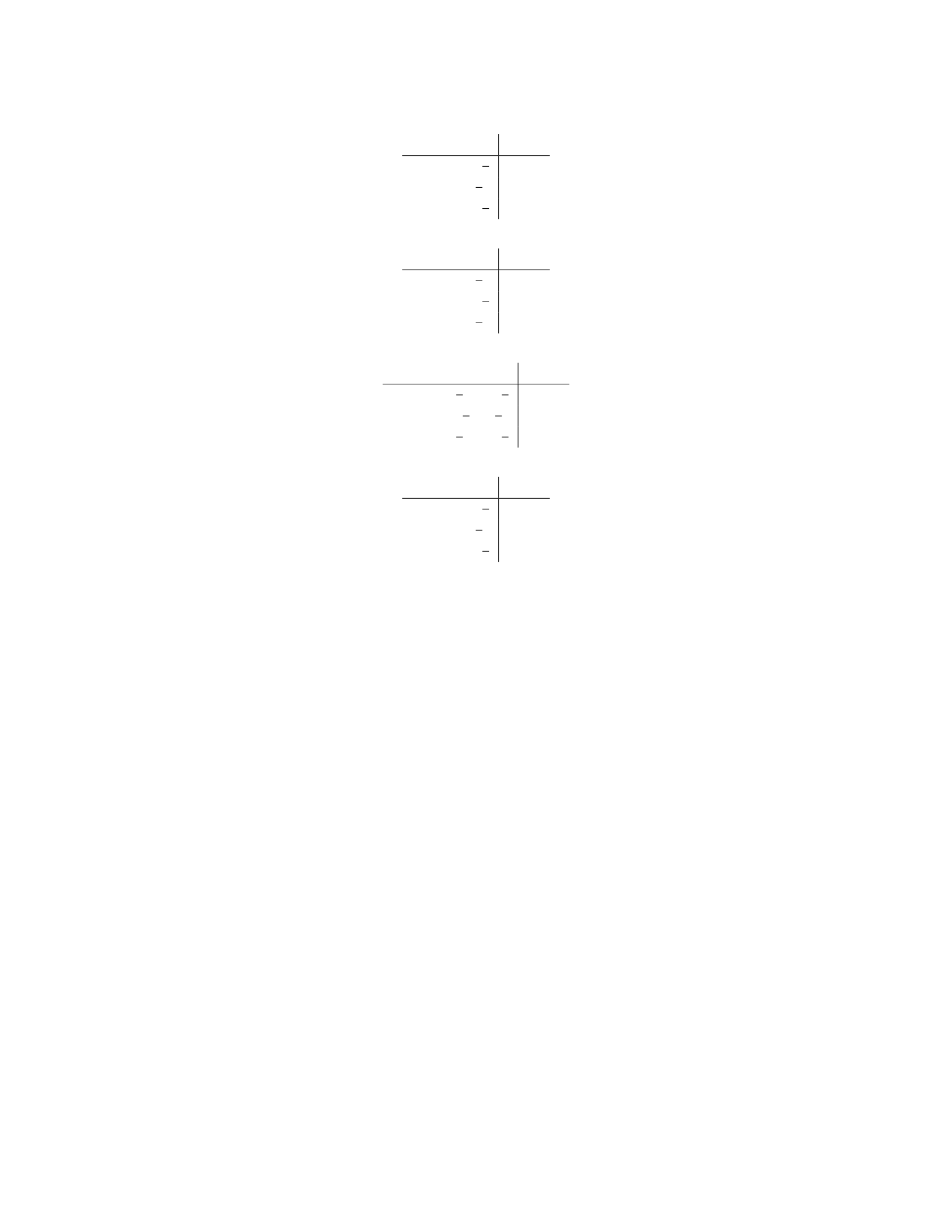
b)
A B S1 RHS
1 0 −1
240
0 1 1
610
0 0 −2
30
c)
A B S2 RHS
1 0 1
240
0 1 −1
610
0 0 2
30
d)
A B S1 S2 RHS
1 0 1
2−1
240
0 1 −1
6
1
610
0 0 2
3−1
30
Answer: b)
A B S1 RHS
1 0 −1
240
0 1 1
610
0 0 −2
30
17. Consider the following linear programming problem:
Maximize Z= 3x+ 2ysubject to the constraints:
2x+y≤10
x+ 2y≤8
x, y ≥0
Which of the following is the feasible region for this problem?
a) A triangle with vertices at (0, 0), (0, 8), and (5, 0)
b) A triangle with vertices at (0, 0), (4, 0), and (0, 10)
c) A rectangle with vertices at (0, 0), (8, 0), (0, 10), and (5, 0)
d) A quadrilateral with vertices at (0, 0), (0, 8), (4, 0), and (8, 0)
Answer: a) A triangle with vertices at (0, 0), (0, 8), and (5, 0)
18. Which of the following statements is true about the Simplex method?
a) It is only applicable to linear programming problems with two decision variables.
b) It always converges to the optimal solution in a finite number of steps.
c) It is a direct search method that evaluates all possible solutions within the feasible region.
d) It involves moving from one basic feasible solution to another in a way that improves the
objective function.
Answer: d) It involves moving from one basic feasible solution to another in a way that improves
the objective function.
1. Consider the following linear programming problem:
Maximize Z= 3x+ 2y
Subject to: 2x+ 3y≤12 3x+ 2y≤10 x, y ≥0
Which of the following is a feasible region for this problem?
a) Quadrant II only

b) Quadrants I and IV only
c) Quadrants I, II, and IV
d) Quadrants I, II, III, and IV
Answer: b) Quadrants I and IV only
2. Consider the linear programming problem:
Maximize Z= 4x+ 3y
Subject to: 2x+y≤8 3x+ 4y≤12 x, y ≥0
What is the optimal solution for this problem?
a) Zopt = 20 at (x= 2, y = 4)
b) Zopt = 18 at (x= 3, y = 2)
c) Zopt = 16 at (x= 2, y = 5)
d) Zopt = 15 at (x= 4, y = 0)
Answer: b) Zopt = 18 at (x= 3, y = 2)
3. For a linear programming problem with three decision variables, how many dimensions does
the feasible region have?
a) 3
b) 1
c) 2
d) 4
Answer: a) 3
1. Consider the following linear programming problem:
Maximize Z= 3x+ 5y
Subject to:
2x+y≤10
x+ 3y≤12
x, y ≥0
Which of the following points satisfies all the given constraints?
a) (1,3)
b) (2,4)
c) (3,2)
d) (4,1)
Answer: c) (3,2)
2. A company produces two types of products A and B. The profit per unit of product A is $5
and for product B is $8. Each unit of product A requires 2 hours for processing and each unit of
product B requires 1 hour. If the company can afford only 50 hours of processing time, what is the
optimal combination of products to maximize profit?
a) Produce 8 units of A and 6 units of B
b) Produce 10 units of A and 5 units of B
c) Produce 12 units of A and 4 units of B
d) Produce 15 units of A and 3 units of B
Answer: a) Produce 8 units of A and 6 units of B
3. In the simplex method, what is the initial tableau setup for a maximization problem with 3
variables and 2 constraints?
a) 3x3 matrix
b) 2x4 matrix
c) 2x5 matrix

d) 3x4 matrix
Answer: b) 2x4 matrix
1. Consider the following linear programming problem:
Maximize Z= 3x1+ 5x2
Subject to:
x1+x2≤6
2x1+x2≤8
x1, x2≥0
Which of the following points satisfies all the constraints?
a) (0,7)
b) (2,4)
c) (5,2)
d) (1,1)
Answer: c) (5,2)
2. In a graphical solution of a linear programming problem with two decision variables, the
feasible region is:
a) A straight line
b) A point
c) An area
d) An infinite region
Answer: c) An area
3. The optimal solution of a linear programming problem:
a) Must lie at the intersection of two constraint lines
b) Can lie at a corner point of the feasible region
c) Always lies at the center of the feasible region
d) Is unbounded
Answer: b) Can lie at a corner point of the feasible region
21.
Consider the following linear programming problem:
Maximize Z= 3x+ 2y
subject to
2x+y≤10
x+y≤8
x≥0,y≥0
What is the optimal solution to this problem?
a) (x= 2, y = 6)
b) (x= 4, y = 4)
c) (x= 3, y = 4)
d) (x= 5, y = 3)
Answer: b) (x= 4, y = 4)
22.
In a production process, a company can produce product A and product B. Each unit of product
A requires 3 units of resource X and 2 units of resource Y. Each unit of product B requires 2 units
of resource X and 4 units of resource Y. If the company has at most 120 units of resource X and
80 units of resource Y available, and the profit per unit of product A is $5 and product B is $8, what
is the optimal production mix to maximize profit?
a) Produce 20 units of A and 10 units of B
b) Produce 15 units of A and 20 units of B

c) Produce 10 units of A and 15 units of B
d) Produce 25 units of A and 5 units of B
Answer: c) Produce 10 units of A and 15 units of B
23.
Solve the following linear programming problem using the Simplex method:
Maximize Z= 2x+ 3y
subject to
4x+ 3y≤12
2x+ 5y≤10
x, y ≥0
a) The optimal solution is (x= 2, y = 2)
b) The optimal solution is (x= 1, y = 3)
c) The optimal solution is (x= 3, y = 1)
d) The optimal solution is (x= 4, y = 2)
Answer: a) The optimal solution is (x= 2, y = 2)

