


How do leaders influence and move their followers to action?
Liberty University
AVIA 245 Aviation Leadership
Professor: Jim Molloy
2022

How do leaders influence and move their followers to action?
Leaders hold a unique position in their groups, exercising influence and providing direction. Leonard
Bernstein was part of the symphony, but his role as the New York Philharmonic conductor differed
dramatically from that of the other symphony members. Besides conducting the orchestra, he created a
vision for the symphony. In this capacity, leadership can be seen as a differentiated role and the nucleus
of group activity.
Organizations have two kinds of leaders: formal and informal. A formal leader is that individual who
is recognized by those outside the group as the official leader of the group. Often, the formal leader is
appointed by the organization to serve in a formal capacity as an agent of the organization. Jack Welch
was the formal leader of General Electric, and Leonard Bernstein was the formal leader of the
symphony. Practically all managers act as formal leaders as part of their assigned role. Organizations
that use self-managed work teams allow members of the team to select the individual who will serve as
their team leader. When this person’s role is sanctioned by the formal organization, these team leaders
become formal leaders. Increasingly, leaders in organizations will be those who “best sell” their ideas on
how to complete a project—persuasiveness and inspiration are important ingredients in the leadership
equation, especially in high-involvement organizations.
Informal leaders, by contrast, are not assigned by the organization. The informal leader is that
individual whom members of the group acknowledge as their leader. Athletic teams often have informal
leaders, individuals who exert considerable influence on team members even though they hold no
official, formal leadership position. In fact, most work groups contain at least one informal leader. Just
like formal leaders, informal leaders can benefit or harm an organization depending on whether their
influence encourages group members to behave consistently with organizational goals.
As we have noted, the terms leader and manager are not synonymous. Grace Hopper, retired U.S.
Navy admiral, draws a distinction between leading and managing: “You don’t manage people, you
manage things. You lead people.” Informal leaders often have considerable leverage over their
colleagues. Traditionally, the roles of informal leaders have not included the total set of management
responsibilities because an informal leader does not always exercise the functions of planning,
organizing, directing, and controlling. However, high-involvement organizations frequently encourage
their formal and informal leaders to exercise the full set of management roles. Many consider such
actions necessary for self-managing work teams to succeed. Informal leaders are acknowledged by the
group, and the group willingly responds to their leadership.
Paths to Leadership
People come to leadership positions through two dynamics. In many instances, people are put into
positions of leadership by forces outside the group. University-based ROTC programs and military
academies (like West Point) formally groom people to be leaders. We refer to this person as the
designated leader (in this instance the designated and formal leader are the same person). Emergent
leaders, on the other hand, arise from the dynamics and processes that unfold within and among a
group of individuals as they endeavor to achieve a collective goal.

A variety of processes help us understand how leaders emerge. Gerald Salancik and Jeffrey Pfeffer
observe that power to influence others flows to those individuals who possess the critical and scarce
resources (often knowledge and expertise) that a group needs to overcome a major problem.24 They
note that the dominant coalition and leadership in American corporations during the 1950s was among
engineers, because organizations were engaged in competition based on product design. The power
base in many organizations shifted to marketing as competition became a game of advertising aimed at
differentiating products in the consumer’s mind. About 10–15 years ago, power and leadership once
again shifted, this time to people with finance and legal backgrounds, because the critical contingencies
facing many organizations were mergers, acquisitions, hostile takeovers, and creative financing. Thus,
Salancik and Pfeffer reason that power and thus leadership flow to those individuals who have the
ability to help an organization or group [overcome its critical contingencies]. As the challenges facing a
group change, so too may the flow of power and leadership.
Many leaders emerge out of the needs of the situation. Different situations call for different
configurations of knowledge, skills, and abilities. A group often turns to the member who possesses the
knowledge, skills, and abilities that the group requires to achieve its goals. People surrender their power
to individuals whom they believe will make meaningful contributions to attaining group goals. The
individual to whom power is surrendered is often a member of the group who is in good standing. As a
result of this member’s contributions to the group’s goals, he has accumulated idiosyncrasy credits (a
form of competency-based status). These credits give the individual a status that allows him to influence
the direction that the group takes as it works to achieve its goals.
It is important to recognize that the traits possessed by certain individuals contribute significantly
to their emergence as leaders. Research indicates that people are unlikely to follow individuals who, for
example, do not display drive, self-confidence, knowledge of the situation, honesty, and integrity.
Leadership as an Exercise of Influence
As we have noted, leadership is the exercise of influence over those who depend on one another
for attaining a mutual goal in a group setting. But how do leaders effectively exercise this influence?
Social or (interpersonal) influence is one’s ability to effect a change in the motivation, attitudes, and/or
behaviors of others. Power, then, essentially answers the “how” question: How do leaders influence
their followers? The answer often is that a leader’s social influence is the source of his power.
French and Raven provide us with a useful typology that identifies the sources and types of power
that may be at the disposal of leaders:
Reward power—the power a person has because people believe that they can bestow rewards
or outcomes, such as money or recognition that others desire
Coercive power—the power a person has because people believe that the person can punish
them by inflicting pain or by withholding or taking away something that they value

Referent power—the power a person has because others want to associate with or be accepted
by him
Expert power—the power a person has because others believe that the person has and is willing
to share expert knowledge that they need (The concept of resource power extends the idea of expert
power to include the power that a person has because others believe that the person possesses and is
willing to share resources, such as information, time, or materials that are needed.)
Legitimate power—the power a person has because others believe that the person possesses
the “right” to influence them and that they ought to obey. This right can originate in tradition; in the
charisma or appeal of the person; and in laws, institutional roles within society, moralistic appeal, and
rationality (that is, logical arguments, factual evidence, reason, and internally consistent positions).
Not all forms of power are equally effective (see Exhibit 13.5), nor is a leader’s total power base the
simple sum of the powers at his disposal. Different types of power elicit different forms of compliance:
Leaders who rely on coercive power often alienate followers who resist their influence attempts.
Leaders who rely on reward power develop followers who are very measured in their responses to
[what?]; the use of rewards often leads people to think in terms of “How much am I getting?” or “How
much should I give?” or “Am I breaking even?” The use of referent power produces identification with
the leader and his cause. The use of rationality, expert power, and/or moralistic appeal generally elicits
commitment and the internalization of the leader’s goals.
Exhibit 13.5 the Leader-Follower Power Relationship
Leaders who use referent and expert power commonly experience a favorable response in terms of
follower satisfaction and performance. Research suggests that rationality is the most effective influence
tactic in terms of its impact on follower commitment, motivation, performance, satisfaction, and group
effectiveness. Reward and legitimate power (that is, relying on one’s position to influence others)
produce inconsistent results. Sometimes these powers lead to follower performance and satisfaction,
yet they also sometimes fail. Coercive power can result in favorable performance, yet follower and
resistance dissatisfaction are not uncommon.
Good leaders, whether formal or informal, develop many sources of power. Leaders who rely solely
on their legitimate power and authority seldom generate the influence necessary to help their
organization and its members succeed. In the process of building their power base, effective leaders
have discovered that the use of coercive power tends to dilute the effectiveness of other powers, while
the development and use of referent power tends to magnify the effectiveness of other forms of power.
A compliment or reward from a person we like generally has greater value than one from someone we
dislike, and punishment from someone we love (such as “tough love” from a parent) is less offensive
than the pain inflicted by someone we dislike.
In sum, one key to effective leadership, especially as it pertains to the exercise of social and
interpersonal influence, relates to the type of power employed by the leader. Overall leader
effectiveness will be higher when people follow because they want to follow. This is much more likely to

happen when the leader’s influence flows out of intrinsic such as rationality, expertise, moralistic
appeal, and/or referent power.
Leadership is also about having a vision and communicating that vision to others in such a way that
it provides meaning for the follower. Language, ritual, drama, myths, symbolic constructions, and
stories are some of the tools leaders use to capture the attention of their “followers to be” to evoke
emotion and to manage the meaning “of the task (challenges) facing the group.” These tools help the
leader influence the attitudes, motivation, and behavior of their followers.
Influence-Based Leadership Styles
Many writers and researchers have explored how leaders can use power to address the needs of
various situations. One view holds that in traditional organizations members expect to be told what to
do and are willing to follow highly structured directions. Individuals attracted to high-involvement
organizations, however, want to make their own decisions, expect their leaders to allow them to do so,
and are willing to accept and act on this responsibility. This suggests that a leader may use and employ
power in a variety of ways.
The Tannenbaum and Schmidt Continuum
In the 1950s, Tannenbaum and Schmidt created a continuum (see Exhibit 13.6) along which
leadership styles range from authoritarian to extremely high levels of worker freedom. Subsequent to
Tannenbaum and Schmidt’s work, researchers adapted the continuum by categorizing leader power
styles as autocratic (boss-centered), participative (workers are consulted and involved), or free-rein
(members are assigned the work and decide on their own how to do it; the leader relinquishes the
active assumption of the role of leadership). Exhibit 13.6 Tannenbaum and Schmidt’s Leadership
Continuum Source: Modified from R. Tannenbaum and W. H. Schmidt. May—June 1971. How to choose
a leadership pattern. Harvard Business Review, 167.
Theory X and Theory Y Leaders
McGregor’s Theory X and Theory Y posits two different sets of attitudes about the individual as an
organizational member. Theory X and Y thinking gives rise to two different styles of leadership. The
Theory X leader assumes that the average individual dislikes work and is incapable of exercising
adequate self-direction and self-control. As a consequence, they exert a highly controlling leadership
style. In contrast, Theory Y leaders believe that people have creative capacities, as well as both the
ability and desire to exercise self-direction and self-control. They typically allow organizational members
significant amounts of discretion in their jobs and encourage them to participate in departmental and
organizational decision-making. Theory Y leaders are much more likely to adopt involvement-oriented
approaches to leadership and organically designed organizations for their leadership group.
Theory X and Theory Y thinking and leadership are not strictly an American phenomenon. Evidence
suggests that managers from different parts of the global community commonly hold the same view. A
study of 3,600 managers from 14 countries reveals that most of them held assumptions about human
nature that could best be classified as Theory X. Even though managers might publicly endorse the
merits of participatory management, most of them doubted their workers’ capacities to exercise self-
direction and self-control and to contribute creatively.
Directive/Permissive Leadership Styles
Contemplating the central role of problem-solving in management and leadership, Jan P. Muczyk
and Bernard C. Reimann of Cleveland State University offer an interesting perspective on four different
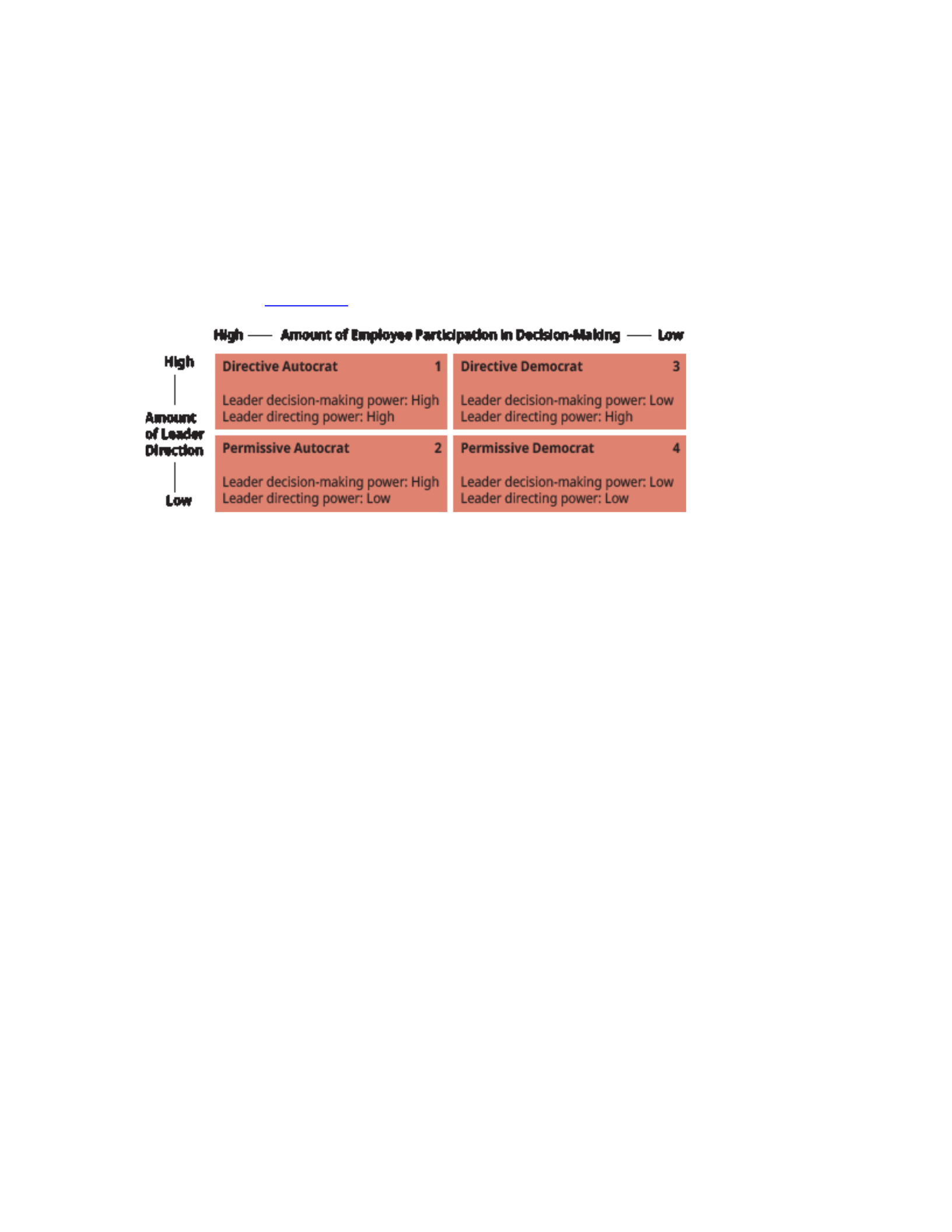
leadership styles (see Exhibit 13.7) that revolve around decision-making and implementation processes.
Exhibit 13.7 Leadership Behavior and the Uses of Power Source: Modified from J. P. Muczyk and B.
C. Reimann. 1987. The case for directive leadership. Academy of Management Executive, 1:304.
A directive autocrat retains power, makes unilateral decisions, and closely supervises workers’
activities. This style of leadership is seen as appropriate when circumstances require quick decisions and
organizational members are new, inexperienced, or underqualified. A doctor in charge of a hastily
constructed shelter for victims of a tornado may use this style to command nonmedical volunteers.
The permissive autocrat mixes his or her use of power by retaining decision-making power but
permitting organizational members to exercise discretion when executing those decisions. This leader
behavior is recommended when decision-making time is limited, when tasks are routine, or when
organizational members have sufficient expertise to determine appropriate role behaviors.
Also sharing power is the directive democrat, who encourages participative decision-making but
retains the power to direct team members in the execution of their roles. This style is appropriate when
followers have valuable opinions and ideas, but one person needs to coordinate the execution of the
ideas. A surgeon might allow the entire surgical team to participate in developing a plan for a surgical
procedure. Once surgery begins, however, the surgeon is completely in charge.
Finally, the permissive democrat shares power with group members, soliciting involvement in both
decision-making and execution. This style is appropriate when participation has both informational and
motivational value, when time permits group decision-making, when group members are capable of
improving decision quality, and when followers are capable of exercising self-management in their
performance of work.

The permissive democratic approach to leadership is characteristic of leadership in high-
involvement organizations. Here, leaders act as facilitators, process consultants, network builders,
conflict managers, inspirationalists, coaches, teachers/mentors, and cheerleaders.40 Such is the role of
Ralph Stayer, founder, owner, and CEO of Johnsonville Foods. He defines himself as his company’s
philosopher. At Quad/Graphics, president Harry V. Quadracci is a permissive democrat because he
encourages all Quad employees to play a major role in decision-making and execution as they manage
their teams as independent profit centers.

