


Artificial Intelligence in Supply Chain
Management
SCM 463 - Global Supply Chain
Management
Arizona State University-Tempe
December 14, 2022

Introduction
Background
Industry 4.0, which refers to the fourth
industrial revolution and also known as
4ILR, is a digital transformation in the
field of manufacturing, production, and
processing that emphasizes the need for
the use of artificial intelligence (AI) when
making decisions and undertaking
specific actions. Information has become
a critical factor that defines the success or
failure of a given business (Yuanita, 2019,
p. 15). As such, firms are under pressure
to find the best ways of processing large
data within the shortest period possible
and use it to make critical decisions.
Traditionally, humans would be expected
to process the data using simple
machines and then make relevant

decisions. However, that is changing with
the emergence of concepts of Big Data
and Machine Learning (ML). It is
becoming increasingly possible to rely on
machines to collect and process data, and
then use it to make critical decisions and
predictions more accurately than a
human would (Tirkolaee, Sadeghi,
Mooseloo, Vandchali, & Aeini, 2021, p.
13). As such, AI has gained popularity in
the field of supply chain management
(SCM). In this study, the researcher
focuses on the benefits, opportunities,
and challenges of embracing ML
technologies in logistics to help SMEs
boost their performance.
Research Problem
Micro, Small & Medium Enterprises
(MSMEs) play a critical role in emerging

and developing economies in terms of
the creation of employment and the
growth of gross domestic products (GDP).
However, they face unfair competition
from large multinational corporations
that have the financial power,
experience, and the right connections to
facilitate their growth and embrace
emerging technologies. Adopting
industry 4.0 has been a major challenge
for these small and medium enterprises
because of the financial implications and
expertise needed. Despite the challenge,
Singh, Wiktorsson, and Hauge (2021)
explain that industry 4.0 offers a unique
opportunity for these firms to redefine
their operations and compete favorably
with the more established rivals (p. 67).
Embracing AI in SCM makes it possible to

reduce expenses on human resources,
improve efficiency in operations, and
enhance the quality of products that they
deliver.
Research Objectives
This study aims to establish a practical
and clear of the benefits, opportunities,
and challenges of adopting machine
learning technologies in logistics to help
SMEs boost their performance. To
achieve this primary goal, the researcher
will focus on realizing the following
objectives:
1. To identify ML techniques
frequently used in logistics in SMEs;
2. To identify the benefits of ML in
Logistics in SMEs;

3. To identify the opportunities of
implementing ML techniques in
logistics in SMEs;
4. To identify the challenges of
implementing ML techniques in
logistics in SMEs;
5. To identify the relationship
between ML adoption in logistics and
MSMEs performance.
Research Questions
Artificial intelligence is a field that has
continued to attract the attention of
many scholars over the years. It is
essential to specifically define the specific
issues that need to be investigated in a
given study. In this research, the
following are the specific questions that
the researcher seeks to answer:

1. What are ML techniques
frequently used in logistics in SMEs
and what are the benefits and
opportunities of adopting them?
2. What are the challenges of
adopting ML techniques in logistics in
SMEs?
3. What is the relationship between
ML adoption in logistics and MSMEs
performance?
Overview of the Current State of
Research and Methodology
Artificial intelligence and its relevance in
supply chain management is a field of
study that has attracted massive
attention from scholars over the years.
According to Singh et al. (2021), scholars
have been keen to understand how AI

can help MSMEs to acquire materials
they need for production more efficiently
and cost-effectively (p. 69). However, a
preliminary review of existing studies
shows that this is a relatively new field as
AI continues to evolve. In this project, the
researcher will rely on secondary data
sources to help achieve the aim and
objectives identified above.
Evolution of Artificial Intelligence
Artificial intelligence and machine
learning have become increasingly
relevant in the modern business
environment. It is necessary to discuss
the evolution of this technology and how
it gained relevance in different fields
(Rabayah, 2013, p. 8). The origin of AI can
be traced back to Europe in the early
20th century, especially in the United

Kingdom and Germany. Mathematicians,
scientists, and philosophers have
conceptualized the idea of having
intelligent machines capable of solving
human problems in the 1950s. Several
scientists were able to develop a logical
framework in 1950 referred to as
Computing Machinery and Intelligence,
which would later redefine the current
use of AI in supply chain management
(Pervaiz, 2020, p. 26). He explained how
machines can be trained to be intelligent
and ways in which their intelligence can
be tested.
Stages of AI Growth
The pioneers in this industry faced
numerous challenges that slowed the
growth of this industry. One of the
biggest challenges was the accessibility of

the computers at this time. Sendler
(2017) explains that leasing a computer in
the 1early periods of its development
was an expensive undertaking, which
meant that only prestigious and
financially empowered institutions could
afford it (p. 87). He describes computers
at that time as being primitive, only
capable of executing commands but not
storing them. Many institutions did not
see the worth of investing in this
technology, which means that these
pioneers did not get the relevant support
they needed to facilitate the growth of
the industry. However, they were able to
overcome these challenges and
facilitated its gradual growth.
It became evident that the growth of AI
needed experts to share ideas to help in

improving its capabilities. The Dartmouth
Summer Research Project on Artificial
Intelligence (DSRPAI) of 1956, which was
hosted by Marvin Minsky and John
McCarthy was the first of its kind and
catalyzed its growth. It brought together
experts in AI and financiers from all over
the world. The technology started
developing as machines could not only
execute but also store data and
remember actions taken.
The Fifth Generation Computer Project
(FGCP), which started in 1980 and lasted
till 1990, saw major improvements in the
technology as computer programs
became enhanced. Personal computers
had also become common, significantly
reducing the cost of having computers
(Matt, Modrák, & Zsifkovits, 2020, p.
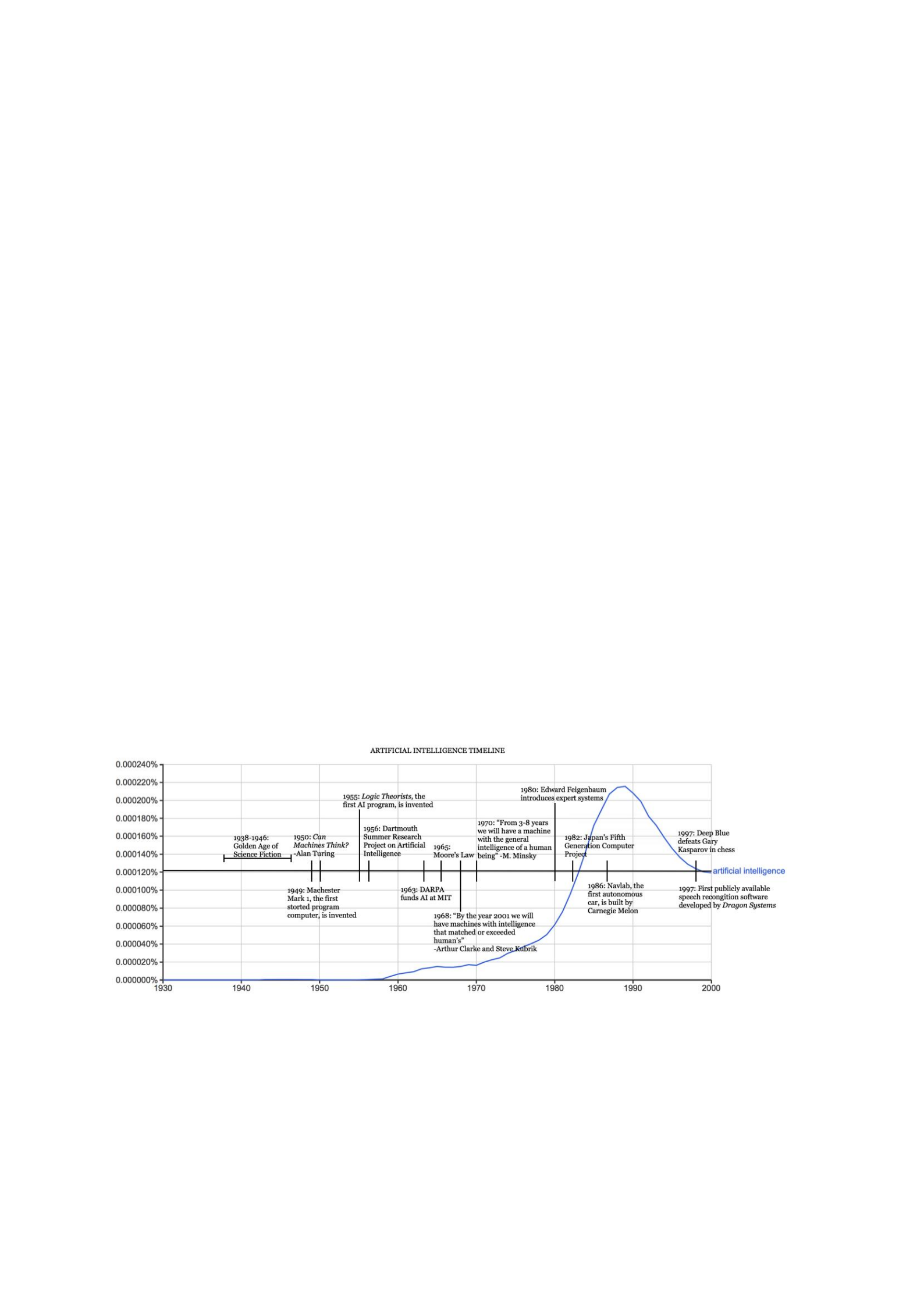
310). By the late 1990s, machine learning
had started gaining massive popularity
around the world. The success of Deep
Blue and Alpha Go in the gaming field
demonstrated that AI had achieved a
level of intelligence that matched or even
surpassed that of humans. During the
same period, the concept of big data also
started gaining rapid popularity. Figure
2.1 below summarizes the evolution path
of artificial intelligence.
Figure 2.1: Evolution of AI

The growth of AI in the late 20th century
and the 21st century can be summarized
in three stages, as shown in figure 2.2
below. The first and critical stage was
machine learning. Large technology
companies such as Apple Inc., Microsoft,
and Amazon.com created Siri, Cortana,
and Alexa respectively. Small companies
may not have such sophisticated tools
but they have a role to play in the general
development of the industry
(Madanchian, Hussein, Noordin, &
Taherdoost, 2015, p. 78). These were
tools capable of communicating with
humans and helping people to execute
specific commands such as conducting
online research and storing specific
information, helping eliminate many
challenges in the supply chain (Linh,

Kumar, & Ruan, 2019, para. 117). These
tools were also designed to become
supper-collectors of data to help these
firms to understand the emerging needs
and expectations of customers. They
were designed to learn based on
information that they gathered
independently.
The success of machine learning led to
the second stage of machine intelligence.
These machines were becoming
increasingly independent as they could
collect data and execute specific actions
without any assistance from human
beings. Earley (2014) explains that the
current technology is at the level of
machine intelligence (p. 59). Once the AI
is trained on basic tasks, they can
facilitate their further training as long as

they can access accurate and reliable
data. These machines are also capable of
taking specific actions without any
human input. The predictions and
decisions that they make are sometimes
superior to that of humans. This is so
because they wholly rely on data instead
of personal biases and cultural
misconceptions, which enhances their
competitiveness (Jovanovski, Seykova,
Boshnyaku, & Fischer, 2019, p. 250). In
the supply chain sector, this technology is
proving to be crucial in supporting the
decisions that a firm makes, based on
data.
The next stage of AI, known as machine
consciousness, is still futuristic. Currently,
AI primarily bases its decisions on data,
focusing on lowering costs while

maximizing profitability (Devang,
Chintan, Gunjan, & Krupa, 2019, p. 31).
However, humanity goes beyond
amassing wealth as these machines do.
Compassion and the need to help those
in distress make humans unique in their
decision-making process. The fact that
these machines lack consciousness may
sometimes force managers to ignore the
predictions, decisions, and simulations of
AI. A firm may decide to invest in
corporate social responsibility (CSR) to
help the needy even if the plan
developed by AI was different. The
current progress in this field of
technology is to facilitate the
development of machine consciousness
(Giudice, Scuotto, Garcia-Perez, &
Petruzzelli, 2019, p. 310). AI should have

human feelings and act in the interest of
humanity.
Figure 2.2: Stages of AI development
Application of AI
AI creators started spreading the
application of AI from the gaming
industry, where it had achieved massive
success, to the business sector. It was
evident that AI could help firms in making
accurate decisions and predictions when
it is fed with the right data (Chung, 2021,
p. 55). One of the areas that it gained
massive popularity was in the
manufacturing sector. As market

competition became stiff, firms were
under pressure to find production
strategies that would lower the cost
while enhancing quality and productivity
as a way of improving profitability. AI
made it possible to develop simulations
of the best manufacturing strategies.
Robots also started taking active roles in
the manufacturing plants as a way of
lowering costs, reducing risks to humans
at these plants, and increasing
standardization and productivity. The
success of AI in the manufacturing sector
made business executives find ways of
applying it in other sectors.
Marketing became another major area
where AI technology gained popularity.
Firms needed to accurately predict
market demands, changing tastes and

preferences, and ways of meeting clients’
needs in the best way possible. AI
became a critical tool that facilitated
predictions and decision-making based
on data. Small and medium-sized
enterprises are under immense pressure
to find ways of improving their efficiency
(Alfoqahaa, 2018, p. 12). AI offers them a
perfect way of overcoming numerous
operational challenges. It can monitor
the money markets and help in making
accurate investment decisions. It also
became an essential financial planning
tool for small, medium, and large
corporations. Intelligent robots are also
currently used in supply chain
management, which is the primary focus
of this paper. Other areas where AI is
actively used include green
manufacturing and other environmental-
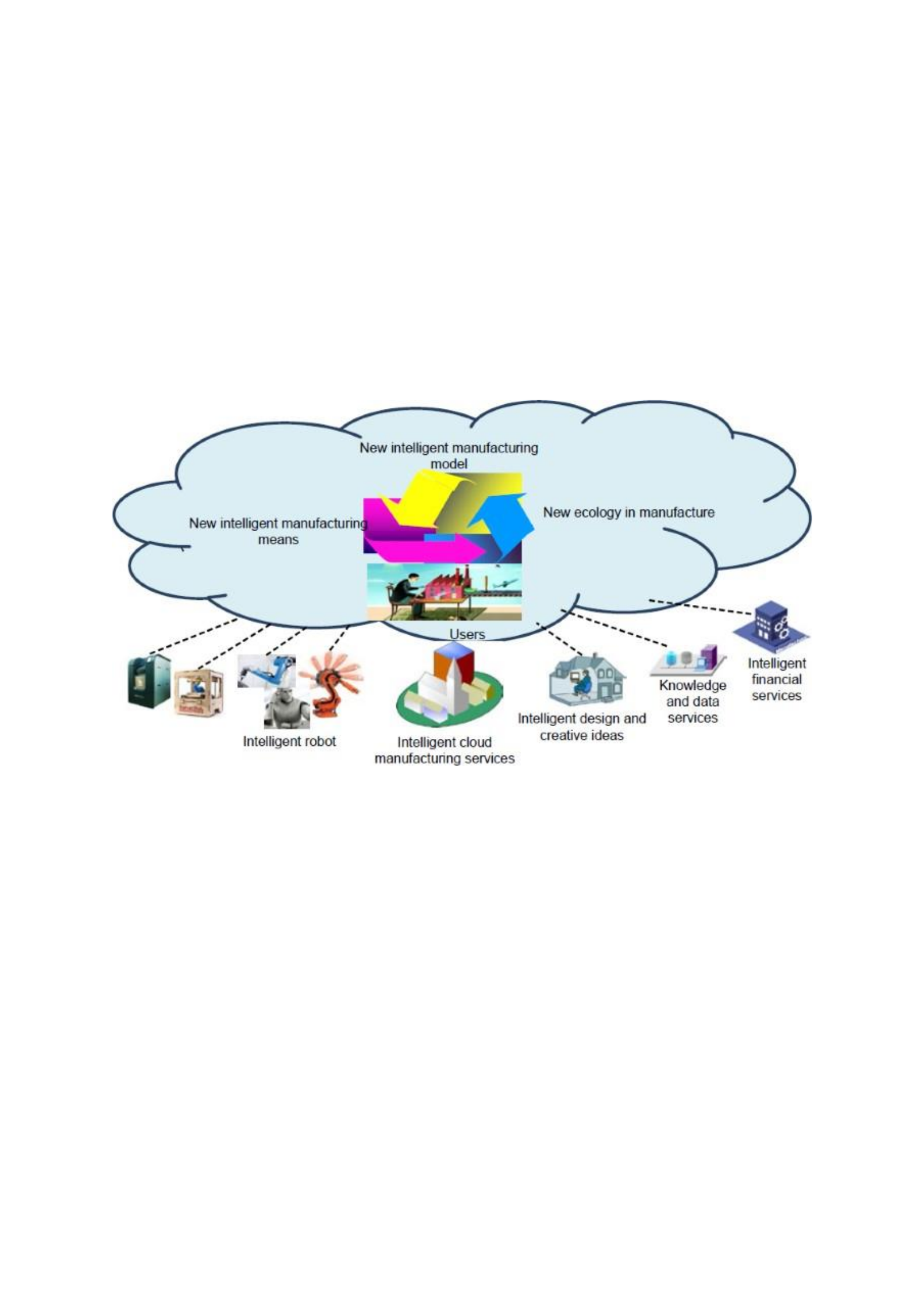
friendly initiatives. Figure 2.3 below
identifies areas where AI has become a
crucial tool that facilitates effective
operations.
Figure 2.3: Application of AI
Technologies, Security, People/Workers
and Society
The rapid growth of AI and its current
application in various fields has been
facilitated by the desire to achieve
efficiency and lower costs. In AI, volume,

velocity, and variety have been the
primary factors that have enhanced
growth. Data has become a critical factor
that defines the ability of a firm to
achieve success. However, firms find
themselves in situations where they have
to collect large amounts of data to help in
the decision-making process. Irrespective
of a firm’s size, it is essential to collect
relevant data that can help inform
decisions and predictions that a company
makes. AI makes it possible to collect
large amounts of data, process it based
on its relevance, and use it to conduct
simulations and predictions (Aarstad &
Saidl, 2019, p. 39). The capacity of the AI
to handle large volumes of data surpasses
that of humans in a significant way.

The speed or velocity with which data is
processed is another important factor
that has made AI popular in the business
world. When collecting data, it is
common for one to have access to large
amounts of information. Humans are
limited in terms of the amount of data
that they can process within a specific
period. The problem with such limitations
is that sometimes the information that is
ignored is the most crucial for the firm’s
growth (Kumar, 2019, para. 6). AI makes
it possible to process such large amounts
of data within a short period. It can
speedily select the most relevant data,
based on the issue that it has to address
and then process the data to help solve
the problem. Once processed, AI also

makes it easy to share information with
all the relevant stakeholders in real-time.
AI and ML enable a firm to have a variety
of options when deciding on various
issues. For instance, when a firm is
interested in selecting an appropriate
supplier, various factors such as price,
quality, and reliability have to be
considered. It is common to find a case
where the decision is solely based on
price or quality instead of the other
equally important variables. Stakeholders
may not feel comfortable when they are
not aware of the decision-making process
(Adixon, 2019, para. 9). AI takes into
consideration all the other important
factors through simulation. It then
provides various alternatives, in terms of
priority, that the firm can consider. It

evaluates both pros and cons in the
simulation before classifying the possible
actions that a firm can take to achieve the
intended goal.
This technology is also meant to make the
work of people, especially employees,
easier than it was in the past. Some of the
physically and mentally demanding tasks
can now be done using machines. Robots
have become effective in handling
physically demanding tasks. On the other
hand, sophisticated computers can now
handle complex data processing and help
in making accurate decisions. According
to Amblee (2018), AI is emerging as a tool
that will help protect modern society
from natural forces such as global
warming and climate change (para. 11).
Fed with the right data, they can facilitate

smart manufacturing and transportation
in ways that have negligible impact on the
environment. It can be possible to
reverse some of the damages that have
been made to the environment.
Scientists believe that AI is set to make
society a better place.
Artificial Intelligence in Supply Chain
Management
Artificial intelligence has become a
critical tool in supply chain management.
According to Anyoha (2017), news about
having driverless trucks was welcome
news to many trucking companies in the
United States (para. 7). Although the idea
is yet to be actualized, its development is
in advanced stages and there is a
consensus that most cars on the road will
not need drivers. For major trucking

companies around the world, such a
technology will have an immense impact
in cutting the cost of hiring numerous
drivers, paying their medical allowance,
and having to deal with workers’ unions.
AI goes beyond the promised creation of
driverless trucks (Kersten, Blecker, &
Ringle, 2019, p. 18). Numerous benefits
are already available for firms that have
chosen to use the new technology. It is
necessary to discuss how AI and ML have
gained relevance in SCM and how they
are applied to help cut operational costs,
improve efficiency, and enhance
profitability.
Data and Optimization across the Value
Chain
The concept of data optimization has
gained massive relevance in the recent

past as firms embrace big data. Data
optimization refers to a process that uses
sophisticated data management tools to
have access to, organize, and process
data from various sources at high speeds
and in a comprehensive manner (Wright
& Recht, p. 45). The processed data is
then used to make critical decisions
within an organization. The primary goal
of data optimization is to facilitate a
performance that is capable of meeting
customers’ expectations (Dash,
McMurtrey, Rebman, & Kar, 2019, p. 43).
It makes it possible to provide real-time
service to clients by understanding their
emerging needs.
In supply chain management, data
optimization has become essential in
ensuring that smart manufacturing is

achieved irrespective of the size of a firm.
Didonet and Díaz (2012, p. 101) observe
that successful companies have come to
appreciate the significance of big data
and its application in making predictions
and decisions. Smart manufacturing
requires effective communication and
coordination in the entire supply chain,
from the stage of raw material
acquisition to the stage when the product
is delivered to clients. As shown in figure
3.1 below, there are five stages that are
involved in smart manufacturing when AI
and ML are applied. The initial stage
involves collection of raw data. At this
stage, the focus is to gather relevant
information about different suppliers to
understand those that offer superior
value.

The second stage is the visualization and
integration of data. A firm starts to
develop a database that can help it in
making critical decisions. The third stage
of material-centric insight involves the
systematic use of the collected data to
assess the suppliers’ worth to the firm
(Belhadi, Mani, Kamble, Khan, & Verma,
2021, p. 4). Continued reliance on data
facilitates transformative analytics and
continuous improvement. At this stage, a
firm will be moving from traditional
approaches of manufacturing to one that
integrates the use of machines in making
predictions and decisions. Once the data
is available, a firm can trust computers to
process it and use it to accurately address
specific challenges that affect the
operations of a company. When these
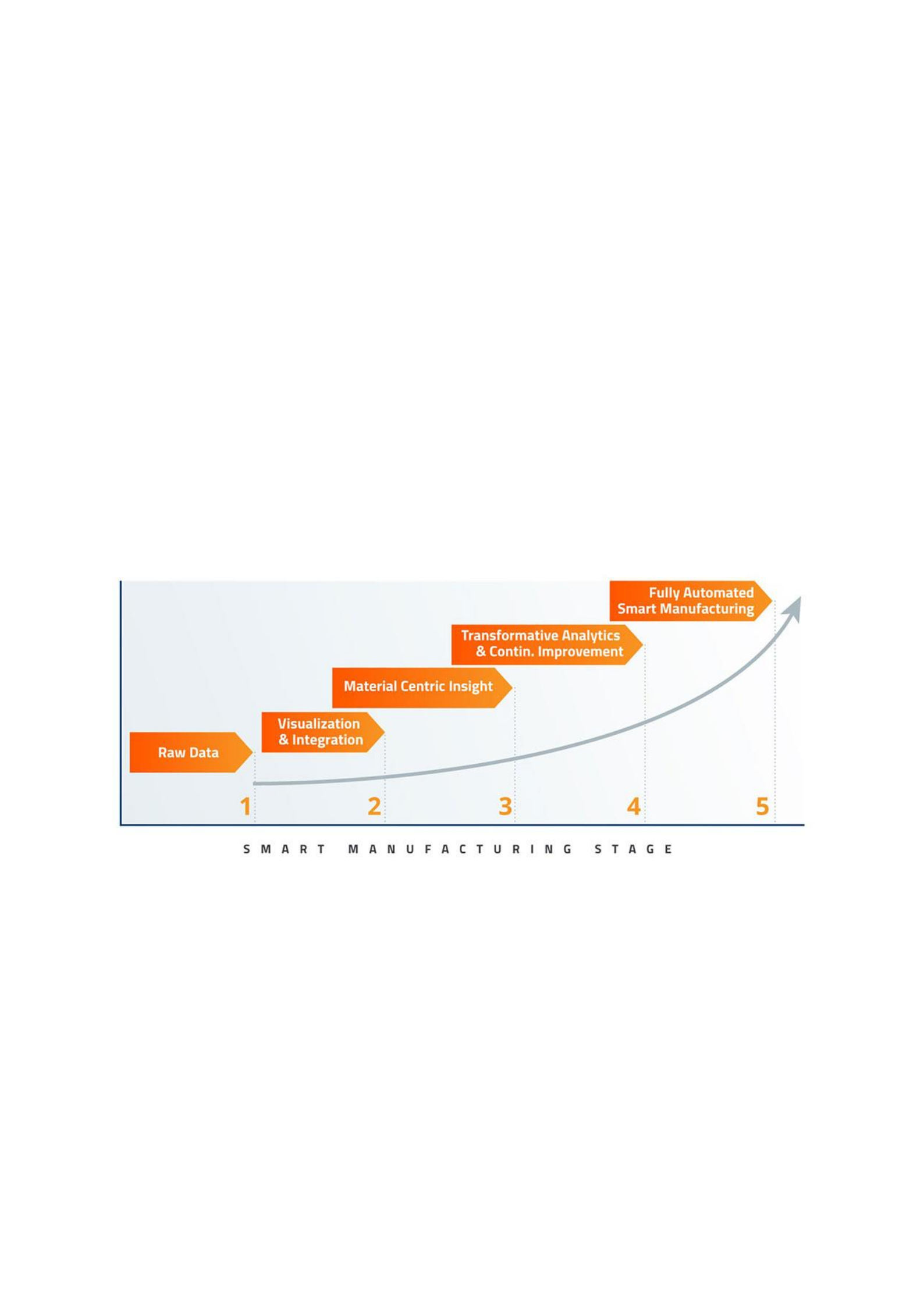
four stages are completed successfully,
the company can move to the final stage
of having fully automated smart
manufacturing. At this stage, computers
will be responsible for providing
simulations about the best ways of
operation that can yield the best output
for the company.
Figure 3.1: Stages in smart manufacturing
AI and ML have made it possible for firms
to achieve fully automated smart
manufacturing. Traditionally, firms had to
make manufacturing decisions based on

human predictions (Toorajipour,
Sohrabpour, Nazarpour, Oghazi, Fischl,
2021, p. 506). The problem with such
predictions was that in most of the cases
it was based on outdated data and
personal biases that led to consistent
inaccuracies. It was always impossible to
produce the exact number of products
needed by clients. The products were
either in excess or less than what the
market needed. Smart manufacturing
helps in eliminating such challenges.
Real-time data makes it possible for a
firm to understand the current demand in
the market.
The information will then be used to
facilitate the delivery of the exact amount
of raw materials needed, which will then
be fully utilized to develop products. The

produce will then be delivered to the
market within the right time. Smart
manufacturing helps in eliminating
wastes caused by overproduction and
delays that result from underproduction.
It also helps in ensuring that the right
quality of products is made available to
customers at the right time. AI and ML
make it possible for smart manufacturing
to be realized in an organization.
ML Techniques Frequently Used in
Logistics in MSMEs
Machine learning has achieved
popularity in various business settings
because of its unique capabilities. For
small and medium enterprises, this
technology offers a wide range of
services that can be used to enhance
activities in the logistics sector. Figure 3.2

below identifies specific ML techniques
that can be used in logistics. Face
recognition has become a powerful tool
that firms use to facilitate the
identification of persons. In the logistics
sector, one of the challenges that SMEs
face is cases where unauthorized
individuals have access to goods on
transit for the primary purpose of stealing
(Chin, Hamid, Rasli, & Baharun, 2012, p.
615). ML has introduced a new
technology that is meant to enhance the
security of products while they are in
transit. Face recognition is a technology
that requires drivers and authorized
individuals to show their faces before
special in-built cameras on the trucks
before one can access the cargo section.
It means that unauthorized individuals

cannot have access to the cargo section
of these trucks. When one tries to make
a forced entry without using face-
recognition technology, information is
sent directly to the security agencies.
The technology can also be used to
ensure that drivers do not allow
unauthorized passengers into the cabin
because they can also be a security threat
to the employee and goods on. The tool
is also widely used in enhancing security
at warehouses transit (Singh, Kumar, &
Shankar, 2012, p. 174). Only those whose
faces the machine can recognize are
allowed into the warehouse. The
technology not only helps in eliminating
the possibility of unauthorized persons
having access to goods and raw materials
but also makes it possible to identify

employees who are stealing from the
firm. The technology records time an
employee entered the warehouse or the
cargo section of the truck, the time they
took before leaving, and what they
carried when leaving. The chances of
stealing from a firm are significantly
reduced in such instances, which means
that the cost of operation will be dropped
significantly.
Object detection is another ML technique
that is gaining relevance in logistics. Using
special sensors, the machine can detect
when an object is approaching and take
necessary action. The technology is
currently used to automate various
activities in warehouses (Lawson, 2021,
para. 7). A common application is
controlling the security lights. Instead of

security lights being on at all the sections
of the warehouse, the sensor can be
trained to detect when people are in the
store and it will automatically switch on
the lights. When people are not within
the warehouse, the sensor automatically
switches off the lights. The technology
helps in saving the cost of energy. Object
detectors can also be used to enhance
security.
When an object, which in most cases is a
human, is detected moving into a
warehouse, information will be relayed
to the security unit immediately. If the
object is considered suspicious,
immediate action can be taken to inspect
it and determine if indeed it is a security
threat. Smart driving technology is
making it possible for trucks to identify

objects on their paths. The technology,
although not fully developed, makes it
possible for a vehicle to make emergency
breaks when it is about to hit an object on
its path. Such technologies will
significantly increase safer working
conditions (Jacobs, 2020, para. 13). It will
significantly reduce losses of lives, trucks,
and goods on transit caused by these
accidents. The insurance premium that
MSMEs have to pay on such smart trucks
and goods on transit will be significantly
low. Object detection technology is
directly related to motion detection, both
of which work together to enhance the
capability of ML.
Advanced ML technology is currently
capable of emotion recognition. When a
driver, a captain, a pilot, or warehouse

employees are in their place of work, AI is
capable of detecting their emotions. The
ML can recognize when one laughs a lot
or specific words that they use in their
conversation to express their emotions.
Advanced AI has become critical in
making important supply chain
management decisions (Stinson, 2021,
para. 3). They can tell when one is
distressed or frustrated while they are on
their official duties. Mental stress
compromises the ability of one to reason.
Emotion recognition technology is meant
to eliminate such cases by identifying
employees who are emotionally
distressed while at work. When they are
captains, drivers, or pilots, measures can
be taken to ensure that they are not
allowed to be fully in control of the

transport vessel. If possible, such an
individual should be temporarily relieved
of their duties to get the relevant
assistance before they can resume work.
When it is not possible or the threat is
assessed to be negligible, they can be
allowed to work alongside a colleague
who can help them navigate the vessel
and to talk about the issue of concern.
ML has made it possible to convert text to
speech in a conversation. Texting while
driving is a major cause of road accident
in the United States. It is significantly
more dangerous than making a call
because one has to take their eyes off the
road to write a text (Pournader, Ghaderi,
Hassanzadegan, & Fahimnia, 2021, p. 2).
Such an action makes it easy for a driver
to lose focus on the road. ML has

introduced a technology where a text can
be converted easily into a sound and vice
versa. It means that a driver can
communicate with others easily without
having to constantly take their eyes off
the road. Their speech can then be
converted to a text in case the person on
the other end of the phone prefers
chatting. Another benefit of this
technology is that a driver, a captain, or a
pilot can make their reports easily
without having to type them. At every
stage, they can verbally report what has
taken place at a specific time. Their verbal
report is then transformed into texts,
which can then be documented for
further references. It eliminates the need
to develop a written report, which saves
them time.

Automatic speech recognition is another
aspect of ML that is proving to be crucial
in the logistics sector. Like face
recognition technology, speech
recognition is also gaining relevance as a
tool that can be used to identify
employees within a firm (Hellingrath &
Lechtenberg, 2019, p. 67). The AI has
developed a unique capacity that enables
it to identify a unique sound of an
individual, just like a fingerprint. Unlike a
signature that can be forged, one cannot
defeat a well-trained machine by faking
another person’s voice. It is also not
possible to steal the voice as one would
steal a password.
One would need to say their name or
utter a specific statement when they
want to have access to the warehouse or

a transport vessel. The voice recognition
tool will then determine if they are
authorized to have access to the store or
the vessel. If they have the permission,
the tool will state their identity, time of
entry, and activities conducted. If they
lack the authority to do so, the machine
will make a report of an attempted
breach of security (Isensee, Teuteberg,
Griese, & Topi, 2020, p. 2). Relevant
authorities can then investigate the issue
immediately. This technology is meant to
eliminate or significantly reduce cases of
theft of goods on transit or those that are
already in the warehouse.

Figure 3.2: ML techniques relevant in
logistics management
Artificial Intelligence Opportunities and
Benefits for MSMEs in the Logistics
Sector
The concepts of AI and ML are rapidly
gaining relevance and acceptance in the
field of business. According to Belhadi et
al. (2021, p. 10), it has become evident
that AI has a unique capacity that is
beyond that of humans when it comes to
making accurate data-based predictions.
The machine can process Big Data within

a relatively short period, and then use it
to address a specific problem that is
affecting a given business entity. Kersten
et al. (2019) state that AI has immense
opportunities and benefits for micro,
small, and medium business entities (p.
49). They only need to understand how to
correctly apply it in specific operations of
their businesses. It is necessary to discuss
the specific opportunities and benefits
that AI presents to these firms.
AI Opportunities for MSMEs in the
Logistics Sector in Logistics Sector
MSMEs face some unique challenges,
which make it necessary for them to find
ways of competing favorably against
some of the larger competitors. For a firm
to succeed in the integration of AI into its
operations, it should understand the

opportunities that the new technology
presents and how it can fully take
advantage of them. The following are
some of the specific opportunities that
using this technology presents to a firm.
New strategies of reaching out to new
suppliers. One of the unique
opportunities that AI presents to MSMEs
in the SCM is the ability to identify, select,
and reach out to new suppliers.
According to Singh et al. (2012), one of
the most important factors that a firm
has to consider is effective ways of
identifying suppliers and communicating
with them effectively (p. 171). Changes in
the market make it necessary for a firm to
regularly evaluate suppliers that can offer
the best deals in the market. Using AI, a
small or medium company can process

large volumes of data within a short
period and select suppliers than offering
the best deals in the market. It can easily
conduct a comparative analysis to
determine how it can get the best value
for every purchase that it makes.
Improved processing of clients’ orders.
According to Klumpp and Ruiner (2018),
large organizations handle numerous
transactions every one hour as they
struggles to serve its customers in the
most efficient way possible (p. 7). Such a
large volume of a transaction within that
short period cannot be possible if
technology is not applied. Small and
medium enterprises must understand
the significance of AI in making such large
volumes of transactions possible. Using
AI, the logistics department can easily

interact with the sales department,
process clients’ orders, and facilitate
their delivery within a short time.
The technology creates a unique
opportunity for expansion for these small
companies. Instead of hiring more
employees to process customers’ orders,
the task is delegated to the machines. It
means that the firm will have an
increased capacity in terms of processing
clients’ orders, without necessarily
increasing the size of its workforce.
Belhadi et al. (2021, p. 20) also reiterate
that customers can track their orders
once they make their payments. Instead
of constantly calling the firm to make
such inquiries, they can easily use their
mobile phone apps or personal
computers to know when their products

will arrive. Such services tend to increase
customer satisfaction, which creates
further opportunities for growth.
Better ways of exploring new markets.
One of the primary goals of every MSME
is to achieve consistent and sustainable
growth in a highly competitive business
environment. However, expanding to
new markets beyond the primary or
understanding future market trends one
often presents numerous challenges, one
of which is how to manage the supply
chain in the new market (Pournader et
al., 2021, p. 16). AI can help address such
a problem when correct data is collected
and processed. AI can provide various
simulations about possible logistics
strategies that can be used in the new
market. The machine will collect and

analyze data about the new market, and
then propose ways in which the firm can
address specific challenges in the market.
If a firm in the United Kingdom or the
United States seeks to start operations in
China or India, it has to understand socio-
cultural, economic, and political forces in
the new country, and how they influence
a firm’s supply chain. Using AI, a firm can
easily assess these forces and determine
how they can be managed to ensure that
operations of the firm are not negatively
affected.
Ability to conduct detailed market
research. At the initial stages of AI
development, there was a general belief
that one had to educate the machine by
continuously feeding it the right data.
However, that has changed as technology

keeps advancing. AI has gained the
capacity to self-educate (Toorajipour et
al., 2021, p. 511). It can easily gather data
from the public domain, learn from it,
and make critical decisions and
predictions without any significant
human input. This new characteristic of
AI makes it an effective tool for
conducting market research. In SCM, one
only needs to specify the nature of the
research that should be conducted. The
machine is capable of gathering
information available in online databases
and answering specific questions of
concern to the firm. It can go a step
further to inform the management of the
best path to take based on several
simulations conducted. In such an
environment, the company will always

base its decisions on actual data instead
of personal feelings and rumors.
Identifying and eliminating wastage and
theft. One of the major challenges that
small and medium enterprises face is
pilferage when goods are in transit. Some
unscrupulous employees believe that the
best time of stealing from their employer
is when delivering materials to the firm or
when delivering finished products to
customers. The firm losses a lot of
resources when such cases of theft are
rampant. Using AI, the firm will have clear
data of materials purchased. The
machine can autonomously check if what
was delivered to the firm is consistent
with what was purchased (Belhadi et al.,
2021, p. 2). It can also accurately
determine if products leaving the firm are

those fully paid for by the client. The
strategy significantly reduces and in some
cases completely seals loopholes that
employees may be using to steal from the
firm.
The technology can also help in
eliminating wastes within the firm.
According to Aarstad and Saidl (2019),
automates the filing system, which
improves efficacy and eliminates
wastage. One of the main causes of waste
generation within a firm is offering excess
raw materials that cannot be consumed
within a specified period. When supplies
are in excess, a significant amount will be
wasted within the firm. It also encourages
theft, and the management may not even
realize that workers are stealing from the
firm. There is also the additional cost of

warehousing. Using AI, the firm will be
ordering only what is needed and
consumable within a specific period. It
will not only reduce the cost of
warehousing but also the wastage and
possible theft among employees. The
management can use the savings made in
facilitating the expansion of the firm to
new markets.
AI Benefits for MSMEs in the Logistics
Sector of MSMEs
AI remains to be relatively new
technology, and many business entities
are yet to fully integrate it into their
operations. Toorajipour et al. (2021)
believe that most executives are not yet
fully aware of the benefits that they may
get from it (513). They still look at AI as a
technology that is limited to data

processing and making predictions when
directly assisted by humans. However,
recent developments in this field have
empowered this technology, and its
capacity to make accurate predictions
and effective data-based decisions are
unmatched. Small and medium
enterprises can benefit significantly from
this technology if they apply it correctly in
supply chain management. The following
are the direct benefits of AI to MSMEs’
SCM.
Eliminating the need for large
warehousing units. One of the obvious
benefits of AI to small and medium
enterprises is that it eliminates the need
for large warehousing units at a firm.
MSMEs cannot afford to have large
warehouses to store raw materials or

finished products. As such, most of them
have been relying on a just-in-time (JIT)
system of inventory management to
ensure that the needed materials are
made available only when they are
needed (Kersten et al., 2019, p. 65). AI
improves this system by providing
relevant data. It can make an accurate
prediction about the flow of materials on
the production floor, making it possible
to know the specific time that the
procurement department needs to
purchase the relevant materials.
AI has also become a powerful tool in
making sales forecast in the market. This
capability makes it possible for it to have
accurate data about the entire flow of
inventory, from purchasing raw materials
from suppliers, moving them to the plant,

processing them, and finally releasing
finished products to the market. Having
an accurate demand forecast means that
the firm will only produce what the
market can consume within a given
period. As such, there will be a reduced
need to store finished products in the
warehouses.
Optimization and automation enhance
productivity. Supply chain management
is one of the critical functions that define
the success of a firm. MSMEs must
ensure that they source the relevant
materials in time to avoid cases where
production is stopped. Similarly, finished
materials have to be made available in
the market at the right time and volume.
Traditionally, decisions and predictions
would be made by humans (Toorajipour

et al., 2021, p. 506). The problem that
firms often face is that human error is
common when there the machine does
not support the process. Human bias and
limitations mean that they cannot always
be accurate as would be desired.
AI optimizes SCM activities through
automation, which enhances
productivity. Although humans are still
expected to be actively involved in the
process, the automation process makes
work easy. The production department
can easily monitor the flow of products
based on sales made within a given
period. As such, they can determine the
volume of products they need to make
available within a certain period. The
same information will be immediately
available to the procurement

department, which will be able to predict
when to make raw materials available to
the production unit. At the same time,
the finance department will be informed
about the needed resources in each of
these departments to facilitate smooth
and effective operations.
Real-time data facilitates real-time
supply chain management. One of the
benefits of using AI is that it makes it
possible for a firm to have real-time data.
Through machine learning, it is possible
to train AI to collect real-time data about
market demands and the availability of
specific materials needed for the
production process. Pournader et al.
(2021) explain that one challenge that
MSMEs face is that sometimes they use
obsolete data to make decisions (p. 41).

As such, they make errors because the
information upon which they base their
decision is not accurate.
AI can be trained to constantly collect
data in the market. It will provide
updated information, enabling the
management to accurate predictions.
With real-time data, the management
can make real-time supply chain
decisions. Christiansen and Skrinjaric
(2021) warn that when using AI to collect
data from the public domain, care should
be taken to identify and avoid misleading
or biased data (p. 39). It is also essential
for the user to ensure that third parties
are not allowed control of the AI because
they can manipulate it in a way that may
provide misleading information.

High business continuity is enhanced by
advanced monitoring and maintenance
possibilities. A significant number of
firms in the United States fail to reach the
third year of operations. One of the
primary factors that lead to the failure of
these start-ups is the inability of the
manager to effectively monitor and
control various operational activities. At
this initial stage, the proprietor is often
forced to hold several managerial
positions because of the few numbers of
workers. It is easy for the manager to fail
to maintain effective monitoring and
evaluation of employees’ work. AI makes
it possible for the proprietor to monitor
the performance of employees. AI also
enhances the capacity to monitor
inventory and how it is used within the

firm (Belhadi et al., 2021, p. 9). The
enhanced monitoring and maintenance
that is facilitated by this technology
minimizes wastage, cuts costs of
operation, and enhances efficiency in
supply chain management, which in turn,
enhances business continuity.
Improved and sustainable working
conditions. Procurement and logistics
can be challenging, especially when for a
firm in the manufacturing sector. In small
and medium enterprises, these tasks are
often assigned to a few employees
because of limited resources within the
firm. Having to collect data, process it,
and use the information to make critical
decisions and actions can be demanding.
AI helps in creating sustainable working
conditions for these MSMEs by

simplifying most of the procurement
tasks. The machine can collect and
process data, then use the information to
make accurate procurement decisions.
Employees can then focus on other tasks
that cannot be conducted by the machine
(Toorajipour et al., 2021, p. 510). The
reduced workload makes it possible for
employees to focus on innovative ideas in
their workplace.
Employees’ safety is one of the main
challenges that MSMEs face in their
supply chain management. Some of the
activities that workers engage in expose
them to dangers. The occupational health
and safety of employees are some of the
major requirements that the government
has set for firms irrespective of their size.
When a worker sustains an injury while

they are in their official duty, it is the
employer will be held fully liable. The
introduction of intelligent robots reduces
cases of such accidents happening. They
are less likely to make mistakes that may
cause an accident in the warehouse
(Klumpp & Ruiner, 2018, p. 5). It means
that the firm is less likely to face
litigations related to accidents in the
workplace environment.
Customization and personalization for
clients. Amazon.com and other large
corporations have learned the
importance of collecting information
from clients and then customizing and
personalizing products to meet their
specific needs. Alexa has become a
powerful tool that Amazon.com uses to
collect information from its clients to

understand their preferences. Small and
medium enterprises can use similar
technologies to understand the specific
needs of their clients. Some individuals
prefer having their products delivered at
their offices while others want the
product delivered at home or in social
settings at specific times. Understanding
these specific customers’ needs and
finding ways of meeting them can help a
firm to create a pool of loyal customers
(Belhadi et al., 2021, p. 9). Having such a
database, the logistics unit will have clear
information about the best time and
place of delivering customers’ orders.
The ability to maintain constant
communication with these clients also
helps in ensuring that cases of lost
products are eliminated.

Enhanced creativity and innovation. In
the current competitive business
environment, firms are under immense
pressure to find ways of meeting the
needs of customers in ways superior to
those of competitors. They also need to
introduce better ways of operations that
can cut the cost of operations to help
improve profitability without necessarily
increasing the product price. It means
that they have to constantly find unique
ways of operation. Creativity and
innovativeness can only be enhanced
when workers have some free time at
work to test and actualize new ideas. It
also thrives in an environment where
there is a steady flow of relevant and
updated data (Kersten et al., 2019, p. 75).

AI can be trained to undertake most of
the tasks in the logistics department.
While large computers are used to collect
and process data and use the information
to make complex predictions,
simulations, and predictions, robots can
be used to handle physical tasks in
warehouses. It means that enough time
will be available for employees to think
creatively and test their ideas to enhance
their productivity (Klumpp & Ruiner,
2018, p. 6). The processed information
made available by the AI also makes them
understand emerging needs in the
market, making it possible for them to
develop relevant concepts that the firm
needs to prosper.
Reduced human error. One of the biggest
promises of AI and ML is the elimination

of human errors. Ceyhun (2020) notes
that even when people are presented
with accurate data, they are likely to be
influenced by personal biases and
stereotypes when making decisions (p.
76). However, machines tend to be highly
objectives when presented with accurate
data. When properly trained, AI makes
very accurate forecasts and decisions
that can help a small or medium
enterprise to achieve rapid growth. Cases
of human error are sometimes caused by
the inability to collect and process data
accurately. This challenge is effectively
addressed by AI technology (Christiansen
& Skrinjaric, 2021, p. 121). In supply chain
management, employees can use AI to
select the best suppliers in terms of the
quality they offer and pricing. Accurate

simulations can also be conducted to
determine how to move products from
the supplier, store them within the firm,
and then deliver them to the market.
Elimination or a significant reduction of
human error lowers the cost of
operations while at the same time
increasing productivity and efficiency.
Reduced number of employees needed.
Small and medium enterprises cannot
afford to have a high number of
employees. However, they still have to
compete against large multinational
corporations that employ thousands of
employees. There is a need for these
firms to find ways of working effectively
with their limited number of workers. AI
makes it possible for these small firms to
operate successfully with a handful of

employees. Robots can now undertake
most of the physical jobs that were
previously conducted by humans in the
procurement sector (Toorajipour et al.,
2021, p. 505). On the other hand,
complex computers can be used to
collect and process data. Doing so makes
it possible for a firm to function efficiently
without the need to have a large number
of workers. The fact that machines can
operate for more than 24 hours without
the need for a break, as is always the case
with humans, means that a great amount
of work can be completed within a
relatively short period.
Enhanced consistency and reliability.
MSMEs need to be consistent and
reliable when meeting the needs of their
customers. When clients approve of a

specific quality of products, it is essential
to ensure that it is maintained until such
a time when it can be improved based on
changing tastes and preferences. AI
makes it possible for a firm to maintain
consistency in many ways. First, it will
ensure that information about the best
suppliers in the market is maintained.
Products can only be of the right quality
if the standards are met when sourcing
for raw materials. Secondly, AI can be
used to ensure that delivery methods are
standardized (Hellingrath & Lechtenberg,
2019, 91). It can also facilitate close
coordination among all the departments
within the firm to ensure that clients’
expectations are always met.
Training and collaboration. AI and ML
create an environment where it is easy

for a small or medium enterprise to
conduct training and enhance
collaboration among employees. AI
creates a system where a firm can easily
assess the knowledge gap of its
employees and job market requirements.
It means that targeted training, which
focuses on addressing the identified
gaps, is possible (Dash et al., 2019, p. 49).
AI significantly enhances data sharing
within departments of a firm and in the
entire organization. Sharing of data also
encourages collaboration among
workers. They can identify a specific
problem and then work closely to find an
effective solution. Targeted training and
collaboration among workers enhance
the efficiency of a firm and its ability to
achieve sustainable growth.

Environmental protection. Global
warming and climate change have
become major concerns in the
21st century. Many governments and
scientists are struggling to find ways of
reducing the emission of greenhouse
gases and eliminating harmful industrial
effluents. In the United States and many
other countries around the world, strict
policies have been introduced to ensure
that companies do not pollute the
environment. Some of these countries
have introduced limits of carbon
emissions that every firm cannot go
beyond within a specific period. AI
promises to help firms to operate
optimally without going beyond these
limits (Pournader et al., 2021, p. 13). The
use of robots that can use green energy

instead of heavy machines that use diesel
is one of the best ways of protecting the
environment. AI can also be used to
develop simulations of how a firm can
operate optimally with the least possible
production of industrial effluent and
greenhouse gases. The same technology
can also help in developing effective ways
of managing wastes. Figure 4.1 below
summarizes the main benefits of Industry
4.0 to small and medium enterprises.
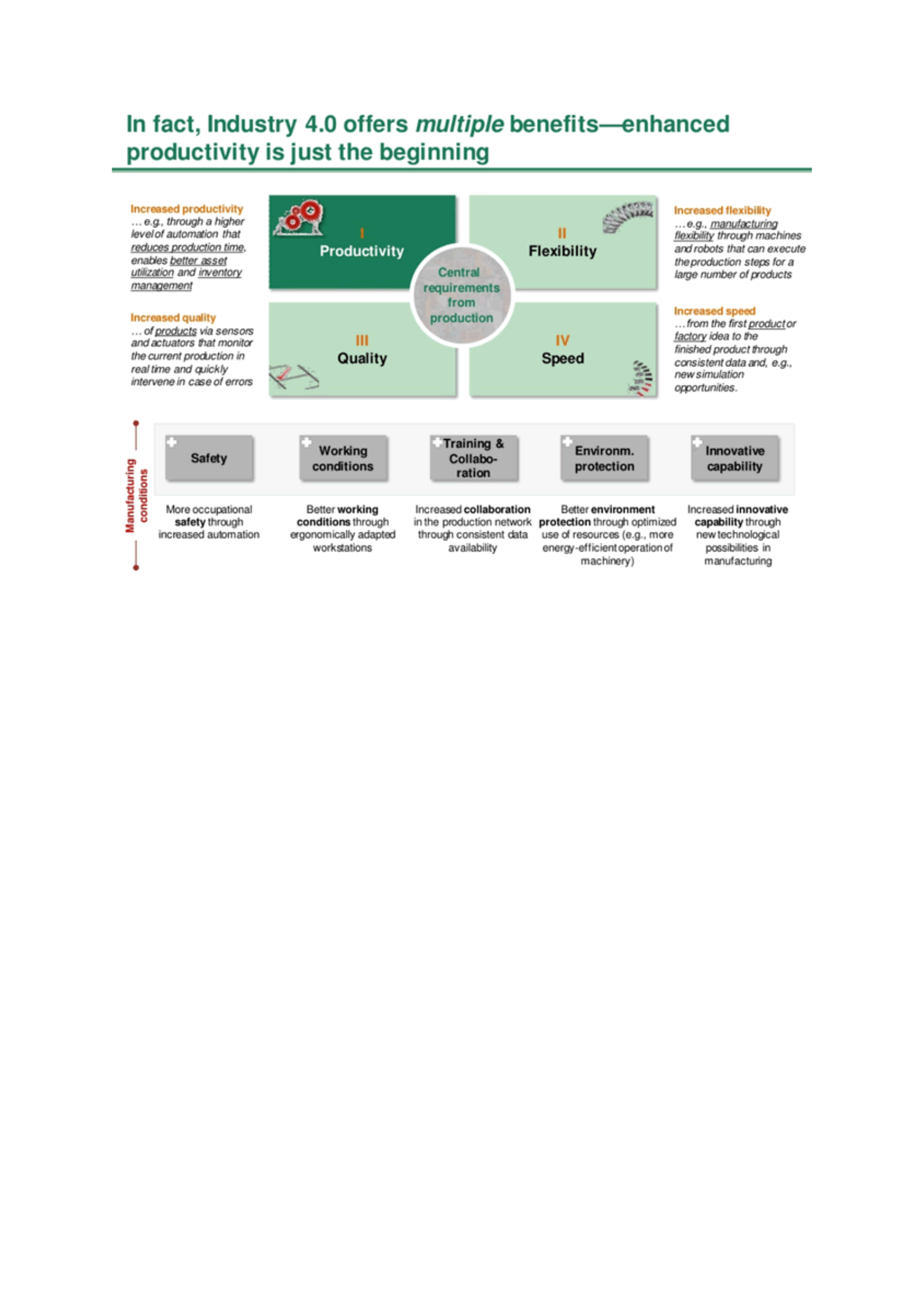
Figure 4.1: Benefits of AI
Artificial Intelligence Challenges for
SMEs in the Logistics Sector
When embracing AI, micro, small, and
medium enterprises must understand
that there are some challenges that they
have to manage. The previous chapter
has outlined benefits and opportunities,
which make this tool an effective one in
enhancing supply chain management

among these entities. Holistic analysis
also focuses on challenges that exist, and
how they can be managed to ensure that
these firms can use them effectively. The
following are the primary challenges that
these firms have to put into
consideration.
Cyber-Security Issues
One of the major issues when using AI to
facilitate operations in the logistics sector
is cyber-security threats. A major cyber-
security threat is system manipulation. It
is a situation where the system is
deliberately fed with misleading and
malicious inputs. The intention is to
expose the machine to a picture that
does not reflect real-world forces.
According to Toorajipour et al. (2021), AI
and ML rely on data to learn about what

it is expected to do (504). It takes time for
the machine to learn about what it is
expected to do. The process involves
feeding it the correct data so that it can
make correct decisions and predictions
based on the information gathered.
Cyber-criminals can manipulate the
system by exposing it to wrong
information.
The outcome is that the decisions and
predictions that the AI makes will be
based on wrong information. Instead of
helping the logistics department in
making the right decisions, it will
misguide the whole process based on the
data it was fed. Data corruption, also
known as data poisoning, has become a
major problem in AI, especially when an
attacker has a specific malicious goal to

achieve, and easy access to the AI data
system (Belhadi et al., 2021, p. 8). A
competitor can easily attack a firm will
poisoned data to mislead them into
taking actions that do not reflect realities
in the market. MSMEs are at a greater risk
of being attacked because of their limited
financial power to establish strong data
security measures.
AI machines are trained to sometimes
gather data independently from the
public domain. As Dash et al. (2019, p. 49)
observe, they do not necessarily need to
rely on their users to feed them with the
data they need to make decisions and
predictions. The problem is that it
exposes them to misleading information
on online platforms. A significant amount
of information available online is biased,

misleading, and sometimes meant to
achieve the selfish goals of some
individuals or entities. When AI has
access to such data and fails to realize
that it is untrue, it may base its decisions
on the information gathered. In such a
case, the machine will end up serving the
interest of external parties, which may be
the competitor, instead of the user.
Kersten et al. (2019) also warn against the
possibility of adversaries retraining the AI
to meet their selfish goals (p. 82). In such
a case, the AI is gradually fed inputs that
shifts their focus from their primary
purpose. Eventually, they become
irrelevant tools that cannot perform
specific tasks assigned to them.
Data privacy is emerging as a major
concern when using artificial intelligence

and machine learning technologies. AI
relies on large volumes of data to
function appropriately. The data has to
be stored in a database to ensure that the
machine can have access to it whenever
it is necessary. The problem that arises is
that external parties may target the
database and extract information. In such
a case, the cybercriminal will easily
predict all the decisions that the machine
is likely to make in specific scenarios. In
such a case, the AI will be a major
weakness to the firm instead of being a
strength because its predictions will be
obvious to the rivals. Some private data
about suppliers or transporters may be
released to the public domain in such
attacks (Klumpp & Ruiner, 2018, p. 12).

The outcome will be a lack of trust with
important partners in the market.
It is crucial to find an effective way of
addressing these challenges. Toorajipour
et al. (2021) advise that when a small or
medium-sized enterprise decides to use
AI in its logistics department, one of the
factors that have to be considered is the
protection of data from cybercriminals
(p. 515). AI and ML highly rely on data
that they have access to when making
crucial decisions and predictions. A firm
must understand that rivals can easily
target the machine and manipulate it to
their benefit. As such, it is essential to
protect the system from any form of
attack. If it is necessary to allow the AI
system to have access to information in
the public domain, some measures may

need to be taken to protect it from
malicious data. The system can be
protected by directing it to specific
websites while limiting its access to
others that are not credible.
A firm must ensure that it is always in
control of the AI system. Measures
should be taken, using the latest data
protection software, to ensure that any
breach is detected as soon as it occurs,
and appropriate measures taken to
address the identified problem.
Christiansen and Skrinjaric (2021)
recommend the use of resilient cyber
security solutions that can provide end-
to-end data encryption and protection,
such as Hardware Security Module (p.
144). They significantly reduce the threat

of external parties having access to the AI
system, including its database.
Computing Power
Artificial intelligence and machine
learning are rapidly gaining popularity in
many parts of the world. However,
Kersten et al. (2019) admit that AI and ML
are relatively new concepts (p. 39).
Although many people in the business
sector have heard about them, their
applications remain a mystery to many
people. The main problem is that
implementing AI in a firm requires
intensive training and a significant
investment in Big Data and related
technologies. A firm must be willing to
spend time and financial resources to
take their employees through rigorous
training on how to feed data to the

system and train it to make critical
decisions and predictions. They should
also learn how to work alongside the
machines without having any conflicts
and making important decisions.
Large multinational corporations have
the financial capacity to embrace AI with
ease. They can spend money on research
to understand how to use the new
technologies in its logistics sector.
However, the same cannot be said about
micro, small, and medium enterprises.
These small firms are struggling to meet
various financial needs in their
operations (Hellingrath & Lechtenberg,
2019, p. 49). They may not afford the high
initial cost of installing the system. They
may also lack the capacity to equip their
employees with the computing skills

needed to operate the system. The
option that they may have is to hire
individuals who already have the needed
skills. The challenge that they are likely to
face is that some employees may
demand higher salaries because of their
unique skills.
The MSMEs must find ways of
overcoming this challenge because
ignoring AI and ML is not an option. One
of the best ways of addressing this
challenge is to have a gradual process of
embracing the new technology. It can
select a few loyal and techno-savvy
employees to learn more about AI and
ML, and how they can be applied in a
normal operation of a business (Dash et
al., 2019, p. 48). Instead of making a
heavy initial investment into the system

at a time when the firm is financially
strained, it can make small steps towards
understanding and embracing the
system. One of the best ways of achieving
the intended goal is to embrace best
practices in the industry. Instead of
spending a lot of time and resources
trying to define how to use this new
technology, these small firms can use
models that have already been
developed by large corporations.
Poaching talented employees with skills
in AI and ML may be another way through
which they can enhance their computing
power.
Trust Deficit
Trust is a major concern among business
executives who are interested in
embracing this new technology. AI and its

capabilities are relatively new, and some
still believe that they cannot fully trust it
to make decisions (Toorajipour et al.,
2021, p. 511). A section of business
executives considers AI to be too complex
to be applied successfully in the business
sector. Its success in the security and
health sectors has not convinced these
stakeholders. Some of them argue that
they do not understand how employees
can easily and successfully interact with
AI and its levels of automation without
causing conflicts. As such, those who are
expected to lead and facilitate
automation have expressed their lack of
trust towards the new system. The
resistance has had a major challenge in
the implementation of AI in the supply
chain sector, especially among MSMEs.

When the management and employees
feel that they cannot trust the system to
perform its functions effectively, they are
less likely to support its implementation.
The current problem of lack of trust
among some stakeholders should be
addressed to ensure that AI and ML are
embraced as tools that can enhance
operations in the logistics sector. Kurt
Lewin’s change model can be used to
help address this problem. This model
identifies three stages of introducing
change within an organization. The first
stage, known as unfreezing, involves
preparing the entire team for the change.
They need to understand the weaknesses
of the current system, and how the
proposed change will help solve the
problems. It also involves undertaking
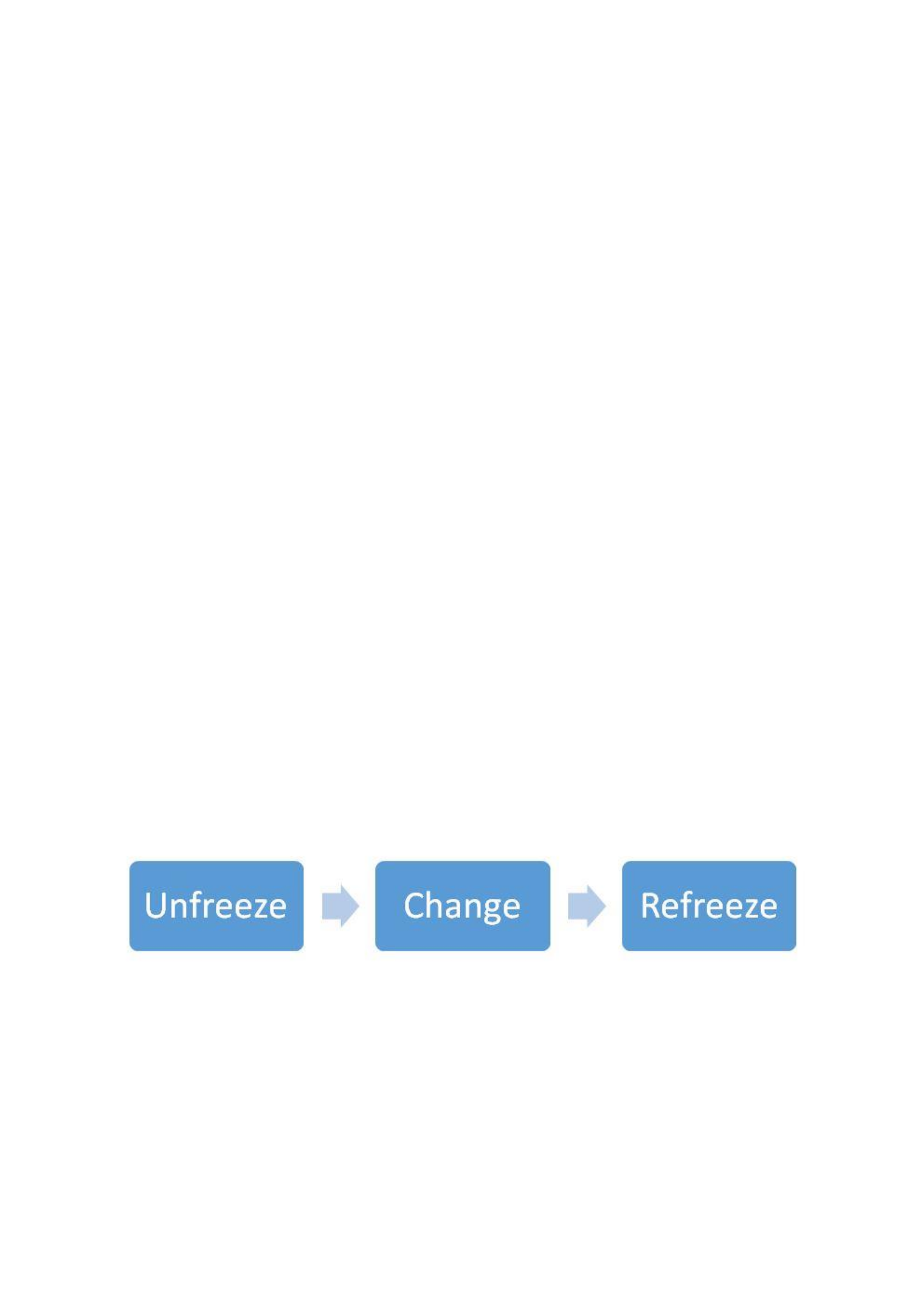
the necessary training so that the team
can understand what is expected of
them. The next step is to undertake the
actual change. The team is expected to
use the already established plan to
introduce the relevant change. The last
stage involves refreezing. The team will
focus on assessing the new system,
identifying new challenges, and then
finding solutions to them. Using this
model will help eliminate possible
resistance to change by ensuring that
everyone is adequately prepared for it.
Figure 6.1. Kurt Lewin’s change model
Limited Knowledge

AI and ML have a huge potential that
MSMEs should fully take advantage of to
manage stiff competition in the market.
However, a major challenge arises from
the fact that there is limited knowledge
about this emerging technology (Aarstad
& Saidl, 2019, p. 134). The first challenge
that most small businesses face is that
their executives have limited knowledge
about it. They might have heard about AI
and ML, but they lack detailed knowledge
about their relevance in business
settings. The controversies about this
technology witnessed in the recent past,
especially on its capacity to replace
humans in decision-making, have also
caused confusion among these
executives, making it difficult for them to
embrace it.

Most of the employees who are already
in the job market have limited knowledge
about artificial intelligence. They may be
having the interested to know more
about it and how it can be implemented.
However, they lack the academic
background to fully understand the
system. As such, some may develop the
fear that instead of AI making their work
easy, it can potentially eliminate the need
for their services in their current firm
(Hellingrath & Lechtenberg, 2019, p. 53).
Another concern is that employing a large
number of fresh college graduates with
some background training in AI would
mean trading experience and loyalty for
one aspect of technology.
Micro, small, and medium enterprises
must find ways of addressing such

challenges. According to Toorajipour et
al. (2021), the number of institutions of
higher learning that offer training in AI is
increasing (p. 510). This technology is
gaining relevance in various fields and
many colleges currently offer some form
of training related to it. Firms should
consider enrolling their current
employees in these colleges so that they
can sharpen their skills in this field.
Executives can also enroll themselves in
online classes to enable them to enhance
their understanding of this new
technology. When hiring, a firm can
emphasize the need for the recruits to
have some basic skills in AI and ML.
The Problem of Bias
AI machines learn from the data to which
they have access. One of the main

challenges that an organization may face
when using AI in the supply chain is bias
(Kersten et al., 2019, p. 57). Sometimes
the system is exposed to bias against or
towards some people or some things. It is
common to find cases where many
organizations prefer hiring male
employees for engineering jobs while
females are given priority for secretarial
or marketing jobs. There is also a
common bias in the United States and
other parts of the world in favor of whites
at the expense of other races, especially
blacks. When AI is exposed to such data
during the learning process, it will base its
decisions based on such bias.
In logistics, a firm may prefer to source
materials from specific individuals or
regions for particular reasons. Dynamics

in the industry creates a situation where
some of the best suppliers or
transporters today may not be the best in
the future (Dash et al., 2019, p. 50).
However, when the machine is exposed
to such bias, they may continue making
choices, which may not be the best for
the firm. In such a case, instead of
facilitating optimum decision-making, it
will become a misleading tool that causes
loss to the firm.
It is essential to find a way of addressing
the problem of biases of AI to ensure that
it remains as effective as possible. One of
the best ways of doing so, as Klumpp and
Ruiner (2018) note, is to ensure that the
AI is exposed to unbiased data during the
training process (p. 2). The user must
ensure that the machine learning process

is free from any racial, religious, or
gender biases. Continuous learning is
another essential tool that can be used to
help the machine make optimal decisions
and accurate decisions. As the forces in
the market continue to change, the data
that the machine uses should also be
updated accordingly. Data on factors
such as the best suppliers, reliable
transporters, and security issues should
be regularly updated to enhance the
efficiency of these machines.
Infrastructure
The infrastructure needed to have a fully
functional AI system in the logistics
department may be a challenge to micro,
small, and medium enterprises. A firm
needs to have large and secure databases
to facilitate the creation of Big Data. It will

then require an AI system that is
specifically designed to facilitate
operations in the logistics department
(Ceyhun, 2020, p. 119). For large
corporations, developing such an
infrastructure may not be a major
challenge because of their financial
capacity. However, the same cannot be
said about smaller firms with a small
budget. Sometimes they may be forced
to choose between installing the
infrastructure or facilitating expansion or
hiring more employees. The decision will
always be based on what the
management considers more urgent and
important to the firm. Sometimes having
the AI infrastructure may not be
considered a priority when the firm is
faced with a financial constraint. Singh et

al. (2012) also warn against poor AI
systems that cannot function efficiently
as expected (p. 172). Some of these AI
systems are developed by individuals
who are still under training, which means
that their creation may have several
weaknesses.
The cost of installing an AI infrastructure
for the logistics department may be
significantly high. However, the
technological trends witnessed in the
recent past show that firms, irrespective
of their size, cannot avoid embracing
emerging technologies (Toorajipour et
al., 2021, p. 504). It means that these
MSMEs must find ways of overcoming
the challenge of having the right
infrastructure for their logistics
department. Gradual planning for AI

infrastructure development may be one
of the ways of overcoming the challenge.
The company can set aside a specific
amount of its monthly income towards
purchasing the infrastructure. It means
that its installation can be categorized as
a mid-term plan that should be realized
within a year. Care should be taken when
selecting the vendors who are selling the
relevant system. It is advisable to select
established vendors with a good
reputation to avoid the problem of
having an ineffective AI system.
Integration of AI into Existing Systems
When the management of a small or
medium enterprise decides to embrace
AI technologies, another challenge that it
has to deal with is integrated into an
existing system. The firm will have to find

a way of introducing the AI system into an
already existing system within the
logistics department. Klumpp and Ruiner
(2018) explain that the integration
process may face various challenges (p.
21). First, the team of employees may
lack the requisite skills needed in the new
platform. Secondly, some employees’
jobs may have to be redefined, especially
those whose roles will be taken by the
machine. There is a possible threat that
some of the employees may reject and
deliberately frustrate the introduction of
the new system if they feel that their
position within the firm will be
threatened. It is also possible that a firm
may have to make a radical shift from
traditional methods of operations to a

new one that is based on the new
technology.
The possible integration challenges will
need to be addressed to ensure that
these small firms can effectively embrace
AI in their supply chain management. To
address the challenge of inadequate skills
among employees, the firm will need to
train a section of the employees who will
be operating the AI in the logistics
department. They should be equipped
with relevant skills necessary for them to
feed and allow the AI systems to make
decisions and predictions (Dash et al.,
2019, p. 48). The firm may also find it
necessary to recruit new employees with
the right skills. When redefining the roles
and responsibilities of employees in line
with the changes introduced, the

management should ensure that it is
done in a way that does not cause fear
among workers. They should be informed
that the new system is meant to
empower them instead of eliminating
them from the firm. The goal is to ensure
that all the relevant stakeholders support
the new system. When it is necessary to
make a radical shift from traditional
methods to new ones, employees should
be adequately trained and prepared for
the change.
Inability to Reach Human-Level in
Decision-Making
One last challenge of AI in the logistics
sector for MSMEs worth discussing at this
stage of the paper is its inability to reach
human-level in decision-making.
According to Klumpp and Ruiner (2018),

there has always been a debate about
whether AI has the capacity of a human
when it comes to making rational
decisions (p. 26). Some AI enthusiasts
have even argued that these machines
are superior to humans when it comes to
making accurate predictions and data-
based decisions. It may be true that AI,
when fed with the right data, can make
accurate predictions and effective
decisions.
Sometimes their predictions may be
more accurate than that of humans
because of their capacity to process large
amounts of data within the shortest
period possible. However, they lack the
compassion that humans have, making
them relatively inferior (Singh et al.,
2012, p. 178). Sometimes it may be

necessary for a firm to make a decision
that is seen to protect humanity and the
environment as opposed to making
profits. However, these machines are
often trained to focus on maximizing
profits while at the same time minimizing
expenses and losses. Some of their
decisions may have serious negative
implications on a firm’s reputation
because of the lack of compassion.
Small and medium enterprises should
find a way of addressing this challenge. AI
has proven to be a highly sophisticated
system capable of doing what only
humans can do. However, they need to
be trained to do that which they are
expected to do. Toorajipour et al. (2021)
argue that it is possible to train the AI to
be compassionate when making

decisions (p. 514). Although these
machines lack human feelings and some
of their decisions may be considered self-
centered and profit-oriented, they are
still essential. To address this challenge,
the management can ensure that the
final decisions are made by humans. The
machine can be allowed to develop a
pathway to different possible actions.
The management can then understand
the possible outcome if a certain decision
is made. Using the information that the AI
has processed, the management can then
make decisions that reflect other human
needs the machine could have ignored.
Figure 6.2 below identifies some of the
major challenges that AI presents to
MSMEs when used in supply chain
management.

Figure
6.2. Challenges of AI in SCM
The Future of MSMEs’ Logistics in the
World of Artificial Intelligence
The last century has seen rapid growth in
popularity and application of AI in the
corporate world. According to
Christiansen and Skrinjaric (2021), the
gaming industry helped in testing the
efficiency of AI and ML. In the current
stage, technology has advanced into the
fields of healthcare, security, transport,
manufacturing, and communication
among others (p. 67). The need to use

real-time data has made it possible for
companies to use this technology in
making important decisions that define
their operations. As Ceyhun (2020) puts
it, the world is moving towards a
corporate world that is fully dependent
on artificial intelligence (p. 183). It is
becoming critical for companies to make
decisions that are based on data to avoid
mistakes and misinformation.
Micro, small, and medium enterprises
have to embrace AI technology in their
operations. As the competition stiffens,
these firms find themselves in positions
where they have to be accurate in making
their predictions. They are moving into a
world where every decision that they
make has to be based on accurate data. It
starts by investigating and determining

specific customers’ needs in the market
(Hanne & Dornberger, 2017, p. 85). The
challenge that exists is that these needs
may change depending on various forces
in the market. The fact that these MSMEs
are not industry leaders means that they
may not dictate most of these changes.
Once customers’ needs are understood,
the firm must determine the demand
size. The information will then be used to
inform the production process. To help
lower the cost, improve quality, and
enhance productivity, a firm must find
ways of embracing smart production. AI
makes it possible for these small firms to
embrace these new methods of
manufacturing.
In the logistics sector, it is becoming
impossible for small and medium

enterprises to ignore AI and ML. The
numerous benefits that the new
technology offers have been discussed in
the previous chapters of the paper. The
current trend shows that firms can no
longer avoid this technology. One of the
reasons why it is currently unavoidable is
the need to deliver products in the
market or to the manufacturing plants in
time (Klumpp & Ruiner, 2018, p. 3). Using
AI, drivers can know the best routes that
they can take to reach their destination
within the shortest time possible. Such
high levels of efficiency are only made
possible through the use of AI. There is
also the need to cut the logistics cost of
operations. Besides identifying the best
routes that are cost-effective for a
company’s trucks, AI also helps to fight

theft and reduce the perishability of
products. All these factors help in
lowering the overall cost of operations.
As such, any MSME that is keen on
achieving sustainable competitiveness in
the market needs to embrace the
technology.
It is common for employees and other
stakeholders to resist change, especially
when they feel that their current position
will be threatened. The management of
these small and medium enterprises
must realize that their employees may
not support the introduction of AI in the
logistics sector because it may not only
replace junior officers but also mid to top
management officers because of its
capacity to make accurate predictions
and data-based decisions (Singh et al.,

2012, p. 175). Having en effective
integration of AI is essential in eliminating
such resistance. Lewin’s change model,
discussed above, may help in introducing
change in these organizations.
The Relationship between ML Adoption
in Logistics and MSMEs Performance
Machine learning is gaining popularity
among small and medium enterprises
keen on redefining their logistics
operations. Many firms have realized that
they have to digitize their logistics as a
way of remaining competitive. The new
technology enables these firms to make
critical decisions based on accurate
predictions and scientific simulations
(Isensee et al., 2020, p. 6). It helps in
eliminating human errors, which may
significantly affect the ability of a

company to meet customers’ needs in
the best way possible. In this section of
the report, the focus is to discuss the
relationship that exists between ML
adoption in logistics and MSMEs’
performance. Figure 3.3 below identifies
specific performance-related factors in
logistics.
The performance of individual drivers will
be significantly enhanced when ML is
introduced in logistics management. The
performance of a firm directly depends
on the performance of an individual
employee. In logistics, drivers play a
critical role in ensuring that goods are
delivered at the right time and without
damage or theft. ML technology makes it
possible for drivers to be efficient in their
operations because of the assistance

from deep learning and text/image
processing technologies (Pournader et
al., 2021, p. 11). Driver-assist technology
helps drivers to make critical decisions
while they are on the road. They can
identify routes that may have traffic
congestion and the technology can help
suggest alternative routes. As such,
delays that may disrupt normal
operations within the firm or customer
dissatisfaction are eliminated. Such
delays may also affect the quality of
goods on transit when handling
perishable products (Belhadi et al., 2021,
p. 7). The driver-assist technology makes
it possible for the pilot, captain, or driver
to monitor the conditions of products on
transit and to set optimal temperature
and moisture that can help preserve

them in the best way possible while on
transit.
Autonomous driving remains one of the
most promising opportunities that AI and
ML will offer to the logistics sector. For
small and medium enterprises, this
technology will offer a perfect
opportunity to scale up operations and
enhance productivity. Current
development in autonomous vehicles,
especially the one which is headed by
Tesla, strongly indicates that driverless
trucks will soon be a reality (Min, 2010, p.
16). If this is achieved, MSMEs will be able
to facilitate the transportation of large
volumes of products within a short
period. Machines do not need to have a
break in ways that humans do. They
cannot complain or demand additional

pay when they have to work for 24 hours
a day. It means that a firm can easily
enhance its productivity in the logistics
department when this technology is
applied.
Cloud computing is another major
opportunity for growth that AI and ML
offer to small and medium corporations.
In logistics management, data has
become a critical factor that defines a
firm’s success. Making decisions based on
real-time data is essential, especially
when handling perishable products. A
firm needs to have accurate information
of demand in the market and other
factors to know the number of products
that should be made available (Kersten et
al., 2019, p. 32). Cloud computing makes
it possible for these firms to access,

process, and utilize large amounts of
data. Instead of relying on guesses and
unfounded speculations, these entities
can streamline their logistics operations
based on real-time data.
Cloud computing also facilitates effective
communication among stakeholders in
value chain management. Once the
demand is determined by the marketing
department, the manufacturing unit will
plan its activities properly and accurately
make an order of materials needed. The
information will be relayed to the
suppliers through the procurement
department. The logistics unit will then
have clear information on the amount
and nature of products that need to be
transported from suppliers to the firm
and from the firm to the market within a

specific period (Pournader et al., 2021, p.
17). The increased coordination and
cooperation of these departments and all
the relevant stakeholders improves the
performance of the logistics department
and the entire firm.
Driver risk assessment is another way in
which a small or medium enterprise can
enhance its performance in the logistics
sector. Aarstad and Saidl (2019) explain
that driver risk assessment involves
determining the likelihood of a driver
being in an accident while on official duty
(p. 43). Various factors may cause an
accident while a driver is on official duty.
They include fatigue that impairs the
judgment of a driver when they are
overworked, vehicles being in a state of
disrepair, poor weather conditions, and

poor conditions of roads, limited training,
drunk driving, and carelessness or
recklessness of a driver. Some of these
factors are direct human errors while
others are forces beyond the control of
the driver.
An MSME can use ML to identify all the
possible causes of accidents by using
driver risk assessment. Factors such as
the poor state of the cars and limited
training can be directly addressed by the
management of the logistics department.
Poor weather and dilapidated road
networks are beyond the control of a firm
or its employees. However, drivers can be
trained on how to maneuver in those
harsh conditions. Problems that are
directly related to irresponsive driving
can be addressed by the human resource

department through strict policies that
guide the actions and decisions of drivers
while they are on official duty. It
significantly enhances supply chain
resilience (Belhadi et al., 2021, p. 7).
These measures help in enhancing the
overall performance of the logistics
department.
AI and ML technologies make it possible
for the procurement and logistics
manager to conduct real-time monitoring
of drivers. Small and medium-sized
enterprises face numerous challenges in
supply chain management (Klumpp &
Ruiner, 2018, p. 4). One of the challenges
that small and medium enterprises
sometimes face is having rogue and
irresponsible drivers. Some of them
engage in personal business using

company trucks during their official
working hours. Others use different
excuses to justify delays caused by their
laziness and irresponsible behavior. AI
and ML offer a perfect solution to the
challenge. It makes it possible to know, in
real-time, the physical location of a
driver. They can easily determine if it is
true that there is a traffic jam or any
other challenge that may affect the
smooth flow of the trucks (Kersten et al.,
2019, p. 66). The technology also makes
it impossible for a driver to use a
company truck to run personal errands
because the information will be relayed
to the management immediately. As
such, ML makes drivers more
responsible, which in turn, enhances the
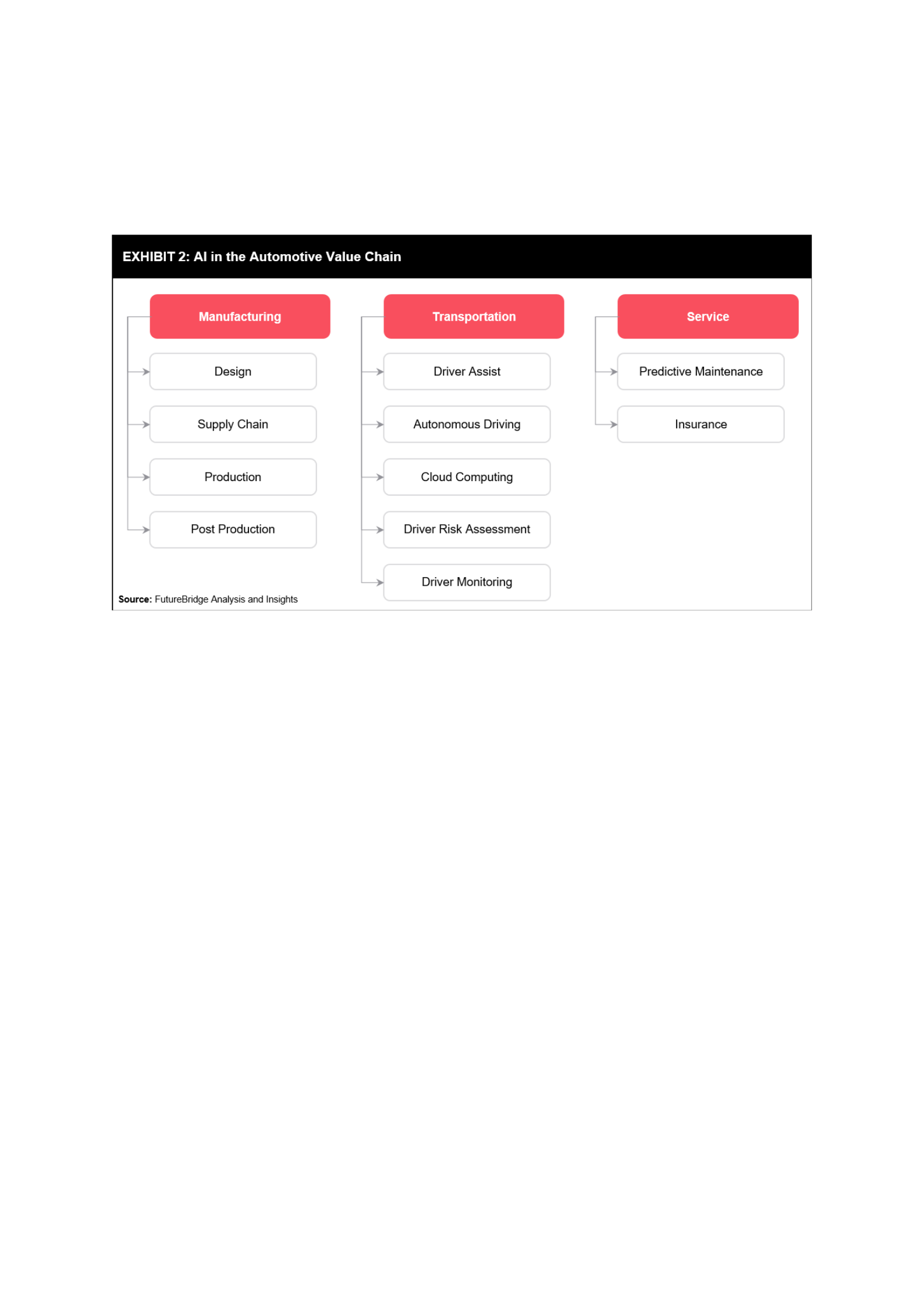
overall performance of the logistics
department.
Figure 3.3: AI in smart manufacturing
Conclusion and Recommendations
The digital transformation that has been
facilitated by Industry 4.0 has had a major
impact on how firms conduct their
operations. As shown in the discussion
above, data has become a critical factor
that defines the ability of a firm to
achieve success in the market.
Traditionally, managers would make

predictions and decisions based on data
currently available, which in some cases
would be outdated. However, AI and ML
have created a system that makes it
possible for companies to collect real-
time data and then use it to make
decisions and predictions. The
technology not only facilitates the
collection of data but also its speedy
analysis and usage in making critical
decisions within a firm. Unlike humans
whose judgments may sometimes be
clouded by misconceptions and personal
biases, AI tends to be highly objective,
basing its decisions and predictions on
data. As such, the technology has
surpassed human potentials in making
accurate predictions and developing

simulations that can yield the best
results.
The superiority of AI in managing data
and using it in making accurate
predictions has made it an efficient tool
in logistics management. The paper
shows that micro, small, and medium
enterprises can use this technology to
improve their supply chain management.
The technology enhances
communication among all stakeholders
in the procurement and logistics sector.
The management can easily track the
movement of goods on transit and
respond to emergencies that may arise
more effectively. Real-time data-based
decision-making and predictions help to
eliminate the challenge of purchasing
excess or limited raw materials that

inflates the cost of warehousing or
disrupts operations. It also ensures that
the firm makes available to the market,
the exact amount of products that are
needed. Industry 4.0 offers these firms a
unique growth opportunity, especially
when they are operating in highly
competitive markets dominated by large
multinational corporations.
Despite the obvious benefits of AI to
MSMEs’ SCM, the paper identified some
challenges that may have a significant
impact on these firms if they are not
effectively managed. Cyber-attack
emerged as one of the possible threats
that these firms may face when they fully
embrace AI. When external stakeholders
with malicious intentions take control of
these machines, they can manipulate

them. As such, they may become a
liability to a firm because of their
misleading predictions and decisions.
Computing power, trust deficit, limited
knowledge of the technology, the
problem of bias when training the
machine, infrastructure cost, integration
of AI into existing systems, and inability to
reach human-level in decision-making
were the other major concerns identified.
MSMEs must find ways of managing
these challenges to enable them to
embrace AI and ML in their SCM to
improve their performance and
productivity. The following
recommendations should be considered:
• A firm should conduct thorough
training for its employees before
introducing AI and ML technologies.

The goal is to ensure that they are
fully prepared once the technology is
introduced.
• MSMEs should invest adequately in AI
infrastructure to ensure that data can
be processed effectively and
disseminated to all the relevant
stakeholders within the firm.
• The management should put in place
effective cyber security measures that
will ensure that there is no breach.
Data that the AI has access to should
also be assessed to ensure that it is
accurate.
• While the machine can make
predictions and simulations, humans
should have the final decision on the
path that should be taken. As such, AI

will help them make information-
based decisions.
• Future research should investigate
dangers that MSMEs may face when
they fully rely on AI in their supply
chain management.
• It is also necessary for future scholars
to determine reasons why some of
the companies, irrespective of their
size, have deliberately avoided
embracing AI in their SCM.
References
Aarstad, A., & Saidl, M. (2019). Barriers to
adopting AI technology in SMEs.
Copenhagen, Denmark: Copenhagen
Business School.

Adixon, R. (2019). Artificial intelligence
opportunities & challenges in
businesses. Web.
Alfoqahaa, S. (2018). Critical success
factors of small and medium-sized
enterprises in Palestine. Journal of
Research in Marketing and
Entrepreneurship, 20(1), 4-16.
Amblee, R. (2018). The ugly fight:
Unleashing artificial intelligence against
global warming. Dubai: Gloture Books.
Anyoha, R. (2017). The history of artificial
intelligence. Web.
Belhadi, A., Mani, V., Kamble, S., Khan, S.,
& Verma, S. (2021). Artificial intelligence-
driven innovation for enhancing supply
chain resilience and performance under
the effect of supply chain dynamism: An

empirical investigation. Annals of
Operations Research, 3(1), 4-11.
Ceyhun, G. C. (2020). Handbook of
research on the applications of
international transportation and logistics
for world trade. Hershey, PA: IGI Global.
Chin, T., Hamid, A., Rasli, A., & Baharun,
R. (2012). Adoption of supply chain
management in SMEs. International
Congress on Interdisciplinary Business
and Social Science, 65(2), 614-619.
Christiansen, B., & Skrinjaric, T.
(2021). Handbook of research on applied
AI for international business and
marketing applications. Hershey, PA:
Business Science Reference.
Chung, S. H. (2021). Applications of smart
technologies in logistics and transport: A

review. Logistics and Transportation
Review, 153(1), 55.
Dash, R., McMurtrey, M., Rebman, C., &
Kar, U. (2019). Application of artificial
intelligence in automation of supply
chain management. Journal of Strategic
Innovation and Sustainability, 14(3), 43-
50.
Devang, V., Chintan, S., Gunjan, T., &
Krupa, R. (2019). Applications of artificial
intelligence in marketing. Economics and
Applied Informatics, 25(1), 28-36.
Didonet, S., & Díaz, G. (2012). Supply
chain management practices as a support
to innovation in SMEs. Journal of
Technology Management & Innovation,
7(3), 91-106.

Earley, S. (2014). The digital
transformation: Staying Competitive. IT
Professional, 16(2), 58-60.
Giudice, M., Scuotto, V., Garcia-Perez, A.,
& Petruzzelli, M. (2019). Shifting wealth II
in Chinese economy. The effect of the
horizontal technology spillover for SMEs
for international growth. Technological
Forecasting and Social Change, 145(1),
307-316.
Hanne, T., & Dornberger, R.
(2017). Computational intelligence in
logistics and supply chain management.
New York, NY: Springer Verlag.
Hellingrath, B., & Lechtenberg, S.
(2019). Applications of artificial
intelligence in supply chain management
and logistics: Focusing onto recognition

for supply chain execution. Cham,
Switzerland: Springer.
I-SCOOP. (2021). Industry 4.0 and the
fourth industrial revolution
explained. Web.
Isensee, C., Teuteberg, F., Griese, K., &
Topi, C. (2020). The relationship between
organizational culture, sustainability, and
digitalization in SMEs: A systematic
review. Journal of Cleaner Production,
275(1), 1-11.
Jacobs, T. (2020). Artificial intelligence
(AI) in supply chain & logistics supply.
Web.
Jovanovski, B., Seykova, D., Boshnyaku,
A., & Fischer, C. (2019). The impact of
Industry 4.0 on the competitiveness of
SMEs. Industry 4.0, 4(5), 250-255.

Kersten, W., Blecker, T., & Ringle, C. (Ed.).
(2019). Artificial intelligence and digital
transformation in supply chain
management: Innovative approaches for
supply chains. Proceedings of the
Hamburg International Conference of
Logistics (HICL), No. 27. Berlin, Germany:
GmbH.
Klumpp, M., & Ruiner, C. (2018).
Regulation for artificial intelligence and
robotics in transportation, logistics, and
supply chain management: Background
and developments. Network Industries
Quarterly, 20(2), 3-7.
Kumar, S. (2019). Advantages and
disadvantages of artificial
intelligence. Web.

Lawson, D. (2021). How AI is improving
supply chain management
processes. Web.
Li, B., Hou, B., Yu, W., Lu, X., & Yang, C.
(2017). Applications of artificial
intelligence in intelligent manufacturing:
A review. Frontiers of Information
Technology & Electronic Engineering,
18(1), 86-96.
Linh, N. K., Kumar, V., & Ruan, X. (2019).
Exploring enablers, barriers and
opportunities to digital supply chain
management in Vietnamese
manufacturing SMEs. International
Journal of Organizational Business
Excellence, 2(2), 101-120.
Madanchian, M., Hussein, N., Noordin, F.,
& Taherdoost, H. (2015). The role of SMEs
in economic development: Case study of

Malaysia. International Journal of
Academic Research in Management, 4(3),
77-84.
Matt, D. T., Modrák, V., & Zsifkovits, H.
(2020). Industry 4.0 for SMEs: Challenges,
opportunities and requirements. New
York, NY: Springer International
Publishing.
Min, H. (2010). Artificial intelligence in
supply chain management: Theory and
applications. International Journal of
Logistics Research and Applications 13(1),
13-39.
Pervaiz, S. (2020). The role of artificial
intelligence in supply chain management.
(Master’s Thesis, University of Applied
Sciences, Berlin, Germany). Web.

Pournader, M., Ghaderi, H.,
Hassanzadegan, A., & Fahimnia, B.
(2021). Artificial intelligence applications
in supply chain
management. International Journal of
Production Economics, 241(11), 7-16.
Rabayah, K. (2013). Adoption patterns of
information and communication
technologies by enterprises in developing
countries: Case study Palestine. Journal
of Information Technology in Developing
Countries, 23(3), 7-11.
Sendler, U. (2017). The internet of things:
Industrie 4.0 unleashed. New York, NY:
Springer International Publishing.
Singh, A., Wiktorsson, M., & Hauge, J. B.
(2021). Trends in machine learning to
solve problems in logistics. Procedia CIRP,
103(1), 67-72.

Singh, R., Kumar, R, & Shankar, R. (2012).
Supply chain management in SMEs: A
case study. International Journal of
Manufacturing Research, 7(2), 165-178.
Stinson, E. (2021). How artificial
intelligence (AI) can be used in supply
chain management. Web.
Tirkolaee, E. B., Sadeghi, S., Mooseloo, F.
M., Vandchali, H. R., & Aeini, S. (2021).
Application of machine learning in supply
chain management: A comprehensive
overview of the main
areas. Mathematical Problems in
Engineering, 20(1), 1-14.
Toorajipour, R., Sohrabpour, V.,
Nazarpour, A., Oghazi, P., & Fisch, M.
(2021). Artificial intelligence in supply
chain management: A systematic

literature review. Journal of Business
Research, 122(1), 502-517.
Wright, J. & Recht, B.
(2022). Optimization for data analysis.
Cambridge, UK: Cambridge University
Press.
Yuanita, N. (2019). Competition and bank
profitability.

