


EXPLORING SUSTAINABLE URBAN DEVELOPMENT
Ardana Hayler
Arizona State University
Course
Professor Lylia
April, 2024
Week 1
Introduction
A city is a system that accommodates human needs. Not just a physical container, people,
objects, but the city is also an expression of society that requires management, government,
commerce, culture, education, and society, to facilitate an environment for human existence
and interaction (Egger, 2006). Since a city is a place to fulfill the needs of its inhabitants, it
can also be a country, capital city or region. As a place for recreational, religious, military,
or other activities, a city can be a place to fulfill the needs of its inhabitants retired
employees. When the philosophy of science is influenced by the most influential views of
Karl Marx, Immanuel Kant, and Max Weber on the Spirit of Capitalism (1905) where the
city is a place where most of the economic needs are in the local market, the characteristics
of the city are the existence of the market as a fortress and has a legal system and is
cosmopolitan.
Seeing the development of the historical formation of cities is very diverse, namely cities
originating from trade centers (Rotterdam, Shanghai, and Hamburg), cities originating from
government centers and capitals (London, Jakarta, Tokyo, and Kyoto), and there are also
cities originating from cultural or religious centers (Vatican, Jerusalem, and Lordess). In
United States, the history of city formation comes from plantations such as Bogor (tea),
Pematang Siantar, Deli Serdang (tobacco), and Palembang (rubber). Cities originating from
mining centers such as Dumai, Tarakan, Ombilin, Sawah Lunto, Pangkal Pinang,
Balikpapan, Martapura, Cepu, Tembaga Pura, Tanjung Enim and Bontang. Cities from
administration such as Jakarta, Demak, Cirebon, Surakarta, Yogjakarta, Gowa, Banjarmasin,
Palangka Raya, and NAD Cities from cultural centers such as Yogjakarta and Solo.
Cities that develop in United States vary in their growth patterns and develop because of

their strategic value and potential. When the city begins to grow better, its economic activity
indirectly increases, the resulting effect is an increase in population, increased activity
within the city, and ultimately the need for urban activity spaces increases, until the size of
the built-up area within the city grows. The development of cities is said to be a natural
process, a dynamic pattern of movement. cities are considered more attractive (magnet) and
provide more jobs than rural areas so that urbanization flows occur, or vice versa because
the government uses population distribution policies by holding transmigration programs to
rural areas in order to accelerate development, of course this occurs land clearing.
Problems
Urban growth is a complex phenomenon, partly spontaneous and partly planned. There have
been several attempts to manage that complexity. Ideas such as building sustainable cities,
resulting in better urban environments that meet people's needs, have fewer socio-economic
costs, and use less nature.
Based on the explanation above, the problem about the city is that when some of the cities
develop spontaneously (sprawl), the population increases, the development of urban areas
and land clearing occurs which changes the function of productive areas of paddy land into
new residential / residential areas, forest conversion into agricultural / plantation land.
Furthermore, the urbanization process also creates socio-economic problems for cities,
forming slum areas that have low income in the city, resulting in crime in urban spaces.
These problems represent urban development that does not take into account the quality of
human life. The congestion of cities such as Jakarta and other large cities, due to poorly
integrated public transportation systems. The earth's temperature is getting hotter due to
CO2 emissions from various human activities on earth such as motor gas air pollution,
greenhouse effect, building materials, and flooding in urban areas, and so on.
Based on the problems mentioned above, the world's cities consume three-quarters of the
world's energy and cause three-quarters of global pollution and cities have become parasitic
ehuge organisms that can drain the earth for food due to excessive energy consumption:
relentless consumers, relentless polluters. So that over time the city system becomes
unstable, resilience and capacity are not high enough, and it is likely that the city will
collapse (colappse). With the phenomena of environmental degradation and rising

temperatures, humans are no longer comfortable in their habitats (Roger, 1998 and Egger
2006).
Cities are the drivers of future growth, but also the biggest contributors to CO2 emissions.
So that a concept that pays attention to environmental balance is needed, namely the concept
of sustainable development. The concept of sustainable development has been widely
developed into the theoretical foundations of sustainable cities. City references and
applicative applications of sustainable urban development are easy to find, both in various
methods and paradigms. The dream of an ideal future city concept in the book "Garden City
of to-morrow" written by Ebenezer Howard (1898), invited controversy, became utopias,
considered irrelevant, unreasonable, and due to this irrelevance, the concept of Garden City
of to-morrow Ebenezer Howard is not widely used, only natural and natural concepts are
widely taken by urban planners, the rest is just a historical record. Twentieth-century urban
planners had a variety of new concepts in planning their cities from the initial idea of a
dream of a sustainable city that had become our common future.
Objectives and Benefits
Based on the above background and problems, the author sees the need to conduct a
theoretical study to better understand the concept of sustainable development in the four
dimensions of sustainable development, namely environmental, social, and economic, and
government. about the meaning and scope as a source of knowledge for the community
(students, academics, and practitioners) while strengthening the body knowledge of
architecture. The results of this paper are expected to be able to provide a deeper
understanding for students, and practitioners, to understand architecture and cities, becoming
a provision in the practice of architecture and planning science.
Writing Method
This research is a literature research to explore the understanding, meaning and scope of the
concept of a sustainable city. Various thoughts about the concept of a sustainable city can be
used as supporting data in this writing. The search for data and information through
documents, both in the form of written documents, photographs, images, and electronic
documents that can support the research process. Research results will also be more credible
if supported by photographs or existing academic and artistic papers (Sugiyono, 2005: 83).
Therefore, literature study can affect the credibility of the results of the research conducted.

Sustainable Cities And Their Development
Cities and their Development
Before understanding more about sustainable cities, it is necessary to know what the
definition of a city, its equivalents, differences, and scale are.
When the philosophy of science developed towards modern thinking. Humanist thinking
was influenced by the views of Karl Marx, Immanuel Kant, and Max Weber, the most
influential of whom was the Spirit of Capitalism (1905). So the city is a place where most of
its economic needs are in the local market, the characteristics of the city are the existence of
a market as a fortress and has a legal system and is cosmopolitan. When the city develops, as
a place to live, a place to produce goods and services, the scale of services develops, there is
a concentration of population, with high density. A small city to a megacity is said to have a
population of 20,000 to 5,000,000.
There are three opinions, namely; Max Weber (1905), Hamilton (2001), Steve Egger (2006),
defining the city basically is to accommodate human needs, community needs, and
economic needs. If we go back to Maslow's (1943) theory in "The Theory Of Human
Motivation" about the Hierarchy of human needs, namely basic needs are elements needed
by humans in maintaining balance both physiologically and psychologically which aims to
maintain life and health. Hierarchy (1) Physiological Needs or Faal Needs (physiological
needs): the right to get oxygen, food, sleep (human self-activity), (2) Safety, security needs:
Protection, (3) Love needs (social needs): social interaction life, (4) Esteem needs EGO
ownership (esteem needs), and (5) Self-actualization (self- actualization needs): recognition
appreciated, social status.
Cities are formed from human needs, to serve (Hamilton, 2001) from the hierarchy of human
needs, spatial formation of community expression (Steve Egger, 2006) makes the city
formed in a network or a system of community expression. As a result of such a system,
cities require management, governance, trade, culture, education, and society, to facilitate an
environment for human existence and interaction (Egger, 2006).
From the various opinions above, it can be concluded that the realization of the city is to
accommodate human needs, and when the city is growing dynamically, the city becomes a

network that is intertwined in a unified system, so that a city requires serious management
based on the scale of services, if not managed, social, economic, and environmental
problems then the city experiences collapse and crisis. A good city is one that responds to
the various problems that occur in the city, and thinks about survival and sustainability.
Sustainability
The definition of sustainability (continue) according to the Big United States Dictionary
(KBBI) is sustainable; and continuously. "Sustain": (1) strengthen or support physically or
mentally, (2) undergo or suffer (something unpleasant, especially an injury), (3) uphold,
affirm, or confirm the justice or validity of, in United States translation "sustain" is
menopang. The definition of sustain here is being able to endure, sustain, support, sustain,
experience, continue, suffer, prolong, and enable. As for the translation of "ability": (1)
possession of the means or skill to do something, (2) talent, skill, or proficiency in a
particular area, in United States translation is ability, capability, talent, ability, proficiency,
cleverness, wisdom, shrewdness, and dexterity.
Sustainable Cities
History of Sustainable Urban Development
To understand what "sustainability" is, and why there is an agreement on sustainable
development. It is therefore necessary to trace a history of the birth of the idea of sustainable
urban development.
In 1972, the Stockholm UN World Conference on Human Environment: UN
Conference on Human Environment (June 5-6, 1972): the focus was on discussing
guidelines and actions in dealing with environmental problems, such as alleviating
poverty, and protecting the environment.
Paul Ehrlich, a Stanford University Professor of Biology, who wrote a book titled
"Population Bomb": was a bestseller written by Stanford University Professor Paul R.
Ehrlich and his wife, Anne Ehrlich (who was not recognized), in 1968. The book
warned of mass human starvation in the 1970s and 1980s due to overpopulation, as
well as social upheaval, and advocated immediate action to limit population growth.
Fears of a widespread "population explosion" in the 1950s and 1960s.
In 1982, the Nairobi World Commission on Environment and Development. One of
the ongoing agendas of this UN meeting was to discuss environmental degradation,
deforestation, soil and water degradation, atmospheric changes - such as depletion of
the ozone layer, increasing concentrations of CO2 gas.
In 1987, the Brundtland report "Our Common Future" stated that sustainable
development is development that meets the needs of the present.
In 1992, the Rio United Nations World Conference on Environment and Development,
discussed the development of ecological sustainability, where at that time the
American President, Ronald Reagen, rejected the agenda because he considered
sustainable development not a solution to the problem, as well as the Australian Prime
Minister, namely John Howard. The countries that agreed to implement the agenda are
Canada, Japan, Europe, From these historical moments, a formulation of sustainable
development emerged, which initially was to pay attention to the needs of the present
and the future, economic development needs to pay attention to the environment or be
wiser and limit the excessive use of natural resources.
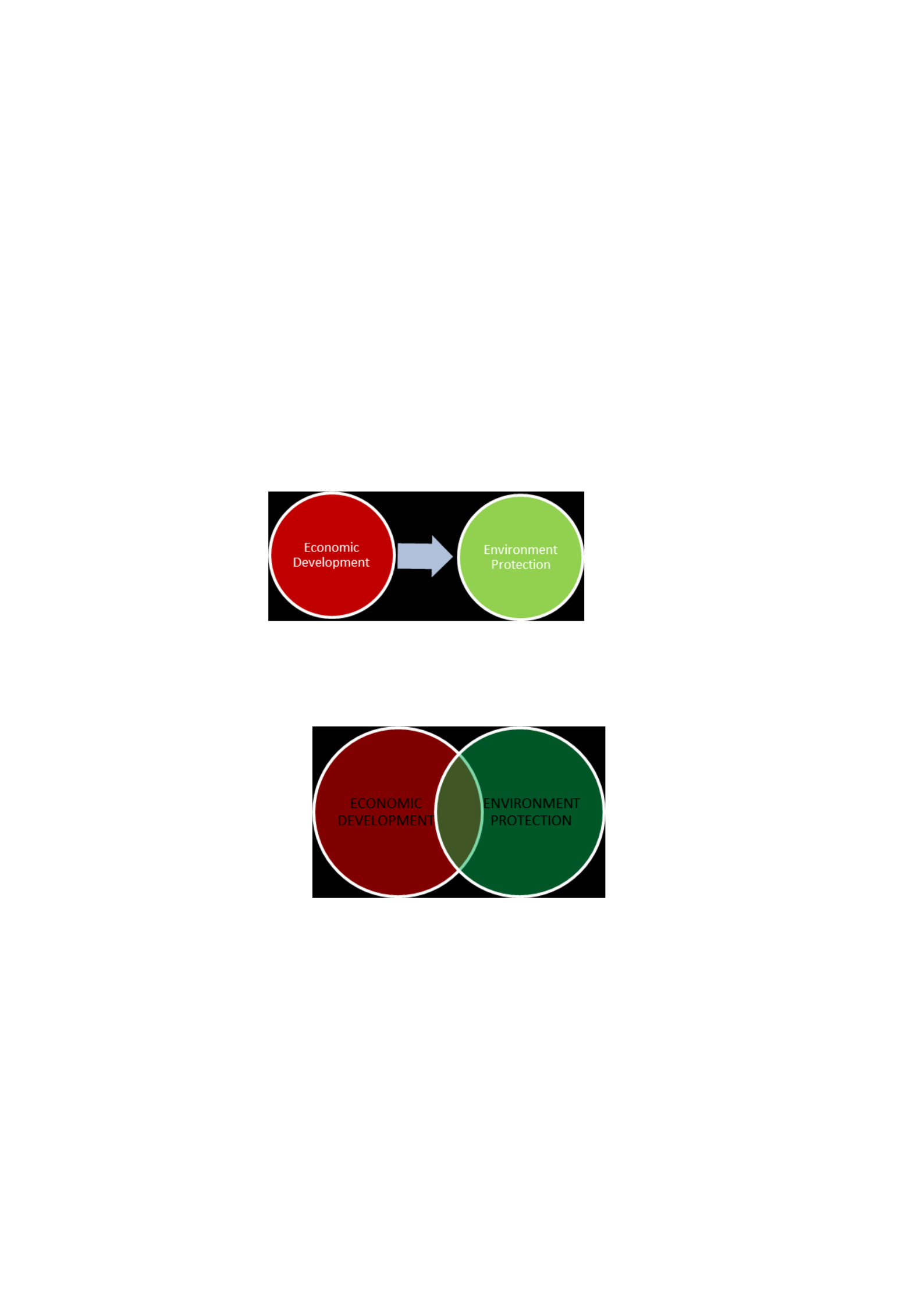
Sustainable development is development that meets current needs
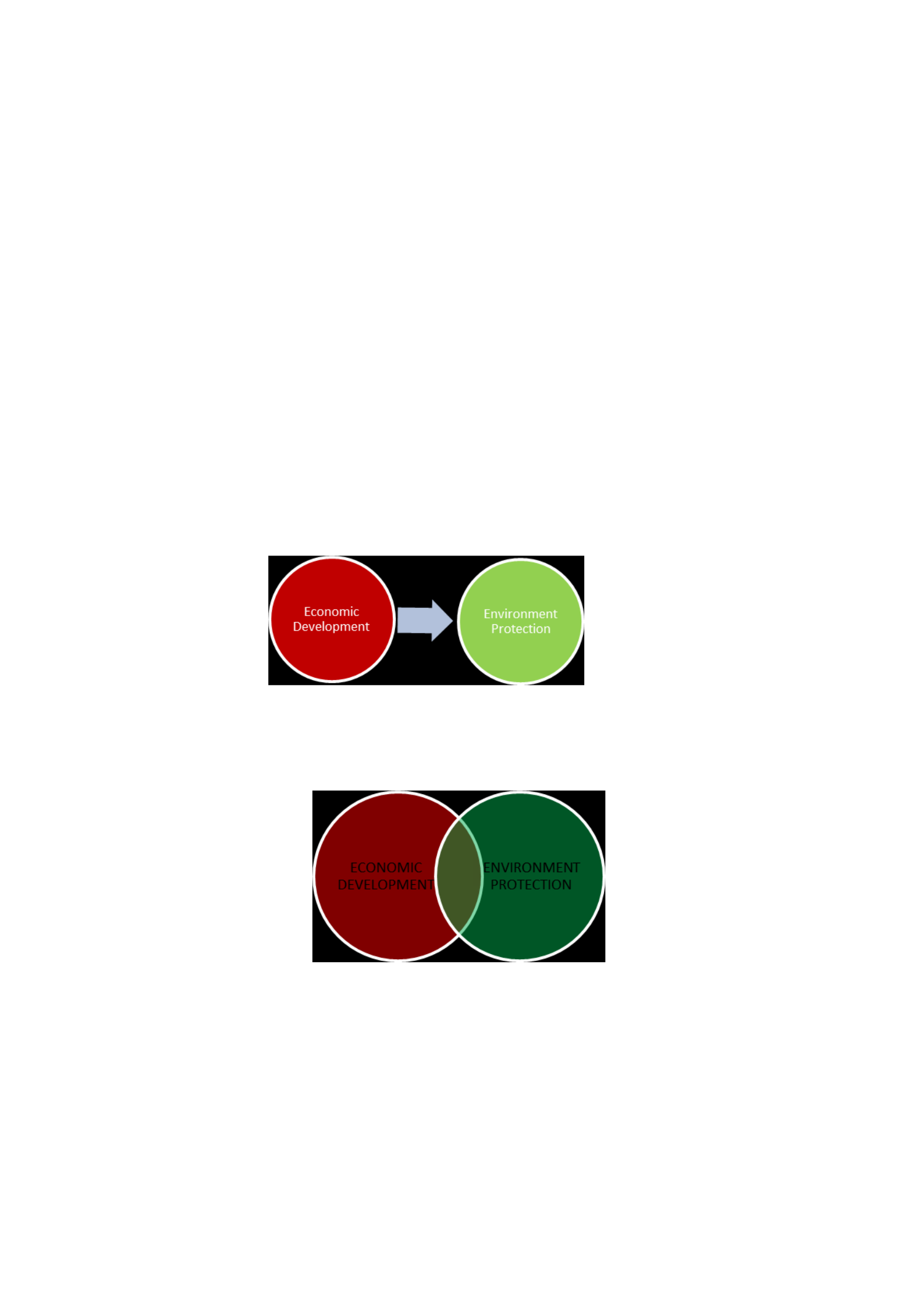
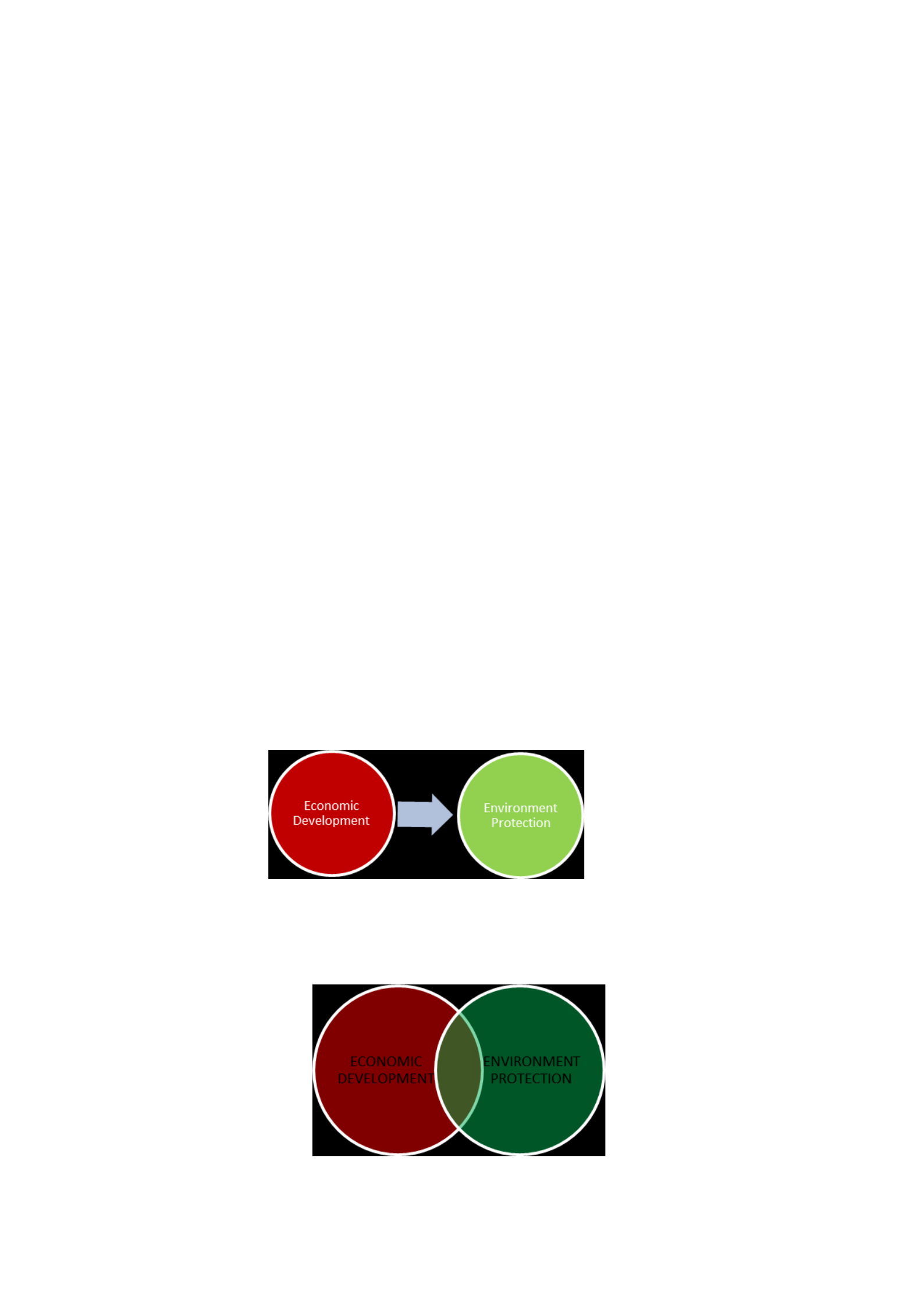
Problem Solving to manage the current condition of urban development is SUSTAINABLE
DEVELOPMENT in an awareness of "our common future" by paying attention to
economic needs that pay attention to environmental protection.
Definition of Sustainable City
Based on the above understanding, a sustainable city is a city that has the ability, ability, and

wise thinking to think about current and future needs, and the city is able to support, support
the needs of living things in a system (cover in system), where the development of a
dynamic and significantly growing city certainly requires efficient and effective
management or planning. So that the city physically has a mental awareness to maintain
environmental balance and sustainability of life in it, so that in the end the city is expected to
be socially just and prosperous.
In an ecological context, sustainability is understood as the ability of ecosystems to maintain
and sustain ecological processes, functions, productivity, and diversity into the future
(Wardhono, 2012).
Sustainable cities are cities that are able to meet the needs of the present without ignoring
the needs of future generations, how to repair environmental destruction without sacrificing
the needs of economic development and social justice. The concept of sustainable cities was
launched by the United Nations in June 2012 at the Rio+20 The United Nations Conference
on Sustainable Development. The concept is planned to be disseminated to the world's urban
stakeholders who are responsible for policy-making, planning and implementation of urban
development. Cities that have the ability to drive future growth, but are also able to grow
more efficiently and environmentally friendly.
The concept of environmental balance, related to sustainable cities "ecocity", which is the
development of cities that currently require a type of development that not only pays
attention to the development of the economic side (without the financial and material), but
needs to pay attention to aspects of the development of the quality of human life in it
(Richard Register, 1987). Then in the Research Triangle Institute (1996) the City must be
able to have five basic principles in the concept of sustainability, namely: Environmental
(Ecology), Economy (Employment), Society (Equity), Engagement and Energy. In its
application, the five elements must be able to run simultaneously, development inequality
will occur if the development of each element is uneven (Budihardjo and Sujarto, 1999).
Furthermore, the concept of sustainable cities according to Rogers (1998), must recognize
that cities need to meet social, environmental, political and cultural as well as economic and
physical goals. Rogers elaborated by including these keywords, such a city also pays
attention to aspects of beauty in art and architecture, creativity to optimize human potential,
resource efficiency and minimal ecological impact, ease of contact, mobility, integrated and
compact communities and diversity.
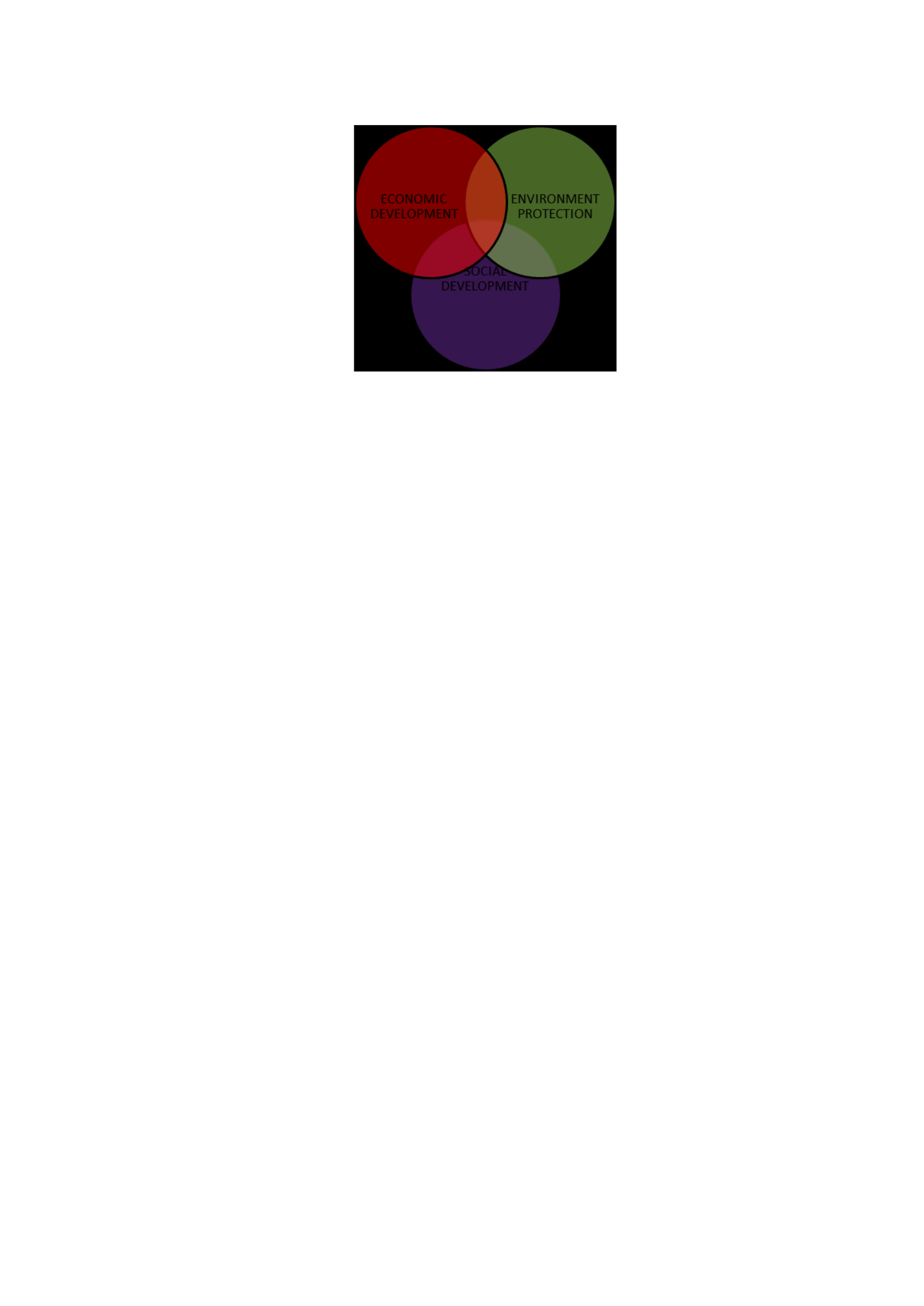
"SIMULTAN"
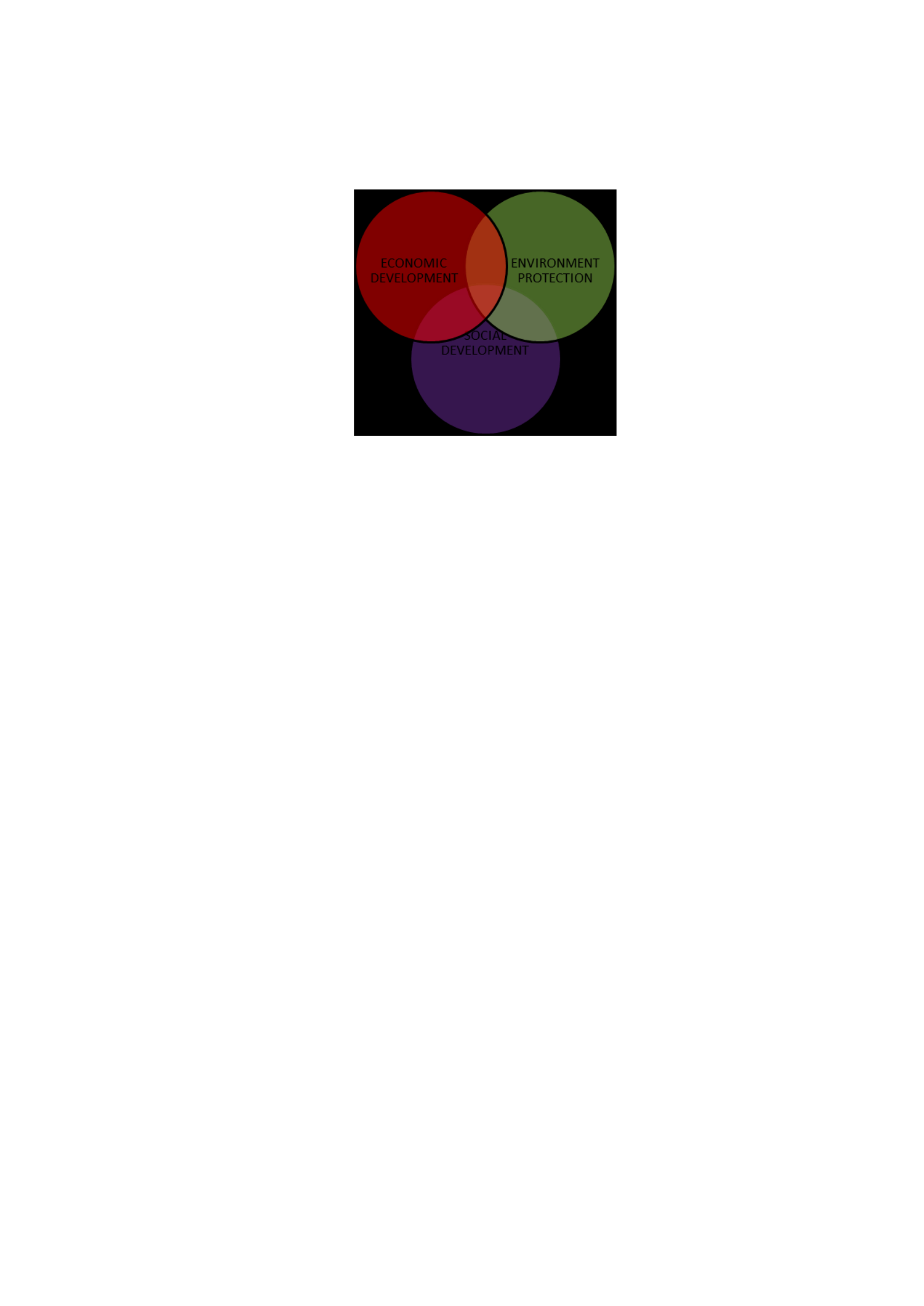
Sustainable development needs to be implemented "SIMULTANEOUSLY"
Sustainable Urban Planning Strategies
Based on the above review, the consideration to protect the environmental conditions that
are decreasing in quality, and the population explosion, then automatically the needs of
human life increase. Therefore, to carry out a sustainable urban development strategy, which
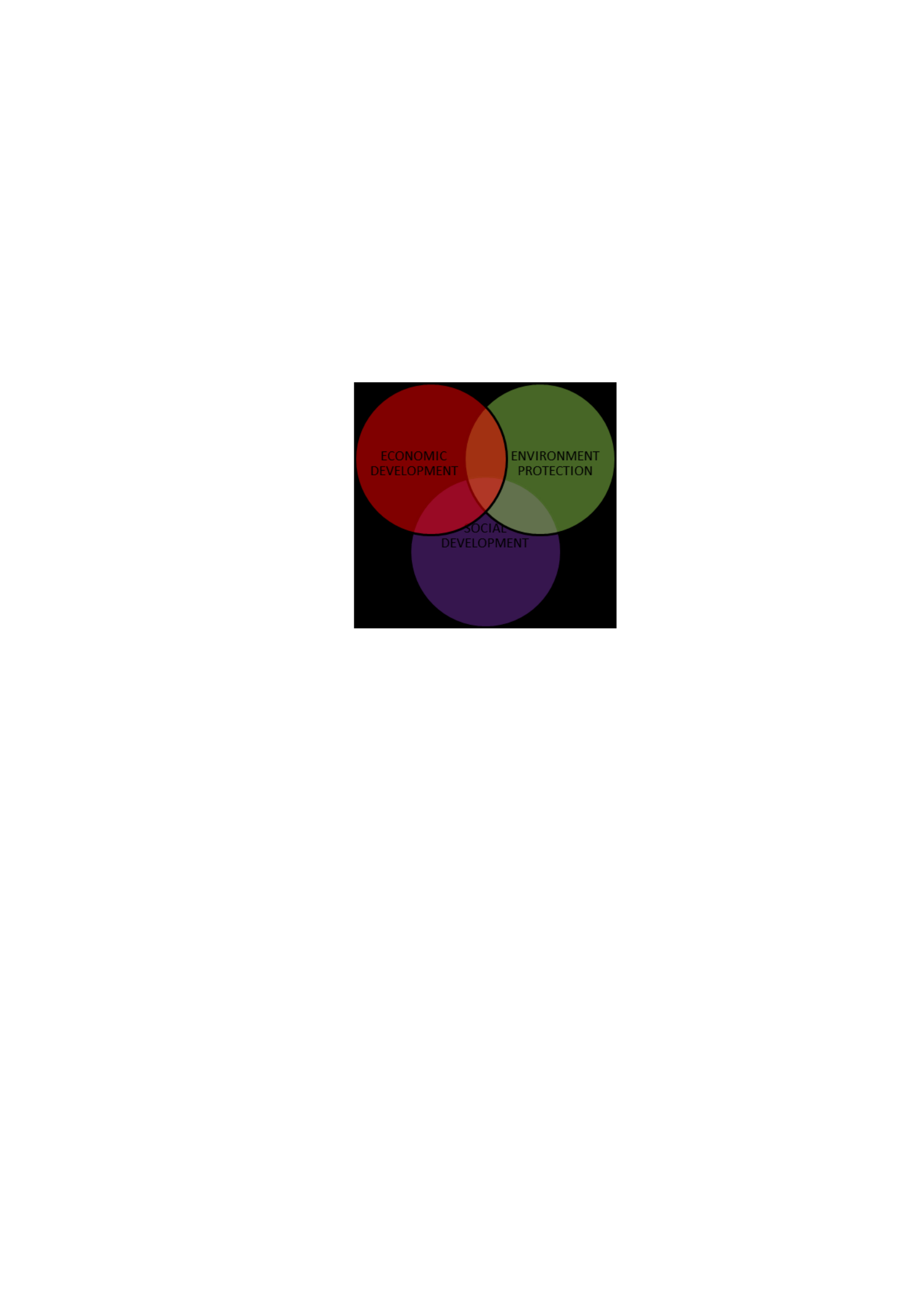
is carried out "Simultaneously" by combining the 4 (four) dimensions, namely: planning
that considers "economic development, by protecting the environment", and paying attention
to "social development", and the need for "Government" management as a regulatory
function and providing infrastructure.
Urban planning, of course, can never wait, because human affairs go on and their direction is
determined by the degree of planning. Realizing a real city that is sustainable is to open a
broad view that every city has housing, high-rise buildings, urban alleys, parks, people's
homes. We see how they live, how their children will become citizens and neighbors of their
children and generations. It is this view that gives direction to the city of the future, a city
that is comfortable to live in for every generation, serves human needs, and directs the
means to shape the urban environment.
Sustainable development in social capital can grow at the individual, family, community,
local community, society in a region, national, and even global levels. Community-level
social capital cannot be measured simply as an aggregation of individual networks. Strong

community-level social capital creates a "civic infrastructure" that will support formal and
informal decision-making processes and public engagement (Potapchuck et.al. 1997).
Individual social capital is closely related to human capital. When individuals invest in
being able to communicate well, they increase their social capital but reduce the social
capital of the community. Determinants of social capital can also include economic and
political instability, patron-client relationships, education, occupation, collective interest and
market legitimization of common values. Social capital can lower the costs of cooperation
and facilitate cooperation. To build social capital effectively, local governments must share
autonomy/roles with their communities, in the sense that they must shift from being
controllers, regulators and providers, to catalysts, conveners and facilitators (Crocker et al.
1998).
The issue of weak state capacity in developing countries, characterized by the inability to
carry out development, has become a hot topic discussed by experts. Theories of
government failure characterized by a "top-down" approach, as well as social capital theory
characterized by a "bottom-up" approach, both provide a framework that underlies the basic
framework for identifying the symptoms of "state incapacity" (Sallis and Dollery, 2001).
The government's role in implementing sustainable urban development is to have a
sustainable-minded leadership spirit so that the dynamic development of the city can be
managed effectively without incurring large costs.
"SUSTAINABLE"
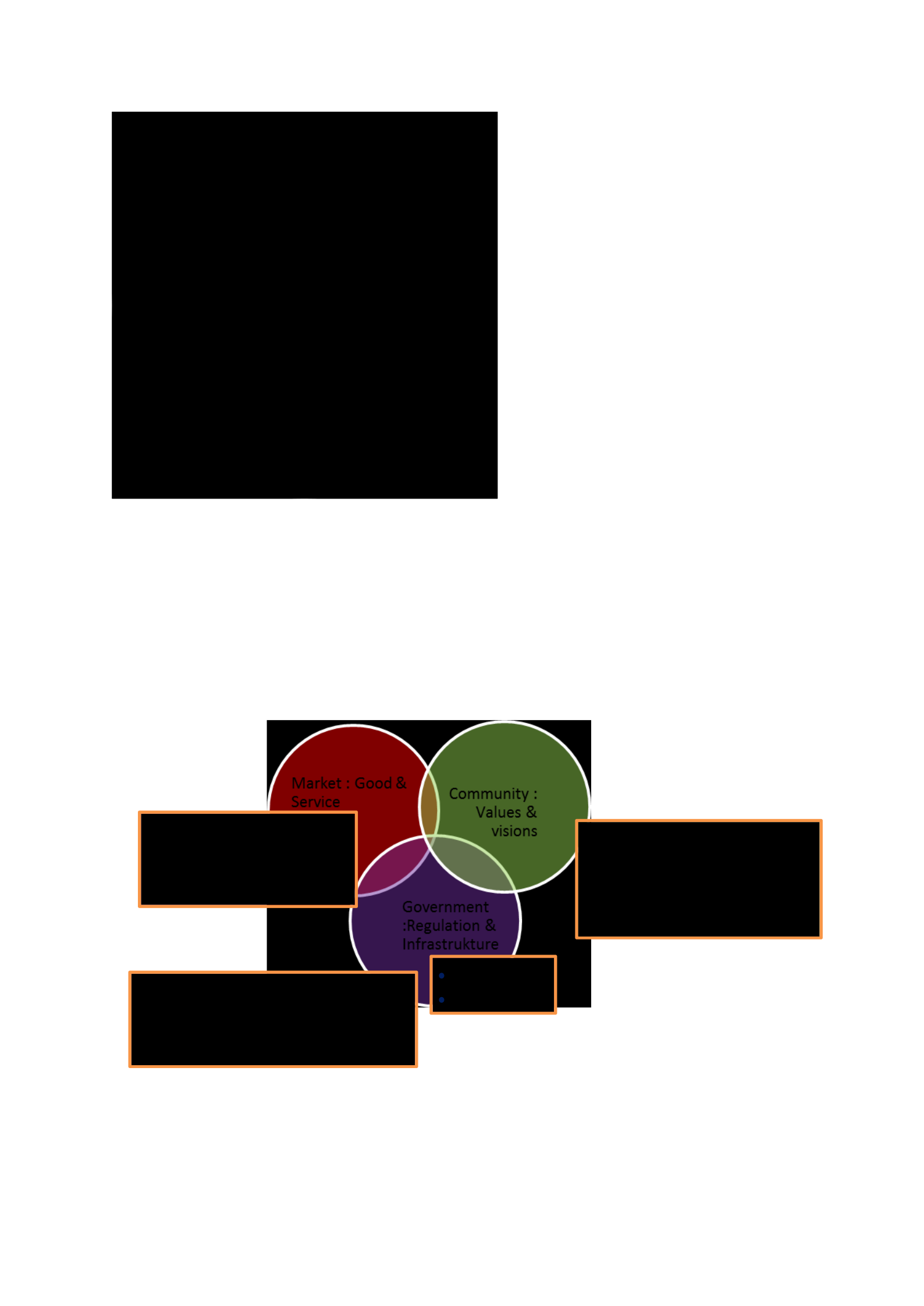
Time regulation:
Short-term Development:
INFRASTRUCTURE (time prime 10
years. MARKET (time prime 6 years)
LEADERSHIP
INNOVATION
In the direction of the
Community: Long term, it can
help and encourage the
community to improve their
quality of life.
The market has "POWER"
and for the Commitment to
be SUSTAINABLE then
Awareness required
Sustainable City Development Concept in 4 (four) Sectoral Dimensions
One of the strategies for sustainable urban development is that the government as a
development manager must have leadership, and innovation. The development program has
the concept of short term and long term development, both concepts support each other in
order to achieve a vision of sustainable urban development.
Sustainable Urban Development Strategy
One example of an innovative leader is being able to make sustainable city breakthroughs
such as Cities with Solar panels, Cities with Smart City, and movements to change the urban
environment to be more environmentally friendly.

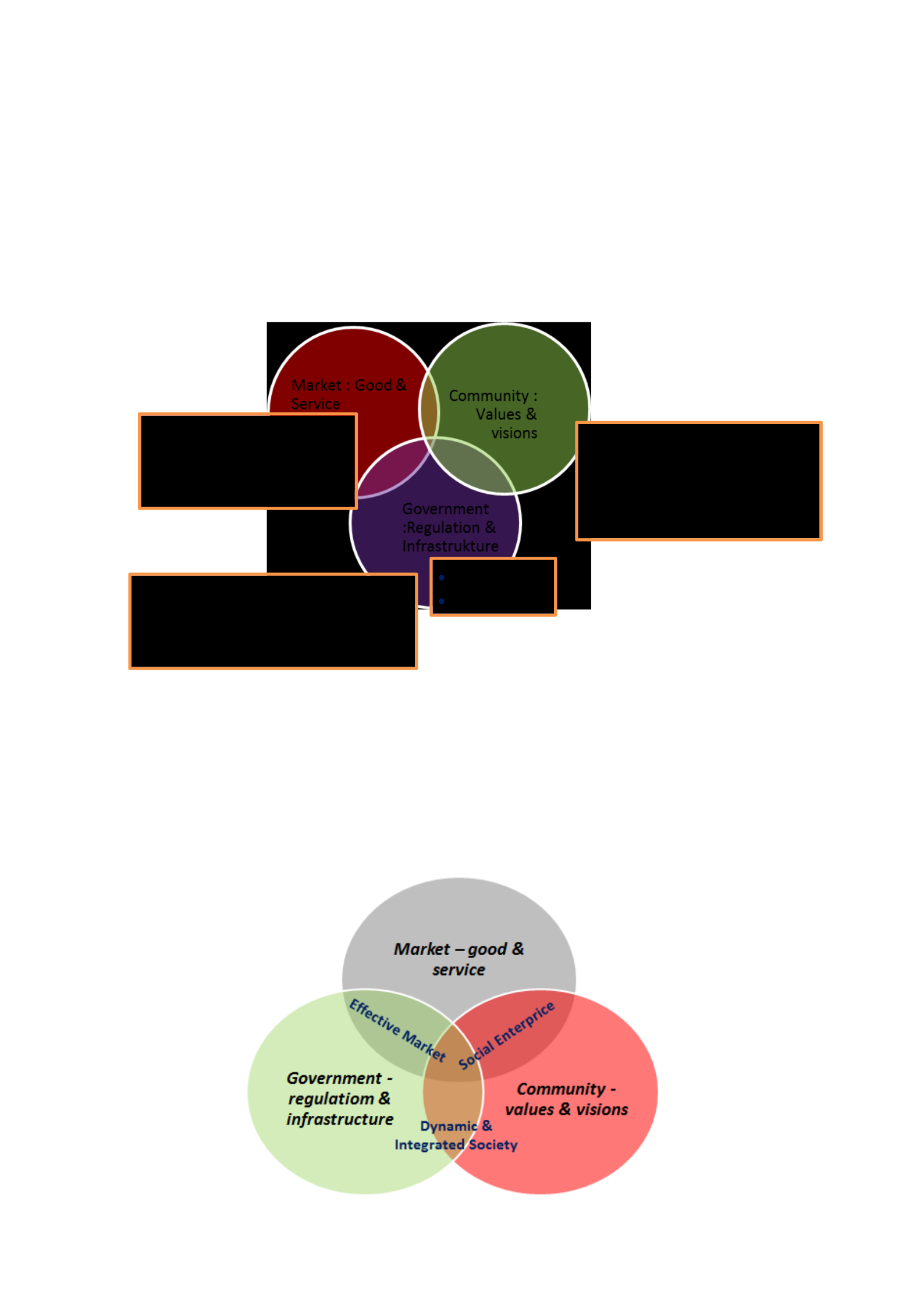
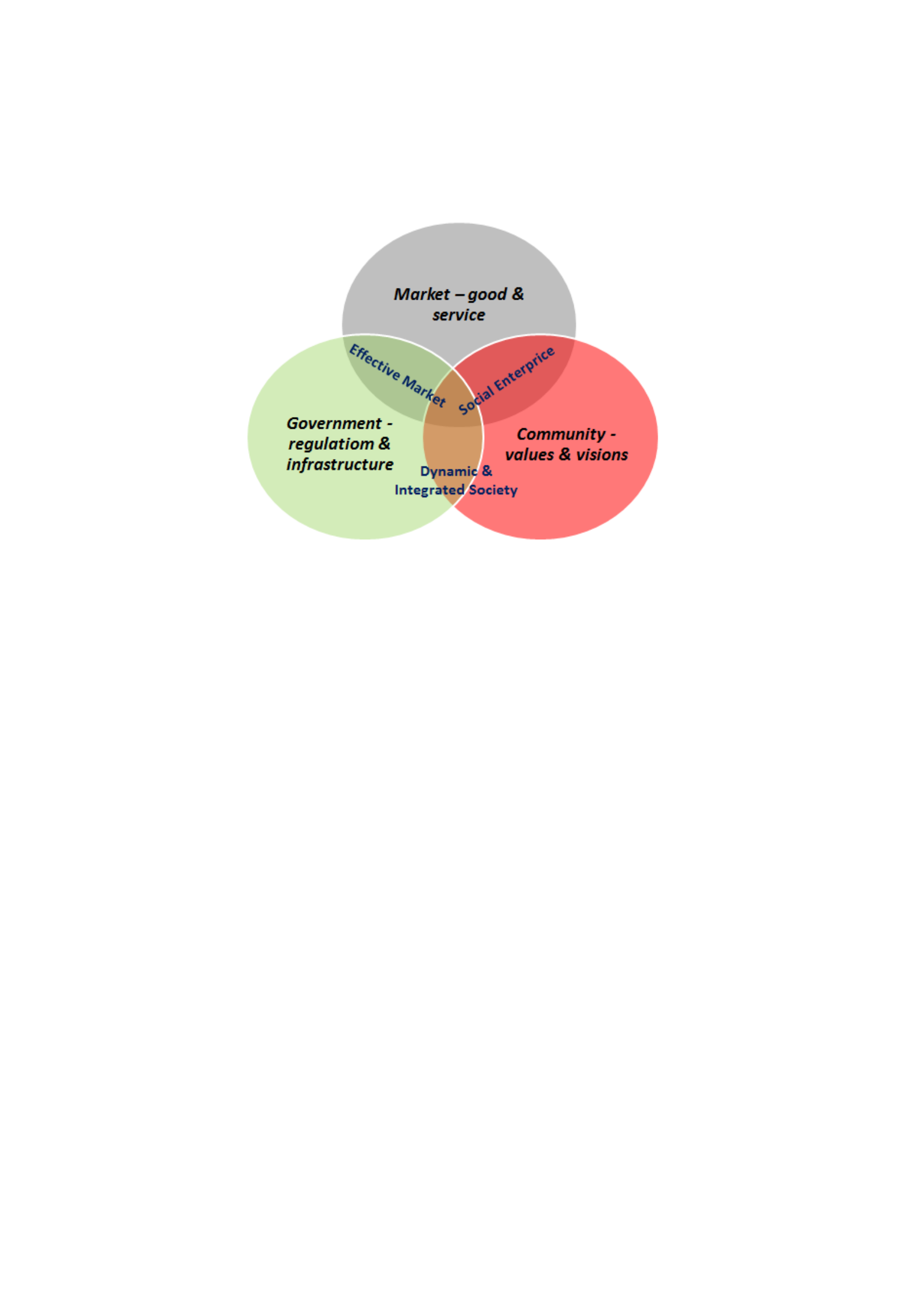
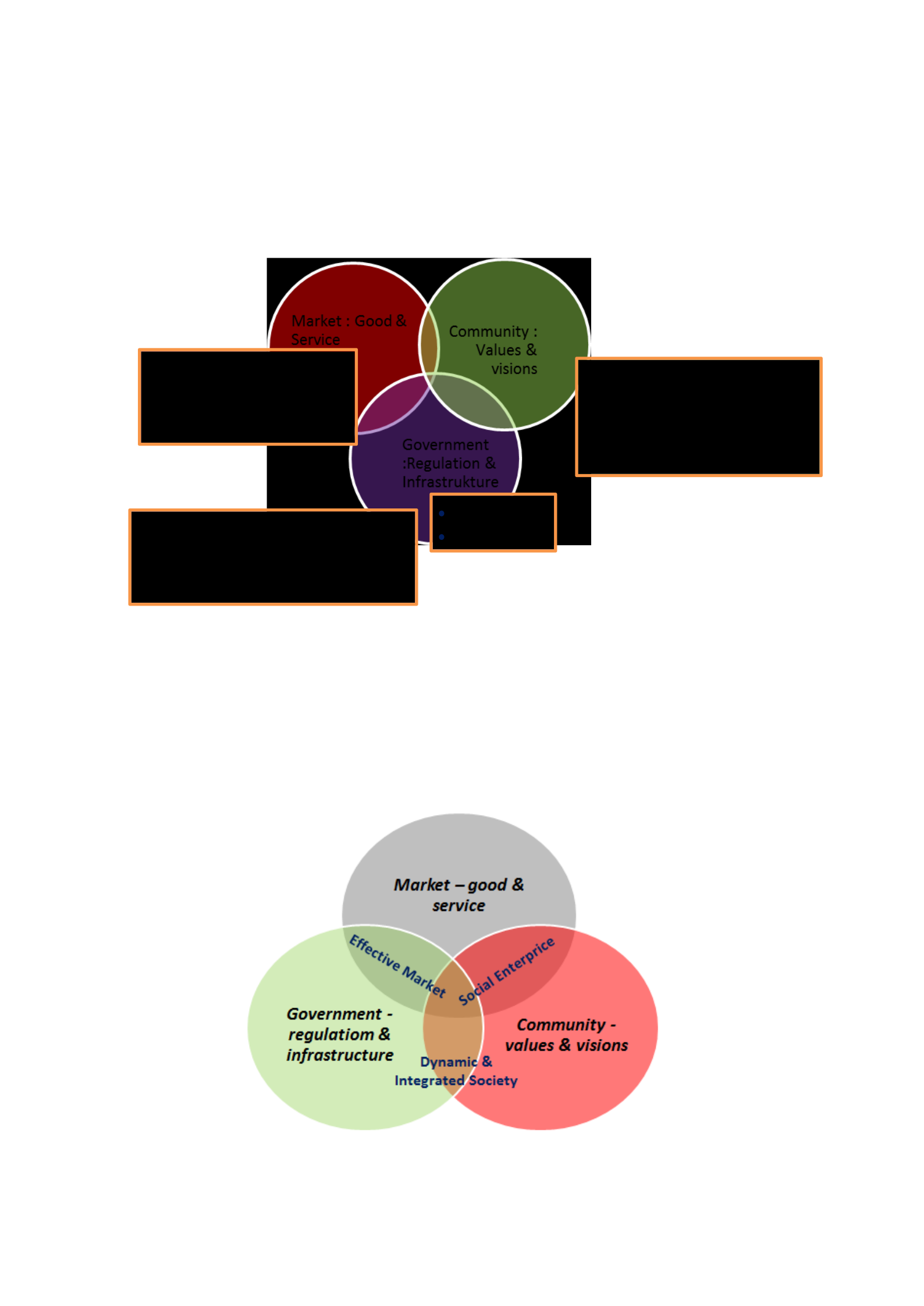
Figure 8. Sectoral dimensions that simultaneously produce something that is Integrity
The above principle illustrates a sectoral dimension, namely social, economic, and
environmental, into a development that cooperates with each other to maintain balance, it
will produce an effective market regulation, and social enterprice economic development
with attention to the environment will produce a good social community value as well. The
principle of sustainable development is one example:
Settlement: sustainable urban development recognizes the earth can only
adjust to a more balanced state if settlements "reduce their ecological
footprint" while they "simultaneously" improve their quality of life. In this
case, reducing the "ecological" footprint means reducing the use of materials
and energy that produce excessive CO2), while simultaneously it means
paying attention to providing healthy settlements, providing jobs, and
designing with social communities in mind.
Place-making: sustainability that recognizes the significance and diversity of
communities and regions for earth stewardship (cultured buildings,
landscaping, sculpture, and attention to biodiversity for future generations).
Net-Benefit: Sustainability that addresses the extraction of non-renewable
resources, providing net environmental social and economic benefits for
future generations. Reduce the impact and maintain the environmental
sustainability of irresponsible agencies.
The principles and enforcement of sustainable cities are expected to pay more attention to
humanity, more humane. Returning to the essence of the city itself is formed from human
needs. The relationship between the city, formed from humans and the environment, related
to the city is a system that cannot be separated from spatial planning, why because cities are
formed as a result of natural processes and social processes, human activities as creatures
that utilize natural resources also have tendencies that are patterned and spatially structured.
According to Rustiadi, et al (2011), human spatial instincts are natural and the result of long
"learning" experiences, so that they get typical spatial patterns, for example in the layout of
residential houses, public spaces (gathering places), yards, fields, rice fields, and so on. The
regularity of the spatial configuration of the community's socio-economic activities or
patterns of space utilization are always found in every community's economy or patterns of

space utilization are always found in every community's life in maintaining its life, adjusting
to the environment, optimizing efforts to utilize natural resources, optimizing social
interactions, as well as forms of cultural expression. The interaction between humans and
the environment requires humans to provide various infrastructure to facilitate access and
manage these resources.
The philosophy of sustainable urban planning is to meet the needs of society, the needs of
generations, and the needs of the economy, which is socially just where the goal is to
prevent unwanted changes, create balance and sustainable development. The beginning of
the process of sustainable urban planning starts with the need to make changes for the better
(welfare, natural disasters, social development, etc.).
Some Countries That Implement Sustainable Urban Development
Learning from other countries, about how to build a vision of a sustainable city and how to
implement it, certainly adds insight into managing a city, even though the cases and
problems are different. Consistency to build a sustainable city vision starts from the
creativity of a leader and building awareness of its citizens. The following is an explanation
of the table below:

Table 3. Countries in the Vision of a Sustainable City
STATE
CITY DESCRIPTION
Singapore
As a small and densely populated island nation with no natural resources,
Singapore's own sustainable development experience has focused on four
key areas, namely, (1) Building a sustainable economy; (2) creating a
sustainable living environment; (3) ensuring sustainable development for
our people; and (4) contributing to international collaboration.
•
Singapore is the 20th most carbon-efficient country in the world
•
Integrated transportation, MRT, BUS., pedestrian way
•
Since the 1970s, economic development has helped lift billions of people
out of poverty. Social indices of human development such as health and
education have improved significantly.
•
Despite not having natural resources, Singapore manages its human
resources more carefully.
•
Singapore plans to introduce a carbon tax from 2019, so those who emit
the most carbon will bear the cost to our environment and be encouraged to
reduce their emissions.
•
Give prizes to residents whose houses are energy efficient, tax discounts
•
A generation of pioneers, with a vision for a clean, green and sustainable
Singapore for all Singaporeans. Instilling the awareness that this little
island is all we have, and we must take good care of it.
•
Over the past 50 years, saw major improvements in housing, water, public
health and sanitation. Provides a City in Parks with about 47 percent green
cover in Singapore. More than 80 percent of households are within a 10-
minute walk of a park.
•
It has 72 hectares of green roof gardens and walls today, and aims to
double that by 2030.

Curitiba,
Brazil
•
Curitiba, is the world's first sustainable city. In 1971, architect Jaime
Lerner was elected mayor for the first of three terms, and came up with
innovative and creative solutions that saw Curitiba undergo a remarkable
evolution.
•
The greenest city, with more than 50 M2 of green space per capita, much
more than the UN recommendation. The reason why there is so much green
space is that Lerner had to find a solution to the frequent flooding that
occurred due to the geographical position of the city, so Lerner created a
large green belt around the city, which has turned into a large habitat for
many plants and animals. These large green areas are maintained by sheep
and goats and the wool they produce is sold to finance social development
in the city.
•
About 60% of people rely on the bus network in the city, efficiency for the
light rail system with dedicated lanes.
•
The city of Curitiba is a wonderful example of what creative leaders dare
and do, to make a city truly serve its residents rather than create stress,
congestion and inequality among its residents.
•
Implement a simple Bus transportation system, by dividing 5 arterial traffic
roads.
•
There are 28 parks and forest areas in Curitiba, creating an urban landscape
unlike any other developing city. The city's parks are designed to be
connected rather than isolated to maximize usage. The park was designed
by Hitoshi Nakamura.
•
The parks also stop squatters from creating shanty towns in flood-prone
zones.
•
Curitiba has 4 times the recommended green space, using sheep to "mow"
some of the grass in the parks.
By examining two countries, namely: Singapore and Curitiba, it is expected to increase
knowledge about "sustainable cities", where sustainable development focuses on human
resources, social justice, creating spatial equality.

Conclusions
Based on the sources of sustainable city references, it can be concluded that a sustainable
city is a city that is able to meet the NEEDS of the present without ignoring the NEEDS of
future GENERATIONS, how to REPAIR ENVIRONMENTAL DAMAGE without
sacrificing the NEEDS of ECONOMIC DEVELOPMENT and SOCIAL JUSTICE.
Building a sustainable city also takes into account 4 dimensions, namely SOCIAL
DIMENSION, ECONOMIC DIMENSION, ENVIRONMENTAL DIMENSION, and
GOVERNMENT DIMENSION. These four things Side by side, the success of sustainable
development does not only depend on the economic dimension but needs the intervention of
the power holder or in this case the government dimension, in order to implement
sustainable development so as to achieve equitable distribution of welfare. Therefore,
sustainable development is oriented towards the development of Green Cities that have a
good quality of life and conducive environmental conditions.
Problems
Urban growth is a complex phenomenon, partly spontaneous and partly planned. There have
been several attempts to manage that complexity. Ideas such as building sustainable cities,
resulting in better urban environments that meet people's needs, have fewer socio-economic
costs, and use less nature.
Based on the explanation above, the problem about the city is that when some of the cities
develop spontaneously (sprawl), the population increases, the development of urban areas
and land clearing occurs which changes the function of productive areas of paddy land into
new residential / residential areas, forest conversion into agricultural / plantation land.
Furthermore, the urbanization process also creates socio-economic problems for cities,
forming slum areas that have low income in the city, resulting in crime in urban spaces.
These problems represent urban development that does not take into account the quality of
human life. The congestion of cities such as Jakarta and other large cities, due to poorly
integrated public transportation systems. The earth's temperature is getting hotter due to
CO2 emissions from various human activities on earth such as motor gas air pollution,
greenhouse effect, building materials, and flooding in urban areas, and so on.

Based on the problems mentioned above, the world's cities consume three-quarters of the
world's energy and cause three-quarters of global pollution and cities have become parasitic
ehuge organisms that can drain the earth for food due to excessive energy consumption:
relentless consumers, relentless polluters. So that over time the city system becomes
unstable, resilience and capacity are not high enough, and it is likely that the city will
collapse (colappse). With the phenomena of environmental degradation and rising
temperatures, humans are no longer comfortable in their habitats (Roger, 1998 and Egger
2006).
Cities are the drivers of future growth, but also the biggest contributors to CO2 emissions.
So that a concept that pays attention to environmental balance is needed, namely the concept
of sustainable development. The concept of sustainable development has been widely
developed into the theoretical foundations of sustainable cities. City references and
applicative applications of sustainable urban development are easy to find, both in various
methods and paradigms. The dream of an ideal future city concept in the book "Garden City
of to-morrow" written by Ebenezer Howard (1898), invited controversy, became utopias,
considered irrelevant, unreasonable, and due to this irrelevance, the concept of Garden City
of to-morrow Ebenezer Howard is not widely used, only natural and natural concepts are
widely taken by urban planners, the rest is just a historical record. Twentieth-century urban
planners had a variety of new concepts in planning their cities from the initial idea of a
dream of a sustainable city that had become our common future.
Objectives and Benefits
Based on the above background and problems, the author sees the need to conduct a
theoretical study to better understand the concept of sustainable development in the four
dimensions of sustainable development, namely environmental, social, and economic, and
government. about the meaning and scope as a source of knowledge for the community
(students, academics, and practitioners) while strengthening the body knowledge of
architecture. The results of this paper are expected to be able to provide a deeper
understanding for students, and practitioners, to understand architecture and cities, becoming
a provision in the practice of architecture and planning science.
Writing Method
This research is a literature research to explore the understanding, meaning and scope of the

concept of a sustainable city. Various thoughts about the concept of a sustainable city can be
used as supporting data in this writing. The search for data and information through
documents, both in the form of written documents, photographs, images, and electronic
documents that can support the research process. Research results will also be more credible
if supported by photographs or existing academic and artistic papers (Sugiyono, 2005: 83).
Therefore, literature study can affect the credibility of the results of the research conducted.
Sustainable Cities And Their Development
Cities and their Development
Before understanding more about sustainable cities, it is necessary to know what the
definition of a city, its equivalents, differences, and scale are.
When the philosophy of science developed towards modern thinking. Humanist thinking
was influenced by the views of Karl Marx, Immanuel Kant, and Max Weber, the most
influential of whom was the Spirit of Capitalism (1905). So the city is a place where most of
its economic needs are in the local market, the characteristics of the city are the existence of
a market as a fortress and has a legal system and is cosmopolitan. When the city develops, as
a place to live, a place to produce goods and services, the scale of services develops, there is
a concentration of population, with high density. A small city to a megacity is said to have a
population of 20,000 to 5,000,000.
There are three opinions, namely; Max Weber (1905), Hamilton (2001), Steve Egger (2006),
defining the city basically is to accommodate human needs, community needs, and
economic needs. If we go back to Maslow's (1943) theory in "The Theory Of Human
Motivation" about the Hierarchy of human needs, namely basic needs are elements needed
by humans in maintaining balance both physiologically and psychologically which aims to
maintain life and health. Hierarchy (1) Physiological Needs or Faal Needs (physiological
needs): the right to get oxygen, food, sleep (human self-activity), (2) Safety, security needs:
Protection, (3) Love needs (social needs): social interaction life, (4) Esteem needs EGO
ownership (esteem needs), and (5) Self-actualization (self- actualization needs): recognition
appreciated, social status.
Cities are formed from human needs, to serve (Hamilton, 2001) from the hierarchy of human
needs, spatial formation of community expression (Steve Egger, 2006) makes the city

formed in a network or a system of community expression. As a result of such a system,
cities require management, governance, trade, culture, education, and society, to facilitate an
environment for human existence and interaction (Egger, 2006).
From the various opinions above, it can be concluded that the realization of the city is to
accommodate human needs, and when the city is growing dynamically, the city becomes a
network that is intertwined in a unified system, so that a city requires serious management
based on the scale of services, if not managed, social, economic, and environmental
problems then the city experiences collapse and crisis. A good city is one that responds to
the various problems that occur in the city, and thinks about survival and sustainability.
Sustainability
The definition of sustainability (continue) according to the Big United States Dictionary
(KBBI) is sustainable; and continuously. "Sustain": (1) strengthen or support physically or
mentally, (2) undergo or suffer (something unpleasant, especially an injury), (3) uphold,
affirm, or confirm the justice or validity of, in United States translation "sustain" is
menopang. The definition of sustain here is being able to endure, sustain, support, sustain,
experience, continue, suffer, prolong, and enable. As for the translation of "ability": (1)
possession of the means or skill to do something, (2) talent, skill, or proficiency in a
particular area, in United States translation is ability, capability, talent, ability, proficiency,
cleverness, wisdom, shrewdness, and dexterity.
Sustainable Cities
History of Sustainable Urban Development
To understand what "sustainability" is, and why there is an agreement on sustainable
development. It is therefore necessary to trace a history of the birth of the idea of sustainable
urban development.
In 1972, the Stockholm UN World Conference on Human Environment: UN
Conference on Human Environment (June 5-6, 1972): the focus was on discussing
guidelines and actions in dealing with environmental problems, such as alleviating
poverty, and protecting the environment.
Paul Ehrlich, a Stanford University Professor of Biology, who wrote a book titled
"Population Bomb": was a bestseller written by Stanford University Professor Paul R.
Ehrlich and his wife, Anne Ehrlich (who was not recognized), in 1968. The book
warned of mass human starvation in the 1970s and 1980s due to overpopulation, as
well as social upheaval, and advocated immediate action to limit population growth.
Fears of a widespread "population explosion" in the 1950s and 1960s.
In 1982, the Nairobi World Commission on Environment and Development. One of
the ongoing agendas of this UN meeting was to discuss environmental degradation,
deforestation, soil and water degradation, atmospheric changes - such as depletion of
the ozone layer, increasing concentrations of CO2 gas.
In 1987, the Brundtland report "Our Common Future" stated that sustainable
development is development that meets the needs of the present.
In 1992, the Rio United Nations World Conference on Environment and Development,
discussed the development of ecological sustainability, where at that time the
American President, Ronald Reagen, rejected the agenda because he considered
sustainable development not a solution to the problem, as well as the Australian Prime
Minister, namely John Howard. The countries that agreed to implement the agenda are
Canada, Japan, Europe, From these historical moments, a formulation of sustainable
development emerged, which initially was to pay attention to the needs of the present
and the future, economic development needs to pay attention to the environment or be
wiser and limit the excessive use of natural resources.
Sustainable development is development that meets current needs

Problem Solving to manage the current condition of urban development is SUSTAINABLE
DEVELOPMENT in an awareness of "our common future" by paying attention to
economic needs that pay attention to environmental protection.
Definition of Sustainable City
Based on the above understanding, a sustainable city is a city that has the ability, ability, and
wise thinking to think about current and future needs, and the city is able to support, support
the needs of living things in a system (cover in system), where the development of a
dynamic and significantly growing city certainly requires efficient and effective
management or planning. So that the city physically has a mental awareness to maintain
environmental balance and sustainability of life in it, so that in the end the city is expected to
be socially just and prosperous.
In an ecological context, sustainability is understood as the ability of ecosystems to maintain
and sustain ecological processes, functions, productivity, and diversity into the future
(Wardhono, 2012).
Sustainable cities are cities that are able to meet the needs of the present without ignoring
the needs of future generations, how to repair environmental destruction without sacrificing
the needs of economic development and social justice. The concept of sustainable cities was
launched by the United Nations in June 2012 at the Rio+20 The United Nations Conference
on Sustainable Development. The concept is planned to be disseminated to the world's urban
stakeholders who are responsible for policy-making, planning and implementation of urban
development. Cities that have the ability to drive future growth, but are also able to grow
more efficiently and environmentally friendly.
The concept of environmental balance, related to sustainable cities "ecocity", which is the
development of cities that currently require a type of development that not only pays
attention to the development of the economic side (without the financial and material), but
needs to pay attention to aspects of the development of the quality of human life in it
(Richard Register, 1987). Then in the Research Triangle Institute (1996) the City must be
able to have five basic principles in the concept of sustainability, namely: Environmental
(Ecology), Economy (Employment), Society (Equity), Engagement and Energy. In its
application, the five elements must be able to run simultaneously, development inequality
will occur if the development of each element is uneven (Budihardjo and Sujarto, 1999).
Furthermore, the concept of sustainable cities according to Rogers (1998), must recognize
that cities need to meet social, environmental, political and cultural as well as economic and
physical goals. Rogers elaborated by including these keywords, such a city also pays
attention to aspects of beauty in art and architecture, creativity to optimize human potential,
resource efficiency and minimal ecological impact, ease of contact, mobility, integrated and
compact communities and diversity.
"SIMULTAN"
Sustainable development needs to be implemented "SIMULTANEOUSLY"
Sustainable Urban Planning Strategies
Based on the above review, the consideration to protect the environmental conditions that
are decreasing in quality, and the population explosion, then automatically the needs of
human life increase. Therefore, to carry out a sustainable urban development strategy, which
is carried out "Simultaneously" by combining the 4 (four) dimensions, namely: planning
that considers "economic development, by protecting the environment", and paying attention
to "social development", and the need for "Government" management as a regulatory
function and providing infrastructure.
Urban planning, of course, can never wait, because human affairs go on and their direction is
determined by the degree of planning. Realizing a real city that is sustainable is to open a
broad view that every city has housing, high-rise buildings, urban alleys, parks, people's
homes. We see how they live, how their children will become citizens and neighbors of their
children and generations. It is this view that gives direction to the city of the future, a city

that is comfortable to live in for every generation, serves human needs, and directs the
means to shape the urban environment.
Sustainable development in social capital can grow at the individual, family, community,
local community, society in a region, national, and even global levels. Community-level
social capital cannot be measured simply as an aggregation of individual networks. Strong
community-level social capital creates a "civic infrastructure" that will support formal and
informal decision-making processes and public engagement (Potapchuck et.al. 1997).
Individual social capital is closely related to human capital. When individuals invest in
being able to communicate well, they increase their social capital but reduce the social
capital of the community. Determinants of social capital can also include economic and
political instability, patron-client relationships, education, occupation, collective interest and
market legitimization of common values. Social capital can lower the costs of cooperation
and facilitate cooperation. To build social capital effectively, local governments must share
autonomy/roles with their communities, in the sense that they must shift from being
controllers, regulators and providers, to catalysts, conveners and facilitators (Crocker et al.
1998).
The issue of weak state capacity in developing countries, characterized by the inability to
carry out development, has become a hot topic discussed by experts. Theories of
government failure characterized by a "top-down" approach, as well as social capital theory
characterized by a "bottom-up" approach, both provide a framework that underlies the basic
framework for identifying the symptoms of "state incapacity" (Sallis and Dollery, 2001).
The government's role in implementing sustainable urban development is to have a
sustainable-minded leadership spirit so that the dynamic development of the city can be
managed effectively without incurring large costs.
Time regulation:
Short-term Development:
INFRASTRUCTURE (time prime 10
years. MARKET (time prime 6 years)
LEADERSHIP
INNOVATION
In the direction of the
Community: Long term, it can
help and encourage the
community to improve their
quality of life.
The market has "POWER"
and for the Commitment to
be SUSTAINABLE then
Awareness required
Sustainable City Development Concept in 4 (four) Sectoral Dimensions
One of the strategies for sustainable urban development is that the government as a
development manager must have leadership, and innovation. The development program has
the concept of short term and long term development, both concepts support each other in
order to achieve a vision of sustainable urban development.
Sustainable Urban Development Strategy
"SUSTAINABLE"
One example of an innovative leader is being able to make sustainable city breakthroughs
such as Cities with Solar panels, Cities with Smart City, and movements to change the urban
environment to be more environmentally friendly.
Figure 8. Sectoral dimensions that simultaneously produce something that is Integrity
The above principle illustrates a sectoral dimension, namely social, economic, and
environmental, into a development that cooperates with each other to maintain balance, it
will produce an effective market regulation, and social enterprice economic development
with attention to the environment will produce a good social community value as well. The
principle of sustainable development is one example:
Settlement: sustainable urban development recognizes the earth can only
adjust to a more balanced state if settlements "reduce their ecological
footprint" while they "simultaneously" improve their quality of life. In this
case, reducing the "ecological" footprint means reducing the use of materials
and energy that produce excessive CO2), while simultaneously it means
paying attention to providing healthy settlements, providing jobs, and
designing with social communities in mind.
Place-making: sustainability that recognizes the significance and diversity of
communities and regions for earth stewardship (cultured buildings,
landscaping, sculpture, and attention to biodiversity for future generations).
Net-Benefit: Sustainability that addresses the extraction of non-renewable
resources, providing net environmental social and economic benefits for
future generations. Reduce the impact and maintain the environmental

sustainability of irresponsible agencies.
The principles and enforcement of sustainable cities are expected to pay more attention to
humanity, more humane. Returning to the essence of the city itself is formed from human
needs. The relationship between the city, formed from humans and the environment, related
to the city is a system that cannot be separated from spatial planning, why because cities are
formed as a result of natural processes and social processes, human activities as creatures
that utilize natural resources also have tendencies that are patterned and spatially structured.
According to Rustiadi, et al (2011), human spatial instincts are natural and the result of long
"learning" experiences, so that they get typical spatial patterns, for example in the layout of
residential houses, public spaces (gathering places), yards, fields, rice fields, and so on. The
regularity of the spatial configuration of the community's socio-economic activities or
patterns of space utilization are always found in every community's economy or patterns of
space utilization are always found in every community's life in maintaining its life, adjusting
to the environment, optimizing efforts to utilize natural resources, optimizing social
interactions, as well as forms of cultural expression. The interaction between humans and
the environment requires humans to provide various infrastructure to facilitate access and
manage these resources.
The philosophy of sustainable urban planning is to meet the needs of society, the needs of
generations, and the needs of the economy, which is socially just where the goal is to
prevent unwanted changes, create balance and sustainable development. The beginning of
the process of sustainable urban planning starts with the need to make changes for the better
(welfare, natural disasters, social development, etc.).
Some Countries That Implement Sustainable Urban Development
Learning from other countries, about how to build a vision of a sustainable city and how to
implement it, certainly adds insight into managing a city, even though the cases and
problems are different. Consistency to build a sustainable city vision starts from the
creativity of a leader and building awareness of its citizens. The following is an explanation
of the table below:

Table 3. Countries in the Vision of a Sustainable City
STATE
CITY DESCRIPTION
Singapore
As a small and densely populated island nation with no natural resources,
Singapore's own sustainable development experience has focused on four
key areas, namely, (1) Building a sustainable economy; (2) creating a
sustainable living environment; (3) ensuring sustainable development for
our people; and (4) contributing to international collaboration.
•
Singapore is the 20th most carbon-efficient country in the world
•
Integrated transportation, MRT, BUS., pedestrian way
•
Since the 1970s, economic development has helped lift billions of people
out of poverty. Social indices of human development such as health and
education have improved significantly.
•
Despite not having natural resources, Singapore manages its human
resources more carefully.
•
Singapore plans to introduce a carbon tax from 2019, so those who emit
the most carbon will bear the cost to our environment and be encouraged to
reduce their emissions.
•
Give prizes to residents whose houses are energy efficient, tax discounts

•
A generation of pioneers, with a vision for a clean, green and sustainable
Singapore for all Singaporeans. Instilling the awareness that this little
island is all we have, and we must take good care of it.
•
Over the past 50 years, saw major improvements in housing, water, public
health and sanitation. Provides a City in Parks with about 47 percent green
cover in Singapore. More than 80 percent of households are within a 10-
minute walk of a park.
•
It has 72 hectares of green roof gardens and walls today, and aims to
double that by 2030.
Curitiba,
Brazil
•
Curitiba, is the world's first sustainable city. In 1971, architect Jaime
Lerner was elected mayor for the first of three terms, and came up with
innovative and creative solutions that saw Curitiba undergo a remarkable
evolution.
•
The greenest city, with more than 50 M2 of green space per capita, much
more than the UN recommendation. The reason why there is so much green
space is that Lerner had to find a solution to the frequent flooding that
occurred due to the geographical position of the city, so Lerner created a
large green belt around the city, which has turned into a large habitat for
many plants and animals. These large green areas are maintained by sheep
and goats and the wool they produce is sold to finance social development
in the city.
•
About 60% of people rely on the bus network in the city, efficiency for the
light rail system with dedicated lanes.
•
The city of Curitiba is a wonderful example of what creative leaders dare
and do, to make a city truly serve its residents rather than create stress,
congestion and inequality among its residents.
•
Implement a simple Bus transportation system, by dividing 5 arterial traffic
roads.
•
There are 28 parks and forest areas in Curitiba, creating an urban landscape
unlike any other developing city. The city's parks are designed to be
connected rather than isolated to maximize usage. The park was designed
by Hitoshi Nakamura.
•
The parks also stop squatters from creating shanty towns in flood-prone

zones.
•
Curitiba has 4 times the recommended green space, using sheep to "mow"
some of the grass in the parks.
By examining two countries, namely: Singapore and Curitiba, it is expected to increase
knowledge about "sustainable cities", where sustainable development focuses on human
resources, social justice, creating spatial equality.
Conclusions
Based on the sources of sustainable city references, it can be concluded that a sustainable
city is a city that is able to meet the NEEDS of the present without ignoring the NEEDS of
future GENERATIONS, how to REPAIR ENVIRONMENTAL DAMAGE without
sacrificing the NEEDS of ECONOMIC DEVELOPMENT and SOCIAL JUSTICE.
Building a sustainable city also takes into account 4 dimensions, namely SOCIAL
DIMENSION, ECONOMIC DIMENSION, ENVIRONMENTAL DIMENSION, and

GOVERNMENT DIMENSION. These four things Side by side, the success of sustainable
development does not only depend on the economic dimension but needs the intervention of
the power holder or in this case the government dimension, in order to implement
sustainable development so as to achieve equitable distribution of welfare. Therefore,
sustainable development is oriented towards the development of Green Cities that have a
good quality of life and conducive environmental conditions.
Problems
Urban growth is a complex phenomenon, partly spontaneous and partly planned. There have
been several attempts to manage that complexity. Ideas such as building sustainable cities,
resulting in better urban environments that meet people's needs, have fewer socio-economic
costs, and use less nature.
Based on the explanation above, the problem about the city is that when some of the cities
develop spontaneously (sprawl), the population increases, the development of urban areas
and land clearing occurs which changes the function of productive areas of paddy land into
new residential / residential areas, forest conversion into agricultural / plantation land.
Furthermore, the urbanization process also creates socio-economic problems for cities,
forming slum areas that have low income in the city, resulting in crime in urban spaces.
These problems represent urban development that does not take into account the quality of
human life. The congestion of cities such as Jakarta and other large cities, due to poorly
integrated public transportation systems. The earth's temperature is getting hotter due to
CO2 emissions from various human activities on earth such as motor gas air pollution,
greenhouse effect, building materials, and flooding in urban areas, and so on.
Based on the problems mentioned above, the world's cities consume three-quarters of the
world's energy and cause three-quarters of global pollution and cities have become parasitic
ehuge organisms that can drain the earth for food due to excessive energy consumption:
relentless consumers, relentless polluters. So that over time the city system becomes
unstable, resilience and capacity are not high enough, and it is likely that the city will
collapse (colappse). With the phenomena of environmental degradation and rising
temperatures, humans are no longer comfortable in their habitats (Roger, 1998 and Egger
2006).

Cities are the drivers of future growth, but also the biggest contributors to CO2 emissions.
So that a concept that pays attention to environmental balance is needed, namely the concept
of sustainable development. The concept of sustainable development has been widely
developed into the theoretical foundations of sustainable cities. City references and
applicative applications of sustainable urban development are easy to find, both in various
methods and paradigms. The dream of an ideal future city concept in the book "Garden City
of to-morrow" written by Ebenezer Howard (1898), invited controversy, became utopias,
considered irrelevant, unreasonable, and due to this irrelevance, the concept of Garden City
of to-morrow Ebenezer Howard is not widely used, only natural and natural concepts are
widely taken by urban planners, the rest is just a historical record. Twentieth-century urban
planners had a variety of new concepts in planning their cities from the initial idea of a
dream of a sustainable city that had become our common future.
Objectives and Benefits
Based on the above background and problems, the author sees the need to conduct a
theoretical study to better understand the concept of sustainable development in the four
dimensions of sustainable development, namely environmental, social, and economic, and
government. about the meaning and scope as a source of knowledge for the community
(students, academics, and practitioners) while strengthening the body knowledge of
architecture. The results of this paper are expected to be able to provide a deeper
understanding for students, and practitioners, to understand architecture and cities, becoming
a provision in the practice of architecture and planning science.
Writing Method
This research is a literature research to explore the understanding, meaning and scope of the
concept of a sustainable city. Various thoughts about the concept of a sustainable city can be
used as supporting data in this writing. The search for data and information through
documents, both in the form of written documents, photographs, images, and electronic
documents that can support the research process. Research results will also be more credible
if supported by photographs or existing academic and artistic papers (Sugiyono, 2005: 83).
Therefore, literature study can affect the credibility of the results of the research conducted.
Sustainable Cities And Their Development

Cities and their Development
Before understanding more about sustainable cities, it is necessary to know what the
definition of a city, its equivalents, differences, and scale are.
When the philosophy of science developed towards modern thinking. Humanist thinking
was influenced by the views of Karl Marx, Immanuel Kant, and Max Weber, the most
influential of whom was the Spirit of Capitalism (1905). So the city is a place where most of
its economic needs are in the local market, the characteristics of the city are the existence of
a market as a fortress and has a legal system and is cosmopolitan. When the city develops, as
a place to live, a place to produce goods and services, the scale of services develops, there is
a concentration of population, with high density. A small city to a megacity is said to have a
population of 20,000 to 5,000,000.
There are three opinions, namely; Max Weber (1905), Hamilton (2001), Steve Egger (2006),
defining the city basically is to accommodate human needs, community needs, and
economic needs. If we go back to Maslow's (1943) theory in "The Theory Of Human
Motivation" about the Hierarchy of human needs, namely basic needs are elements needed
by humans in maintaining balance both physiologically and psychologically which aims to
maintain life and health. Hierarchy (1) Physiological Needs or Faal Needs (physiological
needs): the right to get oxygen, food, sleep (human self-activity), (2) Safety, security needs:
Protection, (3) Love needs (social needs): social interaction life, (4) Esteem needs EGO
ownership (esteem needs), and (5) Self-actualization (self- actualization needs): recognition
appreciated, social status.
Cities are formed from human needs, to serve (Hamilton, 2001) from the hierarchy of human
needs, spatial formation of community expression (Steve Egger, 2006) makes the city
formed in a network or a system of community expression. As a result of such a system,
cities require management, governance, trade, culture, education, and society, to facilitate an
environment for human existence and interaction (Egger, 2006).
From the various opinions above, it can be concluded that the realization of the city is to
accommodate human needs, and when the city is growing dynamically, the city becomes a
network that is intertwined in a unified system, so that a city requires serious management
based on the scale of services, if not managed, social, economic, and environmental

problems then the city experiences collapse and crisis. A good city is one that responds to
the various problems that occur in the city, and thinks about survival and sustainability.
Sustainability
The definition of sustainability (continue) according to the Big United States Dictionary
(KBBI) is sustainable; and continuously. "Sustain": (1) strengthen or support physically or
mentally, (2) undergo or suffer (something unpleasant, especially an injury), (3) uphold,
affirm, or confirm the justice or validity of, in United States translation "sustain" is
menopang. The definition of sustain here is being able to endure, sustain, support, sustain,
experience, continue, suffer, prolong, and enable. As for the translation of "ability": (1)
possession of the means or skill to do something, (2) talent, skill, or proficiency in a
particular area, in United States translation is ability, capability, talent, ability, proficiency,
cleverness, wisdom, shrewdness, and dexterity.
Sustainable Cities
History of Sustainable Urban Development
To understand what "sustainability" is, and why there is an agreement on sustainable
development. It is therefore necessary to trace a history of the birth of the idea of sustainable
urban development.
In 1972, the Stockholm UN World Conference on Human Environment: UN
Conference on Human Environment (June 5-6, 1972): the focus was on discussing
guidelines and actions in dealing with environmental problems, such as alleviating
poverty, and protecting the environment.
Paul Ehrlich, a Stanford University Professor of Biology, who wrote a book titled
"Population Bomb": was a bestseller written by Stanford University Professor Paul R.
Ehrlich and his wife, Anne Ehrlich (who was not recognized), in 1968. The book
warned of mass human starvation in the 1970s and 1980s due to overpopulation, as
well as social upheaval, and advocated immediate action to limit population growth.
Fears of a widespread "population explosion" in the 1950s and 1960s.
In 1982, the Nairobi World Commission on Environment and Development. One of
the ongoing agendas of this UN meeting was to discuss environmental degradation,
deforestation, soil and water degradation, atmospheric changes - such as depletion of
the ozone layer, increasing concentrations of CO2 gas.
In 1987, the Brundtland report "Our Common Future" stated that sustainable
development is development that meets the needs of the present.
In 1992, the Rio United Nations World Conference on Environment and Development,
discussed the development of ecological sustainability, where at that time the
American President, Ronald Reagen, rejected the agenda because he considered
sustainable development not a solution to the problem, as well as the Australian Prime
Minister, namely John Howard. The countries that agreed to implement the agenda are
Canada, Japan, Europe, From these historical moments, a formulation of sustainable
development emerged, which initially was to pay attention to the needs of the present
and the future, economic development needs to pay attention to the environment or be
wiser and limit the excessive use of natural resources.
Sustainable development is development that meets current needs
Problem Solving to manage the current condition of urban development is SUSTAINABLE
DEVELOPMENT in an awareness of "our common future" by paying attention to
economic needs that pay attention to environmental protection.
Definition of Sustainable City
Based on the above understanding, a sustainable city is a city that has the ability, ability, and
wise thinking to think about current and future needs, and the city is able to support, support
the needs of living things in a system (cover in system), where the development of a

dynamic and significantly growing city certainly requires efficient and effective
management or planning. So that the city physically has a mental awareness to maintain
environmental balance and sustainability of life in it, so that in the end the city is expected to
be socially just and prosperous.
In an ecological context, sustainability is understood as the ability of ecosystems to maintain
and sustain ecological processes, functions, productivity, and diversity into the future
(Wardhono, 2012).
Sustainable cities are cities that are able to meet the needs of the present without ignoring
the needs of future generations, how to repair environmental destruction without sacrificing
the needs of economic development and social justice. The concept of sustainable cities was
launched by the United Nations in June 2012 at the Rio+20 The United Nations Conference
on Sustainable Development. The concept is planned to be disseminated to the world's urban
stakeholders who are responsible for policy-making, planning and implementation of urban
development. Cities that have the ability to drive future growth, but are also able to grow
more efficiently and environmentally friendly.
The concept of environmental balance, related to sustainable cities "ecocity", which is the
development of cities that currently require a type of development that not only pays
attention to the development of the economic side (without the financial and material), but
needs to pay attention to aspects of the development of the quality of human life in it
(Richard Register, 1987). Then in the Research Triangle Institute (1996) the City must be
able to have five basic principles in the concept of sustainability, namely: Environmental
(Ecology), Economy (Employment), Society (Equity), Engagement and Energy. In its
application, the five elements must be able to run simultaneously, development inequality
will occur if the development of each element is uneven (Budihardjo and Sujarto, 1999).
Furthermore, the concept of sustainable cities according to Rogers (1998), must recognize
that cities need to meet social, environmental, political and cultural as well as economic and
physical goals. Rogers elaborated by including these keywords, such a city also pays
attention to aspects of beauty in art and architecture, creativity to optimize human potential,
resource efficiency and minimal ecological impact, ease of contact, mobility, integrated and
compact communities and diversity.
"SIMULTAN"
Sustainable development needs to be implemented "SIMULTANEOUSLY"
Sustainable Urban Planning Strategies
Based on the above review, the consideration to protect the environmental conditions that
are decreasing in quality, and the population explosion, then automatically the needs of
human life increase. Therefore, to carry out a sustainable urban development strategy, which
is carried out "Simultaneously" by combining the 4 (four) dimensions, namely: planning
that considers "economic development, by protecting the environment", and paying attention
to "social development", and the need for "Government" management as a regulatory
function and providing infrastructure.
Urban planning, of course, can never wait, because human affairs go on and their direction is
determined by the degree of planning. Realizing a real city that is sustainable is to open a
broad view that every city has housing, high-rise buildings, urban alleys, parks, people's
homes. We see how they live, how their children will become citizens and neighbors of their
children and generations. It is this view that gives direction to the city of the future, a city
that is comfortable to live in for every generation, serves human needs, and directs the
means to shape the urban environment.
Sustainable development in social capital can grow at the individual, family, community,
local community, society in a region, national, and even global levels. Community-level
social capital cannot be measured simply as an aggregation of individual networks. Strong
community-level social capital creates a "civic infrastructure" that will support formal and
informal decision-making processes and public engagement (Potapchuck et.al. 1997).

Individual social capital is closely related to human capital. When individuals invest in
being able to communicate well, they increase their social capital but reduce the social
capital of the community. Determinants of social capital can also include economic and
political instability, patron-client relationships, education, occupation, collective interest and
market legitimization of common values. Social capital can lower the costs of cooperation
and facilitate cooperation. To build social capital effectively, local governments must share
autonomy/roles with their communities, in the sense that they must shift from being
controllers, regulators and providers, to catalysts, conveners and facilitators (Crocker et al.
1998).
The issue of weak state capacity in developing countries, characterized by the inability to
carry out development, has become a hot topic discussed by experts. Theories of
government failure characterized by a "top-down" approach, as well as social capital theory
characterized by a "bottom-up" approach, both provide a framework that underlies the basic
framework for identifying the symptoms of "state incapacity" (Sallis and Dollery, 2001).
The government's role in implementing sustainable urban development is to have a
sustainable-minded leadership spirit so that the dynamic development of the city can be
managed effectively without incurring large costs.
Sustainable City Development Concept in 4 (four) Sectoral Dimensions
"SUSTAINABLE"
Time regulation:
Short-term Development:
INFRASTRUCTURE (time prime 10
years. MARKET (time prime 6 years)
LEADERSHIP
INNOVATION
In the direction of the
Community: Long term, it can
help and encourage the
community to improve their
quality of life.
The market has "POWER"
and for the Commitment to
be SUSTAINABLE then
Awareness required
One of the strategies for sustainable urban development is that the government as a
development manager must have leadership, and innovation. The development program has
the concept of short term and long term development, both concepts support each other in
order to achieve a vision of sustainable urban development.
Sustainable Urban Development Strategy
One example of an innovative leader is being able to make sustainable city breakthroughs
such as Cities with Solar panels, Cities with Smart City, and movements to change the urban
environment to be more environmentally friendly.
Figure 8. Sectoral dimensions that simultaneously produce something that is Integrity

The above principle illustrates a sectoral dimension, namely social, economic, and
environmental, into a development that cooperates with each other to maintain balance, it
will produce an effective market regulation, and social enterprice economic development
with attention to the environment will produce a good social community value as well. The
principle of sustainable development is one example:
Settlement: sustainable urban development recognizes the earth can only
adjust to a more balanced state if settlements "reduce their ecological
footprint" while they "simultaneously" improve their quality of life. In this
case, reducing the "ecological" footprint means reducing the use of materials
and energy that produce excessive CO2), while simultaneously it means
paying attention to providing healthy settlements, providing jobs, and
designing with social communities in mind.
Place-making: sustainability that recognizes the significance and diversity of
communities and regions for earth stewardship (cultured buildings,
landscaping, sculpture, and attention to biodiversity for future generations).
Net-Benefit: Sustainability that addresses the extraction of non-renewable
resources, providing net environmental social and economic benefits for
future generations. Reduce the impact and maintain the environmental
sustainability of irresponsible agencies.
The principles and enforcement of sustainable cities are expected to pay more attention to
humanity, more humane. Returning to the essence of the city itself is formed from human
needs. The relationship between the city, formed from humans and the environment, related
to the city is a system that cannot be separated from spatial planning, why because cities are
formed as a result of natural processes and social processes, human activities as creatures
that utilize natural resources also have tendencies that are patterned and spatially structured.
According to Rustiadi, et al (2011), human spatial instincts are natural and the result of long
"learning" experiences, so that they get typical spatial patterns, for example in the layout of
residential houses, public spaces (gathering places), yards, fields, rice fields, and so on. The
regularity of the spatial configuration of the community's socio-economic activities or
patterns of space utilization are always found in every community's economy or patterns of
space utilization are always found in every community's life in maintaining its life, adjusting
to the environment, optimizing efforts to utilize natural resources, optimizing social

interactions, as well as forms of cultural expression. The interaction between humans and
the environment requires humans to provide various infrastructure to facilitate access and
manage these resources.
The philosophy of sustainable urban planning is to meet the needs of society, the needs of
generations, and the needs of the economy, which is socially just where the goal is to
prevent unwanted changes, create balance and sustainable development. The beginning of
the process of sustainable urban planning starts with the need to make changes for the better
(welfare, natural disasters, social development, etc.).
Some Countries That Implement Sustainable Urban Development
Learning from other countries, about how to build a vision of a sustainable city and how to
implement it, certainly adds insight into managing a city, even though the cases and
problems are different. Consistency to build a sustainable city vision starts from the
creativity of a leader and building awareness of its citizens. The following is an explanation
of the table below:
Table 3. Countries in the Vision of a Sustainable City

STATE
CITY DESCRIPTION
Singapore
As a small and densely populated island nation with no natural resources,
Singapore's own sustainable development experience has focused on four
key areas, namely, (1) Building a sustainable economy; (2) creating a
sustainable living environment; (3) ensuring sustainable development for
our people; and (4) contributing to international collaboration.
•
Singapore is the 20th most carbon-efficient country in the world
•
Integrated transportation, MRT, BUS., pedestrian way
•
Since the 1970s, economic development has helped lift billions of people
out of poverty. Social indices of human development such as health and
education have improved significantly.
•
Despite not having natural resources, Singapore manages its human
resources more carefully.
•
Singapore plans to introduce a carbon tax from 2019, so those who emit
the most carbon will bear the cost to our environment and be encouraged to
reduce their emissions.
•
Give prizes to residents whose houses are energy efficient, tax discounts
•
A generation of pioneers, with a vision for a clean, green and sustainable
Singapore for all Singaporeans. Instilling the awareness that this little
island is all we have, and we must take good care of it.
•
Over the past 50 years, saw major improvements in housing, water, public
health and sanitation. Provides a City in Parks with about 47 percent green
cover in Singapore. More than 80 percent of households are within a 10-
minute walk of a park.
•
It has 72 hectares of green roof gardens and walls today, and aims to
double that by 2030.

Curitiba,
Brazil
•
Curitiba, is the world's first sustainable city. In 1971, architect Jaime
Lerner was elected mayor for the first of three terms, and came up with
innovative and creative solutions that saw Curitiba undergo a remarkable
evolution.
•
The greenest city, with more than 50 M2 of green space per capita, much
more than the UN recommendation. The reason why there is so much green
space is that Lerner had to find a solution to the frequent flooding that
occurred due to the geographical position of the city, so Lerner created a
large green belt around the city, which has turned into a large habitat for
many plants and animals. These large green areas are maintained by sheep
and goats and the wool they produce is sold to finance social development
in the city.
•
About 60% of people rely on the bus network in the city, efficiency for the
light rail system with dedicated lanes.
•
The city of Curitiba is a wonderful example of what creative leaders dare
and do, to make a city truly serve its residents rather than create stress,
congestion and inequality among its residents.
•
Implement a simple Bus transportation system, by dividing 5 arterial traffic
roads.
•
There are 28 parks and forest areas in Curitiba, creating an urban landscape
unlike any other developing city. The city's parks are designed to be
connected rather than isolated to maximize usage. The park was designed
by Hitoshi Nakamura.
•
The parks also stop squatters from creating shanty towns in flood-prone
zones.
•
Curitiba has 4 times the recommended green space, using sheep to "mow"
some of the grass in the parks.
By examining two countries, namely: Singapore and Curitiba, it is expected to increase
knowledge about "sustainable cities", where sustainable development focuses on human
resources, social justice, creating spatial equality.

Conclusions
Based on the sources of sustainable city references, it can be concluded that a sustainable
city is a city that is able to meet the NEEDS of the present without ignoring the NEEDS of
future GENERATIONS, how to REPAIR ENVIRONMENTAL DAMAGE without
sacrificing the NEEDS of ECONOMIC DEVELOPMENT and SOCIAL JUSTICE.
Building a sustainable city also takes into account 4 dimensions, namely SOCIAL
DIMENSION, ECONOMIC DIMENSION, ENVIRONMENTAL DIMENSION, and
GOVERNMENT DIMENSION. These four things Side by side, the success of sustainable
development does not only depend on the economic dimension but needs the intervention of
the power holder or in this case the government dimension, in order to implement
sustainable development so as to achieve equitable distribution of welfare. Therefore,
sustainable development is oriented towards the development of Green Cities that have a
good quality of life and conducive environmental conditions.
Problems
Urban growth is a complex phenomenon, partly spontaneous and partly planned. There have
been several attempts to manage that complexity. Ideas such as building sustainable cities,
resulting in better urban environments that meet people's needs, have fewer socio-economic
costs, and use less nature.
Based on the explanation above, the problem about the city is that when some of the cities
develop spontaneously (sprawl), the population increases, the development of urban areas
and land clearing occurs which changes the function of productive areas of paddy land into
new residential / residential areas, forest conversion into agricultural / plantation land.
Furthermore, the urbanization process also creates socio-economic problems for cities,
forming slum areas that have low income in the city, resulting in crime in urban spaces.
These problems represent urban development that does not take into account the quality of
human life. The congestion of cities such as Jakarta and other large cities, due to poorly
integrated public transportation systems. The earth's temperature is getting hotter due to
CO2 emissions from various human activities on earth such as motor gas air pollution,
greenhouse effect, building materials, and flooding in urban areas, and so on.

Based on the problems mentioned above, the world's cities consume three-quarters of the
world's energy and cause three-quarters of global pollution and cities have become parasitic
ehuge organisms that can drain the earth for food due to excessive energy consumption:
relentless consumers, relentless polluters. So that over time the city system becomes
unstable, resilience and capacity are not high enough, and it is likely that the city will
collapse (colappse). With the phenomena of environmental degradation and rising
temperatures, humans are no longer comfortable in their habitats (Roger, 1998 and Egger
2006).
Cities are the drivers of future growth, but also the biggest contributors to CO2 emissions.
So that a concept that pays attention to environmental balance is needed, namely the concept
of sustainable development. The concept of sustainable development has been widely
developed into the theoretical foundations of sustainable cities. City references and
applicative applications of sustainable urban development are easy to find, both in various
methods and paradigms. The dream of an ideal future city concept in the book "Garden City
of to-morrow" written by Ebenezer Howard (1898), invited controversy, became utopias,
considered irrelevant, unreasonable, and due to this irrelevance, the concept of Garden City
of to-morrow Ebenezer Howard is not widely used, only natural and natural concepts are
widely taken by urban planners, the rest is just a historical record. Twentieth-century urban
planners had a variety of new concepts in planning their cities from the initial idea of a
dream of a sustainable city that had become our common future.
Objectives and Benefits
Based on the above background and problems, the author sees the need to conduct a
theoretical study to better understand the concept of sustainable development in the four
dimensions of sustainable development, namely environmental, social, and economic, and
government. about the meaning and scope as a source of knowledge for the community
(students, academics, and practitioners) while strengthening the body knowledge of
architecture. The results of this paper are expected to be able to provide a deeper
understanding for students, and practitioners, to understand architecture and cities, becoming
a provision in the practice of architecture and planning science.
Writing Method
This research is a literature research to explore the understanding, meaning and scope of the

concept of a sustainable city. Various thoughts about the concept of a sustainable city can be
used as supporting data in this writing. The search for data and information through
documents, both in the form of written documents, photographs, images, and electronic
documents that can support the research process. Research results will also be more credible
if supported by photographs or existing academic and artistic papers (Sugiyono, 2005: 83).
Therefore, literature study can affect the credibility of the results of the research conducted.
Sustainable Cities And Their Development
Cities and their Development
Before understanding more about sustainable cities, it is necessary to know what the
definition of a city, its equivalents, differences, and scale are.
When the philosophy of science developed towards modern thinking. Humanist thinking
was influenced by the views of Karl Marx, Immanuel Kant, and Max Weber, the most
influential of whom was the Spirit of Capitalism (1905). So the city is a place where most of
its economic needs are in the local market, the characteristics of the city are the existence of
a market as a fortress and has a legal system and is cosmopolitan. When the city develops, as
a place to live, a place to produce goods and services, the scale of services develops, there is
a concentration of population, with high density. A small city to a megacity is said to have a
population of 20,000 to 5,000,000.
There are three opinions, namely; Max Weber (1905), Hamilton (2001), Steve Egger (2006),
defining the city basically is to accommodate human needs, community needs, and
economic needs. If we go back to Maslow's (1943) theory in "The Theory Of Human
Motivation" about the Hierarchy of human needs, namely basic needs are elements needed
by humans in maintaining balance both physiologically and psychologically which aims to
maintain life and health. Hierarchy (1) Physiological Needs or Faal Needs (physiological
needs): the right to get oxygen, food, sleep (human self-activity), (2) Safety, security needs:
Protection, (3) Love needs (social needs): social interaction life, (4) Esteem needs EGO
ownership (esteem needs), and (5) Self-actualization (self- actualization needs): recognition
appreciated, social status.
Cities are formed from human needs, to serve (Hamilton, 2001) from the hierarchy of human
needs, spatial formation of community expression (Steve Egger, 2006) makes the city

formed in a network or a system of community expression. As a result of such a system,
cities require management, governance, trade, culture, education, and society, to facilitate an
environment for human existence and interaction (Egger, 2006).
From the various opinions above, it can be concluded that the realization of the city is to
accommodate human needs, and when the city is growing dynamically, the city becomes a
network that is intertwined in a unified system, so that a city requires serious management
based on the scale of services, if not managed, social, economic, and environmental
problems then the city experiences collapse and crisis. A good city is one that responds to
the various problems that occur in the city, and thinks about survival and sustainability.
Sustainability
The definition of sustainability (continue) according to the Big United States Dictionary
(KBBI) is sustainable; and continuously. "Sustain": (1) strengthen or support physically or
mentally, (2) undergo or suffer (something unpleasant, especially an injury), (3) uphold,
affirm, or confirm the justice or validity of, in United States translation "sustain" is
menopang. The definition of sustain here is being able to endure, sustain, support, sustain,
experience, continue, suffer, prolong, and enable. As for the translation of "ability": (1)
possession of the means or skill to do something, (2) talent, skill, or proficiency in a
particular area, in United States translation is ability, capability, talent, ability, proficiency,
cleverness, wisdom, shrewdness, and dexterity.
Sustainable Cities
History of Sustainable Urban Development
To understand what "sustainability" is, and why there is an agreement on sustainable
development. It is therefore necessary to trace a history of the birth of the idea of sustainable
urban development.
In 1972, the Stockholm UN World Conference on Human Environment: UN
Conference on Human Environment (June 5-6, 1972): the focus was on discussing
guidelines and actions in dealing with environmental problems, such as alleviating
poverty, and protecting the environment.
Paul Ehrlich, a Stanford University Professor of Biology, who wrote a book titled
"Population Bomb": was a bestseller written by Stanford University Professor Paul R.
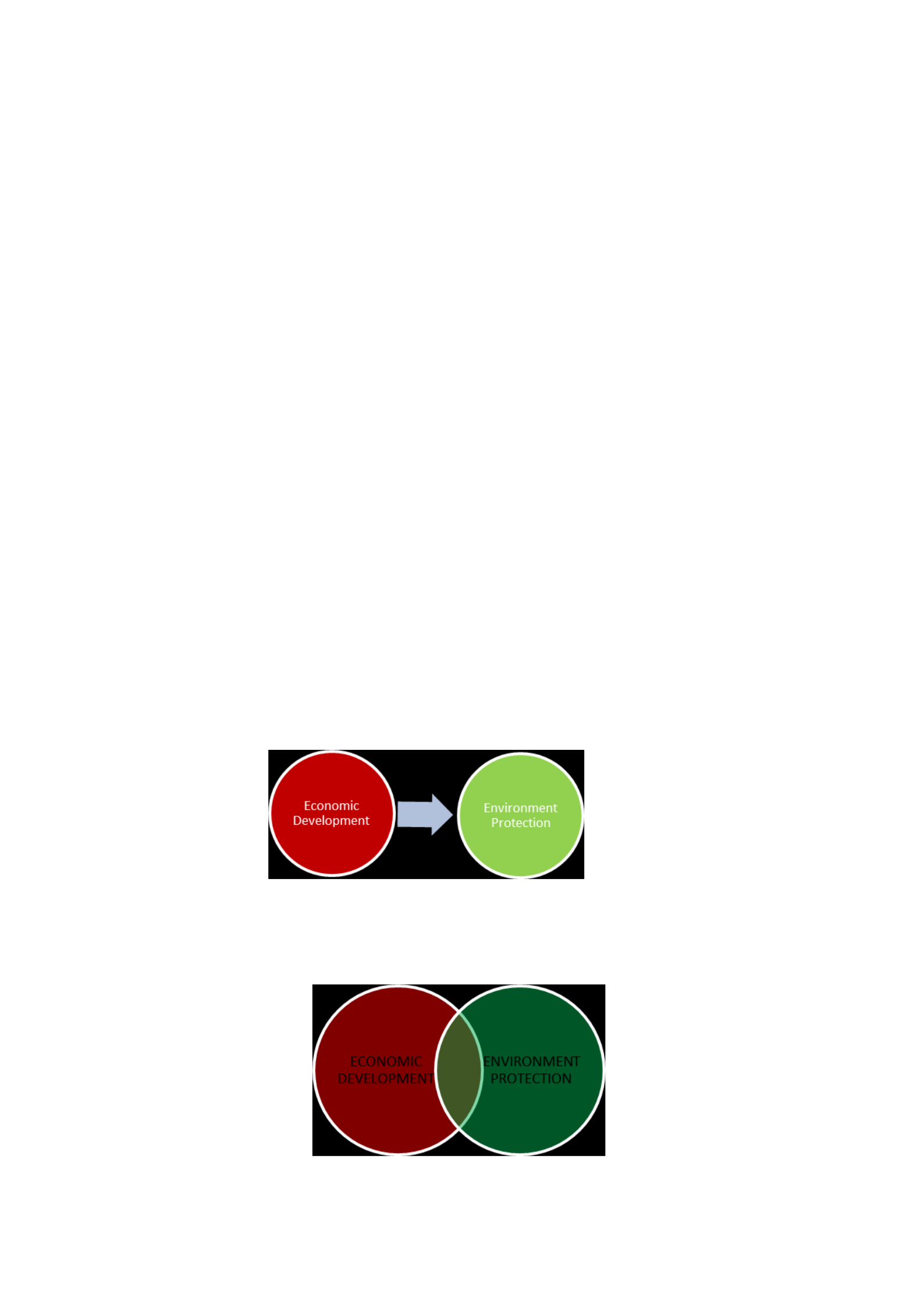
Ehrlich and his wife, Anne Ehrlich (who was not recognized), in 1968. The book
warned of mass human starvation in the 1970s and 1980s due to overpopulation, as
well as social upheaval, and advocated immediate action to limit population growth.
Fears of a widespread "population explosion" in the 1950s and 1960s.
In 1982, the Nairobi World Commission on Environment and Development. One of
the ongoing agendas of this UN meeting was to discuss environmental degradation,
deforestation, soil and water degradation, atmospheric changes - such as depletion of
the ozone layer, increasing concentrations of CO2 gas.
In 1987, the Brundtland report "Our Common Future" stated that sustainable
development is development that meets the needs of the present.
In 1992, the Rio United Nations World Conference on Environment and Development,
discussed the development of ecological sustainability, where at that time the
American President, Ronald Reagen, rejected the agenda because he considered
sustainable development not a solution to the problem, as well as the Australian Prime
Minister, namely John Howard. The countries that agreed to implement the agenda are
Canada, Japan, Europe, From these historical moments, a formulation of sustainable
development emerged, which initially was to pay attention to the needs of the present
and the future, economic development needs to pay attention to the environment or be
wiser and limit the excessive use of natural resources.
Sustainable development is development that meets current needs

Problem Solving to manage the current condition of urban development is SUSTAINABLE
DEVELOPMENT in an awareness of "our common future" by paying attention to
economic needs that pay attention to environmental protection.
Definition of Sustainable City
Based on the above understanding, a sustainable city is a city that has the ability, ability, and
wise thinking to think about current and future needs, and the city is able to support, support
the needs of living things in a system (cover in system), where the development of a
dynamic and significantly growing city certainly requires efficient and effective
management or planning. So that the city physically has a mental awareness to maintain
environmental balance and sustainability of life in it, so that in the end the city is expected to
be socially just and prosperous.
In an ecological context, sustainability is understood as the ability of ecosystems to maintain
and sustain ecological processes, functions, productivity, and diversity into the future
(Wardhono, 2012).
Sustainable cities are cities that are able to meet the needs of the present without ignoring
the needs of future generations, how to repair environmental destruction without sacrificing
the needs of economic development and social justice. The concept of sustainable cities was
launched by the United Nations in June 2012 at the Rio+20 The United Nations Conference
on Sustainable Development. The concept is planned to be disseminated to the world's urban
stakeholders who are responsible for policy-making, planning and implementation of urban
development. Cities that have the ability to drive future growth, but are also able to grow
more efficiently and environmentally friendly.
The concept of environmental balance, related to sustainable cities "ecocity", which is the
development of cities that currently require a type of development that not only pays
attention to the development of the economic side (without the financial and material), but
needs to pay attention to aspects of the development of the quality of human life in it
(Richard Register, 1987). Then in the Research Triangle Institute (1996) the City must be
able to have five basic principles in the concept of sustainability, namely: Environmental
(Ecology), Economy (Employment), Society (Equity), Engagement and Energy. In its
application, the five elements must be able to run simultaneously, development inequality
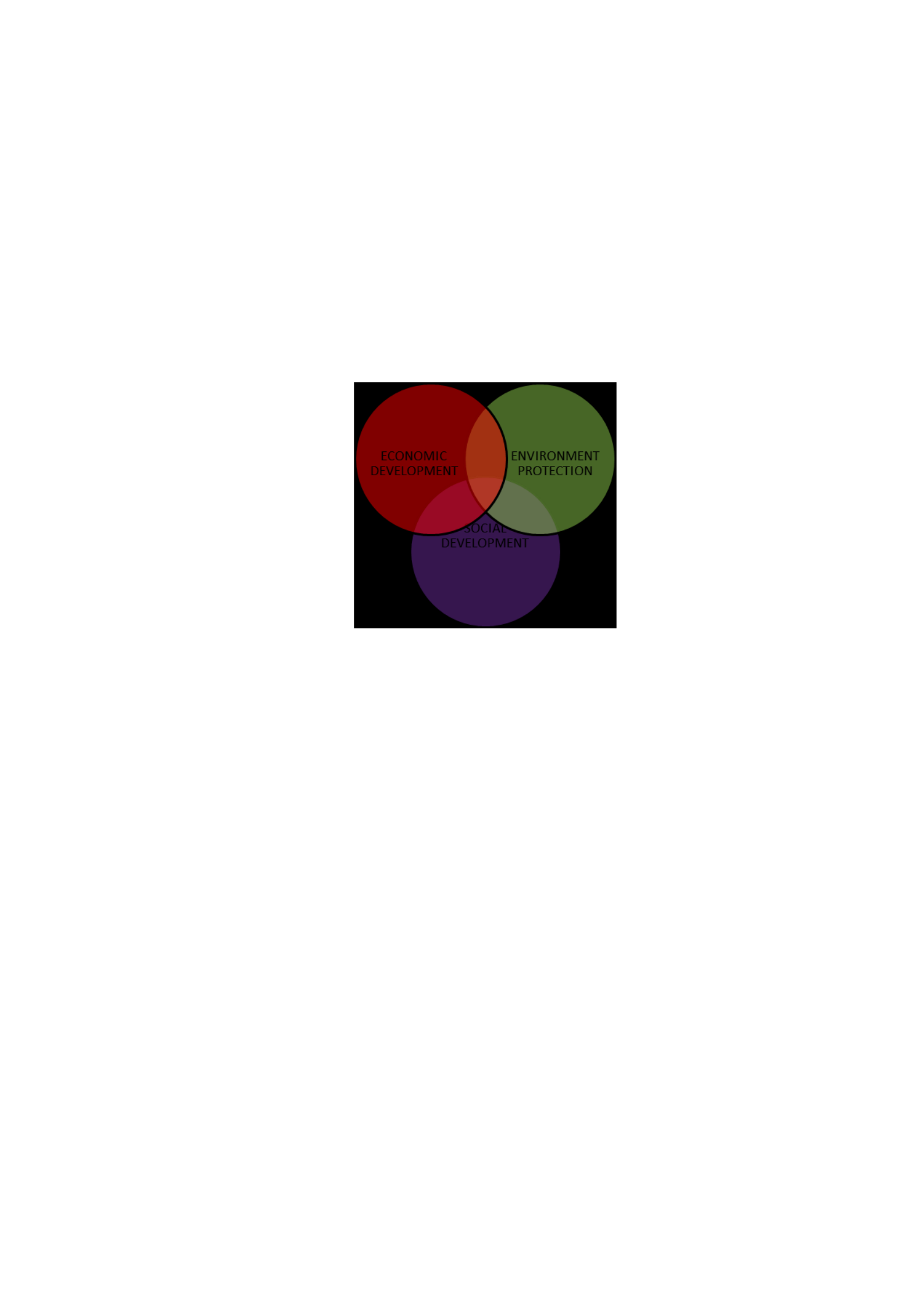
will occur if the development of each element is uneven (Budihardjo and Sujarto, 1999).
Furthermore, the concept of sustainable cities according to Rogers (1998), must recognize
that cities need to meet social, environmental, political and cultural as well as economic and
physical goals. Rogers elaborated by including these keywords, such a city also pays
attention to aspects of beauty in art and architecture, creativity to optimize human potential,
resource efficiency and minimal ecological impact, ease of contact, mobility, integrated and
compact communities and diversity.
"SIMULTAN"
Sustainable development needs to be implemented "SIMULTANEOUSLY"
Sustainable Urban Planning Strategies
Based on the above review, the consideration to protect the environmental conditions that
are decreasing in quality, and the population explosion, then automatically the needs of
human life increase. Therefore, to carry out a sustainable urban development strategy, which
is carried out "Simultaneously" by combining the 4 (four) dimensions, namely: planning
that considers "economic development, by protecting the environment", and paying attention
to "social development", and the need for "Government" management as a regulatory
function and providing infrastructure.
Urban planning, of course, can never wait, because human affairs go on and their direction is
determined by the degree of planning. Realizing a real city that is sustainable is to open a
broad view that every city has housing, high-rise buildings, urban alleys, parks, people's
homes. We see how they live, how their children will become citizens and neighbors of their
children and generations. It is this view that gives direction to the city of the future, a city

that is comfortable to live in for every generation, serves human needs, and directs the
means to shape the urban environment.
Sustainable development in social capital can grow at the individual, family, community,
local community, society in a region, national, and even global levels. Community-level
social capital cannot be measured simply as an aggregation of individual networks. Strong
community-level social capital creates a "civic infrastructure" that will support formal and
informal decision-making processes and public engagement (Potapchuck et.al. 1997).
Individual social capital is closely related to human capital. When individuals invest in
being able to communicate well, they increase their social capital but reduce the social
capital of the community. Determinants of social capital can also include economic and
political instability, patron-client relationships, education, occupation, collective interest and
market legitimization of common values. Social capital can lower the costs of cooperation
and facilitate cooperation. To build social capital effectively, local governments must share
autonomy/roles with their communities, in the sense that they must shift from being
controllers, regulators and providers, to catalysts, conveners and facilitators (Crocker et al.
1998).
The issue of weak state capacity in developing countries, characterized by the inability to
carry out development, has become a hot topic discussed by experts. Theories of
government failure characterized by a "top-down" approach, as well as social capital theory
characterized by a "bottom-up" approach, both provide a framework that underlies the basic
framework for identifying the symptoms of "state incapacity" (Sallis and Dollery, 2001).
The government's role in implementing sustainable urban development is to have a
sustainable-minded leadership spirit so that the dynamic development of the city can be
managed effectively without incurring large costs.
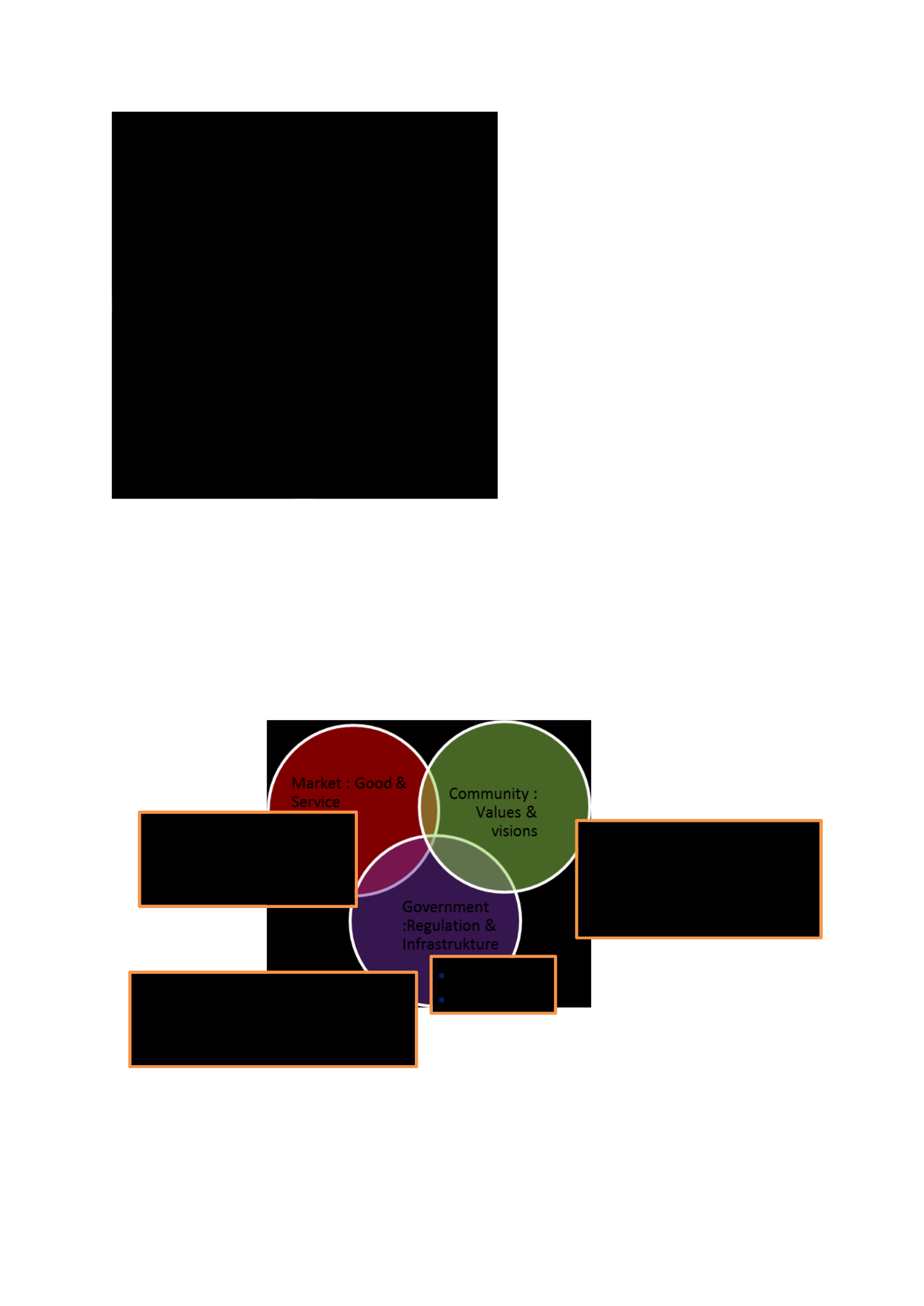
Time regulation:
Short-term Development:
INFRASTRUCTURE (time prime 10
years. MARKET (time prime 6 years)
LEADERSHIP
INNOVATION
In the direction of the
Community: Long term, it can
help and encourage the
community to improve their
quality of life.
The market has "POWER"
and for the Commitment to
be SUSTAINABLE then
Awareness required
Sustainable City Development Concept in 4 (four) Sectoral Dimensions
One of the strategies for sustainable urban development is that the government as a
development manager must have leadership, and innovation. The development program has
the concept of short term and long term development, both concepts support each other in
order to achieve a vision of sustainable urban development.
Sustainable Urban Development Strategy
"SUSTAINABLE"
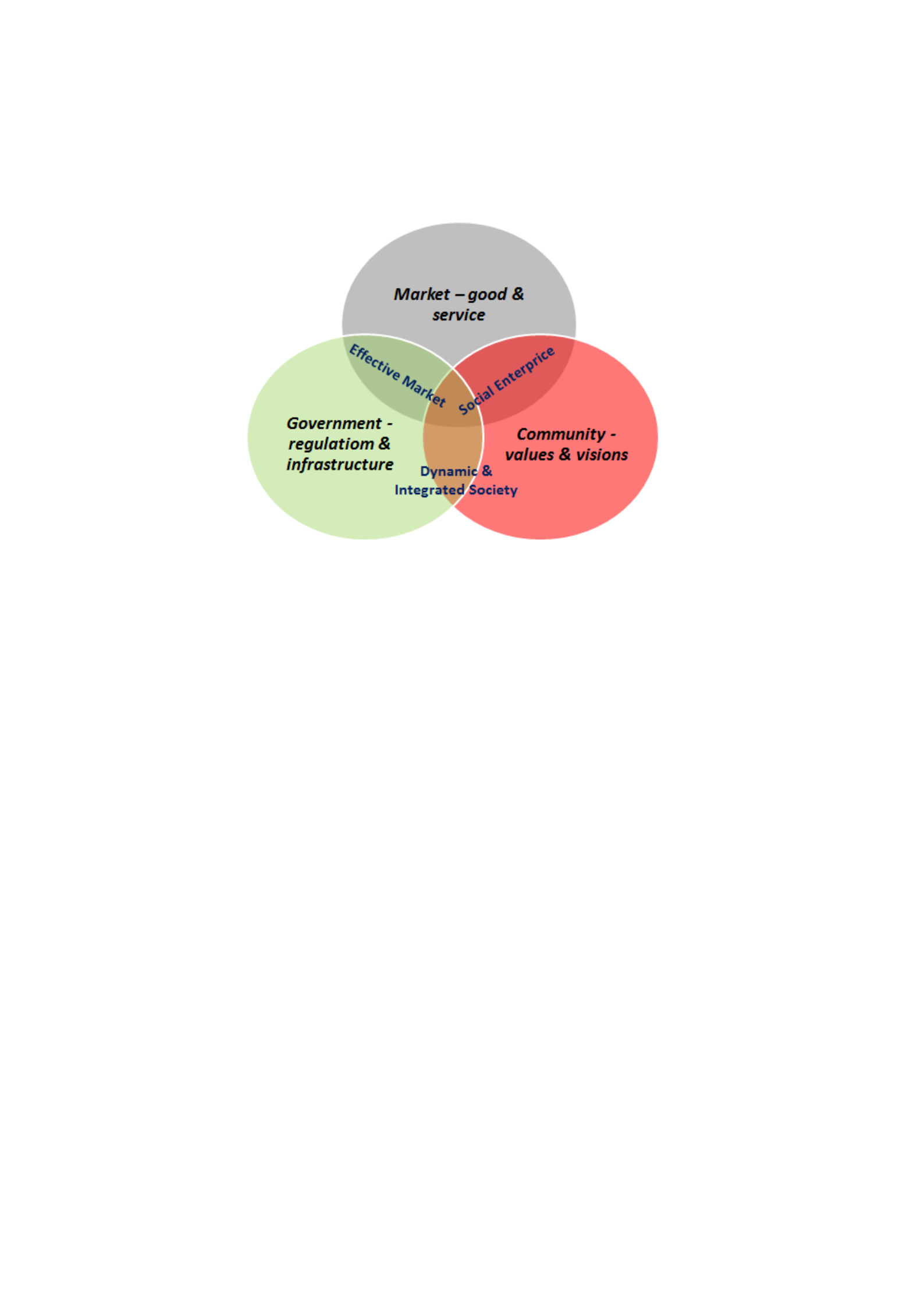
One example of an innovative leader is being able to make sustainable city breakthroughs
such as Cities with Solar panels, Cities with Smart City, and movements to change the urban
environment to be more environmentally friendly.
Figure 8. Sectoral dimensions that simultaneously produce something that is Integrity
The above principle illustrates a sectoral dimension, namely social, economic, and
environmental, into a development that cooperates with each other to maintain balance, it
will produce an effective market regulation, and social enterprice economic development
with attention to the environment will produce a good social community value as well. The
principle of sustainable development is one example:
Settlement: sustainable urban development recognizes the earth can only
adjust to a more balanced state if settlements "reduce their ecological
footprint" while they "simultaneously" improve their quality of life. In this
case, reducing the "ecological" footprint means reducing the use of materials
and energy that produce excessive CO2), while simultaneously it means
paying attention to providing healthy settlements, providing jobs, and
designing with social communities in mind.
Place-making: sustainability that recognizes the significance and diversity of
communities and regions for earth stewardship (cultured buildings,
landscaping, sculpture, and attention to biodiversity for future generations).
Net-Benefit: Sustainability that addresses the extraction of non-renewable
resources, providing net environmental social and economic benefits for
future generations. Reduce the impact and maintain the environmental

sustainability of irresponsible agencies.
The principles and enforcement of sustainable cities are expected to pay more attention to
humanity, more humane. Returning to the essence of the city itself is formed from human
needs. The relationship between the city, formed from humans and the environment, related
to the city is a system that cannot be separated from spatial planning, why because cities are
formed as a result of natural processes and social processes, human activities as creatures
that utilize natural resources also have tendencies that are patterned and spatially structured.
According to Rustiadi, et al (2011), human spatial instincts are natural and the result of long
"learning" experiences, so that they get typical spatial patterns, for example in the layout of
residential houses, public spaces (gathering places), yards, fields, rice fields, and so on. The
regularity of the spatial configuration of the community's socio-economic activities or
patterns of space utilization are always found in every community's economy or patterns of
space utilization are always found in every community's life in maintaining its life, adjusting
to the environment, optimizing efforts to utilize natural resources, optimizing social
interactions, as well as forms of cultural expression. The interaction between humans and
the environment requires humans to provide various infrastructure to facilitate access and
manage these resources.
The philosophy of sustainable urban planning is to meet the needs of society, the needs of
generations, and the needs of the economy, which is socially just where the goal is to
prevent unwanted changes, create balance and sustainable development. The beginning of
the process of sustainable urban planning starts with the need to make changes for the better
(welfare, natural disasters, social development, etc.).
Some Countries That Implement Sustainable Urban Development
Learning from other countries, about how to build a vision of a sustainable city and how to
implement it, certainly adds insight into managing a city, even though the cases and
problems are different. Consistency to build a sustainable city vision starts from the
creativity of a leader and building awareness of its citizens. The following is an explanation
of the table below:

Table 3. Countries in the Vision of a Sustainable City
STATE
CITY DESCRIPTION
Singapore
As a small and densely populated island nation with no natural resources,
Singapore's own sustainable development experience has focused on four
key areas, namely, (1) Building a sustainable economy; (2) creating a
sustainable living environment; (3) ensuring sustainable development for
our people; and (4) contributing to international collaboration.
•
Singapore is the 20th most carbon-efficient country in the world
•
Integrated transportation, MRT, BUS., pedestrian way
•
Since the 1970s, economic development has helped lift billions of people
out of poverty. Social indices of human development such as health and
education have improved significantly.
•
Despite not having natural resources, Singapore manages its human
resources more carefully.
•
Singapore plans to introduce a carbon tax from 2019, so those who emit
the most carbon will bear the cost to our environment and be encouraged to
reduce their emissions.
•
Give prizes to residents whose houses are energy efficient, tax discounts

•
A generation of pioneers, with a vision for a clean, green and sustainable
Singapore for all Singaporeans. Instilling the awareness that this little
island is all we have, and we must take good care of it.
•
Over the past 50 years, saw major improvements in housing, water, public
health and sanitation. Provides a City in Parks with about 47 percent green
cover in Singapore. More than 80 percent of households are within a 10-
minute walk of a park.
•
It has 72 hectares of green roof gardens and walls today, and aims to
double that by 2030.
Curitiba,
Brazil
•
Curitiba, is the world's first sustainable city. In 1971, architect Jaime
Lerner was elected mayor for the first of three terms, and came up with
innovative and creative solutions that saw Curitiba undergo a remarkable
evolution.
•
The greenest city, with more than 50 M2 of green space per capita, much
more than the UN recommendation. The reason why there is so much green
space is that Lerner had to find a solution to the frequent flooding that
occurred due to the geographical position of the city, so Lerner created a
large green belt around the city, which has turned into a large habitat for
many plants and animals. These large green areas are maintained by sheep
and goats and the wool they produce is sold to finance social development
in the city.
•
About 60% of people rely on the bus network in the city, efficiency for the
light rail system with dedicated lanes.
•
The city of Curitiba is a wonderful example of what creative leaders dare
and do, to make a city truly serve its residents rather than create stress,
congestion and inequality among its residents.
•
Implement a simple Bus transportation system, by dividing 5 arterial traffic
roads.
•
There are 28 parks and forest areas in Curitiba, creating an urban landscape
unlike any other developing city. The city's parks are designed to be
connected rather than isolated to maximize usage. The park was designed
by Hitoshi Nakamura.
•
The parks also stop squatters from creating shanty towns in flood-prone

zones.
•
Curitiba has 4 times the recommended green space, using sheep to "mow"
some of the grass in the parks.
By examining two countries, namely: Singapore and Curitiba, it is expected to increase
knowledge about "sustainable cities", where sustainable development focuses on human
resources, social justice, creating spatial equality.
Conclusions
Based on the sources of sustainable city references, it can be concluded that a sustainable
city is a city that is able to meet the NEEDS of the present without ignoring the NEEDS of
future GENERATIONS, how to REPAIR ENVIRONMENTAL DAMAGE without
sacrificing the NEEDS of ECONOMIC DEVELOPMENT and SOCIAL JUSTICE.
Building a sustainable city also takes into account 4 dimensions, namely SOCIAL
DIMENSION, ECONOMIC DIMENSION, ENVIRONMENTAL DIMENSION, and

GOVERNMENT DIMENSION. These four things Side by side, the success of sustainable
development does not only depend on the economic dimension but needs the intervention of
the power holder or in this case the government dimension, in order to implement
sustainable development so as to achieve equitable distribution of welfare. Therefore,
sustainable development is oriented towards the development of Green Cities that have a
good quality of life and conducive environmental conditions.
Problems
Urban growth is a complex phenomenon, partly spontaneous and partly planned. There have
been several attempts to manage that complexity. Ideas such as building sustainable cities,
resulting in better urban environments that meet people's needs, have fewer socio-economic
costs, and use less nature.
Based on the explanation above, the problem about the city is that when some of the cities
develop spontaneously (sprawl), the population increases, the development of urban areas
and land clearing occurs which changes the function of productive areas of paddy land into
new residential / residential areas, forest conversion into agricultural / plantation land.
Furthermore, the urbanization process also creates socio-economic problems for cities,
forming slum areas that have low income in the city, resulting in crime in urban spaces.
These problems represent urban development that does not take into account the quality of
human life. The congestion of cities such as Jakarta and other large cities, due to poorly
integrated public transportation systems. The earth's temperature is getting hotter due to
CO2 emissions from various human activities on earth such as motor gas air pollution,
greenhouse effect, building materials, and flooding in urban areas, and so on.
Based on the problems mentioned above, the world's cities consume three-quarters of the
world's energy and cause three-quarters of global pollution and cities have become parasitic
ehuge organisms that can drain the earth for food due to excessive energy consumption:
relentless consumers, relentless polluters. So that over time the city system becomes
unstable, resilience and capacity are not high enough, and it is likely that the city will
collapse (colappse). With the phenomena of environmental degradation and rising
temperatures, humans are no longer comfortable in their habitats (Roger, 1998 and Egger
2006).

Cities are the drivers of future growth, but also the biggest contributors to CO2 emissions.
So that a concept that pays attention to environmental balance is needed, namely the concept
of sustainable development. The concept of sustainable development has been widely
developed into the theoretical foundations of sustainable cities. City references and
applicative applications of sustainable urban development are easy to find, both in various
methods and paradigms. The dream of an ideal future city concept in the book "Garden City
of to-morrow" written by Ebenezer Howard (1898), invited controversy, became utopias,
considered irrelevant, unreasonable, and due to this irrelevance, the concept of Garden City
of to-morrow Ebenezer Howard is not widely used, only natural and natural concepts are
widely taken by urban planners, the rest is just a historical record. Twentieth-century urban
planners had a variety of new concepts in planning their cities from the initial idea of a
dream of a sustainable city that had become our common future.
Objectives and Benefits
Based on the above background and problems, the author sees the need to conduct a
theoretical study to better understand the concept of sustainable development in the four
dimensions of sustainable development, namely environmental, social, and economic, and
government. about the meaning and scope as a source of knowledge for the community
(students, academics, and practitioners) while strengthening the body knowledge of
architecture. The results of this paper are expected to be able to provide a deeper
understanding for students, and practitioners, to understand architecture and cities, becoming
a provision in the practice of architecture and planning science.
Writing Method
This research is a literature research to explore the understanding, meaning and scope of the
concept of a sustainable city. Various thoughts about the concept of a sustainable city can be
used as supporting data in this writing. The search for data and information through
documents, both in the form of written documents, photographs, images, and electronic
documents that can support the research process. Research results will also be more credible
if supported by photographs or existing academic and artistic papers (Sugiyono, 2005: 83).
Therefore, literature study can affect the credibility of the results of the research conducted.
Sustainable Cities And Their Development

Cities and their Development
Before understanding more about sustainable cities, it is necessary to know what the
definition of a city, its equivalents, differences, and scale are.
When the philosophy of science developed towards modern thinking. Humanist thinking
was influenced by the views of Karl Marx, Immanuel Kant, and Max Weber, the most
influential of whom was the Spirit of Capitalism (1905). So the city is a place where most of
its economic needs are in the local market, the characteristics of the city are the existence of
a market as a fortress and has a legal system and is cosmopolitan. When the city develops, as
a place to live, a place to produce goods and services, the scale of services develops, there is
a concentration of population, with high density. A small city to a megacity is said to have a
population of 20,000 to 5,000,000.
There are three opinions, namely; Max Weber (1905), Hamilton (2001), Steve Egger (2006),
defining the city basically is to accommodate human needs, community needs, and
economic needs. If we go back to Maslow's (1943) theory in "The Theory Of Human
Motivation" about the Hierarchy of human needs, namely basic needs are elements needed
by humans in maintaining balance both physiologically and psychologically which aims to
maintain life and health. Hierarchy (1) Physiological Needs or Faal Needs (physiological
needs): the right to get oxygen, food, sleep (human self-activity), (2) Safety, security needs:
Protection, (3) Love needs (social needs): social interaction life, (4) Esteem needs EGO
ownership (esteem needs), and (5) Self-actualization (self- actualization needs): recognition
appreciated, social status.
Cities are formed from human needs, to serve (Hamilton, 2001) from the hierarchy of human
needs, spatial formation of community expression (Steve Egger, 2006) makes the city
formed in a network or a system of community expression. As a result of such a system,
cities require management, governance, trade, culture, education, and society, to facilitate an
environment for human existence and interaction (Egger, 2006).
From the various opinions above, it can be concluded that the realization of the city is to
accommodate human needs, and when the city is growing dynamically, the city becomes a
network that is intertwined in a unified system, so that a city requires serious management
based on the scale of services, if not managed, social, economic, and environmental

problems then the city experiences collapse and crisis. A good city is one that responds to
the various problems that occur in the city, and thinks about survival and sustainability.
Sustainability
The definition of sustainability (continue) according to the Big United States Dictionary
(KBBI) is sustainable; and continuously. "Sustain": (1) strengthen or support physically or
mentally, (2) undergo or suffer (something unpleasant, especially an injury), (3) uphold,
affirm, or confirm the justice or validity of, in United States translation "sustain" is
menopang. The definition of sustain here is being able to endure, sustain, support, sustain,
experience, continue, suffer, prolong, and enable. As for the translation of "ability": (1)
possession of the means or skill to do something, (2) talent, skill, or proficiency in a
particular area, in United States translation is ability, capability, talent, ability, proficiency,
cleverness, wisdom, shrewdness, and dexterity.
Sustainable Cities
History of Sustainable Urban Development
To understand what "sustainability" is, and why there is an agreement on sustainable
development. It is therefore necessary to trace a history of the birth of the idea of sustainable
urban development.
In 1972, the Stockholm UN World Conference on Human Environment: UN
Conference on Human Environment (June 5-6, 1972): the focus was on discussing
guidelines and actions in dealing with environmental problems, such as alleviating
poverty, and protecting the environment.
Paul Ehrlich, a Stanford University Professor of Biology, who wrote a book titled
"Population Bomb": was a bestseller written by Stanford University Professor Paul R.
Ehrlich and his wife, Anne Ehrlich (who was not recognized), in 1968. The book
warned of mass human starvation in the 1970s and 1980s due to overpopulation, as
well as social upheaval, and advocated immediate action to limit population growth.
Fears of a widespread "population explosion" in the 1950s and 1960s.
In 1982, the Nairobi World Commission on Environment and Development. One of
the ongoing agendas of this UN meeting was to discuss environmental degradation,
deforestation, soil and water degradation, atmospheric changes - such as depletion of
the ozone layer, increasing concentrations of CO2 gas.
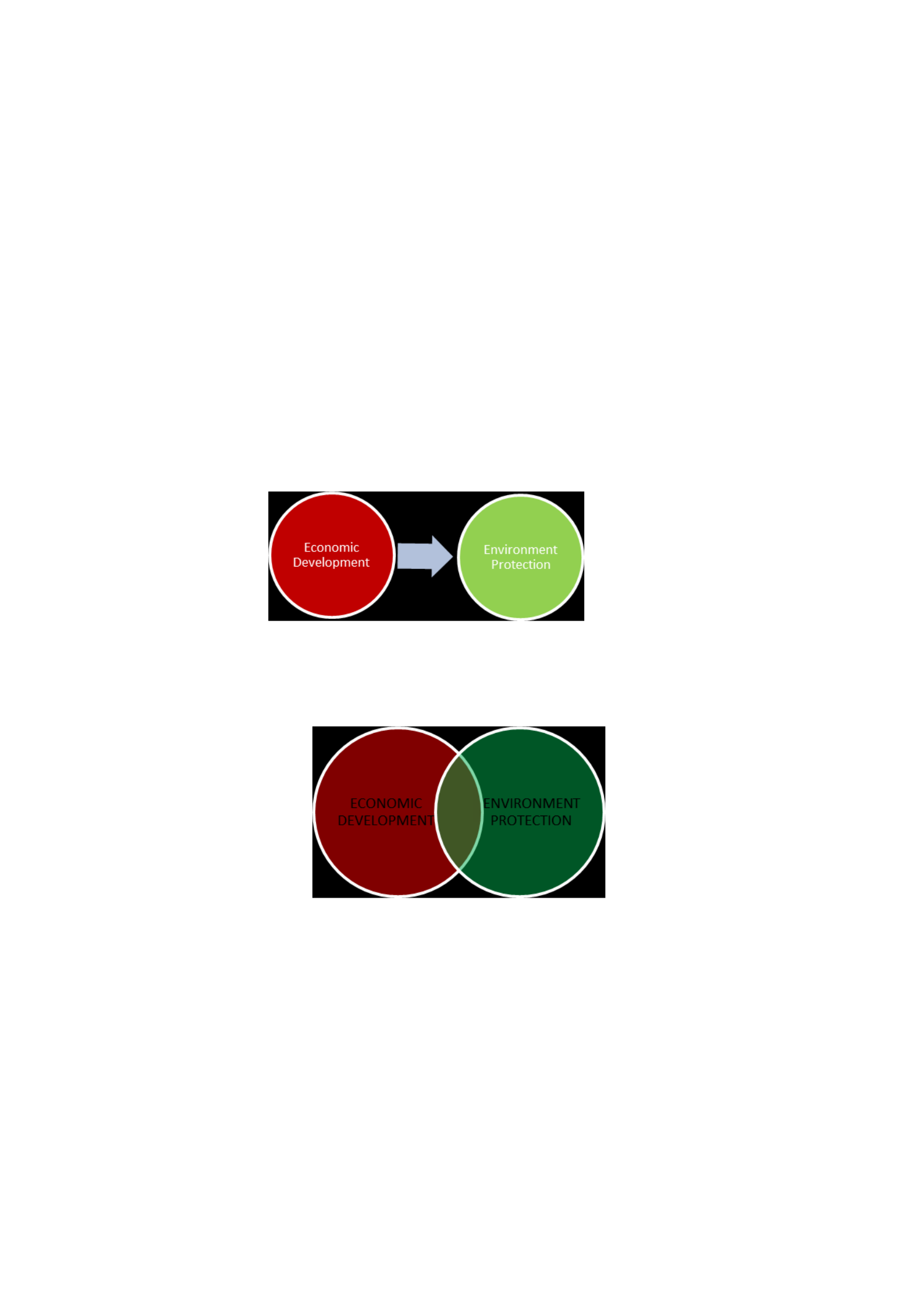
In 1987, the Brundtland report "Our Common Future" stated that sustainable
development is development that meets the needs of the present.
In 1992, the Rio United Nations World Conference on Environment and Development,
discussed the development of ecological sustainability, where at that time the
American President, Ronald Reagen, rejected the agenda because he considered
sustainable development not a solution to the problem, as well as the Australian Prime
Minister, namely John Howard. The countries that agreed to implement the agenda are
Canada, Japan, Europe, From these historical moments, a formulation of sustainable
development emerged, which initially was to pay attention to the needs of the present
and the future, economic development needs to pay attention to the environment or be
wiser and limit the excessive use of natural resources.
Sustainable development is development that meets current needs
Problem Solving to manage the current condition of urban development is SUSTAINABLE
DEVELOPMENT in an awareness of "our common future" by paying attention to
economic needs that pay attention to environmental protection.
Definition of Sustainable City
Based on the above understanding, a sustainable city is a city that has the ability, ability, and
wise thinking to think about current and future needs, and the city is able to support, support
the needs of living things in a system (cover in system), where the development of a

dynamic and significantly growing city certainly requires efficient and effective
management or planning. So that the city physically has a mental awareness to maintain
environmental balance and sustainability of life in it, so that in the end the city is expected to
be socially just and prosperous.
In an ecological context, sustainability is understood as the ability of ecosystems to maintain
and sustain ecological processes, functions, productivity, and diversity into the future
(Wardhono, 2012).
Sustainable cities are cities that are able to meet the needs of the present without ignoring
the needs of future generations, how to repair environmental destruction without sacrificing
the needs of economic development and social justice. The concept of sustainable cities was
launched by the United Nations in June 2012 at the Rio+20 The United Nations Conference
on Sustainable Development. The concept is planned to be disseminated to the world's urban
stakeholders who are responsible for policy-making, planning and implementation of urban
development. Cities that have the ability to drive future growth, but are also able to grow
more efficiently and environmentally friendly.
The concept of environmental balance, related to sustainable cities "ecocity", which is the
development of cities that currently require a type of development that not only pays
attention to the development of the economic side (without the financial and material), but
needs to pay attention to aspects of the development of the quality of human life in it
(Richard Register, 1987). Then in the Research Triangle Institute (1996) the City must be
able to have five basic principles in the concept of sustainability, namely: Environmental
(Ecology), Economy (Employment), Society (Equity), Engagement and Energy. In its
application, the five elements must be able to run simultaneously, development inequality
will occur if the development of each element is uneven (Budihardjo and Sujarto, 1999).
Furthermore, the concept of sustainable cities according to Rogers (1998), must recognize
that cities need to meet social, environmental, political and cultural as well as economic and
physical goals. Rogers elaborated by including these keywords, such a city also pays
attention to aspects of beauty in art and architecture, creativity to optimize human potential,
resource efficiency and minimal ecological impact, ease of contact, mobility, integrated and
compact communities and diversity.
"SIMULTAN"
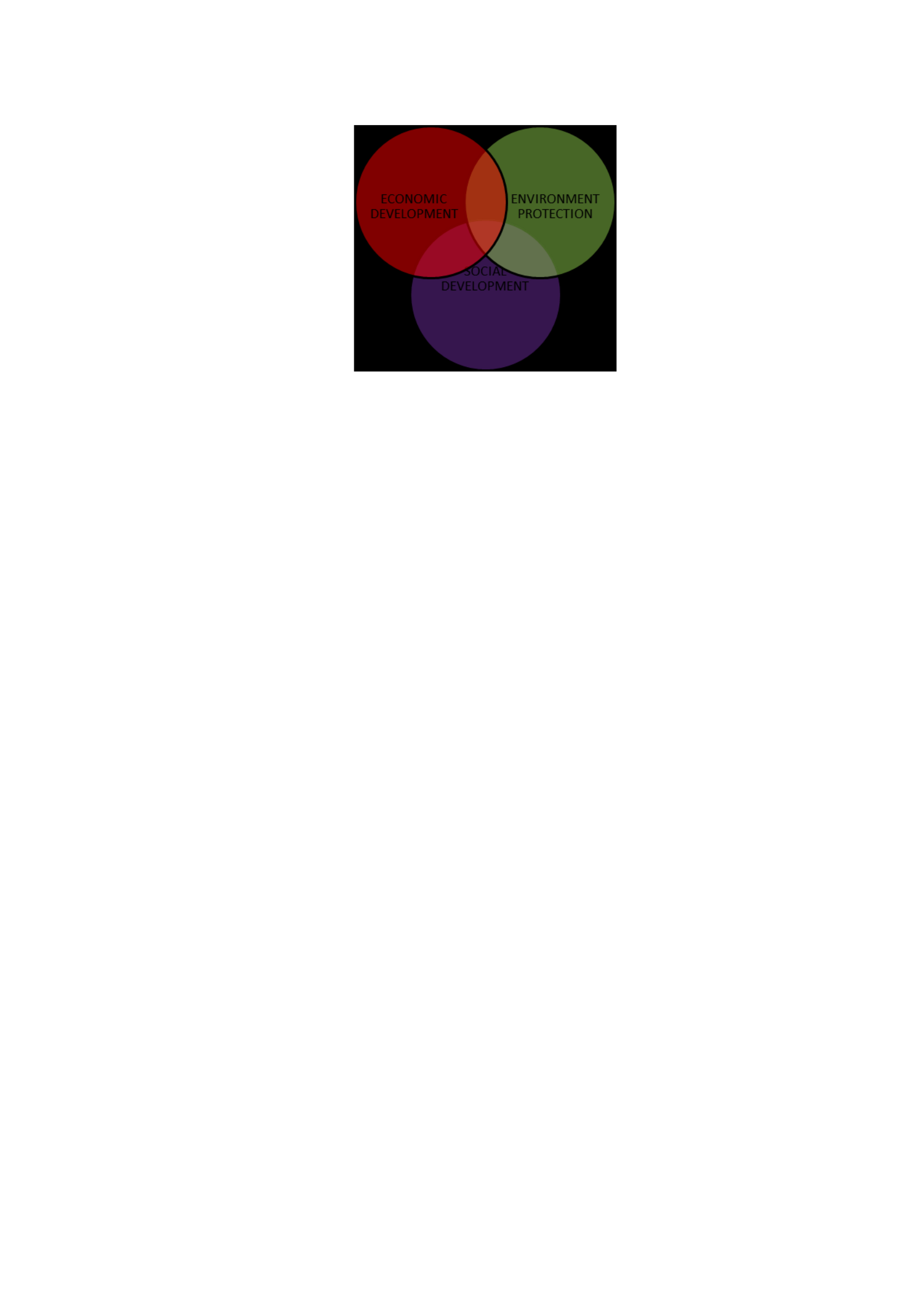
Sustainable development needs to be implemented "SIMULTANEOUSLY"
Sustainable Urban Planning Strategies
Based on the above review, the consideration to protect the environmental conditions that
are decreasing in quality, and the population explosion, then automatically the needs of
human life increase. Therefore, to carry out a sustainable urban development strategy, which
is carried out "Simultaneously" by combining the 4 (four) dimensions, namely: planning
that considers "economic development, by protecting the environment", and paying attention
to "social development", and the need for "Government" management as a regulatory
function and providing infrastructure.
Urban planning, of course, can never wait, because human affairs go on and their direction is
determined by the degree of planning. Realizing a real city that is sustainable is to open a
broad view that every city has housing, high-rise buildings, urban alleys, parks, people's
homes. We see how they live, how their children will become citizens and neighbors of their
children and generations. It is this view that gives direction to the city of the future, a city
that is comfortable to live in for every generation, serves human needs, and directs the
means to shape the urban environment.
Sustainable development in social capital can grow at the individual, family, community,
local community, society in a region, national, and even global levels. Community-level
social capital cannot be measured simply as an aggregation of individual networks. Strong
community-level social capital creates a "civic infrastructure" that will support formal and
informal decision-making processes and public engagement (Potapchuck et.al. 1997).

Individual social capital is closely related to human capital. When individuals invest in
being able to communicate well, they increase their social capital but reduce the social
capital of the community. Determinants of social capital can also include economic and
political instability, patron-client relationships, education, occupation, collective interest and
market legitimization of common values. Social capital can lower the costs of cooperation
and facilitate cooperation. To build social capital effectively, local governments must share
autonomy/roles with their communities, in the sense that they must shift from being
controllers, regulators and providers, to catalysts, conveners and facilitators (Crocker et al.
1998).
The issue of weak state capacity in developing countries, characterized by the inability to
carry out development, has become a hot topic discussed by experts. Theories of
government failure characterized by a "top-down" approach, as well as social capital theory
characterized by a "bottom-up" approach, both provide a framework that underlies the basic
framework for identifying the symptoms of "state incapacity" (Sallis and Dollery, 2001).
The government's role in implementing sustainable urban development is to have a
sustainable-minded leadership spirit so that the dynamic development of the city can be
managed effectively without incurring large costs.
Sustainable City Development Concept in 4 (four) Sectoral Dimensions
"SUSTAINABLE"
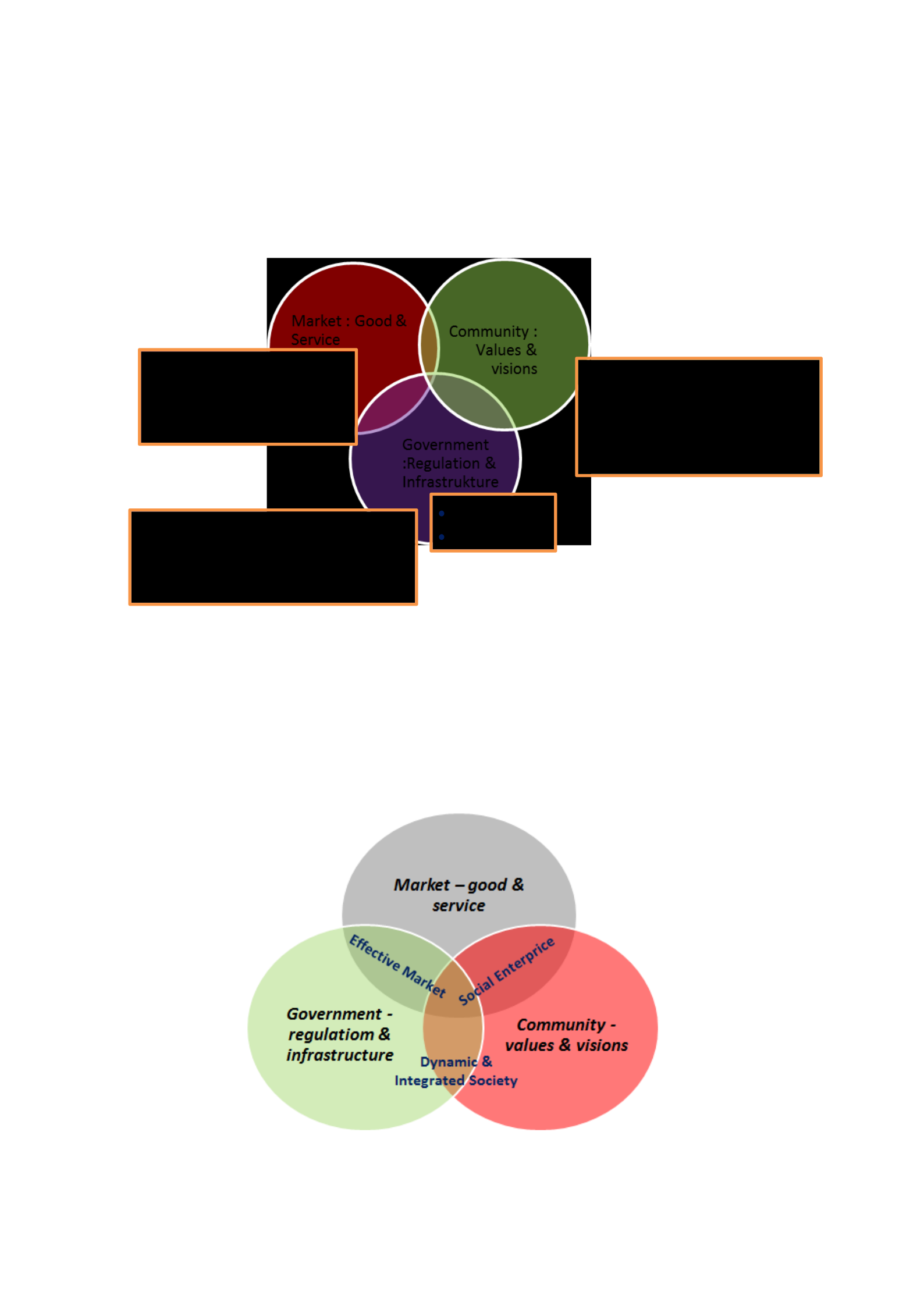
Time regulation:
Short-term Development:
INFRASTRUCTURE (time prime 10
years. MARKET (time prime 6 years)
LEADERSHIP
INNOVATION
In the direction of the
Community: Long term, it can
help and encourage the
community to improve their
quality of life.
The market has "POWER"
and for the Commitment to
be SUSTAINABLE then
Awareness required
One of the strategies for sustainable urban development is that the government as a
development manager must have leadership, and innovation. The development program has
the concept of short term and long term development, both concepts support each other in
order to achieve a vision of sustainable urban development.
Sustainable Urban Development Strategy
One example of an innovative leader is being able to make sustainable city breakthroughs
such as Cities with Solar panels, Cities with Smart City, and movements to change the urban
environment to be more environmentally friendly.
Figure 8. Sectoral dimensions that simultaneously produce something that is Integrity

The above principle illustrates a sectoral dimension, namely social, economic, and
environmental, into a development that cooperates with each other to maintain balance, it
will produce an effective market regulation, and social enterprice economic development
with attention to the environment will produce a good social community value as well. The
principle of sustainable development is one example:
Settlement: sustainable urban development recognizes the earth can only
adjust to a more balanced state if settlements "reduce their ecological
footprint" while they "simultaneously" improve their quality of life. In this
case, reducing the "ecological" footprint means reducing the use of materials
and energy that produce excessive CO2), while simultaneously it means
paying attention to providing healthy settlements, providing jobs, and
designing with social communities in mind.
Place-making: sustainability that recognizes the significance and diversity of
communities and regions for earth stewardship (cultured buildings,
landscaping, sculpture, and attention to biodiversity for future generations).
Net-Benefit: Sustainability that addresses the extraction of non-renewable
resources, providing net environmental social and economic benefits for
future generations. Reduce the impact and maintain the environmental
sustainability of irresponsible agencies.
The principles and enforcement of sustainable cities are expected to pay more attention to
humanity, more humane. Returning to the essence of the city itself is formed from human
needs. The relationship between the city, formed from humans and the environment, related
to the city is a system that cannot be separated from spatial planning, why because cities are
formed as a result of natural processes and social processes, human activities as creatures
that utilize natural resources also have tendencies that are patterned and spatially structured.
According to Rustiadi, et al (2011), human spatial instincts are natural and the result of long
"learning" experiences, so that they get typical spatial patterns, for example in the layout of
residential houses, public spaces (gathering places), yards, fields, rice fields, and so on. The
regularity of the spatial configuration of the community's socio-economic activities or
patterns of space utilization are always found in every community's economy or patterns of
space utilization are always found in every community's life in maintaining its life, adjusting
to the environment, optimizing efforts to utilize natural resources, optimizing social

interactions, as well as forms of cultural expression. The interaction between humans and
the environment requires humans to provide various infrastructure to facilitate access and
manage these resources.
The philosophy of sustainable urban planning is to meet the needs of society, the needs of
generations, and the needs of the economy, which is socially just where the goal is to
prevent unwanted changes, create balance and sustainable development. The beginning of
the process of sustainable urban planning starts with the need to make changes for the better
(welfare, natural disasters, social development, etc.).
Some Countries That Implement Sustainable Urban Development
Learning from other countries, about how to build a vision of a sustainable city and how to
implement it, certainly adds insight into managing a city, even though the cases and
problems are different. Consistency to build a sustainable city vision starts from the
creativity of a leader and building awareness of its citizens. The following is an explanation
of the table below:
Table 3. Countries in the Vision of a Sustainable City

STATE
CITY DESCRIPTION
Singapore
As a small and densely populated island nation with no natural resources,
Singapore's own sustainable development experience has focused on four
key areas, namely, (1) Building a sustainable economy; (2) creating a
sustainable living environment; (3) ensuring sustainable development for
our people; and (4) contributing to international collaboration.
•
Singapore is the 20th most carbon-efficient country in the world
•
Integrated transportation, MRT, BUS., pedestrian way
•
Since the 1970s, economic development has helped lift billions of people
out of poverty. Social indices of human development such as health and
education have improved significantly.
•
Despite not having natural resources, Singapore manages its human
resources more carefully.
•
Singapore plans to introduce a carbon tax from 2019, so those who emit
the most carbon will bear the cost to our environment and be encouraged to
reduce their emissions.
•
Give prizes to residents whose houses are energy efficient, tax discounts
•
A generation of pioneers, with a vision for a clean, green and sustainable
Singapore for all Singaporeans. Instilling the awareness that this little
island is all we have, and we must take good care of it.
•
Over the past 50 years, saw major improvements in housing, water, public
health and sanitation. Provides a City in Parks with about 47 percent green
cover in Singapore. More than 80 percent of households are within a 10-
minute walk of a park.
•
It has 72 hectares of green roof gardens and walls today, and aims to
double that by 2030.

Curitiba,
Brazil
•
Curitiba, is the world's first sustainable city. In 1971, architect Jaime
Lerner was elected mayor for the first of three terms, and came up with
innovative and creative solutions that saw Curitiba undergo a remarkable
evolution.
•
The greenest city, with more than 50 M2 of green space per capita, much
more than the UN recommendation. The reason why there is so much green
space is that Lerner had to find a solution to the frequent flooding that
occurred due to the geographical position of the city, so Lerner created a
large green belt around the city, which has turned into a large habitat for
many plants and animals. These large green areas are maintained by sheep
and goats and the wool they produce is sold to finance social development
in the city.
•
About 60% of people rely on the bus network in the city, efficiency for the
light rail system with dedicated lanes.
•
The city of Curitiba is a wonderful example of what creative leaders dare
and do, to make a city truly serve its residents rather than create stress,
congestion and inequality among its residents.
•
Implement a simple Bus transportation system, by dividing 5 arterial traffic
roads.
•
There are 28 parks and forest areas in Curitiba, creating an urban landscape
unlike any other developing city. The city's parks are designed to be
connected rather than isolated to maximize usage. The park was designed
by Hitoshi Nakamura.
•
The parks also stop squatters from creating shanty towns in flood-prone
zones.
•
Curitiba has 4 times the recommended green space, using sheep to "mow"
some of the grass in the parks.
By examining two countries, namely: Singapore and Curitiba, it is expected to increase
knowledge about "sustainable cities", where sustainable development focuses on human
resources, social justice, creating spatial equality.

Conclusions
Based on the sources of sustainable city references, it can be concluded that a sustainable
city is a city that is able to meet the NEEDS of the present without ignoring the NEEDS of
future GENERATIONS, how to REPAIR ENVIRONMENTAL DAMAGE without
sacrificing the NEEDS of ECONOMIC DEVELOPMENT and SOCIAL JUSTICE.
Building a sustainable city also takes into account 4 dimensions, namely SOCIAL
DIMENSION, ECONOMIC DIMENSION, ENVIRONMENTAL DIMENSION, and
GOVERNMENT DIMENSION. These four things Side by side, the success of sustainable
development does not only depend on the economic dimension but needs the intervention of
the power holder or in this case the government dimension, in order to implement
sustainable development so as to achieve equitable distribution of welfare. Therefore,
sustainable development is oriented towards the development of Green Cities that have a
good quality of life and conducive environmental conditions.
Problems
Urban growth is a complex phenomenon, partly spontaneous and partly planned. There have
been several attempts to manage that complexity. Ideas such as building sustainable cities,
resulting in better urban environments that meet people's needs, have fewer socio-economic
costs, and use less nature.
Based on the explanation above, the problem about the city is that when some of the cities
develop spontaneously (sprawl), the population increases, the development of urban areas
and land clearing occurs which changes the function of productive areas of paddy land into
new residential / residential areas, forest conversion into agricultural / plantation land.
Furthermore, the urbanization process also creates socio-economic problems for cities,
forming slum areas that have low income in the city, resulting in crime in urban spaces.
These problems represent urban development that does not take into account the quality of
human life. The congestion of cities such as Jakarta and other large cities, due to poorly
integrated public transportation systems. The earth's temperature is getting hotter due to
CO2 emissions from various human activities on earth such as motor gas air pollution,
greenhouse effect, building materials, and flooding in urban areas, and so on.

Based on the problems mentioned above, the world's cities consume three-quarters of the
world's energy and cause three-quarters of global pollution and cities have become parasitic
ehuge organisms that can drain the earth for food due to excessive energy consumption:
relentless consumers, relentless polluters. So that over time the city system becomes
unstable, resilience and capacity are not high enough, and it is likely that the city will
collapse (colappse). With the phenomena of environmental degradation and rising
temperatures, humans are no longer comfortable in their habitats (Roger, 1998 and Egger
2006).
Cities are the drivers of future growth, but also the biggest contributors to CO2 emissions.
So that a concept that pays attention to environmental balance is needed, namely the concept
of sustainable development. The concept of sustainable development has been widely
developed into the theoretical foundations of sustainable cities. City references and
applicative applications of sustainable urban development are easy to find, both in various
methods and paradigms. The dream of an ideal future city concept in the book "Garden City
of to-morrow" written by Ebenezer Howard (1898), invited controversy, became utopias,
considered irrelevant, unreasonable, and due to this irrelevance, the concept of Garden City
of to-morrow Ebenezer Howard is not widely used, only natural and natural concepts are
widely taken by urban planners, the rest is just a historical record. Twentieth-century urban
planners had a variety of new concepts in planning their cities from the initial idea of a
dream of a sustainable city that had become our common future.
Objectives and Benefits
Based on the above background and problems, the author sees the need to conduct a
theoretical study to better understand the concept of sustainable development in the four
dimensions of sustainable development, namely environmental, social, and economic, and
government. about the meaning and scope as a source of knowledge for the community
(students, academics, and practitioners) while strengthening the body knowledge of
architecture. The results of this paper are expected to be able to provide a deeper
understanding for students, and practitioners, to understand architecture and cities, becoming
a provision in the practice of architecture and planning science.
Writing Method
This research is a literature research to explore the understanding, meaning and scope of the

concept of a sustainable city. Various thoughts about the concept of a sustainable city can be
used as supporting data in this writing. The search for data and information through
documents, both in the form of written documents, photographs, images, and electronic
documents that can support the research process. Research results will also be more credible
if supported by photographs or existing academic and artistic papers (Sugiyono, 2005: 83).
Therefore, literature study can affect the credibility of the results of the research conducted.
Sustainable Cities And Their Development
Cities and their Development
Before understanding more about sustainable cities, it is necessary to know what the
definition of a city, its equivalents, differences, and scale are.
When the philosophy of science developed towards modern thinking. Humanist thinking
was influenced by the views of Karl Marx, Immanuel Kant, and Max Weber, the most
influential of whom was the Spirit of Capitalism (1905). So the city is a place where most of
its economic needs are in the local market, the characteristics of the city are the existence of
a market as a fortress and has a legal system and is cosmopolitan. When the city develops, as
a place to live, a place to produce goods and services, the scale of services develops, there is
a concentration of population, with high density. A small city to a megacity is said to have a
population of 20,000 to 5,000,000.
There are three opinions, namely; Max Weber (1905), Hamilton (2001), Steve Egger (2006),
defining the city basically is to accommodate human needs, community needs, and
economic needs. If we go back to Maslow's (1943) theory in "The Theory Of Human
Motivation" about the Hierarchy of human needs, namely basic needs are elements needed
by humans in maintaining balance both physiologically and psychologically which aims to
maintain life and health. Hierarchy (1) Physiological Needs or Faal Needs (physiological
needs): the right to get oxygen, food, sleep (human self-activity), (2) Safety, security needs:
Protection, (3) Love needs (social needs): social interaction life, (4) Esteem needs EGO
ownership (esteem needs), and (5) Self-actualization (self- actualization needs): recognition
appreciated, social status.
Cities are formed from human needs, to serve (Hamilton, 2001) from the hierarchy of human
needs, spatial formation of community expression (Steve Egger, 2006) makes the city

formed in a network or a system of community expression. As a result of such a system,
cities require management, governance, trade, culture, education, and society, to facilitate an
environment for human existence and interaction (Egger, 2006).
From the various opinions above, it can be concluded that the realization of the city is to
accommodate human needs, and when the city is growing dynamically, the city becomes a
network that is intertwined in a unified system, so that a city requires serious management
based on the scale of services, if not managed, social, economic, and environmental
problems then the city experiences collapse and crisis. A good city is one that responds to
the various problems that occur in the city, and thinks about survival and sustainability.
Sustainability
The definition of sustainability (continue) according to the Big United States Dictionary
(KBBI) is sustainable; and continuously. "Sustain": (1) strengthen or support physically or
mentally, (2) undergo or suffer (something unpleasant, especially an injury), (3) uphold,
affirm, or confirm the justice or validity of, in United States translation "sustain" is
menopang. The definition of sustain here is being able to endure, sustain, support, sustain,
experience, continue, suffer, prolong, and enable. As for the translation of "ability": (1)
possession of the means or skill to do something, (2) talent, skill, or proficiency in a
particular area, in United States translation is ability, capability, talent, ability, proficiency,
cleverness, wisdom, shrewdness, and dexterity.
Sustainable Cities
History of Sustainable Urban Development
To understand what "sustainability" is, and why there is an agreement on sustainable
development. It is therefore necessary to trace a history of the birth of the idea of sustainable
urban development.
In 1972, the Stockholm UN World Conference on Human Environment: UN
Conference on Human Environment (June 5-6, 1972): the focus was on discussing
guidelines and actions in dealing with environmental problems, such as alleviating
poverty, and protecting the environment.
Paul Ehrlich, a Stanford University Professor of Biology, who wrote a book titled
"Population Bomb": was a bestseller written by Stanford University Professor Paul R.
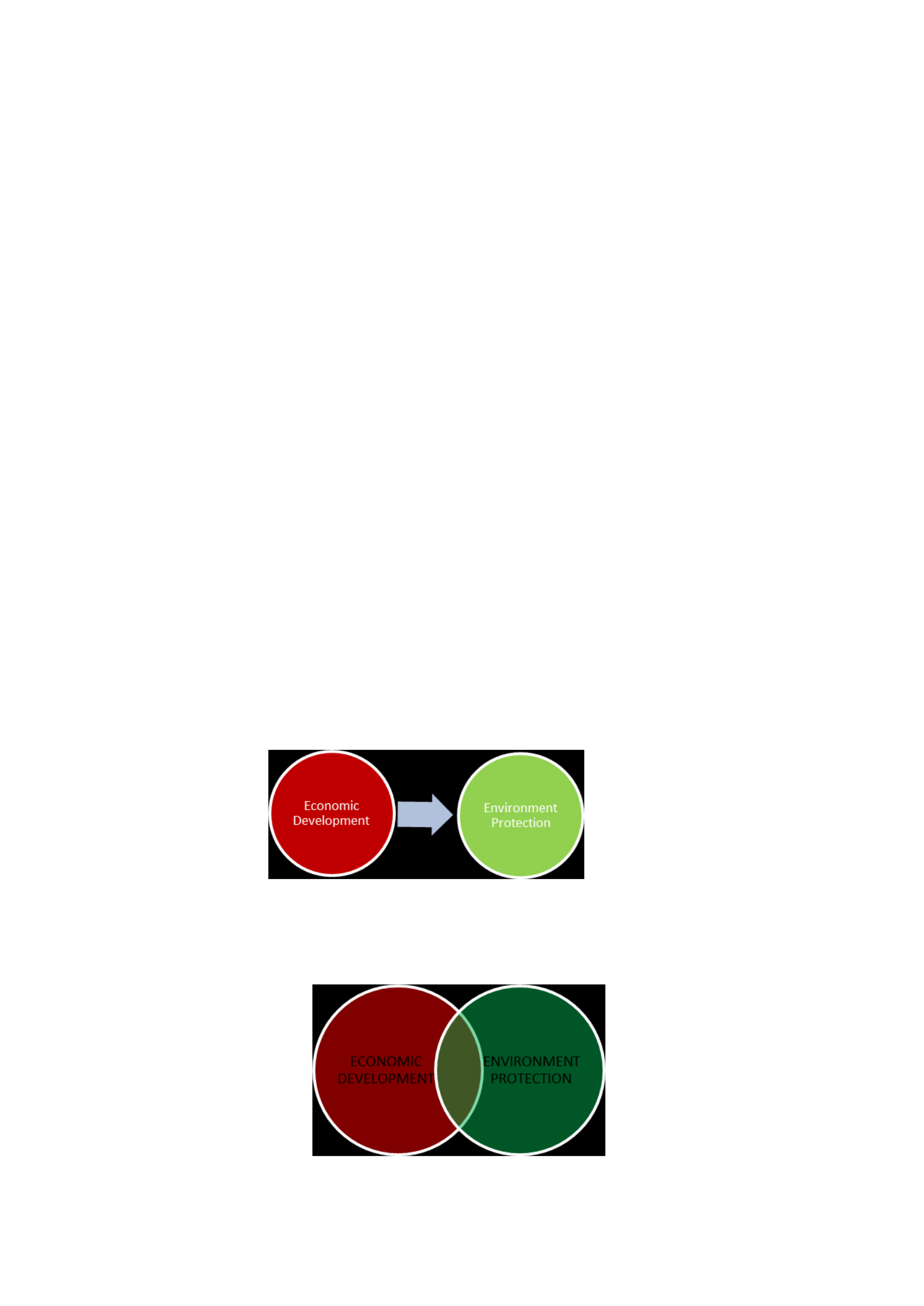
Ehrlich and his wife, Anne Ehrlich (who was not recognized), in 1968. The book
warned of mass human starvation in the 1970s and 1980s due to overpopulation, as
well as social upheaval, and advocated immediate action to limit population growth.
Fears of a widespread "population explosion" in the 1950s and 1960s.
In 1982, the Nairobi World Commission on Environment and Development. One of
the ongoing agendas of this UN meeting was to discuss environmental degradation,
deforestation, soil and water degradation, atmospheric changes - such as depletion of
the ozone layer, increasing concentrations of CO2 gas.
In 1987, the Brundtland report "Our Common Future" stated that sustainable
development is development that meets the needs of the present.
In 1992, the Rio United Nations World Conference on Environment and Development,
discussed the development of ecological sustainability, where at that time the
American President, Ronald Reagen, rejected the agenda because he considered
sustainable development not a solution to the problem, as well as the Australian Prime
Minister, namely John Howard. The countries that agreed to implement the agenda are
Canada, Japan, Europe, From these historical moments, a formulation of sustainable
development emerged, which initially was to pay attention to the needs of the present
and the future, economic development needs to pay attention to the environment or be
wiser and limit the excessive use of natural resources.
Sustainable development is development that meets current needs

Problem Solving to manage the current condition of urban development is SUSTAINABLE
DEVELOPMENT in an awareness of "our common future" by paying attention to
economic needs that pay attention to environmental protection.
Definition of Sustainable City
Based on the above understanding, a sustainable city is a city that has the ability, ability, and
wise thinking to think about current and future needs, and the city is able to support, support
the needs of living things in a system (cover in system), where the development of a
dynamic and significantly growing city certainly requires efficient and effective
management or planning. So that the city physically has a mental awareness to maintain
environmental balance and sustainability of life in it, so that in the end the city is expected to
be socially just and prosperous.
In an ecological context, sustainability is understood as the ability of ecosystems to maintain
and sustain ecological processes, functions, productivity, and diversity into the future
(Wardhono, 2012).
Sustainable cities are cities that are able to meet the needs of the present without ignoring
the needs of future generations, how to repair environmental destruction without sacrificing
the needs of economic development and social justice. The concept of sustainable cities was
launched by the United Nations in June 2012 at the Rio+20 The United Nations Conference
on Sustainable Development. The concept is planned to be disseminated to the world's urban
stakeholders who are responsible for policy-making, planning and implementation of urban
development. Cities that have the ability to drive future growth, but are also able to grow
more efficiently and environmentally friendly.
The concept of environmental balance, related to sustainable cities "ecocity", which is the
development of cities that currently require a type of development that not only pays
attention to the development of the economic side (without the financial and material), but
needs to pay attention to aspects of the development of the quality of human life in it
(Richard Register, 1987). Then in the Research Triangle Institute (1996) the City must be
able to have five basic principles in the concept of sustainability, namely: Environmental
(Ecology), Economy (Employment), Society (Equity), Engagement and Energy. In its
application, the five elements must be able to run simultaneously, development inequality
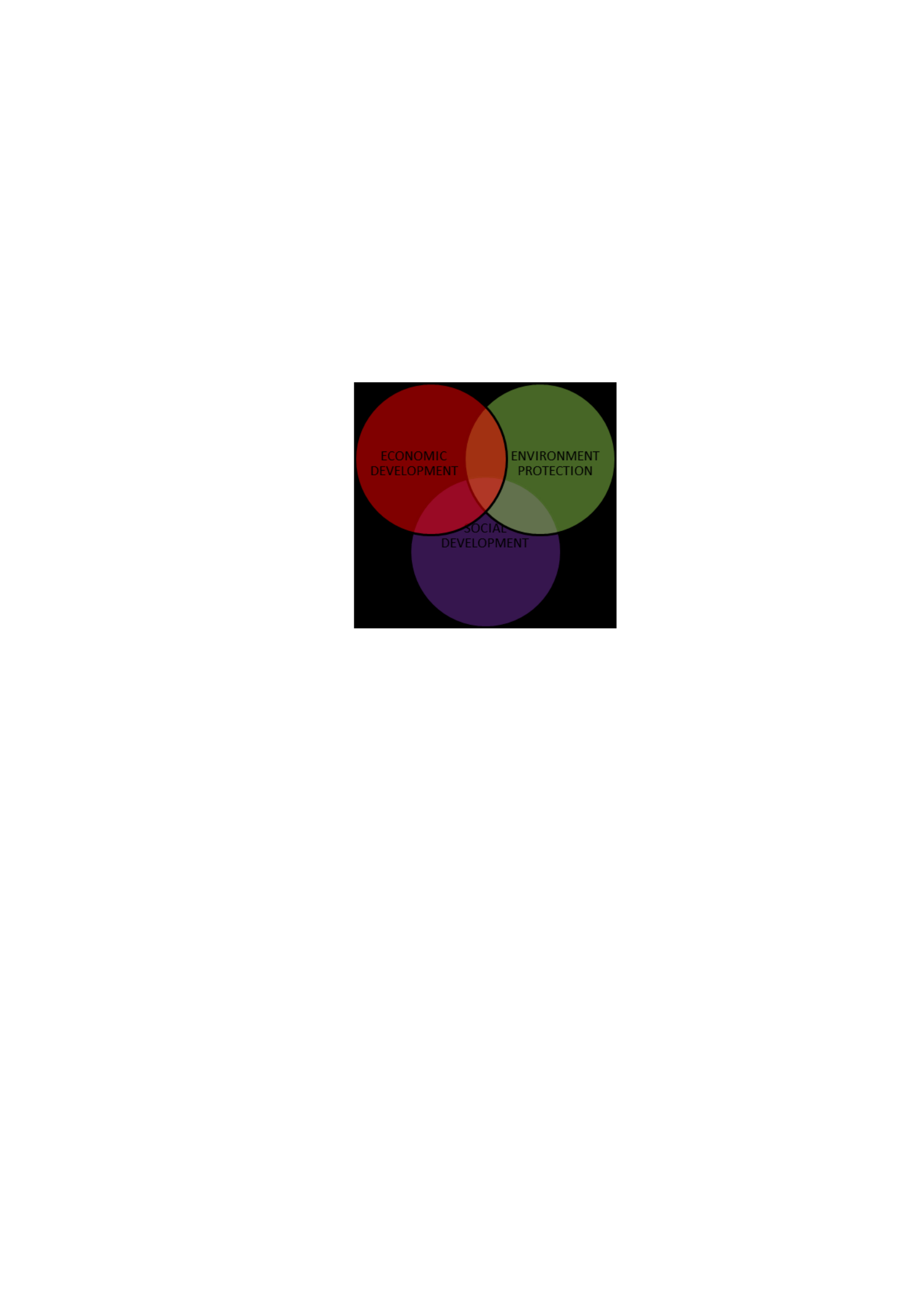
will occur if the development of each element is uneven (Budihardjo and Sujarto, 1999).
Furthermore, the concept of sustainable cities according to Rogers (1998), must recognize
that cities need to meet social, environmental, political and cultural as well as economic and
physical goals. Rogers elaborated by including these keywords, such a city also pays
attention to aspects of beauty in art and architecture, creativity to optimize human potential,
resource efficiency and minimal ecological impact, ease of contact, mobility, integrated and
compact communities and diversity.
"SIMULTAN"
Sustainable development needs to be implemented "SIMULTANEOUSLY"
Sustainable Urban Planning Strategies
Based on the above review, the consideration to protect the environmental conditions that
are decreasing in quality, and the population explosion, then automatically the needs of
human life increase. Therefore, to carry out a sustainable urban development strategy, which
is carried out "Simultaneously" by combining the 4 (four) dimensions, namely: planning
that considers "economic development, by protecting the environment", and paying attention
to "social development", and the need for "Government" management as a regulatory
function and providing infrastructure.
Urban planning, of course, can never wait, because human affairs go on and their direction is
determined by the degree of planning. Realizing a real city that is sustainable is to open a
broad view that every city has housing, high-rise buildings, urban alleys, parks, people's
homes. We see how they live, how their children will become citizens and neighbors of their
children and generations. It is this view that gives direction to the city of the future, a city

that is comfortable to live in for every generation, serves human needs, and directs the
means to shape the urban environment.
Sustainable development in social capital can grow at the individual, family, community,
local community, society in a region, national, and even global levels. Community-level
social capital cannot be measured simply as an aggregation of individual networks. Strong
community-level social capital creates a "civic infrastructure" that will support formal and
informal decision-making processes and public engagement (Potapchuck et.al. 1997).
Individual social capital is closely related to human capital. When individuals invest in
being able to communicate well, they increase their social capital but reduce the social
capital of the community. Determinants of social capital can also include economic and
political instability, patron-client relationships, education, occupation, collective interest and
market legitimization of common values. Social capital can lower the costs of cooperation
and facilitate cooperation. To build social capital effectively, local governments must share
autonomy/roles with their communities, in the sense that they must shift from being
controllers, regulators and providers, to catalysts, conveners and facilitators (Crocker et al.
1998).
The issue of weak state capacity in developing countries, characterized by the inability to
carry out development, has become a hot topic discussed by experts. Theories of
government failure characterized by a "top-down" approach, as well as social capital theory
characterized by a "bottom-up" approach, both provide a framework that underlies the basic
framework for identifying the symptoms of "state incapacity" (Sallis and Dollery, 2001).
The government's role in implementing sustainable urban development is to have a
sustainable-minded leadership spirit so that the dynamic development of the city can be
managed effectively without incurring large costs.
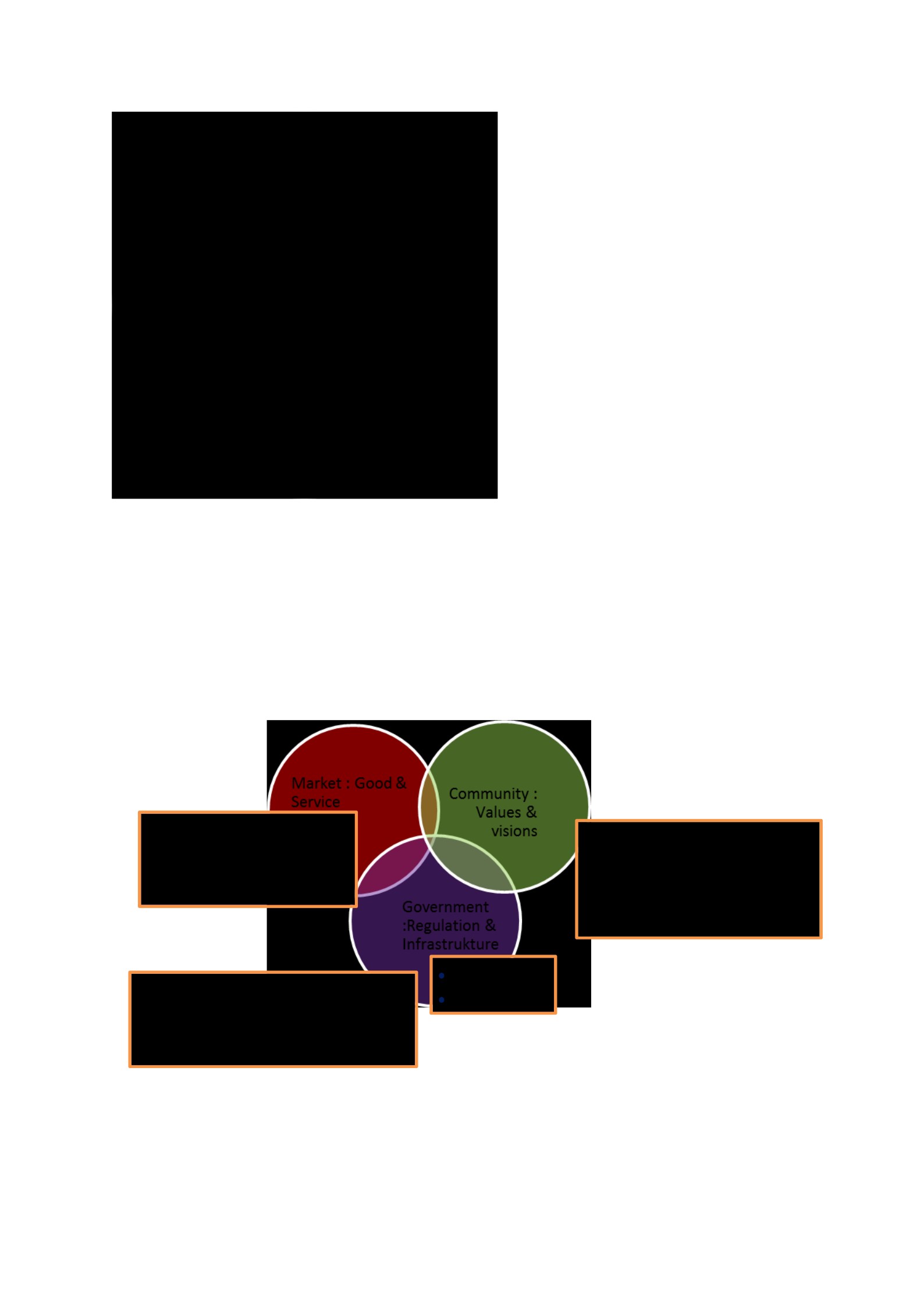
Time regulation:
Short-term Development:
INFRASTRUCTURE (time prime 10
years. MARKET (time prime 6 years)
LEADERSHIP
INNOVATION
In the direction of the
Community: Long term, it can
help and encourage the
community to improve their
quality of life.
The market has "POWER"
and for the Commitment to
be SUSTAINABLE then
Awareness required
Sustainable City Development Concept in 4 (four) Sectoral Dimensions
One of the strategies for sustainable urban development is that the government as a
development manager must have leadership, and innovation. The development program has
the concept of short term and long term development, both concepts support each other in
order to achieve a vision of sustainable urban development.
Sustainable Urban Development Strategy
"SUSTAINABLE"
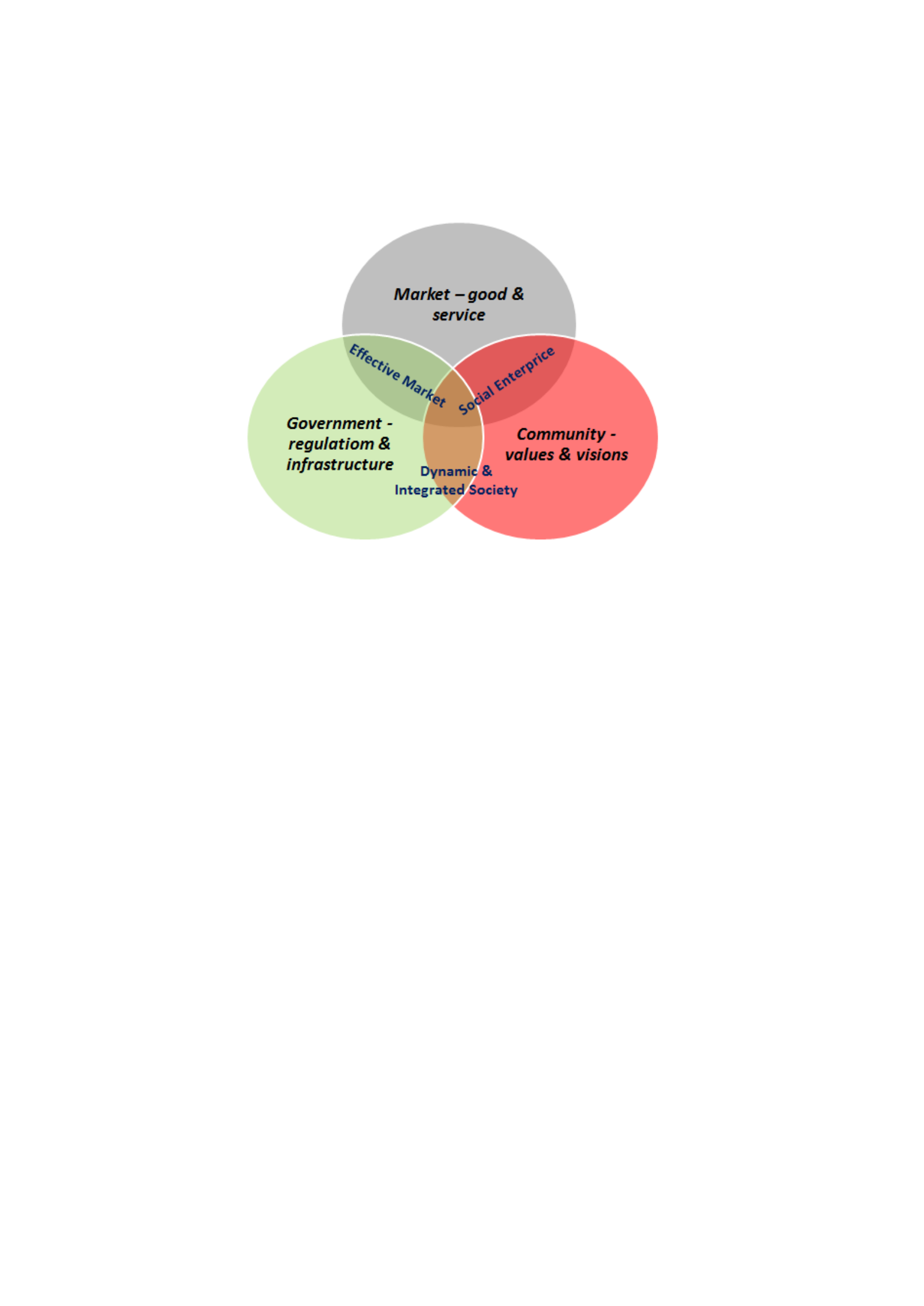
One example of an innovative leader is being able to make sustainable city breakthroughs
such as Cities with Solar panels, Cities with Smart City, and movements to change the urban
environment to be more environmentally friendly.
Figure 8. Sectoral dimensions that simultaneously produce something that is Integrity
The above principle illustrates a sectoral dimension, namely social, economic, and
environmental, into a development that cooperates with each other to maintain balance, it
will produce an effective market regulation, and social enterprice economic development
with attention to the environment will produce a good social community value as well. The
principle of sustainable development is one example:
Settlement: sustainable urban development recognizes the earth can only
adjust to a more balanced state if settlements "reduce their ecological
footprint" while they "simultaneously" improve their quality of life. In this
case, reducing the "ecological" footprint means reducing the use of materials
and energy that produce excessive CO2), while simultaneously it means
paying attention to providing healthy settlements, providing jobs, and
designing with social communities in mind.
Place-making: sustainability that recognizes the significance and diversity of
communities and regions for earth stewardship (cultured buildings,
landscaping, sculpture, and attention to biodiversity for future generations).
Net-Benefit: Sustainability that addresses the extraction of non-renewable
resources, providing net environmental social and economic benefits for
future generations. Reduce the impact and maintain the environmental

sustainability of irresponsible agencies.
The principles and enforcement of sustainable cities are expected to pay more attention to
humanity, more humane. Returning to the essence of the city itself is formed from human
needs. The relationship between the city, formed from humans and the environment, related
to the city is a system that cannot be separated from spatial planning, why because cities are
formed as a result of natural processes and social processes, human activities as creatures
that utilize natural resources also have tendencies that are patterned and spatially structured.
According to Rustiadi, et al (2011), human spatial instincts are natural and the result of long
"learning" experiences, so that they get typical spatial patterns, for example in the layout of
residential houses, public spaces (gathering places), yards, fields, rice fields, and so on. The
regularity of the spatial configuration of the community's socio-economic activities or
patterns of space utilization are always found in every community's economy or patterns of
space utilization are always found in every community's life in maintaining its life, adjusting
to the environment, optimizing efforts to utilize natural resources, optimizing social
interactions, as well as forms of cultural expression. The interaction between humans and
the environment requires humans to provide various infrastructure to facilitate access and
manage these resources.
The philosophy of sustainable urban planning is to meet the needs of society, the needs of
generations, and the needs of the economy, which is socially just where the goal is to
prevent unwanted changes, create balance and sustainable development. The beginning of
the process of sustainable urban planning starts with the need to make changes for the better
(welfare, natural disasters, social development, etc.).
Some Countries That Implement Sustainable Urban Development
Learning from other countries, about how to build a vision of a sustainable city and how to
implement it, certainly adds insight into managing a city, even though the cases and
problems are different. Consistency to build a sustainable city vision starts from the
creativity of a leader and building awareness of its citizens. The following is an explanation
of the table below:

Table 3. Countries in the Vision of a Sustainable City
STATE
CITY DESCRIPTION
Singapore
As a small and densely populated island nation with no natural resources,
Singapore's own sustainable development experience has focused on four
key areas, namely, (1) Building a sustainable economy; (2) creating a
sustainable living environment; (3) ensuring sustainable development for
our people; and (4) contributing to international collaboration.
•
Singapore is the 20th most carbon-efficient country in the world
•
Integrated transportation, MRT, BUS., pedestrian way
•
Since the 1970s, economic development has helped lift billions of people
out of poverty. Social indices of human development such as health and
education have improved significantly.
•
Despite not having natural resources, Singapore manages its human
resources more carefully.
•
Singapore plans to introduce a carbon tax from 2019, so those who emit
the most carbon will bear the cost to our environment and be encouraged to
reduce their emissions.
•
Give prizes to residents whose houses are energy efficient, tax discounts

•
A generation of pioneers, with a vision for a clean, green and sustainable
Singapore for all Singaporeans. Instilling the awareness that this little
island is all we have, and we must take good care of it.
•
Over the past 50 years, saw major improvements in housing, water, public
health and sanitation. Provides a City in Parks with about 47 percent green
cover in Singapore. More than 80 percent of households are within a 10-
minute walk of a park.
•
It has 72 hectares of green roof gardens and walls today, and aims to
double that by 2030.
Curitiba,
Brazil
•
Curitiba, is the world's first sustainable city. In 1971, architect Jaime
Lerner was elected mayor for the first of three terms, and came up with
innovative and creative solutions that saw Curitiba undergo a remarkable
evolution.
•
The greenest city, with more than 50 M2 of green space per capita, much
more than the UN recommendation. The reason why there is so much green
space is that Lerner had to find a solution to the frequent flooding that
occurred due to the geographical position of the city, so Lerner created a
large green belt around the city, which has turned into a large habitat for
many plants and animals. These large green areas are maintained by sheep
and goats and the wool they produce is sold to finance social development
in the city.
•
About 60% of people rely on the bus network in the city, efficiency for the
light rail system with dedicated lanes.
•
The city of Curitiba is a wonderful example of what creative leaders dare
and do, to make a city truly serve its residents rather than create stress,
congestion and inequality among its residents.
•
Implement a simple Bus transportation system, by dividing 5 arterial traffic
roads.
•
There are 28 parks and forest areas in Curitiba, creating an urban landscape
unlike any other developing city. The city's parks are designed to be
connected rather than isolated to maximize usage. The park was designed
by Hitoshi Nakamura.
•
The parks also stop squatters from creating shanty towns in flood-prone

zones.
•
Curitiba has 4 times the recommended green space, using sheep to "mow"
some of the grass in the parks.
By examining two countries, namely: Singapore and Curitiba, it is expected to increase
knowledge about "sustainable cities", where sustainable development focuses on human
resources, social justice, creating spatial equality.
Conclusions
Based on the sources of sustainable city references, it can be concluded that a sustainable
city is a city that is able to meet the NEEDS of the present without ignoring the NEEDS of
future GENERATIONS, how to REPAIR ENVIRONMENTAL DAMAGE without
sacrificing the NEEDS of ECONOMIC DEVELOPMENT and SOCIAL JUSTICE.
Building a sustainable city also takes into account 4 dimensions, namely SOCIAL
DIMENSION, ECONOMIC DIMENSION, ENVIRONMENTAL DIMENSION, and

GOVERNMENT DIMENSION. These four things Side by side, the success of sustainable
development does not only depend on the economic dimension but needs the intervention of
the power holder or in this case the government dimension, in order to implement
sustainable development so as to achieve equitable distribution of welfare. Therefore,
sustainable development is oriented towards the development of Green Cities that have a
good quality of life and conducive environmental conditions.
Problems
Urban growth is a complex phenomenon, partly spontaneous and partly planned. There have
been several attempts to manage that complexity. Ideas such as building sustainable cities,
resulting in better urban environments that meet people's needs, have fewer socio-economic
costs, and use less nature.
Based on the explanation above, the problem about the city is that when some of the cities
develop spontaneously (sprawl), the population increases, the development of urban areas
and land clearing occurs which changes the function of productive areas of paddy land into
new residential / residential areas, forest conversion into agricultural / plantation land.
Furthermore, the urbanization process also creates socio-economic problems for cities,
forming slum areas that have low income in the city, resulting in crime in urban spaces.
These problems represent urban development that does not take into account the quality of
human life. The congestion of cities such as Jakarta and other large cities, due to poorly
integrated public transportation systems. The earth's temperature is getting hotter due to
CO2 emissions from various human activities on earth such as motor gas air pollution,
greenhouse effect, building materials, and flooding in urban areas, and so on.
Based on the problems mentioned above, the world's cities consume three-quarters of the
world's energy and cause three-quarters of global pollution and cities have become parasitic
ehuge organisms that can drain the earth for food due to excessive energy consumption:
relentless consumers, relentless polluters. So that over time the city system becomes
unstable, resilience and capacity are not high enough, and it is likely that the city will
collapse (colappse). With the phenomena of environmental degradation and rising
temperatures, humans are no longer comfortable in their habitats (Roger, 1998 and Egger
2006).

Cities are the drivers of future growth, but also the biggest contributors to CO2 emissions.
So that a concept that pays attention to environmental balance is needed, namely the concept
of sustainable development. The concept of sustainable development has been widely
developed into the theoretical foundations of sustainable cities. City references and
applicative applications of sustainable urban development are easy to find, both in various
methods and paradigms. The dream of an ideal future city concept in the book "Garden City
of to-morrow" written by Ebenezer Howard (1898), invited controversy, became utopias,
considered irrelevant, unreasonable, and due to this irrelevance, the concept of Garden City
of to-morrow Ebenezer Howard is not widely used, only natural and natural concepts are
widely taken by urban planners, the rest is just a historical record. Twentieth-century urban
planners had a variety of new concepts in planning their cities from the initial idea of a
dream of a sustainable city that had become our common future.
Objectives and Benefits
Based on the above background and problems, the author sees the need to conduct a
theoretical study to better understand the concept of sustainable development in the four
dimensions of sustainable development, namely environmental, social, and economic, and
government. about the meaning and scope as a source of knowledge for the community
(students, academics, and practitioners) while strengthening the body knowledge of
architecture. The results of this paper are expected to be able to provide a deeper
understanding for students, and practitioners, to understand architecture and cities, becoming
a provision in the practice of architecture and planning science.
Writing Method
This research is a literature research to explore the understanding, meaning and scope of the
concept of a sustainable city. Various thoughts about the concept of a sustainable city can be
used as supporting data in this writing. The search for data and information through
documents, both in the form of written documents, photographs, images, and electronic
documents that can support the research process. Research results will also be more credible
if supported by photographs or existing academic and artistic papers (Sugiyono, 2005: 83).
Therefore, literature study can affect the credibility of the results of the research conducted.
Sustainable Cities And Their Development

Cities and their Development
Before understanding more about sustainable cities, it is necessary to know what the
definition of a city, its equivalents, differences, and scale are.
When the philosophy of science developed towards modern thinking. Humanist thinking
was influenced by the views of Karl Marx, Immanuel Kant, and Max Weber, the most
influential of whom was the Spirit of Capitalism (1905). So the city is a place where most of
its economic needs are in the local market, the characteristics of the city are the existence of
a market as a fortress and has a legal system and is cosmopolitan. When the city develops, as
a place to live, a place to produce goods and services, the scale of services develops, there is
a concentration of population, with high density. A small city to a megacity is said to have a
population of 20,000 to 5,000,000.
There are three opinions, namely; Max Weber (1905), Hamilton (2001), Steve Egger (2006),
defining the city basically is to accommodate human needs, community needs, and
economic needs. If we go back to Maslow's (1943) theory in "The Theory Of Human
Motivation" about the Hierarchy of human needs, namely basic needs are elements needed
by humans in maintaining balance both physiologically and psychologically which aims to
maintain life and health. Hierarchy (1) Physiological Needs or Faal Needs (physiological
needs): the right to get oxygen, food, sleep (human self-activity), (2) Safety, security needs:
Protection, (3) Love needs (social needs): social interaction life, (4) Esteem needs EGO
ownership (esteem needs), and (5) Self-actualization (self- actualization needs): recognition
appreciated, social status.
Cities are formed from human needs, to serve (Hamilton, 2001) from the hierarchy of human
needs, spatial formation of community expression (Steve Egger, 2006) makes the city
formed in a network or a system of community expression. As a result of such a system,
cities require management, governance, trade, culture, education, and society, to facilitate an
environment for human existence and interaction (Egger, 2006).
From the various opinions above, it can be concluded that the realization of the city is to
accommodate human needs, and when the city is growing dynamically, the city becomes a
network that is intertwined in a unified system, so that a city requires serious management
based on the scale of services, if not managed, social, economic, and environmental

problems then the city experiences collapse and crisis. A good city is one that responds to
the various problems that occur in the city, and thinks about survival and sustainability.
Sustainability
The definition of sustainability (continue) according to the Big United States Dictionary
(KBBI) is sustainable; and continuously. "Sustain": (1) strengthen or support physically or
mentally, (2) undergo or suffer (something unpleasant, especially an injury), (3) uphold,
affirm, or confirm the justice or validity of, in United States translation "sustain" is
menopang. The definition of sustain here is being able to endure, sustain, support, sustain,
experience, continue, suffer, prolong, and enable. As for the translation of "ability": (1)
possession of the means or skill to do something, (2) talent, skill, or proficiency in a
particular area, in United States translation is ability, capability, talent, ability, proficiency,
cleverness, wisdom, shrewdness, and dexterity.
Sustainable Cities
History of Sustainable Urban Development
To understand what "sustainability" is, and why there is an agreement on sustainable
development. It is therefore necessary to trace a history of the birth of the idea of sustainable
urban development.
In 1972, the Stockholm UN World Conference on Human Environment: UN
Conference on Human Environment (June 5-6, 1972): the focus was on discussing
guidelines and actions in dealing with environmental problems, such as alleviating
poverty, and protecting the environment.
Paul Ehrlich, a Stanford University Professor of Biology, who wrote a book titled
"Population Bomb": was a bestseller written by Stanford University Professor Paul R.
Ehrlich and his wife, Anne Ehrlich (who was not recognized), in 1968. The book
warned of mass human starvation in the 1970s and 1980s due to overpopulation, as
well as social upheaval, and advocated immediate action to limit population growth.
Fears of a widespread "population explosion" in the 1950s and 1960s.
In 1982, the Nairobi World Commission on Environment and Development. One of
the ongoing agendas of this UN meeting was to discuss environmental degradation,
deforestation, soil and water degradation, atmospheric changes - such as depletion of
the ozone layer, increasing concentrations of CO2 gas.
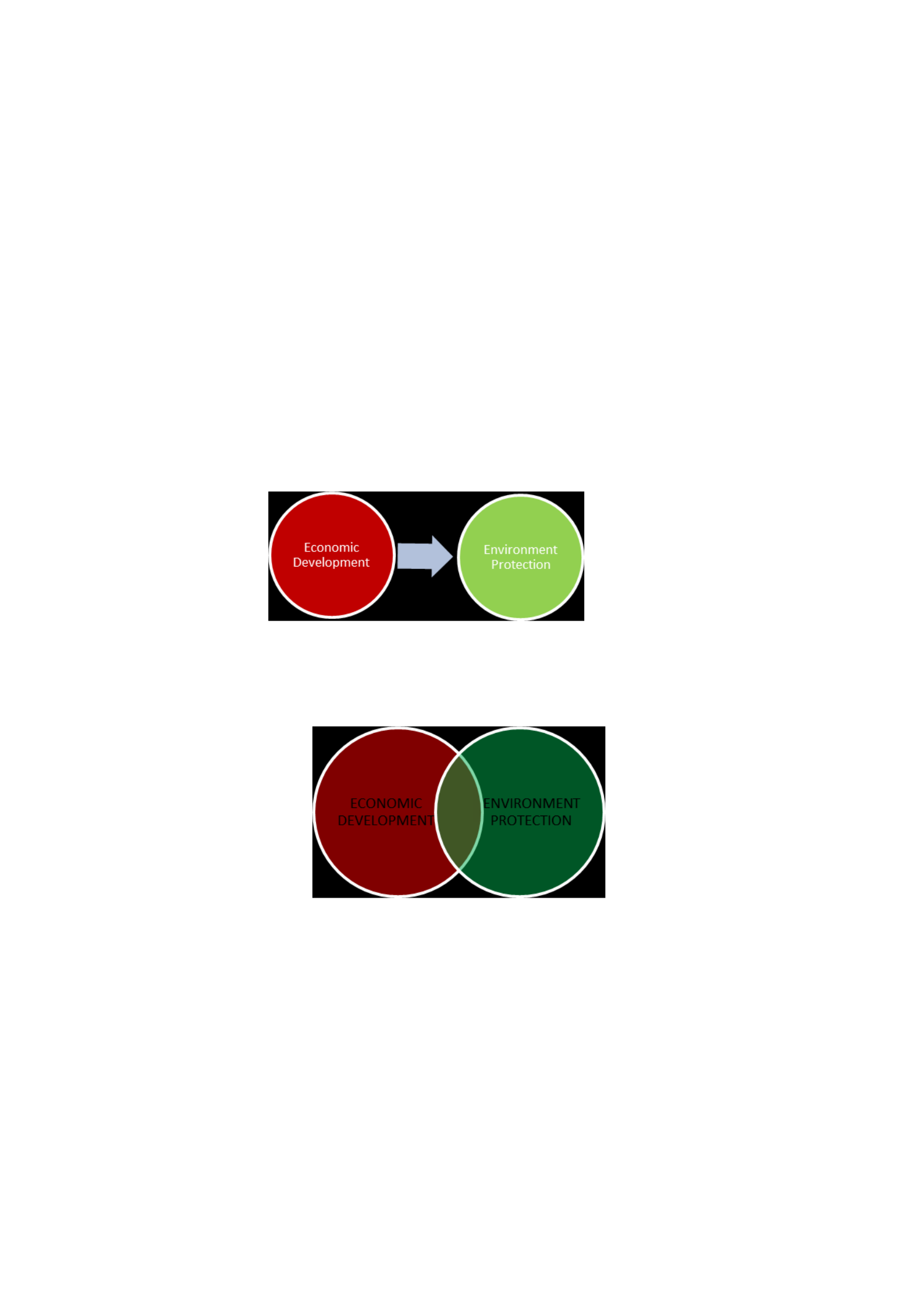
In 1987, the Brundtland report "Our Common Future" stated that sustainable
development is development that meets the needs of the present.
In 1992, the Rio United Nations World Conference on Environment and Development,
discussed the development of ecological sustainability, where at that time the
American President, Ronald Reagen, rejected the agenda because he considered
sustainable development not a solution to the problem, as well as the Australian Prime
Minister, namely John Howard. The countries that agreed to implement the agenda are
Canada, Japan, Europe, From these historical moments, a formulation of sustainable
development emerged, which initially was to pay attention to the needs of the present
and the future, economic development needs to pay attention to the environment or be
wiser and limit the excessive use of natural resources.
Sustainable development is development that meets current needs
Problem Solving to manage the current condition of urban development is SUSTAINABLE
DEVELOPMENT in an awareness of "our common future" by paying attention to
economic needs that pay attention to environmental protection.
Definition of Sustainable City
Based on the above understanding, a sustainable city is a city that has the ability, ability, and
wise thinking to think about current and future needs, and the city is able to support, support
the needs of living things in a system (cover in system), where the development of a

dynamic and significantly growing city certainly requires efficient and effective
management or planning. So that the city physically has a mental awareness to maintain
environmental balance and sustainability of life in it, so that in the end the city is expected to
be socially just and prosperous.
In an ecological context, sustainability is understood as the ability of ecosystems to maintain
and sustain ecological processes, functions, productivity, and diversity into the future
(Wardhono, 2012).
Sustainable cities are cities that are able to meet the needs of the present without ignoring
the needs of future generations, how to repair environmental destruction without sacrificing
the needs of economic development and social justice. The concept of sustainable cities was
launched by the United Nations in June 2012 at the Rio+20 The United Nations Conference
on Sustainable Development. The concept is planned to be disseminated to the world's urban
stakeholders who are responsible for policy-making, planning and implementation of urban
development. Cities that have the ability to drive future growth, but are also able to grow
more efficiently and environmentally friendly.
The concept of environmental balance, related to sustainable cities "ecocity", which is the
development of cities that currently require a type of development that not only pays
attention to the development of the economic side (without the financial and material), but
needs to pay attention to aspects of the development of the quality of human life in it
(Richard Register, 1987). Then in the Research Triangle Institute (1996) the City must be
able to have five basic principles in the concept of sustainability, namely: Environmental
(Ecology), Economy (Employment), Society (Equity), Engagement and Energy. In its
application, the five elements must be able to run simultaneously, development inequality
will occur if the development of each element is uneven (Budihardjo and Sujarto, 1999).
Furthermore, the concept of sustainable cities according to Rogers (1998), must recognize
that cities need to meet social, environmental, political and cultural as well as economic and
physical goals. Rogers elaborated by including these keywords, such a city also pays
attention to aspects of beauty in art and architecture, creativity to optimize human potential,
resource efficiency and minimal ecological impact, ease of contact, mobility, integrated and
compact communities and diversity.
"SIMULTAN"
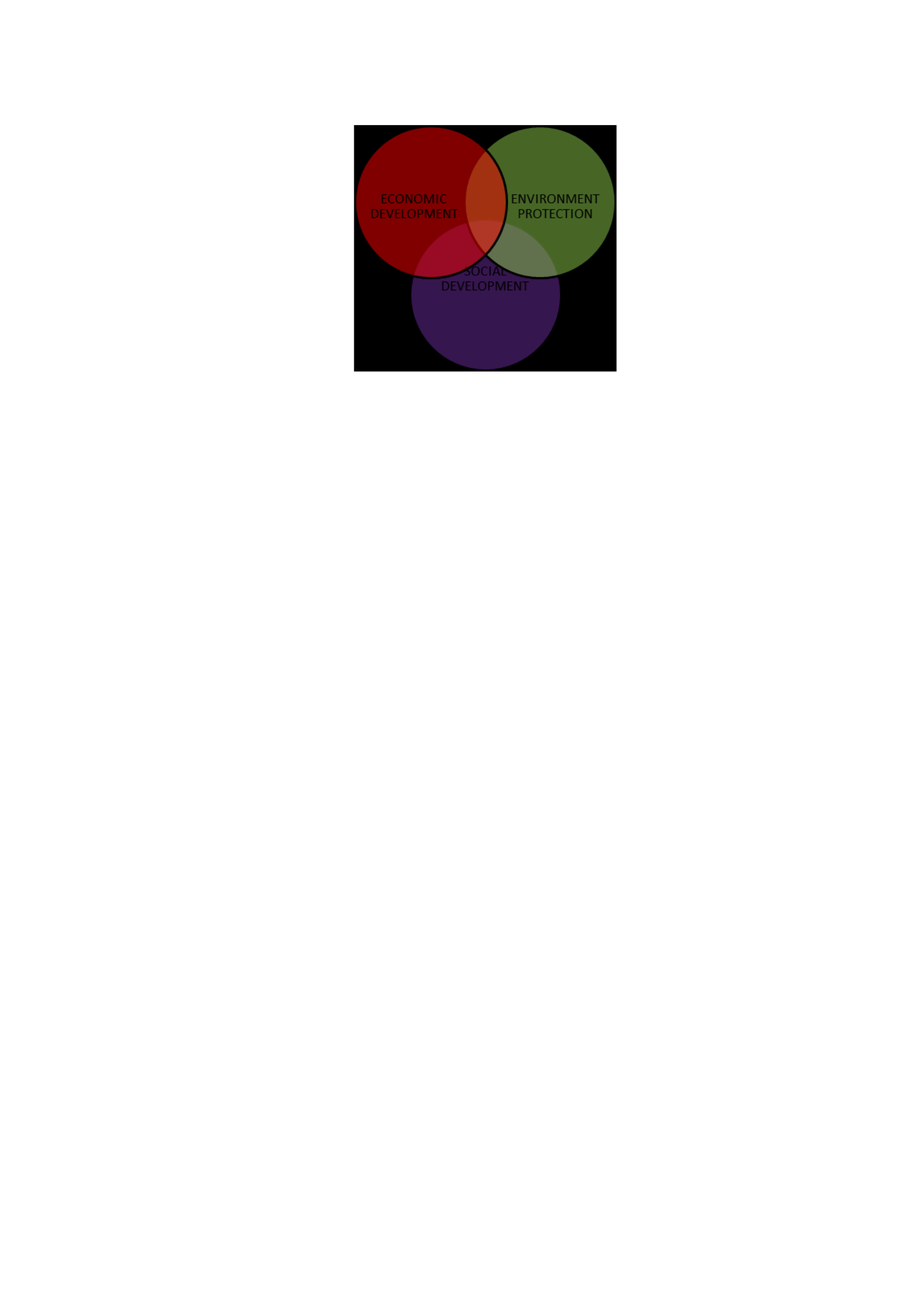
Sustainable development needs to be implemented "SIMULTANEOUSLY"
Sustainable Urban Planning Strategies
Based on the above review, the consideration to protect the environmental conditions that
are decreasing in quality, and the population explosion, then automatically the needs of
human life increase. Therefore, to carry out a sustainable urban development strategy, which
is carried out "Simultaneously" by combining the 4 (four) dimensions, namely: planning
that considers "economic development, by protecting the environment", and paying attention
to "social development", and the need for "Government" management as a regulatory
function and providing infrastructure.
Urban planning, of course, can never wait, because human affairs go on and their direction is
determined by the degree of planning. Realizing a real city that is sustainable is to open a
broad view that every city has housing, high-rise buildings, urban alleys, parks, people's
homes. We see how they live, how their children will become citizens and neighbors of their
children and generations. It is this view that gives direction to the city of the future, a city
that is comfortable to live in for every generation, serves human needs, and directs the
means to shape the urban environment.
Sustainable development in social capital can grow at the individual, family, community,
local community, society in a region, national, and even global levels. Community-level
social capital cannot be measured simply as an aggregation of individual networks. Strong
community-level social capital creates a "civic infrastructure" that will support formal and
informal decision-making processes and public engagement (Potapchuck et.al. 1997).

Individual social capital is closely related to human capital. When individuals invest in
being able to communicate well, they increase their social capital but reduce the social
capital of the community. Determinants of social capital can also include economic and
political instability, patron-client relationships, education, occupation, collective interest and
market legitimization of common values. Social capital can lower the costs of cooperation
and facilitate cooperation. To build social capital effectively, local governments must share
autonomy/roles with their communities, in the sense that they must shift from being
controllers, regulators and providers, to catalysts, conveners and facilitators (Crocker et al.
1998).
The issue of weak state capacity in developing countries, characterized by the inability to
carry out development, has become a hot topic discussed by experts. Theories of
government failure characterized by a "top-down" approach, as well as social capital theory
characterized by a "bottom-up" approach, both provide a framework that underlies the basic
framework for identifying the symptoms of "state incapacity" (Sallis and Dollery, 2001).
The government's role in implementing sustainable urban development is to have a
sustainable-minded leadership spirit so that the dynamic development of the city can be
managed effectively without incurring large costs.
Sustainable City Development Concept in 4 (four) Sectoral Dimensions
"SUSTAINABLE"
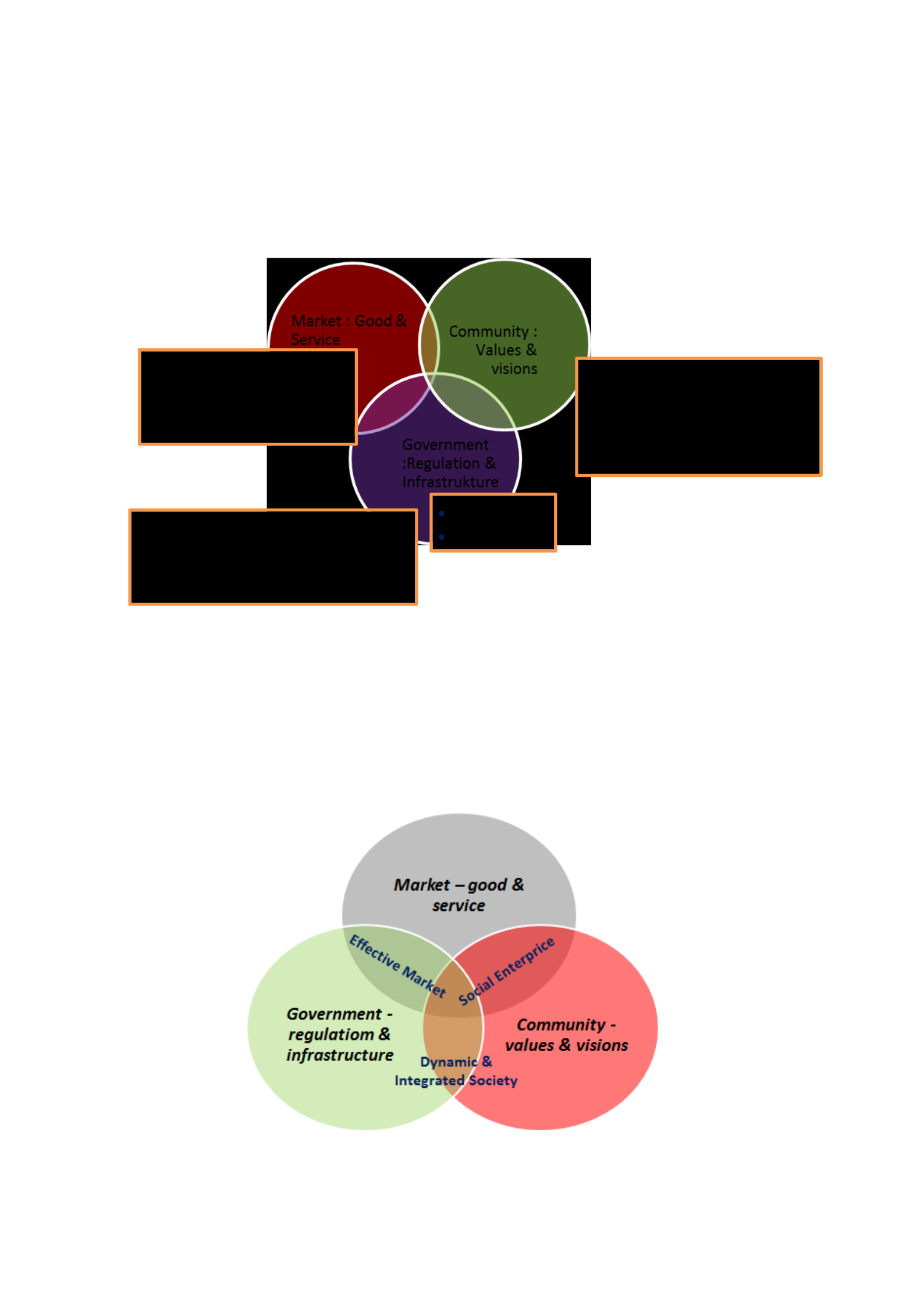
Time regulation:
Short-term Development:
INFRASTRUCTURE (time prime 10
years. MARKET (time prime 6 years)
LEADERSHIP
INNOVATION
In the direction of the
Community: Long term, it can
help and encourage the
community to improve their
quality of life.
The market has "POWER"
and for the Commitment to
be SUSTAINABLE then
Awareness required
One of the strategies for sustainable urban development is that the government as a
development manager must have leadership, and innovation. The development program has
the concept of short term and long term development, both concepts support each other in
order to achieve a vision of sustainable urban development.
Sustainable Urban Development Strategy
One example of an innovative leader is being able to make sustainable city breakthroughs
such as Cities with Solar panels, Cities with Smart City, and movements to change the urban
environment to be more environmentally friendly.
Figure 8. Sectoral dimensions that simultaneously produce something that is Integrity

The above principle illustrates a sectoral dimension, namely social, economic, and
environmental, into a development that cooperates with each other to maintain balance, it
will produce an effective market regulation, and social enterprice economic development
with attention to the environment will produce a good social community value as well. The
principle of sustainable development is one example:
Settlement: sustainable urban development recognizes the earth can only
adjust to a more balanced state if settlements "reduce their ecological
footprint" while they "simultaneously" improve their quality of life. In this
case, reducing the "ecological" footprint means reducing the use of materials
and energy that produce excessive CO2), while simultaneously it means
paying attention to providing healthy settlements, providing jobs, and
designing with social communities in mind.
Place-making: sustainability that recognizes the significance and diversity of
communities and regions for earth stewardship (cultured buildings,
landscaping, sculpture, and attention to biodiversity for future generations).
Net-Benefit: Sustainability that addresses the extraction of non-renewable
resources, providing net environmental social and economic benefits for
future generations. Reduce the impact and maintain the environmental
sustainability of irresponsible agencies.
The principles and enforcement of sustainable cities are expected to pay more attention to
humanity, more humane. Returning to the essence of the city itself is formed from human
needs. The relationship between the city, formed from humans and the environment, related
to the city is a system that cannot be separated from spatial planning, why because cities are
formed as a result of natural processes and social processes, human activities as creatures
that utilize natural resources also have tendencies that are patterned and spatially structured.
According to Rustiadi, et al (2011), human spatial instincts are natural and the result of long
"learning" experiences, so that they get typical spatial patterns, for example in the layout of
residential houses, public spaces (gathering places), yards, fields, rice fields, and so on. The
regularity of the spatial configuration of the community's socio-economic activities or
patterns of space utilization are always found in every community's economy or patterns of
space utilization are always found in every community's life in maintaining its life, adjusting
to the environment, optimizing efforts to utilize natural resources, optimizing social

interactions, as well as forms of cultural expression. The interaction between humans and
the environment requires humans to provide various infrastructure to facilitate access and
manage these resources.
The philosophy of sustainable urban planning is to meet the needs of society, the needs of
generations, and the needs of the economy, which is socially just where the goal is to
prevent unwanted changes, create balance and sustainable development. The beginning of
the process of sustainable urban planning starts with the need to make changes for the better
(welfare, natural disasters, social development, etc.).
Some Countries That Implement Sustainable Urban Development
Learning from other countries, about how to build a vision of a sustainable city and how to
implement it, certainly adds insight into managing a city, even though the cases and
problems are different. Consistency to build a sustainable city vision starts from the
creativity of a leader and building awareness of its citizens. The following is an explanation
of the table below:
Table 3. Countries in the Vision of a Sustainable City

STATE
CITY DESCRIPTION
Singapore
As a small and densely populated island nation with no natural resources,
Singapore's own sustainable development experience has focused on four
key areas, namely, (1) Building a sustainable economy; (2) creating a
sustainable living environment; (3) ensuring sustainable development for
our people; and (4) contributing to international collaboration.
•
Singapore is the 20th most carbon-efficient country in the world
•
Integrated transportation, MRT, BUS., pedestrian way
•
Since the 1970s, economic development has helped lift billions of people
out of poverty. Social indices of human development such as health and
education have improved significantly.
•
Despite not having natural resources, Singapore manages its human
resources more carefully.
•
Singapore plans to introduce a carbon tax from 2019, so those who emit
the most carbon will bear the cost to our environment and be encouraged to
reduce their emissions.
•
Give prizes to residents whose houses are energy efficient, tax discounts
•
A generation of pioneers, with a vision for a clean, green and sustainable
Singapore for all Singaporeans. Instilling the awareness that this little
island is all we have, and we must take good care of it.
•
Over the past 50 years, saw major improvements in housing, water, public
health and sanitation. Provides a City in Parks with about 47 percent green
cover in Singapore. More than 80 percent of households are within a 10-
minute walk of a park.
•
It has 72 hectares of green roof gardens and walls today, and aims to
double that by 2030.

Curitiba,
Brazil
•
Curitiba, is the world's first sustainable city. In 1971, architect Jaime
Lerner was elected mayor for the first of three terms, and came up with
innovative and creative solutions that saw Curitiba undergo a remarkable
evolution.
•
The greenest city, with more than 50 M2 of green space per capita, much
more than the UN recommendation. The reason why there is so much green
space is that Lerner had to find a solution to the frequent flooding that
occurred due to the geographical position of the city, so Lerner created a
large green belt around the city, which has turned into a large habitat for
many plants and animals. These large green areas are maintained by sheep
and goats and the wool they produce is sold to finance social development
in the city.
•
About 60% of people rely on the bus network in the city, efficiency for the
light rail system with dedicated lanes.
•
The city of Curitiba is a wonderful example of what creative leaders dare
and do, to make a city truly serve its residents rather than create stress,
congestion and inequality among its residents.
•
Implement a simple Bus transportation system, by dividing 5 arterial traffic
roads.
•
There are 28 parks and forest areas in Curitiba, creating an urban landscape
unlike any other developing city. The city's parks are designed to be
connected rather than isolated to maximize usage. The park was designed
by Hitoshi Nakamura.
•
The parks also stop squatters from creating shanty towns in flood-prone
zones.
•
Curitiba has 4 times the recommended green space, using sheep to "mow"
some of the grass in the parks.
By examining two countries, namely: Singapore and Curitiba, it is expected to increase
knowledge about "sustainable cities", where sustainable development focuses on human
resources, social justice, creating spatial equality.

Conclusions
Based on the sources of sustainable city references, it can be concluded that a sustainable
city is a city that is able to meet the NEEDS of the present without ignoring the NEEDS of
future GENERATIONS, how to REPAIR ENVIRONMENTAL DAMAGE without
sacrificing the NEEDS of ECONOMIC DEVELOPMENT and SOCIAL JUSTICE.
Building a sustainable city also takes into account 4 dimensions, namely SOCIAL
DIMENSION, ECONOMIC DIMENSION, ENVIRONMENTAL DIMENSION, and
GOVERNMENT DIMENSION. These four things Side by side, the success of sustainable
development does not only depend on the economic dimension but needs the intervention of
the power holder or in this case the government dimension, in order to implement
sustainable development so as to achieve equitable distribution of welfare. Therefore,
sustainable development is oriented towards the development of Green Cities that have a
good quality of life and conducive environmental conditions.
Problems
Urban growth is a complex phenomenon, partly spontaneous and partly planned. There have
been several attempts to manage that complexity. Ideas such as building sustainable cities,
resulting in better urban environments that meet people's needs, have fewer socio-economic
costs, and use less nature.
Based on the explanation above, the problem about the city is that when some of the cities
develop spontaneously (sprawl), the population increases, the development of urban areas
and land clearing occurs which changes the function of productive areas of paddy land into
new residential / residential areas, forest conversion into agricultural / plantation land.
Furthermore, the urbanization process also creates socio-economic problems for cities,
forming slum areas that have low income in the city, resulting in crime in urban spaces.
These problems represent urban development that does not take into account the quality of
human life. The congestion of cities such as Jakarta and other large cities, due to poorly
integrated public transportation systems. The earth's temperature is getting hotter due to
CO2 emissions from various human activities on earth such as motor gas air pollution,
greenhouse effect, building materials, and flooding in urban areas, and so on.

Based on the problems mentioned above, the world's cities consume three-quarters of the
world's energy and cause three-quarters of global pollution and cities have become parasitic
ehuge organisms that can drain the earth for food due to excessive energy consumption:
relentless consumers, relentless polluters. So that over time the city system becomes
unstable, resilience and capacity are not high enough, and it is likely that the city will
collapse (colappse). With the phenomena of environmental degradation and rising
temperatures, humans are no longer comfortable in their habitats (Roger, 1998 and Egger
2006).
Cities are the drivers of future growth, but also the biggest contributors to CO2 emissions.
So that a concept that pays attention to environmental balance is needed, namely the concept
of sustainable development. The concept of sustainable development has been widely
developed into the theoretical foundations of sustainable cities. City references and
applicative applications of sustainable urban development are easy to find, both in various
methods and paradigms. The dream of an ideal future city concept in the book "Garden City
of to-morrow" written by Ebenezer Howard (1898), invited controversy, became utopias,
considered irrelevant, unreasonable, and due to this irrelevance, the concept of Garden City
of to-morrow Ebenezer Howard is not widely used, only natural and natural concepts are
widely taken by urban planners, the rest is just a historical record. Twentieth-century urban
planners had a variety of new concepts in planning their cities from the initial idea of a
dream of a sustainable city that had become our common future.
Objectives and Benefits
Based on the above background and problems, the author sees the need to conduct a
theoretical study to better understand the concept of sustainable development in the four
dimensions of sustainable development, namely environmental, social, and economic, and
government. about the meaning and scope as a source of knowledge for the community
(students, academics, and practitioners) while strengthening the body knowledge of
architecture. The results of this paper are expected to be able to provide a deeper
understanding for students, and practitioners, to understand architecture and cities, becoming
a provision in the practice of architecture and planning science.
Writing Method
This research is a literature research to explore the understanding, meaning and scope of the

concept of a sustainable city. Various thoughts about the concept of a sustainable city can be
used as supporting data in this writing. The search for data and information through
documents, both in the form of written documents, photographs, images, and electronic
documents that can support the research process. Research results will also be more credible
if supported by photographs or existing academic and artistic papers (Sugiyono, 2005: 83).
Therefore, literature study can affect the credibility of the results of the research conducted.
Sustainable Cities And Their Development
Cities and their Development
Before understanding more about sustainable cities, it is necessary to know what the
definition of a city, its equivalents, differences, and scale are.
When the philosophy of science developed towards modern thinking. Humanist thinking
was influenced by the views of Karl Marx, Immanuel Kant, and Max Weber, the most
influential of whom was the Spirit of Capitalism (1905). So the city is a place where most of
its economic needs are in the local market, the characteristics of the city are the existence of
a market as a fortress and has a legal system and is cosmopolitan. When the city develops, as
a place to live, a place to produce goods and services, the scale of services develops, there is
a concentration of population, with high density. A small city to a megacity is said to have a
population of 20,000 to 5,000,000.
There are three opinions, namely; Max Weber (1905), Hamilton (2001), Steve Egger (2006),
defining the city basically is to accommodate human needs, community needs, and
economic needs. If we go back to Maslow's (1943) theory in "The Theory Of Human
Motivation" about the Hierarchy of human needs, namely basic needs are elements needed
by humans in maintaining balance both physiologically and psychologically which aims to
maintain life and health. Hierarchy (1) Physiological Needs or Faal Needs (physiological
needs): the right to get oxygen, food, sleep (human self-activity), (2) Safety, security needs:
Protection, (3) Love needs (social needs): social interaction life, (4) Esteem needs EGO
ownership (esteem needs), and (5) Self-actualization (self- actualization needs): recognition
appreciated, social status.
Cities are formed from human needs, to serve (Hamilton, 2001) from the hierarchy of human
needs, spatial formation of community expression (Steve Egger, 2006) makes the city

formed in a network or a system of community expression. As a result of such a system,
cities require management, governance, trade, culture, education, and society, to facilitate an
environment for human existence and interaction (Egger, 2006).
From the various opinions above, it can be concluded that the realization of the city is to
accommodate human needs, and when the city is growing dynamically, the city becomes a
network that is intertwined in a unified system, so that a city requires serious management
based on the scale of services, if not managed, social, economic, and environmental
problems then the city experiences collapse and crisis. A good city is one that responds to
the various problems that occur in the city, and thinks about survival and sustainability.
Sustainability
The definition of sustainability (continue) according to the Big United States Dictionary
(KBBI) is sustainable; and continuously. "Sustain": (1) strengthen or support physically or
mentally, (2) undergo or suffer (something unpleasant, especially an injury), (3) uphold,
affirm, or confirm the justice or validity of, in United States translation "sustain" is
menopang. The definition of sustain here is being able to endure, sustain, support, sustain,
experience, continue, suffer, prolong, and enable. As for the translation of "ability": (1)
possession of the means or skill to do something, (2) talent, skill, or proficiency in a
particular area, in United States translation is ability, capability, talent, ability, proficiency,
cleverness, wisdom, shrewdness, and dexterity.
Sustainable Cities
History of Sustainable Urban Development
To understand what "sustainability" is, and why there is an agreement on sustainable
development. It is therefore necessary to trace a history of the birth of the idea of sustainable
urban development.
In 1972, the Stockholm UN World Conference on Human Environment: UN
Conference on Human Environment (June 5-6, 1972): the focus was on discussing
guidelines and actions in dealing with environmental problems, such as alleviating
poverty, and protecting the environment.
Paul Ehrlich, a Stanford University Professor of Biology, who wrote a book titled
"Population Bomb": was a bestseller written by Stanford University Professor Paul R.
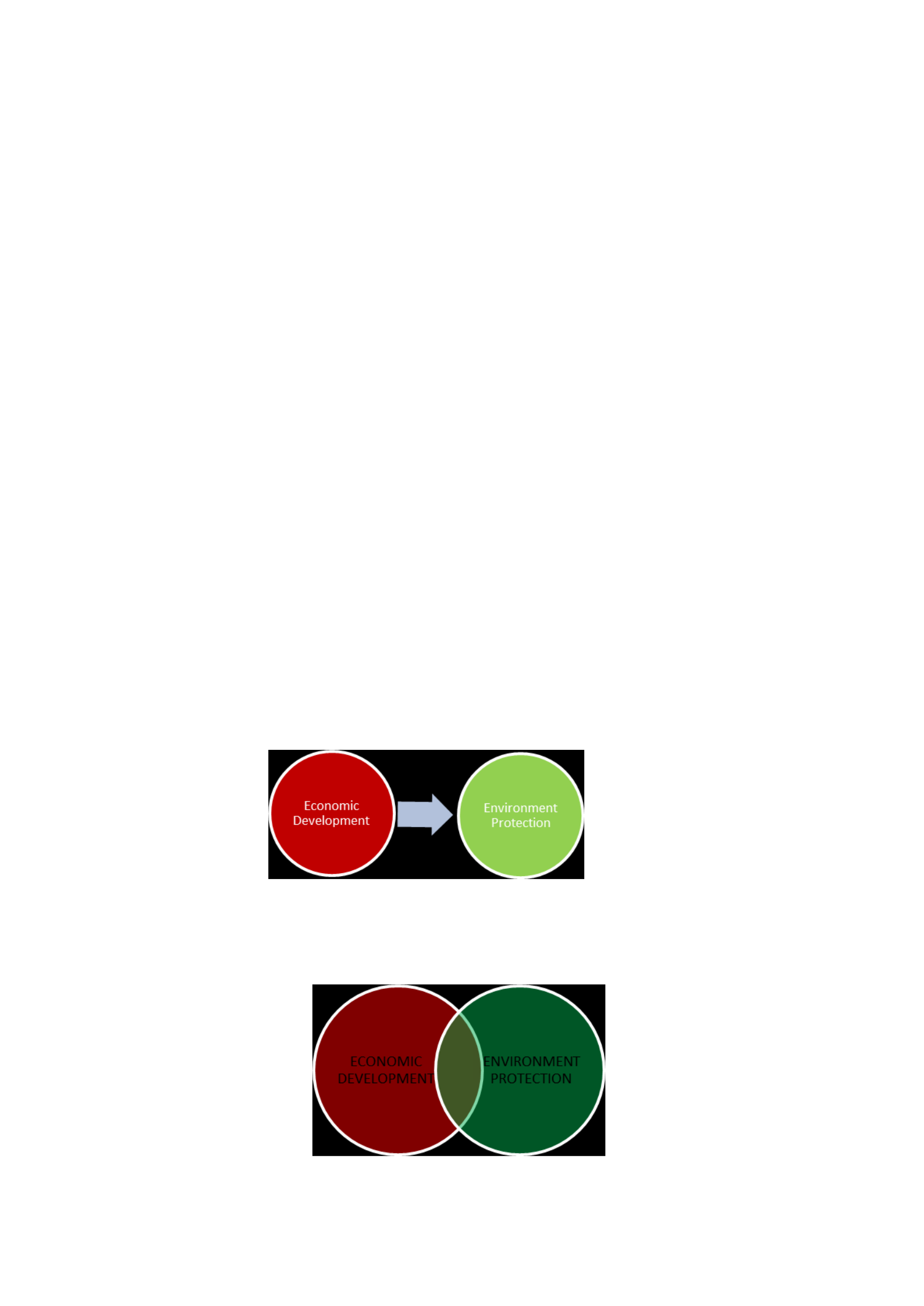
Ehrlich and his wife, Anne Ehrlich (who was not recognized), in 1968. The book
warned of mass human starvation in the 1970s and 1980s due to overpopulation, as
well as social upheaval, and advocated immediate action to limit population growth.
Fears of a widespread "population explosion" in the 1950s and 1960s.
In 1982, the Nairobi World Commission on Environment and Development. One of
the ongoing agendas of this UN meeting was to discuss environmental degradation,
deforestation, soil and water degradation, atmospheric changes - such as depletion of
the ozone layer, increasing concentrations of CO2 gas.
In 1987, the Brundtland report "Our Common Future" stated that sustainable
development is development that meets the needs of the present.
In 1992, the Rio United Nations World Conference on Environment and Development,
discussed the development of ecological sustainability, where at that time the
American President, Ronald Reagen, rejected the agenda because he considered
sustainable development not a solution to the problem, as well as the Australian Prime
Minister, namely John Howard. The countries that agreed to implement the agenda are
Canada, Japan, Europe, From these historical moments, a formulation of sustainable
development emerged, which initially was to pay attention to the needs of the present
and the future, economic development needs to pay attention to the environment or be
wiser and limit the excessive use of natural resources.
Sustainable development is development that meets current needs

Problem Solving to manage the current condition of urban development is SUSTAINABLE
DEVELOPMENT in an awareness of "our common future" by paying attention to
economic needs that pay attention to environmental protection.
Definition of Sustainable City
Based on the above understanding, a sustainable city is a city that has the ability, ability, and
wise thinking to think about current and future needs, and the city is able to support, support
the needs of living things in a system (cover in system), where the development of a
dynamic and significantly growing city certainly requires efficient and effective
management or planning. So that the city physically has a mental awareness to maintain
environmental balance and sustainability of life in it, so that in the end the city is expected to
be socially just and prosperous.
In an ecological context, sustainability is understood as the ability of ecosystems to maintain
and sustain ecological processes, functions, productivity, and diversity into the future
(Wardhono, 2012).
Sustainable cities are cities that are able to meet the needs of the present without ignoring
the needs of future generations, how to repair environmental destruction without sacrificing
the needs of economic development and social justice. The concept of sustainable cities was
launched by the United Nations in June 2012 at the Rio+20 The United Nations Conference
on Sustainable Development. The concept is planned to be disseminated to the world's urban
stakeholders who are responsible for policy-making, planning and implementation of urban
development. Cities that have the ability to drive future growth, but are also able to grow
more efficiently and environmentally friendly.
The concept of environmental balance, related to sustainable cities "ecocity", which is the
development of cities that currently require a type of development that not only pays
attention to the development of the economic side (without the financial and material), but
needs to pay attention to aspects of the development of the quality of human life in it
(Richard Register, 1987). Then in the Research Triangle Institute (1996) the City must be
able to have five basic principles in the concept of sustainability, namely: Environmental
(Ecology), Economy (Employment), Society (Equity), Engagement and Energy. In its
application, the five elements must be able to run simultaneously, development inequality
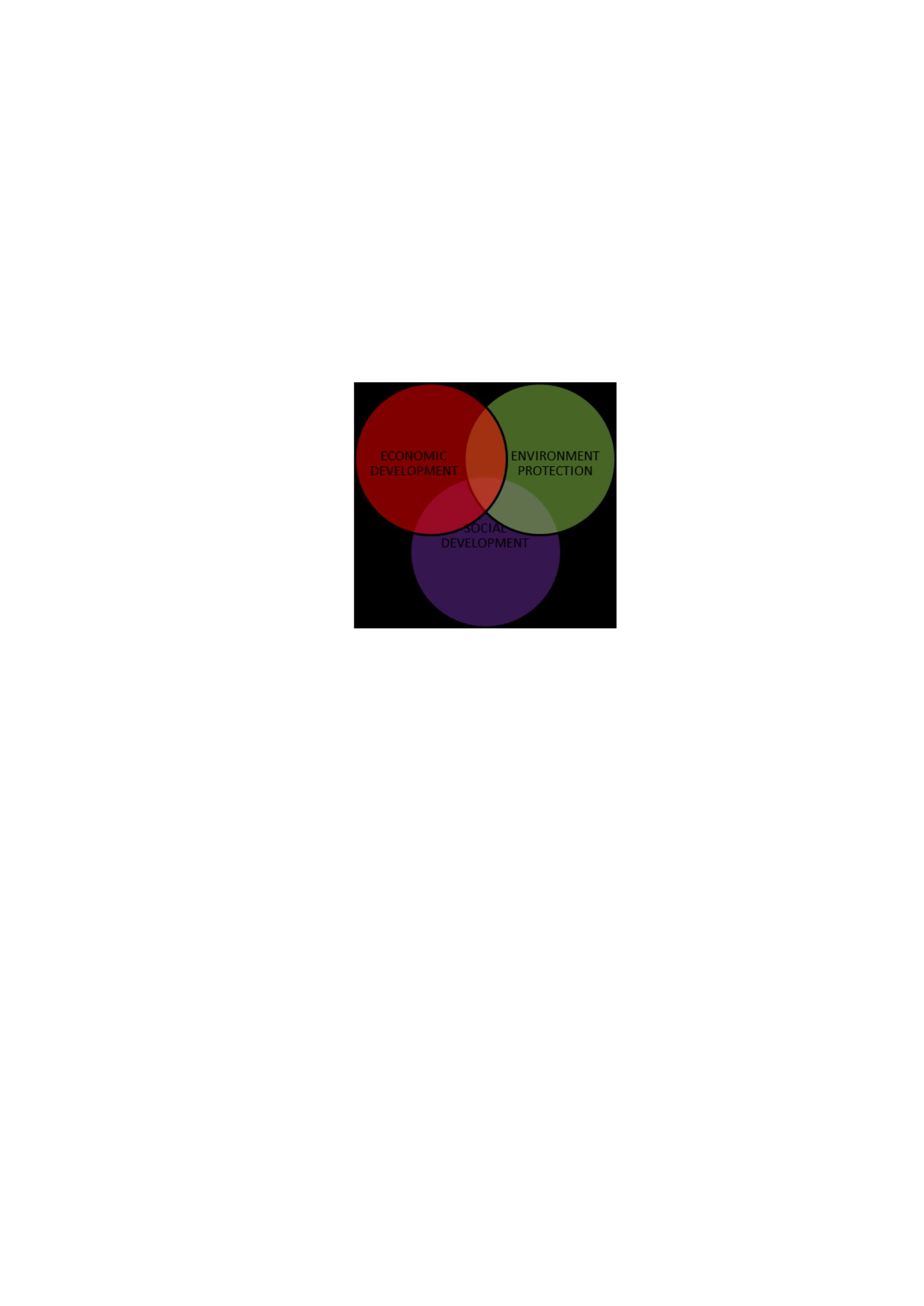
will occur if the development of each element is uneven (Budihardjo and Sujarto, 1999).
Furthermore, the concept of sustainable cities according to Rogers (1998), must recognize
that cities need to meet social, environmental, political and cultural as well as economic and
physical goals. Rogers elaborated by including these keywords, such a city also pays
attention to aspects of beauty in art and architecture, creativity to optimize human potential,
resource efficiency and minimal ecological impact, ease of contact, mobility, integrated and
compact communities and diversity.
"SIMULTAN"
Sustainable development needs to be implemented "SIMULTANEOUSLY"
Sustainable Urban Planning Strategies
Based on the above review, the consideration to protect the environmental conditions that
are decreasing in quality, and the population explosion, then automatically the needs of
human life increase. Therefore, to carry out a sustainable urban development strategy, which
is carried out "Simultaneously" by combining the 4 (four) dimensions, namely: planning
that considers "economic development, by protecting the environment", and paying attention
to "social development", and the need for "Government" management as a regulatory
function and providing infrastructure.
Urban planning, of course, can never wait, because human affairs go on and their direction is
determined by the degree of planning. Realizing a real city that is sustainable is to open a
broad view that every city has housing, high-rise buildings, urban alleys, parks, people's
homes. We see how they live, how their children will become citizens and neighbors of their
children and generations. It is this view that gives direction to the city of the future, a city

that is comfortable to live in for every generation, serves human needs, and directs the
means to shape the urban environment.
Sustainable development in social capital can grow at the individual, family, community,
local community, society in a region, national, and even global levels. Community-level
social capital cannot be measured simply as an aggregation of individual networks. Strong
community-level social capital creates a "civic infrastructure" that will support formal and
informal decision-making processes and public engagement (Potapchuck et.al. 1997).
Individual social capital is closely related to human capital. When individuals invest in
being able to communicate well, they increase their social capital but reduce the social
capital of the community. Determinants of social capital can also include economic and
political instability, patron-client relationships, education, occupation, collective interest and
market legitimization of common values. Social capital can lower the costs of cooperation
and facilitate cooperation. To build social capital effectively, local governments must share
autonomy/roles with their communities, in the sense that they must shift from being
controllers, regulators and providers, to catalysts, conveners and facilitators (Crocker et al.
1998).
The issue of weak state capacity in developing countries, characterized by the inability to
carry out development, has become a hot topic discussed by experts. Theories of
government failure characterized by a "top-down" approach, as well as social capital theory
characterized by a "bottom-up" approach, both provide a framework that underlies the basic
framework for identifying the symptoms of "state incapacity" (Sallis and Dollery, 2001).
The government's role in implementing sustainable urban development is to have a
sustainable-minded leadership spirit so that the dynamic development of the city can be
managed effectively without incurring large costs.
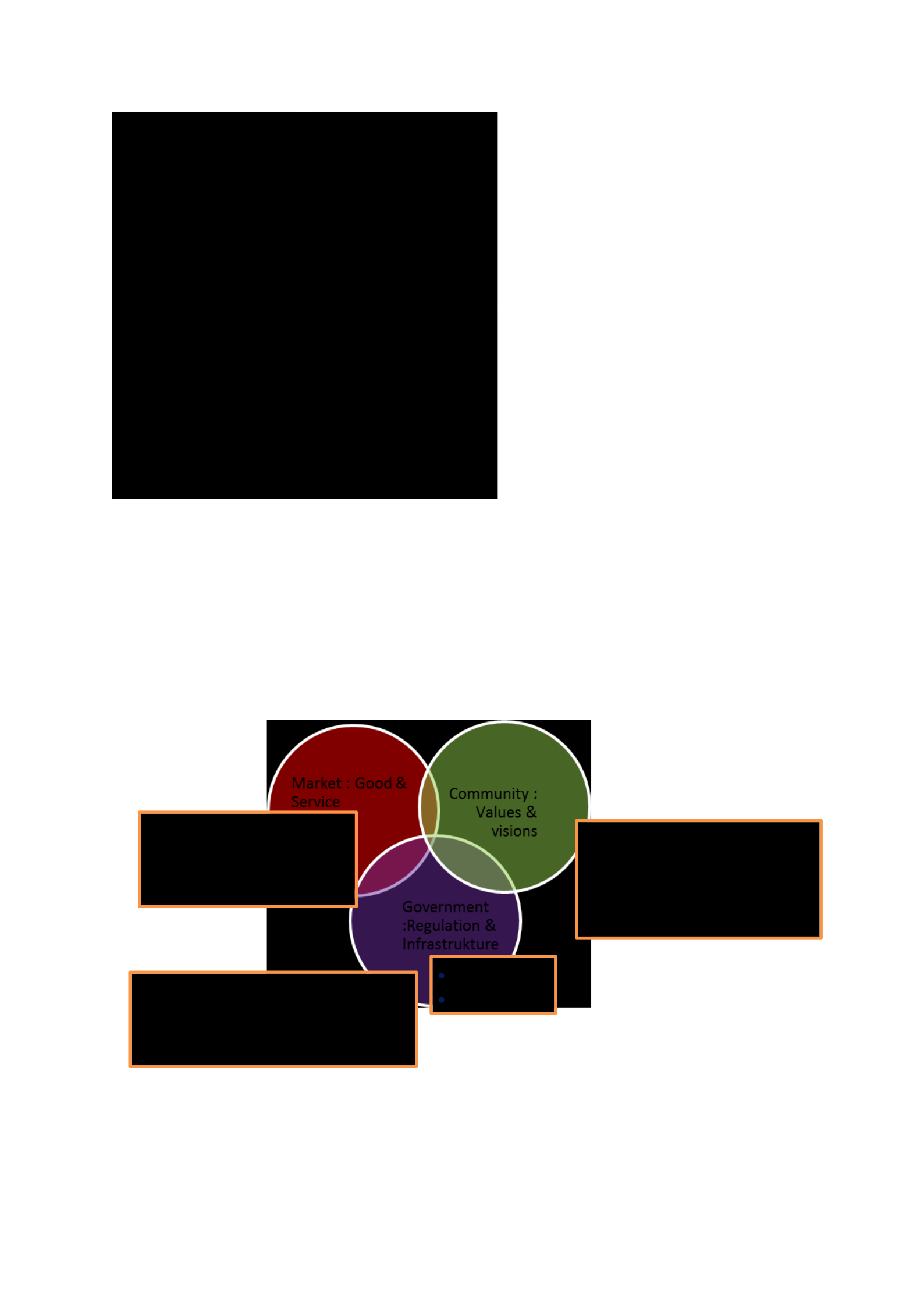
Time regulation:
Short-term Development:
INFRASTRUCTURE (time prime 10
years. MARKET (time prime 6 years)
LEADERSHIP
INNOVATION
In the direction of the
Community: Long term, it can
help and encourage the
community to improve their
quality of life.
The market has "POWER"
and for the Commitment to
be SUSTAINABLE then
Awareness required
Sustainable City Development Concept in 4 (four) Sectoral Dimensions
One of the strategies for sustainable urban development is that the government as a
development manager must have leadership, and innovation. The development program has
the concept of short term and long term development, both concepts support each other in
order to achieve a vision of sustainable urban development.
Sustainable Urban Development Strategy
"SUSTAINABLE"
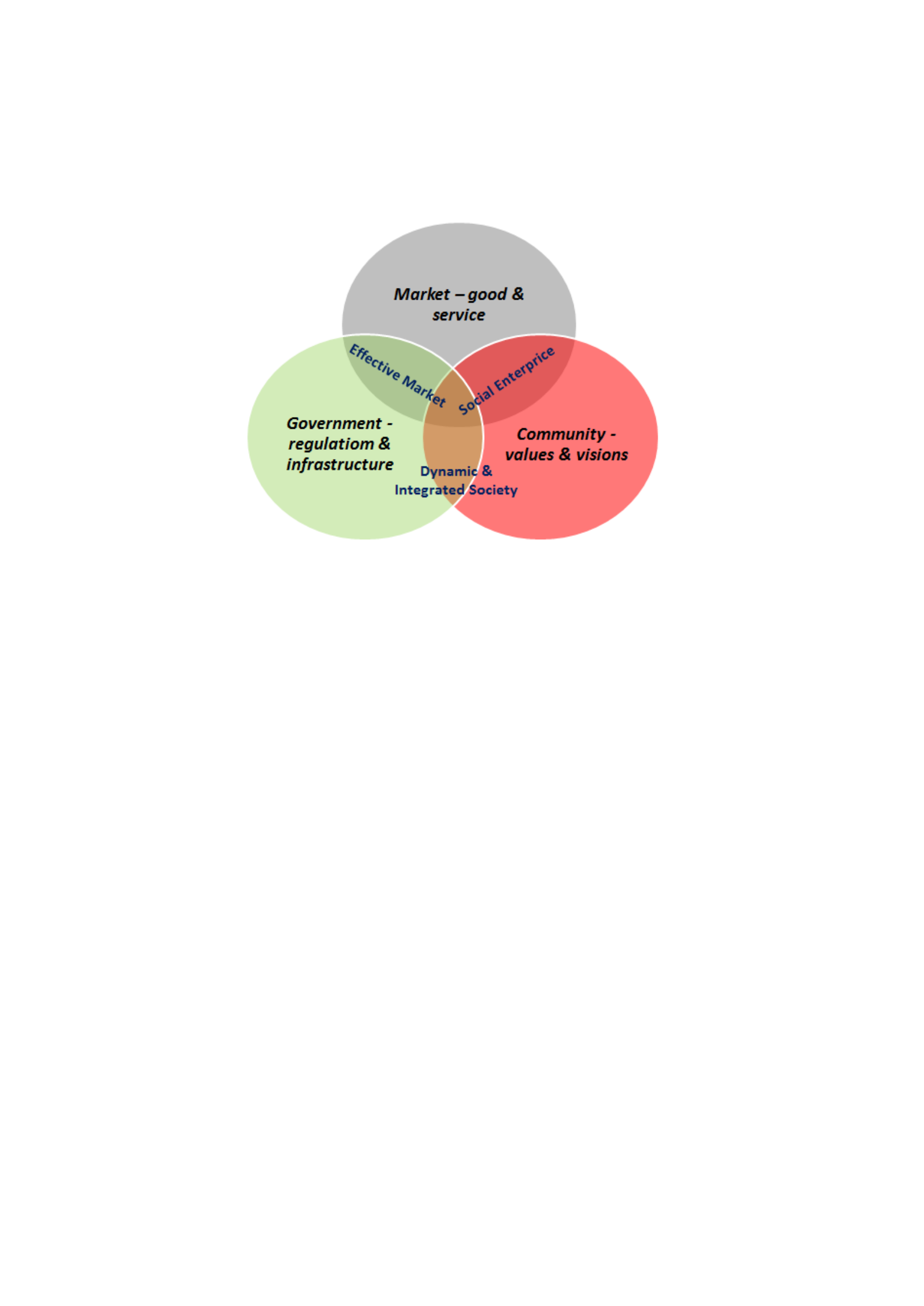
One example of an innovative leader is being able to make sustainable city breakthroughs
such as Cities with Solar panels, Cities with Smart City, and movements to change the urban
environment to be more environmentally friendly.
Figure 8. Sectoral dimensions that simultaneously produce something that is Integrity
The above principle illustrates a sectoral dimension, namely social, economic, and
environmental, into a development that cooperates with each other to maintain balance, it
will produce an effective market regulation, and social enterprice economic development
with attention to the environment will produce a good social community value as well. The
principle of sustainable development is one example:
Settlement: sustainable urban development recognizes the earth can only
adjust to a more balanced state if settlements "reduce their ecological
footprint" while they "simultaneously" improve their quality of life. In this
case, reducing the "ecological" footprint means reducing the use of materials
and energy that produce excessive CO2), while simultaneously it means
paying attention to providing healthy settlements, providing jobs, and
designing with social communities in mind.
Place-making: sustainability that recognizes the significance and diversity of
communities and regions for earth stewardship (cultured buildings,
landscaping, sculpture, and attention to biodiversity for future generations).
Net-Benefit: Sustainability that addresses the extraction of non-renewable
resources, providing net environmental social and economic benefits for
future generations. Reduce the impact and maintain the environmental

sustainability of irresponsible agencies.
The principles and enforcement of sustainable cities are expected to pay more attention to
humanity, more humane. Returning to the essence of the city itself is formed from human
needs. The relationship between the city, formed from humans and the environment, related
to the city is a system that cannot be separated from spatial planning, why because cities are
formed as a result of natural processes and social processes, human activities as creatures
that utilize natural resources also have tendencies that are patterned and spatially structured.
According to Rustiadi, et al (2011), human spatial instincts are natural and the result of long
"learning" experiences, so that they get typical spatial patterns, for example in the layout of
residential houses, public spaces (gathering places), yards, fields, rice fields, and so on. The
regularity of the spatial configuration of the community's socio-economic activities or
patterns of space utilization are always found in every community's economy or patterns of
space utilization are always found in every community's life in maintaining its life, adjusting
to the environment, optimizing efforts to utilize natural resources, optimizing social
interactions, as well as forms of cultural expression. The interaction between humans and
the environment requires humans to provide various infrastructure to facilitate access and
manage these resources.
The philosophy of sustainable urban planning is to meet the needs of society, the needs of
generations, and the needs of the economy, which is socially just where the goal is to
prevent unwanted changes, create balance and sustainable development. The beginning of
the process of sustainable urban planning starts with the need to make changes for the better
(welfare, natural disasters, social development, etc.).
Some Countries That Implement Sustainable Urban Development
Learning from other countries, about how to build a vision of a sustainable city and how to
implement it, certainly adds insight into managing a city, even though the cases and
problems are different. Consistency to build a sustainable city vision starts from the
creativity of a leader and building awareness of its citizens. The following is an explanation
of the table below:

Table 3. Countries in the Vision of a Sustainable City
STATE
CITY DESCRIPTION
Singapore
As a small and densely populated island nation with no natural resources,
Singapore's own sustainable development experience has focused on four
key areas, namely, (1) Building a sustainable economy; (2) creating a
sustainable living environment; (3) ensuring sustainable development for
our people; and (4) contributing to international collaboration.
•
Singapore is the 20th most carbon-efficient country in the world
•
Integrated transportation, MRT, BUS., pedestrian way
•
Since the 1970s, economic development has helped lift billions of people
out of poverty. Social indices of human development such as health and
education have improved significantly.
•
Despite not having natural resources, Singapore manages its human
resources more carefully.
•
Singapore plans to introduce a carbon tax from 2019, so those who emit
the most carbon will bear the cost to our environment and be encouraged to
reduce their emissions.
•
Give prizes to residents whose houses are energy efficient, tax discounts

•
A generation of pioneers, with a vision for a clean, green and sustainable
Singapore for all Singaporeans. Instilling the awareness that this little
island is all we have, and we must take good care of it.
•
Over the past 50 years, saw major improvements in housing, water, public
health and sanitation. Provides a City in Parks with about 47 percent green
cover in Singapore. More than 80 percent of households are within a 10-
minute walk of a park.
•
It has 72 hectares of green roof gardens and walls today, and aims to
double that by 2030.
Curitiba,
Brazil
•
Curitiba, is the world's first sustainable city. In 1971, architect Jaime
Lerner was elected mayor for the first of three terms, and came up with
innovative and creative solutions that saw Curitiba undergo a remarkable
evolution.
•
The greenest city, with more than 50 M2 of green space per capita, much
more than the UN recommendation. The reason why there is so much green
space is that Lerner had to find a solution to the frequent flooding that
occurred due to the geographical position of the city, so Lerner created a
large green belt around the city, which has turned into a large habitat for
many plants and animals. These large green areas are maintained by sheep
and goats and the wool they produce is sold to finance social development
in the city.
•
About 60% of people rely on the bus network in the city, efficiency for the
light rail system with dedicated lanes.
•
The city of Curitiba is a wonderful example of what creative leaders dare
and do, to make a city truly serve its residents rather than create stress,
congestion and inequality among its residents.
•
Implement a simple Bus transportation system, by dividing 5 arterial traffic
roads.
•
There are 28 parks and forest areas in Curitiba, creating an urban landscape
unlike any other developing city. The city's parks are designed to be
connected rather than isolated to maximize usage. The park was designed
by Hitoshi Nakamura.
•
The parks also stop squatters from creating shanty towns in flood-prone

zones.
•
Curitiba has 4 times the recommended green space, using sheep to "mow"
some of the grass in the parks.
By examining two countries, namely: Singapore and Curitiba, it is expected to increase
knowledge about "sustainable cities", where sustainable development focuses on human
resources, social justice, creating spatial equality.
Conclusions
Based on the sources of sustainable city references, it can be concluded that a sustainable
city is a city that is able to meet the NEEDS of the present without ignoring the NEEDS of
future GENERATIONS, how to REPAIR ENVIRONMENTAL DAMAGE without
sacrificing the NEEDS of ECONOMIC DEVELOPMENT and SOCIAL JUSTICE.
Building a sustainable city also takes into account 4 dimensions, namely SOCIAL
DIMENSION, ECONOMIC DIMENSION, ENVIRONMENTAL DIMENSION, and

GOVERNMENT DIMENSION. These four things Side by side, the success of sustainable
development does not only depend on the economic dimension but needs the intervention of
the power holder or in this case the government dimension, in order to implement
sustainable development so as to achieve equitable distribution of welfare. Therefore,
sustainable development is oriented towards the development of Green Cities that have a
good quality of life and conducive environmental conditions.
Problems
Urban growth is a complex phenomenon, partly spontaneous and partly planned. There have
been several attempts to manage that complexity. Ideas such as building sustainable cities,
resulting in better urban environments that meet people's needs, have fewer socio-economic
costs, and use less nature.
Based on the explanation above, the problem about the city is that when some of the cities
develop spontaneously (sprawl), the population increases, the development of urban areas
and land clearing occurs which changes the function of productive areas of paddy land into
new residential / residential areas, forest conversion into agricultural / plantation land.
Furthermore, the urbanization process also creates socio-economic problems for cities,
forming slum areas that have low income in the city, resulting in crime in urban spaces.
These problems represent urban development that does not take into account the quality of
human life. The congestion of cities such as Jakarta and other large cities, due to poorly
integrated public transportation systems. The earth's temperature is getting hotter due to
CO2 emissions from various human activities on earth such as motor gas air pollution,
greenhouse effect, building materials, and flooding in urban areas, and so on.
Based on the problems mentioned above, the world's cities consume three-quarters of the
world's energy and cause three-quarters of global pollution and cities have become parasitic
ehuge organisms that can drain the earth for food due to excessive energy consumption:
relentless consumers, relentless polluters. So that over time the city system becomes
unstable, resilience and capacity are not high enough, and it is likely that the city will
collapse (colappse). With the phenomena of environmental degradation and rising
temperatures, humans are no longer comfortable in their habitats (Roger, 1998 and Egger
2006).

Cities are the drivers of future growth, but also the biggest contributors to CO2 emissions.
So that a concept that pays attention to environmental balance is needed, namely the concept
of sustainable development. The concept of sustainable development has been widely
developed into the theoretical foundations of sustainable cities. City references and
applicative applications of sustainable urban development are easy to find, both in various
methods and paradigms. The dream of an ideal future city concept in the book "Garden City
of to-morrow" written by Ebenezer Howard (1898), invited controversy, became utopias,
considered irrelevant, unreasonable, and due to this irrelevance, the concept of Garden City
of to-morrow Ebenezer Howard is not widely used, only natural and natural concepts are
widely taken by urban planners, the rest is just a historical record. Twentieth-century urban
planners had a variety of new concepts in planning their cities from the initial idea of a
dream of a sustainable city that had become our common future.
Objectives and Benefits
Based on the above background and problems, the author sees the need to conduct a
theoretical study to better understand the concept of sustainable development in the four
dimensions of sustainable development, namely environmental, social, and economic, and
government. about the meaning and scope as a source of knowledge for the community
(students, academics, and practitioners) while strengthening the body knowledge of
architecture. The results of this paper are expected to be able to provide a deeper
understanding for students, and practitioners, to understand architecture and cities, becoming
a provision in the practice of architecture and planning science.
Writing Method
This research is a literature research to explore the understanding, meaning and scope of the
concept of a sustainable city. Various thoughts about the concept of a sustainable city can be
used as supporting data in this writing. The search for data and information through
documents, both in the form of written documents, photographs, images, and electronic
documents that can support the research process. Research results will also be more credible
if supported by photographs or existing academic and artistic papers (Sugiyono, 2005: 83).
Therefore, literature study can affect the credibility of the results of the research conducted.
Sustainable Cities And Their Development

Cities and their Development
Before understanding more about sustainable cities, it is necessary to know what the
definition of a city, its equivalents, differences, and scale are.
When the philosophy of science developed towards modern thinking. Humanist thinking
was influenced by the views of Karl Marx, Immanuel Kant, and Max Weber, the most
influential of whom was the Spirit of Capitalism (1905). So the city is a place where most of
its economic needs are in the local market, the characteristics of the city are the existence of
a market as a fortress and has a legal system and is cosmopolitan. When the city develops, as
a place to live, a place to produce goods and services, the scale of services develops, there is
a concentration of population, with high density. A small city to a megacity is said to have a
population of 20,000 to 5,000,000.
There are three opinions, namely; Max Weber (1905), Hamilton (2001), Steve Egger (2006),
defining the city basically is to accommodate human needs, community needs, and
economic needs. If we go back to Maslow's (1943) theory in "The Theory Of Human
Motivation" about the Hierarchy of human needs, namely basic needs are elements needed
by humans in maintaining balance both physiologically and psychologically which aims to
maintain life and health. Hierarchy (1) Physiological Needs or Faal Needs (physiological
needs): the right to get oxygen, food, sleep (human self-activity), (2) Safety, security needs:
Protection, (3) Love needs (social needs): social interaction life, (4) Esteem needs EGO
ownership (esteem needs), and (5) Self-actualization (self- actualization needs): recognition
appreciated, social status.
Cities are formed from human needs, to serve (Hamilton, 2001) from the hierarchy of human
needs, spatial formation of community expression (Steve Egger, 2006) makes the city
formed in a network or a system of community expression. As a result of such a system,
cities require management, governance, trade, culture, education, and society, to facilitate an
environment for human existence and interaction (Egger, 2006).
From the various opinions above, it can be concluded that the realization of the city is to
accommodate human needs, and when the city is growing dynamically, the city becomes a
network that is intertwined in a unified system, so that a city requires serious management
based on the scale of services, if not managed, social, economic, and environmental

problems then the city experiences collapse and crisis. A good city is one that responds to
the various problems that occur in the city, and thinks about survival and sustainability.
Sustainability
The definition of sustainability (continue) according to the Big United States Dictionary
(KBBI) is sustainable; and continuously. "Sustain": (1) strengthen or support physically or
mentally, (2) undergo or suffer (something unpleasant, especially an injury), (3) uphold,
affirm, or confirm the justice or validity of, in United States translation "sustain" is
menopang. The definition of sustain here is being able to endure, sustain, support, sustain,
experience, continue, suffer, prolong, and enable. As for the translation of "ability": (1)
possession of the means or skill to do something, (2) talent, skill, or proficiency in a
particular area, in United States translation is ability, capability, talent, ability, proficiency,
cleverness, wisdom, shrewdness, and dexterity.
Sustainable Cities
History of Sustainable Urban Development
To understand what "sustainability" is, and why there is an agreement on sustainable
development. It is therefore necessary to trace a history of the birth of the idea of sustainable
urban development.
In 1972, the Stockholm UN World Conference on Human Environment: UN
Conference on Human Environment (June 5-6, 1972): the focus was on discussing
guidelines and actions in dealing with environmental problems, such as alleviating
poverty, and protecting the environment.
Paul Ehrlich, a Stanford University Professor of Biology, who wrote a book titled
"Population Bomb": was a bestseller written by Stanford University Professor Paul R.
Ehrlich and his wife, Anne Ehrlich (who was not recognized), in 1968. The book
warned of mass human starvation in the 1970s and 1980s due to overpopulation, as
well as social upheaval, and advocated immediate action to limit population growth.
Fears of a widespread "population explosion" in the 1950s and 1960s.
In 1982, the Nairobi World Commission on Environment and Development. One of
the ongoing agendas of this UN meeting was to discuss environmental degradation,
deforestation, soil and water degradation, atmospheric changes - such as depletion of
the ozone layer, increasing concentrations of CO2 gas.
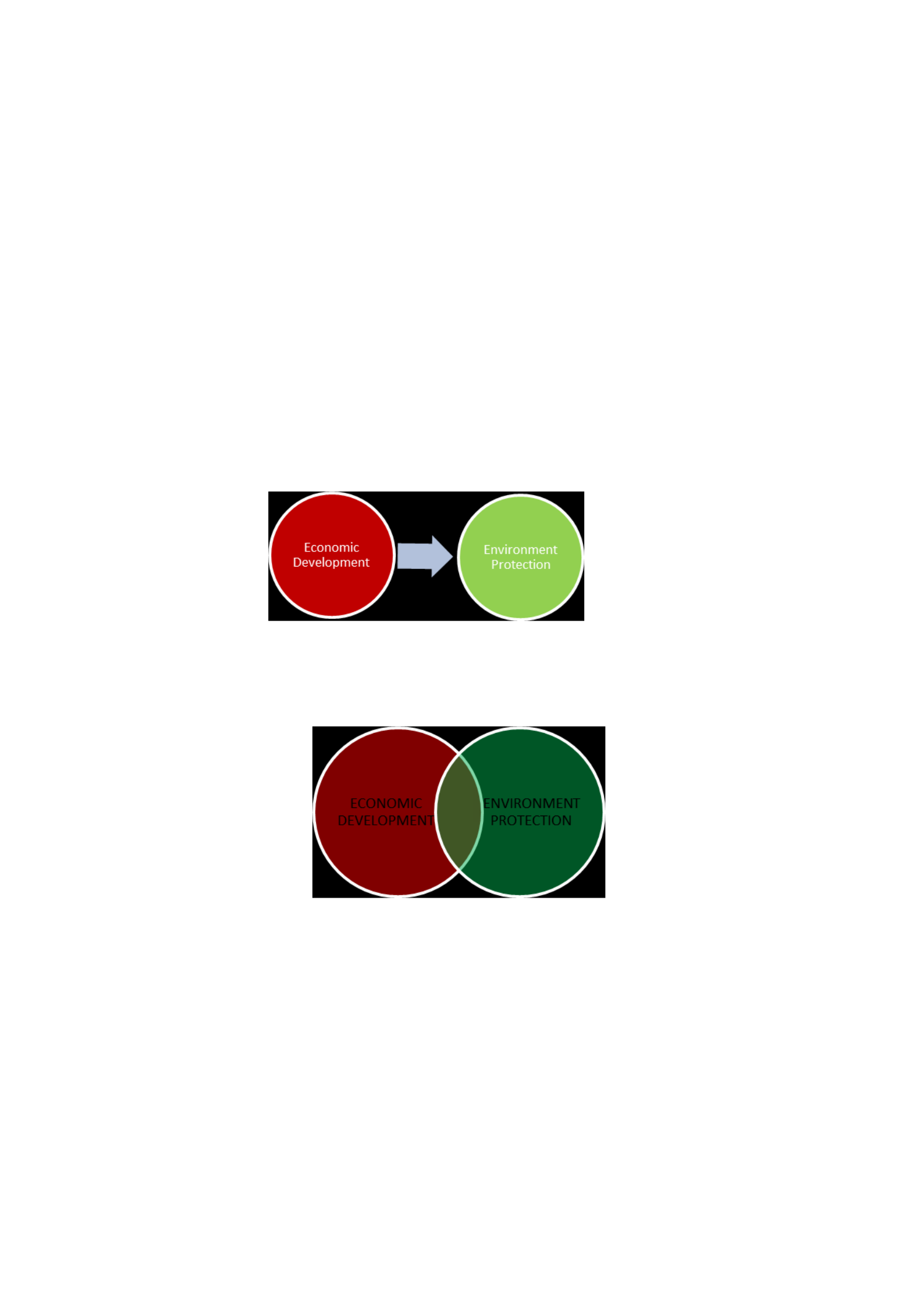
In 1987, the Brundtland report "Our Common Future" stated that sustainable
development is development that meets the needs of the present.
In 1992, the Rio United Nations World Conference on Environment and Development,
discussed the development of ecological sustainability, where at that time the
American President, Ronald Reagen, rejected the agenda because he considered
sustainable development not a solution to the problem, as well as the Australian Prime
Minister, namely John Howard. The countries that agreed to implement the agenda are
Canada, Japan, Europe, From these historical moments, a formulation of sustainable
development emerged, which initially was to pay attention to the needs of the present
and the future, economic development needs to pay attention to the environment or be
wiser and limit the excessive use of natural resources.
Sustainable development is development that meets current needs
Problem Solving to manage the current condition of urban development is SUSTAINABLE
DEVELOPMENT in an awareness of "our common future" by paying attention to
economic needs that pay attention to environmental protection.
Definition of Sustainable City
Based on the above understanding, a sustainable city is a city that has the ability, ability, and
wise thinking to think about current and future needs, and the city is able to support, support
the needs of living things in a system (cover in system), where the development of a

dynamic and significantly growing city certainly requires efficient and effective
management or planning. So that the city physically has a mental awareness to maintain
environmental balance and sustainability of life in it, so that in the end the city is expected to
be socially just and prosperous.
In an ecological context, sustainability is understood as the ability of ecosystems to maintain
and sustain ecological processes, functions, productivity, and diversity into the future
(Wardhono, 2012).
Sustainable cities are cities that are able to meet the needs of the present without ignoring
the needs of future generations, how to repair environmental destruction without sacrificing
the needs of economic development and social justice. The concept of sustainable cities was
launched by the United Nations in June 2012 at the Rio+20 The United Nations Conference
on Sustainable Development. The concept is planned to be disseminated to the world's urban
stakeholders who are responsible for policy-making, planning and implementation of urban
development. Cities that have the ability to drive future growth, but are also able to grow
more efficiently and environmentally friendly.
The concept of environmental balance, related to sustainable cities "ecocity", which is the
development of cities that currently require a type of development that not only pays
attention to the development of the economic side (without the financial and material), but
needs to pay attention to aspects of the development of the quality of human life in it
(Richard Register, 1987). Then in the Research Triangle Institute (1996) the City must be
able to have five basic principles in the concept of sustainability, namely: Environmental
(Ecology), Economy (Employment), Society (Equity), Engagement and Energy. In its
application, the five elements must be able to run simultaneously, development inequality
will occur if the development of each element is uneven (Budihardjo and Sujarto, 1999).
Furthermore, the concept of sustainable cities according to Rogers (1998), must recognize
that cities need to meet social, environmental, political and cultural as well as economic and
physical goals. Rogers elaborated by including these keywords, such a city also pays
attention to aspects of beauty in art and architecture, creativity to optimize human potential,
resource efficiency and minimal ecological impact, ease of contact, mobility, integrated and
compact communities and diversity.
"SIMULTAN"
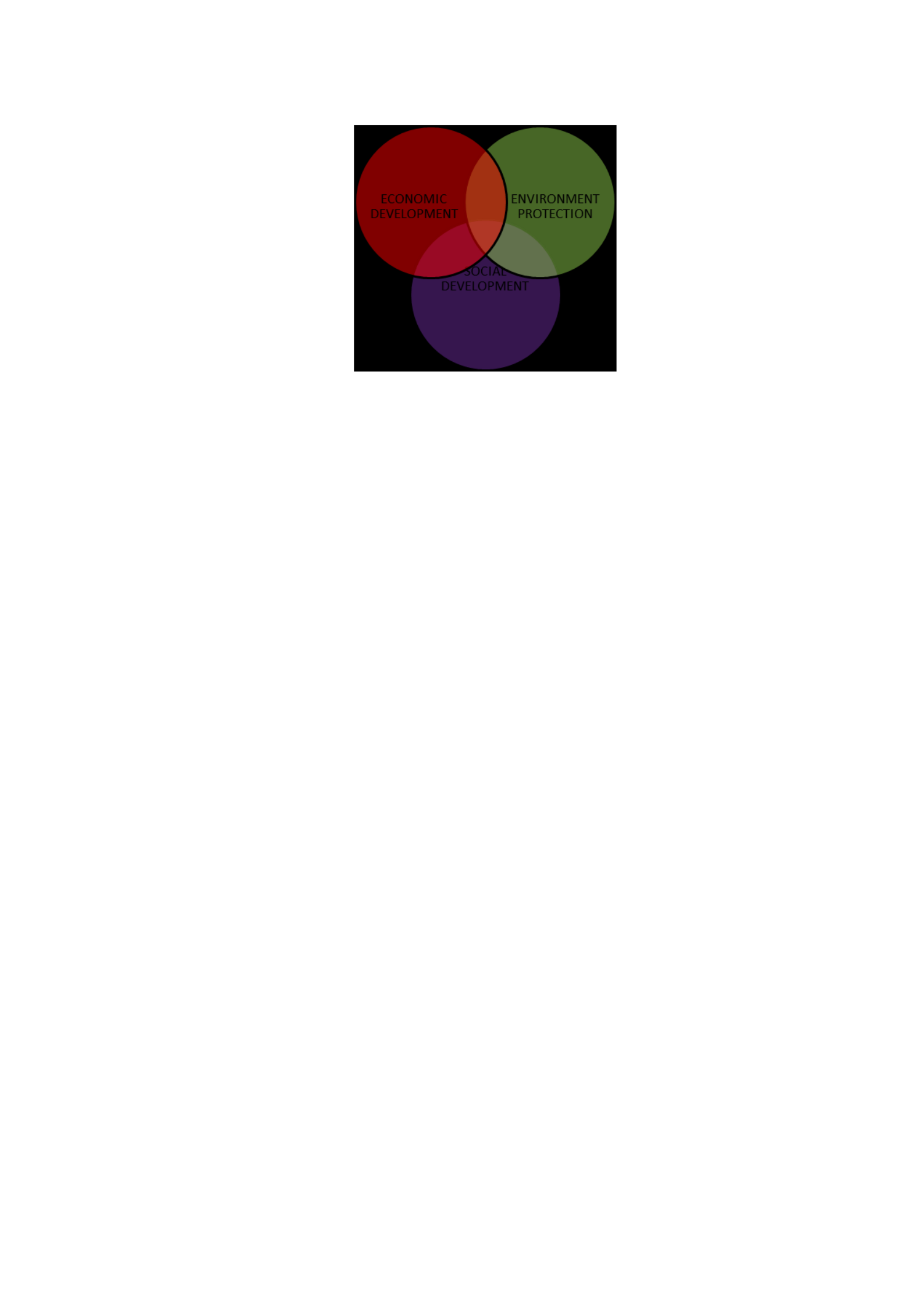
Sustainable development needs to be implemented "SIMULTANEOUSLY"
Sustainable Urban Planning Strategies
Based on the above review, the consideration to protect the environmental conditions that
are decreasing in quality, and the population explosion, then automatically the needs of
human life increase. Therefore, to carry out a sustainable urban development strategy, which
is carried out "Simultaneously" by combining the 4 (four) dimensions, namely: planning
that considers "economic development, by protecting the environment", and paying attention
to "social development", and the need for "Government" management as a regulatory
function and providing infrastructure.
Urban planning, of course, can never wait, because human affairs go on and their direction is
determined by the degree of planning. Realizing a real city that is sustainable is to open a
broad view that every city has housing, high-rise buildings, urban alleys, parks, people's
homes. We see how they live, how their children will become citizens and neighbors of their
children and generations. It is this view that gives direction to the city of the future, a city
that is comfortable to live in for every generation, serves human needs, and directs the
means to shape the urban environment.
Sustainable development in social capital can grow at the individual, family, community,
local community, society in a region, national, and even global levels. Community-level
social capital cannot be measured simply as an aggregation of individual networks. Strong
community-level social capital creates a "civic infrastructure" that will support formal and
informal decision-making processes and public engagement (Potapchuck et.al. 1997).

Individual social capital is closely related to human capital. When individuals invest in
being able to communicate well, they increase their social capital but reduce the social
capital of the community. Determinants of social capital can also include economic and
political instability, patron-client relationships, education, occupation, collective interest and
market legitimization of common values. Social capital can lower the costs of cooperation
and facilitate cooperation. To build social capital effectively, local governments must share
autonomy/roles with their communities, in the sense that they must shift from being
controllers, regulators and providers, to catalysts, conveners and facilitators (Crocker et al.
1998).
The issue of weak state capacity in developing countries, characterized by the inability to
carry out development, has become a hot topic discussed by experts. Theories of
government failure characterized by a "top-down" approach, as well as social capital theory
characterized by a "bottom-up" approach, both provide a framework that underlies the basic
framework for identifying the symptoms of "state incapacity" (Sallis and Dollery, 2001).
The government's role in implementing sustainable urban development is to have a
sustainable-minded leadership spirit so that the dynamic development of the city can be
managed effectively without incurring large costs.
Sustainable City Development Concept in 4 (four) Sectoral Dimensions
"SUSTAINABLE"
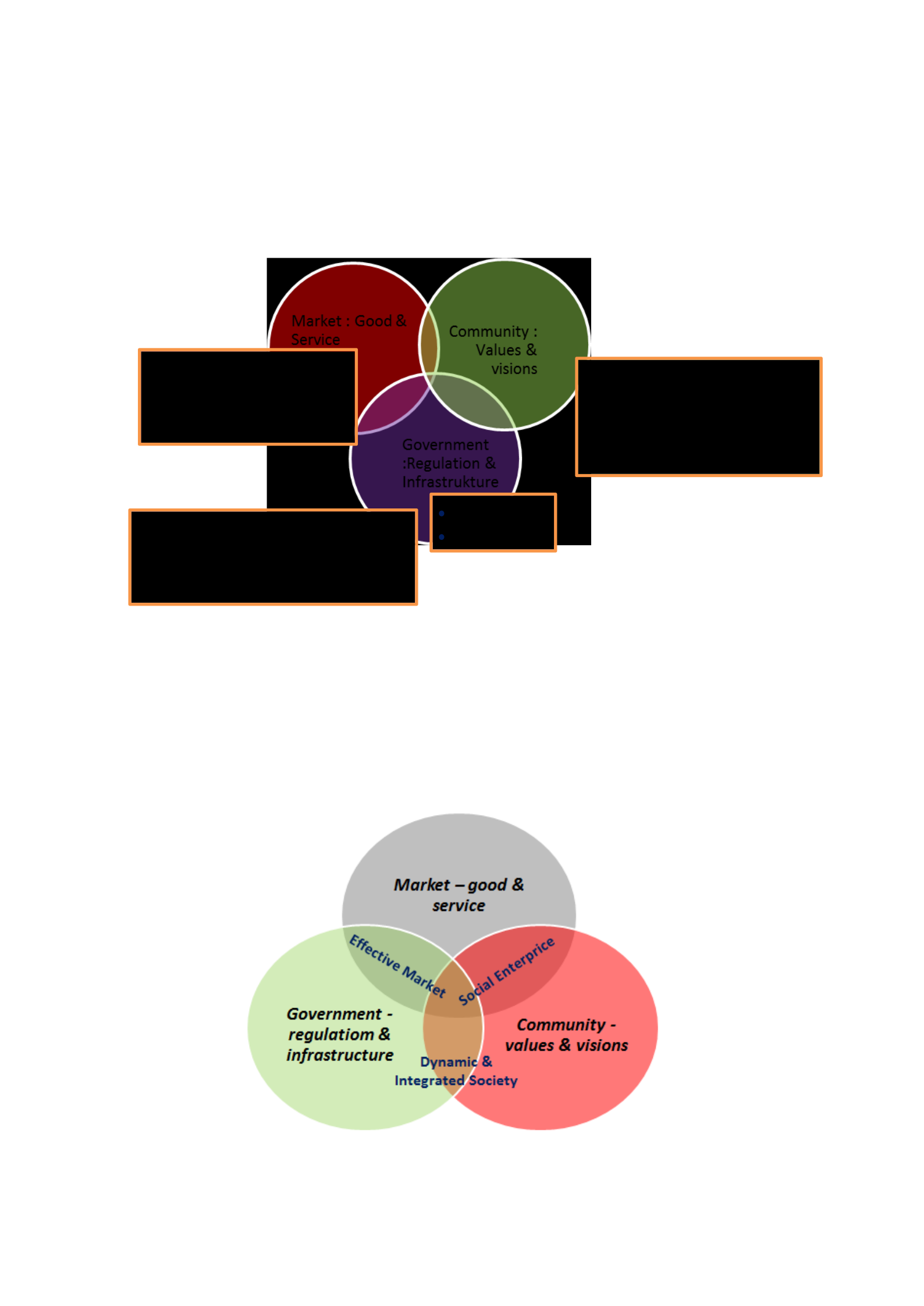
Time regulation:
Short-term Development:
INFRASTRUCTURE (time prime 10
years. MARKET (time prime 6 years)
LEADERSHIP
INNOVATION
In the direction of the
Community: Long term, it can
help and encourage the
community to improve their
quality of life.
The market has "POWER"
and for the Commitment to
be SUSTAINABLE then
Awareness required
One of the strategies for sustainable urban development is that the government as a
development manager must have leadership, and innovation. The development program has
the concept of short term and long term development, both concepts support each other in
order to achieve a vision of sustainable urban development.
Sustainable Urban Development Strategy
One example of an innovative leader is being able to make sustainable city breakthroughs
such as Cities with Solar panels, Cities with Smart City, and movements to change the urban
environment to be more environmentally friendly.
Figure 8. Sectoral dimensions that simultaneously produce something that is Integrity

The above principle illustrates a sectoral dimension, namely social, economic, and
environmental, into a development that cooperates with each other to maintain balance, it
will produce an effective market regulation, and social enterprice economic development
with attention to the environment will produce a good social community value as well. The
principle of sustainable development is one example:
Settlement: sustainable urban development recognizes the earth can only
adjust to a more balanced state if settlements "reduce their ecological
footprint" while they "simultaneously" improve their quality of life. In this
case, reducing the "ecological" footprint means reducing the use of materials
and energy that produce excessive CO2), while simultaneously it means
paying attention to providing healthy settlements, providing jobs, and
designing with social communities in mind.
Place-making: sustainability that recognizes the significance and diversity of
communities and regions for earth stewardship (cultured buildings,
landscaping, sculpture, and attention to biodiversity for future generations).
Net-Benefit: Sustainability that addresses the extraction of non-renewable
resources, providing net environmental social and economic benefits for
future generations. Reduce the impact and maintain the environmental
sustainability of irresponsible agencies.
The principles and enforcement of sustainable cities are expected to pay more attention to
humanity, more humane. Returning to the essence of the city itself is formed from human
needs. The relationship between the city, formed from humans and the environment, related
to the city is a system that cannot be separated from spatial planning, why because cities are
formed as a result of natural processes and social processes, human activities as creatures
that utilize natural resources also have tendencies that are patterned and spatially structured.
According to Rustiadi, et al (2011), human spatial instincts are natural and the result of long
"learning" experiences, so that they get typical spatial patterns, for example in the layout of
residential houses, public spaces (gathering places), yards, fields, rice fields, and so on. The
regularity of the spatial configuration of the community's socio-economic activities or
patterns of space utilization are always found in every community's economy or patterns of
space utilization are always found in every community's life in maintaining its life, adjusting
to the environment, optimizing efforts to utilize natural resources, optimizing social

interactions, as well as forms of cultural expression. The interaction between humans and
the environment requires humans to provide various infrastructure to facilitate access and
manage these resources.
The philosophy of sustainable urban planning is to meet the needs of society, the needs of
generations, and the needs of the economy, which is socially just where the goal is to
prevent unwanted changes, create balance and sustainable development. The beginning of
the process of sustainable urban planning starts with the need to make changes for the better
(welfare, natural disasters, social development, etc.).
Some Countries That Implement Sustainable Urban Development
Learning from other countries, about how to build a vision of a sustainable city and how to
implement it, certainly adds insight into managing a city, even though the cases and
problems are different. Consistency to build a sustainable city vision starts from the
creativity of a leader and building awareness of its citizens. The following is an explanation
of the table below:
Table 3. Countries in the Vision of a Sustainable City

STATE
CITY DESCRIPTION
Singapore
As a small and densely populated island nation with no natural resources,
Singapore's own sustainable development experience has focused on four
key areas, namely, (1) Building a sustainable economy; (2) creating a
sustainable living environment; (3) ensuring sustainable development for
our people; and (4) contributing to international collaboration.
•
Singapore is the 20th most carbon-efficient country in the world
•
Integrated transportation, MRT, BUS., pedestrian way
•
Since the 1970s, economic development has helped lift billions of people
out of poverty. Social indices of human development such as health and
education have improved significantly.
•
Despite not having natural resources, Singapore manages its human
resources more carefully.
•
Singapore plans to introduce a carbon tax from 2019, so those who emit
the most carbon will bear the cost to our environment and be encouraged to
reduce their emissions.
•
Give prizes to residents whose houses are energy efficient, tax discounts
•
A generation of pioneers, with a vision for a clean, green and sustainable
Singapore for all Singaporeans. Instilling the awareness that this little
island is all we have, and we must take good care of it.
•
Over the past 50 years, saw major improvements in housing, water, public
health and sanitation. Provides a City in Parks with about 47 percent green
cover in Singapore. More than 80 percent of households are within a 10-
minute walk of a park.
•
It has 72 hectares of green roof gardens and walls today, and aims to
double that by 2030.

Curitiba,
Brazil
•
Curitiba, is the world's first sustainable city. In 1971, architect Jaime
Lerner was elected mayor for the first of three terms, and came up with
innovative and creative solutions that saw Curitiba undergo a remarkable
evolution.
•
The greenest city, with more than 50 M2 of green space per capita, much
more than the UN recommendation. The reason why there is so much green
space is that Lerner had to find a solution to the frequent flooding that
occurred due to the geographical position of the city, so Lerner created a
large green belt around the city, which has turned into a large habitat for
many plants and animals. These large green areas are maintained by sheep
and goats and the wool they produce is sold to finance social development
in the city.
•
About 60% of people rely on the bus network in the city, efficiency for the
light rail system with dedicated lanes.
•
The city of Curitiba is a wonderful example of what creative leaders dare
and do, to make a city truly serve its residents rather than create stress,
congestion and inequality among its residents.
•
Implement a simple Bus transportation system, by dividing 5 arterial traffic
roads.
•
There are 28 parks and forest areas in Curitiba, creating an urban landscape
unlike any other developing city. The city's parks are designed to be
connected rather than isolated to maximize usage. The park was designed
by Hitoshi Nakamura.
•
The parks also stop squatters from creating shanty towns in flood-prone
zones.
•
Curitiba has 4 times the recommended green space, using sheep to "mow"
some of the grass in the parks.
By examining two countries, namely: Singapore and Curitiba, it is expected to increase
knowledge about "sustainable cities", where sustainable development focuses on human
resources, social justice, creating spatial equality.

Conclusions
Based on the sources of sustainable city references, it can be concluded that a sustainable
city is a city that is able to meet the NEEDS of the present without ignoring the NEEDS of
future GENERATIONS, how to REPAIR ENVIRONMENTAL DAMAGE without
sacrificing the NEEDS of ECONOMIC DEVELOPMENT and SOCIAL JUSTICE.
Building a sustainable city also takes into account 4 dimensions, namely SOCIAL
DIMENSION, ECONOMIC DIMENSION, ENVIRONMENTAL DIMENSION, and
GOVERNMENT DIMENSION. These four things Side by side, the success of sustainable
development does not only depend on the economic dimension but needs the intervention of
the power holder or in this case the government dimension, in order to implement
sustainable development so as to achieve equitable distribution of welfare. Therefore,
sustainable development is oriented towards the development of Green Cities that have a
good quality of life and conducive environmental conditions.
Problems
Urban growth is a complex phenomenon, partly spontaneous and partly planned. There have
been several attempts to manage that complexity. Ideas such as building sustainable cities,
resulting in better urban environments that meet people's needs, have fewer socio-economic
costs, and use less nature.
Based on the explanation above, the problem about the city is that when some of the cities
develop spontaneously (sprawl), the population increases, the development of urban areas
and land clearing occurs which changes the function of productive areas of paddy land into
new residential / residential areas, forest conversion into agricultural / plantation land.
Furthermore, the urbanization process also creates socio-economic problems for cities,
forming slum areas that have low income in the city, resulting in crime in urban spaces.
These problems represent urban development that does not take into account the quality of
human life. The congestion of cities such as Jakarta and other large cities, due to poorly
integrated public transportation systems. The earth's temperature is getting hotter due to
CO2 emissions from various human activities on earth such as motor gas air pollution,
greenhouse effect, building materials, and flooding in urban areas, and so on.

Based on the problems mentioned above, the world's cities consume three-quarters of the
world's energy and cause three-quarters of global pollution and cities have become parasitic
ehuge organisms that can drain the earth for food due to excessive energy consumption:
relentless consumers, relentless polluters. So that over time the city system becomes
unstable, resilience and capacity are not high enough, and it is likely that the city will
collapse (colappse). With the phenomena of environmental degradation and rising
temperatures, humans are no longer comfortable in their habitats (Roger, 1998 and Egger
2006).
Cities are the drivers of future growth, but also the biggest contributors to CO2 emissions.
So that a concept that pays attention to environmental balance is needed, namely the concept
of sustainable development. The concept of sustainable development has been widely
developed into the theoretical foundations of sustainable cities. City references and
applicative applications of sustainable urban development are easy to find, both in various
methods and paradigms. The dream of an ideal future city concept in the book "Garden City
of to-morrow" written by Ebenezer Howard (1898), invited controversy, became utopias,
considered irrelevant, unreasonable, and due to this irrelevance, the concept of Garden City
of to-morrow Ebenezer Howard is not widely used, only natural and natural concepts are
widely taken by urban planners, the rest is just a historical record. Twentieth-century urban
planners had a variety of new concepts in planning their cities from the initial idea of a
dream of a sustainable city that had become our common future.
Objectives and Benefits
Based on the above background and problems, the author sees the need to conduct a
theoretical study to better understand the concept of sustainable development in the four
dimensions of sustainable development, namely environmental, social, and economic, and
government. about the meaning and scope as a source of knowledge for the community
(students, academics, and practitioners) while strengthening the body knowledge of
architecture. The results of this paper are expected to be able to provide a deeper
understanding for students, and practitioners, to understand architecture and cities, becoming
a provision in the practice of architecture and planning science.
Writing Method
This research is a literature research to explore the understanding, meaning and scope of the

concept of a sustainable city. Various thoughts about the concept of a sustainable city can be
used as supporting data in this writing. The search for data and information through
documents, both in the form of written documents, photographs, images, and electronic
documents that can support the research process. Research results will also be more credible
if supported by photographs or existing academic and artistic papers (Sugiyono, 2005: 83).
Therefore, literature study can affect the credibility of the results of the research conducted.
Sustainable Cities And Their Development
Cities and their Development
Before understanding more about sustainable cities, it is necessary to know what the
definition of a city, its equivalents, differences, and scale are.
When the philosophy of science developed towards modern thinking. Humanist thinking
was influenced by the views of Karl Marx, Immanuel Kant, and Max Weber, the most
influential of whom was the Spirit of Capitalism (1905). So the city is a place where most of
its economic needs are in the local market, the characteristics of the city are the existence of
a market as a fortress and has a legal system and is cosmopolitan. When the city develops, as
a place to live, a place to produce goods and services, the scale of services develops, there is
a concentration of population, with high density. A small city to a megacity is said to have a
population of 20,000 to 5,000,000.
There are three opinions, namely; Max Weber (1905), Hamilton (2001), Steve Egger (2006),
defining the city basically is to accommodate human needs, community needs, and
economic needs. If we go back to Maslow's (1943) theory in "The Theory Of Human
Motivation" about the Hierarchy of human needs, namely basic needs are elements needed
by humans in maintaining balance both physiologically and psychologically which aims to
maintain life and health. Hierarchy (1) Physiological Needs or Faal Needs (physiological
needs): the right to get oxygen, food, sleep (human self-activity), (2) Safety, security needs:
Protection, (3) Love needs (social needs): social interaction life, (4) Esteem needs EGO
ownership (esteem needs), and (5) Self-actualization (self- actualization needs): recognition
appreciated, social status.
Cities are formed from human needs, to serve (Hamilton, 2001) from the hierarchy of human
needs, spatial formation of community expression (Steve Egger, 2006) makes the city

formed in a network or a system of community expression. As a result of such a system,
cities require management, governance, trade, culture, education, and society, to facilitate an
environment for human existence and interaction (Egger, 2006).
From the various opinions above, it can be concluded that the realization of the city is to
accommodate human needs, and when the city is growing dynamically, the city becomes a
network that is intertwined in a unified system, so that a city requires serious management
based on the scale of services, if not managed, social, economic, and environmental
problems then the city experiences collapse and crisis. A good city is one that responds to
the various problems that occur in the city, and thinks about survival and sustainability.
Sustainability
The definition of sustainability (continue) according to the Big United States Dictionary
(KBBI) is sustainable; and continuously. "Sustain": (1) strengthen or support physically or
mentally, (2) undergo or suffer (something unpleasant, especially an injury), (3) uphold,
affirm, or confirm the justice or validity of, in United States translation "sustain" is
menopang. The definition of sustain here is being able to endure, sustain, support, sustain,
experience, continue, suffer, prolong, and enable. As for the translation of "ability": (1)
possession of the means or skill to do something, (2) talent, skill, or proficiency in a
particular area, in United States translation is ability, capability, talent, ability, proficiency,
cleverness, wisdom, shrewdness, and dexterity.
Sustainable Cities
History of Sustainable Urban Development
To understand what "sustainability" is, and why there is an agreement on sustainable
development. It is therefore necessary to trace a history of the birth of the idea of sustainable
urban development.
In 1972, the Stockholm UN World Conference on Human Environment: UN
Conference on Human Environment (June 5-6, 1972): the focus was on discussing
guidelines and actions in dealing with environmental problems, such as alleviating
poverty, and protecting the environment.
Paul Ehrlich, a Stanford University Professor of Biology, who wrote a book titled
"Population Bomb": was a bestseller written by Stanford University Professor Paul R.
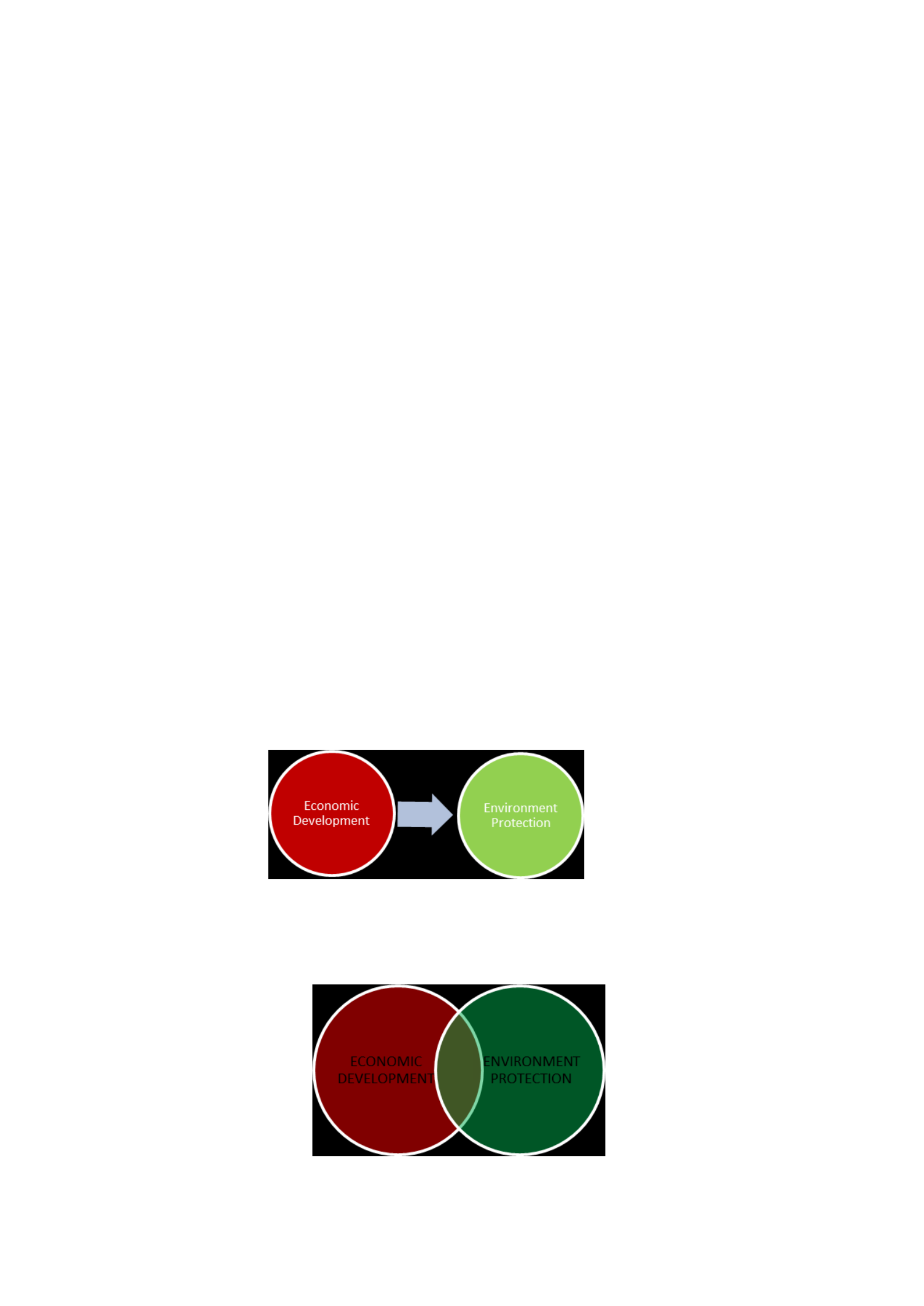
Ehrlich and his wife, Anne Ehrlich (who was not recognized), in 1968. The book
warned of mass human starvation in the 1970s and 1980s due to overpopulation, as
well as social upheaval, and advocated immediate action to limit population growth.
Fears of a widespread "population explosion" in the 1950s and 1960s.
In 1982, the Nairobi World Commission on Environment and Development. One of
the ongoing agendas of this UN meeting was to discuss environmental degradation,
deforestation, soil and water degradation, atmospheric changes - such as depletion of
the ozone layer, increasing concentrations of CO2 gas.
In 1987, the Brundtland report "Our Common Future" stated that sustainable
development is development that meets the needs of the present.
In 1992, the Rio United Nations World Conference on Environment and Development,
discussed the development of ecological sustainability, where at that time the
American President, Ronald Reagen, rejected the agenda because he considered
sustainable development not a solution to the problem, as well as the Australian Prime
Minister, namely John Howard. The countries that agreed to implement the agenda are
Canada, Japan, Europe, From these historical moments, a formulation of sustainable
development emerged, which initially was to pay attention to the needs of the present
and the future, economic development needs to pay attention to the environment or be
wiser and limit the excessive use of natural resources.
Sustainable development is development that meets current needs

Problem Solving to manage the current condition of urban development is SUSTAINABLE
DEVELOPMENT in an awareness of "our common future" by paying attention to
economic needs that pay attention to environmental protection.
Definition of Sustainable City
Based on the above understanding, a sustainable city is a city that has the ability, ability, and
wise thinking to think about current and future needs, and the city is able to support, support
the needs of living things in a system (cover in system), where the development of a
dynamic and significantly growing city certainly requires efficient and effective
management or planning. So that the city physically has a mental awareness to maintain
environmental balance and sustainability of life in it, so that in the end the city is expected to
be socially just and prosperous.
In an ecological context, sustainability is understood as the ability of ecosystems to maintain
and sustain ecological processes, functions, productivity, and diversity into the future
(Wardhono, 2012).
Sustainable cities are cities that are able to meet the needs of the present without ignoring
the needs of future generations, how to repair environmental destruction without sacrificing
the needs of economic development and social justice. The concept of sustainable cities was
launched by the United Nations in June 2012 at the Rio+20 The United Nations Conference
on Sustainable Development. The concept is planned to be disseminated to the world's urban
stakeholders who are responsible for policy-making, planning and implementation of urban
development. Cities that have the ability to drive future growth, but are also able to grow
more efficiently and environmentally friendly.
The concept of environmental balance, related to sustainable cities "ecocity", which is the
development of cities that currently require a type of development that not only pays
attention to the development of the economic side (without the financial and material), but
needs to pay attention to aspects of the development of the quality of human life in it
(Richard Register, 1987). Then in the Research Triangle Institute (1996) the City must be
able to have five basic principles in the concept of sustainability, namely: Environmental
(Ecology), Economy (Employment), Society (Equity), Engagement and Energy. In its
application, the five elements must be able to run simultaneously, development inequality
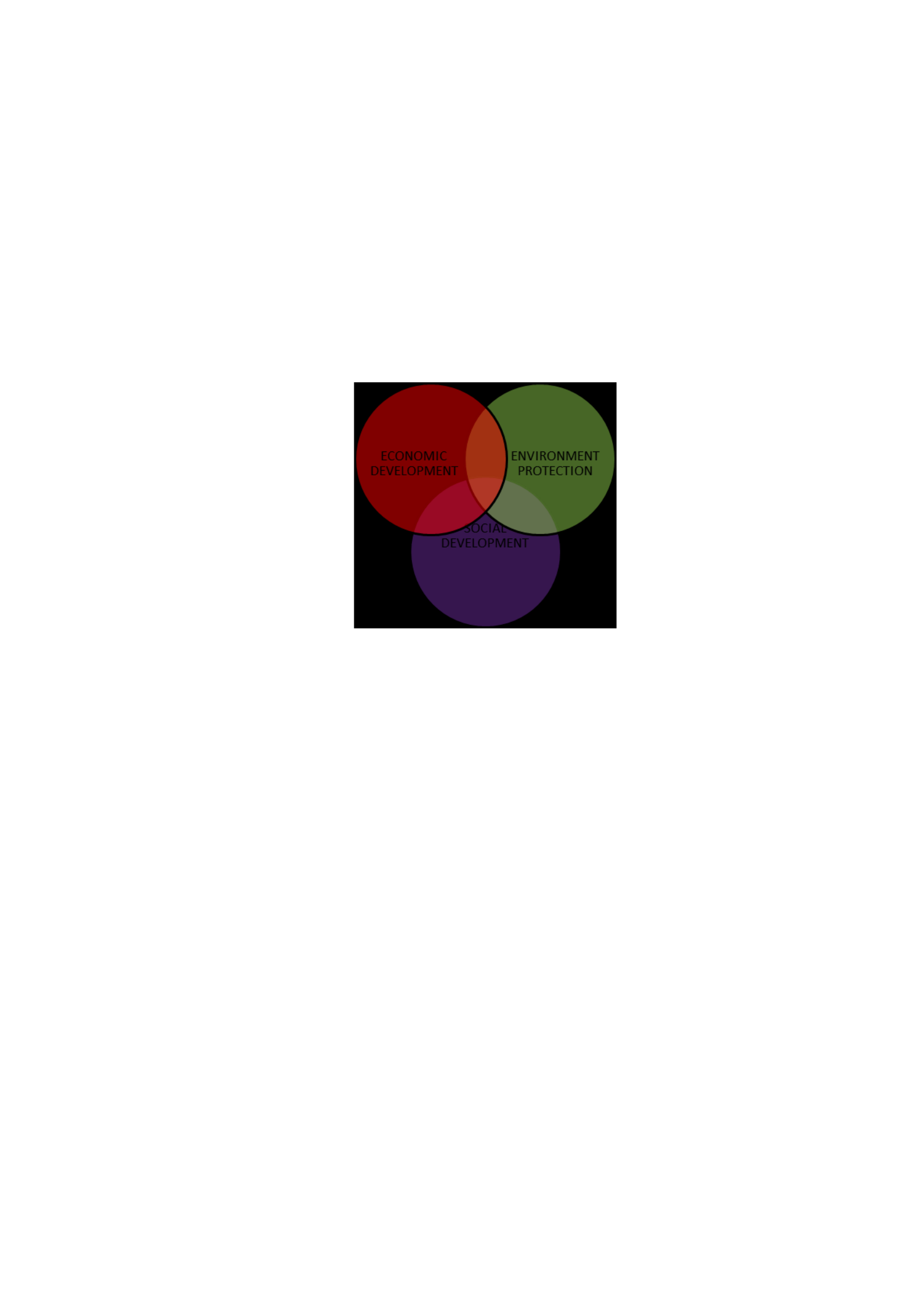
will occur if the development of each element is uneven (Budihardjo and Sujarto, 1999).
Furthermore, the concept of sustainable cities according to Rogers (1998), must recognize
that cities need to meet social, environmental, political and cultural as well as economic and
physical goals. Rogers elaborated by including these keywords, such a city also pays
attention to aspects of beauty in art and architecture, creativity to optimize human potential,
resource efficiency and minimal ecological impact, ease of contact, mobility, integrated and
compact communities and diversity.
"SIMULTAN"
Sustainable development needs to be implemented "SIMULTANEOUSLY"
Sustainable Urban Planning Strategies
Based on the above review, the consideration to protect the environmental conditions that
are decreasing in quality, and the population explosion, then automatically the needs of
human life increase. Therefore, to carry out a sustainable urban development strategy, which
is carried out "Simultaneously" by combining the 4 (four) dimensions, namely: planning
that considers "economic development, by protecting the environment", and paying attention
to "social development", and the need for "Government" management as a regulatory
function and providing infrastructure.
Urban planning, of course, can never wait, because human affairs go on and their direction is
determined by the degree of planning. Realizing a real city that is sustainable is to open a
broad view that every city has housing, high-rise buildings, urban alleys, parks, people's
homes. We see how they live, how their children will become citizens and neighbors of their
children and generations. It is this view that gives direction to the city of the future, a city

that is comfortable to live in for every generation, serves human needs, and directs the
means to shape the urban environment.
Sustainable development in social capital can grow at the individual, family, community,
local community, society in a region, national, and even global levels. Community-level
social capital cannot be measured simply as an aggregation of individual networks. Strong
community-level social capital creates a "civic infrastructure" that will support formal and
informal decision-making processes and public engagement (Potapchuck et.al. 1997).
Individual social capital is closely related to human capital. When individuals invest in
being able to communicate well, they increase their social capital but reduce the social
capital of the community. Determinants of social capital can also include economic and
political instability, patron-client relationships, education, occupation, collective interest and
market legitimization of common values. Social capital can lower the costs of cooperation
and facilitate cooperation. To build social capital effectively, local governments must share
autonomy/roles with their communities, in the sense that they must shift from being
controllers, regulators and providers, to catalysts, conveners and facilitators (Crocker et al.
1998).
The issue of weak state capacity in developing countries, characterized by the inability to
carry out development, has become a hot topic discussed by experts. Theories of
government failure characterized by a "top-down" approach, as well as social capital theory
characterized by a "bottom-up" approach, both provide a framework that underlies the basic
framework for identifying the symptoms of "state incapacity" (Sallis and Dollery, 2001).
The government's role in implementing sustainable urban development is to have a
sustainable-minded leadership spirit so that the dynamic development of the city can be
managed effectively without incurring large costs.
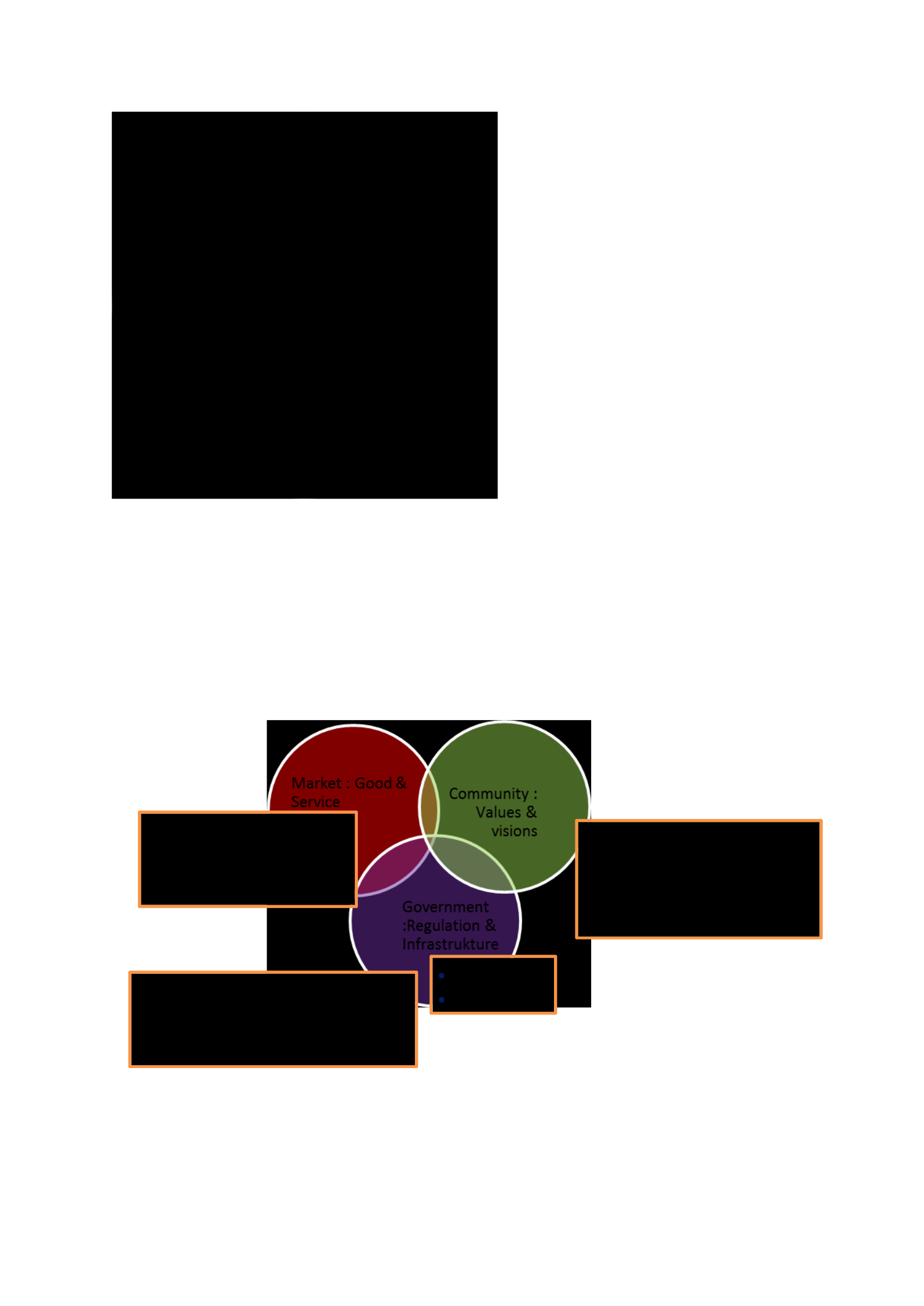
Time regulation:
Short-term Development:
INFRASTRUCTURE (time prime 10
years. MARKET (time prime 6 years)
LEADERSHIP
INNOVATION
In the direction of the
Community: Long term, it can
help and encourage the
community to improve their
quality of life.
The market has "POWER"
and for the Commitment to
be SUSTAINABLE then
Awareness required
Sustainable City Development Concept in 4 (four) Sectoral Dimensions
One of the strategies for sustainable urban development is that the government as a
development manager must have leadership, and innovation. The development program has
the concept of short term and long term development, both concepts support each other in
order to achieve a vision of sustainable urban development.
Sustainable Urban Development Strategy
"SUSTAINABLE"
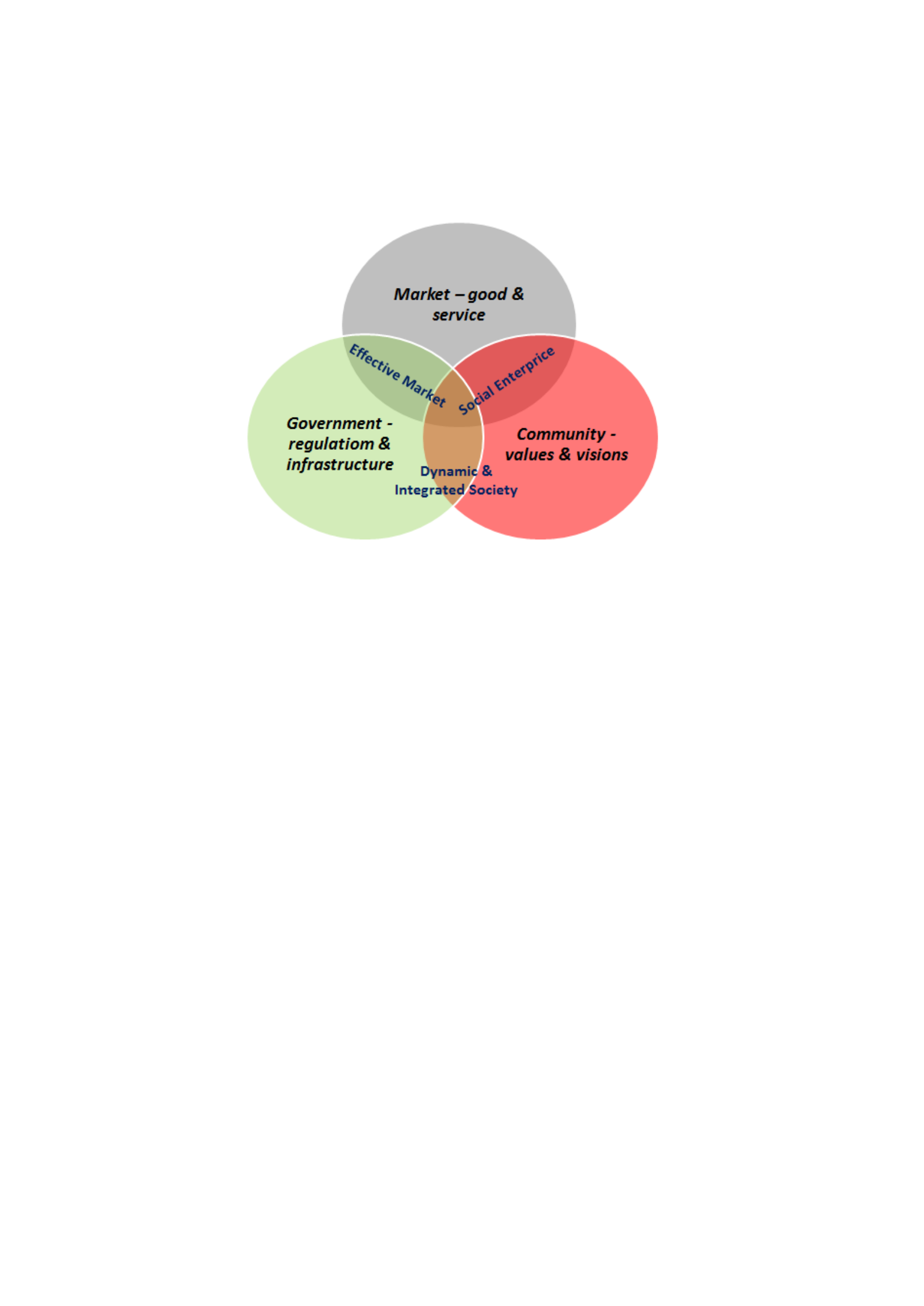
One example of an innovative leader is being able to make sustainable city breakthroughs
such as Cities with Solar panels, Cities with Smart City, and movements to change the urban
environment to be more environmentally friendly.
Figure 8. Sectoral dimensions that simultaneously produce something that is Integrity
The above principle illustrates a sectoral dimension, namely social, economic, and
environmental, into a development that cooperates with each other to maintain balance, it
will produce an effective market regulation, and social enterprice economic development
with attention to the environment will produce a good social community value as well. The
principle of sustainable development is one example:
Settlement: sustainable urban development recognizes the earth can only
adjust to a more balanced state if settlements "reduce their ecological
footprint" while they "simultaneously" improve their quality of life. In this
case, reducing the "ecological" footprint means reducing the use of materials
and energy that produce excessive CO2), while simultaneously it means
paying attention to providing healthy settlements, providing jobs, and
designing with social communities in mind.
Place-making: sustainability that recognizes the significance and diversity of
communities and regions for earth stewardship (cultured buildings,
landscaping, sculpture, and attention to biodiversity for future generations).
Net-Benefit: Sustainability that addresses the extraction of non-renewable
resources, providing net environmental social and economic benefits for
future generations. Reduce the impact and maintain the environmental

sustainability of irresponsible agencies.
The principles and enforcement of sustainable cities are expected to pay more attention to
humanity, more humane. Returning to the essence of the city itself is formed from human
needs. The relationship between the city, formed from humans and the environment, related
to the city is a system that cannot be separated from spatial planning, why because cities are
formed as a result of natural processes and social processes, human activities as creatures
that utilize natural resources also have tendencies that are patterned and spatially structured.
According to Rustiadi, et al (2011), human spatial instincts are natural and the result of long
"learning" experiences, so that they get typical spatial patterns, for example in the layout of
residential houses, public spaces (gathering places), yards, fields, rice fields, and so on. The
regularity of the spatial configuration of the community's socio-economic activities or
patterns of space utilization are always found in every community's economy or patterns of
space utilization are always found in every community's life in maintaining its life, adjusting
to the environment, optimizing efforts to utilize natural resources, optimizing social
interactions, as well as forms of cultural expression. The interaction between humans and
the environment requires humans to provide various infrastructure to facilitate access and
manage these resources.
The philosophy of sustainable urban planning is to meet the needs of society, the needs of
generations, and the needs of the economy, which is socially just where the goal is to
prevent unwanted changes, create balance and sustainable development. The beginning of
the process of sustainable urban planning starts with the need to make changes for the better
(welfare, natural disasters, social development, etc.).
Some Countries That Implement Sustainable Urban Development
Learning from other countries, about how to build a vision of a sustainable city and how to
implement it, certainly adds insight into managing a city, even though the cases and
problems are different. Consistency to build a sustainable city vision starts from the
creativity of a leader and building awareness of its citizens. The following is an explanation
of the table below:

Table 3. Countries in the Vision of a Sustainable City
STATE
CITY DESCRIPTION
Singapore
As a small and densely populated island nation with no natural resources,
Singapore's own sustainable development experience has focused on four
key areas, namely, (1) Building a sustainable economy; (2) creating a
sustainable living environment; (3) ensuring sustainable development for
our people; and (4) contributing to international collaboration.
•
Singapore is the 20th most carbon-efficient country in the world
•
Integrated transportation, MRT, BUS., pedestrian way
•
Since the 1970s, economic development has helped lift billions of people
out of poverty. Social indices of human development such as health and
education have improved significantly.
•
Despite not having natural resources, Singapore manages its human
resources more carefully.
•
Singapore plans to introduce a carbon tax from 2019, so those who emit
the most carbon will bear the cost to our environment and be encouraged to
reduce their emissions.
•
Give prizes to residents whose houses are energy efficient, tax discounts

•
A generation of pioneers, with a vision for a clean, green and sustainable
Singapore for all Singaporeans. Instilling the awareness that this little
island is all we have, and we must take good care of it.
•
Over the past 50 years, saw major improvements in housing, water, public
health and sanitation. Provides a City in Parks with about 47 percent green
cover in Singapore. More than 80 percent of households are within a 10-
minute walk of a park.
•
It has 72 hectares of green roof gardens and walls today, and aims to
double that by 2030.
Curitiba,
Brazil
•
Curitiba, is the world's first sustainable city. In 1971, architect Jaime
Lerner was elected mayor for the first of three terms, and came up with
innovative and creative solutions that saw Curitiba undergo a remarkable
evolution.
•
The greenest city, with more than 50 M2 of green space per capita, much
more than the UN recommendation. The reason why there is so much green
space is that Lerner had to find a solution to the frequent flooding that
occurred due to the geographical position of the city, so Lerner created a
large green belt around the city, which has turned into a large habitat for
many plants and animals. These large green areas are maintained by sheep
and goats and the wool they produce is sold to finance social development
in the city.
•
About 60% of people rely on the bus network in the city, efficiency for the
light rail system with dedicated lanes.
•
The city of Curitiba is a wonderful example of what creative leaders dare
and do, to make a city truly serve its residents rather than create stress,
congestion and inequality among its residents.
•
Implement a simple Bus transportation system, by dividing 5 arterial traffic
roads.
•
There are 28 parks and forest areas in Curitiba, creating an urban landscape
unlike any other developing city. The city's parks are designed to be
connected rather than isolated to maximize usage. The park was designed
by Hitoshi Nakamura.
•
The parks also stop squatters from creating shanty towns in flood-prone

zones.
•
Curitiba has 4 times the recommended green space, using sheep to "mow"
some of the grass in the parks.
By examining two countries, namely: Singapore and Curitiba, it is expected to increase
knowledge about "sustainable cities", where sustainable development focuses on human
resources, social justice, creating spatial equality.
Conclusions
Based on the sources of sustainable city references, it can be concluded that a sustainable
city is a city that is able to meet the NEEDS of the present without ignoring the NEEDS of
future GENERATIONS, how to REPAIR ENVIRONMENTAL DAMAGE without
sacrificing the NEEDS of ECONOMIC DEVELOPMENT and SOCIAL JUSTICE.
Building a sustainable city also takes into account 4 dimensions, namely SOCIAL
DIMENSION, ECONOMIC DIMENSION, ENVIRONMENTAL DIMENSION, and

GOVERNMENT DIMENSION. These four things Side by side, the success of sustainable
development does not only depend on the economic dimension but needs the intervention of
the power holder or in this case the government dimension, in order to implement
sustainable development so as to achieve equitable distribution of welfare. Therefore,
sustainable development is oriented towards the development of Green Cities that have a
good quality of life and conducive environmental conditions.
Problems
Urban growth is a complex phenomenon, partly spontaneous and partly planned. There have
been several attempts to manage that complexity. Ideas such as building sustainable cities,
resulting in better urban environments that meet people's needs, have fewer socio-economic
costs, and use less nature.
Based on the explanation above, the problem about the city is that when some of the cities
develop spontaneously (sprawl), the population increases, the development of urban areas
and land clearing occurs which changes the function of productive areas of paddy land into
new residential / residential areas, forest conversion into agricultural / plantation land.
Furthermore, the urbanization process also creates socio-economic problems for cities,
forming slum areas that have low income in the city, resulting in crime in urban spaces.
These problems represent urban development that does not take into account the quality of
human life. The congestion of cities such as Jakarta and other large cities, due to poorly
integrated public transportation systems. The earth's temperature is getting hotter due to
CO2 emissions from various human activities on earth such as motor gas air pollution,
greenhouse effect, building materials, and flooding in urban areas, and so on.
Based on the problems mentioned above, the world's cities consume three-quarters of the
world's energy and cause three-quarters of global pollution and cities have become parasitic
ehuge organisms that can drain the earth for food due to excessive energy consumption:
relentless consumers, relentless polluters. So that over time the city system becomes
unstable, resilience and capacity are not high enough, and it is likely that the city will
collapse (colappse). With the phenomena of environmental degradation and rising
temperatures, humans are no longer comfortable in their habitats (Roger, 1998 and Egger
2006).

Cities are the drivers of future growth, but also the biggest contributors to CO2 emissions.
So that a concept that pays attention to environmental balance is needed, namely the concept
of sustainable development. The concept of sustainable development has been widely
developed into the theoretical foundations of sustainable cities. City references and
applicative applications of sustainable urban development are easy to find, both in various
methods and paradigms. The dream of an ideal future city concept in the book "Garden City
of to-morrow" written by Ebenezer Howard (1898), invited controversy, became utopias,
considered irrelevant, unreasonable, and due to this irrelevance, the concept of Garden City
of to-morrow Ebenezer Howard is not widely used, only natural and natural concepts are
widely taken by urban planners, the rest is just a historical record. Twentieth-century urban
planners had a variety of new concepts in planning their cities from the initial idea of a
dream of a sustainable city that had become our common future.
Objectives and Benefits
Based on the above background and problems, the author sees the need to conduct a
theoretical study to better understand the concept of sustainable development in the four
dimensions of sustainable development, namely environmental, social, and economic, and
government. about the meaning and scope as a source of knowledge for the community
(students, academics, and practitioners) while strengthening the body knowledge of
architecture. The results of this paper are expected to be able to provide a deeper
understanding for students, and practitioners, to understand architecture and cities, becoming
a provision in the practice of architecture and planning science.
Writing Method
This research is a literature research to explore the understanding, meaning and scope of the
concept of a sustainable city. Various thoughts about the concept of a sustainable city can be
used as supporting data in this writing. The search for data and information through
documents, both in the form of written documents, photographs, images, and electronic
documents that can support the research process. Research results will also be more credible
if supported by photographs or existing academic and artistic papers (Sugiyono, 2005: 83).
Therefore, literature study can affect the credibility of the results of the research conducted.
Sustainable Cities And Their Development

Cities and their Development
Before understanding more about sustainable cities, it is necessary to know what the
definition of a city, its equivalents, differences, and scale are.
When the philosophy of science developed towards modern thinking. Humanist thinking
was influenced by the views of Karl Marx, Immanuel Kant, and Max Weber, the most
influential of whom was the Spirit of Capitalism (1905). So the city is a place where most of
its economic needs are in the local market, the characteristics of the city are the existence of
a market as a fortress and has a legal system and is cosmopolitan. When the city develops, as
a place to live, a place to produce goods and services, the scale of services develops, there is
a concentration of population, with high density. A small city to a megacity is said to have a
population of 20,000 to 5,000,000.
There are three opinions, namely; Max Weber (1905), Hamilton (2001), Steve Egger (2006),
defining the city basically is to accommodate human needs, community needs, and
economic needs. If we go back to Maslow's (1943) theory in "The Theory Of Human
Motivation" about the Hierarchy of human needs, namely basic needs are elements needed
by humans in maintaining balance both physiologically and psychologically which aims to
maintain life and health. Hierarchy (1) Physiological Needs or Faal Needs (physiological
needs): the right to get oxygen, food, sleep (human self-activity), (2) Safety, security needs:
Protection, (3) Love needs (social needs): social interaction life, (4) Esteem needs EGO
ownership (esteem needs), and (5) Self-actualization (self- actualization needs): recognition
appreciated, social status.
Cities are formed from human needs, to serve (Hamilton, 2001) from the hierarchy of human
needs, spatial formation of community expression (Steve Egger, 2006) makes the city
formed in a network or a system of community expression. As a result of such a system,
cities require management, governance, trade, culture, education, and society, to facilitate an
environment for human existence and interaction (Egger, 2006).
From the various opinions above, it can be concluded that the realization of the city is to
accommodate human needs, and when the city is growing dynamically, the city becomes a
network that is intertwined in a unified system, so that a city requires serious management
based on the scale of services, if not managed, social, economic, and environmental

problems then the city experiences collapse and crisis. A good city is one that responds to
the various problems that occur in the city, and thinks about survival and sustainability.
Sustainability
The definition of sustainability (continue) according to the Big United States Dictionary
(KBBI) is sustainable; and continuously. "Sustain": (1) strengthen or support physically or
mentally, (2) undergo or suffer (something unpleasant, especially an injury), (3) uphold,
affirm, or confirm the justice or validity of, in United States translation "sustain" is
menopang. The definition of sustain here is being able to endure, sustain, support, sustain,
experience, continue, suffer, prolong, and enable. As for the translation of "ability": (1)
possession of the means or skill to do something, (2) talent, skill, or proficiency in a
particular area, in United States translation is ability, capability, talent, ability, proficiency,
cleverness, wisdom, shrewdness, and dexterity.
Sustainable Cities
History of Sustainable Urban Development
To understand what "sustainability" is, and why there is an agreement on sustainable
development. It is therefore necessary to trace a history of the birth of the idea of sustainable
urban development.
In 1972, the Stockholm UN World Conference on Human Environment: UN
Conference on Human Environment (June 5-6, 1972): the focus was on discussing
guidelines and actions in dealing with environmental problems, such as alleviating
poverty, and protecting the environment.
Paul Ehrlich, a Stanford University Professor of Biology, who wrote a book titled
"Population Bomb": was a bestseller written by Stanford University Professor Paul R.
Ehrlich and his wife, Anne Ehrlich (who was not recognized), in 1968. The book
warned of mass human starvation in the 1970s and 1980s due to overpopulation, as
well as social upheaval, and advocated immediate action to limit population growth.
Fears of a widespread "population explosion" in the 1950s and 1960s.
In 1982, the Nairobi World Commission on Environment and Development. One of
the ongoing agendas of this UN meeting was to discuss environmental degradation,
deforestation, soil and water degradation, atmospheric changes - such as depletion of
the ozone layer, increasing concentrations of CO2 gas.
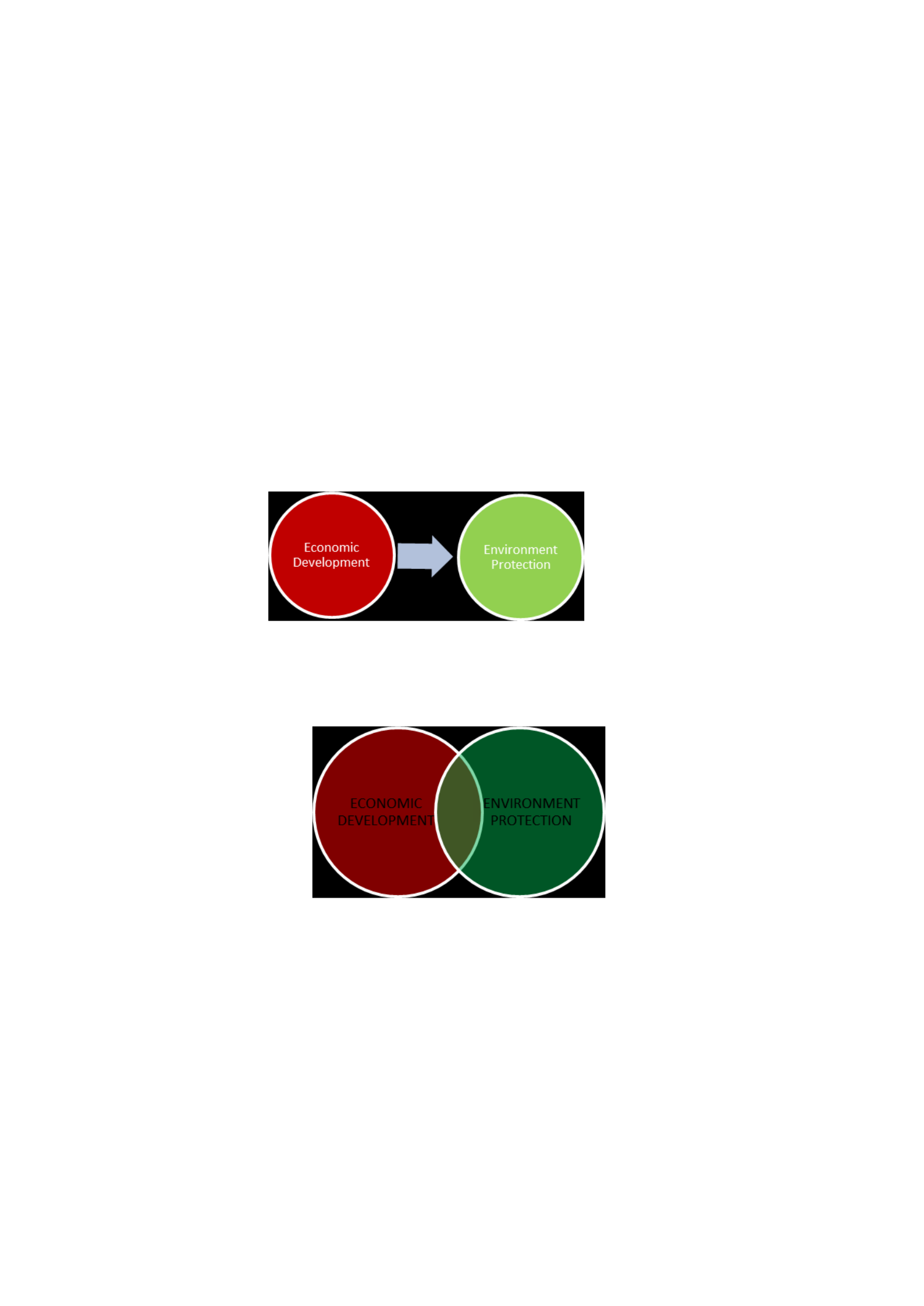
In 1987, the Brundtland report "Our Common Future" stated that sustainable
development is development that meets the needs of the present.
In 1992, the Rio United Nations World Conference on Environment and Development,
discussed the development of ecological sustainability, where at that time the
American President, Ronald Reagen, rejected the agenda because he considered
sustainable development not a solution to the problem, as well as the Australian Prime
Minister, namely John Howard. The countries that agreed to implement the agenda are
Canada, Japan, Europe, From these historical moments, a formulation of sustainable
development emerged, which initially was to pay attention to the needs of the present
and the future, economic development needs to pay attention to the environment or be
wiser and limit the excessive use of natural resources.
Sustainable development is development that meets current needs
Problem Solving to manage the current condition of urban development is SUSTAINABLE
DEVELOPMENT in an awareness of "our common future" by paying attention to
economic needs that pay attention to environmental protection.
Definition of Sustainable City
Based on the above understanding, a sustainable city is a city that has the ability, ability, and
wise thinking to think about current and future needs, and the city is able to support, support
the needs of living things in a system (cover in system), where the development of a

dynamic and significantly growing city certainly requires efficient and effective
management or planning. So that the city physically has a mental awareness to maintain
environmental balance and sustainability of life in it, so that in the end the city is expected to
be socially just and prosperous.
In an ecological context, sustainability is understood as the ability of ecosystems to maintain
and sustain ecological processes, functions, productivity, and diversity into the future
(Wardhono, 2012).
Sustainable cities are cities that are able to meet the needs of the present without ignoring
the needs of future generations, how to repair environmental destruction without sacrificing
the needs of economic development and social justice. The concept of sustainable cities was
launched by the United Nations in June 2012 at the Rio+20 The United Nations Conference
on Sustainable Development. The concept is planned to be disseminated to the world's urban
stakeholders who are responsible for policy-making, planning and implementation of urban
development. Cities that have the ability to drive future growth, but are also able to grow
more efficiently and environmentally friendly.
The concept of environmental balance, related to sustainable cities "ecocity", which is the
development of cities that currently require a type of development that not only pays
attention to the development of the economic side (without the financial and material), but
needs to pay attention to aspects of the development of the quality of human life in it
(Richard Register, 1987). Then in the Research Triangle Institute (1996) the City must be
able to have five basic principles in the concept of sustainability, namely: Environmental
(Ecology), Economy (Employment), Society (Equity), Engagement and Energy. In its
application, the five elements must be able to run simultaneously, development inequality
will occur if the development of each element is uneven (Budihardjo and Sujarto, 1999).
Furthermore, the concept of sustainable cities according to Rogers (1998), must recognize
that cities need to meet social, environmental, political and cultural as well as economic and
physical goals. Rogers elaborated by including these keywords, such a city also pays
attention to aspects of beauty in art and architecture, creativity to optimize human potential,
resource efficiency and minimal ecological impact, ease of contact, mobility, integrated and
compact communities and diversity.
"SIMULTAN"
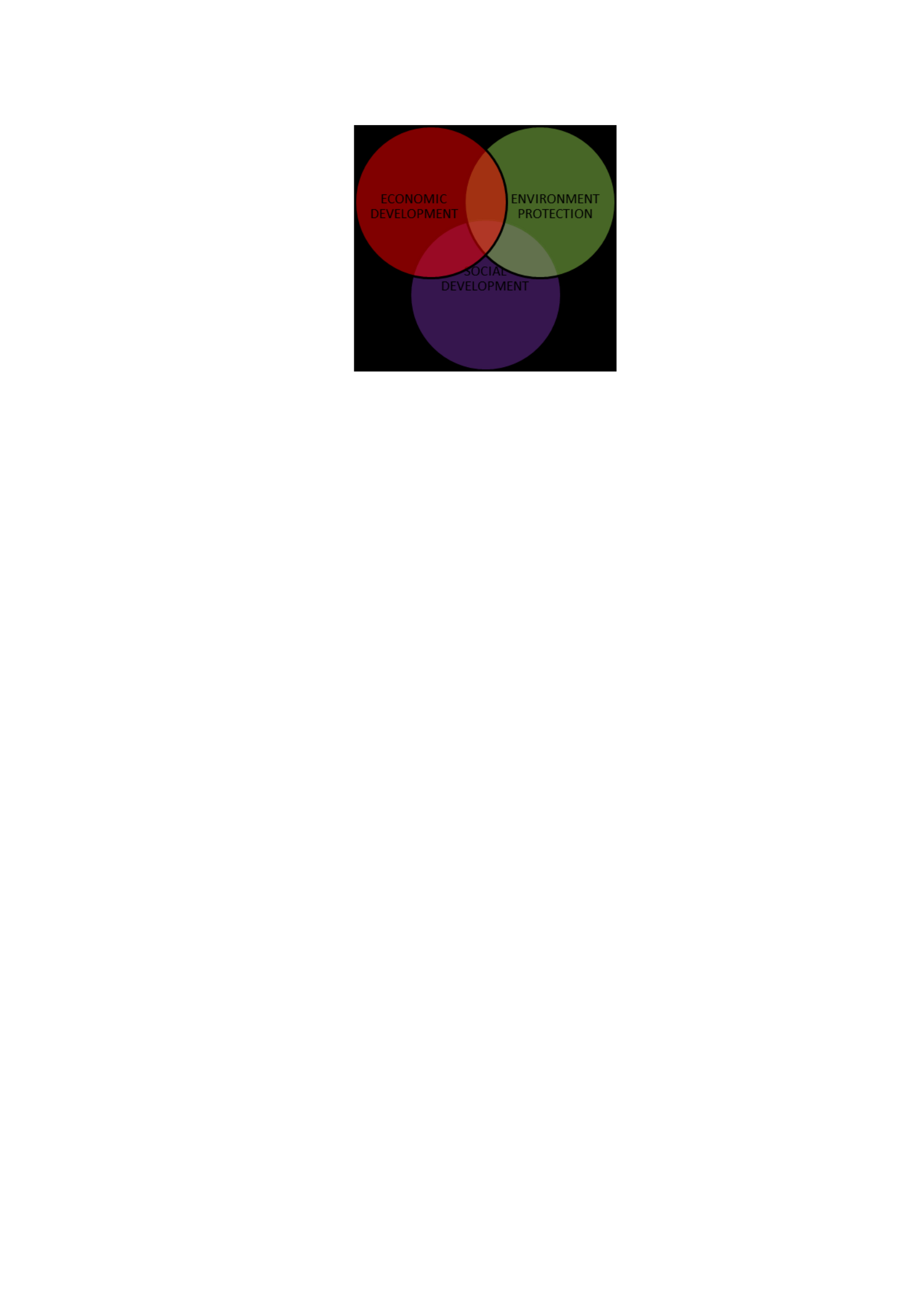
Sustainable development needs to be implemented "SIMULTANEOUSLY"
Sustainable Urban Planning Strategies
Based on the above review, the consideration to protect the environmental conditions that
are decreasing in quality, and the population explosion, then automatically the needs of
human life increase. Therefore, to carry out a sustainable urban development strategy, which
is carried out "Simultaneously" by combining the 4 (four) dimensions, namely: planning
that considers "economic development, by protecting the environment", and paying attention
to "social development", and the need for "Government" management as a regulatory
function and providing infrastructure.
Urban planning, of course, can never wait, because human affairs go on and their direction is
determined by the degree of planning. Realizing a real city that is sustainable is to open a
broad view that every city has housing, high-rise buildings, urban alleys, parks, people's
homes. We see how they live, how their children will become citizens and neighbors of their
children and generations. It is this view that gives direction to the city of the future, a city
that is comfortable to live in for every generation, serves human needs, and directs the
means to shape the urban environment.
Sustainable development in social capital can grow at the individual, family, community,
local community, society in a region, national, and even global levels. Community-level
social capital cannot be measured simply as an aggregation of individual networks. Strong
community-level social capital creates a "civic infrastructure" that will support formal and
informal decision-making processes and public engagement (Potapchuck et.al. 1997).

Individual social capital is closely related to human capital. When individuals invest in
being able to communicate well, they increase their social capital but reduce the social
capital of the community. Determinants of social capital can also include economic and
political instability, patron-client relationships, education, occupation, collective interest and
market legitimization of common values. Social capital can lower the costs of cooperation
and facilitate cooperation. To build social capital effectively, local governments must share
autonomy/roles with their communities, in the sense that they must shift from being
controllers, regulators and providers, to catalysts, conveners and facilitators (Crocker et al.
1998).
The issue of weak state capacity in developing countries, characterized by the inability to
carry out development, has become a hot topic discussed by experts. Theories of
government failure characterized by a "top-down" approach, as well as social capital theory
characterized by a "bottom-up" approach, both provide a framework that underlies the basic
framework for identifying the symptoms of "state incapacity" (Sallis and Dollery, 2001).
The government's role in implementing sustainable urban development is to have a
sustainable-minded leadership spirit so that the dynamic development of the city can be
managed effectively without incurring large costs.
Sustainable City Development Concept in 4 (four) Sectoral Dimensions
"SUSTAINABLE"
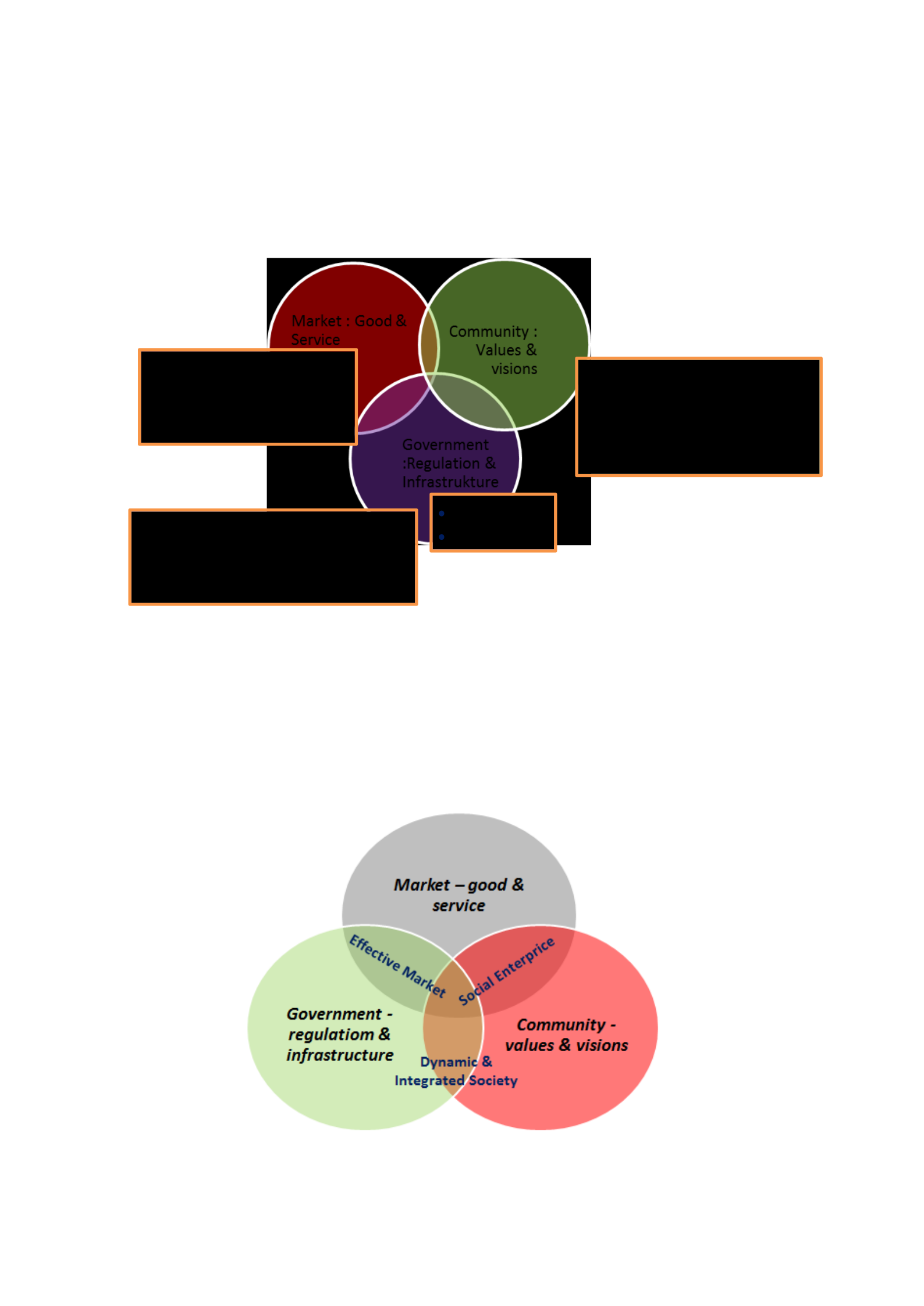
Time regulation:
Short-term Development:
INFRASTRUCTURE (time prime 10
years. MARKET (time prime 6 years)
LEADERSHIP
INNOVATION
In the direction of the
Community: Long term, it can
help and encourage the
community to improve their
quality of life.
The market has "POWER"
and for the Commitment to
be SUSTAINABLE then
Awareness required
One of the strategies for sustainable urban development is that the government as a
development manager must have leadership, and innovation. The development program has
the concept of short term and long term development, both concepts support each other in
order to achieve a vision of sustainable urban development.
Sustainable Urban Development Strategy
One example of an innovative leader is being able to make sustainable city breakthroughs
such as Cities with Solar panels, Cities with Smart City, and movements to change the urban
environment to be more environmentally friendly.
Figure 8. Sectoral dimensions that simultaneously produce something that is Integrity

The above principle illustrates a sectoral dimension, namely social, economic, and
environmental, into a development that cooperates with each other to maintain balance, it
will produce an effective market regulation, and social enterprice economic development
with attention to the environment will produce a good social community value as well. The
principle of sustainable development is one example:
Settlement: sustainable urban development recognizes the earth can only
adjust to a more balanced state if settlements "reduce their ecological
footprint" while they "simultaneously" improve their quality of life. In this
case, reducing the "ecological" footprint means reducing the use of materials
and energy that produce excessive CO2), while simultaneously it means
paying attention to providing healthy settlements, providing jobs, and
designing with social communities in mind.
Place-making: sustainability that recognizes the significance and diversity of
communities and regions for earth stewardship (cultured buildings,
landscaping, sculpture, and attention to biodiversity for future generations).
Net-Benefit: Sustainability that addresses the extraction of non-renewable
resources, providing net environmental social and economic benefits for
future generations. Reduce the impact and maintain the environmental
sustainability of irresponsible agencies.
The principles and enforcement of sustainable cities are expected to pay more attention to
humanity, more humane. Returning to the essence of the city itself is formed from human
needs. The relationship between the city, formed from humans and the environment, related
to the city is a system that cannot be separated from spatial planning, why because cities are
formed as a result of natural processes and social processes, human activities as creatures
that utilize natural resources also have tendencies that are patterned and spatially structured.
According to Rustiadi, et al (2011), human spatial instincts are natural and the result of long
"learning" experiences, so that they get typical spatial patterns, for example in the layout of
residential houses, public spaces (gathering places), yards, fields, rice fields, and so on. The
regularity of the spatial configuration of the community's socio-economic activities or
patterns of space utilization are always found in every community's economy or patterns of
space utilization are always found in every community's life in maintaining its life, adjusting
to the environment, optimizing efforts to utilize natural resources, optimizing social

interactions, as well as forms of cultural expression. The interaction between humans and
the environment requires humans to provide various infrastructure to facilitate access and
manage these resources.
The philosophy of sustainable urban planning is to meet the needs of society, the needs of
generations, and the needs of the economy, which is socially just where the goal is to
prevent unwanted changes, create balance and sustainable development. The beginning of
the process of sustainable urban planning starts with the need to make changes for the better
(welfare, natural disasters, social development, etc.).
Some Countries That Implement Sustainable Urban Development
Learning from other countries, about how to build a vision of a sustainable city and how to
implement it, certainly adds insight into managing a city, even though the cases and
problems are different. Consistency to build a sustainable city vision starts from the
creativity of a leader and building awareness of its citizens. The following is an explanation
of the table below:
Table 3. Countries in the Vision of a Sustainable City

STATE
CITY DESCRIPTION
Singapore
As a small and densely populated island nation with no natural resources,
Singapore's own sustainable development experience has focused on four
key areas, namely, (1) Building a sustainable economy; (2) creating a
sustainable living environment; (3) ensuring sustainable development for
our people; and (4) contributing to international collaboration.
•
Singapore is the 20th most carbon-efficient country in the world
•
Integrated transportation, MRT, BUS., pedestrian way
•
Since the 1970s, economic development has helped lift billions of people
out of poverty. Social indices of human development such as health and
education have improved significantly.
•
Despite not having natural resources, Singapore manages its human
resources more carefully.
•
Singapore plans to introduce a carbon tax from 2019, so those who emit
the most carbon will bear the cost to our environment and be encouraged to
reduce their emissions.
•
Give prizes to residents whose houses are energy efficient, tax discounts
•
A generation of pioneers, with a vision for a clean, green and sustainable
Singapore for all Singaporeans. Instilling the awareness that this little
island is all we have, and we must take good care of it.
•
Over the past 50 years, saw major improvements in housing, water, public
health and sanitation. Provides a City in Parks with about 47 percent green
cover in Singapore. More than 80 percent of households are within a 10-
minute walk of a park.
•
It has 72 hectares of green roof gardens and walls today, and aims to
double that by 2030.

Curitiba,
Brazil
•
Curitiba, is the world's first sustainable city. In 1971, architect Jaime
Lerner was elected mayor for the first of three terms, and came up with
innovative and creative solutions that saw Curitiba undergo a remarkable
evolution.
•
The greenest city, with more than 50 M2 of green space per capita, much
more than the UN recommendation. The reason why there is so much green
space is that Lerner had to find a solution to the frequent flooding that
occurred due to the geographical position of the city, so Lerner created a
large green belt around the city, which has turned into a large habitat for
many plants and animals. These large green areas are maintained by sheep
and goats and the wool they produce is sold to finance social development
in the city.
•
About 60% of people rely on the bus network in the city, efficiency for the
light rail system with dedicated lanes.
•
The city of Curitiba is a wonderful example of what creative leaders dare
and do, to make a city truly serve its residents rather than create stress,
congestion and inequality among its residents.
•
Implement a simple Bus transportation system, by dividing 5 arterial traffic
roads.
•
There are 28 parks and forest areas in Curitiba, creating an urban landscape
unlike any other developing city. The city's parks are designed to be
connected rather than isolated to maximize usage. The park was designed
by Hitoshi Nakamura.
•
The parks also stop squatters from creating shanty towns in flood-prone
zones.
•
Curitiba has 4 times the recommended green space, using sheep to "mow"
some of the grass in the parks.
By examining two countries, namely: Singapore and Curitiba, it is expected to increase
knowledge about "sustainable cities", where sustainable development focuses on human
resources, social justice, creating spatial equality.

Conclusions
Based on the sources of sustainable city references, it can be concluded that a sustainable
city is a city that is able to meet the NEEDS of the present without ignoring the NEEDS of
future GENERATIONS, how to REPAIR ENVIRONMENTAL DAMAGE without
sacrificing the NEEDS of ECONOMIC DEVELOPMENT and SOCIAL JUSTICE.
Building a sustainable city also takes into account 4 dimensions, namely SOCIAL
DIMENSION, ECONOMIC DIMENSION, ENVIRONMENTAL DIMENSION, and
GOVERNMENT DIMENSION. These four things Side by side, the success of sustainable
development does not only depend on the economic dimension but needs the intervention of
the power holder or in this case the government dimension, in order to implement
sustainable development so as to achieve equitable distribution of welfare. Therefore,
sustainable development is oriented towards the development of Green Cities that have a
good quality of life and conducive environmental conditions.
Problems
Urban growth is a complex phenomenon, partly spontaneous and partly planned. There have
been several attempts to manage that complexity. Ideas such as building sustainable cities,
resulting in better urban environments that meet people's needs, have fewer socio-economic
costs, and use less nature.
Based on the explanation above, the problem about the city is that when some of the cities
develop spontaneously (sprawl), the population increases, the development of urban areas
and land clearing occurs which changes the function of productive areas of paddy land into
new residential / residential areas, forest conversion into agricultural / plantation land.
Furthermore, the urbanization process also creates socio-economic problems for cities,
forming slum areas that have low income in the city, resulting in crime in urban spaces.
These problems represent urban development that does not take into account the quality of
human life. The congestion of cities such as Jakarta and other large cities, due to poorly
integrated public transportation systems. The earth's temperature is getting hotter due to
CO2 emissions from various human activities on earth such as motor gas air pollution,
greenhouse effect, building materials, and flooding in urban areas, and so on.

Based on the problems mentioned above, the world's cities consume three-quarters of the
world's energy and cause three-quarters of global pollution and cities have become parasitic
ehuge organisms that can drain the earth for food due to excessive energy consumption:
relentless consumers, relentless polluters. So that over time the city system becomes
unstable, resilience and capacity are not high enough, and it is likely that the city will
collapse (colappse). With the phenomena of environmental degradation and rising
temperatures, humans are no longer comfortable in their habitats (Roger, 1998 and Egger
2006).
Cities are the drivers of future growth, but also the biggest contributors to CO2 emissions.
So that a concept that pays attention to environmental balance is needed, namely the concept
of sustainable development. The concept of sustainable development has been widely
developed into the theoretical foundations of sustainable cities. City references and
applicative applications of sustainable urban development are easy to find, both in various
methods and paradigms. The dream of an ideal future city concept in the book "Garden City
of to-morrow" written by Ebenezer Howard (1898), invited controversy, became utopias,
considered irrelevant, unreasonable, and due to this irrelevance, the concept of Garden City
of to-morrow Ebenezer Howard is not widely used, only natural and natural concepts are
widely taken by urban planners, the rest is just a historical record. Twentieth-century urban
planners had a variety of new concepts in planning their cities from the initial idea of a
dream of a sustainable city that had become our common future.
Objectives and Benefits
Based on the above background and problems, the author sees the need to conduct a
theoretical study to better understand the concept of sustainable development in the four
dimensions of sustainable development, namely environmental, social, and economic, and
government. about the meaning and scope as a source of knowledge for the community
(students, academics, and practitioners) while strengthening the body knowledge of
architecture. The results of this paper are expected to be able to provide a deeper
understanding for students, and practitioners, to understand architecture and cities, becoming
a provision in the practice of architecture and planning science.
Writing Method
This research is a literature research to explore the understanding, meaning and scope of the

concept of a sustainable city. Various thoughts about the concept of a sustainable city can be
used as supporting data in this writing. The search for data and information through
documents, both in the form of written documents, photographs, images, and electronic
documents that can support the research process. Research results will also be more credible
if supported by photographs or existing academic and artistic papers (Sugiyono, 2005: 83).
Therefore, literature study can affect the credibility of the results of the research conducted.
Sustainable Cities And Their Development
Cities and their Development
Before understanding more about sustainable cities, it is necessary to know what the
definition of a city, its equivalents, differences, and scale are.
When the philosophy of science developed towards modern thinking. Humanist thinking
was influenced by the views of Karl Marx, Immanuel Kant, and Max Weber, the most
influential of whom was the Spirit of Capitalism (1905). So the city is a place where most of
its economic needs are in the local market, the characteristics of the city are the existence of
a market as a fortress and has a legal system and is cosmopolitan. When the city develops, as
a place to live, a place to produce goods and services, the scale of services develops, there is
a concentration of population, with high density. A small city to a megacity is said to have a
population of 20,000 to 5,000,000.
There are three opinions, namely; Max Weber (1905), Hamilton (2001), Steve Egger (2006),
defining the city basically is to accommodate human needs, community needs, and
economic needs. If we go back to Maslow's (1943) theory in "The Theory Of Human
Motivation" about the Hierarchy of human needs, namely basic needs are elements needed
by humans in maintaining balance both physiologically and psychologically which aims to
maintain life and health. Hierarchy (1) Physiological Needs or Faal Needs (physiological
needs): the right to get oxygen, food, sleep (human self-activity), (2) Safety, security needs:
Protection, (3) Love needs (social needs): social interaction life, (4) Esteem needs EGO
ownership (esteem needs), and (5) Self-actualization (self- actualization needs): recognition
appreciated, social status.
Cities are formed from human needs, to serve (Hamilton, 2001) from the hierarchy of human
needs, spatial formation of community expression (Steve Egger, 2006) makes the city

formed in a network or a system of community expression. As a result of such a system,
cities require management, governance, trade, culture, education, and society, to facilitate an
environment for human existence and interaction (Egger, 2006).
From the various opinions above, it can be concluded that the realization of the city is to
accommodate human needs, and when the city is growing dynamically, the city becomes a
network that is intertwined in a unified system, so that a city requires serious management
based on the scale of services, if not managed, social, economic, and environmental
problems then the city experiences collapse and crisis. A good city is one that responds to
the various problems that occur in the city, and thinks about survival and sustainability.
Sustainability
The definition of sustainability (continue) according to the Big United States Dictionary
(KBBI) is sustainable; and continuously. "Sustain": (1) strengthen or support physically or
mentally, (2) undergo or suffer (something unpleasant, especially an injury), (3) uphold,
affirm, or confirm the justice or validity of, in United States translation "sustain" is
menopang. The definition of sustain here is being able to endure, sustain, support, sustain,
experience, continue, suffer, prolong, and enable. As for the translation of "ability": (1)
possession of the means or skill to do something, (2) talent, skill, or proficiency in a
particular area, in United States translation is ability, capability, talent, ability, proficiency,
cleverness, wisdom, shrewdness, and dexterity.
Sustainable Cities
History of Sustainable Urban Development
To understand what "sustainability" is, and why there is an agreement on sustainable
development. It is therefore necessary to trace a history of the birth of the idea of sustainable
urban development.
In 1972, the Stockholm UN World Conference on Human Environment: UN
Conference on Human Environment (June 5-6, 1972): the focus was on discussing
guidelines and actions in dealing with environmental problems, such as alleviating
poverty, and protecting the environment.
Paul Ehrlich, a Stanford University Professor of Biology, who wrote a book titled
"Population Bomb": was a bestseller written by Stanford University Professor Paul R.
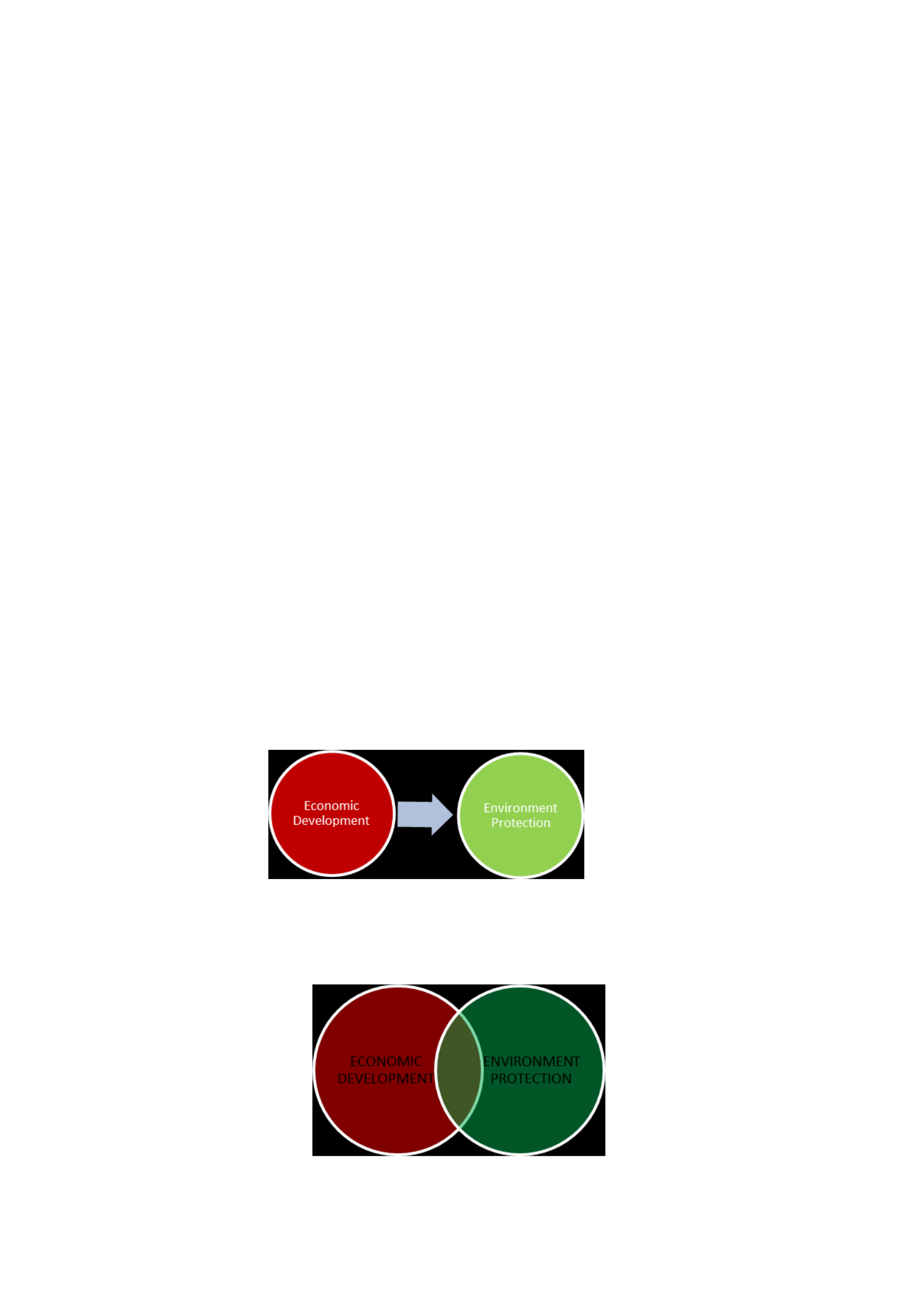
Ehrlich and his wife, Anne Ehrlich (who was not recognized), in 1968. The book
warned of mass human starvation in the 1970s and 1980s due to overpopulation, as
well as social upheaval, and advocated immediate action to limit population growth.
Fears of a widespread "population explosion" in the 1950s and 1960s.
In 1982, the Nairobi World Commission on Environment and Development. One of
the ongoing agendas of this UN meeting was to discuss environmental degradation,
deforestation, soil and water degradation, atmospheric changes - such as depletion of
the ozone layer, increasing concentrations of CO2 gas.
In 1987, the Brundtland report "Our Common Future" stated that sustainable
development is development that meets the needs of the present.
In 1992, the Rio United Nations World Conference on Environment and Development,
discussed the development of ecological sustainability, where at that time the
American President, Ronald Reagen, rejected the agenda because he considered
sustainable development not a solution to the problem, as well as the Australian Prime
Minister, namely John Howard. The countries that agreed to implement the agenda are
Canada, Japan, Europe, From these historical moments, a formulation of sustainable
development emerged, which initially was to pay attention to the needs of the present
and the future, economic development needs to pay attention to the environment or be
wiser and limit the excessive use of natural resources.
Sustainable development is development that meets current needs

Problem Solving to manage the current condition of urban development is SUSTAINABLE
DEVELOPMENT in an awareness of "our common future" by paying attention to
economic needs that pay attention to environmental protection.
Definition of Sustainable City
Based on the above understanding, a sustainable city is a city that has the ability, ability, and
wise thinking to think about current and future needs, and the city is able to support, support
the needs of living things in a system (cover in system), where the development of a
dynamic and significantly growing city certainly requires efficient and effective
management or planning. So that the city physically has a mental awareness to maintain
environmental balance and sustainability of life in it, so that in the end the city is expected to
be socially just and prosperous.
In an ecological context, sustainability is understood as the ability of ecosystems to maintain
and sustain ecological processes, functions, productivity, and diversity into the future
(Wardhono, 2012).
Sustainable cities are cities that are able to meet the needs of the present without ignoring
the needs of future generations, how to repair environmental destruction without sacrificing
the needs of economic development and social justice. The concept of sustainable cities was
launched by the United Nations in June 2012 at the Rio+20 The United Nations Conference
on Sustainable Development. The concept is planned to be disseminated to the world's urban
stakeholders who are responsible for policy-making, planning and implementation of urban
development. Cities that have the ability to drive future growth, but are also able to grow
more efficiently and environmentally friendly.
The concept of environmental balance, related to sustainable cities "ecocity", which is the
development of cities that currently require a type of development that not only pays
attention to the development of the economic side (without the financial and material), but
needs to pay attention to aspects of the development of the quality of human life in it
(Richard Register, 1987). Then in the Research Triangle Institute (1996) the City must be
able to have five basic principles in the concept of sustainability, namely: Environmental
(Ecology), Economy (Employment), Society (Equity), Engagement and Energy. In its
application, the five elements must be able to run simultaneously, development inequality
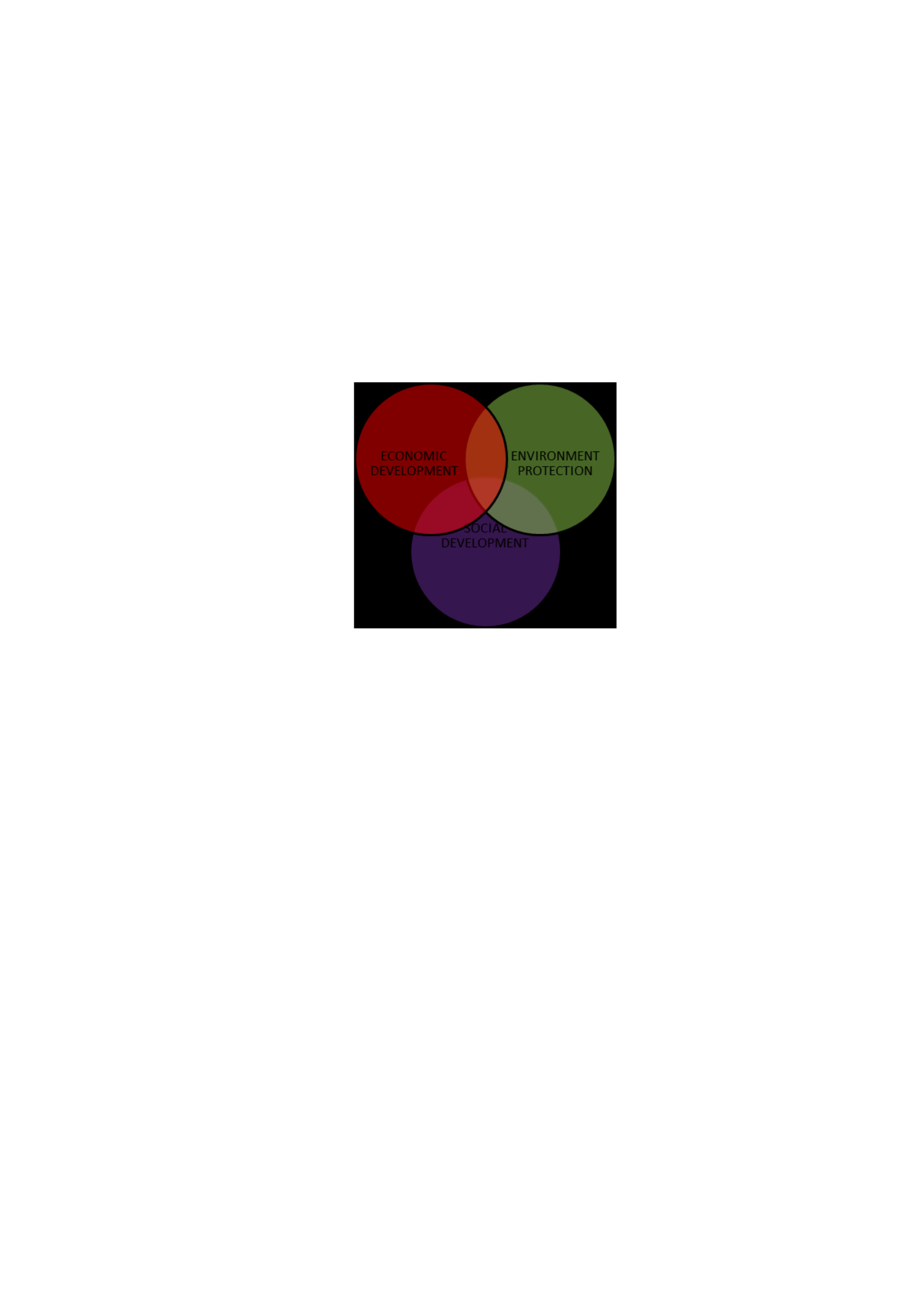
will occur if the development of each element is uneven (Budihardjo and Sujarto, 1999).
Furthermore, the concept of sustainable cities according to Rogers (1998), must recognize
that cities need to meet social, environmental, political and cultural as well as economic and
physical goals. Rogers elaborated by including these keywords, such a city also pays
attention to aspects of beauty in art and architecture, creativity to optimize human potential,
resource efficiency and minimal ecological impact, ease of contact, mobility, integrated and
compact communities and diversity.
"SIMULTAN"
Sustainable development needs to be implemented "SIMULTANEOUSLY"
Sustainable Urban Planning Strategies
Based on the above review, the consideration to protect the environmental conditions that
are decreasing in quality, and the population explosion, then automatically the needs of
human life increase. Therefore, to carry out a sustainable urban development strategy, which
is carried out "Simultaneously" by combining the 4 (four) dimensions, namely: planning
that considers "economic development, by protecting the environment", and paying attention
to "social development", and the need for "Government" management as a regulatory
function and providing infrastructure.
Urban planning, of course, can never wait, because human affairs go on and their direction is
determined by the degree of planning. Realizing a real city that is sustainable is to open a
broad view that every city has housing, high-rise buildings, urban alleys, parks, people's
homes. We see how they live, how their children will become citizens and neighbors of their
children and generations. It is this view that gives direction to the city of the future, a city

that is comfortable to live in for every generation, serves human needs, and directs the
means to shape the urban environment.
Sustainable development in social capital can grow at the individual, family, community,
local community, society in a region, national, and even global levels. Community-level
social capital cannot be measured simply as an aggregation of individual networks. Strong
community-level social capital creates a "civic infrastructure" that will support formal and
informal decision-making processes and public engagement (Potapchuck et.al. 1997).
Individual social capital is closely related to human capital. When individuals invest in
being able to communicate well, they increase their social capital but reduce the social
capital of the community. Determinants of social capital can also include economic and
political instability, patron-client relationships, education, occupation, collective interest and
market legitimization of common values. Social capital can lower the costs of cooperation
and facilitate cooperation. To build social capital effectively, local governments must share
autonomy/roles with their communities, in the sense that they must shift from being
controllers, regulators and providers, to catalysts, conveners and facilitators (Crocker et al.
1998).
The issue of weak state capacity in developing countries, characterized by the inability to
carry out development, has become a hot topic discussed by experts. Theories of
government failure characterized by a "top-down" approach, as well as social capital theory
characterized by a "bottom-up" approach, both provide a framework that underlies the basic
framework for identifying the symptoms of "state incapacity" (Sallis and Dollery, 2001).
The government's role in implementing sustainable urban development is to have a
sustainable-minded leadership spirit so that the dynamic development of the city can be
managed effectively without incurring large costs.
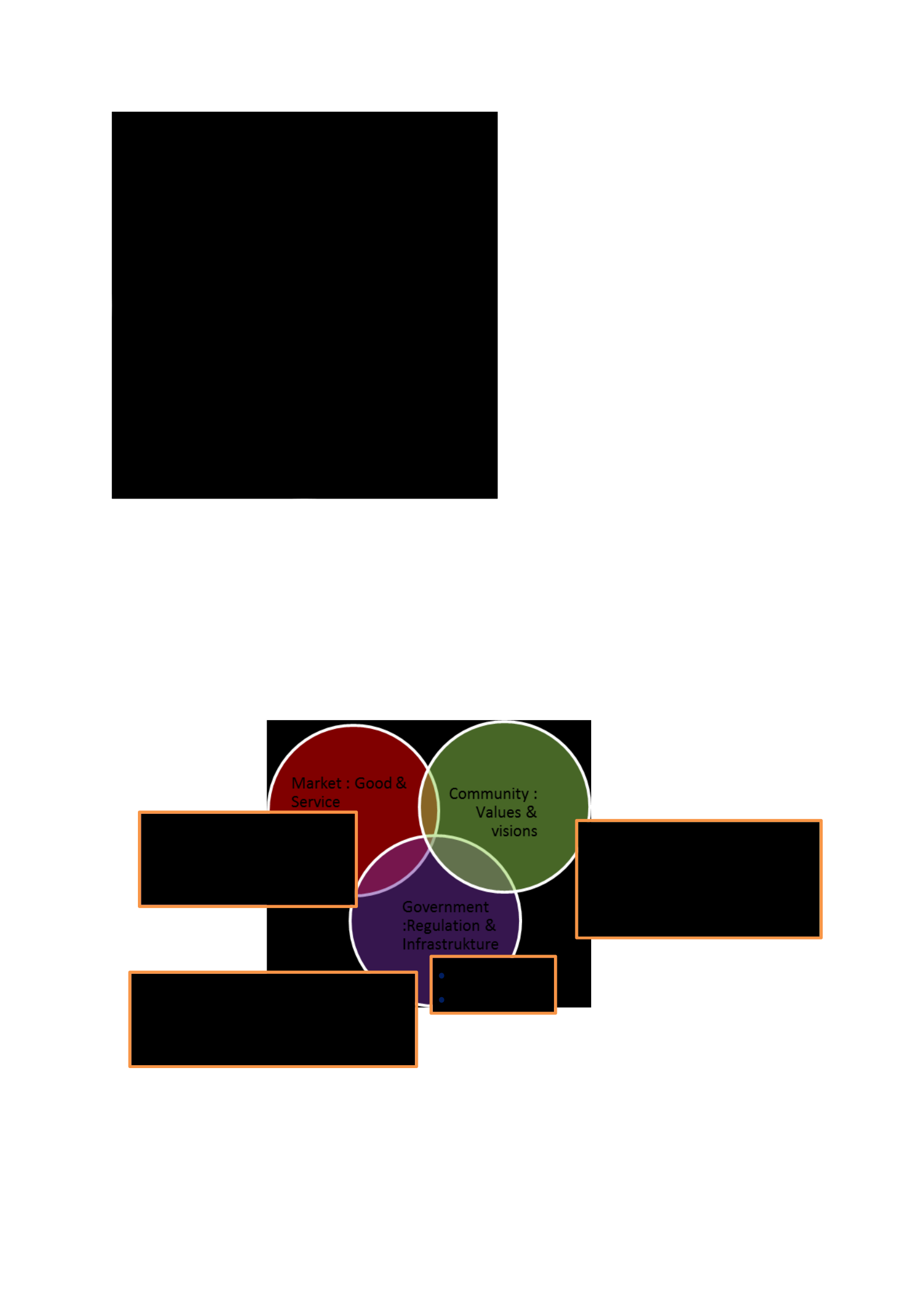
Time regulation:
Short-term Development:
INFRASTRUCTURE (time prime 10
years. MARKET (time prime 6 years)
LEADERSHIP
INNOVATION
In the direction of the
Community: Long term, it can
help and encourage the
community to improve their
quality of life.
The market has "POWER"
and for the Commitment to
be SUSTAINABLE then
Awareness required
Sustainable City Development Concept in 4 (four) Sectoral Dimensions
One of the strategies for sustainable urban development is that the government as a
development manager must have leadership, and innovation. The development program has
the concept of short term and long term development, both concepts support each other in
order to achieve a vision of sustainable urban development.
Sustainable Urban Development Strategy
"SUSTAINABLE"
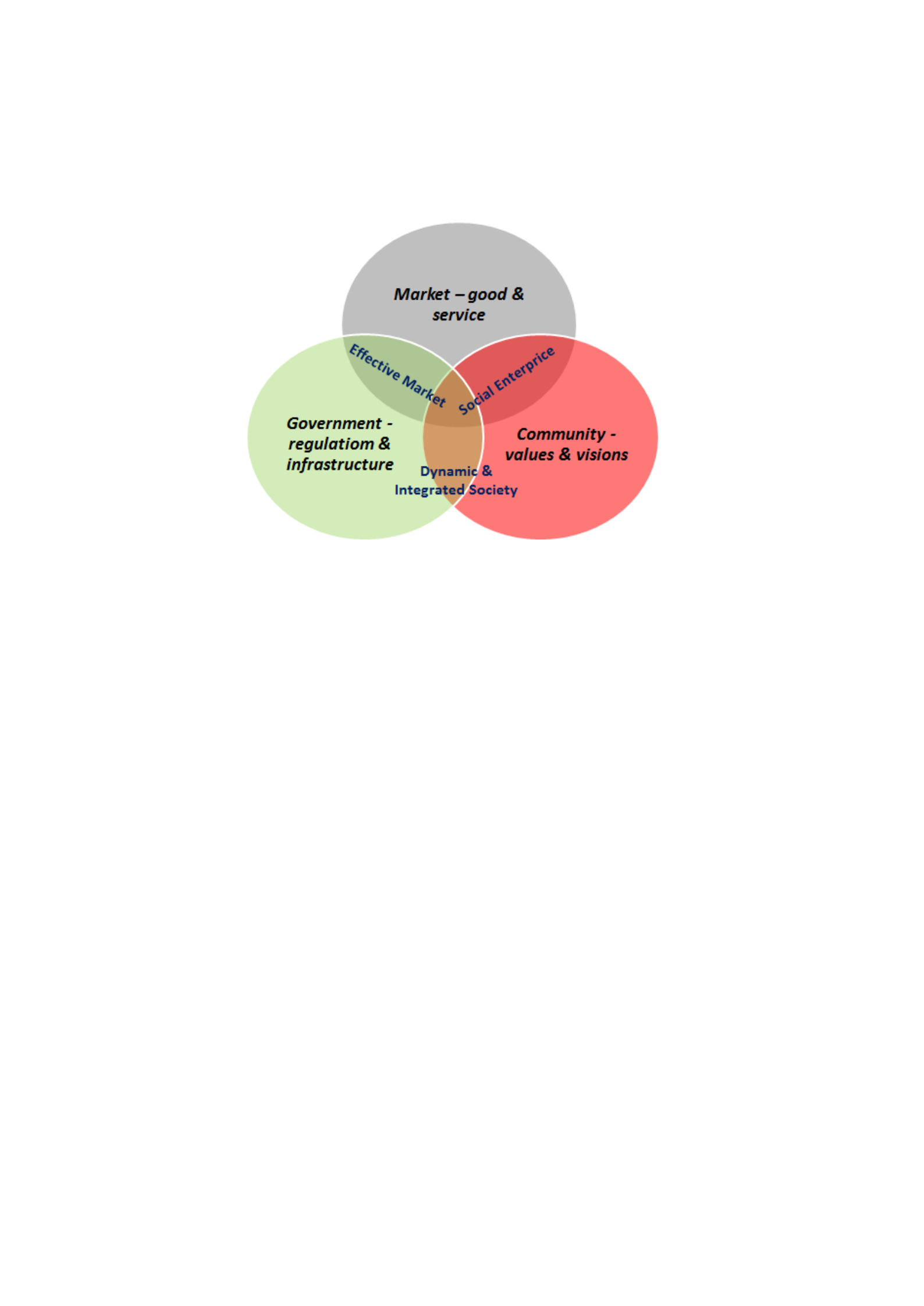
One example of an innovative leader is being able to make sustainable city breakthroughs
such as Cities with Solar panels, Cities with Smart City, and movements to change the urban
environment to be more environmentally friendly.
Figure 8. Sectoral dimensions that simultaneously produce something that is Integrity
The above principle illustrates a sectoral dimension, namely social, economic, and
environmental, into a development that cooperates with each other to maintain balance, it
will produce an effective market regulation, and social enterprice economic development
with attention to the environment will produce a good social community value as well. The
principle of sustainable development is one example:
Settlement: sustainable urban development recognizes the earth can only
adjust to a more balanced state if settlements "reduce their ecological
footprint" while they "simultaneously" improve their quality of life. In this
case, reducing the "ecological" footprint means reducing the use of materials
and energy that produce excessive CO2), while simultaneously it means
paying attention to providing healthy settlements, providing jobs, and
designing with social communities in mind.
Place-making: sustainability that recognizes the significance and diversity of
communities and regions for earth stewardship (cultured buildings,
landscaping, sculpture, and attention to biodiversity for future generations).
Net-Benefit: Sustainability that addresses the extraction of non-renewable
resources, providing net environmental social and economic benefits for
future generations. Reduce the impact and maintain the environmental

sustainability of irresponsible agencies.
The principles and enforcement of sustainable cities are expected to pay more attention to
humanity, more humane. Returning to the essence of the city itself is formed from human
needs. The relationship between the city, formed from humans and the environment, related
to the city is a system that cannot be separated from spatial planning, why because cities are
formed as a result of natural processes and social processes, human activities as creatures
that utilize natural resources also have tendencies that are patterned and spatially structured.
According to Rustiadi, et al (2011), human spatial instincts are natural and the result of long
"learning" experiences, so that they get typical spatial patterns, for example in the layout of
residential houses, public spaces (gathering places), yards, fields, rice fields, and so on. The
regularity of the spatial configuration of the community's socio-economic activities or
patterns of space utilization are always found in every community's economy or patterns of
space utilization are always found in every community's life in maintaining its life, adjusting
to the environment, optimizing efforts to utilize natural resources, optimizing social
interactions, as well as forms of cultural expression. The interaction between humans and
the environment requires humans to provide various infrastructure to facilitate access and
manage these resources.
The philosophy of sustainable urban planning is to meet the needs of society, the needs of
generations, and the needs of the economy, which is socially just where the goal is to
prevent unwanted changes, create balance and sustainable development. The beginning of
the process of sustainable urban planning starts with the need to make changes for the better
(welfare, natural disasters, social development, etc.).
Some Countries That Implement Sustainable Urban Development
Learning from other countries, about how to build a vision of a sustainable city and how to
implement it, certainly adds insight into managing a city, even though the cases and
problems are different. Consistency to build a sustainable city vision starts from the
creativity of a leader and building awareness of its citizens. The following is an explanation
of the table below:

Table 3. Countries in the Vision of a Sustainable City
STATE
CITY DESCRIPTION
Singapore
As a small and densely populated island nation with no natural resources,
Singapore's own sustainable development experience has focused on four
key areas, namely, (1) Building a sustainable economy; (2) creating a
sustainable living environment; (3) ensuring sustainable development for
our people; and (4) contributing to international collaboration.
•
Singapore is the 20th most carbon-efficient country in the world
•
Integrated transportation, MRT, BUS., pedestrian way
•
Since the 1970s, economic development has helped lift billions of people
out of poverty. Social indices of human development such as health and
education have improved significantly.
•
Despite not having natural resources, Singapore manages its human
resources more carefully.
•
Singapore plans to introduce a carbon tax from 2019, so those who emit
the most carbon will bear the cost to our environment and be encouraged to
reduce their emissions.
•
Give prizes to residents whose houses are energy efficient, tax discounts

•
A generation of pioneers, with a vision for a clean, green and sustainable
Singapore for all Singaporeans. Instilling the awareness that this little
island is all we have, and we must take good care of it.
•
Over the past 50 years, saw major improvements in housing, water, public
health and sanitation. Provides a City in Parks with about 47 percent green
cover in Singapore. More than 80 percent of households are within a 10-
minute walk of a park.
•
It has 72 hectares of green roof gardens and walls today, and aims to
double that by 2030.
Curitiba,
Brazil
•
Curitiba, is the world's first sustainable city. In 1971, architect Jaime
Lerner was elected mayor for the first of three terms, and came up with
innovative and creative solutions that saw Curitiba undergo a remarkable
evolution.
•
The greenest city, with more than 50 M2 of green space per capita, much
more than the UN recommendation. The reason why there is so much green
space is that Lerner had to find a solution to the frequent flooding that
occurred due to the geographical position of the city, so Lerner created a
large green belt around the city, which has turned into a large habitat for
many plants and animals. These large green areas are maintained by sheep
and goats and the wool they produce is sold to finance social development
in the city.
•
About 60% of people rely on the bus network in the city, efficiency for the
light rail system with dedicated lanes.
•
The city of Curitiba is a wonderful example of what creative leaders dare
and do, to make a city truly serve its residents rather than create stress,
congestion and inequality among its residents.
•
Implement a simple Bus transportation system, by dividing 5 arterial traffic
roads.
•
There are 28 parks and forest areas in Curitiba, creating an urban landscape
unlike any other developing city. The city's parks are designed to be
connected rather than isolated to maximize usage. The park was designed
by Hitoshi Nakamura.
•
The parks also stop squatters from creating shanty towns in flood-prone

zones.
•
Curitiba has 4 times the recommended green space, using sheep to "mow"
some of the grass in the parks.
By examining two countries, namely: Singapore and Curitiba, it is expected to increase
knowledge about "sustainable cities", where sustainable development focuses on human
resources, social justice, creating spatial equality.
Conclusions
Based on the sources of sustainable city references, it can be concluded that a sustainable
city is a city that is able to meet the NEEDS of the present without ignoring the NEEDS of
future GENERATIONS, how to REPAIR ENVIRONMENTAL DAMAGE without
sacrificing the NEEDS of ECONOMIC DEVELOPMENT and SOCIAL JUSTICE.
Building a sustainable city also takes into account 4 dimensions, namely SOCIAL
DIMENSION, ECONOMIC DIMENSION, ENVIRONMENTAL DIMENSION, and

GOVERNMENT DIMENSION. These four things Side by side, the success of sustainable
development does not only depend on the economic dimension but needs the intervention of
the power holder or in this case the government dimension, in order to implement
sustainable development so as to achieve equitable distribution of welfare. Therefore,
sustainable development is oriented towards the development of Green Cities that have a
good quality of life and conducive environmental conditions.
Problems
Urban growth is a complex phenomenon, partly spontaneous and partly planned. There have
been several attempts to manage that complexity. Ideas such as building sustainable cities,
resulting in better urban environments that meet people's needs, have fewer socio-economic
costs, and use less nature.
Based on the explanation above, the problem about the city is that when some of the cities
develop spontaneously (sprawl), the population increases, the development of urban areas
and land clearing occurs which changes the function of productive areas of paddy land into
new residential / residential areas, forest conversion into agricultural / plantation land.
Furthermore, the urbanization process also creates socio-economic problems for cities,
forming slum areas that have low income in the city, resulting in crime in urban spaces.
These problems represent urban development that does not take into account the quality of
human life. The congestion of cities such as Jakarta and other large cities, due to poorly
integrated public transportation systems. The earth's temperature is getting hotter due to
CO2 emissions from various human activities on earth such as motor gas air pollution,
greenhouse effect, building materials, and flooding in urban areas, and so on.
Based on the problems mentioned above, the world's cities consume three-quarters of the
world's energy and cause three-quarters of global pollution and cities have become parasitic
ehuge organisms that can drain the earth for food due to excessive energy consumption:
relentless consumers, relentless polluters. So that over time the city system becomes
unstable, resilience and capacity are not high enough, and it is likely that the city will
collapse (colappse). With the phenomena of environmental degradation and rising
temperatures, humans are no longer comfortable in their habitats (Roger, 1998 and Egger
2006).

Cities are the drivers of future growth, but also the biggest contributors to CO2 emissions.
So that a concept that pays attention to environmental balance is needed, namely the concept
of sustainable development. The concept of sustainable development has been widely
developed into the theoretical foundations of sustainable cities. City references and
applicative applications of sustainable urban development are easy to find, both in various
methods and paradigms. The dream of an ideal future city concept in the book "Garden City
of to-morrow" written by Ebenezer Howard (1898), invited controversy, became utopias,
considered irrelevant, unreasonable, and due to this irrelevance, the concept of Garden City
of to-morrow Ebenezer Howard is not widely used, only natural and natural concepts are
widely taken by urban planners, the rest is just a historical record. Twentieth-century urban
planners had a variety of new concepts in planning their cities from the initial idea of a
dream of a sustainable city that had become our common future.
Objectives and Benefits
Based on the above background and problems, the author sees the need to conduct a
theoretical study to better understand the concept of sustainable development in the four
dimensions of sustainable development, namely environmental, social, and economic, and
government. about the meaning and scope as a source of knowledge for the community
(students, academics, and practitioners) while strengthening the body knowledge of
architecture. The results of this paper are expected to be able to provide a deeper
understanding for students, and practitioners, to understand architecture and cities, becoming
a provision in the practice of architecture and planning science.
Writing Method
This research is a literature research to explore the understanding, meaning and scope of the
concept of a sustainable city. Various thoughts about the concept of a sustainable city can be
used as supporting data in this writing. The search for data and information through
documents, both in the form of written documents, photographs, images, and electronic
documents that can support the research process. Research results will also be more credible
if supported by photographs or existing academic and artistic papers (Sugiyono, 2005: 83).
Therefore, literature study can affect the credibility of the results of the research conducted.
Sustainable Cities And Their Development

Cities and their Development
Before understanding more about sustainable cities, it is necessary to know what the
definition of a city, its equivalents, differences, and scale are.
When the philosophy of science developed towards modern thinking. Humanist thinking
was influenced by the views of Karl Marx, Immanuel Kant, and Max Weber, the most
influential of whom was the Spirit of Capitalism (1905). So the city is a place where most of
its economic needs are in the local market, the characteristics of the city are the existence of
a market as a fortress and has a legal system and is cosmopolitan. When the city develops, as
a place to live, a place to produce goods and services, the scale of services develops, there is
a concentration of population, with high density. A small city to a megacity is said to have a
population of 20,000 to 5,000,000.
There are three opinions, namely; Max Weber (1905), Hamilton (2001), Steve Egger (2006),
defining the city basically is to accommodate human needs, community needs, and
economic needs. If we go back to Maslow's (1943) theory in "The Theory Of Human
Motivation" about the Hierarchy of human needs, namely basic needs are elements needed
by humans in maintaining balance both physiologically and psychologically which aims to
maintain life and health. Hierarchy (1) Physiological Needs or Faal Needs (physiological
needs): the right to get oxygen, food, sleep (human self-activity), (2) Safety, security needs:
Protection, (3) Love needs (social needs): social interaction life, (4) Esteem needs EGO
ownership (esteem needs), and (5) Self-actualization (self- actualization needs): recognition
appreciated, social status.
Cities are formed from human needs, to serve (Hamilton, 2001) from the hierarchy of human
needs, spatial formation of community expression (Steve Egger, 2006) makes the city
formed in a network or a system of community expression. As a result of such a system,
cities require management, governance, trade, culture, education, and society, to facilitate an
environment for human existence and interaction (Egger, 2006).
From the various opinions above, it can be concluded that the realization of the city is to
accommodate human needs, and when the city is growing dynamically, the city becomes a
network that is intertwined in a unified system, so that a city requires serious management
based on the scale of services, if not managed, social, economic, and environmental

problems then the city experiences collapse and crisis. A good city is one that responds to
the various problems that occur in the city, and thinks about survival and sustainability.
Sustainability
The definition of sustainability (continue) according to the Big United States Dictionary
(KBBI) is sustainable; and continuously. "Sustain": (1) strengthen or support physically or
mentally, (2) undergo or suffer (something unpleasant, especially an injury), (3) uphold,
affirm, or confirm the justice or validity of, in United States translation "sustain" is
menopang. The definition of sustain here is being able to endure, sustain, support, sustain,
experience, continue, suffer, prolong, and enable. As for the translation of "ability": (1)
possession of the means or skill to do something, (2) talent, skill, or proficiency in a
particular area, in United States translation is ability, capability, talent, ability, proficiency,
cleverness, wisdom, shrewdness, and dexterity.
Sustainable Cities
History of Sustainable Urban Development
To understand what "sustainability" is, and why there is an agreement on sustainable
development. It is therefore necessary to trace a history of the birth of the idea of sustainable
urban development.
In 1972, the Stockholm UN World Conference on Human Environment: UN
Conference on Human Environment (June 5-6, 1972): the focus was on discussing
guidelines and actions in dealing with environmental problems, such as alleviating
poverty, and protecting the environment.
Paul Ehrlich, a Stanford University Professor of Biology, who wrote a book titled
"Population Bomb": was a bestseller written by Stanford University Professor Paul R.
Ehrlich and his wife, Anne Ehrlich (who was not recognized), in 1968. The book
warned of mass human starvation in the 1970s and 1980s due to overpopulation, as
well as social upheaval, and advocated immediate action to limit population growth.
Fears of a widespread "population explosion" in the 1950s and 1960s.
In 1982, the Nairobi World Commission on Environment and Development. One of
the ongoing agendas of this UN meeting was to discuss environmental degradation,
deforestation, soil and water degradation, atmospheric changes - such as depletion of
the ozone layer, increasing concentrations of CO2 gas.
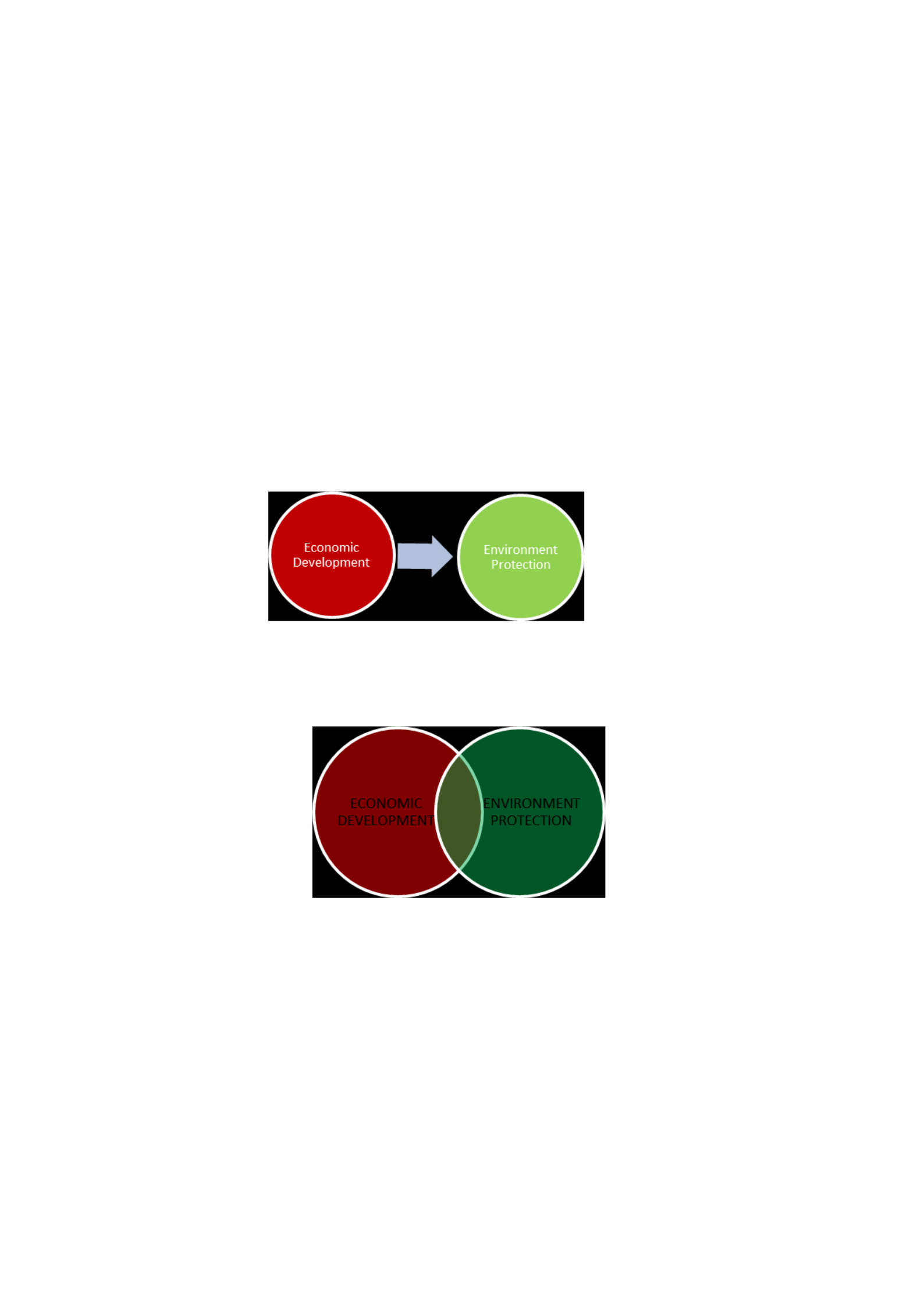
In 1987, the Brundtland report "Our Common Future" stated that sustainable
development is development that meets the needs of the present.
In 1992, the Rio United Nations World Conference on Environment and Development,
discussed the development of ecological sustainability, where at that time the
American President, Ronald Reagen, rejected the agenda because he considered
sustainable development not a solution to the problem, as well as the Australian Prime
Minister, namely John Howard. The countries that agreed to implement the agenda are
Canada, Japan, Europe, From these historical moments, a formulation of sustainable
development emerged, which initially was to pay attention to the needs of the present
and the future, economic development needs to pay attention to the environment or be
wiser and limit the excessive use of natural resources.
Sustainable development is development that meets current needs
Problem Solving to manage the current condition of urban development is SUSTAINABLE
DEVELOPMENT in an awareness of "our common future" by paying attention to
economic needs that pay attention to environmental protection.
Definition of Sustainable City
Based on the above understanding, a sustainable city is a city that has the ability, ability, and
wise thinking to think about current and future needs, and the city is able to support, support
the needs of living things in a system (cover in system), where the development of a

dynamic and significantly growing city certainly requires efficient and effective
management or planning. So that the city physically has a mental awareness to maintain
environmental balance and sustainability of life in it, so that in the end the city is expected to
be socially just and prosperous.
In an ecological context, sustainability is understood as the ability of ecosystems to maintain
and sustain ecological processes, functions, productivity, and diversity into the future
(Wardhono, 2012).
Sustainable cities are cities that are able to meet the needs of the present without ignoring
the needs of future generations, how to repair environmental destruction without sacrificing
the needs of economic development and social justice. The concept of sustainable cities was
launched by the United Nations in June 2012 at the Rio+20 The United Nations Conference
on Sustainable Development. The concept is planned to be disseminated to the world's urban
stakeholders who are responsible for policy-making, planning and implementation of urban
development. Cities that have the ability to drive future growth, but are also able to grow
more efficiently and environmentally friendly.
The concept of environmental balance, related to sustainable cities "ecocity", which is the
development of cities that currently require a type of development that not only pays
attention to the development of the economic side (without the financial and material), but
needs to pay attention to aspects of the development of the quality of human life in it
(Richard Register, 1987). Then in the Research Triangle Institute (1996) the City must be
able to have five basic principles in the concept of sustainability, namely: Environmental
(Ecology), Economy (Employment), Society (Equity), Engagement and Energy. In its
application, the five elements must be able to run simultaneously, development inequality
will occur if the development of each element is uneven (Budihardjo and Sujarto, 1999).
Furthermore, the concept of sustainable cities according to Rogers (1998), must recognize
that cities need to meet social, environmental, political and cultural as well as economic and
physical goals. Rogers elaborated by including these keywords, such a city also pays
attention to aspects of beauty in art and architecture, creativity to optimize human potential,
resource efficiency and minimal ecological impact, ease of contact, mobility, integrated and
compact communities and diversity.
"SIMULTAN"
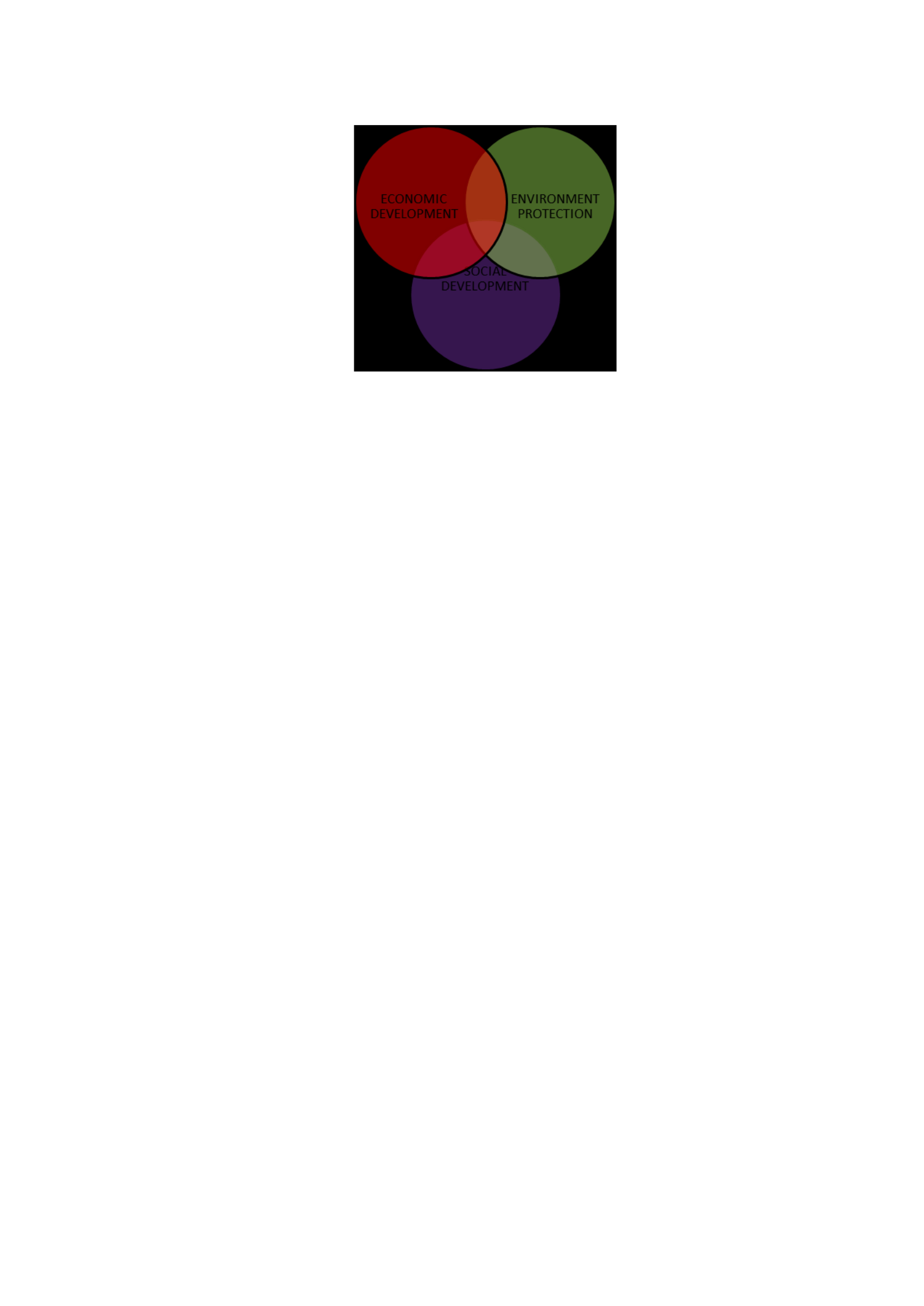
Sustainable development needs to be implemented "SIMULTANEOUSLY"
Sustainable Urban Planning Strategies
Based on the above review, the consideration to protect the environmental conditions that
are decreasing in quality, and the population explosion, then automatically the needs of
human life increase. Therefore, to carry out a sustainable urban development strategy, which
is carried out "Simultaneously" by combining the 4 (four) dimensions, namely: planning
that considers "economic development, by protecting the environment", and paying attention
to "social development", and the need for "Government" management as a regulatory
function and providing infrastructure.
Urban planning, of course, can never wait, because human affairs go on and their direction is
determined by the degree of planning. Realizing a real city that is sustainable is to open a
broad view that every city has housing, high-rise buildings, urban alleys, parks, people's
homes. We see how they live, how their children will become citizens and neighbors of their
children and generations. It is this view that gives direction to the city of the future, a city
that is comfortable to live in for every generation, serves human needs, and directs the
means to shape the urban environment.
Sustainable development in social capital can grow at the individual, family, community,
local community, society in a region, national, and even global levels. Community-level
social capital cannot be measured simply as an aggregation of individual networks. Strong
community-level social capital creates a "civic infrastructure" that will support formal and
informal decision-making processes and public engagement (Potapchuck et.al. 1997).

Individual social capital is closely related to human capital. When individuals invest in
being able to communicate well, they increase their social capital but reduce the social
capital of the community. Determinants of social capital can also include economic and
political instability, patron-client relationships, education, occupation, collective interest and
market legitimization of common values. Social capital can lower the costs of cooperation
and facilitate cooperation. To build social capital effectively, local governments must share
autonomy/roles with their communities, in the sense that they must shift from being
controllers, regulators and providers, to catalysts, conveners and facilitators (Crocker et al.
1998).
The issue of weak state capacity in developing countries, characterized by the inability to
carry out development, has become a hot topic discussed by experts. Theories of
government failure characterized by a "top-down" approach, as well as social capital theory
characterized by a "bottom-up" approach, both provide a framework that underlies the basic
framework for identifying the symptoms of "state incapacity" (Sallis and Dollery, 2001).
The government's role in implementing sustainable urban development is to have a
sustainable-minded leadership spirit so that the dynamic development of the city can be
managed effectively without incurring large costs.
Sustainable City Development Concept in 4 (four) Sectoral Dimensions
"SUSTAINABLE"
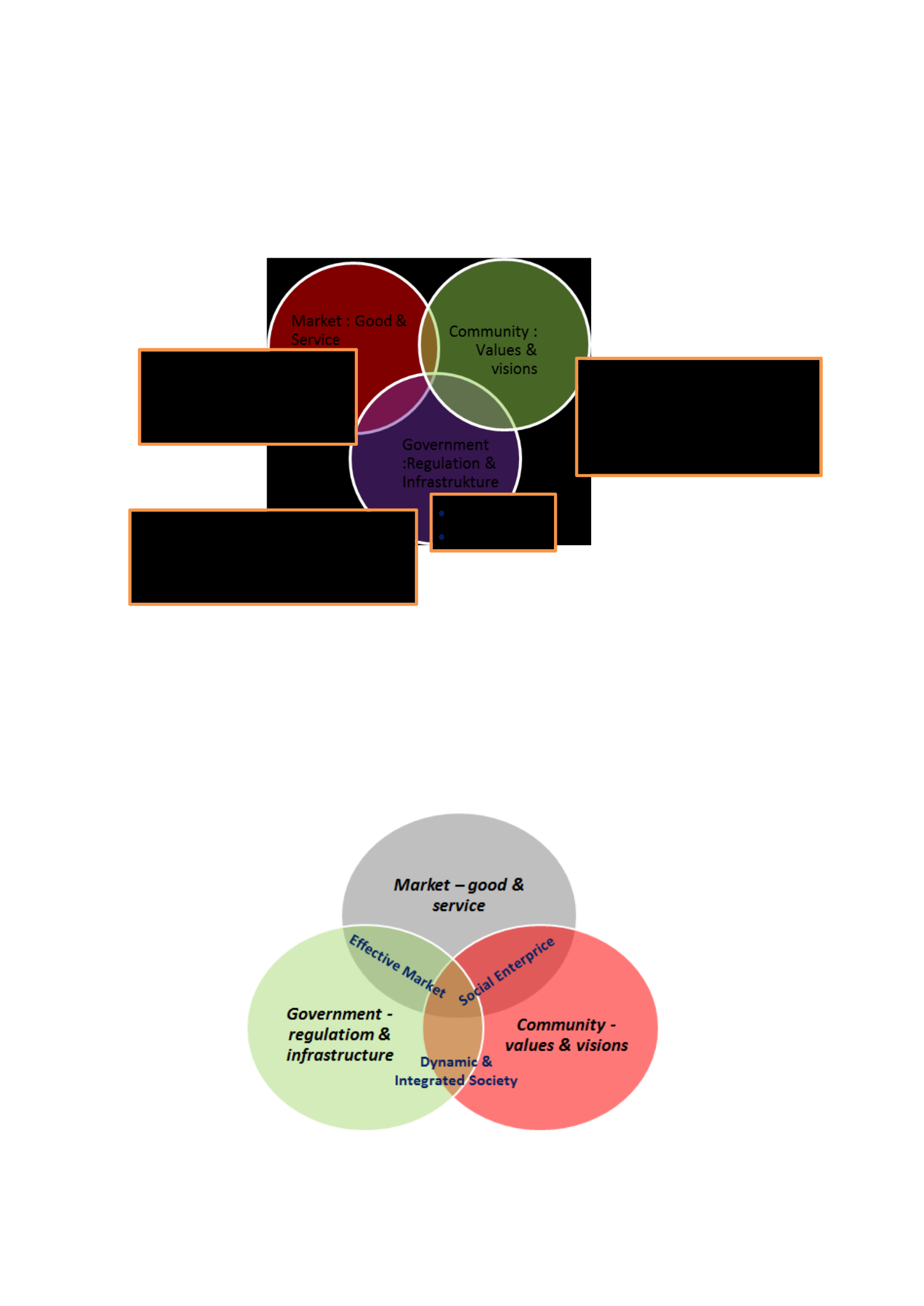
Time regulation:
Short-term Development:
INFRASTRUCTURE (time prime 10
years. MARKET (time prime 6 years)
LEADERSHIP
INNOVATION
In the direction of the
Community: Long term, it can
help and encourage the
community to improve their
quality of life.
The market has "POWER"
and for the Commitment to
be SUSTAINABLE then
Awareness required
One of the strategies for sustainable urban development is that the government as a
development manager must have leadership, and innovation. The development program has
the concept of short term and long term development, both concepts support each other in
order to achieve a vision of sustainable urban development.
Sustainable Urban Development Strategy
One example of an innovative leader is being able to make sustainable city breakthroughs
such as Cities with Solar panels, Cities with Smart City, and movements to change the urban
environment to be more environmentally friendly.
Figure 8. Sectoral dimensions that simultaneously produce something that is Integrity

The above principle illustrates a sectoral dimension, namely social, economic, and
environmental, into a development that cooperates with each other to maintain balance, it
will produce an effective market regulation, and social enterprice economic development
with attention to the environment will produce a good social community value as well. The
principle of sustainable development is one example:
Settlement: sustainable urban development recognizes the earth can only
adjust to a more balanced state if settlements "reduce their ecological
footprint" while they "simultaneously" improve their quality of life. In this
case, reducing the "ecological" footprint means reducing the use of materials
and energy that produce excessive CO2), while simultaneously it means
paying attention to providing healthy settlements, providing jobs, and
designing with social communities in mind.
Place-making: sustainability that recognizes the significance and diversity of
communities and regions for earth stewardship (cultured buildings,
landscaping, sculpture, and attention to biodiversity for future generations).
Net-Benefit: Sustainability that addresses the extraction of non-renewable
resources, providing net environmental social and economic benefits for
future generations. Reduce the impact and maintain the environmental
sustainability of irresponsible agencies.
The principles and enforcement of sustainable cities are expected to pay more attention to
humanity, more humane. Returning to the essence of the city itself is formed from human
needs. The relationship between the city, formed from humans and the environment, related
to the city is a system that cannot be separated from spatial planning, why because cities are
formed as a result of natural processes and social processes, human activities as creatures
that utilize natural resources also have tendencies that are patterned and spatially structured.
According to Rustiadi, et al (2011), human spatial instincts are natural and the result of long
"learning" experiences, so that they get typical spatial patterns, for example in the layout of
residential houses, public spaces (gathering places), yards, fields, rice fields, and so on. The
regularity of the spatial configuration of the community's socio-economic activities or
patterns of space utilization are always found in every community's economy or patterns of
space utilization are always found in every community's life in maintaining its life, adjusting
to the environment, optimizing efforts to utilize natural resources, optimizing social

interactions, as well as forms of cultural expression. The interaction between humans and
the environment requires humans to provide various infrastructure to facilitate access and
manage these resources.
The philosophy of sustainable urban planning is to meet the needs of society, the needs of
generations, and the needs of the economy, which is socially just where the goal is to
prevent unwanted changes, create balance and sustainable development. The beginning of
the process of sustainable urban planning starts with the need to make changes for the better
(welfare, natural disasters, social development, etc.).
Some Countries That Implement Sustainable Urban Development
Learning from other countries, about how to build a vision of a sustainable city and how to
implement it, certainly adds insight into managing a city, even though the cases and
problems are different. Consistency to build a sustainable city vision starts from the
creativity of a leader and building awareness of its citizens. The following is an explanation
of the table below:
Table 3. Countries in the Vision of a Sustainable City

STATE
CITY DESCRIPTION
Singapore
As a small and densely populated island nation with no natural resources,
Singapore's own sustainable development experience has focused on four
key areas, namely, (1) Building a sustainable economy; (2) creating a
sustainable living environment; (3) ensuring sustainable development for
our people; and (4) contributing to international collaboration.
•
Singapore is the 20th most carbon-efficient country in the world
•
Integrated transportation, MRT, BUS., pedestrian way
•
Since the 1970s, economic development has helped lift billions of people
out of poverty. Social indices of human development such as health and
education have improved significantly.
•
Despite not having natural resources, Singapore manages its human
resources more carefully.
•
Singapore plans to introduce a carbon tax from 2019, so those who emit
the most carbon will bear the cost to our environment and be encouraged to
reduce their emissions.
•
Give prizes to residents whose houses are energy efficient, tax discounts
•
A generation of pioneers, with a vision for a clean, green and sustainable
Singapore for all Singaporeans. Instilling the awareness that this little
island is all we have, and we must take good care of it.
•
Over the past 50 years, saw major improvements in housing, water, public
health and sanitation. Provides a City in Parks with about 47 percent green
cover in Singapore. More than 80 percent of households are within a 10-
minute walk of a park.
•
It has 72 hectares of green roof gardens and walls today, and aims to
double that by 2030.

Curitiba,
Brazil
•
Curitiba, is the world's first sustainable city. In 1971, architect Jaime
Lerner was elected mayor for the first of three terms, and came up with
innovative and creative solutions that saw Curitiba undergo a remarkable
evolution.
•
The greenest city, with more than 50 M2 of green space per capita, much
more than the UN recommendation. The reason why there is so much green
space is that Lerner had to find a solution to the frequent flooding that
occurred due to the geographical position of the city, so Lerner created a
large green belt around the city, which has turned into a large habitat for
many plants and animals. These large green areas are maintained by sheep
and goats and the wool they produce is sold to finance social development
in the city.
•
About 60% of people rely on the bus network in the city, efficiency for the
light rail system with dedicated lanes.
•
The city of Curitiba is a wonderful example of what creative leaders dare
and do, to make a city truly serve its residents rather than create stress,
congestion and inequality among its residents.
•
Implement a simple Bus transportation system, by dividing 5 arterial traffic
roads.
•
There are 28 parks and forest areas in Curitiba, creating an urban landscape
unlike any other developing city. The city's parks are designed to be
connected rather than isolated to maximize usage. The park was designed
by Hitoshi Nakamura.
•
The parks also stop squatters from creating shanty towns in flood-prone
zones.
•
Curitiba has 4 times the recommended green space, using sheep to "mow"
some of the grass in the parks.
By examining two countries, namely: Singapore and Curitiba, it is expected to increase
knowledge about "sustainable cities", where sustainable development focuses on human
resources, social justice, creating spatial equality.

Conclusions
Based on the sources of sustainable city references, it can be concluded that a sustainable
city is a city that is able to meet the NEEDS of the present without ignoring the NEEDS of
future GENERATIONS, how to REPAIR ENVIRONMENTAL DAMAGE without
sacrificing the NEEDS of ECONOMIC DEVELOPMENT and SOCIAL JUSTICE.
Building a sustainable city also takes into account 4 dimensions, namely SOCIAL
DIMENSION, ECONOMIC DIMENSION, ENVIRONMENTAL DIMENSION, and
GOVERNMENT DIMENSION. These four things Side by side, the success of sustainable
development does not only depend on the economic dimension but needs the intervention of
the power holder or in this case the government dimension, in order to implement
sustainable development so as to achieve equitable distribution of welfare. Therefore,
sustainable development is oriented towards the development of Green Cities that have a
good quality of life and conducive environmental conditions.
Problems
Urban growth is a complex phenomenon, partly spontaneous and partly planned. There have
been several attempts to manage that complexity. Ideas such as building sustainable cities,
resulting in better urban environments that meet people's needs, have fewer socio-economic
costs, and use less nature.
Based on the explanation above, the problem about the city is that when some of the cities
develop spontaneously (sprawl), the population increases, the development of urban areas
and land clearing occurs which changes the function of productive areas of paddy land into
new residential / residential areas, forest conversion into agricultural / plantation land.
Furthermore, the urbanization process also creates socio-economic problems for cities,
forming slum areas that have low income in the city, resulting in crime in urban spaces.
These problems represent urban development that does not take into account the quality of
human life. The congestion of cities such as Jakarta and other large cities, due to poorly
integrated public transportation systems. The earth's temperature is getting hotter due to
CO2 emissions from various human activities on earth such as motor gas air pollution,
greenhouse effect, building materials, and flooding in urban areas, and so on.

Based on the problems mentioned above, the world's cities consume three-quarters of the
world's energy and cause three-quarters of global pollution and cities have become parasitic
ehuge organisms that can drain the earth for food due to excessive energy consumption:
relentless consumers, relentless polluters. So that over time the city system becomes
unstable, resilience and capacity are not high enough, and it is likely that the city will
collapse (colappse). With the phenomena of environmental degradation and rising
temperatures, humans are no longer comfortable in their habitats (Roger, 1998 and Egger
2006).
Cities are the drivers of future growth, but also the biggest contributors to CO2 emissions.
So that a concept that pays attention to environmental balance is needed, namely the concept
of sustainable development. The concept of sustainable development has been widely
developed into the theoretical foundations of sustainable cities. City references and
applicative applications of sustainable urban development are easy to find, both in various
methods and paradigms. The dream of an ideal future city concept in the book "Garden City
of to-morrow" written by Ebenezer Howard (1898), invited controversy, became utopias,
considered irrelevant, unreasonable, and due to this irrelevance, the concept of Garden City
of to-morrow Ebenezer Howard is not widely used, only natural and natural concepts are
widely taken by urban planners, the rest is just a historical record. Twentieth-century urban
planners had a variety of new concepts in planning their cities from the initial idea of a
dream of a sustainable city that had become our common future.
Objectives and Benefits
Based on the above background and problems, the author sees the need to conduct a
theoretical study to better understand the concept of sustainable development in the four
dimensions of sustainable development, namely environmental, social, and economic, and
government. about the meaning and scope as a source of knowledge for the community
(students, academics, and practitioners) while strengthening the body knowledge of
architecture. The results of this paper are expected to be able to provide a deeper
understanding for students, and practitioners, to understand architecture and cities, becoming
a provision in the practice of architecture and planning science.
Writing Method
This research is a literature research to explore the understanding, meaning and scope of the

concept of a sustainable city. Various thoughts about the concept of a sustainable city can be
used as supporting data in this writing. The search for data and information through
documents, both in the form of written documents, photographs, images, and electronic
documents that can support the research process. Research results will also be more credible
if supported by photographs or existing academic and artistic papers (Sugiyono, 2005: 83).
Therefore, literature study can affect the credibility of the results of the research conducted.
Sustainable Cities And Their Development
Cities and their Development
Before understanding more about sustainable cities, it is necessary to know what the
definition of a city, its equivalents, differences, and scale are.
When the philosophy of science developed towards modern thinking. Humanist thinking
was influenced by the views of Karl Marx, Immanuel Kant, and Max Weber, the most
influential of whom was the Spirit of Capitalism (1905). So the city is a place where most of
its economic needs are in the local market, the characteristics of the city are the existence of
a market as a fortress and has a legal system and is cosmopolitan. When the city develops, as
a place to live, a place to produce goods and services, the scale of services develops, there is
a concentration of population, with high density. A small city to a megacity is said to have a
population of 20,000 to 5,000,000.
There are three opinions, namely; Max Weber (1905), Hamilton (2001), Steve Egger (2006),
defining the city basically is to accommodate human needs, community needs, and
economic needs. If we go back to Maslow's (1943) theory in "The Theory Of Human
Motivation" about the Hierarchy of human needs, namely basic needs are elements needed
by humans in maintaining balance both physiologically and psychologically which aims to
maintain life and health. Hierarchy (1) Physiological Needs or Faal Needs (physiological
needs): the right to get oxygen, food, sleep (human self-activity), (2) Safety, security needs:
Protection, (3) Love needs (social needs): social interaction life, (4) Esteem needs EGO
ownership (esteem needs), and (5) Self-actualization (self- actualization needs): recognition
appreciated, social status.
Cities are formed from human needs, to serve (Hamilton, 2001) from the hierarchy of human
needs, spatial formation of community expression (Steve Egger, 2006) makes the city

formed in a network or a system of community expression. As a result of such a system,
cities require management, governance, trade, culture, education, and society, to facilitate an
environment for human existence and interaction (Egger, 2006).
From the various opinions above, it can be concluded that the realization of the city is to
accommodate human needs, and when the city is growing dynamically, the city becomes a
network that is intertwined in a unified system, so that a city requires serious management
based on the scale of services, if not managed, social, economic, and environmental
problems then the city experiences collapse and crisis. A good city is one that responds to
the various problems that occur in the city, and thinks about survival and sustainability.
Sustainability
The definition of sustainability (continue) according to the Big United States Dictionary
(KBBI) is sustainable; and continuously. "Sustain": (1) strengthen or support physically or
mentally, (2) undergo or suffer (something unpleasant, especially an injury), (3) uphold,
affirm, or confirm the justice or validity of, in United States translation "sustain" is
menopang. The definition of sustain here is being able to endure, sustain, support, sustain,
experience, continue, suffer, prolong, and enable. As for the translation of "ability": (1)
possession of the means or skill to do something, (2) talent, skill, or proficiency in a
particular area, in United States translation is ability, capability, talent, ability, proficiency,
cleverness, wisdom, shrewdness, and dexterity.
Sustainable Cities
History of Sustainable Urban Development
To understand what "sustainability" is, and why there is an agreement on sustainable
development. It is therefore necessary to trace a history of the birth of the idea of sustainable
urban development.
In 1972, the Stockholm UN World Conference on Human Environment: UN
Conference on Human Environment (June 5-6, 1972): the focus was on discussing
guidelines and actions in dealing with environmental problems, such as alleviating
poverty, and protecting the environment.
Paul Ehrlich, a Stanford University Professor of Biology, who wrote a book titled
"Population Bomb": was a bestseller written by Stanford University Professor Paul R.
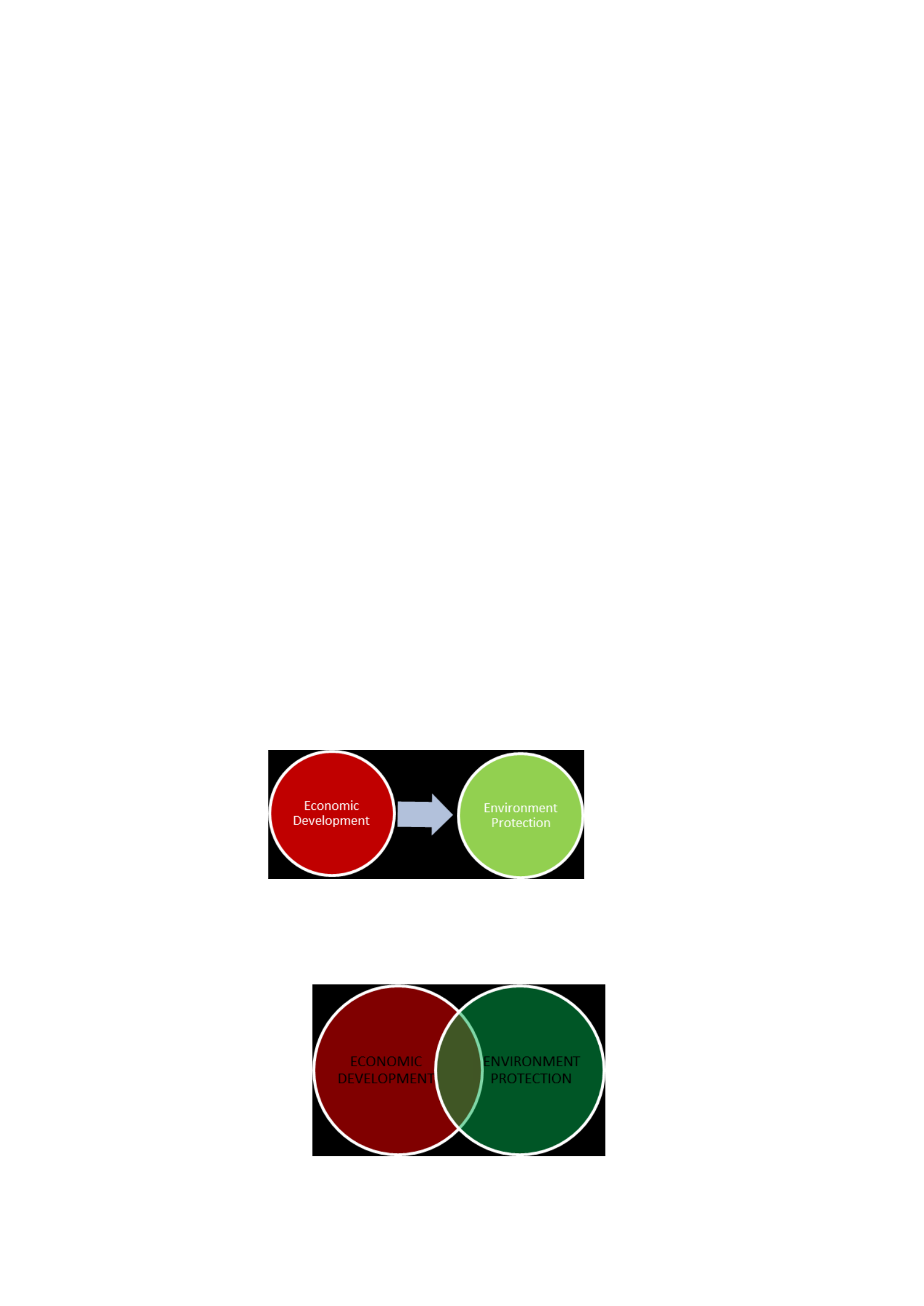
Ehrlich and his wife, Anne Ehrlich (who was not recognized), in 1968. The book
warned of mass human starvation in the 1970s and 1980s due to overpopulation, as
well as social upheaval, and advocated immediate action to limit population growth.
Fears of a widespread "population explosion" in the 1950s and 1960s.
In 1982, the Nairobi World Commission on Environment and Development. One of
the ongoing agendas of this UN meeting was to discuss environmental degradation,
deforestation, soil and water degradation, atmospheric changes - such as depletion of
the ozone layer, increasing concentrations of CO2 gas.
In 1987, the Brundtland report "Our Common Future" stated that sustainable
development is development that meets the needs of the present.
In 1992, the Rio United Nations World Conference on Environment and Development,
discussed the development of ecological sustainability, where at that time the
American President, Ronald Reagen, rejected the agenda because he considered
sustainable development not a solution to the problem, as well as the Australian Prime
Minister, namely John Howard. The countries that agreed to implement the agenda are
Canada, Japan, Europe, From these historical moments, a formulation of sustainable
development emerged, which initially was to pay attention to the needs of the present
and the future, economic development needs to pay attention to the environment or be
wiser and limit the excessive use of natural resources.
Sustainable development is development that meets current needs

Problem Solving to manage the current condition of urban development is SUSTAINABLE
DEVELOPMENT in an awareness of "our common future" by paying attention to
economic needs that pay attention to environmental protection.
Definition of Sustainable City
Based on the above understanding, a sustainable city is a city that has the ability, ability, and
wise thinking to think about current and future needs, and the city is able to support, support
the needs of living things in a system (cover in system), where the development of a
dynamic and significantly growing city certainly requires efficient and effective
management or planning. So that the city physically has a mental awareness to maintain
environmental balance and sustainability of life in it, so that in the end the city is expected to
be socially just and prosperous.
In an ecological context, sustainability is understood as the ability of ecosystems to maintain
and sustain ecological processes, functions, productivity, and diversity into the future
(Wardhono, 2012).
Sustainable cities are cities that are able to meet the needs of the present without ignoring
the needs of future generations, how to repair environmental destruction without sacrificing
the needs of economic development and social justice. The concept of sustainable cities was
launched by the United Nations in June 2012 at the Rio+20 The United Nations Conference
on Sustainable Development. The concept is planned to be disseminated to the world's urban
stakeholders who are responsible for policy-making, planning and implementation of urban
development. Cities that have the ability to drive future growth, but are also able to grow
more efficiently and environmentally friendly.
The concept of environmental balance, related to sustainable cities "ecocity", which is the
development of cities that currently require a type of development that not only pays
attention to the development of the economic side (without the financial and material), but
needs to pay attention to aspects of the development of the quality of human life in it
(Richard Register, 1987). Then in the Research Triangle Institute (1996) the City must be
able to have five basic principles in the concept of sustainability, namely: Environmental
(Ecology), Economy (Employment), Society (Equity), Engagement and Energy. In its
application, the five elements must be able to run simultaneously, development inequality
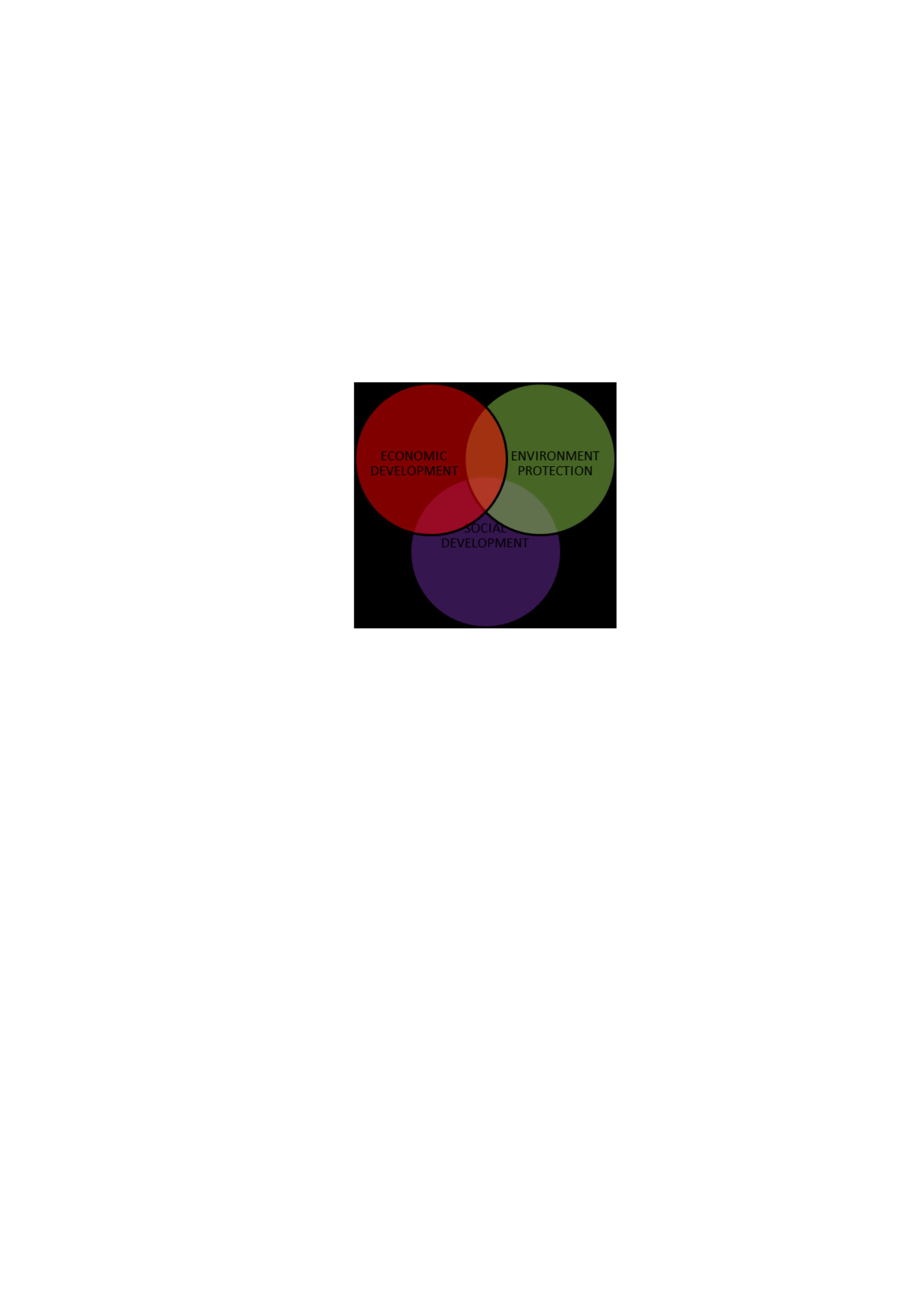
will occur if the development of each element is uneven (Budihardjo and Sujarto, 1999).
Furthermore, the concept of sustainable cities according to Rogers (1998), must recognize
that cities need to meet social, environmental, political and cultural as well as economic and
physical goals. Rogers elaborated by including these keywords, such a city also pays
attention to aspects of beauty in art and architecture, creativity to optimize human potential,
resource efficiency and minimal ecological impact, ease of contact, mobility, integrated and
compact communities and diversity.
"SIMULTAN"
Sustainable development needs to be implemented "SIMULTANEOUSLY"
Sustainable Urban Planning Strategies
Based on the above review, the consideration to protect the environmental conditions that
are decreasing in quality, and the population explosion, then automatically the needs of
human life increase. Therefore, to carry out a sustainable urban development strategy, which
is carried out "Simultaneously" by combining the 4 (four) dimensions, namely: planning
that considers "economic development, by protecting the environment", and paying attention
to "social development", and the need for "Government" management as a regulatory
function and providing infrastructure.
Urban planning, of course, can never wait, because human affairs go on and their direction is
determined by the degree of planning. Realizing a real city that is sustainable is to open a
broad view that every city has housing, high-rise buildings, urban alleys, parks, people's
homes. We see how they live, how their children will become citizens and neighbors of their
children and generations. It is this view that gives direction to the city of the future, a city

that is comfortable to live in for every generation, serves human needs, and directs the
means to shape the urban environment.
Sustainable development in social capital can grow at the individual, family, community,
local community, society in a region, national, and even global levels. Community-level
social capital cannot be measured simply as an aggregation of individual networks. Strong
community-level social capital creates a "civic infrastructure" that will support formal and
informal decision-making processes and public engagement (Potapchuck et.al. 1997).
Individual social capital is closely related to human capital. When individuals invest in
being able to communicate well, they increase their social capital but reduce the social
capital of the community. Determinants of social capital can also include economic and
political instability, patron-client relationships, education, occupation, collective interest and
market legitimization of common values. Social capital can lower the costs of cooperation
and facilitate cooperation. To build social capital effectively, local governments must share
autonomy/roles with their communities, in the sense that they must shift from being
controllers, regulators and providers, to catalysts, conveners and facilitators (Crocker et al.
1998).
The issue of weak state capacity in developing countries, characterized by the inability to
carry out development, has become a hot topic discussed by experts. Theories of
government failure characterized by a "top-down" approach, as well as social capital theory
characterized by a "bottom-up" approach, both provide a framework that underlies the basic
framework for identifying the symptoms of "state incapacity" (Sallis and Dollery, 2001).
The government's role in implementing sustainable urban development is to have a
sustainable-minded leadership spirit so that the dynamic development of the city can be
managed effectively without incurring large costs.
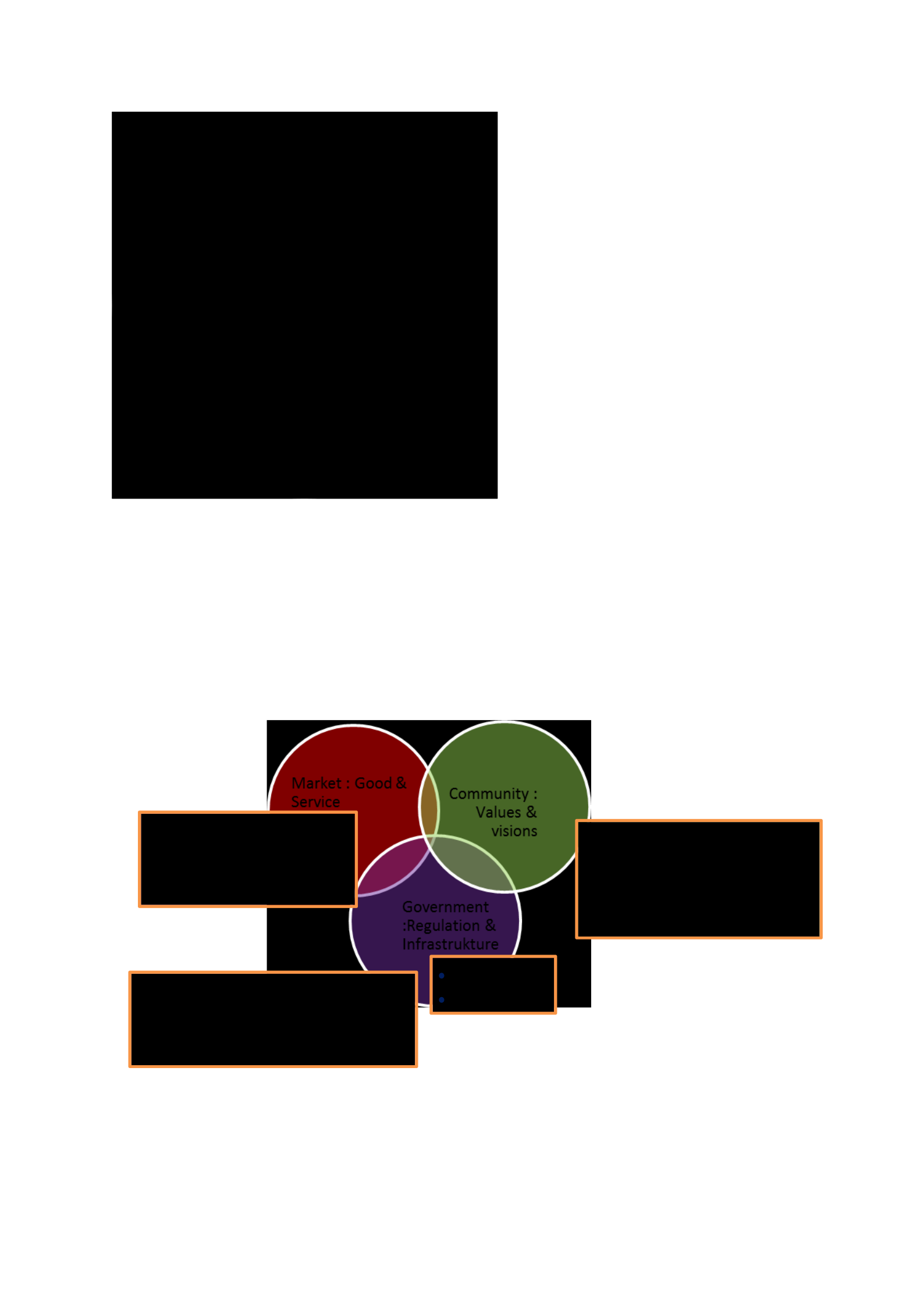
Time regulation:
Short-term Development:
INFRASTRUCTURE (time prime 10
years. MARKET (time prime 6 years)
LEADERSHIP
INNOVATION
In the direction of the
Community: Long term, it can
help and encourage the
community to improve their
quality of life.
The market has "POWER"
and for the Commitment to
be SUSTAINABLE then
Awareness required
Sustainable City Development Concept in 4 (four) Sectoral Dimensions
One of the strategies for sustainable urban development is that the government as a
development manager must have leadership, and innovation. The development program has
the concept of short term and long term development, both concepts support each other in
order to achieve a vision of sustainable urban development.
Sustainable Urban Development Strategy
"SUSTAINABLE"
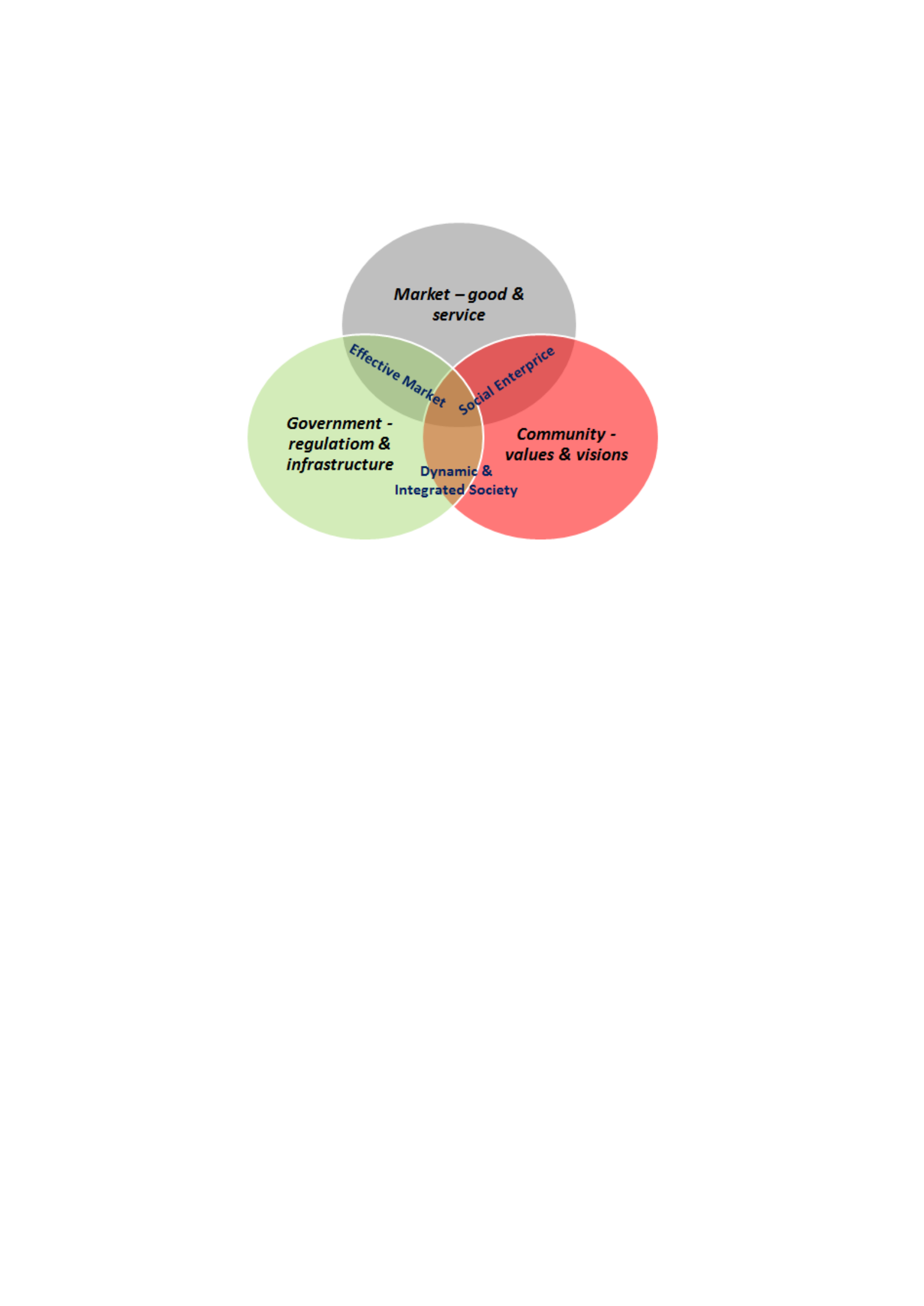
One example of an innovative leader is being able to make sustainable city breakthroughs
such as Cities with Solar panels, Cities with Smart City, and movements to change the urban
environment to be more environmentally friendly.
Figure 8. Sectoral dimensions that simultaneously produce something that is Integrity
The above principle illustrates a sectoral dimension, namely social, economic, and
environmental, into a development that cooperates with each other to maintain balance, it
will produce an effective market regulation, and social enterprice economic development
with attention to the environment will produce a good social community value as well. The
principle of sustainable development is one example:
Settlement: sustainable urban development recognizes the earth can only
adjust to a more balanced state if settlements "reduce their ecological
footprint" while they "simultaneously" improve their quality of life. In this
case, reducing the "ecological" footprint means reducing the use of materials
and energy that produce excessive CO2), while simultaneously it means
paying attention to providing healthy settlements, providing jobs, and
designing with social communities in mind.
Place-making: sustainability that recognizes the significance and diversity of
communities and regions for earth stewardship (cultured buildings,
landscaping, sculpture, and attention to biodiversity for future generations).
Net-Benefit: Sustainability that addresses the extraction of non-renewable
resources, providing net environmental social and economic benefits for
future generations. Reduce the impact and maintain the environmental

sustainability of irresponsible agencies.
The principles and enforcement of sustainable cities are expected to pay more attention to
humanity, more humane. Returning to the essence of the city itself is formed from human
needs. The relationship between the city, formed from humans and the environment, related
to the city is a system that cannot be separated from spatial planning, why because cities are
formed as a result of natural processes and social processes, human activities as creatures
that utilize natural resources also have tendencies that are patterned and spatially structured.
According to Rustiadi, et al (2011), human spatial instincts are natural and the result of long
"learning" experiences, so that they get typical spatial patterns, for example in the layout of
residential houses, public spaces (gathering places), yards, fields, rice fields, and so on. The
regularity of the spatial configuration of the community's socio-economic activities or
patterns of space utilization are always found in every community's economy or patterns of
space utilization are always found in every community's life in maintaining its life, adjusting
to the environment, optimizing efforts to utilize natural resources, optimizing social
interactions, as well as forms of cultural expression. The interaction between humans and
the environment requires humans to provide various infrastructure to facilitate access and
manage these resources.
The philosophy of sustainable urban planning is to meet the needs of society, the needs of
generations, and the needs of the economy, which is socially just where the goal is to
prevent unwanted changes, create balance and sustainable development. The beginning of
the process of sustainable urban planning starts with the need to make changes for the better
(welfare, natural disasters, social development, etc.).
Some Countries That Implement Sustainable Urban Development
Learning from other countries, about how to build a vision of a sustainable city and how to
implement it, certainly adds insight into managing a city, even though the cases and
problems are different. Consistency to build a sustainable city vision starts from the
creativity of a leader and building awareness of its citizens. The following is an explanation
of the table below:

Table 3. Countries in the Vision of a Sustainable City
STATE
CITY DESCRIPTION
Singapore
As a small and densely populated island nation with no natural resources,
Singapore's own sustainable development experience has focused on four
key areas, namely, (1) Building a sustainable economy; (2) creating a
sustainable living environment; (3) ensuring sustainable development for
our people; and (4) contributing to international collaboration.
•
Singapore is the 20th most carbon-efficient country in the world
•
Integrated transportation, MRT, BUS., pedestrian way
•
Since the 1970s, economic development has helped lift billions of people
out of poverty. Social indices of human development such as health and
education have improved significantly.
•
Despite not having natural resources, Singapore manages its human
resources more carefully.
•
Singapore plans to introduce a carbon tax from 2019, so those who emit
the most carbon will bear the cost to our environment and be encouraged to
reduce their emissions.
•
Give prizes to residents whose houses are energy efficient, tax discounts

•
A generation of pioneers, with a vision for a clean, green and sustainable
Singapore for all Singaporeans. Instilling the awareness that this little
island is all we have, and we must take good care of it.
•
Over the past 50 years, saw major improvements in housing, water, public
health and sanitation. Provides a City in Parks with about 47 percent green
cover in Singapore. More than 80 percent of households are within a 10-
minute walk of a park.
•
It has 72 hectares of green roof gardens and walls today, and aims to
double that by 2030.
Curitiba,
Brazil
•
Curitiba, is the world's first sustainable city. In 1971, architect Jaime
Lerner was elected mayor for the first of three terms, and came up with
innovative and creative solutions that saw Curitiba undergo a remarkable
evolution.
•
The greenest city, with more than 50 M2 of green space per capita, much
more than the UN recommendation. The reason why there is so much green
space is that Lerner had to find a solution to the frequent flooding that
occurred due to the geographical position of the city, so Lerner created a
large green belt around the city, which has turned into a large habitat for
many plants and animals. These large green areas are maintained by sheep
and goats and the wool they produce is sold to finance social development
in the city.
•
About 60% of people rely on the bus network in the city, efficiency for the
light rail system with dedicated lanes.
•
The city of Curitiba is a wonderful example of what creative leaders dare
and do, to make a city truly serve its residents rather than create stress,
congestion and inequality among its residents.
•
Implement a simple Bus transportation system, by dividing 5 arterial traffic
roads.
•
There are 28 parks and forest areas in Curitiba, creating an urban landscape
unlike any other developing city. The city's parks are designed to be
connected rather than isolated to maximize usage. The park was designed
by Hitoshi Nakamura.
•
The parks also stop squatters from creating shanty towns in flood-prone

zones.
•
Curitiba has 4 times the recommended green space, using sheep to "mow"
some of the grass in the parks.
By examining two countries, namely: Singapore and Curitiba, it is expected to increase
knowledge about "sustainable cities", where sustainable development focuses on human
resources, social justice, creating spatial equality.
Conclusions
Based on the sources of sustainable city references, it can be concluded that a sustainable
city is a city that is able to meet the NEEDS of the present without ignoring the NEEDS of
future GENERATIONS, how to REPAIR ENVIRONMENTAL DAMAGE without
sacrificing the NEEDS of ECONOMIC DEVELOPMENT and SOCIAL JUSTICE.
Building a sustainable city also takes into account 4 dimensions, namely SOCIAL
DIMENSION, ECONOMIC DIMENSION, ENVIRONMENTAL DIMENSION, and

GOVERNMENT DIMENSION. These four things Side by side, the success of sustainable
development does not only depend on the economic dimension but needs the intervention of
the power holder or in this case the government dimension, in order to implement
sustainable development so as to achieve equitable distribution of welfare. Therefore,
sustainable development is oriented towards the development of Green Cities that have a
good quality of life and conducive environmental conditions.
Problems
Urban growth is a complex phenomenon, partly spontaneous and partly planned. There have
been several attempts to manage that complexity. Ideas such as building sustainable cities,
resulting in better urban environments that meet people's needs, have fewer socio-economic
costs, and use less nature.
Based on the explanation above, the problem about the city is that when some of the cities
develop spontaneously (sprawl), the population increases, the development of urban areas
and land clearing occurs which changes the function of productive areas of paddy land into
new residential / residential areas, forest conversion into agricultural / plantation land.
Furthermore, the urbanization process also creates socio-economic problems for cities,
forming slum areas that have low income in the city, resulting in crime in urban spaces.
These problems represent urban development that does not take into account the quality of
human life. The congestion of cities such as Jakarta and other large cities, due to poorly
integrated public transportation systems. The earth's temperature is getting hotter due to
CO2 emissions from various human activities on earth such as motor gas air pollution,
greenhouse effect, building materials, and flooding in urban areas, and so on.
Based on the problems mentioned above, the world's cities consume three-quarters of the
world's energy and cause three-quarters of global pollution and cities have become parasitic
ehuge organisms that can drain the earth for food due to excessive energy consumption:
relentless consumers, relentless polluters. So that over time the city system becomes
unstable, resilience and capacity are not high enough, and it is likely that the city will
collapse (colappse). With the phenomena of environmental degradation and rising
temperatures, humans are no longer comfortable in their habitats (Roger, 1998 and Egger
2006).

Cities are the drivers of future growth, but also the biggest contributors to CO2 emissions.
So that a concept that pays attention to environmental balance is needed, namely the concept
of sustainable development. The concept of sustainable development has been widely
developed into the theoretical foundations of sustainable cities. City references and
applicative applications of sustainable urban development are easy to find, both in various
methods and paradigms. The dream of an ideal future city concept in the book "Garden City
of to-morrow" written by Ebenezer Howard (1898), invited controversy, became utopias,
considered irrelevant, unreasonable, and due to this irrelevance, the concept of Garden City
of to-morrow Ebenezer Howard is not widely used, only natural and natural concepts are
widely taken by urban planners, the rest is just a historical record. Twentieth-century urban
planners had a variety of new concepts in planning their cities from the initial idea of a
dream of a sustainable city that had become our common future.
Objectives and Benefits
Based on the above background and problems, the author sees the need to conduct a
theoretical study to better understand the concept of sustainable development in the four
dimensions of sustainable development, namely environmental, social, and economic, and
government. about the meaning and scope as a source of knowledge for the community
(students, academics, and practitioners) while strengthening the body knowledge of
architecture. The results of this paper are expected to be able to provide a deeper
understanding for students, and practitioners, to understand architecture and cities, becoming
a provision in the practice of architecture and planning science.
Writing Method
This research is a literature research to explore the understanding, meaning and scope of the
concept of a sustainable city. Various thoughts about the concept of a sustainable city can be
used as supporting data in this writing. The search for data and information through
documents, both in the form of written documents, photographs, images, and electronic
documents that can support the research process. Research results will also be more credible
if supported by photographs or existing academic and artistic papers (Sugiyono, 2005: 83).
Therefore, literature study can affect the credibility of the results of the research conducted.
Sustainable Cities And Their Development

Cities and their Development
Before understanding more about sustainable cities, it is necessary to know what the
definition of a city, its equivalents, differences, and scale are.
When the philosophy of science developed towards modern thinking. Humanist thinking
was influenced by the views of Karl Marx, Immanuel Kant, and Max Weber, the most
influential of whom was the Spirit of Capitalism (1905). So the city is a place where most of
its economic needs are in the local market, the characteristics of the city are the existence of
a market as a fortress and has a legal system and is cosmopolitan. When the city develops, as
a place to live, a place to produce goods and services, the scale of services develops, there is
a concentration of population, with high density. A small city to a megacity is said to have a
population of 20,000 to 5,000,000.
There are three opinions, namely; Max Weber (1905), Hamilton (2001), Steve Egger (2006),
defining the city basically is to accommodate human needs, community needs, and
economic needs. If we go back to Maslow's (1943) theory in "The Theory Of Human
Motivation" about the Hierarchy of human needs, namely basic needs are elements needed
by humans in maintaining balance both physiologically and psychologically which aims to
maintain life and health. Hierarchy (1) Physiological Needs or Faal Needs (physiological
needs): the right to get oxygen, food, sleep (human self-activity), (2) Safety, security needs:
Protection, (3) Love needs (social needs): social interaction life, (4) Esteem needs EGO
ownership (esteem needs), and (5) Self-actualization (self- actualization needs): recognition
appreciated, social status.
Cities are formed from human needs, to serve (Hamilton, 2001) from the hierarchy of human
needs, spatial formation of community expression (Steve Egger, 2006) makes the city
formed in a network or a system of community expression. As a result of such a system,
cities require management, governance, trade, culture, education, and society, to facilitate an
environment for human existence and interaction (Egger, 2006).
From the various opinions above, it can be concluded that the realization of the city is to
accommodate human needs, and when the city is growing dynamically, the city becomes a
network that is intertwined in a unified system, so that a city requires serious management
based on the scale of services, if not managed, social, economic, and environmental

problems then the city experiences collapse and crisis. A good city is one that responds to
the various problems that occur in the city, and thinks about survival and sustainability.
Sustainability
The definition of sustainability (continue) according to the Big United States Dictionary
(KBBI) is sustainable; and continuously. "Sustain": (1) strengthen or support physically or
mentally, (2) undergo or suffer (something unpleasant, especially an injury), (3) uphold,
affirm, or confirm the justice or validity of, in United States translation "sustain" is
menopang. The definition of sustain here is being able to endure, sustain, support, sustain,
experience, continue, suffer, prolong, and enable. As for the translation of "ability": (1)
possession of the means or skill to do something, (2) talent, skill, or proficiency in a
particular area, in United States translation is ability, capability, talent, ability, proficiency,
cleverness, wisdom, shrewdness, and dexterity.
Sustainable Cities
History of Sustainable Urban Development
To understand what "sustainability" is, and why there is an agreement on sustainable
development. It is therefore necessary to trace a history of the birth of the idea of sustainable
urban development.
In 1972, the Stockholm UN World Conference on Human Environment: UN
Conference on Human Environment (June 5-6, 1972): the focus was on discussing
guidelines and actions in dealing with environmental problems, such as alleviating
poverty, and protecting the environment.
Paul Ehrlich, a Stanford University Professor of Biology, who wrote a book titled
"Population Bomb": was a bestseller written by Stanford University Professor Paul R.
Ehrlich and his wife, Anne Ehrlich (who was not recognized), in 1968. The book
warned of mass human starvation in the 1970s and 1980s due to overpopulation, as
well as social upheaval, and advocated immediate action to limit population growth.
Fears of a widespread "population explosion" in the 1950s and 1960s.
In 1982, the Nairobi World Commission on Environment and Development. One of
the ongoing agendas of this UN meeting was to discuss environmental degradation,
deforestation, soil and water degradation, atmospheric changes - such as depletion of
the ozone layer, increasing concentrations of CO2 gas.
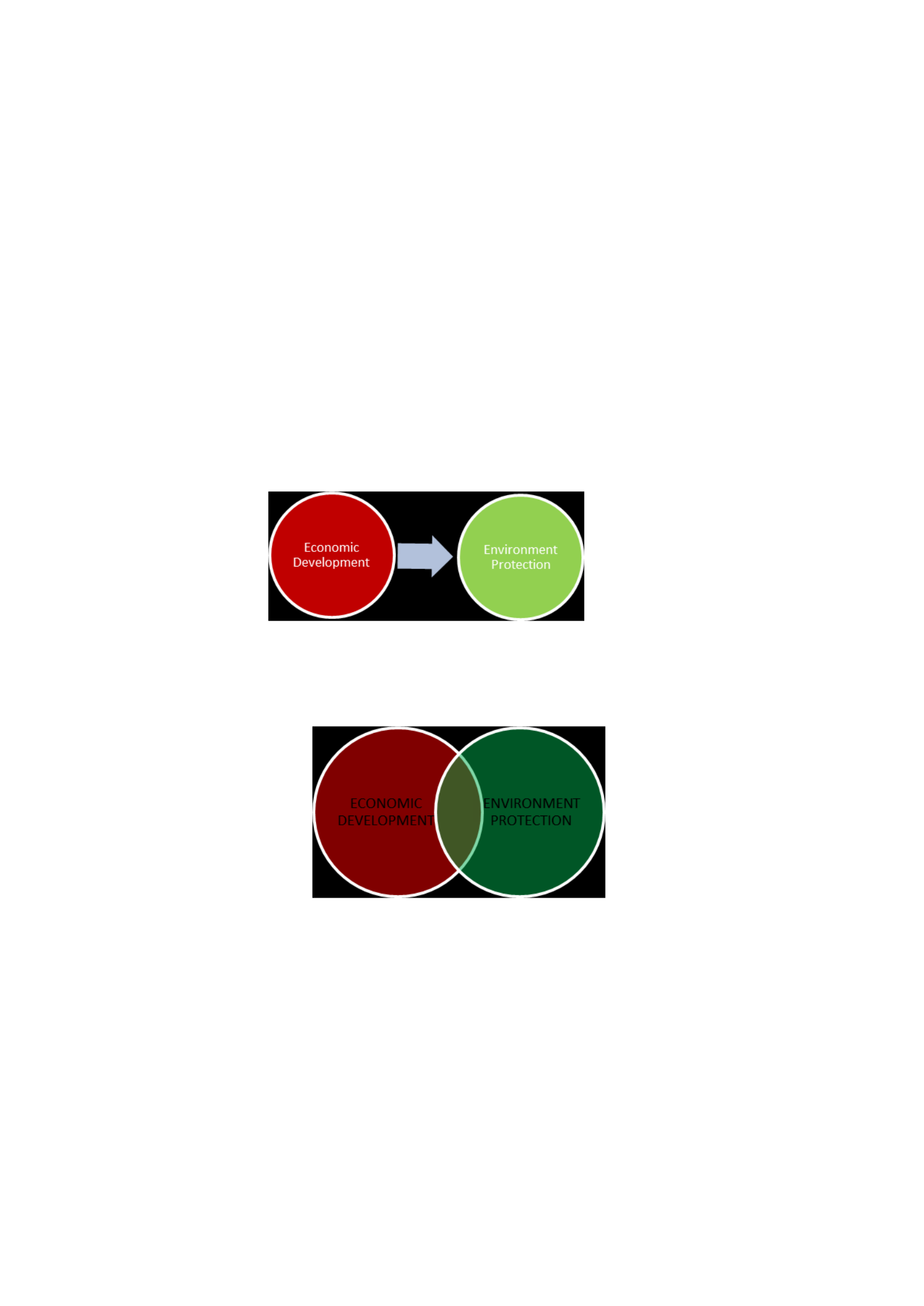
In 1987, the Brundtland report "Our Common Future" stated that sustainable
development is development that meets the needs of the present.
In 1992, the Rio United Nations World Conference on Environment and Development,
discussed the development of ecological sustainability, where at that time the
American President, Ronald Reagen, rejected the agenda because he considered
sustainable development not a solution to the problem, as well as the Australian Prime
Minister, namely John Howard. The countries that agreed to implement the agenda are
Canada, Japan, Europe, From these historical moments, a formulation of sustainable
development emerged, which initially was to pay attention to the needs of the present
and the future, economic development needs to pay attention to the environment or be
wiser and limit the excessive use of natural resources.
Sustainable development is development that meets current needs
Problem Solving to manage the current condition of urban development is SUSTAINABLE
DEVELOPMENT in an awareness of "our common future" by paying attention to
economic needs that pay attention to environmental protection.
Definition of Sustainable City
Based on the above understanding, a sustainable city is a city that has the ability, ability, and
wise thinking to think about current and future needs, and the city is able to support, support
the needs of living things in a system (cover in system), where the development of a

dynamic and significantly growing city certainly requires efficient and effective
management or planning. So that the city physically has a mental awareness to maintain
environmental balance and sustainability of life in it, so that in the end the city is expected to
be socially just and prosperous.
In an ecological context, sustainability is understood as the ability of ecosystems to maintain
and sustain ecological processes, functions, productivity, and diversity into the future
(Wardhono, 2012).
Sustainable cities are cities that are able to meet the needs of the present without ignoring
the needs of future generations, how to repair environmental destruction without sacrificing
the needs of economic development and social justice. The concept of sustainable cities was
launched by the United Nations in June 2012 at the Rio+20 The United Nations Conference
on Sustainable Development. The concept is planned to be disseminated to the world's urban
stakeholders who are responsible for policy-making, planning and implementation of urban
development. Cities that have the ability to drive future growth, but are also able to grow
more efficiently and environmentally friendly.
The concept of environmental balance, related to sustainable cities "ecocity", which is the
development of cities that currently require a type of development that not only pays
attention to the development of the economic side (without the financial and material), but
needs to pay attention to aspects of the development of the quality of human life in it
(Richard Register, 1987). Then in the Research Triangle Institute (1996) the City must be
able to have five basic principles in the concept of sustainability, namely: Environmental
(Ecology), Economy (Employment), Society (Equity), Engagement and Energy. In its
application, the five elements must be able to run simultaneously, development inequality
will occur if the development of each element is uneven (Budihardjo and Sujarto, 1999).
Furthermore, the concept of sustainable cities according to Rogers (1998), must recognize
that cities need to meet social, environmental, political and cultural as well as economic and
physical goals. Rogers elaborated by including these keywords, such a city also pays
attention to aspects of beauty in art and architecture, creativity to optimize human potential,
resource efficiency and minimal ecological impact, ease of contact, mobility, integrated and
compact communities and diversity.
"SIMULTAN"
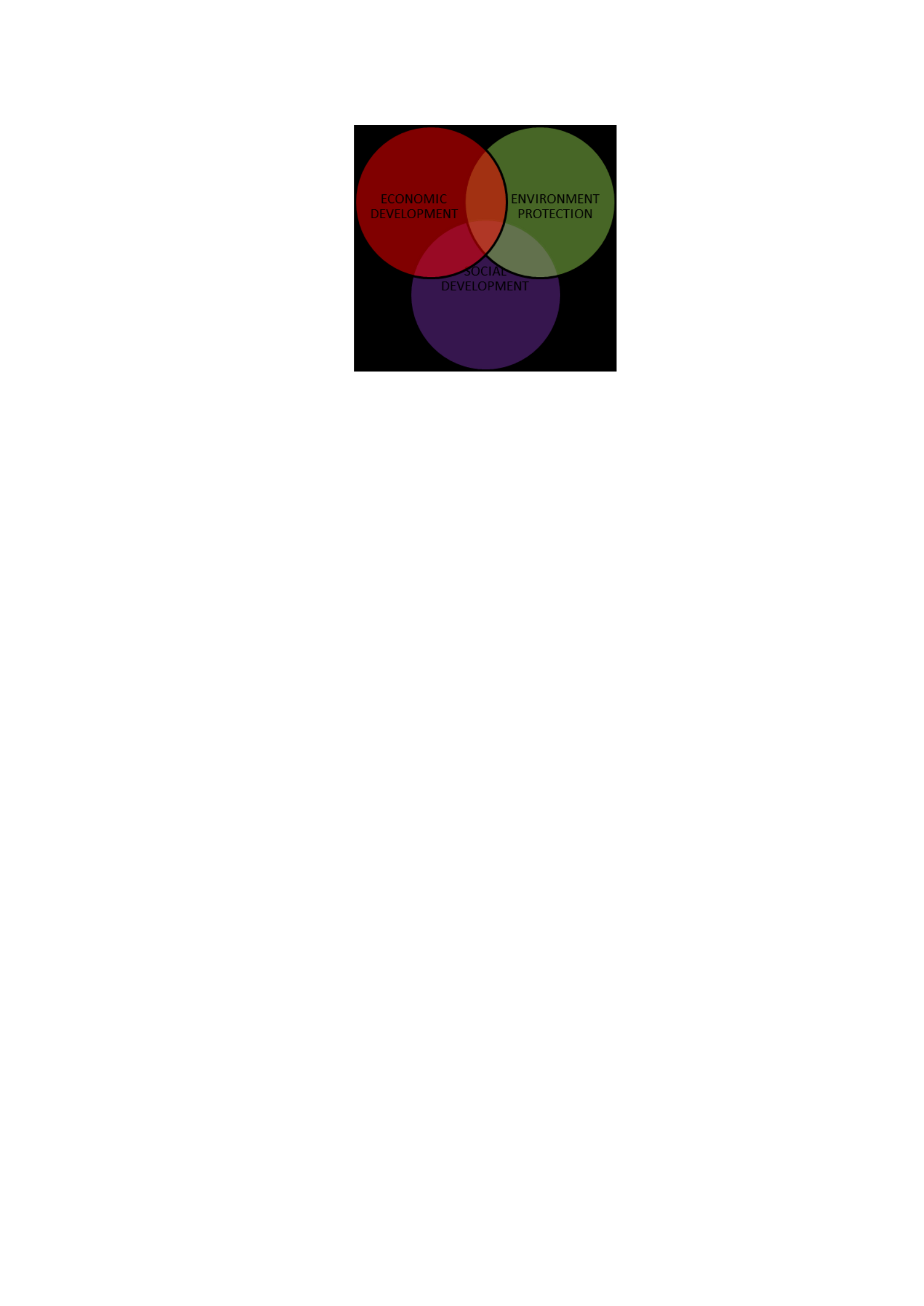
Sustainable development needs to be implemented "SIMULTANEOUSLY"
Sustainable Urban Planning Strategies
Based on the above review, the consideration to protect the environmental conditions that
are decreasing in quality, and the population explosion, then automatically the needs of
human life increase. Therefore, to carry out a sustainable urban development strategy, which
is carried out "Simultaneously" by combining the 4 (four) dimensions, namely: planning
that considers "economic development, by protecting the environment", and paying attention
to "social development", and the need for "Government" management as a regulatory
function and providing infrastructure.
Urban planning, of course, can never wait, because human affairs go on and their direction is
determined by the degree of planning. Realizing a real city that is sustainable is to open a
broad view that every city has housing, high-rise buildings, urban alleys, parks, people's
homes. We see how they live, how their children will become citizens and neighbors of their
children and generations. It is this view that gives direction to the city of the future, a city
that is comfortable to live in for every generation, serves human needs, and directs the
means to shape the urban environment.
Sustainable development in social capital can grow at the individual, family, community,
local community, society in a region, national, and even global levels. Community-level
social capital cannot be measured simply as an aggregation of individual networks. Strong
community-level social capital creates a "civic infrastructure" that will support formal and
informal decision-making processes and public engagement (Potapchuck et.al. 1997).

Individual social capital is closely related to human capital. When individuals invest in
being able to communicate well, they increase their social capital but reduce the social
capital of the community. Determinants of social capital can also include economic and
political instability, patron-client relationships, education, occupation, collective interest and
market legitimization of common values. Social capital can lower the costs of cooperation
and facilitate cooperation. To build social capital effectively, local governments must share
autonomy/roles with their communities, in the sense that they must shift from being
controllers, regulators and providers, to catalysts, conveners and facilitators (Crocker et al.
1998).
The issue of weak state capacity in developing countries, characterized by the inability to
carry out development, has become a hot topic discussed by experts. Theories of
government failure characterized by a "top-down" approach, as well as social capital theory
characterized by a "bottom-up" approach, both provide a framework that underlies the basic
framework for identifying the symptoms of "state incapacity" (Sallis and Dollery, 2001).
The government's role in implementing sustainable urban development is to have a
sustainable-minded leadership spirit so that the dynamic development of the city can be
managed effectively without incurring large costs.
Sustainable City Development Concept in 4 (four) Sectoral Dimensions
"SUSTAINABLE"
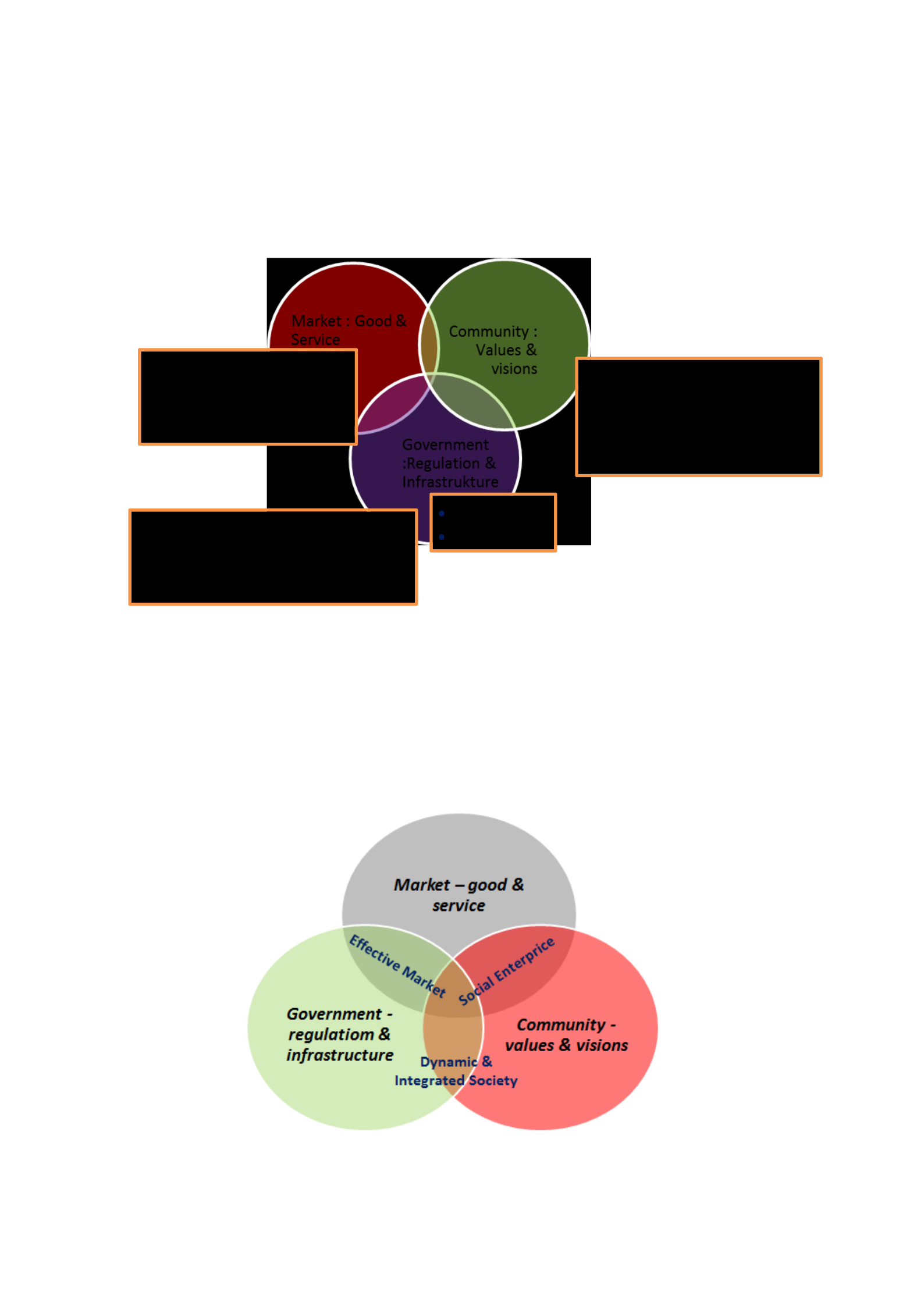
Time regulation:
Short-term Development:
INFRASTRUCTURE (time prime 10
years. MARKET (time prime 6 years)
LEADERSHIP
INNOVATION
In the direction of the
Community: Long term, it can
help and encourage the
community to improve their
quality of life.
The market has "POWER"
and for the Commitment to
be SUSTAINABLE then
Awareness required
One of the strategies for sustainable urban development is that the government as a
development manager must have leadership, and innovation. The development program has
the concept of short term and long term development, both concepts support each other in
order to achieve a vision of sustainable urban development.
Sustainable Urban Development Strategy
One example of an innovative leader is being able to make sustainable city breakthroughs
such as Cities with Solar panels, Cities with Smart City, and movements to change the urban
environment to be more environmentally friendly.
Figure 8. Sectoral dimensions that simultaneously produce something that is Integrity

The above principle illustrates a sectoral dimension, namely social, economic, and
environmental, into a development that cooperates with each other to maintain balance, it
will produce an effective market regulation, and social enterprice economic development
with attention to the environment will produce a good social community value as well. The
principle of sustainable development is one example:
Settlement: sustainable urban development recognizes the earth can only
adjust to a more balanced state if settlements "reduce their ecological
footprint" while they "simultaneously" improve their quality of life. In this
case, reducing the "ecological" footprint means reducing the use of materials
and energy that produce excessive CO2), while simultaneously it means
paying attention to providing healthy settlements, providing jobs, and
designing with social communities in mind.
Place-making: sustainability that recognizes the significance and diversity of
communities and regions for earth stewardship (cultured buildings,
landscaping, sculpture, and attention to biodiversity for future generations).
Net-Benefit: Sustainability that addresses the extraction of non-renewable
resources, providing net environmental social and economic benefits for
future generations. Reduce the impact and maintain the environmental
sustainability of irresponsible agencies.
The principles and enforcement of sustainable cities are expected to pay more attention to
humanity, more humane. Returning to the essence of the city itself is formed from human
needs. The relationship between the city, formed from humans and the environment, related
to the city is a system that cannot be separated from spatial planning, why because cities are
formed as a result of natural processes and social processes, human activities as creatures
that utilize natural resources also have tendencies that are patterned and spatially structured.
According to Rustiadi, et al (2011), human spatial instincts are natural and the result of long
"learning" experiences, so that they get typical spatial patterns, for example in the layout of
residential houses, public spaces (gathering places), yards, fields, rice fields, and so on. The
regularity of the spatial configuration of the community's socio-economic activities or
patterns of space utilization are always found in every community's economy or patterns of
space utilization are always found in every community's life in maintaining its life, adjusting
to the environment, optimizing efforts to utilize natural resources, optimizing social

interactions, as well as forms of cultural expression. The interaction between humans and
the environment requires humans to provide various infrastructure to facilitate access and
manage these resources.
The philosophy of sustainable urban planning is to meet the needs of society, the needs of
generations, and the needs of the economy, which is socially just where the goal is to
prevent unwanted changes, create balance and sustainable development. The beginning of
the process of sustainable urban planning starts with the need to make changes for the better
(welfare, natural disasters, social development, etc.).
Some Countries That Implement Sustainable Urban Development
Learning from other countries, about how to build a vision of a sustainable city and how to
implement it, certainly adds insight into managing a city, even though the cases and
problems are different. Consistency to build a sustainable city vision starts from the
creativity of a leader and building awareness of its citizens. The following is an explanation
of the table below:
Table 3. Countries in the Vision of a Sustainable City

STATE
CITY DESCRIPTION
Singapore
As a small and densely populated island nation with no natural resources,
Singapore's own sustainable development experience has focused on four
key areas, namely, (1) Building a sustainable economy; (2) creating a
sustainable living environment; (3) ensuring sustainable development for
our people; and (4) contributing to international collaboration.
•
Singapore is the 20th most carbon-efficient country in the world
•
Integrated transportation, MRT, BUS., pedestrian way
•
Since the 1970s, economic development has helped lift billions of people
out of poverty. Social indices of human development such as health and
education have improved significantly.
•
Despite not having natural resources, Singapore manages its human
resources more carefully.
•
Singapore plans to introduce a carbon tax from 2019, so those who emit
the most carbon will bear the cost to our environment and be encouraged to
reduce their emissions.
•
Give prizes to residents whose houses are energy efficient, tax discounts
•
A generation of pioneers, with a vision for a clean, green and sustainable
Singapore for all Singaporeans. Instilling the awareness that this little
island is all we have, and we must take good care of it.
•
Over the past 50 years, saw major improvements in housing, water, public
health and sanitation. Provides a City in Parks with about 47 percent green
cover in Singapore. More than 80 percent of households are within a 10-
minute walk of a park.
•
It has 72 hectares of green roof gardens and walls today, and aims to
double that by 2030.

Curitiba,
Brazil
•
Curitiba, is the world's first sustainable city. In 1971, architect Jaime
Lerner was elected mayor for the first of three terms, and came up with
innovative and creative solutions that saw Curitiba undergo a remarkable
evolution.
•
The greenest city, with more than 50 M2 of green space per capita, much
more than the UN recommendation. The reason why there is so much green
space is that Lerner had to find a solution to the frequent flooding that
occurred due to the geographical position of the city, so Lerner created a
large green belt around the city, which has turned into a large habitat for
many plants and animals. These large green areas are maintained by sheep
and goats and the wool they produce is sold to finance social development
in the city.
•
About 60% of people rely on the bus network in the city, efficiency for the
light rail system with dedicated lanes.
•
The city of Curitiba is a wonderful example of what creative leaders dare
and do, to make a city truly serve its residents rather than create stress,
congestion and inequality among its residents.
•
Implement a simple Bus transportation system, by dividing 5 arterial traffic
roads.
•
There are 28 parks and forest areas in Curitiba, creating an urban landscape
unlike any other developing city. The city's parks are designed to be
connected rather than isolated to maximize usage. The park was designed
by Hitoshi Nakamura.
•
The parks also stop squatters from creating shanty towns in flood-prone
zones.
•
Curitiba has 4 times the recommended green space, using sheep to "mow"
some of the grass in the parks.
By examining two countries, namely: Singapore and Curitiba, it is expected to increase
knowledge about "sustainable cities", where sustainable development focuses on human
resources, social justice, creating spatial equality.

Conclusions
Based on the sources of sustainable city references, it can be concluded that a sustainable
city is a city that is able to meet the NEEDS of the present without ignoring the NEEDS of
future GENERATIONS, how to REPAIR ENVIRONMENTAL DAMAGE without
sacrificing the NEEDS of ECONOMIC DEVELOPMENT and SOCIAL JUSTICE.
Building a sustainable city also takes into account 4 dimensions, namely SOCIAL
DIMENSION, ECONOMIC DIMENSION, ENVIRONMENTAL DIMENSION, and
GOVERNMENT DIMENSION. These four things Side by side, the success of sustainable
development does not only depend on the economic dimension but needs the intervention of
the power holder or in this case the government dimension, in order to implement
sustainable development so as to achieve equitable distribution of welfare. Therefore,
sustainable development is oriented towards the development of Green Cities that have a
good quality of life and conducive environmental conditions.

