


Workplace Success
Have you ever received a write-up at work for something you said to your boss? Or have you
ever posted an image or statement on the internet that you wish you could take back? Do you
know what steps to take to earn a promotion at work?
Career Development and Growth
What exactly is career development? It’s a lifelong process in which we become aware of,
interested in, knowledgeable about, and skilled in a career. It’s a key part of human
development as our identity forms and our life unfolds. Below you will learn about the various
stages you will go through as your career develops.
Stages of Career Development
There are five main stages of career development (Super & Jordaan, 1973; Kosine & Lewis,
2008). Each stage correlates with attitudes, behaviors, and relationships we all tend to have at
that point and age. As we progress through each stage and reach the milestones identified, we
prepare to move on to the next one.
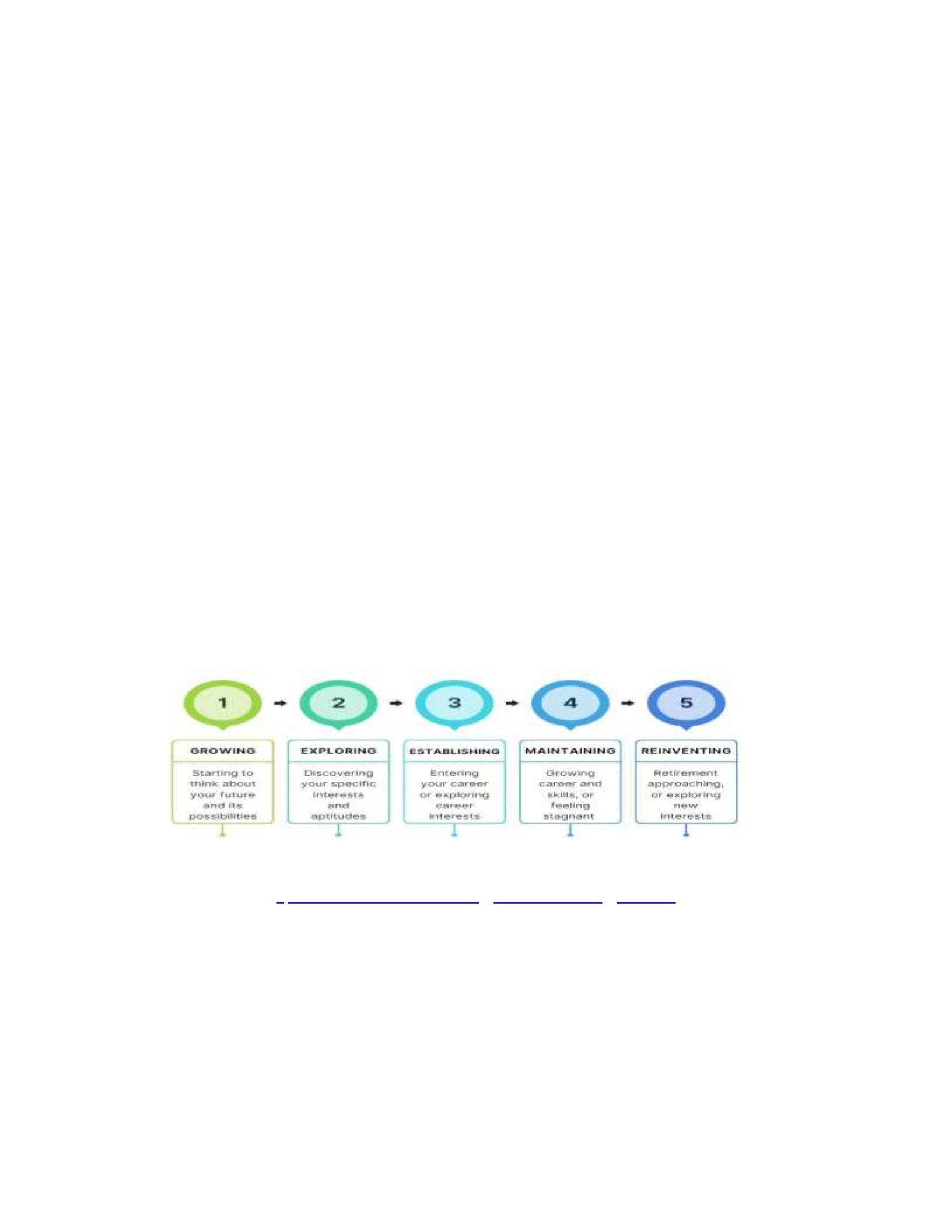
Throughout our lives we go through different stages that influence our careers.
5 Stages of Career Development – Stevy.Scarbrough – CC BY 4.0
Growing
This is a time in early years (4–13 years old) when you begin to have a sense about the future.
You begin to realize that your participation in the world is related to being able to do certain
tasks and accomplish certain goals.

Exploring
This period begins when you are a teenager, extends into your mid-twenties, and may extend
later. In this stage you find that you have specific interests and aptitudes. You are aware of your
inclinations to perform and learn about some subjects more than others. You may try out jobs
in your community or at your school. You may begin to explore a specific career. At this stage,
you have some detailed “data points” about careers, which will guide you in certain directions.
Establishing
This period covers your mid-twenties through mid-forties. By now you are selecting or entering
a field you consider suitable, and you are exploring job opportunities that will be stable. You are
also looking for upward growth, so you may be thinking about an advanced degree.
Maintaining
This stage is typical for people in their mid-forties to mid-sixties. You may be in an upward
pattern of learning new skills and staying engaged. But you might also be merely “coasting and
cruising” or even feeling stagnant. You may be taking stock of what you’ve accomplished and
where you still want to go.
Reinventing
In your mid-sixties, you are likely transitioning into retirement. But retirement in our
technologically advanced world can be just the beginning of a new career or pursuit—a time
when you can reinvent yourself. There are many new interests to pursue, including teaching
others what you’ve learned, volunteering, starting online businesses, consulting, etc.
Keep in mind that your career development path is personal to you, and you may not fit neatly
into the categories described above. It’s more common than it has been in the past for people
to change careers in their thirties, forties, fifties, and even sixties. Perhaps your socioeconomic
background changes how you fit into the schema. Perhaps your physical and mental abilities
affect how you define the idea of a “career.” Chance is a factor that plays into everyone’s career
path in a way that can’t be predicted or anticipated. You are unique, and your career path can
only be developed by you.
Career Development Resources
Career experts say that people will change careers (not to mention jobs) five to seven times in a
lifetime. So, your career will likely not be a straight and narrow path. Be sure to set goals and
assess your interests, skills and values often. Seek opportunities for career growth and
enrichment. And take advantage of the rich set of resources available to you. Below are just a
few.

Whether you are a prospective student, a current student, a graduate, or even an employer, you
can obtain invaluable career development assistance at your college or university. Campus
career centers can support, guide, and empower you in every step of the career development
process, from initial planning to achieving lifelong career satisfaction.
Going to college is one of the best steps you can take to prepare for a career. But soon-tobe or
recently graduated students are not necessarily guaranteed jobs. Staying educated about
strategies for developing your career and finding new jobs will help you manage ongoing
transitions. The book The Secret to Getting a Job After College: Marketing Tactics to Turn
Degrees into Dollars by Larry Chiagouris was written specifically to help recent grads increase
their chances of finding a job right after college. This book speaks to students in all majors and
provides tips and tactics to attract the attention of an employer and successfully compete with
other candidates to get the job you want.
Career Roadmap
You can use the Career Roadmap, from DePaul University, to evaluate where you are and where
you want to be in your career/careers. This roadmap can help you decide if you want to change
career paths and can guide you in searching for a new job. The road map identifies the following
four cyclical steps:
1. Know yourself.
2. Explore and choose options.
3. Gain knowledge and experience.
4. Put it all together: the job search process.
Plan, Do, Check, Act
PDCA (plan–do–check–act) is a four-step strategy for carrying out change. You can use it to
evaluate where you are in the career development process and to identify your next steps. The
strategy is typically used in the business arena as a framework for improving processes and
services. But you can think of your career as a personal product you are offering or selling.
A diagram showing the PDCA Cycle – Diagram by Karn G. Bulsuk (http://www.bulsuk.com) – CC BY 3.0 Unported

1. PLAN: What are your goals and objectives? What process will you use to get to your
targets? You might want to plan smaller to begin with and test out possible effects. For
instance, if you are thinking of getting into a certain career, you might plan to try it out
first as an intern or volunteer or on a part-time basis. When you start on a small scale,
you can test possible outcomes.
2. DO: Implement your plan. Sell your product—which is YOU and your skills, talents,
energy, and enthusiasm. Collect data as you go along; you will need it for charting and
analyzing in the Check and Act steps ahead.
3. CHECK: Look at your results so far. Are you happy with your job or wherever you are in
the career development process? How is your actual accomplishment measuring up next
to your intentions and wishes? Look for where you may have deviated in your intended
steps. For example, did you take a job in another city when your initial plans were for
working closer to friends and family? What are the pros and cons? If you like, create a
chart that shows you all the factors. With a chart, it will be easier to see trends over
several PDCA cycles.
4. ACT: How should you act going forward? What changes in planning, doing, and checking
do you want to take? The PDCA framework is an ongoing process. Keep planning, doing,
checking, and acting. The goal is continuous improvement.
Career Skills
Employers want individuals who have the necessary hard and soft skills to do the job well and
adapt to changes in the workplace. Soft skills may be especially in demand today because
employers are generally equipped to train new employees in a hard skill, such as new computer
software, but it’s much more difficult to teach an employee a soft skill such as developing
rapport with coworkers or knowing how to manage conflict.
Hard Skills
Hard skills are concrete or objective abilities that you learn and perhaps have mastered. They
are skills you can easily quantify, like using a computer, speaking a foreign language, or
operating a machine. You might earn a certificate, a college degree, or other credentials that
attest to your hard-skill competencies. Obviously, because of changes in technology, the hard
skills required by industries today are vastly different from those required centuries ago.
Knowing how to use the computer is a valuable hard skill in today’s technology-driven world. Woman Using
Computer – StartupStockPhotos – Pixabay License
Soft Skills
Soft skills, on the other hand, are subjective skills that have changed very little over time. Such
skills might pertain to the way you relate to people; the way you think; or the ways in which you
behave—for example, listening attentively, working well in groups, and speaking clearly. Soft
skills are sometimes also called transferable skills because you can easily transfer them from job
to job or profession to profession without much training.
These skills are transferable because they are positive attributes that are invaluable in
practically any kind of work. They also do not require much training from an employer— you
have them already and take them with you wherever you go. Soft skills are a big part of your
“total me” package.
So, identify the soft skills that show you off the best, and identify the ones that prospective
employers are looking for. By comparing both sets, you can more directly gear your job search
to your strongest professional qualities.
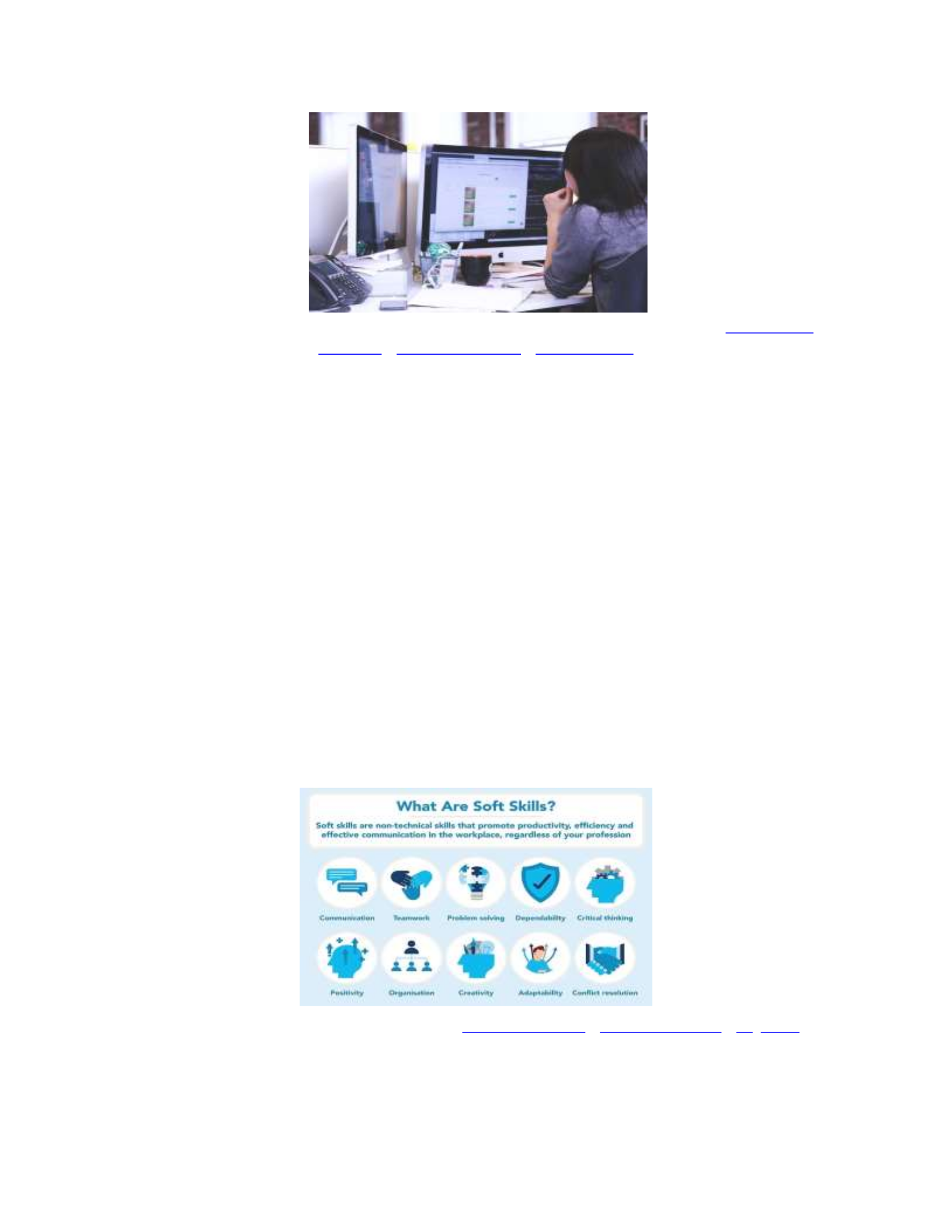
The Top 10 Soft Skills employers are looking for. Soft Skills Summary – Digits.co.uk Images – CC BY 2.0

Networking
In the context of career development, networking is the process by which people build
relationships with one another for the purpose of helping one another achieve professional
goals. Networking involves the exchange information with others. For example:
• You may share business cards, résumés, cover letters, job-seeking strategies, leads about
open jobs, information about companies and organizations, and information about a
specific field.
• You might also share information about meet-up groups, conferences, special events,
technology tools, and social media.
• You might also solicit job “headhunters,” career counselors, career centers, career
coaches, an alumni association, family members, friends, acquaintances, and vendors.
Networking can occur anywhere and at any time. In fact, your network expands with each new
relationship you establish. And the networking strategies you can employ are nearly limitless.
With imagination and ingenuity, your networking can be highly successful.
Networking with other people can lead to establishing connections to more contacts. 3D Social Networking – Chris
Potter – CC BY 2.0
Strategies for Networking
We live in a social world. Almost everywhere you go and anything you do professionally involves
connecting with people. It stands to reason that finding a new job and advancing your career
entails building relationships with these people. The challenge is figuring out how to do it. What
is your first step? Whom do you contact? What do you say? How long will it take? Where do you
concentrate efforts? How do you know if your investments will pay off?
The following strategies can be useful tools for networking:
1. Create an action plan and use it to think through your career goals and the steps you
need to take to meet them. Use the information you learned in Chapter 3 to help you
create your action plan.

2. Think of your network holistically. You probably know people who can help. Identify
those you know personally, academically, and professionally. Let the people in your
network know what you are trying to achieve.
3. Attend as many events as you can. Put yourself into new situations and become
comfortable talking about your career goals and interests.
4. Create a professional social media profile. Employers are using LinkedIn and other sites
like Indeed to find and screen candidates.
Strategies at College
• Get to know your professors: Communicating with instructors is a valuable way to learn
about a career and also get letters of reference if and when needed for a job. When you
learn in a virtual environment, it is important to be communicative to build relationships
and be memorable. Your instructor can’t provide you with an academic reference if they
don’t remember you. Connecting with your instructors might provide you with leads on
job openings, internships, or research possibilities. Get to know your instructors. They
are a valuable part of your network.
• Network with alumni: Attend alumni events to find people working in your desired
field. Search for alums on LinkedIn – they might be willing to do an informational
interview or help you in some other way. It is easier to network with people that you
share something in common with.
• Network with your learning colleagues: Classmates are an excellent source of
information and connections. Many of them may already be working in your desired
field.
• Volunteer: Volunteering is an excellent way to meet new people who can help you
develop your career, even if the organization you are volunteering with is not in your
field. Just by working alongside others and working toward common goals, you build
relationships that may later serve you in unforeseen and helpful ways.
• Get an internship: Many organizations offer internship positions to college students.
Some of these positions are paid, but often they are not. Paid or not, you gain
experience relevant to your career, and you potentially make many new contacts.
• Conduct informational interviews: You may initiate contact with people in your chosen
field who can tell you about their experiences of entering the field and thriving in it.
Many websites have guidance on how to plan and conduct these interviews.
Strategies at Work
• Join professional organizations: You can meet many influential people at local and
national meetings and events of professional and volunteer organizations. Learn about
these organizations. See if they have membership discounts for students, or student

chapters. Once you are a member, you may have access to membership lists, which can
give you prospective access to many new people to network with. Following professional
organizations on LinkedIn or other social media allows you to see their content and keep
abreast of emerging trends and best practices.
• Get a part-time job: Working full-time may be your ultimate goal, but you may want to
fill in some cracks or crevices by working in a part-time job. Invariably you will meet
people who can feasibly help with your networking goals. And you can gain good
experience along the way, which can also be noted on your résumé. Talk to Career
Services to learn more about the possibilities.
• Attend networking events: There are innumerable professional networking events
taking place around the world and also online. Find them listed in magazines,
community calendars, newspapers, journals, and at the websites of companies,
organizations, and associations.
Strategies at Home and Beyond
• Get comfortable and participate in online social media: An explosion of career
opportunity awaits you with social media, including LinkedIn, Twitter, Facebook,
Instagram, and many more. You will find an extensive list of suggested sites at
CareerOneStop. Keep your communication professional at these sites. Follow the
guidelines for communication found in the previous section of this chapter. Peruse
magazine articles, and if you find one that’s relevant to your field and it contains names
of professionals, you can reach out to them to learn more and get job leads. Realize that
social media is public and posting pictures of yourself at parties or commenting in an
unbecoming way could cost you an opportunity.
• Ask family members and friends, coworkers, and acquaintances for referrals: Do they
know others who might help you? You can start with the question “Who else should I be
talking to?”
• Use business cards or networking cards: A printed business card can be an essential tool
to help your contacts remember you. Creativity can help in this regard, too. Students
often design cards themselves and either hand print them or print them on a home
printer.
The bottom line with developing professional networks is to cull information from as many
sources as possible and use that information in creative ways to advance your career
opportunities.

Career Growth
Once you have found a career that interests you and have started on that path, your focus
should familiarize yourself with planning strategies used by people who want to further their
careers. Each of these involves and requires emotional intelligence skills that you learned about
in chapter 5 and throughout the book. Having emotional intelligence skills, as you may recall, is
even more important than having a high IQ in the workplace
(Goleman, 2005). Knowing yourself and your ability to manage your actions and behaviors is
necessary to achieve career success.
Getting Promoted
How to get promoted must be one of the questions managers are asked the most. Often
earning a promotion or movement into a higher level is dependent on not only one’s skills and
abilities but also certain behaviours. According to Siang (2006) there are several characteristics
people have that can help them earn a promotion, and these areas fall into one of three
categories; plan, attitude, and action: Plan
1. Perform self-analysis. Examining your strengths and weaknesses can help you to
improve your work to prepare for a promotion.
2. Keep your eye on the goals. What are your work goals? What do you need to do to
accomplish them? Developing S.M.A.R.T. goals and an action plan for each goal will help
you to achieve them.
Attitude
3. Be proud of your work. Put in the necessary effort to complete your work at the highest
levels and be proud of what you accomplish.
4. Develop your knowledge, skills, and abilities. Do what needs to be done to acquire
skills. Take seminars and workshops and attend conferences. Make sure you continually
update your skills.
5. View challenges as opportunities for growth. Avoid complaining and look at things to
overcome as ways to improve your skills but also to show others you are capable of
solving problems.
Action
6. Understand your role in helping the organization achieve goals. Be a team player to
understand what you must do to help the rest of the department and organization
achieve.
7. Do your best. Take initiative. Look at how you can solve problems or contribute new
ideas. But don’t over-extend yourself!

8. Go the extra mile. Take the initiative to aid with work or problems that you know how to
or think you can solve.
9. Do work from the next level up. Continue to do your own work, but try to take on
assignments that may be “above your pay grade” or above your normal expected
workload. This shows you are capable of the position you want.
Besides understanding the skills, attitudes, and abilities needed for promotion, learning how to
handle change is a great way to earn a promotion and obtain career success.
Professionalism
What is professionalism? A profession is an occupation that involves mastery of complex
knowledge and skills through prolonged training, education, or practical experience. Becoming
a member of a specific profession doesn’t happen overnight. Whether you seek to be a public
relations expert, lawyer, doctor, teacher, welder, electrician, and so on, each profession involves
that interested parties invest themselves in learning to become a professional or a member of a
profession who earns their living through specified expert activity. It’s much easier to define the
terms “profession” and “professional” than it is to define the term “professionalism” because
each profession will have its take on what it means to be a professional within a given field.
According to the United States Department of Labor (2012) professionalism isn’t one thing: it’s a
combination of qualities. A professional employee arrives on time for work and manages time
effectively. Professional workers take responsibility for their own behavior and work effectively
with others. High quality work standards, honesty, and integrity are also part of the package.
Professional employees look clean and neat and dress appropriately for the job. Communicating
effectively and appropriately for the workplace is also an essential part of professionalism.
As you can see here, professionalism isn’t a single “thing” that can be labeled. Instead,
professionalism involves the aims and behaviors that demonstrate an individual’s level of
competence expected by a professional within a given profession. By the word “aims,” we mean
that someone who exhibits professionalism is guided by a set of goals in a professional setting.
Whether the aim is to complete a project on time or help ensure higher quarterly incomes for
their organization, professionalism involves striving to help one’s organization achieve specific
goals. By “behaviors,” we mean specific ways of acting and communicating within an
organizational environment. Some common behaviors can include acting ethically, respecting
others, collaborating effectively, and taking personal/professional responsibility. Let’s look at
each of these separately.

Ethics
The word “ethics” actually is derived from the Greek word ethos, which means the nature or
disposition of a culture (Oxford English Dictionary, 1963). From this perspective, ethics then
involves the moral center of a culture that governs behavior. Without getting too deep, let’s just
say that philosophers debate the very nature of ethics, and they have described a wide range of
different philosophical perspectives on what constitutes ethics. For our purposes, ethics is the
judgmental attachment to whether something is good, right, or just.
Every year there are lapses in ethical judgment by organizations and organizational members.
For example, the head of the Environmental Protection Agency (EPA), Scott Pruitt, committed
many ethical lapses during his tenure with the agency prompting his resignation. Some of the
ethical lapses included ordering raises for two aides even when the White House rejected them,
spending $3.5 million (twice times as much as his predecessor) on taxpayer-funded security,
using that security to pick up his favorite moisturizing lotion and dry-cleaning, renting a room
from a lobbyist who had dealings with the EPA for $50 per night, installing a $43,000 private
phone booth in his office that allegedly was used once, spending $124,000 on first-class flights,
purchasing two seasonticket seats to a University of Kentucky basketball game from a billionaire
coal executive, tried to use his position to get his wife a Chick-fil-A franchise, and others. Sadly,
these ethical lapses are still frequent in corporate America, and they often come with huge
lawsuit settlements and/or jail time.
In the business world, we often talk about business ethics, which involves things like not
stealing from a company; not lying to one’s boss, coworkers, or customers/clients; not taking
bribes, payoffs, or kickbacks; taking credit for someone else’s work; abusing and belittling
someone in the workplace; or simply letting other people get away with unethical behavior. For
example, if you know your organization has a zero-tolerance policy for workplace discrimination
and you know that one supervisor is purposefully not hiring pregnant women because “they’ll
just be leaving on maternity leave soon anyway,” then you are just as responsible as that
supervisor. We might also add, that discriminating against someone who is pregnant or can get
pregnant is also a violation of Equal Employment Opportunity law, so you can see that often the
line between ethics and rules (or laws) can be blurred.
From a communication perspective, there are also ethical issues that you should be aware of.
Redding (1996) broke down unethical organizational communication into six specific categories;
coercive, destructive, deceptive, intrusive, secretive, manipulative/exploitative.
Respect for Others
Our second category related to professionalism is respecting others. From workplace bullying to
sexual harassment, many people simply do not always treat people with dignity and respect in
the workplace. So, what do we mean by treating someone with respect? There are a lot of

behaviors one can engage in that are respectful if you’re interacting with a coworker or
interacting with leaders or followers. Here’s a list we created of respectful behaviors for
workplace interactions:
• Be courteous, polite, and kind to everyone.
• Do not criticize or nitpick at little inconsequential things.
• Do not engage in patronizing or demeaning behaviors.
• Don’t engage in physically hostile body language.
• Don’t roll your eyes when your coworkers are talking.
• Don’t use an aggressive tone of voice when talking with coworkers.
• Encourage coworkers to express opinions and ideas.
• Encourage your coworkers to demonstrate respect to each other as well.
• Listen to your coworkers openly without expressing judgment before they’ve finished
speaking.
• Listen to your coworkers without cutting them off or speaking over them.
• Make sure you treat all of your coworkers fairly and equally.
• Make sure your facial expressions are appropriate and not aggressive.
• Never engage in verbally aggressive behavior: insults, name-calling, rumor mongering,
disparaging, and putting people or their ideas down.
• Praise your coworkers more often than you criticize them. Point out when they’re doing
great things, not just when they’re doing “wrong” things.
• Provide an equal opportunity for all coworkers to provide insight and input during
meetings.
• Treat people the same regardless of age, gender, race, religion, sex, sexual orientation,
etc.…
• When expressing judgment, focus on criticizing ideas, and not the person.
Personal Responsibility
Personal responsibility refers to an individual’s willingness to be accountable for what they feel,
think, and behave. Whether we’re talking about our attitudes, our thought processes, or
physical/communicative behaviors, personal responsibility is simply realizing that we are in the
driver’s seat and not blaming others for our current circumstances. Now, this is not to say that
there are never external factors that impede our success. Of course, there are. This is not to say
that certain people have a leg-up on life because of a privileged background, of course, some
people have. However, personal responsibility involves differentiating between those things we
can control and those things that are outside of our control. For example, you may not be able
to control a coworker who decides to yell at you, but you can control how you feel about that
coworker, how you think about that coworker, and how you choose to respond to that

coworker. Here are some ways that you can take personal responsibility in your own life (or in
the workplace):
• Acknowledge that you are responsible for your choices in the workplace.
• Acknowledge that you are responsible for how you feel at work.
• Acknowledge that you are responsible for your behaviors at work.
• Accept that your choices are yours alone, so you can’t blame someone else for them.
• Accept that your sense of self-efficacy and self-esteem are yours.
• Accept that you can control your stress and feelings of burnout.
• Decide to invest in your self-improvement.
• Decide to take control of your attitudes, thoughts, and behaviors.
• Decide on specific professional goals and make an effort and commitment to accomplish
those goals.
Although you may have the ability to take responsibility for your feelings, thoughts, and
behaviors, not everyone in the workplace will do the same. Most of us will come in contact with
coworkers who do not take personal responsibility. Dealing with coworkers who have a million
and one excuses can be frustrating and demoralizing.
Excuse-making occurs any time an individual attempts to shift the blame for an individual’s
behavior from reasons more central to the individual to sources outside of their control in the
attempt to make themselves look better and more in control (Snyder & Higgins, 1988). For
example, an individual may explain their tardiness to work by talking about how horrible the
traffic was on the way to work instead of admitting that they slept in late and left the house
late. People make excuses because they fear that revealing the truth would make them look bad
or out of control. In this example, waking up late and leaving the house late is the fault of the
individual, but they blame the traffic to make themself look better and in control even though
they were late.
Excuse-making happens in every facet of life, but excuse-making in the corporate world can be
highly problematic. For example, research has shown that when front-line service providers
engage in excuse-making, they are more likely to lose return customers as a result Hill, Baer, &
Kosenko, 1992). In one study, when salespeople attempted to excuse their lack of ethical
judgment on their customer’s lack of ethics, supervisors tended to punish more severely those
who engaged in excuse-making than those who had not
Bellizzi, & Norvell, (1991). Of course, even an individual’s peers can become a little annoyed by a
colleague who always has a handy excuse for their behavior. For this reason, Nordam (2014)
recommends using the ERROR method when handling a situation where your behavior was
problematic: Empathy, Responsibility, Reason, Offer Reassurance. Here is an example Nordam
uses to illustrate the ERROR method:

I hate that you [burden placed on person] because of me
(Empathy). I should have thought things out better (Responsibility),
but I got caught up in [reason for behavior] (Reason). Next time I’ll
[preventative action] (Offer Reassurance).
As you can see, the critical parts of this response involve validating the other person, taking
responsibility, and providing an explanation for how you’ll behave in the future to avoid similar
problems.
General Etiquette for Career Success
Introductions
An introduction to a person is possibly one of the most important aspects to etiquette. This
nonverbal behavior can send positive or not-so-positive messages to a person with whom you
want to make a good impression. Here are the components to a good handshake and
introduction (Lorenz, 2004):
1. Firm handshake. A firm handshake shows self-confidence. Try not to make it too firm or
too soft. Do not place your hand on top of the other person’s hand while shaking.
2. Web to web. When you shake someone’s hand, put your right hand out and the web of
skin between your thumb and pointer finger should touch the web of the other person.
Try to avoid grabbing someone’s fingers when shaking hands, as this could send a
negative message.
3. Eye contact. As you shake the person’s hand, make direct eye contact. This can be
challenging for some people who grew up in a culture where direct eye contact would be
considered rude. Make sure to smile.
4. Say your name and repeat the other person’s name. As you are making eye contact and
shaking hands, you might say something like, “Hi, my name is Laura Portolese Dias. It is a
pleasure to meet you.” When they say their name, make sure to repeat it, which will
make it easier to remember.
5. Introducing two people. If you know two people and are introducing them, say both
people’s names and try to tell them something they have in common they can discuss.
For example, “Casey, meet Ms. Robins. Both of you went to the University of
Washington-Bothell campus.” This gives them a starting point to begin their
conversation.
Good handshakes and introductions are important, but they also take practice. Often, people
are too worried about the impression they are making to focus on their handshake, eye contact,
and other aspects. The more comfortable you can get with this, the more second nature it will
become and the better your human relations will be.
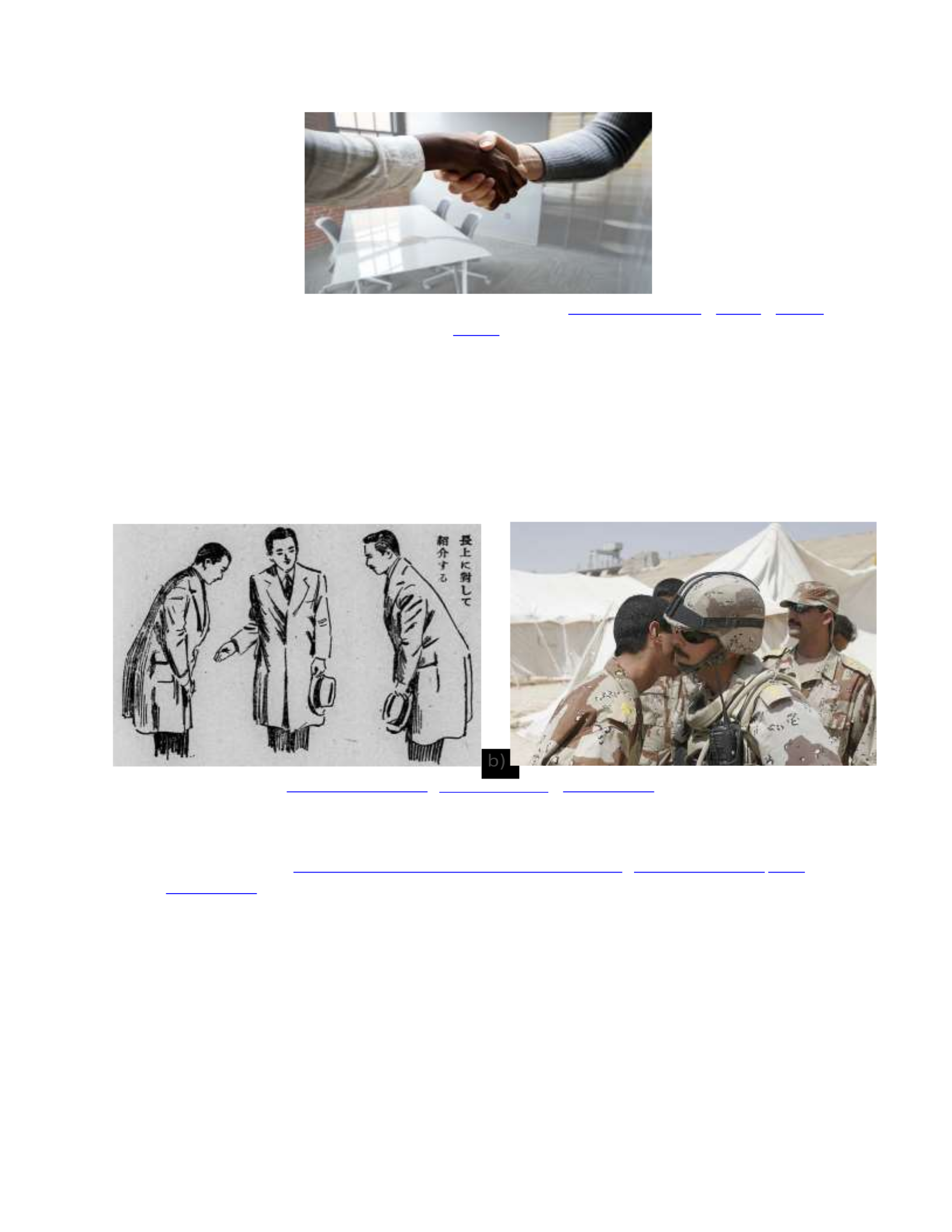
A firm handshake can make a good first impression at a job interview. Handshake Interview – Tumisu – Pixabay
License
While a firm handshake can make a good first impression in most Western Contexts, it is
important to remember that culture also plays a role in how to go about making a good first
impression. When working with teams, clients, or businesses from international contexts,
learning about their customs for introductions can often result in positive working relationships,
or at least start them off on the right track.
a)
a) Greeting in Japan. Handshake Illustration - 国民礼法研究会 – Public Domain
b) Col. Muhammed greets an Iraqi lieutenant. It is common for Iraqis to exchange kisses on the cheek as
a greeting between close friends. An odd number of kisses, usually more than three but fewer than
seven are exchanged. HADITHAH DAM, AL ANBAR, IRAQ (August 13, 2005) - Lance Corporal Marc Fencil
– Public Domain
Clothing
Dress is another consideration with etiquette. Dress will vary greatly from region to region. For
example, in the Seattle area, it is normal for many people to wear jeans to work, while in other
parts of the country, this would be considered inappropriate. When deciding what to wear, it is
always best to be a bit overdressed than underdressed. For job interviews, jeans or shorts
would rarely, if ever, be acceptable. Normally in job interviews, dressing one “step up” from
what people wear at the company is a good rule of thumb.

Showing too much skin or revealing tattoos or facial piercings in some work environments may
prevent upward movement in a company, as it sends the wrong message to your boss, or future
boss. Fair or not, there are many unspoken rules about what is appropriate and what is not. The
best thing to do is to look at what the successful people around you are wearing. For example, if
all of the men in the workplace wear suit jackets and rarely take them off, this is an indicator of
expected workplace dress. If all of the women in the office wear closed toed shoes and leave
the flip flops at home, it might be a good idea for you to do the same as well. Personal style and
individuality are important, but in some professions, it makes sense to err on the side of caution
when choosing a work wardrobe (Sinberg, 2009).
Technology
Another important thing to mention is the use of technology. Although many people use it, the
increased use of technology has actually made people ruder; 9 out of 10 Americans report
they’ve seen others misuse technology and 75 percent agree that mobile etiquette is worse
than it was a year ago (Bruzzese, 2011).
Looking at your phone while talking with someone
is viewed similarly as turning your back to them in
the middle of a conversation. Man Texting –
TheHilaryClark – Pixabay License
Here are some examples of basic etiquette when it comes to technology:
• Don’t look at your phone while talking with someone else.
• Don’t use a phone for calls or texts while at the dinner table.
• Don’t talk loudly on the phone in a public space.
• Avoid letting “text speak” cross over into e-mails (i.e., “IDK” is okay in a text message,
but spell it out, “I don’t know,” in e-mails).

• Try to avoid multitasking with your phone in inappropriate places, such as when in the
restroom.
• When sending e-mails, avoid clogging up peoples’ e-mail boxes with “reply all”
messages.
• Use spell-check for e-mails.
• Try to answer e-mails within twenty-four hours, even if it is to say, “I am not sure about
this but I will get back to you.”
Reputation Management
Many companies pay hundreds, even thousands of dollars every month to monitor and clean up
their online reputations. The process of monitoring your online reputation is called reputation
management. Reputation.com, one of hundreds of firms that specializes in “fixing” online
reputations, has become popular for companies looking to enhance their online image.
Reputation management isn’t just for companies, individuals are using these services to make
unflattering things on the Internet about them disappear (Tozzi, 2008).
Anything posted on the Internet, from a picture on Facebook to a comment on a blog, will be in
cyberspace indefinitely. Consider the case of a New York professor. Eight years earlier, he had
been charged with receiving grant money wrongfully. If you googled his name, you would find a
press release listing this charge as one of his name’s top search results, even though he had
paid the $2,000 fine (Bilton, 2011). Not exactly something he would want a potential or current
employer to see!
This is exactly why it is important in career development to be aware of the kinds of things you
post, whether you are looking for a job or already have a job. For example, thirteen Virgin
Airlines employees were fired for a chat they had on Facebook about the plane’s safety, along
with negative comments about customers (Bloomberg News, 2008). In yet another example, a
job seeker posted the following to Twitter: “Cisco just offered me a job! Now I have to weigh the
utility of a fatty paycheck against the daily commute to San Jose and hating the work.” And
Cisco, who regularly monitors the Internet for mentions of their name (reputation
management), replied, “Who is the hiring manager. I’m sure they would love to know that you
will hate the work. We here at Cisco are versed in the web.” The job offer to this future
employee was rescinded (Popkin, 2009).
Websites that allow for professional networking can be a great tool but can also be detrimental.
For example, a human resource executive posted his resume on LinkedIn and searching for new
career opportunities. He was forced out of his job and then sued his employer for constructive
dismissal (Williams, 2012).
So how exactly can you monitor your online reputation? Here are some tips:

• Google yourself often and see what the search results return.
• Consider changing your privacy settings in Facebook, so people you are not friends with
cannot view your profile.
• Change your Facebook setting so you must approve posts that “tag” you.
• Be aware of your company’s policy on posting resumes on websites like LinkedIn.
• Do not talk about work on Twitter, Facebook, or any other social media site.
• Never mention your company name on social media sites.
Managing your online reputation can make sure that when an employer or potential employer
sees your online persona, they are seeing the side you want them to see. It will show them that
you represent the company in a positive light, which can enhance career success.
Workplace Communication
Oral and written communication proficiencies are consistently ranked in the top ten desirable
skills by employer surveys year after year. In fact, high-powered business executives sometimes
hire consultants to coach them in sharpening their communication skills. According to the
National Association of Colleges and Employers (2009), the following are the top five personal
qualities or skills potential employers seek:
1. Communication skills (verbal and written)
2. Strong work ethic
3. Teamwork skills (works well with others, group communication) 4. Initiative
5. Analytical skills
Knowing this, you can see that one way for you to be successful and increase your promotion
potential is to increase your abilities to speak and write effectively.
Effective communication skills can increase your chance of promotion. Baltimore Jewish Council Meeting –
Maryland GovPics – CC BY 2.0
The College Board (2004) found that writing is related to attaining high-skill, high-wage work.
Not being able to clearly articulate yourself can limit your opportunities for professional,
salaried employment. unable to express themselves clearly in writing limit their opportunities

for professional, salaried employment. An individual with excellent communication skills is an
asset to every organization. No matter what career you plan to pursue, learning to express
yourself professionally in speech and in writing will help you get there. Let’s examine the
various ways communication is used in the workplace today.
Language Use
In the workplace, the type of language and how we use language is essential. PayScale (2016)
surveyed 63,924 managers. The top 3 Hard-Skills managers reported that new college graduates
lack are writing proficiency (44%), public speaking (39%), and data analysis (36%). The top 3 Soft
Skills the managers reported that new college graduates lack are critical thinking/problem-
solving (60%), attention to detail (56%), and communication (46%). One of the most important
factors of professionalism in today’s workplace is effective written and oral communication.
From the moment someone sends in a resume with a cover letter, their language skills are being
evaluated, so knowing how to use both formal language effectively and jargon/specialized
language is paramount for success in the workplace.
Formal Language
Formal language is a specific writing and spoken style that adheres to strict conventions of
grammar. This is in contrast to informal language, which is more common when we speak. In
the workplace, there are reasons why someone would use both formal and informal language.
Formal language is less personal and more professional in tone than informal language. Some
key factors of formal language include complex sentences, use of full words, and the third
person.
Informal language, on the other hand, is more colloquial or common in tone; it contains simple,
direct sentences; uses contractions and abbreviations, and allows for a more personal approach
that includes emotional displays. For people entering the workplace, learning how to navigate
both formal and informal language is very beneficial because different circumstances will call for
both in the workplace. If you’re writing a major report for shareholders, then knowing how to
use formal language is very important. On the other hand, if you’re a PR professional speaking
on behalf of an organization, speaking to the media using formal language could make you (and
your organization) look distant and disconnected, so using informal language can help in this
case.
Use of Jargon/Specialized Language
Every industry is going to be filled with specialized jargon or the specialized or technical
language particular to a specific profession, occupation, or group that is either meaningless or
difficult for outsiders to understand. For example, if you were informed that a “factor analysis
with a varimax rotation” was conducted, you would likely be confused. However, those who

study human communication from a social scientific perspective, would know what that phrase
means because they learned it during their training in graduate school. If you walked into a
hospital and heard an Emergency Department (ED) physician referring to the GOMER in bay 9,
most of you would be equally perplexed. Every job has some jargon, so part of being a
professional is learning the jargon within your industry and peripherally related sectors as well.
For example, if you want to be a pharmaceutical sales representative, learning some of the
jargon of an ED (notice they’re not called ERs anymore). Trust us, watching the old television
show ER isn’t going to help you learn this jargon very well either (Primack, et al., 2012).
Instead, you have to spend time within an organization or field to pick up the necessary jargon.
However, you can start this process while a student by joining student groups associated with
specific fields. If you want to learn the jargon of public relations, join the Public Relations
Student Society of America. If you want to go into training and development, becoming a
student member of the Association for Talent Development.
Want to go into nonprofit work, become a member of the Association for Volunteer
Administration or the Young Nonprofit Professionals Network. If you do not have a student
chapter of one of these groups on your campus, then find a group on LinkedIn or another social
networking site aimed at professionals. One of the great things about modern social networking
is the ability to watch professionals engaging in professional dialogue virtually. By watching the
discussions in LinkedIn groups, you can start to pick up on the major issues of a field and some
of the everyday jargon.
Texting
Text messages and e-mails are part of our communication landscape, and skilled business
communicators consider them a valuable tool to connect. Netiquette refers to etiquette, or
protocols and norms for communication, on the Internet.
Whatever digital device you use, written communication in the form of brief messages, or
texting, has become a common way to connect. It is useful for short exchanges, and is a
convenient way to stay connected with others when talking on the phone would be
cumbersome. Texting is not useful for long or complicated messages, and careful consideration
should be given to the audience.
It is often said that you can tell how old someone is by how he or she inputs a phone number on
a cell phone. If the person uses his or her thumb while holding the digital device, that person
may have been raised on video games and be adept at one-handed interfaces. If he holds the
digital device with one hand and inputs the number with the other, he may be over thirty, or
may be less comfortable with some technological devices. Of course, there is no actual
correlation between input and age, but it is a useful example to use when considering who your
audience is when writing a text message. If the person is a one-hander, and knows all the

abbreviations common to texting, you may be able to use similar codes to communicate
effectively. If the person is a two-hander, you are better off using fewer words and spelling them
out. Texting can be a great tool for connecting while on the go, but consider your audience and
your company, and choose words, terms, or abbreviations that will deliver your message.
Texting is a quick and convenient way to communicate for work purposes. Woman Texting – StockSnap – Pixabay
License
Tips for Effective Business Texting
• Know your recipient. “? % dsct” may be an understandable way to ask a close associate
what the proper discount is to offer a certain customer, but if you are writing a text to
your boss, it might be wiser to write, “what % discount does Murray get on $1K order?”
• Anticipate unintentional misinterpretation. Texting often uses symbols and codes to
represent thoughts, ideas, and emotions. Given the complexity of communication, and
the useful but limited tool of texting, be aware of its limitation and prevent
misinterpretation with brief messages.
• Contacting someone too frequently can border on harassment. Texting is a tool. Use it
when appropriate but don’t abuse it.
• Unplug yourself once in a while. Do you feel constantly connected? Do you feel lost or
“out of it” if you don’t have your cell phone and cannot connect to people, even for
fifteen minutes? Sometimes being unavailable for a time can be healthy, everything in
moderation, including texting.
• Don’t text and drive. Research shows that the likelihood of an accident increases
dramatically if the driver is texting behind the wheel (Houston Chronicle, 2009). Being in
an accident while conducting company business would reflect poorly on your judgment
as well as on your employer.
E-mail
Electronic mail, usually called e-mail, is quite familiar to most students and workers. It may be
used like text, or synchronous chat, and it can be delivered to a cell phone. In business, it has
largely replaced print hard copy letters for external (outside the company) correspondence, as
well as taking the place of memos for internal (within the company) communication (Guffey,
2008). E-mail can be very useful for messages that have slightly more content than a text
message, but it is still best used for brief messages.
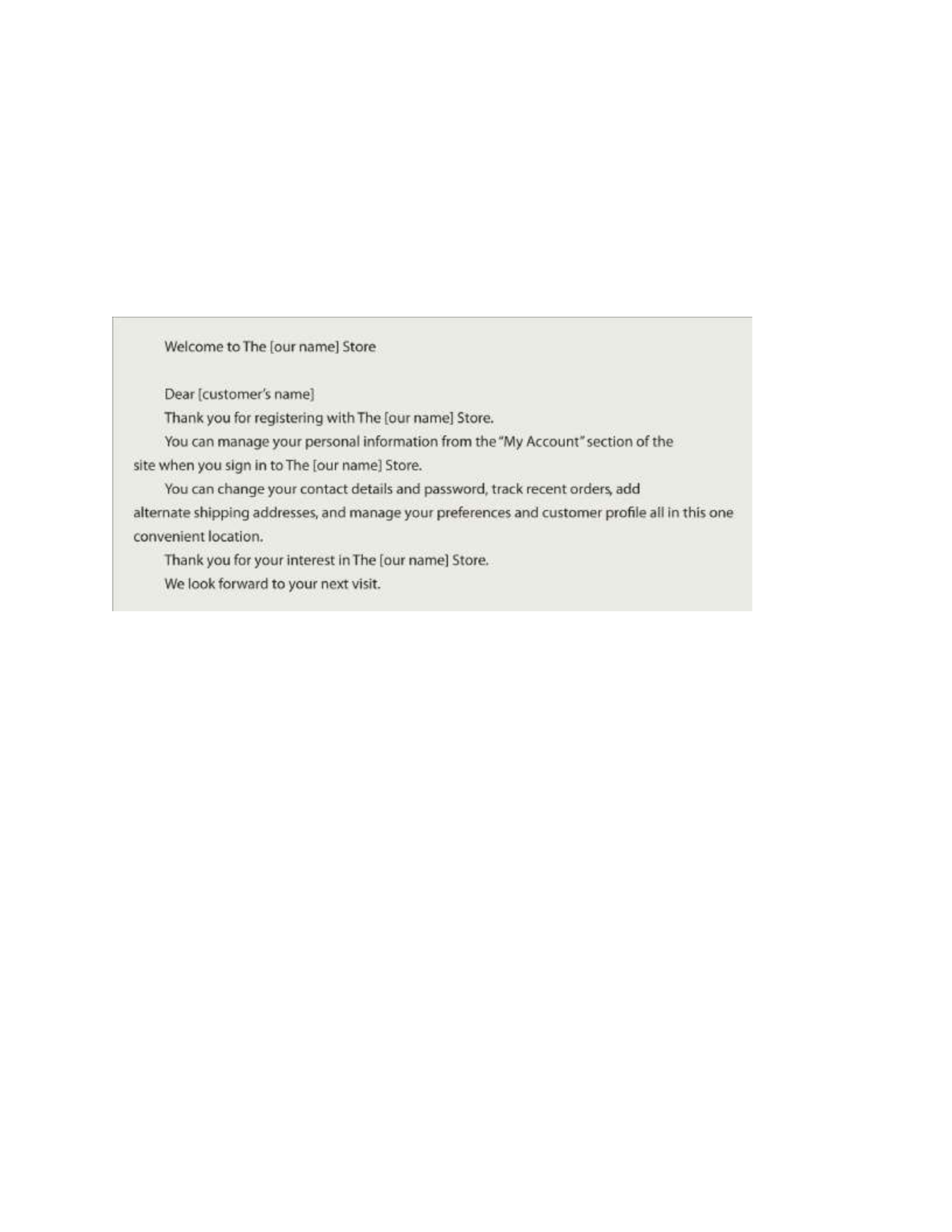
Many businesses use automated e-mails to acknowledge communications from the public, or to
remind associates that periodic reports or payments are due. You may also be assigned to
“populate” a form e-mail in which standard paragraphs are used but you choose from a menu
of sentences to make the wording suitable for a particular transaction.
Automated business email form.
E-mails may be informal in personal contexts, but business communication requires attention to
detail, awareness that your e-mail reflects you and your company, and a professional tone so
that it may be forwarded to any third party if needed. Email often serves to exchange
information within organizations. Although e-mail may have an informal feel, remember that
when used for business, it needs to convey professionalism and respect. Never write or send
anything that you wouldn’t want read in public or in front of your company president.

Business letter written specifically for the situation and audience.
Tips for Effective Business E-mails
• Proper salutations should demonstrate respect and avoid mix-ups in case a message is
accidentally sent to the wrong recipient. For example, use a salutation like “Dear Ms. X”
(external) or “Hi Barry” (internal).
• Subject lines should be clear, brief, and specific. This helps the recipient understand the
essence of the message. For example, “Proposal attached” or “Your question of 10/25.”
• Close with a signature. Identify yourself by creating a signature block that automatically
contains your name and business contact information.
• Avoid abbreviations. An e-mail is not a text message, and the audience may not find your
wit cause to ROTFLOL (roll on the floor laughing out loud).
• Be brief. Omit unnecessary words.

• Use a good format. Include line breaks between sentences or divide your message into
brief paragraphs for ease of reading. A good e-mail should get to the point and conclude
in three small paragraphs or less.
• Reread, revise, and review. Catch and correct spelling and grammar mistakes before you
press “send.” It will take more time and effort to undo the problems caused by a hasty,
poorly written e-mail than to get it right the first time.
• Reply promptly. Watch out for an emotional response—never reply in anger—but make
a habit of replying to all e-mails within twenty-four hours, even if only to say that you
will provide the requested information in forty-eight or seventy-two hours.
• Use “Reply All” sparingly. Do not send your reply to everyone who received the initial e-
mail unless your message absolutely needs to be read by the entire group.
• Avoid using all caps. Capital letters are used on the Internet to communicate emphatic
emotion or yelling and are considered rude.
• Test links. If you include a link, test it to make sure it is complete.
• E-mail ahead of time if you are going to attach large files (audio and visual files are often
quite large) to prevent exceeding the recipient’s mailbox limit or triggering the spam
filter.
• Give feedback or follow up. If you don’t get a response in twenty-four hours, e-mail or
call. Spam filters may have intercepted your message, so your recipient may never have
received it.
Netiquette
We create personal pages, post messages, and interact via mediated technologies as a normal
part of our careers, but how we conduct ourselves can leave a lasting image, literally. The
photograph you posted on your Facebook or Instagram may have been seen by your potential
employer, or that nasty remark in a post may come back to haunt you later. When the Internet
was a new phenomenon, Shea (1994) laid out a series of ground rules for communication online
that continue to serve us today.
Virginia Shea’s Rules of Netiquette
• Remember the human on the other side of the electronic communication.
• Adhere to the same standards of behavior online that you follow in real life.
• Know where you are in cyberspace.
• Respect other people’s time and bandwidth.
• Make yourself look good online.
• Share expert knowledge.
• Keep flame wars under control.
• Respect other people’s privacy.

• Don’t abuse your power.
• Be forgiving of other people’s mistakes.
Her rules speak for themselves and remind us that the golden rule (treat others as you would
like to be treated) is relevant wherever there is human interaction.

